Automating Air-Sensitive Chemistry: Strategies for Safe, Efficient, and Scalable Synthesis
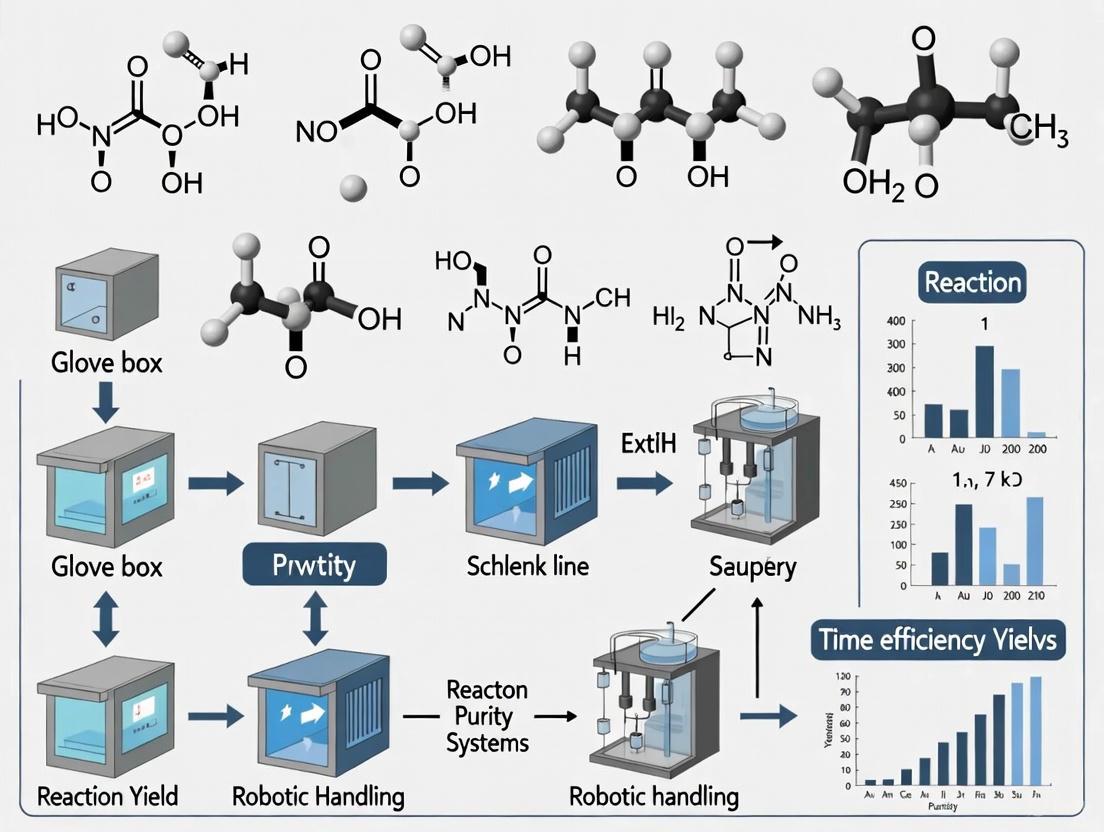
This article provides a comprehensive guide for researchers and drug development professionals on automating air-sensitive chemical synthesis.
Automating Air-Sensitive Chemistry: Strategies for Safe, Efficient, and Scalable Synthesis
Abstract
This article provides a comprehensive guide for researchers and drug development professionals on automating air-sensitive chemical synthesis. It explores the fundamental challenges of handling oxygen- and moisture-sensitive reactions and details the latest technological solutions, from programmable Schlenk lines and integrated robotic platforms to AI-driven optimization. The content covers practical methodologies for implementation, strategies for troubleshooting common issues, and frameworks for validating automated system performance. By synthesizing foundational knowledge with cutting-edge applications, this resource aims to accelerate the adoption of automation in process chemistry, enabling safer and more efficient development of pharmaceuticals and fine chemicals.
Understanding Air-Sensitive Chemistry and the Imperative for Automation
Air-sensitive reagents are chemical compounds that react with some constituent of air, most commonly atmospheric oxygen (Oâ‚‚) or water vapor (Hâ‚‚O), although reactions with carbon dioxide (COâ‚‚) or nitrogen (Nâ‚‚) are also possible [1]. These reactions can favor side-reactions, decompose reagents, or cause fires and explosions [2]. The handling of these compounds is critical in various chemical fields, from academic research to industrial drug development. This guide provides a technical foundation for troubleshooting common issues and outlines emerging automated strategies for managing these challenging substances.
Troubleshooting Guides and FAQs
Q1: My air-sensitive reaction failed, yielding no desired product. What are the most likely causes?
- A: The failure is most likely due to contamination from oxygen or moisture, which decomposed your reagents [2].
- Investigate Your Solvent: Ensure you are using extra-dry solvents. Inappropriate handling can cause solvent degradation over time, which is hard to detect but will interfere with experiments [2].
- Check Your Glassware: Confirm that all glassware was thoroughly cleaned and dried before use. Even minor air moisture condensation caused by temperature differences can be enough to cause a fire or decomposition [2].
- Inspect Your Inert Atmosphere: If using a Schlenk line, verify the integrity of the inert gas (Nâ‚‚ or Ar) supply and check that the system is leak-free. A malfunctioning bubbler or leaky tubing can introduce air [3].
Q2: I am new to handling pyrophoric materials like butyllithium. What is the safest way to dispense them?
- A: The safest method involves using specialized packaging and syringes under an inert gas.
- Use Specialized Packaging: Reagents packaged in systems like AcroSeal, which feature a multi-layer septum, limit exposure to the atmosphere [2].
- Follow Safe Dispensing Protocols:
- Use a syringe with an 18- to 21-gauge needle and a dry inert gas like nitrogen or argon.
- Pressurize the bottle by injecting the inert gas before withdrawing the desired amount of liquid.
- Alternatively, use a double-tipped needle—one to withdraw the liquid and the other to add inert gas from a gas line or balloon [2].
- Consider Syringe Material: While some protocols recommend glass syringes, less experienced users may find single-use polypropylene Luer lock syringes easier and safer to handle [2].
Q3: What are the fundamental differences between a Schlenk line and a glovebox, and when should I use each?
- A: The choice depends on the specific requirements of your experiment.
- Schlenk Line: Ideal for reactions performed in solution, as they lend themselves well to cannula and counterflow techniques. They use flexible tubing to connect apparatus and are best for manipulations where easy setup and takedown are needed [3].
- Glovebox: A sealed cabinet filled with an inert gas, allowing you to use normal laboratory equipment inside an isolated environment. This is necessary for handling solids that are extremely sensitive, for long-term storage of sensitive compounds, or for operating equipment that cannot be easily adapted to a Schlenk line [1].
Q4: What are the critical safety practices when working with highly reactive, air-sensitive compounds?
- A: Adherence to strict safety protocols is non-negotiable.
- Never Work Alone: Always have another person present who is familiar with the operation’s hazards and specific emergency procedures [4].
- Use Personal Protective Equipment (PPE): Always wear a lab coat, eye protection, and appropriate chemical-resistant gloves [4].
- Know Emergency Procedures: Be aware of the location of emergency equipment like eyewash stations, safety showers, and fire extinguishers [4].
- Develop a Written SOP: For higher hazard chemicals, a written Standard Operating Procedure (SOP) is an effective tool for communicating hazards, safety precautions, and proper work procedures [4].
Automated Workflows for Quantifying Air-Sensitivity
Traditional handling of air-sensitive compounds is binary—treating them as either "air-sensitive" or "air-stable"—which limits reproducibility and mechanistic understanding. Modern research focuses on digital and automated workflows to quantitatively assess stability [5].
Experimental Protocol: Automated Degradation Profiling with ReactIR
This methodology enables reproducible, high-resolution degradation profiling of air-sensitive compounds [5].
- Workflow Integration: A modular digital workflow integrates an automated liquid handler, a stirring module, and an in-situ ReactIR spectrometer.
- Python Control: The central component is
ReactPyR, a Python package that provides programmable control of the ReactIR platform and seamless integration with the digital laboratory infrastructure [5]. - Sample Preparation: The automated liquid handler dispenses the target compound (e.g., a hexamethyldisilazide salt) and solvent into a sealed reaction vessel under a controlled atmosphere.
- Data Collection: The system exposes the sample to a controlled environment while the ReactIR probe collects real-time spectroscopic data (e.g., infrared spectra) at set intervals.
- Data Analysis: The
ReactPyRworkflow processes the spectral data to identify and quantify degradation products, generating precise degradation profiles and kinetic data that are unfeasible to obtain through conventional methods [5].
The Scientist's Toolkit: Essential Research Reagent Solutions
The following table details key equipment and materials essential for working with air-sensitive reagents.
| Item | Function & Application |
|---|---|
| Schlenk Line | A dual-manifold system (vacuum and inert gas) that allows glassware to be evacuated and refilled with an inert gas for handling air-sensitive compounds [1] [3]. |
| Glovebox | A sealed cabinet filled with an inert gas (Ar or Nâ‚‚) that allows manipulation of highly sensitive materials and equipment in an isolated environment [1]. |
| AcroSeal / Safe Packaging | Specialized packaging with a self-healing septum that allows safe storage and dispensing of air-sensitive liquids via syringe, limiting atmospheric exposure [2]. |
| Schlenk Flasks & Glassware | Specialized glassware with side-arms for connection to a Schlenk line, enabling reactions to be isolated from the atmosphere [3]. |
| Inert Gas (Nâ‚‚ or Ar) | Provides an oxygen- and moisture-free atmosphere. Nitrogen is typically preferred unless compounds react with it, in which case the more expensive argon is used [3]. |
| Uridine triphosphate trisodium salt | Uridine triphosphate trisodium salt, MF:C9H14N2Na3O15P3, MW:552.10 g/mol |
| Dammar-20(21)-en-3,24,25-triol | Dammar-20(21)-en-3,24,25-triol, MF:C30H52O3, MW:460.7 g/mol |
The field of air-sensitive chemistry is evolving from a purely manual, qualitative practice to a quantitative and automated science. By combining foundational techniques like Schlenk lines and safe dispensing methods with emerging digital workflows, researchers can achieve greater reproducibility, safety, and fundamental understanding in their work with these challenging yet essential reagents.
Troubleshooting Guide: Common Issues in Air-Sensitive Chemistry
Q1: My air-sensitive reaction failed or yielded an unexpected product. What are the common causes? Failure in air-sensitive reactions often stems from incomplete oxygen or moisture exclusion. Even minor air exposure can decompose reagents, favor side-reactions, or cause no reaction to occur [2]. Using water-contaminated solvents in air-sensitive reactions is particularly dangerous and can lead to violent outcomes [2]. Check that all glassware is thoroughly clean and dry, as moisture condensation from temperature differences between labware and the environment can be enough to cause a fire [2].
Q2: How can I detect and locate a leak in my glove box? Signs of a glove box leak include a continuous increase in Oâ‚‚ and Hâ‚‚O levels when sealed, the system struggling to maintain pressure, or deflated gloves [6]. To confirm and locate a leak:
- Run an automated leak test if your system has one [6].
- Visually inspect for tears in the gloves or O-ring seals on the antechamber door [6].
- Check that all bolts around the window are sufficiently tight [6].
- Spray the outside of the glove box with soapy water while circulating nitrogen; bubbles will form where gas is escaping [6].
Q3: The Oâ‚‚/Hâ‚‚O levels in my glove box are gradually increasing. What should I check? First, check that the circulation system is functioning [6]. Then, investigate further based on when the increase happens:
- During antechamber use: The issue could be the antechamber door seal [6].
- When you put your hands in the gloves: A hole in the gloves is a likely cause [6].
- During system purging: The inlet tubing or nitrogen source may be compromised [6]. If no leak is found, the oxygen sensor itself may need replacement [6].
Q4: How do I safely isolate a solid, air-sensitive product after a reaction? Common isolation methods under an inert atmosphere include [7]:
- Solvent Removal: Remove solvent under vacuum using a cold trap. To avoid "bumping," which can coat the flask with product, swirl the flask to redissolve splashed material [7].
- Filtration: Use a cannula with a fitted filter or a specialized sintered-glass filter stick to separate solid product from the solution [7].
- Precipitation/Recrystallization: Force the product out of solution by reducing solvent volume, cooling, or adding a solvent in which the product is sparingly soluble (e.g., adding hexane to dichloromethane) [7].
Q5: How can I protect air-sensitive samples when I need to remove them from the glove box for analysis? To protect samples outside an inert environment [6]:
- Encapsulation: For thin films, use UV-curable epoxy with a glass cover slide.
- Sealed Containers: Use screw-lid bottles, glass ampules, or vacuum-sealed bags.
- Short-Term Transfer: For brief exposures, zip-lock bags can offer some protection.
The following table summarizes quantitative data on the sensitivity of a desiccant material (DRIERITE) when exposed to ambient lab conditions versus a controlled glove box environment, demonstrating the critical need for inert environments [8].
| Time on Autosampler (minutes) | Moisture Uptake in Ambient Lab (%) | Moisture Uptake in Glove Box (%) |
|---|---|---|
| 1 | 0.11 | 0.00 |
| 10 | 0.21 | 0.00 |
| 30 | 0.38 | 0.00 |
| 60 | 0.59 | 0.00 |
| 120 | 0.85 | 0.00 |
| 180 | 0.92 | 0.00 |
| 300 | 0.92 | 0.00 |
| 1440 (24 hours) | - | 0.06 |
Experimental Protocol: A single granule of indicating DRIERITE was heated to 150°C to remove moisture, then placed on the autosampler for varying durations. The sample was heated again to 150°C, and the weight gain due to absorbed moisture was measured using TGA. One TGA was in ambient conditions; the other was installed inside a nitrogen-purged glove box [8].
Research Reagent Solutions for Air-Sensitive Chemistry
| Item | Function |
|---|---|
| AcroSeal Packaging | Specialized packaging with a multi-layer septum for safe storage and dispensing of air-sensitive liquids, limiting atmospheric exposure [2]. |
| Schlenk Line | A vacuum/inert gas manifold system for handling compounds that react with Oâ‚‚, water, or COâ‚‚, enabling reactions under an argon or nitrogen atmosphere [7]. |
| Inert-Atmosphere Glove Box | Provides a protective environment against oxygen, water vapor, and other reactive gases for long-term storage and handling of sensitive materials [9]. |
| Extra-Dry Solvents | Solvents with minimal water content to prevent undesired side reactions and hazardous situations when used with air-sensitive reagents [2]. |
| Sintered-Glass Filter Stick | Specialized glassware for filtering solid products under an inert atmosphere without exposure to air [7]. |
Workflow Diagram: Air-Sensitive Product Isolation
The following diagram outlines the logical workflow for isolating an air-sensitive product after a reaction, from assessing stability to choosing the appropriate technique.
Workflow Diagram: Glove Box Leak Diagnostics
This troubleshooting flowchart guides you through the logical steps to diagnose the source of a leak in a glove box system.
FAQs: Core Concepts in Automation and Air-Sensitive Chemistry
Q1: What are the primary advantages of automating air-sensitive chemistry? Automation brings transformative improvements to air-sensitive workflows. Key advantages include enhanced reproducibility by eliminating human error in repetitive tasks, improved safety by minimizing researcher exposure to hazardous materials and conditions, and superior material efficiency through miniaturized and parallelized reactions. Furthermore, it enables the generation of high-quality, consistent data sets essential for machine learning and closed-loop optimization systems [10] [11] [12].
Q2: My research involves pyrophoric organometallic catalysts. Which air-free technique is most suitable? For handling highly reactive, pyrophoric compounds, a glove box is often the most secure option. It provides a continuously maintained inert atmosphere, allowing for open handling, weighing, and manipulation of materials with minimal risk of exposure. While Schlenk lines are excellent for chemical synthesis, a glove box offers a higher security level for straightforward but highly sensitive tasks like decanting or storing these materials [13].
Q3: We are setting up a high-throughput experimentation (HTE) lab. How can we address spatial bias in our microtiter plates? Spatial bias, where reaction outcomes vary between edge and center wells due to uneven temperature or light distribution, is a known challenge in HTE. Mitigation strategies include using specialized MTPs designed for uniform heating and stirring, ensuring proper calibration of irradiation sources for photochemistry, and implementing experimental design (DoE) strategies that randomize condition placement to decouple spatial effects from reaction variables [10].
Q4: What is the difference between automated and autonomous chemistry platforms? Automation involves using robotics to execute pre-defined human-designed procedures with high precision. Autonomy represents a higher level of capability, where the system can independently plan experiments, execute them, analyze results, and—crucially—use that analysis to form new hypotheses and decide what to do next, creating a self-improving loop. Most current platforms are automated, with true autonomy being a key goal for the future [14] [15].
Troubleshooting Guides
Table 1: Troubleshooting Common Issues in Automated Air-Sensitive Chemistry
| Problem Symptom | Potential Cause | Solution Steps | Preventive Measures |
|---|---|---|---|
| Inconsistent yields across a microtiter plate | Spatial temperature gradient, uneven mixing, or evaporation bias [10]. | Verify calibration of heating block and shaker. Use an infrared camera to map plate temperature. Seal plates with chemically inert seals. | Implement randomized experimental design. Use calibrated, high-uniformity equipment. |
| Failed reaction due to suspected oxygen/moisture | Inadequate purging of reaction vessels, leak in gas supply, or compromised glove box atmosphere [3] [13]. | Check system for leaks with a pressure test. Verify inert gas purity and bubbler function. Regenerate glove box antechamber and catalyst. | Establish routine leak-check protocols. Monitor Oâ‚‚/Hâ‚‚O levels in glove boxes continuously. |
| Clogging in automated liquid handling lines | Precipitation of solids, use of viscous solvents, or crystallization in lines [15]. | Flush system with a compatible solvent. Inspect and clean or replace clogged tubing and nozzles. | Pre-filter all solutions. Use temperature control on fluidic paths. Optimize solvent choice for solubility. |
| Poor data quality from in-line LC/MS | Carryover from previous samples, column degradation, or misalignment of autosampler. | Run blank solvent injections. Perform LC/MS system maintenance (column cleaning/replacement). Recalibrate autosampler position. | Implement robust washing cycles between samples. Adhere to a strict instrument maintenance schedule. |
| Robotic arm fails to grip vial | Incorrect vial type/size, misaligned rack, or faulty sensor. | Manually reset the vial and rack. Check and recalibrate the gripper's force and position sensors. | Standardize labware across the platform. Perform regular calibration and sensor checks. |
Detailed Protocol: Establishing an Inert Atmosphere on a Schlenk Line
The Schlenk line is a cornerstone tool for air-sensitive synthesis. This protocol details the proper procedure for rendering a piece of glassware inert.
Principle: The technique of "Evacuate-Refill" (or "Pump-Purge") uses repeated cycles of applying a vacuum to remove the ambient atmosphere and refilling with an inert gas to displace any residual air [3].
Materials:
- Schlenk line connected to a vacuum pump and inert gas (Nâ‚‚ or Ar) supply.
- Cold trap (for solvent vapor protection).
- Schlenk flask or similar glassware with a sidearm.
- Grease for ground-glass joints.
Methodology:
- Preparation: Ensure the cold trap is filled with liquid nitrogen or a dry-ice/acetone mixture. Apply a thin, even layer of vacuum grease to all ground-glass joints to ensure an air-tight seal [3].
- Initial Connection: With the flask's tap open to air, connect it to the Schlenk line via flexible tubing.
- Evacuation: Close the flask's tap. Slowly open the Schlenk line's vacuum tap to evacuate the flask. Hold under vacuum for 15-30 seconds.
- Refilling: Close the vacuum tap and slowly open the inert gas tap to fill the flask with gas.
- Cycling: Repeat the Evacuate-Refill cycle (steps 3-4) at least three times. This ensures the atmospheric gases inside are sufficiently diluted and removed.
- Completion: After the final refill cycle, the flask is under a positive pressure of inert gas. The flask is now ready for the reaction to be set up under this inert atmosphere.
Visual Workflow:
The Scientist's Toolkit: Essential Research Reagent Solutions
Table 2: Key Materials for Automated Air-Sensitive Research
| Item | Function & Application | Key Considerations |
|---|---|---|
| Schlenk Line | Dual-manifold system for performing chemical reactions under inert vacuum or gas atmosphere. Essential for synthesis, cannula transfers, and other manipulations [3] [13]. | Requires a vacuum pump, cold trap, and inert gas supply. Nitrogen is common; argon is used for highly sensitive species. |
| Glove Box | Sealed chamber with an inert atmosphere and attached gloves, allowing for direct, open-vessel manipulation of air-sensitive materials [13]. | Ideal for long-term storage, weighing solids, and operating equipment that fits inside. Requires monitoring of Oâ‚‚/Hâ‚‚O levels. |
| Microtiter Plates (MTPs) | Multi-well plates (e.g., 96 or 384-well) that enable high-throughput experimentation (HTE) by running numerous reactions in parallel [10] [11]. | Material compatibility with organic solvents is critical. Sealing methods must prevent evaporation and contamination. |
| Inert Gas (Nâ‚‚/Ar) | Creates an oxygen- and moisture-free environment. Used to purge reaction vessels, maintain positive pressure in lines, and fill glove boxes [3]. | Gas purity is paramount. Can be passed through drying columns to remove trace Hâ‚‚O/Oâ‚‚. Argon is denser, providing better blanketing. |
| Chemical Description Language (XDL) | A hardware-agnostic programming language for describing chemical synthesis procedures in a standardized, machine-readable format [14] [15]. | Enables reproducibility and sharing of synthetic protocols across different automated platforms. |
| 24,25-Epoxytirucall-7-en-3,23-dione | 24,25-Epoxytirucall-7-en-3,23-dione, MF:C30H46O3, MW:454.7 g/mol | Chemical Reagent |
| endo-BCN CE-Phosphoramidite | endo-BCN CE-Phosphoramidite, MF:C24H40N3O5P, MW:481.6 g/mol | Chemical Reagent |
Advanced Workflow: Integrating AI with Air-Sensitive Automation
The frontier of laboratory automation lies in closing the loop between AI-driven hypothesis generation, robotic execution, and data analysis. This workflow is key to achieving true autonomy.
Visual Workflow:
Methodology:
- AI-Driven Planning: An AI model (e.g., a retrosynthesis algorithm or a Bayesian optimizer) proposes a synthetic target or a set of reaction conditions to test, generating a machine-readable protocol [14] [15].
- Robotic Execution: The automated platform, housed within a glove box or using Schlenk techniques, executes the protocol. This involves precise liquid handling, temperature control, and stirring in an air-free environment [14] [15].
- In-line Analysis: The reaction crude is automatically sampled and analyzed using integrated analytical instruments like LC/MS or NMR. The key challenge is automated structural elucidation and yield quantification without manual intervention [15].
- Data Integration & Learning: The analytical results are processed and fed back to the AI model. This data, rich in procedural detail, is used to refine the model's predictions, creating a self-improving, closed-loop system that accelerates discovery and optimization beyond human-only capabilities [14] [15].
Troubleshooting Guides
Guide 1: Addressing High Residual Moisture Levels
Problem: After purging, your system fails to achieve the required sub-ppm moisture levels.
Check 1: Inert Gas Purity
- Verify the purity specification of your nitrogen or argon gas supply. For sub-ppm work, the gas itself must be of ultra-high purity (e.g., 99.999% or better).
- Install or check the condition of gas purifiers or drying columns in your gas line, as these can become exhausted over time [3].
Check 2: System Leaks
Check 3: Outgassing
- Consider internal outgassing from chamber walls, hoses, or other components. This is a common source of moisture in vacuum systems [16].
- Implement a baking procedure if your system allows it, to accelerate the desorption of water vapor from internal surfaces.
Guide 2: Managing Vacuum Pump Performance Issues
Problem: The vacuum pump fails to reach or maintain the desired base pressure for effective degassing.
Check 1: Pump Oil and Maintenance
- For oil-sealed pumps (e.g., rotary vane pumps), check the condition of the pump oil. Degraded or contaminated oil will significantly reduce pumping efficiency and ultimate vacuum. Change the oil if it appears cloudy or discolored [17].
- Adhere to the manufacturer's recommended service intervals for your specific pump model [17].
Check 2: Cold Trap Operation
- Ensure the cold trap is correctly installed between your vacuum chamber and the pump. The cold trap, typically cooled with liquid nitrogen or a dry-ice/acetone mixture, protects the pump by condensing volatile solvents and water vapor, preventing them from degrading the pump oil [3].
- Verify the cold trap is not blocked with condensed material, which can restrict pumping speed.
Check 3: Process-Related Contamination
- Be aware that handling condensable vapors or reactive gases without a proper cold trap can lead to corrosion, fouling, or hydraulic shock inside the pump, especially in dry screw vacuum pumps [17].
- Maintain proper thermal management of the pump to prevent internal condensation of process vapors [17].
Frequently Asked Questions (FAQs)
Q1: What is the fundamental principle behind using vacuum and inert gas for air-sensitive chemistry?
The core principle is to create a controlled environment isolated from the atmosphere. A vacuum pump removes the bulk of the air (including Oâ‚‚ and Hâ‚‚O), while an inert gas (like Nâ‚‚ or Ar) is used to backfill the system, providing an oxygen- and moisture-free atmosphere for handling sensitive compounds [3]. This two-step process is often repeated in cycles to progressively dilute and remove contaminants.
Q2: How do I choose between nitrogen and argon for my inert atmosphere?
Nitrogen is typically the preferred gas due to its lower cost. However, argon must be used if you are working with compounds that are reactive toward nitrogen [3]. Argon, being denser than air and nitrogen, can also provide a better protective blanket in open configurations like gloveboxes.
Q3: What are the different methods for purging a system?
The three common purging approaches are summarized in the table below.
Table: Comparison of Common Purging Techniques
| Purging Method | Basic Principle | Best For |
|---|---|---|
| Flowing Gas Purge [18] | Continuous flow of inert gas through the system, displacing the existing atmosphere. | Simple geometries without long dead-end branches. |
| Pressurizing-Venting Cycle Purge [18] | System is pressurized with inert gas and then vented; repeated cycles dilute contaminants. | Complex systems, including those with long dead ends (e.g., certain gas cylinders). |
| Vacuum Purging [18] | System is evacuated with a vacuum pump and then backfilled with inert gas. | Systems that can withstand vacuum pressure; often the most efficient method. |
Q4: My Oâ‚‚ sensor readings seem inaccurate. How can I troubleshoot this?
- Perform a Response Test: For a simple functional check, gently blow on the sensor. You should observe a decrease in the oxygen reading, confirming the sensor is responsive [19].
- Check Calibration: Oxygen sensors can drift over time. Perform a two-point calibration using 0% and a known reference point (e.g., 20.9% for air) [19].
- Proper Storage: Always store the Oâ‚‚ sensor in an upright position to maintain its longevity and accuracy [19].
Research Reagent Solutions
Table: Essential Materials for Air-Sensitive Research
| Item | Function |
|---|---|
| Schlenk Line [3] | A dual-manifold vacuum/inert gas system that is the central workstation for handling air-sensitive materials. |
| Inert Gas (Nâ‚‚ or Ar) [3] | Provides an inert atmosphere; supplied from high-purity cylinders or liquid Dewars. |
| Vacuum Pump [3] [17] | Removes air and volatiles from the system. Types include oil-sealed rotary vane pumps (common for Schlenk lines) and dry screw pumps (for clean, oil-free operation). |
| Cold Trap [3] | Fitted between the vacuum line and pump to condense solvents and water vapor, protecting the pump and improving vacuum. |
| Gas Purifier/Drying Column [3] | Installed in the inert gas line to remove residual Oâ‚‚ and Hâ‚‚O, ensuring gas purity is adequate for sub-ppm work. |
| Schlenk Flasks & Tubes [3] | Specialized glassware with side-arms for easy connection to the Schlenk line. |
| High-Vacuum Grease [3] | Used on ground-glass joints and taps to create airtight, reversible seals. |
| Bubbler [3] | Fitted to the inert gas outlet to provide a visible monitor of gas flow and a pressure release for the system. |
Experimental Workflows for System Preparation
Workflow 1: Initial System Evacuation and Purging
This diagram illustrates the logical sequence for preparing a contaminated system for air-sensitive work.
Workflow 2: Leak Testing and System Integrity Verification
This diagram outlines the process for verifying the integrity of a sealed system.
Implementing Automated Platforms: From Schlenk Lines to Integrated AI Systems
Troubleshooting Guides
Schlenk Line and Inert-Atmosphere Reactors
Problem: Poor Vacuum Pressure
Poor vacuum pressure is a primary indicator of a system leak or blockage, easily identified when solvents are not being removed effectively or oil is sucked from the bubbler into the inert gas manifold [20].
- Identification and Resolution Workflow:
- Diagnostic Steps:
- Check for System Leaks: Isolate parts of the Schlenk line to identify the leak source. Individually twist each stopcock to the inert gas line and observe if the manometer reading changes significantly [20].
- Inspect Solvent Trap: A blocked or warm solvent trap can cause poor vacuum. If the trap is blocked by frozen solvents (common with benzene or dioxane), shut down the line, thaw, and empty it. Ensure the trap is topped up with liquid nitrogen [20].
- Evaluate Vacuum Pump: If leaks and blockages are ruled out, the issue may be with the vacuum pump itself, requiring professional maintenance [20].
Problem: Slow or Failed Cannula Transfers
Slow transfers can disrupt the integrity of an inert atmosphere during fluid movement [20].
- Identification and Resolution Workflow:
- Corrective Actions:
- Seal Integrity: Replace leaky rubber septa [20].
- Flow Path: Clean or unblock the cannula and bleed needle [20].
- Pressure and Gravity: Increase the inert gas pressure slightly or raise the transfer flask (or lower the receiving flask) to improve flow [20].
- Filtration Blockages: For cannula filtrations, allow fine solids to settle before filtration and replace the cannula filter. Lower the filter into the suspension slowly to prevent blockages [20].
Problem: Contamination from Sucked-In Materials
Accidentally sucking solids or solvents into the Schlenk line is a common issue [20].
- Immediate Action: Close the stopcock to vacuum immediately to prevent further contamination [20].
- Preventive Measures:
- Use an external trap between the reaction flask and the Schlenk line vacuum manifold [20].
- Attach a hosing adapter with a glass frit for fine solids [20].
- Open the vacuum stopcock slowly and incrementally, especially when drying fine solids or using volatile solvents, and ensure adequate stirring to prevent bumping [20].
Problem: Seized Stoppers and Stopcocks
Ground glass joints can seize under vacuum if inadequately greased or left unused for long periods [20].
- Resolution: Gentle heating with a heat gun can expand the glass and loosen the grease. Always wear appropriate heat-resistant gloves to prevent burns. If unsuccessful, consult a professional glassblower for safe separation [20].
Specialized Glassware
Problem: Poor Cleaning Results in Laboratory Glassware Washers
Residue on cleaned glassware can introduce contaminants into sensitive reactions [21].
- Troubleshooting Steps:
- Cleaning Path: Verify spray arms rotate freely and that nozzles and filters are clean of debris [21].
- Chemicals and Water: Ensure correct detergent type and concentration, and check that water temperature meets the manufacturer's specifications. Use deionized or purified rinse water to prevent mineral spots [21].
- Loading: Avoid overloading the washer racks, as this prevents proper spray coverage [21].
Problem: Glassware Calibration Out of Tolerance
Inaccurate glassware leads to volumetric errors in quantitative analysis [22].
- Calibration Workflow for Volumetric Flask:
- Preparation: Clean and grease the glassware. Bring it and distilled water to room temperature for at least one hour [22].
- Weighing: Record the weight of an empty, dry flask [22].
- Filling: Fill the flask with distilled water just below the mark, then adjust the meniscus precisely to the calibration mark [22].
- Calculation: Weigh the filled flask. Convert the mass of water to volume using standard temperature-correction Z-factors (e.g., 1.00285 mL/g at 20°C for AR-Glas) [22].
- Acceptance: Compare the calculated volume to the acceptable tolerance limits for the glassware class [22].
Frequently Asked Questions (FAQs)
Q1: What are the core working principles for safely operating a Schlenk line? A1: Key principles include [23]:
- Always performing multiple vacuum and inert gas cycles on oven-dried glassware to thoroughly remove air and moisture.
- Maintaining a slight positive pressure of inert gas during manipulations to prevent air ingress.
- Using a dynamic vacuum to remove volatile solvents.
- Ensuring all connections, including greased ground glass joints or Teflon taps, provide an airtight seal.
Q2: How can I monitor my Schlenk line's health? A2: "Know your own Schlenk line" by familiarizing yourself with its normal operation [23]. Key indicators include the typical vacuum pressure reading, the sound of the vacuum pump, and the standard inert gas flow rate and pressure. Any deviation from these baselines can signal an emerging problem.
Q3: My glassware comes out spotted from the lab washer. What should I do? A3: Spots or cloudiness are typically caused by mineral deposits from the rinse water [21]. Switch to using deionized or purified water for the final rinse. Also, check and adjust the detergent concentration if streaking occurs, and ensure the water softener salt is not exhausted.
Q4: How often should a laboratory glassware washer be serviced? A4: Follow a structured maintenance schedule [21]:
| Frequency | Key Maintenance Actions |
|---|---|
| Daily | Inspect for residue; clean coarse and fine filters; check spray arms for free rotation; verify chemical levels. |
| Weekly | Deep clean interior surfaces and door seals; inspect racks for damage; run an empty maintenance cycle with detergent. |
| Monthly | Descale the machine; inspect the dosing system and door seals; lubricate hinges as per manufacturer guidelines. |
| Annually | Schedule professional servicing to calibrate and validate performance. |
Q5: What is the tolerance for a Class A 50 mL volumetric flask? A5: According to standards, a Class A 50 mL volumetric flask has a tolerance of ±0.05 mL [22].
Experimental Protocols
Protocol: Calibration of a Volumetric Flask
This standard operating procedure ensures analytical accuracy [22].
- Objective: To confirm that the nominal volume of glassware is within prescribed tolerance limits.
- Scope: Applicable to volumetric flasks, pipettes, and burettes used in quality control.
- Materials: Glassware to be calibrated, distilled water, analytical balance, thermometer, tissue paper.
- Method (for a Volumetric Flask):
- Clean the flask to ensure it is free of grease [22].
- Allow the flask and distilled water to equilibrate to room temperature for at least one hour [22].
- Weigh the clean, dry, empty flask. Record the weight (W~empty~).
- Fill the flask with distilled water so the meniscus bottom is aligned with the ring mark. Ensure no water is above the meniscus; wipe the outside dry [22].
- Weigh the filled flask. Record the weight (W~filled~).
- Calculate the mass of water: Mass~water~ = W~filled~ - W~empty~.
- Record the water temperature and find the corresponding Z-factor (mL/g) from a standard table (e.g., 1.00285 mL/g at 20°C) [22].
- Calculate the actual flask volume: Volume~actual~ (mL) = Mass~water~ × Z-factor.
- Compare the actual volume to the nominal volume. The difference must be within the tolerance limit for the glassware class (see Table 1).
Table 1: Selected Tolerance Limits for Common Volumetric Glassware (Class A)
| Glassware Type | Nominal Capacity (mL) | Tolerance (± mL) |
|---|---|---|
| Volumetric Flask | 50 | 0.05 [22] |
| Volumetric Flask | 100 | 0.06 [22] |
| One-Mark Pipette | 10 | 0.02 [22] |
| One-Mark Pipette | 25 | 0.03 [22] |
| Burette | 50 | 0.05 [22] |
The Scientist's Toolkit: Essential Research Reagents & Materials
Table 2: Key Materials for Air-Sensitive Chemistry Automation
| Item | Function & Importance in Automation |
|---|---|
| Teflon Taps | Provide a grease-free, inert seal for Schlenk line stopcocks, reducing contamination and maintenance [20]. |
| Rubber Septa | Create a resealable, gas-tight port on flasks for syringe and cannula manipulations under inert atmosphere [23]. |
| High-Vacuum Grease | Ensures an airtight seal on ground glass joints under dynamic vacuum; inadequate greasing can cause leaks or seizure [20]. |
| Cannulae (Stainless Steel/Glass) | Enable safe transfer of liquids and suspensions between vessels within an inert atmosphere manifold [20]. |
| Inert Gas (Nâ‚‚/Ar) | Provides the oxygen- and moisture-free environment. Argon is denser than air, offering better blanket protection [23]. |
| Liquid Nitrogen Traps | Placed between the vacuum line and pump to condense volatile solvents and moisture, protecting the pump from damage and preventing backstreaming [20]. |
| HEPA-Filtered Dryer | Integrated into advanced glassware washers to ensure glassware is dried with particle-free air, ready for sensitive applications [21]. |
| Anti-inflammatory agent 6 | Anti-inflammatory Agent 6|NF-κB Inhibitor|476.39 g/mol |
| TCO-PEG3-amide-C3-triethoxysilane | TCO-PEG3-amide-C3-triethoxysilane, MF:C27H52N2O9Si, MW:576.8 g/mol |
Frequently Asked Questions
Q1: What are the most common sources of error in automated liquid handling? The most common errors stem from pipetting techniques, tip selection and quality, contamination, and incorrect method parameters in the software. Using the wrong pipetting mode (forward vs. reverse) for a specific liquid type, or employing low-quality tips that do not fit properly, can significantly compromise accuracy and precision. [24] [25]
Q2: How can I prevent contamination during automated runs? Contamination can be prevented by using disposable tips to eliminate carryover, adding a trailing air gap after aspiration to prevent droplets from falling, and carefully planning the deck layout to avoid ejecting tips over critical labware. For fixed-tip systems, rigorous validation of tip-washing protocols is essential. [26] [24] [25]
Q3: Why are my serial dilution results inconsistent? Inconsistent serial dilutions are often due to inefficient mixing. If the reagent in the well is not homogenized before the next transfer, the concentration will not be as theoretically assumed, skewing all subsequent results. Ensure your method includes adequate mixing steps, such as aspirate/dispense cycles or on-deck shaking, before each transfer. [24] [25]
Q4: How often should I calibrate my liquid handler? While vendors typically perform qualification (IQ/OQ/PQ) during installation and may offer annual or semi-annual service, this is often insufficient. For high-frequency use, laboratories should implement a regular, standardized volume verification check to quickly identify performance drift. Relying on only one or two checks per year when you may run over 150 experiments creates significant risk. [27]
Q5: What is the economic impact of liquid handling inaccuracy? The impact is substantial. In a high-throughput screening lab, over-dispensing expensive reagents by just 20% could lead to over $750,000 in additional annual costs and risk depleting rare compounds. Under-dispensing can cause false negatives, potentially causing a company to miss the next blockbuster drug and billions in future revenue. [24] [25]
Troubleshooting Guides
Problem: Inaccurate Volume Dispensing
| Symptom | Possible Cause | Solution |
|---|---|---|
| Consistent over- or under-dispensing across all channels. | Incorrect liquid class or pipetting mode selected. [24] [25] | Use forward mode for aqueous solutions; use reverse mode for viscous or foaming liquids. [24] [25] |
| Low precision (high variation) between dispenses. | Poor quality or non-vendor-approved pipette tips. [24] [25] | Use vendor-approved tips to ensure proper fit, material, and wettability. [26] [24] |
| Drift in accuracy over time without method changes. | Lack of regular calibration and performance verification. [27] | Implement a frequent calibration schedule using a standardized, traceable method. [24] [25] |
Problem: Cross-Contamination Between Samples
| Symptom | Possible Cause | Solution |
|---|---|---|
| Carryover of reagents between samples in a run. | Ineffective washing of fixed tips. [24] [25] | Validate and optimize tip wash station protocols to ensure complete residue removal. [24] |
| Contamination on the deck or labware. | Droplets falling from tips during movement. [24] [25] | Program a "trailing air gap" to follow reagent aspiration. [24] [25] |
| Splatter when tips are ejected. [24] | Adjust method to eject tips into a waste container that is not over other critical labware. [24] |
Problem: Failed Serial Dilution Assays
| Symptom | Possible Cause | Solution |
|---|---|---|
| Non-linear or unpredictable dose-response curves. | Inefficient mixing after each dilution step. [24] [25] | Incorporate mixing steps (e.g., repeated aspirate/dispense cycles or on-deck shaking) after each reagent addition. [24] |
| Inconsistent volumes in sequential dispensing. | "First and last dispense" error from a large aspirated volume. [24] [25] | Validate that the same volume is dispensed in each well; consider breaking into separate aspirations. [24] |
Problem: System Errors and Hardware Failures
| Symptom | Possible Cause | Solution |
|---|---|---|
| Liquid sensing errors; failure to aspirate. | Tips lowered into bubbly or frothy liquid, causing false sensing. [24] [25] | Adjust the method to aspirate from a calmer part of the reservoir or use a different liquid detection setting. |
| Clogged probes or tips. | Precipitates in reagents or dispensing into dry wells. [26] | Implement tip cleaning routines or use disposable tips. For dry dispenses, ensure the dispensing height is correct to avoid splashing. |
| Robotic arm movement is jerky or inaccurate. | Mechanical wear of bearings, belts, or servo motors. [28] | Perform regular preventive maintenance as per the vendor's schedule. Check for unusual vibrations. [28] |
Experimental Protocol: Volume Transfer Verification
Objective: To regularly verify the accuracy and precision of an automated liquid handler's volume delivery.
Methodology (Gravimetric):
- Preparation: Tare a high-precision microbalance. Place a small weighing vessel on the balance.
- Environmental Recording: Record the temperature and relative humidity of the lab.
- System Setup: Program the liquid handler to dispense a target volume of pure water (density ~1 g/µL at 20°C) into the weighing vessel. Ensure the liquid class settings (aspirate/dispense speed, delay, etc.) are correct.
- Dispensing: Run the method. For each dispense, record the weight. Repeat for at least n=10 replicates per channel or volume being tested.
- Calculation:
- Actual Volume (µL) = Mass (mg) / Water Density (mg/µL) (correct for temperature).
- Calculate the Accuracy as (Mean Actual Volume / Target Volume) x 100%.
- Calculate the Precision as the Coefficient of Variation (%CV) of the actual volumes.
- Analysis: Compare the calculated accuracy and precision against the manufacturer's specifications and your laboratory's required tolerances for the assay.
The Scientist's Toolkit: Essential Research Reagent Solutions
| Item | Function |
|---|---|
| Vendor-Approved Pipette Tips | Ensure optimal fit and performance. Special low-volume tips are validated for reliable microliter/sub-microliter dispensing. [26] [24] |
| Sterile, Filter Tips | For applications requiring sterility or when working with radioactive/biohazardous materials, they prevent aerosol contamination and protect the instrument. [26] |
| Liquid Displacement Needles | Fixed, washable steel needles ideal for piercing septa, handling viscous liquids, and multi-dispensing small volumes below 5 µL. [26] |
| Optimal Liquid Class | A software-defined set of parameters (speeds, delays, etc.) tailored to the physical properties (viscosity, surface tension) of a specific reagent. [24] [25] |
| Certified Reference Materials | Traceable standards used for calibrating liquid handlers and validating that they dispense the correct volumes. [24] |
| Purpurin 18 methyl ester | Purpurin 18 methyl ester, MF:C34H34N4O5, MW:578.7 g/mol |
| pGlu-Pro-Arg-MNA monoacetate | pGlu-Pro-Arg-MNA monoacetate, MF:C25H36N8O9, MW:592.6 g/mol |
Troubleshooting Logic and Resolution Pathway
The following diagram outlines a systematic approach to diagnosing and resolving common liquid handling issues.
Troubleshooting Guide: Common XDL Programming Issues
This guide addresses specific issues users might encounter when programming automated synthesis platforms with the Chemical Description Language (XDL) for air-sensitive chemistry.
Table 1: Troubleshooting Common XDL Execution Errors
| Error Symptom | Potential Cause | Solution | Reference |
|---|---|---|---|
HardwareNotFound or ComponentUnavailable during compilation |
Hardware graph does not match physical platform configuration; incorrect device names or connections. | Verify the hardware graph (procedure_graph.json) accurately reflects the system setup, including all Schlenk line taps, reactors, and liquid handlers. Use the platform's introspection tools to confirm device availability. |
[29] [30] |
StepExecutionTimeout or procedure hangs |
A hardware operation (e.g., EvacuateAndRefill, liquid transfer) did not complete within the expected time. |
Check for physical blockages, ensure Schlenk line vacuum pressure is sufficient (<0.1 mbar), and verify sensor feedback. Implement dynamic steps with timeout handling to manage non-ideal conditions. | [31] [32] |
CompilationError with reaction blueprints |
Syntax error in XDL file; missing required parameters for a blueprint; type mismatch. | Validate XDL syntax against the standard. Ensure all Reagents and Parameters required by the blueprint (e.g., molecular weight, density, stoichiometry) are correctly defined. |
[33] [30] |
| Uncontrolled exotherm or reaction failure | Lack of real-time feedback for highly exothermic reactions; fixed addition rates unsuitable for scale-up. | Integrate a DynamicStep that uses an in-situ temperature probe to control reagent addition rate, pausing the addition if a temperature threshold is exceeded. |
[31] |
| Failed transfer of air-sensitive liquids | Inadequate inertization of vessels or transfer lines; leak in the system. | Ensure the EvacuateAndRefill cycle is performed correctly (e.g., 3 min vacuum, 2 min gas, 3 repeats). Use a liquid sensor or vision system to confirm transfers and detect failures. |
[32] |
| Inconsistent results between manual and automated runs | Ambient conditions (temperature, humidity) affecting reaction; subtle differences in timing. | Use the environmental sensor to record ambient conditions. Employ the Monitor step to use inline analytics (e.g., Raman, NMR) for endpoint detection instead of fixed times. |
[31] |
Frequently Asked Questions (FAQs)
Q1: What is XDL and how does it enhance reproducibility in air-sensitive chemistry? XDL (Chemical Description Language) is a universal, high-level programming language for encoding chemical synthesis procedures in a hardware-independent, human- and machine-readable format [29] [30]. For air-sensitive chemistry, it allows the precise digital capture of complex inert-atmosphere protocols—including Schlenk line operations, evacuation-and-refill cycles, and handling of pyrophoric reagents—as executable code. This eliminates ambiguity and manual technique variations, ensuring that every reproduced procedure follows the exact same sequence of operations, thereby significantly enhancing reproducibility [32].
Q2: How can I implement real-time feedback control for safety in my XDL procedure?
XDL supports DynamicSteps that can react to sensor data in real-time. You can implement feedback control by using steps that monitor sensor input. For example, to safely handle an exothermic reaction or quench alkali metals, you can define a DynamicStep that reads from an in-situ temperature probe. The step's logic can be programmed to pause reagent addition or initiate a cooling sequence if the temperature exceeds a predefined safety threshold, preventing thermal runaway [31] [32].
Q3: What are "Reaction Blueprints" and how do they help in synthesizing a library of compounds? Reaction Blueprints are the chemical analog to functions in computer science. They allow you to define a general, multi-step synthesis protocol (e.g., for a class of organocatalysts) where the specific reagents and parameters (e.g., concentrations, temperatures) are treated as inputs [33]. This means you can write a single, validated blueprint and then reuse it to synthesize different members of a compound library simply by providing different input reagents (e.g., different aryl halides) and parameters. This promotes code reuse, reduces redundancy, and standardizes synthetic workflows across a research group [33].
Q4: Which analytical techniques can be integrated for closed-loop optimization and how?
The AnalyticalLabware Python package enables integration with various inline analytical instruments for closed-loop optimization [31]. Supported techniques include:
- HPLC-DAD: For quantifying yield and purity.
- NMR Spectroscopy: For structural confirmation and reaction monitoring.
- Raman Spectroscopy: For tracking reaction progress in real-time.
- UV-Vis/NIR Spectroscopy: For concentration measurement and endpoint detection.
The workflow involves adding an
Analysestep in your XDL. The collected spectral data is processed, and the result (e.g., yield) is fed to an optimization algorithm (e.g., from the Summit or Olympus frameworks), which then suggests and updates the reaction parameters for the next automated iteration [31].
Q5: Our lab has both batch and flow chemistry modules. Can XDL control hybrid systems?
Yes, a core principle of XDL is hardware abstraction [29] [34]. The same XDL procedure can be compiled to run on different platforms, provided the target platform's hardware graph defines the available components (e.g., a batch reactor or a continuous flow reactor). The XDL interpreter handles the translation of abstract steps (like Add, Heat, Stir) into the platform-specific commands, making it suitable for hybrid or reconfigurable systems [31] [34].
Experimental Protocol: Automated Synthesis of an Air-Sensitive Organometallic Complex
The following methodology details a validated automated synthesis on the Schlenkputer platform, capable of handling compounds sensitive to oxygen and water at sub-ppm levels [32].
1. Objective: To autonomously synthesize and isolate {DippNacNacMgI}2 (a highly air-sensitive compound) using XDL-controlled Schlenk hardware.
2. Required Reagents and Materials:
- Precursor: DippNacNacH ligand.
- Reagent: Alkyl iodide or alkali metal (e.g., for metalation).
- Solvents: Dry, deoxygenated hydrocarbon and ether solvents (e.g., toluene, diethyl ether).
- Inert Gas: High-purity argon or nitrogen gas.
3. Essential Hardware Setup (The Schlenkputer):
- Programmable Schlenk Line: Automated vacuum taps capable of achieving ≤ 1.5 x 10â»Â³ mbar [32].
- Automated Liquid Handling (Chemputer backbone): For precise reagent delivery.
- Specialized Glassware: Remotely operable Schlenk flasks with automated taps for isolation and filtration.
- In-line NMR probe or UV-Vis spectrometer: For reaction monitoring and analysis.
- In-situ Temperature Probe: For safety monitoring and feedback.
4. XDL Procedure Workflow: The automated sequence is encoded in an XDL file and can be visualized as the following workflow:
5. Key Technical Considerations for Air-Sensitive Synthesis:
- Inertization: The
EvacuateAndRefillstep is critical. The standard is three cycles of vacuum (3 min) and inert gas refill (2 min) to achieve sub-ppm Oâ‚‚/Hâ‚‚O levels [32]. - Safety Feedback: The addition of the metal reagent is controlled by a
DynamicStepthat uses the temperature probe to pause addition if an exotherm is detected, preventing thermal runaway [32]. - Endpoint Detection: Instead of a fixed reaction time, the procedure uses a
Monitorstep with in-line NMR to determine completion, ensuring consistency [31] [32]. - Solid Handling: The product is transferred under inert atmosphere to the automated filtration flask. The solid is isolated by removing solvent in vacuo, all within the sealed system, allowing for retrieval from a glovebox [32].
The Scientist's Toolkit: Key Research Reagent Solutions
Table 2: Essential Reagents and Materials for Automated Air-Sensitive Chemistry
| Item | Function in the Context of Automation | Rationale |
|---|---|---|
| Rotaflo or J. Young Taps | Remotely operable glassware taps controlled by linear actuators for Schlenk line and flasks. | Enable full software control over the inert atmosphere, replacing manual manipulation. Essential for dynamic evacuation and refill cycles. [32] |
| Perfluoroelastomer O-Rings | Seals for automated Schlenk glassware and taps. | Provide excellent chemical resistance and minimal swelling upon solvent exposure, ensuring long-term gas-tight integrity for sensitive reagents. [32] |
| In-situ Raman Probe | For real-time, non-destructive reaction monitoring directly in the reactor. | Integrated via the AnalyticalLabware package. Provides data for endpoint detection and quantitative analysis for closed-loop optimization. [31] |
| Color/Turbidity Sensor | Low-cost sensor for monitoring reaction progress or physical state changes. | Can detect endpoints based on discoloration (e.g., in nitrile synthesis) or increased turbidity during crystallization, triggering the next step dynamically. [31] |
| Modular Solvent Dispensing System | Integrated solvent reservoirs connected to the liquid handling system. | Provides a continuous supply of dry, deoxygenated solvents, which is crucial for the success of multi-step, unattended air-sensitive syntheses. [32] |
| 2,3,5,6-Tetrachloroaniline-d3 | 2,3,5,6-Tetrachloroaniline-d3, CAS:1219806-05-9, MF:C6H3Cl4N, MW:233.9 g/mol | Chemical Reagent |
| Vasopressin V2 receptor antagonist 2 | Vasopressin V2 receptor antagonist 2, MF:C62H91FN16O11, MW:1255.5 g/mol | Chemical Reagent |
The integration of artificial intelligence (AI) and machine learning (ML) with automated laboratory equipment is revolutionizing chemical research. These "self-driving laboratories" perform iterative, closed-loop experiments to discover and optimize reactions with minimal human intervention [35] [36]. For researchers working with air-sensitive chemistry, these systems present unique challenges and opportunities. This guide serves as a technical support center, providing troubleshooting and detailed protocols for implementing these advanced workflows within a controlled, inert atmosphere.
Frequently Asked Questions & Troubleshooting
This section addresses common technical issues encountered when running autonomous workflows for air-sensitive chemistry.
FAQ 1: My autonomous platform is suggesting experimental conditions that lead to decomposition or poor yield. How can I improve the quality of its suggestions?
- Problem: The AI algorithm is exploring regions of the experimental parameter space that are non-productive or lead to failed reactions.
- Solution:
- Review Parameter Bounds: Check the defined ranges for parameters like temperature, concentration, and catalyst loading. Impose stricter bounds based on prior chemical knowledge to prevent the algorithm from exploring impractical conditions [37].
- Incorporate Prior Knowledge: Use transfer learning strategies. Fine-tune the AI model on a small, high-quality dataset of relevant, known successful reactions before starting the autonomous optimization. This seeds the algorithm with better initial intuition [37].
- Inspect the Acquisition Function: The acquisition function (e.g., in Bayesian optimization) balances exploration vs. exploitation. If it is over-prioritizing exploration, adjust its parameters to focus more on optimizing areas near known successful conditions.
FAQ 2: I am observing inconsistent results and catalyst deactivation during a long-term autonomous run. What could be causing this?
- Problem: The system's performance is degrading over time, compromising data integrity.
- Solution:
- Check Air-Sensitive Integrity: Verify the integrity of your inert atmosphere (e.g., glovebox, Schlenk line). Use a oxygen/moisture probe to confirm that levels remain below the acceptable threshold (typically <1 ppm) throughout the entire experiment [3].
- Inspect for Catalyst Poisoning: In heterogeneous catalytic systems, check for catalyst leaching or fouling from the reactor's 3D-printed structure itself. Analyze the reactor's material compatibility with your catalyst and solvents [36].
- Validate Automated Sampling: Ensure that the automated liquid handling system for sample preparation is not introducing oxygen or moisture during reagent transfers. Check for leaks in tubing, valves, or seals in the flow chemistry system [35].
FAQ 3: The real-time analytical data (e.g., from NMR) used for feedback is noisy, causing the AI model to make poor decisions. How can this be resolved?
- Problem: Unreliable or noisy data from inline analyzers leads to incorrect performance calculations and misguided subsequent experiments.
- Solution:
- Increase Acquisition Time/Average Scans: For techniques like benchtop NMR, increase the signal averaging to improve the signal-to-noise ratio, even if it slightly slows the analytical loop [36].
- Implement Data Pre-processing: Introduce real-time data smoothing or filtering algorithms (e.g., Savitzky-Golay filter) in the software pipeline before the data is passed to the AI model.
- Calibrate Analytical Equipment: Perform regular calibration of the inline analyzer with standard samples to ensure accuracy. For UV-Vis, ensure the flow cell is clean and free of air bubbles.
FAQ 4: The closed-loop workflow is taking too long per cycle, limiting the number of experiments we can run. What are the potential bottlenecks?
- Problem: The experiment cycle time is slow, reducing the overall throughput of the self-driving laboratory.
- Solution:
- Analyze Cycle Timeline: Break down the workflow into steps: reagent preparation, reaction execution, analysis, and AI decision time. Identify the slowest step.
- Parallelize Experiments: If possible, design the platform to run multiple reactions in parallel, a key feature of advanced self-driving labs [36].
- Optimize Reaction Time: For flow chemistry systems, consider increasing the flow rate to reduce residence time, provided it does not adversely impact conversion or selectivity.
- Review AI Optimization: Consider using a faster, less computationally expensive surrogate model during the active learning cycle.
Experimental Protocols for Key Workflows
The following are detailed methodologies for establishing core autonomous workflows, with special considerations for air-sensitive chemistry.
Protocol 1: Autonomous Electrochemical Mechanistic Investigation
This protocol is adapted from a study on the mechanistic investigation of molecular electrochemistry using a closed-loop platform [35].
1. Objective: To autonomously identify the presence of an EC (Electrochemical-Chemical) mechanism and extract kinetic parameters for the chemical (C) step.
2. Experimental Setup & Reagents:
- Platform Modules: Integrated system with (a) flow chemistry for automated electrolyte formulation, (b) potentiostat with automated iR compensation, (c) DL-based voltammogram analysis model, and (d) Bayesian optimization algorithm for decision-making [35].
- Core Reactor: Standard single-compartment, three-electrode electrochemical cell inside a glovebox ( [35], [3]).
- Key Reagents:
- Analyte: Cobalt tetraphenylporphyrin (CoTPP), 1 mM in DMF.
- Electrophile Library: Various organohalides (RX) like 1-bromobutane.
- Supporting Electrolyte: 0.1 M Tetrabutylammonium hexafluorophosphate (NBu₄PF₆) in DMF.
- Inert Atmosphere: Nitrogen or Argon gas supply for glovebox, maintained at <1 ppm Oâ‚‚/Hâ‚‚O [3].
3. Step-by-Step Workflow:
- System Initialization: Purge the glovebox and flow chemistry lines with inert gas. Confirm atmospheric purity.
- Parameter Space Definition: Define the ranges for scan rate (ν, e.g., 0.01-0.2 V/s) and electrophile concentration ([RX], e.g., 0-20 mM).
- Autonomous Loop Execution:
- Design: The Bayesian optimization algorithm suggests a new combination of ν and [RX].
- Formulate & Execute: The flow system prepares the electrolyte with the specified [RX]. The potentiostat runs a set of six cyclic voltammetry (CV) scans at different ν.
- Analyze: The deep learning (DL) model analyzes the CV set and outputs a numerical propensity (probability) for the EC mechanism versus other pathways [35].
- Decide: Based on the DL output, the algorithm evaluates if the objective (e.g., high confidence in EC mechanism) is met. If not, it designs a new experiment to probe the mechanism more effectively or to precisely map the kinetics.
- Kinetic Extraction: Once an EC mechanism is confirmed, the system focuses on finding optimal (ν, [RX]) pairs to accurately determine the second-order rate constant (k₀) for the C step.
4. Key Data & Output:
The primary output is the kinetic rate constant kâ‚€. The table below summarizes example data for different electrophiles from an autonomous run.
Table 1: Exemplar Kinetic Data from Autonomous EC Mechanism Investigation
| Organohalide Electrophile (RX) | Propensity for EC Mechanism | Extracted Rate Constant, kâ‚€ (Mâ»Â¹sâ»Â¹) |
|---|---|---|
| 1-Bromobutane | 0.95 | 1.5 x 10² |
| Benzyl Chloride | 0.89 | 2.1 x 10âµ |
| Iodomethane | 0.91 | 5.8 x 10ⶠ|
| (Negative Control) | <0.10 | Not Applicable |
Protocol 2: AI-Driven Optimization of a 3D-Printed Catalytic Reactor
This protocol is based on the Reac-Discovery platform for continuous-flow catalytic reactor discovery and optimization [36].
1. Objective: To autonomously design, fabricate, and optimize the performance of a 3D-printed catalytic reactor for a multiphase reaction.
2. Experimental Setup & Reagents:
- Platform Modules: (a) Reac-Gen: parametric design software for Periodic Open-Cell Structures (POCS), (b) Reac-Fab: high-resolution 3D printing and functionalization, (c) Reac-Eval: self-driving lab with parallel reactors and real-time NMR monitoring [36].
- Key Reagents:
- Reaction-specific chemicals: e.g., Acetophenone and Hâ‚‚ gas for hydrogenation; Epoxide and COâ‚‚ for cycloaddition.
- Immobilized Catalyst: e.g., Metal nanoparticles on a solid support, packed or coated within the 3D-printed reactor.
- Solvents: Anhydrous, degassed solvents (e.g., THF, MeCN).
3. Step-by-Step Workflow:
- Reactor Design (Reac-Gen): The algorithm generates a set of reactor geometries (POCS like Gyroids) by varying parameters: Size (S), Level Threshold (L), and Resolution (R) [36].
- Printability Check & Fabrication (Reac-Fab): An ML model validates the generated designs for printability. Validated designs are 3D-printed via stereolithography.
- Catalyst Functionalization: The printed reactors are functionalized with the immobilized catalyst, typically via coating or packing in a controlled atmosphere.
- Autonomous Evaluation & Optimization (Reac-Eval):
- The fabricated reactors are installed in the parallel testing rig.
- The SDL varies process descriptors (temperature, gas/liquid flow rates, concentration).
- Real-time NMR monitors reaction conversion and yield.
- Two ML models are trained: one optimizes process conditions, and the other refines the reactor geometry for the next iteration, creating a closed loop between design and performance [36].
4. Key Data & Output: The primary output is the Space-Time Yield (STY). The system co-optimizes geometry and process parameters.
Table 2: Exemplar Optimization Parameters and Performance Output for a COâ‚‚ Cycloaddition Reaction
| Optimization Parameter | Parameter Type | Role in Reaction Performance | Optimized Value (Example) |
|---|---|---|---|
| Gyroid Level Threshold (L) | Geometric | Controls porosity & wall thickness; impacts surface area and mass transfer. | 0.75 |
| Temperature | Process | Governs reaction kinetics; must be balanced against catalyst stability. | 100 °C |
| Gas Flow Rate | Process | Determines reactant availability and residence time in gas-liquid-solid systems. | 5 mL/min |
| Liquid Flow Rate | Process | Controls liquid residence time and mixing. | 0.2 mL/min |
| Resulting Space-Time Yield | Performance Metric | Mass of product produced per unit reactor volume per unit time. Key metric for reactor efficiency. | 950 g Lâ»Â¹ hâ»Â¹ |
The Scientist's Toolkit: Essential Research Reagents & Materials
This table details critical items for setting up autonomous workflows for air-sensitive chemistry.
Table 3: Essential Materials for Autonomous Air-Sensitive Chemistry Workflows
| Item | Function & Importance |
|---|---|
| Schlenk Line or Glovebox | Provides an inert atmosphere (Nâ‚‚/Ar) for handling sensitive compounds and setting up reactions; foundational for preventing catalyst decomposition and side reactions [3]. |
| Anhydrous, Degassed Solvents | Essential for preventing quenching of reactive intermediates and maintaining catalyst activity; typically dried over molecular sieves and sparged with inert gas. |
| Air-Free Syringes & Cannulae | Enable the safe and precise transfer of liquids and solutions between sealed vessels without exposure to air [3]. |
| 3D Printer (SLA/DLP) | For fabricating custom reactor geometries with complex internal structures (POCS) that enhance mass/heat transfer in continuous flow systems [36]. |
| In-line NMR Spectrometer | Provides real-time, non-destructive reaction monitoring, supplying the crucial data stream on conversion/yield for the AI's feedback loop [36]. |
| Bayesian Optimization Software | The core AI engine (e.g., Dragonfly) that designs sequential experiments by modeling the parameter space and maximizing a performance objective [35]. |
| Deep Learning Model (e.g., ResNet) | Used for advanced data analysis, such as classifying electrochemical mechanisms from subtle features in voltammograms, translating raw data into actionable insights [35]. |
| GABA receptor Antagonist 1 | GABA receptor Antagonist 1, MF:C21H17Cl2F6N3O3S, MW:576.3 g/mol |
| Antimicrobial agent-29 | Antimicrobial agent-29, MF:C19H14N4O4S, MW:394.4 g/mol |
Workflow Visualization
The diagram below illustrates the core closed-loop feedback process that is fundamental to autonomous experimentation.
Closed-Loop Autonomous Experimentation
Troubleshooting Guides
Issue 1: Catalyst Degradation and Loss of Activity
- Problem Description: The homogeneous catalyst, particularly a transition metal complex like a palladium or ruthenium catalyst, shows significantly reduced activity or complete deactivation during the automated synthesis process [38].
- Possible Causes:
- Solutions:
- Preventive Handling: Store and handle all air-sensitive catalysts in an inert atmosphere using a glovebox (e.g., MIKROUNA Glovebox) or nitrogen cabinet (e.g., CATEC nitrogen cabinet) [39].
- System Purging: Implement and validate an inert gas purging system (using nitrogen or argon) for the automated synthesizer to maintain an inert environment throughout the synthesis cycle [38].
- Equipment Selection: Use chemically inert reactors, such as glass-lined reactors, to minimize interaction between the catalyst and reactor surfaces [38].
Issue 2: Reactor Clogging in Continuous-Flow Systems
- Problem Description: Solid particulates, often from by-products or precipitated intermediates, obstruct the flow path in a continuous-flow microreactor or a packed-bed reactor, leading to increased pressure and process failure [40].
- Possible Causes:
- Solutions:
- In-line Filtration: Integrate in-line filters or cross-flow filtration modules ahead of critical reactors and narrow flow paths.
- Solvent Compatibility Scouting: During reaction development, perform solubility studies for intermediates in the solvents used in subsequent steps to avoid precipitation [40].
- Process Analytical Technology (PAT): Use PAT tools to monitor pressure drops across the reactor in real-time, allowing for early detection and intervention before complete clogging occurs.
Issue 3: Isomerization of PNP Ligands to PPN Form
- Problem Description: Diphosphinoamine (PNP) ligands, crucial for certain catalytic reactions like ethylene tetramerization, isomerize to their iminobisphosphine (PPN) form under reaction conditions. This leads to decreased catalytic performance and increased formation of undesirable polyethylene by-products [41].
- Possible Causes:
- Solutions:
- Computational Pre-Screening: Before synthesis, use an automated computational workflow (e.g., XTBDFT) to calculate the thermodynamic stability of the PNP ligand against isomerization (ΔGPPN). Ligands with a more negative ΔGPPN are more stable and less likely to isomerize [41].
- Ligand Selection: Select PNP ligand candidates based on computational screening to rule out those with non-trivial synthetic routes and poor expected stability, saving significant experimental time and resources [41].
Issue 4: Inconsistent Yield and Impurity Profile in Automated Multistep Synthesis
- Problem Description: Batch-to-batch variability in yield and impurity profile is observed during a multistep automated synthesis, such as the synthesis of Prexasertib [40] [42].
- Possible Causes:
- Solutions:
- Solid-Phase Synthesis (SPS-Flow): Adopt a solid-phase synthesis approach in a continuous flow. The target molecule grows on a solid resin, and all purifications are done by simple filtration before the final compound is cleaved, effectively eliminating solvent and reagent incompatibility issues [40].
- Protective Group Strategy: Re-evaluate the protective group used. For example, in the synthesis of MK-0941, selecting a proper protective group for a key O-alkylation step was critical to improving the synthesis [42].
- High-Throughput Screening (HTS): Use HTS to rapidly identify optimal catalysts and reaction conditions for each step, ensuring high conversion and selectivity before automating the full process [39].
Frequently Asked Questions (FAQs)
Q1: What are the key advantages of automated SPS-flow synthesis over traditional batch methods for APIs?
Automated Solid-Phase Synthesis in flow (SPS-flow) offers several key advantages [40]:
- Avoids Incompatibility: It overcomes solvent and reagent incompatibility between synthetic steps by anchoring the growing molecule to a solid resin, with simple filtrations between steps.
- Enables Long Sequences: Facilitates automation of multistep synthesis with longer steps (e.g., a demonstrated 6-step synthesis of Prexasertib).
- Wider Reagent Compatibility: Tolerates a much wider range of reagents, including pyrophoric ones like LDA.
- Compact and Reusable: The synthesizer is compact and can be reused for different targets without system reconstruction.
Q2: How can computational methods accelerate catalyst and ligand development?
Computational methods can dramatically speed up development [41]:
- Automated Conformer Analysis: Tools like XTBDFT automate the identification of the global minimum energy structure for conformationally complex molecules (like ligands), which is crucial for accurate thermodynamic calculations.
- Predictive Thermodynamics: They can calculate key properties, such as the thermodynamic stability of a ligand against isomerization (ΔG_PPN), which has shown a strong inverse correlation with experimental catalyst performance (e.g., polyethylene formation).
- Virtual Screening: Researchers can computationally screen novel candidate ligands, ruling out those with poor expected performance before investing time and resources in their complex synthesis.
Q3: What equipment is essential for handling air-sensitive catalysts in an automated workflow?
Essential equipment for handling air-sensitive catalysts includes [39] [38]:
- Inert Atmosphere Chambers: A glovebox (e.g., MIKROUNA) or nitrogen cabinet (e.g., CATEC) for catalyst storage, weighing, and loading into the system.
- Inert Reactors: Glass-lined reactors that provide a chemically inert environment to prevent catalyst deactivation.
- Sealed Conveying Systems: Automated bulk material handling and conveying systems designed to mitigate risks of degradation and contamination.
- Inert Gas Purging: Integrated inert gas (Nâ‚‚, Ar) purging systems for the entire automated synthesizer to maintain an oxygen- and moisture-free environment.
Q4: What are the typical turnaround times for high-throughput catalyst screening services?
High-throughput catalyst screening services can provide results very rapidly [39]:
- Standard Service: Delivers screening results within a 72-hour turnaround time.
- VIP/Expedited Service: Offers results in as little as 48 hours.
| Metric | Performance Data |
|---|---|
| API Synthesized | Prexasertib (Trifluoroacetic Acid Salt) |
| Number of Steps | 6 steps |
| System Type | Automated SPS-Flow |
| Execution Time | 32 hours (continuous-flow cyclic execution) |
| Resin Used | 2 grams of 2-chlorotrityl chloride resin |
| Isolated Yield | 65% |
| Derivative Library Size | 23 prexasertib derivatives |
| Service Phase | Activity Description | Standard Duration |
|---|---|---|
| Reaction Design & Setup | Define parameters and select screening matrix. | Within 12 hours |
| Screening Execution | Conduct parallel experiments under controlled conditions. | Within 24 hours |
| Analysis & Data Compilation | Analyze conversion, selectivity, and yields. | Within 48-72 hours |
| Total Standard Turnaround | 72 hours | |
| Total VIP Turnaround | 48 hours |
Experimental Protocols
Objective: To execute a fully automated, multistep synthesis of the active pharmaceutical ingredient Prexasertib and its derivatives using solid-phase synthesis in a continuous flow.
Methodology:
- Reactor Setup: A single column reactor is filled with 2.0 grams of 2-chlorotrityl chloride resin.
- Computer Recipe File (CRF): The synthesis is controlled by a computer-based chemical recipe file (CRF) developed through prior batch studies.
- Cyclic Execution: The automated system executes the following steps cyclically for 32 hours:
- Coupling: Reagents and activated amino acids or building blocks are delivered to the solid-phase resin.
- Washing: Solvents are pumped through the column to remove excess reagents and by-products.
- Deprotection: Specific reagents are introduced to remove protective groups from intermediates.
- Filtration: After each step, the resin is washed, and solutions are filtered away, purifying the bound intermediate.
- Cleavage: After the final synthetic step, a cleavage cocktail is introduced to release the finished Prexasertib molecule from the solid resin.
- Precipitation & Isolation: The product is precipitated and isolated as a trifluoroacetic acid salt.
Objective: To automatically identify the lowest-energy conformer of PNP and PPN isomers and calculate the Gibbs free energy of isomerization (ΔG_PPN) to predict ligand stability and catalyst performance.
Methodology:
- Initial Geometry Generation: Generate an initial 3D molecular structure (
.xyzfile) using a molecular editor like MolView. - Conformer Sampling with CREST: Use the CREST software, driven by the GFN2-xTB semi-empirical method, to perform a meta-dynamics search. This generates a broad ensemble of conformers within a specified energy window (e.g., 6 kcal/mol).
- Conformer Refinement with DFT: Re-optimize the geometry of the lowest-energy conformers from Step 2 using Density Functional Theory (DFT) in NWChem with a B3LYP functional and a def2-SV(P) basis set.
- High-Level Single-Point Energy Calculation: Perform a more accurate single-point energy evaluation on the refined DFT-optimized structure using a larger basis set (def2-TZVP).
- Thermochemical Correction: Apply a quasi-harmonic correction to low-frequency vibrational modes (below 100 cmâ»Â¹) using the GoodVibes script to obtain an accurate Gibbs free energy (G).
- Calculate ΔGPPN: The thermodynamic stability is calculated as: ΔGPPN = GPPN - GPNP. A more negative ΔG_PPN indicates a PNP ligand that is more stable against isomerization.
Workflow Diagrams
Automated SPS-Flow Synthesis
Computational Ligand Screening
The Scientist's Toolkit: Research Reagent Solutions
Table 3: Essential Materials for Automated API Synthesis & Catalyst Optimization
| Item | Function / Application |
|---|---|
| 2-Chlorotrityl Chloride Resin | A common solid support for anchoring the first building block in Solid-Phase Synthesis (SPS), allowing for cleavage under mild acidic conditions [40]. |
| Transition Metal Complexes | Catalysts such as Palladium, Platinum, and Ruthenium complexes are used for key transformations like C-C bond formation (e.g., Suzuki coupling) and hydrogenation in automated synthesis [38] [42]. |
| Diphosphinoamine (PNP) Ligands | A class of ligands used in catalysis, such as Cr-catalyzed ethylene oligomerization. Their stability is critical to prevent isomerization to less active PPN forms [41]. |
| GFN2-xTB Semi-Empirical Method | A computationally efficient quantum chemical method used to power initial conformational searches for complex molecules, saving significant time vs. full DFT [41]. |
| TPGS-750-M Surfactant | A second-generation, nanodispersed surfactant that forms micelles in water. It acts as a nanoreactor enabling transition metal-catalyzed cross-couplings in water at room temperature, supporting green chemistry in API synthesis [42]. |
| 2',3'-Dibenzoyl-1-methylpseudouridine | 2',3'-Dibenzoyl-1-methylpseudouridine|RUO |
| 2,3-Diethyl-5-methylpyrazine-d7 | 2,3-Diethyl-5-methylpyrazine-d7, MF:C9H14N2, MW:157.26 g/mol |
Solving Common Challenges and Enhancing Automated System Performance
Mitigating Spatial and Environmental Bias in High-Throughput Experimentation (HTE) Platforms
In the context of advancing air-sensitive chemistry automation, High-Throughput Experimentation (HTE) platforms are indispensable for accelerating research. However, the physical arrangement of experiments and subtle environmental variations can introduce spatial and environmental biases, compromising data integrity and reproducibility. This technical support center provides targeted troubleshooting guides and FAQs to help researchers identify and mitigate these biases, ensuring the reliability of automated experimental data, particularly in sensitive applications like quantifying compound stability in air [5].
Frequently Asked Questions (FAQs) and Troubleshooting
Q1: What are the common signs of spatial bias in my HTE platform's output? Spatial bias often manifests as a location-dependent pattern in your results. Key indicators include:
- Systematic Yield or Conversion Variation: Reactions or analyses in specific plate regions (e.g., edges, corners) consistently show higher or lower values than the center.
- "Edge Effects": Wells on the perimeter of a microtiter plate show different results from interior wells, often due to uneven heating, evaporation, or light exposure.
- Correlated Failures: Failed experiments or outliers are not randomly distributed but cluster in specific zones of your worktable or reactor block.
Q2: How can environmental factors like oxygen or moisture ingress specifically affect my automated air-sensitive chemistry experiments? Automated systems are not inherently sealed. Problems can arise from:
- Degradation Profiles: Unaccounted-for decomposition of sensitive compounds, such as hexamethyldisilazide salts, leading to inconsistent results and incorrect conclusions about stability [5].
- Failed Catalytic Cycles: In reactions like palladium-catalyzed cross-couplings, trace oxygen can deactivate the catalyst, resulting in low or zero yield and misleading optimization data [43].
- Irreproducible Data: Small, uncontrolled variations in atmospheric exposure between identical experiments in different locations on the platform can make results non-reproducible, undermining the goal of high-throughput automation.
Q3: What is a practical first step to diagnose environmental bias across my HTE platform? Implement a mapping experiment using a standardized, environmentally sensitive chemical probe.
- Protocol:
- Select a Probe: Choose a chemical reaction or compound known to be sensitive to oxygen or moisture (e.g., a colorimetric Oâ‚‚ indicator or a reaction with a known degradation rate).
- Design the Layout: Run this identical probe reaction in every well of your HTE platform (e.g., all 96 wells of a standard plate) simultaneously.
- Quantify Output: Use an in-situ analytical method like ReactIR to obtain a quantitative measurement (e.g., conversion rate, degradation rate) for each well [5].
- Analyze Spatially: Plot the results based on their physical location on the platform to visualize any spatial patterns indicative of bias.
Q4: How can AI and software tools help mitigate these biases? AI-driven systems can transform bias from an unknown variable into a correctable factor.
- Automated Workflows: Tools like the ReactPyR Python package enable programmable control of in-situ spectroscopy, allowing for systematic, high-resolution degradation profiling that is less susceptible to manual handling bias [5].
- Bias-Aware Experimental Design: Advanced systems like Coscientist can autonomously design and execute experiments. When properly configured, they can randomize the location of experimental conditions to de-correlate spatial effects from the variables of interest [43].
- Data Analysis and Correction: Machine Learning (ML) models can be trained on mapping experiment data to identify and computationally correct for spatial bias patterns in subsequent high-throughput data sets, a core component of the Smart Analytical Chemistry approach [44].
Q5: My automated liquid handler seems to dispense inconsistently. Could this be a spatial bias? Yes, this is a common form of spatial bias in automation. To troubleshoot:
- Check Calibration: Verify the calibration of tips across all positions.
- Perform a Dispensing Test: Use a dye solution and a microplate reader to measure the actual volume dispensed into every well across the plate.
- Analyze the Pattern: If volume inaccuracies follow a pattern (e.g., all wells serviced by one specific tip or channel are off), it indicates a hardware-level spatial bias that requires mechanical or software calibration.
Experimental Protocols for Bias Identification
Protocol 1: Comprehensive Spatial Bias Mapping
Objective: To create a spatial performance map of the entire HTE platform.
Materials:
- HTE platform (e.g., automated liquid handler, reactor block)
- Standardized chemical probe (e.g., a hydrolysis-sensitive ester or an oxidation-prone catalyst)
- In-situ analysis instrument (e.g., ReactIR probe, plate reader) [5]
Methodology:
- Preparation: Prepare a large, homogeneous batch of the chemical probe solution.
- Distribution: Using the automated liquid handler, dispense an identical volume of the probe solution into every well of the platform.
- Initiation: Simultaneously initiate the reaction in all wells (e.g., by adding a trigger reagent or applying heat).
- Monitoring: Use the in-situ analysis instrument to monitor the reaction progress in all wells over a defined period.
- Data Extraction: For each well, extract a key performance indicator (KPI) such as final conversion, initial rate, or endpoint absorbance.
Data Analysis: Structure the results in a table format that mirrors the physical layout of your HTE platform for easy visualization of trends.
Table 1: Example Data Structure for Spatial Bias Mapping (KPI: Reaction Yield %)
| Well Column > | 1 | 2 | 3 | ... |
|---|---|---|---|---|
| Row A | 95% | 96% | 94% | ... |
| Row B | 78% | 80% | 79% | ... |
| Row C | 92% | 94% | 93% | ... |
| ... | ... | ... | ... | ... |
Protocol 2: Quantifying Environmental Stability for Air-Sensitive Compounds
Objective: To quantitatively determine the degradation profile of a compound under automated handling conditions, a key requirement for air-sensitive chemistry automation research [5].
Materials:
- Automated platform with integrated stirring and in-situ ReactIR spectroscopy [5]
- Anhydrous, oxygen-free solvents
- Air-sensitive compound of interest (e.g., hexamethyldisilazide salts)
Methodology:
- Baseline Establishment: Under controlled inert atmosphere, establish a spectral baseline for the compound.
- Induced Degradation: Systematically introduce a controlled, small challenge of a degrading agent (e.g., humidified air, oxygen) while maintaining stirring.
- Continuous Monitoring: Use the ReactPyR workflow to programmatically collect high-resolution IR spectra at regular intervals [5].
- Data Processing: Identify a key analyte peak and a stable reference peak. Calculate the normalized peak area or height over time.
Data Analysis: Quantify stability by calculating degradation rates or half-lives. Compare these metrics across different physical locations on the platform.
Table 2: Key Parameters for Quantifying Environmental Stability
| Parameter | Description | Significance in Bias Mitigation |
|---|---|---|
| Degradation Rate Constant (k) | The rate at which the compound decomposes, derived from time-series data. | A consistent k across the platform indicates minimal environmental bias. |
| Half-life (tâ‚/â‚‚) | The time required for 50% of the compound to degrade. | Allows for direct comparison of compound stability in different locations or conditions. |
| Spectral Quality Metrics | Signal-to-noise ratio and baseline stability of the in-situ spectra. | Poor spectral quality in specific locations can indicate physical or alignment issues. |
Workflow Visualization
The following diagram illustrates a systematic workflow for identifying and mitigating spatial and environmental bias in an HTE platform, integrating both experimental and computational steps.
The Scientist's Toolkit: Essential Research Reagents and Materials
This table details key reagents and materials crucial for experiments focused on mitigating bias in air-sensitive HTE, as referenced in the cited protocols.
Table 3: Key Research Reagent Solutions for Air-Sensitive HTE
| Item | Function in Bias Mitigation | Specific Example |
|---|---|---|
| Chemical Probes | Serve as sensitive indicators to reveal spatial and environmental variations across the HTE platform. | Hydrolysis-sensitive esters, oxidation-prone catalysts (e.g., Pd(PPh₃)₄), hexamethyldisilazide salts [5]. |
| In-Situ Spectroscopic Probes | Enable real-time, non-invasive monitoring of reaction progress directly within the reaction vessel, eliminating sampling bias. | ReactIR probes for mid-IR spectroscopy, allowing quantification of degradation kinetics [5]. |
| Automation-Control Software | Provides programmable control over hardware, enabling systematic and reproducible execution of bias-mapping protocols. | Python packages like ReactPyR for controlling ReactIR and integrating with lab automation [5]. |
| AI/Large Language Models (LLMs) | Assist in autonomous experimental design, planning, and data analysis, helping to de-bias the research process. | Systems like Coscientist for planning and optimizing experiments [43]. |
| Methylthiomcresol-succinaldehydic acid | Methylthiomcresol-succinaldehydic acid, MF:C12H14O4S, MW:254.30 g/mol | Chemical Reagent |
| Antiangiogenic agent 4 | Antiangiogenic agent 4, MF:C21H24N4O3, MW:380.4 g/mol | Chemical Reagent |
Troubleshooting Guides
Solvent Evaporation in Air-Sensitive Systems
Problem: Researchers report inconsistent results or failed reactions during workup, suspected to be due to incomplete or improper solvent removal, particularly with high-boiling-point solvents under inert atmosphere.
Solution: Implement the Cryovap method, an ambient-temperature evaporation technique suitable for air-sensitive chemistry [45].
- Detailed Protocol:
- Apparatus Setup: Assemble an all-glass, closed-system apparatus as depicted in Diagram 1. A Schlenk flask is ideal as the distillation flask. Ensure all connections are secure [45].
- Initial Charging: Place your solution into the distillation flask. To ensure complete removal of non-condensable gas from the entire system, add a minute amount of the same solvent or a volatile co-solvent (e.g., diethyl ether) into the receiver flask [45].
- System Evacuation: With the stopcock open, evacuate the entire system using a vacuum manifold. This step removes air and allows solvent vapor to fill the apparatus. After evacuation, close the stopcock to isolate the system [45].
- Initiate Distillation: Chill the receiver with an appropriate cryogen (e.g., liquid nitrogen for DMSO, ice for water). The pressure gradient between the flask and the cold receiver will drive the solvent to evaporate at room temperature and condense in the receiver. Thermal energy from the surrounding air or a water bath (maintained at 18-28°C) supplies the required heat for evaporation [45].
- Completion: The process is complete when all solvent has been transferred. Distillation times are typically 90-140 minutes for 50 mL of solvents like DMSO or NMP [45].
Table 1: Performance of Cryovap Method for 50 mL Solvent Batches
| Solvent | Normal Boiling Point (°C) | Water Bath Temperature (°C) | Approximate Distillation Time (min) |
|---|---|---|---|
| NMP | 202 | 18-28 | 140 |
| DMSO | 189 | 18-28 | 120 |
| DMF | 153 | 18-28 | 90 |
| Water | 100 | 21-22 | 180 (with ice-chilled receiver) |
Data adapted from [45].
Diagram 1: Cryovap Solvent Removal Workflow
Cross-Contamination in Automated Workflows
Problem: Unexplained experimental artifacts or inconsistent data across sample batches, suggesting cross-contamination between samples or from the environment.
Solution: A multi-layered strategy combining rigorous protocols, personal practices, and laboratory design [46] [47] [48].
- Detailed Protocol:
- Automate Sample Handling: Introduce automated liquid handling equipment. The enclosed hood of these systems, often equipped with HEPA filters and UV light, creates a contamination-free workspace and eliminates human error from pipetting [46].
- Enforce Strict PPE and Hygiene: Mandate lab coats, gloves, and safety glasses. Never reuse disposable gloves, and change them when moving between samples. Maintain good hand hygiene [46] [48].
- Establish Rigorous Cleaning: Develop and follow a strict schedule for cleaning and sterilizing all lab equipment and surfaces. Use appropriate disinfectants (e.g., 70% ethanol, bleach solutions) and keep records of all cleaning activities [46] [48].
- Designate Workspaces: Create physically separated work areas for different tasks (e.g., sample prep, analysis). Do not share equipment like pipettes between these zones without decontamination. Implement a unidirectional workflow to prevent back-tracking [48].
- Verify Water Purity: If widespread contamination is suspected, test the lab's purified water supply using an electroconductive meter or by culturing on media. Ensure water purification systems are regularly serviced [46].
Particulate Clogging in Automated Fluidic Lines
Problem: Automated systems, such as those for Solid-Phase Extraction (SPE), experience frequent clogging from challenging sample matrices (e.g., soil, tissue), leading to instrument downtime and failed runs.
Solution: Employ a three-tier anti-clogging defense system within the automated platform [49] [50].
- Detailed Protocol:
- Primary Barrier (Anti-clogging Tips): Use specialized tips as the first line of defense. They are designed to act as a physical barrier to larger particulates, sediment, and floating materials, protecting the instrument's fluidic lines and inlets [49].
- Secondary Barrier (Inline Filters): Install high-capacity inline filters for secondary screening of finer particulates. This reduces line and cartridge clogging, maintaining consistent system performance and backpressure [49].
- Tertiary Barrier (Anti-clogging Frits): Utilize stackable frits as a final safeguard against ultra-fine particulates. These frits support a seamless extraction process within the consumable itself [49].
- Proactive De-clogging: For systems equipped with the capability, activate a user-defined or AI-driven (e.g., LabSentry AI) de-clogging function. This can clear developing clogs in real-time mid-run, sustaining workflows even with challenging samples [49] [50].
Diagram 2: Three-Tier Anti-Clogging Defense System
Frequently Asked Questions (FAQs)
Q: Why is species-level microbial identification critical in contamination investigations? A: Species-level identification, especially in all cleanroom grades (A-D), is vital for pinpointing the source of contamination. For example, knowing a contaminant is Bacillus cereus rather than just Bacillus sp. allows investigators to quickly narrow down potential sources in the facility, dramatically accelerating the investigation and corrective actions [51].
Q: How can self-driving labs improve data quality for air-sensitive research? A: Self-driving labs automate the "Design-Make-Test-Analyze" (DMTA) cycle. They increase reproducibility by eliminating human error and meticulously recording all experimental conditions and metadata. This generates large amounts of high-quality, information-rich data that is essential for training robust machine learning models and accelerating discovery in sensitive chemistry [52].
Q: What is the single most effective step to reduce human-caused contamination? A: Automating liquid handling processes is perhaps the most effective step. It significantly reduces the number of physical "touches" and sample transfers, which are primary vectors for human error and cross-contamination. The enclosed, HEPA-filtered environment of an automated hood further protects samples [46].
Q: Our lab uses rotary evaporators. When should we consider the Cryovap method? A: The Cryovap method is particularly advantageous when working with heat-sensitive compounds or high-boiling-point solvents (like DMSO or NMP) that are difficult to remove completely with standard rotary evaporators without applying excessive heat that could degrade your product [45].
The Scientist's Toolkit: Essential Research Reagents & Materials
Table 2: Key Reagents and Materials for Automated Air-Sensitive Chemistry
| Item Name | Function / Application | Key Consideration for Automation |
|---|---|---|
| HEPA-Filtered Enclosure | Provides a contamination-free, laminar flow workspace for automated systems. | Critical for protecting samples from airborne particulates and microbes; requires regular validation [46]. |
| Anti-clogging Tips & Frits | Primary and tertiary physical barriers against particulates in automated SPE. | Essential for processing challenging matrices (soil, tissue) without interrupting the workflow [49]. |
| ChemOS / Orchestration Software | Software to democratize and orchestrate autonomous discovery in self-driving labs. | Must be hardware-agnostic to control diverse equipment; integrates machine learning for experiment planning [52]. |
| Modular All-Glassware | For setting up custom, closed-system apparatus like the Cryovap. | Allows for flexible configuration under inert atmosphere and vacuum for air-sensitive workups [45]. |
| Specialized Disinfectants | For rigorous decontamination (e.g., 70% ethanol, bleach solutions). | Must be effective yet leave no residues that could interfere with sensitive analyses or reactions [48]. |
| High-Boiling Point Solvents (DMSO, NMP) | Common solvents for chemical synthesis. | Their removal is a key challenge; automated, low-temperature methods like cryovap are ideal [45]. |
Troubleshooting Guides
FAQ 1: My product crashes out of solution immediately after heating, forming an oil or fine powder. How can I improve crystal quality?
Rapid crystallization often incorporates impurities and prevents proper crystal formation [53]. To slow down the process:
- Add More Solvent: Return the solution to the heat source and add extra solvent (e.g., 1-2 mL per 100 mg of solid) to create a more dilute, less saturated solution. This slows crystal growth, allowing for purer, better-formed crystals [53].
- Improve Cooling Conditions: Ensure the flask is properly insulated. Use a watch glass, place it on an insulating surface (paper towels, wood block), or cover it with an inverted beaker to facilitate slow, gradual cooling [53].
- Modify the Solvent System: For air-sensitive compounds, try a mixed-solvent approach. Slowly diffuse an "anti-solvent" (a miscible solvent in which your compound has low solubility) into your saturated solution. This gently reduces solubility and encourages slow crystal growth [54].
FAQ 2: No crystals are forming at all upon cooling. What can I do to induce crystallization?
If your solution remains clear and no solid forms, the solution is likely undersaturated [53].
- Initiate Crystallization Manually:
- Scratching: Use a glass stirring rod to gently scratch the inner surface of the flask at the solution's surface. This creates microscopic grooves that can serve as nucleation sites [53].
- Seeding: Introduce a tiny seed crystal of the pure compound into the saturated solution. If no pure material is available, dip a glass rod into the solution, allow the solvent to evaporate to deposit a thin residue of crystals, and then use this rod to seed the main solution [53].
- Increase Concentration: Return the solution to the heat source and boil off a portion of the solvent (e.g., 10-25%), then allow it to cool slowly again. This increases the concentration and drives the solution toward supersaturation [53] [54].
- Lower the Temperature Further: If the solution has cooled to room temperature without crystallizing, place the sealed vessel in a refrigerator or freezer for an extended period (hours to days). Always ensure the vessel is properly sealed to exclude air and moisture [54].
FAQ 3: How do I isolate a solid product from a solution under an inert atmosphere?
Standard filtration is not suitable for air-sensitive solids. The two primary methods are cannula filtration and filtration using a filter stick [7].
- Filtration with a Cannula and Filter: This method uses a modified cannula to transfer the solution while leaving the solid behind.
- Apparatus: A small glass tube is fitted with a piece of filter paper secured with Teflon tape or wire. A rubber septum is inserted into the other end to attach it to a flat-tipped cannula [7].
- Procedure: Under a positive flow of inert gas, use this assembly to perform a standard cannula transfer from the flask containing the solid to a new, clean, and dry Schlenk flask. The solid will be retained on the filter, and the filtrate will be collected in the new flask. The solid can then be washed by adding a small volume of fresh solvent [7].
- Filtration with a Filter Stick: This dedicated glassware is more efficient for isolating the solid itself.
- Apparatus: A filter stick with a sintered glass frit is connected between the reaction flask and a receiving flask [7].
- Procedure: The entire assembly is evacuated and refilled with inert gas (evacuate-refill cycle). The apparatus is then inverted, allowing the solution to pass through the sintered glass frit into the receiving flask, leaving the purified solid on the frit. The solid can be washed in place [7].
FAQ 4: What is the safest way to remove solvent from an air-sensitive solid?
Solvent removal under vacuum is the most common technique [7].
- Prevent Bumping: Apply the vacuum slowly and carefully to avoid "bumping," where solvent violently boils and splashes, potentially contaminating the manifold and losing product. To recover product splashed on the flask walls, redissolve it by swirling the remaining solvent [7].
- Use a Cold Trap: Always use a cold trap (e.g., cooled with liquid nitrogen) between your flask and the vacuum pump to condense the evaporated solvent and prevent damage to the pump [7].
- Control Temperature: For high-boiling-point solvents, a room-temperature or slightly warm water bath can encourage evaporation. For low-boiling-point solvents, evaporation will cool the flask, often causing ice to form on the outside [7].
Experimental Protocols
Protocol 1: Slow Cooling Crystallization Under Inert Atmosphere
This protocol is ideal for growing single crystals suitable for X-ray diffraction [54].
- Step 1: Partial Dissolution. In a Schlenk flask under an inert atmosphere, partially dissolve or suspend your compound in the chosen crystallization solvent at room temperature.
- Step 2: Full Dissolution. Carefully heat the mixture using a heat gun or heating mantle until all solid material dissolves. If some solid remains, add the minimum amount of additional solvent needed to achieve full dissolution. For heat-sensitive compounds or low-boiling solvents like dichloromethane, simply add the minimum solvent volume at room temperature without heating [54].
- Step 3: Prepare for Crystallization. Seal the Schlenk flask and disconnect it from the Schlenk line. If heating was used, allow the solution to cool gently to room temperature first.
- Step 4: Slow Cooling. Place the sealed flask in a fridge or freezer, ensuring it is away from vibrations and disruptions. Crystals may take hours to weeks to form [54].
- Step 5 (Optional, if no crystals form): If crystals do not form, the solution may be undersaturated. Gently remove solvent under vacuum to concentrate the solution, or add a few drops of an anti-solvent before returning the flask to cold storage [54].
Protocol 2: Liquid-Liquid Diffusion Crystallization
This method is excellent for compounds that are difficult to crystallize [54].
- Step 1: Prepare Saturated Solution. Dissolve your compound in the minimum quantity of a dense solvent (e.g., dichloromethane, chloroform) in a long, narrow Schlenk tube or flask.
- Step 2: Layer Anti-Solvent. Carefully and slowly layer a lighter, miscible anti-solvent (e.g., hexane, diethyl ether) on top of the solution. Use 2-3 times the volume of the solution. The two solvents should form a sharp interface.
- Step 3: Allow Diffusion. Carefully seal the flask and store it undisturbed, safe from vibrations. Over days or weeks, the solvents will slowly diffuse, reducing the solubility of your compound at the interface and encouraging crystal growth [54].
Protocol 3: Solvent Removal Under Vacuum for Air-Sensitive Solids
- Step 1: Setup. Ensure your Schlenk line is active and the cold trap is filled with coolant (e.g., liquid nitrogen).
- Step 2: Apply Vacuum. Slowly open the tap on your Schlenk flask's side arm to the vacuum manifold.
- Step 3: Monitor Evaporation. Watch for "bumping." If splashing occurs, close the tap slightly to slow the process. Gently swirl the flask to redissolve any solid that has splashed onto the sides.
- Step 4: Confirm Completion. Once all solvent has evaporated (or the desired amount has been removed), close the tap to the vacuum.
- Step 5: Release Vacuum and Isolate. Carefully backfill the flask with inert gas. The solid can now be scraped from the flask with a spatula under a positive gas flow for further handling or transfer to a glovebox [7]. To prevent fine powders from escaping, use a septum with a slit for the spatula [7].
The Scientist's Toolkit: Research Reagent Solutions
Table 1: Essential Materials for Air-Sensitive Solid Handling
| Item | Function/Benefit |
|---|---|
| Schlenk Flask | Core reaction vessel with a side arm for applying vacuum/inert gas, allowing for safe handling of air-sensitive materials [7]. |
| Cold Trap | Placed between the vacuum pump and the manifold to condense solvent vapors during removal, protecting the pump and preventing contamination [7]. |
| Cannula with Filter | Enables filtration and transfer of solutions away from solids without exposure to air. The filter is typically handmade from a glass tube and filter paper [7]. |
| Sintered Glass Filter Stick | Dedicated glassware for quantitative isolation of air-sensitive solids by filtration under an inert atmosphere [7]. |
| Anti-Solvents (e.g., Hexane, Ether) | Miscible solvents in which the product has low solubility; used to induce crystallization by reducing the overall solvent power in a mixed system [54] [7]. |
Workflow Visualizations
The following diagrams illustrate the logical workflows for the key techniques discussed in this guide.
Crystallization Process
Filtration Method Selection
Automation Research Context
Technical Support Center: FAQs & Troubleshooting Guides
Context: This support center is designed within the framework of advancing air-sensitive chemistry automation research. It addresses the pivotal challenge of managing and analyzing the vast, high-quality datasets generated by High-Throughput Experimentation (HTE) platforms, such as self-driving labs, to fuel effective machine learning models [52].
FAQ: Data Acquisition & Quality
Q1: Our HTE platform generates terabytes of data. What are the first steps to make this data usable for ML? A: The initial focus must be on establishing a robust data preprocessing pipeline. Raw data from HTE is often messy and requires cleaning and transformation before model training [55]. Key first steps include:
- Data Acquisition & Consolidation: Gather data from all instruments and synthesis platforms (e.g., Schlenkputer systems [32]) into a centralized, version-controlled repository like a data lake [55].
- Handle Missing Values: Decide on a strategy (removal or imputation using mean/median/mode) based on the amount and nature of missing data [55] [56].
- Encode Categorical Data: Convert non-numerical data (e.g., solvent names, catalyst types) into numerical format using techniques like Label Encoding or One-Hot Encoding so ML algorithms can process them [56].
Q2: Why is data quality from self-driving labs considered superior for ML, and how do we maintain it? A: Self-driving laboratories generate information-rich data with precise experimental conditions and metadata, including "negative" results often omitted from traditional publications [52]. This high-quality, comprehensive data is crucial for training unbiased and generalizable models. Maintenance involves:
- Standardized Data Formats: Implement and use standardized digital procedures and formats to ensure consistency and reproducibility [52].
- Automated Record-Keeping: Leverage the self-driving lab's software (e.g., ChemOS [52]) to automatically log all parameters and outcomes, eliminating human recording error.
- Open Repositories: Place datasets in open repositories to allow community verification and reuse, further enhancing scientific reproducibility [52].
FAQ: Data Preprocessing & Feature Engineering
Q3: What are the critical data preprocessing steps we cannot skip for ML? A: A structured seven-step workflow is recommended [55]:
- Acquire the dataset.
- Import necessary libraries (e.g., pandas, scikit-learn).
- Import/load the dataset.
- Identify and handle missing values.
- Encode categorical data into numerical form.
- Scale features (normalization/standardization).
- Split the dataset into training, validation, and test sets. Skipping steps like encoding or scaling can lead to models that fail to train or produce meaningless results.
Q4: How do we choose between different feature scaling methods? A: The choice depends on your data's distribution and the presence of outliers [55] [56].
| Scaling Method | Best For | Description |
|---|---|---|
| Standard Scaler (Z-score) | Features assumed to be normally distributed. | Centers data to mean=0 and scales to standard deviation=1. |
| Min-Max Scaler | Scaling features to a specific range (e.g., [0, 1]). | Shrinks data to the given range. Sensitive to outliers. |
| Robust Scaler | Datasets with significant outliers. | Uses median and interquartile range (IQR), making it robust to outliers. |
| Max-Abs Scaler | Scaling sparse data. | Scales each feature by its maximum absolute value. |
Q5: What is the difference between instance-level and full-pass transformations, and why does it matter? A: This distinction is critical to avoid training-serving skew [57].
- Instance-level: Transformations use only values from the same data row (e.g., multiplying two features). The same logic is applied during training and prediction.
- Full-pass: Transformations require computing statistics (e.g., mean, standard deviation, vocabulary list) from the entire training dataset. These statistics are then used to transform individual instances during both training and later prediction. If you recalculate statistics on new prediction data, the feature distribution changes and model performance degrades [57].
FAQ: Model Training & Computational Challenges
Q6: Training models on large datasets is slow. What are the best practices to reduce time? A: Several strategies can significantly reduce training time [58] [59]:
- Data Sampling & Learning Curves: Use learning curves to determine if a smaller, representative subset of your massive dataset is sufficient to saturate the model's learning capacity. Adding more data beyond this point yields diminishing returns [59].
- Distributed Computing: For datasets larger than available RAM, use distributed computing frameworks like Apache Spark to parallelize processing across multiple machines [58] [59].
- Efficient Algorithms & Hardware: Utilize algorithm implementations designed for parallel processing and sparse matrices (e.g., XGBoost). Leverage cloud platforms or GPUs for scalable computational power [60] [59].
- Feature Selection: Reduce dimensionality by removing irrelevant or highly correlated features, decreasing the computational load [58] [59].
Q7: Is cross-validation necessary with very large datasets, or is a simple train-test split enough? A: Cross-validation remains a must for reliable model evaluation, even with large datasets [59]. A simple train-test split may not reveal instability in model performance across different data subsets. Cross-validation helps detect overfitting and provides a more robust estimate of model generalization error. To manage time, you can perform cross-validation on a strategically sampled subset or use parallel computing to run folds simultaneously [59].
Q8: How should we handle highly imbalanced reaction outcome data (e.g., many failures, few successes)? A: Imbalance is common in discovery campaigns. Techniques include:
- Under-sampling the Majority Class: Randomly discard some instances from the over-represented class (e.g., "failed" reactions) to balance the dataset. This is a practical option with large datasets [59].
- Over-sampling the Minority Class: Use algorithms like SMOTE to generate synthetic examples of the rare class (e.g., "successful" reactions) [58].
- Ensemble Methods: Build an ensemble of models trained on balanced subsets of the data [59].
- Algorithm Choice: Use models that are less sensitive to class imbalance or that allow cost-sensitive learning.
Experimental Protocols for Data Generation
Protocol 1: Generating HTE Data via an Automated Schlenk Line (Schlenkputer) This protocol enables the automated synthesis of air- and moisture-sensitive compounds, producing consistent, high-quality data for ML [32].
- System Setup: Integrate a programmable Schlenk line (capable of reaching <1.5 x 10â»Â³ mbar) with a liquid handling backbone (e.g., Chemputer architecture) [32].
- Glassware Inertization: Program the system to perform an
EvacuateAndRefillcycle (e.g., 3 min vacuum, 2 min inert gas, 3 repeats) on all connected automated Schlenk flasks to achieve sub-ppm Oâ‚‚/Hâ‚‚O levels [32]. - Reagent Addition: Using liquid handling or integrated solid addition tools under continuous inert flow, add reagents to the reaction vessel. For air-sensitive solids, employ a glovebox-loaded solid addition tube [32] [61].
- Reaction Execution: Execute the synthesis with programmed steps (stirring, heating, cooling). Monitor via in-line sensors (e.g., temperature probe, inline NMR) [32].
- Product Isolation & Analysis: Automate workup procedures (crystallization, filtration, sublimation) using specialized glassware. Transfer samples for analysis (e.g., UV-Vis) or isolate final products in an automated collection flask [32].
- Data Logging: All parameters (timing, temperatures, pressures, volumes) and outcomes (analytical results, yields) are automatically recorded by the orchestration software (e.g., ChemOS [52]) into a structured database (e.g., Molar [52]).
Visualization of Workflows
HTE to ML Closed-Loop Workflow
Data Preprocessing Pipeline with Full-Pass Stats
The Scientist's Toolkit: Research Reagent Solutions
| Item | Function in Air-Sensitive HTE/Data Workflow |
|---|---|
| Programmable Schlenk Line (Schlenkputer) | Core hardware for automated, inert-atmosphere synthesis. Generates reproducible data on highly reactive compounds [32]. |
| Orchestration Software (e.g., ChemOS) | Software platform that schedules experiments, controls hardware, and uses ML to propose new experiments, integrating the "Design-Make-Test-Analyze" (DMTA) loop [52]. |
| Structured Database (e.g., Molar) | A NewSQL database designed for self-driving labs that stores all experimental data and metadata, enabling traceability and complex queries [52]. |
| Automated Schlenk Glassware | Specialized flasks with remotely operable taps for filtration, isolation, and storage of sensitive compounds without breaking inert atmosphere [32]. |
| Solid Addition Tube | Glassware for safely introducing pre-weighed, air-sensitive solid reagents from a glovebox into a reaction vessel under inert flow [61]. |
| Data Preprocessing Library (e.g., pandas, scikit-learn) | Python libraries essential for data cleaning, transformation, and encoding, forming the foundation of the ML pipeline [55] [56]. |
| Full-Pass Transformation Library (e.g., TensorFlow Transform) | A library that computes dataset-wide statistics during training and applies them consistently during prediction, preventing training-serving skew [57]. |
| Distributed Computing Framework (e.g., Apache Spark) | Enables processing and model training on datasets that exceed the memory of a single machine by distributing work across a cluster [58] [59]. |
Core Troubleshooting Guides
FAQ: Addressing Common Scaling Challenges in Air-Sensitive Synthesis
Q1: Our automated synthesis yields are inconsistent when scaling from milligram to gram-scale. What could be causing this?
A: Inconsistent yields often stem from inadequate inertization or heat/mass transfer limitations. At larger scales, the surface-to-volume ratio decreases, making efficient mixing and temperature control critical.
- Solution: Implement dynamic pressure monitoring during the inertization cycles. Ensure your automated Schlenk line can achieve and maintain a high vacuum of at least 1.5×10â»Â³ mbar before backfilling with inert gas [32]. For reactions, use reactors designed for optimal mixing and consider switching from batch to continuous flow systems for better heat and mass transfer control [12] [62].
Q2: How can we safely handle the quenching of highly exothermic reactions or reactive by-products during an automated, scaled-up process?
A: Uncontrolled exothermic reactions are a major safety risk during scale-up.
- Solution: Integrate real-time temperature probes for dynamic feedback. The Schlenkputer system has successfully demonstrated the safe handling and quenching of alkali metal reagents using inline temperature monitoring, allowing for immediate corrective action [32]. Furthermore, automate slow, controlled addition of reagents and design your process to keep the concentration of hazardous materials low at any given time, as shown in an automated synthesis where a flow-based format minimized the presence of hydrazine [12].
Q3: Our product purity drops significantly at larger scales, particularly for air- and moisture-sensitive compounds. How can we address this?
A: This indicates a failure in maintaining the inert atmosphere throughout the entire process chain, often during work-up or isolation.
- Solution: Automate the entire workflow, including crystallization, filtration, and sublimation, using specially designed glassware with integrated, programmable taps [32]. Ensure all connections use thick-walled (≥3 mm) tubing and that all ground-glass joints are properly greased to maintain an air-tight seal. Implement a "tube-in-tube" strategy for integrated liquid handling and inertization through a single port to minimize potential leak points [32].
Q4: What is the most effective way to monitor reaction progress and profile compound stability in an automated, sealed system?
A: Inline or online analytical techniques are essential for closed-loop automation.
- Solution: Integrate in-situ analytical probes such as ReactIR for real-time monitoring of reaction kinetics and compound degradation [5]. For the quantification of sensitive compound stability, employ digital workflows like ReactPyR, which programmatically control the ReactIR and integrate data for high-resolution degradation profiling [5]. Inline NMR and UV-Vis spectroscopy can also be used for sampling and analysis without breaking the inert atmosphere [32].
Troubleshooting Table: Scaling and Integration Pitfalls
| Challenge | Symptom | Root Cause | Solution |
|---|---|---|---|
| Poor Inertization | Product decomposition, low yield | High line pressure, leaky seals, insufficient cycle number | Achieve vacuum of <0.1 mbar; use automated EvacuateAndRefill cycles; grease all joints [32] [3]. |
| Mass Transfer Limits | Increased reaction time, byproduct formation | Inefficient mixing at larger volumes | Use optimized reactor geometry; transition to continuous oscillating baffled reactor (COBR) technology [62]. |
| Thermal Runaway | Uncontrolled temperature/pressure spike | Inefficient heat removal at scale | Use inline temperature probes for feedback; employ flow chemistry to manage exotherms [32] [12]. |
| Solid Handling Failure | Clogged transfer lines, failed filtration | Poorly designed solid-handling modules | Use automated filtration flasks with separate inlet/outlet ports; integrate celite filtration [32]. |
| Data Inconsistency | Irreproducible results between scales | Lack of process understanding & high-resolution data | Implement in-situ analytics (ReactIR/NMR) and Python workflows (ReactPyR) for quantitative profiling [5] [32]. |
Experimental Protocols for Scalable, Air-Sensitive Automation
Protocol 1: Automated Inertization of Schlenk Glassware
Objective: To achieve sub-ppm levels of Oâ‚‚ and Hâ‚‚O in reaction vessels programmatically.
Materials:
- Programmable Schlenk line (e.g., Schlenkputer) capable of 1.5×10â»Â³ mbar [32]
- Automated, sealable Schlenk glassware with linear-actuated taps [32]
- Inert gas source (Nâ‚‚ or Ar)
Methodology:
- Connection: Attach the clean, dry Schlenk flask to the automated line using flexible tubing with a wall thickness of at least 3 mm. Use a gentle rocking motion to connect, avoiding twisting [3].
- Initial Evacuation: Execute the
SchlenkLineOpenVacuumcommand. Apply vacuum for 3 minutes. - Inert Gas Backfill: Execute the
SchlenkLineOpenGascommand. Refill with inert gas for 2 minutes. - Cycling: Repeat steps 2 and 3 for two additional cycles (three total cycles).
- Positive Pressure: After the final cycle, maintain the flask under a slight positive pressure of inert gas confirmed by an oil bubbler [32] [3].
Protocol 2: Quantitative Stability Assessment via In-Situ Spectroscopy
Objective: To obtain quantitative degradation profiles of air-sensitive compounds under controlled atmospheres.
Materials:
- ReactIR probe with programmable Python interface (ReactPyR) [5]
- Automated liquid handling system
- Stirring hotplate integrated into the workflow
Methodology:
- System Setup: Integrate the ReactIR probe with the reaction vessel. Calibrate according to manufacturer specifications.
- Automated Initiation: Use the liquid handler to introduce the sensitive compound solution into the pre-inertized reactor.
- Data Acquisition: Use the ReactPyR package to programmatically control the ReactIR, collecting spectral data at defined time intervals.
- Data Analysis: Apply ReactPyR's data analysis functions to quantify the decrease in concentration of the starting material or the appearance of degradation products over time [5].
- Modeling: Fit the degradation data to kinetic models to determine degradation half-lives and quantify air-sensitivity.
The Scientist's Toolkit: Essential Research Reagent Solutions
Table: Key Materials for Automated Air-Sensitive Chemistry
| Item | Function | Technical Specification & Handling |
|---|---|---|
| Programmable Schlenk Line | Core infrastructure for creating and maintaining an inert atmosphere | Dual manifold; achieves ≤1.5×10â»Â³ mbar; 5-10 reactor lines with independently operable taps [32]. |
| Automated Schlenk Flasks | Reaction vessels for storage, isolation, and manipulation of sensitive compounds | Feature integrated, remotely operable taps with perfluoroelastomer O-rings; resistant to solvent swelling [32]. |
| Inert Gas (Nâ‚‚/Ar) | Creates an oxygen- and moisture-free environment | Nitrogen is standard; use argon for species reactive with Nâ‚‚. Gas must be dry and high-purity [3]. |
| ReactIR with ReactPyR | Enables in-situ, quantitative monitoring of reaction progression and compound stability | Python package (ReactPyR) provides programmable control and data integration for degradation profiling [5]. |
| Inline NMR/UV-Vis | Provides real-time analytical data without breaking inert atmosphere | Used for reaction sampling and analysis; integrated into the automated workflow [32]. |
| Thick-Walled Tubing | Connects glassware to the Schlenk line while maintaining vacuum | Portex PVC or Tygon tubing with walls ≥3 mm thick to prevent collapse under vacuum [3]. |
| High-Vacuum Grease | Ensures air-tight seals on all ground-glass joints | Apply in two thin, opposite stripes on the male joint and rotate to distribute evenly [3]. |
Automated Workflow Visualization
Automated Scaling Workflow for Air-Sensitive Chemistry
Technical Specifications for Scalable Automation
Table: Quantitative System Performance Targets
| Parameter | Miniaturized Screening (mg) | Process-Scale Synthesis (kg) | Key for Success |
|---|---|---|---|
| Reactor Volume | 10 - 100 mL | 10 - 100 L | Maintain geometric similarity where possible [62]. |
| Line Pressure | < 0.1 mbar | < 0.1 mbar | Critical for sub-ppm Oâ‚‚/Hâ‚‚O; achievable with automated Schlenk lines [32] [3]. |
| Inertization Cycles | 3 (3 min vac / 2 min gas) | 3 (3 min vac / 2 min gas) | Standardized protocol ensures reproducibility [32]. |
| Reaction Monitoring | In-situ ReactPyR [5] | In-line NMR/UV-Vis [32] | Data-rich feedback for process control. |
| Process Type | Batch/Flow | Primarily Continuous Flow [12] [62] | Flow chemistry improves safety & heat/mass transfer. |
Benchmarking and Validating Automated Air-Sensitive Systems for Reliable Deployment
FAQs and Troubleshooting for Automated Air-Sensitive Chemistry
This technical support guide provides targeted solutions for researchers automating air-sensitive chemistry, framed within the broader research context of developing robust, automated platforms for handling highly reactive compounds.
Troubleshooting Common Performance Issues
1. FAQ: My system cannot achieve or maintain the target vacuum level. What should I check?
- Issue: Inadequate pressure attainment indicates a system integrity failure, directly compromising atmosphere purity.
- Troubleshooting Steps:
- Leak Detection: Methodically inspect all seals, including greased ground-glass joints, rubber septa, and tubing connections. A vacuum gauge is essential for quantifying and locating leaks [63].
- Vacuum Pump Performance: Verify the pump's ultimate vacuum pressure and pumping speed. Ensure oil levels are correct and the oil is clean.
- Manifold Integrity: Check for blockages or cracks in the Schlenk line manifold itself, which can occur from backstreaming of oil or solvents [64].
2. FAQ: How can I verify the purity of my inert atmosphere and what are the target metrics?
- Issue: The inert gas is contaminated, leading to failed reactions.
- Solution:
- Quantitative Metrics: Use a trace oxygen or moisture analyzer to validate the system's output. For highly sensitive work (e.g., with organolithiums or low-valent metal catalysts), purity should reach parts-per-million (ppm) levels of Oâ‚‚ and Hâ‚‚O [63].
- Purification Techniques: Integrate in-line gas purifiers. Pressure Swing Adsorption (PSA) and chemical purification methods are highly effective for removing oxygen and moisture from nitrogen or argon streams to achieve the required purity [65].
- Cycling Efficacy: Ensure the
Evacuate-Refill Cycleis repeated sufficiently. Three to five cycles are typically required to reduce contaminant concentrations to negligible levels [63].
3. FAQ: My automated reactions show low success rates despite a leak-free system. What are the hidden factors?
- Issue: Contamination is introduced from solvents or reagents, not the atmosphere.
- Troubleshooting Steps:
- Solvent Purity: Confirm that solvents have been rigorously dried and degassed immediately before use in the automated process. The Freeze-Pump-Thaw method is the most effective for degassing, while sparging with inert gas is suitable for less sensitive applications or large volumes [64] [63].
- Gas Selection: For reactions involving highly sensitive catalysts (e.g., nickel or palladium complexes) or lithium metal, argon is superior to nitrogen as it is chemically inert under all standard conditions and denser than air, providing a better protective blanket [63].
- Maintain Positive Pressure: The automated system must maintain a slight positive pressure of inert gas to prevent atmospheric ingress. An oil bubbler serves as a crucial visual indicator of this constant, gentle outflow [63].
Quantitative Performance Metrics
The following table summarizes key performance indicators (KPIs) for automated air-sensitive systems, derived from established laboratory protocols.
Table 1: Key Performance Metrics for Air-Sensitive Systems
| Metric | Target Performance | Measurement Method | Impact on Reaction Success |
|---|---|---|---|
| Pressure Attainment | Ultimate vacuum below 50 mTorr | Vacuum gauge on the Schlenk line manifold | Ensures efficient removal of atmospheric contaminants during the evacuate-refill cycle [63]. |
| Atmosphere Purity | < 10 ppm Oâ‚‚ and Hâ‚‚O | Trace oxygen/moisture analyzer | Prevents oxidation and hydrolysis of sensitive reagents and catalysts [65] [63]. |
| Evacuate-Refill Cycles | 3 to 5 cycles | Automated cycle counter in control software | Reduces residual atmospheric gases to ppm levels for a statistically robust inert environment [64] [63]. |
| System Leak Rate | < 10 mTorr/min | Pressure rise test (isolate system and monitor gauge) | Ensures long-term integrity and maintenance of the inert atmosphere over the reaction duration [63]. |
Experimental Protocols for Key Metrics
Protocol 1: Validating System Integrity via Pressure Rise Test
This standardized leak-check procedure should be performed regularly.
- Isolate System: Close all taps on the Schlenk line and attached vessels. Ensure the vacuum pump is valved off from the main manifold.
- Evacuate: Open the main vacuum tap to evacuate the entire isolated manifold to its lowest attainable pressure.
- Measure Baseline: Close the main vacuum tap and record the initial pressure (Pâ‚) and time (Tâ‚).
- Monitor Pressure: After a set period (e.g., 10-30 minutes), record the new pressure (Pâ‚‚) and time (Tâ‚‚).
- Calculate Leak Rate: Leak Rate (mTorr/min) = (Pâ‚‚ - Pâ‚) / (Tâ‚‚ - Tâ‚). A rate below 10 mTorr/min indicates good system integrity for most applications.
Protocol 2: The Standard Vacuum-Backfill Cycle
This is the core operational protocol for establishing an inert environment in a reaction vessel [64] [63].
- Connect Vessel: Attach clean, dry glassware to the Schlenk line.
- Evacuate: Open the vessel's tap to the vacuum line for 10-30 seconds (adjust for vessel size).
- Refill: Close the vacuum tap and slowly open the tap to the inert gas line. Critical: Monitor the oil bubbler and control the flow to prevent oil from being sucked back into the manifold.
- Repeat: Perform this cycle 3-5 times to ensure a high-purity inert atmosphere.
Workflow Visualization
The following diagram illustrates the logical workflow for diagnosing and resolving common performance issues in an automated air-sensitive system.
Diagram: Troubleshooting Performance Metrics
The Scientist's Toolkit: Essential Research Reagent Solutions
Table 2: Key Materials for Air-Sensitive Experimentation
| Item | Function | Key Consideration |
|---|---|---|
| Schlenk Line | Dual-manifold system for applying vacuum and inert gas to perform the Evacuate-Refill cycle [64] [63]. | The core hardware for manual or automated atmosphere control. |
| Inert Gas (Nâ‚‚/Ar) | Displaces air to create a non-reactive environment [63]. | Nâ‚‚ is cost-effective; Ar is essential for highly sensitive species. Use ultra-high purity (UHP) grade. |
| Gas Purifier | In-line device to remove Oâ‚‚/Hâ‚‚O from the gas stream, ensuring ppm-level purity [65]. | Critical for long-term automation to prevent catalyst deactivation. |
| Oil Bubbler | Visual flow indicator that maintains a slight positive pressure in the system, preventing air ingress [63]. | A simple but vital safety and monitoring device. |
| Greased Ground-Glass Joints | Create vacuum-tight seals between glassware components [64]. | High-quality, low-vapor-pressure grease is essential to maintain vacuum and prevent contamination. |
| Solvent Purification System | Provides a source of reliably dry, degassed solvents on demand [64]. | Eliminates a major source of contamination; superior to manual drying for automation. |
The handling of air-sensitive compounds is a cornerstone of advanced research in fields including pharmaceuticals, materials science, and organometallic chemistry. Exposure to even trace amounts of oxygen or moisture can lead to decomposed reagents, favor side-reactions, or create hazardous conditions [2]. For decades, the primary tools for this work have been the glove box and the Schlenk line [13] [66]. Today, the evolution of these systems integrates automation and programmability, giving rise to advanced glovebox-based automated workstations and the conceptual "Schlenkputer"—a programmable Schlenk line system. This article provides a comparative analysis of these two automated strategies, framed within the context of a broader thesis on automation in air-sensitive chemistry research. The content is structured as a technical support center, offering troubleshooting guides and FAQs to assist researchers, scientists, and drug development professionals in selecting and effectively utilizing these complex systems.
Glovebox-Based Automated Systems
A traditional glove box provides a large, sealed inert environment, typically maintained by a continuous purge of inert gas and a recirculation system that passes the atmosphere over catalysts and molecular sieves to remove oxygen and water [6] [13]. Automation in this context involves integrating robotic arms, liquid handlers, and analytical instruments within the glove box chamber. This allows for the uninterrupted, automated execution of multi-step processes—such as sample preparation, reaction initiation, and inline analysis—entirely within a protected atmosphere [13].
Programmable Schlenk Line Systems (Schlenkputer)
The Schlenk line is a dual-manifold apparatus that allows glassware to be alternately evacuated by a vacuum pump and refilled with an inert gas [67] [3]. A "Schlenkputer" system builds upon this foundation by automating its core functions. This involves the integration of programmable logic controllers (PLCs) and software to precisely control valves, pressure sensors, and vacuum pumps. This automation enables complex, pre-programmed purge-and-refill cycles, solvent transfers, and reaction sequences with minimal manual intervention [68].
Direct System Comparison
The table below summarizes the key characteristics of both systems for direct comparison.
Table 1: Comparative Analysis of Automated Air-Sensitive Systems
| Feature | Glovebox-Based Automation | Programmable Schlenk Line (Schlenkputer) |
|---|---|---|
| Primary Operating Principle | Large, sealed chamber with an inert atmosphere [13] | Automated evacuation and refill of connected glassware [68] |
| Typical Atmosphere Purity (Oâ‚‚/Hâ‚‚O) | Consistently <1 ppm with proper maintenance [6] | Can achieve near-perfect purity for the glassware volume after multiple vac-refill cycles [68] |
| Ideal Workflow Type | Parallel processing; multiple, discrete small-scale manipulations [13] | Sequential, linear process execution [3] |
| Sample & Reaction Scale Flexibility | Limited by internal chamber volume [13] | Highly flexible; limited only by the size of external glassware [3] |
| Level of Dexterity for Complex Setups | High; standard lab equipment can be used inside the chamber [13] [66] | Low; relies on pre-configured external glassware setups [3] |
| Handling of Volatile/Solvent Vapors | Can challenge purification system; may poison catalysts [66] | Vapors are trapped by a cold trap, protecting the pump [67] [3] |
| Key Automation Strength | Robotic manipulation of samples and instruments inside the inert environment | Precise, programmable control of gas and vacuum states for reaction vessels |
Troubleshooting Guides & FAQs
This section addresses common issues users might encounter, framed within a technical support format.
Glovebox System Troubleshooting
FAQ 1: The Oâ‚‚ and Hâ‚‚O levels in my glove box are consistently increasing. What should I check?
A rising impurity level indicates a breach in the inert environment or a failure of the purification system. Follow this diagnostic workflow to identify the source.
Additionally, consider these specific checks:
- Check Purification System: The molecular sieves and catalysts in the recirculation system become saturated over time and require periodic regeneration, a process of flushing with a hydrogen/nitrogen mix at high temperatures to "dry them out" [6].
- Monitor During Use: Note if levels spike during specific actions. An increase when the antechamber is opened may point to a door seal issue, while a jump when inserting hands suggests a glove tear [6].
FAQ 2: How can I reduce static electricity when handling powders inside the glove box?
Electrostatic charge is a common issue when weighing or decanting powders, causing materials to cling to surfaces and become difficult to handle.
- Grounding: Ensure the glove box system is properly grounded [6].
- Nitrile Gloves: Wear disposable nitrile gloves over the main butyl rubber gloves. This simple step can significantly reduce static buildup [6].
- Anti-Static Equipment: Use an ionizer or anti-static gun inside the chamber to neutralize charge on surfaces like glass substrates [6].
Schlenkputer System Troubleshooting
FAQ 1: The system is failing to achieve a good vacuum pressure. What are the likely causes?
Poor vacuum is a common problem that can halt experiments. The causes range from simple seal issues to more serious pump failures.
Table 2: Troubleshooting Poor Vacuum in a Schlenk Line System
| Symptom | Possible Cause | Diagnostic & Fix |
|---|---|---|
| Gradual pressure increase across all ports | Leaks in the manifold or at stopcocks | Isolate sections to identify the leaky port. Inspect and regrease ground-glass stopcocks or clean Teflon taps [20]. |
| Poor vacuum from a single port | Leak at specific connection | Check the tubing and hosing connections for that port. Ensure the attached glassware is properly greased and sealed [3]. |
| Consistently poor vacuum across the entire system | Blocked or full solvent trap | Check that the cold trap is not blocked by frozen solvent (common with solvents like benzene). Thaw, empty, and refill the trap [20]. |
| Vacuum pump failure | Check pump oil level and color. Contaminated or low oil impairs performance. The pump may require servicing by a trained professional [20]. |
FAQ 2: My automated cannula transfers are slow or have stopped completely. How can I fix this?
Slow or halted transfers disrupt liquid handling protocols.
- Check for Blockages: The cannula or the bleed needle in the receiving flask may be clogged. Clean or replace them [20].
- Inspect Seals: Leaky septa will prevent a good pressure differential from forming. Replace old or pierced septa [20].
- Adjust Pressure/Height: The system's inert gas pressure may be insufficient. Slightly increase the pressure (without risking the bubbler overflowing) or physically raise the position of the transfer flask relative to the receiving flask to improve flow by gravity [20].
Essential Experimental Protocols & Methodologies
Standardized Purge-and-Refill Cycle for a Schlenkputer
This is the fundamental method for rendering glassware air-free using a programmable Schlenk line. The "Schlenkputer" automates this sequence with high precision and reproducibility.
- Initial Connection: Attach the dry Schlenk flask or reaction vessel to the programmed port of the Schlenk line [67].
- Initiate Program: Start the automated cycle. The system will: a. Evacuate: Open the vacuum tap to evacuate the flask to a target pressure (e.g., <0.1 mbar) [68]. b. Refill: Close the vacuum tap and open the inert gas tap to refill the flask to atmospheric pressure.
- Cycle Repetition: The system repeats steps 2a and 2b for a pre-set number of cycles (typically 3). Each cycle reduces the residual atmospheric contaminants exponentially [68].
- Completion: The vessel is left under a positive pressure of inert gas, ready for further operations.
Handling and Weighing Air-Sensitive Powders in a Glove Box
This protocol ensures accurate measurements while minimizing exposure and static issues.
- Preparation: Weigh an empty, dry vial outside the glove box and record its weight.
- Transfer: Take the vial into the main glove box chamber via the antechamber (which must be purged according to its standard procedure) [6].
- Decanting: Slowly decant a small amount of the air-sensitive powder into the pre-weighed vial. To reduce static, work slowly and consider using an anti-static gun [6].
- Removal: Place the capped vial in the antechamber and remove it from the glove box after the antechamber is repressurized.
- Final Weighing: Weigh the filled vial outside the glove box. The mass of the powder is the difference between the final and initial weights. This method avoids the inaccuracies of weighing inside the glove box caused by pressure fluctuations on the balance [6].
Encapsulation of Air-Sensitive Thin Film Samples
For characterizing samples outside the inert environment, robust encapsulation is critical.
- Inside the Glove Box:
- Place the prepared thin film substrate on a clean surface.
- Apply a thin bead of UV-curable epoxy around the perimeter of the active area of the sample.
- Carefully place a clean glass cover slide on top, allowing the epoxy to spread and form a thin, uniform layer without bubbles.
- Cure the epoxy by exposing it to a UV light source inside the glove box [6].
- Verification: The encapsulated sample can now be safely transported outside the glove box for short-term characterization. Always verify the integrity of the encapsulation before and after analysis.
The Scientist's Toolkit: Key Research Reagent Solutions
Table 3: Essential Materials for Air-Sensitive Experimentation
| Item | Function & Application |
|---|---|
| Molecular Sieves (3Ã…) | Superior desiccant for drying solvents inside a glove box or in solvent storage bombs. They can reduce water content in solvents to below 1 ppm [66]. |
| Gas Purification Catalysts | Used in glove box recirculation loops. They catalytically remove oxygen from the atmosphere, often using a hydrogen/nitrogen mix, and require periodic regeneration [6]. |
| AcroSeal/Safe-Seal Bottles | Specialized packaging for air-sensitive liquids. They feature a sealed septum and cap, allowing safe storage and dispensing via syringe and cannula without exposure to air [2]. |
| Butyl Rubber Gloves | Primary gloves for glove boxes. They offer low permeability to oxygen and moisture but can be prone to static. They are often covered with disposable nitrile gloves for protection and static reduction [6]. |
| Schlenk Bombs & Straus Flasks | Heavy-walled glassware with Teflon plug valves for the safe storage and transfer of air-sensitive solids and solvents under inert gas or vacuum [68]. |
| Benzophenone Ketyl | A chemical indicator for moisture and oxygen. Its deep purple color in solution (as the radical anion) bleaches upon contact with air or water, providing a visual alert to system contamination [66]. |
The choice between glovebox-based automation and a programmable Schlenk line system is not a matter of superiority, but of strategic alignment with research goals. Glovebox automation excels in providing a versatile, hands-free inert workspace for parallel, multi-step procedures and integrated analysis. In contrast, the Schlenkputer offers unparalleled precision and control for sequential, larger-scale synthetic chemistry workflows. As automation continues to transform air-sensitive chemistry research, the optimal strategy may well involve a hybrid approach, leveraging the strengths of both systems to drive innovation in drug development and advanced materials synthesis.
➤ Frequently Asked Questions (FAQs)
Q1: What are the most common points of failure when automating air-sensitive reaction setups? The most common failures occur at the interfaces between different automated components, particularly during the transfer of solids and liquids. Issues include:
- Solid Dispensing: Automated systems struggle with visually-dependent tasks like powder dispensing, especially with small quantities where individual grain properties matter [52].
- Software Integration: Many laboratory instruments are not designed for self-driving laboratories, leading to control and communication failures between different hardware and software platforms [52].
- Protocol Translation: Directly translating a manual procedure for an automated system often fails. Procedures must be re-engineered for automation, which may involve finding new, more efficient pathways [52].
Q2: How can I quantitatively monitor the degradation of an air-sensitive organometallic intermediate in real-time? In-situ ReactIR spectroscopy is a key tool for this. It allows for real-time, quantitative monitoring of reaction species.
- Implementation: Integrate a ReactIR probe directly into your reaction vessel. Use a software package like ReactPyR to programmatically control the ReactIR and collect high-resolution spectral data over time [5].
- Outcome: This workflow enables the creation of high-resolution degradation profiles, moving beyond qualitative stability assessments ("air-sensitive") to quantitative kinetic data [5].
Q3: Our autonomous optimization loop for a catalytic reaction is failing to converge. What could be wrong? This "cognitive" challenge in the DMTA (Design-Make-Test-Analyze) cycle can have several causes:
- Unexpected Outcomes: The algorithm may encounter results far outside the expected parameters (e.g., sudden precipitation or decomposition) that it cannot process [52].
- Data Quality: The model's performance is hampered by a lack of high-quality data, including negative results and detailed metadata, which are crucial for training [52].
- Algorithm Selection: The chosen optimization algorithm may not be suitable for the complexity of your chemical space. Exploring different Bayesian optimization algorithms like Phoenics can be beneficial [52].
Q4: What is the advantage of using a continuous flow system for synthesizing reactive pharmaceutical intermediates? Continuous flow processing offers superior control and safety for handling reactive intermediates.
- Improved Control: It provides enhanced regulation of parameters like heat and mass transfer, mixing, and residence times compared to batch processes [69].
- Increased Safety: The small reactor volume reduces the inventory of reactive chemicals, contains the reaction, and allows for real-time monitoring with automated shutdown protocols [69].
- Telescoping Steps: Multiple reaction steps, including work-up and analysis, can be integrated into a single, streamlined process, minimizing exposure to air or moisture [69].
➤ Troubleshooting Guides
Problem 1: Precipitation or Clogging in a Telescoped Flow Synthesis
This problem is common when integrating a reaction stream with an in-line quench or work-up.
| Step | Symptom | Possible Root Cause | Verification Method | Solution |
|---|---|---|---|---|
| Make | Pressure spike in reactor line. | Insoluble byproduct or salt formation. | Visual inspection of reactor coil; in-line IR/PAT to identify new solid phases [69]. | Introduce an in-line liquid-liquid separator or back-pressure regulator; adjust solvent composition to improve solubility. |
| Test | Loss of pressure at analysis node. | Particulate matter fouling the flow cell. | Check diagnostic/analysis unit for errors; compare IR spectra to clean solvent baseline. | Install an in-line filter (0.5 µm) before critical components; consider switching to a meso-scale reactor to reduce fouling [69]. |
| Analyze | Inconsistent analytical results. | Incomplete mixing of reagent streams before analysis. | Use a colored dye to visualize mixing efficiency in a transparent mixer. | Incorporate a more efficient static mixing element or a Continuous Oscillatory Baffled Reactor (COBR) to ensure homogeneity [69]. |
Problem 2: Autonomous Platform Fails to Execute a Planned Synthesis
This points to a failure in the platform's ability to interpret or act upon a high-level instruction.
| System Module | Symptom | Diagnostic Procedure | Corrective Action |
|---|---|---|---|
| Planner | The system proposes a chemically incorrect or unsafe procedure. | Check the system's access to updated chemical databases and safety rules. | Ground the LLM by improving its access to technical documentation and reaction databases (Reaxys, SciFinder) to reduce "hallucinations" [43]. |
| Documentation Search | The system cannot translate a command (e.g., "stir and heat") into low-level API code. | Verify that the relevant API documentation (e.g., for a heater-shaker module) is properly embedded and retrievable [43]. | Use a vector database and neural network embeddings to improve the retrieval of the correct documentation sections for the tool being used [43]. |
| Automation | Code is generated but fails to run on the physical hardware. | Check the generated code (e.g., for an Opentrons OT-2 or Emerald Cloud Lab) against the API examples for syntax errors [43]. | Implement a code execution module within a secure Docker container to test and debug generated code before sending it to hardware [43]. |
➤ Experimental Workflow for Automated Validation
The following diagram outlines a core digital workflow for the automated synthesis and validation of air-sensitive compounds, integrating elements from the case studies.
Automated Validation Workflow
Detailed Methodology for Key Experiments
Experiment: Quantitative Stability Assessment of Air-Sensitive Salts
This protocol is adapted from the ReactPyR workflow for quantifying the stability of hexamethyldisilazide (HMDS) salts [5].
Setup:
- Employ an automated liquid handling system and a reactor capable of magnetic stirring inside an inert atmosphere (Nâ‚‚ or Ar) glovebox.
- Equip the reactor with a ReactIR probe (e.g., Mettler Toledo ReactIR) for in-situ monitoring.
- Ensure the ReactIR system and automated liquid handler are connected to a central computer running the ReactPyR Python package.
Execution:
- Using ReactPyR, program the sequence for adding solvent and the air-sensitive solute to the reactor via the liquid handler.
- Initiate stirring and data collection. The script should command the ReactIR to collect spectra at defined time intervals (e.g., every 30 seconds).
- Introduce a controlled, fixed volume of air or moisture into the reactor headspace to initiate degradation.
Data Collection & Analysis:
- ReactPyR will collect the time-series spectral data.
- Use multivariate analysis or specific peak integration (e.g., the disappearance of a key N-H or Si-H peak) to convert spectral data into concentration data.
- Plot concentration over time to generate a degradation profile. Fit this data to appropriate kinetic models (e.g., first-order decay) to obtain quantitative rate constants.
Experiment: Autonomous Optimization of a Catalytic Cross-Coupling
This protocol is based on the capabilities of systems like Coscientist and closed-loop DMTA cycles [52] [43].
Setup:
- Configure a closed-loop system integrating a AI Planner (e.g., using a platform like ChemOS), an automated synthesizer (e.g., for Suzuki-Miyaura reactions), and an in-line or at-line analysis module (e.g., HPLC or LC-MS).
Execution:
- Design: The AI Planner (e.g., using a Bayesian optimization algorithm like Phoenics) selects an initial set of reaction conditions (e.g., ligand, base, temperature) from a predefined search space.
- Make: The system sends instructions to the automated synthesizer to execute the reaction.
- Test: The reaction mixture is automatically sampled and transferred to the analysis instrument to determine yield or conversion.
- Analyze: The result is fed back to the AI Planner, which uses the data to update its model and propose the next best set of conditions to test.
Data Collection & Analysis:
- The system autonomously runs iterations until a convergence criterion is met (e.g., yield > 90% or no further improvement after a set number of experiments).
- The final output is a set of optimal conditions and a model of the reaction landscape.
➤ The Scientist's Toolkit: Essential Research Reagents & Materials
The following table details key solutions and materials for conducting automated validation of sensitive compounds.
| Item | Function / Application |
|---|---|
| ReactIR with ReactPyR | A Python package that provides programmable control of ReactIR spectrometers, enabling automated, high-resolution degradation profiling and integration with digital lab infrastructure [5]. |
| Modular Flow Reactor | A system assembled from specialized components (mixers, residence coils, in-line separators) for the continuous, safe, and highly controlled synthesis of reactive pharmaceutical intermediates [69]. |
| ChemOS Software | An orchestration software designed to democratize autonomous discovery. It is hardware-agnostic and performs experiment scheduling and selection using machine learning [52]. |
| Coscientist AI System | An AI system powered by GPT-4 that autonomously designs, plans, and performs complex experiments by using tools for web search, documentation search, and code execution for robotic platforms [43]. |
| Phoenics Algorithm | A Bayesian global optimization algorithm that proposes new experimental conditions based on prior results, minimizing redundant evaluations during autonomous optimization campaigns [52]. |
The integration of artificial intelligence into chemical research, particularly in the handling of air-sensitive chemistry, is transforming modern laboratories. This technical support center addresses the specific challenges researchers face when benchmarking and implementing AI-driven optimization algorithms within automated workflows for air-sensitive compounds. Proper benchmarking is crucial for validating AI performance against traditional methods and ensuring the reliability of automated systems that handle pyrophoric, moisture-sensitive, or oxygen-sensitive materials [2]. The guidance provided here stems from a comprehensive thesis on automation strategies, offering troubleshooting and methodologies to bridge the gap between in-silico predictions and experimental validation in this specialized field.
Quantitative Benchmarking: AI Performance Data
Benchmarking AI performance requires a clear comparison of key metrics against traditional methods. The following tables summarize quantitative data from successful implementations.
Table 1: Benchmarking AI vs. Traditional Drug Discovery Timelines
| Metric | Traditional Approach | AI-Driven Approach (Insilico Medicine) | Performance Gain |
|---|---|---|---|
| Average Time to Preclinical Candidate | 2.5 - 4 years [70] | ~13 months [70] [71] | ~65-75% reduction |
| Molecules Synthesized per Program | Often thousands | ~70 (on average) [71] | >90% reduction |
| Success Rate to IND-Enabling Studies | Industry variable | 100% (excluding voluntary discontinuations) [71] | Significantly higher |
Table 2: Performance of AI Models in Cyclic Peptide Permeability Prediction
| Model Type | Best Performing Model | Key Performance Insight |
|---|---|---|
| Graph-Based Models | Directed Message Passing Neural Network (DMPNN) | Consistently top performance across regression and classification tasks [72] |
| Fingerprint-Based | Random Forest (RF) | Achieved up to 98.2% accuracy in specific forecasting tasks, competitive with complex models [73] [72] |
| String-Based (SMILES) | Recurrent Neural Networks (RNNs) | Effective but generally outperformed by graph-based models [72] |
| Image-Based | Convolutional Neural Networks (CNNs) | Less common and generally lower performance for this specific task [72] |
Table 3: Optimization Algorithm Applications
| Algorithm | Application Context | Key Advantage |
|---|---|---|
| Genetic Algorithms (GA) | Optimizing chemical kinetics reaction mechanisms [74] | Effectiveness and robustness in coping with uncertainty, insufficient information, and noise [74] |
| Multi-Objective GA | Incorporating multiple data types (e.g., PSR and laminar flame data) [74] | Enables greater confidence in the predictive capabilities of the optimized mechanisms [74] |
| Random Forest | Air pollution monitoring and forecasting [73] | High accuracy in processing complex environmental data sets [73] |
Experimental Protocols for Benchmarking
Protocol 1: Quantifying Air-Sensitivity Using an Automated Workflow
This protocol is adapted from the ReactPyR digital workflow for quantifying the stability of air-sensitive compounds [5].
1. Objective: To systematically assess and quantify the degradation profile of commercial hexamethyldisilazide salts upon exposure to air.
2. Materials:
- ReactPyR Python Package: Provides programmable control of the ReactIR platform and integration with digital lab infrastructure [5].
- Automated Liquid Handler: For reproducible reagent handling.
- Stirring System: Integrated with the workflow.
- In-situ ReactIR Spectroscopy: For real-time monitoring of chemical changes.
3. Methodology:
- Workflow Integration: The modular digital workflow integrates automated liquid handling, stirring, and in-situ ReactIR spectroscopy [5].
- Data Collection: The ReactPyR package automates data acquisition from the ReactIR, enabling high-resolution, reproducible degradation profiling.
- Analysis: The collected spectral data is analyzed to uncover mechanistic trends in decomposition that are unfeasible to observe through conventional, manual methods.
4. Benchmarking AI Integration: AI or machine learning models can be developed or trained using the high-fidelity, quantitative data generated by this workflow to predict the stability of other air-sensitive compounds, thereby reducing experimental overhead.
Protocol 2: Benchmarking AI-Driven Molecule Design and Synthesis
This protocol is based on published benchmarks for AI-designed therapeutics [70] [71].
1. Objective: To benchmark the performance of an AI-driven design platform (e.g., Insilico's Chemistry42) against traditional discovery in generating a preclinical candidate.
2. Materials:
- AI Design Platform: A generative AI platform for molecular design.
- Virtual Screening Suite: For in-silico ADME and toxicity prediction.
- Laboratory Automation: For high-throughput synthesis and testing.
3. Methodology:
- Target Selection: Identify a high-confidence target (e.g., GLP-1R for cardiometabolic disease) [70].
- AI-Driven Design: Use the generative AI platform to design novel molecular structures with multi-parameter optimization (e.g., binding affinity, solubility, metabolic stability). The benchmark is the nomination of a preclinical candidate molecule [71].
- In-silico Validation: Conduct virtual screening for binding affinity (enzymatic assays), pharmacokinetics (in vitro ADME), and toxicity (28-day non-GLP studies in two species) [71].
- Experimental Validation:
4. Key Performance Indicators (KPIs):
- Time from project initiation to Preclinical Candidate (PCC) nomination (Benchmark: ~13 months) [71].
- Number of molecules synthesized before PCC nomination (Benchmark: ~70) [71].
- Success rate in advancing from PCC to IND-enabling studies (Benchmark: 100%) [71].
Troubleshooting Guides and FAQs
FAQ: AI and Machine Learning
Q1: What type of AI model should I use first for predicting molecular properties like permeability? A: For a balanced performance and ease of use, start with a Random Forest (RF) model using molecular fingerprints. For maximum predictive accuracy, especially with complex structure-activity relationships, a graph-based model like a Directed Message Passing Neural Network (DMPNN) is recommended, as it consistently achieves top performance [72].
Q2: Should I frame my predictive task as a regression or a classification problem? A: The evidence suggests that a regression approach generally outperforms classification for tasks like predicting continuous permeability values. Regression provides more granular data that can be more informative for optimization [72].
Q3: My AI model performs well on a random data split but poorly in real-world testing. Why? A: This is likely a generalizability issue. A random split may not adequately test the model's ability to predict for novel chemical scaffolds. Always validate your model using a rigorous scaffold split, which separates compounds in the test set based on core chemical structures not seen in training. Be aware that this will typically yield lower performance metrics but provides a more realistic assessment of the model's utility [72].
FAQ: Automation and Air-Sensitive Chemistry
Q4: Our automated system for handling air-sensitive reagents is constantly failing due to clogging or corrosion. What are the likely causes? A: This is a common issue with multiple potential failure points.
- Cause 1 (Most Likely): Water Purity. You must use Deionized (DI) Water in any cooling or closed-loop system. Tap water minerals deplete inhibitor packages, cause galvanic corrosion, and form insulating scale that clogs channels [75].
- Cause 2: Incorrect Coolant. Never use raw, uninhibited glycol. Ensure you are using an industrial coolant with an appropriate inhibitor package (e.g., OAT or HOAT) to protect against corrosion, especially for aluminum components common in automation [75].
- Cause 3: Improper Handling. For reagents, ensure you are using specialized packaging (e.g., AcroSeal) and techniques like using an inert gas (Nâ‚‚ or Ar) to pressurize vials before liquid withdrawal to prevent atmospheric exposure [2].
Q5: What is the critical safety practice when automating stoichiometrically air-sensitive reactions? A: The two non-negotiable practices are: 1) the use of clean and dry glassware and equipment, and 2) the use of specialized packaging, syringes, and inert dry gases [2]. Minor moisture condensation from temperature differences can be enough to cause a violent reaction or fire. Automation must be designed to maintain an inert atmosphere throughout the entire process.
Q6: How can I quantify the air-sensitivity of a new compound for my automated system? A: Implement a digital workflow like ReactPyR, which integrates automated liquid handling with in-situ ReactIR spectroscopy. This allows for systematic, quantitative degradation profiling instead of relying on qualitative "air-sensitive/air-stable" classifications [5].
The Scientist's Toolkit: Essential Research Reagent Solutions
Table 4: Key Reagents and Materials for Automated Air-Sensitive Chemistry
| Item | Function / Application | Critical Consideration |
|---|---|---|
| AcroSeal Packaging | Safe storage and dispensing of air-sensitive liquids and ultra-dry solvents [2]. | The multi-layer septum self-seals after syringe puncture, limiting atmospheric exposure. Use with a dry inert gas for pressurization. |
| Deionized (DI) Water | The base for cooling system mixtures in automated, heat-generating equipment [75]. | Non-negotiable for preventing scale and corrosion. Never use tap water. |
| Inhibited Glycol Coolant | Heat transfer fluid in direct-to-chip or rack-level liquid cooling systems [75]. | The inhibitor package (e.g., OAT) prevents corrosion of copper, aluminum, and steel in the cooling loop. |
| Ethylene Glycol (EG) | High-performance glycol for closed-loop cooling systems [75]. | Superior thermal conductivity and lower viscosity than PG, but is toxic. Ideal for mission-critical, sealed systems. |
| Propylene Glycol (PG) | Safer glycol for cooling systems where leakage is a concern [75]. | Generally Recognized as Safe (GRAS) by the FDA, but slightly less efficient at heat transfer than EG. |
| Double-Tipped Needle | For safely transferring air-sensitive reagents from sealed containers [2]. | One needle adds inert gas to pressurize the vial, the other simultaneously withdraws the liquid, preventing air ingress. |
| Isopropyl Alcohol (ACS Grade) | High-purity solvent for cleaning sensitive components (CPUs, circuit boards) and removing thermal paste during hardware maintenance [75]. | Leaves no residue, ensuring optimal thermal contact and preventing electrical shorts. |
Workflow Visualization
The following diagrams illustrate the core workflows and architectures discussed in this guide.
AI-Driven Drug Discovery Workflow
AI Drug Discovery Flow
Autonomous AI Research System Architecture
AI System Architecture
Troubleshooting Guide: Common Failures in Automated Workflows
This guide addresses specific, high-impact failures that can compromise data integrity and reproducibility in automated systems for air-sensitive chemistry.
Issue 1: Inconsistent Experimental Results in Parallel High-Throughput Runs
- Problem Statement: Yields or reaction outcomes vary significantly between wells on the same microtiter plate during high-throughput experimentation (HTE), making data unreliable.
- Root Cause: Spatial bias within the reaction platform. This can include uneven temperature distribution, inconsistent light irradiation for photoredox reactions, or variations in stirring efficiency between center and edge wells [10].
- Step-by-Step Resolution:
- Confirm the Pattern: Analyze results data spatially (e.g., map yields to well positions). A pattern of lower performance in edge wells often confirms spatial bias.
- Calibrate Equipment: Verify and calibrate the temperature uniformity of heating blocks and the intensity profile of light sources.
- Utilize Blank Wells: Fill unused perimeter wells with solvent to create a uniform thermal and vapor barrier.
- Validate with Control Reaction: Run a plate where the same reaction is performed in every well to quantify the level of spatial variability.
- Preventive Measures:
- Specify equipment with demonstrated spatial uniformity for critical parameters.
- Incorporate spatial bias checks into routine system validation protocols.
Issue 2: Loss of Inert Atmosphere in a Robotic Workflow
- Problem Statement: Air-sensitive reagents or catalysts decompose, leading to failed reactions and inconsistent data, indicating a breach of the inert environment.
- Root Cause: Failed seals, glove box glove perforations, low pressure in nitrogen/vacuum manifolds, or improper operation of an automated platform's air-lock system.
- Step-by-Step Resolution:
- Isolate the System: Halt all automated operations to prevent further contamination.
- Check Atmospheric Monitors: Confirm oxygen and moisture levels within the glove box or enclosed reactor.
- Pressure Test: Perform a positive pressure test on enclosed chambers to identify leaks. A common method is to slightly pressurize the chamber and monitor for a pressure drop.
- Inspect Physical Components: Manually check the integrity of gloves, seals, gaskets, and air-lock doors for visible damage or wear.
- Preventive Measures:
- Implement a scheduled maintenance plan for replacing seals and inspecting gloves.
- Integrate real-time oxygen/moisture sensors with the automation control software to trigger automatic shutdown if thresholds are exceeded.
- Log all chamber entry/exit events to trace potential contamination sources.
Issue 3: Data Integrity Alert - Files Not ALCOA+ Compliant
- Problem Statement: Automated data capture from instruments produces files that are not Attributable, Legible, Contemporaneous, Original, and Accurate (ALCOA+), creating regulatory compliance risks [76].
- Root Cause: Instruments saving data in proprietary, non-standard formats; lack of automated metadata capture; or manual data transfer steps.
- Step-by-Step Resolution:
- Audit Data Flow: Trace the journey of a single data point from the instrument to its final storage location, identifying all manual or non-standardized steps.
- Configure Instrument Software: Enable features that automatically embed user credentials (Attributable), timestamps (Contemporaneous), and method parameters (Accurate).
- Eliminate Manual Transcription: Use direct instrument-to-LIMS (Laboratory Information Management System) data transfer via standardized APIs.
- Implement Write-Once-Read-Many (WORM) Archives: Ensure data files are stored in a way that they cannot be altered after creation, preserving their Original status.
- Preventive Measures:
Issue 4: Robotic Liquid Handler Dispensing Inaccuracy
- Problem Statement: Volumes dispensed by an automated liquid handler are inconsistent, leading to high data variance and failed experiments.
- Root Cause: Clogged or worn pipette tips, degraded syringe pumps, incorrect liquid class parameters for the solvent (especially problematic with diverse organic solvents in HTE), or poor calibration [10].
- Step-by-Step Resolution:
- Gravimetric Analysis: Perform a gravimetric calibration check by dispensing water into a microbalance and comparing actual vs. target volumes.
- Inspect and Replace Components: Check tips for blockages and replace worn seals or syringes.
- Optimize Liquid Classes: Re-calibrate the liquid class parameters (e.g., aspirate/dispense speed, blow-out volume) for the specific solvents used, as surface tension and viscosity vary greatly.
- Verify Tip Seal: Ensure a proper seal is formed between the tip and the pipetting head.
- Preventive Measures:
- Establish a strict schedule for preventative maintenance and gravimetric calibration.
- Create and validate a library of liquid classes for all commonly used solvents.
- Use liquid level detection sensors to prevent errors and cross-contamination.
Frequently Asked Questions (FAQs)
Q1: Our automated workflow integrates multiple instruments from different vendors. How can we ensure data interoperability and seamless communication? A1: The key is standardization. Advocate for and implement common communication protocols like SiLA (Standardization in Lab Automation) or AnIML (Analytical Information Markup Language) for data output [76] [77]. This creates a unified data fabric, allowing AI algorithms and your LIMS to access and correlate information from all instruments, which is crucial for building reliable multi-tech workflows and for regulatory audits.
Q2: How can we validate that an AI/ML model used for predictive chemistry or data analysis in our automated system is reliable and compliant? A2: AI model validation requires a rigorous, documented approach:
- Data Foundation: Train models only on high-quality, FAIR (Findable, Accessible, Interoperable, Reusable) data generated from your validated automated workflows [10].
- Performance Testing: Demonstrate model accuracy, precision, and robustness using a hold-out test dataset not seen during training.
- Documentation: Maintain comprehensive records of the model's purpose, architecture, training data, performance metrics, and any updates.
- Human-in-the-Loop (HITL): Initially, implement a workflow where the AI's predictions or decisions are reviewed and approved by a scientist. As confidence grows, this can transition towards full automation with ongoing monitoring [78].
Q3: What are the most critical steps for maintaining reproducibility when scaling up an optimized reaction from a high-throughput microplate to a larger automated synthesizer? A3: Focus on translating the fundamental physical parameters, not just the chemical recipe:
- Mixing Efficiency: Ensure mixing (e.g., stirring speed, vortexing) is scaled appropriately to maintain equivalent mass/heat transfer.
- Heat Transfer: Account for differences in surface-to-volume ratio, which can affect heating and cooling rates.
- Atmosphere Control: Verify that the larger system provides an equally effective inert environment.
- Validation Runs: Perform the scaled-up reaction in triplicate to establish new reproducibility metrics for the larger scale before integrating it into a fully autonomous workflow.
Q4: Our test environments are unstable, leading to inconsistent automation results. How can we fix this? A4: Unstable environments are a common bottleneck. The solution is to implement Infrastructure as Code (IaC) and containerization [79] [80]. Using tools like Docker and Kubernetes allows you to create reliable, repeatable, and production-like test environments on demand. This eliminates conflicts caused by missing dependencies, incorrect configurations, or "it works on my machine" syndromes, ensuring your automated chemical workflows behave consistently across different runs.
Experimental Protocol: Method for Validating an Automated Air-Sensitive Workflow
This protocol provides a detailed methodology for establishing the reliability of an automated system handling air-sensitive chemistry, forming a core part of a thesis chapter on validation strategies.
1.0 Objective To quantitatively determine the reproducibility, inertness, and operational precision of an automated robotic platform for performing a standard air-sensitive catalytic reaction.
2.0 Principle A palladium-catalyzed Suzuki-Miyaura cross-coupling, a well-established reaction sensitive to oxygen and catalyst activity, will be performed in parallel by the automated system. The consistency of yield and the absence of side products will serve as indicators of the system's integrity and its ability to maintain an oxygen-free environment [10].
3.0 Materials and Equipment
- Automated System: Robotic platform (e.g., Chemputer, FLUID, or Kuka arm) housed within a glove box or equipped with Schlenk-line capabilities [14].
- Analytical Instrument: UHPLC-MS with automated sample injection.
- Reaction Vessels: Air-tight microtiter plates or sealed vials compatible with the platform.
4.0 Procedure 4.1 System Preparation
- Purge the automated system and all fluidic lines with inert gas (Nâ‚‚ or Ar) for a minimum of 30 minutes.
- Confirm an oxygen level below 10 ppm within the operational environment using a calibrated sensor.
- Load all reagents and solvents, ensuring they have been properly degassed.
4.2 Experimental Execution
- Program the robotic platform to perform the Suzuki-Miyaura coupling in 24 parallel reactions using identical quantities of aryl halide, boronic acid, base, and catalyst.
- The platform should execute all steps: vessel selection, reagent dispensing, mixing, heating to a defined temperature (e.g., 60°C), and quenching after a set time.
4.3 Sample Analysis
- The robotic system should automatically dilute and transfer an aliquot from each reaction vessel to a UHPLC vial.
- Analyze all samples using the standardized UHPLC-MS method.
- Use an internal standard to calculate the percent yield for each of the 24 parallel reactions.
5.0 Data Analysis and Validation
- Calculate the mean yield, standard deviation, and %RSD (Relative Standard Deviation) across the 24 replicates.
- An RSD of <5% indicates high reproducibility and precision in liquid handling and environmental control.
- Inspect UHPLC traces for all samples. The absence of oxidative side products (e.g., homocoupling of boronic acid) in all traces confirms the effective maintenance of an inert atmosphere.
The table below summarizes the key materials required for this validation experiment.
Table 1: Research Reagent Solutions for Validation Protocol
| Item | Function in Experiment |
|---|---|
| Aryl Halide | Electrophilic coupling partner in the Suzuki-Miyaura reaction. |
| Boronic Acid | Nucleophilic coupling partner in the Suzuki-Miyaura reaction. |
| Palladium Catalyst | Catalyzes the cross-coupling reaction. Performance is highly sensitive to oxygen. |
| Base | Activates the boronic acid and facilitates transmetalation. |
| Degassed Solvent | Reaction medium; degassing is critical to remove dissolved oxygen. |
| Internal Standard | Added to reaction aliquots for accurate quantitative analysis by UHPLC. |
Workflow and Troubleshooting Visualization
The following diagrams illustrate the core automated workflow and a systematic troubleshooting process.
Automated Workflow for Air-Sensitive Chemistry
Troubleshooting Decision Tree
Conclusion
The automation of air-sensitive chemistry marks a paradigm shift, moving beyond manual, skill-intensive techniques to a future of reproducible, data-driven, and safer chemical synthesis. The integration of robust hardware like the Schlenkputer with intelligent software and machine learning, as demonstrated in pharmaceutical process development, drastically accelerates timelines and unlocks new reactive possibilities. For biomedical research, this translates to the faster discovery and scalable synthesis of novel therapeutic agents, including those based on sensitive organometallic chemistry. Future advancements will hinge on the development of even more flexible and integrated platforms, the creation of extensive, high-quality datasets for AI training, and the widespread adoption of these strategies to democratize access to cutting-edge synthetic capabilities across the research community.
References
- 1. Air sensitivity [https://en.wikipedia.org/wiki/Air_sensitivity]
- 2. Air-Sensitive Chemistry: Practical and Safety Considerations [https://www.fishersci.com/us/en/scientific-products/publications/lab-reporter/2021/issue-2/air-sensitive-chemistry-practical-and-safety-considerations.html]
- 3. Tips and Tricks for the Lab: Air-Sensitive Techniques (1) [https://www.chemistryviews.org/details/education/3728881/Tips_and_Tricks_for_the_Lab_Air-Sensitive_Techniques_1/]
- 4. Air-Sensitive or Highly Reactive Compounds [https://ehs.stanford.edu/subtopic/air-sensitive-or-highly-reactive-compounds]
- 5. ReactPyR: a python workflow for ReactIR allows for ... [https://pubs.rsc.org/en/content/articlelanding/2025/dd/d5dd00305a]
- 6. Cleaning, Maintenance, And Troubleshooting: Glove Boxes [https://www.ossila.com/pages/glove-box-maintenance]
- 7. Tips and Tricks for the Lab: Air-Sensitive Techniques (4) [https://www.chemistryviews.org/details/education/4519261/Tips_and_Tricks_for_the_Lab_Air-Sensitive_Techniques_4/]
- 8. Thermogravimetry of Air Sensitive Materials [https://www.tainstruments.com/applications-notes/thermogravimetry-of-air-sensitive-materials/]
- 9. Air Sensitive Compounds [https://www.ossila.com/pages/air-sensitive-compounds]
- 10. Advancing Organic Chemistry Using Highâ€Throughput ... [https://pmc.ncbi.nlm.nih.gov/articles/PMC12462754/]
- 11. Automated approaches, reaction parameterisation, and data ... [https://pubs.rsc.org/en/content/articlehtml/2024/dd/d3dd00249g]
- 12. The Molecular Industrial Revolution: Automated Synthesis ... [https://pmc.ncbi.nlm.nih.gov/articles/PMC5912692/]
- 13. Air Free Techniques | Handling Air - Sensitive Materials | Ossila [https://www.ossila.com/pages/air-free-techniques]
- 14. democratizing automation and the evolution towards true AI ... [https://pubs.rsc.org/en/content/articlehtml/2025/sc/d5sc03183d]
- 15. Autonomous platforms for data-driven organic synthesis [https://www.nature.com/articles/s41467-022-28736-4]
- 16. How Vacuum Chambers Can Enhance Your Research and ... [https://www.ymvac.com/blog/how-vacuum-chambers-can-enhance-your-research-and-development]
- 17. Vacuum Technology for Chemical and Pharmaceutical ... [https://www.aiche.org/resources/publications/cep/2025/august/vacuum-technology-chemical-and-pharmaceutical-processes]
- 18. Purging | H2tools [https://h2tools.org/bestpractices/operating-procedures/purging]
- 19. O 2 Gas Sensor Troubleshooting and FAQs [https://www.vernier.com/til/1421?srsltid=AfmBOoqBbAMZfhfJPNu35Qh6eHTO96vE5aUmCbDxD9H5rnlhFqCzq4ii]
- 20. Troubleshooting [https://schlenklinesurvivalguide.com/troubleshooting/]
- 21. Laboratory Glassware Washer Maintenance Guide [https://aresscientific.com/laboratory-glassware-washer-maintenance-guide/]
- 22. SOP for Calibration of Glassware in Pharmaceuticals [https://www.pharmaguideline.com/2011/10/sop-for-calibration-of-glassware.html]
- 23. Working Principles [https://schlenklinesurvivalguide.com/working-principles/]
- 24. Automated Liquid Handlers As Sources of Error [https://www.bioprocessintl.com/assays/automated-liquid-handlers-as-sources-of-error]
- 25. Automated Liquid Handlers as Sources of Error [https://www.aicompanies.com/education-training/knowledge-center/automated-liquid-handlers-as-sources-of-error/]
- 26. How to choose the right liquid handling automation for your ... [https://www.tecan.com/blog/how-to-choose-the-right-liquid-handling-automation-system-for-your-lab-needs]
- 27. Liquid Handling Robot Performance Monitoring - Why is it ... [https://www.synthace.com/blog/liquid-handling-robot-performance-monitoring-why-is-it-important]
- 28. VHP Robot Troubleshooting | Maintenance Best Practices [https://qualia-bio.com/blog/vhp-robot-troubleshooting-maintenance-best-practices/]
- 29. GitHub - mcrav/xdl: XDL synthesis description language. ... [https://github.com/mcrav/xdl]
- 30. XDL 2.0 Standard [https://croningroup.gitlab.io/chemputer/xdl/standard/index.html]
- 31. An integrated self-optimizing programmable chemical ... [https://pmc.ncbi.nlm.nih.gov/articles/PMC10858227/]
- 32. Autonomous execution of highly reactive chemical ... [https://www.nature.com/articles/s44286-023-00024-y]
- 33. Reaction blueprints and logical control flow for parallelized ... [https://www.nature.com/articles/s41467-024-54238-6]
- 34. This new chemical programming language could revolutionise ... [https://www.fanaticalfuturist.com/2021/06/scientists-chemical-programming-language-could-revolutionise-chemistry/]
- 35. Autonomous closed-loop mechanistic investigation of ... [https://www.nature.com/articles/s41467-024-47210-x]
- 36. Reac-Discovery: an artificial intelligence–driven platform ... [https://www.nature.com/articles/s41467-025-64127-1]
- 37. Machine Learning Strategies for Reaction Development [https://pmc.ncbi.nlm.nih.gov/articles/PMC11163943/]
- 38. Navigating Bulk Material Handling Challenges with ... - UniTrak [https://www.unitrak.com/blogs/navigating-bulk-material-handling-challenges-with-homogeneous-catalysts-strategies-for-chemical-manufacturers]
- 39. Catalyst Screening Services [https://medicilon.com/drug-discovery/chemistry/catalyst-screening-services/]
- 40. Automated Synthesis of APIs and Derivatives through SPS ... [https://communities.springernature.com/posts/automated-synthesis-of-apis-and-derivatives-through-sps-flow-technology]
- 41. Computer-assisted catalyst development via automated ... [https://www.nature.com/articles/s41598-021-82816-x]
- 42. Improving API Synthesis [https://www.pharmtech.com/view/improving-api-synthesis]
- 43. Autonomous chemical research with large language models [https://www.nature.com/articles/s41586-023-06792-0]
- 44. Smart analytical chemistry: Integrating green, sustainable ... [https://www.sciencedirect.com/science/article/pii/S0165993625001633]
- 45. A Versatile Method of Ambient-Temperature Solvent ... [https://pmc.ncbi.nlm.nih.gov/articles/PMC8174813/]
- 46. How to Avoid Contamination in Lab Samples [https://www.aurorabiomed.com/how-to-avoid-contamination-in-lab-samples/?srsltid=AfmBOoqJ5SHhdh35yhtQs9Y1DxYH_yba9r7L8CK8rzWxBepf4RMBkbot]
- 47. How To Avoid Contamination in Lab [https://techsafety.com/blog/avoid-contamination-in-lab]
- 48. TECH TIPS: 7 Tips to Avoid Cross-Contamination in the Lab [https://gentechscientific.com/prevent-cross-contamination/]
- 49. Reliable SPE Automation Handles: Challenging Samples ... [https://www.promochrom.com/post/reliable-spe-automation-handles-challenging-samples-with-anti-clogging-solutions]
- 50. How PromoChrom's SPE-03 handles tough samples with ... [https://www.linkedin.com/posts/promochromtechnologies_labautomation-sampleprep-activity-7376224045635104769-70_e]
- 51. How Automation is Redefining Contamination Investigations [https://www.criver.com/eureka/how-automation-redefining-contamination-investigations]
- 52. Challenges and Perspectives on Establishing a Self-Driving Lab [https://pmc.ncbi.nlm.nih.gov/articles/PMC9454899/]
- 53. 3.6F: Troubleshooting [https://chem.libretexts.org/Bookshelves/Organic_Chemistry/Organic_Chemistry_Lab_Techniques_(Nichols)/03%3A_Crystallization/3.06%3A_Step-by-Step_Procedures/3.6F%3A_Troubleshooting]
- 54. Crystallisation [https://schlenklinesurvivalguide.com/crystallisation/]
- 55. Data Preprocessing in Machine Learning: Steps & Best ... [https://lakefs.io/blog/data-preprocessing-in-machine-learning/]
- 56. Data Pre-processing in Machine Learning: From Raw ... [https://medium.com/@tubelwj/data-pre-processing-in-machine-learning-from-raw-data-to-model-training-3e782343e897]
- 57. Data preprocessing for ML: options and recommendations [https://www.tensorflow.org/tfx/guide/tft_bestpractices]
- 58. Scaling Machine Learning Models with Large Datasets and ... [https://www.sapien.io/blog/scaling-machine-learning-models-with-large-datasets-and-data-labeling]
- 59. Machine Learning Best Practices for Big Dataset [https://datascience.stackexchange.com/questions/13901/machine-learning-best-practices-for-big-dataset]
- 60. Large Datasets in Machine Learning: A Complete Guide [https://sqream.com/blog/large-datasets-for-machine-learning/]
- 61. Tips and Tricks for the Lab: Air-Sensitive Techniques (3) [https://www.chemistryviews.org/details/education/4360441/Tips_and_Tricks_for_the_Lab_Air-Sensitive_Techniques_3/]
- 62. Six Key Challenges When Scaling Up Sustainable Chemical… [https://www.uk-cpi.com/blog/6-key-challenges-when-scaling-up-sustainable-chemical-processes]
- 63. How We Can Develop Inert Atmosphere For A Chemical ? Reaction [https://kindle-tech.com/faqs/how-we-can-develop-inert-atmosphere-for-a-chemical-reaction]
- 64. Tips and Tricks for the Lab: Air - Sensitive ... - ChemistryViews [https://www.chemistryviews.org/details/education/4308331/Tips_and_Tricks_for_the_Lab_Air-Sensitive_Techniques_2/]
- 65. Inert gas purification techniques [https://www.inertcorp.com/inert-gas-purification-techniques/]
- 66. Air-free technique [https://en.wikipedia.org/wiki/Air-free_technique]
- 67. The Schlenk Line Survival Guide – Illustrated guides designed ... [https://schlenklinesurvivalguide.com/]
- 68. Schlenk flask [https://en.wikipedia.org/wiki/Schlenk_flask]
- 69. The synthesis of active pharmaceutical ingredients (APIs) using continuous flow chemistry - PMC [https://pmc.ncbi.nlm.nih.gov/articles/PMC4578405/]
- 70. BIO Europe 2025 | Pushing the frontiers of generative AI for ... [https://insilico.com/tpost/89a86bpg91-bio-europe-2025-pushing-the-frontiers-of]
- 71. Insilico Medicine Reports Benchmarks for its AI-Designed ... [https://www.biopharmatrend.com/post/1137-insilico-medicine-reports-preclinical-benchmarks-for-ai-designed-therapeutics/]
- 72. Systematic benchmarking of 13 AI methods for predicting ... [https://pmc.ncbi.nlm.nih.gov/articles/PMC12392647/]
- 73. Application of artificial intelligence in air pollution ... [https://www.sciencedirect.com/science/article/pii/S1364815224003736]
- 74. Genetic algorithms for optimisation of chemical kinetics ... [https://www.sciencedirect.com/science/article/abs/pii/S0360128504000115]
- 75. The Unseen Chemistry of AI: The Definitive Guide to Data ... [https://alliancechemical.com/blogs/articles/the-unseen-chemistry-of-ai?srsltid=AfmBOorpW-EHedbCZfy_INj3lr4xhWBoOyCV-uLw7CfmzKn6Qo7YEkX3]
- 76. The Future of Analytical Labs: Data, Automation, and AI [https://www.labmanager.com/the-future-of-analytical-labs-data-automation-and-ai-34418]
- 77. HPLC 2025 Preview: The Present and Future of ... [https://www.chromatographyonline.com/view/hplc-2025-preview-the-present-and-future-of-automation-in-analytical-laboratories]
- 78. AI Workflow Automation in 2025: The Complete Guide to ... [https://www.kuse.ai/blog/insight/ai-workflow-automation-in-2025-the-complete-guide-to-building-ai-workflows-that-scale]
- 79. Why Your Automated QA Fails After Every Release [https://metadesignsolutions.com/why-your-automated-qa-fails-after-every-release-and-how-to-fix-it-in-2025/]
- 80. Top 17 Software QA Challenges 2025 - How to Solve Them [https://blog.qasource.com/top-software-qa-challanges]