Modular Robotic Systems: Revolutionizing Exploratory Synthetic Chemistry and Drug Discovery
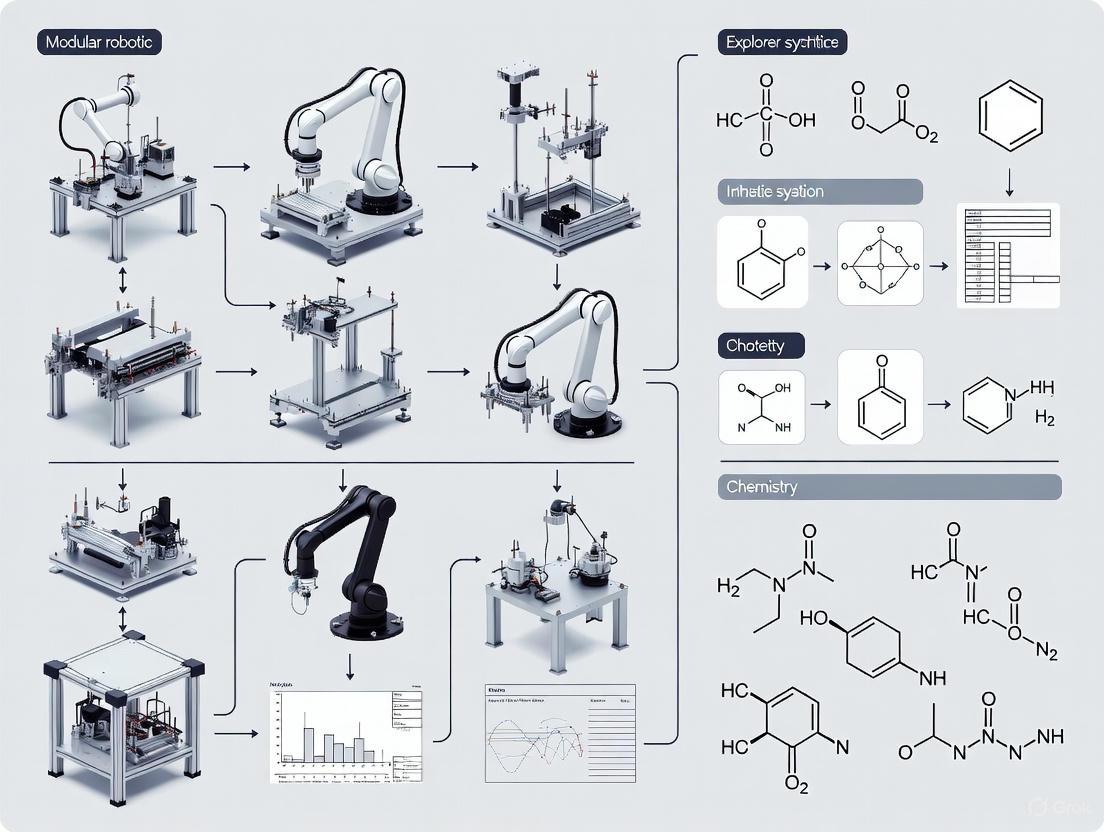
This article explores the transformative impact of modular robotic systems on exploratory synthetic chemistry, a critical field for pharmaceutical R&D.
Modular Robotic Systems: Revolutionizing Exploratory Synthetic Chemistry and Drug Discovery
Abstract
This article explores the transformative impact of modular robotic systems on exploratory synthetic chemistry, a critical field for pharmaceutical R&D. It details the foundational principles of these systems, which leverage mobile robots to integrate standard laboratory equipment into autonomous workflows. The content covers key methodological applications in areas like structural diversification and supramolecular chemistry, supported by case studies. It also addresses critical challenges in system integration, AI decision-making, and optimization, providing a troubleshooting guide for researchers. Finally, the article validates this approach through performance benchmarks, comparative analysis with traditional automation, and a discussion of its growing market adoption, offering scientists and drug development professionals a comprehensive resource for leveraging this disruptive technology.
The New Lab Assistants: Understanding Modular Robotics and Autonomous Discovery
Defining Modular Robotic Systems vs. Traditional Lab Automation
The landscape of laboratory science, particularly in exploratory fields like synthetic chemistry and drug development, is undergoing a fundamental transformation. The traditional model of automation, characterized by large, fixed, and dedicated systems, is being challenged by a new paradigm: modular robotic systems. This shift is driven by the need for greater flexibility, adaptability, and efficiency in research environments where objectives and protocols evolve rapidly. In the specific context of exploratory synthetic chemistry, where reactions can yield multiple potential products and require diverse analytical techniques, the limitations of traditional automation become particularly constraining [1]. This technical guide delineates the core distinctions between these two approaches, providing a framework for researchers and drug development professionals to make informed strategic decisions about automating their laboratories. The move towards modularity represents more than a technical upgrade; it is a conceptual shift from automation as a static tool to automation as a dynamic, integrated partner in the discovery process.
Core Definitions and Conceptual Frameworks
Traditional Lab Automation
Traditional lab automation encompasses systems designed to automate specific, well-defined laboratory processes. These systems are often characterized by their fixed configuration and dedicated function. They can be categorized into several levels of complexity:
- Manual Systems: These involve basic instruments that enhance precision but rely heavily on human operation, such as electronic pipettors and basic spectrophotometers [2].
- Stand-Alone Automation (Modular): These systems automate a single process or a group of related processes, such as automated pipetting systems or plate readers. They offer flexibility as they can be used independently or later integrated with other systems [2].
- Total Laboratory Automation (TLA): TLA systems represent the highest degree of traditional automation, integrating several different processes and instruments into a single, coordinated system. They are commonly used in high-throughput environments like clinical diagnostic labs to automate the entire workflow from sample receipt to result reporting [2].
A key feature of traditional systems, especially TLA, is their reliance on bespoke engineering and physically integrated analytical equipment. This often leads to the proximal monopolization of equipment, forcing decision-making algorithms to operate with limited analytical information [1].
Modular Robotic Systems
Modular robotic systems are composed of discrete, integrated units—or modules—that can function independently or dock with one another to form a composite entity with different capabilities. In a laboratory context, this philosophy translates to a distributed and scalable network of robotic agents and specialized instruments that can be physically and digitally reconfigured for different tasks.
Each module is self-contained, with its own computing, sensing, or actuation capabilities [3]. The system's core strength lies in its interoperability; mobile robotic agents can transport samples between physically separated synthesis and analysis modules, such as an automated synthesizer, a liquid chromatography–mass spectrometer (UPLC-MS), and a benchtop NMR spectrometer, all located anywhere in the laboratory [1]. This architecture allows robots to share existing laboratory equipment with human researchers without monopolizing it or requiring extensive redesign, creating a workflow that closely mimics human experimentation protocols [1].
Table 1: Key Characteristics of Traditional vs. Modular Automation Systems
| Characteristic | Traditional Lab Automation | Modular Robotic Systems |
|---|---|---|
| System Architecture | Fixed, centralized, and often linear | Flexible, distributed, and networked |
| Integration Level | Tightly coupled, bespoke engineering | Loosely coupled, vendor-agnostic orchestration |
| Scalability | Difficult and expensive; often requires a new system | Incremental and flexible; modules can be added as needed |
| Typical Workflow | High-throughput, repetitive, well-defined tasks | Exploratory, variable, and adaptable protocols |
| Interaction with Humans | Replaces human effort in specific tasks | Collaborates with humans, sharing space and equipment |
| Data Handling | Often siloed within the system | Integrated through central dashboards and advanced analytics [4] |
A Detailed Comparison in Practice
The theoretical distinctions between traditional and modular automation manifest concretely in laboratory operations, impacting everything from physical setup to data utilization.
Workflow and Physical Integration
In a Traditional TLA system, the workflow is linear and confined to a fixed track or conveyor system that links integrated instruments. This creates a highly efficient assembly line for a specific, unchanging process. However, it is inherently inflexible; modifying the workflow to include a new analytical technique or to change the process order can require significant mechanical and software re-engineering.
In contrast, a Modular Robotic system employs a hub-and-spoke or free-roaming model. As demonstrated in a Nature publication, a synthesis laboratory was integrated into an autonomous laboratory using mobile robots that operate equipment and make decisions in a human-like way [1]. The workflow is modular, combining mobile robots, an automated synthesis platform, a liquid chromatography–mass spectrometer, and a benchtop NMR spectrometer as separate modules. Mobile robots handle sample transportation between these distributed stations, allowing for dynamic and non-linear workflows [1]. This setup is inherently expandable, as other instruments can be added to the network by simply programming the mobile robots to access them.
Decision-Making and Autonomy
The level of autonomy is a critical differentiator. Most traditional automated systems excel at automation—the execution of pre-programmed, repetitive tasks. The decisions about the workflow are made by researchers who set the parameters beforehand.
Modular robotic systems, particularly in advanced implementations, are capable of autonomy. This implies that the system can not only execute tasks but also record and interpret analytical data and make decisions based on them [1]. For example, in an exploratory synthesis workflow, a heuristic decision-maker can process orthogonal NMR and UPLC-MS data, autonomously giving a pass/fail grade to each reaction and selecting successful ones for further study and scale-up, all without human intervention [1]. This closed-loop operation, where the outcome of an experiment directly informs the subsequent step, is a hallmark of advanced modular systems.
Adaptability and Economic Considerations
Adaptability is perhaps the most significant advantage of modular systems. They are designed for change, capable of being reconfigured for new research projects, which is ideal for exploratory chemistry and early-stage drug discovery. Traditional TLA systems are built for stability and peak efficiency in a single, high-volume process, making them more suited to late-stage development and clinical diagnostics.
From an economic perspective, the initial investment for a full-scale modular system can be high. However, its flexibility protects the investment over time, as it can be adapted rather than replaced when research needs change. Traditional TLA requires a massive capital outlay for a system that may become obsolete if the research pipeline shifts. Furthermore, modular systems can leverage existing laboratory equipment, whereas TLA often requires purchasing dedicated, integrated versions of these instruments [1].
Table 2: Comparison of Application and Economic Factors
| Factor | Traditional Lab Automation | Modular Robotic Systems |
|---|---|---|
| Ideal Application | High-throughput screening, clinical diagnostics, repetitive quality control | Exploratory synthesis, protocol development, multi-step complex reactions |
| Initial Investment | Very high for TLA; lower for stand-alone modules | High, but can be phased |
| Cost of Reconfiguration | Very high | Relatively low |
| Data Utilization | Siloed; used for immediate process control | Integrated; used for real-time decision-making and long-term learning [4] |
| Return on Investment | Justified by massive, repetitive throughput | Justified by accelerated discovery and research flexibility |
Experimental Protocols in Exploratory Synthetic Chemistry
The application of modular robotic systems is best understood through specific experimental protocols. The following workflow, derived from a published autonomous laboratory, exemplifies the integration of modular hardware and heuristic decision-making [1].
Protocol: Autonomous Divergent Synthesis and Analysis
Objective: To perform a multi-step synthesis, autonomously identify successful reactions using orthogonal analysis techniques, and scale up only the successful pathways for further elaboration.
Materials and Equipment:
- Synthesis Module: Chemspeed ISynth automated synthesizer [1].
- Analysis Modules: Ultrahigh-performance liquid chromatography–mass spectrometer (UPLC-MS) and an 80-MHz benchtop NMR spectrometer [1].
- Transportation: Mobile robotic agents with multipurpose grippers.
- Reagents: Appropriate amines, isothiocyanates, isocyanates, and solvents for the desired reactions.
Methodology:
- Synthesis Initiation: The host computer instructs the Chemspeed ISynth to perform the parallel synthesis of precursor molecules, for example, three ureas and three thioureas via combinatorial condensation [1].
- Sample Reformating: Upon reaction completion, the ISynth synthesizer takes an aliquot of each reaction mixture and reformats it into standard vials for MS and NMR analysis.
- Robotic Transport: A mobile robot collects the vials and transports them to the location of the UPLC-MS and NMR instruments. Electric actuators on the instrument doors allow for automated access.
- Autonomous Analysis: The robotic agent loads the samples into each instrument. Customizable Python scripts control data acquisition, and the results are saved in a central database.
- Heuristic Decision-Making: A decision-making algorithm processes the orthogonal UPLC-MS and ¹H NMR data. Based on experiment-specific pass/fail criteria defined by a domain expert (e.g., presence of a desired mass peak, cleanliness of NMR spectrum), it gives a binary grade to each reaction.
- Closed-Loop Action: Reactions that pass both analyses are automatically selected for scale-up within the ISynth platform. The scaled-up products are then used as substrates for the next stage of the divergent synthesis, repeating the analysis-decision-action cycle.
This protocol highlights the key differentiator: the tight integration of physical manipulation and intelligent data interpretation to create a truly autonomous discovery engine.
Visualization of Workflow
The following diagram, generated using Graphviz, illustrates the logical flow and decision points within the autonomous modular robotic system described in the protocol.
The Scientist's Toolkit: Essential Components for a Modular System
Building or implementing a modular robotic system for exploratory chemistry requires a suite of core components, both hardware and software.
Table 3: Key Research Reagent Solutions for a Modular Robotic Laboratory
| Component | Function | Example in Context |
|---|---|---|
| Mobile Robotic Agent | Provides physical linkage between discrete modules; transports samples and tools. | Free-roaming robot with a multipurpose gripper for handling vials and operating instrument doors [1]. |
| Automated Synthesis Platform | Executes chemical reactions autonomously; handles liquid and solid dosing, heating, and stirring. | Chemspeed ISynth platform [1]. |
| Orthogonal Analysis Instruments | Provides complementary data for robust characterization and decision-making. | UPLC-MS for mass and purity data; Benchtop NMR for structural information [1]. |
| Laboratory Orchestration Software | The central nervous system; provides vendor-agnostic scheduling and control for all hardware. | Software platforms that offer drivers for diverse laboratory hardware and link data to central dashboards [4]. |
| Heuristic Decision-Maker | Algorithmically interprets analytical data and makes context-based "go/no-go" decisions. | A customizable rules-based system that processes UPLC-MS and NMR data against expert-defined criteria [1]. |
| Digital Record-Keeping System | Automates record-keeping, manages workflows, and enables data mining. | Laboratory Information Management System (LIMS) or Electronic Lab Notebook (ELN) [4]. |
| Erythromycin Ethylsuccinate | Erythromycin Ethylsuccinate, CAS:41342-53-4, MF:C43H75NO16, MW:862.1 g/mol | Chemical Reagent |
| Lactose octaacetate | Lactose octaacetate, MF:C28H38O19, MW:678.6 g/mol | Chemical Reagent |
The choice between traditional lab automation and modular robotic systems is not a matter of one being universally superior to the other. Instead, it is a strategic decision based on the laboratory's primary mission. Traditional TLA remains the champion of unmatched efficiency and reproducibility in stable, high-volume, and well-defined processes, such as those in clinical diagnostics.
However, for the frontier of exploratory synthetic chemistry and drug discovery, where the path is not linear and the outcomes are not guaranteed, modular robotic systems offer a transformative advantage. Their core strengths—flexibility, adaptability, and intelligent autonomy—align perfectly with the needs of modern research. By mimicking the multifaceted approach of a human scientist and freeing researchers from repetitive tasks, modular systems accelerate the journey from hypothesis to discovery. They represent not just an incremental improvement in laboratory technology, but a fundamental re-imagining of the experimental process itself, poised to unlock new levels of innovation in science and medicine.
The advent of modular robotic systems is fundamentally reshaping the landscape of exploratory synthetic chemistry research. By integrating three core technological pillars—mobile robots, automated synthesis platforms, and orthogonal analytics—these systems create a flexible, scalable, and efficient framework for autonomous chemical discovery. This paradigm shifts research from traditional, linear, human-centric workflows to continuous, closed-loop cycles that dramatically accelerate the design-make-test-analyze (DMTA) process. The modularity of this approach allows researchers to leverage existing laboratory instrumentation without costly, bespoke engineering, making advanced automation more accessible [1] [5]. This technical guide details the components, integration methodologies, and experimental protocols that underpin these systems, providing a blueprint for their implementation in modern research and development environments, particularly in drug discovery and materials science.
In exploratory synthetic chemistry, the challenge of navigating vast chemical spaces is compounded by the reliance on manual, time-consuming, and often irreproducible experimental procedures. Modular robotic systems address these limitations through a decentralized architecture where physically distinct, specialized modules are connected via mobile robotic agents. This stands in contrast to traditional, hardwired automated systems where synthesis and analysis equipment are permanently integrated, which can be inflexible and expensive [1] [6].
The core philosophy of the modular approach is embodied intelligence, where mobile robots act as the physical link between discrete stations for synthesis and analysis, mimicking the sample transportation and handling tasks of a human researcher [6] [7]. This architecture is inherently scalable; new analytical instruments or synthesis workstations can be incorporated by simply updating the robot's navigation and operation protocols, without redesigning the entire laboratory infrastructure [1]. Furthermore, it promotes resource sharing, as the same high-value analytical equipment (e.g., NMR spectrometers) can be used by both robotic and human researchers, maximizing utility and return on investment [1]. The following diagram illustrates the logical workflow and data flow within such a system.
Core Component 1: Mobile Robots as a Physical Link
Mobile robots serve as the dynamic, physical backbone of the modular system, replacing fixed conveyor belts or hardwired connections. Their primary function is to bridge the physical gaps between automated synthesis stations and a diverse array of characterization instruments.
Technical Specifications and Capabilities
- Navigation and Mobility: These robots are typically free-roaming, capable of navigating standard laboratory environments to access instruments located anywhere in the facility [1]. They are equipped with sophisticated sensors to avoid obstacles and ensure safe operation alongside human researchers.
- Sample Handling: Robots are fitted with multipurpose grippers designed to handle standard laboratory consumables, such as vials and sample plates [1]. This allows them to perform precise tasks including:
- Collecting aliquots from the synthesis platform.
- Transporting samples to different analytical instruments.
- Loading and unloading samples into the UPLC-MS autosampler and NMR spectrometer.
- System Architecture: Implementation can involve multiple task-specific robots for high-throughput environments or a single multi-purpose robot to minimize equipment redundancy and cost [1]. An example from a proven setup uses two mobile robots for sample transport and instrument operation, but successfully demonstrates that a single agent can also perform all required tasks [1].
Experimental Protocols for Integration
Integrating mobile robots requires a structured approach to ensure seamless operation:
- Instrument Access Modification: Minor physical modifications, such as installing electric actuators on automated synthesis platform doors, are necessary to grant robots automated entry and exit [1].
- Workflow Orchestration: A central control software (host computer) must be deployed to orchestrate the entire workflow. This software sends commands to the robots, directing their movement and task execution based on the predefined experimental sequence [1].
- Protocol Development: Domain experts should develop analytical and synthesis routines using the control software's interface, which requires no specialized robotics programming skills, thereby enhancing accessibility [1].
Core Component 2: Automated Synthesis Platforms
The synthesis module is responsible for the precise and reproducible execution of chemical reactions. In modular systems, these platforms are operated by, rather than permanently connected to, the mobile robots.
Platform Specifications
- Primary Equipment: The Chemspeed ISynth synthesizer is a commonly used platform in documented systems [1] [5]. These systems are designed for automated, parallel chemical synthesis under programmable conditions.
- Environmental Control: They provide precise control over critical reaction parameters such as temperature, pressure, stirring, and irradiation, which is essential for reproducibility and for establishing structure-property relationships [5].
- Automated Sampling: A key feature is the ability to automatically take aliquots from ongoing reactions and reformat them into vials suitable for subsequent analysis by MS and NMR [1].
Key Research Reagent Solutions
The following table details essential reagents and materials used in a typical automated synthesis platform for exploratory chemistry, as demonstrated in the synthesis of ureas and thioureas [1].
Table 1: Essential Research Reagents for Automated Synthesis Workflows
| Reagent/Material | Function & Application in Automated Synthesis |
|---|---|
| Alkyne Amines | Core building blocks for combinatorial library synthesis, enabling structural diversification [1]. |
| Isothiocyanates | Electrophilic reagents for the automated synthesis of thiourea derivatives [1]. |
| Isocyanates | Electrophilic reagents for the automated synthesis of urea derivatives [1]. |
| Cu/TEMPO Catalyst | Dual catalytic system for autonomous optimization of aerobic alcohol oxidation reactions [8]. |
| Deuterated Solvents | Essential for preparing samples for NMR analysis within the automated workflow [1]. |
| Standard LC Solvents | Required for sample dilution, chromatography, and purification steps (e.g., acetonitrile) [1] [5]. |
Core Component 3: Orthogonal Analytics
Orthogonal analytics refers to the use of multiple, complementary characterization techniques to obtain a comprehensive and unambiguous assessment of reaction outcomes. This is a critical feature that mirrors expert human decision-making.
Analytical Instrumentation
The combination of Ultrahigh-Performance Liquid Chromatography–Mass Spectrometry (UPLC-MS) and Benchtop Nuclear Magnetic Resonance (NMR) Spectroscopy provides a powerful duo for autonomous analysis [1] [5].
- UPLC-MS provides information on molecular weight, purity, and reaction conversion.
- Benchtop NMR (e.g., 80 MHz) offers insights into molecular structure, functional groups, and reaction progress.
- The use of unmodified, commercial benchtop NMR spectrometers is a key aspect of the modular philosophy, allowing them to be shared with other workflows or human researchers [1].
Data Acquisition and Processing
- Automated Data Capture: After sample delivery by the mobile robot, customizable Python scripts autonomously initiate data acquisition on the instruments [1].
- Structured Data Outputs: To ensure interoperability and machine-readability, analytical data is saved in structured formats such as ASM-JSON (Allotrope Simple Model), JSON, or XML [5]. This structured data is then saved in a central database for processing by the decision-maker.
Table 2: Comparison of Orthogonal Analytical Techniques in Modular Systems
| Technique | Key Data Output | Role in Decision-Making | Throughput in Workflow |
|---|---|---|---|
| UPLC-MS | Molecular weight, chromatographic purity, semi-quantification. | Detects presence/absence of target mass; assesses reaction cleanliness. | High; often the first-line analysis. |
| Benchtop NMR | Molecular structure, functional group transformation, reaction progress. | Confirms structural identity and monitors conversion via spectral changes. | Medium; provides confirmatory data. |
| Additional Analytics (e.g., SFC) | Enantiomeric excess (ee), chiral purity. | Resolves and quantifies stereoisomers in the screening path [5]. | Conditional; used if chirality is a factor. |
Integrated Workflow and Decision-Making
The true power of a modular system is realized when the three core components are seamlessly integrated into a closed-loop workflow, governed by an intelligent decision-making module.
The Autonomous Workflow Cycle
The end-to-end process, depicted in the diagram below, operates as a continuous cycle:
Decision-Making Algorithms: From Heuristics to AI Agents
The system's "brain" can be implemented through different levels of sophistication:
- Heuristic Decision-Maker: This rule-based system processes UPLC-MS and NMR data using expert-defined criteria. It assigns a binary pass/fail grade to each reaction based on both analytical streams. For example, a reaction might need to show both the correct mass in MS and the expected spectral change in NMR to be considered a "pass" and proceed to scale-up [1]. This "loose" heuristic approach remains open to novel discoveries without being overly constrained by pre-defined objectives.
- Large Language Model (LLM) Agents: More advanced systems employ LLM-based agents (e.g., based on GPT-4) as a central planner. These systems, such as the LLM-based reaction development framework (LLM-RDF), can coordinate multiple sub-agents (e.g., Literature Scouter, Experiment Designer, Result Interpreter) to manage the entire process [8]. They use techniques like Retrieval-Augmented Generation (RAG) to access up-to-date literature and tool-calling to interact with robotic platforms and data analysis software [8]. This enables more flexible and general-purpose autonomous research.
Case Study & Experimental Protocol
Case Study: Autonomous Exploratory Synthesis and Screening [1]
This case study demonstrates the application of a modular robotic system in the exploratory synthesis of ureas/thioureas and the investigation of supramolecular host-guest chemistry.
Objective: To autonomously synthesize a library of compounds, identify successful reactions, validate reproducibility, and, in the case of supramolecular systems, even assay function (host-guest binding).
Detailed Methodology:
Synthesis Setup:
- The Chemspeed ISynth platform is loaded with starting materials: three alkyne amines and one isothiocyanate or isocyanate.
- The platform is programmed to perform parallel condensations to synthesize three ureas and three thioureas combinatorially.
Automated Sampling and Analysis:
- Upon reaction completion, the synthesizer automatically takes aliquots and reformats them for MS and NMR analysis.
- A mobile robot collects the sample vials and transports them to the UPLC-MS and benchtop NMR instruments.
Orthogonal Characterization:
- UPLC-MS Analysis: The system acquires chromatographic and mass spectrometric data for each sample.
- NMR Analysis: The robot loads the sample into the benchtop NMR, which acquires a 1H NMR spectrum.
Data Processing and Decision:
- The heuristic decision-maker processes the data:
- MS Data: Checked against a precomputed m/z lookup table for expected products.
- NMR Data: Analyzed using dynamic time warping to detect reaction-induced spectral changes.
- Reactions that pass both MS and NMR criteria are flagged as successful.
- The heuristic decision-maker processes the data:
Autonomous Follow-up Actions:
- The system automatically initiates reproducibility checks by re-running successful reactions.
- Confirmed hits are then scaled-up for further elaboration or functional testing.
- In the supramolecular chemistry example, the system proceeded to autonomously conduct a host-guest binding assay to evaluate the function of the synthesized assembly.
The integration of mobile robots, automated synthesis platforms, and orthogonal analytics represents a transformative, modular architecture for exploratory synthetic chemistry. This paradigm enables scalable, flexible, and highly efficient research workflows that closely mimic—and in some aspects surpass—the multifaceted decision-making processes of expert human chemists. By closing the DMTA loop with minimal human intervention, these systems significantly accelerate the discovery of new molecules and materials, as evidenced by their successful application in drug discovery and supramolecular chemistry. Future advancements will hinge on developing more robust and generalizable AI decision-makers, standardizing data formats and hardware interfaces, and creating even more fault-tolerant systems. As these technologies mature and become more accessible, modular robotic systems are poised to become a cornerstone of modern chemical research infrastructure.
The paradigm of robotic systems in research is undergoing a fundamental transformation, shifting from static automation to adaptive autonomy. Where traditional automated systems execute predetermined protocols with high precision but limited adaptability, autonomous laboratories represent a revolutionary leap forward. These systems integrate embodied intelligence with robotic hardware to form closed-loop research environments capable of iterative experimentation and intelligent decision-making without human intervention [6]. This shift is particularly transformative for exploratory synthetic chemistry, where the vastness of chemical space and the complexity of structure-property relationships have traditionally constrained the pace of discovery. The emergence of AI as the central decision-making "brain" enables robotic platforms to navigate this complexity, transforming them from mere tools into active research partners that can generate hypotheses, design experiments, and interpret results in the pursuit of novel chemical entities.
Fundamental Architecture of an Autonomous Laboratory
An autonomous laboratory is an advanced robotic platform equipped with embodied intelligence, enabling it to execute experiments, interact with robotic systems, and manage data to effectively close the predict-make-measure discovery loop [6]. This integrated system relies on several synergistic core elements that work together to create a seamless, closed-loop research environment for synthetic chemistry.
Core Element 1: The Chemical Science Database
The chemical science database serves as the foundational knowledge repository for the autonomous system. It manages and organizes diverse, multimodal chemical data, providing essential support for experimental design, prediction, and optimization [6]. These databases integrate:
- Structured data from proprietary databases (e.g., Reaxys, SciFinder) and open-access platforms (e.g., ChEMBL, PubChem).
- Unstructured data extracted from scientific literature, patents, and experimental reports using Natural Language Processing (NLP) techniques and toolkits like ChemDataExtractor and ChemicalTagger [6].
- Knowledge graphs (KGs) that provide a structured representation of data, with modern construction methods leveraging large language models (LLMs) for superior performance and enhanced interpretability [6].
Core Element 2: Large-Scale Intelligent Models
Intelligent models form the analytical core of the autonomous laboratory, enabling data processing, outcome prediction, and informed decision-making at each experimental stage [6]. These include:
- Advanced Optimization Algorithms: Genetic Algorithms (GAs) for handling large variable spaces in catalyst discovery; Bayesian optimization to minimize experimental trials; and the SNOBFIT algorithm combining local and global search strategies [6].
- Predictive Modeling: Random forest models and Gaussian processes trained iteratively on prior data to forecast experimental outcomes and exclude suboptimal paths [6].
- Iterative Theory-Experiment Fusion: Integration of automated theoretical calculations (e.g., density functional theory) to provide valuable prior knowledge and enhance adaptive learning capabilities [6].
Core Element 3: Automated Experimental Platforms
Robotic hardware systems provide the physical implementation layer, executing synthetic and analytical procedures with precision and reproducibility. These platforms include:
- Robotic manipulators for solid and liquid handling.
- Continuous flow reactors for reaction optimization.
- In-line analytical instruments (e.g., HPLC, NMR, MS) for real-time reaction monitoring.
- Mobile robotic chemists capable of autonomously conducting high-throughput experimentation [6].
Core Element 4: Integrated Management and Decision Systems
The control architecture orchestrates all components through a unified software environment that manages:
- Experimental workflow execution and scheduling.
- Data flow between databases, AI models, and robotic platforms.
- Closed-loop operation by analyzing results and initiating subsequent experiments.
- Resource allocation and safety protocols.
Table 1: Quantitative Comparison of AI Algorithms Used in Autonomous Laboratories
| Algorithm Type | Key Strengths | Common Applications | Convergence Efficiency | Implementation Complexity |
|---|---|---|---|---|
| Bayesian Optimization | Excellent for sample-efficient optimization | Reaction optimization, catalyst selection | High with limited data | Moderate |
| Genetic Algorithms (GAs) | Effective with large variable spaces | Materials discovery, formulation optimization | Gradual but thorough | Moderate to High |
| Random Forest | Handles heterogeneous data well | Property prediction, experimental outcome forecasting | Fast training | Low to Moderate |
| Gaussian Processes | Provides uncertainty estimates | Process optimization, thin-film materials | High with small datasets | High computational cost |
| Reinforcement Learning | Learns optimal actions through trial and feedback [9] | Autonomous navigation, complex task learning | Slow initial, improves with time | High |
Implementation Framework for Synthetic Chemistry
The Closed-Loop Workflow for Exploratory Synthesis
The autonomous discovery cycle operates through an integrated predict-make-measure-analyze loop specifically adapted for synthetic chemistry research:
AI-Driven Reaction Prediction: The system selects target molecules or materials based on multi-objective optimization (e.g., yield, selectivity, cost) using prior knowledge from chemical databases and predictive models.
Automated Synthesis Protocol Generation: AI generates executable synthetic protocols, including reagent selection, stoichiometry, solvent systems, and reaction conditions, often using tools like SYNTHIA or AiZynthFinder [6].
Robotic Reaction Execution: Automated platforms perform the synthesis using precisely controlled liquid handling, reactor systems, and environmental control.
In-Line Analysis and Characterization: Integrated analytical instruments (HPLC, UV-Vis, NMR, MS) provide real-time reaction monitoring and characterization.
Data Analysis and Model Refinement: Machine learning models analyze results, update predictive models, and refine understanding of structure-property relationships, informing the next cycle of experimentation.
Experimental Protocol: Autonomous Optimization of Catalytic Reactions
Objective: To autonomously discover and optimize a homogeneous catalytic system for asymmetric synthesis using a closed-loop robotic platform.
Materials:
- Robotic Liquid Handling System: equipped with inert atmosphere capability
- In-line HPLC-MS: for reaction monitoring and enantioselectivity determination
- Microplate Reactor Array: with temperature control (-20°C to 150°C) and stirring capability
- Chemical Reagents: Catalyst libraries, substrate variants, solvent options
Methodology:
- Experimental Design: Bayesian optimization algorithm selects initial reaction conditions based on prior knowledge, exploring catalyst structure, solvent, temperature, and concentration parameter space.
Automated Setup: Robotic platform prepares reaction mixtures in microplate reactors under inert atmosphere, executing liquid transfers with precision.
Reaction Execution: Reactions proceed with controlled heating/stirring for predetermined times or until monitored completion.
Real-time Analysis: In-line HPLC-MS samples each reaction at multiple timepoints, quantifying conversion and enantiomeric excess.
Data Integration: Analytical results are automatically processed and fed into the optimization algorithm.
Iterative Optimization: AI model updates its understanding of the reaction landscape and selects the most informative subsequent experiments to maximize enantioselectivity and yield.
Termination: The loop continues until convergence to optimal conditions or exceeding a predefined performance threshold.
Key Performance Metrics:
- Convergence rate to optimal conditions
- Number of experiments required
- Final achieved enantioselectivity and yield
- Model prediction accuracy throughout process
Table 2: Research Reagent Solutions for Autonomous Synthetic Chemistry
| Reagent Category | Specific Examples | Function in Autonomous System | Storage & Handling Requirements |
|---|---|---|---|
| Catalyst Libraries | Ligand classes (BINOL, BINAP, Salen), metal complexes (Pd, Ru, Rh) | Exploration of structure-activity relationships in reaction optimization | Inert atmosphere, temperature-controlled storage |
| Substrate Collections | Functionalized building blocks with varying electronic and steric properties | Systematic investigation of substrate scope and selectivity | Standard temperature, humidity control |
| Solvent Systems | Polar protic, polar aprotic, non-polar with varying coordination ability | Optimization of reaction medium for solubility and selectivity | Anhydrous conditions, inert atmosphere |
| Activating Agents | Peptide coupling reagents, bases, oxidants, reductants | Facilitation of specific bond-forming transformations | Moisture-sensitive storage conditions |
Case Studies in Autonomous Chemical Research
Advanced Implementation: The A-Lab for Materials Discovery
The A-Lab, developed by DeepMind, represents a cutting-edge implementation of autonomous materials research. This system utilizes computational tools, literature data, machine learning, and active learning to plan and interpret the outcomes of experiments performed by robotics, specifically addressing challenges associated with handling and characterizing solid inorganic powders [6]. The lab successfully synthesizes and characterizes novel inorganic materials with minimal human intervention by:
- Leveraging predictive models like the GNoME intelligent model for crystal structure prediction, which has expanded the number of known stable materials nearly tenfold [6].
- Employing active learning to continuously refine synthesis strategies based on experimental outcomes.
- Integrating automated characterization techniques, particularly powder X-ray diffraction (PXRD), with AI-driven pattern analysis to assess synthesis success.
Chinese Advances in Autonomous Laboratories
Research in China has demonstrated significant progress in autonomous laboratories, evolving from simple iterative-algorithm-driven systems to comprehensive intelligent autonomous systems powered by large-scale models [6]. Key developments include:
- Mobile robotic chemists capable of autonomously conducting high-throughput photocatalyst selection, outperforming humans through Bayesian optimization [6].
- Fully autonomous solid-state workflows involving multiple robots for powder X-ray diffraction (PXRD) experiments [6].
- Integrated AI-chemical platforms that enable self-driving chemical discovery within individual laboratories, closing the loop between prediction, synthesis, and characterization.
Future Directions and Challenges
The continued evolution of autonomous laboratories faces several technical and conceptual challenges that represent opportunities for further research and development:
Data Quality and Standardization
The performance of AI-driven approaches relies on large amounts of high-quality, structured data. However, most available experimental data suffers from significant issues including non-standardization, fragmentation, and poor reproducibility [6]. Automated robotic platforms are being rapidly developed specifically to generate high-quality experimental data in a standardized and high-throughput manner to address this fundamental limitation.
Distributed Autonomous Laboratory Networks
Most current autonomous laboratories operate in isolation with limited inter-lab communication. The next evolutionary stage involves developing these intelligent systems into distributed networks that can achieve seamless data and resource integration across multiple laboratories [6]. Such networks would enable:
- Collaborative experimentation across geographical boundaries
- Shared learning between different robotic platforms
- Standardized data protocols for chemical research
- Cloud-based resource sharing for specialized instrumentation
Algorithmic Advances for Chemical Intelligence
Future algorithmic development needs to address several key challenges:
- Multi-objective optimization balancing competing priorities (yield, cost, safety, sustainability)
- Transfer learning between different chemical domains
- Uncertainty quantification in predictive models
- Explainable AI for interpretable chemical insights
- Integration of scientific knowledge with data-driven approaches
Ethical and Safety Considerations
As autonomous systems make more decisions without human intervention, rigorous safeguards and transparent algorithms become essential to ensure trust and fairness in research outcomes [10]. Key considerations include:
- Safety protocols for unexpected chemical reactions
- Ethical AI design prioritizing safe and beneficial outcomes
- Transparent decision-making processes for regulatory compliance
- Intellectual property frameworks for AI-generated discoveries
Table 3: Performance Metrics of Autonomous vs. Traditional Laboratory Approaches
| Performance Metric | Traditional Laboratory | Autonomous Laboratory | Improvement Factor |
|---|---|---|---|
| Experimental Throughput | 5-10 reactions/day | 100-1000 reactions/day | 20-100x |
| Data Generation Quality | Variable, operator-dependent | Standardized, reproducible | Significant improvement |
| Optimization Convergence | 20-50 iterations | 5-15 iterations | 3-5x faster |
| Resource Consumption | Higher (manual optimization) | Lower (targeted experiments) | 30-50% reduction |
| Operational Timeframe | Limited by human schedule | 24/7 continuous operation | 3-5x increase |
The shift from automation to autonomy represents a fundamental transformation in chemical research methodology, with AI emerging as the central decision-making "brain" that enables true discovery without constant human guidance. This paradigm shift addresses core challenges in exploratory synthetic chemistry by allowing researchers to navigate vast chemical spaces more efficiently, elucidate complex structure-property relationships more effectively, and accelerate the transition from fundamental research to practical application. As autonomous laboratories evolve from individual implementations to distributed networks, they hold the potential to dramatically accelerate scientific discovery across pharmaceutical development, materials science, and sustainable chemistry. The integration of embodied intelligence with robotic experimentation platforms marks the beginning of a new era in chemical research, one where human scientists are augmented by AI partners capable of conceptualizing and executing research strategies at scale and with precision previously unimaginable.
The field of synthetic chemistry is undergoing a profound transformation, shifting from traditional manual operations to increasingly automated and intelligent systems. This evolution began with dedicated, task-specific automation and has progressed to the era of mobile robotic chemists that operate with a degree of autonomy reminiscent of human researchers. This transition is critical for exploratory synthetic chemistry, where the ability to rapidly test hypotheses and characterize diverse products accelerates discovery. The move toward modular robotic systems represents a paradigm shift in laboratory workflows, enabling seamless integration of synthesis, analysis, and decision-making processes. These systems leverage artificial intelligence and advanced robotics to share existing laboratory equipment with human researchers without monopolizing instruments or requiring extensive redesign, thereby bridging the gap between traditional automation and fully autonomous experimentation [1]. This whitepaper traces the historical trajectory from the earliest forms of solid-phase synthesis to contemporary mobile robotic chemists, providing researchers and drug development professionals with a technical examination of the methodologies, protocols, and architectures driving this revolution.
Traditional organic synthesis has historically relied on highly trained chemists performing labor-intensive manual operations, leading to challenges with inconsistent reproducibility and limited efficiency. The first major breakthrough in automation arrived in the 1960s with Merrifield's solid-phase peptide synthesis, which automated molecular assembly by attaching peptide chains to a resin and using protective groups to enable sequential reagent addition and removal [11]. For decades, this represented the state of the art in chemical automation—effective for specialized applications but limited in scope and flexibility.
The 21st century witnessed accelerated innovation, beginning with platforms for iterative cross-coupling (e.g., Burke's work using TIDA-supported C-Csp3 bond formation) and advanced flow-based synthesis (e.g., Gilmore's automated multistep synthesizer with inline NMR and IR monitoring) [11]. A significant milestone was the development of the Chemputer by Cronin's group, which used a chemical description language (XDL) to standardize and automate synthetic procedures extracted from scientific literature, demonstrating the assembly of pharmaceuticals with superior yields and purity compared to manual methods [12] [11]. This evolution culminated in the recent emergence of mobile robotic chemists—such as the system described by Burger et al., which autonomously performed 688 reactions over eight days—and AI-integrated platforms like Jiang's AI-Chemist, which encompasses the entire process from synthetic planning to execution and machine learning [11]. These systems mark the transition from stationary, dedicated automation to flexible, mobile systems capable of operating in dynamic laboratory environments.
Table: Major Historical Developments in Automated Synthesis
| Time Period | Key Development | Representative Technology | Primary Innovation |
|---|---|---|---|
| 1960s | Solid-Phase Synthesis | Merrifield's Peptide Synthesizer | Automation of sequential synthesis on a solid support |
| Early 2000s | Iterative Cross-Coupling | Automated Synthesis Machines | C-C bond formation with commercial building blocks |
| 2010s | Flow Chemistry & Inline Analysis | Radial Flow Synthesizers | Continuous flow processes with real-time monitoring |
| 2018-2020 | Chemical Programming | Chemputer Platform | Standardization via chemical description language (XDL) |
| 2020-Present | Mobile Robotic Chemists | Autonomous Mobile Robots | Free-roaming robots using multiple characterization techniques |
Core Principles of Modern Modular Robotic Systems
Modern modular robotic systems for exploratory synthetic chemistry are built upon several foundational principles that distinguish them from earlier automation approaches. These principles enable the flexibility and intelligence required for autonomous discovery in complex chemical spaces.
Modularity and Distributed Instrumentation
Contemporary systems employ a modular workflow where physically separated synthesis and analysis modules are connected by mobile robots for sample transportation and handling [1]. This architecture differs fundamentally from bespoke automated equipment with hard-wired characterization techniques. Instead, mobile robots act as the physical linkage between independent modules—such as automated synthesis platforms, liquid chromatography–mass spectrometers (UPLC-MS), and benchtop nuclear magnetic resonance (NMR) spectrometers—allowing instruments to be shared with human researchers and located anywhere in the laboratory [1]. This distributed approach creates an inherently expandable system that can incorporate additional instruments as needed, limited only by laboratory space constraints.
Orthogonal Analytical Characterization
Unlike automated systems designed to maximize a single figure of merit (e.g., yield), exploratory synthesis requires characterization capable of identifying diverse potential products. Modern systems address this by combining multiple characterization techniques—typically UPLC-MS and ¹H NMR—to achieve a standard comparable to manual experimentation [1]. This orthogonal approach is essential for capturing the diversity inherent in modern organic chemistry and mitigates the uncertainty associated with unidimensional measurements. For example, in supramolecular chemistry, self-assembly processes can produce complex product mixtures that require multimodal data for unambiguous identification [1].
Autonomous Decision-Making with Heuristic Reasoning
True autonomy requires systems that can interpret analytical data and make decisions without human intervention. Modern platforms employ heuristic decision-makers that process orthogonal measurement data to select successful reactions for further study [1]. These algorithms apply experiment-specific pass/fail criteria to both MS and NMR analyses, combining the results to determine subsequent workflow steps. This "loose" heuristic approach remains open to novelty and chemical discovery, unlike optimization-focused algorithms that might overlook unexpected results [1]. The system also automatically checks the reproducibility of screening hits before scale-up, mimicking human experimental protocols.
Technical Architectures and Methodologies
Mobile Robotic Platforms for Distributed Workflows
The architecture of modern autonomous laboratories centers around mobile robotic agents that navigate laboratory environments to operate equipment and transport samples. These systems represent a significant advancement over fixed-base robots, which lack mobility to interact with spatially distributed instruments [13]. Recent implementations include both robots equipped with linear translational tracks and wheeled platforms, with the latter offering greater workspace accessibility [13].
A key technical challenge involves addressing the navigation inaccuracies inherent to mobile bases, which can compromise precision-critical manipulation tasks. Solutions include tactile-based localization methods (e.g., cube-mounted location systems) that achieve high accuracy but require static infrastructure, and vision-based methods (e.g., fiducial markers, LIDAR, learning-based keypoint detection) that offer greater adaptability for dynamic workflows [13]. These mobile systems physically integrate instruments without requiring extensive modification—typically needing only simple adaptations like automated doors for robot access [1].
The LIRA Module: Closed-Loop Error Detection and Correction
The LIRA (Localization, Inspection, and Reasoning) module represents a recent advancement in addressing the open-loop manipulation problem common in self-driving laboratories (SDLs) [13]. Unlike traditional robotic manipulation that assumes flawless execution, LIRA provides real-time error detection and correction through vision-language models (VLMs).
Table: Technical Components of the LIRA Module
| Component | Function | Implementation | Performance Metrics |
|---|---|---|---|
| Localization | Precise positioning for manipulation tasks | Vision-based with calibration board; uses ArUco marker pose detection | High localization accuracy; 10x reduction in localization time [13] |
| Inspection | Automated visual error detection | Fine-tuned Vision-Language Model (VLM) on chemistry lab dataset | 97.9% success rate in error inspection [13] |
| Reasoning | Decision-making for error recovery | Natural language processing of visual inputs | Enables dynamic adaptation to workflow variations |
| Edge Computing | Real-time processing | Server layer on edge device | Reduces manipulation time by 34% in solid-state workflows [13] |
LIRA's architecture comprises three layers: (1) a robot client interface integrated into existing workflow scripts, (2) a communication layer managing data exchange over local networks using SOAP and Flask protocols, and (3) a server layer on an edge device providing computational power for real-time image processing and VLM execution [13]. The system operates through a structured workflow: after a mobile robot navigates to a station, the arm moves to a predefined position for visual calibration, the client sends an ArUco pose request, and a 6×1 vector representing the marker pose is returned to update manipulation-related frames [13]. During task execution, inspection requests formulated as input prompts are transmitted with camera images to LIRA, which returns inspection and reasoning results to guide subsequent actions.
Integrated Synthesis Platforms with Real-Time Feedback
Advanced synthesis platforms like the Chemspeed ISynth and Chemputer form the core of modern automated synthesis workflows. These systems integrate reagent storage, reaction preparation modules, multiple reactor configurations, and purification systems in coordinated architectures [1] [12]. The Chemputer, for example, uses the chemical description language XDL to provide methodological instructions for individual synthetic steps, integrating automation with bench-scale techniques through natural language processing algorithms [12] [11].
A critical advancement in these platforms is the incorporation of real-time analytical feedback from techniques including on-line NMR, liquid chromatography, and infrared spectroscopy [12]. This enables dynamic adjustment of process conditions during reaction progression. For instance, in the synthesis of [2]rotaxane molecular machines, integrated on-line NMR and liquid chromatography provided feedback that informed adjustments throughout the divergent four-step synthesis and purification process, which averaged 800 base steps over 60 hours [12].
Experimental Protocols for Autonomous Workflows
Protocol: Autonomous Exploratory Synthesis Using Mobile Robots
This protocol outlines the methodology for conducting autonomous exploratory synthesis using mobile robotic systems, based on the workflow described by [1].
Materials and Equipment:
- Mobile robotic platform with manipulator
- Automated synthesis platform (e.g., Chemspeed ISynth)
- UPLC-MS system
- Benchtop NMR spectrometer
- Central control software and database
Procedure:
- Workflow Initialization:
- Program the synthesis sequence in the automated synthesis platform
- Define experiment-specific pass/fail criteria for MS and NMR analyses in the heuristic decision-maker
- Initialize parameters for robotic manipulation (station names, target names, fiducial marker IDs)
Synthetic Execution:
- Execute parallel synthesis operations in the automated synthesis platform
- Upon reaction completion, the synthesizer takes aliquots of each reaction mixture
- Reformats samples separately for MS and NMR analysis
Sample Transportation and Analysis:
- Mobile robots transport samples to appropriate instruments (UPLC-MS and NMR)
- Implement automated data acquisition using customizable Python scripts
- Save resulting data to a central database
Data Analysis and Decision-Making:
- Process UPLC-MS and ¹H NMR data using heuristic algorithms
- Apply binary pass/fail grading to each analysis based on predefined criteria
- Combine results from orthogonal analyses to determine subsequent workflow steps
- Select successful reactions for scale-up or further elaboration
- Automatically verify reproducibility of screening hits before progression
Iterative Cycle:
- Execute subsequent synthesis operations based on decision-maker instructions
- Continue synthesis-analysis-decision cycles without human intervention
Applications:
- Structural diversification chemistry
- Supramolecular host-guest chemistry
- Photochemical synthesis
- Library synthesis for drug discovery
Protocol: Closed-Loop Error Correction Using LIRA
This protocol details the implementation of the LIRA module for real-time error detection and correction in autonomous workflows [13].
Materials and Equipment:
- LIRA edge computing module
- Camera system mounted on robotic manipulator
- Calibration board with fiducial markers
- Client-server communication infrastructure
Procedure:
- System Initialization:
- Navigate mobile robot to target station
- Move robotic arm to predefined calibration position
- Initialize communication between robot client and LIRA server
Visual Localization:
- Capture image of workspace using onboard camera
- Send ArUco pose request to LIRA server via network
- Receive 6×1 vector representing marker pose
- Update manipulation-related frames based on pose data
Task Execution and Monitoring:
- Execute manipulation task (e.g., vial placement, instrument operation)
- At critical error-prone points, capture current workspace image
- Formulate inspection request as natural language prompt
Inspection and Reasoning:
- Transmit image and prompt to LIRA server
- Process input using fine-tuned VLM
- Return inspection results and reasoning to client
Error Recovery:
- Apply InspectionHandler to interpret LIRA response
- Execute appropriate corrective action based on reasoning results
- Repeat inspection until successful task completion
- Proceed to next workflow step
Performance Data and Comparative Analysis
Modern autonomous systems have demonstrated significant performance improvements across multiple metrics compared to traditional automated approaches. The following table summarizes quantitative performance data from recent implementations:
Table: Performance Metrics of Autonomous Chemistry Platforms
| Platform/Technology | Key Performance Metric | Result | Comparative Advantage |
|---|---|---|---|
| Mobile Robot with LIRA Module [13] | Error Inspection Success Rate | 97.9% | Enables closed-loop error correction in dynamic environments |
| Mobile Robot with LIRA Module [13] | Manipulation Time Reduction | 34% decrease | Faster task completion through optimized localization |
| LIRA Localization [13] | Localization Time | 10x reduction | High-speed calibration for workflow efficiency |
| Autonomous Mobile Robot [1] | Analytical Techniques | UPLC-MS + NMR | Orthogonal characterization comparable to manual standards |
| Chemputer Rotaxane Synthesis [12] | Process Steps | 800 steps over 60 hours | Manages complex multi-step synthesis autonomously |
| AI-Chemist Platform [11] | Functional Scope | End-to-end operation | Manages synthesis planning, execution, and machine learning |
The Scientist's Toolkit: Essential Research Reagents and Materials
Table: Key Research Reagent Solutions for Autonomous Synthesis Workflows
| Item | Function | Application Example | Technical Specifications |
|---|---|---|---|
| Alkyne Amines (1-3) [1] | Building blocks for combinatorial condensation | Parallel synthesis of ureas and thioureas | Used with isothiocyanates/isocyanates for library generation |
| Isothiocyanate (4) & Isocyanate (5) [1] | Electrophilic coupling partners | Structural diversification chemistry | React with alkyne amines to form diverse scaffolds |
| Tetramethyl N-methyliminodiacetic acid (TIDA) [11] | Supporting ligand for C-C bond formation | Automated synthesis of small molecules | Enables C-Csp3 bond formation in synthesis machines |
| ArUco Fiducial Markers [13] | Visual reference for robot localization | Precision manipulation tasks | Enables high-accuracy positioning in vision-based systems |
| Commercial Building Blocks [11] | Diverse starting materials | Automated synthesis with >5000 options | Supports creation of numerous small molecule targets |
| Chlorophyll a | Chlorophyll a Reagent | Bench Chemicals | |
| Azure B | Azure B, CAS:1231958-32-9, MF:C15H16ClN3S, MW:305.8 g/mol | Chemical Reagent | Bench Chemicals |
The evolution from solid-phase synthesis to mobile robotic chemists represents a fundamental transformation in how chemical research is conducted. Modern modular robotic systems have demonstrated the capability to perform complex, multi-step syntheses with integrated analytical characterization and decision-making, significantly advancing the field of exploratory synthetic chemistry. These systems address critical challenges in reproducibility, efficiency, and discovery throughput that have long constrained traditional manual approaches.
Future developments in autonomous chemistry will likely focus on several key areas: improved seamless integration of synthetic platforms with analytical instruments and computational systems; enhanced AI-driven synthesis planning that more effectively captures existing chemical knowledge; development of more user-friendly interfaces and universal chemical programming languages; and creation of more compact, affordable systems accessible to a broader range of laboratories [11]. As these technologies mature, organic chemists will be increasingly liberated from repetitive experimental tasks, allowing greater focus on creative strategic questions—what to synthesize and why—rather than the mechanics of synthesis execution [11]. This shift promises to accelerate scientific discovery and open new frontiers in molecular design and development.
Diagram: Autonomous Chemistry Workflow
Diagram: LIRA Closed-Loop Error Correction
From Theory to Bench: Implementing Modular Workflows for Complex Chemistry
In the evolving landscape of exploratory synthetic chemistry, the demand for more adaptive, efficient, and intelligent research systems has never been greater. This whitepaper details a specialized workflow architecture designed to meet this challenge by integrating synthesis, analysis, and decision cycles within a framework of modular robotic systems. The core thesis is that a purpose-built workflow architecture, leveraging modularity and automation, can create a self-optimizing research platform capable of accelerating discovery, particularly in pharmaceutical development. By treating the research process not as a series of discrete steps but as a continuous, data-driven cycle, this system promises to enhance reproducibility, enable real-time adaptation, and maximize the utility of both human and robotic resources.
Core Workflow Concepts & Typology
A workflow is fundamentally a sequence of tasks organized to achieve a specific outcome, serving as a roadmap that guides a process from inception to completion [14]. In the context of automated research, selecting the appropriate workflow type is critical for success.
- Sequential Workflow: This model executes a series of steps in a strict, linear sequence, where each task must be completed before the next can begin [14] [15]. It is best suited for straightforward, well-defined synthetic pathways where the process is predictable and requires no deviation.
- State Machine Workflow: This model incorporates loops and decision points, allowing the process to move between different states based on specific outcomes or analytical results [14] [15]. It is essential for exploratory research, as it can adapt to failed reactions or unexpected data by branching to alternative synthesis or purification paths.
- Rules-Driven Workflow: This model automates tasks based on predetermined business rules or logical criteria, often expressed as "if-then" statements [14] [15]. In a chemistry context, this could automatically trigger a different workup procedure if analysis detects a particularly stubborn impurity.
These workflow models are orchestrated by a Workflow Management System (WMS), a software solution designed to define, execute, monitor, and optimize business processes [16]. The primary purpose of a WMS is to increase organizational efficiency by automating workflows, reducing manual intervention, and ensuring consistent execution [16]. Its key features include a process modeler for designing workflows, a workflow engine for execution, task management for assignment and tracking, and robust integration tools to connect with other laboratory instruments and software [16].
System Architecture of a Workflow Management System
The functionality of a WMS is grounded in its underlying architecture, which determines its scalability, flexibility, and integration potential. For a research environment requiring high adaptability, certain architectural patterns are more suitable.
- Microservices Architecture: This approach structures the WMS as a collection of small, independent services, each responsible for a discrete function [16]. This is ideal for modular robotic systems, as services for "Synthesis Control," "Analytical Data Processing," or "Decision Logic" can be developed, scaled, and updated independently. This aligns with the modular philosophy, allowing the overall system to remain agile and resilient [16].
- Event-Driven Architecture: This architecture centers on the production, detection, and reaction to events, making the system highly responsive to real-time changes [16]. In a laboratory setting, an event could be "Reaction Completed," "MS Data Ready," or "Purity Threshold Met," which then automatically triggers the next step in the workflow, such as initiating a purification or starting a subsequent reaction.
The core components of a WMS architecture that bring these models to life include [16]:
- Process Definition: The foundation where business processes are mapped into a digital format using standards like Business Process Model and Notation (BPMN).
- Execution Engine: The heart of the system that interprets process definitions and manages the execution of workflow instances.
- Task Management: Ensures that work is assigned to the correct resources (human or robotic) and is completed in the correct order.
- Integration Layer: Allows the WMS to communicate with other systems and databases via APIs and connectors, creating a cohesive laboratory ecosystem.
Integration with Modular Robotic Systems
Modular self-reconfiguring robotic systems are autonomous kinematic machines with variable morphology. Beyond conventional actuation, sensing, and control, these robots can deliberately change their shape by rearranging the connectivity of their parts to adapt to new circumstances, perform new tasks, or recover from damage [17]. This capability aligns perfectly with the needs of exploratory synthetic chemistry, where the optimal physical configuration of laboratory hardware may need to change for different reaction sequences or purification techniques.
The motivation for integrating these systems is twofold: functional advantage and economic advantage [17]. Functionally, a modular robotic system is more robust and adaptive than a fixed-configuration system. It can reassemble to form new morphologies better suited to new tasks. Economically, a single set of mass-produced modules can create a wide array of complex machines, potentially lowering overall costs [17].
From an architectural perspective, these systems are often classified as follows [17]:
- Lattice Architecture: Modules connect at points in a virtual grid, similar to atoms in a crystal. This simplifies mechanical design and reconfiguration planning.
- Chain Architecture: Modules are not confined to a grid and can reach any point in space, offering greater versatility but increased computational complexity for planning.
- Hybrid Architecture: Combines advantages of both lattice and chain architectures.
A key research focus in this field is the automatic synthesis of both robot design and controllers, enabling a reactive control policy that can generalize to new, unseen robot designs formed from the modules [18]. This capability is critical for a chemistry platform that must constantly adapt its physical form.
<100: Modular Robotic Workflow
Application in Synthetic Chemistry Workflows
The integration of workflow architecture and modular robotics finds a powerful application in modern synthetic chemistry, particularly with the adoption of flow chemistry. Flow chemistry offers significant advantages over traditional batch processes, including improved mass and heat transfer, enhanced safety, increased efficiency, and superior scalability [19].
A typical organic chemistry workflow involves multiple steps, from initial literature review and synthesis planning to the execution of reactions, work-up, purification, and isolation of the final compound [20]. This multi-step process is an ideal candidate for automation and optimization through a state-machine workflow model.
For instance, the synthesis of complex pharmaceuticals like Verubecestat showcases the power of flow chemistry, where efficient mixing in flow reactors enhances selectivity and yield [19]. Furthermore, flow chemistry enables multi-step synthesis by integrating multiple reactions into a continuous process, which reduces the need for intermediate purification and significantly improves overall efficiency [19]. The continuous synthesis of the antibiotic Linezolid demonstrates this potential for enhanced efficiency, safety, and scalability [19].
The Scientist's Toolkit: Research Reagent Solutions
The following table details key materials and equipment essential for implementing automated synthesis workflows.
Table: Essential Materials for Automated Synthesis Workflows
| Item | Function/Application |
|---|---|
| Microwave Reactor | Used for organic synthesis to rapidly heat reaction mixtures, often reducing reaction times from hours to minutes [20]. |
| Liquid Chromatography/Mass Spectrometry (LC/MS) | A critical analytical tool for reaction monitoring, identifying compounds, and assessing reaction completion and purity [20]. |
| Automated Flash Purification System | Purifies complex reaction mixtures using a solid media and solvents to separate components; often includes UV, ELSD, or mass detection to isolate target compounds [20]. |
| Phase Separators & Drying Cartridges | Cartridge-based tools used during the work-up to separate liquid phases (e.g., organic and aqueous) and scavenge water from the solution [20]. |
| High-Speed Evaporator | Rapidly removes solvent from a sample after extraction or purification to isolate a solid or oil product [20]. |
| Photocatalyst (e.g., decatungstate) | Enables photochemical reactions under flow conditions, allowing for transformations like C(sp³)–H bond amination that are challenging in batch [19]. |
| AChE/BChE-IN-1 | AChE/BChE-IN-1, CAS:39669-35-7, MF:C8H13NO2, MW:155.19 g/mol |
| (+)-Sparteine sulfate pentahydrate | (+)-Sparteine sulfate pentahydrate, MF:C15H38N2O9S, MW:422.5 g/mol |
Experimental Protocols & Methodologies
This section provides a detailed, generalized methodology for a self-optimizing chemical synthesis loop, integrating the concepts of workflow management and modular robotics.
Protocol: Automated Multi-Step Synthesis with Real-Time Analysis and Decision Making
Objective: To autonomously synthesize a target organic compound through a multi-step pathway, with in-line analysis and decision cycles that adapt the process based on yield and purity thresholds.
Workflow Model: State Machine
Prerequisites:
- Modular flow chemistry system with reconfigurable reactor modules.
- In-line analytical instrumentation (e.g., LC/MS, IR).
- Integrated WMS with a rules engine capable of executing BPMN-defined processes.
Methodology:
Process Definition & Robot Configuration:
- The target molecule and its synthetic pathway (e.g., a two-step sequence with an intermediate purification) are defined within the WMS using a visual process modeler [16].
- The WMS instructs the modular robotic system to configure itself into the required morphology (e.g., assembling a sequence of reactor, mixer, and heater modules for the first synthetic step) [17].
Synthesis Execution & Reaction Monitoring:
- The workflow engine initiates the process, controlling pumps to introduce reagents into the flow system [16].
- Reaction parameters (temperature, pressure, flow rate) are continuously monitored and controlled by the WMS.
- Upon completion of the residence time, the reaction stream is automatically diverted to the in-line LC/MS for analysis [20].
Analysis & Decision Cycle:
- The analytical data is processed in real-time. The WMS's rules engine evaluates the data against pre-defined criteria.
- Rule 1 (Synthesis Success):
IF(Yield of Intermediate > 80% AND Major Impurity < 5%)THEN(Proceed to Step 2 Purification). - Rule 2 (Synthesis Failure):
IF(Yield of Intermediate < 80%)THEN(Trigger Reconfiguration & Re-synthesis). The system may reconfigure modules to adjust reactor volume or temperature and repeat the step [17].
Purification & Isolation:
- If the synthesis is successful, the WMS reconfigures the robotic platform for purification, connecting the output to an automated flash chromatography system [20].
- The purified intermediate is analyzed again (LC/MS). If purity thresholds are met, it is evaporated and re-dissolved for the next step [20]. If not, the workflow may branch to an alternative purification method.
Iteration and Final Output:
- Steps 2-4 are repeated for subsequent synthetic steps, with the workflow state machine navigating the path based on analytical results at each stage.
- The final, purified compound is isolated, and data from the entire process is logged for reproducibility and future optimization.
The logical flow of this adaptive protocol, driven by analytical results, can be visualized as follows:
<100: Experimental Protocol Flow
Data Visualization and Reporting
Effective data visualization is critical for researchers to quickly understand the outcomes of automated experiments and make informed decisions. The choice of visualization depends on the type of data being presented.
- Quantitative Data: Data that can be represented numerically. This is divided into:
- Discrete Data: Characterized by a small number of distinct possible responses (e.g., number of reaction attempts). Bar charts are ideal for this data type [21].
- Continuous Data: Characterized by many different possible values (e.g., reaction yield, temperature, purity percentage). Histograms are used when visualizing the distribution of a continuous dataset [21].
Table: Data Visualization Selection Guide
| Data Type | Example in Chemistry Context | Recommended Visualization |
|---|---|---|
| Qualitative/Categorical | Types of catalysts used, success/failure status of reactions | Bar Chart [22] [21] |
| Quantitative Discrete | Number of synthetic steps, number of modules in a robot configuration | Bar Chart [22] [21] |
| Quantitative Continuous | Reaction yield distribution across 100 experiments, purity measurements of final products | Histogram [21] |
| Relationship (Categorical vs. Quantitative) | Final yield achieved by different robotic configurations | Bar Chart [21] |
| Performance Benchmarking | Actual yield vs. target yield for a series of compounds | Bullet Chart [22] |
For reporting and dashboard creation within the WMS, bar charts and column charts are universally useful for comparing values across categories due to their simplicity and ease of understanding [22]. For more specific tasks, such as benchmarking the performance of a synthetic route against a target yield, a bullet chart is a space-efficient and effective choice [22].
The integration of a robust workflow architecture with modular robotic systems presents a paradigm shift for exploratory synthetic chemistry research. This technical guide has outlined how state-machine and rules-driven workflows, executed by a microservices-based WMS, can direct the physical actions of self-reconfiguring robots to create a closed-loop, adaptive research platform. The result is a system that not only automates repetitive tasks but also intelligently navigates the inherent uncertainties of chemical synthesis. For researchers and drug development professionals, adopting this architecture translates to accelerated discovery cycles, enhanced reproducibility, and a more efficient use of resources, ultimately pushing the boundaries of what is possible in synthetic chemistry.
The process of structural diversification—creating a wide array of chemically distinct compounds from a set of core building blocks—is a fundamental bottleneck in modern drug discovery. Traditional approaches require extensive manual effort, limiting the speed and scope of chemical exploration. The integration of modular robotic systems and autonomous decision-making is transforming this critical phase, enabling the rapid generation and triage of novel chemical entities with minimal human intervention. This paradigm shift is embodied by the development of autonomous laboratories, where mobile robotic agents, modular automation platforms, and heuristic decision-makers work in concert to emulate and extend the capabilities of human researchers [1].
Framed within the broader thesis of modular robotic systems for exploratory chemistry, this approach moves beyond bespoke, hardwired automation. Instead, it leverages a flexible, distributed network of hardware and software that can share existing laboratory infrastructure with human scientists. This modularity is key to its adaptability, allowing the system to be reconfigured for different synthetic challenges without requiring a complete overhaul of the laboratory space [23] [1]. The core value proposition lies in creating a continuous, closed-loop cycle of synthesis, analysis, and decision-making that accelerates the design-make-test-analyze cycle, a crucial process for identifying viable drug candidates [24].
Core Technological Framework
The autonomous structural diversification workflow is built upon three interdependent pillars: modular hardware, orthogonal analytical characterization, and intelligent software for decision-making.
Modular Robotic and Automation Systems
Unlike traditional, static automation, the modern approach to autonomous synthesis emphasizes modularity and physical flexibility. This is achieved through two primary means:
- Modular Workcells: Systems like those from HighRes Biosolutions utilize MicroDock technology, where instruments are placed on wheeled carts that can be easily docked and undocked from a central automated framework [23]. This allows the system layout to be rapidly adapted as scientific needs change, supporting both current requirements and future strategic directions in drug discovery.
- Mobile Robotic Agents: Free-roaming mobile robots act as the physical link between otherwise disconnected modules, such as synthesizers, liquid chromatography-mass spectrometers (UPLC-MS), and benchtop nuclear magnetic resonance (NMR) spectrometers [1]. This architecture means robots can share existing, unmodified laboratory equipment with human researchers, avoiding the high cost and space commitment of dedicated, hardwired analytical lines. A single robot with a multipurpose gripper can often perform the tasks of multiple task-specific agents, demonstrating the system's scalability and efficiency [1].
Orthogonal Analytical Characterization
A key limitation of earlier automated systems was their reliance on a single, integrated characterization technique, which provides a narrow view of reaction outcomes. The advanced workflow instead employs orthogonal analytical techniques—specifically UPLC-MS and ¹H NMR—to achieve a standard of characterization comparable to manual experimentation [1].
- UPLC-MS provides information on molecular weight and purity.
- NMR yields detailed structural insights. The combination of these techniques is essential for capturing the diversity inherent in modern organic and supramolecular chemistry. It mitigates the uncertainty associated with unidimensional measurements and provides a robust dataset for autonomous decision-making, especially when reaction outcomes are not unique and can yield complex product mixtures [1].
Heuristic Decision-Making and AI
Autonomy requires more than automation; it requires the system to interpret data and make decisions. In exploratory synthesis, where the goal is not always to maximize a single, known metric (like yield), simple optimization algorithms can fail. The solution is a heuristic decision-maker [1].
This software component processes the orthogonal UPLC-MS and NMR data, applying experiment-specific pass/fail criteria defined by scientists with domain expertise. For instance, a reaction might be required to show both a desired mass signal and a characteristic NMR spectrum to be considered a "hit." The decision-maker then instructs the synthesis platform on the next set of experiments to perform, such as scaling up successful reactions or synthesizing analogous structures. This mimics human protocols, creating a synthesis-analysis-decision cycle that remains open to novel discoveries rather than being confined to a narrow optimization path [1]. Furthermore, AI plays a role in optimizing the entire robotic workflow, from scheduling tasks to predictive maintenance of hardware, ensuring maximum uptime and efficiency [24].
Quantitative Data and System Performance
The performance and components of autonomous drug discovery systems can be quantitatively summarized for clear comparison.
Table 1: Performance Metrics of Autonomous Discovery Systems
| System Component / Metric | Performance / Specification | Impact / Significance |
|---|---|---|
| High-Throughput Screening (HTS) Throughput | ~20+ campaigns/year against a library of ~2 million compounds [23] | Drastically shortens discovery timelines and enables vast chemical space exploration. |
| Stable Materials Discovery (Computational) | 383 new stable/nearly stable materials found in 16 autonomous campaigns [25] | Demonstrates efficacy of autonomous agents in expanding known chemical space. |
| Scheduling Software Uptime | Enhanced error recovery and auto-recovery from system errors [23] | Increases overall system reliability and productivity by minimizing downtime. |
| Modular Platform Flexibility | Dockable cart system for equipment swapping (e.g., MicroDock technology) [23] | Provides adaptability to varied cell, biophysical, and biochemical assays without system redesign. |
Table 2: Key Research Reagent Solutions for Autonomous Structural Diversification
| Reagent / Material | Function in the Workflow |
|---|---|
| Alkyne Amines [1] | Core building blocks used in the parallel synthesis of ureas and thioureas for creating a diverse library of compounds. |
| Isothiocyanates & Isocyanates [1] | Condensation partners that react with amines to form thiourea and urea linkages, enabling structural diversification. |
| Supramolecular Building Blocks [1] | Chemical components designed for self-assembly into host-guest complexes, allowing exploration of supramolecular chemical space. |
| Photoreactor Substrates [1] | Specialized reagents for photochemical synthesis, demonstrating the platform's extensibility to diverse reaction chemistries. |
Detailed Experimental Protocol
The following protocol outlines the end-to-end process for autonomous structural diversification, as exemplified by a divergent multi-step synthesis with medicinal chemistry relevance [1].
The diagram below illustrates the integrated, cyclical workflow of synthesis, analysis, and decision-making.
Step-by-Step Methodology
- Reaction Setup and Parallel Synthesis: The automated synthesizer (e.g., Chemspeed ISynth) performs the combinatorial condensation of three alkyne amines with either an isothiocyanate or an isocyanate to attempt the parallel synthesis of three ureas and three thioureas [1].
- Sample Preparation for Analysis: Upon completion of the synthesis, the ISynth platform automatically takes an aliquot from each reaction mixture and reformats it into separate, standard laboratory consumables suitable for MS and NMR analysis [1].
- Robotic Sample Transport: A mobile robotic agent, equipped with a multipurpose gripper, picks up the prepared samples and transports them across the laboratory to the remotely located, unmodified UPLC-MS and benchtop NMR instruments [1].
- Orthogonal Data Acquisition: Customizable Python scripts autonomously run the samples on both the UPLC-MS and the NMR spectrometer. The resulting data (mass spectra, chromatograms, and NMR spectra) are saved to a central database for processing [1].
- Heuristic Data Analysis and Decision: The heuristic decision-maker processes the data from both analytical streams. It assigns a binary pass/fail grade to each reaction based on pre-defined, experiment-specific criteria (e.g., the presence of a specific mass ion and a characteristic NMR shift). Reactions that pass both analyses are automatically selected for the next stage, which may involve scale-up or further elaboration in a divergent synthesis [1].
- Closed-Loop Iteration: The decision-maker sends instructions back to the synthesis module to execute the next round of experiments, thereby closing the loop and creating a continuous, autonomous cycle of discovery without human intervention [1].
Key Technology Providers
The vision of autonomous drug discovery is enabled by specialized companies providing the core robotic and automation technologies.
Table 3: Key Technology Providers for Automated Drug Discovery Labs
| Provider | Core Technology & Specialization |
|---|---|
| HighRes Biosolutions [23] [24] | Modular robotic systems (e.g., Prime, Cellario) and dynamic workcells for flexible automation of entire workflows. |
| Tecan [24] | Automated liquid handling systems (e.g., Fluent, Freedom EVO), microplate readers, and integrated workflow solutions. |
| Hamilton Company [24] | Automated liquid handling workstations (e.g., Microlab Star, Vantage) for HTS and complex assay automation. |
| Chemspeed [1] | Automated synthesis platforms (e.g., ISynth) that serve as core modules for autonomous chemical reactions. |
| ABB Robotics [24] | Collaborative and industrial robotic arms integrated into intelligent automated laboratory workstations. |
Supramolecular chemistry involving macrocyclic hosts represents a highly interdisciplinary and fast-growing research field at the intersection of chemistry, biochemistry, and materials science [26]. Host-guest complexes are constructed through reversible non-covalent interactions—including hydrogen bonding, van der Waals forces, electrostatic interactions, and hydrophobic effects—to form dynamic molecular assemblies that can be readily tuned using external stimuli [26] [27]. These systems embody the lock-and-key principle at a molecular level, where host molecules provide confined spaces that can selectively recognize and encapsulate specific guest molecules [28].
The field has evolved from studying simple host-guest pairs to progressively complex supramolecular assemblies with advanced functionalities [26]. Macrocyclic hosts such as cyclodextrins, cucurbit[n]urils, and calix[n]arenes possess unique architectural features including hydrophobic cavities of varying dimensions alongside hydrophilic external surfaces [26]. These versatile cavitands can encapsulate diverse guest molecules to form stable complexes with distinctive structures and properties. The resulting host-guest complexes exhibiting amphiphilic characteristics can further self-assemble into advanced architectures including pseudorotaxanes, rotaxanes, supramolecular polymers, micelles, vesicles, and various functional nanostructures [26].
The exploration of these systems faces significant challenges due to the vast combinatorial space of possible host-guest combinations and the dynamic nature of non-covalent interactions. Traditional manual experimentation struggles to efficiently navigate this complexity, creating an pressing need for automated and intelligent approaches to accelerate discovery and optimization in supramolecular chemistry [1].
The Evolution of Automation in Supramolecular Exploration
From Manual Methods to Autonomous Systems
Traditional supramolecular chemistry research has relied heavily on manual experimentation and characterization techniques. Researchers typically utilize a suite of analytical methods including nuclear magnetic resonance (NMR) spectroscopy, mass spectrometry (MS), UV-vis absorption, and calorimetry to study host-guest complexation [27] [28]. These methods provide indirect evidence of molecular recognition through measurements of chemical shift variations, absorption changes, or heat transfer during complexation [27]. While informative, these manual approaches are often time-consuming, low-throughput, and subject to human bias in interpretation.
The limitations of manual methods become particularly apparent when exploring large parametric spaces or seeking unexpected discoveries. As noted in recent research, "Artificial-intelligence-based approaches, confined by their training data, might impede genuinely new discoveries by adhering too closely to established prior knowledge. Likewise, rule-based decision methods require careful implementation lest they overlook chemistry that deviates from the rules" [1]. This fundamental challenge in exploratory synthesis has driven the development of more autonomous approaches.
Modular Robotic Platforms for Supramolecular Chemistry
Recent advances in laboratory automation have introduced modular robotic workflows that transform supramolecular exploration. These systems integrate mobile robots, automated synthesis platforms, and multiple analytical instruments into a cohesive discovery pipeline [1]. One demonstrated configuration combines a Chemspeed ISynth synthesizer with ultrahigh-performance liquid chromatography-mass spectrometry (UPLC-MS) and benchtop NMR spectroscopy, linked by mobile robotic agents that handle sample transportation between modules [1].
This modular architecture offers significant advantages over traditional bespoke automated systems. By using free-roaming mobile robots for sample logistics, the approach enables shared use of expensive analytical equipment with human researchers without requiring extensive laboratory redesign or instrument monopolization [1]. The physical separation of synthesis and analysis modules connected by mobile robots creates a scalable and flexible infrastructure that can be expanded by incorporating additional instruments as needed.
A key innovation in these platforms is the development of heuristic decision-makers that process orthogonal analytical data (NMR and UPLC-MS) to autonomously select successful reactions for further investigation [1]. This synthesis-analysis-decision cycle mimics human experimental reasoning while operating at significantly higher throughput and consistency. The heuristic approach remains sufficiently "loose" to accommodate novelty and unexpected discoveries, unlike strictly optimization-focused algorithms that might overlook unconventional results [1].
Autonomous Workflow for Host-Guest System Exploration
Integrated Robotic Platform Architecture
The autonomous exploration of supramolecular host-guest assemblies follows a structured workflow that integrates physical automation with intelligent decision-making. The process begins with the automated synthesis of potential host-guest systems using programmable liquid handling systems that can precisely combine building blocks under controlled conditions [1] [12]. Following synthesis, the platform automatically aliquots reaction mixtures and reformats them for complementary analytical characterization.
Mobile robotic agents then transport samples to orthogonal analysis stations, typically including UPLC-MS for molecular weight information and separation analysis, and NMR spectroscopy for structural characterization [1]. This multimodal approach is crucial for supramolecular systems where products may exhibit complex NMR spectra but simple mass spectra, or vice versa [1]. The combination of techniques provides a comprehensive characterization standard comparable to manual experimentation while enabling automated interpretation.
The analytical data feeds into a decision-making algorithm that applies domain-specific heuristics to evaluate the success of each reaction. This evaluation generates a binary pass/fail grading for each analysis type, which are combined to determine which reactions proceed to subsequent stages [1]. This decision logic can be customized based on research objectives—for instance, requiring successful outcomes in both NMR and MS analyses, or weighting one technique more heavily depending on the specific supramolecular system under investigation.
Application to Complex Supramolecular Systems
This autonomous workflow has been successfully applied to challenging supramolecular targets including structural diversification chemistry, supramolecular host-guest assemblies, and photochemical synthesis [1]. In host-guest chemistry specifically, the platform demonstrates particular value for exploring self-assembly processes that can yield multiple potential products from the same starting materials [1].
The methodology extends beyond synthesis to autonomously assay function by evaluating host-guest binding properties of successful supramolecular complexes [1]. This integrated approach—combining synthesis, characterization, and functional assessment—creates a closed-loop discovery system that continuously prioritizes promising candidates for further exploration.
For particularly complex supramolecular targets such as rotaxanes and other molecular machines, specialized automated platforms like the Chemputer have been developed [12]. These systems integrate online NMR and liquid chromatography with a chemical programming language (XDL) to standardize and autonomously execute multi-step syntheses that can involve hundreds of individual steps over several days [12]. The automation of such time-consuming procedures enhances reproducibility while freeing researchers from repetitive manual operations.
Key Methodologies and Characterization Techniques
Analytical Methods for Host-Guest Complexation
The comprehensive characterization of supramolecular host-guest assemblies requires multiple complementary analytical techniques that provide orthogonal information about the complexes. Each methodology offers unique insights into different aspects of the host-guest systems.
Nuclear Magnetic Resonance (NMR) Spectroscopy serves as one of the most powerful tools for supramolecular characterization, providing detailed information about molecular structure and interactions [29]. NMR chemical shifts, integration, and splitting patterns reveal the electronic environment of nuclei, affected by factors such as conjugation, neighboring functional groups, and non-covalent interactions [29]. Specialized NMR techniques including diffusion-ordered spectroscopy (DOSY) enable the determination of hydrodynamic radii for self-assembled species, while quantitative NMR (qNMR) allows quantification of non-detectable higher-order structures [29]. For systems with restricted molecular mobility, high-resolution magic angle spinning (HR-MAS) NMR and solid-state NMR provide structural insights for semi-solid and solid samples respectively [29].
Mass Spectrometry (MS), particularly when coupled with separation techniques like UPLC, offers complementary information about molecular weights and complex stoichiometry [1]. The combination of UPLC-MS with NMR provides a robust platform for autonomous characterization, as these orthogonal techniques can capture diverse structural features that might be missed by a single method [1].
Binding Constant Determination represents a crucial aspect of host-guest characterization, with multiple experimental approaches available. The indicator displacement strategy enables binding constant determination for poorly water-soluble guests by monitoring competitive binding with a fluorescent reporter dye [28]. For surface-adsorbed host-guest systems, scanning tunneling microscopy (STM) provides direct visualization of complexation events at sub-molecular resolution, offering unique insights into dynamics and structural features of the complexes [27].
Table 1: Key Characterization Techniques for Supramolecular Host-Guest Systems
| Technique | Information Obtained | Applications in Host-Guest Chemistry |
|---|---|---|
| NMR Spectroscopy | Molecular structure, interaction sites, complex stoichiometry, dynamics | Chemical shift changes upon complexation, DOSY for size determination, NOE for spatial proximity |
| Mass Spectrometry | Molecular weight, complex stoichiometry, purity assessment | Direct detection of host-guest complexes, determination of binding stoichiometries |
| UPLC/HPLC | Separation and quantification of complex components | Assessment of complex purity, separation of isomeric complexes, analysis of stability |
| Fluorescence Spectroscopy | Binding constants, interaction thermodynamics | Indicator displacement assays, direct measurement of fluorescent guest binding |
| Scanning Tunneling Microscopy | Direct visualization of surface-adsorbed complexes | Structural analysis of 2D host-guest networks, dynamics of complex formation at surfaces |
| Isothermal Titration Calorimetry | Binding constants, thermodynamic parameters (ΔH, ΔS) | Determination of binding energetics, mechanistic insights into driving forces |
Computational Approaches and Prediction Tools
Computational methods provide essential support for interpreting experimental data and predicting host-guest behavior. The MD/QM/CSM (molecular dynamics/quantum mechanics/continuum solvent model) approach combines multiple theoretical methods to investigate host-guest binding mechanisms [30]. This integrated methodology uses MD simulations to sample binding conformations, quantum mechanics calculations to evaluate interaction energies, and continuum solvent models to account for solvation effects [30].
Blind prediction challenges such as the HYDROPHOBE challenge have been instrumental in assessing and improving computational methods for supramolecular systems [28]. These exercises compare experimentally measured binding affinities with predictions from multiple computational approaches, including coupled-cluster theory (DLPNO-CCSD(T)), dispersion-corrected density functional theory (DFT), and explicit solvent molecular dynamics simulations [28]. The results highlight that while molecular dynamics simulations generally show better correlation with experimental trends (R²MD = 0.80 vs R²QM = 0.66), quantum chemical methods provide more accurate absolute binding affinities [28].
Online resources such as supramolecular.org offer accessible tools for analyzing supramolecular systems, including binding constant calculators from NMR, UV-vis, and fluorescence titration data [31]. These platforms provide free analytical resources supported by the supramolecular chemistry community, lowering barriers to entry for sophisticated data analysis.
Research Reagent Solutions for Host-Guest Chemistry
The experimental study of supramolecular host-guest assemblies relies on specialized reagents and materials that enable the formation and characterization of these complexes. The table below summarizes key research reagents essential for this field.
Table 2: Essential Research Reagents for Supramolecular Host-Guest Chemistry
| Reagent/Material | Function and Utility | Examples and Applications |
|---|---|---|
| Macrocyclic Hosts | Provide molecular cavities for guest encapsulation | Cucurbit[n]urils, cyclodextrins, calix[n]arenes, pillararenes |
| Guest Molecules | Species encapsulated by host cavities | Hydrocarbons, dyes, pharmaceuticals, biomarkers, gases |
| Deuterated Solvents | Enable NMR spectroscopy of supramolecular complexes | D₂O, CDCl₃, DMSO-d₆ for solvent-dependent binding studies |
| Fluorescent Indicators | Enable displacement assays for binding constant determination | DAPI, acridine orange, and other dyes for competitive binding studies |
| Reference Standards | Quantitative analysis and instrument calibration | Internal standards for qNMR, retention time markers for chromatography |
| Surface Substrates | Support for surface-based host-guest systems | HOPG, Au(111), MoSâ‚‚ for STM studies of 2D supramolecular networks |
| Buffers and Salts | Control of ionic strength and pH | Phosphate buffers, ammonium salts, controlled ionic environments |
Data Analysis and Interpretation Framework
Binding Constant Determination and Validation
The quantification of host-guest interactions through binding constants provides fundamental information about complex stability and selectivity. Multiple experimental approaches exist for determining these parameters, each with specific advantages and limitations.
For hydrocarbon guests with cucurbit[7]uril, binding constants typically range from 10³ to 10â¹ Mâ»Â¹, increasing with guest size due to the combined effects of hydrophobic interactions and dispersion forces [28]. The experimental determination of these values often employs the indicator displacement method, which is particularly valuable for guests with poor water solubility or weak spectral signatures [28]. In this approach, a fluorescent reporter dye with known binding to the host is displaced by the guest molecule, resulting in fluorescence changes that can be correlated with binding affinity.
Validation of binding data requires careful consideration of multiple factors including stoichiometry, solvent effects, and temperature control. Computational approaches provide valuable validation through comparison of experimental binding free energies with predicted values [28] [30]. Discrepancies between experimental and computational results can reveal limitations in either approach or highlight unusual structural features that merit further investigation.
Structural Characterization and Complex Morphology
The structural analysis of host-guest complexes employs multiple complementary techniques to build comprehensive models of the supramolecular architectures. NMR spectroscopy provides information about binding modes, conformational changes, and dynamics through chemical shift perturbations, nuclear Overhauser effects (NOE), and relaxation measurements [29].
Mass spectrometry complements NMR by confirming complex stoichiometry and revealing gas-phase stability of the supramolecular assemblies [1]. For surface-adsorbed systems, scanning tunneling microscopy offers direct visualization of host-guest networks, enabling the study of molecular packing, cavity formation, and guest encapsulation at solid-liquid interfaces [27].
The integration of these orthogonal data streams enables robust structural assignment and reveals structure-property relationships that guide the design of improved supramolecular systems. This multi-technique approach is particularly important for autonomous discovery platforms, where algorithmic decision-making relies on comprehensive and reliable characterization data [1].
Integration with Modular Robotic Systems
Workflow Automation for Accelerated Discovery
The integration of supramolecular chemistry with modular robotic systems creates a powerful paradigm for exploratory synthesis. These automated platforms address key limitations of manual experimentation by enabling high-throughput screening of host-guest combinations, continuous operation without human intervention, and data-driven decision-making based on multiple analytical techniques [1].
A representative automated workflow for supramolecular exploration involves several interconnected phases: First, the platform performs parallel synthesis of potential host-guest systems using automated liquid handling. Second, mobile robots transport samples to various characterization instruments. Third, analytical data is automatically processed and interpreted by heuristic algorithms. Finally, the system makes autonomous decisions about which reactions to scale up, which to modify, and which to abandon [1].
This automated approach is particularly valuable for exploratory synthesis where outcomes are not easily predicted from starting materials. Unlike optimization problems focused on maximizing a single parameter (such as yield), exploratory synthesis of supramolecular assemblies presents a more open-ended challenge with multiple possible products [1]. The flexible, heuristic-based decision-making employed by advanced platforms accommodates this uncertainty while efficiently navigating the complex reaction space.
Case Study: Autonomous Discovery of Functional Assemblies
The practical implementation of autonomous supramolecular exploration is exemplified by recent work combining mobile robots with modular analytical instruments [1]. This platform successfully executed a three-stage process: (1) parallel synthesis of candidate complexes, (2) orthogonal characterization by UPLC-MS and NMR, and (3) heuristic-directed selection of promising systems for further investigation [1].
A key innovation in this approach is the extension beyond synthesis to autonomous function assay, where the platform automatically evaluates host-guest binding properties of successful supramolecular complexes [1]. This integrated workflow—encompassing synthesis, characterization, and functional assessment—creates a truly closed-loop discovery system that bridges molecular structure and macroscopic function.
For the synthesis of complex molecular machines such as rotaxanes, specialized automated platforms like the Chemputer have demonstrated the ability to execute multi-step synthetic sequences involving hundreds of individual operations over several days [12]. These systems integrate online monitoring techniques (NMR, liquid chromatography) to dynamically adjust process conditions based on real-time feedback, ensuring reproducible synthesis of architecturally complex supramolecular systems [12].
The integration of supramolecular host-guest chemistry with modular robotic systems represents a transformative approach to exploratory synthesis. These automated platforms address fundamental challenges in supramolecular research by enabling comprehensive characterization, data-driven decision-making, and efficient navigation of complex reaction spaces. The combination of synthetic automation with orthogonal analytical techniques and intelligent algorithms creates a powerful discovery engine that operates at a pace and scale beyond manual capabilities.
Future developments in this field will likely focus on increasing analytical diversity by incorporating additional characterization methods, enhancing decision algorithms through machine learning approaches, and expanding synthetic capabilities to more complex molecular architectures. As these platforms evolve, they will enable more ambitious exploratory synthesis targeting functional supramolecular systems with tailored properties for applications in sensing, drug delivery, catalysis, and materials science.
The modular nature of these robotic systems ensures they can adapt to evolving research needs and incorporate new technologies as they emerge. By bridging the gap between manual experimentation and fully autonomous discovery, these platforms provide a practical pathway for accelerating supramolecular research while maintaining the flexibility and serendipity that drive fundamental scientific advances.
The integration of modular robotic systems into synthetic chemistry represents a paradigm shift in how researchers approach exploratory synthesis and reaction optimization. These systems address critical limitations of traditional manual methods by combining advanced automation with intelligent decision-making algorithms, enabling unprecedented acceleration of chemical discovery processes. Within modern laboratory environments, these platforms function as cohesive ecosystems where mobile robots, automated synthesis instruments, and analytical characterization tools operate synergistically under digital control systems. The fundamental architecture of these systems mirrors human experimental workflows while eliminating bottlenecks associated with manual operation, particularly in applications requiring high-throughput screening or exploration of complex chemical spaces.
This technical guide examines the core principles, implementation methodologies, and practical applications of modular robotic systems specifically configured for accelerated reaction screening and optimization. By framing this discussion within the broader context of exploratory synthetic chemistry research, we will demonstrate how these systems enhance reproducibility, increase experimental throughput, and enable research directions previously constrained by practical limitations of manual experimentation. Particular emphasis will be placed on the integration of orthogonal analytical techniques, implementation of heuristic and algorithmic decision-making, and specific case studies demonstrating successful deployment in pharmaceutical and materials science research environments.
Enabling Technologies for Automated Reaction Screening
Modular Robotic Platform Architectures
Modern automated reaction screening platforms employ distributed modular architectures that physically separate synthesis and analysis functions while maintaining seamless integration through robotic sample transfer systems. This approach maximizes flexibility and scalability compared to traditional integrated systems. The core components typically include:
- Automated synthesis modules (e.g., Chemspeed ISynth platforms) capable of performing diverse chemical reactions in parallel with precise temperature and atmospheric control [1]
- Mobile robotic agents that transport samples between modules using multipurpose grippers, emulating human researchers' physical operations without requiring extensive laboratory redesign [1]
- Orthogonal analytical instrumentation including UPLC-MS systems for separation and mass analysis and benchtop NMR spectrometers for structural characterization [1]
- Central control software that orchestrates workflow execution, data management, and communication between system components [1]
This distributed architecture allows instruments to be shared between automated workflows and human researchers, addressing a significant limitation of dedicated automated systems that monopolize equipment. The modular approach also facilitates incremental expansion and technology updates without requiring complete system overhaul.
Advanced Detection and Monitoring Methodologies
Effective reaction screening requires analytical techniques that provide comprehensive characterization of complex reaction outcomes. Modular systems achieve this through multiple complementary detection strategies:
Online NMR Spectroscopy enables real-time structural analysis and yield determination without requiring physical sample transfer or manual intervention. In the Chemputer platform, online ¹H NMR provides crucial feedback for dynamic adjustment of process conditions during multi-step syntheses of molecular machines like rotaxanes [12] [32]. This capability is particularly valuable for monitoring reaction progression and identifying intermediates in complex transformations.
Liquid Chromatography-Mass Spectrometry (LC-MS) delivers orthogonal data on molecular weight and purity, with UPLC systems providing rapid separation compatible with high-throughput screening workflows [1]. Advanced visualization tools like Brukin2D software facilitate comparison of complex LC-MS data sets by representing mean mass spectra of all chromatogram compounds in two-dimensional contour plots, enabling rapid identification of differences between experimental runs [33].
High-Resolution Microscopy combined with artificial intelligence represents an emerging detection modality for reaction screening. The High Resolution Drug Screening (HRDS) project employs STED (Stimulated Emission Depletion) microscopy, which surpasses the Abbe diffraction limit to visualize sub-200nm cellular structures, combined with AI-based image analysis to accelerate identification of bioactive compounds [34]. This approach is particularly valuable in pharmaceutical screening where compound interactions with cellular targets require visualization at resolutions unattainable with conventional microscopes.
Table 1: Comparison of Analytical Techniques for Reaction Monitoring
| Technique | Key Applications | Throughput | Information Content | Implementation in Automated Systems |
|---|---|---|---|---|
| Online NMR | Yield determination, structural characterization | Medium | High (molecular structure) | Integrated flow cells with automated sampling [12] [32] |
| UPLC-MS | Purity assessment, molecular weight confirmation | High | Medium (mass, retention time) | Automated sample injection from synthesis platform [1] |
| STED Microscopy | Cellular target engagement, subcellular localization | Low | Very High (spatial distribution) | Specialized systems with AI-based image analysis [34] |
| Plate Reader Absorbance | Metabolic pathway output, pigment production | Very High | Low (aggregate signal) | Direct integration with microtiter plates [35] |
Experimental Design and Workflow Implementation
Autonomous Synthesis-Analysis-Decision Cycles
The core innovation in modern reaction screening systems is the implementation of closed-loop synthesis-analysis-decision cycles that emulate human researcher workflows while operating autonomously. These cycles typically follow a structured sequence:
Automated Synthesis Execution: The synthesis platform prepares reaction mixtures according to predefined experimental designs or algorithmically generated conditions. For example, in supramolecular chemistry applications, the system can combinatorially combine building blocks to explore self-assembly outcomes [1].
Robotic Sample Transfer and Preparation: Upon reaction completion, mobile robots transport aliquots to various analytical instruments, reformatting samples as needed for specific characterization techniques (e.g., dilution for LC-MS analysis, transfer to NMR tubes) [1].
Orthogonal Analytical Characterization: Multiple analytical techniques (typically NMR and LC-MS) automatically collect data on reaction outcomes, with results stored in a central database for integrated analysis [1].
Algorithmic Result Interpretation and Decision Making: A heuristic decision-maker processes the multimodal analytical data to assign pass/fail ratings based on experiment-specific criteria determined by domain experts. Successful reactions advance to subsequent experimental stages, while failures are documented for learning [1].
This cyclic process continues autonomously, with each iteration informing subsequent experimental choices, thereby progressively navigating complex chemical reaction spaces with minimal human intervention.
Optimization Algorithms and Search Strategies
Efficient navigation of complex chemical reaction spaces requires sophisticated optimization algorithms that balance exploration of new regions with exploitation of promising leads:
Bayesian Optimization approaches have demonstrated particular effectiveness in multi-parameter optimization challenges. In metabolic engineering applications, Gaussian process regression has successfully optimized five-inducer concentration systems for lycopene production in E. coli, systematically searching high-dimensional spaces that would be intractable through traditional grid searches [35]. This methodology enabled identification of optimal promoter induction patterns while minimizing experimental iterations.
Heuristic Decision-Making provides an alternative to mathematics-intensive optimization for exploratory synthesis where reaction outcomes may be qualitative and multidimensional. By encoding domain expertise into rule-based systems, these approaches can identify promising synthetic targets based on orthogonal analytical data without requiring simplified scalar metrics [1]. This flexibility is particularly valuable in supramolecular chemistry and materials science where successful outcomes may include novel structures rather than optimization of known products.
Integer Linear Programming supports experimental design by optimizing practical aspects of automated workflows. In the lycopene optimization platform, integer linear programming (solved via Gurobi optimizer) determined optimal pipetting schemes for distributing inducers across 96-well plates, maximizing the efficiency of robotic liquid handling systems [35].
Table 2: Optimization Methods for Reaction Screening and Their Applications
| Method | Key Features | Best-Suited Applications | Implementation Example |
|---|---|---|---|
| Bayesian Optimization | Efficient high-dimensional search, uncertainty modeling | Metabolic pathway optimization, reaction condition screening [35] | Lycopene production in E. coli using Gaussian process regression |
| Heuristic Decision-Making | Rule-based, expert-defined criteria | Exploratory synthesis, supramolecular chemistry [1] | Binary pass/fail grading of reactions based on NMR and LC-MS data |
| Integer Linear Programming | Operational optimization, resource allocation | Experimental design for liquid handling robots [35] | Optimal inducer pipetting schemes in 96-well plates |
Case Studies in Pharmaceutical and Materials Chemistry
Autonomous Synthesis of Molecular Machines
The Chemputer platform has demonstrated the capability to autonomously execute complex multi-step syntheses of mechanically interlocked molecular architectures, specifically [2]rotaxanes [12] [32]. This achievement highlights several key advantages of modular robotic systems:
Extended Operational Capability: The platform performed an average of 800 base steps over 60 hours, executing a divergent four-step synthesis with integrated purification protocols [12]. This represents a significantly longer continuous operation than practical with manual techniques.
Integrated Purification: The system addressed two critical bottlenecks in autonomous synthesis - yield determination via online ¹H NMR and product purification using multiple column chromatography techniques (silica gel and size exclusion) [32].
Real-Time Process Adjustment: Online spectroscopy enabled dynamic adjustment of process conditions based on real-time feedback, improving reliability and reproducibility compared to manual execution [12].
This case study demonstrates how modular robotic systems can standardize and automate complex synthetic sequences that would normally require extensive researcher time and expertise, potentially democratizing access to sophisticated molecular architectures.
High-Throughput Pharmaceutical Screening
The High Resolution Drug Screening (HRDS) project exemplifies the convergence of advanced microscopy, automation, and artificial intelligence for accelerated pharmaceutical development [34]. This approach addresses fundamental limitations in conventional drug screening:
Enhanced Resolution: By implementing STED microscopy, the platform visualizes subcellular structures and potential drug binding sites at resolutions below 200nm, providing structural details inaccessible to conventional pharmaceutical screening microscopes [34].
Intelligent Image Analysis: Artificial intelligence algorithms automatically recognize and evaluate cellular structures in microscopy images, accelerating analysis of new drug candidates while reducing subjective human assessment [34].
Specialized Fluorescent Probes: The integration of advanced fluorescent dyes specifically developed for high-resolution microscopy enables precise visualization of cellular targets and drug interactions [34].
This €11.7 million project represents a significant advancement in phenotypic screening capabilities, potentially reducing early-stage drug discovery timelines while providing deeper mechanistic insights into compound activities.
Supramolecular Host-Guest System Exploration
Modular robotic systems have proven particularly valuable in supramolecular chemistry, where complex self-assembly processes can yield multiple products from identical starting materials [1]. The platform's ability to characterize and evaluate these systems demonstrates its versatility:
Open-Ended Exploration: Unlike optimization workflows focused on a single output metric, the system remains open to discovering unexpected supramolecular assemblies, using heuristic analysis of orthogonal analytical data to identify successful formations [1].
Functional Assessment: The platform extends beyond synthesis to autonomously assay function, evaluating host-guest binding properties of successful supramolecular syntheses without human intervention [1].
Reproducibility Verification: The system automatically checks reproducibility of screening hits before scale-up, addressing a critical challenge in supramolecular chemistry where assembly processes can be sensitive to subtle experimental variations [1].
This application highlights how modular robotic systems can navigate complex chemical spaces where outcomes are multidimensional and not easily reduced to simple optimization metrics.
The Scientist's Toolkit: Essential Research Reagents and Materials
Successful implementation of accelerated reaction screening requires careful selection of reagents, materials, and instrumentation. The following table details key components used in the featured studies:
Table 3: Essential Research Reagents and Materials for Automated Reaction Screening
| Item | Function | Implementation Example | Technical Specifications |
|---|---|---|---|
| Chemspeed ISynth Platform | Automated synthesis module | Parallel synthesis of ureas/thioureas and supramolecular assemblies [1] | Temperature control, inert atmosphere, liquid handling |
| Benchtop NMR Spectrometer | Structural characterization and yield determination | Online reaction monitoring in rotaxane synthesis [12] [1] | 80 MHz, automated flow injection compatibility |
| UPLC-MS System | Separation and mass analysis | Reaction outcome assessment in exploratory synthesis [1] | High-speed separation, electrospray ionization |
| STED Microscope | High-resolution cellular imaging | Drug target engagement studies in HRDS project [34] | Resolution <200nm, compatible with live-cell imaging |
| Opentrons Liquid Handler | Automated sample preparation | Inducer distribution in metabolic optimization [35] | 96-well plate compatibility, Python API control |
| Abberior Fluorescent Dyes | High-resolution microscopy probes | Cellular target labeling in drug screening [34] | STED-compatible, photostable emissions |
| TSQ Triple Quadrupole MS | Quantitative analysis of small molecules | Targeted quantitation in proteomics and metabolomics [36] | Multiple reaction monitoring (MRM) capability |
| Brukin2D Software | LC-MS data visualization and comparison | Analysis of complex protein mixtures [33] | MATLAB-based, contour plot visualization |
| Kemptide | Kemptide, MF:C32H61N13O9, MW:771.9 g/mol | Chemical Reagent | Bench Chemicals |
| Ethambutol Hydrochloride | Ethambutol Hydrochloride, CAS:22196-75-4, MF:C10H26Cl2N2O2, MW:277.23 g/mol | Chemical Reagent | Bench Chemicals |
Implementation Considerations and Future Directions
System Integration and Data Management
Successful deployment of modular robotic systems for reaction screening requires careful attention to system integration and data management challenges:
Interoperability Between Instruments: Platforms must establish seamless communication between instruments from different manufacturers, often requiring custom software interfaces and standardized data formats [1]. The use of Python APIs for instrument control, as demonstrated in the metabolic engineering platform, provides a flexible approach to this challenge [35].
Multimodal Data Integration: Effective decision-making depends on correlating data from multiple analytical techniques. Centralized databases that store and cross-reference NMR, LC-MS, and other analytical outputs enable comprehensive reaction outcome assessment [1].
Remote Monitoring and Control: Modern systems incorporate remote access capabilities, allowing researchers to monitor experiment progress and make adjustments without physical presence in the laboratory [36] [1]. This feature enhances operational flexibility and enables extended experimental campaigns.
Emerging Trends and Development Opportunities
The field of automated reaction screening continues to evolve rapidly, with several promising directions emerging:
Expanded Analytical Integration: Future platforms will likely incorporate broader arrays of analytical techniques, potentially including infrared spectroscopy, X-ray diffraction, and advanced microscopy methods, further enhancing characterization capabilities [34] [1].
Advanced Decision Algorithms: While current systems primarily use heuristic or Bayesian optimization approaches, integration of large language models and other artificial intelligence architectures could enhance reasoning capabilities and experimental design [37].
Accessibility Improvements: As these technologies mature, emphasis on user-friendly interfaces and accessibility features (such as high-contrast themes for programming environments) will broaden participation across diverse researcher populations [38].
The ongoing development of modular robotic systems for reaction screening represents a fundamental transformation in chemical research methodology, potentially accelerating discovery across pharmaceutical development, materials science, and fundamental chemical investigation.
The advent of autonomous laboratories represents a paradigm shift in exploratory scientific research, moving beyond automated synthesis to encompass functional analysis and property prediction within closed-loop workflows. This whitepaper examines the integration of modular robotic systems with heuristic decision-making algorithms and machine learning to create self-driving labs capable of not only synthesizing new compounds but also autonomously characterizing their functional properties. By leveraging mobile robots that operate standard laboratory equipment and multi-modal analytical techniques, these systems emulate human researcher capabilities while achieving unprecedented throughput and reproducibility. We present detailed experimental protocols, quantitative performance data, and visualization frameworks that establish a foundation for next-generation autonomous research platforms in chemistry and materials science, with particular relevance to drug development and functional materials discovery.
Traditional automated synthesis platforms have primarily focused on reaction execution with limited analytical capabilities, creating a significant bottleneck in the design-make-test-analyze cycle. The emergence of modular robotic systems addresses this limitation by integrating synthesis with multiple characterization techniques and functional assays within a unified workflow. Unlike bespoke automated systems that require dedicated instrumentation, these modular approaches utilize mobile robotic agents to operate standard laboratory equipment, enabling flexible integration of analytical techniques such as liquid chromatography-mass spectrometry (UPLC-MS), nuclear magnetic resonance (NMR) spectroscopy, and custom functional assays without instrument modification [1].
This evolution from synthesis-focused automation to comprehensive functional analysis represents a critical advancement for exploratory research domains such as drug discovery and materials science, where understanding functional properties—biological activity, binding affinity, photoconductance, or catalytic performance—is significantly more valuable than mere synthetic success. The core innovation lies in implementing heuristic decision-makers that process orthogonal measurement data to select successful reactions for further investigation and automatically verify the reproducibility of screening hits, mimicking the decision-making processes of human researchers [1].
Core Architectural Framework
Modular Robotic Workflows
The architectural foundation for autonomous functional analysis partitions the laboratory into physically distinct synthesis and analysis modules connected by mobile robots responsible for sample transportation and handling. This distributed approach enables instrument sharing between robotic and human researchers without equipment monopolization. A typical implementation utilizes:
- An automated synthesis platform (e.g., Chemspeed ISynth) for reaction execution
- Orthogonal analytical instruments (UPLC-MS, benchtop NMR) for characterization
- Mobile robots with multipurpose grippers for sample transport between modules
- A central control system orchestrating the workflow and data management [1]
This modular paradigm is inherently extensible, allowing incorporation of additional characterization instruments and specialized functional assay platforms as required by specific research objectives. The physical separation of modules connected by mobile robots mirrors the workflow of human researchers and allows laboratories to incrementally adopt autonomy without complete infrastructure overhaul.
Decision-Making Algorithms
Autonomous functional assessment requires sophisticated decision-making algorithms that transcend simple optimization to embrace exploratory research goals where outcomes may be multidimensional and not easily quantifiable as a single figure of merit. Two complementary approaches have emerged:
Heuristic decision-makers incorporate domain expertise through customizable pass/fail criteria applied to orthogonal analytical data streams. These algorithms first assign binary ratings to individual analyses (e.g., MS and NMR), then combine these assessments to determine subsequent workflow steps. This approach remains open to novel discoveries while ensuring rigorous assessment based on expert knowledge [1].
Machine learning-guided systems incorporate materials-science domain knowledge from human experts into models that guide robotic measurement strategies. These systems utilize self-supervised neural networks to determine optimal measurement parameters, significantly increasing data quality and acquisition efficiency while minimizing human intervention [39].
Experimental Protocols and Methodologies
Autonomous Functional Assay for Supramolecular Chemistry
The extension of autonomous platforms from synthesis to functional assessment is exemplified by host-guest binding characterization in supramolecular chemistry. The following protocol enables fully autonomous evaluation of binding properties following synthesis:
Sample Preparation:
- The synthesis platform (Chemspeed ISynth) prepares reaction mixtures following predefined combinatorial schemes
- Upon reaction completion, the platform aliquots each mixture and reformats samples for MS and NMR analysis
- Mobile robots transport samples to the respective analytical instruments [1]
Analysis and Decision Cycle:
- UPLC-MS analysis characterizes molecular weight and purity of assembled structures
- Benchtop NMR (80 MHz) provides structural confirmation
- A heuristic decision-maker processes both data streams using experiment-specific criteria:
- MS data assessed for expected mass signatures of host-guest complexes
- NMR spectra evaluated for chemical shift changes indicative of binding
- Reactions passing both analyses proceed to scale-up; failures are discarded
- The system automatically checks reproducibility of promising hits before further investigation [1]
Functional Assessment:
- Successful supramolecular hosts are subjected to binding assays with candidate guest molecules
- Titration experiments conducted autonomously with NMR or spectroscopic monitoring
- Binding constants calculated automatically from titration data
- Results inform subsequent synthesis decisions, closing the autonomous design-make-test-analyze loop [1]
High-Throughput Material Property Mapping
For materials science applications, an autonomous robotic system has been developed for rapid characterization of photoconductance, a critical property for semiconductor and solar cell development:
System Configuration:
- Robotic probe with computer vision for sample recognition
- Custom path planning algorithm for efficient measurement
- Photoconductance measurement apparatus with light source and electrical contacts
- Machine learning model incorporating materials science domain knowledge [39]
Measurement Protocol:
- Robotic system captures image of material sample using onboard camera
- Computer vision segments image, identifying distinct material regions
- Neural network with embedded domain knowledge determines optimal contact points for probe measurements
- Path planning algorithm calculates most efficient route between measurement points
- Robotic probe automatically makes contact and measures photoconductance at each point
- System identifies hotspots of high photoconductance and regions of material degradation [39]
Performance Metrics:
- Measurement rate: >125 unique measurements per hour
- Operation duration: Demonstrated continuous 24-hour operation
- Total throughput: >3,000 measurements in 24-hour period
- Precision: Superior to other AI-based methods [39]
Quantitative Performance Data
Table 1: Performance Metrics of Autonomous Characterization Systems
| System Type | Measurement Rate | Operation Duration | Data Points Collected | Accuracy/Precision |
|---|---|---|---|---|
| Material Photoconductance Probe [39] | >125 measurements/hour | 24 hours (demonstrated) | >3,000 measurements | Higher precision than other AI methods |
| Machine Learning Property Prediction (ChemXploreML) [40] | N/A | N/A | N/A | Up to 93% accuracy (critical temperature) |
| VICGAE Molecular Representation [40] | 10x faster than Mol2Vec | N/A | N/A | Nearly equivalent accuracy to standard methods |
Table 2: Analytical Techniques in Autonomous Functional Analysis
| Technique | Function in Workflow | Information Content | Integration Method |
|---|---|---|---|
| UPLC-MS [1] | Reaction monitoring and purity assessment | Molecular weight, purity | Mobile robot transport to dedicated instrument |
| Benchtop NMR (80 MHz) [1] | Structural verification | Molecular structure, binding events | Mobile robot transport to dedicated instrument |
| Photoconductance Probe [39] | Material property mapping | Electrical response to light | Fully integrated robotic measurement system |
Workflow Visualization
Autonomous Functional Analysis Workflow: This diagram illustrates the complete cyclic process from synthesis through functional assessment, highlighting the decision points where successful candidates proceed to scale-up while failures inform new synthetic attempts.
PSPP Relationships in Material Robotics: This diagram visualizes the fundamental Processing-Structure-Property-Performance relationships that guide the development of functional materials in autonomous robotics research, showing how manufacturing techniques ultimately determine functional capabilities.
The Scientist's Toolkit: Essential Research Reagents and Materials
Table 3: Key Research Reagent Solutions for Autonomous Exploration
| Reagent/Material | Function in Autonomous Workflow | Application Examples |
|---|---|---|
| Alkyne Amines (1-3) [1] | Building blocks for combinatorial synthesis | Structural diversification chemistry |
| Isothiocyanate (4) & Isocyanate (5) [1] | Condensation reagents for library synthesis | Urea and thiourea parallel synthesis |
| Magnetic Fillers (NdFeB, Fe₃O₄) [41] | Enable magnetic responsiveness in polymer composites | Untethered magnetic robotics |
| Polymer Matrices (Thermosets/ Thermoplastics) [41] | Provide structural framework for composite materials | Miniaturized magnetic robot bodies |
| Perovskite Precursor Solutions [39] | Enable discovery of new semiconductor materials | High-throughput photoconductance screening |
| MAFP | MAFP, CAS:180509-15-3, MF:C21H36FO3P, MW:386.5 g/mol | Chemical Reagent |
| AG-825 | AG-825, CAS:625836-67-1, MF:C19H15N3O3S2, MW:397.5 g/mol | Chemical Reagent |
Implementation Considerations
Data Management and Analysis
Autonomous functional analysis generates complex, multimodal datasets that require sophisticated management and interpretation strategies. Successful implementation requires:
- Centralized data repositories that aggregate results from all analytical techniques
- Automated data processing pipelines that extract relevant features from raw analytical data
- Cross-correlation algorithms that identify relationships between synthetic parameters and functional outcomes
- Continuous model refinement using newly generated experimental data to improve prediction accuracy [1] [40]
Integration with Existing Laboratory Infrastructure
A key advantage of modular robotic systems is their compatibility with standard laboratory equipment, facilitating gradual adoption without complete infrastructure overhaul. Critical integration considerations include:
- API accessibility of commercial instruments for robotic control
- Standardized sample formats compatible with both robotic and manual manipulation
- Flexible scheduling systems that enable shared instrument access between robotic and human researchers
- Safety protocols for human-robot collaboration in laboratory environments [1]
Future Perspectives
The convergence of modular robotics, artificial intelligence, and laboratory automation is creating unprecedented opportunities for autonomous discovery across chemistry and materials science. Emerging trends indicate:
- Expansion to autonomous formulation optimization where multiple material properties are balanced against each other
- Development of generalized functional assay platforms adaptable to diverse research domains
- Integration of active learning algorithms that proactively guide experimental direction based on accumulating results
- Implementation of federated learning approaches that leverage distributed autonomous laboratories while preserving data privacy [1] [39] [40]
As these technologies mature, autonomous functional analysis will become increasingly central to exploratory research, potentially transforming the pace and nature of scientific discovery across pharmaceuticals, materials science, and renewable energy applications.
Navigating Challenges: A Practical Guide to Optimization and Integration
Overcoming Hardware Integration Hurdles in Legacy Laboratory Spaces
The integration of modular robotic systems into legacy laboratory environments represents a paradigm shift for exploratory synthetic chemistry, offering unprecedented capabilities for autonomous discovery. However, the implementation of these advanced systems faces significant hardware integration challenges in spaces designed for traditional manual workflows. This technical guide examines the core hurdles—including system compatibility, data silos, and operational disruption—and provides detailed methodologies for overcoming these barriers through strategic modernization approaches, middleware implementation, and modular robotic solutions. By leveraging case studies and quantitative data from successful implementations, we demonstrate how research institutions can transform legacy laboratories into efficient, data-driven discovery hubs without complete infrastructure overhaul, thereby accelerating drug development and materials research.
The transformation of traditional laboratory spaces into automated, data-rich environments is redefining scientific discovery in synthetic chemistry. Where legacy laboratories were designed for manual experimentation, modern exploratory research demands integrated systems capable of autonomous operation and real-time decision-making. The concept of "Lab 4.0" represents a fundamental shift toward highly efficient, data-driven hubs where automation, artificial intelligence, and connectivity converge to accelerate research and development [42]. This transformation is particularly crucial for synthetic chemistry, where exploratory research can yield multiple potential products and requires sophisticated characterization and decision-making capabilities [1].
The integration of modular robotic systems into existing laboratory infrastructures presents unique technical challenges that must be addressed to unlock their full potential. Legacy systems, often comprising equipment from multiple generations of technology, frequently lack the connectivity and compatibility required for seamless automation [43]. The obstacles range from physical compatibility issues to data integration bottlenecks, each requiring specialized approaches for resolution. This whitepaper examines these hardware integration hurdles within the broader thesis that modular robotic systems represent the future of exploratory synthetic chemistry research, providing drug development professionals with practical strategies for modernization while maintaining operational continuity.
Core Integration Challenges in Legacy Environments
Compatibility and Connectivity Limitations
Legacy laboratory equipment presents fundamental compatibility challenges when integrating modern robotic systems. Older instruments were typically designed as standalone units without application programming interfaces (APIs) or standard communication protocols necessary for automation integration [43]. This creates significant interoperability issues, as proprietary data formats and closed architectures prevent seamless data exchange between systems. Modern robotic platforms rely on standardized digital communication protocols (e.g., MQTT, OPC UA, SILA 2) that simply did not exist when many legacy instruments were manufactured [44].
The physical integration layer presents equally difficult challenges. Robotic systems require precise mechanical interfaces for sample transfer and manipulation, while legacy equipment often lacks standardized form factors or access points. This incompatibility frequently necessitates custom engineering solutions for each instrument-robot interface, dramatically increasing implementation complexity and cost [45].
Data Silos and Information Fragmentation
Legacy laboratories typically operate with disconnected data systems that create information silos, hindering the comprehensive data analysis essential for autonomous discovery workflows. In a survey of integration challenges, data silos and fragmentation were identified as primary obstacles, making it difficult to access and analyze information across various departments [46]. This fragmentation results in inconsistent or incomplete views of critical experimental data, directly opposing the integrated data environment required for effective AI-driven research.
Modern exploratory synthetic chemistry generates complex, multimodal datasets that require correlation across multiple analytical techniques [1]. Without unified data architecture, researchers cannot achieve the holistic analysis needed for informed decision-making in autonomous workflows. This data disconnection fundamentally limits the effectiveness of modular robotic systems, which depend on seamless information flow between synthesis, analysis, and decision-making components.
Financial and Operational Constraints
The financial implications of legacy system integration present substantial barriers, particularly for research institutions with limited capital budgets. The specialized tools, expertise, and custom solutions required for integration often demand significant investment [46]. These costs extend beyond initial implementation to include ongoing maintenance and support for hybrid systems comprising both legacy and modern components.
Operationally, laboratories face the critical challenge of maintaining research continuity during integration. System downtime or disruptions to daily operations can significantly impact research timelines and outcomes, particularly for long-term experiments [43] [46]. This creates a tension between the need to modernize and the imperative to maintain ongoing research activities, often leading to delayed or partial implementations that fail to achieve full integration benefits.
Table 1: Quantitative Impact of Legacy System Challenges on Laboratory Operations
| Challenge Category | Key Metric | Impact Level | Primary Consequence |
|---|---|---|---|
| System Compatibility | Integration Time | 40-60% increase | Extended implementation timelines |
| Data Management | Error Rate | 50% reduction post-integration [43] | Improved data quality |
| Operational Costs | Maintenance Time | >16 hours/week [46] | Reduced resource availability |
| Process Efficiency | Sample Processing | 50% speed increase [43] | Higher throughput |
Strategic Framework for Hardware Integration
Middleware and Interoperability Solutions
Middleware solutions serve as critical bridges between legacy equipment and modern robotic systems, enabling communication without requiring extensive instrument modification. These software layers translate between legacy protocols and modern standards, allowing older instruments to function within automated workflows [43]. This approach preserves investments in existing equipment while enabling participation in integrated systems.
Industry-specific middleware platforms such as Green Button Go Scheduler and Orchestrator provide vendor-agnostic integration capabilities, coordinating tasks between legacy and modern systems while synchronizing instruments to eliminate workflow bottlenecks [43]. These platforms typically employ standardized communication protocols like MQTT, which enables legacy equipment to connect with a wide variety of lab peripherals through standard APIs [44]. The implementation of such middleware creates a unified control layer that manages the entire automated ecosystem regardless of the age or origin of individual components.
Modular Robotic Systems for Flexible Integration
Modular robotic platforms represent a paradigm shift in legacy laboratory integration by adapting to existing spaces and equipment rather than requiring purpose-built environments. Unlike traditional automated systems that require fixed installations and extensive laboratory modifications, mobile robotic agents can navigate existing laboratory layouts and operate standard equipment [1]. This approach dramatically reduces the physical integration challenges associated with legacy spaces.
Research demonstrates the effectiveness of mobile robots for synthetic chemistry applications, where robots transport samples between synthesis platforms and analytical instruments located throughout the laboratory [1] [47]. This distributed model enables comprehensive experimental workflows incorporating multiple characterization techniques (e.g., UPLC-MS, NMR) without requiring physical co-location of instruments [1]. The modularity of this approach allows laboratories to incrementally expand capabilities by adding robotic agents or instruments without redesigning the entire system.
Phased Implementation Methodology
A structured, phased implementation approach minimizes operational disruption while systematically advancing integration objectives. This methodology prioritizes critical workflow elements while maintaining laboratory functionality throughout the transition process [43] [44]. The implementation process typically follows five key phases:
- Comprehensive Assessment: Detailed evaluation of existing equipment, workflows, and data systems to identify integration priorities and constraints [43]
- Middleware Deployment: Implementation of integration software layers to enable communication between legacy and modern systems [46]
- Pilot Workflow Automation: Initial implementation focusing on a discrete, high-value workflow to demonstrate capabilities and refine approaches [44]
- System Expansion: Sequential integration of additional instruments and workflows based on pilot project learnings [45]
- Full Optimization: Continuous refinement and expansion of integrated capabilities across the laboratory environment [43]
This phased approach allows laboratories to manage risk, control costs, and demonstrate incremental value throughout the integration process, building stakeholder confidence and securing support for continued investment.
Case Study: Autonomous Mobile Robots for Exploratory Synthesis
Experimental Protocol and Workflow Design
A groundbreaking study published in Nature demonstrated the successful integration of mobile robots into a legacy laboratory environment for exploratory synthetic chemistry [1]. The research team developed a modular autonomous platform that combined mobile robots with standard laboratory equipment including a Chemspeed ISynth synthesizer, UPLC-MS system, and benchtop NMR spectrometer. The physical linkage between modules was achieved using mobile robots for sample transportation and handling, with instruments remaining in their original locations without modification [1].
The experimental workflow emulated human decision-making processes through automated synthesis, analysis, and decision cycles. Upon completion of chemical synthesis, the platform reformatted reaction mixtures for analysis, with mobile robots transporting samples to the appropriate instruments. Data acquisition occurred autonomously after sample delivery, with results saved in a central database for processing by a heuristic decision-maker that determined subsequent synthesis operations based on experiment-specific criteria [1]. This approach enabled exploratory research where outcomes were not limited to optimization of a single parameter but included open-ended discovery of new compounds and reactions.
Diagram 1: Mobile robot workflow for exploratory synthesis
Implementation and Integration Methodology
The integration strategy employed in this case study emphasized minimal modification to existing laboratory infrastructure. Rather than creating custom-built automated workstations, the team deployed mobile robots that could operate standard laboratory equipment [1]. The only modification required was the installation of electric actuators on the synthesis platform door to enable automated access by robotic agents—all other instruments remained physically unmodified [1]. This approach significantly reduced implementation complexity and cost while demonstrating the feasibility of integrating autonomous systems into legacy environments.
A critical innovation was the development of a "loose" heuristic decision-maker that remained open to chemical discovery rather than being constrained by predefined optimization parameters. This algorithm applied binary pass/fail grading to MS and NMR analyses based on experiment-specific criteria defined by domain experts [1]. The orthogonal analytical data were combined to determine which reactions would proceed to subsequent stages, mimicking human decision-making processes while operating autonomously. This approach proved particularly valuable for supramolecular chemistry, where reactions can produce diverse product mixtures rather than single outcomes.
Research Reagent Solutions and Essential Materials
Table 2: Key Research Reagents and Materials for Autonomous Exploratory Synthesis
| Reagent/Material | Function in Workflow | Implementation Role |
|---|---|---|
| Mobile Robotic Agents | Sample transport between modules | Physical integration of spatially separated instruments |
| Chemspeed ISynth Platform | Automated synthesis execution | Central synthesis module for reaction initiation |
| UPLC-MS System | Chromatographic separation and mass analysis | Primary analytical module for reaction characterization |
| Benchtop NMR Spectrometer | Structural elucidation | Orthogonal analytical technique complementary to MS |
| Heuristic Decision Algorithm | Data interpretation and experiment selection | Autonomous decision-making based on multiple data streams |
| Modular Software Architecture | Workflow coordination and data management | System integration and communication control |
Performance Metrics and Outcomes
The integrated mobile robotic system demonstrated exceptional performance across multiple chemistry domains, including structural diversification chemistry, supramolecular host-guest chemistry, and photochemical synthesis [1]. The platform successfully executed complex multi-step synthetic sequences with full autonomy, making decisions about which reactions to scale up based on orthogonal analytical data. This capability proved particularly valuable for supramolecular assemblies, where the system was extended to include autonomous function assays evaluating host-guest binding properties [1].
The case study demonstrated that mobile robotic systems could successfully operate alongside human researchers in shared laboratory spaces, with instruments utilized by both robotic and human researchers between measurements [1]. This shared usage model maximizes equipment utilization while minimizing the dedicated infrastructure requirements typically associated with automation, making it particularly suitable for legacy laboratory environments where complete dedication of instruments to automated workflows may be impractical.
Quantitative Benefits and Implementation Metrics
The integration of modular robotic systems into legacy laboratory environments delivers measurable improvements across multiple performance dimensions. Organizations implementing these solutions report significant efficiency gains, quality improvements, and operational benefits that justify the integration investment.
Table 3: Quantitative Benefits of Laboratory Automation Integration
| Performance Category | Metric | Pre-Integration Baseline | Post-Integration Performance | Change |
|---|---|---|---|---|
| Process Efficiency | Sample Processing Speed | 350 samples/week [43] | 560 samples/week [43] | +60% |
| Data Quality | Error Rate | Industry average | 60% reduction [43] | -60% |
| Operational Capacity | Manual Labor Requirement | 100% manual processes | 40% reduction in manual tasks [45] | -40% |
| Resource Utilization | Equipment Downtime | Varies by institution | 40% reduction in turnaround times [45] | -40% |
| Research Output | Experimental Throughput | Limited by manual operations | 700 experiments/8 days [1] | Massive increase |
The implementation of modular robotic systems also delivers significant qualitative benefits that complement these quantitative improvements. Laboratories report enhanced collaboration capabilities through cloud-based systems and shared digital platforms that connect researchers across geographic boundaries [42]. Additionally, these systems contribute to sustainability objectives through energy-efficient equipment, waste-minimizing solutions, and optimized resource utilization [42] [48]. The automation of routine tasks also enhances safety by reducing human exposure to hazardous materials and minimizing risks associated with repetitive manual operations [44].
The integration of modular robotic systems into legacy laboratory spaces represents a transformative opportunity for exploratory synthetic chemistry research. While significant challenges exist in compatibility, data integration, and operational continuity, the strategic implementation of middleware solutions, modular robotics, and phased modernization approaches can successfully overcome these hurdles. The case study of mobile robotic integration demonstrates that legacy environments can be transformed into autonomous discovery platforms without requiring complete infrastructure replacement.
For drug development professionals and research scientists, these integration strategies offer a practical pathway to enhance research capabilities while preserving investments in existing laboratory infrastructure. By embracing modular approaches that emphasize flexibility and incremental implementation, organizations can balance innovation with operational stability. As the field advances, the continued development of standards and interoperability frameworks will further simplify integration, making autonomous discovery capabilities increasingly accessible to research institutions operating in legacy environments.
The future of exploratory synthetic chemistry lies in connected, automated systems that enhance human creativity with robotic precision and endurance. By overcoming hardware integration challenges in legacy spaces, researchers can accelerate the pace of discovery while maximizing the value of existing laboratory investments.
Optimizing Heuristic and AI-Driven Decision-Makers for Complex Data
The integration of modular robotic systems into laboratory environments is revolutionizing exploratory research in fields such as synthetic chemistry and drug development. The efficacy of these autonomous systems hinges on their decision-making core—the sophisticated algorithms that interpret complex, multimodal data to guide scientific discovery. This technical guide provides an in-depth analysis of optimizing heuristic and artificial intelligence (AI)-driven decision-makers for handling the intricate data generated within modular robotic workflows. Framed within the context of exploratory synthetic chemistry, we detail the symbiotic relationship between rule-based heuristics and machine learning models, offering structured methodologies, data presentation standards, and visualization protocols to enhance the autonomy, efficiency, and reliability of robotic research platforms.
The paradigm of scientific research is shifting with the introduction of autonomous laboratories. In these settings, modular robotic systems perform tasks ranging from sample synthesis and handling to analysis, emulating the physical operations of human scientists [1]. However, automation is merely the first step; true autonomy requires intelligent agents capable of making context-aware decisions based on complex analytical data.
This is particularly critical in exploratory synthetic chemistry, where reaction outcomes are not always predictable and can yield a multitude of products, as seen in supramolecular self-assembly processes [1]. Unlike optimization problems focused on a single figure of merit (e.g., yield maximization), exploratory synthesis involves an open-ended problem space. Decision-making algorithms must, therefore, process diverse, orthogonal data streams—such as Ultrahigh-Performance Liquid Chromatography–Mass Spectrometry (UPLC-MS) and Nuclear Magnetic Resonance (NMR) spectroscopy—to identify successful reactions and navigate the subsequent experimental steps [1].
This guide explores the fusion of heuristic and AI-driven approaches to create robust decision-makers that can navigate the uncertainty and complexity inherent in cutting-edge scientific research, providing a technical foundation for researchers and developers in the field.
Core Principles of Heuristic and AI Decision-Making
The Role of Heuristic Functions
A heuristic function, in the context of AI and decision-making, is a technique that uses minimal relevant information to produce a workable and practical solution for a complex problem within a reasonable time [49]. It acts as a mental shortcut or a rule of thumb, guiding the search algorithm by estimating the cost or value associated with a particular option without evaluating all possible information [50].
- Admissible Heuristics: A crucial characteristic for ensuring optimality is admissibility. An admissible heuristic never overestimates the cost of reaching the goal, guaranteeing that the first solution found is optimal, as seen in algorithms like A* search [50] [49].
- Problem-Solving Efficacy: Heuristics are particularly valuable in situations of uncertainty where complete information is unavailable. They prioritize speed over absolute precision, making them ideal for real-time decision-making in resource-constrained environments [49].
AI-Driven and Machine Learning Approaches
AI-driven approaches, particularly machine learning (ML), complement heuristics by learning complex patterns from large datasets. While heuristics provide a fast, rule-based framework, ML models can adapt and improve their decision-making as more data becomes available.
- Heuristic Search Hypothesis: Proposed by Newell and Simon, this hypothesis posits that intelligent problem-solving involves a search through symbol structures. The system generates and modifies these structures, using heuristics to pursue paths with a higher probability of success and eliminating unlikely ones, thereby saving time and computational resources [49].
- Synergistic Integration: In practice, heuristic rules are often blended with optimization algorithms. The heuristics can quickly narrow the solution space, and the ML model then refines the search, enhancing overall efficiency. For instance, a heuristic can abort a search path early if it recognizes the current solution is worse than a known good one [49].
Application in Exploratory Synthesis
In autonomous chemical research, a "loose" heuristic decision-maker is often designed to remain open to novelty. For example, a system can be programmed to give a binary pass/fail grade to reactions based on orthogonal UPLC-MS and 1H NMR analyses, with specific criteria defined by domain experts [1]. This approach mimics human protocols, where decisions are rarely based on a single measurement, and allows the system to check the reproducibility of screening hits before scale-up.
Methodologies for Optimizing Decision-Makers
Optimizing the decision-making core of a modular robotic system involves a multi-faceted approach that addresses data quality, algorithmic selection, and computational efficiency.
Data Handling and Preprocessing
The quality of decisions is directly proportional to the quality and diversity of the input data.
- Multimodal Data Integration: Autonomous systems must be capable of processing orthogonal analytical techniques simultaneously. Combining UPLC-MS (for molecular weight) and NMR (for molecular structure) provides a more unambiguous identification of chemical species than a single technique alone [1].
- Data Validation: Implement protocols to automatically assess data quality (e.g., signal-to-noise ratios) before feeding it into the decision-maker to prevent erroneous judgments based on faulty measurements.
Algorithm Selection and Hybridization
Choosing the right algorithmic strategy is paramount.
- Heuristic Design: Develop heuristics based on deep domain expertise. The rules should be customizable for specific chemistry types but broad enough to allow for the discovery of unexpected outcomes. For instance, a reaction might be required to pass both MS and NMR analyses to proceed, but the weighting of each technique can be adjusted [1].
- Hybrid Heuristic-AI Models: Use heuristics for initial, rapid screening and triage of experiments. Subsequently, employ more computationally intensive ML models (e.g., for regression analysis or pattern recognition in complex spectra) for deeper analysis of promising candidates. This layered approach balances speed with depth.
Workflow and Architectural Optimization
The physical and software architecture of the autonomous lab significantly impacts decision-making efficacy.
- Modular Workflow Design: Adopt a modular platform where mobile robots physically link separated synthesis and analysis modules. This allows robots to share existing laboratory equipment with human researchers without monopolizing it, making the system scalable and cost-effective [1].
- Centralized Data Management: All analytical data from various instruments should be saved in a central database. A control software orchestrates the workflow, processes data through the decision-maker, and instructs the robotic platforms on the next operations [1].
Experimental Protocols and Data Presentation
Detailed Experimental Methodology
The following protocol, derived from a modular robotic workflow for exploratory synthesis, can be adapted for various chemistry domains [1].
- Autonomous Synthesis: A robotic synthesizer (e.g., Chemspeed ISynth) performs parallel reactions based on a pre-defined set of building blocks and conditions selected by domain experts.
- Sample Aliquoting and Reformating: Upon reaction completion, the synthesizer automatically takes an aliquot of each reaction mixture and reformats it into standard consumables for MS and NMR analysis.
- Mobile Robot Transportation: Free-roaming mobile robots, equipped with multipurpose grippers, transport the sample plates to the respective analytical instruments (UPLC-MS and benchtop NMR).
- Automated Data Acquisition: Customizable Python scripts control the analytical instruments to perform measurements autonomously after sample delivery.
- Data Processing and Decision-Making: The acquired UPLC-MS and 1H NMR data are processed by a heuristic decision-maker.
- The algorithm assigns a binary pass/fail grade to each data stream based on experiment-specific criteria (e.g., presence of a target mass in MS, or specific chemical shifts in NMR).
- The results are combined (e.g., a reaction must pass both analyses) to determine the overall success.
- The decision-maker then issues commands for the next steps, which may include: scale-up of successful reactions, further elaboration of substrates in a multi-step synthesis, or replication of hits to confirm reproducibility.
- Functional Assay (Extension): In workflows like supramolecular chemistry, the autonomy can be extended beyond synthesis. Successful products can be automatically subjected to functional assays (e.g., host-guest binding studies), with the data fed back into the decision-maker.
Structured Data Presentation
Effective data summarization is critical for interpreting the outcomes of autonomous experimentation. The tables below provide templates for presenting quantitative results.
Table 1: Heuristic Performance Metrics in Search Algorithms
| Algorithm Name | Heuristic Function | Cost Function | Completeness & Optimality | Primary Use Case |
|---|---|---|---|---|
| Greedy Best-First Search | (h(n)) (estimate to goal) | (g(n)=0) | Not guaranteed | Fast, preliminary search |
| A* Search | (h(n)) (estimate to goal) | (f(n)=g(n)+h(n)) | Complete & optimal if (h(n)) is admissible [50] | Optimal pathfinding |
| Uniform Cost Search | (h(n)=0) | (g(n)) (cost from start) | Complete & optimal | Cost-effective exploration |
Table 2: Quantitative Data Analysis for Reaction Outcome Evaluation
| Analysis Method | Data Type | Central Tendency Measures | Dispersion Measures | Application in Decision |
|---|---|---|---|---|
| UPLC-MS | Chromatogram peak areas, m/z values | Mean integrated peak area for replicates | Standard deviation of retention times | Pass/Fail based on target mass and purity threshold |
| ¹H NMR | Chemical shifts, integration values | Median chemical shift for a functional group | Variance in integration values | Pass/Fail based on presence/absence of key signals |
| Cross-Tabulation | Categorical (e.g., success/failure per building block) [51] | Frequency counts | N/A | Identify significant relationships between inputs and outcomes |
Mandatory Visualizations
The following diagrams, created using Graphviz DOT language, illustrate the core workflows and logical relationships described in this guide.
Autonomous Synthesis Workflow
Heuristic-AI Decision Logic
The Scientist's Toolkit: Research Reagent Solutions
The following table details essential components for establishing a modular robotic system for exploratory synthesis, as featured in the cited research [1].
Table 3: Key Research Reagents and Materials for Autonomous Synthesis
| Item Name | Function / Role in Workflow |
|---|---|
| Automated Synthesis Platform | Core module for performing chemical reactions autonomously with precise liquid handling and temperature control. |
| Mobile Robots | Free-roaming agents that transport samples between modules, enabling a flexible, non-monolithic lab design. |
| UPLC-MS Instrument | Provides orthogonal data on molecular weight and reaction purity for heuristic decision-making. |
| Benchtop NMR Spectrometer | Provides structural information about synthesized compounds, crucial for confirming successful reactions. |
| Standard Laboratory Consumables | Includes vials, plates, and NMR tubes compatible with both the robotic grippers and analytical instruments. |
| Heuristic Control Software | Orchestrates the entire workflow, from synthesis commands to data analysis and subsequent decision execution. |
| Mtb-IN-9 | Mtb-IN-9, MF:C10H4Br2F3NO2, MW:386.95 g/mol |
Addressing Data Scarcity and Ensuring Robustness Against Experimental Failure
Within exploratory synthetic chemistry, the transition from manual experimentation to automated, data-driven discovery is hampered by two fundamental challenges: data scarcity and experimental failure. Traditional automated systems, often reliant on bespoke, rigid architectures, struggle with the open-ended nature of exploratory tasks and are vulnerable to single points of failure. This technical guide examines how modular robotic systems, framed within a new paradigm of "chemputation," provide a robust framework to overcome these challenges. By leveraging distributed, mobile hardware and heuristic, context-aware decision-making, these systems enhance data acquisition and ensure operational resilience, thereby accelerating the discovery of novel molecules and materials [1] [52].
The Core Challenges in Automated Chemistry
The Data Scarcity Bottleneck
The application of artificial intelligence (AI) in fields like energetic materials is constrained not by algorithms, but by the availability of high-quality, diverse chemical data. Challenges include data heterogeneity, inconsistency, and sensitivity, which hinder the transition of AI from research to production. Overcoming this requires strategies for reliable data acquisition, augmentation, and automated annotation to build scalable data assets [53].
The Robustness Problem
In autonomous systems, experimental failure is not a matter of "if" but "when." Traditional hardwired platforms are brittle; a malfunction in a single integrated component, such as a dedicated analyzer, can halt an entire workflow. Furthermore, algorithmic decision-making that depends on a single, narrow data stream (e.g., maximizing a single yield) is ill-suited for exploratory synthesis where outcomes are multifaceted and unknown in advance. Robustness, therefore, requires both hardware redundancy and algorithmic flexibility to handle unexpected results [1].
Modular Robotics as a Solution Framework
Modular robotic systems address these challenges through a distributed architecture. Unlike monolithic platforms, a modular system comprises independent but interoperable units for synthesis, analysis, and transport, connected by a unifying software layer.
System Architecture and "Chemputation"
The core of this approach is chemputation—the ability to produce a given experimental outcome from chemical inputs using a standard, universal machine for executing chemical processes. This requires a standard ontology for combining unit operations (e.g., liquid handling, stirring, separation) across various modular tools [52]. A key implementation involves using mobile robots to physically link separate synthesis and analysis modules.
Table: Key Modules in a Modular Robotic Chemistry Platform
| Module Type | Example Components | Core Function | Impact on Robustness & Data |
|---|---|---|---|
| Synthesis Module | Chemspeed ISynth platform [1] | Executes automated chemical reactions in parallel. | Standardizes synthetic procedures, reducing human error and increasing reproducibility. |
| Analysis Modules | UPLC-MS, Benchtop NMR [1] | Provides orthogonal characterization data (molecular weight, structure). | Multi-technique analysis enriches data quality and cross-verifies results. |
| Transport Module | Mobile Robots [1] | Transports samples between synthesis and analysis stations. | Decouples modules, allowing equipment to be shared and preventing workflow monopolization. |
| Software & Control | Chemical Programming Language (XDL/χDL) [52] [12] | Orchestrates the entire workflow and records experimental steps. | Ensures procedural reproducibility and enables the sharing of successful and failed experiments. |
This architecture is inherently more robust. The failure of one analyzer does not stop the workflow, as the system can potentially route samples to another functional module. Furthermore, by using mobile robots to share existing, unmodified laboratory equipment, the system avoids the cost and single-point fragility of bespoke integrated hardware, making it more accessible and resilient [1].
Figure 1: Modular robotic workflow for exploratory chemistry. The system's resilience stems from distributed analysis and a central decision-maker that can route experiments based on outcomes.
Data Engineering Through Multi-Technique Characterization
Modular systems combat data scarcity by systematically generating rich, multi-modal datasets. The combination of orthogonal analytical techniques like UPLC-MS and NMR is crucial. MS probes molecular weight, while NMR provides structural insight; together, they offer a more complete picture of a reaction's outcome, which is vital for identifying novel products or complex mixtures in supramolecular chemistry [1].
This multi-technique approach is a form of active data augmentation. Each experiment yields a richer data asset, which can be used to train more robust AI/ML models. For instance, an autonomous platform was used to perform reactions and classify them as reactive/non-reactive, generating a dataset that trained a model to predict reactivity with >86% accuracy after analyzing only ~10% of a 1,000-reaction space [52].
Table: Analytical Techniques for Robust Data Acquisition
| Technique | Data Type | Role in Addressing Data Scarcity | Application Context |
|---|---|---|---|
| UPLC-MS | Molecular weight, purity | High-throughput screening of reaction outcomes; identifies presence of target masses. | Initial triage of parallel reactions; essential for supramolecular assembly analysis [1]. |
| NMR Spectroscopy (1H, 19F, 13C, 2D) | Molecular structure, conversion | Provides unambiguous structural confirmation and kinetic data in real-time. | Used in closed-loop systems for optimization based on stereoselectivity [52]. |
| In-line Spectroscopy (ATR-IR, UV-Vis) | Functional groups, kinetics | Fast, real-time feedback for dynamic reaction control and intermediate detection. | Guides exploration in supramolecular chemistry and reaction discovery platforms [52]. |
Heuristic Decision-Making for Robust Autonomy
At the heart of a robust autonomous system is its decision-making logic. For exploratory chemistry, where targets are not always known, simple optimization is insufficient. A more effective approach is a "loose" heuristic decision-maker that processes multi-modal data to make context-based judgments, much like a human researcher.
Algorithmic Workflow
The decision-maker processes data from all available analytical streams (e.g., UPLC-MS and NMR) based on experiment-specific pass/fail criteria defined by a domain expert. For example, a reaction might be required to pass both MS and NMR checks to be considered a "hit." This orthogonal verification prevents the system from pursuing false positives based on a single, potentially misleading, data stream [1].
Figure 2: Logic of the heuristic decision-maker. By requiring multiple data streams to concur, the system ensures robust selection of valid reactions for further investigation.
Ensuring Reproducibility
A critical feature of a robust autonomous system is its ability to autonomously verify its own findings. The decision-maker can be programmed to automatically check the reproducibility of any screening hits before committing to resource-intensive scale-up. This built-in validation step is a fundamental safeguard against pursuing irreproducible artifacts, a common failure mode in high-throughput experimentation [1].
Experimental Protocols for Validation
The following protocols demonstrate how modular robotic systems are deployed in practice to tackle specific chemical challenges, generating robust data and mitigating failure.
Protocol 1: Autonomous Exploratory Synthesis & Screening
- Objective: To autonomously synthesize and identify successful reactions from a combinatorial set of starting materials, such as in the structural diversification of ureas/thioureas or the discovery of supramolecular assemblies [1].
- Workflow:
- Parallel Synthesis: The synthesis module (e.g., Chemspeed ISynth) performs parallel reactions from a predefined set of amines and (iso)cyanates/thiocyanates.
- Automated Sampling & Reformating: The synthesizer takes aliquots of each reaction mixture and reformats them into standard vials for UPLC-MS and NMR analysis.
- Mobile Transport: A mobile robot collects the vials and transports them to the respective, physically separated analytical instruments.
- Data Acquisition & Centralization: Python scripts autonomously run the instruments (UPLC-MS, benchtop NMR). The resulting chromatographic and spectral data are saved to a central database.
- Heuristic Decision: The decision-maker evaluates the data. For a supramolecular screen, "passing" might require MS evidence of a target assembly and a sufficiently complex NMR spectrum. Only passing reactions are selected for scale-up or further elaboration.
Protocol 2: Multi-step Synthesis with Real-Time Feedback
- Objective: To autonomously execute a multi-step synthetic sequence, such as the synthesis of [2]rotaxanes, with real-time feedback to control process conditions and ensure yield [12].
- Workflow:
- Programmed Synthesis: The synthetic sequence (averaging 800 base steps over 60 hours) is codified and executed using a chemical programming language (XDL) on a platform like the Chemputer.
- On-line Analysis: The reaction progress is monitored in real-time using integrated on-line NMR and liquid chromatography.
- Dynamic Adjustment: The control software processes the analytical data to dynamically adjust process conditions (e.g., reaction time, temperature) based on pre-set thresholds for conversion or purity.
- Automated Purification: Upon meeting the in-process criteria, the system autonomously triggers purification steps, such as column chromatography (silica gel or size exclusion).
The Scientist's Toolkit: Research Reagent Solutions
Table: Essential Research Reagent Solutions for Modular Robotic Chemistry
| Reagent/Category | Function in Experimental Workflow | Specific Example |
|---|---|---|
| Alkyne Amines | Serve as versatile building blocks for combinatorial library synthesis through condensation reactions. | Amines 1-3 used in the autonomous parallel synthesis of ureas and thioureas [1]. |
| Isocyanates/Isothiocyanates | Electrophilic partners for condensation with amines to generate diverse pharmacophores (ureas/thioureas). | Isothiocyanate 4 and isocyanate 5 used combinatorially with amines [1]. |
| Supramolecular Building Blocks | Pre-programmed molecular subunits designed to self-assemble into complex architectures like cages or rotaxanes. | Iron and cobalt complexes with triazole-pyridine ligands discovered autonomously [52]; [2]rotaxane precursors [12]. |
| Deuterated Solvents | Essential for NMR spectroscopy; provides the locking and referencing signal for the spectrometer. | Used in the benchtop NMR module for reaction monitoring and product characterization [1]. |
| Chromatography Media | Stationary phases for automated purification, critical for isolating desired products from complex mixtures. | Silica gel and size exclusion media used for automated purification of molecular machines [12]. |
Modular robotic systems represent a foundational shift in the automation of exploratory synthetic chemistry. By embracing a philosophy of distributed, interoperable modules connected by mobile agents and governed by heuristic, context-aware software, they directly confront the twin challenges of data scarcity and experimental failure. This architecture ensures robustness not by being infallible, but by being resilient—able to route around problems and make intelligent decisions based on rich, multi-faceted data. As these systems evolve, supported by standardized programming languages like XDL/χDL, they will rapidly expand the accessible chemical space, providing the high-quality, reproducible data assets required to power the next generation of AI-driven chemical discovery.
Balancing Flexibility, Cost, and Throughput in System Design
The advent of modular robotic systems is revolutionizing exploratory synthetic chemistry, offering unprecedented capabilities for the autonomous discovery of new molecules and materials. However, designing these complex systems requires navigating a fundamental trilemma between flexibility, cost, and throughput. Excellence in one dimension often necessitates compromises in others, creating a landscape of strategic trade-offs that system architects must carefully evaluate. Within the context of exploratory synthetic chemistry research, this balance is not merely an engineering concern but a determinant of scientific capability, influencing the types of discoveries possible and the efficiency with which they can be achieved.
Modular robotic systems, characterized by their reconfigurable hardware and software components, offer a paradigm shift from traditional bespoke automation. Where earlier automated laboratories often involved hardwired, single-purpose equipment [1], modern modular designs employ free-roaming mobile robots that can operate a diverse array of standard laboratory instruments [1]. This architectural shift introduces critical decisions regarding how much flexibility to embed, at what cost, and with what implications for experimental throughput. For researchers and drug development professionals, understanding these trade-offs is essential for designing platforms that align with specific research goals, whether optimizing known reactions, exploring fundamentally new chemical spaces, or bridging the gap between discovery and scale-up.
Core Trade-Offs and Performance Metrics
The Interdependent Dimensions of System Performance
In system design for autonomous chemistry, three key dimensions form a tightly coupled relationship:
- Flexibility (or Modularity): The system's ability to adapt to new experimental protocols, integrate diverse characterization techniques, and reconfigure workflows without fundamental architectural changes. This is often quantified by the Accessible Parameter Space and the Degree of Autonomy [54].
- Throughput: The rate at which the system can conduct experiments, typically measured in experiments per hour or day. This is a function of both hardware speed and algorithmic efficiency [54].
- Cost: The total financial investment required, encompassing not only initial hardware and software but also ongoing operational expenses, maintenance, and material consumption [54].
The tension between these dimensions manifests in multiple ways. High-throughput systems often employ specialized, dedicated equipment that sacrifices flexibility for speed. Conversely, highly flexible modular systems may incur higher initial costs and require more sophisticated control software. The optimal balance depends fundamentally on the research context—closed-loop optimization of a known reaction class prioritizes throughput, while exploratory synthesis of novel molecular architectures demands flexibility.
Quantifying Performance: Metrics for Self-Driving Labs
Evaluating the trade-offs between flexibility, cost, and throughput requires robust, standardized metrics. For self-driving labs (SDLs) in chemistry and materials science, key quantitative metrics include [54]:
Table 1: Key Performance Metrics for Modular Robotic Systems in Chemistry
| Metric | Description | Measurement Approach |
|---|---|---|
| Degree of Autonomy | Level of human intervention required, classified as piecewise, semi-closed-loop, or closed-loop [54]. | Classification based on human role in experimental loops. |
| Operational Lifetime | Total time a platform can operate autonomously, categorized as demonstrated/theoretical and assisted/unassisted [54]. | Hours of continuous operation before mandatory intervention. |
| Throughput | Experiment execution rate, encompassing both sample preparation and measurement phases [54]. | Experiments/hour (both demonstrated and theoretical). |
| Material Usage | Quantity of materials consumed per experiment, particularly important for expensive or hazardous reagents [54]. | Volume/mass per experiment, including auxiliary steps. |
| Accessible Parameter Space | Range of experimental conditions and manipulations the system can perform [54]. | Qualitative and quantitative description of demonstrated/theoretical capabilities. |
| Optimization Efficiency | Performance of the experiment-selection algorithm in navigating complex parameter spaces [54]. | Benchmarking against random sampling and state-of-the-art algorithms. |
These metrics provide a framework for comparing diverse system architectures and making informed decisions about where to compromise when design constraints preclude optimizing all dimensions simultaneously.
Architectural Patterns in Modular Robotic Systems
Classifying Autonomy and Integration Models
The degree of autonomy represents a fundamental architectural choice with direct implications for the flexibility-cost-throughput balance. Systems can be categorized into three distinct levels:
- Piecewise Systems: Feature complete separation between platform and algorithm, requiring human researchers to transfer data and experimental conditions [54]. This model offers maximum flexibility at lower implementation cost but severely limits throughput by introducing human-dependent bottlenecks.
- Semi-Closed-Loop Systems: Incorporate direct communication between physical platforms and experiment-selection algorithms but require human intervention for specific steps such as system resetting or detailed offline measurements [54]. This approach balances moderate throughput with retained flexibility for complex measurements.
- Closed-Loop Systems: Operate without human intervention throughout the entire experimental cycle—from execution and data collection to analysis and next-experiment selection [54]. This architecture maximizes throughput and enables data-greedy algorithms but typically requires higher initial investment and may sacrifice some flexibility through standardization.
Recent implementations demonstrate how these patterns manifest in practice. The system described by Burger et al. uses mobile robots to physically connect discrete modules for synthesis, UPLC-MS analysis, and NMR characterization, creating a flexible architecture that can share existing laboratory equipment with human researchers [1]. This approach preserves flexibility while potentially reducing costs by utilizing institutional infrastructure.
Workflow Integration and Decision-Making Architectures
The operational workflow of a modular robotic system embodies the concrete implementation of flexibility-throughput trade-offs. Automated synthesis platforms integrated with mobile transportation systems enable a continuous cycle of synthesis, analysis, and decision-making [1].
Diagram 1: Modular Robotic System Workflow
A critical element balancing flexibility and throughput is the decision-making engine. Unlike optimization-focused systems that maximize a single figure of merit, exploratory chemistry benefits from "loose" heuristic decision-makers that can process orthogonal characterization data (e.g., combining UPLC-MS and NMR results) and remain open to novel outcomes [1]. This approach mirrors human decision-making by using multiple data streams to evaluate success, thereby maintaining flexibility in experimental progression without requiring constant human intervention.
Quantitative Analysis of System Trade-Offs
Performance Comparisons Across Architecture Types
The strategic choices in system architecture directly manifest in quantifiable performance differences. These trade-offs become evident when comparing implemented systems across key metrics relevant to exploratory synthetic chemistry.
Table 2: System Architecture Trade-Off Analysis
| Architecture Type | Degree of Autonomy | Theoretical Throughput | Demonstrated Throughput | Implementation Cost | Flexibility/Modularity |
|---|---|---|---|---|---|
| Piecewise (Human-in-the-loop) | Low (Human transfers data) | Limited by human speed | Variable | Low | High (Adapts to new protocols easily) |
| Semi-Closed-Loop | Medium (Human intervenes for specific steps) | Moderate | 30-33 samples/hour (demonstrated in specific systems) [54] | Medium | Medium (Accommodates offline measurements) |
| Closed-Loop (Mobile Robot Integration) | High (Fully autonomous operation) | High (Continuous operation) | Not specified | High | Medium-High (Modular, uses existing equipment) [1] |
| Closed-Loop (Integrated Platform) | High (Fully autonomous operation) | High (Continuous, parallel operation) | 700 samples (demonstrated unassisted) [54] | Very High | Low (Often hardwired, specialized) |
The data reveals clear patterns: higher autonomy levels generally correlate with increased throughput but come with greater implementation costs. Flexibility presents a more complex relationship—highly specialized closed-loop systems may sacrifice flexibility, while modular closed-loop approaches using mobile robots can maintain it [1].
Material and Cost Considerations
Beyond initial implementation costs, operational expenses significantly impact total cost of ownership. Material usage represents a particularly important consideration for chemistry research, where reagents can be extraordinarily expensive.
Advanced systems demonstrate impressive minimization of material consumption, with some microfluidic platforms using just 0.06 to 0.2 mL per sample [54]. This reduction has dual benefits: directly lowering cost per experiment and enabling research with scarce or expensive compounds. Systems that employ sophisticated scheduling and parallel execution, such as ORGANA, further optimize resource utilization and reduce operational costs per experiment [55].
Implementation Frameworks and Experimental Protocols
The Scientist's Toolkit: Research Reagent Solutions
Successful implementation of modular robotic systems requires both hardware infrastructure and chemical intelligence. The integration of physical and digital capabilities enables autonomous decision-making based on experimental outcomes.
Table 3: Essential Components for Modular Robotic Chemistry Systems
| Component | Function | Implementation Example |
|---|---|---|
| Mobile Robotic Agents | Sample transport between modular stations | Free-roaming robots transferring samples from synthesizer to analytical instruments [1] |
| Automated Synthesis Platform | Executing chemical reactions robotically | Chemspeed ISynth synthesizer for combinatorial chemistry [1] |
| Orthogonal Analysis Techniques | Comprehensive reaction characterization | Combined UPLC-MS and benchtop NMR spectroscopy [1] |
| Heuristic Decision-Maker | Autonomous evaluation and experiment selection | Algorithm processing NMR and MS data against expert-defined criteria [1] |
| Chemical Programming Language | Standardizing and reproducing synthetic procedures | XDL (Chemical Description Language) for precise execution of complex syntheses [12] |
| Natural Language Interface | Intuitive human-robot interaction | LLM-based reasoning to translate natural language instructions into executable plans [55] |
This toolkit highlights how modular systems balance flexibility and throughput—by employing standardized interfaces (like XDL) while maintaining reconfigurability through mobile components and multiple analytical techniques.
Detailed Experimental Methodology: Autonomous Exploratory Synthesis
The following protocol exemplifies how modular robotic systems integrate flexibility and throughput for exploratory synthesis, drawn from published autonomous workflows [1]:
Workflow Initialization: Human researchers define initial reaction parameters and building blocks based on domain expertise, establishing pass/fail criteria for the heuristic decision-maker using both MS and NMR data characteristics.
Parallel Synthesis Execution: The automated synthesis platform (e.g., Chemspeed ISynth) performs combinatorial reactions across multiple candidates, typically in microliter-scale volumes to minimize reagent consumption.
Automated Sample Preparation and Transfer: The synthesis platform aliquots reaction mixtures and reformats them for specific analytical techniques. Mobile robots then transport samples to appropriate characterization stations.
Orthogonal Analysis:
- UPLC-MS Analysis: Provides molecular weight and purity information
- Benchtop NMR Spectroscopy: Delivers structural insights through chemical shift data Both instruments operate autonomously after sample delivery via customizable Python scripts.
Data Integration and Decision Making: Analytical results are stored in a central database and processed by the heuristic decision-maker. Reactions must pass both MS and NMR criteria to proceed to the next stage, though weighting can be adjusted by application.
Reproducibility Verification and Scale-Up: The system automatically checks reproducibility of screening hits before selecting candidates for subsequent synthesis cycles or scale-up, emulating human researcher protocols.
This methodology demonstrates the critical integration of flexible analysis (multiple characterization techniques) with automated decision-making to maintain throughput without sacrificing experimental rigor.
Visualization of System Architectures
Relationship Mapping of Design Decisions and Outcomes
Understanding the interconnected nature of design decisions helps architects visualize the ripple effects of prioritizing flexibility, cost, or throughput. The following diagram maps these critical relationships:
Diagram 2: System Design Decision Impact Map
This visualization illustrates how core design priorities (flexibility, cost, throughput) directly influence hardware, software, and operational decisions, which in turn determine critical performance metrics like operational lifetime and optimization efficiency.
Balancing flexibility, cost, and throughput in modular robotic systems requires a nuanced approach tailored to specific research objectives. Through quantitative analysis of implemented systems, several strategic principles emerge:
First, match the autonomy level to the research phase. Exploratory research with uncertain outcomes benefits from piecewise or semi-closed-loop systems that preserve flexibility, while optimization of known reactions justifies the higher cost of closed-loop implementation for greater throughput.
Second, embrace modularity without sacrificing integration. Mobile robotic components that leverage existing laboratory infrastructure offer a compelling path to maintaining flexibility while managing costs [1]. This approach enables progressive investment rather than requiring complete system replacement.
Third, implement intelligent decision-making that mirrors expert reasoning. Heuristic systems that process orthogonal data streams (MS and NMR) can maintain scientific rigor while operating autonomously, ensuring that throughput enhancements don't compromise experimental quality [1].
For researchers and institutions investing in automated chemistry platforms, the optimal balance point depends critically on the intended research domain. Systems prioritizing novel discovery should lean toward flexibility through modular architectures, while those focused on compound library generation or reaction optimization should emphasize throughput. Across all applications, the explicit quantification of performance metrics—throughput, operational lifetime, material usage, and optimization efficiency—provides the essential framework for making informed design decisions and advancing the capabilities of autonomous synthetic chemistry.
The field of exploratory synthetic chemistry is undergoing a profound transformation, moving from isolated, manual experimentation toward integrated, intelligent systems. This shift is driven by two interconnected technological revolutions: the advancement of artificial intelligence (AI) for decision-making and the adoption of standardized interfaces that enable modular robotic workflows. In the context of modular robotic systems for exploratory research, future-proofing is not merely about adopting new technology but about creating an adaptive infrastructure where physical automation, data, and intelligence form a continuous, reinforcing cycle. This technical guide examines the core components of this new paradigm, detailing how the synergy between AI and standardized interfaces is building a more efficient, reproducible, and discovery-oriented future for chemical research and drug development.
The AI Engine: From Data to Decision Intelligence
Artificial intelligence serves as the cognitive core of modern chemical discovery, transforming raw data into predictive insights and actionable hypotheses. Its role extends far beyond simple automation into the realm of intelligent decision-making.
Foundational AI Techniques in Drug Discovery
AI encompasses a suite of technologies that are applied across the drug discovery pipeline. The following table summarizes the core techniques and their primary applications. [56] [57]
Table 1: Core AI Techniques and Their Applications in Drug Discovery
| AI Technique | Sub-categories | Key Applications in Chemistry & Biology |
|---|---|---|
| Machine Learning (ML) | Supervised Learning (e.g., SVMs, Random Forests), Unsupervised Learning (e.g., k-means, PCA), Reinforcement Learning (RL) | Quantitative Structure-Activity Relationship (QSAR) modeling, toxicity prediction, virtual screening, chemical clustering, de novo molecule generation. [57] |
| Deep Learning (DL) | Deep Neural Networks (DNNs), Convolutional Neural Networks (CNNs), Recurrent Neural Networks (RNNs) | Compound classification, bioactivity prediction, analysis of complex biological data (e.g., imaging, omics). [57] |
| Generative Models | Variational Autoencoders (VAEs), Generative Adversarial Networks (GANs) | De novo design of novel drug-like molecules with specified properties (e.g., binding affinity, solubility). [58] [57] |
| Natural Language Processing (NLP) | Transformer Models, Knowledge Graph Embeddings | Mining scientific literature and patents for target identification, extracting biological context, and building comprehensive knowledge graphs. [58] |
AI in Action: Experimental Protocols for Target Identification and Molecule Design
The practical application of these AI techniques can be illustrated through two key experimental protocols.
Protocol 1: AI-Driven Target Identification Using Multi-Modal Data Integration This methodology leverages the "holistic" approach of modern AI drug discovery (AIDD) platforms. [58]
- Data Acquisition and Curation: Compile a multi-modal dataset including genomics (e.g., RNA sequencing), proteomics, data from clinical trials, and scientific literature. For instance, the PandaOmics module is noted for leveraging 1.9 trillion data points from over 10 million biological samples. [58]
- Knowledge Graph Construction: Build a biological knowledge graph that encodes relationships (e.g., gene–disease, compound–target) using embedding techniques. NLP models extract and structure information from text sources. [58]
- Target Hypothesis Generation: Apply machine learning models and graph analytics to the knowledge graph to identify and prioritize novel therapeutic targets based on their network biology effects and genetic evidence. [58]
- Experimental Validation: The top-ranked targets are moved into the wet-lab for validation, creating a feedback loop that refines the AI models. [58]
Protocol 2: Generative AI for De Novo Molecule Design This protocol outlines the generation of novel, synthetically accessible small molecules. [58] [57]
- Objective Definition: Specify the desired properties for the new molecule, such as high binding affinity for a specific target (e.g., PD-L1), metabolic stability, and low toxicity.
- Model Training and Generation: Employ a generative model, such as a Generative Adversarial Network (GAN) or a model using Reinforcement Learning (RL). The model is trained on existing chemical libraries and rewarded for generating structures that meet the defined objectives. The Chemistry42 platform, for example, uses deep learning to design novel drug-like molecules. [58]
- Multi-Objective Optimization: The AI performs multi-parameter optimization, balancing potency, selectivity, and ADMET (Absorption, Distribution, Metabolism, Excretion, Toxicity) properties. This involves policy-gradient-based RL to fine-tune the generated molecules. [58] [57]
- In Silico Validation: The best-generated candidates are screened in silico using predictive models for binding affinity and other key properties before being selected for synthesis.
AI-Driven Molecule Design Workflow
Standardized Interfaces: The Architecture of Modularity
While AI provides the intelligence, standardized interfaces provide the interoperable physical and digital backbone that allows for flexible and scalable automation.
The Modular Robotic Workflow
A leading example of this architecture is the use of mobile robots to create a modular laboratory. In this setup, robots physically link specialized but separate modules for synthesis and analysis. [1]
- Synthesis Module: An automated synthesizer (e.g., a Chemspeed ISynth) performs the chemical reactions. [1]
- Analysis Modules: Standard, unmodified analytical instruments like a liquid chromatography–mass spectrometer (UPLC-MS) and a benchtop Nuclear Magnetic Resonance (NMR) spectrometer are used. [1]
- Mobile Robot Agents: These free-roaming robots transport samples between the synthesizer and the various analytical instruments. They operate existing laboratory equipment without requiring extensive redesign or monopolizing it, allowing for shared use with human researchers. [1]
- Control Software: Centralized software orchestrates the entire workflow, from synthesis to analysis and decision-making. [1]
This modular paradigm is inherently expandable, allowing for the integration of additional equipment, such as a commercial photoreactor, as needed. [1]
Experimental Protocol for Autonomous Exploratory Synthesis
This protocol details the operation of a modular robotic system for open-ended chemical exploration. [1]
- Synthesis Execution: The automated synthesis platform (e.g., Chemspeed ISynth) executes a batch of programmed reactions.
- Sample Reformating and Transport: Upon completion, the synthesizer takes aliquots of each reaction mixture and reformats them for MS and NMR analysis. Mobile robots then collect and transport these samples to the respective instruments. [1]
- Orthogonal Data Acquisition: The UPLC-MS and NMR instruments autonomously perform their analyses, with data saved to a central database. [1]
- Heuristic Decision-Making: A heuristic algorithm, designed with input from domain experts, processes the orthogonal MS and NMR data. It assigns a binary "pass" or "fail" grade to each reaction based on experiment-specific criteria. Reactions that pass both analyses are selected for the next step, such as scale-up or further elaboration. [1]
- Closed-Loop Workflow: The decision-maker automatically instructs the synthesis platform on the next set of experiments to perform, creating a closed synthesis–analysis–decision cycle that mimics human protocols without intervention. [1]
Modular Robotics System Architecture
The Scientist's Toolkit: Key Research Reagent Solutions
The implementation of AI-driven, modular robotic systems relies on a suite of physical and digital tools. The following table details essential components and their functions. [1] [12] [59]
Table 2: Essential Components for an Automated Exploratory Laboratory
| Component | Type | Function in the Workflow |
|---|---|---|
| Chemspeed ISynth | Automated Synthesis Platform | Executes chemical reactions in parallel, including dosing, stirring, and temperature control. [1] |
| UPLC-MS | Analytical Instrument | Provides ultra-high-performance liquid chromatography separation paired with mass spectrometry for compound separation and mass identification. [1] |
| Benchtop NMR | Analytical Instrument | Provides nuclear magnetic resonance data for structural elucidation of reaction products. [1] |
| Mobile Robot Agents | Robotic Hardware | Physically transport samples between different, non-integrated laboratory modules, enabling a distributed workflow. [1] |
| Chemical Description Language (XDL) | Software/Standardization | A programming language for chemistry that allows for the standardized, reproducible description of synthetic procedures on automated platforms. [12] |
| eProtein Discovery System | Specialized Automation | Automates protein production from DNA to purified protein, streamlining the study of biological targets. [59] |
| MO:BOT Platform | Specialized Automation | Standardizes and automates 3D cell culture (organoid) processes, providing human-relevant biological models for testing. [59] |
Synergistic Integration: Achieving a Future-Proofed Discovery Platform
The true power of this new paradigm is realized when AI and standardized interfaces are woven together into a cohesive system. AI's predictive power is constrained without high-quality, diverse data, which modular robotic systems are designed to provide robustly.
The Integrated Workflow: A Closed-Loop System
The integrated system functions as a closed-loop, continuously learning operation. The AI does not just predict; it plans, learns, and guides the physical robotic platform. This creates a "biology-first" cycle where automation supports experimental design rather than dictating it. [1] [59] The AI can design molecules, plan their synthesis on a modular platform, analyze the results using multiple characterization techniques, and then use that new, high-quality data to refine the next cycle of design. This tight integration is crucial for tackling exploratory synthesis, where outcomes are not always a simple scalar value like yield, but can involve complex product mixtures, as in supramolecular chemistry. [1]
AI-Robotics Closed-Loop Workflow
Future-Proofing through Interoperability and Data Traceability
The resilience of this integrated system is rooted in two principles enabled by standardized interfaces: interoperability and data traceability.
- Interoperability: A modular approach allows laboratories to upgrade or replace individual components (e.g., a new mass spectrometer) without overhauling the entire system. This protects investments and allows the platform to evolve with technological advancements. [1]
- Data Traceability: As emphasized by industry leaders, for AI to be effective, it requires more than just results; it needs comprehensive metadata. Every condition and instrument state must be recorded to provide quality data for AI to learn from. [59] Standardized interfaces and control software are key to capturing this rich, traceable data, building a foundation of trust for AI-driven decisions and ensuring the system grows smarter over time.
By uniting modular robotic hardware with intelligent software, research organizations can build a dynamic, scalable, and continuously improving discovery environment that is truly prepared for the future.
Proving Ground: Performance Benchmarks and Strategic Advantage
The integration of modular robotic systems into exploratory synthetic chemistry represents a paradigm shift in research methodology, directly addressing critical bottlenecks in the design-make-test-analyze cycle. These systems combine physical automation with intelligent decision-making, enabling the execution of complex chemical experiments with minimal human intervention. Within the context of drug development and molecular discovery, this approach accelerates the identification of promising compounds and assemblies. This technical guide provides an in-depth analysis of the measurable efficiency gains and success rates achieved through the deployment of these systems, supported by quantitative data, detailed protocols, and visualizations of the automated workflows.
Case Study: Mobile Robotic System for Exploratory Synthesis
A landmark study published in Nature detailed a modular autonomous platform for general exploratory synthetic chemistry that utilizes mobile robots to integrate a synthesis platform with standard analytical equipment like UPLC-MS and benchtop NMR spectrometers [1]. This system employs a heuristic decision-maker to process orthogonal analytical data, autonomously selecting successful reactions for further study and scale-up. Its application in supramolecular host-guest chemistry and photochemical synthesis demonstrated the platform's ability to navigate large, open-ended reaction spaces.
Table 1: Efficiency Metrics for Mobile Robotic Chemistry Platform
| Performance Metric | Outcome | Significance |
|---|---|---|
| Obstacle Avoidance Success Rate (Drone-based validation) | 88.4% (18/20 trials) [60] | Demonstrates high reliability in autonomous navigation within complex environments. |
| Task Execution Latency | Consistently below 1 millisecond [60] | Enables real-time control and responsiveness for time-sensitive chemical processes. |
| Analytical Technique Integration | Combines UPLC-MS and 1H NMR [1] | Provides orthogonal data for robust, human-like decision-making, mitigating uncertainty from single-method characterization. |
| Workflow Scalability | Operates with a single multipurpose mobile robot [1] | Reduces equipment redundancy and increases the flexibility of the laboratory setup. |
Experimental Protocol
The experimental workflow for the mobile robotic system is designed to emulate and automate the protocols a human researcher would follow [1].
- Synthesis: The Chemspeed ISynth synthesizer executes the programmed chemical reactions. Upon completion, it automatically takes an aliquot of each reaction mixture and reformats it into separate vials for MS and NMR analysis.
- Transport: Mobile robotic agents, equipped with grippers, transport the sample vials from the synthesizer to the remotely located analytical instruments. The laboratory instruments are physically unmodified, allowing for shared use with human researchers.
- Analysis: The robots deliver the samples to the UPLC-MS and the benchtop NMR spectrometer. Customizable Python scripts autonomously initiate data acquisition on each instrument. The resulting chromatographic and spectral data are saved to a central database.
- Decision-Making: A heuristic decision-maker, designed with rules from domain experts, processes the orthogonal UPLC-MS and 1H NMR data. It assigns a binary pass/fail grade to each reaction based on experiment-specific criteria (e.g., presence of expected molecular ions in MS, specific chemical shifts in NMR). Reactions that pass both analyses are automatically selected for the next step, such as reproducibility testing or scale-up.
Figure 1: Autonomous Synthesis-Analysis-Decision Workflow. This diagram illustrates the closed-loop process where mobile robots bridge physically separate synthesis and analysis modules, with a decision-maker determining subsequent steps.
The Scientist's Toolkit: Research Reagent Solutions
Table 2: Essential Research Reagents and Materials for Exploratory Synthesis
| Item | Function in the Experiment |
|---|---|
| Alkyne Amines (e.g., 1-3) | Served as key building blocks in the parallel synthesis of ureas and thioureas, enabling structural diversification for library generation [1]. |
| Isothiocyanate & Isocyanate (e.g., 4, 5) | Reacted with amine building blocks to form the core urea/thiourea structures, creating a combinatorial library for autonomous evaluation [1]. |
| Supramolecular Building Blocks | Pre-selected by domain experts for the autonomous identification of self-assembled host-guest structures, presenting a complex, multi-product reaction space for the system to navigate [1]. |
| UPLC-MS Solvents and Buffers | Essential for chromatographic separation and mass spectrometric detection, enabling the analysis of reaction outcome diversity and product identification [1]. |
| Deuterated Solvents (e.g., CDCl3, DMSO-d6) | Required for benchtop NMR spectroscopy, providing structural information complementary to MS data for confident autonomous decision-making [1]. |
Case Study: The Chemputer for Molecular Machine Synthesis
The Chemputer is a universal, programmable robotic synthesis platform specifically designed for the autonomous construction of complex molecular architectures, such as rotaxanes [12]. Its significance lies in automating syntheses that are traditionally time-consuming and labor-intensive. The platform integrates on-line NMR and liquid chromatography to provide real-time feedback on reaction progress and yield, dynamically adjusting process conditions.
Table 3: Performance Metrics for the Chemputer Platform
| Performance Metric | Outcome | Significance |
|---|---|---|
| Synthesis Complexity | Averaged 800 base steps over 60 hours [12] | Demonstrates capability to autonomously execute long, complex multi-step synthesis and purification sequences. |
| Key Automation Bottlenecks Addressed | Yield determination (on-line NMR) and product purification (auto-column chromatography) [12] | Enhances reliability and reproducibility by automating the most variable and skill-dependent steps in synthesis. |
| Synthetic Focus | [2]Rotaxane molecular machines [12] | Provides a pathway to manufacture sophisticated nanotechnologies with exquisite functional properties that are otherwise limited by manual synthesis. |
Experimental Protocol
The Chemputer operates using the chemical description language XDL, which standardizes and ensures the reproducibility of synthetic procedures [12].
- Programming: The synthetic sequence for the target [2]rotaxane is coded into the Chemputer using the XDL language, detailing every step from reaction initiation to final purification.
- Execution with Feedback: The Chemputer executes the synthesis. Crucially, it utilizes on-line NMR spectroscopy to monitor reaction progression in real-time. This data provides dynamic feedback on reaction yield and completion.
- Dynamic Adjustment: Based on the real-time analytical data, the Chemputer can adjust process conditions (e.g., reaction time, temperature) to ensure controlled progression and optimize intermediate yields.
- Automated Purification: After reaction steps, the platform autonomously performs product purification using multiple column chromatography techniques, including silica gel and size exclusion chromatography, which are typically manual and time-intensive tasks.
Figure 2: Closed-Loop Synthesis with Real-Time Feedback. This workflow highlights the Chemputer's use of on-line analytics for dynamic process control, a key feature for achieving high reproducibility in complex syntheses.
Cross-Cutting Trends and Enabling Technologies
The success of the described systems is underpinned by several key technological trends. Artificial Intelligence and Machine Learning are critical, enhancing robot autonomy and decision-making. For instance, machine learning frameworks have been adapted to guarantee robot performance in unfamiliar environments, as validated by an 88.4% success rate in drone obstacle avoidance trials [61] [60]. Modularity and Customization are also central, as demonstrated by the mobile robot platform's ability to incorporate unmodified, standard laboratory instruments, providing a flexible and scalable alternative to bespoke, hard-wired automated systems [1] [61]. Finally, Digital Twin Technology allows for the virtual representation and simulation of robotic systems, enabling engineers to identify inefficiencies and optimize performance before physical deployment, thereby reducing development costs and improving reliability [61].
The pursuit of scientific discovery in synthetic chemistry is increasingly constrained by the limitations of manual experimentation. In response, the field is turning toward automation to accelerate research cycles. A central strategic decision in this transition is the choice between modular robotic systems and bespoke integrated automation. This article provides a comparative analysis of these two paradigms within the context of exploratory synthetic chemistry, offering researchers a framework to select the optimal path for their experimental goals and operational constraints.
Modular systems are characterized by their use of discrete, interoperable components that can be assembled and reconfigured for various tasks. In a laboratory setting, this often involves mobile robots that can transport samples between standard, unmodified instruments such as synthesizers, chromatographs, and spectrometers [1]. In contrast, bespoke integrated automation involves custom-engineered, tightly coupled systems where hardware and software are designed as a single, optimized unit for a specific chemical process, such as a dedicated platform for the multi-step synthesis of molecular machines like rotaxanes [12].
Core Concepts and Definitions
Defining Modular Robotic Systems
Modular robotic systems in chemistry are defined by their distributed architecture and reconfigurability. The core principle is the use of free-roaming mobile robots to act as a physical link between standalone, often pre-existing, laboratory instruments [1]. This creates a flexible workflow where synthesis, analysis, and decision-making are handled by separate but connected modules.
The primary advantage of this approach is its scalability and accessibility. New analytical techniques or synthesis platforms can be incorporated into the workflow with minimal redesign, simply by enabling a mobile robot to interact with them [1] [7]. This allows laboratories to automate processes without monopolizing equipment, permitting shared use with human researchers. The modular approach is inherently open-ended, making it particularly suited for exploratory research where experimental parameters and goals may evolve rapidly.
Defining Bespoke Integrated Automation
Bespoke integrated automation, often referred to as self-driving labs, represents a holistically engineered approach. Here, the entire system—from reagent handling and reaction control to in-line analysis and data processing—is designed from the ground up as a single, continuous unit [12] [7].
These systems are characterized by highly specialized hardware and tightly controlled processes. A prime example is the Chemputer, which uses a chemical description language (XDL) to standardize and autonomously execute complex multi-step syntheses with integrated on-line NMR and liquid chromatography for real-time feedback and purification [12]. Another is A-Lab, an autonomous facility for solid-state materials synthesis that integrates AI for recipe generation, robotic arms for handling, and machine learning for X-ray diffraction analysis in a closed-loop cycle [7]. The strength of this paradigm lies in its optimized efficiency for a specific, well-defined class of problems, enabling high-throughput and reproducible results with minimal human intervention.
Comparative Analysis: Performance and Operational Metrics
The choice between modular and bespoke systems has significant implications for a laboratory's capabilities, costs, and research agility. The table below summarizes the key comparative metrics.
Table 1: Strategic and Operational Comparison between Modular and Bespoke Systems
| Metric | Modular Robotic Systems | Bespoke Integrated Automation |
|---|---|---|
| Implementation Time & Cost | Lower initial cost; leverages existing lab equipment [1]. | High initial capital investment for custom engineering [62]. |
| Flexibility & Reconfigurability | High; mobile robots can be reprogrammed to access new instruments [1] [63]. | Low; hardware is purpose-built for specific tasks [7]. |
| Scalability | High; new modules (instruments) can be added to the network as needed [1]. | Fixed; scaling typically requires duplicating the entire system. |
| Typical Application Scope | Exploratory synthesis, reaction discovery, supramolecular chemistry [1]. | Optimized synthesis of known targets, high-throughput materials screening [12] [7]. |
| Data Integration | Relies on a central software platform to process orthogonal data (e.g., MS & NMR) from disparate instruments [1]. | Built-in, standardized data acquisition from integrated in-line or at-line analytics [12]. |
| Operational Throughput | Subject to scheduling and logistics of shared, mobile robots [1]. | Highly optimized for maximum throughput on dedicated tasks [7]. |
Beyond the operational metrics, the financial model differs significantly. Modular systems benefit from cost-effective scalability and reduced initial capital outlay. In contrast, bespoke systems, while having high upfront costs, can offer superior long-term operational efficiency for high-volume, repetitive tasks, potentially leading to a lower cost-per-experiment in their specific domain [62].
Experimental Protocols in Modular Robotic Systems
The following workflow diagram and detailed protocol are based on a validated modular approach for exploratory synthetic chemistry.
Diagram 1: Modular robotic workflow for exploratory chemistry.
Detailed Experimental Methodology
The protocol for a modular robotic screening campaign, as exemplified in the synthesis of ureas/thioureas and supramolecular assemblies, involves the following stages [1]:
Experiment Initiation and Synthesis: The workflow begins in the automated synthesis module (e.g., a Chemspeed ISynth platform). The system is loaded with stock solutions of starting materials, and the parallel synthesis of multiple reaction candidates is executed according to pre-defined parameters (e.g., temperature, stirring, duration).
Sample Aliquoting and Reformating: Upon reaction completion, the synthesizer automatically takes an aliquot from each reaction vessel. This sample is then reformatted into separate vials suitable for analysis by Ultraperformance Liquid Chromatography–Mass Spectrometry (UPLC-MS) and benchtop Nuclear Magnetic Resonance (NMR) spectroscopy.
Mobile Robot Transport: Mobile robotic agents, equipped with grippers, are dispatched to the synthesizer. They pick up the prepared sample plates, transport them across the laboratory, and load them into the UPLC-MS autosampler and the benchtop NMR spectrometer. This step physically connects the otherwise independent instruments.
Orthogonal Analysis: The UPLC-MS and NMR instruments run their respective analytical methods autonomously. The UPLC-MS provides data on molecular mass and purity, while the NMR spectrum offers structural insight. The raw data from both instruments are saved to a central database.
Heuristic Decision-Making: A software-based decision-maker, programmed with rules defined by a domain expert, processes the orthogonal data. For example:
- UPLC-MS Analysis: The system checks for the presence of a mass signal corresponding to the target molecule.
- NMR Analysis: Dynamic time warping algorithms are used to detect significant spectral changes between the pre- and post-reaction mixtures, indicating product formation. Reactions are assigned a binary "pass" or "fail" grade based on the combined results. This heuristic approach mimics a researcher's judgment, remaining open to novel outcomes rather than simply optimizing a single metric.
Autonomous Workflow Progression: Based on the decision, the system autonomously determines the next step:
- Pass: The reaction is flagged for scale-up or further elaboration in a subsequent synthetic step.
- Inconclusive/Hit: The system may automatically initiate a replicate experiment to confirm reproducibility before proceeding.
- Fail: The reaction is discarded from the campaign.
This entire cycle operates for multiple days, enabling the exploration of a vast chemical space with minimal human intervention.
The Scientist's Toolkit: Key Research Reagents and Materials
The implementation of automated systems, particularly modular ones, relies on a foundation of specific hardware and software components.
Table 2: Essential Components for a Modular Robotic Laboratory
| Item | Function in the Workflow |
|---|---|
| Mobile Robotic Agent(s) | Provides physical linkage between modules; transports samples and operates instrument doors/buttons [1]. |
| Automated Synthesis Platform | Executes liquid handling, reaction setup, and incubation in a parallelized fashion under controlled conditions [1] [12]. |
| UPLC-MS (Ultraperformance Liquid Chromatography–Mass Spectrometry) | Provides orthogonal analytical data on reaction outcome, including separation, quantification, and molecular mass identification [1]. |
| Benchtop NMR Spectrometer | Provides complementary orthogonal analytical data for structural elucidation and reaction monitoring [1]. |
| Heuristic Decision-Maker Software | The "brain" of the operation; processes multimodal analytical data to make pass/fail decisions and direct the subsequent workflow [1]. |
| Central Control Software & Database | Orchestrates the entire workflow, scheduling tasks for robots and instruments, and storing all experimental data and metadata [1] [7]. |
The trajectory of laboratory automation points toward greater integration of artificial intelligence. Large Language Model (LLM)-based agents like Coscientist and ChemCrow are emerging as sophisticated planners and executors of complex chemical tasks [7]. The future likely lies in hybrid architectures that combine the flexibility of modular systems with the intelligent planning and control offered by AI.
In conclusion, the choice between modular systems and bespoke integrated automation is not a matter of superiority, but of strategic alignment. For exploratory synthetic chemistry, where pathways are uncertain and flexibility is paramount, modular robotic systems offer a powerful, accessible, and scalable path to autonomy. They allow laboratories to leverage existing infrastructure and adapt to new research questions with agility. Bespoke integrated automation, meanwhile, remains the benchmark for maximizing throughput and reliability in well-defined, high-volume synthetic campaigns. By understanding the core trade-offs, research teams can make informed decisions that best accelerate their specific journey of chemical discovery.
The integration of modular robotic systems into pharmaceutical and biotech research represents a fundamental shift in the paradigm of drug discovery and development. These systems, characterized by their adaptability, scalability, and integration with artificial intelligence (AI), are addressing critical industry pressures including rising R&D costs, patent expirations, and the need for greater operational efficiency. The global modular robotic market is on a strong growth trajectory, projected to rise from USD 15.0 billion in 2025 to USD 43.6 billion by 2035, at a compound annual growth rate (CAGR) of 11.3% [64]. This growth is propelled by the convergence of advanced automation with breakthroughs in AI, enabling the establishment of autonomous laboratories that accelerate exploratory synthetic chemistry and materials science with minimal human intervention [65] [7]. This guide provides a technical deep-dive into the market data, experimental protocols, and core technologies driving this transformation, offering drug development professionals a roadmap for adoption.
Market Analysis and Quantitative Growth Trends
The adoption of automation in life sciences is being driven by the need for greater speed, improved reproducibility, and the ability to safely conduct hazardous experiments [65]. The quantitative data below underscores the significant market confidence and financial investment in modular robotic solutions.
Table 1: Global Modular Robotic Market Forecast (2025-2035)
| Metric | Value | Source/Notes |
|---|---|---|
| Market Value (2025) | USD 15.0 billion | [64] |
| Projected Value (2035) | USD 43.6 billion | [64] |
| Forecast CAGR (2025-2035) | 11.3% | [64] |
| Leading Product Segment (2025) | Articulated Modular Robots (39.7%) | Valued for motion flexibility and precision in complex tasks [64] |
| Leading Configuration | Auto-Configuration (57.8%) | Enables autonomous module detection and setup [64] |
Table 2: Regional Market Growth Hotspots
| Country/Region | Forecasted CAGR (2025-2035) | Key Growth Drivers |
|---|---|---|
| Japan | 22.25% | Significant R&D investments and robust manufacturing [64] |
| China | 21.80% | Government IT programs and manufacturing expansion [64] |
| South Korea | 20.20% | |
| Germany | 19.80% | Precision engineering expertise and startup innovation [64] |
| United States | 16.70% | Cloud technology adoption and R&D to reduce labor costs [64] |
The broader pharmaceutical market, projected to reach approximately $1.6 trillion in 2025, creates a substantial foundation for this growth [66]. Key therapeutic areas driving R&D investment and, consequently, the need for advanced research tools like modular robotics, include oncology (projected spending of ~$273 billion in 2025), immunology (~$175 billion), and metabolic diseases [66].
The Scientific Driver: Autonomous Laboratories for Exploratory Chemistry
Modular robotics is not merely about automation but enabling full autonomy, where machines make intelligent decisions based on experimental data. This is exemplified by pioneering work in exploratory synthetic chemistry, a critical process in early drug discovery.
Experimental Protocol: A Modular Workflow for Synthesis and Analysis
The following protocol is adapted from a landmark study demonstrating a modular autonomous platform for general exploratory synthesis [1].
Objective: To autonomously perform multi-step synthetic chemistry, characterize reaction products using orthogonal techniques, and make heuristic decisions on subsequent experimental steps without human intervention.
Modular Robotic Workflow Components:
- Synthesis Module: A Chemspeed ISynth synthesizer for automated chemical synthesis.
- Analytical Modules: An ultraperformance liquid chromatography–mass spectrometer (UPLC–MS) and a benchtop nuclear magnetic resonance (NMR) spectrometer.
- Mobile Robotics: Free-roaming mobile robots for sample transport between modules.
- Decision-Maker: A heuristic software algorithm that processes analytical data to determine the next steps [1].
Table 3: The Scientist's Toolkit - Core Components for a Modular Robotic Lab
| Component | Function |
|---|---|
| Chemspeed ISynth Synthesizer | Automated synthesis platform for executing chemical reactions in parallel. |
| UPLC-MS (Ultraperformance Liquid Chromatography–Mass Spectrometer) | Separates reaction mixtures (chromatography) and provides molecular weight and structural information (mass spectrometry). |
| Benchtop NMR Spectrometer | Provides structural information about synthesized molecules. |
| Mobile Robots with Multipurpose Grippers | Transport samples between synthesizer and analytical instruments, mimicking human researchers. |
| Heuristic Decision-Maker Algorithm | Processes UPLC-MS and NMR data to assign a pass/fail grade to reactions and autonomously decides the next steps (e.g., scale-up, replication). |
Methodology:
- Synthesis: The Chemspeed ISynth platform is programmed to perform a parallel synthesis, for instance, creating a library of ureas and thioureas from amine and isocyanate/isothiocyanate precursors.
- Sample Aliquoting & Reformating: Upon reaction completion, the synthesizer automatically takes an aliquot of each reaction mixture and prepares it for both MS and NMR analysis.
- Robotic Transport: A mobile robot collects the prepared samples and transports them to the UPLC-MS and NMR instruments located elsewhere in the lab.
- Autonomous Analysis: Custom scripts control the analytical instruments to perform measurements and save the data to a central database.
- Heuristic Decision-Making: The decision-maker algorithm analyzes the UPLC-MS and NMR data for each reaction. It uses expert-defined criteria (e.g., detection of desired molecular ion in MS, appearance of specific proton signals in NMR) to assign a binary pass/fail grade.
- Closed-Loop Execution: Reactions that pass both analyses are automatically selected for the next stage, such as scale-up or functional assay. The system instructs the synthesizer to begin the next batch of experiments, closing the loop [1].
This workflow was successfully applied to structural diversification chemistry, supramolecular host-guest chemistry, and photochemical synthesis, demonstrating its versatility for exploratory research [1].
Workflow Visualization
The following diagram illustrates the closed-loop, autonomous process enabled by the modular robotic system.
Technological Enablers and Industry Adoption Drivers
The feasibility of advanced modular robotic systems rests on several key technological and strategic pillars.
The Central Role of Artificial Intelligence
AI acts as the "brain" of autonomous laboratories, moving beyond simple automation to enable scientific reasoning [65].
- Large Language Models (LLMs): Systems like Coscientist and ChemCrow use LLMs to autonomously design experiments, plan synthetic routes, and control robotic operations by leveraging tool-use capabilities [7]. Recent developments like ChemAgents feature a hierarchical multi-agent system with a central manager coordinating role-specific agents (e.g., Literature Reader, Experiment Designer, Robot Operator) [7].
- Machine Learning for Optimization: AI techniques like active learning and Bayesian optimization are used within closed-loop systems to iteratively improve synthesis routes and conditions based on experimental outcomes [7].
Strategic Shifts in Pharmaceutical R&D
The industry is undergoing a transformation that makes the adoption of technologies like modular robotics a strategic imperative.
- Focus on Core Strengths: Research indicates that pharmaceutical companies deriving over 70% of revenue from their top two therapeutic areas saw a 65% increase in shareholder return, driving a focused, efficient R&D model where advanced tools provide a competitive edge [67].
- External Innovation: Biotech companies are now a primary source of breakthrough therapies, having produced 40% more FDA-approved "priority" drugs than large pharma between 1998 and 2016 [66]. This forces large pharma to adopt open innovation models, creating a need for agile, standardized research platforms that can be used across organizations.
- Pressure to Improve Efficiency: AI and automation are reported to potentially reduce preclinical discovery time by 30-50% and lower costs by 25-50% [67]. Real-world examples, such as Amgen doubling clinical trial enrollment speed with a machine learning tool, demonstrate the tangible value proposition [68].
Implementation Considerations and Future Outlook
While the potential is vast, successful implementation requires addressing several key challenges.
- Data Quality and Standardization: The performance of AI models depends on high-quality, diverse data. Data scarcity, noise, and inconsistent sources remain significant hurdles [7]. Future efforts will focus on developing standardized data formats and FAIR (Findable, Accessible, Interoperable, Reusable) data principles [65].
- Generalization and Flexibility: Current systems can be highly specialized. Overcoming hardware and software generalization barriers requires developing standardized interfaces and modular architectures that allow for reconfiguration between different chemical tasks (e.g., solid-phase vs. organic synthesis) [7].
- Trust and Validation: A "crisis of trust" exists regarding AI-generated outputs and synthetic data, including concerns about algorithmic bias and AI "hallucinations" [69]. Establishing robust validation frameworks and potentially third-party "Validation-as-a-Service" will be crucial for widespread adoption [69].
The future of modular robotics in pharma and biotech points toward more collaborative intelligence, where humans and machines co-create knowledge, each leveraging their distinct strengths to accelerate the pace of scientific discovery [65].
The integration of modular robotic systems into exploratory synthetic chemistry represents a paradigm shift in research and development (R&D). This technical guide provides a comprehensive economic framework for evaluating the investment in such automation. By synthesizing current market data and published experimental workflows, we demonstrate that a strategic investment in modular robotics—characterized by mobile robots, shared analytical instrumentation, and heuristic decision-making—can yield a compelling return on investment (ROI). The economic advantage is achieved through dramatic accelerations in research cycles, significant improvements in data quality and reproducibility, and a reallocation of human expertise from repetitive tasks to high-level scientific investigation. This document provides R&D leaders, scientists, and drug development professionals with the quantitative models, methodological protocols, and strategic roadmap necessary to build a robust business case for the adoption of modular robotic systems in modern research laboratories.
Exploratory synthetic chemistry, particularly in drug discovery and materials science, is defined by high costs, long timelines, and inherent risk. The traditional manual research model is increasingly a limiting factor, creating bottlenecks in the design-make-test-analyze (DMTA) cycle that delay critical discoveries. Modular robotic systems present a transformative solution. Unlike bespoke, hardwired automation, a modular approach uses free-roaming mobile robots to integrate and operate standard, unmodified laboratory equipment such as synthesis platforms, liquid chromatography–mass spectrometers (UPLC-MS), and benchtop nuclear magnetic resonance (NMR) spectrometers [70]. This architecture allows for shared use of expensive capital equipment with human researchers, avoiding monopolization and reducing the total capital outlay. This section establishes the economic context, framing automation not as a mere capital expense but as a strategic lever to enhance R&D productivity, mitigate resource constraints, and secure a competitive advantage in the rapidly evolving landscape of scientific discovery.
Quantitative Cost-Benefit Analysis
A rigorous cost-benefit analysis (CBA) is fundamental to justifying the investment in laboratory robotics. The following data, synthesized from current market intelligence and published economic studies, provides a foundation for building a financial model.
Market Context and Investment Scope
The global market for laboratory robotics is experiencing robust growth, underscoring a broad industry shift towards automation.
Table 1: Global Laboratory Robotics Market Overview
| Metric | Value | Source/Timeframe |
|---|---|---|
| Market Size (2024) | US$ 2.48 Billion | [71] |
| Projected Market Size (2033) | US$ 4.44 Billion | [71] |
| Compound Annual Growth Rate (CAGR) | 6.7% (2025-2033) | [71] |
| Chemistry Lab Robots Market (2025) | $1.5 Billion | [72] |
| Chemistry Lab Robots Projection (2033) | $2.8 Billion | [72] |
| Dominant Product Segment | Automated Liquid Handling Systems (38.46% share) | [71] |
Cost-Benefit Framework
The economic viability of automation is demonstrated through a direct comparison of manual and automated workflows, focusing on key operational metrics.
Table 2: Comparative Cost-Benefit Analysis: Manual vs. Automated Workflows
| Factor | Manual Workflow | Modular Robotic Automation | Data Source |
|---|---|---|---|
| Production Time per Unit | Baseline | ~40% Reduction | [73] |
| Labor Wages per Unit | Baseline | 69.7% Reduction | [73] |
| Energy Consumption Cost per Unit | Baseline | 11.6% Reduction | [73] |
| Initial Investment (CapEx) | Baseline | Approximately 321% Higher | [73] |
| Data Fidelity | Subject to human error | High, due to orthogonal data (UPLC-MS & NMR) and reproducibility checks [70] | [70] |
| Operational Flexibility | Low, fixed processes | High, modular and reconfigurable for different chemistry campaigns [70] | [70] |
| Typical Payback Period | Not Applicable | Approximately 3 years | [73] |
Key Financial Indicators
For a hypothetical automation project, standard discounted cash flow (DCF) analysis can be applied. Assuming the cost savings and efficiency gains quantified in Table 2, the financial viability is captured by:
- Positive Net Present Value (NPV): The projected net cash flows, discounted to the present, exceed the initial capital investment.
- Benefit-Cost Ratio (BCR) > 1: The total discounted benefits outweigh the total discounted costs.
- Payback Period: The analysis indicates a return of the initial investment in approximately 3 years, after which the system generates net positive cash flow [73].
Experimental Protocols for Economic Validation
To empirically validate the economic argument, laboratories can implement specific experimental protocols designed to benchmark robotic performance against manual methods.
Protocol: Benchmarking a Divergent Synthesis Workflow
This protocol is adapted from a demonstrated autonomous workflow for structural diversification chemistry, a common task in medicinal chemistry [70].
1. Objective: To quantitatively compare the time, cost, and output quality of a two-step divergent synthesis performed manually versus using a modular robotic system.
2. Materials and Reagents: The "Scientist's Toolkit" below details the core components of the modular robotic system and their functions.
Table 3: Research Reagent Solutions & Essential Materials for Modular Robotics
| Item | Function in Workflow |
|---|---|
| Mobile Robot(s) | Transport samples and materials between physically separated synthesis and analysis modules [70]. |
| Automated Synthesis Platform (e.g., Chemspeed ISynth) | Executes liquid handling, reaction setup, and aliquot sampling autonomously [70]. |
| Benchtop NMR Spectrometer | Provides orthogonal structural data for reaction monitoring and product verification without human operation [70]. |
| UPLC-MS (Ultrahigh-Performance Liquid Chromatography–Mass Spectrometer) | Provides orthogonal molecular weight and separation data for reaction monitoring and product verification [70]. |
| Heuristic Decision-Maker Software | Algorithmically processes NMR and MS data to assign pass/fail grades and autonomously decide the next synthesis steps [70]. |
3. Methodology:
- Manual Workflow: A chemist performs the synthesis of 10 precursor molecules, followed by their elaboration into 20 second-generation molecules. All reaction setup, quenching, work-up, sample preparation for UPLC-MS and NMR, and data interpretation are performed manually.
- Robotic Workflow: The same 10 + 20 reactions are performed by the modular robotic system. The system autonomously handles synthesis, aliquoting, sample transport to UPLC-MS and NMR, data acquisition, and decision-making based on pre-defined heuristics.
4. Data Collection and Economic Analysis:
- Time Metrics: Record the total hands-on researcher time (manual) and total process time from start to final decision (both).
- Cost Metrics: Track all consumables and calculate the cost of researcher hours for the manual workflow.
- Output Quality: Measure the reproducibility of successful reactions and the false-positive/false-negative rate of reaction success identification.
5. Expected Outcome: The robotic workflow is projected to show a significant reduction in researcher hands-on time and total process time per compound, with equal or improved reproducibility, thereby providing the data for the cost savings shown in Table 2.
Workflow Visualization
The logical relationship and workflow of the modular robotic system for exploratory chemistry is defined by its synthesis-analysis-decision cycle, which mimics human protocols autonomously.
Autonomous Research Workflow
Strategic Implementation Roadmap
Successfully implementing a modular robotic system requires more than a financial investment; it demands strategic planning.
1. Needs Assessment and Scope Definition: Identify a specific, high-volume exploratory chemistry workflow (e.g., supramolecular assembly, photochemical synthesis) as an initial pilot project [70].
2. Technology Selection and Integration:
- Hardware: Prioritize modularity and compatibility with existing lab equipment (UPLC-MS, NMR) [70].
- Software: The "heuristic decision-maker" is critical. It must be customizable by domain experts to process orthogonal NMR and MS data for specific chemistry goals [70].
3. Financial Modeling and Justification:
- CapEx: Include mobile robots, robotic arms, and integration costs.
- OpEx: Factor in maintenance, software licenses, and specialized consumables.
- Benefits Quantification: Model cost savings from reduced labor, faster cycle times, and reduced reagent consumption from miniaturization [71] [74].
4. Phased Deployment and Scale-Up: Begin with a pilot to demonstrate value and work out technical challenges before a full-scale rollout, allowing the system to scale by adding more mobile robots or modules [70].
The economic argument for integrating modular robotic systems into R&D labs is robust and multi-faceted. The initial capital investment, while significant, is offset by substantial and quantifiable gains in operational efficiency, personnel productivity, and research quality. The modular paradigm, which leverages mobile robots to create flexible connections between existing laboratory equipment, offers a scalable and financially accessible path to automation. By adopting the framework outlined in this guide—utilizing the provided cost-benefit models, experimental protocols, and strategic roadmap—research institutions and pharmaceutical companies can make a data-driven decision to invest in this transformative technology. The result is not merely cost reduction, but a fundamental acceleration of the discovery process, enabling researchers to navigate the vast landscape of exploratory synthetic chemistry with unprecedented speed and precision.
Conclusion
Modular robotic systems represent a paradigm shift in exploratory synthetic chemistry, moving beyond simple automation to create truly autonomous discovery environments. By seamlessly integrating mobile robots with existing laboratory instrumentation and leveraging AI for decision-making, these systems offer unprecedented flexibility, scalability, and efficiency. The synthesis of insights from foundational principles, practical applications, and validation data confirms their power to accelerate drug discovery, reduce R&D costs, and navigate complex chemical spaces. The future will be shaped by more advanced AI models, increased hardware modularity, and the development of standardized protocols. For biomedical research, this promises a faster transition from novel compound discovery to clinical therapeutic, fundamentally enhancing our ability to develop personalized and effective treatments.
References
- 1. Autonomous mobile robots for exploratory synthetic chemistry [https://www.nature.com/articles/s41586-024-08173-7]
- 2. Types of Laboratory Automation Systems [https://highresbio.com/blog/automation-infrastructure/laboratory-automation-types]
- 3. Design and Experiments of a Compact Self-Assembling ... [https://www.mdpi.com/2076-3417/12/6/3050]
- 4. From bench to bedside: Transforming R&D labs through ... [https://www.mckinsey.com/industries/life-sciences/our-insights/from-bench-to-bedside-transforming-r-and-d-labs-through-automation]
- 5. A FAIR research data infrastructure for high-throughput digital ... [https://pubs.rsc.org/en/content/articlehtml/2025/dd/d5dd00297d]
- 6. Autonomous laboratories in China: an embodied intelligence ... [https://pubs.rsc.org/en/content/articlehtml/2025/dd/d5dd00072f]
- 7. Artificial intelligence-driven autonomous laboratory for ... [https://www.oaepublish.com/articles/cs.2025.66]
- 8. An automatic end-to-end chemical synthesis development ... [https://www.nature.com/articles/s41467-024-54457-x]
- 9. Applications of AI in Robotics: Industry Breakdown [https://ep.jhu.edu/news/applications-of-ai-in-robotics-industry-breakdown/]
- 10. Machine Learning in Robotics: Enhancing Autonomy and ... [https://www.automate.org/news/machine-learning-in-robotics-enhancing-autonomy-and-decision-making-119]
- 11. Synthetic Automations: A Revolution from Stone Age to ... [https://www.synthiaonline.com/resources/white-paper/synthetic-automations-a-revolution-from-stone-age-to-modern-era]
- 12. Article A programmable modular robot for the synthesis of ... [https://www.sciencedirect.com/science/article/pii/S2451929425000944]
- 13. Localization, inspection, and reasoning (LIRA) module for ... [https://www.nature.com/articles/s42004-025-01770-1]
- 14. Decoding Types Of Workflows: Everything You Need To ... [https://www.redwood.com/article/decoding-types-of-workflows-overview/]
- 15. A guide to successful workflow design [https://slack.com/intl/pt-br/blog/productivity/workflow-design]
- 16. A Guide to Workflow Management System Architecture [https://www.nected.ai/us/blog-us/workflow-management-system-architecture]
- 17. Self-reconfiguring modular robot [https://en.wikipedia.org/wiki/Self-reconfiguring_modular_robot]
- 18. Modular Robots: Mechanism and Control Design [https://www.ri.cmu.edu/project/modular-robots-mechanism-and-control-design/]
- 19. A Field Guide to Flow Chemistry for Synthetic Organic ... [https://www.elveflow.com/blog/a-field-guide-to-flow-chemistry-for-synthetic-organic-chemists.html/]
- 20. Organic Chemistry Workflow – Typical Steps and Equipment [https://www.biotage.com/blog/organic-chemistry-workflow-typical-steps-and-equipment]
- 21. 5.6 Data Visualization [https://web.stevenson.edu/mbranson/m4tp/version1/greenhouse-gas-math-topic-data-visualization.html]
- 22. 80 types of charts & graphs for data visualization (with ... [https://www.datylon.com/blog/types-of-charts-graphs-examples-data-visualization]
- 23. Advancing automation in high-throughput screening: Modular unguarded systems enable adaptable drug discovery - ScienceDirect [https://www.sciencedirect.com/science/article/abs/pii/S1359644622001180]
- 24. Lab automation: How AI and robotics are accelerating drug discovery [https://roboticsandautomationnews.com/2025/05/19/lab-automation-how-ai-and-robotics-are-accelerating-drug-discovery/90980/]
- 25. Autonomous intelligent agents for accelerated materials ... [https://pubs.rsc.org/en/content/articlehtml/2020/sc/d0sc01101k]
- 26. An overview from simple host – guest systems to progressively... [https://pubs.rsc.org/en/content/articlelanding/2021/cp/d1cp03556h]
- 27. Chemistry: Supramolecular – Host Molecular Complexes - PMC Guest [https://pmc.ncbi.nlm.nih.gov/articles/PMC8271753/]
- 28. The HYDROPHOBE Challenge - PubMed Central [https://pmc.ncbi.nlm.nih.gov/articles/PMC6247792/]
- 29. Tools to enable the study and translation of supramolecular ... [https://pubs.rsc.org/en/content/articlehtml/2023/cs/d3cs00480e]
- 30. Exploring host–guest complexation mechanisms by a ... [https://www.sciencedirect.com/science/article/abs/pii/S0009261416300136]
- 31. Supramolecular.org - Binding Constant Calculators ... [http://supramolecular.org/]
- 32. A programmable modular robot for the synthesis of ... [https://pubmed.ncbi.nlm.nih.gov/40895201/]
- 33. 'Brukin2D': a 2D visualization and comparison tool for LC-MS ... [https://bmcbioinformatics.biomedcentral.com/articles/10.1186/1471-2105-10-S6-S12]
- 34. Accelerated screening for active pharmaceutical ingredients [https://www.mpg.de/19866235/new-research-project-aims-to-accelerate-screening-for-active-pharmaceutical-ingredients]
- 35. Genomics and Bioinformatics Research: Stoneville, MS [https://www.ars.usda.gov/research/project/?accnNo=438896]
- 36. Triple Quadrupole LC-MS Comparison Table [https://www.thermofisher.com/us/en/home/industrial/mass-spectrometry/liquid-chromatography-mass-spectrometry-lc-ms/lc-ms-systems/triple-quadrupole-lc-ms/triple-quadrupole-lc-ms-comparison-table.html]
- 37. ARS: Automatic Routing Solver with Large Language Models [https://arxiv.org/html/2502.15359v3]
- 38. High Contrast Theme Coming Soon to VEXcode! [https://plc.pd.vex.com/t/high-contrast-theme-coming-soon-to-vexcode/1272]
- 39. Robotic probe quickly measures key properties of new ... [https://news.mit.edu/2025/robotic-probe-quickly-measures-key-properties-new-materials-0704]
- 40. New machine-learning application to help researchers ... [https://news.mit.edu/2025/chemxploreml-app-helps-predict-chemical-properties-0724]
- 41. Processing–Structure–Property–Performance relationships ... [https://www.sciencedirect.com/science/article/abs/pii/S007967002500084X]
- 42. how technology is transforming scientific discovery in 2026 [https://www.scispot.com/blog/the-lab-of-the-future-unveiled-how-technology-is-transforming-scientific-discovery]
- 43. Lab legacy system modernization: The path to efficiency [https://biosero.com/blog/lab-legacy-system-modernization/]
- 44. Automation for Life Science | United Robotics ... [https://unitedrobotics.group/en-us/industries/lifescience]
- 45. Laboratory Automation and Industrial Robotics [https://etechgroup.com/lab-automation-and-industrial-robotics/]
- 46. Legacy System Integration Challenges and Strategies [https://www.waferwire.com/blog/legacy-data-integration-challenges-strategies]
- 47. Autonomous mobile robots for exploratory synthetic chemistry [https://community.materialssquare.com/t/autonomous-mobile-robots-for-exploratory-synthetic-chemistry/865]
- 48. Top lab trends for 2025 | LabLeaders [https://diagnostics.roche.com/global/en/article-listing/lab-leaders/article/top-lab-trends-2025.html]
- 49. Understanding the Role of Heuristics in Decision-making [https://www.spiceworks.com/tech/artificial-intelligence/articles/what-is-heuristics/]
- 50. Understanding Heuristic Functions: Enhancing AI Decision ... [https://yugensys.com/2024/07/22/heuristic-functions-in-ai-and-decision-making/]
- 51. Top 6 Visualizations for Quantitative Data Analysis Methods [https://chartexpo.com/blog/quantitative-data-analysis-methods]
- 52. Robotic Modules for the Programmable Chemputation of ... [https://pmc.ncbi.nlm.nih.gov/articles/PMC10450877/]
- 53. Data Engineering for AI Applications in Energetic Materials [http://www.sciencedirect.com/science/article/pii/S2667134425000835]
- 54. Performance metrics to unleash the power of self-driving ... [https://pmc.ncbi.nlm.nih.gov/articles/PMC10866889/]
- 55. ORGANA: A robotic assistant for automated chemistry ... [https://www.sciencedirect.com/science/article/abs/pii/S2590238524005423]
- 56. The future of pharmaceuticals: Artificial intelligence in drug ... [https://www.sciencedirect.com/science/article/pii/S2095177925000656]
- 57. Integrating artificial intelligence into small molecule ... [https://www.nature.com/articles/s44386-025-00029-y]
- 58. Beyond Legacy Tools: Defining Modern AI Drug Discovery ... [https://www.biopharmatrend.com/business-intelligence/what-is-ai-drug-discovery/]
- 59. Inside ELRIG's Drug Discovery 2025 [https://www.drugtargetreview.com/article/190237/inside-elrigs-drug-discovery-2025/]
- 60. Understanding Robotic Guidance Machine Vision Systems ... [https://www.unitxlabs.com/resources/robotic-guidance-machine-vision-2025/]
- 61. Robotics Advancements and Automation Industry Trends in ... [https://novushitech.com/robotics-advancements-and-automation-2025/]
- 62. Automation in Modular Construction Manufacturing [https://www.mdpi.com/2071-1050/16/21/9238]
- 63. How Modular Systems Are Changing Industrial Processes [https://www.seymouradvancedtechnologies.com/post/how-modular-systems-are-changing-industrial-processes]
- 64. Market | Global Market Analysis Report - 2035 Modular Robotic [https://www.futuremarketinsights.com/reports/modular-robotics-market]
- 65. AI and automation: democratizing automation and the evolution... [https://pubs.rsc.org/en/content/articlehtml/2025/sc/d5sc03183d]
- 66. Global Pharmaceutical Market: 2025 Analysis & Key Trends [https://intuitionlabs.ai/articles/pharmaceutical-market-analysis-trends]
- 67. Biopharma Trends 2025 [https://www.bcg.com/publications/2025/biopharma-trends]
- 68. Pharmaceutical industry trends 2025, outlook and strategies [https://www.zs.com/insights/pharmaceutical-trends-2025-outlook-ai-supplychain-and-beyond]
- 69. Research report: The state of synthetic research in 2025 [https://christophersilvestri.com/research-reports/state-of-synthetic-research-in-2025/]
- 70. Autonomous mobile robots for exploratory synthetic chemistry [https://pmc.ncbi.nlm.nih.gov/articles/PMC11602721/]
- 71. Laboratory Robotics Market Size, Share, Growth Report ... [https://www.datamintelligence.com/research-report/laboratory-robotics-market]
- 72. Chemistry Laboratory Robots Strategic Roadmap: Analysis ... [https://www.archivemarketresearch.com/reports/chemistry-laboratory-robots-178918]
- 73. Cost-Benefit Analysis of Automating Modular Construction ... [https://www.frontiersin.org/journals/built-environment/articles/10.3389/fbuil.2025.1713686/full]
- 74. Innovations Driving Lab Robotic Systems Market 2025-2033 [https://www.datainsightsmarket.com/reports/lab-robotic-systems-1215913]