Advanced Electrophoresis Techniques for Biomolecule Separation: A Comprehensive Guide for Research and Drug Development
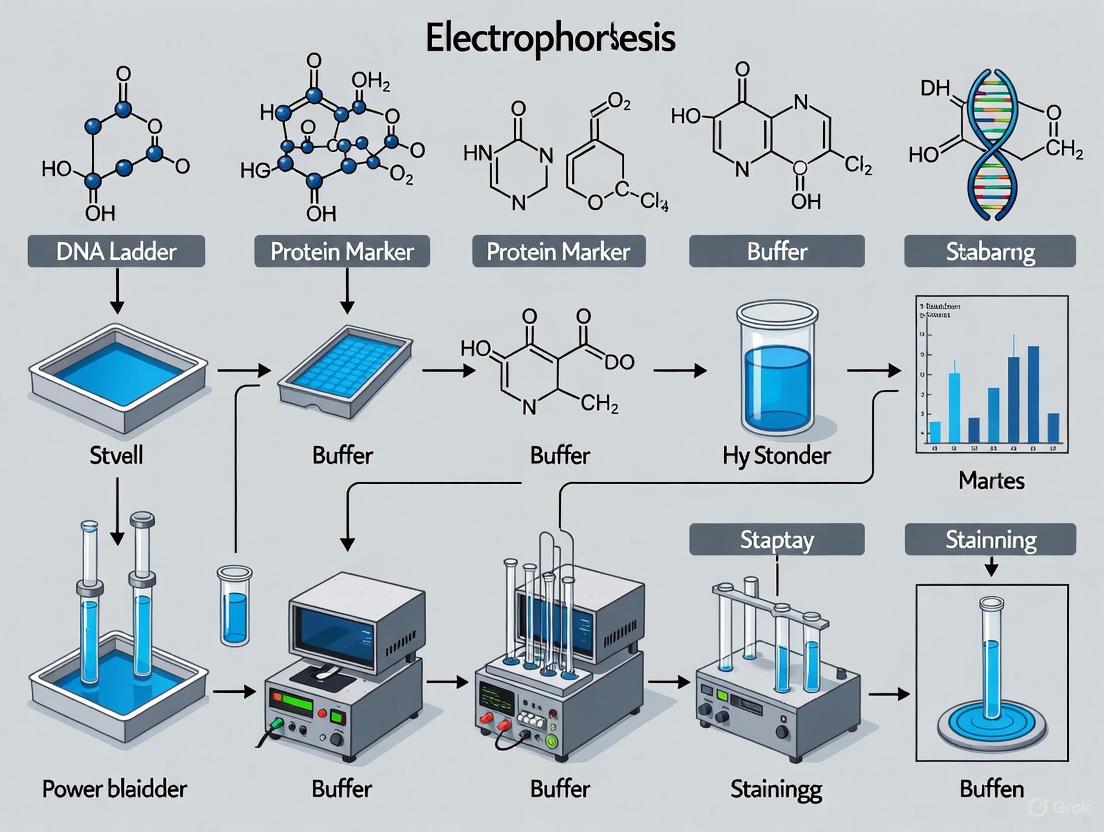
This comprehensive article explores the fundamental principles, diverse methodologies, practical applications, and emerging trends in electrophoresis for biomolecule separation.
Advanced Electrophoresis Techniques for Biomolecule Separation: A Comprehensive Guide for Research and Drug Development
Abstract
This comprehensive article explores the fundamental principles, diverse methodologies, practical applications, and emerging trends in electrophoresis for biomolecule separation. Tailored for researchers, scientists, and drug development professionals, it covers foundational concepts of slab gel, capillary, and microchip techniques; detailed protocols for nucleic acid and protein analysis; systematic troubleshooting for common experimental artifacts; and comparative validation with innovative alternatives. The content synthesizes current innovations, including automation, AI integration, and microfluidics, providing both theoretical knowledge and practical guidance to enhance experimental efficiency and accuracy in biomedical research and clinical diagnostics.
Core Principles and Evolution of Electrophoresis Technology
The field of biomolecule separation was fundamentally transformed by the pioneering work of Arne Tiselius, who in 1937 demonstrated that charged particles could be separated using an electrical field [1] [2]. His development of moving-boundary electrophoresis represented the first systematic method for separating complex biological mixtures based on charge differences, earning him the Nobel Prize in Chemistry in 1948 [3]. This breakthrough initiated a technological evolution that has progressed through increasingly sophisticated separation methodologies, culminating in today's integrated microfluidic systems [1] [4].
The journey from Tiselius' original apparatus to modern microfluidic devices reflects a continuous pursuit of higher resolution, faster analysis, and greater automation. Where early electrophoresis used liquid media susceptible to diffusion and convection, the subsequent introduction of solid supporting matrices like filter paper, agarose, and polyacrylamide gel dramatically improved resolution by stabilizing separated components into discrete zones [1] [2]. This evolution has positioned electrophoresis as an indispensable tool in molecular biology, proteomics, and clinical diagnostics, enabling everything from DNA sequencing to protein fingerprinting [1].
Historical Milestones in Electrophoresis Development
The Tiselius Era and Moving-Boundary Electrophoresis
Arne Tiselius's groundbreaking work built upon earlier observations of electrokinetic phenomena dating back to 1807 by Strakhov and Reuß, who noted that clay particles in water would migrate under a constant electric field [1]. Tiselius's key innovation was the refinement of these principles into a practical analytical tool. His apparatus, developed with support from the Rockefeller Foundation, employed optical detection of moving boundaries using schlieren techniques to visualize separated components in solution [1].
The Tiselius method suffered from significant limitations—it could not achieve complete separation of similar compounds and provided limited resolution due to gravitational effects and diffusion in liquid media [1] [2]. Despite these constraints, it successfully demonstrated that serum proteins could be separated into different fractions, laying the foundation for subsequent advances in protein analysis [3]. Tiselius himself recognized these limitations and later coined the term "zone electrophoresis" in 1950 to describe emerging methods that used solid or gel matrices to separate compounds into discrete bands [1].
The Zone Electrophoresis Revolution
The 1940s and 1950s witnessed a paradigm shift from moving-boundary to zone electrophoresis techniques, which addressed fundamental limitations of the Tiselius apparatus. The introduction of solid supporting matrices including filter paper, cellulose acetate, and various gels enabled complete separation of components into stable, discrete zones [1] [2]. This period marked the transition of electrophoresis from a specialized analytical technique to a broadly accessible laboratory tool.
A critical advancement came in 1955 when Oliver Smithies introduced starch gel electrophoresis, which provided significantly improved resolution for protein separation [1]. This was followed by the development of polyacrylamide gel electrophoresis (PAGE), which offered precise control over pore size through adjustable cross-linking densities [1] [2]. The introduction of sodium dodecyl sulfate (SDS) to denature proteins and impart a uniform charge-to-mass ratio further revolutionized protein analysis, enabling separation based primarily on molecular weight [2] [5].
Capillary and Microfluidic Electrophoresis
The 1980s and 1990s saw the emergence of capillary electrophoresis (CE), which addressed several limitations of slab gel methods [4] [6]. By performing separations within narrow-bore capillaries, CE leveraged efficient heat dissipation to enable application of very high voltages (typically 10-30 kV), resulting in faster separations with superior resolution [2] [4]. The technique also facilitated direct on-line detection through various detection methods including UV-Vis absorbance and laser-induced fluorescence [4].
The most recent evolutionary stage has been the integration of electrophoresis principles with microfluidic technology, creating lab-on-a-chip devices that miniaturize and automate complex analytical workflows [7] [4]. First proposed in the early 1990s, these systems manipulate small fluid volumes (microliter to picoliter range) within channels less than 1 millimeter wide [7] [6]. The convergence of electrophoresis with microfluidics has enabled unprecedented levels of automation, parallelization, and integration of multiple processing steps from sample preparation to final detection [7] [8].
Table 1: Historical Evolution of Electrophoresis Techniques
| Time Period | Dominant Technology | Key Innovations | Primary Applications |
|---|---|---|---|
| 1930s-1940s | Moving-boundary electrophoresis | Tiselius apparatus, schlieren optics | Serum protein separation |
| 1950s-1960s | Zone electrophoresis | Starch gels, polyacrylamide gels, cellulose acetate | Protein fractionation, clinical diagnostics |
| 1970s-1980s | Advanced gel electrophoresis | SDS-PAGE, isoelectric focusing, 2D electrophoresis | Molecular biology, proteomics, DNA separation |
| 1990s-2000s | Capillary electrophoresis | High voltage separation, on-column detection | Pharmaceutical analysis, genetic analysis |
| 2000s-Present | Microfluidic electrophoresis | Lab-on-a-chip, integrated systems, digital microfluidics | Point-of-care diagnostics, high-throughput screening, single-cell analysis |
Fundamental Principles and Technical Considerations
Core Principles of Electrophoresis
All electrophoresis techniques share the fundamental principle that charged particles will migrate in response to an applied electric field [2] [5]. The direction and velocity of migration depend on the net charge, size, and shape of the molecule, as well as the properties of the separation medium [4]. In gel electrophoresis, the matrix acts as a molecular sieve, retarding larger molecules while allowing smaller ones to migrate more rapidly [9] [5].
Several critical factors influence electrophoretic separation efficiency. The electrophoretic mobility (μ) of a molecule is directly proportional to its net charge and inversely proportional to its size and the viscosity of the medium [2] [5]. Buffer conditions including pH and ionic strength significantly impact separation by altering the charge state of molecules and affecting current flow and heating [4] [5]. Optimal ionic strength is essential, as high ionic strength increases current and heat generation, while low ionic strength reduces resolution due to diminished current flow [5].
Key Technical Components
All electrophoresis systems share common core components, though their implementation varies across different platforms. These include:
- Power supply: Provides the electrical field necessary for particle migration, with voltage requirements ranging from 100-150 V for conventional slab gels to thousands of volts for capillary systems [9] [5].
- Buffer system: Carries current and maintains stable pH conditions throughout separation [2] [5]. Common buffers include TAE (Tris-acetate-EDTA) and TBE (Tris-borate-EDTA) for nucleic acids, and various Tris-based buffers for proteins [9].
- Support medium: Provides the matrix for separation, with choice of medium depending on application requirements [2] [5].
- Detection system: Visualizes and quantifies separated components, ranging from simple staining and UV transillumination to sophisticated in-line detectors for capillary systems [9] [5].
Table 2: Common Support Media in Electrophoresis
| Medium Type | Typical Applications | Resolution | Key Characteristics |
|---|---|---|---|
| Agarose gel | DNA/RNA separation, large proteins | Moderate | Easy to use, non-toxic, pore size 0.1-0.5% |
| Polyacrylamide gel | Proteins, small DNA fragments, sequencing | High | Adjustable pore size, can be toxic |
| Cellulose acetate | Clinical protein analysis, hemoglobin variants | Good | Rapid separation, minimal sample interaction |
| Capillary | Various analytes with UV/fluorescence detection | Very High | Fast, automated, requires specialized instrumentation |
| Microfluidic chip | Diverse applications with integrated processing | High to Very High | Miniaturized, automated, low sample consumption |
Modern Electrophoresis Techniques and Applications
Slab Gel Electrophoresis Methods
Despite the emergence of more advanced technologies, traditional slab gel electrophoresis remains widely employed in research and clinical laboratories due to its simplicity, low cost, and ability to process multiple samples simultaneously [4]. Key variants include:
Agarose Gel Electrophoresis is the method of choice for separating nucleic acids ranging from 100 base pairs to over 25 kilobases [9]. The pore size of agarose gels is determined by the agarose concentration (typically 0.7%-2%), with lower percentages providing better resolution for larger DNA fragments and higher percentages optimizing separation of smaller fragments [9]. Agarose gels are simple to prepare and are typically run at moderate voltages (1-10 V/cm) for 30 minutes to several hours [9].
Polyacrylamide Gel Electrophoresis (PAGE) provides superior resolution for proteins and small nucleic acids [2] [5]. The cross-linked structure of polyacrylamide creates a more uniform molecular sieve with precisely controllable pore sizes determined by the ratio of acrylamide to bis-acrylamide [2]. SDS-PAGE denatures proteins and masks their native charge, enabling separation based primarily on molecular weight [2] [5]. Native PAGE preserves protein structure and biological activity, separating based on both size and charge [2].
Two-Dimensional Electrophoresis combines isoelectric focusing (separation based on isoelectric point) with SDS-PAGE (separation based on molecular weight) to achieve extremely high resolution for complex protein mixtures [2] [5]. This technique can resolve thousands of proteins in a single analysis and has been instrumental in proteomics research [5].
Capillary Electrophoresis
Capillary electrophoresis represents a significant advancement over slab gel methods, offering faster analysis, higher resolution, and automated operation [4]. In CE, separation occurs within narrow-bore capillaries (typically 25-100 μm internal diameter) filled with buffer or separation matrix [4]. The high surface-to-volume ratio enables efficient heat dissipation, allowing application of very high electric fields (100-500 V/cm) without excessive heating [4]. This results in rapid separations (often minutes instead of hours) with exceptional resolution [4].
CE systems typically incorporate on-column detection methods such as UV-Vis absorbance, laser-induced fluorescence, or mass spectrometry, enabling real-time monitoring and quantification of separated components [4]. The technique finds extensive application in pharmaceutical analysis, clinical diagnostics, and genetic analysis [4].
Microfluidic Electrophoresis Systems
Microfluidic electrophoresis represents the current state-of-the-art, integrating separation capabilities with other analytical functions on miniaturized chips [7] [4]. These lab-on-a-chip devices typically feature networks of microchannels, chambers, and valves that enable precise manipulation of fluid volumes in the microliter to picoliter range [7]. The microscale dimensions confer several advantages including minimal reagent consumption, rapid analysis times, and portability [7].
Key variants of microfluidic electrophoresis include:
- Continuous-flow microfluidics: Manipulates streams of fluid through permanently open channels for applications such as chemical reactions and separations [7].
- Droplet-based microfluidics: Generates and manipulates discrete picoliter-volume droplets, each serving as an isolated microreactor ideal for digital PCR and single-cell analysis [7] [8].
- Digital microfluidics: Controls individual droplets through electrowetting on an array of electrodes, enabling programmable, pump-free fluid handling [8].
- Paper-based microfluidics: Utilizes capillary action in patterned paper channels for ultra-low-cost diagnostic devices suitable for resource-limited settings [7].
Microfluidic electrophoresis systems have found particularly valuable application in point-of-care diagnostics, where their compact size, rapid analysis, and automation capabilities enable sophisticated testing outside central laboratories [7] [8]. Commercial applications include infectious disease testing, blood glucose monitoring, and COVID-19 detection [7].
Comparative Analysis of Electrophoresis Techniques
The various electrophoresis platforms offer distinct advantages and limitations, making them suitable for different applications and operational contexts. Understanding these trade-offs is essential for selecting the appropriate method for specific research or diagnostic needs.
Table 3: Performance Comparison of Electrophoresis Techniques
| Technique | Resolution | Analysis Speed | Throughput | Cost | Ease of Use |
|---|---|---|---|---|---|
| Slab Gel Electrophoresis | Moderate to High | Slow (1-4 hours) | Moderate | Low | Moderate |
| Capillary Electrophoresis | High | Fast (5-30 minutes) | Low to Moderate | High | High (automated) |
| Microchip Electrophoresis | High to Very High | Very Fast (1-10 minutes) | High | Moderate to High | High |
| Isotachophoresis | Moderate | Moderate (10-30 minutes) | Low | Moderate | Moderate |
Slab gel electrophoresis remains popular for applications requiring visual comparison of multiple samples, educational use, and situations where cost is a primary concern [4]. However, it is relatively labor-intensive, difficult to automate, and provides limited quantitative capabilities compared to more advanced platforms [4].
Capillary electrophoresis offers superior resolution and quantification capabilities, particularly for complex mixtures, and enables full automation of the separation and detection process [4]. Its limitations include higher instrument costs and reduced ability to process multiple samples in parallel compared to slab gels [4].
Microfluidic electrophoresis provides the highest level of integration and automation, enabling consolidation of multiple processing steps onto a single platform [7] [4]. These systems excel in applications requiring minimal sample volume, rapid analysis, and portability [7]. Current limitations include higher development complexity and challenges in scaling up manufacturing [7] [8].
Detailed Experimental Protocols
Protocol: Standard Agarose Gel Electrophoresis for DNA Separation
This protocol describes the fundamental method for separating DNA fragments using agarose gel electrophoresis, a cornerstone technique in molecular biology laboratories [9].
Research Reagent Solutions:
- Agarose powder: Polysaccharide matrix that forms a porous gel for size-based separation [9].
- TAE or TBE buffer (1x): Carries current and maintains stable pH; Tris-acetate-EDTA or Tris-borate-EDTA [9].
- DNA loading dye: Contains dense agents (e.g., glycerol) to help samples sink into wells and tracking dyes to monitor migration progress [9].
- Ethidium bromide solution (10 mg/mL): Fluorescent nucleic acid stain for DNA visualization under UV light; handle with care as it is a mutagen [9].
- DNA molecular weight ladder: A mixture of DNA fragments of known sizes for calibrating and estimating the size of unknown fragments [9].
Equipment:
- Gel casting tray and well combs
- Gel electrophoresis box and power supply
- Microwave oven or hot plate
- UV transilluminator or gel documentation system
Procedure:
- Prepare Agarose Gel Solution: Weigh the appropriate amount of agarose for the desired gel concentration (e.g., 1.0 g for a 1% gel in 100 mL of 1x TAE buffer). A 1% gel is suitable for separating 0.5-10 kb DNA fragments [9].
- Melt Agarose: Mix agarose powder with 1x TAE buffer in a heat-resistant flask. Microwave in short bursts (30-45 seconds) until the agarose is completely dissolved, swirling gently between bursts to ensure even heating. Exercise caution to avoid boil-overs [9].
- Cool Solution: Allow the melted agarose solution to cool to approximately 50-60°C (comfortable to hold in bare hands) to prevent warping the casting tray [9].
- Add Stain (if desired): For post-staining, the gel can be cast without stain. For integrated staining, add ethidium bromide to a final concentration of 0.2-0.5 μg/mL and mix thoroughly. Wear appropriate PPE [9].
- Cast the Gel: Place the well comb in the casting tray. Pour the cooled agarose solution into the tray, ensuring no bubbles form near the comb. Allow the gel to solidify completely at room temperature for 20-30 minutes [9].
- Set Up Electrophoresis: Once solidified, carefully remove the comb and place the gel in the electrophoresis chamber. Submerge the gel completely with 1x TAE buffer [9].
- Load Samples: Mix DNA samples with 6x loading dye. Carefully load the DNA ladder and samples into the wells [9].
- Run Electrophoresis: Connect the lid, ensuring the correct polarity (DNA migrates toward the positive anode - "Run to Red"). Apply a voltage of 80-150 V. Run until the tracking dye has migrated 75-80% of the gel length [9].
- Visualize DNA: Turn off the power. If the gel was not pre-stained, carefully transfer it to a staining solution containing ethidium bromide (0.5 μg/mL) for 20-30 minutes, followed by a brief destaining step in water. Visualize the DNA bands using a UV transilluminator [9].
Troubleshooting Tips:
- Poor Resolution of Bands: Run the gel at a lower voltage for a longer period, load less DNA, or adjust the agarose concentration for the fragment sizes being separated [9].
- Smiled Bands: Often caused by uneven heating; ensure the gel is fully submerged in buffer and consider running at a lower voltage [9].
Protocol: Microfluidic Electrophoresis Chip Operation
This protocol outlines the general workflow for performing an electrophoretic separation using a commercial microfluidic chip system, such as those used for protein or nucleic acid analysis (e.g., Agilent Bioanalyzer or LabChip systems).
Research Reagent Solutions:
- Proprietary Gel-Matrix Polymer: Contains a replaceable sieving polymer and fluorescent dye for on-chip separation and detection [7].
- Proprietary DNA/RNA or Protein Marker: Used as an internal size standard for accurate fragment sizing and quantification.
- Ionic Buffer/Sieving Buffer: Provides the conductive medium for electrophoresis within the microchannels.
- Sample Buffer: Contains a proprietary dye and denaturants (if required) to prepare the sample for injection.
Equipment:
- Microfluidic Chip (e.g., DNA, RNA, or Protein chip)
- Chip Priming Station
- Microfluidic Instrumentation (includes chip reader, software, and voltage controllers)
- IKA Vortex Mixer
- Magnetic Spin Vac
- Pipettes and specific tips
Procedure:
- Chip and Reagent Preparation: Remove the gel matrix, dyes, and chips from storage and allow them to warm to room temperature. Vortex the gel matrix and spin down. Label the chip appropriately [7].
- Chip Priming: Pipette the gel matrix into the appropriate well. Position the chip in the priming station and close the lid. Press the plunger and hold for exactly 60 seconds. Release the plunger slowly. Confirm that the plunger has moved back to the start position, indicating the chip has been properly filled [7].
- Load Buffers and Samples: Pipette the ionic buffer/sieving buffer into the designated buffer wells. Pipette the marker into all sample wells and any unused wells. Pipette the prepared samples (mixed with sample buffer) into the designated sample wells. Ensure no bubbles are introduced [7].
- Chip Processing: Place the chip securely into the instrument adapter. Close the lid and start the run via the associated software. The instrument automatically applies voltages for sample injection, separation, and detection via a laser-induced fluorescence (LIF) detector [7].
- Data Analysis: After the run is complete (typically 20-40 minutes), the software automatically generates an electrophoretogram for each sample, displays a virtual gel image, and provides sizing and concentration data based on the internal standard [7].
Troubleshooting Tips:
- Poor Sensitivity: Ensure reagents are at room temperature and have not expired. Check that the chip was primed correctly and that no bubbles are blocking the microchannels [7].
- Inaccurate Sizing: Ensure the correct ladder/marker was used and that it was loaded properly. Check for degraded samples [7].
Advanced Applications and Future Perspectives
Electrophoresis techniques have become indispensable across diverse scientific and clinical domains. In genomics and molecular biology, agarose and polyacrylamide gel electrophoresis remain fundamental for analyzing PCR products, restriction digests, and nucleic acid purity [9] [4]. Capillary electrophoresis has become the gold standard for Sanger sequencing and fragment analysis for genetic testing [4] [6].
In proteomics, two-dimensional gel electrophoresis enables comprehensive analysis of complex protein mixtures, while capillary electrophoresis coupled with mass spectrometry provides high-resolution separation and identification of peptides and proteins [4] [6]. Clinical diagnostics relies heavily on electrophoresis for serum protein analysis, hemoglobin variant detection, and immunofixation electrophoresis for identifying monoclonal gammopathies [2] [5].
Emerging trends point toward increasing integration, miniaturization, and intelligence in electrophoresis systems. The convergence of microfluidics with artificial intelligence is enabling automated image analysis, pattern recognition, and data interpretation from complex electrophoretic separations [8]. The development of organ-on-a-chip platforms that incorporate electrophoretic analysis capabilities is creating new opportunities for drug screening and disease modeling in physiologically relevant environments [7] [8].
Future developments will likely focus on enhancing multi-omics integration, where electrophoretic separations are seamlessly coupled with downstream genomic, proteomic, and metabolomic analyses. Advances in materials science are yielding new polymer matrices with enhanced separation properties and reduced environmental impact [8]. As these technologies continue to evolve, electrophoresis will maintain its central role in advancing our understanding of biological systems and improving human health.
Diagram 1: Experimental workflow for agarose gel and microfluidic electrophoresis protocols
Diagram 2: Historical timeline of key developments in electrophoresis technology
Electrophoresis remains a cornerstone technique in biochemical research and clinical diagnostics for the separation and analysis of complex biomolecules. The technique, first demonstrated by Tiselius in 1937, exploits the differential migration of charged particles under the influence of an electric field [5]. The fundamental separation mechanisms governing electrophoretic mobility rely on three core biomolecular properties: charge, size, and shape [5] [4]. A comprehensive understanding of these dynamics is crucial for researchers and drug development professionals to select appropriate methodologies, optimize separation conditions, and accurately interpret analytical results for molecules ranging from nucleic acids and proteins to novel biopharmaceutical entities.
This article details the principles and protocols underpinning these separation mechanisms, providing a structured framework for their application in modern biomolecular research.
Core Principles of Electrophoretic Separation
The rate of migration (electrophoretic mobility) of a molecule in an electric field is determined by a balance between the driving force of the electric field and the retarding frictional forces of the medium. The dynamics of this process are governed by several interrelated factors [5] [4].
- Charge: The net charge of a molecule is the primary driver of its electrophoretic mobility. Positively charged cations migrate toward the negative cathode, while negatively charged anions migrate toward the positive anode [5]. The charge of a biomolecule like a protein is highly dependent on the pH of the buffer relative to the molecule's isoelectric point (pI) [4].
- Size: For molecules of similar charge, smaller entities experience less drag and migrate faster through the gel matrix or capillary medium. This inverse relationship between size and mobility is the basis for molecular weight determination [5] [10].
- Shape: The three-dimensional conformation of a molecule affects the frictional drag it experiences. Globular proteins, with their compact structures, exhibit faster mobility compared to fibrous proteins of similar molecular weight [5].
Other critical factors fine-tuning the separation include the strength of the electrical field, the buffer's pH and ionic strength, and the properties of the supporting medium (e.g., pore size) [5] [4]. The following table summarizes the influence of these key parameters.
Table 1: Factors Affecting Electrophoretic Mobility
| Factor | Effect on Mobility | Practical Consideration |
|---|---|---|
| Net Charge | Directly proportional | Higher charge increases migration speed; controlled by buffer pH [5]. |
| Size/Mass | Inversely proportional | Larger molecules migrate slower; basis for molecular weight analysis [5]. |
| Molecular Shape | Impacts frictional drag | Globular shapes migrate faster than fibrous molecules of similar mass [5]. |
| Electric Field Strength | Directly proportional | Higher voltage speeds up migration but can generate excessive heat [5]. |
| Buffer Ionic Strength | Complex effect | Higher ionic strength increases current but can slow migration and generate heat [5] [4]. |
| Support Medium Pore Size | Impacts molecular sieving | Smaller pores retard larger molecules more effectively; gel concentration controls pore size [5]. |
Key Electrophoresis Techniques and Mechanisms
Different electrophoresis techniques leverage the core principles of charge, size, and shape in distinct ways to achieve specific analytical goals. The workflow below illustrates the decision pathway for selecting the appropriate technique based on research objectives and sample properties.
Diagram 1: Technique selection workflow for common electrophoresis methods.
Gel Electrophoresis: Molecular Sieving
Gel electrophoresis separates molecules primarily by size using a porous gel matrix as a molecular sieve. The two most common media are agarose and polyacrylamide.
- Agarose Gel Electrophoresis: Utilized for separating larger molecules like nucleic acids (DNA and RNA). Agarose gels have larger pores, allowing for the resolution of nucleic acid fragments from dozens to thousands of base pairs [11] [10]. The separation is based on the fact that DNA is uniformly negatively charged, so migration distance is inversely proportional to the logarithm of the molecular weight.
- Polyacrylamide Gel Electrophoresis (PAGE): Provides finer resolution for smaller molecules, including proteins and small nucleic acids. Its smaller, more uniform pore size allows for the separation of molecules with very slight size differences [5] [10]. A critical variant is SDS-PAGE, where the anionic detergent SDS binds to proteins, masking their native charge and conferring a uniform negative charge-to-mass ratio. SDS also denatures proteins, giving them a uniform rod-like shape. This eliminates the effects of charge and shape, allowing separation based purely on polypeptide chain mass [5].
Capillary Electrophoresis: Electrokinetic Separation
Capillary electrophoresis (CE) performs separations within a narrow-bore fused-silica capillary filled with buffer. The primary separation mechanism is a combination of electrophoretic mobility (governed by a molecule's charge-to-size ratio) and electroosmotic flow (EOF), a bulk flow of buffer solution induced by the charged capillary wall [4] [10]. CE offers high resolution, rapid analysis (often in minutes), automation, and requires only nanoliter sample volumes. It is widely applied in clinical diagnostics (e.g., hemoglobin analysis), pharmaceutical quality control, and DNA sequencing [12] [10].
Isoelectric Focusing: Charge-Based Separation
Isoelectric focusing (IEF) separates molecules based solely on their isoelectric point (pI). The technique uses a gel matrix containing a pH gradient established by ampholytes. When an electric field is applied, molecules migrate until they reach the pH region where their net charge is zero (their pI), at which point migration ceases [5]. This technique provides exceptionally high resolution for separating protein charge variants, such as those with different post-translational modifications.
Two-Dimensional Electrophoresis
Two-dimensional (2D) electrophoresis combines IEF and SDS-PAGE to achieve the highest resolution for complex protein mixtures. Proteins are first separated based on their pI by IEF in one dimension. The entire gel strip is then applied to a polyacrylamide gel and subjected to SDS-PAGE in the second dimension, separating the proteins by molecular mass [5]. This orthogonal separation method allows for the resolution of thousands of proteins from a single sample.
Table 2: Comparative Analysis of Major Electrophoresis Techniques
| Technique | Primary Separation Mechanism | Key Applications | Advantages | Limitations |
|---|---|---|---|---|
| Agarose Gel | Size (Molecular sieving) | DNA/RNA fragment analysis, PCR verification [11] [10] | Simple, cost-effective, good for large fragments [10] | Lower resolution, manual, qualitative/semi-quantitative [10] |
| SDS-PAGE | Size (Mass of polypeptide chains) | Protein purity, molecular weight estimation, Western blot [5] [10] | Eliminates charge/shape effects, reproducible, widely used [5] | Requires protein denaturation, not for native charge analysis |
| Isoelectric Focusing (IEF) | Charge (Isoelectric point) | Separation of protein isoforms, charge variant analysis [5] | Extremely high resolution for charge-based separation [5] | Requires specific pH gradients, not for size analysis |
| Capillary Electrophoresis (CE) | Size-to-charge ratio & Electroosmotic Flow | Clinical diagnostics (hemoglobin, serum proteins), DNA sequencing, high-throughput QC [4] [10] | High resolution, fast, automated, low sample volume, quantitative [10] | Higher instrument cost, more complex operation than gel [12] |
| 2D Electrophoresis | Charge (1D) & Size (2D) | Proteomics, complex protein mixture analysis [5] | Highest resolution, can separate thousands of proteins [5] | Technically challenging, time-consuming, low throughput |
Detailed Experimental Protocols
Protocol: SDS-PAGE for Protein Separation
This protocol describes the standard method for separating proteins by molecular weight using a vertical gel electrophoresis system [5] [11].
Research Reagent Solutions & Materials: Table 3: Essential Materials for SDS-PAGE
Item Function Vertical Gel Electrophoresis System Apparatus to hold gel and buffer, provide electrical field [11] Polyacrylamide Gel Support medium with precise pore size for molecular sieving [5] Power Supply Provides controlled electrical current/voltage [11] SDS-PAGE Running Buffer Carries current, maintains pH during run [11] Laemmli Sample Buffer Contains SDS (denatures, confers charge), glycerol (adds density), dye (tracking) [5] Protein Ladder (Molecular Weight Marker) Reference for estimating sample protein sizes [11] Staining Solution (e.g., Coomassie) Visualizes separated protein bands post-run [11] Step-by-Step Procedure:
- Sample Preparation: Mix protein samples with Laemmli sample buffer. Heat denature at 95-100°C for 5 minutes to fully denature proteins and ensure uniform SDS binding [5] [11].
- Gel and Buffer Setup: Assemble the vertical gel apparatus. Pour the running buffer into the upper and lower chambers, ensuring the gel is fully submerged. Remove the comb from the gel to expose the wells [11].
- Sample Loading: Using a micro-pipette, carefully load equal volumes of prepared samples and protein ladder into designated wells. Record the loading order [11].
- Electrophoresis Run: Attach the lid to the apparatus, connecting the electrodes to the power supply. Run the gel at a constant voltage (e.g., 100-150 V) until the dye front migrates to the bottom of the gel (typically 45-90 minutes). Voltage can be optimized for resolution and speed [11].
- Protein Visualization: After the run, turn off the power supply. Disassemble the apparatus and carefully remove the gel. Stain the gel with Coomassie Blue or a fluorescent protein stain to visualize the separated bands. Destain as needed, then image the gel using a digital imager or scanner for analysis [11].
Protocol: Capillary Electrophoresis for Nucleic Acid Analysis
This protocol outlines the general workflow for analyzing DNA fragments using capillary electrophoresis, common in genetic testing and sequencing applications [4] [10].
Research Reagent Solutions & Materials:
- Capillary Electrophoresis Instrument
- Fused-Silica Capillary
- Separation Matrix (e.g., polymer solution)
- Run Buffer (Electrolyte)
- DNA Size Standard
- Sample Tray and Vials
Step-by-Step Procedure:
- Instrument Setup: Install the capillary and initialize the instrument according to the manufacturer's instructions. Prime the capillary with the appropriate separation polymer and run buffer [10].
- Sample Preparation: Dilute DNA samples and internal size standards in the recommended buffer. Transfer the samples to the instrument's sample vials and place them in the designated tray [10].
- Automated Run Sequence: Program the instrument method, specifying injection parameters (pressure or voltage), separation voltage, temperature, and detection settings. The instrument will automatically perform the following steps [10]:
- Electrokinetic Injection: A brief electric field is applied to inject a nanoliter-volume plug of the sample into the capillary.
- Separation: A high voltage (e.g., 5-15 kV) is applied. DNA fragments, which are negatively charged, migrate toward the anode. The polymer matrix acts as a sieve, separating fragments by size.
- On-Column Detection: As separated DNA fragments pass through a detector (typically laser-induced fluorescence) at the end of the capillary, they are detected in real-time.
- Data Analysis: The detector generates an electropherogram, a plot of signal intensity versus migration time. Software converts migration times to fragment sizes based on the internal standard and provides quantitative data on peak area and height [10]. The entire process, from injection to data output, is typically completed in under 30 minutes.
Applications in Biomolecular Research and Drug Development
The precise separation capabilities of electrophoresis techniques make them indispensable across diverse scientific disciplines.
- Genomics and Molecular Biology: Agarose gel electrophoresis is fundamental for analyzing PCR products, restriction digests, and nucleic acid quality control. Capillary electrophoresis is the gold standard for DNA sequencing and fragment analysis (e.g., STR profiling in forensics) [12] [10].
- Proteomics and Biomarker Discovery: 2D electrophoresis remains a powerful tool for profiling complex protein mixtures from cells or tissues, facilitating the discovery of disease-specific biomarkers. SDS-PAGE is a routine step in Western blotting for protein detection and quantification [5] [4].
- Clinical Diagnostics: Electrophoresis is used to separate serum proteins for diagnosing conditions like monoclonal gammopathies and to analyze hemoglobin variants for disorders such as sickle cell disease [5] [10].
- Pharmaceutical and Biopharmaceutical Analysis: Electrophoresis techniques are critical for quality control and stability testing of biologics. CE and SDS-PAGE are used to assess drug purity, detect degradation products, and characterize charge heterogeneity of therapeutic proteins like monoclonal antibodies [12] [4] [13].
The separation of biomolecules by electrophoresis is governed by the fundamental dynamics of charge, size, and shape. Mastery of these principles allows researchers to leverage a versatile toolkit—from the classical gel-based methods to advanced automated capillary systems—to solve complex analytical challenges. As research in genomics, proteomics, and biopharmaceuticals advances, these electrophoresis techniques will continue to be vital for driving discovery, ensuring diagnostic accuracy, and maintaining the quality and safety of novel therapeutics.
Electrophoresis is a cornerstone technique in biomolecular research, enabling the separation, analysis, and purification of DNA, RNA, and proteins based on size, charge, and shape. Its applications span critical areas from disease diagnosis and drug development to the elucidation of fundamental molecular pathways [14]. The reproducibility, resolution, and success of any electrophoretic separation are fundamentally dependent on three essential components: the buffer system, the support medium, and the power supply. This application note details the functions, selection criteria, and advanced methodologies for these core components, providing researchers and drug development professionals with detailed protocols to optimize their electrophoresis workflows.
The Buffer System: Foundation for Separation
The electrophoresis buffer is an electrolyte solution that serves multiple critical functions: it provides the ions necessary to carry the electrical current, establishes a stable pH to ensure biomolecules maintain their charge, and contributes to the overall ionic strength and conductivity of the system [15] [16].
Composition and Function of Key Buffers
Different buffers are optimized for specific applications. The table below summarizes the properties of common electrophoresis buffers.
Table 1: Characteristics of Common Gel Electrophoresis Buffers
| Buffer | Full Name & Key Components | Useful pH Range | pKa (25°C) | Conductivity & Heat Generation | Primary Applications |
|---|---|---|---|---|---|
| TAE | Tris-Acetate-EDTA [16] | 7.5 - 9.0 [17] | 7.8 - 8.2 [17] | Higher conductivity, more heat [16] | Larger DNA fragments (>1 kb); DNA recovery post-electrophoresis [16] |
| TBE | Tris-Borate-EDTA [16] | Not explicitly stated | Not explicitly stated | Lower conductivity, less heat, allows higher voltage [16] | Smaller DNA fragments (<1 kb); high-resolution separations [16] |
| Tricine | N-[Tris(hydroxymethyl)methyl]glycine [14] | 7.4 - 8.8 [17] | 8.0 - 8.3 [17] | Used in low-conductivity BGE for CE [14] | Peptide and protein separation; capillary electrophoresis [17] |
| Bicine | N,N-Bis(2-hydroxyethyl)glycine [17] | 7.6 - 9.0 [17] | 8.1 - 8.5 [17] | Not explicitly stated | Specialized protein separations (e.g., membrane proteins) [17] |
| CHES | 2-(Cyclohexylamino)ethanesulfonic acid [17] | 9.7 - 11.1 [17] | 10.2 - 10.6 [17] | Not explicitly stated | Capillary electrophoresis at alkaline pH [17] |
The Critical Role of Conductivity
The ionic strength of the buffer determines its conductivity, which directly impacts the electric field strength and heat generation during a run. Managing conductivity is crucial. High-conductivity buffers, such as Phosphate-Buffered Saline (PBS), are often necessary to maintain biomolecular interactions under physiological conditions. However, when used in capillary electrophoresis (CE) with a low-conductivity Background Electrolyte (BGE), they can cause significant artifacts like peak broadening, splitting, and distortion, ultimately reducing measurement accuracy in binding assays [14]. Conversely, low-conductivity buffers like Tris-Borate or Sodium Borate (SB) allow for higher applied voltages and faster run times with reduced Joule heating [16].
Best Practice: For consistent results, the ionic system of the gel casting buffer and the running buffer should be matched or closely compatible to maintain steady pH and field strength [15].
Support Media: The Separation Matrix
The support medium, or gel matrix, provides a porous structure through which biomolecules migrate. The choice of medium depends on the size of the molecules being separated and the required resolution.
- Agarose Gels: Derived from seaweed, agarose forms a porous matrix with large pore sizes, making it ideal for separating large nucleic acid fragments (from dozens to thousands of base pairs). It is typically used at concentrations between 0.5% and 2% [15] [16].
- Polyacrylamide Gels (PAGE): These gels are formed through the polymerization of acrylamide monomers into a cross-linked mesh-like matrix with much smaller pores than agarose. They are the preferred medium for separating proteins and small nucleic acids with high resolution. The pore size can be precisely controlled by adjusting the concentration of acrylamide and the cross-linker [18].
The matrix functions as a molecular sieve, allowing smaller molecules to migrate faster while larger molecules are retarded [18]. In techniques like SDS-PAGE, sodium dodecyl sulfate (SDS) denatures proteins and confers a uniform negative charge, ensuring separation is based almost exclusively on molecular weight [18].
Power Systems: Driving the Separation
The power supply is the engine of electrophoresis, providing the stable electrical current necessary for driving the separation of biomolecules. Its performance is a critical determinant of experimental reproducibility [19] [20].
Operational Modes
Power supplies operate in three primary modes, each suited to different applications:
Table 2: Operational Modes of Electrophoresis Power Supplies
| Mode | Principle | Primary Application | Key Advantage |
|---|---|---|---|
| Constant Voltage | Voltage remains fixed; current and power can fluctuate [19]. | DNA separation on agarose gels [19]. | Simple and reliable for standard runs [19]. |
| Constant Current | Current remains fixed; voltage and power can fluctuate [19]. | Protein separation (SDS-PAGE) [19]. | Maintains uniform migration rate and prevents band distortion ("smiling") from uneven heating [19]. |
| Constant Power | Power (the product of V and I) remains fixed; voltage and current fluctuate [19]. | Sensitive separations requiring strict temperature control [19]. | Prevents sample degradation by ensuring a consistent rate of heat generation [19]. |
Technical Specifications and Market Trends
When selecting a power supply, key specifications to consider include voltage/current range, power output (in watts), and the number of outputs for running multiple gels simultaneously [19]. The market for high-current power supplies is evolving, with a projected growth from USD 689.2 million in 2025 to USD 1,020.2 million by 2035, driven by expanding molecular biology workflows [21]. Modern units are increasingly featuring programmable interfaces, safety interlocks (e.g., lid interrupts), overheating protection, and integration with laboratory information management systems for enhanced reproducibility and data tracking [21] [19] [20].
Advanced Application: A Protocol for Studying Biomolecular Interactions via Capillary Electrophoresis
Capillary Electrophoresis (CE) is a powerful tool for quantifying biomolecular interactions, such as aptamer-protein binding, due to its high speed, low sample consumption, and adaptability [14]. The following protocol outlines a method for studying these interactions, even under challenging high-conductivity conditions.
Background and Principle
Methods like Affinity Probe Capillary Electrophoresis (APCE) and Nonequilibrium Capillary Electrophoresis of Equilibrium Mixtures (NECEEM) involve introducing pre-equilibrated ligand-target mixtures into the capillary. If the free and bound species have different electrophoretic mobilities, they can be separated and quantified to determine binding parameters such as the dissociation constant (Kd) [14]. A major challenge arises when the sample buffer has higher conductivity than the BGE, leading to peak distortions and reduced accuracy. This protocol includes strategies to mitigate these effects [14].
Materials and Reagents
Table 3: Research Reagent Solutions for Aptamer-Protein Binding Assay
| Item | Function / Explanation |
|---|---|
| FAM-labeled DNA Aptamer | The fluorescently labeled ligand (e.g., a 29mer thrombin-binding aptamer) whose binding is being studied [14]. |
| Target Protein | The target molecule (e.g., thrombin or Human Serum Albumin) [14]. |
| Low-Conductivity BGE | Background Electrolyte (e.g., 30 mM Tricine buffer). Low conductivity is preferred for faster separations and reduced Joule heating [14]. |
| High-Conductivity Sample Buffer | Sample buffer (e.g., 1x PBS or 2x Tris-Glycine) used to maintain physiological or binding-compatible conditions [14]. |
| CE Instrument with LIF Detection | A capillary electrophoresis system equipped with a Laser-Induced Fluorescence (LIF) detector for sensitive detection of labeled aptamers [14]. |
Experimental Workflow
The following diagram illustrates the key steps of the capillary electrophoresis binding assay.
Step-by-Step Procedure
Sample Preparation:
- Reconstitute the FAM-labeled DNA aptamer (e.g., 5′-FAM-AGT CCG TGG TAG GGC AGG TTG GGG TGA CT-3′) in Tris-EDTA buffer [14].
- Heat-cycling: Prior to sample preparation, heat the aptamer in its sample buffer to 95°C for 3 minutes, then allow it to cool to room temperature. This step ensures a consistent secondary structure [14].
- Prepare a series of samples with a constant concentration of aptamer and varying concentrations of the target protein (e.g., thrombin) in a high-conductivity sample buffer (e.g., 1x PBS).
- Incubation: Allow the samples to incubate at room temperature for 1 hour to reach binding equilibrium [14].
Capillary Electrophoresis:
- Use a capillary filled with a low-conductivity BGE, such as 30 mM Tricine [14].
- Injection: Inject the equilibrated sample mixture into the capillary. Critical Note: To minimize artifacts caused by the conductivity mismatch, use a short injection time to reduce the length of the high-conductivity sample plug [14].
- Separation: Apply a separation voltage. The local electric field is inversely related to local conductivity, meaning the high-conductivity sample plug will create a low-field zone, potentially causing de-stacking and band broadening [14].
Data Analysis and Quantification:
- Traditional Peak Analysis: If the separation is successful and produces distinct peaks for the free aptamer and the aptamer-protein complex, quantify the areas under these peaks [14].
- Alternative "De-stacked" Fraction Analysis: Under large conductivity mismatches (e.g., PBS sample buffer vs. Tricine BGE), distinct peaks may not form. The sample zone becomes broad and indistinct. In this case, an alternative method is to quantify the fraction of aptamer that has "escaped" the diffuse sample zone as a sharp, de-stacked peak. This fraction can be correlated with the binding parameters [14].
- Fitting Binding Data: Plot the fraction bound (or the de-stacked fraction) against the target protein concentration and fit the data to an appropriate binding model (e.g., Hill equation) to determine the dissociation constant (Kd) and the Hill coefficient (n) [14].
Integrated Workflow and Technological Advancements
A modern electrophoresis workflow integrates the three core components with advanced instrumentation for data capture and analysis. Gel documentation systems, essential for recording results, now feature high-resolution CCD cameras, broad dynamic range, and sensitive detection for various stains and blots [18] [22]. Furthermore, artificial intelligence is revolutionizing data interpretation. The AI-powered tool GelGenie can automatically identify bands in gel images via segmentation, surpassing the capabilities of traditional software in both ease-of-use and versatility, and providing results that quantitatively match manual analyses [23].
The synergy of optimized buffers, appropriate support media, a stable power supply, and advanced analysis tools ensures that electrophoresis remains a robust, reproducible, and indispensable technique in biomolecular research and drug development.
Gel electrophoresis remains a cornerstone technique in molecular biology and biochemistry laboratories worldwide for the separation of biomolecules such as nucleic acids and proteins [24]. The fundamental principle of this technique involves the movement of charged molecules through a porous matrix under the influence of an electric field, separating them based on size, charge, or conformation. The fidelity and reproducibility of an experiment fundamentally depend on the careful selection of the appropriate gel matrix [24]. The two primary matrices employed for this purpose are agarose and polyacrylamide. While both serve as molecular sieves, their unique physical and chemical properties dictate their specific suitability for different classes of macromolecules and experimental objectives [24] [25]. This application note provides a detailed comparative analysis of agarose and polyacrylamide gels, framed within the context of biomolecule separation research, to guide researchers and drug development professionals in making an informed selection tailored to their specific needs.
Fundamental Properties and Separation Mechanisms
Agarose Gels: Structure and Sieving Properties
Agarose is a polysaccharide polymer extracted from seaweed genera such as Gelidium and Gracilaria [26]. It consists of repeated agarobiose (L- and D-galactose) subunits [26]. The gel matrix is formed by non-covalent association of linear polysaccharide chains, which, upon cooling, form a three-dimensional lattice with relatively large and non-uniform pores [24] [26]. The pore size is influenced by the agarose concentration, with lower percentages (e.g., 0.5%) producing larger pores suitable for separating very large molecules, and higher percentages (e.g., 2%) yielding smaller pores for resolving smaller fragments [24] [9]. The leading model for DNA movement through an agarose gel is "biased reptation," whereby the leading edge of the DNA molecule moves forward and pulls the rest of the molecule along [26]. Agarose gels are particularly valued for their ease of preparation, non-toxic nature, and ability to separate large DNA fragments ranging from 100 base pairs (bp) to 25 kilobase pairs (kbp) and beyond [24] [26].
Polyacrylamide Gels: Structure and Sieving Properties
In contrast, polyacrylamide gel is a synthetic polymer formed through a chemical polymerization reaction involving acrylamide monomers and a crosslinker, most commonly N,N'-methylenebisacrylamide (bis-acrylamide) [24]. Acrylamide monomers form long chains, while bis-acrylamide connects these chains to create a tight, highly ordered, and uniform three-dimensional mesh [24]. The key advantage of polyacrylamide gels is the precise control over pore size, which can be finely tuned by adjusting the total monomer concentration (%T) and the crosslinker ratio (%C) [24]. A higher %T results in a denser matrix with smaller pores, offering superior resolution for smaller molecules, allowing separation of proteins or nucleic acids with very minimal mass differences [24]. It is critical to note that unpolymerized acrylamide is a potent neurotoxin, requiring strict safety protocols including gloves and a lab coat during handling and preparation [24] [27].
Comparative Analysis of Physical Properties
Table 1: Comparative Properties of Agarose and Polyacrylamide Gels
| Property | Agarose Gel | Polyacrylamide Gel |
|---|---|---|
| Chemical Nature | Polysaccharide from seaweed [24] | Synthetic polymer of acrylamide and bis-acrylamide [24] |
| Polymerization | Physical, non-covalent association upon cooling [24] | Chemical, free radical-driven polymerization [24] |
| Pore Size | Large, non-uniform [24] | Small, uniform, and tunable [24] |
| Typical Pore Control | Adjusted via agarose concentration [24] | Precisely tuned via %T and %C [24] |
| Toxicity | Non-toxic [24] | Neurotoxic monomer (acrylamide) [24] [27] |
| Typical Gel Format | Horizontal slabs [26] | Vertical slabs [24] |
Applications in Biomolecule Separation
Applications of Agarose Gel Electrophoresis
The primary application of agarose gel electrophoresis is the separation of nucleic acids, specifically double-stranded DNA and RNA [24] [26]. Given the large size of most DNA fragments, the flexible and large-pored structure of agarose is ideally suited for their migration. DNA molecules, which are negatively charged due to their phosphate backbone, migrate toward the positive anode, with smaller fragments moving more quickly through the matrix than larger ones [26]. The concentration of the agarose gel is critical for achieving optimal separation, as shown in Table 2 [27]. Agarose gel electrophoresis is the standard method for applications such as genotyping, verifying PCR amplification products, plasmid DNA purification, and DNA quantification [24] [9]. For separating very large chromosomal DNA fragments (e.g., >25-50 kb), a specialized technique called Pulsed-Field Gel Electrophoresis (PFGE) is used, which involves periodically changing the direction of the electric field [24] [26].
Applications of Polyacrylamide Gel Electrophoresis
Polyacrylamide gel electrophoresis (PAGE) is the matrix of choice for separating proteins and very small nucleic acids [24]. The tight, uniform pores provide the high resolution necessary to resolve molecules with small mass differences. For protein analysis, the most common form is Sodium Dodecyl Sulfate-PAGE (SDS-PAGE), where the detergent SDS denatures proteins and imparts a uniform negative charge, ensuring separation is based almost exclusively on molecular weight [24]. For the analysis of proteins in their native, folded state, non-denaturing or Native PAGE is used [24]. Furthermore, polyacrylamide gels are indispensable for resolving very short DNA or RNA fragments (e.g., primers, siRNAs, microRNAs) or for techniques requiring single-base-pair resolution, such as in SNP analysis or Sanger sequencing [24] [27]. Specialized variants like Blue-Native PAGE (BN-PAGE) and Clear-Native PAGE (CN-PAGE) are powerful tools for studying intact protein complexes, such as the mitochondrial oxidative phosphorylation (OXPHOS) complexes and their superstructures [28].
Table 2: Optimal Gel Concentrations for Size-Based Separation
| Agarose Gels | Polyacrylamide Gels | ||
|---|---|---|---|
| % Agarose | Optimum Resolution (bp) | % Acrylamide | Optimum Resolution (bp) |
| 0.5% | 1,000 - 30,000 [27] | 3.5% | 1,000 - 2,000 [27] |
| 0.7% | 800 - 12,000 [27] | 5.0% | 80 - 500 [27] |
| 1.0% | 500 - 10,000 [27] | 8.0% | 60 - 400 [27] |
| 1.2% | 400 - 700 [27] | 12.0% | 25 - 150 [27] |
| 1.5% | 200 - 500 [27] | 15.0% | 25 - 150 [27] |
| 2.0% | 100 - 500 [24] [9] | 20.0% | 6 - 100 [27] |
Orthogonal and Emerging Techniques
While gel-based methods are foundational, capillary electromigration methods represent a powerful orthogonal and complementary approach for protein analysis [29] [30]. Techniques such as Capillary Zone Electrophoresis (CZE) and Capillary Isoelectric Focusing (CIEF) offer high separation efficiency, automation, and minimal sample consumption, making them particularly valuable in biopharmaceutical quality control, especially for monoclonal antibodies and their biosimilars [29]. Furthermore, innovative methods are continuously being developed to enhance the capabilities of traditional gels. For instance, a recent advancement describes a facile and sensitive immune PAGE with online fluorescence imaging (PAGE-FI), which allows for rapid, specific, and quantitative detection of a target protein directly within the gel, overcoming the limitations of complex Western blot procedures [31].
Detailed Experimental Protocols
Protocol: Agarose Gel Electrophoresis for DNA Analysis
This protocol is adapted from standard laboratory methods for casting and running a 1% agarose gel [26] [9].
Workflow Overview:
Step-by-Step Methodology:
- Prepare the Gel Mold: Place the gel casting tray on a level surface. Insert a well comb of the desired size and thickness, ensuring it does not touch the bottom of the tray [26] [9].
- Prepare Agarose Solution: Weigh 1.0 g of agarose powder and add it to 100 mL of 1x TAE (or TBE) buffer in a heat-resistant Erlenmeyer flask. The flask should not be more than one-third full to prevent boiling over [9].
- Dissolve Agarose: Microwave the mixture in short bursts (30-45 seconds), swirling gently between intervals until the agarose is completely dissolved and the solution appears clear. Caution: The solution will be very hot and may eruptively boil. Use appropriate protection. [9].
- Cool the Solution: Allow the molten agarose to cool on the benchtop until the flask is comfortable to hold (approx. 50-60°C). This prevents warping of the casting tray and reduces evaporation of the staining dye [26] [9].
- Add Nucleic Acid Stain (Optional): For post-staining, skip this step. For in-gel staining, add a mutagenic dye like ethidium bromide (EtBr) to a final concentration of 0.2-0.5 µg/mL and swirl to mix evenly. Caution: EtBr is a known mutagen. Wear gloves, a lab coat, and eye protection. Alternatively, use safer, non-mutagenic fluorescent dyes like SYBR Safe or GelRed. [26] [9] [27].
- Cast the Gel: Slowly pour the molten agarose into the prepared gel mold, avoiding air bubbles. If bubbles form, they can be moved to the edge with a pipette tip. Let the gel solidify completely at room temperature for 20-30 minutes. It will appear opaque and firm when ready [26] [9].
- Load Samples: Once solidified, carefully remove the comb and place the gel in the electrophoresis chamber. Cover the gel with the same running buffer (1x TAE/TBE) used for casting. Mix DNA samples with a 6X gel loading dye. Load a DNA molecular weight ladder into the first lane, then load your samples into subsequent lanes [26] [9].
- Run Electrophoresis: Connect the electrodes to the power supply (black to cathode, red to anode). Run the gel at 80-150 V until the dye front has migrated 75-80% of the way down the gel. A typical run time is 1-1.5 hours [9].
- Visualize DNA: Turn off the power supply. If not stained in-gel, follow the destaining protocol. Using a UV transilluminator or gel documentation system, visualize the DNA bands. Caution: Wear UV-protective eyewear. [26] [9].
Protocol: SDS-Polyacrylamide Gel Electrophoresis (SDS-PAGE) for Proteins
This protocol outlines the key steps for protein separation using a denaturing polyacrylamide gel, typically using a pre-cast gel for convenience and safety.
Workflow Overview:
Step-by-Step Methodology:
- Sample Preparation: Dilute protein samples in an appropriate SDS-PAGE sample buffer containing SDS and a reducing agent (e.g., β-mercaptoethanol or DTT). Heat the samples at 95-100°C for 5-10 minutes to fully denature the proteins [24] [31].
- Set Up Gel Apparatus: For pre-cast gels, remove the tape from the bottom and carefully remove the comb. Place the gel into the vertical electrophoresis module. Fill the inner and outer chambers with the recommended running buffer (e.g., 1x Tris-Glycine-SDS) [31].
- Load Samples: Using a gel-loading pipette tip, slowly load the denatured protein samples and a pre-stained protein molecular weight marker into the wells [31].
- Run Electrophoresis: Attach the lid, connecting the electrodes to the correct terminals. Run the gel at a constant voltage as recommended by the gel manufacturer (e.g., 150-200 V) until the dye front reaches the bottom of the gel [24].
- Protein Detection: After electrophoresis, proteins can be visualized using various staining methods. Coomassie Brilliant Blue staining is common for general purposes, while silver staining offers higher sensitivity. For specific detection, the gel can be used for Western blotting [31].
The Scientist's Toolkit: Essential Research Reagent Solutions
Table 3: Key Reagents and Materials for Gel Electrophoresis
| Reagent/Material | Function/Purpose | Key Considerations |
|---|---|---|
| Agarose | Forms the porous matrix for nucleic acid separation [26]. | Choose concentration based on target DNA size; low EEO (Electroendosmosis) grade is preferred for sharp bands [26] [27]. |
| Acrylamide/Bis-Acrylamide | Forms the cross-linked polymer mesh for high-resolution separation of proteins and small nucleic acids [24]. | Potent neurotoxin in monomeric form. Use gloves and mask when handling powder; pre-mixed solutions or pre-cast gels are safer [24] [27]. |
| TAE or TBE Buffer | Provides the conducting ionic medium for electrophoresis and maintains stable pH [9] [27]. | TBE provides sharper bands, especially for small DNA, but borate can inhibit downstream enzymes. TAE is more common for standard DNA gels [27]. |
| DNA/Protein Ladder | A mix of fragments of known sizes used as a reference to estimate the size of unknown samples [26] [9]. | Essential for accurate size determination. Choose a ladder with a range that covers your fragments of interest. |
| Gel Loading Dye | Contains a visible dye to track migration and glycerol/sucrose to increase sample density for well loading [26] [9]. | Common dyes: Bromophenol blue and xylene cyanol. Their migration varies with gel type and concentration [27]. |
| Ethidium Bromide (EtBr) | Intercalating dye that fluoresces under UV light, allowing visualization of nucleic acids [26] [9]. | Known mutagen. Requires careful handling and disposal. Safer alternatives (e.g., SYBR Safe, GelRed) are recommended [26] [27]. |
| Coomassie Blue/Silver Stain | Stains proteins for visualization in polyacrylamide gels [31]. | Coomassie is less sensitive; silver staining offers high sensitivity but is more complex [31]. |
| SDS (Sodium Dodecyl Sulfate) | Anionic detergent that denatures proteins and imparts a uniform negative charge per unit mass [24]. | Critical for SDS-PAGE to ensure separation is based solely on molecular weight, not native charge or shape [24]. |
| Ammonium Persulfate (APS) & TEMED | Catalyzes the chemical polymerization of acrylamide gels [27]. | APS should be fresh or aliquoted and stored at -20°C for efficient and complete polymerization [27]. |
Concluding Remarks
The choice between agarose and polyacrylamide gel electrophoresis is a foundational decision that impacts the entire experimental process, from sample preparation to data analysis [24]. Agarose gels, with their robust and easily-prepared matrix, excel in the separation of large nucleic acids, making them the workhorse for most DNA and RNA analyses in research and diagnostics. In contrast, polyacrylamide gels, with their fine-tuned pore structure, are the superior choice for high-resolution separation of proteins and small nucleic acid fragments. This selection is not merely a technicality but a strategic consideration that balances the size of the target molecules, the required resolution, and laboratory safety considerations. By making an informed choice, researchers can streamline their workflows, enhance the reliability of their results, and push the boundaries of molecular analysis in basic research and drug development.
Within biomolecule separation research, electrophoresis is a foundational technique whose resolution and efficacy are profoundly influenced by three key physicochemical parameters: pH, ionic strength, and temperature. The controlled manipulation of these factors is critical for developing robust, reproducible, and high-resolution analytical methods for proteins, nucleic acids, and other charged species. This application note details the quantitative effects of these parameters and provides standardized protocols for their optimization, framed within the context of advanced electrophoresis techniques for drug development and life science research.
The separation of charged particles in an electric field is governed by their electrophoretic mobility, which is directly affected by the molecule's net charge, size, and shape, as well as the properties of the surrounding medium [5]. The pH of the background electrolyte (BGE) determines the ionization state of both the analytes and the capillary or gel matrix, the ionic strength governs current flow and heat generation, and temperature impacts buffer viscosity and biomolecule stability. A systematic understanding of their interplay is a prerequisite for successful method development in techniques ranging from capillary electrophoresis (CE) to gel-based analyses [32].
Quantitative Effects of Key Parameters
The following tables summarize the core effects and optimal ranges for pH, ionic strength, and temperature in electrophoresis.
Table 1: Core Effects of Key Parameters on Electrophoretic Separation
| Parameter | Primary Effect | Impact on Resolution | Consequence of Improper Setting |
|---|---|---|---|
| pH | Determines the net charge and ionization state of analytes and the capillary wall [32] [5]. | Directly controls selectivity and migration velocity; critical for separation tuning [32]. | Altered migration order, poor peak shape, adsorption to capillary wall, incomplete separation. |
| Ionic Strength | Controls the electrical conductivity, current, and Joule heating [32] [5]. | Higher ionic strength can enhance efficiency by reducing band broadening from diffusion, but excess causes high current and heat [32]. | Excessive Joule heating leading to band broadening; low ionic strength reduces resolution and can cause peak distortion. |
| Temperature | Affects buffer viscosity, analyte diffusion, and reaction rates (e.g., in SDS-PAGE) [32] [5]. | Stabilized temperature is vital for high efficiency; reduces viscosity for faster analysis and consistent mobility [32]. | Band broadening due to thermal gradients, decreased reproducibility, and inconsistent migration times. |
Table 2: Optimizing Parameter Ranges for Different Techniques
| Technique / Analyte | Recommended pH Range | Recommended Ionic Strength | Recommended Temperature Control |
|---|---|---|---|
| Capillary Electrophoresis (General) | pH dictates analyte charge. For acids, use higher pH; for bases, use lower pH to increase net charge [32]. | 20-100 mM for standard BGEs; balance between efficiency and heat generation [32]. | Active cooling (forced-air or liquid) is essential; voltage is optimized to maintain stable current [32]. |
| Isoelectric Focusing | Uses a stable pH gradient; analytes migrate to their isoelectric point (pI) [5]. | Determined by ampholyte concentration; must form a stable gradient. | Controlled to prevent gradient disruption and ensure reproducible pI migration. |
| SDS-PAGE | Typically run at alkaline pH (e.g., Tris-glycine, pH ~8.3-8.8) for uniform negative charge on proteins [5]. | Buffer concentration affects migration sharpness and Laemmli buffer system stability. | Often run with cooling to manage heat from high voltages, preventing gel distortion. |
| Agarose Gel Electrophoresis (DNA) | Neutral to alkaline pH (e.g., TAE or TBE, pH ~8.0) to maintain DNA negative charge [9]. | Standardized in TAE (40 mM Tris-acetate, 1 mM EDTA) or TBE (89 mM Tris-borate, 2 mM EDTA) [9]. | Often run at room temperature; for high voltages, cooling may be applied to prevent gel melting. |
Experimental Protocols
Protocol 1: Systematic Optimization of BGE pH and Ionic Strength
This protocol is designed for developing a new CE or gel electrophoresis method where the optimal BGE composition is unknown.
I. Materials and Reagents
- Background electrolyte components (e.g., Tris, Borate, Phosphate)
- HCl and NaOH for pH adjustment
- Analytic standards
- Deionized water
- Capillary electrophoresis system or gel electrophoresis apparatus
- pH meter
II. Procedure
- Prepare BGE Stock Solutions: Prepare a concentrated stock solution (e.g., 200 mM) of your chosen buffer.
- Create pH Series: Dilute the stock to an intermediate ionic strength (e.g., 50 mM). Divide into aliquots and adjust each to a different pH across a relevant range (e.g., pH 2.0, 4.0, 6.0, 8.0, 10.0) using HCl or NaOH.
- Create Ionic Strength Series: At the pH that shows the best initial separation, prepare a series of BGEs with varying ionic strengths (e.g., 20, 50, 75, 100 mM) by diluting the stock solution.
- Execute Electrophoresis Runs: For each BGE condition, perform the separation using identical samples, injection parameters, and voltage settings.
- Analyze Data: Record migration times, peak areas, and resolution between critical analyte pairs. Plot resolution as a function of pH and ionic strength to identify optimal conditions.
Protocol 2: Assessing and Controlling for Joule Heating Effects
This protocol outlines a voltage study to determine the maximum operating voltage before Joule heating degrades separation.
I. Materials and Reagents
- Optimized BGE from Protocol 1
- Capillary electrophoresis system with active temperature control
II. Procedure
- Set Constant Temperature: Stabilize the capillary cartridge at a standard temperature (e.g., 25 °C).
- Run Voltage Gradient: Using the optimized BGE, run the same standard sample at increasing voltages (e.g., 10, 15, 20, 25, 30 kV).
- Monitor Current: Record the current at each voltage setting. A linear current-voltage relationship indicates minimal Joule heating. A non-linear increase signals significant heating.
- Evaluate Performance: For each run, calculate the efficiency (theoretical plates) for a key analyte. Observe peak shape and baseline resolution.
- Determine Optimal Voltage: Select the voltage that provides the best compromise between analysis speed, efficiency, and resolution, while maintaining a stable, linear current profile.
The Scientist's Toolkit: Essential Research Reagents & Materials
Table 3: Key Reagents and Materials for Electrophoresis Method Development
| Item | Function / Application | Example / Key Property |
|---|---|---|
| Background Electrolyte (BGE) Salts | Carries current and maintains pH; choice of ion affects electroosmotic flow (EOF) and analyte mobility [32] [5]. | Tris-borate, Tris-acetate, Phosphate. |
| Capillary Coating (Dynamic) | Additive adsorbed to the capillary wall to suppress analyte-wall interactions and stabilize/alter EOF [32]. | Polybrene (for positive coating), hydroxypropyl methylcellulose (neutral). |
| Chiral Selectors | Added to BGE to separate enantiomers via formation of transient diastereomeric complexes [32]. | Cyclodextrins (α-, β-, γ- and derivatives). |
| Ion-Pairing Reagents | Introduces a pseudostationary phase for separating neutral molecules (e.g., in Micellar Electrokinetic Chromatography) [32]. | Sodium Dodecyl Sulfate (SDS). |
| Organic Modifiers | Added to BGE to alter selectivity, hydrophobicity, and viscosity [32]. | Methanol, Acetonitrile. |
| Ultrapure Agarose | Gel matrix for separating larger biomolecules like DNA and proteins; low sulfate content minimizes electroendosmosis [9] [5]. | < 0.1% sulfate content. |
| Polyacrylamide | Gel matrix for high-resolution separation of proteins and nucleic acids; pore size is tunable [5]. | Formed from acrylamide and bis-acrylamide. |
Workflow and Relationship Visualizations
Electrophoresis Method Development Workflow
Parameter Interrelationships in Electrophoresis
The field of biomolecule separation is undergoing a transformative shift, moving from traditional manual techniques toward highly integrated, automated microfluidic platforms. Conventional electrophoresis, while foundational, often involves sequential, labor-intensive processes prone to user-induced variability and contamination [5] [33]. Microfluidics, the science of manipulating small fluid volumes in micrometer-scale channels, directly addresses these limitations by enabling the miniaturization and integration of entire laboratory workflows onto single chips, known as Lab-on-a-Chip (LOC) devices [7] [8]. The integration of artificial intelligence (AI) and machine learning (ML) is further advancing these systems from simple automation to intelligent platforms capable of real-time decision-making and optimization [34]. This evolution is critical for applications demanding high reproducibility and throughput, such as drug discovery, point-of-care diagnostics, and personalized medicine [7] [8] [34]. This article explores these emerging trends, providing detailed application notes and experimental protocols for implementing automated microfluidic systems in biomolecule research.
From Traditional Electrophoresis to Integrated Microsystems
Limitations of Conventional Platforms
Traditional gel electrophoresis, a workhorse technique for separating nucleic acids and proteins, relies on a multi-step process: gel preparation, sample loading, electrophoresis, and visualization [11]. This workflow presents several challenges:
- Operator Dependency: Manual sample handling, gel pouring, and buffer preparation introduce significant variability, reducing inter-experiment reproducibility [33].
- Time and Resource Intensity: Processes like hand-casting gels and extended run times can be lengthy, while the volumes of samples and reagents required are relatively large [11].
- Analytical Bottlenecks: Post-separation analysis often requires additional manual steps, such as staining, de-staining, and band quantification, which are difficult to scale for high-throughput applications [5] [11].
Microfluidic integration consolidates these disparate steps into a seamless, automated workflow, directly confronting the limitations of conventional methods [33].
Principles of Microfluidic Electrophoresis
At the microscale, fluid behavior is governed by unique physical principles. The Reynolds number is low, resulting in laminar flow, where fluids move in parallel layers without turbulent mixing [7]. This enables precise spatial control of samples within microchannels. Furthermore, the high surface-to-volume ratio enhances heat dissipation, allowing for the application of higher electric fields, which dramatically accelerates separation times compared to standard gel boxes [7] [8]. Capillary electrophoresis (CE), a precursor to more complex microsystems, leverages these principles in narrow bore tubes, separating molecules based on their charge-to-size ratio with high efficiency and speed [5] [35].
Intelligent Microfluidics and Automated Platforms
The convergence of microfluidics with advanced control systems and AI has given rise to a new generation of "intelligent" platforms that transcend simple automation.
AI and Machine Learning Integration
AI and ML algorithms are being deployed to enhance nearly every aspect of microfluidic operation, moving systems toward autonomous decision-making [34]. Key applications include:
- Real-time Analysis and Classification: Deep learning models, particularly Convolutional Neural Networks (CNNs), can process image data from within microchannels to classify cells or analyze results without manual intervention. For instance, CNNs have classified thousands of cells per second (e.g., leukemia cells, RBCs) with over 96% accuracy, and have been used to predict tumor cell viability in drug susceptibility testing based on morphological changes [34].
- Predictive Fluid Dynamics: AI-driven simulations can predict fluid behavior within complex channel geometries much faster than traditional computational fluid dynamics (CFD) models, aiding in the design and control of devices [34].
- Generative Design: AI can autonomously generate and optimize microfluidic chip designs to maximize performance metrics such as mixing efficiency or separation resolution while minimizing material use [34].
- Process Optimization: Reinforcement learning (RL) has been applied to optimize the operation of components like peristaltic micropumps, improving critical parameters such as maximum flow rate [34].
Automated "Sample-to-Answer" Systems
Fully automated platforms are designed to accept a raw sample and deliver a processed result with minimal human intervention, fulfilling the "sample-in, answer-out" paradigm [8] [36]. Two advanced examples illustrate this capability:
Table 1: Performance Metrics of Automated Microfluidic Platforms
| Platform Name/Type | Target Analytes | Limit of Detection (LoD) | Analysis Time | Throughput |
|---|---|---|---|---|
| Fully Automated Rotary Microfluidic Platform (FA-RMP) [36] | Respiratory Pathogen DNA (e.g., Mycoplasma pneumoniae) | 50 copies/μL | 30 minutes | 16 parallel reactions; 4 independent samples per run |
| Microfluidic Integrated Electrochemiluminescence (μfluidic-ECL) [37] | Diabetes Markers (Glucose, Lactate, Uric Acid) | Glucose: 27 μMLactate: 20 μMUric Acid: 10.9 μM | Not Specified | Multiplexed detection in a single run |
- Fully Automated Rotary Microfluidic Platform (FA-RMP): This system performs high-throughput multiplex detection of respiratory pathogens. It integrates swab lysis, reagent partitioning, lyophilized RT-LAMP amplification, and fluorescence detection within a disposable cartridge. An Arduino-based controller manages a precise six-step automated sequence, ensuring high reproducibility [36].
- Standalone Electrochemiluminescence Platform: This system automates the entire workflow for detecting diabetes complication markers from non-invasive biofluids like sweat and urine. It performs fluid handling, mixing, and detection via an integrated ECL biosensing chip, demonstrating wide linear ranges for its target analytes [37].
Application Notes & Experimental Protocols
Protocol 1: Automated Nucleic Acid Analysis via a Rotary Platform
This protocol details the operation of a Fully Automated Rotary Microfluidic Platform (FA-RMP) for multiplex pathogen detection, as validated in clinical samples [36].
1. Principle The platform automates sample lysis, nucleic acid amplification via reverse transcription loop-mediated isothermal amplification (RT-LAMP), and real-time fluorescence detection within a sealed, disposable cartridge. The process is managed by a benchtop reader unit that controls fluidics, temperature, and optics.
2. Materials and Reagents
- Microfluidic Cartridge: Pre-loaded with lyophilized RT-LAMP reagent beads [36].
- Running Buffer: Lyo-Ready Direct RNA/DNA LAMP reaction mixture [36].
- Primers: Specific LAMP primer sets for target pathogens (e.g., Influenza A, Influenza B, M. pneumoniae) [36].
- Sample: Nasopharyngeal swab samples in release reagent.
- Platform: FA-RMP benchtop unit (4-channel reader, integrated thermal controller, and moving fluorescence detector) [36].
3. Procedure
- Step 1: System Initialization. Power on the FA-RMP reader. Initialize the software and select the assay protocol for the target pathogens. Place the pre-loaded disposable cartridge into the designated bay.
- Step 2: Sample Loading. Pipette the prepared clinical sample (e.g., 15.8 µL of lysed swab solution) into the dedicated sample inlet port on the cartridge.
- Step 3: Automated Run Initiation. Close the lid and start the run. The system automatically executes the following sequence [36]:
- Preliminary Cleaning: The cartridge's internal channels are flushed.
- Sample Loading & Mixing: The sample is moved into the rotary module and mixed with rehydrated reagents.
- Incubation & Amplification: The mixture is partitioned into reaction chambers and heated to 65°C for 30 minutes for isothermal amplification.
- Real-time Fluorescence Detection: The optical head moves across the chambers, acquiring a fluorescence signal every 60 seconds.
- Step 4: Data Analysis and Result Reporting. The integrated software analyzes the real-time fluorescence curves, determines the threshold time for positive amplification, and generates a result report, identifying which pathogens are present in the sample.
4. Data Analysis The threshold time (Tt) for fluorescence amplification is calculated for each reaction. A positive result is determined if the fluorescence signal exceeds a pre-set threshold within the run time. The platform's software correlates the Tt with template concentration, providing semi-quantitative analysis [36].
Protocol 2: Automated Cell Culture and Analysis via Intelligent LOC
This protocol describes an automated system for long-term T-cell culture and proliferation analysis, integrating microfluidics with deep learning-based image analysis [38].
1. Principle A microfluidic Lab-on-a-Chip (LOC) device supports the perfusion culture of suspension T-cells. An automated platform controls medium delivery, while an integrated microscope captures time-lapse images. A deep learning model (U-Net or YOLOv8) analyzes the images to quantify cell coverage and estimate cell numbers, enabling label-free, non-invasive monitoring.
2. Materials and Reagents
- LOC Device: Commercial ibidi µ-Slide or a custom-fabricated PDMS device [38].
- Microfluidic System: Elveflow OB1 pressure controller, MFS flow sensors, and MUX distribution valves [38].
- Cell Line: Jurkat T-cells or primary human T-cells.
- Culture Medium: Advanced RPMI 1640 supplemented with FBS.
- Imaging Setup: Inverted microscope with camera, housed in an incubator for environmental control.
3. Procedure
- Step 1: System Setup and Calibration. Assemble the microfluidic setup as shown in Figure 1. Connect the pressure controller to culture medium reservoirs and the LOC device via the MUX valves. Calibrate the flow sensors to maintain a stable, pulseless flow rate (e.g., 2-80 µL/min) optimized for cell culture [38].
- Step 2: Cell Seeding. For the ibidi LOC, seed Jurkat or primary T-cells directly into the wells via the removable coverslip. For the custom PDMS LOC, introduce the cell suspension through the inlet port, allowing cells to settle into the wells by gravity [38].
- Step 3: Automated Perfusion Culture. Initiate the automated perfusion script. The system will continuously supply fresh medium and remove waste products. The flow parameters are monitored and adjusted in real-time by the pressure controller to maintain stability.
- Step 4: Automated Image Acquisition. Program the microscope to automatically capture images of the wells at regular intervals (e.g., every 4-6 hours) over the culture period (multiple days).
- Step 5: Deep Learning-Based Image Analysis. Process the acquired time-lapse images using a pre-trained deep learning model. The model performs segmentation to identify and quantify cell coverage area in each well, which is correlated with cell number. This is benchmarked against traditional tools like the Trainable Weka Segmentation (TWS) plugin for Fiji for validation [38].
4. Data Analysis The primary output is a growth curve generated from the deep learning model's estimation of cell numbers over time. This data is used to calculate population doubling times and assess cell viability and proliferation kinetics in response to experimental conditions, such as the administration of drugs or activators [38].
Table 2: The Scientist's Toolkit - Key Reagents and Materials for Automated Microfluidics
| Item | Function/Application | Examples & Notes |
|---|---|---|
| PDMS (Polydimethylsiloxane) | Biocompatible, flexible elastomer for rapid prototyping of microfluidic devices [7] [38]. | Sylgard 184; ideal for custom LOC fabrication; gas-permeable, supporting cell culture. |
| Lyophilized Reagent Beads | Stable, pre-packaged reagents for on-chip assays [36]. | Pre-loaded in cartridges for RT-LAMP; enables room-temperature storage and shelf-stable devices. |
| LAMP Primers | For isothermal nucleic acid amplification in point-of-care systems [36]. | Designed with PrimerExplorer V5; enables rapid amplification at constant temperature. |
| Electrochemiluminescence (ECL) Substrates | Labels for highly sensitive detection in integrated biosensors [37]. | Used in μfluidic-ECL platforms for diabetes marker detection; provides wide linear range. |
| AI/ML Models (e.g., CNN, U-Net) | For real-time image analysis, classification, and predictive control [34] [38]. | YOLOv8 for object detection; U-Net for segmentation; CNNs for cell classification. |
Comparative Data and Visualization
The performance of automated systems is benchmarked against conventional methods and other emerging technologies. Key advantages are summarized below.
Table 3: Comparison of Biomolecule Separation and Analysis Platforms
| Parameter | Traditional Gel Electrophoresis [11] | Capillary Electrophoresis (CE) [5] [35] | Automated Microfluidic Platform (e.g., FA-RMP) [36] |
|---|---|---|---|
| Assay Integration | Single step (separation only) | Primarily separation only | Full integration (sample prep, reaction, detection) |
| Automation Level | Manual | High for separation | Full "sample-to-answer" |
| Analysis Time | 45-90 minutes | Minutes | ~30 minutes (including sample prep) |
| Sample Volume | Microliters | Nanoliters | Microliters (efficiently used) |
| Reproducibility | User-dependent | High | Very High (system-controlled) |
| Throughput | Low (1 gel/run) | Medium | High (parallel processing) |
Figure 1: Automated "Sample-to-Answer" Workflow. This diagram illustrates the fully integrated process from raw sample to analytical result within an automated microfluidic platform, such as the FA-RMP used for pathogen detection [36].
Figure 2: AI Feedback Loop in Intelligent Microfluidics. Real-time data from the microfluidic device is processed by AI models to enable dynamic control, classification, and design optimization [34].
The integration of microfluidics with advanced automation and artificial intelligence represents a paradigm shift in biomolecule separation and analysis. These platforms directly address the critical needs of modern life science research and drug development: enhanced speed, superior reproducibility, reduced reagent consumption, and high-throughput capability. The detailed protocols for nucleic acid analysis and cell culture provided herein offer a practical roadmap for researchers to adopt these technologies. As the field progresses, the synergy between microfluidic engineering, sophisticated materials like Flexdym and novel polymers, and foundational AI will continue to yield more powerful, accessible, and intelligent systems [7] [8] [34]. This will undoubtedly accelerate discovery in proteomics, genomics, and cell biology, while firmly establishing point-of-care diagnostics and personalized medicine as clinical realities.
Practical Protocols and Diverse Biomedical Applications
Agarose gel electrophoresis is a foundational technique in molecular biology, enabling the separation, identification, and purification of DNA and RNA fragments based on size [39]. This method is indispensable for a wide range of applications, from routine verification of PCR products and plasmid preparations to complex analyses in pharmaceutical research and vaccine development [39] [40]. Its role in quality control and basic research ensures its continued relevance in modern laboratories, despite advancements in other separation technologies [41]. This application note provides detailed protocols and analytical frameworks for employing agarose gel electrophoresis in the context of biomolecule separation research.
Theoretical Foundation and Principles
The fundamental principle of agarose gel electrophoresis exploits the inherent negative charge of the phosphate backbone in DNA and RNA molecules [39]. When subjected to an electric field within a gel matrix, these nucleic acids migrate toward the positively charged electrode (anode) [9]. The agarose gel, a porous polysaccharide matrix, acts as a molecular sieve. Smaller fragments navigate the pores more easily and migrate faster and farther than larger fragments, resulting in separation by molecular size [39].
The concentration of agarose in the gel is a critical experimental parameter that determines the pore size and thus the range of optimal separation [42]. Using the correct agarose percentage for the expected size of the nucleic acid fragments is essential for achieving high-resolution results.
Table 1: Agarose Gel Percentage and DNA Separation Range
| Agarose Percentage (%) | Optimal Separation Range (base pairs) |
|---|---|
| 0.5 | 2,000 – 50,000 |
| 0.7 | 800 – 12,000 |
| 0.9 | 600 – 10,000 |
| 1.0 | 400 – 8,000 |
| 1.2 | 300 – 7,000 |
| 1.5 | 200 – 3,000 |
| 2.0 | 100 – 2,000 |
| 3.0 | 25 – 1,000 |
| 4.0 | 10 – 500 |
Essential Materials and Reagents
Successful electrophoresis requires a set of specific reagents and equipment. The following toolkit outlines the core components necessary for routine agarose gel electrophoresis of DNA.
Table 2: Research Reagent Solutions and Essential Materials
| Item | Function / Description |
|---|---|
| Agarose | A purified polysaccharide that forms the porous gel matrix for separating nucleic acids by size [42]. |
| Electrophoresis Buffer (TAE or TBE) | Provides the conductive medium and maintains stable pH during the run [39]. |
| Loading Dye | Contains a dense substance (e.g., glycerol) to help samples sink into wells and tracking dyes to monitor migration [39]. |
| Nucleic Acid Stain | Intercalates into DNA/RNA (e.g., Ethidium Bromide, SYBR Safe) for visualization under UV/blue light [9]. |
| DNA/RNA Ladder | A mixture of DNA fragments of known sizes run alongside samples to estimate the size of unknown fragments [39]. |
| Gel Casting Tray & Combs | Molds used to form the gel and create the sample wells [9]. |
| Electrophoresis Chamber & Power Supply | The apparatus that holds the gel and applies the electrical field to drive migration [39]. |
Experimental Protocols
Standard Protocol for DNA Analysis
This protocol is adapted from standard molecular biology procedures [39] [9].
Part 1: Gel Preparation
- Dissolve Agarose: Weigh the appropriate amount of agarose (see Table 1) and add it to the desired volume of electrophoresis buffer (TAE or TBE) in a flask. Heat the mixture in a microwave or over a flame, swirling frequently until the solution is completely clear and free of suspended particles. Exercise caution to avoid boiling over [9].
- Cool Agarose: Allow the dissolved agarose to cool to approximately 50-60°C. This prevents warping of the casting tray and is the safe temperature for adding heat-sensitive nucleic acid stains if they are being incorporated directly into the gel [39].
- Cast the Gel: Place the gel casting tray on a level surface and insert the comb. Pour the cooled agarose solution into the tray, avoiding air bubbles. Allow the gel to solidify completely at room temperature for 20-45 minutes. Once solid, carefully remove the comb and then the tape or dams from the tray [39] [9].
Part 2: Sample Preparation and Electrophoretic Run
- Prepare Samples: Mix DNA samples with loading dye to a final concentration of 1X. The dye adds density for loading and allows visual tracking of the run progress [9].
- Load the Gel: Place the solidified gel into the electrophoresis chamber and cover it with running buffer. Carefully load the prepared DNA samples and an appropriate DNA ladder into the wells using a micropipette [39].
- Run the Gel: Connect the chamber to the power supply, ensuring the electrodes are correctly oriented (DNA migrates toward the positive/red anode). Apply a voltage of 1-5 V/cm of gel length. Run the gel until the tracking dye has migrated a sufficient distance (e.g., 75-80% down the gel) [9].
- Visualize DNA: After electrophoresis, turn off the power supply. If the gel was prestained, visualize the DNA bands directly under a UV transilluminator or blue light gel imaging system. If not stained, the gel must be submerged in a staining solution (e.g., Ethidium Bromide or SYBR Safe) for 15-30 minutes, followed by a brief destaining in water if necessary, before visualization [39] [9].
Figure 1: Experimental workflow for standard DNA agarose gel electrophoresis.
Specialized Protocol for RNA Analysis
RNA analysis requires stringent precautions to prevent degradation by RNases and to denature secondary structures that affect mobility [39].
Crucial Considerations:
- RNase Decontamination: Always use certified RNase-free tips, tubes, and water. Wear gloves and frequently change them. Treat surfaces and equipment with RNase decontamination solutions [39].
- Denaturation: For accurate RNA sizing, electrophoresis is typically performed under denaturing conditions using reagents like formaldehyde and formamide to disrupt secondary structures [39].
Denaturing Agarose Gel Electrophoresis (Formaldehyde Method):
- Prepare the Gel: Work in a fume hood. Dissolve agarose in RNase-free water and cool to ~60°C. Add MOPS running buffer and formaldehyde to the cooled agarose solution. Pour the gel in an RNase-free tray and allow it to solidify [39].
- Prepare RNA Samples: Mix RNA samples with an RNA loading buffer containing formamide and formaldehyde. Heat-denature the samples at 65-70°C for 5-15 minutes, then chill on ice immediately before loading [39].
- Run and Visualize: Load the denatured RNA and an appropriate RNA ladder. Run the gel at 5-6 V/cm in a fume hood or well-ventilated area. Visualize the RNA on a UV transilluminator. Intact eukaryotic total RNA should show two sharp, prominent bands for the 28S and 18S ribosomal RNAs, with the 28S band approximately twice as intense as the 18S band. Degraded RNA appears as a smear, and mRNA as a faint, heterogeneous smear [39].
Data Interpretation and Analysis
Proper interpretation of the gel image is critical for drawing accurate conclusions.
- Size Estimation: The distance a DNA fragment migrates is inversely proportional to the logarithm of its molecular weight. By comparing the migration of sample bands to those of a DNA ladder, the size of unknown fragments can be estimated [39] [43].
- Quality Assessment: The sharpness and number of bands indicate sample quality. A single, crisp band suggests a pure, intact sample, while smearing can indicate degradation, overloading, or excessive voltage [39] [43]. For RNA, the 2:1 ratio of 28S to 18S rRNA band intensity is a key metric for integrity [39].
- Troubleshooting: Common issues and their solutions are summarized in the diagram below, which provides a logical pathway for diagnosing and resolving problems encountered during electrophoresis.
Figure 2: Logical troubleshooting pathway for common agarose gel issues.
Advanced Applications and Quantitative Considerations
While primarily qualitative, agarose gel electrophoresis can be used for quantitative analysis, such as assessing the proportions of different plasmid DNA isoforms (supercoiled, open-circular, linear) in quality control for pharmaceutical applications [40]. However, quantitative interpretation requires an understanding of the method's limitations and uncertainties.
Sources of uncertainty include factors affecting migration rate (e.g., gel concentration, voltage, buffer ion depletion), staining variability, and image analysis algorithms [41]. For precise quantification, techniques like capillary gel electrophoresis (CGE) are emerging as alternatives, offering higher reproducibility, automation, and lower cost per sample by minimizing manual steps and "human factors" [40]. Nevertheless, the ease of use and versatility of agarose gel electrophoresis ensure its persistence as a fundamental tool for biomolecule separation research [41].
Within the framework of electrophoresis techniques for biomolecule separation research, polyacrylamide gel electrophoresis (PAGE) stands as a fundamental methodology for protein analysis. Two primary techniques, SDS-PAGE and Native PAGE, serve distinct yet complementary roles in the characterization of proteins. These methods are indispensable tools for researchers, scientists, and drug development professionals seeking to understand protein structure, function, and composition [44] [45].
The core distinction lies in the state of the protein during separation. SDS-PAGE (Sodium Dodecyl Sulfate-Polyacrylamide Gel Electrophoresis) employs denaturing conditions to separate proteins based primarily on their molecular mass [46]. In contrast, Native PAGE utilizes non-denaturing conditions, preserving the protein's native structure and allowing separation based on a combination of size, charge, and shape [46]. This fundamental difference dictates their application scope; while SDS-PAGE is ideal for determining molecular weight and subunit composition, Native PAGE is essential for studying functional properties, protein complexes, and enzymatic activity [45] [47].
Principles and Comparative Analysis
SDS-PAGE: Denaturing Separation by Mass
SDS-PAGE is the most widely used electrophoresis technique for protein analysis. Its principle relies on the anionic detergent sodium dodecyl sulfate (SDS), which denatures proteins by binding to the polypeptide backbone in a constant weight ratio (approximately 1.4 g SDS per 1 g of protein) [46]. This process masks the proteins' intrinsic charges, imparting a uniform negative charge density. Consequently, when an electric field is applied, all SDS-bound proteins migrate through the polyacrylamide gel matrix toward the anode, with separation governed principally by molecular size as smaller proteins move faster through the pores [46] [48]. The gel itself acts as a molecular sieve, and the inclusion of reducing agents like beta-mercaptoethanol or dithiothreitol (DTT) further breaks disulfide bonds, ensuring complete denaturation into polypeptide subunits [44].
Native PAGE: Non-Denaturing Separation by Charge and Size
Native PAGE, also known as non-denaturing PAGE, separates proteins in their native, folded conformation. No denaturing agents are used, allowing proteins to retain their higher-order structure, enzymatic activity, and interactions with cofactors or other subunits [46] [47]. In this system, separation depends on the protein's intrinsic net charge, size, and three-dimensional shape [46]. Proteins migrate through the gel at a rate proportional to their charge density (more negative charges per mass result in faster migration) while simultaneously being influenced by the sieving effect of the gel, which retards larger complexes more than smaller ones [46]. This technique is particularly valuable for studying multimeric protein complexes, protein-protein interactions, and for purifying active proteins post-electrophoresis [45].
The table below provides a structured comparison of the key parameters and characteristics of SDS-PAGE and Native PAGE.
Table 1: Comprehensive Comparison of SDS-PAGE and Native PAGE
| Parameter | SDS-PAGE | Native PAGE |
|---|---|---|
| Separation Basis | Molecular weight (mass) of polypeptide subunits [44] [46] | Native size, overall net charge, and 3D shape [44] [46] |
| Gel Nature | Denaturing [44] [47] | Non-denaturing [44] [47] |
| Use of SDS | Present (key denaturing agent) [44] | Absent [44] |
| Sample Preparation | Heating with SDS and reducing agents (e.g., DTT, BME) [44] | Not heated; no denaturing/reducing agents [44] |
| Protein State | Denatured and linearized [44] | Native, folded conformation [44] |
| Protein Function Post-Separation | Destroyed [44] | Retained [44] |
| Protein Recovery | Not typically recoverable in functional form [44] | Can be recovered in active form [44] |
| Net Charge on Proteins | Uniformly negative (from SDS coating) [44] | Intrinsic charge (can be positive or negative) [44] |
| Primary Applications | Determine molecular weight, check purity/expression, western blotting [44] [46] [48] | Study protein structure, subunit composition, oligomeric state, enzymatic function [44] [45] |
| Typical Running Temperature | Room Temperature [44] | 4°C (to minimize denaturation) [44] |
Experimental Protocols
SDS-PAGE Protocol
Principle: This protocol denatures protein samples to separate them based on the molecular weight of their subunits, enabling analysis of purity, size, and expression levels [48].
Materials & Reagents:
- Reagents: 30% Acrylamide/Bis solution, 1.5 M Tris-HCl (pH 8.8), 1.0 M Tris-HCl (pH 6.8), 10% SDS, 10% Ammonium Persulfate (APS), TEMED, Protein Molecular Weight Marker, 2X Laemmli Sample Buffer (containing SDS and DTT/BME), Running Buffer (e.g., 25 mM Tris, 192 mM Glycine, 0.1% SDS), Coomassie Brilliant Blue stain, Destain solution (e.g., Methanol/Acetic Acid/Water) [48].
- Equipment: Vertical gel electrophoresis unit, power supply, heating block, centrifuge, gel documentation system.
Procedure:
- Gel Casting:
- Resolving Gel: Assemble glass plates. Mix components for the resolving gel (e.g., for a 10% gel: water, 1.5 M Tris-HCl pH 8.8, 30% Acrylamide, 10% SDS, 10% APS, and TEMED). Pour the mixture between the plates and immediately overlay with isopropanol or water to create a flat surface. Allow to polymerize for ~30 minutes [48].
- Stacking Gel: After polymerization, pour off the overlay. Mix the stacking gel solution (lower acrylamide percentage, e.g., 5%, and 1.0 M Tris-HCl pH 6.8). Pour it on top of the resolving gel and insert a comb. Polymerize for another 30 minutes [48].
- Sample Preparation: Mix protein sample with an equal volume of 2X Laemmli Sample Buffer. Heat the mixture at 70-100°C for 5-10 minutes to denature the proteins. Briefly centrifuge to collect condensation [46] [48].
- Electrophoresis: Assemble the gel cassette in the electrophoresis tank filled with running buffer. Load prepared samples and molecular weight markers into the wells. Run the gel at a constant voltage (e.g., 90V until the dye front enters the resolving gel, then increase to 150V) until the dye front reaches the bottom of the gel [48].
- Staining and Visualization: Carefully disassemble the cassette and remove the gel. Submerge the gel in Coomassie stain for 15-60 minutes with gentle agitation. Destain with multiple changes of destain solution until the background is clear and protein bands are visible [48]. Image the gel using a documentation system.
Blue Native PAGE (BN-PAGE) Protocol
Principle: A specialized form of Native PAGE used to separate intact protein complexes in their native state, ideal for studying multisubunit enzymes and mitochondrial complexes [49].
Materials & Reagents:
- Reagents: Acrylamide/Bis solution, 6-aminocaproic acid, Bis-Tris, Tricine, Coomassie Blue G-250, n-dodecyl-β-D-maltoside (DDM), Protease Inhibitors (e.g., PMSF, leupeptin, pepstatin), Anode and Cathode Buffers [49].
- Equipment: Vertical gel electrophoresis unit, power supply, ultracentrifuge (or high-speed microcentrifuge).
Procedure:
- Sample Preparation (Mitochondrial Extract):
- Resuspend isolated mitochondrial pellets (e.g., 0.4 mg) in a solubilization buffer (e.g., 0.75 M aminocaproic acid, 50 mM Bis-Tris, pH 7.0) containing protease inhibitors.
- Add a mild non-ionic detergent (e.g., 10% n-dodecyl-β-D-maltoside) to a final concentration of ~1-2%. Mix and incubate on ice for 30 minutes to solubilize protein complexes.
- Centrifuge at high speed (e.g., 72,000 x g for 30 min at 4°C) to remove insoluble debris. Collect the supernatant [49].
- Add Coomassie blue G-250 dye (e.g., 5% solution) to the supernatant. The dye binds to proteins, imparting a negative charge for electrophoresis [49].
- Gel Casting (First Dimension):
- Prepare a native gradient gel (e.g., linear 6-13% acrylamide) in a buffer containing 6-aminocaproic acid and Bis-Tris (pH 7.0). Polymerize using APS and TEMED.
- Use a stacking gel with a lower acrylamide percentage [49].
- First Dimension Electrophoresis (Native):
- Load the prepared samples onto the gel.
- Run with specific anode (50 mM Bis-Tris, pH 7.0) and cathode (50 mM Tricine, 15 mM Bis-Tris, 0.02% Coomassie G-250, pH 7.0) buffers.
- Run at a constant voltage (e.g., 150V) for approximately 2 hours at 4°C until the dye front migrates to the bottom [49].
- Second Dimension Electrophoresis (Denaturing, Optional):
- For higher resolution of complex subunits, excise a lane from the first-dimension BN-PAGE gel.
- Soak the gel strip in SDS-PAGE denaturing buffer containing DTT.
- Place the strip horizontally on top of an SDS-PAGE gel and run a standard second dimension to separate the individual subunits of each complex [49].
Workflow and Signaling Pathways
The following workflow diagrams illustrate the key procedural and decision-making pathways for implementing SDS-PAGE and Native PAGE.
The Scientist's Toolkit: Essential Reagents and Materials
Successful execution of PAGE experiments requires specific reagents and equipment. The following table details the core components of a protein electrophoresis toolkit.
Table 2: Essential Research Reagent Solutions for PAGE
| Item | Function/Description |
|---|---|
| Acrylamide/Bis-Acrylamide | Forms the cross-linked polymer matrix of the gel, which acts as a molecular sieve. The ratio and concentration determine pore size [46]. |
| Tris Buffers | Provides the necessary ionic environment and pH control in gels and running buffers (e.g., Tris-HCl at pH 6.8 for stacking gel and pH 8.8 for resolving gel in SDS-PAGE) [48]. |
| Sodium Dodecyl Sulfate (SDS) | Anionic detergent that denatures proteins and confers a uniform negative charge, enabling separation by mass in SDS-PAGE [46] [47]. |
| Reducing Agents (DTT/BME) | Breaks disulfide bonds in proteins, ensuring complete denaturation into individual polypeptide subunits for accurate molecular weight determination [44]. |
| Ammonium Persulfate (APS) & TEMED | Catalysts for the free-radical polymerization of acrylamide to form polyacrylamide gels [46]. |
| Coomassie Brilliant Blue Dye | Anionic dye used for staining proteins post-electrophoresis; binds non-specifically to proteins, making bands visible [48]. In BN-PAGE, Coomassie G-250 also imparts charge for migration [49]. |
| Glycine/MOPS/Other Buffers | Components of the running buffer that provide ions to conduct current and maintain stable pH during electrophoresis [50] [46]. |
| Native Detergents (e.g., DDM) | Mild, non-ionic detergents like n-dodecyl-β-D-maltoside used in Native PAGE to solubilize membrane protein complexes without denaturing them [49]. |
| Protein Molecular Weight Markers | A mixture of proteins of known molecular weights run alongside samples to allow estimation of the size of unknown proteins [46]. |
| Vertical Gel Electrophoresis Unit | Apparatus that holds the gel cassette and buffer, allowing for the application of an electric field. Includes cathode and anode chambers [46] [48]. |
| Power Supply | Provides the stable, regulated direct current (DC) voltage required to drive protein migration through the gel [48]. |
Advanced Applications and Emerging Trends
The utility of SDS-PAGE and Native PAGE extends far beyond basic protein separation. In drug development, SDS-PAGE is critical for assessing the purity and stability of biopharmaceuticals, such as monoclonal antibodies [51]. Native PAGE, particularly BN-PAGE, is indispensable for analyzing complexome profiles—for instance, characterizing the subunits of mitochondrial oxidative phosphorylation complexes to understand disease mechanisms and drug effects [49].
Emerging variations continue to enhance these techniques. The development of Native SDS-PAGE (NSDS-PAGE), which uses significantly reduced SDS concentrations and omits heating and reducing agents, demonstrates that high-resolution separation can be achieved while retaining enzymatic activity and metal cofactors in many proteins [50]. This hybrid approach addresses the traditional limitation of SDS-PAGE, which destroys functional properties.
Furthermore, PAGE remains a cornerstone in integrated analytical workflows. It is routinely coupled with western blotting for immunodetection and mass spectrometry for protein identification [46] [48]. The ongoing evolution of capillary electrophoresis and microchip electrophoresis also builds upon the fundamental principles of slab gel PAGE, offering higher throughput, automation, and integration with sensitive detection methods like MS for proteomic applications [4] [51].
Two-dimensional electrophoresis (2-DE) and isoelectric focusing (IEF) represent cornerstone techniques in biomolecule separation research, enabling high-resolution analysis of complex protein mixtures. IEF separates proteins based on their isoelectric point (pI)—the specific pH at which a protein carries no net electrical charge [52]. When integrated with molecular weight separation as part of 2-DE, this technique provides unparalleled resolution for proteomic analysis [53].
These methods have evolved significantly since their inception. IEF emerged in the 1960s as a revolutionary approach for separating proteins with similar molecular weights but different charges [53]. The paradigm-shifting introduction of 2-DE by O'Farrell in 1975 combined IEF with SDS-PAGE, dramatically increasing resolving power by separating proteins based on two independent properties: isoelectric point and molecular weight [53]. Subsequent innovations, including immobilized pH gradient (IPG) strips in the 1980s and integration with mass spectrometry, have further enhanced reproducibility and analytical capabilities [53].
Table 1: Technical Comparison of 2-DE and IEF
| Parameter | 2-D Electrophoresis | Isoelectric Focusing |
|---|---|---|
| Separation Principle | Two independent properties: isoelectric point (1st dimension) & molecular weight (2nd dimension) [54] | Single property: isoelectric point (pI) [52] |
| Resolution Capacity | Can resolve thousands of proteins simultaneously; detects protein isoforms and post-translational modifications [55] | Exceptional resolution for proteins differing by minimal pI variations [52] |
| Sample Throughput | Lower throughput; multi-step process requiring significant hands-on time [53] | Higher throughput for charge-based separation; can be automated [53] [56] |
| Dynamic Range Limitations | Limited detection of low-abundance proteins; high-abundance proteins can mask less abundant ones [53] | Fewer issues with masking but limited to separation by charge only [52] |
| Reproducibility Challenges | Inter-laboratory variations can exceed 30%; affected by environmental factors and buffer variations [53] | Improved reproducibility with immobilized pH gradients [53] |
| Key Applications | Comprehensive proteome analysis, biomarker discovery, post-translational modification studies [55] [57] | Protein charge heterogeneity analysis, clinical diagnostics (e.g., hemoglobinopathies), quality control of biologics [52] [56] |
Theoretical Principles
Fundamental Separation Mechanisms
The foundation of IEF lies in the migration of charged proteins through a pH gradient under an electric field. Proteins carry a net positive charge in environments with pH below their pI, migrating toward the cathode, and a net negative charge when the pH is above their pI, migrating toward the anode [52] [4]. As proteins migrate through the gradient, their net charge decreases until they reach their pI and stop moving—a phenomenon known as "focusing" that produces exceptionally sharp bands [52].
2-DE builds upon this charge-based separation by adding a second orthogonal separation dimension. After IEF separation, proteins are subjected to SDS-PAGE, which separates them based on molecular weight [54]. The denaturing conditions of SDS-PAGE ensure that proteins unfold, bind SDS, and become uniformly negatively charged, making separation dependent solely on molecular size rather than native charge or shape [58]. This orthogonal approach dramatically increases resolution, allowing separation of proteins with similar pI but different molecular weights, and vice versa [53].
Critical Technical Considerations
Several factors significantly impact the performance and resolution of both techniques. In IEF, the establishment of a stable pH gradient is paramount, achieved through carrier ampholytes or immobilized pH gradients [53] [52]. Buffer conditions including pH, ionic strength, and composition profoundly affect separation efficiency by influencing protein charge and mobility [4]. Temperature control during electrophoresis is critical as it affects buffer viscosity, protein stability, and electrical field stability [4].
For 2-DE, sample preparation is particularly crucial. Proteins must remain soluble throughout the process, requiring chaotropic agents (e.g., urea), detergents (e.g., NP-40), and reducing agents (e.g., DTT) to maintain solubility and prevent aggregation [53] [54]. The transfer between dimensions must be carefully optimized to minimize protein diffusion and loss [54]. Additionally, gel composition and polymerization conditions significantly impact resolution and reproducibility in both IEF and SDS-PAGE dimensions [53].
Diagram 1: 2-D Electrophoresis Workflow
Application Notes
Research and Biotechnology Applications
2-DE and IEF serve critical roles across diverse research domains. In proteomics, 2-DE enables comprehensive analysis of complex protein mixtures, facilitating the detection of post-translational modifications, protein isoforms, and expression changes under different physiological conditions [55] [57]. The technique's ability to resolve intact proteins makes it particularly valuable for studying proteoforms that may not be distinguishable through shotgun proteomic approaches [55].
In pharmaceutical development, IEF has become indispensable for characterizing therapeutic proteins, including monoclonal antibodies and biosimilars [56]. The technique assesses charge heterogeneity—a critical quality attribute that can impact efficacy, stability, and safety [56]. Advanced imaged capillary IEF (icIEF) platforms provide high-throughput analysis for quality control and lot-release testing of biologics [56]. Furthermore, 2-DE supports drug discovery by identifying potential biomarkers and elucidating mechanisms of drug action through differential protein expression analysis [53].
Clinical and Diagnostic Applications
IEF plays a vital role in clinical diagnostics, particularly in hemoglobinopathy screening for disorders such as sickle cell anemia and thalassemia [52]. The technique separates hemoglobin variants based on subtle charge differences, enabling accurate diagnosis and classification [52]. IEF also analyzes isoenzyme patterns for various conditions; abnormal patterns of lactate dehydrogenase (LDH) and alkaline phosphatase (ALP) can indicate cancers, liver diseases, and cardiac conditions [52].
In biomarker discovery, 2-DE facilitates the identification of disease-associated proteins by comparing protein profiles between healthy and diseased states [57] [59]. Despite challenges with low-abundance proteins, the technique's comprehensive view of the proteome makes it valuable for uncovering diagnostic, prognostic, and therapeutic biomarkers [59]. Recent advances in image analysis algorithms have improved the detection of subtle but clinically significant protein spot changes [57] [59].
Table 2: Quantitative Performance Metrics
| Performance Measure | Typical Range for 2-DE | Typical Range for IEF |
|---|---|---|
| Resolution Capacity | Thousands of proteins; ~1-2 kDa molecular weight difference [58] | Minimal pI differences (as small as 0.01 pH units) [52] |
| Reproducibility (Inter-laboratory) | Variations can exceed 30% [53] | Improved with IPG; >90% with standardized protocols [53] |
| Sample Requirement | Micrograms to milligrams of protein [55] | Nanograms to micrograms of protein [56] |
| Analysis Time | 1-2 days (including staining/destaining) [55] | 1-3 hours for conventional IEF; <30 minutes for icIEF [56] |
| Detection Sensitivity | Low nanogram range (silver stain); picogram range (fluorescent dyes) [59] | Similar to 2-DE but dependent on detection method [52] |
| Dynamic Range | 3-4 orders of magnitude (limited by staining methods) [53] | 3-4 orders of magnitude [52] |
Protocols
Two-Dimensional Electrophoresis Protocol
Sample Preparation
- Extract proteins using appropriate lysis buffer (e.g., 9.5 M urea, 2% Nonidet P-40, 5% β-mercaptoethanol) to maintain solubility and prevent degradation [54].
- Remove interfering substances (lipids, nucleic acids, salts) through precipitation or filtration.
- Quantify protein concentration using compatible assays (e.g., Bradford, BCA).
- Prepare sample solution containing 8 M urea, 2% CHAPS, 50 mM DTT, 0.5% carrier ampholytes, and bromophenol blue [55].
First Dimension: Isoelectric Focusing
- Rehydrate immobilized pH gradient (IPG) strips (e.g., 7 cm, pH 3-10) with sample solution for 10-12 hours [55].
- Perform IEF using stepwise voltage program: 500 V for 30 minutes, 1000 V for 1 hour, 8000 V for 2.5 hours (total ~20,000 V·hr) [55].
- Maintain temperature at 20°C throughout focusing to ensure reproducible results.
Gel Equilibration
- Equilibrate focused IPG strips in SDS-equilibration buffer (50 mM Tris-HCl, pH 8.8, 6 M urea, 30% glycerol, 2% SDS) with 1% DTT for 15 minutes [54].
- Transfer to same buffer containing 2.5% iodoacetamide (instead of DTT) for additional 15 minutes to alkylate reduced cysteine residues [55].
Second Dimension: SDS-PAGE
- Place equilibrated IPG strip onto SDS-polyacrylamide gel (e.g., 4-20% gradient gel).
- Embed strip with 0.5% agarose in SDS-running buffer containing bromophenol blue.
- Run electrophoresis at constant current (e.g., 15 mA/gel for 30 minutes, then 30 mA/gel for 3-4 hours) until dye front reaches bottom [55].
- Maintain cooling at 15-20°C during run to prevent overheating and gel distortion.
Visualization and Analysis
- Fix proteins in gel using 40% ethanol/10% acetic acid for 1 hour.
- Stain with appropriate dye (Coomassie Blue, silver stain, or fluorescent dyes) [59].
- Destain until background is clear and protein spots are visible.
- Capture gel images using high-resolution scanner or CCD camera [59].
- Analyze images using specialized software (e.g., PDQuest, Melanie, or open-source alternatives) for spot detection, matching, and quantification [57] [59].
Isoelectric Focusing Protocol
Gel Preparation
- Prepare IEF gel mixture containing 5% acrylamide, 8 M urea, 2% Nonidet P-40, and 2% carrier ampholytes spanning desired pH range [54].
- Cast gel in appropriate apparatus and allow to polymerize completely.
- Alternatively, use commercial IPG strips for improved reproducibility and convenience.
Sample Preparation
- Dilute protein samples in IEF sample buffer (8 M urea, 2% CHAPS, 0.5% ampholytes, 50 mM DTT) [52].
- Clarify samples by centrifugation at 14,000 × g for 10 minutes to remove insoluble material.
- For complex samples, consider pre-fractionation or depletion of abundant proteins to enhance resolution.
Focusing Procedure
- Apply samples to wells or directly onto gel surface using sample application pieces.
- Set power supply to run at constant power (e.g., 1 W) with maximum settings of 2000 V and 50 mA [52].
- Continue focusing until constant voltage pattern is achieved (typically 1.5-2 hours for mini-gels, up to 20,000 V·hr for analytical separations).
- Maintain precise temperature control (10-20°C) throughout focusing process.
Post-Focusing Analysis
- Fix focused proteins in gel using 20% trichloroacetic acid for 30 minutes to prevent diffusion.
- Stain with appropriate dye (Coomassie Blue, silver nitrate, or specific protein stains) [52].
- For western blotting, transfer proteins to membrane immediately after focusing without fixing.
- For additional analysis, excise protein bands and proceed with mass spectrometry or other characterization techniques.
Diagram 2: IEF Separation Principle
The Scientist's Toolkit
Table 3: Essential Research Reagent Solutions
| Reagent/Material | Function and Application Notes |
|---|---|
| Immobilized pH Gradient (IPG) Strips | Pre-cast pH gradients covalently bound to gel matrix; provide superior reproducibility and resolution compared to carrier ampholytes alone [53]. |
| Carrier Ampholytes | Small, multi-charged molecules that establish stable pH gradients when subjected to electric field; critical for conventional IEF [52]. |
| Chaotropic Agents (Urea, Thiourea) | Disrupt hydrogen bonding to solubilize proteins; typically used at 7-9 M urea with 2 M thiourea for challenging membrane proteins [55]. |
| Nonionic/Zwitterionic Detergents (CHAPS, NP-40) | Maintain protein solubility during IEF without interfering with charge-based separation [54]. |
| Reducing Agents (DTT, DTE, TCEP) | Break disulfide bonds to ensure complete protein unfolding; TCEP offers advantages of stability across pH range [55]. |
| Acrylamide/Bis-acrylamide | Standard matrix for polyacrylamide gels; concentration ratio determines pore size and resolution capabilities [4]. |
| Agarose | Gel matrix for specific applications; borate cross-linked agarose enables baseline hump-free capillary electrophoresis of therapeutic proteins [60]. |
| Specialized Stains (Coomassie, SYPRO, Silver) | Protein detection with varying sensitivity; Coomassie (100 ng), SYPRO Ruby (10 ng), silver stain (1 ng) [59]. |
| IEF Markers (pI Standards) | Proteins of known isoelectric points; essential for pH gradient calibration and validation [52]. |
Concluding Remarks
Two-dimensional electrophoresis and isoelectric focusing remain indispensable tools in biomolecule separation research, each offering unique capabilities for protein analysis. While 2-DE provides comprehensive proteome visualization with the ability to detect post-translational modifications, IEF excels in high-resolution charge-based separations essential for characterizing protein heterogeneity [53] [56].
The continued evolution of these techniques addresses persistent challenges including reproducibility, dynamic range limitations, and throughput constraints [53]. Innovations such as imaged capillary IEF (icIEF) with mass spectrometry coupling, advanced fractionation methodologies, and improved computational tools for image analysis are expanding applications in biopharmaceutical characterization and clinical diagnostics [57] [56]. Despite competition from liquid chromatography-mass spectrometry approaches, 2-DE and IEF maintain distinct advantages for intact protein analysis, ensuring their continued relevance in biomolecular research [59].
As these technologies evolve, integration with complementary approaches and continued refinement of protocols will further enhance their utility. The development of more sensitive detection methods, standardized protocols, and automated platforms will address current limitations while opening new applications in proteomics, biomarker discovery, and biopharmaceutical development [53] [56].
Capillary and Microchip Electrophoresis for High-Throughput Analysis
The analysis of biomolecules is a cornerstone of modern biological research and pharmaceutical development. Electrophoresis techniques, which separate charged molecules based on size and charge under an electric field, have evolved significantly from traditional slab gel methods to advanced automated systems [5]. Capillary electrophoresis and its miniaturized counterpart, microchip electrophoresis, have emerged as powerful tools for high-throughput analysis, offering superior speed, resolution, and automation capabilities compared to conventional methods [61] [62]. These techniques are particularly valuable in supporting the rapid development of biopharmaceuticals, including mRNA-based vaccines and therapeutics, where characterizing critical quality attributes like structural integrity and poly(A) tail length is essential [61]. This application note provides a detailed overview of the principles, applications, and protocols for implementing these advanced electrophoretic techniques in biomolecular research.
Technical Comparison and Performance Metrics
Capillary and microchip electrophoresis systems offer distinct advantages for different analytical scenarios. The table below summarizes their key characteristics and performance metrics for high-throughput applications.
Table 1: Performance Comparison of High-Throughput Electrophoresis Platforms
| Parameter | Capillary Electrophoresis (CE) | Microchip Electrophoresis (MCE) |
|---|---|---|
| Sample Volume | Microliter range (low consumption) [51] | Nanoliter range (very low consumption) [62] |
| Analysis Time | Minutes to hours [62] | Seconds to minutes [62] |
| Throughput | High (e.g., 48-capillary arrays) [61] | Very High (parallel operation possible) [63] |
| Resolution | High [51] | High to Very High [64] |
| Integration Potential | Moderate (coupled with detectors like MS) [51] | High (multiple functions on a single chip) [62] |
| Key Applications | mRNA integrity, poly(A) tail length, protein/peptide analysis, nucleic acid analysis [61] [51] | DNA sequencing, clinical diagnostics (e.g., cancer, renal markers), biomarker analysis [64] [63] |
The global market for capillary electrophoresis is projected to grow from USD 391.5 million in 2025 to USD 569.5 million by 2032, reflecting a compound annual growth rate of 5.5% and underscoring the technique's expanding adoption in pharmaceutical and biotechnology sectors [65].
Table 2: Application-Based Performance of Capillary Electrophoresis
| Application Segment | Key Uses | Market Share (2025) | Primary Driving Factors |
|---|---|---|---|
| Nucleic Acid Analysis | DNA/RNA sequencing, fragment analysis [65] | 23.5% [65] | Genomics research, medical diagnostics, personalized medicine [65] |
| Proteomics | Protein/peptide separation, glycan profiling, biomarker discovery [51] [65] | Not Specified | Rise of biopharmaceuticals, need for sensitive analysis [65] |
| Pharmaceutical QC | Impurity profiling, charge variant analysis, stability testing [65] | Not Specified | Regulatory requirements, need for high-resolution QC [65] |
| Clinical Diagnostics | Genetic disorder diagnostics, hemoglobin variant separation [65] | Not Specified | Demand for precision medicine and automated systems [65] |
Detailed Experimental Protocols
Protocol 1: High-Throughput mRNA Integrity and Poly(A) Tail Analysis via Capillary Gel Electrophoresis
This protocol describes a comprehensive workflow for assessing mRNA structural integrity and poly(A) tail length using a multi-capillary CGE system, optimized for both naked mRNA and lipid nanoparticle (LNP)-encapsulated mRNA [61].
Materials and Reagents
- Instrumentation: Agilent 5300 Fragment Analyzer or equivalent system with a parallel capillary array [61].
- Capillary Gels: Commercially available gel matrices suitable for RNA separation.
- Sample Buffer: Tris-EDTA (TE) Buffer or equivalent [61].
- Denaturation Buffer: For naked mRNA (70°C, 5 min); for LNP-encapsulated mRNA (2% Triton-X100, 70°C, 5 min) [61].
- RNase T1: For poly(A) tail digestion [61].
- Magnetic Beads: Dynabeads Oligo(dT)25 for purification of poly(A) tails [61].
- Size Calibration Ladder: Custom-designed for poly(A) tail length determination [61].
Procedure
Sample Preparation:
CGE Analysis for Integrity:
- Fill the capillary array with the appropriate gel matrix.
- Inject the denatured samples hydrodynamically (e.g., 50 mbar for 6 seconds) [61].
- Apply a separation voltage (e.g., +25 kV) and perform the electrophoresis run.
- Detect the separated mRNA fragments using UV absorption or laser-induced fluorescence.
Poly(A) Tail Length Analysis:
- Digest the mRNA sample with RNase T1 to cleave RNA at guanosine residues, leaving the poly(A) tail intact [61].
- Isolate the poly(A) tail fragments using magnetic oligo(dT) beads [61].
- Analyze the purified poly(A) tails via CGE using a custom size calibration ladder to determine the average tail length [61].
Data Processing:
Protocol 2: Microchip Electrophoresis of Preterm Birth Biomarkers using 3D Printed Devices
This protocol outlines the use of advanced 3D printed microfluidic devices for the rapid separation and analysis of peptide and protein biomarkers associated with preterm birth risk [64].
Materials and Reagents
- Microchips: 3D printed devices with cross-injector design, featuring either short/long straight channels or 2-/4-turn serpentine channels (separation lengths: 1.3 - 4.7 cm) [64]. Serpentine channels should incorporate tapered turns to minimize band broadening [64].
- Polymer Resin: Polyethylene glycol diacrylate (PEGDA) for device fabrication [64].
- Running Buffer: 4-(2-hydroxyethyl)-1-piperazineethanesulfonic acid (HEPES) buffer [64].
- Biomarker Standards: Peptides and proteins relevant to preterm birth (e.g., insulin-like growth factor binding protein 1, ferritin, etc.) [64].
- Fluorescent Label: AlexaFluor 532 NHS ester or equivalent for analyte detection [64].
Procedure
Microchip Preparation:
Sample Preparation:
- Derivatize the biomarker standards or sample extracts with the fluorescent label (AlexaFluor 532 NHS ester) [64].
- Mix the labeled samples with a loading buffer containing glycerol to increase density.
Sample Injection and Separation:
- Load the sample into the sample reservoir.
- Apply an injection voltage (e.g., 200 V) for a few seconds to introduce a narrow sample plug into the cross-channel intersection [64].
- Switch the electric field to the separation channel. Apply a high separation voltage (optimized between 1000-2500 V, depending on channel length and design) [64].
- The entire separation is typically completed in under 3 minutes [64].
Detection and Analysis:
- Detect the separated biomarker bands using laser-induced fluorescence at the detection point near the end of the separation channel.
- Calculate theoretical plate counts (N) and resolution (R) to evaluate separation efficiency [64] [62].
- Use the formula ( N = 5.54 [tr / \sigma]^2 ) where ( tr ) is retention time and ( \sigma ) is the peak width at half-height [62].
Workflow and Signaling Pathway Diagrams
Diagram Title: High-Throughput Electrophoresis Workflows for Biomolecule Analysis
The Scientist's Toolkit: Essential Research Reagents and Materials
Successful implementation of high-throughput electrophoresis methods requires specific reagents and materials. The following table details key solutions and their functions.
Table 3: Essential Reagents and Materials for High-Throughput Electrophoresis
| Category | Item | Function/Application | Key Considerations |
|---|---|---|---|
| Separation Matrices | Linear Polymers (PEO, PVA) [62] | Sieving matrix for capillary gel electrophoresis (CGE) of proteins and nucleic acids. | Viscosity and porosity controlled by concentration and MW [62]. |
| Agarose & Polyacrylamide Gels [11] | Standard media for size-based separation of nucleic acids and proteins, respectively. | Gel percentage determines pore size and resolution [11]. | |
| Surface Modifiers | Dynamic Coatings (e.g., Methylglucamine) [63] | Prevent adsorption of biomolecules (e.g., lipoproteins) to capillary walls. | Essential for analyzing proteins in biological samples [63]. |
| Permanent Coatings (e.g., PVA, PEI) [51] [62] | Permanently modify capillary surface to control electroosmotic flow (EOF) and reduce adsorption. | Crucial for protein analysis using fused silica capillaries [51]. | |
| Buffers & Additives | Surfactants (e.g., Triton-X100, SDS) [61] [63] | Disrupt lipid nanoparticles (LNPs) and denature proteins (SDS) for uniform charge [61] [11]. | Concentration and type must be optimized for specific samples [61]. |
| Salt Buffers (e.g., NH₄Ac, HEPES) [51] [64] | Carry current and maintain pH during separation. | Ionic strength affects current, heating, and resolution [5]. | |
| Specialized Reagents | RNase T1 [61] | Specific enzyme for mRNA digestion in poly(A) tail length analysis. | Cleaves RNA at guanosine residues, leaving poly(A) tail intact [61]. |
| Magnetic Oligo(dT) Beads [61] | Purify poly(A) tails post-RNase T1 digestion for CGE analysis. | Enable specific isolation of polyadenylated fragments [61]. | |
| Detection Reagents | Fluorescent Dyes (e.g., AlexaFluor) [64] | Label biomolecules for highly sensitive laser-induced fluorescence (LIF) detection. | Required for detecting low-abundance analytes in MCE [64]. |
| Intercalating Dyes (e.g., Ethidium Bromide) | Stain nucleic acids for visualization in gel electrophoresis. | Often used for DNA/RNA fragment analysis in agarose gels [11]. |
Capillary and microchip electrophoresis represent the forefront of high-throughput analytical techniques for biomolecule separation. The detailed protocols and workflows provided in this application note demonstrate the robust capabilities of CGE for characterizing critical attributes of complex therapeutics like mRNA and the rapid, integrated analysis possible with advanced MCE systems for clinical biomarkers. As the field progresses, the integration of these platforms with mass spectrometry, further automation, and the development of novel microfluidic designs will continue to expand their applications in pharmaceutical development, clinical diagnostics, and biomedical research. The consistent growth of the capillary electrophoresis market underscores the critical role these technologies play in advancing life sciences and personalized medicine [65].
Electrophoresis is a foundational technique in clinical laboratories for separating complex mixtures of proteins or hemoglobin variants based on their physical properties, including net charge, size, and shape [66]. This methodology plays a critical role in diagnosing and monitoring numerous clinical conditions, from plasma cell dyscrasias to inherited hemoglobin disorders. When a charge is applied to a serum or hemoglobin sample placed on a specific medium, such as agarose gel or within a capillary tube, proteins migrate according to their electrophoretic properties, forming characteristic patterns and bands that can be analyzed qualitatively and quantitatively [66].
The application of electrophoresis in clinical medicine spans two major domains: serum protein analysis for detecting monoclonal gammopathies such as multiple myeloma, and hemoglobin variant analysis for diagnosing hemoglobinopathies such as sickle cell disease and thalassemia. According to recent data, multiple myeloma alone is projected to affect approximately 36,110 people in the United States in 2025, underscoring the importance of accurate diagnostic techniques [67]. Similarly, hemoglobinopathies represent the most common inherited disorders worldwide, affecting over 270 million people as carriers and resulting in approximately 300,000 children born each year with serious hemoglobin disorders [68].
This article provides comprehensive application notes and experimental protocols for electrophoresis techniques in clinical diagnostics, focusing on both established methodologies and emerging technologies, including artificial intelligence-assisted interpretation and advanced mass spectrometry approaches.
Serum Protein Electrophoresis: Principles and Applications
Fundamental Principles and Methodological Approaches
Serum protein electrophoresis (SPEP) separates serum proteins into five distinct fractions based on their migration in an electric field: albumin, α1-globulins, α2-globulins, β-globulins, and γ-globulins [66]. The resulting electrophoretogram presents a graphical pattern that reflects the relative proportions of these protein components, with each fraction exhibiting characteristic changes in specific disease states.
Two primary methodological platforms dominate clinical laboratory practice for serum protein electrophoresis:
Agarose Gel Electrophoresis: This traditional method has long been considered the gold standard for SPEP and immunofixation electrophoresis (IFE) [67]. Proteins are separated on an agarose gel matrix under the influence of an electric field, followed by staining to visualize the distinct bands. The major advantage of this technique is its well-established protocol and extensive clinical validation history. However, it requires significant hands-on manipulation, is time-consuming, and demands substantial technical expertise.
Capillary Electrophoresis: This more recent technology interrogates serum proteins in a thin capillary tube, offering enhanced automation and reduced labor requirements [67]. According to a 2018 survey cited in recent literature, fewer than 32% of labs worldwide used capillary electrophoresis for diagnosing and monitoring plasma cell dyscrasia, with the majority still utilizing agarose gel electrophoresis [67]. The primary benefits of capillary methods include improved efficiency, lower operational costs due to reduced staff time, and minimal manual intervention.
Table 1: Comparison of Serum Protein Electrophoresis Methodologies
| Parameter | Agarose Gel Electrophoresis | Capillary Electrophoresis |
|---|---|---|
| Throughput | Lower | Higher |
| Degree of Automation | Low (extensive hands-on manipulation) | High (minimal manual intervention) |
| Labor Intensity | High (measured in FTE hours) | Low |
| Established History | Considered gold standard | More recent adoption |
| Sensitivity | Well-characterized | Potentially slightly less sensitive for specific immunoglobulins |
| Current Usage | Majority of laboratories (68% worldwide) | Minority of laboratories (32% worldwide) |
Clinical Interpretation of Serum Protein Electrophoresis
Interpretation of SPEP patterns requires correlation of electrophoretic findings with clinical presentation. The albumin band, which represents the largest protein component of human serum, is typically closest to the positive electrode [66]. Decreased albumin levels may indicate malnutrition, significant liver disease, renal loss (e.g., nephrotic syndrome), or burns, while elevated levels often reflect dehydration [66] [69].
The α1-globulin fraction contains proteins such as α1-antitrypsin, thyroid-binding globulin, and transcortin. This fraction increases in malignancy and acute inflammation (as acute-phase reactants) and decreases in α1-antitrypsin deficiency or liver disease impairing production [66]. The α2-globulin fraction includes ceruloplasmin, α2-macroglobulin, and haptoglobin, which also increase as acute-phase reactants [66].
The beta fraction separates into β1 (primarily transferrin) and β2 (containing beta-lipoprotein), with immunoglobulins (IgA, IgM, and sometimes IgG) and complement proteins also migrating in this region [66]. The gamma region contains predominantly immunoglobulins (mainly IgG) and is the primary focus for detecting monoclonal gammopathies [66].
Table 2: Characteristic Serum Protein Electrophoresis Patterns in Disease States
| Condition | Albumin | α1-Globulin | α2-Globulin | β-Globulin | γ-Globulin |
|---|---|---|---|---|---|
| Nephrotic Syndrome | Decreased | Variable | Dramatically increased | Variable | Decreased to normal |
| Cirrhosis | Decreased | Normal | Normal to decreased | Beta-gamma bridging | Beta-gamma bridging |
| Acute Inflammation | Normal to decreased | Increased | Increased | Normal | Normal to decreased |
| Chronic Inflammation | Normal to decreased | Normal | Increased | Normal | Increased (polyclonal) |
| Monoclonal Gammopathy | Normal to decreased | Normal | Normal | Normal (may contain spike) | M-spike (tall, narrow peak) |
| Hypogammaglobulinemia | Normal | Normal | Normal | Normal | Decreased |
Detection of Monoclonal Gammopathies
A principal application of SPEP is the detection of monoclonal gammopathies, characterized by a homogeneous "M-spike" on the electrophoretogram [66] [69]. This spike appears as a sharp, well-defined band in the gamma region (or occasionally in the beta region) and represents the clonal expansion of plasma cells producing identical immunoglobulin molecules [66].
Monoclonal gammopathies are associated with both malignant and premalignant conditions, including multiple myeloma, Waldenström's macroglobulinemia, solitary plasmacytoma, smoldering multiple myeloma, monoclonal gammopathy of undetermined significance (MGUS), plasma cell leukemia, heavy chain disease, and amyloidosis [66]. The International Myeloma Working Group (IMWG), College of American Pathologists (CAP), and National Comprehensive Cancer Network (NCCN) recommend using SPEP and immunofixation electrophoresis, along with serum free light chains, for diagnosing and monitoring these conditions [67].
It is crucial to differentiate monoclonal from polyclonal gammopathies, as the latter present as a broad, diffuse increase in the gamma region and typically represent reactive or inflammatory processes [66]. Common causes of polyclonal gammopathy include chronic infections (e.g., hepatitis, HIV), connective tissue diseases (e.g., systemic lupus erythematosus, rheumatoid arthritis), liver diseases (e.g., cirrhosis), and various solid tumors [66].
Hemoglobin Electrophoresis: Techniques and Diagnostic Applications
Methodological Platforms for Hemoglobin Variant Analysis
Hemoglobin electrophoresis is essential for diagnosing hemoglobinopathies—inherited disorders characterized by abnormal hemoglobin structure or synthesis. Several methodological approaches exist for hemoglobin analysis, each with distinct advantages and limitations:
Gel Electrophoresis (Isoelectric Focusing): This method involves placing a blood sample on special paper or gel and applying an electric current [70]. Hemoglobins migrate to form bands that indicate the amount of each hemoglobin type. Traditional gel electrophoresis has largely been supplemented by more precise techniques, though it remains in use in some settings. Isoelectric focusing (IEF) offers higher resolution by separating hemoglobins based on their isoelectric points in a pH gradient [71].
High-Performance Liquid Chromatography (HPLC): This automated method separates hemoglobin variants based on charge characteristics using a cation-exchange column [72]. HPLC provides accurate quantification of normal hemoglobins (A, A2, F) and common variants (S, C) and is widely used in newborn screening programs [68] [72]. The methodology employed in test code HBEV by UChicago Medicine Medical Laboratories exemplifies the clinical application of HPLC for hemoglobin screening and quantitation [72].
Capillary Zone Electrophoresis (CZE): This technique separates hemoglobin variants in a capillary tube based on their charge-to-size ratio [68]. CZE offers high resolution and precise quantification, making it a popular choice for clinical laboratories. Like HPLC, it can detect and quantify most common hemoglobin variants.
Mass Spectrometry (MS)-Based Methods: Emerging MS technologies, particularly liquid chromatography-high-resolution mass spectrometry (LC-HR-MS), offer unprecedented accuracy in identifying hemoglobin variants [68] [73]. These methods can separate and identify variant hemoglobin subunits with mass shifts of less than 1 Da, providing structural information that conventional methods cannot [73]. A 2025 study described a targeted multiplexed mass spectrometry assay that identified hemoglobin variants in their homozygous, heterozygous, or compound heterozygous states with high sensitivity and specificity [68].
Table 3: Comparison of Hemoglobin Analysis Methodologies
| Method | Principle of Separation | Advantages | Limitations |
|---|---|---|---|
| Gel Electrophoresis | Electric charge in gel matrix | Low cost; multiple samples simultaneously | Limited quantification; manual interpretation |
| Isoelectric Focusing | Isoelectric point in pH gradient | High resolution; clear band separation | Limited quantification; technical expertise required |
| HPLC | Cation-exchange chromatography | Automated; accurate quantification | Limited resolution for some variants; potential co-elution |
| Capillary Electrophoresis | Charge-to-size ratio in capillary | High resolution; precise quantification | Instrument cost; limited to common variants |
| Mass Spectrometry | Mass-to-charge ratio | Structural identification; high specificity | Cost; technical complexity; not widely available |
Clinical Interpretation of Hemoglobin Electrophoresis
Normal hemoglobin patterns vary significantly with age. In adults, normal percentages include HbA (95% to 98%), HbA2 (2% to 3%), and HbF (0.8% to 2%), with absent HbS and HbC [70]. Infants display markedly different patterns, with HbF comprising 50% to 80% of total hemoglobin in newborns, decreasing to 8% by 6 months, and reaching adult levels (<2%) after 6 months of age [70].
Abnormal hemoglobin patterns indicate various inherited disorders:
Sickle Cell Disease: Characterized by the presence of HbS, which forms in homozygous (SS) state or compound heterozygous states (e.g., SC) [70]. Sickle cell trait (AS) presents with approximately 40% HbS and 60% HbA.
Hemoglobin C Disease: Identified by the presence of HbC, which causes excessive red blood cell destruction and hemolytic anemia in homozygous (CC) state [70].
Thalassemias: These disorders involve reduced synthesis of globin chains. β-thalassemia typically shows elevated HbA2 (>3.5%) and HbF, with reduced HbA [68]. α-thalassemia may show normal electrophoresis patterns or the presence of HbH or HbBarts, depending on the number of affected α-globin genes.
Other Variants: Numerous other hemoglobin variants exist, including HbE, HbD-Punjab, and many others, each with characteristic electrophoretic mobility and clinical significance.
The University of Washington Laboratory Test Guide emphasizes that hemoglobin electrophoresis alone is not adequate for diagnosing thalassemia and suggests reflexive testing panels that include CBC parameters for comprehensive evaluation [71].
Advanced Methodologies and Emerging Technologies
Artificial Intelligence in Electrophoresis Interpretation
Recent advances in artificial intelligence (AI) are transforming the interpretation of electrophoresis patterns. A 2025 retrospective validation study from Helsinki University Hospital trained three neural network models for serum protein electrophoresis analysis [74]:
Fractionation Model: Designed to fractionate electropherograms, demonstrating an error rate of ≤0.33 g/L in 95% of samples.
Classification Model: Capable of classifying samples as normal, ambiguous, or abnormal (containing paraprotein), achieving an area under the curve (AUC) of 97% in receiver operating characteristic (ROC) analysis with 95% sensitivity and 81% specificity.
Integration Model: Developed to predict the concentration and location of paraproteins, showing a coefficient of determination (R²) of 0.991 and a root-mean-square error of 1.37 g/L in linear regression.
This AI implementation demonstrated suitability for partial automation in SPEP reporting, particularly for classifying normal electropherograms, and accurately suggested the location and concentration of paraproteins [74]. The models were trained on 34,625 patients and their first serum protein electrophoresis samples, representing one of the largest validation studies to date.
Mass Spectrometry Applications in Hemoglobinopathy Diagnosis
Mass spectrometry-based approaches are increasingly recognized for their potential to overcome limitations of conventional hemoglobin separation techniques. A 2025 study detailed a targeted multiplexed assay using liquid chromatography coupled to a triple quadrupole mass spectrometer for identifying hemoglobin variants and thalassemias [68]. This method identified proteo-specific peptides from α-, β-, γ-, and δ-globin chains and 17 hemoglobin variants, using stable isotope-labeled versions as internal standards for identification and selected reaction monitoring (SRM)-based quantification.
The mass spectrometry approach demonstrated several advantages over conventional methods:
- Identification of multiple hemoglobin variants in a single assay without requiring multiple tests
- High sensitivity and specificity for detecting patients with hemoglobin variants and thalassemia
- Accurate determination of α:β-globin ratios, significantly differentiating between normal patients and those with β-thalassemia
- Precise identification of variants in homozygous, heterozygous, or compound heterozygous states
- Intra-assay and interassay precision CV both <20%
Another 2025 study reported a liquid chromatography-high-resolution mass spectrometry (LC-HR-MS) method for separating and identifying hemoglobin variant subunits with mass shifts of less than 1 Da [73]. This method effectively separated several pairs of normal and variant Hb subunits and successfully identified them in intact-protein and top-down analyses, demonstrating potential to complement or partially replace conventional methods in clinical laboratories.
Experimental Protocols
Protocol 1: Serum Protein Electrophoresis Using Agarose Gel
Principle: Serum proteins are separated on agarose gel based on their charge and size under an electric field, followed by staining and densitometric quantification.
Materials and Reagents:
- Agarose gel support medium
- Barbital buffer (pH 8.6)
- Fixative solution (acetic acid/methanol)
- Staining solution (Amido Black or Coomassie Blue)
- Destaining solution
- Densitometer
Procedure:
- Prepare 1% agarose gel in barbital buffer and allow to solidify on a glass slide.
- Apply 1-2 μL of patient serum to the application well using a template.
- Perform electrophoresis at 90-100 V for 45-60 minutes.
- Fix proteins in the gel using fixative solution for 5 minutes.
- Stain the gel for 5 minutes with staining solution.
- Destain with multiple changes of destaining solution until background is clear.
- Dry the gel and scan with a densitometer for quantification.
- Calculate absolute values (g/dL) for each protein fraction based on total protein concentration.
Interpretation: Analyze the electrophoretogram for normal pattern and presence of monoclonal spikes. Compare fraction percentages and absolute values to reference ranges. Suspect monoclonal gammopathy if a sharp, narrow peak is present in the gamma or beta region.
Protocol 2: Hemoglobin Variant Analysis by Capillary Electrophoresis
Principle: Hemoglobin variants are separated in a capillary tube based on their charge-to-size ratio under alkaline conditions.
Materials and Reagents:
- Capillary electrophoresis system (e.g., Sebia Capillarys)
- Alkaline buffer (pH 9.4)
- Hemolysate preparation reagents
- System cleaning solutions
- Quality control materials (normal and abnormal hemoglobin patterns)
Procedure:
- Prepare hemolysate by mixing 5 μL of EDTA whole blood with 1.5 mL of hemolysing reagent.
- Vortex and incubate at room temperature for 5 minutes.
- Load samples into the instrument along with quality control materials.
- Initiate automated analysis sequence, which includes:
- Sample aspiration
- Injection into the capillary
- Electrophoretic separation at high voltage
- Direct detection at 415 nm
- Data analysis and pattern recognition
- Review separation pattern and quantify hemoglobin fractions.
- Verify any abnormal patterns with secondary method if required.
Interpretation: Identify major hemoglobin fractions (A, F, A2) and any variant hemoglobins (S, C, E, etc.) based on their migration times. Compare percentages to age-specific reference ranges.
Protocol 3: Mass Spectrometry-Based Hemoglobin Variant Identification
Principle: Hemoglobin variants are identified based on their molecular mass and characteristic peptide fragments using high-resolution mass spectrometry.
Materials and Reagents:
- High-resolution mass spectrometer with LC system
- C4 reversed-phase column
- Trypsin (tosyl-phenylalanyl-chloromethyl-ketone-treated)
- Dithiothreitol (reducing agent)
- Iodoacetamide (alkylating agent)
- Stable isotope-labeled internal standards
- Formic acid and acetonitrile (LC-MS grade)
Procedure:
- Prepare hemolysate from EDTA whole blood.
- Denature hemoglobin with acetonitrile.
- Reduce with dithiothreitol (10 mmol/L, pH 8.0 at 60°C for 30 minutes).
- Alkylate with iodoacetamide (20 mmol/L, room temperature for 20 minutes in dark).
- Digest with trypsin (1:20 ratio) at 37°C for 2 hours with shaking.
- Purify tryptic peptides using C18 Stage Tips.
- Analyze by LC-HR-MS using a scheduled SRM method.
- Process data using Xcalibur software or equivalent.
- Confirm variant peptides by observing mutant peaks in corresponding transitions.
Interpretation: Identify hemoglobin variants based on detected mutant peptides and calculate globin chain ratios. Compare to established reference ranges for thalassemia detection.
Research Reagent Solutions
Table 4: Essential Research Reagents for Electrophoresis-Based Clinical Diagnostics
| Reagent/Category | Specific Examples | Function/Application |
|---|---|---|
| Separation Media | Agarose gel, Cellulose acetate | Support matrix for protein separation |
| Buffers | Barbital buffer (pH 8.6), Alkaline buffer (pH 9.4) | Maintain pH for optimal separation |
| Staining Solutions | Amido Black, Coomassie Blue, Ponceau S | Visualize separated protein bands |
| Hemolysing Reagents | Commercial hemolysing preparations | Release hemoglobin from red blood cells |
| Internal Standards | Stable isotope-labeled peptides (for MS) | Quantification and method calibration |
| Digestion Enzymes | Trypsin (TPCK-treated) | Protein digestion for mass spectrometry |
| Reducing Agents | Dithiothreitol (DTT), β-mercaptoethanol | Reduce disulfide bonds in proteins |
| Alkylating Agents | Iodoacetamide | Stabilize reduced cysteine residues |
| Chromatography Columns | C4 reversed-phase, C18 Stage Tips | Separate proteins or peptides for MS analysis |
| Quality Controls | Normal and abnormal hemoglobin controls, Serum protein controls | Verify method performance and accuracy |
Workflow Diagrams
Diagram 1: Clinical Diagnostic Workflow for Serum Protein and Hemoglobin Analysis
Diagram 2: Mass Spectrometry Workflow for Hemoglobin Variant Identification
Serum protein and hemoglobin electrophoresis remain cornerstone techniques in clinical diagnostics, with ongoing technological advancements enhancing their accuracy, efficiency, and diagnostic utility. The evolution from traditional gel-based methods to automated capillary systems and advanced mass spectrometry platforms represents significant progress in clinical laboratory science.
Emerging methodologies, including artificial intelligence-assisted interpretation and high-resolution mass spectrometry, offer promising avenues for improving diagnostic precision and expanding the capabilities of clinical laboratories. These advances are particularly valuable for detecting subtle abnormalities, identifying rare variants, and standardizing interpretation across laboratories.
As electrophoresis technologies continue to evolve, their integration with complementary diagnostic approaches will further enhance their clinical utility, ultimately improving patient care through more accurate diagnosis and monitoring of hematological disorders and protein dyscrasias.
Electrophoresis techniques have become indispensable in the biopharmaceutical industry, particularly in the critical areas of quality control (QC) and biosimilar development. These techniques enable the separation, analysis, and characterization of complex biomolecules based on their charge, size, and shape under the influence of an electric field [4] [5]. The foundational principle of electrophoresis, first proposed in 1937 and developed through instruments in the 1930s, has evolved into sophisticated methodologies including slab gel, capillary, microchip, and isotachophoresis techniques [4]. In biosimilar development, which involves creating biological products highly similar to already approved reference biological medicines, electrophoresis provides essential analytical capabilities for demonstrating similarity through comparative structural and functional analysis [75]. The growing importance of these applications is underscored by the expanding global market for protein therapeutics, which reached $174.7 billion in 2015, with more than 60 protein therapies approved by the FDA and hundreds more in clinical and preclinical development [76].
Table 1: Electrophoresis Techniques in Pharmaceutical Applications
| Technique | Key Characteristics | Primary Pharmaceutical Applications | Limitations |
|---|---|---|---|
| Slab Gel Electrophoresis | Uses gel matrix (agarose/polyacrylamide), moderate cost, good resolution | Protein purity analysis, nucleic acid separation, QC testing | Time-consuming, moderate throughput, manual processing [4] |
| Capillary Electrophoresis (CE) | High resolution, automated, small sample volume | Protein charge variant analysis, impurity profiling, biosimilar characterization | Higher equipment cost, specialized expertise required [4] [5] |
| Microchip Electrophoresis (MCE) | Very rapid analysis, high throughput, minimal reagent consumption | High-throughput screening, process monitoring, rapid QC testing | Limited sample capacity, specialized equipment [4] |
| Isotachophoresis (ITP) | High sensitivity, sample focusing capability | Analyte concentration, trace impurity detection, sample preparation | Specialized applications, method development complexity [4] |
Regulatory Framework and the Evolution of Biosimilar Development
The regulatory landscape for biosimilars has evolved significantly since the first biosimilar (somatropin) was approved by the European Medicines Agency in 2006 [75]. Biological medicines, produced from living cells using biotechnology techniques, are significantly more complex in structure compared to small-molecule drugs, with molecular weights up to 270,000 Da [75]. This complexity necessitates sophisticated analytical approaches for characterization. In a substantial regulatory shift, the U.S. Food and Drug Administration (FDA) issued new guidance in 2025 that eliminates the requirement for comparative clinical efficacy studies (CES) in most biosimilar development programs [77] [78]. This change reflects the FDA's recognition that "currently available analytical technologies can structurally characterize highly purified therapeutic proteins and model in vivo functional effects with a high degree of specificity and sensitivity" [78].
The updated regulatory approach permits a "streamlined approach" where CES may not be necessary for therapeutic protein products when three conditions are met: (1) the proposed biosimilar and reference product are derived from clonal cell lines, are highly purified, and can be well characterized using modern analytical techniques; (2) the relationship between product quality attributes and clinical efficacy is well understood and can be evaluated through validated assays; and (3) a human pharmacokinetic similarity study is feasible and clinically relevant [77] [78]. Under this framework, electrophoresis and other analytical techniques move from supporting tools to primary evidence for demonstrating biosimilarity.
Diagram 1: Biosimilar Characterization Workflow. The process centers on comparative analytical assessment, with electrophoresis playing key roles in structural, functional, and purity analyses.
Analytical Characterization of Biosimilars Using Electrophoresis
Primary Structure Analysis
The comprehensive analytical characterization of biosimilars requires multiple electrophoresis techniques to evaluate different quality attributes. For primary structure analysis, capillary electrophoresis with laser-induced fluorescence detection provides high-sensitivity assessment of protein sequences and amino acid composition [4]. This technique offers superior resolution for detecting minor sequence variants or modifications that might impact biosimilar similarity.
Higher-Order Structure and Charge Variant Analysis
Higher-order structure analysis employs native gel electrophoresis to evaluate protein folding and quaternary structure, while capillary isoelectric focusing precisely characterizes charge heterogeneity by separating proteins based on their isoelectric points [4] [5]. This is particularly critical for biosimilars because "small variations between the reference product and the biosimilar have no significant impact on the quality and safety of the product due to the stringent development and approval process for biosimilars" when properly characterized [75].
Purity and Impurity Profiling
SDS-polyacrylamide gel electrophoresis remains a workhorse technique for purity analysis and impurity profiling, separating proteins based on molecular weight under denaturing conditions [5]. Recent innovations in stain-free electrophoresis technology have dramatically reduced analysis times from a full day to under 30 minutes while providing increased dynamic range, sensitivity, and lower limits of detection compared to traditional Coomassie staining methods [76]. This acceleration is particularly valuable in quality control environments where rapid turnaround is essential.
Table 2: Electrophoresis Applications in Biosimilar Quality Attributes
| Quality Attribute | Electrophoresis Technique | Methodology | Acceptance Criteria |
|---|---|---|---|
| Identity | Capillary Isoelectric Focusing (cIEF) | Separation based on isoelectric point | Matching charge heterogeneity profile to reference product |
| Purity/Impurities | SDS-PAGE (reduced/non-reduced) | Separation by molecular weight under denaturing conditions | Comparable impurity profile, meeting predefined purity thresholds |
| Size Variants | Size Exclusion Chromatography with CE detection | Separation based on hydrodynamic size | Matching oligomeric distribution, within quantitative limits |
| Product-Related Substances | Two-Dimensional Electrophoresis | Separation by pI followed by molecular weight | Consistent post-translational modification patterns |
Experimental Protocols for Biosimilar Characterization
Protocol 1: SDS-PAGE for Protein Purity Analysis
Principle: SDS-PAGE separates proteins based on molecular weight under denaturing conditions, providing information about protein purity, integrity, and the presence of fragments or aggregates [5] [79].
Materials and Reagents:
- Pre-cast polyacrylamide gels (4-20% gradient)
- SDS-PAGE running buffer (25 mM Tris, 192 mM glycine, 0.1% SDS, pH 8.3)
- Protein molecular weight markers
- Sample buffer (62.5 mM Tris-HCl, pH 6.8, 2% SDS, 25% glycerol, 0.01% bromophenol blue)
- Reducing agent (β-mercaptoethanol or DTT)
- Staining solution (Coomassie Brilliant Blue or stain-free compatible reagents)
Procedure:
- Dilute biosimilar and reference product samples to 1 mg/mL in appropriate buffer.
- Mix sample with sample buffer in 1:1 ratio. For reduced conditions, add 5% β-mercaptoethanol.
- Heat samples at 95°C for 5 minutes to denature proteins.
- Centrifuge briefly to collect condensate and load 10-20 μL per well.
- Run electrophoresis at constant voltage (150-200 V) until dye front reaches bottom of gel.
- For stain-free gels: Image using UV transillumination (1-5 min exposure). For traditional staining: Incubate in Coomassie Blue stain (30 min), then destain until background is clear.
- Image gel using appropriate documentation system and analyze band patterns using densitometry software.
Data Interpretation: Compare electrophoretic profiles of biosimilar and reference product. Bands should align at equivalent molecular weights with similar intensity patterns. Quantify percentage of main band and any impurities.
Protocol 2: Capillary Electrophoresis for Charge Variant Analysis
Principle: Capillary electrophoresis separates charge variants based on their isoelectric points or electrophoretic mobility, detecting post-translational modifications such as deamidation, sialylation, or glycosylation [4].
Materials and Reagents:
- Fused silica capillaries (50 μm internal diameter, 40 cm effective length)
- cIEF reagents: ampholytes (pH 3-10), methyl cellulose solution
- Mobilization solutions: acid (100 mM phosphoric acid) and base (100 mM sodium hydroxide)
- pI markers for calibration
- CE instrument with UV detection (280 nm)
Procedure:
- Rinse capillary with 0.1 M NaOH for 2 minutes, followed by deionized water for 2 minutes.
- Prepare sample mixture: biosimilar or reference product (0.5 mg/mL) with ampholytes (4%) and pI markers.
- Pressure-inject sample mixture into capillary for 30-60 seconds.
- Apply focusing voltage (20-30 kV) for 5-10 minutes until current stabilizes.
- Mobilize separated zones using chemical mobilization (pressure-assisted with acid or base).
- Detect separated peaks at 280 nm and record electropherogram.
- Regenerate capillary between runs with NaOH, water, and running buffer.
Data Interpretation: Compare electropherogram profiles of biosimilar and reference product. Identify major and minor peaks, calculate relative percentages, and ensure similar distribution of charge variants. The relative abundance of acidic, main, and basic species should fall within predefined similarity margins.
Orthogonal Methods and Quality Management
While electrophoresis provides critical separation capabilities, it is typically employed as part of an orthogonal analytical approach in biosimilar development. Chromatography techniques, particularly high-pressure liquid chromatography (HPLC), are often used alongside electrophoresis to provide complementary data [80] [76]. As noted in regulatory guidance, "currently available analytical technologies can structurally characterize highly purified therapeutic proteins and model in vivo functional effects with a high degree of specificity and sensitivity" [78], making this orthogonal approach scientifically valid for demonstrating biosimilarity.
Diagram 2: Orthogonal Methods for Biosimilar Analysis. Multiple analytical techniques, including various electrophoresis methods, provide complementary data for comprehensive biosimilar characterization.
Effective quality management systems are essential for maintaining data integrity throughout biosimilar development. Implementation of document management systems, equipment asset management, and change management processes ensures traceability and reliability of electrophoretic and other analytical data [81]. These systems are particularly important when electrophoresis data forms part of the regulatory submission package for demonstrating biosimilarity.
The Scientist's Toolkit: Essential Research Reagent Solutions
Table 3: Key Research Reagents for Electrophoresis in Biosimilar Development
| Reagent/Equipment | Function | Application Notes |
|---|---|---|
| Pre-cast Polyacrylamide Gels | Provide standardized matrix for protein separation | Enable consistent SDS-PAGE results; available in various percentages for different separation ranges |
| Ultrapure Agarose | Nucleic acid separation matrix | Low electroendosmosis (EEO) for minimal band distortion; used for DNA/RNA analysis [5] |
| cIEF Ampholytes | Create pH gradient for charge-based separation | Essential for capillary isoelectric focusing; various pH ranges available (e.g., 3-10, 5-8) |
| Stain-Free Gel Systems | Rapid protein visualization without traditional staining | UV-activated trihalo compounds bind tryptophan residues for fluorescence detection; 30-minute workflow vs. full day [76] |
| CE-SDS Reagents | Capillary electrophoresis SDS analysis | Automated, quantitative replacement for traditional SDS-PAGE; higher precision and throughput |
| Molecular Weight Markers | Reference standards for size determination | Pre-stained or unstained proteins of known molecular weights; essential for accurate sample analysis |
Electrophoresis techniques have evolved from basic separation tools to sophisticated analytical platforms that form the foundation of biosimilar characterization and quality control in the biopharmaceutical industry. The regulatory shift toward emphasizing analytical similarity, as evidenced by the FDA's 2025 guidance eliminating the requirement for comparative clinical efficacy studies in most cases, underscores the critical importance of these techniques [77] [78]. As the biopharmaceutical landscape continues to evolve with increasing emphasis on biosimilars to address healthcare costs and improve patient access, electrophoresis will remain an essential technology for ensuring the quality, safety, and efficacy of these complex biological products. The ongoing development of faster, more sensitive, and higher-throughput electrophoretic methods, including stain-free technologies and microchip platforms, will further enhance their utility throughout the drug development lifecycle.
Solving Common Experimental Challenges and Performance Enhancement
Gel electrophoresis is a foundational technique in biomolecule separation research, enabling the analysis of nucleic acids and proteins based on size and charge. However, even meticulously planned experiments can be compromised by artifacts such as smearing, faint bands, and poor resolution, which undermine data integrity and reproducibility. Within the broader context of advancing electrophoresis techniques for biomolecular research, this application note provides a systematic troubleshooting framework to identify and rectify common procedural and reagent-based errors. The guidance herein is designed to empower researchers and drug development professionals to diagnose issues efficiently, implement corrective protocols, and achieve the high-quality, reliable separations essential for downstream applications in genomics, proteomics, and biopharmaceutical development.
Principles of Gel Electrophoresis and Common Artifacts
The fundamental principle of gel electrophoresis involves driving charged biomolecules through a porous gel matrix under an electric field. Nucleic acids, with their uniform negative charge, separate primarily by size, with smaller fragments migrating faster [82]. Proteins, however, require treatment with sodium dodecyl sulfate (SDS) to impart a uniform negative charge and denature their structure, allowing separation by molecular weight in SDS-PAGE [83] [82]. The gel matrix acts as a molecular sieve; its pore size, determined by the concentration of agarose or polyacrylamide, is critical for resolving specific size ranges of molecules [82].
Despite its conceptual simplicity, the technique is susceptible to artifacts stemming from sample integrity, reagent quality, and electrophoretic conditions. Smearing appears as a continuous, blurry trail of DNA or protein down the lane, often indicating sample degradation or improper running conditions [84] [85]. Faint or absent bands signal problems with sample concentration, detection, or a complete failure of the electrophoresis process itself [84] [85] [86]. Poor resolution, where bands are too close to distinguish, typically results from suboptimal gel concentration or voltage [84] [85]. A systematic approach to diagnosing these artifacts is vital for ensuring data accuracy. The following workflow outlines a logical diagnostic path, from initial observation to root cause and solution.
Figure 1: Diagnostic troubleshooting workflow for common gel electrophoresis artifacts.
Artifact I: Band Smearing
Causes and Corrective Actions
Band smearing presents as a diffuse, blurry trail extending from the well or a distinct band, compromising the clarity and interpretability of results. The underlying causes are frequently related to sample integrity or electrophoretic conditions [84] [85].
- Sample Degradation: Nucleases or proteases can digest nucleic acids or proteins, creating a population of fragments of varying sizes that appear as a continuous smear. RNase contamination is a predominant concern when working with RNA [85]. In protein samples, proteases active at room temperature before heat denaturation can cause significant degradation [87].
- Excessive Voltage: Running the gel at an inappropriately high voltage generates excessive Joule heating. This heat can denature DNA fragments or cause proteins to unfold irregularly, leading to diffuse smearing [84] [88].
- Incorrect Gel Concentration: Using a gel percentage with a pore size inappropriate for the target molecule size range will result in poor separation. A gel that is too concentrated will impede the migration of large molecules, while a gel that is too dilute will fail to resolve smaller molecules effectively, both potentially causing smearing [84].
- Well Damage or Overloading: Physically puncturing the well bottom with a pipette tip or overloading the well with sample can cause the sample to leak into the surrounding gel matrix, creating a smeared appearance [85]. Overloading also introduces excess salt, creating local heating and band distortion [84].
Detailed Protocol: Assessing and Preventing Sample Degradation
Objective: To determine if sample degradation is the cause of smearing and to establish a sterile workflow. Materials: DNA/RNA sample, DNase/RNase-free tubes and tips, protein inhibitor cocktail, heat block, agarose gel electrophoresis system. Procedure:
- Handle with Care: Always wear gloves and use nuclease-free filter tips to prevent contamination [85]. Keep samples on ice whenever possible to slow enzymatic activity.
- Use Molecular Biology Grade Reagents: Ensure all buffers and water are certified nuclease-free [85].
- Check Sample Purity: If smearing is suspected, run an aliquot of the sample on a gel alongside a fresh, high-integrity control (e.g., a commercial ladder). A degraded sample will appear as a smear compared to the sharp bands of the control [86].
- For Protein Samples: Add protease inhibitors to the lysis buffer immediately upon cell disruption. Heat the sample in SDS-PAGE loading buffer at 95-100°C for 5 minutes immediately after preparation to inactivate proteases. Avoid leaving samples in SDS buffer at room temperature for extended periods prior to heating [87].
- For Nucleic Acid Samples: Designate a clean, RNase-free workspace for RNA work. Use specific RNase inhibitors if necessary.
Artifact II: Faint or Absent Bands
Causes and Corrective Actions
The failure to visualize bands, or the appearance of extremely faint bands, indicates a failure at one or more stages of the experiment, from sample preparation to visualization [84] [85] [86].
- Insufficient Sample Concentration: The most straightforward cause is loading too little DNA, RNA, or protein onto the gel. The quantity may be below the detection limit of the stain being used [85] [89].
- Sample Degradation or Loss: During purification, samples can be lost or degraded to the point where the concentration of intact, full-length molecules is too low to detect [84].
- Errors in Electrophoresis Setup: Simple mistakes, such as forgetting to turn on the power supply, incorrectly connecting the electrodes (reversed polarity), or using exhausted running buffer, will prevent or severely limit migration [84] [85].
- Incorrect Staining Protocol: The staining solution may be degraded, prepared incorrectly, or the staining duration may be insufficient for the gel thickness or percentage. For example, high-percentage gels require longer staining times for the dye to penetrate fully [85].
Detailed Protocol: Troubleshooting a Complete Gel Failure
Objective: To systematically identify the cause of faint or absent bands. Materials: DNA ladder/marker, fresh running buffer, fresh staining solution, power supply. Procedure:
- Check the Marker/Ladder: First, look at the lane containing the DNA or protein ladder. If the ladder bands are also absent or faint, the problem lies with the electrophoresis setup or staining, not the specific samples [84].
- Verify Power Supply Settings: Confirm the power supply is turned on and delivering the correct voltage. Check that the current is flowing by looking for bubbles forming on the electrodes in the buffer.
- Inspect Electrode Connections: Ensure the leads are securely connected and that the electrodes are not corroded. Verify the gel is oriented correctly; for a horizontal DNA gel, the wells should be near the black (negative) cathode, as DNA migrates toward the red (positive) anode [85] [82].
- Use Fresh Buffer and Stain: Replace the running buffer with a fresh batch, as its buffering capacity can be exhausted. Similarly, prepare a fresh staining solution and ensure the gel is submerged for the recommended time with gentle agitation for even staining [84] [85].
- Confirm Sample Loading: Verify that the sample was loaded correctly and that the well did not leak. The presence of the loading dye at the bottom of the gel confirms that current flowed through the lane.
- Increase Sample Amount: If the ladder is visible but sample bands are faint, the sample concentration is likely too low. Concentrate the sample or load a greater volume in a subsequent run [85] [86].
Table 1: Troubleshooting Guide for Faint or Absent Bands
| Observed Issue | Potential Cause | Corrective Action |
|---|---|---|
| Ladder and samples are absent | Power supply not functioning; Electrodes reversed | Check power connections; Ensure gel orientation is correct (wells at cathode) [85] |
| Ladder is visible, samples are faint | Sample concentration too low; Sample degraded | Precipitate or concentrate sample; Check sample integrity and handling [84] [86] |
| Bands are faint only in certain lanes | Uneven staining; Well leakage | Ensure gel is fully submerged and agitated during staining; Load sample carefully to avoid well damage [85] |
| Bands ran off the gel | Excessive run time | Reduce electrophoresis time; Monitor migration of loading dye [85] [86] |
Artifact III: Poor Band Resolution
Causes and Corrective Actions
Poor resolution manifests as poorly separated, blurry, or overly broad bands that are difficult to distinguish from one another. This artifact is primarily governed by the sieving properties of the gel and the conditions under which the electrophoresis is performed [84].
- Suboptimal Gel Concentration: The percentage of agarose or polyacrylamide is the most critical factor for resolution. A gel with too low a percentage will not adequately resolve small fragments, while a gel that is too high a percentage will not allow larger fragments to migrate, compressing the band pattern [84] [85].
- Overloading the Wells: Loading too much sample physically distorts the bands, causing them to appear thick, fused, and U-shaped, which obscures the separation between adjacent bands [85] [89].
- Incorrect Run Time or Voltage: Running the gel for too short a time does not allow sufficient separation. Conversely, running for too long can cause bands to diffuse and spread out. Excessively high voltage causes bands to "streak" and reduces resolution [84] [88].
Table 2: Optimal Gel Concentrations for Separating Nucleic Acids and Proteins
| Molecule Type | Size Range | Recommended Gel Type & Concentration | Key Considerations |
|---|---|---|---|
| DNA | 1,000 - 25,000 bp | 0.5% Agarose [86] | Low % for large fragments |
| 500 - 10,000 bp | 1.0% Agarose [86] | Standard range for genomic DNA/PCR | |
| 50 - 1,500 bp | 2.0% Agarose [86] | High % for small fragments | |
| < 1,000 bp, esp. < 500 bp | 6-12% Polyacrylamide [85] [82] | High resolution for small nucleic acids | |
| Proteins | 100 - 600 kDa | 4% Polyacrylamide [83] | Stacking gel or large proteins |
| 30 - 300 kDa | 10% Polyacrylamide [83] | Common range for many proteins | |
| 10 - 200 kDa | 12% Polyacrylamide [83] | Good for a broad range | |
| 3 - 100 kDa | 15% Polyacrylamide [83] | High % for small peptides/proteins |
Detailed Protocol: Optimizing Gel Percentage and Run Conditions
Objective: To achieve sharp, well-resolved bands by selecting the appropriate gel matrix and electrophoretic parameters. Materials: Agarose or acrylamide/bis-acrylamide, appropriate running buffer, power supply with constant voltage/current capability. Procedure for Agarose Gels:
- Select Gel Percentage: Based on the expected size of your DNA fragments, consult a table (see Table 2) to choose the optimal agarose percentage [86].
- Cast the Gel Correctly: Ensure the gel is 3-4 mm thick to prevent band diffusion. Allow the gel to solidify completely at room temperature before removing the comb to prevent well damage [85].
- Set Optimal Voltage: Run the gel at a moderate voltage (e.g., 5-10 V/cm of gel length). High voltages (>150V for a standard mini-gel) generate heat that degrades resolution [84] [88].
- Monitor Run Time: Allow the gel to run until the loading dye front has migrated sufficiently to separate bands of interest. Avoid over-running, which leads to band diffusion [85].
Procedure for SDS-PAGE (Protein Gels):
- Choose Acrylamide Percentage: Select a gel percentage based on the molecular weight of your target protein and the desired resolution (see Table 2). Gradient gels (e.g., 4-20%) are excellent for resolving a wide size range [89] [83].
- Ensure Proper Polymerization: Use fresh ammonium persulfate (APS) and TEMED for consistent and complete gel polymerization. Incomplete polymerization leads to poor well formation and distorted bands [89].
- Use Constant Current: For vertical protein gels, using a constant current mode (e.g., 25-35 mA per gel) helps manage heat generation and provides a more consistent migration rate, improving band sharpness [84] [89].
The Scientist's Toolkit: Essential Reagents and Materials
Table 3: Key Research Reagent Solutions for Electrophoresis
| Reagent/Material | Function | Key Considerations |
|---|---|---|
| Agarose | Matrix for nucleic acid separation [82] | Choose grade and concentration based on required resolution and fragment size [86]. |
| Polyacrylamide/Bis-Acrylamide | Matrix for high-resolution protein/nucleic acid separation [82] | Unpolymerized acrylamide is a neurotoxin; handle with gloves. Pore size is controlled by total %T and cross-linker %C [89]. |
| DNA Ladder | Molecular weight standard for nucleic acids | Use ready-to-load ladders for convenience. Do not heat before loading to prevent denaturation [86]. |
| SDS (Sodium Dodecyl Sulfate) | Ionic detergent for protein denaturation and charge uniformity [83] | Ensures proteins are linearized and carry a uniform negative charge. |
| Loading Dye | Adds density for well loading and visual tracking | Contains dyes (e.g., Bromophenol Blue) that migrate at predictable sizes [86]. |
| Running Buffers (TAE, TBE, Tris-Glycine) | Conducts current and maintains stable pH | TBE is better for resolving small DNA fragments; use fresh buffer for each run [84] [85]. |
| Nucleic Acid Stains (e.g., GelRed, SYBR Safe) | Intercalates or binds to DNA/RNA for visualization | Safer alternatives to ethidium bromide; some are compatible with blue light transilluminators [88]. |
| Alkylation Reagents (e.g., Iodoacetamide, NEM) | Alkylates free cysteines in non-reduced protein analysis | Must be thoroughly evaluated; NEM can cause artifact peaks by reacting with lysine residues [90]. |
Advanced Considerations and Artifact Prevention
Sample Preparation Artifacts
The quality of the sample loaded onto the gel is paramount. Several subtle artifacts originate from sample handling and preparation.
- Protein Carbamylation: Urea, a common denaturant, can decompose to form ammonium cyanate, which carbamylates lysine residues in proteins. This alters their charge and mass, leading to unexpected bands or streaks on 2D gels. To prevent this, use fresh urea solutions, treat urea with mixed-bed resins, or include scavengers like glycylglycine [87].
- Keratin Contamination: Keratin from skin and hair is a common contaminant in protein samples, appearing as bands at ~55-65 kDa on silver-stained gels. Always wear gloves and use sterile, clean labware. Running a sample buffer-only control can help identify buffer contamination [87].
- Chemical Leachables: Chemicals from disposable plasticware can leach into samples. Pre-rinsing tubes or using high-quality labware can mitigate this risk [87].
Electrophoresis and Staining Optimization
- Pre-cast vs. Hand-cast Gels: Pre-cast gels offer convenience and reproducibility, while hand-cast gels provide flexibility in formulation. If polymerization is inconsistent with hand-cast gels, ensure reagents (especially APS and TEMED) are fresh and the solution is properly degassed [89].
- Staining and Destaining: For protein gels stained with Coomassie Brilliant Blue, ensure adequate destaining to reduce background and improve band contrast. For fluorescent nucleic acid stains, ensure the stain is evenly mixed into the gel or that post-staining is performed with sufficient agitation and time [85] [88].
Achieving publication-quality gel electrophoresis results requires a meticulous approach to both technique and troubleshooting. This application note has detailed the primary causes and solutions for the most common artifacts—smearing, faint bands, and poor resolution—framed within the rigorous demands of biomolecule separation research. The provided protocols, standardized tables, and advanced considerations equip scientists to diagnose issues systematically, implement corrective measures, and optimize their electrophoretic separations. By adhering to these guidelines and maintaining strict attention to sample integrity, reagent quality, and running conditions, researchers can ensure the generation of robust, reliable, and reproducible data, thereby accelerating discovery and development in the life sciences.
Within the framework of advanced electrophoresis techniques for biomolecule separation, the integrity of experimental data is paramount. This application note addresses two critical, yet often overlooked, challenges in sample preparation: protease degradation and keratin contamination. These pitfalls can compromise the accuracy and reproducibility of electrophoresis results, leading to erroneous conclusions in research and drug development. Protease activity can cause unintended protein cleavage, while keratin introduced from the laboratory environment can obscure genuine protein bands, particularly in high-sensitivity detection methods. This document provides detailed protocols and quantitative guidelines to identify, prevent, and troubleshoot these issues, ensuring the reliability of electrophoretic analysis in biomolecule research.
The Problem: Protease Degradation
Protein degradation by proteases is a major source of artifactual results in electrophoresis. Proteases are enzymes that cleave peptide bonds and can remain active in sample buffers until denatured. As little as 1 picogram of protease in a protein sample can cause significant degradation if the sample is not heated immediately after being added to the lysis buffer [87]. This activity results in smearing, multiple unexpected bands, or a complete loss of the target band on the gel [87] [91].
Table 1: Characteristic Signs of Protease Degradation in Electrophoresis
| Observation on Gel | Underlying Cause |
|---|---|
| Multiple lower molecular weight bands | Partial, non-specific cleavage of the protein of interest. |
| General smearing in the lane | Widespread, random degradation of proteins. |
| Absence or faintness of the target band | Complete or near-complete degradation of the protein. |
| Inconsistent banding patterns between replicates | Variable, uncontrolled protease activity during sample handling. |
Beyond general protease activity, a specific chemical cleavage can occur at aspartic acid-proline (Asp-Pro) bonds when samples are heated to 95-100°C for prolonged periods [87]. This is a heat- and acid-catalyzed reaction distinct from enzymatic proteolysis.
The Problem: Keratin Contamination
Keratin, a structural protein from skin, hair, and dander, is a pervasive contaminant in protein electrophoresis. It is frequently introduced into samples or lysis buffers via skin contact or dust [87]. On reducing SDS-PAGE gels, keratin appears as a heterogeneous cluster of bands in the 55-65 kDa region, and near the top of the gel under non-reducing conditions [87]. While often a minor issue in Coomassie-stained gels, it is a significant problem in silver-stained gels and can even be observed in western blots if the antigen used to generate the antibody was contaminated [87].
Table 2: Common Sources of Contamination in Sample Preparation
| Contaminant | Primary Source | Typical Artifact on Gel | Prevention Strategy |
|---|---|---|---|
| Keratin | Skin, hair, laboratory dust | Bands at ~55-65 kDa | Wear gloves, use aliquoted buffer, maintain a clean environment. |
| Leachables | Disposable plasticware | Variable smearing or background | Pre-wash plasticware with methanol or DMSO. |
| Cyanate | Decomposition of urea | Charge trains, carbamylation | Use fresh urea solutions or include scavengers like glycylglycine. |
Experimental Protocols
Protocol 1: Testing for Protease Activity
This protocol is designed to diagnose whether observed multiple bands or smearing are due to protease degradation during sample preparation [87].
Materials:
- Protein sample
- Standard SDS-PAGE sample buffer (with SDS and β-mercaptoethanol or DTT)
- Heating block
- Centrifuge
Method:
- Divide the Sample: Add the protein of interest to two separate aliquots of SDS sample buffer. Mix well.
- Immediate Heat Denaturation: Heat one aliquot immediately at 95-100°C for 5 minutes.
- Delayed Heat Denaturation: Leave the second aliquot at room temperature for 2-4 hours, then heat it at the same temperature and duration as the first.
- Analysis: Centrifuge both samples briefly to pellet any insoluble material. Load the supernatants onto an SDS-PAGE gel and run as usual.
- Interpretation: Compare the two lanes. A significant increase in smearing or the appearance of lower molecular weight bands in the "delayed" sample compared to the "immediate" sample indicates protease degradation.
Protocol 2: Preventing Asp-Pro Bond Cleavage
For proteins known or suspected to contain Asp-Pro bonds, modify the standard denaturation heating condition to prevent acid-catalyzed cleavage [87].
Materials:
- Protein sample in SDS-PAGE sample buffer
- Heating block
Method:
- Alternative Heating: Instead of 95-100°C, heat the sample at 75°C for 5 minutes.
- Validation: This condition has been found to sufficiently inactivate proteases while avoiding the cleavage of the acid-labile Asp-Pro bond [87].
Protocol 3: Assessing and Preventing Keratin Contamination
This protocol helps identify the source of keratin contamination, whether from the sample itself or the lysis buffer [87].
Materials:
- Aliquoted SDS lysis buffer (stored at -80°C)
- Standard SDS-PAGE reagents and equipment
Method:
- Run a Blank: Load a lane on the gel with sample buffer alone (without any protein sample).
- Analysis: After running and staining (especially with silver stain), inspect the "blank" lane for the presence of bands in the 55-65 kDa region.
- Interpretation and Action: If bands are visible in the blank lane, the lysis buffer is contaminated. Remake the buffer, aliquot it, and store it at -80°C to prevent future contamination. Always wear gloves and work in a clean area when handling buffers and samples.
The Scientist's Toolkit: Essential Reagents
Table 3: Key Research Reagent Solutions for Sample Integrity
| Reagent / Material | Function | Key Consideration |
|---|---|---|
| Protease Inhibitor Cocktails | Broad-spectrum inhibition of serine, cysteine, metallo-proteases, etc. | Add fresh to lysis buffers immediately before use. |
| Dithiothreitol (DTT) / β-Mercaptoethanol | Reducing agents that break disulfide bonds, aiding denaturation and inactivating some proteases. | Use fresh solutions; DTT is more stable and has less odor. |
| Aliquoted Lysis Buffer | Prevents repeated introduction of contaminants (e.g., keratin) from frequent handling. | Store at -80°C; discard after single use. |
| Mixed-Bed Resin (e.g., AG 501-X8) | Removes cyanate ions from urea solutions to prevent protein carbamylation. | Treat urea solutions prior to use for IEF or 2D-PAGE [87]. |
| Molecular Biology Grade Water | Ensures the absence of nucleases and proteases in all buffers. | Use in place of purified lab water for critical buffers. |
Troubleshooting Guide
The following workflow synthesizes the key recommendations for diagnosing and resolving the sample preparation issues discussed in this note.
Within the broader context of electrophoresis techniques for biomolecule separation research, the optimization of core parameters is fundamental to achieving reliable and reproducible results. Gel concentration, applied voltage, and buffer selection are not independent variables; they form a synergistic system that directly controls resolution, efficiency, and the success of downstream analyses. This application note provides a detailed framework for researchers and drug development professionals to systematically optimize these parameters for both nucleic acid and protein separation, ensuring data integrity in applications from routine genotyping to complex proteomic studies.
Optimizing Gel Concentration for Target Biomolecules
The gel matrix acts as a molecular sieve, and its concentration is the primary determinant of pore size, which in turn dictates the size range of molecules that can be effectively separated. Using an incorrect gel concentration is a common source of poor resolution, leading to inconclusive or failed experiments.
Agarose Gel Concentration for Nucleic Acids
Agarose gels are ideal for separating nucleic acids across a wide size range. The optimal concentration is selected based on the expected size of the DNA or RNA fragments, with lower percentages resolving larger molecules and higher percentages providing better separation for smaller molecules [92] [93].
Table 1: Agarose Gel Concentration for DNA Fragment Separation
| Agarose Concentration (%) | Optimal Linear DNA Separation Range (bp) | Common Applications |
|---|---|---|
| 0.5 | 1,000 - 30,000 | Genomic DNA, large PCR products |
| 0.7 | 800 - 12,000 | Routine cloning, PCR verification |
| 1.0 | 500 - 10,000 | Standard electrophoresis |
| 1.2 | 400 - 7,000 | Plasmid digestion, smaller PCR products |
| 1.5 | 200 - 3,000 | High-resolution analysis |
| 2.0 | 50 - 2,000 | Small fragments, PCR primers |
Polyacrylamide Gel Concentration for Proteins and Nucleic Acids
Polyacrylamide gels offer finer resolution than agarose and are the standard for protein separation via SDS-PAGE and for analyzing small nucleic acids. The polymerization of acrylamide and bis-acrylamide creates a mesh with uniform, controllable pores [93] [94].
Table 2: Polyacrylamide Gel Concentration Guidelines
| Acrylamide Concentration (%) | Optimal Protein Separation Range (kDa) | Optimal DNA Separation Range (nt, denatured) | Gel Type |
|---|---|---|---|
| 4 - 6 | N/A | N/A | Stacking Gel |
| 7.5 | 40 - 200 | N/A | Resolving Gel |
| 10 | 20 - 100 | N/A | Resolving Gel |
| 12 | 15 - 80 | N/A | Resolving Gel |
| 15 | 10 - 60 | N/A | Resolving Gel |
| 5 | N/A | 80 - 500 | DNA Sequencing |
| 8 | N/A | 60 - 400 | DNA Sequencing |
For complex protein samples, gradient gels (e.g., 4-12%) are highly effective as they provide a broader range of separation in a single gel, producing sharper bands and better resolution of similarly sized proteins [93].
Diagram 1: Gel Selection and Concentration Workflow. This diagram outlines the decision-making process for selecting the appropriate gel type and concentration based on the target biomolecule and its size.
Buffer Systems: Selection and Optimization
The electrophoresis buffer is an electrolyte solution that conducts current and maintains a stable pH during the run. Its composition critically affects migration speed, resolution, and downstream applications [16].
Comparison of Common DNA Electrophoresis Buffers
Table 3: Key Characteristics of Common DNA Gel Electrophoresis Buffers
| Buffer | Full Name & Key Components | pH | Conductivity & Heat Generation | Best For | Downstream Compatibility |
|---|---|---|---|---|---|
| TAE | Tris-Acetate-EDTA | ~8.0 | Higher conductivity, more heat generation [16] | Larger DNA fragments (>1 kb); preparative gels for DNA recovery [92] [16] | Highly compatible with enzymatic steps (e.g., ligation, digestion) [92] |
| TBE | Tris-Borate-EDTA | ~8.3 | Lower conductivity, less heat, allows higher voltages [16] | Smaller DNA fragments (<1 kb); high-resolution separation; longer runs [92] [16] | Not recommended for enzymatic applications due to borate chelation [92] |
| SB | Sodium Borate | ~8.5 | Very low conductivity, enables very fast runs [16] | Rapid separations of both small and large fragments at high voltage [16] | May require optimization for specific applications [16] |
Buffer Optimization in Capillary Electrophoresis (CE)
In capillary electrophoresis (CE), the background electrolyte (BGE) serves a function analogous to the running buffer in gel electrophoresis. Its optimization is even more critical, as it directly influences electroosmotic flow (EOF), analyte mobility, and peak resolution. Key BGE parameters include:
- pH: Determines the ionization state of both the analytes and the capillary wall silanols, directly affecting electrophoretic mobility and EOF. For example, a study separating pharmaceutical contaminants optimized BGE pH at 9 for efficient separation [95].
- Ionic Strength: Typically optimized between 20-100 mM; higher ionic strength can improve efficiency by reducing Joule heating but may suppress EOF [32].
- Additives: Cyclodextrins for chiral separations, ionic surfactants like SDS for micellar electrokinetic chromatography (MEKC) of neutral compounds, and organic modifiers (e.g., methanol) to alter selectivity [32].
Voltage and Thermal Management
The applied voltage drives the separation, but its interaction with the buffer's conductivity and the gel system's ability to dissipate heat must be carefully managed to prevent artifacts.
Voltage Optimization in Gel Electrophoresis
- General Practice: Lower voltages (e.g., 5-10 V/cm) are used for large DNA fragments to prevent trapping and smearing, while higher voltages (e.g., 10-15 V/cm) can be used for smaller fragments to reduce run times [92].
- The "Smiling" Effect: Uneven heating across the gel, often caused by excessive voltage, results in DNA samples in the center lanes migrating faster than those in the peripheral lanes, creating a crescent-shaped band pattern. This can be mitigated by running the gel at a lower voltage or ensuring even thermal distribution in the apparatus [92].
- Buffer Volume: The gel must be fully submerged, with 3-5 mm of buffer covering its surface. Insufficient buffer leads to poor resolution, band distortion, and potential gel melting, while excess buffer can decrease DNA mobility and cause distortion [92].
Advanced Considerations for Capillary Electrophoresis
In CE, voltage optimization is a systematic process. The goal is to apply the highest voltage possible without generating excessive Joule heating, which causes parabolic flow profiles and band broadening [32]. A voltage study is performed to determine the maximum stable voltage, often indicated by a linear current-voltage relationship. One optimization study using a central composite design successfully identified 10 kV as an optimal applied voltage for their specific separation [95].
Integrated Experimental Protocols
Protocol: SDS-PAGE for Protein Analysis
Principle: SDS-PAGE separates proteins based almost exclusively on molecular weight by coating them with the anionic detergent SDS, which imparts a uniform negative charge and denatures the proteins [94].
Materials:
- Research Reagent Solutions:
- SDS-PAGE Running Buffer: Tris, Glycine, SDS.
- 2X SDS Loading Buffer: Tris-HCl, SDS, Glycerol, Bromophenol Blue, β-Mercaptoethanol.
- Resolving Gel Solution: Acrylamide/Bis-acrylamide, Tris-HCl (pH 8.8), SDS, APS, TEMED.
- Stacking Gel Solution: Acrylamide/Bis-acrylamide, Tris-HCl (pH 6.8), SDS, APS, TEMED.
- Pre-stained Protein Ladder.
Methodology:
- Gel Casting: Assemble glass plates in a casting stand.
- Resolving Gel: Prepare the resolving gel solution according to Table 2 (e.g., 12% for 15-80 kDa proteins). Add APS and TEMED last to initiate polymerization, then pipette the solution into the cast, leaving space for the stacking gel. Overlay with isopropanol or water for a flat interface. Polymerize for 20-30 minutes.
- Stacking Gel: Prepare a 4-5% acrylamide stacking gel. Pour out the overlay, add the stacking gel solution, and immediately insert a clean comb. Polymerize for 15-20 minutes.
- Sample Preparation: Mix protein samples with an equal volume of 2X SDS Loading Buffer. Heat at 95-100°C for 5 minutes to fully denature the proteins.
- Electrophoresis: Mount the gel in the electrophoresis tank and fill with running buffer. Load samples and the protein ladder into the wells. Run at a constant voltage (e.g., 80-120 V for a mini-gel) until the dye front reaches the bottom of the gel.
- Visualization: Following separation, proteins can be visualized by staining with Coomassie Blue or other fluorescent stains, or transferred to a membrane for Western blotting [94].
Protocol: SURE Electrophoresis for Dilute Nucleic Acid Samples
Principle: Successive Reloading (SURE) electrophoresis concentrates dilute DNA samples directly within the gel well by repeatedly loading the sample and applying a brief electrical pulse, resulting in a single, concentrated band with minimal broadening [96].
Materials:
- Research Reagent Solutions:
- Dilute DNA Sample.
- Standard DNA Loading Dye (with or without SDS).
- TAE or TBE Running Buffer.
- Agarose Gel (standard concentration, e.g., 0.8-1%).
Methodology:
- Setup: Prepare a standard horizontal agarose gel and submerge it in running buffer.
- Successive Loading and Stacking:
- Load a defined volume (e.g., 25 µL) of the dilute DNA sample mixed with loading dye into the well.
- Connect the power supply and apply a brief, optimized electrical pulse (e.g., 6-8 V/cm for 20-40 seconds) [96].
- Turn off the power supply and disconnect the leads.
- Load another identical aliquot of the same sample into the same well.
- Repeat the brief electrical pulse.
- Continue this cycle of loading and pulsing for multiple iterations (e.g., 6-20 times, depending on the required concentration factor).
- Final Separation: After the final loading, continue the electrophoresis run at a standard constant voltage until the tracking dye has migrated sufficiently for separation.
- Visualization and Analysis: Stain the gel with ethidium bromide, SYBR Gold, or a similar dye and visualize. The target DNA will appear as a single, sharp band with significantly enhanced intensity, allowing for detection or extraction [96].
Diagram 2: SURE Electrophoresis Workflow. This protocol illustrates the successive loading and stacking process used to concentrate dilute DNA samples for improved detection and purification.
The Scientist's Toolkit: Essential Research Reagent Solutions
Table 4: Key Reagents for Electrophoresis Optimization
| Reagent / Material | Function / Purpose | Key Considerations |
|---|---|---|
| Agarose | Polysaccharide matrix for nucleic acid separation. | Select concentration based on target DNA size (Table 1). Low electroendosmosis (EEO) grades are preferred for high resolution [93]. |
| Polyacrylamide | Polymer matrix for protein and small nucleic acid separation. | Pore size is controlled by %T (total acrylamide) and %C (cross-linker). A neurotoxin in its monomeric form; always handle with care [93]. |
| TAE Buffer | Running buffer for DNA electrophoresis. | Ideal for larger fragments and gel extraction for downstream enzymatic applications [92] [16]. |
| TBE Buffer | Running buffer for DNA electrophoresis. | Superior buffering capacity; preferred for high-resolution separation of small fragments and longer runs [92] [16]. |
| SDS (Sodium Dodecyl Sulfate) | Anionic detergent for protein denaturation. | Binds to proteins, masking intrinsic charge and imparting a uniform negative charge-to-mass ratio for separation by size in SDS-PAGE [94]. |
| Loading Dye | Mixed with sample prior to loading. | Contains a dense agent (e.g., glycerol) to sink the sample and tracking dyes to monitor migration. Avoid dyes that comigrate with bands of interest [92]. |
| DNA Ladder | Molecular weight standard. | Contains DNA fragments of known sizes for accurate sample sizing. Choose a ladder with bands in the size range of interest [92]. |
| SYBR Safe / Gold | Fluorescent nucleic acid gel stain. | Safer alternatives to ethidium bromide, with high sensitivity. SYBR Gold is more sensitive than SYBR Safe or EtBr [92] [96]. |
| Coomassie Blue | Protein gel stain. | Binds non-specifically to proteins, allowing visualization after electrophoresis [94]. |
| Capillary Coating | Modifies inner capillary wall in CE. | Dynamic (additives in BGE) or permanent (covalent) coatings reduce analyte adsorption to the silanol groups, improving peak shape and reproducibility [32]. |
Addressing Electroendosmosis and Heat Dissipation Challenges
In biomolecule separation research, electroendosmosis (EEO or EOF) and heat dissipation are two interconnected phenomena that critically impact the resolution, efficiency, and reproducibility of electrophoresis techniques. Electroendosmosis refers to the bulk flow of liquid in a capillary or gel matrix induced by an electric field interacting with charged surfaces. This flow can distort migration times and band shapes if not properly controlled [97]. Simultaneously, the application of an electric field generates Joule heating, which can create temperature gradients, leading to band broadening, decreased resolution, and potential degradation of heat-sensitive samples like proteins or nucleic acids [98]. The effective management of both EOF and heat is therefore paramount for obtaining reliable, high-quality data in applications ranging from genetic analysis to clinical diagnostics and drug development [4].
This document provides detailed application notes and experimental protocols to help researchers measure, control, and optimize these parameters within the context of a broader thesis on advanced electrophoresis techniques.
Understanding and Controlling Electroendosmosis
Fundamentals of Electroendosmosis
Electroendosmosis arises from the electric double layer that forms at the interface between a charged surface (e.g., the silica wall of a capillary) and the electrolyte solution. In a fused silica capillary at neutral to basic pH, the silanol groups (Si-OH) deprotonate, creating a negatively charged surface. To maintain electroneutrality, cations from the buffer accumulate near the wall. When an electric field is applied, these mobile cations in the diffuse layer are propelled towards the cathode, dragging the bulk solution with them through viscous forces. This generates a flat, plug-like flow profile that distinguishes EOF from the parabolic flow profile of pressure-driven systems [97].
The velocity and direction of the EOF are described by the Helmholtz-Smoluchowski equation:
μ_eo = (εζ)/(4πη)
where μ_eo is the electroosmotic mobility, ε is the dielectric constant of the buffer, ζ is the zeta potential at the shear plane, and η is the viscosity of the electrolyte [97]. The observed mobility (μ_obs) of an analyte is the vector sum of its electrophoretic mobility (μ_ep) and the electroosmotic mobility (μ_eo): μ_obs = μ_ep + μ_eo [97].
Experimental Protocol: Measuring EOF Mobility
Principle: This protocol uses a neutral, detectable marker to measure the velocity of the EOF directly, as the marker's migration is solely due to EOF.
Materials and Reagents:
- Capillary Electrophoresis system with UV-Vis or DAD detector
- Fused silica capillary (e.g., 50 µm i.d., 50 cm total length, 40 cm to detector)
- Background Electrolyte (e.g., 20 mM Borate buffer, pH 8.5)
- Neutral marker (e.g., Acetone, Dimethyl sulfoxide, Mesityl oxide)
- Deionized water
Procedure:
- Conditioning: Flush the new capillary sequentially with 1 M NaOH for 30 minutes, deionized water for 10 minutes, and Background Electrolyte for 20 minutes.
- Baseline Establishment: Apply the separation voltage (e.g., 15-30 kV) for 10 minutes with the Background Electrolyte to establish a stable baseline.
- Neutral Marker Injection: Hydrodynamically inject the neutral marker solution for 3-5 seconds.
- Data Collection: Perform the separation at a set voltage (e.g., 20 kV) and record the migration time (
t_eo) of the neutral marker peak. - Calculation: Calculate the EOF mobility using the formula:
μ_eo = (L_d * L_t) / (V * t_eo)whereL_dis the capillary length to the detector (cm),L_tis the total capillary length (cm),Vis the applied voltage (V), andt_eois the migration time of the neutral marker (seconds). The units ofμ_eoare cm²/V·s.
Data Interpretation: A high EOF mobility will result in a short
t_eo. The direction is typically towards the cathode for bare fused silica at pH > 3. Compare calculated mobilities under different buffer conditions or capillary coatings to assess the effectiveness of EOF control strategies.
Research Reagent Solutions for EOF Control
Table 1: Key reagents and materials for manipulating electroosmotic flow.
| Reagent/Material | Function & Mechanism | Example Application |
|---|---|---|
| Dynamic Coating (Cationic Surfactant) | Adsorbs to the negatively charged capillary wall via hydrophobic and electrostatic interactions, reversing the wall charge and generating anodic EOF. | TTAB (Tetradecyltrimethylammonium bromide) or HTAB (Hexadecyltrimethylammonium bromide) at low concentrations (0.1-1 mM) in the run buffer [97]. |
| Covalent Capillary Coating | Permanently modifies the capillary surface to eliminate charged silanols, effectively suppressing EOF. | Polyacrylamide, polyvinyl alcohol, or neutral hydrophilic polymers covalently bonded to the capillary wall [4]. |
| Buffer pH Modifiers | Modifies the ionization state of silanol groups (Si-OH Si-O⁻) and analyte charge. Lower pH reduces EOF by protonating silanols. | Using a phosphate or citrate buffer at pH 2.5-3.0 drastically reduces EOF [97]. |
| Ionic Strength Modifiers | Alters the thickness of the electric double layer (Debye length). Higher ionic strength compresses the double layer, reducing the zeta potential and EOF. | Increasing the buffer concentration from 10 mM to 100 mM. Note: Higher ionic strength also increases current and Joule heating [4]. |
| Switchable EOF Polymers | Copolymers with ionizable groups that provide pH-dependent EOF, allowing for cathodic, anodic, or zero EOF. | VP–VI (vinylpyrrolidone–vinylimidazole) or EpyM–DMA (ethylpyrrolidine methacrylate–N,N-dimethylacrylamide) copolymers [97]. |
Managing Heat Dissipation in Electrophoresis Systems
The Impact of Joule Heating
Joule heating is the generation of thermal energy as electric current passes through the resistive buffer solution within the capillary (Power = Voltage × Current). Inadequate dissipation of this heat creates a radial temperature gradient, with the center of the capillary being hotter than the walls. This gradient causes variations in buffer viscosity and analyte mobility, leading to increased band dispersion and reduced separation efficiency [98]. In extreme cases, it can cause buffer boiling and formation of gas bubbles, which interrupt the electrical circuit.
Experimental Protocol: Assessing Thermal Performance
Principle: This protocol uses the temperature-dependent change in buffer resistance to estimate the internal temperature of the capillary.
Materials and Reagents:
- Capillary Electrophoresis system with precise current monitoring
- Thermostatted capillary cartridge
- Background Electrolyte (e.g., 25 mM Tris-Glycine buffer)
- Temperature-controlled bath or circulator
Procedure:
- Baseline Current: Set the capillary cartridge to a known, stable temperature (e.g., 20°C). Flush the capillary with the Background Electrolyte. Apply a low voltage (e.g., 5 kV) and record the steady-state current (
I_1). - Elevated Temperature Current: Increase the cartridge temperature to a higher set point (e.g., 30°C). Allow the system to equilibrate. Apply the same voltage (5 kV) and record the new steady-state current (
I_2). The current increases because the buffer's viscosity decreases and ionic mobility increases with temperature. - Operational Current: Return the cartridge to the original temperature (20°C). Apply the intended operational voltage (e.g., 25 kV) and record the steady-state current (
I_op). - Calculation: The effective internal temperature (
T_int) can be estimated by comparingI_opto the calibration curve established byI_1andI_2. A linear relationship between temperature and current is often assumed for small ranges. A significantly higherT_intthan the set cartridge temperature indicates poor heat dissipation.
- Baseline Current: Set the capillary cartridge to a known, stable temperature (e.g., 20°C). Flush the capillary with the Background Electrolyte. Apply a low voltage (e.g., 5 kV) and record the steady-state current (
Data Interpretation: A large discrepancy between the set temperature and the calculated internal temperature suggests excessive Joule heating. Mitigation strategies include reducing the operating voltage, using a lower conductivity buffer, or employing a capillary with better cooling (e.g., a smaller internal diameter).
Heat Dissipation Techniques and Materials
Effective thermal management often requires a multi-pronged approach, combining instrument design and methodological choices.
For Capillary Electrophoresis (CE):
- Active Cooling: Most modern CE instruments use a thermostatted cartridge with a forced air or liquid coolant to maintain a constant external capillary temperature [99].
- Reduced Capillary Diameter: Using capillaries with a smaller internal diameter (e.g., 25 µm vs. 75 µm) improves the surface-to-volume ratio, enhancing heat transfer to the surroundings [97].
- Lower Conductivity Buffers: Reducing the ionic strength of the buffer decreases the current and thus the power generated for a given voltage.
For System-Level Thermal Management (including instrument design):
- Thermal Vias: Used in printed circuit boards (PCBs) of the instrument's control electronics, these are metallic-filled holes that provide a low-thermal-resistance path to conduct heat away from high-power components (e.g., the high-voltage power supply) to a heat sink [99].
- Heat Sinks: Finned structures, typically made of aluminum or copper, attached to heat-generating components to increase the surface area for convective heat transfer to the air [100] [101].
- Heat Pipes & Vapor Chambers: Highly efficient two-phase heat transfer devices. They contain a working fluid that vaporizes at the heat source, moves to a cooler region, condenses, and returns via capillary action (wick). They are particularly useful for moving heat away from localized hotspots in compact instruments [100].
- Fans: Enhance convective heat transfer from heat sinks and other components by forcing air flow, preventing stagnant, hot air layers from forming [101].
- Liquid Cooling: For high-power applications, circulating a liquid coolant (e.g., water-glycol mixtures) offers superior heat capacity and thermal conductivity compared to air [101].
Table 2: Quantitative comparison of common heat dissipation methods used in electronic systems (including electrophoresis instrumentation).
| Dissipation Method | Typical Thermal Performance | Key Advantages | Key Limitations / Considerations |
|---|---|---|---|
| Conductive Heat Spreader | Thermal Conductivity: Copper ~400 W/m·K | Simple, reliable, no moving parts. | Performance limited by contact area and thermal interface. |
| Heat Sink (Passive) | Thermal Resistance: 1-10 °C/W | Low cost, highly reliable. | Relies on natural convection; performance is ambient-dependent. |
| Heat Sink + Fan (Active) | Thermal Resistance: 0.1-1 °C/W | Much higher performance than passive sinks. | Adds noise, cost, and a potential point of failure (fan). |
| Heat Pipe | Effective Thermal Conductivity: 10,000-100,000 W/m·K | Extremely efficient for moving heat over short distances. | Orientation-sensitive, cost, can dry out over time. |
| Vapor Chamber | Effective Thermal Conductivity: >5,000 W/m·K | Excellent for spreading heat from small, high-flux sources. | Higher cost than heat pipes, thickness can be a constraint. |
| Liquid Cooling (Closed Loop) | Heat Removal: >500 W | Highest cooling capacity for extreme heat loads. | Complex system (pump, radiator, tubing), potential for leaks. |
Integrated Experimental Workflows
The following diagrams and protocols illustrate how EOF and heat management strategies are integrated into practical experimental workflows.
Workflow for Optimizing Capillary Coating and Separation Conditions
Diagram Title: Capillary Coating and Separation Optimization
Protocol for In-Line Dynamic Coating and Analysis
This protocol is ideal for rapidly screening the effects of different EOF modifiers.
- Capillary Preparation: Flush a new bare silica capillary with 1 M NaOH for 20 min, water for 10 min, and a background electrolyte (e.g., 25 mM phosphate, pH 7.0) for 10 min.
- Dynamic Coating Injection: Pressure-inject a solution of the coating agent (e.g., 0.5 mM HTAB in background electrolyte) for 2-5 minutes.
- Equilibration: Rinse the capillary with the background electrolyte for 5 minutes. Apply the separation voltage for 10 minutes to stabilize the coated surface.
- EOF Measurement: Follow the "Experimental Protocol: Measuring EOF Mobility" (Section 2.2) to establish the new EOF under the coated conditions.
- Analyte Separation: Perform the separation of your target analytes (e.g., a mixture of anions and cations) using the established conditions.
- Regeneration: Between runs or when changing coatings, flush the capillary sequentially with 0.1 M NaOH (5 min), water (5 min), and background electrolyte (5 min) to remove the adsorbed surfactant.
Thermal Management and Heat Dissipation Workflow
Diagram Title: Thermal Management Strategy Flowchart
The precise control of electroendosmosis and efficient dissipation of Joule heat are not merely technical details but foundational aspects of robust and high-performance electrophoresis. By understanding the principles outlined in these application notes and implementing the provided protocols, researchers can systematically troubleshoot and optimize their separations. This enables the development of more reliable methods for biomolecule analysis, directly supporting advancements in genomics, proteomics, and pharmaceutical development. The integration of advanced capillary coatings with effective thermal management strategies, as detailed in the workflows above, provides a clear pathway to overcoming these persistent challenges in electrophoresis-based research.
Preventing Keratin Contamination and Chemical Leaching Artifacts
In the realm of biomolecule separation research, gel electrophoresis stands as a fundamental technique for analyzing proteins and nucleic acids. However, the integrity of this data is perpetually threatened by two pervasive classes of technical artifacts: keratin contamination and chemical leaching. Keratin, a structural protein from human skin and hair, is a notorious contaminant in mass spectrometry-based proteomics, where it can obscure the detection of low-abundance proteins and lead to significant signal loss [102] [87]. Concurrently, chemical leaching from disposable plasticware can introduce exogenous compounds that interfere with separation and analysis [87]. This application note provides detailed, actionable protocols to help researchers mitigate these artifacts, thereby enhancing the reliability of their electrophoretic separations within the broader context of a thesis on advanced biomolecular techniques.
Understanding the Artifacts and Their Impacts
Keratin Contamination
Keratin contamination primarily originates from human skin, hair, dander, and dust. In mass spectrometry analysis, high concentrations of keratin can cause significant signal loss and a decrease in protein identifications, critically hindering the detection of low-abundance proteins [102] [103]. On reducing SDS-PAGE gels, keratin appears as a heterogeneous cluster of bands in the 55-65 kDa region, while on non-reducing gels, it migrates near the top [87]. Its prominence increases when the proteins of interest are at low levels, making meticulous prevention essential for sensitive analyses [104].
Chemical Leaching
Chemical leaching involves the release of substances from disposable laboratory plasticware into aqueous buffers. These chemicals can include oleamide, used as a lubricating agent in the molding process, and cationic biocides intended to prevent bacterial colonization [87]. The leached compounds can have unpredictable and deleterious effects on experimental results, potentially altering protein migration or staining patterns.
Table 1: Common Artifacts in Gel Electrophoresis and Their Identifiers
| Artifact Type | Primary Sources | Visual Indicators on Gel | Impact on Research |
|---|---|---|---|
| Keratin Contamination | Skin, hair, dust, clothing, latex gloves [102]. | Bands at ~55-65 kDa (reducing SDS-PAGE); streaking near top (non-reducing) [87]. | Signal loss; reduced protein identifications; masks low-abundance proteins [102] [103]. |
| Chemical Leaching | Disposable plastic tubes, tips, and trays [87]. | Unexplained bands or streaking; background in staining. | Introduction of exogenous compounds that interfere with separation and analysis. |
| Urea Carbamylation | Decomposition of urea to ammonium cyanate [87]. | Charge trains or shifts in isoelectric focusing; +43 Da adducts in MS. | Altered protein charge and function; blocks protease cleavage sites. |
Protocols for Preventing Keratin Contamination
Keratin contamination is nearly impossible to eliminate entirely, but it can be managed to negligible levels through rigorous laboratory practices [104]. The following integrated protocol focuses on creating a clean workflow from gel preparation to in-gel digestion.
Laboratory Setup and Personal Protective Equipment (PPE)
- Designated Clean Area: Perform critical steps like gel disassembly and in-gel digestion in a laminar flow hood [102] [104].
- Personal Attire: Always wear a lab coat, cap, mask, and NON-LATEX (e.g., nitrile) gloves [102] [103]. Avoid wearing wool clothing in the lab [102].
- Electrostatic Control: Use an electrostatic eliminator in the clean area. Static electricity built up on insulated materials can attract keratin-containing dust; neutralizing this charge has been shown to significantly reduce contamination [103].
Reagent and Gel Handling
- Reagent Quality: Use the highest grade reagents available (proteomics or mass spec grade). Common buffers, DTT, and β-mercaptoethanol are frequent contamination sources [104].
- Storage: Store consumables and reagents in covered containers to protect them from dust [102].
- Glass Plate Cleaning: Wash all glass plates thoroughly with 70% ethanol before casting any SDS-PAGE gel [102] [104].
Gel Processing and Staining
- Disassembly: After electrophoresis, disassemble the gel cassette in a laminar flow hood [102] [104].
- Storing Gels: Do not store gels in plastic wrap (e.g., Saran Wrap). Instead, use new, cleaned plastic or glass gel trays [102] [104].
- Destaining: Perform destaining in a clean container that has been thoroughly rinsed with 70% ethanol or methanol/acetonitrile [102] [104].
- Gel Excision: When excising bands, use fresh razor blades while wearing nitrile gloves in the laminar flow hood [104].
The following workflow diagram summarizes the key steps for preventing keratin contamination:
Addressing Chemical Leaching and Sample Preparation Artifacts
Preventing Contamination from Plasticware
- Pre-Washing: Wash all disposable plasticware (tubes, tips) with methanol or DMSO before use to remove lubricants and biocides [87].
- Quality Selection: Consider using higher-purity, low-extractable plasticware for highly sensitive applications.
Managing Urea-Based Buffers
Urea solutions contain ammonium cyanate, which can carbamylate proteins by reacting with amino groups, thereby altering their charge, mass, and function [87].
- Pre-Treatment: Treat urea solutions with a mixed-bed resin (e.g., Bio-Rad AG 501-X8) to remove ions.
- Use of Scavengers: Add chemical scavengers like glycylglycine or glycinamide (5-25 mM) to the buffer to reduce cyanate concentration [87].
- Common Ion Effect: Add 25-50 mM ammonium chloride to the buffer; the ammonium ion pushes the urea-cyanate equilibrium toward urea, suppressing cyanate formation [87].
- Time and Temperature: Keep urea solutions cool and use them for the shortest time possible, as cyanate re-accumulates over time [87].
Optimal Sample Preparation for SDS-PAGE
Common mistakes in sample preparation can lead to degraded or anomalous results.
- Protease Inactivation: Add protein samples to SDS-sample buffer and heat immediately at 95-100°C for 5 minutes. If proteases are a concern, heating at 75°C for 5 minutes can inactivate them while avoiding cleavage of the acid-labile Asp-Pro bond [87].
- Insoluble Material: After heating, centrifuge samples briefly (e.g., 2 min at 17,000 x g) to remove insoluble material that can cause streaking [87].
- Protein-to-Buffer Ratio: Maintain an adequate sample buffer-to-protein ratio. Hames (1998) recommends a 3:1 mass ratio of SDS to protein to ensure complete denaturation [87].
- Protein Load: Load 0.5-4.0 µg of a purified protein or 40-60 µg of a crude sample for Coomassie Blue staining. Adjust downward by a factor of about 100 for more sensitive silver staining [87].
Table 2: Troubleshooting Common Sample Preparation Mistakes
| Mistake | Consequence | Recommended Best Practice |
|---|---|---|
| Delayed heating after adding sample buffer | Protease activity; protein degradation and multiple bands [87]. | Heat sample immediately after adding buffer (95-100°C, 5 min) [87]. |
| Prolonged heating at high temperature | Cleavage of Asp-Pro bond [87]. | Heat at 75°C for 5 min if Asp-Pro bonds are present [87]. |
| Incorrect protein load | Overloading: distorted bands; Underloading: faint bands [87]. | Load 0.5-4 µg (pure) or 40-60 µg (crude) for Coomassie [87]. |
| Not removing insoluble material | Streaking within the gel [87]. | Centrifuge sample after heating (17,000 x g, 2 min) [87]. |
| Using contaminated urea | Protein carbamylation (+43 Da adducts in MS) [87]. | Use fresh urea; add scavengers or ammonium chloride [87]. |
The following workflow outlines the process for identifying and mitigating key chemical artifacts:
The Scientist's Toolkit: Essential Reagents and Materials
A carefully selected toolkit is fundamental to executing the protocols described above and ensuring artifact-free electrophoresis.
Table 3: Research Reagent Solutions for Artifact Prevention
| Item | Function/Benefit | Key Usage Note |
|---|---|---|
| Nitrile Gloves | Prevents introduction of keratin and contaminants from hands; avoids latex-related issues [102] [104]. | Always wear over clean hands; change frequently. |
| Electrostatic Eliminator | Neutralizes static charge on plasticware and surfaces, reducing attraction of keratin-laden dust [103]. | Use in the laminar flow hood during sensitive steps like in-gel digestion [103]. |
| Laminar Flow Hood | Provides a clean, controlled air environment for dust-free sample and gel handling [102] [104]. | Use for gel disassembly, destaining, and gel band excision. |
| Proteomics/Mass Spec Grade Reagents | Minimizes intrinsic chemical contaminants in buffers that can interfere with analysis [104]. | Especially critical for DTT, β-mercaptoethanol, and urea. |
| Non-Flaking Lab Coat & Cap | Contains personal dander and hair, preventing shedding into samples [103]. | Wear dedicated, clean lab attire. |
| Pre-Washed Plasticware | Removes leachable lubricants (e.g., oleamide) and biocides from manufacturing [87]. | Wash with methanol or DMSO before use. |
| Mixed-Bed Resin (e.g., AG 501-X8) | Removes ions and contaminants from urea solutions to reduce cyanate formation [87]. | Use when preparing fresh urea stocks. |
| Cyanate Scavengers (e.g., Glycylglycine) | Reacts with and neutralizes cyanate in urea solutions, preventing protein carbamylation [87]. | Add to final concentration of 5-25 mM. |
Method Validation and Emerging Alternative Technologies
Within the framework of a broader thesis on electrophoresis techniques for biomolecule separation, the demonstration of a method's reliability is paramount. For any analytical procedure to be considered suitable for its intended purpose in research or drug development, it must undergo a rigorous validation process. This process confirms that the method consistently produces accurate and reliable results. Key validation parameters include precision, which measures the consistency of results; linearity, which assesses the method's ability to obtain results directly proportional to analyte concentration; and robustness, which determines the method's resilience to small, deliberate variations in method parameters [105]. This document outlines detailed protocols and application notes for the assessment of these critical parameters, with a specific focus on capillary electrophoresis (CE) methods used for biomolecules such as proteins and nucleic acids.
Precision Assessment
Precision evaluates the closeness of agreement between a series of measurements obtained from multiple sampling of the same homogeneous sample under prescribed conditions. It is typically expressed as relative standard deviation (% RSD) [105].
Experimental Protocol for Precision Measurement
1. Sample Preparation:
- Prepare a homogeneous sample solution at a specified concentration within the method's working range. For a capillary zone electrophoresis (CZE) method analyzing pharmaceutical compounds, a sample containing all analytes (e.g., Clarithromycin, Omeprazole, Tinidazole) should be prepared in a suitable solvent [106].
- For imaged Capillary Isoelectric Focusing (icIEF) of monoclonal antibodies (mAbs), prepare a sample formulation with a defined concentration of the mAb and necessary additives (ampholytes, urea, etc.) [107].
2. Instrumental Analysis:
- Analyze the sample repeatedly as per the developed method.
- Repeatability: Perform six consecutive injections of the same sample preparation under the same operating conditions, by the same analyst, using the same equipment, in a short period of time.
- Intermediate Precision: Perform the analysis on different days, with different analysts, or using different instruments. A minimum of 12 determinations is recommended.
3. Data Analysis:
- For each analyte, calculate the migration time and the peak area (or ratio) for all replicates.
- Calculate the mean (
x̄) and standard deviation (SD) for the measured values. - Calculate the Relative Standard Deviation:
% RSD = (SD / x̄) × 100. - Acceptance criteria for precision are often set at <1% RSD for migration time and <2% RSD for peak area ratio when an internal standard is used, demonstrating high method precision [108].
Table 1: Exemplary Precision Data from a Validated CZE Method
| Analyte | Parameter | Mean (n=6) | SD | % RSD | Acceptance Criteria |
|---|---|---|---|---|---|
| Potassium Ion [108] | Migration Time | ~4.5 min | 0.02 min | <0.5% | N/A |
| Peak Area Ratio | ~0.85 | 0.008 | <1.0% | <1% | |
| Clarithromycin [106] | Peak Area | To be determined by experiment | <2% | Typically <2% | |
| mAb (icIEF) [107] | Peak Area (% Main Isoform) | To be determined by experiment | <2% | Per ICH Q2(R2) |
Visualization: Precision Assessment Workflow
The following diagram illustrates the step-by-step workflow for conducting a precision assessment.
Linearity Assessment
Linearity determines the ability of the method to elicit test results that are directly, or through a well-defined mathematical transformation, proportional to the concentration of the analyte in samples within a given range [105].
Experimental Protocol for Linearity Measurement
1. Standard Solution Preparation:
- Prepare a stock solution of the reference standard with known high purity.
- From this stock, prepare a series of at least five standard solutions spanning the claimed range of the procedure (e.g., 60-250 μg mL⁻¹ for Clarithromycin, 5-60 μg mL⁻¹ for Omeprazole, 80-250 μg mL⁻¹ for Tinidazole) [106].
2. Instrumental Analysis:
- Inject each concentration level in triplicate following the established electrophoretic method (e.g., 50 mM phosphate buffer at pH 4.5, 22 kV applied voltage, 25 °C) [106].
3. Data Analysis:
- Plot the mean peak area (or peak area ratio if using an internal standard) against the corresponding concentration of the analyte.
- Calculate the regression line using the least-squares method. The output is
y = mx + c, whereyis the response,mis the slope,xis the concentration, andcis the y-intercept. - Calculate the correlation coefficient (r) or the coefficient of determination (r²). An r² value > 0.999 indicates excellent linearity [106].
- The y-intercept should be evaluated relative to the response at the target level; it is often required to be not statistically significantly different from zero.
Table 2: Exemplary Linearity and Range Data from Electrophoresis Methods
| Analyte | Technique | Concentration Range | Correlation Coefficient (r²) | Linearity Outcome |
|---|---|---|---|---|
| Clarithromycin [106] | CZE | 60 – 250 μg mL⁻¹ | >0.999 | Excellent |
| Omeprazole [106] | CZE | 5 – 60 μg mL⁻¹ | >0.999 | Excellent |
| Tinidazole [106] | CZE | 80 – 250 μg mL⁻¹ | >0.999 | Excellent |
| mAbs (icIEF) [107] | icIEF | Defined range per ICH Q2(R2) | Validated per ICH Q2(R2) | Meets regulatory standards |
Robustness Assessment
Robustness is a measure of the method's capacity to remain unaffected by small, deliberate variations in method parameters. It provides an indication of the method's reliability during normal usage and is a key component of the Analytical Procedure Control Strategy (APCS) as outlined in ICH Q14 [109].
Experimental Protocol for Robustness Measurement
1. Identification of Critical Method Parameters (CMPs):
- Using risk management tools like Failure Mode Effect Analysis (FMEA), identify potential critical method parameters (pCMPs) that may affect method performance. These are typically derived from the method development and optimization studies using Design of Experiments (DoE) [109].
- For a CZE method, common parameters to evaluate include:
- pH of the Background Electrolyte (BGE): e.g., ± 0.2 pH units.
- BGE Concentration: e.g., ± 5 mM.
- Capillary Temperature: e.g., ± 2 °C.
- Applied Voltage: e.g., ± 2 kV.
- Injection Time: e.g., ± 1 s [106].
2. Experimental Design:
- A structured approach such as a Plackett-Burman or Fractional Factorial design can be used to efficiently study the effects of multiple parameters with a minimal number of experiments.
3. Instrumental Analysis:
- Using a standard solution, perform the separation under the nominal (center point) conditions and then under each of the varied conditions as per the experimental design.
4. Data Analysis:
- Monitor critical quality attributes (CQAs) such as migration time, resolution between critical peak pairs, peak efficiency (theoretical plates), and peak tailing factor.
- The effect of each parameter variation is evaluated by comparing the CQAs to those obtained under nominal conditions.
- A parameter is considered robust if the variation does not lead to a statistically significant or practically relevant change in the CQAs. The goal is to establish proven acceptable ranges (PARs) for each parameter [109].
Visualization: Robustness Evaluation Logic
The logical process for evaluating the robustness of an electrophoresis method is shown below.
Essential Research Reagent Solutions
The following table details key reagents and materials essential for conducting validation studies in capillary electrophoresis.
Table 3: Key Research Reagent Solutions for Electrophoresis Validation
| Reagent/Material | Function / Role in Validation | Example from Literature |
|---|---|---|
| Background Electrolyte (BGE) | The medium through which separation occurs; its composition (pH, ionic strength) is critical for robustness. | 50 mM Phosphate Buffer, pH 4.5 [106] |
| Internal Standard | A compound added in a constant amount to all samples and standards to correct for analytical variability, improving precision. | Used in potassium ion CE method to achieve <1% RSD precision [108] |
| Chemical Reference Substances (CRS) | High-purity standards used to prepare calibration solutions for establishing linearity and accuracy. | Omeprazole, Clarithromycin, Tinidazole reference standards [106] |
| Ampholytes | Used in icIEF to generate a stable pH gradient for separating charge variants of biomolecules like mAbs. | Critical reagent for icIEF method development and validation [107] |
| Capillary (Fused Silica) | The separation channel. Its dimensions and conditioning are vital for reproducible migration times (precision). | Conditioning and temperature control key for <0.5% RSD in migration time [108] |
The systematic assessment of precision, linearity, and robustness is fundamental to proving the reliability of any electrophoresis method intended for the analysis of biomolecules. As demonstrated through the cited examples, a well-executed validation following structured protocols and ICH guidelines [109] [105] provides confidence in the analytical results. This is crucial for their application in critical areas such as pharmaceutical quality control [110], drug development, and regulatory submissions. Integrating these validation principles, particularly the QbD-based robustness testing, ensures that methods are not only technically sound but also remain fit-for-purpose throughout their lifecycle, thereby supporting the advancement of biomolecule research.
Electrophoresis stands as a foundational technique in biomolecule separation, essential for advancements in life sciences, clinical diagnostics, and pharmaceutical development [4] [10]. This analysis directly compares two principal methodologies: the traditional slab gel electrophoresis and the more contemporary capillary electrophoresis (CE). The selection between these systems significantly impacts the resolution, throughput, and quantitative accuracy of analytical workflows in research and quality control [4] [111]. Framed within a broader thesis on electrophoresis techniques, this document provides a detailed, application-oriented comparison. It is structured to assist researchers, scientists, and drug development professionals in making informed methodological choices based on empirical performance data and detailed experimental protocols.
The operational distinctions between slab gel and capillary electrophoresis translate into directly comparable performance characteristics. The following tables summarize key quantitative and qualitative data to guide platform selection.
Table 1: Quantitative Performance Metrics
| Performance Parameter | Slab Gel Electrophoresis | Capillary Electrophoresis |
|---|---|---|
| Typical Run Time | Tens of minutes to several hours [10] [111] | Minutes to ~40 minutes [112] [10] [111] |
| Sample Volume | Microliters (µL) [111] | Nanoliters (nL) [10] [111] |
| Electric Field Strength | 4–10 V/cm [111] | 300–600 V/cm [111] |
| Theoretical Plate Efficiency | Lower | >1,000,000 [111] |
| Precision (Standard Deviation) | ~0.2 bp (for STR sizing) [112] | ~0.12 bp (for STR sizing) [112] |
| Detection Limit (DNA) | Varies with staining | 0.07 ng/µL (advanced SGE) [113] |
| DNA Fragment Sizing Precision | ±1 base pair (inter-gel) [112] | ±1 base pair (inter-instrument) [112] |
Table 2: Qualitative Characteristics and Applicability
| Feature | Slab Gel Electrophoresis | Capillary Electrophoresis |
|---|---|---|
| Separation Medium | Agarose or Polyacrylamide gel slab [10] [111] | Fused-silica capillary with buffer/polymer [10] [111] |
| Detection Method | End-point, staining & imaging [10] [111] | Real-time, on-capillary (UV, LIF) [114] [10] [111] |
| Automation Level | Low, mostly manual [115] [111] | High, fully automated [115] [10] [111] |
| Data Output | Band intensity on gel image [111] | Digital electropherogram [10] [111] |
| Primary Advantage | Low cost, visual confirmation, preparative use [10] [111] | High resolution, speed, quantitative accuracy [10] [111] |
| Primary Disadvantage | Low resolution, low throughput, manual [115] [111] | High instrument cost, primarily analytical [115] [111] |
| Ideal Application | Routine qualitative checks, teaching, protein immunoblotting [10] [111] | High-resolution nucleic acid analysis, biopharmaceutical QC [65] [10] [111] |
Experimental Protocols
Protocol: Short Tandem Repeat (STR) Analysis by Capillary Electrophoresis
This protocol details the analysis of fluorescently labeled PCR products of STR fragments using CE, a gold standard in forensic and genetic identity testing [112].
3.1.1 Research Reagent Solutions
| Item | Function |
|---|---|
| Multiplex PCR Master Mix | Simultaneously amplifies target STR loci (e.g., Hum TH01, Hum D21S11) [112]. |
| Fluorescently Labeled Primers | Allows detection of amplified DNA fragments via laser-induced fluorescence [112]. |
| Size Standard | An internal lane standard labeled with a distinct fluorescent dye for precise fragment sizing [112]. |
| CE Separation Polymer | A replaceable polymer matrix (e.g., POP-4) that acts as a molecular sieve for size-based separation [112]. |
| Running Buffer | Provides the conductive medium for electrophoresis within the capillary [112]. |
3.1.2 Workflow Diagram
3.1.3 Step-by-Step Procedure
- Sample Preparation: Prepare the sample by mixing the multiplex PCR product with an appropriate internal size standard. The standard must be labeled with a fluorescent dye distinguishable from those used for the STR amplicons [112].
- Instrument Setup: Install a capillary of the specified length (e.g., 50 cm effective length) and fill it with the designated separation polymer. Set the instrument temperature to a constant value (e.g., 40°C) to ensure run-to-run reproducibility [112].
- Capillary Pre-Rinse: Rinse the capillary with running buffer or a specified conditioning solution to establish a stable electroosmotic flow and ensure a clean separation path [112].
- Sample Injection: Introduce the sample into the capillary via electrokinetic injection. Apply a low voltage (e.g., 2-5 kV) for a short duration (e.g., 5-10 seconds) to move a nanoliter-volume plug of the sample into the capillary inlet [112] [111].
- Electrophoretic Separation: Apply a high voltage (e.g., 10-15 kV) across the capillary. The fragments are separated based on their size as they migrate through the polymer matrix toward the detector. The total run time is approximately 32 minutes [112].
- On-line Detection: As separated fragments pass the detection window near the capillary outlet, a laser excites the fluorescent dyes, and the emitted light is captured by a detector, generating a signal in real-time [112] [114].
- Data Analysis: Software automatically correlates the migration time of each peak with the internal standard to calculate the fragment size in base pairs. The alleles are called by comparing the sample's peak sizes to an allelic ladder [112].
Protocol: SDS-Protein Analysis by Capillary Agarose Gel Electrophoresis
This protocol describes a novel, rapid method for analyzing therapeutic proteins using a sodium dodecyl sulfate (SDS) capillary agarose gel system, which eliminates common baseline disturbances [60].
3.2.1 Research Reagent Solutions
| Item | Function |
|---|---|
| SDS Sample Buffer | Denatures proteins and confers a uniform negative charge-to-mass ratio. |
| Reducing Agent (e.g., DTT) | Breaks disulfide bonds to separate protein subunits (for reduced analysis). |
| Tetrahydroxyborate-Cross-linked Agarose Gel | Novel sieving matrix within the capillary for high-resolution, hump-free separation [60]. |
| Molecular Weight Standard | A set of pre-stained proteins of known mass for accurate molecular weight determination. |
3.2.2 Workflow Diagram
3.2.3 Step-by-Step Procedure
- Sample Denaturation: Dilute the protein sample (e.g., a monoclonal antibody) in a SDS-containing sample buffer. For reduced analysis, include a reducing agent like DTT or 2-mercaptoethanol. Heat the mixture at 70°C for 5-10 minutes to ensure complete denaturation [115] [60].
- Capillary Preparation: Use a capillary with a short effective length (e.g., 10 cm). Fill it with the novel tetrahydroxyborate-stabilized agarose gel matrix, which serves as the molecular sieve [60].
- Sample Injection: Inject the denatured sample into the capillary hydrodynamically by applying pressure. This introduces a defined plug of the sample for analysis [60].
- Electrophoretic Separation: Apply a high voltage to achieve rapid separation. The SDS-coated proteins migrate through the agarose matrix based on their molecular weight. The analysis is complete in approximately 5 minutes [60].
- On-line Detection: Detect the separated protein peaks using UV absorbance at 220 nm as they pass the detector. The borate-agarose matrix provides a stable, hump-free baseline, enabling accurate quantification [60].
- Data Analysis: Software integrates the peak areas for the main protein product (e.g., intact antibody, heavy chain, light chain) and any low- or high-molecular-weight impurities. Report the percentage purity and identify fragment species by comparing their migration times to a molecular weight standard [115] [60].
The Scientist's Toolkit: Implementation Guide
Table 3: Platform Selection and Implementation Guide
| Application Scenario | Recommended Technique | Justification and Technical Notes |
|---|---|---|
| Routine QC of Protein Purity (Biopharma) | CE-SDS | Superior reproducibility, quantitative data for regulatory filings, and higher throughput compared to SDS-PAGE [115]. |
| STR Analysis (Forensics, Genetics) | Capillary Electrophoresis | Unmatched resolution for single-base differences, high throughput with multi-capillary arrays, and automated data analysis [112] [65] [10]. |
| CRISPR Edit Genotyping (Research) | Slab Gel Electrophoresis | Cost-effective for screening many clones simultaneously; heteroduplex bands are easily visualized on high-percentage agarose gels [111]. |
| PCR Product Verification (Teaching/QC) | Slab Gel Electrophoresis | Ideal for quick, visual confirmation of amplicon size and presence; low equipment cost and simplicity [10] [111]. |
| Therapeutic mAb Charge Variant Analysis | Capillary Electrophoresis (cIEF) | High-resolution separation of charge isoforms (e.g., deamidation, sialylation) that is difficult to achieve with gel-based IEF [114] [115]. |
| Point-of-Care Nucleic Acid Testing | Portable Slab Gel Systems | Emerging portable, real-time SGE systems offer rapid, sensitive DNA detection in field settings, bridging a gap for decentralized analysis [113]. |
The global market analysis reinforces this technical assessment, projecting the capillary electrophoresis market to grow from USD 391.5 million in 2025 to USD 569.5 million by 2032, driven by its critical role in pharmaceutical and biotechnology sectors [65]. North America currently leads the market, while the Asia-Pacific region is anticipated to be the fastest-growing, reflecting increased investment in life sciences R&D [65].
Within the broader context of biomolecule separation research, electrophoresis techniques—from slab gel to capillary formats—have long been the cornerstone for protein analysis and characterization [4]. These methods separate proteins based on charge and size, providing critical information about molecular weight and purity [116]. However, the field is witnessing a significant methodological expansion with the emergence of label-free interferometric optical detection techniques that offer complementary and, in some cases, superior capabilities for protein sizing and characterization [117].
These emerging interferometric methods, including Interferometric Optical Detection Method (IODM), Interferometric Scattering Microscopy (iSCAT), and Backscatter Interferometry (BSI), enable direct analysis of proteins in their native states without the need for labeling or extensive sample preparation [117] [118]. This application note details the principles, protocols, and key applications of these techniques, positioning them as powerful alternatives to traditional electrophoretic approaches for researchers in academia and drug development.
Comparative Analysis of Techniques
The following table summarizes the fundamental characteristics of traditional electrophoresis alongside emerging interferometric detection methods for protein sizing.
Table 1: Comparison of Protein Sizing and Analysis Techniques
| Technique | Principle | Sample Requirements | Key Applications | Throughput | Key Limitations |
|---|---|---|---|---|---|
| Slab Gel Electrophoresis | Separation by size/charge in gel matrix under electric field [4] | Moderate volume, often requires denaturation [117] | MW determination, purity check [117] | Low to moderate | Limited resolution for larger molecules, time-consuming [4] |
| Capillary Electrophoresis (CE) | Separation in narrow capillaries under electric field [4] [30] | Small volume (nL), may require capillary coating [30] [116] | High-resolution separation, protein-pharmaceutical QC [30] | High | Protein adsorption to capillary walls [30] |
| Interferometric Optical Detection (IODM) | Measures refractive index change or light interference [117] | Minimal volume, no denaturation required [117] | Accurate MW determination, native protein analysis [117] | Moderate to high | Requires instrument optimization |
| Interferometric Scattering (iSCAT) | Detects scattered light interference from sample [118] [119] | Ultra-low concentrations (femtomolar) [120] | Single-protein detection, oligomer assembly, interaction studies [120] [118] | High for single molecules | Sophisticated optics, data processing |
| Backscatter Interferometry (BSI) | Refractive index detection in CE systems [121] | Compatible with CE volumes, label-free [121] | Universal detection for CE, binding constants [121] | High | Sensitivity to experimental conditions |
Quantitative performance characteristics further highlight the capabilities of these methods:
Table 2: Quantitative Performance Metrics for Protein Analysis Techniques
| Technique | Detection Limit | Sizing Range | Concentration Range | Key Advantages |
|---|---|---|---|---|
| Slab Gel | Low μg range [4] | 5-250 kDa [4] | N/A | Low cost, widely accessible [4] |
| Capillary Electrophoresis | Varies with detection | Broad range [30] | N/A | High resolution, automation [30] [116] |
| IODM | Minimal sample consumption [117] | Broad range demonstrated [117] | N/A | No denaturation, simple procedure [117] |
| iSCAT/smMDS | <60 kDa proteins [118], femtomolar concentrations [120] | <1 nm to >100 nm [120] | femtomolar to nanomolar [120] | Single-molecule sensitivity, in-solution analysis [120] |
| BSI-CE | Sub-μM Refractive Index Unit (RIU) changes (~10⁻⁷ RIU) [121] | Small ions to proteins [121] | μM range [121] | Label-free, universal detection for CE [121] |
Principles of Interferometric Detection
Interferometric detection methods operate on the fundamental principle of measuring interference patterns generated when light interacts with proteins. The specific implementation varies by technique:
Interferometric Scattering (iSCAT) detects light scattered from a sample interfering with a reference beam, typically reflected from a glass-water interface [118] [119]. The interference intensity (Idet) follows the equation:
I_det = |E_r + E_s|² ≈ |E_r|² + 2E_rE_ssinφ
where Er and Es are the reference and scattered electric fields, and φ is their phase difference [118]. For small proteins, the scattering signal (|Es|²) becomes negligible, leaving only the interference term, which scales linearly with protein polarizability and molecular weight [118].
Backscatter Interferometry (BSI) measures refractive index changes in solution by detecting shifts in backscattered interference fringes [121]. The total refractive index change (Δn) has two components:
Δn = Δn_C + Δn_E
where ΔnC represents composition-dependent changes from the analyte, and ΔnE represents field-dependent changes proportional to the square of the separation voltage in electrophoretic applications [121].
Single-Molecule Microfluidic Diffusional Sizing (smMDS), a recently developed interferometric method, combines single-molecule fluorescence detection with microfluidics to measure hydrodynamic radii (R_h) of individual proteins and complexes through their diffusion coefficients (D) based on the Stokes-Einstein relation [120].
Experimental Protocols
iSCAT for Single Protein Detection and Sizing
iSCAT Experimental Workflow
Materials and Reagents:
- Purified protein sample (e.g., myosin 5a HMM, 502 kDa) [118]
- Glass coverslips with high reflectivity coating
- Appropriate physiological buffer
- Actin filaments for motility assays (optional)
Procedure:
- Sample Preparation: Dilute protein in compatible buffer to working concentration. For motility studies, immobilize actin filaments on coverslip surface [118].
Microscope Setup: Configure iSCAT microscope with laser illumination, high-NA objective, quarter-wave plate, polarizing beamsplitter, and CMOS camera [118]. Ensure stable mounting to minimize vibrational noise.
Image Acquisition:
Differential Imaging:
Data Analysis:
- Identify diffraction-limited spots that co-localize with filaments
- Track particle motion across frames
- Determine iSCAT contrast (approximately 0.18% for 502 kDa myosin 5a HMM) [118]
- Correlate contrast values with molecular weight using calibration standards
Troubleshooting:
- Excessive background noise: Ensure proper optical alignment and clean interfaces
- Weak protein signals: Increase averaging time or optimize illumination intensity
- Non-specific binding: Use appropriate surface passivation methods
BSI Integration with Capillary Electrophoresis
BSI-CE Integration Workflow
Materials and Reagents:
- Fused silica capillaries (25-50 μm internal diameter) [121]
- Background electrolyte (BGE) with optimized conductivity [121]
- Protein samples in appropriate solvent
- BSI detection system with laser source, objectives, and split photodiode detector [121]
Procedure:
- Capillary Preparation:
BSI Optical Alignment:
- Focus laser into capillary detection zone using 20x objective [121]
- Position split photodiode to capture backscattered interference fringes
- Optimize fringe pattern for maximum sensitivity
BGE and Sample Preparation:
- Select BGE composition to maximize conductivity difference between BGE and analyte zones [121]
- Prepare protein samples at appropriate concentration in compatible buffer
Electrophoretic Separation with BSI Detection:
- Inject sample using appropriate method (electrokinetic or hydrodynamic)
- Apply separation voltage (e.g., up to 15 kV for 50 μm capillary) [121]
- Monitor BSI signal throughout separation
- Record differential output from split photodiode
Signal Enhancement:
Data Analysis:
- Plot electropherograms with BSI signal versus time
- Calculate peak areas and determine relationship with separation voltage
- For quantitative analysis, use calibration standards of known concentration
Essential Research Reagent Solutions
Table 3: Key Research Reagents and Materials for Interferometric Protein Detection
| Category | Specific Examples | Function/Purpose | Technical Notes |
|---|---|---|---|
| Reference Materials | ETFE polymer particles [122] | Mimic protein particle properties for instrument validation | Low refractive index (≈1.40), morphologically similar to protein particles [122] |
| Photolithographic particles [122] | Size standards with controlled geometry | Fabricated using semiconductor methods, precise dimensions [122] | |
| Surface Coatings | Capillary coatings [30] | Prevent protein adsorption to surfaces | Critical for CE and microfluidic applications to maintain efficiency [30] |
| Separation Media | Screening polymers (PVP, HEC) [116] | Enhance separation resolution in CE | Concentration affects entanglement with analytes [116] |
| Background Electrolytes | Conductivity-optimized BGE [121] | Maximize signal in BSI detection | Selection crucial for field-enhanced detection [121] |
Applications in Drug Discovery and Development
Interferometric detection methods offer significant advantages for pharmaceutical applications, particularly in characterization of biopharmaceuticals and study of protein interactions. Biolayer Interferometry (BLI) has established diverse applications in drug research and development, including fragment-based library screening, structure-activity relationship studies, and quality control of biologic drug substances [123]. The real-time, label-free nature of these methods enables direct measurement of binding kinetics and affinity without secondary labels.
The exceptional sensitivity of single-molecule interferometric methods like smMDS allows characterization of protein assembly states, oligomerization, and aggregation—critical factors in biopharmaceutical development where protein particles may cause immunogenic responses in patients [120] [122]. These techniques can resolve heterogeneous mixtures of protein species at biologically relevant concentrations, providing insights into stability and formulation challenges.
Furthermore, integration of interferometric detection with separation techniques like CE enhances capability for analyzing complex biological mixtures. BSI-CE enables label-free detection of various analytes—from small molecules to proteins—supporting applications in purity assessment, binding constant determination, and metabolite profiling [121].
Interferometric optical detection methods represent a significant advancement in the protein analysis toolkit, offering complementary capabilities to traditional electrophoresis techniques. Their key advantages—including single-molecule sensitivity, minimal sample requirements, and label-free operation—position them as powerful tools for researchers studying protein sizing, interactions, and assembly states.
As these technologies continue to evolve, they hold particular promise for applications in drug discovery and biopharmaceutical development where understanding native protein behavior and detecting low-abundance species is critical. By providing detailed protocols and performance comparisons, this application note enables researchers to effectively integrate these emerging methods into their biomolecule separation and characterization workflows.
Electrophoresis has long been a cornerstone technique for biomolecule separation, but its traditional role is being transformed through integration with advanced analytical technologies. The combination of electrophoresis with mass spectrometry (MS) creates a powerful platform for structural proteomics, enabling comprehensive protein characterization beyond mere separation [124]. Concurrently, artificial intelligence (AI) is revolutionizing how electrophoresis data is processed and interpreted, overcoming long-standing limitations of conventional analysis methods [23] [125]. This integration framework provides researchers with unprecedented capabilities for biomarker discovery, drug development, and fundamental biological research.
The synergy between these techniques addresses critical gaps in conventional workflows. While electrophoresis excels at separating complex protein mixtures, MS provides definitive identification and structural information [124]. Similarly, where traditional gel analysis suffers from manual subjectivity and limited throughput, AI-powered solutions deliver automated, accurate, and reproducible quantification [23]. This application note details practical implementations of these integrated approaches for research and development applications.
Integration with Mass Spectrometry
Structural Proteomics Workflows
The confluence of electrophoresis with mass spectrometry has opened new pathways for structural proteomics, which aims to characterize protein structures and interactions on a proteome-wide scale. Several MS methodologies have been successfully integrated with electrophoretic separation:
Top-down MS: This approach involves ionization of intact proteins and fragmentation within the MS instrument to obtain comprehensive chemical structural information [124]. Unlike bottom-up methods that digest proteins into peptides, top-down MS preserves valuable information about proteoforms and post-translational modifications.
Cross-linking MS (XL-MS): This technique chemically cross-links protein molecules in solution, followed by bottom-up MS analysis to reveal cross-linking sites, enabling detailed mapping of protein-protein interactions and complex architectures [124].
Native MS: This method enables detection of protein ions that maintain higher-order structure by suppressing structural destruction during electrospray ionization, providing insights into protein complexes in their native states [124].
The critical challenge in coupling electrophoresis with structural MS has been the efficient recovery of proteins from gel matrices while maintaining structural integrity. Traditional methods like electroelition and passive extraction often suffered from low recovery rates and extended processing times [124].
PEPPI-MS: A Breakthrough in Gel-Based Sample Preparation
The development of Passively Eluting Proteins from Polyacrylamide Gels as Intact Species for MS (PEPPI-MS) in 2020 represented a significant advancement for top-down proteomics [124]. This innovative extraction technique uses Coomassie Brilliant Blue (CBB) as an extraction enhancer, enabling highly efficient protein recovery across a wide molecular weight range with simple shaking for just 10 minutes [124].
Table 1: Performance Metrics of PEPPI-MS Protein Recovery
| Molecular Weight Range | Mean Recovery Rate | Key Advantages |
|---|---|---|
| Below 100 kDa | 68% | High reproducibility, rapid processing |
| Above 100 kDa | 57% | Moderate recovery, potential for optimization |
The PEPPI-MS workflow has enabled GeLC-MS approaches for top-down proteomics that rival specialized fractionation systems like gel-eluted liquid fraction entrapment electrophoresis (GELFrEE) while offering cost advantages and accessibility to standard biochemistry laboratories [124]. Three-dimensional separation strategies integrating gel, liquid, and gas phase separations have dramatically increased analytical depth, as demonstrated in workflows combining PEPPI-MS with LC-FAIMS-Orbitrap MS systems [124].
Figure 1: PEPPI-MS Workflow for Top-Down Proteomics. This diagram illustrates the integrated process for protein recovery from polyacrylamide gels followed by mass spectrometric analysis.
Capillary Electrophoresis-Mass Spectrometry (CE-MS)
Capillary electrophoresis coupled with mass spectrometry has emerged as a powerful complementary technique for analyzing compounds that challenge conventional liquid chromatography approaches [126]. CE-MS is particularly well-suited for polar and ionic compounds in complex matrices, significantly expanding metabolite coverage compared to LC-MS and GC-MS [127].
Key applications of CE-MS in biomedicine include:
- Comprehensive urine analysis for disease biomarker discovery [126]
- Cancer biomarker identification and quantitative analysis of tumor microenvironments [127]
- Metabolic profiling of biological samples available in limited quantities [127]
- Host-microbiome interaction studies in gastrointestinal research [127]
The technique offers high resolution and efficient separation of charged species using simple aqueous media with minimal sample preparation [126]. However, challenges remain in sensitivity due to limited sample loading capacity (typically sub-microliter) and interface compatibility between CE buffers and mass spectrometric detection [127].
AI-Powered Analysis of Electrophoresis Data
Limitations of Conventional Gel Analysis
Traditional gel electrophoresis image analysis has remained largely unchanged for decades, relying on manual processes or semi-automated algorithms with significant limitations [23]. Conventional workflows typically involve filtering images to reduce background noise, scanning one-dimensional signal profiles for lane identification, and applying peak-finding algorithms with background correction to extract bands [23]. These approaches frequently miss bands, generate false positives, inaccurately identify band edges, and struggle with sub-optimal gel conditions such as warped bands, high background, or diffuse bands [23].
GelGenie: An AI Revolution in Gel Analysis
GelGenie represents a transformative approach to gel image analysis through the application of artificial intelligence. This AI-powered framework uses U-Net convolutional neural networks trained on a extensive dataset of 500+ manually-labeled gel images to accurately identify bands through segmentation - classifying each pixel as 'band' or 'background' [23] [125].
Table 2: Performance Comparison: AI vs. Traditional Gel Analysis Methods
| Analysis Method | Quantitation Error (DNA Mass) | Key Characteristics | Limitations |
|---|---|---|---|
| AI Segmentation (GelGenie) | Statistically equivalent to background-corrected GelAnalyzer | Full pixel-level classification, handles shape variations | Requires training dataset |
| GelAnalyzer (with background correction) | Comparable to AI for NEB ladder, higher variance for ThermoFisher | Traditional peak-finding algorithms | Struggles with imperfect conditions |
| Manual Analysis | Not quantitatively compared | Subjective, time-consuming, experience-dependent | Low throughput, interpreter bias |
Unlike traditional methods that reduce lane data to one-dimensional profiles, GelGenie's segmentation approach places no restrictions on band shape or position, enabling accurate analysis even under challenging conditions [23]. The system has demonstrated the ability to generate results that quantitatively match those of original researchers when applied to electrophoresis data from external laboratories [23].
Figure 2: AI-Powered Gel Analysis Workflow. This diagram illustrates the GelGenie pipeline for automated band identification and quantification using deep learning.
Experimental Protocols
PEPPI-MS Protocol for Top-Down Proteomics
Materials Required:
- Protein sample of interest
- SDS-PAGE equipment and reagents
- Aqueous Coomassie Brilliant Blue (CBB) staining solution
- Disposable plastic homogenizer (e.g., Bio Masher II)
- Extraction solution: 0.05% SDS in 100 mM ammonium bicarbonate
- Organic solvents for protein precipitation (acetone or ethanol)
- LC-MS system for analysis
Procedure:
- Sample Preparation and Electrophoresis:
- Prepare protein extract according to standard protocols (40 μg recommended for human cell protein extract)
- Separate proteins using appropriate SDS-PAGE system (e.g., NuPAGE 4%-12% gel)
- Perform electrophoresis under standard conditions
Gel Staining and Sectioning:
- Stain gel with aqueous CBB solution (e.g., ATTO EzStain AQua)
- Destain as needed to visualize protein bands
- Excise the entire lane and divide into molecular weight regions based on markers (typically 8 fractions from 245 kDa to 11 kDa)
- Further cut each region into small pieces (~1 mm³)
Protein Extraction:
- Transfer gel pieces to disposable homogenizer
- Thoroughly grind gel with pestle to facilitate extraction
- Add 300-500 μL extraction solution (0.05% SDS/100 mM ammonium bicarbonate)
- Shake vigorously for 10 minutes at room temperature
- Centrifuge at 10,000 × g for 1 minute to pellet gel debris
- Transfer supernatant to fresh tube
Sample Cleanup:
- Precipitate proteins using ice-cold acetone or ethanol (4:1 solvent-to-sample ratio)
- Incubate at -20°C for 2 hours or overnight
- Centrifuge at 14,000 × g for 15 minutes
- Carefully discard supernatant without disturbing pellet
- Air-dry protein pellet for 5-10 minutes
- Resuspend in appropriate buffer for LC-MS analysis
LC-MS Analysis:
- Analyze recovered proteins using reversed-phase ultra-high performance LC coupled to high-resolution MS (e.g., 21 T Fourier transform ion cyclotron resonance MS or Orbitrap MS)
- For enhanced depth, incorporate additional separation dimensions such as FAIMS
Agarose Gel Electrophoresis for DNA Separation with AI Analysis
Materials Required:
- Molecular biology grade agarose
- TAE or TBE buffer (1× working concentration)
- DNA staining option: Ethidium bromide (0.5 μg/mL) or alternative dyes (SYBR Gold, SYBR Green)
- DNA ladder (e.g., from ThermoFisher or New England Biolabs)
- Gel loading dye (6× concentration)
- Gel documentation system with UV light source
- GelGenie software or alternative AI analysis platform
Procedure:
- Gel Preparation:
- Prepare 1% agarose gel by mixing 1 g agarose with 100 mL 1× TAE buffer in microwavable flask
- Microwave in 30-second intervals until completely dissolved, swirling between intervals
- Cool agarose to approximately 50°C (comfortable to touch)
- Add ethidium bromide to final concentration of 0.5 μg/mL (alternative: post-stain after electrophoresis)
- Pour gel into tray with well comb in place, avoiding bubbles
- Allow to solidify at room temperature for 20-30 minutes or at 4°C for 10-15 minutes
Sample Loading and Electrophoresis:
- Mix DNA samples with loading dye (5 μL dye per 25 μL sample)
- Place solidified gel in electrophoresis chamber and cover with 1× TAE buffer
- Carefully load DNA ladder in first lane and samples in subsequent lanes
- Run gel at 80-150 V until dye front migrates 75-80% of gel length (typically 1-1.5 hours)
DNA Visualization:
- Remove gel from chamber and image using gel documentation system with UV light
- If using post-staining method, incubate gel in ethidium bromide solution (0.5 μg/mL in TAE) for 15-30 minutes with gentle agitation, followed by destaining in water for 5 minutes
AI-Powered Image Analysis:
- Export gel image in standard format (JPEG, PNG, TIFF)
- Open GelGenie application and import gel image
- Run automated band segmentation with default parameters
- Review and validate identified bands and lanes
- Export quantitative data (band volumes, sizes, intensities)
- For quantitative applications, generate calibration curve using DNA ladder bands of known mass
The Scientist's Toolkit: Essential Research Reagents and Materials
Table 3: Key Research Reagent Solutions for Integrated Electrophoresis Workflows
| Reagent/Material | Function/Application | Notes and Considerations |
|---|---|---|
| Polyacrylamide Gels | Protein separation by molecular weight | Varying percentages (4-12%) optimize resolution for different size ranges |
| Agarose Gels | DNA separation by fragment size | Concentrations (0.7-2%) determine resolution range; low melting points aid recovery |
| Coomassie Brilliant Blue (CBB) | Protein staining and extraction enhancer in PEPPI-MS | Enables high recovery rates (68% <100 kDa) without specialized equipment |
| Ethidium Bromide | DNA intercalating dye for visualization | Suspected carcinogen; requires proper safety precautions and disposal |
| Alternative DNA Dyes | Safer DNA visualization options | SYBR Gold, SYBR Green, Crystal Violet, Methyl Blue; varying sensitivity/cost |
| SDS (Sodium Dodecyl Sulfate) | Protein denaturation and separation | Anionic surfactant denatures proteins and imparts uniform charge-to-mass ratio |
| TAE/TBE Buffers | Electrophoresis running buffers | Maintain pH and ionic strength during separation; consistent use critical |
| Loading Dyes | Sample density and migration tracking | Contains glycerol for density and dyes (bromphenol blue) to track migration |
| DNA Ladders | Molecular weight standards for calibration | Essential for size determination and quantitative calibration in AI analysis |
| Capillary Electrophoresis Columns | Separation matrix for CE-MS | Enables high-resolution separation of charged species prior to MS detection |
The integration of electrophoresis with mass spectrometry and artificial intelligence represents a paradigm shift in biomolecule analysis. These complementary techniques create powerful synergies that extend the utility of traditional electrophoresis far beyond simple separation. The PEPPI-MS method overcomes longstanding challenges in protein recovery from gels, enabling robust structural proteomics workflows [124]. Concurrently, AI-powered analysis platforms like GelGenie eliminate the subjectivity and labor-intensity of traditional gel interpretation while improving accuracy and reproducibility [23]. For researchers in drug development and biomedical research, these integrated approaches offer enhanced capabilities for biomarker discovery, structural biology, and diagnostic applications. As these technologies continue to evolve, they will further democratize advanced analytical capabilities, making sophisticated structural and quantitative analysis accessible to broader research communities.
Market Landscape and Quantitative Analysis
The global electrophoresis market is experiencing robust growth, propelled by increasing demand in molecular diagnostics, proteomics, and genetic research. Key market metrics and projections are summarized below.
Table 1: Global Electrophoresis Market Size and Growth Projections
| Market Segment | 2024/2025 Base Value | 2032/2033 Projected Value | Compound Annual Growth Rate (CAGR) | Key Drivers |
|---|---|---|---|---|
| Automated Electrophoresis Systems [128] | ~USD 2.5 Billion (2025) | ~USD 4.2 Billion (2033) | 7.0% (2025-2033) | Demand for high-throughput, accurate analysis; rising chronic diseases; personalized medicine focus. |
| Electrophoresis Reagents [129] [130] | USD 1.31 Billion (2024) | USD 1.86 Billion (2029) | 7.9% (2024-2029) | Expansion of clinical diagnostics; novel reagent formulations; growth in academic research. |
| Overall Electrophoresis Market [131] | USD 3.43 Billion (2025) | USD 5.02 Billion (2032) | 5.6% (2025-2032) | Demand from molecular biology, genomics, and proteomics; increasing genetic disease prevalence. |
Regional analysis indicates that North America currently holds the dominant market share, estimated at 33.5% in 2025, supported by advanced healthcare infrastructure and high research spending [131]. However, the Asia-Pacific region is poised to be the fastest-growing market due to increasing healthcare expenditure, rising research investments, and a growing focus on precision medicine [128] [131] [130].
Key Trends and Innovation Frontiers
Automation and Technological Integration
The shift from manual to fully automated systems is a central trend, minimizing human intervention to enhance throughput, reproducibility, and data integrity [128] [132]. These systems integrate sample handling, separation, detection, and data analysis into a seamless workflow.
Artificial Intelligence (AI) and Machine Learning are revolutionizing data analysis by automating image recognition, band quantitation, and pattern evaluation. AI-driven software provides predictive analytics to optimize experimental parameters like voltage and run time, improving reproducibility and reducing trial-and-error cycles [131].
Microfluidic Electrophoresis and lab-on-a-chip technologies are enabling high-throughput analysis with significantly reduced sample and reagent volumes, leading to faster turnaround times and lower costs [128] [131] [4]. This is particularly valuable for point-of-care diagnostics and large-scale screening applications.
Reagent Innovations and Development
Innovation in reagents is focused on improving performance, safety, and sustainability.
- Advanced Formulations: Companies are launching novel reagents, such as bio-balanced polyacrylamide, which offer high performance while incorporating sustainable materials [129].
- Enhanced Detection: New staining dyes (e.g., SYBR Green) provide greater sensitivity for detecting low-abundance biomolecules, reducing the limits of detection in applications like genetic testing [133] [130].
- Eco-friendly Reagents: There is a growing industry emphasis on developing ecologically sound reagent compositions to reduce environmental impact [129].
Application-Oriented Trends
- Personalized Medicine: Automated electrophoresis is crucial for rapid genetic and protein analysis required for tailored treatment strategies [128].
- Biopharmaceuticals: The surge in protein therapeutic development (e.g., monoclonal antibodies) drives the adoption of high-resolution, regulatory-compliant capillary electrophoresis systems for rigorous quality control and characterization [131].
- Clinical Diagnostics: The growing geriatric population and the rising prevalence of chronic diseases (cancer, genetic disorders) are expanding the use of electrophoresis-based diagnostic tests [131] [129].
Experimental Protocols for Advanced Electrophoresis
Protocol: Automated Capillary Electrophoresis for Protein Purity Analysis
This protocol is designed for quality control in biopharmaceutical development, utilizing the high resolution and automation of capillary electrophoresis [131].
I. Research Reagent Solutions
Table 2: Essential Reagents for Capillary Electrophoresis Protein Analysis
| Reagent/Solution | Function | Specification/Notes |
|---|---|---|
| Capillary Cartridge | Separation pathway | Fused silica capillaries; dimensions vary by application (e.g., 50 µm inner diameter). |
| SDS-MW Gel Matrix | Sieving matrix for size-based separation | Ready-to-use polymer matrix containing SDS. |
| SDS Running Buffer | Maintains pH and conductivity | Contains Tris, Tricine, EDTA, and SDS. |
| Protein Sample | Analytic | Denatured and reduced in sample buffer. |
| Size Standard | Molecular weight calibration | Mixture of proteins of known molecular weights. |
| Mobility Marker | Internal reference for peak identification | Included in some kits to normalize migration time. |
II. Methodology
Sample Preparation:
- Dilute protein samples and standards to a concentration within the linear range of detection (typically 0.1–1 mg/mL).
- Mix the sample with an equal volume of reducing sample buffer (containing SDS and DTT).
- Heat the mixture at 70°C for 10 minutes to denature the proteins.
Instrument Setup:
- Prime the capillary with fresh SDS-MW gel matrix according to the manufacturer's instructions for the specific system (e.g., Agilent 2100 Bioanalyzer or similar).
- Place the sample vials, containing prepared samples, standards, and running buffer, in the designated autosampler tray.
Automated Run Execution:
- Program the method parameters in the control software: sample injection parameters (pressure or voltage), separation voltage, and run time.
- Initiate the automated run. The system will perform injection, electrophoretic separation, and on-capillary detection (typically via laser-induced fluorescence).
Data Analysis:
- The software automatically records electropherograms and identifies peaks based on the size standard.
- Analyze the peak areas and migration times to determine protein purity, identify fragment populations, and quantify specific species.
The workflow for this automated analysis is streamlined, as shown in the diagram below.
Diagram 1: Automated CE Workflow.
Protocol: Quantitative Slab Gel Analysis with Curve Fitting
This protocol details a method for obtaining precise quantitative data from slab gels, crucial for applications like binding affinity studies [134].
I. Research Reagent Solutions
- Polyacrylamide Gel: Pre-cast or hand-cast gel at an appropriate percentage for the target biomolecule size.
- Electrophoresis Buffer: Tris-Glycine-SDS buffer for protein separation or TAE/TBE for nucleic acids.
- Staining Solution: Fluorescent dye (e.g., SYBR Green, SYPRO Ruby) compatible with subsequent imaging.
- Destaining Solution: Deionized water or a specified destaining buffer to reduce background.
II. Methodology
Electrophoresis Execution:
- Load samples and molecular weight standards onto the polyacrylamide or agarose gel.
- Run the gel at a constant voltage until adequate separation is achieved, optimizing conditions to prevent band broadening [4].
Gel Staining and Imaging:
- Stain the gel using a sensitive fluorescent dye according to the manufacturer's protocol.
- Capture a high-resolution digital image of the gel using a CCD-based gel documentation system. Ensure the image is not saturated.
Data Deconvolution with Curve Fitting:
- Import the digital image into specialized analysis software (e.g., GelExplorer, ImageJ with appropriate plugins) [134].
- Define lanes and bands. For overlapping bands, employ a nonlinear least-squares optimization algorithm to deconvolute the signal.
- Use a Lorentzian lineshape function, which has been empirically demonstrated to provide a better model for gel band contours than a Gaussian function [134].
- The software will fit the bands and output integrated intensities for each individual band, even in overlapping regions.
The quantitative analysis process is highly dependent on several key experimental factors, as illustrated.
Diagram 2: Quantitative Gel Analysis.
The future of electrophoresis is shaped by the convergence of automation, data science, and material science. Key future directions include:
- Enhanced AI Integration: Deeper integration of AI and machine learning will advance towards predictive experiment design and fully autonomous optimization of separation parameters [131].
- Point-of-Care Diagnostics: Continued miniaturization and development of portable, user-friendly systems will expand access to diagnostics in remote and resource-limited settings [128] [129].
- Sustainability Focus: The development of eco-friendly reagents, reduced energy consumption systems, and biodegradable gels will gain prominence [128] [129].
- Multi-Omics Workflows: Electrophoresis will continue to be a critical upstream sample preparation and analysis step in integrated multi-omics platforms, feeding into mass spectrometry and next-generation sequencing [4] [135].
In conclusion, the electrophoresis market is dynamically evolving beyond a simple separation technique into a sophisticated, automated, and intelligent analytical platform. Trends in automation, reagent innovation, and application expansion are firmly positioning electrophoresis to remain a cornerstone technology in biomolecule separation research, clinical diagnostics, and drug development for the foreseeable future.
Electrophoresis remains a cornerstone technique for biomolecule separation, with its market valuation projected to grow from USD 3.43 billion in 2025 to USD 5.02 billion by 2032, exhibiting a compound annual growth rate (CAGR) of 5.6% [131]. This growth is primarily driven by increasing applications in molecular biology, genomics, proteomics, and clinical diagnostics. The technology landscape encompasses several core techniques—slab gel, capillary, microchip, and isotachophoresis—each offering distinct advantages in resolution, sensitivity, speed, and cost-effectiveness for specific applications in research and diagnostic settings. This analysis provides a comprehensive cost-benefit framework to guide researchers, scientists, and drug development professionals in selecting optimal electrophoresis technologies based on their specific analytical requirements, throughput needs, and budget constraints.
The electrophoresis market is characterized by consistent innovation and expanding application areas. North America currently holds a dominant market position (33.5% share in 2025), though significant growth is occurring in the Asia-Pacific region, fueled by government initiatives such as India's National Genomics Mission [131]. Key market trends shaping technology adoption include:
- Technological Convergence: Integration of artificial intelligence (AI) for automated image analysis, band quantification, and data interpretation is revolutionizing workflow efficiency and reproducibility [131].
- Miniaturization and Automation: Microfluidic chip-based systems and pre-cast gels are reducing manual intervention, decreasing analysis time, and improving reproducibility [4] [58].
- Application-Driven Innovation: Increasing demand for protein therapeutics is driving adoption of high-resolution, regulatory-compliant capillary electrophoresis systems for quality control and characterization [131].
- Material Advancements: Development of safer, more sensitive fluorescent dyes (e.g., SYBR Safe, GelGreen) is replacing mutagenic stains like ethidium bromide, enhancing laboratory safety [58].
Table 1: Electrophoresis Market Segmentation and Projections
| Segment | 2025 Market Estimate | Key Growth Drivers | Regional Highlights |
|---|---|---|---|
| Overall Market | USD 3.43 Billion [131] | Genomic research, precision medicine, cancer diagnostics [131] | North America leads (33.5% share) [131] |
| Product Type | Instruments hold 44.0% share [131] | Demand for automation and high-throughput systems [131] | |
| Application | Forensic science dominating [131] | DNA fingerprinting in criminal investigations [131] | |
| End User | Pharmaceutical & Biotechnology Companies dominating [131] | Drug discovery and quality control in biologics manufacturing [131] |
Comparative Analysis of Electrophoresis Techniques
Technical Specifications and Performance Metrics
Each electrophoresis technique offers a unique combination of performance characteristics, making it suitable for specific applications in research and diagnostics.
Table 2: Technical Comparison of Core Electrophoresis Techniques [4] [58]
| Parameter | Slab Gel Electrophoresis | Capillary Electrophoresis (CE) | Microchip Electrophoresis (MCE) | Isotachophoresis (ITP) |
|---|---|---|---|---|
| Resolution | DNA: ~5 bp difference; Proteins: ~1-2 kDa [58] | High (due to reduced diffusion) [4] | High [4] | High for ionic species [4] |
| Sensitivity | Moderate (improving with new stains) [58] | High [4] | High [4] | High [4] |
| Analysis Speed | 20-60 min (DNA), 1-2 hours (proteins) [58] | Rapid (minutes) [4] | Very Rapid (seconds to minutes) [4] | Rapid [4] |
| Throughput | Low to Moderate | Moderate | High [4] | Moderate |
| Automation Potential | Low | High [131] | Very High [4] | High |
| Sample Volume | Microliters (µL) | Nanoliters (nL) [131] | Picoliters (pL) [4] | Microliters (µL) |
| Consumable Cost | Low | Moderate to High | High (specialized chips) | Moderate |
Cost-Benefit Analysis by Technique
Slab Gel Electrophoresis
- Benefits: Lowest initial investment ($500-$3,000 for basic units) and consumable costs; unparalleled visual output; ideal for education, method development, and applications not requiring extreme precision [131] [58].
- Limitations: Lower reproducibility; moderate throughput; requires significant manual operation and expertise [4].
- Positioning: Cost-effective workhorse for academic labs, routine checks, and training. Its simplicity and low cost ensure it remains relevant despite newer technologies [58].
Capillary Electrophoresis (CE)
- Benefits: Superior resolution and reproducibility; automated operation; minimal sample volume requirements; direct quantitative data output; compliant with regulatory standards (GMP, 21 CFR Part 11) [131] [4].
- Limitations: High capital cost ($25,000-$120,000); requires skilled technicians; higher cost of consumables (capillaries, specific buffers) [131].
- Positioning: Premium solution for biopharmaceutical QC (e.g., protein charge heterogeneity, purity analysis), clinical diagnostics, and high-precision genetic analysis where data integrity and compliance are critical [131].
Microchip Electrophoresis (MCE)
- Benefits: Fastest analysis speed; very high throughput; ultra-low sample consumption; potential for point-of-care diagnostics [4].
- Limitations: Highest cost per analysis due to specialized chips; limited availability of application-specific protocols [4].
- Positioning: Cutting-edge technology for high-throughput screening in drug discovery, clinical diagnostics requiring rapid results, and applications where sample volume is extremely limited [4].
Detailed Experimental Protocols
Protocol 1: Agarose Gel Electrophoresis for DNA Analysis
This protocol is fundamental for separating and analyzing DNA fragments, such as PCR products, in research and preliminary diagnostic verification [58].
Workflow Diagram: DNA Agarose Gel Electrophoresis
Materials and Reagents
- Agarose: Gel matrix forming a porous sieve for DNA separation [58].
- TAE or TBE Buffer: Provides ions to carry current and maintains stable pH [58].
- DNA Loading Dye: Contains dense solute (e.g., glycerol) for easy well loading and tracking dyes (e.g., bromophenol blue) to monitor migration [58].
- DNA Stain (e.g., SYBR Safe, GelRed): Intercalates with DNA for fluorescence visualization under specific light [58].
- DNA Ladder: Standard with fragments of known sizes for molecular weight calibration [58].
Step-by-Step Methodology
- Gel Preparation: Dissolve appropriate percentage agarose (e.g., 1.5% for 100-2000 bp fragments) in TAE/TBE buffer by heating. Cool to ~60°C, add safe DNA stain, and pour into a casting tray with a well comb [58].
- Sample Preparation: Mix DNA samples with 6X loading dye to a final 1X concentration.
- Electrophoresis Setup: Place solidified gel in an electrophoresis chamber filled with buffer to cover the gel. Carefully remove the comb.
- Loading and Run: Pipette samples and DNA ladder into wells. Close lid, connect to power supply, and run at 50-150V until the tracking dye has migrated adequately [58].
- Visualization and Analysis: Image the gel using a UV or blue light transilluminator and document system. Compare sample band sizes to the ladder [58].
Protocol 2: SDS-PAGE for Protein Analysis
SDS-PAGE (Sodium Dodecyl Sulfate-Polyacrylamide Gel Electrophoresis) is a denaturing technique that separates proteins based solely on molecular weight, essential for proteomics and biopharmaceutical development [58].
Workflow Diagram: Protein SDS-PAGE Analysis
Materials and Reagents
- Acrylamide/Bis-acrylamide: Forms the cross-linked polyacrylamide gel matrix. Percentage (e.g., 4-20%) determines resolution range [58].
- SDS (Sodium Dodecyl Sulfate): Anionic detergent that denatures proteins and confers uniform negative charge [58].
- β-Mercaptoethanol or DTT: Reducing agents that break disulfide bonds [58].
- APS and TEMED: Catalysts for polyacrylamide polymerization [58].
- Protein Stain (e.g., Coomassie Brilliant Blue, Silver Stain): Binds to proteins for visualization with varying sensitivity [58].
Step-by-Step Methodology
- Sample Preparation: Mix protein samples with 2X SDS-PAGE loading buffer (containing SDS and reducing agent). Heat at 95°C for 5-10 minutes to fully denature proteins.
- Gel Casting: Assemble gel cassette. Prepare resolving gel solution, pour, and overlay with isopropanol or water for a flat interface. After polymerization, prepare and pour stacking gel, then insert well comb.
- Electrophoresis Setup: Mount gel in a vertical electrophoresis chamber. Fill inner and outer chambers with SDS-running buffer.
- Loading and Run: Load prepared samples and protein molecular weight ladder into wells. Run at constant voltage (e.g., 100-150V) until the dye front reaches the bottom of the gel.
- Staining and Analysis: Carefully disassemble the cassette and stain the gel with Coomassie Blue or a more sensitive silver stain. Destain, image, and analyze the band patterns.
The Scientist's Toolkit: Essential Research Reagent Solutions
The choice of reagents and materials is critical for successful and reproducible electrophoresis experiments.
Table 3: Key Reagent Solutions and Their Functions in Electrophoresis
| Reagent/Material | Function | Application Notes |
|---|---|---|
| Agarose | Forms porous gel matrix for size-based separation of nucleic acids [58]. | Percentage (0.5%-3%) determines resolution range; low melting point agarose is for specialized applications [58]. |
| Polyacrylamide | Forms cross-linked gel matrix for high-resolution separation of proteins and small nucleic acids [58]. | Percentage (4%-20%) determines pore size; bis-acrylamide ratio affects cross-link density [58]. |
| SDS (Sodium Dodecyl Sulfate) | Denatures proteins and confers uniform negative charge, allowing separation by size alone [58]. | Critical for SDS-PAGE; must be used with a reducing agent (DTT/β-ME) to break disulfide bonds [58]. |
| SYBR Safe / GelGreen | Fluorescent nucleic acid stains for DNA/RNA visualization [58]. | Safer alternatives to ethidium bromide; compatible with blue light transilluminators [58]. |
| Coomassie Brilliant Blue | Protein stain that binds basic and hydrophobic residues [58]. | Standard for general protein detection; sensitivity ~50-100 ng; requires destaining [58]. |
| TAE & TBE Buffers | Provide conductive medium and maintain stable pH during electrophoresis [58]. | TBE is preferred for sharper resolution of small DNA fragments (<1 kb); TAE is better for large fragments and downstream processing [58]. |
Strategic Technology Positioning and Recommendations
Decision Framework for Technique Selection
The choice of electrophoresis technology should be guided by a balanced consideration of analytical requirements, operational context, and economic factors.
For Academic and Training Laboratories:
- Recommended Technology: Slab Gel Electrophoresis.
- Rationale: Lowest capital and consumable costs; provides visual, educational output; sufficient for most research and training purposes like PCR product verification and basic protein analysis [58].
For Biopharmaceutical Quality Control and Clinical Diagnostics:
- Recommended Technology: Capillary Electrophoresis (CE).
- Rationale: Meets regulatory requirements for data integrity (21 CFR Part 11, GMP); provides high precision, quantitative results, and automation for reproducible analysis of biologics like monoclonal antibodies [131].
For High-Throughput Screening and Drug Discovery:
- Recommended Technology: Microchip Electrophoresis (MCE).
- Rationale: Maximizes throughput and minimizes analysis time; ideal for screening large compound libraries or clinical samples where speed is critical [4].
Future Outlook and Concluding Remarks
The electrophoresis landscape is evolving toward greater integration, automation, and intelligence. Key future directions include the deeper incorporation of AI and machine learning for predictive analytics and automated data interpretation, further miniaturization via microfluidics for point-of-care diagnostics, and the development of hybrid techniques that combine separation with downstream analysis like mass spectrometry [131] [4] [58].
In conclusion, no single electrophoresis technology is universally superior. Slab gel systems offer unmatched cost-effectiveness for routine analyses, while capillary and microchip systems provide the precision, speed, and compliance required in advanced diagnostic and pharmaceutical settings. A strategic, application-driven approach to technology selection, informed by the cost-benefit framework presented herein, will enable research and diagnostic professionals to optimize their investment and maximize scientific output.
Conclusion
Electrophoresis remains an indispensable tool in biomolecule separation, continuously evolving through technological integration with microfluidics, automation, and AI-enhanced analysis. While traditional slab gel methods provide cost-effective solutions for routine analysis, advanced techniques like capillary and microchip electrophoresis offer superior resolution and throughput for complex applications. The future landscape will be shaped by emerging alternatives such as interferometric detection, which enables protein analysis without denaturation, alongside growing trends toward miniaturization, enhanced reagent sensitivity, and sustainable methodologies. For researchers and drug development professionals, mastering both fundamental principles and innovative applications ensures electrophoresis will continue to drive discoveries in genomics, proteomics, and clinical diagnostics, maintaining its critical role in advancing biomedical science and therapeutic development.
References
- 1. History of electrophoresis [https://en.wikipedia.org/wiki/History_of_electrophoresis]
- 2. Electrophoresis [https://pubmed.ncbi.nlm.nih.gov/36251838/]
- 3. Arne Tiselius – Facts - NobelPrize.org [https://www.nobelprize.org/prizes/chemistry/1948/tiselius/facts/]
- 4. Trends development and applications on electrophoresis ... [https://www.sciencedirect.com/science/article/abs/pii/S0039914025005193]
- 5. Electrophoresis - StatPearls - NCBI Bookshelf - NIH [https://www.ncbi.nlm.nih.gov/books/NBK585057/]
- 6. Micro-scale technologies propel biology and medicine - PMC [https://pmc.ncbi.nlm.nih.gov/articles/PMC8081554/]
- 7. Microfluidics in 2025: Applications, Trends & How It Work [https://eden-microfluidics.com/news-events/microfluidics-overview/]
- 8. Emerging Trends in Microfluidics [https://elveflow.com/microfluidic-reviews/emerging-trends-in-microfluidics/]
- 9. Protocols Agarose Gel Electrophoresis [https://www.addgene.org/protocols/gel-electrophoresis/]
- 10. Capillary Electrophoresis vs. Gel Electrophoresis [https://www.labx.com/resources/capillary-electrophoresis-vs-gel-electrophoresis-a-comprehensive-guide/5548]
- 11. Gel Electrophoresis Steps [https://azurebiosystems.com/blog/gel-electrophoresis-steps/]
- 12. Electrophoresis Market 2025 Forecast to 2032 [https://www.24chemicalresearch.com/reports/247278/global-electrophoresis-forecast-market]
- 13. Electrophoresis Equipment Market Size 2025–2035 [https://www.futuremarketinsights.com/reports/electrophoresis-equipment-supplies-market]
- 14. Quantifying Biomolecular Interactions in High‐Conductivity ... [https://pmc.ncbi.nlm.nih.gov/articles/PMC12504146/]
- 15. Overview: Electrophoresis Buffers [https://www.bostonbioproducts.com/electrophoresis-buffers-overview/]
- 16. Comparing gel electrophoresis buffers [https://www.minipcr.com/comparing-buffers/]
- 17. 9 popular biological buffers for electrophoresis - Blog [https://www.hopaxfc.com/en/blog/tricine-handling-tips-thatyou-must-know]
- 18. Gel Documentation [https://azurebiosystems.com/western-blotting-applications/gel-documentation/]
- 19. Electrophoresis Power Supplies: Key Features and Buying ... [https://www.labx.com/resources/electrophoresis-power-supplies-key-features-and-buying-tips/5538]
- 20. Gel Electrophoresis Power Supplies Market Size 2025-2032 [https://www.360iresearch.com/library/intelligence/gel-electrophoresis-power-supplies]
- 21. High Current Power Supply for Electrophoresis Market [https://www.futuremarketinsights.com/reports/high-current-power-supply-for-electrophoresis-market]
- 22. Gel Documentation Systems | Thermo Fisher Scientific - ES [https://www.thermofisher.com/us/en/home/life-science/dna-rna-purification-analysis/nucleic-acid-gel-electrophoresis/gel-documentation.html]
- 23. GelGenie: an AI-powered framework for gel ... [https://www.nature.com/articles/s41467-025-59189-0]
- 24. Choosing Between Agarose and Polyacrylamide Gels [https://www.labx.com/resources/choosing-between-agarose-and-polyacrylamide-gels-a-comparative-guide/5537]
- 25. Agarose versus Polyacrylamide: Not All Gels Are Created ... [https://bitesizebio.com/20395/agarose-versus-polyacrylamide-not-all-gels-are-created-equal/]
- 26. Agarose Gel Electrophoresis for the Separation of DNA ... [https://pmc.ncbi.nlm.nih.gov/articles/PMC4846332/]
- 27. Running agarose and polyacrylamide gels | IDT [https://www.idtdna.com/page/support-and-education/decoded-plus/running-agarose-and-polyacrylamide-gels/]
- 28. Validation of blue- and clear-native polyacrylamide gel ... [https://pmc.ncbi.nlm.nih.gov/articles/PMC12445495/]
- 29. Separation and analysis of proteins by capillary ... [https://www.sciencedirect.com/science/article/abs/pii/S0003267025007172]
- 30. Separation and analysis of proteins by capillary ... [https://pubmed.ncbi.nlm.nih.gov/40670000/]
- 31. A Facile and Sensitive Protein Immune Polyacrylamide Gel ... [https://www.sciencedirect.com/science/article/abs/pii/S000326702501253X]
- 32. Method Development for Capillary Electrophoresis [https://www.labx.com/resources/method-development-for-capillary-electrophoresis-optimization-strategies/5638]
- 33. Light-Operated MicroFluidic System for the Automated ... [https://www.sciencedirect.com/science/article/pii/S0003267025013200]
- 34. Intelligent microfluidics: From automation to decision-making [https://microfluidics-innovation-center.com/reviews/intelligent-microfluidics-from-automation-to-decision-making/]
- 35. Electrophoresis separation methods | Research Starters [https://www.ebsco.com/research-starters/science/electrophoresis-separation-methods]
- 36. A fully automated rotary microfluidic platform for high ... [https://www.nature.com/articles/s41378-025-01044-9]
- 37. Fully automated standalone microfluidic integrated ... [https://pubs.rsc.org/en/content/articlelanding/2025/lc/d5lc00275c]
- 38. Automated T-Cell Proliferation in Lab-on-Chip Devices ... [https://pmc.ncbi.nlm.nih.gov/articles/PMC12563272/]
- 39. How to do to Agarose Gel Electrophoresis for DNA and RNA ... [https://www.clyte.tech/post/mastering-the-matrix-your-comprehensive-guide-to-agarose-gel-electrophoresis-for-dna-and-rna-analys?srsltid=AfmBOopOWdCEsf2IT8GnF98v3spaLai-UfB1VFJGTSSKto2VG133cgo-]
- 40. Rapid quantitative analysis of double-stranded plasmid ... [https://www.nature.com/articles/s41598-025-85132-w]
- 41. Uncertainty Estimation for Quantitative Agarose Gel ... [https://www.mdpi.com/1424-8220/23/4/1999]
- 42. Steps in Nucleic Acid Gel Electrophoresis [https://www.thermofisher.com/us/en/home/life-science/cloning/cloning-learning-center/invitrogen-school-of-molecular-biology/na-electrophoresis-education/na-electrophoresis-workflow.html]
- 43. Interpreting Electrophoresis Gels [https://bento.bio/resources/bento-lab-advice/interpreting-electrophoresis-gels-with-bento-lab/]
- 44. Differences between SDS PAGE and Native PAGE [https://www.geeksforgeeks.org/biology/differences-between-sds-page-and-native-page/]
- 45. How Is Native PAGE Different from SDS-PAGE? [https://synapse.patsnap.com/article/how-is-native-page-different-from-sds-page]
- 46. Overview of Protein Electrophoresis [https://www.thermofisher.com/us/en/home/life-science/protein-biology/protein-biology-learning-center/protein-biology-resource-library/pierce-protein-methods/overview-electrophoresis.html]
- 47. SDS PAGE vs Native PAGE [https://byjus.com/biology/difference-between-sds-page-and-native-page/]
- 48. SDS-PAGE Protocol [https://neutab.creative-biolabs.com/sds-page-analysis.htm]
- 49. Blue native electrophoresis protocol [https://www.abcam.com/en-us/technical-resources/protocols/blue-native-electrophoresis]
- 50. Native SDS-PAGE: High Resolution Electrophoretic ... [https://pmc.ncbi.nlm.nih.gov/articles/PMC4517606/]
- 51. A Comprehensive Review on Capillary Electrophoresis ... [https://pmc.ncbi.nlm.nih.gov/articles/PMC12461452/]
- 52. Isoelectric Focusing: Principles, Applications, Advantages ... [https://www.creative-proteomics.com/resource/isoelectric-focusing-principles-applications-advantages-limitations.htm]
- 53. Comparing Two-Dimensional Electrophoresis vs Isoelectric ... [https://eureka.patsnap.com/report-comparing-two-dimensional-electrophoresis-vs-isoelectric-focusing]
- 54. Two-dimensional gel electrophoresis of proteins [https://www.nature.com/articles/nmeth0105-83]
- 55. A systematic evaluation of sample preparation and 2-D gel ... [https://www.sciencedirect.com/science/article/pii/S2215016124001316]
- 56. Recent developments of imaged capillary isoelectric ... [https://www.sciencedirect.com/science/article/pii/S0165993625000809]
- 57. Two-dimensional gel electrophoresis (2D-GE) image ... [https://pmc.ncbi.nlm.nih.gov/articles/PMC7717798/]
- 58. Why Gel Electrophoresis Still Matters in 2025? [https://eureka.patsnap.com/blog/what-is-gel-electrophoresis-used-for/]
- 59. Informatics and Statistics for Analyzing 2-D Gel ... [https://pmc.ncbi.nlm.nih.gov/articles/PMC3711025/]
- 60. Rapid baseline hump-free analysis of therapeutic proteins ... [https://pubmed.ncbi.nlm.nih.gov/40409905/]
- 61. Developing a High-Throughput Capillary Gel ... [https://www.sciencedirect.com/science/article/abs/pii/S0021967325007319]
- 62. Microchip Electrophoresis [https://www.mdpi.com/2673-8392/1/1/6]
- 63. Clinical Analysis by Microchip Capillary Electrophoresis - PMC [https://pmc.ncbi.nlm.nih.gov/articles/PMC7108151/]
- 64. High-performance microchip electrophoresis separations ... [https://www.sciencedirect.com/science/article/abs/pii/S0021967323004673]
- 65. Capillary Electrophoresis Market Size, Trends & Forecast, ... [https://www.coherentmarketinsights.com/industry-reports/capillary-electrophoresis-market]
- 66. Understanding and Interpreting Serum Protein ... [https://www.aafp.org/pubs/afp/issues/2005/0101/p105.html]
- 67. Should you use gel or capillary serum protein ... [https://myadlm.org/cln/articles/2025/julyaugust/should-you-use-gel-or-capillary-serum-protein-electrophoresis-to-monitor-myeloma]
- 68. A Mass Spectrometry–Based Multiplexed Targeted Assay ... [https://pmc.ncbi.nlm.nih.gov/articles/PMC12597561/]
- 69. 001487: Protein Electrophoresis, Serum [https://www.labcorp.com/tests/001487/protein-electrophoresis-serum]
- 70. Hemoglobin electrophoresis [https://www.ucsfhealth.org/medical-tests/hemoglobin-electrophoresis]
- 71. Hemoglobin Electrophoresis (Isoelectric Focusing) [https://dlmp.uw.edu/test-guide/view/HBELEC]
- 72. Test Code HBEV Hemoglobin Electrophoresis [https://uchicagomedlabs.testcatalog.org/show/HBEV--1]
- 73. A liquid chromatography-high-resolution mass ... [https://www.sciencedirect.com/science/article/pii/S2667145X25000021]
- 74. Artificial intelligence aided serum protein electrophoresis ... [https://www.sciencedirect.com/science/article/pii/S0009898124023398]
- 75. An Overview of Biosimilars—Development, Quality ... [https://pmc.ncbi.nlm.nih.gov/articles/PMC10892806/]
- 76. Electrophoresis: Enabling Faster Protein Pruification [https://www.bioprocessintl.com/product-characterization/enabling-faster-workflows-with-protein-purification-technologies-improvements-in-chromatography-and-electrophoresis]
- 77. FDA Proposes To Eliminate Comparative Clinical ... [https://www.arnoldporter.com/en/perspectives/advisories/2025/11/fda-proposes-to-eliminate-biosimilar-comparative-studies]
- 78. FDA Seeks to Accelerate Biosimilar Development ... [https://www.wiley.law/alert-FDA-Seeks-to-Accelerate-Biosimilar-Development-by-Easing-Data-Requirements]
- 79. Protein Purification: Techniques and Protocols Explained [https://www.technologynetworks.com/analysis/articles/an-introduction-to-protein-purification-methods-technologies-and-applications-388443]
- 80. Separation techniques: Chromatography - PMC [https://pmc.ncbi.nlm.nih.gov/articles/PMC5206469/]
- 81. Quality Assurance in R&D for Biosimilars [https://www.precisionformedicine.com/blog/quality-assurance-in-rd-for-biosimilars/]
- 82. How Does Gel Electrophoresis Work? [https://www.hinotek.com/how-does-gel-electrophoresis-work/]
- 83. SDS-PAGE Optimization for Western Blot [https://www.bosterbio.com/protocol-and-troubleshooting/western-blotting-optimization/sds-page?srsltid=AfmBOopOAsP5imjIZpr0y5KHoCdI15tVNrnvAWSu4aW1BZX3WDhdJSYM]
- 84. Troubleshooting Common Electrophoresis Problems and ... [https://www.labx.com/resources/troubleshooting-common-electrophoresis-problems-and-artifacts/5539]
- 85. Nucleic Acid Gel Electrophoresis Troubleshooting [https://www.thermofisher.com/us/en/home/life-science/cloning/cloning-learning-center/invitrogen-school-of-molecular-biology/na-electrophoresis-education/na-electrophoresis-troubleshooting.html]
- 86. Troubleshooting DNA Ladders [https://www.goldbio.com/blogs/articles/troubleshooting-dna-ladders?srsltid=AfmBOoqDDI-_eIDXYWgpNdeIgsBNLbbVe8qfjBPOLsXaW2vfDnmln4Tn]
- 87. Common artifacts and mistakes made in electrophoresis [https://pmc.ncbi.nlm.nih.gov/articles/PMC7295095/]
- 88. Troubleshooting Nucleic Acid Gel Electrophoresis—Solved in ... [https://www.yeasenbio.com/blogs/molecular-biology/troubleshooting-nucleic-acid-gel-electrophoresis-solved-in-one-go]
- 89. Troubleshooting Sodium Dodecyl Sulfate- Polyacrylamide ... [https://www.hycultbiotech.com/sds-page/troubleshooting/]
- 90. Investigation of an artifact during non-reduced capillary ... [https://www.sciencedirect.com/science/article/abs/pii/S0003269722002937]
- 91. What Are the Possible Causes of Protein Band ... [https://www.mtoz-biolabs.com/what-are-the-possible-causes-of-protein-band-degradation-in-electrophoresis.html]
- 92. Eight Tips to Improve Gel Electrophoresis Results [https://www.thermofisher.com/us/en/home/brands/thermo-scientific/molecular-biology/molecular-biology-learning-center/molecular-biology-resource-library/spotlight-articles/8-DNA-ladder-tips.html]
- 93. Optimization of Electrophoresis Gel Concentration | AAT Bioquest [https://www.aatbio.com/resources/application-notes/optimization-of-electrophoresis-gel-concentration]
- 94. Mastering Electrophoresis: Techniques, Equipment, and ... [https://www.labx.com/resources/mastering-electrophoresis-techniques-equipment-and-applications-in-dna-rna-and-protei/5535]
- 95. Optimization of Capillary Electrophoresis by Central ... [https://ui.adsabs.harvard.edu/abs/2025Envi...12...22E/abstract]
- 96. SURE gel electrophoresis: A method for improved detection and purification of dilute nucleic acid samples - PMC [https://pmc.ncbi.nlm.nih.gov/articles/PMC11733979/]
- 97. Electroosmosis - an overview [https://www.sciencedirect.com/topics/chemistry/electroosmosis]
- 98. A computational investigation for heat and fluid transport ... [https://www.sciencedirect.com/science/article/pii/S2214157X24010190]
- 99. 12 PCB Thermal Management Techniques [https://www.protoexpress.com/blog/12-pcb-thermal-management-techniques-to-reduce-pcb-heating/]
- 100. Heat Dissipation Design Guide for Electronics | Colomn [https://www.global.dnp/biz/column/detail/10162258_4117.html]
- 101. Heat Dissipation Methods → Term [https://energy.sustainability-directory.com/term/heat-dissipation-methods/]
- 102. Guidelines & Protocols | Michael Hooker Metabolomics ... [https://www.med.unc.edu/proteomics-metabolomics/resources/guidelines-and-protocols/]
- 103. Usage of electrostatic eliminator reduces human keratin ... [https://www.sciencedirect.com/science/article/abs/pii/S1874391911000911]
- 104. Methods - Proteomics [https://research.wayne.edu/proteomics/methods]
- 105. Method Validation Guidelines [https://www.biopharminternational.com/view/method-validation-guidelines]
- 106. Development and validation of a capillary zone electrophoresis ... [https://pubs.rsc.org/en/content/articlelanding/2025/ay/d5ay00437c]
- 107. Development and Validation of an Optimized ... [https://www.sciencedirect.com/science/article/pii/S0928098725002957]
- 108. Full paper Validation of a capillary electrophoresis method ... [https://www.sciencedirect.com/science/article/abs/pii/073170859400120Q]
- 109. A Practical Approach to Implementing ICH Q14 [https://pmc.ncbi.nlm.nih.gov/articles/PMC12449753/]
- 110. Electrophoresis Market Size and Forecast 2025 to 2034 [https://www.precedenceresearch.com/electrophoresis-market]
- 111. Capillary vs. Gel Electrophoresis: Differences, Advantages, ... [https://www.bostonind.com/blog/capillary-vs-gel-electrophoresis-differences-advantages-and-applications?srsltid=AfmBOooNuY6EB45y4sSHDQkRIaxQ3FSqsezrAsbLHxqTrFueoT0yJq5i]
- 112. Comparison of slab gel electrophoresis and capillary ... [https://www.sciencedirect.com/science/article/abs/pii/S0021967397003944]
- 113. A portable, low-cost real-time imaging slab gel ... [https://www.sciencedirect.com/science/article/abs/pii/S092540052500680X]
- 114. Performance of capillary electrophoresis instruments [https://www.sciencedirect.com/science/article/abs/pii/S0165993623001437]
- 115. The Evolution of SDS-Based Protein Separation [https://www.bio-techne.com/resources/blogs/advantages-of-ce-sds]
- 116. A Brief Review on the Analysis of dsDNA, RNA, Amino ... [https://www.mdpi.com/2306-5354/12/12/1306]
- 117. Comparative analysis of electrophoresis and ... [https://pubmed.ncbi.nlm.nih.gov/39229532/]
- 118. Label-Free, All-Optical Detection, Imaging, and Tracking of ... [https://pmc.ncbi.nlm.nih.gov/articles/PMC4186656/]
- 119. Digital Holography for 3D Interferometric Scattering - PMC [https://pmc.ncbi.nlm.nih.gov/articles/PMC12613799/]
- 120. Single-molecule digital sizing of proteins in solution [https://www.nature.com/articles/s41467-024-50825-9]
- 121. Electric field-enhanced backscatter interferometry detection ... [https://www.nature.com/articles/s41598-024-52621-3]
- 122. Standards for the Optical Detection of Protein Particles [https://www.americanpharmaceuticalreview.com/Featured-Articles/36988-Standards-for-the-Optical-Detection-of-Protein-Particles/]
- 123. Biolayer interferometry and its applications in drug ... [https://www.sciencedirect.com/science/article/pii/S0165993624002243]
- 124. In-depth structural proteomics integrating mass ... [https://www.frontiersin.org/journals/analytical-science/articles/10.3389/frans.2022.1107183/full]
- 125. an AI-powered framework for gel electrophoresis image ... [https://pubmed.ncbi.nlm.nih.gov/40324991/]
- 126. Current applications of capillary electrophoresis‐mass ... [https://pmc.ncbi.nlm.nih.gov/articles/PMC9292318/]
- 127. Capillary Electrophoresis Mass Spectrometry - an overview [https://www.sciencedirect.com/topics/biochemistry-genetics-and-molecular-biology/capillary-electrophoresis-mass-spectrometry]
- 128. Automated Electrophoresis 2025-2033 Trends: Unveiling Growth ... [https://www.archivemarketresearch.com/reports/automated-electrophoresis-494624]
- 129. Key Factor Supporting Global Electrophoresis Reagents ... [https://www.openpr.com/news/4270259/key-factor-supporting-global-electrophoresis-reagents-market]
- 130. Electrophoresis Reagents Market Size | Growth Report 2035 [https://www.researchnester.com/reports/electrophoresis-reagents-market/8151]
- 131. Electrophoresis Market Trends, Share and Forecast, 2025- ... [https://www.coherentmarketinsights.com/market-insight/electrophoresis-market-2666]
- 132. What is Automated Electrophoresis Systems? Uses, How It ... [https://www.linkedin.com/pulse/what-automated-electrophoresis-systems-uses-how-works-fhfrc]
- 133. How Electrophoresis Reagents Works — In One Simple ... [https://www.linkedin.com/pulse/how-electrophoresis-reagents-works-one-simple-flow-uyw7c/]
- 134. Quantitative analysis of electrophoresis data: novel curve ... [https://pmc.ncbi.nlm.nih.gov/articles/PMC146501/]
- 135. Finding Signals in the Storm: Automation in Biomarker ... [https://www.genedata.com/company/news/details/news-article/finding-signals-in-the-storm-automation-in-biomarker-discovery]