Advanced Recrystallization and Extraction Protocols for Organic Solids: A Comprehensive Guide for Pharmaceutical Scientists
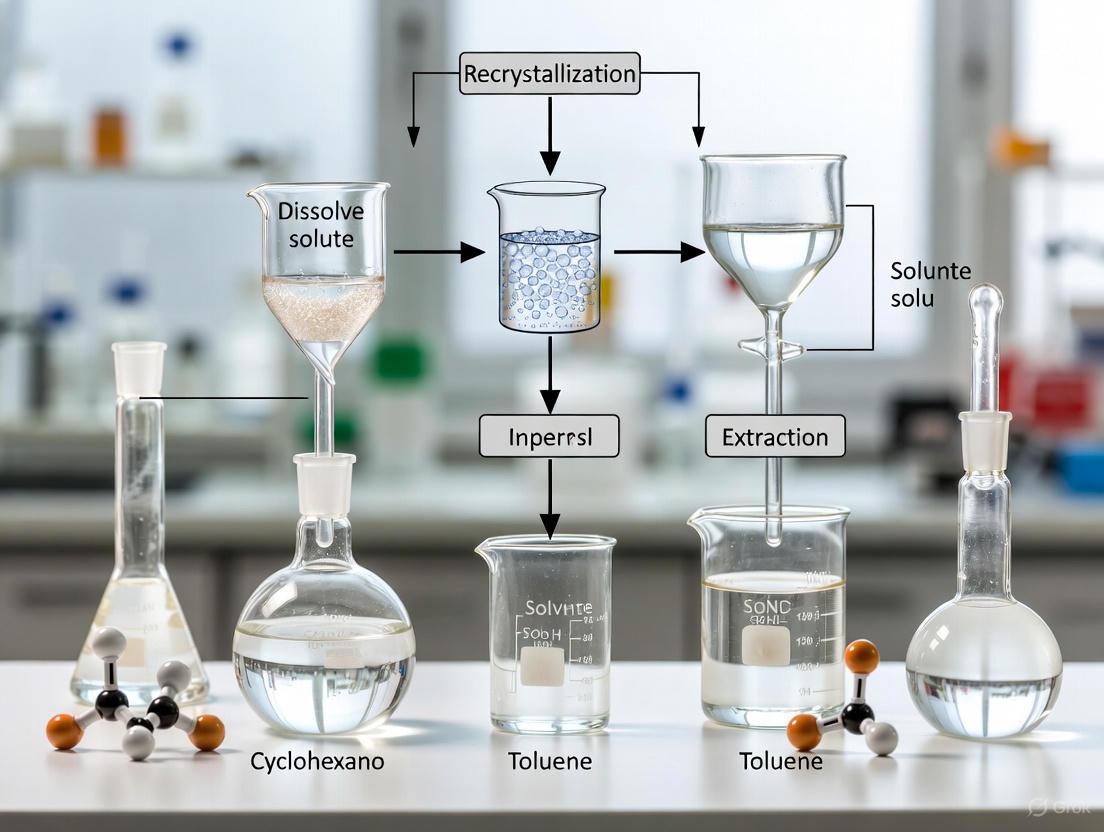
This comprehensive article explores modern recrystallization and extraction protocols for organic solids, with particular emphasis on pharmaceutical applications.
Advanced Recrystallization and Extraction Protocols for Organic Solids: A Comprehensive Guide for Pharmaceutical Scientists
Abstract
This comprehensive article explores modern recrystallization and extraction protocols for organic solids, with particular emphasis on pharmaceutical applications. Covering both foundational principles and advanced computational approaches, it addresses critical challenges in solid form selection, polymorph control, and purity optimization. The content integrates experimental methodologies with emerging informatics and energy-based computational tools for solid form derisking. Designed for researchers, scientists, and drug development professionals, this guide provides practical strategies for troubleshooting common crystallization issues, optimizing process parameters, and validating solid form performance to ensure robust drug product development with optimal bioavailability, stability, and manufacturability.
Understanding Solid Form Landscapes: Principles of Polymorphism and Crystal Engineering
The design and development of active pharmaceutical ingredients (APIs) hinge on a fundamental principle: the interconnected relationship between a material's structure, its properties, and its ultimate performance in a drug product. This paradigm is formally conceptualized as the Processing–Structure–Property–Performance (PSPP) relationship, often visualized as a materials science tetrahedron [1] [2]. Within pharmaceutical sciences, this framework provides a critical roadmap for understanding how the molecular and solid-state structure of an API, achieved through specific processing techniques like recrystallization and extraction, dictates its physicochemical properties, which in turn govern the biopharmaceutical performance, stability, and manufacturability of the final dosage form.
A profound understanding of PSPP relationships is essential for robust drug development. The crystal structure and particle properties of an API directly influence key performance attributes such as bioavailability, dissolution rate, and chemical stability [3]. Furthermore, these properties are not inherent but are imparted through carefully controlled processing steps, including synthesis, purification, and particle size reduction. This application note delineates the core principles of the Pharmaceutical Materials Science Tetrahedron, providing detailed protocols and analytical data to guide researchers in establishing predictive PSPP models for organic solids, with a specific focus on recrystallization and extraction protocols.
Theoretical Framework: The PSPP Relationship
The PSPP relationship is a cyclic, interdependent framework essential for systematic material design as shown in Figure 1.
Figure 1. PSPP Relationship Diagram: The core cycle of the materials science tetrahedron shows how processing defines structure, which determines properties, which ultimately dictates performance, with feedback loops enabling continuous optimization.
- Processing: This refers to the methods used to synthesize, isolate, and formulate the API. In the context of organic solids, this includes recrystallization for purification and polymorph control, and various extraction and milling techniques for isolation and particle size reduction [4] [3]. Processing parameters (e.g., solvent choice, cooling rate, milling energy) directly determine the solid-state and particulate structure of the material.
- Structure: This encompasses the arrangement of molecules in the solid state. Key structural attributes include polymorphic form, crystal habit (morphology), crystal lattice defects, particle size, and particle size distribution (PSD) [3] [2]. For instance, a needle-like crystal habit (structure) resulting from a specific recrystallization protocol (processing) will lead to different powder flow properties (property) compared to a block-like habit.
- Properties: These are the measurable physicochemical characteristics arising from the structure. They include mechanical properties (e.g., Young's modulus, hardness), thermal properties (e.g., melting point), solubility, dissolution rate, hygroscopicity, and powder flowability [3]. Properties form the critical link between the API's structure and its performance.
- Performance: This is the final manifestation of the API's attributes in the drug product, encompassing bioavailability, content uniformity, chemical and physical stability, and tabletability [3]. The ultimate goal is to design a processing route that yields a structure conferring the properties necessary for the desired therapeutic performance and manufacturability.
Application Note: Recrystallization Protocol for Polymorph Control
Background and Principle
Recrystallization is a cornerstone purification technique that also serves as a primary method for controlling the solid-state structure of an API. The process involves dissolving the crude solid in a suitable solvent at an elevated temperature and then allowing the pure substance to crystallize upon cooling, while impurities remain dissolved in the mother liquor [4]. The selection of solvent and cooling profile are critical processing parameters that dictate the structure (polymorph, crystal size, and habit), which in turn influences key properties like solubility and dissolution rate, ultimately affecting the in vivo performance [4].
Detailed Experimental Protocol
Objective: To purify a crude API and produce a specific polymorphic form (Form I) with a controlled crystal size distribution.
Materials:
- Crude API (e.g., ~5 g)
- Appropriate solvent (e.g., Ethanol, 95%)
- Activated charcoal (decolorizing carbon)
- Hotplate with magnetic stirrer and temperature control
- Buchner funnel and filter paper
- Ice-water bath
Procedure:
- Solvent Selection: Based on preliminary testing, select a solvent in which the API is highly soluble at its boiling point but has limited solubility at room temperature. A mixed solvent system may be required [4].
- Dissolution: Place the crude API in a round-bottom flask. Add a minimal volume of the chosen solvent to just cover the solid. Gently heat the mixture with stirring until the solid completely dissolves. If the solution is colored, add a small spatula-tip of activated charcoal, continue heating for 5-10 minutes, and then perform a hot gravity filtration to remove the charcoal and insoluble impurities [4].
- Crystallization: Allow the clear, hot filtrate to cool slowly to room temperature undisturbed. Do not accelerate cooling by placing in an ice bath at this stage. Slow cooling promotes the growth of larger, purer crystals of the desired polymorph. Scratching the inner surface of the flask with a glass rod may provide nucleation sites if crystallization does not initiate spontaneously [4].
- Isolation: Once crystallization is complete, cool the mixture further in an ice-water bath for 15-20 minutes to maximize yield. Collect the crystals by vacuum filtration using a Buchner funnel.
- Washing and Drying: Wash the crystals with a small, cold portion of the recrystallization solvent to remove adhering mother liquor. Allow the crystals to air-dry on the filter under vacuum, then transfer to a watch glass to dry completely at room temperature or in a vacuum oven [4].
Critical Processing Parameters:
- Solvent System: Directly influences polymorphic outcome and crystal habit.
- Cooling Rate: Slow cooling favors larger crystals; rapid cooling may lead to metastable forms or oiling out.
- Nucleation: Seeding with pure Form I crystals during crystallization can ensure the desired polymorph is obtained.
The workflow for this protocol is illustrated in Figure 2.
Figure 2. Recrystallization Workflow: The step-by-step process from crude solid to pure crystals, highlighting key stages like solvent selection, slow cooling, and isolation that are critical for structure control.
Application Note: Advanced Extraction and Particle Engineering
Advanced Extraction Techniques
While traditional liquid-solid extraction (shake-filter method) is simple, modern techniques use increased temperature and pressure to enhance efficiency, reduce time, and solvent consumption [5] [6]. These are particularly relevant for isolating compounds from natural products or complex matrices.
- Pressurized Liquid Extraction (PLE): Also known as Accelerated Solvent Extraction (ASE), this technique uses high temperature and pressure to keep the solvent in a liquid state well above its normal boiling point, significantly improving extraction kinetics and efficiency [5].
- Microwave-Assisted Extraction (MAE): This method uses microwave energy to heat the solvent and sample directly, leading to rapid heating and cell rupture, which facilitates the release of compounds into the solvent [5] [6].
- Supercritical Fluid Extraction (SFE): Primarily using supercritical CO₂, SFE is a solvent-free technique with tunable solvent power by adjusting pressure and temperature. It is highly selective but has seen fluctuating commercial adoption for analytical-scale applications [5].
Particle Size Reduction via Jet Milling
Milling is a critical processing step for normalizing API particle size, which is a key structural attribute affecting dissolution and content uniformity. Spiral jet milling is a preferred dry milling method in the pharmaceutical industry [3].
Principle: A spiral jet mill comprises a chamber with tangential nozzles. Compressed gas is pushed through these nozzles, creating a high-velocity vortex. Particles are fed into this vortex and undergo size reduction primarily through inter-particulate collisions. The resulting particle size is determined by a balance of centrifugal forces and fluid drag forces [3].
PSPP Relationship in Jet Milling: The processing parameters (e.g., gas flow rate, feed rate) and the intrinsic properties of the API (e.g., mechanical properties) determine the final particle structure (size and size distribution), which directly impacts the performance (e.g., dissolution rate and bioavailability) [3].
Table 1: Impact of Material Properties and Process Settings on Jet Milling Outcomes [3]
| Factor | Impact on Milling Performance |
|---|---|
| Gas Flow Rate | The most significant contributor to particle size reduction. A higher flow rate decreases the critical particle size for breakage. |
| Young's Modulus | A measure of stiffness. Higher values can correlate with different breakage rates and unmilled particle sizes. |
| Poisson's Ratio | Influences how materials deform under stress and is correlated with milling behavior. |
| Crystal Habit | Needle-like (habit 1) vs. block-like (habit 2) crystals exhibit different size reduction behaviors and resultant particle size distributions. |
Table 2: Energy Parameters from Compaction Simulation for API Grades [3]
| API Grade | Elastic Recovery (%) | Specific Work of Compaction (J/g) | Plastic Energy (%) |
|---|---|---|---|
| Domperidone (Original) | 12.5 | 45.2 | 68.3 |
| Ketoconazole (Habit-Modified) | 8.7 | 52.1 | 78.9 |
| Metformin (Habit 1 - Needle) | 15.1 | 38.7 | 60.1 |
| Metformin (Habit 2 - Block) | 9.8 | 49.5 | 75.4 |
The Scientist's Toolkit: Essential Research Reagents and Materials
Table 3: Key Reagents and Materials for Recrystallization and Extraction
| Item | Function/Application |
|---|---|
| Agro-solvents (e.g., Ethanol, Ethyl Acetate) | Green solvents used in extraction and recrystallization to dissolve target analytes, replacing more hazardous solvents [7] [8]. |
| Molecularly Imprinted Polymers (MIPs) | Synthetic polymers with tailor-made recognition sites for specific molecules. Used in solid-phase extraction for highly selective extraction and clean-up [9] [7]. |
| Metal-Organic Frameworks (MOFs) | Advanced porous materials with extra-large surface area and tunable porosity. Serve as efficient sorbents for the extraction and pre-concentration of analytes from complex matrices [9] [7]. |
| Covalent Organic Frameworks (COFs) | Crystalline porous polymers with designable structures, offering high surface area and stability. Used as next-generation sustainable adsorbent materials [7]. |
| Deep Eutectic Solvents (DES) | Biodegradable and low-toxicity solvents formed from natural compounds. Used as green alternatives for the extraction of organic compounds [6]. |
| Activated Charcoal | Used during hot filtration in recrystallization to adsorb colored, impurity. |
| Filter Paper (Cellulose) | Used in Soxhlet extraction and post-recrystallization filtration to separate solids from liquids [4] [6]. |
The Pharmaceutical Materials Science Tetrahedron provides an indispensable framework for de-risking and accelerating drug development. By rigorously understanding and applying the Processing–Structure–Property–Performance relationships, scientists can move beyond empirical experimentation to a predictive, knowledge-driven approach. The protocols and data presented herein for recrystallization and particle engineering underscore the profound impact of processing decisions on the solid-state structure of an API, which cascades directly to its critical quality attributes and therapeutic efficacy. Mastering these relationships is fundamental to designing robust, high-performance pharmaceutical products.
In the field of pharmaceutical development, polymorphism—the ability of a drug substance to exist in multiple crystalline forms—presents both significant challenges and opportunities. Different polymorphs of the same active pharmaceutical ingredient (API) possess distinct internal crystal structures, resulting in different physicochemical properties including solubility, dissolution rate, stability, and bioavailability [10] [11]. With over 80% of crystalline drugs exhibiting polymorphism and approximately 70% of new drug candidates having poor water solubility, understanding and controlling polymorphic forms has become critical for developing effective and reliable pharmaceutical products [10] [11]. The case of ritonavir, which was withdrawn from the market in 1998 due to the unexpected appearance of a more stable, less soluble polymorph, exemplifies the substantial economic and clinical risks involved, highlighting why regulatory agencies now require exhaustive polymorph screening during drug development [10] [11] [12].
Quantitative Impact of Polymorphism on Key Pharmaceutical Properties
Different polymorphic forms can significantly influence critical drug properties. The following table summarizes documented property variations across known polymorphic drug systems.
Table 1: Pharmaceutical Property Variations Across Polymorphic Forms
| Drug Example | Property Measured | Polymorph Variation | Impact on Performance |
|---|---|---|---|
| ABT-072 / ABT-333 [13] | Aqueous Solubility | Significant differences due to crystal packing and hydrate formation | Impacts bioavailability; can require specialized formulations |
| General Drug Compounds [11] | Solubility Ratio | Typically < 2-fold; rarely up to 5-fold between polymorphs | Moderate effect on dissolution and absorption |
| Ritonavir [10] | Dissolution Rate / Bioavailability | Appearance of more stable Form II reduced bioavailability | Led to product withdrawal and reformulation |
The physical stability of polymorphs is a crucial consideration. Metastable forms, which possess higher kinetic solubility, tend to convert to the more thermodynamically stable form over time, with transitions accelerated by factors such as humidity, temperature fluctuations, and mechanical stress [10] [11]. This is particularly critical for BCS Class II drugs (low solubility, high permeability), where even slight changes in solubility can dramatically impact bioavailability [11] [14].
Table 2: Stability and Transformation Risks of Polymorphic Forms
| Polymorph Type | Solubility & Bioavailability | Physical Stability | Transformation Risks |
|---|---|---|---|
| Stable Form | Lower, but predictable | High; thermodynamically favored | Low risk of conversion |
| Metastable Form | Higher, but variable | Low; kinetically favored | High risk of converting to stable form |
| Hydrate/Solvate | Variable (often slower dissolution) | Dependent on humidity/temperature | Dehydration or hydrate formation under changing conditions |
Experimental Protocols for Polymorph Screening and Characterization
A robust polymorph screening strategy is essential for identifying and characterizing all possible solid forms of a drug substance early in development. The following protocol outlines a comprehensive approach.
Protocol: High-Throughput Polymorph Screening
Objective: To systematically generate and identify crystalline polymorphs, hydrates, and solvates of an API.
Materials and Reagents:
- API (Pure active pharmaceutical ingredient)
- Organic solvents of varying polarity (e.g., methanol, acetone, acetonitrile, ethyl acetate, toluene)
- Aqueous buffers (covering physiological pH range)
- 96-well crystallization plates or glass vials
- Temperature-controlled incubation oven and refrigerated centrifuge
Procedure:
- Solution Preparation: Prepare saturated solutions of the API in a diverse range of 20-30 different pure solvents and solvent/water mixtures [12] [15].
- Crystallization Induction: Use multiple methods to induce crystallization:
- Slow Evaporation: Allow solvent to evaporate slowly at ambient temperature and controlled humidity [12].
- Temperature Cycling: Cycle samples between different temperatures (e.g., 4°C and 40°C) to promote nucleation [10].
- Anti-Solvent Addition: Add an anti-solvent (e.g., water or heptane) to the API solution to induce precipitation [12].
- Slurrying: Create suspensions in various solvents and agitate for extended periods (days to weeks) [10].
- Solid Form Isolation: After crystals form, isolate the solids by filtration or centrifugation.
- Characterization: Analyze all resulting solid forms using techniques detailed in Section 3.2 to confirm distinct polymorphic identities.
Protocol: Solid-State Characterization of Polymorphs
Objective: To fully characterize the physicochemical properties of each discovered polymorph.
Materials and Equipment:
- Isolated polymorphic samples
- X-Ray Powder Diffractometer (XRPD)
- Differential Scanning Calorimeter (DSC)
- Thermogravimetric Analyzer (TGA)
- Dynamic Vapor Sorption (DVS) apparatus
- HPLC with validated stability-indicating method
Procedure:
- Structural Analysis:
- Thermal Analysis:
- Run DSC to determine melting points, enthalpies of fusion, and detect any solid-solid transitions. The stable polymorph typically exhibits the highest melting point and lowest enthalpy of fusion [11].
- Perform TGA to quantify volatile content (e.g., water or solvent) and distinguish between anhydrous forms and solvates/hydrates [15].
- Hygroscopicity Assessment:
- Subject samples to DVS analysis, exposing them to a range of relative humidities (e.g., 0-90% RH) to monitor moisture uptake and identify potential hydrate formation [11].
- Solubility and Dissolution Profiling:
- Determine equilibrium solubility of each polymorph in aqueous media (e.g., water, pH-adjusted buffers) [11].
- Perform intrinsic dissolution rate testing to compare dissolution kinetics under standardized conditions.
- Stability Assessment:
Visualization: Polymorph Screening and Risk Assessment Workflow
The following diagram illustrates the integrated workflow for polymorph screening and risk assessment in drug development.
Advanced Predictive Tools: Crystal Structure Prediction (CSP)
Modern computational approaches like Crystal Structure Prediction (CSP) have emerged as powerful tools to complement experimental polymorph screening. CSP methods use systematic crystal packing searches combined with machine learning force fields to predict low-energy polymorphs theoretically [16]. This approach can identify potential "disappearing polymorphs" or yet-undiscovered forms that might pose development risks later. For instance, CSP successfully reproduced the experimental polymorphs of ABT-072 and ABT-333 and provided atomistic insights into their different conformational preferences and intermolecular interactions, explaining their distinct polymorphism behavior [13]. The MACH (Mapping Approach for Crystalline Hydrates) algorithm further extends CSP capabilities by efficiently predicting stable hydrate structures, addressing a major challenge in early drug development [13].
The Scientist's Toolkit: Essential Reagents and Materials
Table 3: Key Research Reagent Solutions for Polymorph Studies
| Reagent / Material | Function in Polymorph Research |
|---|---|
| Diverse Organic Solvents | To explore a wide crystallization space and discover multiple polymorphic forms [12]. |
| Aqueous Buffer Solutions | To assess pH-dependent solubility and identify potential hydrate forms [11]. |
| Seeds of Known Polymorphs | To facilitate selective crystallization of specific forms and study transformation pathways [10]. |
| Polymeric Stabilizers (e.g., PVP, HPMC) | To inhibit phase transformation by stabilizing metastable forms in suspensions and solid dispersions [12]. |
| Crystal Structure Prediction Software | To computationally predict stable polymorphs and identify potential development risks [13] [16]. |
The strategic management of polymorphism is indispensable to modern drug development. While different polymorphic forms can offer opportunities to enhance drug solubility and bioavailability, they also present substantial risks to product stability and performance if not properly controlled. A comprehensive approach integrating robust experimental screening, thorough solid-state characterization, and emerging computational prediction tools like CSP is essential to de-risk pharmaceutical development. Furthermore, maintaining strict control over crystallization processes and formulation parameters ensures the consistent production of the desired polymorph throughout the drug product's lifecycle. As the pharmaceutical industry continues to face challenges with poorly soluble compounds, advanced polymorph control strategies will remain critical for developing safe, effective, and reliable medicines.
Hydrogen Bond Networks and Conformational Flexibility in Crystal Packing
Within organic solids research, the strategic manipulation of hydrogen bond networks and conformational flexibility is paramount for dictating the structural landscape and physicochemical properties of crystalline materials. These molecular-level interactions serve as the primary design elements for controlling crystal packing, influencing critical outcomes in polymorphism, stability, and functionality of organic compounds. This Application Note provides a structured framework for investigating these phenomena, integrating advanced analytical techniques and computational modeling to establish robust recrystallization and extraction protocols. The guidance presented enables researchers to systematically engineer crystalline solids with predefined properties, accelerating development across pharmaceutical, agrochemical, and materials science sectors.
Fundamental Principles and Key Analytical Techniques
The Interplay of Conformational Flexibility and Hydrogen Bonding
In crystal engineering, conformational flexibility allows molecules to adapt their shape to achieve optimal packing, while hydrogen-bonding networks provide the directional interactions that stabilize these arrangements. This synergy is exemplified in host-guest systems, where flexible macrocyclic hosts like p-sulfonato-calix[n]arenes exhibit remarkable adaptation to guest molecules. For instance, the smaller calix[4]arene (C4S) provides its outer surface as a scaffold for pentamidine guests, which adopt a C-shaped conformation fitted to the macrocycle's curvature. In contrast, the larger calix[8]arene (C8S) flattens into a distorted pleated loop conformation, enabling pentamidine to take advantage of the entire macrocyclic surface [17].
These conformational adaptations are governed by the cooperative nature of hydrogen bonding, where the energetic cost of burying an unsatisfied hydrogen bond donor or acceptor can reach 5–6 kcal/mol [18]. This substantial energy penalty drives the formation of self-contained, satisfied hydrogen bond networks where all buried polar groups possess suitable bonding partners.
Advanced Techniques for Network Characterization
Table 1: Techniques for Characterizing Hydrogen Bond Networks
| Technique | Key Applications | Spatial Resolution | Key Insights Provided |
|---|---|---|---|
| Microcrystal Electron Diffraction (MicroED) [19] | Hydrogen atom positioning, charged state determination | Sub-atomic (0.87 Å) | Direct visualization of hydrogen atoms, hydrogen bonding interactions |
| Solid-State NMR (SSNMR) [20] | Hydrogen bonding network elucidation, atomic assignment | Atomic-level | Hydrogen atom positions, assignment of C/N/O atoms, internuclear distances |
| Combined ED/SSNMR/Computations [20] | Full structural determination of nanocrystals | Atomic-level | Complete hydrogen-bonding networks in challenging systems |
| In-situ Solid-State NMR [21] [22] | Monitoring crystallization pathways, phase evolution | Phase identification | Real-time tracking of solid form transformations, intermediate phases |
| X-ray Diffraction with H-bonded Frameworks [23] | Structure determination of challenging molecules | Atomic-level | Molecular structure and absolute configuration of flexible molecules |
The integration of multiple characterization approaches is often necessary to fully elucidate complex hydrogen bonding networks. For example, combining electron diffraction with solid-state NMR and first-principles quantum calculations has proven highly effective for determining structures with ambiguous hydrogen atom positions or misassigned atoms with similar atomic numbers (e.g., C, N, O) [20]. This hybrid methodology is particularly valuable for nanocrystals and microcrystals that are too small for conventional X-ray diffraction analysis.
Experimental Protocols
Protocol 1: Engineering Hydrogen Bond Networks in Crystalline Inclusion Compounds
Scope and Application
This protocol describes the crystallization of flexible organic molecules within engineered hydrogen-bonded frameworks to control conformation and packing. It is adapted from methodologies for studying pentamidine with p-sulfonato-calix[n]arenes [17] and utilizing guanidinium organosulfonate (GS) frameworks for molecular structure determination [23].
Principle
Flexible host frameworks can adapt their conformation to accommodate guest molecules through induced-fit molecular recognition. The hosts provide anionic sulfonate rims for charge-assisted hydrogen bonding and aromatic surfaces for CH-π interactions, directing guest conformation and packing.
Materials and Equipment
- Host Compounds: p-sulfonato-calix[4,6,8]arenes (C4S, C6S, C8S) or guanidinium organosulfonates (G2BPDS, G2ADS, G2NDS)
- Guest Compound: Target molecule (e.g., pentamidine, chiral natural products)
- Solvents: Methanol, water, water-alcohol mixtures, isopropanol, acetone
- Equipment: NMR tubes, crystallization plates, X-ray diffractometer, NMR spectrometer
Procedure
- Solution Preparation: Dissolve host and guest compounds in appropriate solvent mixtures (e.g., water-alcohol)
- Complexation: Allow host-guest complexation in methanolic solution, monitored via ( ^1 \text{H} ) NMR spectroscopy [17]
- Crystallization: Conduct slow evaporation or vapor diffusion crystallization
- Structure Determination: Collect single-crystal X-ray diffraction data
- Conformational Analysis: Analyze host and guest conformations, hydrogen bonding geometries, and packing arrangements
Data Analysis
- Conformational Metrics: Measure distances between key atoms (e.g., O···O distances in pentamidine: 6.0–6.5 Å in exclusion complexes vs. 4.4 Å in inclusion complexes) [17]
- Hydrogen Bonding: Identify amidinium-sulfonate hydrogen bonding synthons and CH-π interactions
- Packing Analysis: Evaluate the role of solvent molecules in filling cavities and supporting the framework
Protocol 2: In-situ NMR Monitoring of Crystallization Pathways
Scope and Application
This protocol employs in-situ solid-state NMR spectroscopy to monitor the evolution of hydrogen-bonded crystalline phases during crystallization, enabling identification of transient intermediates and competing pathways [21] [22].
Principle
The CLASSIC (Crystallization from Liquid Phase And Solid-State In-situ Characterization) NMR strategy selectively detects the solid phase in heterogeneous solid-liquid systems using ( ^1\text{H}→^{13}\text{C} ) cross-polarization, while simultaneously monitoring solution-phase changes [22].
Materials and Equipment
- Sample Material: ( ^{13}\text{C} )-labeled compounds (e.g., 13C-urea) for enhanced sensitivity
- Solvents: Methanol, toluene, D(_2)O, or mixed solvent systems
- Equipment: Solid-state NMR spectrometer with magic-angle spinning (MAS) capability, liquid-state inserts for MAS rotors
Procedure
- Sample Preparation: Prepare an undersaturated solution at elevated temperature in an NMR rotor
- Temperature Control: Cool to supersaturated conditions to initiate crystallization
- Data Acquisition: Acquire sequential ( ^{13}\text{C} ) NMR spectra using ( ^1\text{H}→^{13}\text{C} ) cross-polarization for solid phase and direct excitation ( ^{13}\text{C} ) NMR for solution phase
- Time Resolution: Set acquisition parameters for 2-30 minute time resolution depending on crystallization kinetics
Data Analysis
- Phase Identification: Identify different solid forms (polymorphs, hydrates, co-crystals) based on chemical shift differences
- Kinetic Profiling: Quantify phase evolution and transformation rates
- Pathway Elucidation: Identify metastable intermediates and transformation sequences
Computational Protocol: Sampling Hydrogen Bond Networks with MC HBNet
Scope and Application
This protocol utilizes the Monte Carlo Hydrogen Bond Network (MC HBNet) sampling algorithm in Rosetta to identify amino acid mutations that form self-contained hydrogen bond networks for protein engineering applications [18].
Principle
MC HBNet searches sequence space and sidechain conformational space to find sets of amino acids that form closed hydrogen bond networks where every buried polar group has a hydrogen bond partner, addressing the non-pairwise decomposable nature of hydrogen bond networks [18].
Procedure
- Graph Construction: Build an HbondGraph where nodes represent rotamers and edges represent hydrogen bonds between compatible rotamers
- Monte Carlo Traversal: Perform user-defined trajectories starting from randomly selected seed edges
- Network Assembly: Grow networks stochastically by adding adjacent edges that lead to compatible nodes
- Satisfaction Checking: Track all heavy polar atoms that are buried and unsatisfied, removing them as they become satisfied during network growth
- Output: Return viable hydrogen bond networks that leave no buried polar group without a hydrogen bond partner
Data Analysis
- Network Evaluation: Assess hydrogen bond energy (typically -0.5 to -1.5 Rosetta Energy Units)
- Validation: Experimentally validate designed networks using structural and spectroscopic methods
The Scientist's Toolkit: Essential Research Reagents and Materials
Table 2: Key Research Reagent Solutions for Hydrogen Bond Network Studies
| Reagent/Material | Function/Application | Example Systems |
|---|---|---|
| p-sulfonato-calix[n]arenes [17] | Flexible macrocyclic hosts for conformational adaptation studies | Pentamidine complexation, exclusion/inclusion control |
| Guanidinium Organosulfonates (GS Frameworks) [23] | Hydrogen-bonded hosts for molecular structure determination | Absolute configuration determination, challenging molecules |
| Deuterated Solvents for In-situ NMR [22] | Crystallization monitoring without interfering signals | CLASSIC NMR, real-time pathway analysis |
| 13C/15N-Labeled Compounds [22] | Enhanced sensitivity for NMR crystallization studies | Tracking molecular evolution, quantifying kinetics |
| Rosetta Software with MC HBNet [18] | Computational sampling of hydrogen bond networks | Protein design, interface engineering |
Data Presentation and Analysis
Quantitative Analysis of Host-Guest Complexation
Table 3: Host-Guest Conformational Adaptation in Calixarene-Pentamidine Complexes
| Host System | Host Conformation | Guest Conformation | O···O Distance (Å) | Key Interactions |
|---|---|---|---|---|
| C4S (Water) [17] | Pinched cone | U-shaped (inclusion) | 4.4 | Cavity inclusion, amidinium-sulfonate H-bonds |
| C4S (Water-Alcohol) [17] | Pinched cone | C-shaped (exclusion) | 6.0–6.5 | Outer surface binding, solvent cavity occupation |
| C8S [17] | Distorted pleated loop | Extended and folded forms | Variable | Full macrocyclic surface utilization |
Crystallization Pathway Analysis
Table 4: Competing Crystallization Pathways in Multicomponent Systems
| System | Initial Phase | Final Phase | Pathway Relationship | Key Evidence |
|---|---|---|---|---|
| 1,10-dihydroxydecane + urea [21] | Urea inclusion compound | (Urea)(_2) co-crystal | Independent phases | In-situ ( ^{13}\text{C} ) NMR shows coexistence |
| Glycine (aqueous) [22] | β-polymorph (metastable) | α/γ-polymorph (stable) | Sequential transformation | CLASSIC NMR reveals transient pure β-phase |
Workflow Visualization
Diagram 1: Integrated workflow for analyzing hydrogen bond networks and conformational flexibility in crystal packing, highlighting the iterative nature of protocol optimization.
Diagram 2: Mechanism of host-guest conformational adaptation showing key steps and influencing factors in hydrogen-bond-directed crystal formation.
Solid form screening is a critical foundation of organic solids research, particularly in pharmaceutical development where the crystalline form of an active pharmaceutical ingredient (API) dictates key properties including solubility, stability, and bioavailability [24]. This document details two essential experimental methods for solid form screening and manipulation: solvent-mediated polymorphic transformation (SMPT) and cryomilling. Within the broader context of recrystallization and extraction protocols, these techniques enable researchers to navigate complex solid form landscapes, access metastable forms, and overcome challenges posed by poorly soluble compounds. SMPT explores form stability in solution environments, while cryomilling utilizes mechanical force under cryogenic conditions to alter solid-state properties. When integrated into a comprehensive screening strategy, these methods provide powerful tools for mapping polymorphic relationships and developing robust recrystallization protocols.
Solvent-Mediated Polymorphic Transformation
Principle and Applications
Solvent-mediated polymorphic transformation is a recrystallization process in which a metastable crystalline form dissolves and a more thermodynamically stable form nucleates and grows from the solution [25]. This phenomenon is crucial for solid form screening as it helps identify the most stable polymorph under given conditions, thereby de-risking development by minimizing the chance of late-appearing, more stable forms [26]. SMPT traditionally employs conventional solvents but has been successfully extended to non-conventional media like polymer melts, expanding its utility in formulating crystalline solid dispersions [25].
The transformation proceeds via three fundamental steps:
- Dissolution of the metastable crystalline form into the solvent or polymer melt.
- Nucleation of the stable polymorph from the supersaturated solution.
- Growth of the stable polymorph crystals, sustained by the continued dissolution of the metastable form [25].
Protocol: SMPT in Polyethylene Glycol Melts
Application Note: This protocol describes the induction of polymorphic transformation in a polymer melt system, using Acetaminophen (ACM) Form II to Form I transformation in polyethylene glycol (PEG) as a model [25]. This method is valuable for studying transformations in viscous, non-conventional solvents relevant to hot-melt extrusion and other melt-based formulation processes.
Materials:
- API: Acetaminophen Form II (ACM II)
- Polymer: Polyethylene Glycol (PEG, Mw 4000, 10,000, 20,000, or 35,000 g/mol)
- Equipment: Hot-stage with temperature controller, In-situ Raman spectrometer, Mortar and pestle, Differential Scanning Calorimeter (DSC), Powder X-ray Diffractometer (PXRD)
Procedure:
- Preparation of ACM II:
- Place approximately 300 mg of ACM I in a 20 mL scintillation vial.
- Heat the vial to 180°C for 4 minutes with constant magnetic agitation to melt the API.
- Transfer the vial to a 70°C block heater and hold for 15 minutes to recrystallize ACM II.
- Confirm the successful formation of ACM II using PXRD before proceeding [25].
Preparation of Physical Mixture:
- Gently grind 1-90 wt% of ACM II with PEG using a mortar and pestle for 5 minutes at ambient conditions.
- Verify by PXRD that the grinding process has not inadvertently altered the polymorphic form of the API [25].
In-situ Monitoring of SMPT:
- Place the physical mixture on a temperature-controlled hot stage coupled with a Raman spectrometer.
- For isothermal experiments, equilibrate the sample at the desired process temperature (e.g., above the eutectic temperature of the API-PEG system).
- Collect Raman spectra at regular intervals (e.g., 30-second sampling interval with 28 s exposure time) to monitor characteristic spectral shifts indicating the form transformation [25].
- The induction time for the transformation is determined as the time interval between reaching the isothermal hold temperature and the first detectable appearance of the stable form (ACM I) in the Raman spectrum [25].
Key Parameters and Data: The induction time for SMPT in polymer melts is highly dependent on the molecular weight and viscosity of the PEG and the process temperature. Higher PEG molecular weights significantly hinder API diffusivity, prolonging the induction time [25].
Table 1: Diffusion Coefficients (D) and Induction Times for ACM II to I SMPT in Various Solvents [25].
| Solvent System | Viscosity (mPa·s) | Diffusion Coefficient, D (m²/s) | Induction Time |
|---|---|---|---|
| Ethanol (Conventional) | <5 | 4.84 × 10⁻⁹ | ~30 seconds |
| PEG 4000 Melt | Not Specified | 5.32 × 10⁻¹¹ | Significantly longer than in ethanol |
| PEG 35000 Melt | Not Specified | 8.36 × 10⁻¹⁴ | Significantly longer than in PEG 4000 |
Workflow Visualization
Cryomilling
Principle and Applications
Cryomilling (cryogenic grinding) is a size reduction technique where materials are cooled to cryogenic temperatures, typically using liquid nitrogen (-196°C) or dry ice (-78°C), and subjected to mechanical impact [27] [28]. This process embrittles the sample, facilitating fracture and enabling the grinding of materials that are otherwise elastic, temperature-sensitive, or sticky at ambient conditions [28]. In pharmaceutical research, cryomilling is pivotal for:
- Particle Size Reduction: Enhancing the surface area of polymers for improved blend homogeneity with low-concentration APIs in drug-delivery devices [27].
- Amorphization: Producing amorphous solid dispersions to improve the solubility and dissolution rate of poorly water-soluble APIs [29] [30].
- Solid Form Manipulation: Accessing metastable polymorphs or inducing co-amorphization in multi-component systems [29] [30].
The extreme cold suppresses the material's glass transition temperature, preventing melting or rubbery behavior and promoting brittle fracture [27] [28]. It also preserves volatile components and inhibits thermal degradation [28].
Protocol: Cryogenic Preparation of Pharmaceutical Solids
Application Note: This protocol covers the cryomilling of APIs or polymer-API mixtures for particle size reduction or amorphization, applicable to small-scale development (e.g., using a mixer mill) [28] [30].
Materials:
- Sample: Crystalline API (e.g., Bosentan monohydrate) or physical mixture of API and excipient/coformer.
- Grinding Aid: Liquid Nitrogen (LN₂) or Dry Ice.
- Equipment: Cryogenic mill (e.g., Retsch CryoMill, MM 400), Insulated container, Protective cryogenic gloves, Tongs, Balance, Characterization tools (DSC, PXRD, FTIR).
Procedure:
- Sample Preparation:
Pre-cooling:
- Place the sample into the appropriate grinding jar (e.g., 50 mL stainless steel).
- Add the grinding ball(s) to the jar and securely close the lid.
- Using tongs, submerge the sealed grinding jar in an insulated container filled with liquid nitrogen for 2-3 minutes to embrittle the sample. For the CryoMill, the system often includes an auto-cooling feature [28] [30].
Cryomilling Process:
- For Mixer Mills (e.g., MM 400): Quickly transfer the pre-cooled jar to the mill and clamp it securely. Process at a high frequency (e.g., 30 Hz) for a short duration (e.g., 1-3 minutes). If longer grinding is needed, perform cycles with intermediate re-cooling to prevent sample warming [28].
- For Dedicated CryoMill: The jar is automatically cooled continuously with LN₂. A typical program may include a pre-cooling time (e.g., 5 minutes), followed by grinding cycles (e.g., 12 min grinding at 9 Hz, interspersed with 3 min cool-down periods), with a total milling time of up to several hours for complete amorphization [30].
Sample Recovery:
- After milling, carefully open the jar and immediately transfer the powdered product to a sealed container stored in a desiccator to prevent moisture uptake and potential recrystallization [30].
Key Parameters and Data: Cryomilling conditions must be optimized for each material. The table below provides examples of milling parameters for different applications and sample types.
Table 2: Exemplary Cryomilling Parameters for Various Applications [29] [28] [30].
| Sample / Application | Mill Type | Grinding Aid | Frequency / Speed | Time (Cycles) | Result |
|---|---|---|---|---|---|
| Polymer (e.g., PLGA, EVA) Homogenization | Not Specified | Liquid Nitrogen | Semi-continuous process | Not Specified | Uniform particle size for drug-polymer blending [27] |
| Bosentan Amorphization | CryoMill | Liquid Nitrogen | 9 Hz | 2.5 hours (multiple cycles) | Amorphous Bosentan [30] |
| Nimesulide-Bicalutamide Co-amorphous System | Retsch Ball Mill | Liquid Nitrogen | 30 Hz | 60 min (4 cooling cycles) | Co-amorphous system [29] |
| Gummy Bears / Sticky Food | MM 400 | Liquid Nitrogen | 30 Hz | 1 min | < 300 µm [28] |
Workflow Visualization
The Scientist's Toolkit: Essential Research Reagent Solutions
Successful implementation of SMPT and cryomilling protocols relies on a set of key reagents and materials. The following table details critical components and their functions in the context of these experimental methods.
Table 3: Essential Research Reagents and Materials for Solid Form Screening
| Reagent / Material | Function / Application | Examples / Notes |
|---|---|---|
| Polyethylene Glycol (PEG) | Non-conventional solvent for SMPT studies in polymer melts; used to model formulation processes like hot-melt extrusion [25]. | Varying molecular weights (e.g., 4k, 10k, 35k Da) to study the effect of viscosity on API diffusivity and transformation kinetics. |
| Liquid Nitrogen (LN₂) | Primary cryogen for cryomilling; embrittles materials by cooling them to -196°C, enabling fracture and inhibiting thermal degradation [27] [28]. | Used for cooling grinding jars and samples directly. Requires careful handling due to extreme cold and potential for asphyxiation. |
| Dry Ice (Solid CO₂) | Alternative cryogen for cryomilling; provides a cooling temperature of -78°C [28]. | Can be mixed directly with the sample in certain mills, extending the cooling effect. Often considered safer and easier to handle than LN₂ for some applications. |
| Pharmaceutical Polymers | Used as excipients in cryomilling to form amorphous solid dispersions or as components of drug-delivery devices [27] [24]. | Common examples include PLGA, EVA, TPU, and PCL. Their properties (Mw, crystallinity) affect drug release profiles. |
| Coformers | Neutral molecules used in conjunction with APIs to create multicomponent solid forms via cryomilling or other techniques [29] [24]. | Form co-crystals or co-amorphous systems to alter API physicochemical properties (e.g., piperazine, gentisic acid with Nimesulide). |
Solvent-mediated transformation and cryomilling represent two powerful, complementary techniques within the solid form screening arsenal. SMPT provides critical insight into thermodynamic stability relationships in both conventional and non-conventional solvents, directly informing recrystallization protocols and formulation strategies. Cryomilling offers a versatile mechanical approach for particle engineering, amorphization, and the generation of metastable forms that are often inaccessible through solution-based recrystallization. By integrating these methods into a coherent experimental workflow and leveraging the detailed protocols and reagent knowledge contained herein, researchers and drug development professionals can more effectively navigate complex solid-form landscapes, de-risk development pathways, and ultimately design more efficacious and stable organic solid materials.
Regulatory Framework and Quality-by-Design Considerations for Solid Forms
The development and manufacturing of solid-form pharmaceuticals, including active pharmaceutical ingredients (APIs) and final dosage forms, are governed by a rigorous regulatory framework aimed at ensuring product quality, safety, and efficacy. Quality by Design (QbD) has revolutionized pharmaceutical development by transitioning from reactive quality testing to proactive, science-driven methodologies [31]. Rooted in ICH Q8–Q11 guidelines, QbD emphasizes defining Critical Quality Attributes (CQAs), establishing design spaces, and integrating risk management to enhance product robustness and regulatory flexibility [31]. For solid forms, which include various crystalline structures, polymorphs, and salts, the application of QbD is particularly critical as their physical and chemical properties directly influence drug performance, stability, and bioavailability.
This document outlines the application of QbD principles specifically for solid forms, detailing the regulatory expectations, systematic development approaches, and practical experimental protocols. The content is framed within the broader context of recrystallization and extraction research, providing scientists with actionable strategies for developing robust, controllable processes for organic solid forms while meeting global regulatory standards.
Regulatory Foundations and QbD Principles
The International Council for Harmonisation (ICH) guidelines provide the foundational framework for implementing QbD in pharmaceutical development. The core principles are established through a series of key documents:
- ICH Q8 (Pharmaceutical Development): Introduces the concepts of design space and critical quality attributes, emphasizing enhanced product and process understanding [31].
- ICH Q9 (Quality Risk Management): Provides systematic methods for risk assessment to identify and control variables affecting product quality [31].
- ICH Q10 (Pharmaceutical Quality System): Describes a comprehensive model for an effective pharmaceutical quality system throughout the product lifecycle [31].
- ICH Q11 (Development and Manufacture of Drug Substances): Extends QbD principles to drug substance development, including solid forms [31].
Global regulatory agencies, including the FDA, EMA, and others, have incorporated these guidelines into their oversight approaches. Recent regulatory surveillance indicates continued harmonization efforts, such as the FDA-EMA QbD pilot program, which aims to align expectations for submissions containing QbD elements [32] [33]. Furthermore, agencies like China's NMPA are increasingly emphasizing QbD principles in their evolving regulatory frameworks, requiring manufacturers to enhance their Quality Management Systems and change management processes [32].
Table 1: Core ICH Guidelines for QbD Implementation
| ICH Guideline | Focus Area | Key QbD Components |
|---|---|---|
| Q8 (R2) | Pharmaceutical Development | Quality Target Product Profile (QTPP), Critical Quality Attributes (CQAs), Design Space, Control Strategy |
| Q9 | Quality Risk Management | Risk Assessment Tools (FMEA, FTA), Risk Control, Risk Review |
| Q10 | Pharmaceutical Quality System | Knowledge Management, Quality Metrics, Continuous Improvement |
| Q11 | Drug Substance Development | Critical Material Attributes (CMAs), Approach to Control Strategy |
For solid forms, regulatory flexibility is achieved through demonstrated process understanding. A process is considered well-understood when "all critical sources of variability are identified and explained" and "variability is managed by the process" [34]. This is particularly relevant for crystallization processes, where understanding polymorphism, crystal habit, and particle size distribution is essential for consistent product quality.
QbD Implementation Framework for Solid Forms
Implementing QbD for solid forms involves a systematic workflow that translates regulatory principles into practical development activities. The following diagram illustrates the key stages and their relationships in the QbD implementation process:
Define Quality Target Product Profile (QTPP)
The QTPP forms the foundation of QbD implementation. For solid forms, the QTPP should include specific targets related to solid-state properties:
- Dosage form and route of administration (e.g., oral solid dosage)
- Drug product quality attributes (e.g., stability, purity, dissolution)
- Solid-form specific attributes (e.g., polymorphic form, crystal habit, particle size distribution)
The QTPP serves as the reference point for all subsequent development decisions, ensuring the final product consistently meets its intended quality characteristics [31].
Identify Critical Quality Attributes (CQAs)
CQAs are physical, chemical, biological, or microbiological properties or characteristics that should be within an appropriate limit, range, or distribution to ensure the desired product quality [31]. For solid forms, typical CQAs include:
- Polymorphic form - critical for stability and bioavailability
- Crystal habit and morphology - influences filtration, flow, and compaction
- Particle size distribution - affects dissolution, bioavailability, and processability
- Chemical purity and impurity profile
- Residual solvent content
CQAs are identified through risk assessment that links product attributes to safety and efficacy [31].
Risk Assessment and Variable Identification
Systematic risk assessment tools are employed to identify material attributes and process parameters that may impact CQAs:
- Failure Mode Effects Analysis (FMEA) - qualitative or semi-quantitative approach to rank risks
- Ishikawa (fishbone) diagrams - visual tool for identifying potential causes of variability
- Risk assessment matrices - prioritize factors for experimental investigation
For crystallization processes, high-risk factors typically include solvent composition, cooling rate, agitation, and seed quality [31]. Risk assessment outputs guide subsequent experimental designs by focusing resources on the most critical factors.
Design of Experiments (DoE) and Modeling
DoE is a powerful statistical approach for systematically studying the effect of multiple factors and their interactions on CQAs. For solid-form development, common DoE applications include:
- Solvent selection and optimization for crystallization
- Process parameter optimization (temperature profiles, agitation rates)
- Formulation development for final dosage forms
Advanced modeling approaches, including deep learning algorithms, are increasingly used to predict crystallization conditions and optimize solvent systems [35]. Case studies demonstrate that DoE can improve extraction efficiency by up to 500% while maintaining compound integrity [36].
Table 2: Common Experimental Designs for Solid-Form Development
| Experimental Design | Application in Solid Forms | Key Advantages |
|---|---|---|
| Factorial Designs | Screening multiple factors (e.g., solvent composition, temperature) | Efficient identification of critical factors and interactions |
| Response Surface Methodology (RSM) | Optimizing crystallization conditions | Models nonlinear relationships, identifies optimal operating regions |
| Central Composite Design | Establishing design space boundaries | Provides comprehensive coverage of experimental region |
| Box-Behnken Design | Process optimization with limited resources | Requires fewer runs than central composite designs |
Application Notes: QbD in Crystallization Process Development
Solvent Selection and Optimization
Solvent selection is a critical determinant of crystallization success, influencing polymorphic outcome, crystal size distribution, purity, and yield. The QbD approach systematizes this selection through:
- Solvent suitability screening based on solubility parameters, polarity, and chemical compatibility
- Risk assessment of solvent properties (boiling point, toxicity, environmental impact)
- Experimental verification using small-scale crystallization trials
Modern approaches employ machine learning algorithms trained on reaction data in SMILES notation to predict appropriate crystallization solvents, achieving prediction accuracies of up to 87% [35]. This in silico prescreening accelerates development while reducing material consumption.
Process Analytical Technology (PAT) Integration
PAT tools enable real-time monitoring and control of critical crystallization parameters:
- In-situ particle size analyzers (e.g., FBRM) for monitoring crystal growth and nucleation
- Raman and NIR spectroscopy for polymorphic form identification and quantification
- ATR-FTIR for solution concentration measurement
PAT implementation facilitates the development of controlled crystallization processes within the defined design space, enabling real-time release testing and reducing batch failures by up to 40% [31].
Design Space Establishment for Crystallization
The design space represents the multidimensional combination of input variables (e.g., material attributes, process parameters) demonstrated to ensure quality [31]. For a crystallization process, the design space may include:
- Solvent composition ranges (single or mixed solvent systems)
- Temperature parameters (initial dissolution temperature, cooling rate, final temperature)
- Process parameters (agitation rate, seed loading, addition rates)
- Material attributes (API purity, seed quality)
Operating within the established design space is not considered a change from a regulatory perspective, providing operational flexibility [31].
Experimental Protocols
Protocol: QbD-Based Solvent Screening for Recrystallization
Objective: Systematically identify optimal recrystallization solvents for an organic solid using QbD principles.
Materials:
- Organic solid compound (API or intermediate)
- Candidate solvents (varying polarity, boiling point)
- Laboratory equipment: test tubes, hot plate, temperature controller, vacuum filtration apparatus, analytical balance
Procedure:
Pre-experimental Planning
- Define QTPP for the solid form (e.g., desired polymorph, purity, particle size)
- Identify CQAs likely affected by solvent selection
- Conduct risk assessment to prioritize solvent properties for investigation
Initial Solvent Screening
- Place small amounts (~50 mg) of solid in test tubes
- Add 1-2 mL of candidate solvents at room temperature
- Observe and record solubility (high, moderate, low)
- For solvents with low solubility, heat in water bath (~50°C) and record solubility
Temperature-Dependent Solubility Profiling
- Select solvents demonstrating high temperature coefficient of solubility (low solubility at room temperature, high solubility at elevated temperature)
- Prepare saturated solutions at elevated temperature
- Cool solutions gradually, observing crystallization behavior
- Collect crystals by filtration and analyze for polymorphic form, purity, and crystal habit
Mixed Solvent Systems Evaluation
- For compounds with challenging solubility profiles, evaluate mixed solvent systems
- Use DoE approaches to efficiently explore solvent composition ratios
- Optimize anti-solvent addition rates if applicable
Data Analysis and Selection
- Evaluate solvents based on multiple criteria: yield, purity, crystal form, operational safety
- Select optimal solvent system that consistently produces material meeting CQAs
- Document the proven acceptable ranges for solvent composition and process parameters
Protocol: Design of Experiments for Crystallization Optimization
Objective: Establish design space for a cooling crystallization process using response surface methodology.
Materials:
- API compound
- Optimal solvent (from previous screening)
- Laboratory crystallizer with temperature control and agitation
- PAT tools (e.g., FBRM, Raman spectrometer)
Procedure:
Define Experimental Objectives and Responses
- Identify critical process parameters (CPPs): cooling rate, agitation speed, seed loading
- Define measured responses: yield, mean particle size, purity, polymorphic form
Experimental Design
- Select appropriate experimental design (e.g., Central Composite Design)
- Define factor ranges based on prior knowledge and risk assessment
- Randomize run order to minimize systematic error
Execution
- Set up crystallizer with predetermined solvent volume
- Dissolve API at elevated temperature to achieve saturation
- Implement programmed cooling profile according to experimental design
- Add seeds at specified loading when appropriate supersaturation is reached
- Monitor process using PAT tools
- Isolate crystals at final temperature, wash, and dry
Analysis
- Characterize solid products for all response variables
- Develop mathematical models relating CPPs to CQAs
- Statistically validate models and identify significant factors
- Establish design space boundaries using contour plots and overlay analysis
Verification
- Conduct confirmation experiments within design space to verify predictions
- Challenge design space boundaries to establish edges of failure
- Document control strategy for commercial manufacturing
The Scientist's Toolkit: Essential Materials and Reagents
Successful implementation of QbD for solid forms requires specific materials and analytical capabilities. The following table outlines key research reagents and their functions:
Table 3: Essential Research Reagents and Materials for Solid-Form Development
| Reagent/Material | Function in Solid-Form Development | QbD Application Examples |
|---|---|---|
| Solvent Systems (water, ethanol, hexane, acetonitrile, etc.) | Media for crystallization and purification | Screening optimal solvent composition for target CQAs; establishing design space boundaries |
| Seed Crystals | Controlled nucleation for consistent crystallization | Ensuring reproducible polymorphic form and particle size distribution |
| API/Intermediate Compounds | Target molecules for process development | Defining QTPP and CQAs; establishing material attributes for control strategy |
| PAT Tools (FBRM, PVM, Raman, NIR) | Real-time process monitoring | Tracking CQAs during processing; enabling real-time control and endpoint determination |
| Reference Standards (polymorphs, impurities) | Analytical method development and validation | Quantifying critical quality attributes during development |
Control Strategy and Lifecycle Management
A comprehensive control strategy for solid forms includes:
- Material controls - specifications for raw materials, solvents, and intermediates
- Process controls - parameter ranges for unit operations within design space
- Analytical controls - monitoring of CQAs through validated methods
- Procedural controls - SOPs for critical operations
Lifecycle management involves continuous verification of process performance and periodic reassessment of the design space as additional knowledge is gained. Emerging trends, including AI-integrated design space exploration and digital twin technologies, promise to further enhance predictive control and lifecycle management [31] [37].
The application of QbD principles to solid-form development provides a systematic framework for achieving consistent quality while maintaining regulatory compliance. By implementing science- and risk-based approaches from early development through commercial manufacturing, organizations can establish robust processes that accommodate natural variability while ensuring product quality. The integration of modern tools—including DoE, PAT, and predictive modeling—enables deeper process understanding and more efficient development of recrystallization and extraction processes for organic solids. As regulatory expectations continue to evolve globally, the adoption of QbD represents not only a compliance imperative but also a strategic opportunity to enhance development efficiency, reduce costs, and ensure reliable supply of high-quality pharmaceutical products.
Practical Recrystallization and Extraction Techniques: From Laboratory to Industrial Scale
Recrystallization is the most important method for purifying nonvolatile organic solids, a critical unit operation in industrial and pharmaceutical settings where it significantly influences the physicochemical properties of substances [38] [39]. This purification process involves dissolving the target solute in an appropriate hot solvent, then allowing the solution to cool and become saturated, prompting the solute to crystallize out of solution. As the crystal lattice develops, impurities are excluded, thereby completing the purification [38]. The process does not involve breaking chemical bonds but rather overcomes intermolecular attractive forces such as Van der Waals interactions [38].
The systematic selection of solvents is paramount for controlling final crystal properties, including purity, morphology (crystal habit), and polymorphic form. These characteristics directly impact critical material properties in pharmaceuticals, such as bioavailability, stability, dissolution rates, and processing behavior [40]. Furthermore, in materials science, crystal morphology influences performance characteristics in applications like polymer solar cells and energetic materials [41] [42]. This application note provides a structured framework for solvent selection and experimental protocol design to achieve desired crystal morphology and purity, contextualized within a broader thesis on recrystallization and extraction protocols for organic solids research.
The Scientist's Toolkit: Key Reagents and Materials
The following table details essential materials and reagents commonly used in recrystallization experiments for controlling crystal morphology.
Table 1: Key Research Reagent Solutions for Crystal Morphology Studies
| Reagent/Material | Function & Application Context |
|---|---|
| Hydroxypropyl Methylcellulose (HPMC) | Polymer additive used as a crystal habit modifier. Selectively adsorbs onto specific crystal facets to inhibit growth and reduce crystal aspect ratio [43]. |
| Deep Eutectic Solvents (DES) | Sustainable media capable of modulating nucleation and crystal growth; used for regulating polymorphism, crystal habit, and cocrystal formation [39]. |
| Decolorizing Carbon | Used to adsorb colored impurity molecules from a hot solution before crystallization, preventing them from becoming trapped in the crystal lattice [38]. |
| Solvent (e.g., Acetone, Methyl Acetate) | Primary dissolution medium. The choice directly influences crystal aspect ratio, morphology, and polymorphic outcome due to varying facet-solvent interactions [43] [40]. |
| Antisolvent (e.g., Water) | A solvent in which the solute has low solubility; added to a solution to induce supersaturation and crystal precipitation, thereby controlling the rate of nucleation and growth [42]. |
Data Presentation: Quantitative Effects of Solvent Selection
The following tables consolidate experimental data from case studies, highlighting the quantitative impact of solvent selection on crystal properties.
Table 2: Solvent Impact on Crystal Morphology and Polymorphic Outcome
| Compound | Solvent | Key Findings | Source |
|---|---|---|---|
| Aceclofenac (ACF) | Acetone (ACT) | Regenerated crystals exhibited a smaller aspect ratio. | [43] |
| Methyl Acetate (MA) | Regenerated crystals exhibited a larger aspect ratio. Molecular simulation indicated weaker interaction with radial (1 1 0) facet, leading to its faster growth. | [43] | |
| ACT/MA with 0.5% HPMC | Aspect ratio reduced to 2.19. HPMC selectively adsorbed on radial (1 1 -1) and (1 1 0) facets, inhibiting growth. | [43] | |
| Ritonavir | Ethanol | Produced the stable Form II polymorph. | [40] |
| Acetone, Ethyl Acetate, Acetonitrile, Toluene | Produced the metastable "disappeared" Form I polymorph. The required driving force for nucleation decreased with solubility. | [40] | |
| PYX (Energetic Material) | DMSO, DMF, NMP | PYX solubility was highest in NMP, followed by DMF, and lowest in DMSO. Solubility in NMP and DMSO increased markedly with temperature. | [42] |
Table 3: Property Enhancement via Recrystallization: PYX Case Study
| Property | Industrial Grade PYX | Recrystallized PYX | Improvement & Implication |
|---|---|---|---|
| Aspect Ratio | 3.47 | 1.19 | Morphology changed from needle/rod-like to more equidimensional, improving packing density [42]. |
| Roundness | 0.47 | 0.86 | Crystal shape became more spherical, enhancing flow and processing [42]. |
| Impact Sensitivity | 40% | 12% | Significantly reduced mechanical sensitivity, improving handling and operational safety [42]. |
| Thermal Decomposition Peak | Tpeak | Tpeak + 5 °C | Enhanced thermal stability [42]. |
| Chemical Purity | Baseline | +0.7% | Effective purification confirmed by IR spectroscopy, which showed no structural changes [42]. |
Experimental Protocols
Core Recrystallization Protocol
This standard protocol is adapted from fundamental recrystallization procedures [38] and serves as a baseline for purification and crystal growth.
Solvent Selection: Choose a solvent using these criteria:
- High Temperature Coefficient: The solute must have high solubility in the hot solvent and low solubility at room temperature [38].
- Impurity Management: The solvent should either dissolve impurities readily at all temperatures or not dissolve them at all [38].
- Inertness: The solvent must not react with the solute [38].
- Volatility: A solvent with a low boiling point is preferred for easy removal from crystals via evaporation [38].
Dissolution:
- Place the crude solid in an Erlenmeyer flask and add a small volume of hot solvent.
- Heat the solvent to boiling (using boiling stones to prevent bumping) and add it gradually to the flask while swirling or stirring until the solute just dissolves. Avoid excess solvent to ensure saturation upon cooling [38].
Decolorization (Optional):
- If the solution contains colored impurities, add a small amount of decolorizing carbon.
- Heat the mixture to boiling briefly, then proceed to the next step [38].
Hot Gravity Filtration:
- Rapidly filter the hot solution through filter paper to remove any undissolved impurities or decolorizing carbon.
- Critical: Do not use vacuum filtration at this stage, as the cooling and pressure drop can cause premature crystallization [38].
Crystallization:
- Allow the filtered hot solution to cool slowly to room temperature undisturbed. Slow cooling promotes the formation of large, pure crystals.
- If crystals do not form, induce nucleation by: a) Scratching the inside of the flask with a glass rod. b) Seeding with a small crystal of the pure solute. c) Cooling the flask in an ice-water bath [38].
Collection and Washing:
- Collect the crystals by vacuum filtration using a Buchner funnel at room temperature.
- Wash the crystals with a small quantity of ice-cold recrystallization solvent to rinse off surface impurities [38].
Drying:
- Dry the crystals by leaving them under vacuum in the funnel for a few minutes or by allowing them to air-dry on a watch glass for several days [38].
Advanced Protocol: Regulating Crystal Morphology via Solvent and Polymer Additives
This protocol, derived from the aceclofenac case study [43], details methods for active crystal habit control.
- Objective: To regenerate broken crystal seeds and control the final crystal aspect ratio using different solvents and a polymer additive (HPMC).
- Materials: Aceclofenac (ACF), solvent (e.g., Acetone, Methyl Acetate), hydroxypropyl methylcellulose (HPMC).
Procedure:
- Seed Crystal Preparation: Prepare initial ACF crystal seeds from a saturated solution.
- Intentional Crystal Cleavage: Artificially break the seed crystals along the predetermined cleavage plane (e.g., the (1 0 -1) facet for ACF) [43].
- Crystal Regeneration: a. Prepare supersaturated solutions of ACF in different solvents (e.g., Acetone and Methyl Acetate). b. Introduce the broken crystal seeds into the supersaturated solutions. c. Observe and monitor the regeneration process, noting that growth occurs primarily along the fracture face to restore original morphology.
- Polymer-Mediated Morphology Control: a. Prepare a supersaturated ACF solution. b. Add HPMC as a crystal habit modifier at a specific concentration (e.g., 0.5% mass fraction). c. Introduce the broken seeds or allow spontaneous nucleation. d. Characterize the final crystals, noting the significant reduction in aspect ratio due to HPMC's selective adsorption on specific radial crystal facets [43].
Workflow and Decision Pathways
The following diagram visualizes the systematic decision-making process for solvent selection and recrystallization strategy, integrating both core and advanced considerations.
Diagram 1: Systematic workflow for solvent selection and recrystallization strategy, integrating purification-focused and morphology-focused pathways.
Systematic solvent selection is a foundational step in recrystallization that extends beyond basic purification to enable precise control over crystal morphology and polymorphic form. The integration of computational screening tools, molecular-level understanding of solvent-facet interactions, and strategic use of polymer additives or novel solvent systems like DES provides researchers with a powerful toolkit. By adhering to structured protocols and decision pathways, scientists and development professionals can reliably optimize recrystallization processes to meet specific material requirements, thereby enhancing product performance, stability, and safety in pharmaceutical and specialty chemical applications.
Within the framework of advanced organic solids research, particularly in pharmaceutical development, mastering recrystallization and extraction protocols is paramount for isolating pure, high-quality active pharmaceutical ingredients (APIs) [4]. The purification efficacy and final crystal properties—such as purity, polymorphic form, size, and yield—are critically governed by process parameters during the crystallization phase. This application note delineates the roles of three pivotal critical process parameters (CPPs): Crystallization Termination Temperature, Cooling Rate, and Stirring Speed. These parameters are interlinked kinetic and thermodynamic factors that dictate nucleation, crystal growth, and impurity exclusion, directly impacting the success of downstream extraction and formulation processes [44] [45].
Crystallization is the phase transition where molecules arrange into an ordered, crystalline structure from a solution or melt [46]. The Crystallization Termination Temperature marks the point where this process is effectively complete under given conditions, which is always below the thermodynamic melting point [47]. The Cooling Rate from a saturated or supersaturated state is a primary driver of crystallization kinetics, influencing nucleation density, crystal size distribution, and ultimate crystallinity [48]. Stirring Speed (agitation) controls mass and heat transfer, homogenizes the solution, and influences secondary nucleation and crystal attrition [45] [49]. Optimizing these parameters in concert is essential for achieving the target Critical Quality Attributes (CQAs) of the recrystallized product.
The following tables consolidate quantitative findings from key studies on polymers and inorganic systems, providing actionable insights for organic solids research.
Table 1: Effect of Cooling Rate on Crystallization Parameters in Polypropylene (PP) [48]
| Cooling Rate (K/s) | Onset Crystallization Temp, Ts (°C) | Peak Crystallization Temp, Tm (°C) | Relative Crystallinity (%) |
|---|---|---|---|
| 0.1 | 124.5 | 119.2 | 100 (Reference) |
| 1 | 122.1 | 116.8 | 98.5 |
| 10 | 117.3 | 111.5 | 95.2 |
| 100 | 110.8 | 104.1 | 89.7 |
| 1000 | 105.5 (plateau region) | 98.3 (plateau region) | 78.4 |
Key Trend: Both crystallization temperatures and final crystallinity decrease monotonically with increasing cooling rate.
Table 2: Effect of Pressure and Cooling Rate on Crystallization Temperature in Isotactic Polypropylene (iPP) [50]
| Applied Pressure (bar) | Crystallization Temp at 0.1 °C/s cooling (°C) | Crystallization Temp at 1 °C/s cooling (°C) | Notes on Morphology |
|---|---|---|---|
| 100 | ~118 | ~112 | Larger spherulites at slow cooling |
| 200 | ~122 | ~116 | Spherulite size decreases with |
| 400 | ~126 | ~120 | increasing cooling rate. |
| 600 | ~130 | ~124 | Linear increase with pressure. |
Key Trend: Increased pressure elevates the crystallization temperature, while increased cooling rate lowers it for any given pressure.
Table 3: Effect of Physical and Chemical Factors on CaSO₄ Crystallization in Brine [49]
| Factor | Condition Change | Effect on Crystal Size/Quantity | Proposed Mechanism |
|---|---|---|---|
| Temperature | Increase (50°C to 80°C) | Significant increase in size and quantity | Enhanced ion mobility and reaction kinetics. |
| pH | Increase (5 to 9) | Increased crystal size | Complexation with NaCl ions at high pH. |
| Agitation (Stirring) | From static to stirred | Enhanced crystal formation | Improved mass transfer and reduced local supersaturation gradients. |
| Stirring Speed | Excessive agitation | Can lead to smaller crystals and attrition [45] | Increased crystal collisions and secondary nucleation. |
Detailed Experimental Protocols
Protocol 3.1: Determining Crystallization Kinetics via Flash Differential Scanning Calorimetry (FSC)
Objective: To model the relationship between cooling rate and crystallization termination temperature/enthalpy for a novel organic compound.
Materials: Flash DSC 2+ instrument, ultra-high purity nitrogen, micro-fabricated sample chips, 1-10 ng of target compound.
Methodology:
1. Sample Preparation: Place a nanogram-scale sample on the sensor area of the chip using a micro-manipulator under a microscope.
2. Thermal History Erasure: Heat the sample to 20-30°C above its melting point (e.g., 220°C for PP analogs) at 200 K/s and hold for 0.1 s.
3. Non-Isothermal Crystallization: Cool the melt to 0°C at a defined rate (e.g., 0.1, 1, 10, 100, 1000 K/s). Cover a range relevant to your process (0.1 to 1000 K/s).
4. Melting Scan: Immediately re-heat the crystallized sample to the melt temperature at a standard high rate (200 K/s) to measure the enthalpy of fusion.
5. Data Analysis: From the cooling exotherm, determine the onset (Ts) and peak (Tm) crystallization temperatures [48]. Use the melting enthalpy from the subsequent heating scan to calculate relative crystallinity by comparing to the enthalpy obtained at the slowest cooling rate.
6. Modeling: Fit the Ts and Tm data versus cooling rate (r) to equations: Ts = d1 - k1 * r^(t1) and Tm = d2 - k2 * r^(t2) to predict behavior at untested rates [48].
Protocol 3.2: Investigating Stirring Speed and Cooling Rate for Recrystallization Purity
Objective: To optimize stirring speed and cooling rate for maximizing crystal purity and size of an API. Materials: 500 mL round-bottom flask, overhead stirrer with precise RPM control, heating mantle, temperature probe, vacuum filtration setup, HPLC for purity analysis. Methodology: 1. Solution Preparation: Dissolve the crude API in a minimum volume of suitable hot solvent (based on solubility studies). 2. Impurity Seeding (Optional): For studies on impurity inclusion, add a known impurity (e.g., 2% w/w of a structural analog) [45]. 3. Crystallization Run: Set the stirrer to a specific speed (e.g., 200, 320, 400 RPM). Initiate a controlled linear cooling ramp from the saturation point to the predetermined Crystallization Termination Temperature. The termination temperature should be selected based on prior solubility data, often 20-40°C below the saturation point. 4. Harvesting: Once the termination temperature is reached and held for a defined time (e.g., 1 hour), filter the slurry under vacuum. 5. Analysis: Wash crystals with cold solvent and dry. Analyze purity by HPLC. Measure crystal size distribution (CSD) using laser diffraction or image analysis. 6. Optimization: Repeat across a matrix of stirring speeds and cooling rates. Purity often shows a maximum at an intermediate stirring speed (e.g., ~320 RPM) due to a balance between solution homogeneity and crystal attrition/inclusion formation [45].
Protocol 3.3: High-Pressure Crystallization Kinetics Using Dilatometry
Objective: To study the combined effect of pressure and cooling rate on crystallization termination for materials processed under compaction. Materials: Piston-die dilatometer (e.g., Pirouette), ring-shaped sample (~60 mg), pressure and temperature control system. Methodology: 1. Sample Loading & Melting: Place sample in the pressure cell. Heat to 20-30°C above Tm at 10°C/min and hold to erase thermal history. 2. Pressurization: Apply and maintain constant isobaric pressure (e.g., 100 to 600 bar). 3. Non-Isothermal Cooling: Cool the sample to ambient temperature under constant pressure at two distinct average cooling rates (e.g., 0.1 °C/s and 1 °C/s) [50]. 4. Data Collection: The dilatometer records specific volume (V) as a function of Temperature (T) at constant Pressure (P)—a PvT diagram. The sharp change in slope marks the crystallization region. 5. Analysis: Determine the crystallization termination temperature from the PvT curve as the point where the volume-temperature slope stabilizes to that of the solid state. Plot this temperature against pressure for each cooling rate to establish a linear model [50].
Visualization of Parameter Relationships and Workflows
Diagram 1: Interplay of CPPs on Crystal Attributes (76 chars)
Diagram 2: CPP Optimization Workflow for Recrystallization (65 chars)
The Scientist's Toolkit: Essential Research Reagents & Materials
Table 4: Key Reagents and Equipment for Crystallization Process Research
| Item/Category | Example/Specification | Primary Function in CPP Studies |
|---|---|---|
| High-Purity Model Compounds | Isotactic Polypropylene (iPP), Paracetamol, Glycine | Well-characterized systems for fundamental kinetics studies [48] [45] [50]. |
| Thermal Analysis Instruments | Flash DSC 2+, Conventional DSC, Piston-Die Dilatometer | Quantify crystallization temperatures, enthalpies, and specific volume changes under varying cooling rates and pressures [48] [50]. |
| Agitation & Reactor Systems | Overhead stirrer with RPM control, 500 mL RBF, Reactor stations | Precisely control stirring speed and shear environment during solution crystallization [45] [49]. |
| Characterization Suite | HPLC-PDA/MS, Laser Diffraction CSD Analyzer, PXRD, Polarized Optical Microscope | Assess purity, crystal size distribution, polymorphic form, and morphology as outcomes of CPP variation [44] [45]. |
| Specialty Solvents & Agents | Analytical grade solvents, Decolorizing carbon, Selected impurity analogs | Prepare solutions, remove colored impurities, and study the effect of specific impurities on crystallization [4] [45]. |
| Data Analysis Software | Origin, MATLAB, Statistical packages (JMP, Design-Expert) | Model non-linear relationships (e.g., Ts vs. cooling rate), perform DoE analysis, and fit kinetic models [48] [51]. |
Optimizing Recrystallization Cycles for Maximum Yield and Purity
Within organic solids research, recrystallization remains a cornerstone purification technique, fundamental to obtaining materials of sufficient purity for pharmaceutical development and analytical characterization. The core principle of recrystallization is based on the differential solubility of a target compound and its impurities in a solvent system, where the solubility increases with temperature [52]. A highly concentrated solution prepared at an elevated temperature is cooled, causing the desired substance to crystallize in a purer form while impurities remain dissolved in the mother liquor [52]. The efficacy of this process is not inherent but is highly dependent on the meticulous optimization of cycle parameters. This protocol details a systematic approach to optimizing recrystallization cycles, focusing on the critical interplay between yield—the mass of pure product recovered—and purity—the absence of impurities. The strategies herein are framed within the context of advanced organic solids research, providing a reproducible framework for scientists engaged in the development of high-value fine chemicals and active pharmaceutical ingredients (APIs).
The Scientist's Toolkit: Essential Research Reagent Solutions
The success of a recrystallization protocol is contingent upon the selection of appropriate reagents and equipment. The following table catalogues the essential materials and their specific functions within the optimization process.
Table 1: Key Research Reagent Solutions and Essential Materials
| Item | Function/Application in Recrystallization |
|---|---|
| Solvent Systems (Water, Ethanol, Hexane) | The primary medium for dissolution; selection is based on the "like dissolves like" principle of polarity to achieve high solubility at elevated temperatures and low solubility at reduced temperatures [53] [52]. |
| Analytical-Grade Sodium Bicarbonate (NaHCO₃) | A model compound for process optimization, as used in the cited study [54]. |
| Carbon Dioxide (CO₂) Gas (≥99.9%) | Used as an anti-decomposition agent during the dissolution of compounds with low thermal stability (e.g., NaHCO₃), shifting the decomposition equilibrium and stabilizing the supersaturated solution [54]. |
| Jacketed Crystallizer with Temperature Control | Provides precise control over heating and cooling rates, which are critical for managing supersaturation and crystal growth [54]. |
| Agitated Nutsche Filter Dryer (ANFD) | An all-in-one unit for solid-liquid separation, product washing, and efficient drying. Its contained design minimizes product loss, thereby enhancing overall yield [55]. |
| Mel-Temp Apparatus | Used for melting point determination of both crude and recrystallized solids; a sharp, narrow melting point range indicates a high-purity sample [53]. |
| Vacuum Filtration System (Büchner funnel, filter flask) | For the effective and rapid isolation of crystallized product from the mother liquor [52]. |
Core Principles and Quantitative Optimization Data
Optimization requires a deep understanding of reaction kinetics and the physical parameters governing crystallization [55]. The systematic investigation of variables such as temperature, pressure, and agitation allows for the fine-tuning necessary to produce high-purity, large-particle crystals consistently.
Table 2: Optimized Recrystallization Parameters for Maximum Yield and Purity
| Parameter | Optimal Condition | Impact on Yield and Purity |
|---|---|---|
| Dissolution Temperature | 75 °C | Balances high solute solubility with minimal thermal decomposition of the target compound [54]. |
| CO₂ Pressure | 0.2 MPa | Suppresses decomposition of thermally labile compounds (e.g., NaHCO₃) by shifting the chemical equilibrium, stabilizing the solution, and preserving purity [54]. |
| Crystallization Temperature | 45 °C | Provides a controlled thermal driving force for crystallization, promoting the growth of large, uniform crystals [54]. |
| Static Growth Phase | 4 hours | Allows for slow crystal growth without disturbance, favoring the formation of larger (300–400 μm) crystals and improving overall size distribution [54]. |
| Cooling Rate | Slow and controlled | Prevents excessive nucleation, enabling fewer crystals to grow larger and more pure [54] [52]. |
| Process Cycles | 4 repeated cycles | Confirms process stability, reproducibility, and high yield, which is critical for scalable industrial production [54]. |
Detailed Experimental Protocols
Protocol A: CO₂-Assisted Recrystallization with Thermal Stabilization
This protocol is adapted from advanced studies on the recrystallization of sodium bicarbonate and is particularly suited for compounds susceptible to thermal decomposition [54].
Materials:
- Analytical-grade target compound (e.g., NaHCO₃)
- Deionized water
- CO₂ gas cylinder (≥99.9% purity)
- Jacketed stainless-steel crystallizer with temperature control, magnetic stirrer, and CO₂ inlet
- Vacuum filtration setup
Procedure:
- Dissolution: Charge the crystallizer with the impure compound and a minimal volume of purified water. Begin heating and stirring. Simultaneously, introduce CO₂ gas to maintain a constant pressure of 0.2 MPa within the vessel. Heat the mixture to the optimal dissolution temperature of 75 °C until a homogeneous solution is formed. The CO₂ atmosphere is critical for suppressing decomposition during this step.
- Crystallization Initiation: Once fully dissolved, cool the saturated solution to the crystallization temperature of 45 °C at a controlled rate.
- Static Crystal Growth: After reaching the target temperature, cease all agitation and initiate a 4-hour static growth phase. This undisturbed period is crucial for the development of large, uniform crystals.
- Isolation and Drying: Separate the crystals from the mother liquor using vacuum filtration. Wash the crystals with a small amount of ice-cold solvent to displace surface impurities. Dry the purified crystals to constant weight, ideally using an Agitated Nutsche Filter Dryer (ANFD) for maximum efficiency and yield preservation [55].
- Yield and Purity Analysis: Determine the percent recovery by mass. Assess purity via melting point determination, comparing the crude and recrystallized products [53].
Protocol B: Inquiry-Based Solvent Screening and Recrystallization
This POGIL-style protocol emphasizes collaborative, critical thinking for determining the optimal recrystallization conditions for an unknown organic solid [53].
Materials:
- Unknown solid sample (e.g., Benzoic Acid, Acetanilide, Vanillin)
- Range of solvents of varying polarity (e.g., Water, Ethanol, Hexane)
- Test tubes, hot plate, Erlenmeyer flask, melting point apparatus
Procedure:
- Solvent Selection: In small test tubes, add a tiny amount of the unknown solid to each solvent to be tested at room temperature. Record solubility.
- Temperature Dependence: For solvents where the solid is insoluble at room temperature, heat the test tubes in a warm water bath. The ideal solvent will demonstrate low solubility at room temperature and high solubility at elevated temperatures [53] [52].
- Dissolution: Based on the screening results, dissolve the unknown sample in a minimal volume of the hot, optimal solvent within an Erlenmeyer flask.
- Hot Filtration (if needed): If insoluble impurities are present, perform a rapid hot filtration through fluted filter paper into a clean flask to prevent premature crystallization.
- Crystallization: Allow the filtrate to cool slowly to room temperature, then optionally place it in an ice bath to maximize yield. Slow cooling promotes purity and larger crystal size [52].
- Identification and Purity Assessment: Collect the crystals via vacuum filtration, dry, and determine the percent recovery. Measure the melting point of the purified solid and perform a mixed melting point with a suspected reference compound to confirm identity and high purity [53].
Workflow Visualization and Mechanistic Insights
The following diagrams illustrate the logical workflow for solvent selection and the experimental setup for advanced thermal-stabilized recrystallization.
The strategic optimization of recrystallization cycles, as detailed in these application notes, provides a robust pathway for achieving simultaneous maxima in yield and purity. The integration of precise parameter control—notably dissolution temperature, CO₂ stabilization for labile compounds, and managed crystal growth—enables the reliable production of high-purity, large-particle crystals. These protocols, grounded in the principles of solubility and reaction kinetics, offer a scalable and reproducible framework that is directly applicable to the demanding environments of fine chemical and pharmaceutical research. By adhering to these detailed methodologies, researchers can significantly enhance the quality and efficiency of their purification processes, thereby advancing the overall scope and capability of organic solids research.
Phytosterols in Health and Industry Phytosterols are natural bioactive compounds with a chemical structure similar to cholesterol. They are renowned for their ability to reduce intestinal cholesterol absorption, thereby lowering serum LDL levels and mitigating cardiovascular disease risk [56] [57]. These properties have driven their incorporation into functional foods, nutraceuticals, and pharmaceuticals. Corn oil deodorizer distillate (CoDD), a by-product of the corn oil refining process, presents an economical and abundant source for the recovery of these high-value compounds [57] [58]. The deodorization step, which removes free fatty acids and odorous compounds, concentrates heat-labile valuable components like phytosterols and tocopherols into the distillate fraction [58].
The Purification Challenge The purification of phytosterols from CoDD is technically challenging due to the complex nature of the matrix, which contains a mixture of free fatty acids, glycerides, tocopherols, squalene, and other minor lipophilic compounds alongside the sterols [57]. Phytosterols can exist in free form or as esters with fatty acids, and they are relatively heat-labile, necessitating purification strategies that avoid excessive temperatures to prevent degradation [57]. This case study details an efficient and scalable laboratory-scale protocol for the purification of crude phytosterols from CoDD, employing saponification to hydrolyze sterol esters followed by a strategically optimized recrystallization process to achieve high purity. The context of this purification is framed within broader thesis research on recrystallization and extraction protocols for organic solids, demonstrating the practical application of these fundamental separation principles.
Experimental Protocol
Materials and Reagents
Table 1: Essential Research Reagent Solutions
| Reagent/Material | Function/Application |
|---|---|
| Corn Oil Deodorizer Distillate (CoDD) | Raw starting material containing crude phytosterols [57]. |
| Ethanolic Potassium Hydroxide (KOH) | Saponification agent; hydrolyzes sterol esters and neutralizes fatty acids [56] [59]. |
| n-Hexane | Organic solvent for liquid-liquid extraction of unsaponifiable matter (e.g., phytosterols) [56] [57]. |
| Ethyl Acetate | Crystallization solvent for purification of phytosterols [60]. |
| Methanol | Washing agent for phytosterol crystals to remove residual impurities [61]. |
| Anhydrous Ethanol | Solvent for phytosterol analysis and sample preparation [61]. |
Methodology
Saponification and Extraction
The following procedure liberates free phytosterols from their esterified forms and separates them from the bulk of the saponifiable material:
- Reaction Setup: Weigh approximately 20 g of CoDD into a round-bottom flask. Add 200 mL of 2 M potassium hydroxide (KOH) in 95% ethanol [56] [61].
- Heating under Reflux: Fit the flask with a condenser and heat the mixture in a water bath or on a heating mantle at 80 °C for 2 hours with continuous stirring to ensure complete saponification [61].
- Cooling and Dilution: After the reaction, allow the mixture to cool. Transfer it to a separatory funnel and add 200 mL of deionized water to reduce the polarity of the aqueous phase and prevent emulsion formation during extraction.
- Liquid-Liquid Extraction:
- Add 150 mL of n-hexane to the separatory funnel, seal, and shake vigorously with periodic venting.
- Allow the phases to separate completely. The unsaponifiable matter, including phytosterols and tocopherols, will partition into the upper hexane layer, while the soaps (potassium salts of fatty acids) and glycerol remain in the lower aqueous-alcoholic phase.
- Drain and collect the hexane layer.
- Repeat the extraction twice more with fresh 150 mL portions of n-hexane [56].
- Solvent Evaporation: Combine all hexane extracts in a clean flask and evaporate to dryness using a rotary evaporator at a temperature not exceeding 60 °C. The resulting solid is the crude phytosterol extract [61].
Recrystallization Purification
Recrystallization is a critical step for achieving high phytosterol purity. The following protocol, optimized using response surface methodology, ensures superior results [60]:
- Dissolution: Dissolve the crude phytosterol extract in a minimal volume of warm ethyl acetate (approximately 10 mL per gram of crude extract) under slight heating (~50-60°C) with continuous stirring until complete dissolution [61] [60].
- Crystallization:
- Once fully dissolved, set the stirring rate to 46 rpm.
- Program a cooling rate of 0.6 °C per minute from the dissolution temperature down to the final crystallization temperature of 23 °C.
- Maintain the mixture at 23 °C for 12 hours to allow for complete crystal formation and ripening [60].
- Isolation and Washing: After the crystallization period, collect the phytosterol crystals by vacuum filtration using a Büchner funnel. Wash the crystal cake thoroughly with a small amount of cold methanol to remove residual mother liquor and co-crystallized impurities [61].
- Drying: Transfer the washed crystals to a vacuum oven and dry at a mild temperature (e.g., 50 °C) until a constant weight is achieved. The final product is a purified, free-flowing white powder.
Table 2: Optimized Recrystallization Parameters for High Purity [60]
| Parameter | Optimal Condition | Effect on Purity and Yield |
|---|---|---|
| Crystallization Solvent | Ethyl Acetate | High solubility for impurities, yields loose powder with 99.10% purity. |
| Crystallization Temperature | 23 °C | Balances supersaturation for good yield while excluding impurities. |
| Cooling Rate | 0.6 °C/min | Controlled crystal growth promotes formation of pure, regular crystals. |
| Stirring Rate | 46 rpm | Ensures uniform temperature and concentration, preventing clumping. |
| Number of Cycles | 3 | Successive recrystallizations incrementally increase final purity. |
Analysis and Quantification
The purity and composition of the purified phytosterols can be determined using Gas Chromatography with Flame Ionization Detection (GC-FID) or High-Performance Liquid Chromatography (HPLC).
- GC-FID Analysis: Derivatize the sample if necessary and inject into a GC system equipped with a DB-1 capillary column. Use a temperature program starting at 285°C, held for 30 min, then ramped to 300°C. Use β-sitosterol as an internal standard for quantification. Purity is calculated based on peak areas [61].
- HPLC Analysis: For underivatized analysis, a normal-phase HPLC system with a silica column (e.g., Vertisep UPS) can be used. A mobile phase of n-hexane/tetrahydrofuran/2-propanol allows for the simultaneous analysis of phytosterols and other unsaponifiables like tocopherols and squalene within 22 minutes [62].
Results and Discussion
Process Workflow and Expected Outcomes
The complete purification process, from raw CoDD to purified phytosterols, is summarized in the workflow below.
Diagram 1: Phytosterol Purification Workflow from CoDD.
Expected Yield and Composition Following this protocol, researchers can expect a phytosterol recovery with a purity exceeding 99% and a yield of approximately 80% after three recrystallization cycles [60]. The predominant phytosterol in corn oil is typically β-sitosterol. Analysis of commercial corn oil has shown total phytosterol content can reach 4.35 mg/g (4350 μg/g) in the original oil, with a composition dominated by β-sitosterol, campesterol, and stigmasterol [56]. The final physicochemical properties of the purified phytosterols should align with established standards, exhibiting an acid value below 0.5 mg/g, a melting point of approximately 139°C, and minimal ash content [60].
Critical Factors in Protocol Optimization
The success of this purification hinges on several optimized parameters within the recrystallization step, which is central to the broader research on organic solids.
- Solvent Selection: Ethyl acetate is superior to solvents like methanol or acetone for recrystallization. It effectively dissolves the crude phytosterols at elevated temperatures but has significantly lower solubility for the target sterols at ambient and lower temperatures, thereby promoting high recovery yields. Furthermore, it provides an excellent balance of polarity that excludes more non-polar impurities (e.g., squalene) and more polar contaminants, resulting in a final purity of up to 99.10% [60].
- Thermodynamic Control: The controlled cooling rate (0.6 °C/min) is a critical thermodynamic parameter. Slow cooling prevents the rapid creation of excessive supersaturation, which leads to oily separation or impure, irregular crystal formation (kinetic crystallization). Instead, it allows for the gradual growth of stable, pure crystals [60].
- Impurity Exclusion: The saponification step is crucial for converting steryl esters into free sterols and transforming fatty acids into water-soluble soaps. This chemical modification fundamentally alters the polarity of these major impurities, enabling their effective separation during the subsequent hexane extraction and water wash, thereby significantly enriching the phytosterol content in the crude extract before recrystallization [59] [57].
The Scientist's Toolkit
Table 3: Key Instrumentation for Analysis and Purification
| Tool/Technique | Primary Function | Application Note |
|---|---|---|
| Rotary Evaporator | Gentle removal of organic solvents under reduced pressure. | Prevents thermal degradation of heat-labile phytosterols during concentration steps [61]. |
| GC-FID / GC-MS | Separation, identification, and quantification of phytosterols. | Considered the gold standard; often requires derivatization. Provides high sensitivity and resolution [56] [61]. |
| HPLC-DAD/FLD | Separation and quantification of underivatized phytosterols and other unsaponifiables. | Normal-phase HPLC allows simultaneous analysis of sterols, tocopherols, and squalene in a single run [62]. |
| Ultrasonic Bath | Assisted extraction using cavitation. | Can be used to improve extraction efficiency of crude sterols from solid matrices, though not critical for this liquid CoDD protocol [61]. |
This application note provides a validated and detailed protocol for the purification of high-purity phytosterols from corn oil deodorizer distillate. The two-step process of saponification followed by optimized solvent recrystallization with ethyl acetate is a robust and effective method, capable of producing phytosterols with a purity >99% [60]. This protocol not only adds value to an industrial by-product but also serves as a practical case study within thesis research on the fundamental principles of recrystallization and extraction for purifying organic solids. The methods outlined are readily adaptable for the purification of phytosterols from other deodorizer distillates, such as those from soybean or sunflower oil, supporting advanced research and development in the nutraceutical and pharmaceutical industries.
Scale-up Considerations for Industrial Crystallization Processes
Crystallization is a critical separation and purification technique in the chemical and pharmaceutical industries. The process involves two primary steps: nucleation, where molecular aggregates form as nuclei, and crystal growth, where these nuclei expand into larger, macroscopic structures [63]. While laboratory-scale crystallization is well-established, scaling these processes to industrial production presents significant challenges. Maintaining consistent crystal size distribution, purity, polymorphic form, and yield during scale-up is complex due to changes in mixing efficiency, heat and mass transfer, and fluid dynamics [63] [64]. This application note details the critical considerations and methodologies for successfully scaling up crystallization processes from laboratory to industrial scale, with particular emphasis on protocols relevant to organic solids research.
Core Scale-Up Challenges and Fundamental Principles
Primary Scale-Up Obstacles
The transition from bench-scale to production-scale crystallization introduces several technical hurdles:
- Mixing and Homogeneity: As reactor volume increases, achieving uniform mixing becomes challenging. Inhomogeneities in temperature and solute concentration can lead to inconsistent nucleation rates and crystal growth, resulting in non-uniform particle size distribution and undesirable crystal habits [63].
- Heat Transfer Efficiency: Larger volumes complicate the maintenance of precise temperature profiles required for optimal crystallization. The reduced surface-area-to-volume ratio in large vessels impedes efficient heating or cooling, potentially causing localized supersaturation variations [63].
- Fluid Dynamics and Suspension Behavior: Altered flow patterns at larger scales affect how crystals remain suspended in the solution. Poor suspension can prevent crystals from receiving fresh, supersaturated solution, stunting growth, while excessive agitation can cause crystal breakage and secondary nucleation [63].
- Supersaturation Control: The metastable zone width—the region between saturation and spontaneous nucleation—can shift with scale. Maintaining supersaturation within this zone is critical for controlling nucleation and growth kinetics, but becomes more difficult in large vessels where local concentrations vary [63] [65].
Scale-Up Principles and Similarity Criteria
Successful scale-up requires maintaining key process attributes between scales through similarity criteria:
- Geometric Similarity: Maintaining consistent ratios between all dimensions of the crystallizer (e.g., reactor diameter, impeller size, baffle arrangement) [65].
- Dynamic Similarity: Preserving dimensionless numbers that characterize fluid flow, such as the Reynolds number (related to turbulence) and Power number (related to power input per volume) [65].
- Thermodynamic Similarity: Ensuring consistent supersaturation profiles, temperature trajectories, and residence time distributions [65].
Experimental Protocols for Scale-Up Development
Protocol 1: System Characterization and Solubility Analysis
Objective: To determine the fundamental thermodynamic and kinetic parameters of the crystallization system.
Solubility Measurement:
- Prepare saturated solutions of the target compound in selected solvents across a temperature range (e.g., 5°C to 50°C).
- Maintain equilibrium with excess solid for 24-48 hours with continuous agitation.
- Analyze supernatant concentration using HPLC, UV-Vis spectroscopy, or gravimetric analysis.
- Plot solubility versus temperature to generate the solubility curve [65].
Metastable Zone Width (MSZW) Determination:
- Prepare a clear, undersaturated solution at an elevated temperature.
- Cool the solution at a controlled, constant rate while monitoring for crystal formation via in-situ technologies such as FBRM (Focused Beam Reflectance Measurement) or PVM (Particle Video Microscopy).
- Record the temperature at which nucleation is first detected—the cloud point.
- The difference between the saturation temperature and cloud point defines the MSZW for the given cooling rate [65].
Crystal Growth Rate Measurement:
- Use a seeded isothermal desupersaturation experiment.
- Introduce a known mass and size distribution of seed crystals to a supersaturated solution.
- Monitor solute concentration over time as crystals grow.
- Calculate growth rates from the concentration decay profile and characterization of the final crystal size distribution [65].
Protocol 2: Automated Model-Based Design of Experiments (MB-DoE)
Objective: To efficiently optimize crystallization parameters with minimal material usage and experimental effort through automated platforms and data-driven modeling [66].
Parameter Setting: Define critical process parameters (e.g., cooling rate, seed mass, seed point supersaturation) and quality attributes (e.g., target crystal size, yield) based on Quality by Digital Design (QbDD) objectives [66].
Initial Experimental Design: Employ an initial screening design, such as a Latin Hypercube Design, to explore the defined parameter space broadly [66].
Automated Experimental Execution:
- Utilize an automated multi-vessel platform (e.g., a 1L crystallizer vessel with associated feed tanks).
- The platform automatically executes the experimental conditions, including:
- Charging pre-heated solution from a feed tank into the crystallizer.
- Dosing seed slurry at the programmed temperature/supersaturation setpoint.
- Executing the temperature ramp (cooling crystallization).
- Transferring the final slurry to a collection vessel [66].
Data Collection and Processing:
- Integrated Process Analytical Technology (PAT) tools, such as in-situ imaging and online HPLC, collect real-time data on crystal size, shape, and solution concentration.
- Automated data analysis extracts key performance indicators: nucleation rates, growth rates, and final yield [66].
Model-Based Optimization:
- Employ Bayesian optimization to analyze the initial data and predict the optimal conditions for the next experiment to maximize the objective function (e.g., maximize crystal size while minimizing coefficient of variation).
- Iterate the cycle of automated experimentation and model refinement to rapidly converge on optimal, scalable conditions [66].
Protocol 3: Mixing Optimization using CFD and Statistical Modeling
Objective: To define scale-up criteria based on the relationship between mixing parameters and critical quality attributes (CQAs) like particle size distribution (PSD) [64].
Small-Scale Experiments with Varied Agitation:
- Perform crystallization experiments (e.g., 0.5L scale) with systematic variation in agitation rate and active volume.
- Measure the resulting particle size distribution (PSD) of the products for each condition [64].
Computational Fluid Dynamics (CFD) Simulation:
- Execute quasi-steady-state CFD simulations (e.g., using the k−ɛ turbulence model) corresponding to each experimental condition.
- Extract a plethora of CFD variables describing the flow field, such as shear rate distributions, energy dissipation, and velocity gradients [64].
Statistical Model Development:
- Use multivariate statistics, such as Partial Least Squares (PLS) regression, to correlate the CFD variables with the measured CQAs (e.g., Dv10, Dv50, Dv90).
- Apply recursive feature selection to identify the most critical CFD variables (e.g., those related to shear) that predict the product CQAs [64].
Scale-Up Prediction:
- Use the calibrated PLS model and CFD simulations of the large-scale (e.g., 5L) geometry to predict the product CQAs on the larger scale.
- Select large-scale operating conditions (e.g., agitator speed) that are predicted to reproduce the CQAs obtained at the optimal small-scale conditions [64].
Visualization of Workflows
Automated Crystallization Development Workflow
The following diagram illustrates the integrated, iterative workflow for automated model-based crystallization process development [66].
Scale-Up Strategy Integration
This diagram outlines the strategic sequence for transitioning a crystallization process from laboratory discovery to industrial production.
Critical Process Parameters and Control Strategies
Table 1: Key Scale-Up Parameters and Their Impact on Product Quality
| Parameter Category | Specific Parameter | Impact on Crystallization | Scale-Up Consideration |
|---|---|---|---|
| Thermodynamic | Solubility & Supersaturation | Determines driving force for nucleation and growth; affects yield [63]. | Profile must be reproducible at larger scales; independent of scale with proper control. |
| Kinetic | Cooling/Anti-solvent Addition Rate | Impacts nucleation rate, supersaturation consumption, and final crystal size [63] [66]. | Rate must be adjusted to account for different heat/mass transfer capabilities at large scale. |
| Kinetic | Seed Loading & Quality | Controls initial surface area for growth, helping to suppress excessive primary nucleation [66]. | Seeding strategy must be consistent; seed quality (size, polymorph) is critical. |
| Operational | Agitation Rate / Tip Speed | Influences mixing, heat/mass transfer, and crystal suspension; affects crystal size and can cause attrition [63] [64]. | Direct scale-up is difficult; often use constant power per volume or constant tip speed as a starting point. |
| Operational | Residence Time | Determines time available for crystal growth; critical for continuous processes [66]. | Must be maintained constant when scaling continuous crystallizers. |
The Scientist's Toolkit: Essential Research Reagents and Materials
Table 2: Key Reagents and Equipment for Crystallization Process Development
| Item | Function / Application |
|---|---|
| Polyethylene Glycol (PEG) | A common polymer precipitant used in crystallization screens, particularly for biological macromolecules and pharmaceuticals [67]. |
| Solvents & Anti-Solvents | A range of solvents (aqueous, organic) and anti-solvents is essential for exploring solubility and identifying optimal crystallization conditions based on polarity [63] [53]. |
| Additives / Impurities | Small molecules or ions that can modify crystal habit, enhance stability, or inhibit/promote the formation of specific polymorphs [63] [67]. |
| Seeding Crystals | Well-characterized microcrystals of the target compound used to initiate controlled crystal growth and ensure the correct polymorphic form [66]. |
| Automated Crystallization Platform (e.g., CrystalSCAN) | Enables parallel, reproducible screening and optimization of crystallization parameters with precise control over temperature and agitation [63]. |
| Process Analytical Technology (PAT) | Includes tools like CrystalEYES (turbidity probe), in-situ imagers, and online HPLC for real-time monitoring of crystallization processes [63] [66]. |
The successful scale-up of industrial crystallization processes requires a systematic and integrated approach that moves beyond empirical methods. Key to this success is a deep understanding of the system's thermodynamics and kinetics, coupled with strategic experimentation. The adoption of automated platforms and model-based design of experiments (MB-DoE) significantly accelerates development by efficiently generating high-quality data for model building and optimization [66]. Furthermore, leveraging computational tools like CFD alongside statistical modeling provides a powerful method for defining mixing-related scale-up criteria to maintain critical quality attributes [64]. By adhering to these principles and employing the detailed protocols outlined in this document, scientists and engineers can robustly translate laboratory crystallization processes to industrial production, ensuring consistent product quality, yield, and manufacturability.
Addressing Complex Challenges: Polymorph Control, Solubility Issues, and Hydrate Formation
In organic solids research, particularly during drug development, the solid form of an active pharmaceutical ingredient (API) dictates critical properties including solubility, stability, and bioavailability. A "Solid Form Health Check" is a proactive risk assessment to ensure the selected solid form (e.g., polymorph, salt, cocrystal) is optimal for development and manufacturing. Traditional experimental approaches for solid-form characterization are often slow, resource-intensive, and explore a limited experimental space. This application note details informatics-based workflows that integrate computational modeling, high-throughput experimentation (HTE), and data-driven analytics to de-risk solid-form selection and optimization, with a specific focus on recrystallization and extraction protocols. By adopting these methodologies, researchers can systematically identify risks related to polymorphic instability, solvent selection, and purification efficiency early in the development pipeline.
Informatics Approaches for Solid Form Risk Assessment
The following methodologies leverage computational and data-driven tools to predict, control, and optimize the solid forms of organic compounds.
Machine Learning for Crystallization Solvent Prediction
Selecting an appropriate solvent is a critical, yet often empirical, step in recrystallization for purification. Machine learning (ML) models can significantly accelerate this process.
- Principle: A deep learning model is trained to predict the optimal solvent or solvent mixture for crystallizing a target compound from its molecular structure.
- Implementation: The model is formulated as a multi-label, multi-class classification task. The input is the molecular structure of the reactant(s) and product(s) represented in SMILES notation. The output is one or more recommended solvents from a predefined set [35].
- Model Architecture: Comparative studies indicate that using Extended-Connectivity Fingerprints (ECFPs) for molecular vectorization coupled with a Feed-Forward Neural Network (FFNN) classifier can achieve high predictive accuracy [35]. This approach provides an in silico screening tool to shortlist solvent candidates before laboratory testing.
Computer Vision and Automation for Crystallization Control
Controlling crystal morphology is essential for reproducible filtration, drying, and formulation. An integrated automated workflow enables rapid mapping of synthesis conditions to crystallization outcomes.
- Principle: Combine laboratory robotics with computer vision to high-throughput screen crystallization parameters and quantitatively analyze the results [68].
- Implementation:
- High-Throughput Synthesis: A liquid-handling robot (e.g., Opentrons OT-2) prepares precursor formulations across a multi-dimensional parameter space (e.g., solvent composition, temperature, reaction time), ensuring consistency and reproducibility [68].
- High-Throughput Characterization: An automated optical microscopy system rapidly images the resulting crystals [68].
- Computer Vision Analysis: A dedicated framework (e.g., "Bok Choy Framework") automatically processes the images to identify crystals, distinguish them from impurities, and extract key morphological features such as aspect ratio and crystal area [68]. This analysis is approximately 35 times faster than manual methods [68].
Predictive Risk Assessment for Complex Substances
Organic synthesis products and natural extracts can be complex mixtures, categorized as UVCBs. Their risk assessment is challenging due to variable composition.
- Principle: A computational workflow uses read-across and Quantitative Structure-Activity Relationship (QSAR) models to predict the toxicological properties of complex substances when experimental data are scarce [69].
- Implementation:
- Virtual Library Construction: Enumerate the structures of possible components based on known scaffolds [69].
- In Silico Prediction: Apply validated QSAR models to the virtual library to predict physicochemical properties and toxicity endpoints (e.g., acute oral toxicity LD50, repeated dose toxicity) [69].
- Risk Profiling: Compare predictions with available experimental data to group substances and fill data gaps, informing a overall risk assessment without extensive new animal testing [69].
Solubility Prediction for Process Efficiency
Solubility is a fundamental property affecting recrystallization yield and purity. Accurate in silico prediction streamlines process design.
- Principle: Machine learning models trained on large solubility datasets can predict a compound's solubility in various organic solvents at arbitrary temperatures [70].
- Implementation: Models derived from architectures like FASTSOLV (based on FASTPROP) use molecular structures of the solute and solvent, and temperature, to directly regress logS (solubility). These models are optimized for extrapolation to new, unseen solutes, which is critical for application in novel compound development [70]. It is important to note that the aleatoric uncertainty of experimental solubility data (typically 0.5–1.0 logS units) sets a practical limit on prediction accuracy [70].
Table 1: Comparison of Informatics-Based Risk Assessment Methodologies
| Methodology | Primary Application | Key Inputs | Key Outputs | Reported Performance/Advantage |
|---|---|---|---|---|
| ML Solvent Prediction [35] | Recrystallization solvent selection | Reactant & product SMILES | Recommended solvent label(s) | Testing accuracy of 0.870; accelerates manual R&D. |
| Automated Crystallization [68] | Crystal morphology control | Synthesis parameters (solvent, time, temp.) | Quantitative morphological features (aspect ratio, area) | ~35x faster image analysis; precise, reproducible control. |
| UVCB Risk Assessment [69] | Toxicology profiling of complex mixtures | Component scaffolds & structures | Predicted toxicity endpoints (e.g., LD50) | Fills data gaps for substances without experimental data. |
| Solubility Prediction [70] | Process design & solvent screening | Solute/solvent structures & temperature | Predicted logS (solubility) | Reaches aleatoric limit of experimental data; fast inference. |
Experimental Protocols
Protocol: ML-Guided Solvent Selection for Recrystallization
This protocol details the use of a pre-trained model to identify potential recrystallization solvents for a synthetic product.
I. Materials and Software
- SMILES strings of the reaction's reactants and primary product.
- Access to a predictive model (e.g., an FFNN classifier using ECFP vectors) [35].
- List of solvents compatible with the model (e.g., 13 common crystallization solvents) [35].
- Standard laboratory glassware and solvents for validation.
II. Procedure
- Input Preparation: Generate the canonical SMILES string for the primary solid product intended for purification. If the model is trained on reaction context, include SMILES for the main reactants [35].
- Model Inference: a. Vectorize the input SMILES string using the same ECFP parameters (e.g., radius=2, 1024 bits) used during model training [35]. b. Submit the feature vector to the trained FFNN classifier. c. The model returns a list of one or more recommended solvents, often with associated probabilities.
- Experimental Validation: a. Begin laboratory testing with the highest-ranked solvent. b. Dissolve the crude product in a minimal volume of the hot solvent. c. Allow the solution to cool slowly to room temperature and then optionally in an ice bath to induce crystallization. d. If crystals do not form, employ an anti-solvent strategy or proceed to the next solvent on the list.
Protocol: Automated Screening of Crystallization Conditions
This protocol outlines an automated workflow for rapidly identifying conditions that yield desired crystal morphology.
I. Materials and Equipment
- Liquid-handling robot (e.g., Opentrons OT-2) [68].
- Chemical precursors and solvents.
- Reactor block (e.g., a 96-well plate suitable for solvothermal reactions) [68].
- Automated optical microscope with a motorized XY stage.
- Computer vision software for image analysis (e.g., Bok Choy Framework) [68].
II. Procedure
- Experimental Design: a. Define the parameter space to explore (e.g., solvent composition, metal-to-ligand ratio, temperature, reaction time). b. Program the liquid-handling robot to prepare precursor solutions and dispense them into the reactor plate according to the designed experiment [68].
- High-Throughput Synthesis: a. Seal the reactor plate and place it in a heated shaker or oven for the specified reaction time. b. After the reaction, centrifuge the plate to settle solids.
- High-Throughput Characterization: a. Transfer an aliquot from each well to a microscopy plate. b. Use the automated microscope to collect images from every well.
- Computer Vision Analysis: a. Process all images through the computer vision framework to identify and isolate individual crystals from amorphous aggregates or impurities [68]. b. For each identified crystal, extract quantitative morphological data, including major and minor axis lengths (to calculate aspect ratio), projected surface area, and circularity [68].
- Data Analysis: a. Correlate the input synthesis parameters with the output morphological features to build a predictive model of the process. b. Identify the synthesis conditions that consistently produce the target crystal morphology (e.g., a specific aspect ratio for improved flow properties).
Workflow Visualization
The following diagram illustrates the integrated informatics workflow for solid-form risk assessment, from in silico prediction to experimental validation and feedback.
Informatics Risk Assessment Workflow
The Scientist's Toolkit: Essential Research Reagents & Materials
Table 2: Key Reagents and Materials for Informatics-Based Solid Form Studies
| Item | Function/Application | Example/Note |
|---|---|---|
| Liquid-Handling Robot | Automated, reproducible dispensing of precursors and solvents for high-throughput screening. | Opentrons OT-2 platform [68]. |
| Deep Eutectic Solvents (DES) | Novel, green solvents for extraction and crystallization; offer low toxicity and high biodegradability. | Sustainable alternative to traditional organic solvents [71]. |
| Pressurized Fluid Extraction | Efficient, solvent-saving technique for extracting organic solids from natural matrices. | Also known as Pressurized Liquid Extraction (PLE); uses elevated T and P [71]. |
| Computer Vision Framework | Automated, quantitative analysis of crystal morphology from optical microscopy images. | Bok Choy Framework; extracts aspect ratio, area, etc. [68]. |
| ECFPs | Molecular vectorization method to convert chemical structures into numerical fingerprints for ML. | Extended-Connectivity Fingerprints; used as input for neural networks [35]. |
| FASTSOLV Model | Open-source tool for rapid prediction of organic solubility in various solvents at arbitrary temperatures. | Python package or web interface; based on FASTPROP architecture [70]. |
Managing Polymorphic Transitions and Physical Stability Throughout the Product Lifecycle
Within the broader research on recrystallization and extraction protocols for organic solids, managing polymorphic forms presents a paramount challenge. Polymorphism, defined as the ability of a substance with constant chemical composition to exist in more than one crystalline structure, is a critical determinant of a solid material's properties [72]. For active pharmaceutical ingredients (APIs) and nutraceuticals, the selected solid form impacts efficacy, manufacturability, and shelf-life [73] [72]. An infamous example is the HIV protease inhibitor ritonavir, where the unexpected precipitation of a more stable, less soluble polymorph led to a product recall [72]. This application note details protocols for controlling polymorphic transitions and ensuring physical stability from early-stage crystallization through final product lifecycle, integrating principles of recrystallization purification [4], modern crystallization strategies [74], and formulation science [73].
Fundamentals of Polymorphism and Physical Stability
Polymorphic Phase Transitions are first-order solid-state transformations driven by thermodynamic and kinetic factors. They are classified by mechanism: displacive/martensitic (cooperative, rapid), reconstructive (bond-breaking, slow), and diffusive (involving molecular migration) [72]. Transitions can be induced by mechanical stress, temperature, humidity, or processing.
Physical Stability refers to a formulation's ability to maintain its physical properties—such as crystal form, particle size, and appearance—over time. It is distinct from chemical stability, which concerns molecular integrity [75]. For hygroscopic solids, moisture uptake can induce deleterious phase transitions, including transformation to hydrates, deliquescence, or recrystallization of amorphous phases, adversely affecting solubility, dissolution rate, and bioavailability [73].
Table 1: Factors Influencing Polymorphic Transitions and Stability
| Factor | Influence on Transition/Stability | Typical Range/Example | Reference |
|---|---|---|---|
| Temperature | Alters thermodynamic stability; can induce solid-solid or melt-mediated transitions. | Storage stability studies: 5°C, 25°C, 40°C. Transition temps vary by API. | [73] [72] [75] |
| Relative Humidity (RH) | Primary driver for hydrate formation & deliquescence in hygroscopic solids. | Critical RH for deliquescence is API-specific. Testing at 30%, 65%, 75% RH. | [73] |
| Mechanical Stress | Milling, compression can induce amorphization or transition to more stable polymorph. | Common during tablet manufacturing. | [72] |
| Solvent Environment | Can mediate solution-mediated phase transformation during processing or storage. | Residual solvent in crystal lattice. | [4] [74] |
| Particle Size & Surface Area | Higher surface area increases reactivity with moisture and can shift transition kinetics. | Micronized vs. unmicronized API. | [73] |
Table 2: Common Formulation Strategies to Mitigate Hygroscopicity & Transitions
| Strategy | Mechanism | Typical Application | Key Consideration | |
|---|---|---|---|---|
| Film Coating | Forms a physical moisture barrier around core (tablet, granule). | Pharmaceuticals (tablets), nutraceuticals. | Coating integrity, permeability. | [73] |
| Encapsulation (Spray Drying/Coacervation) | Envelopes API in polymer matrix, isolating it from environment. | Nutraceuticals, hygroscopic APIs. | Payload, release profile. | [73] |
| Co-Processing with Excipients | Excipients (e.g., silica) deflect moisture away from API. | Powder blends for direct compression. | Compatibility, flowability. | [73] |
| Crystal Engineering (Co-crystallization) | Alters crystal packing via co-former, improving stability & reducing hygroscopicity. | Pharmaceuticals aiming for stable metastable forms. | Co-crystal selection, regulatory path. | [73] [72] |
Experimental Protocols for Analysis and Control
Protocol 3.1: High-Throughput Polymorph Screening and Slurry Conversion
Objective: Identify accessible polymorphs and their relative stability under relevant conditions. Materials: API, 10-20 diverse solvents (varying polarity, protic/aprotic), 2-4 ml vials, magnetic stir bars, temperature-controlled block. Procedure:
- Suspension Creation: In each vial, add ~50 mg of API and 1 ml of solvent to create a saturated suspension.
- Temperature Cycling: Seal vials and subject to programmed temperature cycles (e.g., 5-50°C) with agitation for 7-14 days.
- Sampling and Analysis: Periodically isolate solids by filtration. Analyze using Powder X-ray Diffraction (PXRD) and Raman spectroscopy to identify forms [74].
- Stability Ranking: The form that persists in all solvents after cycling is typically the most thermodynamically stable form under those conditions.
Protocol 3.2: Controlled Recrystallization for Pure Polymorph Isolation
Objective: Obtain bulk quantities of a specific, pure polymorph via solution crystallization. Procedure (Adapted from Classical Recrystallization [4]):
- Solvent Selection: Choose a solvent where the desired polymorph has the appropriate solubility profile (high solubility at elevated T, low at room T).
- Dissolution: Dissolve the crude API (with impurities/other forms) in minimal volume of hot solvent.
- Seeding: Cool solution to a pre-determined supersaturation point. Introduce seeds of the target polymorph.
- Controlled Cooling/Anti-Solvent Addition: Slowly cool or add anti-solvent to promote growth on added seeds, suppressing nucleation of other forms.
- Isolation: Filter crystals under vacuum, wash with small amount of cold solvent to remove impurities and mother liquor.
- Drying: Dry under controlled temperature and humidity to prevent hydrate formation or form change.
Protocol 3.3: Formulation-Based Stability Enhancement (Film Coating)
Objective: Apply a functional moisture-protective coating to solid dosage forms. Materials: Core tablets/granules, coating polymer (e.g., hydroxypropyl methylcellulose - HPMC), plasticizer, coating pan or fluidized bed coater. Procedure:
- Coating Solution Preparation: Dissolve polymer and plasticizer in water or organic solvent to achieve 5-15% w/w solids.
- Coating Process: Load cores into coater. Under controlled airflow and temperature, apply coating solution via spray nozzle. Process continues until target weight gain (typically 2-5%) is achieved.
- Curing: Subject coated units to a final drying/curing step to ensure film formation and eliminate residual solvent.
- Testing: Evaluate coated units for moisture uptake (gravimetric analysis under high RH) and dissolution profile versus uncoated cores [73].
Protocol 3.4: Accelerated Physical Stability Studies
Objective: Predict long-term physical stability under various storage conditions. Materials: Solid formulation (API, blend, or final dosage form), stability chambers, analytical equipment (PXRD, laser diffraction for particle size, TURBISCAN for dispersions). Procedure (ICH Q1A Framework):
- Storage Conditions: Place samples in stability chambers set at specified conditions: e.g., 25°C/60% RH, 30°C/65% RH, 40°C/75% RH.
- Time Points: Remove samples at intervals (0, 1, 3, 6 months).
- Analysis: Assess for (a) Polymorphic form: PXRD or Raman mapping; (b) Particle size/distribution: Laser diffraction; (c) Moisture content: Karl Fischer titration; (d) Physical appearance: Visual and microscopic inspection [75].
- Data Interpretation: Correlate changes in physical form with storage conditions to define stable storage specifications.
Visualization: Workflows and Relationships
Title: Triggers and Consequences of Polymorphic Transition
Title: Integrated Workflow for Polymorph and Stability Management
Title: Stability Management Tools Across Product Lifecycle
The Scientist's Toolkit: Key Research Reagents & Materials
Table 3: Essential Toolkit for Polymorph and Stability Research
| Item | Primary Function | Application Context |
|---|---|---|
| Single Crystal X-ray Diffractometer (SCXRD) | Determines absolute molecular and crystal structure, including absolute configuration. Gold standard for polymorph identification [74]. | Early-stage polymorph characterization. |
| Powder X-ray Diffractometer (PXRD) | Fingerprints crystalline phases in bulk powder. Essential for tracking form changes during processing and stability studies [74] [75]. | Routine polymorph identification and quantification. |
| MicroED (Microcrystal Electron Diffraction) | Determines structures from nanocrystals (< 1 µm). Overcomes size limitation of SCXRD for poorly crystallizing molecules [74]. | Structure elucidation of low-yield or nano-crystalline forms. |
| Dynamic Vapor Sorption (DVS) Analyzer | Precisely measures moisture uptake/loss as a function of RH. Identifies deliquescence points and hydrate formation [73]. | Hygroscopicity assessment and excipient selection. |
| Co-crystal Co-former Library | A diverse set of GRAS (Generally Recognized as Safe) molecules (e.g., carboxylic acids, amides) used to engineer new crystalline forms with improved stability [73]. | Crystal engineering for stability enhancement. |
| Polymer Coating Materials (e.g., HPMC, PVA) | Form moisture-barrier films around solid cores, physically isolating the hygroscopic API from environmental humidity [73]. | Formulation strategy for solid oral dosage forms. |
| Controlled Humidity Stability Chambers | Provide precise, long-term control of temperature and relative humidity for ICH-compliant stability testing [73] [75]. | Defining product shelf-life and storage conditions. |
| TURBISCAN or Similar Optical Analyzer | Quantitatively measures physical instability (creaming, sedimentation, particle size change) in dispersions and formulations in real-time [75]. | Accelerated physical stability testing of liquid or semi-solid formulations. |
Computational Approaches to Hydrate Prediction and Control
Within organic solids research, particularly in the development of active pharmaceutical ingredients (APIs), hydrates—crystalline solids containing water molecules in their lattice—present both challenges and opportunities. The formation of hydrates is a critical aspect of recrystallization protocols, as different hydrate forms can exhibit vastly different physical and chemical properties, including solubility, dissolution rate, stability, and bioavailability [76]. Statistically, approximately one-third of pharmaceutical solids exist in at least two forms differing in hydration level, making the prediction and control of hydrate formation an essential competency for researchers and drug development professionals [76]. This application note details contemporary computational and experimental methodologies for predicting and controlling hydrate formation, with a specific focus on their application within organic solids research and API development.
Computational Prediction Methods
Empirical and Thermodynamic Modeling
Traditional approaches to hydrate prediction have relied on empirical correlations and thermodynamic models. These methods establish relationships between operational conditions and hydrate stability, providing practical tools for researchers.
Simplified Empirical Correlation: A recent advancement in empirical modeling for methane hydrate systems demonstrates that a simplified two-parameter correlation of the form T = a·P^b can effectively predict hydrate equilibrium conditions across extended ranges (273.2 K to 326.6 K and 2.65 MPa to 874 MPa) [77]. With parameters optimized as a = 266.5 and b = 0.03, this model achieves an average absolute temperature deviation of just 0.5 K, representing the most concise methane hydrate equilibrium model to date [77].
Thermodynamic Models: For more complex systems, thermodynamic models like the Chen-Guo model coupled with the N-NRTL-NRF activity model have shown effectiveness in predicting hydrate equilibrium conditions in electrolyte solutions. Recent studies demonstrate this approach can predict methane hydrate equilibrium in inorganic salt solutions with absolute relative deviations (AARD) between 1.08% and 1.24% across various salt systems [78].
Table 1: Performance Comparison of Hydrate Prediction Models
| Model Type | Key Parameters | Application Range | Accuracy Metrics | Reference |
|---|---|---|---|---|
| Simplified Empirical Correlation | a = 266.5, b = 0.03 | 273.2 K–326.6 K, 2.65–874 MPa | MAE = 0.4867 K, RMSE = 0.5930 K | [77] |
| Chen-Guo + N-NRTL-NRF | System-dependent interaction parameters | Electrolyte solutions | AARD = 1.08%–1.24% | [78] |
| Support Vector Machine (SVM) | Pressure, salinity, ion concentrations | 26 saline water solutions | MAPE = 0.26%, SD = 0.78% | [79] |
| Random Forest (RF) | Molecular descriptors, pressure, mole fraction | Systems with hydrate formers | R² = 0.930, RMSE = 1.71, AARD = 0.48% | [80] |
Machine Learning Approaches
Machine learning techniques have emerged as powerful tools for predicting hydrate equilibrium conditions, often surpassing traditional methods in accuracy, particularly for complex systems.
Support Vector Machines and Decision Trees: For predicting methane hydrate formation temperature (HFTM) in saline solutions, Support Vector Machine (SVM) and Decision Tree (DT) approaches have demonstrated exceptional performance. Trained on a comprehensive dataset of 1051 experimental measurements across 26 different saline water solutions, SVM models achieved a mean absolute percentage error (MAPE) of just 0.26% with a standard deviation of 0.78% during validation [79]. More than 90% of predictions fell within the ±1% error bound, indicating high reliability for research and industrial applications [79].
Advanced Ensemble Methods: Recent research incorporating diverse water-soluble hydrate formers with methane has shown that Random Forest (RF) algorithms achieve superior performance in predicting equilibrium conditions. Using molecular descriptors alongside operational parameters (mole fraction and pressure) as inputs, RF models demonstrated a coefficient of determination (R²) of 0.930, root mean square error (RMSE) of 1.71, and average absolute relative deviation (AARD) of 0.48% [80]. These models employed a novel data-splitting approach based on hydrate formers rather than traditional sample-based splits, improving generalization across different chemical systems [80].
Diagram 1: Machine Learning Workflow for Hydrate Prediction. This workflow illustrates the process from data collection through model selection to final prediction, highlighting the multiple algorithm options available.
Experimental Validation Protocols
Structural Characterization Methods
Verification of hydrate structures and stoichiometry requires multiple complementary analytical techniques, each providing distinct information about the crystalline material.
X-ray Diffraction Techniques: Single crystal X-ray diffraction (SCXRD) provides the most detailed structural information, allowing precise determination of atomic positions, hydrogen bonding networks, and water molecule placement within the crystal lattice. When single crystals are unavailable, powder X-ray diffraction (PXRD) serves as a powerful alternative for phase identification and monitoring phase transformations during hydration/dehydration processes [76].
Spectroscopic Methods: Solid-state nuclear magnetic resonance (ssNMR) spectroscopy offers unique insights into local molecular environments and dynamics, capable of distinguishing between different hydrate forms based on chemical shift differences. Fourier-transformed infrared (FT-IR) and Raman spectroscopy provide complementary information about molecular vibrations and hydrogen bonding patterns, with characteristic shifts in O-H stretching frequencies often indicating hydrate formation [76].
Table 2: Experimental Techniques for Hydrate Characterization
| Technique | Key Applications in Hydrate Analysis | Sample Requirements | Information Obtained |
|---|---|---|---|
| SCXRD | Definitive crystal structure determination | Single crystal (~0.1-0.5 mm) | Atomic positions, H-bonding networks, stoichiometry |
| PXRD | Phase identification, monitoring transformations | Powder (mg quantities) | Crystal structure, phase purity, unit cell parameters |
| ssNMR | Local molecular environment analysis | Powder (50-100 mg) | Molecular mobility, hydrate stoichiometry |
| TGA | Hydration degree determination | 3-10 mg | Mass loss upon dehydration, thermal stability |
| DVS | Hydration/dehydration kinetics | 10-30 mg | Water sorption/desorption isotherms |
| DSC | Thermal transitions analysis | 3-10 mg | Dehydration temperatures, enthalpy changes |
Thermal and Gravimetric Analysis
Thermal and gravimetric methods provide crucial information about hydrate stability, decomposition behavior, and water content.
Thermogravimetric Analysis (TGA): TGA measures mass changes as a function of temperature or time under controlled atmosphere, enabling precise determination of hydration degree by quantifying water loss during dehydration events. This technique is particularly valuable for distinguishing between stoichiometric and non-stoichiometric hydrates based on the temperature and sharpness of dehydration events [76].
Differential Scanning Calorimetry (DSC): DSC monitors heat flows associated with phase transitions, providing information about dehydration temperatures, enthalpies, and potential polymorphic transformations during heating. Coupled with TGA, DSC offers comprehensive thermal characterization of hydrate systems [76].
Dynamic Vapour Sorption (DVS): DVS measures water uptake and loss as a function of relative humidity at constant temperature, providing critical information about hydrate stability under different humidity conditions and identifying phase transitions during hydration/dehydration cycles [76].
Hydrate Control Strategies in Recrystallization Protocols
Thermodynamic and Kinetic Control
Controlling hydrate formation during recrystallization requires careful manipulation of both thermodynamic and kinetic factors to direct crystallization toward the desired solid form.
Supersaturation Control: The degree of supersaturation is a critical parameter determining whether nucleation or crystal growth dominates the crystallization process. Maintaining supersaturation within the metastable zone promotes crystal growth over nucleation, typically resulting in larger crystals with improved purity and more uniform particle size distribution [81]. Implementation of controlled cooling or anti-solvent addition rates is essential for maintaining appropriate supersaturation levels throughout the recrystallization process.
Seeding Strategies: Effective seeding protocols are among the most powerful tools for controlling hydrate formation. The quantity, size, and quality of seed material significantly impact the final crystal product. Well-developed seeding strategies help avoid uncontrolled nucleation ("snowing out") and ensure reproducible crystallization outcomes upon scale-up [81]. For growth-dominated processes, seed loads of 1-5% of the total batch size are typically employed, with careful attention to seed addition timing to prevent dissolution or secondary nucleation [81].
Diagram 2: Hydrate Control Strategies Workflow. This diagram outlines the decision process between thermodynamic and kinetic approaches for controlling hydrate formation during recrystallization.
The Role of Mixing and Additives
Mixing Optimization: Mixing conditions significantly impact crystallization outcomes by influencing heat and mass transfer, supersaturation distribution, and crystal suspension. Different mixing parameters may be required for various aspects of the crystallization process, creating potential conflicts that must be optimized for each specific system [81]. Scale-up of crystallization processes requires particular attention to mixing parameters, as small-scale experiments often operate with reduced turnover time and more passes by the impeller than large-scale systems [81].
Additives and Inhibitors: Both thermodynamic and kinetic inhibitors play crucial roles in hydrate control strategies. Thermodynamic inhibitors, such as inorganic salts (NaCl, KCl, NaBr, KBr) and alcohols, shift hydrate equilibrium conditions, requiring lower temperatures or higher pressures for hydrate formation [78]. Recent studies demonstrate that Na+ exerts stronger inhibitory effects on methane hydrate formation than K+, while little difference is observed between Cl− and Br− anions [78]. Kinetic inhibitors, including polymers and surfactants, interfere with crystal nucleation and growth without significantly altering thermodynamic equilibrium conditions, providing alternative control mechanisms for hydrate management [78].
Essential Research Reagents and Materials
Table 3: Key Research Reagents for Hydrate Studies
| Reagent/Material | Function in Hydrate Research | Application Context | Key Considerations |
|---|---|---|---|
| Inorganic Salts (NaCl, KCl, etc.) | Thermodynamic inhibitors | Shift hydrate equilibrium conditions | Concentration-dependent inhibition efficacy; cation type significant |
| Methanol, Ethylene Glycol | Thermodynamic inhibitors | Industrial hydrate prevention in pipelines | Environmental and toxicity concerns |
| Poly(N-vinyl caprolactam) | Kinetic inhibitor | Delay hydrate nucleation and growth | Concentration, molecular weight dependent performance |
| Lactose Monohydrate | Model hydrate compound | Pharmaceutical excipient studies | Well-characterized reference material |
| Deuterated Solvents (D₂O) | NMR spectroscopy | Structural studies of hydrates | Isotope effects on hydrogen bonding |
| Specific Polymers/Surfactants | Crystal habit modification | Control crystal morphology and size | Potential impact on dissolution and bioavailability |
The prediction and control of hydrate formation represents a critical aspect of organic solids research, particularly in pharmaceutical development where hydrate forms significantly influence key product characteristics. Contemporary approaches combine computational modeling—ranging from simplified empirical correlations to advanced machine learning algorithms—with robust experimental validation protocols to predict hydrate stability conditions across diverse chemical systems. Effective control strategies leverage both thermodynamic and kinetic principles, employing careful supersaturation management, seeding protocols, mixing optimization, and selective use of additives to direct crystallization toward desired solid forms. As computational methods continue to advance, particularly with the integration of molecular descriptors and interpretable machine learning, researchers are increasingly equipped to design recrystallization protocols that reliably produce target hydrate forms with optimal properties for pharmaceutical applications.
Overcoming Solubility Challenges Through Crystal Engineering and Salt Formation
A critical challenge in modern drug development is the poor aqueous solubility of active pharmaceutical ingredients (APIs), which can severely limit their bioavailability and therapeutic efficacy. This issue is pervasive, with approximately 90% of newly discovered drugs and 40% of marketed pharmaceutical compounds falling into Class II and IV of the Biopharmaceutics Classification System, characterized by poor solubility [82]. Crystal engineering has emerged as a powerful, green chemistry approach to overcome these physicochemical limitations without altering the fundamental molecular structure of the API. Through the strategic design of multicomponent crystal systems such as pharmaceutical salts and cocrystals, scientists can significantly enhance solubility, dissolution rates, and ultimately, drug performance [82].
This application note provides a structured framework for leveraging crystal engineering strategies, with a specific focus on salt and cocrystal formation, to address solubility challenges. The protocols and data presented herein are designed for seamless integration within broader research on recrystallization and extraction of organic solids, offering researchers a systematic pathway from candidate screening to experimental validation.
Multicomponent Solid Forms: Strategic Selection
The strategic selection of an appropriate multicomponent solid form is paramount to successfully modulating API properties. Salts and cocrystals represent two distinct classes with unique formation criteria and characteristics, as outlined in Table 1.
Table 1: Comparison of Pharmaceutical Salts and Cocrystals
| Characteristic | Pharmaceutical Salts | Pharmaceutical Cocrystals |
|---|---|---|
| Definition | Ionic complex of acidic and basic molecules connected by proton transfer [83] | Neutral molecular complex connected by non-covalent interactions (no proton transfer) [82] |
| Primary Requirement | Ionizable API (acid or base) [83] | Compatible API and coformer (ionizable or non-ionizable) [83] |
| Bonding Type | Ionic bonds [83] | Hydrogen bonds, π-π stacking, van der Waals forces [82] |
| Key Design Rule | Empirical ΔpKa rule (typically ΔpKa > 4 for salt formation) [83] | Synthon concept and hydrogen bonding propensity [82] |
| Typical Impact on Solubility | Often significant increase due to changed ionization state [83] | Can be modulated, often improved, but depends on coformer [82] |
| Stability Considerations | Potential for dissociation in reactive environments [83] | Generally high physical stability [82] |
The formation of a salt requires an ionizable API and is traditionally guided by the empirical ΔpKa rule, where a ΔpKa (pKa(base) - pKa(acid)) greater than 4 typically favors salt formation. However, this rule has limitations, particularly in the chemically ambiguous region between -1 and 4, where outcomes can be unpredictable [83]. In contrast, cocrystals are accessible for both ionizable and non-ionizable APIs and are designed based on the synthon concept, which predicts the likelihood of specific supramolecular interactions between the API and a pharmaceutically acceptable coformer [82].
In-Silico Screening and Prediction Protocols
Advanced computational methods now enable researchers to move beyond traditional rules and efficiently prioritize candidate coformers and salt formers with a high probability of success.
Machine Learning-Driven Prediction Protocol
The following protocol utilizes a multi-class classification model, such as the DualNet Ensemble algorithm, to predict the formation outcome (salt, cocrystal, or physical mixture) for a given API-coformer pair [83].
- Objective: To confidently predict the solid-form outcome and rank prospective coformers/salt formers for experimental validation.
- Principles: The model integrates two complementary molecular representations—curated physicochemical descriptors (including predicted pKa) and molecular graph embeddings—to achieve robust prediction and estimate its own uncertainty [83].
- Procedure:
- Input Preparation: For the API and each candidate coformer, generate two data types:
- Model Execution: Process both input types through the trained DualNet Ensemble model. The ensemble architecture provides multiple predictions per input, allowing for the calculation of a confidence metric based on the variance between individual model outputs [83].
- Output Analysis: The model returns:
- A multi-class prediction (Salt, Cocrystal, or Physical Mixture).
- A confidence score associated with the prediction.
- A ranked list of coformers based on the likelihood of successful salt or cocrystal formation [83].
- Candidate Prioritization: For experimental follow-up, prioritize coformers that are ranked highest and are associated with high model confidence scores. This approach has proven effective in prospective case studies, successfully identifying and ranking confirmed salts and cocrystals [83].
Workflow for Integrated Solid Form Screening
The following diagram illustrates the integrated computational and experimental workflow for screening multicomponent solid forms.
Experimental Protocol for Salt and Cocrystal Screening
This protocol details a reliable and commonly used method for the experimental generation and scale-up of pharmaceutical cocrystals and salts via slurry crystallization [82].
- Objective: To experimentally produce and isolate candidate salt or cocrystal forms of an API based on in-silico screening results.
- Principles: The method relies on facilitating supramolecular synthesis between the API and coformer in a saturated solution, achieved through continuous stirring in a thermostatted chamber. This approach is considered facile, scalable, and green [82].
- Materials:
- API (purified)
- Coformer (pharmaceutical grade, from prioritized list)
- Appropriate solvent or solvent mixture (e.g., ethanol, ethanol-water, acetone)
- Laboratory balance (accuracy ± 0.1 mg)
- Hot plate with magnetic stirring and temperature control
- Thermostatted chamber or water bath
- Vials or Erlenmeyer flasks
- Vacuum filtration setup (Büchner funnel, filter flask)
- Filter paper
- Desiccator
- Procedure:
- Preparation: Weigh out equimolar quantities of the API and the selected coformer. Record exact masses.
- Slurry Formation: Transfer the solid mixture into a vial. Add a sufficient volume of solvent to create a saturated slurry—enough liquid to allow for free stirring while maintaining solid presence.
- Equilibration: Place the sealed vial on a magnetic stirrer within a thermostatted chamber. Stir continuously (e.g., 300-500 rpm) at a constant temperature (typically 25-30°C) for a period of 24-72 hours to allow the system to reach equilibrium [82].
- Isolation: After the equilibration period, collect the resulting solid by vacuum filtration.
- Washing & Drying: Rinse the crystals with a small amount of cold solvent to remove any residual mother liquor and coformer. Allow the crystals to air-dry on the filter under vacuum or transfer to a desiccator for further drying.
- Characterization: Proceed with solid-state characterization techniques to confirm the formation of the new solid form and assess its properties.
Characterization and Analysis Techniques
Confirming the successful formation of a new multicomponent solid form and evaluating its key properties is a critical step. The primary techniques for characterization are summarized in Table 2.
Table 2: Key Techniques for Characterizing Multicomponent Solid Forms
| Technique | Information Obtained | Role in Solubility Assessment |
|---|---|---|
| Powder X-ray Diffraction (PXRD) | Crystal structure, phase purity, and identification of a unique crystalline form distinct from the starting materials. | Confirms the creation of a new, stable crystalline phase. |
| Differential Scanning Calorimetry (DSC) | Melting point, phase transitions, and thermal stability. A distinct melting point indicates a new solid form. | A changed melting point can influence dissolution rate and thermodynamic solubility. |
| Hot-Stage Microscopy (HSM) | Visual observation of thermal events (melting, recrystallization) and crystal habit. | Complements DSC data. |
| Dynamic Vapor Sorption (DVS) | Hygroscopicity and stability under different humidity conditions. | Critical for determining physical stability and handling requirements. |
| Dissolution Testing | Rate and extent of API release under physiologically relevant conditions (e.g., pH, surfactant). | Directly measures the performance enhancement (e.g., increased dissolution rate) conferred by the salt/cocrystal. |
The Scientist's Toolkit: Essential Research Reagents and Materials
The following table lists key materials and reagents essential for conducting research in crystal engineering for solubility enhancement.
Table 3: Essential Research Reagents and Materials
| Item | Function / Purpose | Example Types / Notes |
|---|---|---|
| Pharmaceutical Grade Coformers | To form multicrystal phases with the API. Selected based on GRAS status and synthon compatibility. | Carboxylic acids (e.g., succinic acid), amides (e.g., nicotinamide), sugars [82]. |
| Selection of Polar Solvents | For slurry crystallization and recrystallization processes. | Water, ethanol, methanol, acetone, ethyl acetate, and their mixtures [53]. |
| Selection of Non-Polar Solvents | For solubility testing and washing crystals. | Hexane, heptane, toluene [53]. |
| Laboratory Balance | Precise weighing of APIs and coformers. | Accuracy of ± 0.1 mg is critical for preparing stoichiometric mixtures. |
| Hot Plate with Magnetic Stirring | To facilitate dissolution and maintain homogeneity during slurry crystallization. | Temperature control is essential [53]. |
| Mel-Temp Apparatus | Determining melting point and purity of crude and recrystallized solids [53]. | A sharp, narrow melting point range indicates high purity. |
| Vacuum Filtration Setup | Isolation of crystals from the mother liquor. | Consists of a Büchner funnel, filter flask, and vacuum source [53]. |
| Characterization Equipment | For confirming new solid forms and measuring solubility enhancement. | PXRD, DSC, dissolution testing apparatus. |
In the fields of organic solids research, pharmaceutical development, and crystal engineering, the precise determination of lattice energy is paramount for predicting crystal stability, polymorphism, and solubility. Lattice energy, defined as the energy released when isolated gas-phase molecules form a crystalline solid, reflects the totality of intermolecular interactions within a crystal structure [84]. The accurate calculation of this property presents a significant challenge due to the dominance of weak non-covalent forces in molecular crystals, which are difficult to model with classical computational methods [84] [85].
Density Functional Theory (DFT) has emerged as a powerful first-principles quantum mechanical method for modeling periodic systems like molecular crystals. However, conventional DFT approximations often fail to adequately capture the long-range van der Waals (vdW) forces, including dispersion interactions, which are crucial for accurate lattice energy predictions [84]. This application note details protocols for employing dispersion-corrected DFT to overcome these limitations, providing researchers with robust methodologies for lattice energy calculations within the broader context of recrystallization and extraction optimization for organic solids.
Theoretical Background and Computational Foundation
The Critical Role of Dispersion Interactions
In molecular crystals, the cohesive forces that determine lattice energy are predominantly weak intermolecular interactions, such as hydrogen bonding and van der Waals forces. Hartree-Fock (HF) theory completely lacks description of these interactions, while practical implementations of standard DFT often underestimate them [84]. The weak intermolecular dispersion interactions must be explicitly considered for the accurate prediction of both crystal structure and lattice energy [84].
Research on molecular crystals including α-resorcinol, β-succinic acid, hexamine, and various amino acid crystals has demonstrated that neglecting dispersion corrections leads to severe underestimation of lattice energies and poor reproduction of experimental crystal structures [84]. The incorporation of empirical dispersion corrections, such as the Grimme corrections (DFT-D), has proven essential for achieving quantitative accuracy in lattice energy calculations.
Basis Set Selection and the BSSE Compromise
The choice of basis set significantly impacts the accuracy of lattice energy calculations. Counterintuitively, heavier basis sets do not always yield superior results for lattice energy prediction. Studies have shown that lattice energies calculated using the B3LYP functional with a moderate 6-31G(d,p) basis set can provide closer agreement with experimental results compared to those obtained with larger triple zeta polarization (TZP) basis sets [84].
This phenomenon occurs because the smaller basis sets introduce larger Basis Set Superposition Errors (BSSE), which inadvertently compensate for missing dispersion energies in the functional [84]. Therefore, researchers must carefully balance basis set size and dispersion correction to achieve accurate results, rather than automatically opting for the largest available basis sets.
Table 1: Performance of DFT Methods for Lattice Energy and Structure Prediction
| Computational Method | Lattice Energy Accuracy | Structural Parameter Accuracy | Recommended Application |
|---|---|---|---|
| B3LYP/6-31G(d,p) | High agreement with experiment | Moderate | Routine lattice energy calculation |
| B3LYP-D/TZP | Severely underestimated | High agreement with experiment | Crystal structure optimization |
| PBE-D3 | Varies with system | High under pressure | High-pressure phase studies |
| B3LYP-D/6-31G(d,p) | High | High | Combined energy/structure analysis |
Application Notes and Protocols
Protocol: Lattice Energy Calculation for Organic Molecular Crystals
This protocol outlines the steps for calculating the lattice energy of an organic molecular crystal using dispersion-corrected DFT, specifically adapted for pharmaceutical compounds and research organic solids.
Initial System Setup and Preparation
- Obtain Initial Crystal Structure: Acquire the crystal structure from databases such as the Cambridge Structural Database (CSD) or experimental X-ray diffraction data. For recrystallization studies, use the experimentally determined structure of the relevant polymorph.
- Build Crystal Model: Create a periodic representation of the crystal system using the unit cell parameters and space group symmetry. Ensure the model includes complete molecules at correct crystallographic positions.
- Geometry Pre-Optimization: Perform a preliminary geometry optimization at a lower theory level (e.g., molecular mechanics with a force field) to resolve any significant steric clashes while maintaining the general crystal packing arrangement.
Computational Parameters Selection
- DFT Functional Selection: Select a hybrid functional such as B3LYP that has demonstrated performance for organic molecular crystals [84].
- Dispersion Correction: Apply an empirical dispersion correction (e.g., Grimme's DFT-D2, D3, or similar). The correction should be appropriate for the selected functional.
- Basis Set Selection: Choose a moderate-sized basis set such as 6-31G(d,p) for initial calculations, as smaller basis sets provide BSSE that can compensate for missing dispersion energies [84].
- k-Point Sampling: Select an appropriate k-point mesh for Brillouin zone integration based on unit cell size. For typical organic crystals, a Monkhorst-Pack grid with 2-4 k-points per Å⁻¹ is often sufficient.
- SCF Convergence Criteria: Set the self-consistent field (SCF) convergence threshold to at least 10⁻⁷ Ha to ensure energy accuracy.
Calculation Execution
- Crystal Geometry Optimization: Optimize both atomic positions and unit cell parameters simultaneously while maintaining the space group symmetry constraints.
- Single Point Energy Calculation: After geometry optimization, perform a high-quality single-point energy calculation on the optimized structure with tighter convergence criteria.
- Frequency Calculation (Optional): Conduct a frequency calculation to confirm the optimized structure is at a minimum on the potential energy surface and to obtain thermodynamic corrections.
Lattice Energy Calculation and Validation
- Energy Calculation: Calculate the lattice energy (Elatt) using the formula: Elatt = Ecrystal/Z - Emonomer, where Ecrystal is the energy per unit cell, Z is the number of molecules per unit cell, and Emonomer is the energy of an isolated gas-phase molecule optimized at the same theory level.
- BSSE Correction: Apply the Boys-Bernardi counterpoise correction to account for Basis Set Superposition Error in the final lattice energy.
- Experimental Validation: Compare calculated lattice energies with experimental sublimation enthalpies (ΔHsub) where available, using the approximate relationship: ΔHsub ≈ -E_latt - 2RT.
Protocol: High-Pressure Phase Behavior Analysis
For recrystallization studies involving pressure variations, this protocol extends DFT calculations to predict high-pressure polymorphic behavior.
High-Pressure Structure Optimization
- Apply External Pressure: Implement the target pressure value in the DFT calculation parameters using the crystal code's built-in pressure control functionality.
- Variable-Cell Optimization: Perform geometry optimization with variable cell parameters at constant pressure to simulate crystal compression and identify potential phase transitions.
- Multiple Pressure Points: Repeat optimizations across a pressure range (e.g., 0-10 GPa) to map the equation of state and identify discontinuities indicating phase transitions.
Phase Stability Analysis
- Enthalpy Calculation: At each pressure, calculate the crystal enthalpy H = E + pV, where E is the internal energy from DFT, p is the pressure, and V is the cell volume.
- Relative Stability: Compare enthalpies of different polymorphs at each pressure to determine phase stability fields and transition pressures.
- Transition Barriers: For suspected first-order transitions, estimate transition barriers through nudged elastic band (NEB) calculations or similar techniques.
Table 2: Key Computational Tools for DFT Lattice Energy Calculations
| Resource | Type | Function/Role | Application Notes |
|---|---|---|---|
| CRYSTAL09 | Software Code | Periodic DFT calculations with Gaussian-type orbitals | Used in foundational lattice energy studies; handles molecular crystals efficiently [84] |
| CASTEP | Software Code | Plane-wave pseudopotential DFT code | Suitable for high-pressure studies; used in MOF and energetic materials research [85] |
| VASP | Software Code | Plane-wave DFT with projector-augmented waves | Applied to complex systems under pressure including perovskites and energetic materials [85] |
| Gaussian-type Basis Sets | Computational Resource | Atomic orbital basis functions | 6-31G(d,p) recommended for lattice energy; TZP for structural parameters [84] |
| Grimme Dispersion Corrections (D2, D3) | Computational Method | Empirical dispersion correction | Critical for accurate lattice energies; various parameterizations available [84] [85] |
| B3LYP Functional | Computational Method | Hybrid exchange-correlation functional | Demonstrates good performance for organic molecular crystals [84] |
| PBE Functional | Computational Method | Generalized gradient approximation | Popular for solid-state studies; often requires dispersion correction [85] |
Applications in Organic Solids Research
Polymorph Prediction and Stability
Accurate lattice energy calculations enable researchers to predict the relative stability of different polymorphs, which is crucial for controlling crystallization outcomes in pharmaceutical development. The energy differences between polymorphs are often small (1-2 kJ/mol), requiring the high accuracy provided by dispersion-corrected DFT methods [84]. By computing the lattice energies of possible polymorphic structures, researchers can identify the most stable form under specific temperature and pressure conditions, guiding recrystallization protocols to obtain the desired polymorph.
High-Pressure Phase Behavior
DFT calculations have proven invaluable for interpreting high-pressure experimental results and predicting pressure-induced phase transitions. The contribution of pressure-volume terms (pV) to free energy in the 0.1-20 GPa range can be comparable to covalent bond energies, making pressure a powerful thermodynamic variable for generating new materials or modifying existing ones [85]. DFT simulations can identify isosymmetric phase transitions (where the space group symmetry is maintained) and anisotropic structural distortions that are difficult to distinguish experimentally [85].
Table 3: DFT Applications for Specific Material Classes
| Material Class | DFT Approach | Key Findings | Relevance to Organic Solids |
|---|---|---|---|
| Amino Acids (e.g., Alanine, Glycine polymorphs) | B3LYP-D/6-31G(d,p) | Lattice energies closely match experimental sublimation enthalpies | Predictive models for amino acid crystallization [84] |
| Energetic Materials (e.g., RDX) | PBE with vdW correction | High-pressure phase stability up to 20.7 GPa | Safety and stability under processing conditions [85] |
| Pharmaceutical Compounds | Periodic DFT with dispersion correction | Polymorph stability rankings | Guiding pharmaceutical development and patent strategy [84] |
| Metal-Organic Frameworks | PBE/G06 | Hydrogen storage capacity under pressure | Tunable porous materials for catalysis and separation [85] |
Troubleshooting and Methodological Considerations
Addressing Computational Challenges
- Convergence Issues: For difficult-to-converge systems, begin with a single-point calculation using the experimental geometry before proceeding to full optimization. Gradually increase SCF convergence criteria and consider using smearing to facilitate initial convergence.
- Metastable Polymorphs: When studying metastable polymorphs, maintain crystallographic constraints during optimization to prevent collapse to the global minimum structure. Use phonon frequency calculations to confirm the structure represents a true local minimum.
- Hydrogen Bonding Systems: For crystals with strong hydrogen bonding, ensure the functional accurately describes these interactions. Hybrid functionals like B3LYP typically perform better than GGA functionals for hydrogen-bonded systems.
Validation Against Experimental Data
Always validate computational methodology against available experimental data for similar systems. Key validation points include:
- Lattice Parameters: Compare optimized unit cell parameters with experimental X-ray diffraction data; deviations should typically be <2% for well-described systems.
- Lattice Energies: Compare with experimental sublimation enthalpies where available, accounting for the relationship: ΔHsub ≈ -Elatt - 2RT.
- Pressure-Volume Behavior: For high-pressure studies, validate the calculated equation of state against experimental p-V data.
Density Functional Theory, when properly implemented with empirical dispersion corrections and appropriate basis sets, provides a powerful tool for calculating lattice energies of organic molecular crystals. The protocols outlined in this application note enable researchers to predict crystal stability, polymorphic behavior, and high-pressure phase transitions with quantitative accuracy. These computational approaches are particularly valuable in the context of recrystallization and extraction protocol development for organic solids research, where understanding crystal energetics guides process optimization and controls material properties. As computational resources continue to advance and methodological improvements emerge, DFT-based lattice energy calculations will play an increasingly central role in rational materials design and pharmaceutical development.
Analytical and Computational Validation Strategies for Solid Form Characterization
Within organic solids research, particularly in pharmaceutical development, the physical form of a compound—its crystal structure—directly dictates critical properties such as solubility, stability, and bioavailability. The process of recrystallization aims to isolate the most optimal and stable polymorph. However, the landscape of possible crystal packings, or polymorphs, is complex, and the unexpected appearance of a new, more stable polymorph late in development can jeopardize a drug's viability [86] [26]. Crystal Structure Prediction (CSP) has emerged as a powerful computational discipline to complement experimental recrystallization and extraction protocols. By generating and ranking plausible crystal structures in silico, CSP provides a proactive means to de-risk the solid form selection process, guiding experimental efforts toward the most thermodynamically stable forms and alerting researchers to the potential for undiscovered, risky polymorphs [87] [26]. This application note details modern CSP methodologies and protocols for the rigorous comparison of predicted and experimental polymorphs.
Current State of CSP Methods and Performance
The core challenge of CSP lies in both comprehensively exploring the vast configurational space of possible crystal packings and accurately ranking their relative stability, as energy differences between polymorphs are often less than a few kJ/mol [88]. Recent advances have been propelled by more efficient search algorithms, the integration of machine learning (ML), and the use of accurate machine learning interatomic potentials (MLIPs) for structure relaxation and ranking.
Table 1: Key Performance Metrics from Recent CSP Studies
| Study / Method | Dataset / Validation | Key Performance Metric | Reported Success Rate |
|---|---|---|---|
| Schrödinger CSP [86] | 66 drug-like molecules (137 polymorphs) | Known polymorphs ranked in top 10 | ~100% (All known forms found and ranked highly) |
| SPaDe-CSP (ML-guided sampling) [89] [90] | 20 diverse organic molecules | Recovery of experimental crystal structure | 80% (2x higher than random sampling) |
| FastCSP (UMA MLIP) [88] | 28 mostly rigid molecules | Experimental structure generated and ranked within 5 kJ/mol | Consistent generation and high-ranking of known forms |
| CSP-informed Evolutionary Algorithm [91] | Organic semiconductor search space | Identification of high electron mobility materials | Outperformed searches based on molecular properties alone |
The table above demonstrates the high accuracy achieved by contemporary CSP methods. Large-scale validations, such as the one on 66 diverse drug-like molecules, show that modern workflows can reliably reproduce and correctly rank all experimentally known polymorphs [86]. Furthermore, methods that move beyond random sampling, such as those using machine learning to predict likely space groups and packing densities, can significantly improve computational efficiency and success rates [89] [90].
Experimental and Computational Protocols
A robust approach to solid form derisking integrates both extensive experimental screening and computational CSP. The following protocols outline a combined strategy.
This protocol is designed for comprehensive experimental polymorph screening, which can be performed in parallel with CSP studies.
- Sample Preparation:
- Initial Form Isolation: Perform solution-based crystallization from a relevant solvent system (e.g., from hemi-solvates via slurry in solvent/water mixtures).
- Polymorph Screen: Execute a broad experimental screen using various techniques:
- Slurrying: Suspend the solid in multiple solvent systems at controlled temperatures (e.g., 20°C) for extended periods (e.g., 120 minutes).
- Cooling Crystallization: Dissolve the compound at elevated temperature and cool the solution at a controlled rate (e.g., 1°C/min) to a lower holding temperature.
- Solvent-Mediated Transformation: Use solvents to facilitate the conversion between solid forms.
- Vapor Sorption: Expose the solid to different humidity or organic vapor conditions.
- Mechanical Grinding: Perform cryomilling or grinding to induce polymorphic transformations.
- Solid Form Characterization:
- Analyze resulting solids using Powder X-Ray Diffraction (PXRD), thermal analysis (DSC/TGA), and spectroscopy (Raman, ssNMR).
- For each distinct polymorph, determine the single-crystal structure by X-ray diffraction where possible.
- Informatics-Based Health Check:
- Using the crystal structure of a given polymorph (e.g., Form 1), conduct a computational risk assessment.
- Intramolecular Geometry Analysis: Compare molecular conformations (bond lengths, angles, torsions) to statistical distributions from the Cambridge Structural Database (CSD) to identify high-energy strains [26].
- Intermolecular Interaction Analysis: Assess hydrogen-bond donor-acceptor pairings and geometric parameters against CSD knowledge bases to identify suboptimal or weak interactions that might indicate metastability [26] [89].
- Energetic Assessment:
- Complement the informatics analysis with lattice energy calculations using Density Functional Theory (DFT).
- Calculate the relative lattice energies of all discovered polymorphs. A form with higher energy based on informatics and DFT is considered metastable and a potential risk.
This protocol details a hierarchical CSP workflow that combines systematic structure generation with high-accuracy energy ranking.
- Input Preparation:
- Define the molecular structure of the compound, typically starting from a 2D diagram or SMILES string.
- Generate a low-energy molecular conformer for the search. For flexible molecules, multiple plausible conformers may need to be considered.
- Crystal Structure Generation:
- Use a systematic or quasi-random packing algorithm (e.g., as implemented in Genarris 3.0 or Schrödinger's CSP) to generate initial crystal structures [92] [88].
- Constraints: Search over a defined set of the most common space groups (e.g., the 25 most frequent for organic molecules). The number of molecules in the unit cell (Z) is typically set to common values, often starting with Z'=1.
- Initial Sampling: Generate thousands to hundreds of thousands of trial crystal structures by varying unit cell parameters and molecular positions/orientations. Methods like the "Rigid Press" algorithm can be used to achieve realistic close-packed structures based on geometric constraints [92].
- Structure Relaxation and Initial Ranking (Machine Learning Potential):
- Perform geometry optimization on all generated structures using a universal Machine Learning Interatomic Potential (MLIP) such as UMA or a system-specific MLIP [88] [86].
- This step is computationally efficient and allows for the rapid relaxation of thousands of structures.
- Deduplicate the relaxed structures using a tool like Pymatgen's StructureMatcher to remove redundant packing motifs [88].
- Rank the unique structures by their lattice energy and retain all structures within a defined energy window (e.g., 5-10 kJ/mol above the global minimum) for further analysis [88].
- High-Accuracy Final Ranking (Density Functional Theory):
- For the shortlist of low-energy, unique structures from the previous step, perform further geometry optimization and single-point energy calculations using dispersion-inclusive Density Functional Theory (DFT), such as the r2SCAN-D3 functional [86].
- This step provides near-chemical accuracy for final stability ranking, as DFT more reliably captures subtle intermolecular interactions.
- Free Energy Calculation (Optional):
- For the top-ranked polymorphs, calculate the finite-temperature Gibbs free energy to account for vibrational contributions to stability at relevant temperatures (e.g., room temperature) [86]. This can be critical for understanding relative stability under experimental conditions.
- Analysis and Comparison with Experiment:
- Compare the predicted low-energy structures with experimentally known forms using metrics like root-mean-square deviation (RMSD) of molecular clusters (e.g., RMSD₁₅ or RMSD₂₅) [86].
- The final output is a crystal energy landscape—a plot of calculated energy versus density—that visualizes the predicted polymorphs and their relative stability, placing known forms in the context of hypothetical ones.
The Scientist's Toolkit: Essential Research Reagents and Solutions
The following table lists key computational and data resources essential for executing the protocols described above.
Table 2: Key Research Reagent Solutions for CSP and Solid Form Analysis
| Tool / Resource | Type | Primary Function in Protocol |
|---|---|---|
| Cambridge Structural Database (CSD) [26] | Database | Provides foundational data for informatics health checks, statistical analysis of geometries, and intermolecular interactions. |
| MLIPs (e.g., UMA [88], AIMNet2 [92]) | Software Model | Enables fast, accurate relaxation and initial energy ranking of thousands of candidate crystal structures (Protocol 2, Step 3). |
| Dispersion-inclusive DFT (e.g., r2SCAN-D3 [86]) | Computational Method | Provides high-accuracy final energy ranking for shortlisted polymorph candidates (Protocol 2, Step 4). |
| Genarris 3.0 [92] [88] | Software | An open-source package for the random generation of molecular crystal structures across multiple space groups. |
| Pymatgen StructureMatcher [88] | Software Algorithm | Identifies and removes duplicate crystal structures from a large set of candidates after relaxation. |
| Solid Form Informatics Tools [26] | Software Workflow | Automates the comparison of a target crystal structure against CSD distributions for conformation and hydrogen-bonding patterns (Protocol 1, Step 3). |
The integration of advanced CSP methodologies into the recrystallization and extraction protocols for organic solids represents a paradigm shift in materials and pharmaceutical research. No longer a purely theoretical exercise, CSP is now a robust, validated tool that can proactively map the polymorphic landscape, identify potential risks from undiscovered stable forms, and provide atomic-level understanding of the relationship between crystal structure, stability, and properties. By adopting the combined experimental and computational protocols outlined in this document, researchers can significantly de-risk the solid-form selection process, accelerate the development of robust, life-saving medications, and pave the way for the rational design of organic solids with tailored functionalities.
Molecular Dynamics and Free Energy Perturbation for Solubility Prediction
Solubility prediction is a critical, yet challenging, step in the development of pharmaceuticals and the optimization of recrystallization protocols for organic solids. Traditional experimental methods for determining solubility are often time-consuming and resource-intensive, creating a bottleneck in research and development pipelines [93]. Within this context, computational physics-based methods, particularly Molecular Dynamics (MD) and Free Energy Perturbation (FEP), have emerged as powerful tools for providing accurate, atomistic insights into solubility, a key component of a broader thesis on advanced recrystallization and extraction techniques.
FEP is an alchemical free energy calculation method based in statistical mechanics, introduced by Zwanzig in 1954 [94]. Its power lies in the ability to rigorously compute the free energy difference between two states, such as a molecule in a crystalline solid state versus in a solution. This difference is directly related to the thermodynamic solubility. Unlike empirical or machine-learning methods that rely on training data and can struggle with novel chemical entities, FEP simulations model the underlying physical interactions, offering a more fundamental understanding of the dissolution process [95] [96]. This note details the application of FEP for solubility prediction, providing structured protocols, comparative data, and practical toolkits for researchers.
Theoretical Foundation of FEP for Solubility
The core of solubility prediction via FEP involves calculating the free energy cycle for the dissolution of a crystalline organic solid. The process can be conceptualized in two primary steps: the sublimation of the solute from its crystal lattice into the gas phase, and the subsequent solvation of the gas-phase molecule into the solvent.
The fundamental equation governing FEP is the Zwanzig equation, which gives the free energy difference for transforming a system from state A (e.g., the initial molecule) to state B (e.g., the mutated molecule or the molecule in a different environment) [94]: [ \Delta F(\mathbf{A} \to \mathbf{B}) = F{\mathbf{B}} - F{\mathbf{A}} = -k{\text{B}}T \ln \left\langle \exp\left(-\frac{E{\mathbf{B}} - E{\mathbf{A}}}{k{\text{B}}T}\right) \right\rangle{\mathbf{A}} ] where ( k{\text{B}} ) is the Boltzmann constant, ( T ) is the temperature, and the angular brackets denote an average over a simulation run for state A.
For aqueous solubility, the overall free energy change is related to the hydration free energy and the sublimation free energy (the energy required to break up the crystal lattice). A key advance has been the explicit inclusion of 3D crystalline packing energetics in FEP+ Solubility approaches, moving beyond simple descriptors like logP [95] [96]. This allows researchers to understand how specific functional group substitutions can disturb favorable solid-state interactions, sometimes leading to counter-intuitive improvements in solubility [95].
The following diagram illustrates the logical workflow and key calculations involved in a typical FEP-based solubility prediction protocol.
Performance Data and Comparative Analysis
The predictive performance of FEP-based methods has been rigorously validated against experimental data. The table below summarizes key quantitative findings from recent studies, comparing FEP with other computational approaches.
Table 1: Comparative Performance of Solubility Prediction Methods
| Method | Dataset/Context | Performance Metrics | Key Strengths |
|---|---|---|---|
| FEP+ Solubility [95] [96] | Diverse pharmaceutically relevant compounds; AbbVie compounds | RMSE = 0.86 (LogS); R² = 0.69 [96] | Explicit 3D crystal packing; Wide domain of applicability; No training set needed |
| Alchemical MD (FEP) [97] | FOX-7 in 10 solvents | Superior accuracy vs. SMD, COSMO-RS, COSMO-SAC [97] | High transferability; Based on physical principles |
| Machine Learning (FastSolv) [98] [93] | BigSolDB (54k measurements, 830 molecules, 138 solvents) | 2-3x more accurate than prior SolProp model [93] | Fast predictions; Handles temperature dependence |
| Graph Convolutional Network (GCN) [99] | 27k measurements in binary solvent mixtures | MAE = 0.28 LogS units [99] | Excellent for structurally similar compounds; Interpretable via attention mechanisms |
FEP has been successfully applied in live drug discovery projects. For instance, in a collaboration between Schrödinger and Janssen, the FEP+ Solubility method was used prospectively to classify compounds based on their solubility profile, helping teams break out of "insoluble regimes" and achieve balanced pharmacokinetic profiles within just 1-2 synthesis cycles [95].
A critical factor for the accuracy of FEP is the explicit treatment of the crystalline state. A 2023 study highlighted that FEP+ provided notably improved correlations to experimental solubility compared to state-of-the-art machine learning approaches utilizing quantum mechanics-based descriptors, precisely because it accounts for crystalline packing [96]. This makes it particularly valuable for optimizing the recrystallization of organic solids, where different polymorphs can have vastly different solubilities.
Detailed FEP Solubility Prediction Protocol
This protocol outlines the steps for predicting the intrinsic aqueous solubility of a small organic molecule using a free energy perturbation approach, incorporating best practices from recent literature.
System Setup
Initial Structure Preparation
- Obtain the crystal structure of the target molecule from databases like the Cambridge Structural Database (CSD). The crystal structure is essential for accurately modeling the solid-state packing [95] [96].
- For the solvation free energy calculation, generate a 3D structure of a single molecule and optimize its geometry using quantum mechanics methods at a level such as DFT/B3LYP/6-31G*.
Solvent and System Building
- For the aqueous solution system, place a single molecule of the solute in a pre-equilibrated cubic box of water (e.g., TIP3P model). Ensure the box size provides at least 10 Å of solvent padding around the solute.
- For the crystalline system, build the simulation box to replicate the unit cell of the crystal, maintaining the periodic boundary conditions of the solid state.
Parameterization and Force Field
- Assign partial atomic charges and force field parameters (e.g., OPLS4, GAFF2). It is critical to use a consistent force field for both the solvated and crystalline systems to ensure energy differences are meaningful.
Molecular Dynamics Simulation
Energy Minimization
- Minimize the energy of both the solvated and crystalline systems using steepest descent and conjugate gradient algorithms to remove any bad contacts. Perform at least 5,000 steps for each system.
Equilibration
- Conduct equilibration in the NVT ensemble for 100 ps, gradually heating the system to the target temperature (e.g., 298.15 K) using a Langevin thermostat.
- Follow with equilibration in the NPT ensemble for at least 1 ns, using a Monte Carlo barostat to maintain a pressure of 1 atm. This ensures the system reaches the correct density.
Production Run
- For the solvated system, run a production simulation in the NPT ensemble for 20-100 ns, saving coordinates every 10-100 ps. This trajectory will be used for analysis and as a starting point for alchemical simulations.
Free Energy Perturbation Calculation
Define the Transformation
- The calculation of solubility requires estimating the chemical potential difference between the molecule in the crystalline phase and in solution. This is often done indirectly through a thermodynamic cycle that involves calculating the hydration free energy and the sublimation free energy.
Alchemical Sampling with Hamiltonian Replica Exchange
- To improve sampling, use Hamiltonian Replica Exchange (HRE) or similar enhanced sampling techniques. This involves running multiple replicas of the system with different Hamiltonians (i.e., different λ coupling parameters) and allowing swaps between them [100].
- A typical setup uses 12-24 λ windows, exponentially spaced between 0 and 1, where λ=0 corresponds to the fully interacting system and λ=1 corresponds to the decoupled (gas phase) system.
- Run each λ window for a sufficient time (e.g., 5-20 ns per window) to ensure convergence. The total simulation time for a single molecule can range from 100 to 500 ns.
Free Energy Analysis
- Calculate the free energy change (ΔG) using the Bennett Acceptance Ratio (BAR) or Multistate BAR (MBAR) method, which generally provides better statistical accuracy than exponential averaging [94] [100].
- Faithfully estimate statistical uncertainties by using block analysis or bootstrapping methods to ensure the reliability of the predictions [100].
Solubility Calculation and Analysis
Compute Thermodynamic Solubility
- The intrinsic solubility (Log S) can be derived from the computed free energies. The standard state free energy change is: ΔG° = ΔGsub - ΔGhyd, where ΔGsub is the sublimation free energy and ΔGhyd is the hydration free energy.
- The solubility is then: Log S = -ΔG° / (2.303 RT), where R is the gas constant and T is the temperature.
Interaction Analysis
- To gain mechanistic insights, analyze the simulation trajectories. Use tools like the Independent Gradient Model (IGM) or Atoms in Molecules (AIM) theory to identify and quantify specific intermolecular interactions, such as hydrogen bonding and van der Waals forces, that dominate the solvation process and crystal packing [97].
The Scientist's Toolkit: Essential Research Reagents and Software
Successful implementation of FEP for solubility prediction relies on a suite of specialized software and computational resources. The following table details key components of the research toolkit.
Table 2: Essential Research Reagent Solutions for FEP Studies
| Tool Name | Type | Primary Function in Protocol |
|---|---|---|
| FEP+ [95] | Software Module | Integrated FEP suite for predicting solubility and binding affinity; known for handling 3D crystal packing. |
| Amber [94] [100] | Molecular Dynamics Software | MD package enabling automated large-scale FEP calculations with Hamiltonian replica exchange. |
| Schrödinger Platform [95] | Integrated Software Suite | Provides a unified environment for FEP+, MD, informatics (LiveDesign), and analysis. |
| GROMACS | Molecular Dynamics Software | High-performance MD engine often used for custom FEP and alchemical calculations. |
| OpenMM | Molecular Dynamics Toolkit | Open-source library for GPU-accelerated MD and free energy simulations, offering high flexibility. |
| Cresset FEP [94] | Software Module | Another commercial implementation of FEP for ligand potency and solubility predictions. |
| VMD [97] | Analysis & Visualization | Tool for visualizing trajectories, analyzing hydrogen bonds, and preparing publication-quality images. |
Integrated Workflow for Research and Development
The true power of FEP-based solubility prediction is realized when it is integrated with other computational and experimental analyses within a holistic drug discovery or materials research workflow. The diagram below maps this integrated process, from initial compound design to final experimental validation.
This integrated approach allows research teams to simultaneously optimize for multiple, often anti-correlated, properties. For example, a team can use FEP+ to identify a molecular change that improves solubility without sacrificing potency or permeability, thereby escaping lengthy and uncertain empirical optimization cycles [95]. The predictions from these physics-based and machine-learning models inform the selection of the most promising candidates for synthesis, after which experimental validation provides crucial feedback to refine the next round of computational design.
The selection of an optimal solid form for an Active Pharmaceutical Ingredient (API) is a critical milestone in drug development [26]. The internal structure of a solid form influences key pharmaceutical properties, including solubility, dissolution rate, physical stability, and chemical stability [26]. Polymorphism, the ability of a single API to exist in multiple crystalline arrangements, presents both challenges and opportunities for formulation scientists [101]. The unexpected appearance of a more stable polymorph after drug product commercialization can lead to significant issues, including altered bioavailability, reduced efficacy, and product recalls [26].
This application note details a comprehensive case study on the solid form de-risking of PF-06282999, a myeloperoxidase (MPO) inhibitor with complex solid-state behavior [26] [102]. The molecule's conformational flexibility, conferred by four rotatable bonds, and multiple hydrogen bonding possibilities (two donors and five acceptors) create a complex polymorphic landscape [102]. We demonstrate how an integrated approach combining experimental screening, solid-state informatics, and energetic calculations provides a robust framework for polymorph risk assessment and form selection.
Materials and Analytical Methods
Research Reagent Solutions
The table below lists key reagents, materials, and software tools essential for conducting a similar solid-form risk assessment.
Table 1: Essential Research Reagents and Tools for Solid Form De-risking
| Reagent/Tool Name | Function/Application | Specific Example / Note |
|---|---|---|
| Cambridge Structural Database (CSD) | Provides a database of experimental crystal structures for informatics-based comparison and analysis of intramolecular and intermolecular interactions [102]. | Over 1.3 million structures; used with CSD-Materials software [26] [102]. |
| Solid Form Health Check Workflow | A digital risk assessment workflow using CSD-derived knowledge to identify high-energy conformations and suboptimal hydrogen bonding [26] [102]. | Partially automated with the CSD Python API; performed via Mercury software [26] [102]. |
| Hydrogen Bond Propensity (HBP) | A computational tool to qualitatively assess the usage and combination of hydrogen bond donors and acceptors in a crystal structure compared to statistical norms [102]. | Flags deviations from optimal donor/acceptor coordination [102]. |
| Full Interaction Maps (FIMs) | Generates a computational visualization of predicted favorable interaction sites around a molecule based on CSD data [102]. | Identifies regions where intermolecular interactions are under-satisfied [102]. |
| Density Functional Theory (DFT) | An energy-based computational method for calculating lattice energies and conformational stability of crystal structures [26]. | Used to determine the relative thermodynamic stability of polymorphs [26]. |
Experimental Solid Form Screening
An extensive polymorph screen was executed for PF-06282999 to map its solid-form landscape [26]. The following experimental protocols were employed:
- Slurry Experiments: The hemi-DMF solvate of PF-06282999 was slurried in a 1:1 (v/v) methanol-water mixture at 20°C for 120 minutes. The slurry was then cooled to 10°C at a controlled rate of 1°C per minute and held for 60 minutes. The resulting solid was isolated via filtration under nitrogen pressure, washed with methanol-water and then pure methanol, and finally dried under vacuum [26].
- Cooling Crystallization: A separate sample was dissolved in 2-butanol at 75°C and cooled linearly to 5°C to produce a different crystalline form [26].
- Characterization: Isolated solids were characterized using standard techniques, including X-ray Powder Diffraction (XRPD) and Differential Scanning Calorimetry (DSC) to confirm distinct crystalline phases [26].
This screening resulted in the identification of four anhydrous polymorphs, designated as Form 1, Form 2, Form 3, and Form 4 [26].
Results and Comparative Analysis
Informatics-Based Risk Assessment (Solid Form Health Check)
The four polymorphs of PF-06282999 were subjected to a detailed Solid Form Health Check analysis. The workflow for this analysis is summarized in the diagram below.
Diagram 1: Solid Form Health Check workflow.
Key findings from the informatics analysis for each polymorph are summarized in the table below.
Table 2: Comparative Informatics Analysis of PF-06282999 Polymorphs
| Polymorph | Hydrogen Bonding Analysis | Packing & Interaction Analysis | Informatics Risk Conclusion |
|---|---|---|---|
| Form 1 | Uses high-propensity pairs (N3-O2, N3-O3, N1-O2), but O2 is bifurcated. Acceptor S1 is unused [102]. | No unusual geometries. No void volumes [102]. | Features suggest a low-energy form, but alternative viable networks exist [102]. |
| Form 2 | Avoids O2 bifurcation but uses a lower-propensity acceptor (Cl1) [102]. | Two moderately strong aromatic interactions. No void volumes [102]. | Good hydrogen bonding and the highest number of stabilizing aromatic interactions [102]. |
| Form 3 | Molecule 1 has an unused donor proton on N3, a very undesirable feature [102]. | FIMs show a large unfilled density cloud around N3. Small pocket voids (0.7% unit cell volume) [102]. | Blocked donor is a risk. Higher energy due to unsatisfied interactions suggested [102]. |
| Form 4 | Exhibits the same H-bonding as Form 1 [102]. | Only one moderate aromatic interaction. Large voids (8.5% unit cell volume) [102]. | Considerably less well-packed, indicating potential lower stability [102]. |
Energetic Analysis
The insights from the informatics analysis were complemented by energy-based calculations using Density Functional Theory (DFT). The lattice energies calculated for Forms 1, 2, and 3 were found to be close, confirming the informatics-based conclusion that these are competing, low-energy forms [102]. Crucially, the lattice energy for Form 4 was 10–12 kJ/mol higher than those of Forms 1–3, providing quantitative confirmation of its lower thermodynamic stability as predicted by its poor packing and large void spaces [102].
The relationship between the analytical techniques and the final risk assessment is illustrated below.
Diagram 2: Integration of methods for risk assessment.
The combined approach proved highly effective in de-risking the solid form selection for PF-06282999. While Form 1 was the first discovered and initially nominated form, the analysis revealed that Forms 1, 2, and 3 are all close in energy and possess reasonably robust hydrogen-bonding networks, making them viable candidates for development [26] [102]. The informatics and energetic data consistently flagged Form 4 as metastable, reducing the risk of its unexpected appearance later in development [102].
This case study underscores that a holistic strategy is superior to relying on any single method. Experimental screening discovers the forms, informatics provides rapid, deep structural insight to identify potential weaknesses, and energetic calculations deliver quantitative validation of relative stability. For researchers developing recrystallization and extraction protocols for organic solids, this integrated methodology provides a powerful framework for ensuring the selection of a physically robust and commercially viable solid form for pharmaceutical development.
In the development of organic solid materials, from active pharmaceutical ingredients (APIs) to organic semiconductors, even minor molecular modifications can profoundly alter the crystal structure and, consequently, the material's bulk properties. The ability to predict and understand how specific functional group changes impact crystal packing is essential for rational materials design. This application note details a structured methodology, combining computational prediction and experimental validation, to assess the impact of structural analogs on crystalline materials. The protocols are framed within the critical context of recrystallization and extraction workflows, providing researchers with a reliable framework to de-risk solid-form selection and optimize material performance.
Core Principle: The Sensitivity of Crystal Packing to Molecular Structure
The fundamental challenge in crystal engineering is that crystal packing is highly sensitive to minor molecular changes. Small alterations made to tune molecular properties can have a large effect on the preferred crystal packing because the weak intermolecular forces that govern molecular crystal stability are easily perturbed [91]. This makes assuming a template crystal packing for a series of analogs unreliable [91]. For instance, in oligorylene semiconductors, the symmetry of substitution (symmetrical vs. unsymmetrical) dictates the packing motif, which in turn critically influences charge carrier mobility [103].
Table 1: Common Minor Molecular Modifications and Their Potential Impact on Crystal Packing
| Type of Modification | Example Change | Potential Impact on Crystal Packing |
|---|---|---|
| Functional Group Substitution | -OH to -OCH3 | Alters hydrogen bonding capacity and molecular polarity, potentially changing the dominant hydrogen-bonding network [104]. |
| Halogen Exchange | -Cl to -F | Changes molecular electrostatic potential and van der Waals volume, influencing halogen bonding and dispersion forces [104]. |
| Symmetrical vs. Unsymmetrical Derivatization | Mono- vs. di-substitution | Can trigger a complete change in packing motif (e.g., from herringbone to sandwich herringbone) due to altered steric demands and interaction landscapes [103]. |
| Alkyl Chain Elongation | -CH3 to -C2H5 | Introduces new conformational degrees of freedom and can alter the balance between core-core and core-chain interactions. |
Assessment Methodology: An Integrated Workflow
A robust assessment requires an integrated workflow that leverages computational predictions to guide targeted experimental studies. The following diagram outlines the key stages of this process.
Diagram Title: Structural Analog Assessment Workflow
Computational Pre-Screening with Crystal Structure Prediction (CSP)
Crystal Structure Prediction (CSP) is a powerful computational method for generating and ranking the likely crystal packing possibilities of a molecule by exploring the lattice energy surface for the lowest-energy local minima [91]. Modern hierarchical CSP approaches can efficiently search the vast chemical space for promising candidates.
Protocol: Hierarchical CSP for Structural Analogs
- Molecular Input Preparation: For each structural analog, generate a low-energy molecular conformation. A line notation (e.g., an InChI string) can serve as the starting point for fully automated CSP workflows [91].
- Initial Structure Generation and Screening: Perform a pseudo-random search of crystal packing space. This typically involves generating ~10⁵–10⁷ trial crystal structures across the most common space groups (often the 15-20 most prevalent ones) using an inexpensive force field to manage computational cost [105].
- Intermediate Refinement: Refine the low-energy structures (e.g., the top ~1,000) from the initial screen using a more sophisticated intermediate-quality model.
- Final Ranking with DFT-D: Refine and rank the few hundred most stable structures from the previous stage using dispersion-corrected density functional theory (DFT-D). This high-quality quantum-mechanical method provides kJ mol⁻¹ resolution necessary to distinguish between closely ranked polymorphs [105].
- Landscape Analysis: For each analog, analyze the predicted crystal structure landscape. Key outputs include:
- The global lattice energy minimum structure.
- All low-energy polymorphs within ~7 kJ mol⁻¹ of the global minimum.
- The predicted materials properties (e.g., charge carrier mobility, density, porosity) for the most stable structures [91].
Quantitative Analysis of Intermolecular Interactions
Computational analysis of the predicted and experimentally determined crystal structures is critical to understand the driving forces behind packing changes.
- Hirshfeld Surface Analysis: This technique provides a quantitative, visual picture of the intermolecular interactions contributing to crystal packing. The associated 2D fingerprint plots allow for a direct comparison of the interaction profiles (e.g., % contribution of H...H, C...C, C...O, etc.) between analogs [104] [106].
- Energy Framework Analysis: This method visualizes the magnitude and directionality of the interaction energies between molecules in a crystal lattice, helping to identify which specific contacts are most stabilizing [106].
- Topological Analysis (QTAIM): Using Bader's Quantum Theory of Atoms in Molecules on the electron density, one can identify (3,-1) bond critical points and analyze their topological parameters (e.g., electron density, Laplacian) to classify the nature and strength of intermolecular interactions as closed-shell interactions [104].
- PIXEL Method: This approach calculates the total intermolecular interaction energy in a molecular dimer by partitioning the electron density and calculating electrostatic, polarization, dispersion, and repulsion contributions separately [104].
Experimental Protocols for Crystallization and Analysis
Guided by computational predictions, targeted experimental work is conducted to obtain the actual crystal forms.
Advanced Crystallization of Small Organic Molecules
The major bottleneck for single-crystal X-ray diffraction (SCXRD) is often growing high-quality, single crystals. Beyond classical methods (slow evaporation, thermal cooling, liquid-liquid diffusion), advanced techniques are crucial for challenging molecules [107].
Protocol A: Microbatch Under-Oil Crystallization This high-throughput method is ideal for screening multiple crystallization conditions with minimal sample consumption [107].
- Solution Preparation: Prepare a concentrated solution of the analyte in a suitable solvent.
- Droplet Dispensing: Dispense ~1 µL droplets of the solution onto a glass or plastic surface under a layer of inert, water-permeable oil (e.g., a mixture of paraffin and silicone oil).
- Controlled Evaporation: The oil layer prevents droplet evaporation and allows for very slow, controlled diffusion of solvent into the oil, inducing supersaturation and nucleation.
- Crystal Harvesting: Once crystals of suitable size form, manually harvest them from the droplet using a micro-loop.
Protocol B: Encapsulated Nanodroplet Crystallization (ENaCt) A further development of the under-oil technique, ENaCt uses nanoliter-volume droplets for even greater efficiency and is amenable to automation [107] [74].
- Droplet Array Formation: Use an automated dispenser to create an array of nanoliter-volume droplets of the analyte solution under oil.
- Incubation and Monitoring: Incubate the array plate and monitor droplet crystallization using automated imaging systems.
- In-Situ Analysis: Crystals can often be analyzed by SCXRD directly from the droplet, minimizing handling and degradation.
Structural and Property Characterization
- Single-Crystal X-ray Diffraction (SCXRD): For any crystal obtained, collect SCXRD data to unambiguously determine the molecular and crystal structure. This provides the ground-truth data against which computational predictions are validated [107].
- Property Measurement: Measure the key properties of the crystalline material (e.g., charge carrier mobility for semiconductors, dissolution rate for APIs, thermal stability). This data is used to establish the critical structure-property relationship.
The Scientist's Toolkit: Essential Research Reagents and Materials
Table 2: Key Research Reagent Solutions for Analog Assessment
| Reagent / Material | Function / Application | Example Use in Protocol |
|---|---|---|
| Crystalline Sponges (e.g., metal-organic frameworks) | Acts as a "crystallization chaperone" for non-crystallizable molecules. The analyte is absorbed into the porous host, and its ordered arrangement allows for SCXRD analysis without needing single crystals of the analyte itself [107] [74]. | Absolute configuration determination of oily molecules or natural products. |
| Tetraaryladamantane-based Inclusion Chaperones | Organic host molecules that form inclusion complexes with guest molecules, facilitating their structural analysis by SCXRD [107]. | Crystallization and analysis of liquids and oils. |
| Water-Permeable Silicone/Parrafin Oil | Forms an inert barrier that allows for slow, controlled solvent evaporation in under-oil crystallizations [107]. | Creating a controlled environment for microbatch and ENaCt protocols. |
| High-Throughput Crystallization Plates | Multi-well plates designed for preparing hundreds of crystallization trials in parallel. | Automated screening of solvent/anti-solvent conditions for structural analogs. |
Data Interpretation and Correlation
The final, critical step is to synthesize all data to build a predictive understanding.
- Validate Computational Predictions: Compare the experimentally obtained crystal structures with the CSP-generated landscapes. A successful prediction is one where the experimental structure is found among the low-energy predicted forms and its stability is accurately ranked [105].
- Identify Key Interactions: Use the quantitative interaction analysis tools (Hirshfeld, PIXEL, QTAIM) to pinpoint exactly which intermolecular interactions have changed between analogs. For example, a change from an "edge-to-face" to an "end-to-face" herringbone packing can be traced to the disruption of specific C–H···π interactions [103].
- Establish Structure-Property Relationship: Correlate the observed changes in crystal packing with the measured properties. For instance, the superior charge carrier mobility in a specific analog can be linked to a packing motif that favors better π-orbital overlap and more effective charge transport pathways [91] [103].
The following diagram illustrates the logical process of analyzing a single crystal structure to understand its stability and properties.
Diagram Title: Crystal Structure Analysis Logic
Integrating Experimental Data with Computational Predictions for Robust Solid Form Selection
The selection of an optimal solid form, such as a specific crystalline polymorph, is a critical milestone in the development of organic solid materials, particularly for active pharmaceutical ingredients (APIs) [26]. This process determines key physicochemical properties, including solubility, dissolution rate, and physical and chemical stability, which ultimately influence the performance and efficacy of the final product [108] [26]. An integrated approach, combining traditional experimental screening with modern computational modeling, has emerged as a powerful strategy to de-risk the solid form selection process. This methodology provides a comprehensive understanding of solid-form structure, properties, and performance, enabling more robust and efficient drug development [26]. This protocol details the application of this integrated framework within the broader context of recrystallization and extraction protocols for organic solids research.
Theoretical Background and Key Principles
Solid-form screening aims to identify all potentially relevant polymorphs, salts, co-crystals, and solvates of an organic molecule. The unexpected appearance of a more stable polymorph late in development can lead to significant issues, including altered bioavailability and necessitated product recalls [26]. Computational predictions serve to complement and guide experimental efforts by providing a molecular-level understanding of the forces governing crystallization and stability.
The stabilization of a solid form is often a result of a complex interplay between enthalpic and entropic factors. For instance, in host-guest complexes, stabilization can arise from structural confinement within a hydrophobic cavity and entropic gains from the release of water molecules upon encapsulation [109]. Computational tools like Density Functional Theory (DFT) and molecular dynamics (MD) simulations can elucidate these mechanisms by calculating lattice energies, conformational metastability, and the thermodynamic parameters of molecular interactions [109] [108] [26]. Informatics-based tools, such as the "Solid Form Health Check," leverage structural databases like the Cambridge Structural Database (CSD) to assess the risk associated with a given crystal structure by comparing its intramolecular geometry and hydrogen-bonding networks to known statistical distributions [26].
Computational Prediction and Informatics Protocol
Objectives
The primary goal of this computational phase is to generate a risk assessment for experimentally observed solid forms and to predict the likelihood of more stable, unobserved polymorphs.
Materials and Software
- Software: CSP algorithms (e.g., from CCDC), DFT software (e.g., Gaussian, VASP), MD software (e.g., GROMACS), CSD Python API, informatics tools (e.g., CCDC's "Health Check").
- Hardware: High-performance computing (HPC) cluster.
Step-by-Step Procedure and Data Analysis
1. Crystal Structure Prediction (CSP):
- Perform a CSP search to generate a landscape of plausible crystal packing arrangements for the target molecule.
- Rank the predicted crystal structures according to their computed lattice energies (typically using DFT). The global minimum in the lattice energy landscape represents the predicted most thermodynamically stable form [26].
2. Informatics-Based Health Check:
- For each experimentally obtained crystal structure, conduct a "Health Check" analysis. This involves:
- Intramolecular Geometry Analysis: Compare molecular conformations in the crystal structure to relevant fragment distributions in the CSD to identify high-energy, strained conformations [26].
- Intermolecular Interaction Analysis: Assess the strength and geometry of hydrogen-bonding networks and other non-covalent interactions against CSD-derived knowledge bases. Identify donor-acceptor pairings that are suboptimal or statistically rare [26].
- A structure with a conformation and hydrogen-bonding network that sits within well-populated areas of database-derived distributions is considered lower risk.
3. Energetic Calculations:
- Employ DFT calculations to determine the lattice energies of all observed and predicted polymorphs to establish their relative thermodynamic stability [26].
- Calculate the gas-phase conformational energy of the molecule as it exists in each crystal structure. A high energy indicates significant conformational metastability, which may pose a kinetic risk [26].
Table 1: Summary of Key Computational Methods and Their Applications in Solid Form Selection
| Computational Method | Primary Function | Key Outputs | Role in De-risking |
|---|---|---|---|
| Crystal Structure Prediction (CSP) | To predict all plausible crystal packing arrangements of a molecule. | Landscape of predicted crystal structures ranked by lattice energy. | Identifies the potential for more stable, unobserved polymorphs. |
| Informatics Health Check | To compare a crystal structure's features against a vast database of known structures. | Assessment of conformational strain and hydrogen-bonding network quality. | Flags crystal structures with atypical features that may indicate instability. |
| Density Functional Theory (DFT) | To calculate the electronic structure and energy of molecules and crystals. | Accurate lattice energies, conformational energies, and interaction energies. | Validates relative stability of polymorphs and quantifies metastability. |
The following workflow outlines the integrated computational and experimental process for solid form selection and derisking:
Experimental Validation and Recrystallization Protocol
Objectives
To experimentally identify and characterize solid forms of the target molecule, guided by computational predictions, and to obtain pure samples of the most promising forms through controlled recrystallization.
Materials
- Chemicals: Target organic solid (e.g., PF-06282999 [26]), high-purity solvents of varying polarity (e.g., water, ethanol, hexane, acetonitrile) [53].
- Equipment: Hot plate with magnetic stirring, Büchner funnel and filtration flask, Erlenmeyer flasks, test tubes, Mel-Temp apparatus or other melting point analyzer, hot-stage microscope, X-ray powder diffractometer (XRPD) [53] [26].
Step-by-Step Recrystallization and Characterization
1. Solvent Selection and Solubility Analysis:
- Select a range of solvents based on computational predictions of polarity and solubility [53] [108].
- In small test tubes, place a small amount of the solid sample. Add enough of each test solvent to cover the solid and record solubility at room temperature [53].
- For solvents with low room-temperature solubility, place the test tube in a hot water bath for a few minutes and record the solubility at elevated temperature. The ideal recrystallization solvent shows low solubility at room temperature and high solubility at elevated temperature [53] [110].
2. Dissolution and Hot Filtration:
- Place the crude solid in an Erlenmeyer flask and add a minimum amount of the chosen hot solvent.
- Heat the mixture gently with stirring until the solid dissolves completely [53] [110].
- If insoluble impurities are present, quickly filter the hot solution through fluted filter paper into a pre-heated flask to prevent premature crystallization [53].
3. Crystallization and Crystal Growth:
- Allow the hot, saturated solution to cool slowly to room temperature without disturbance. Do not place the flask on a cold surface, as "shock cooling" leads to precipitate formation instead of uniform crystals [110].
- Once the solution has reached room temperature and crystals have formed, place the flask in an ice-water bath to maximize yield [53].
4. Isolation and Characterization:
- Collect the crystals by vacuum filtration using a Büchner funnel.
- Rinse the crystals with a small amount of cold solvent to wash away impurities and allow them to air-dry completely [53] [110].
- Characterize the recrystallized solid using the following techniques:
- Melting Point: Determine the melting point range. A pure compound typically exhibits a sharp, narrow melting point. Compare the crude and recrystallized material to assess purity [53] [110].
- XRPD: Obtain a diffraction pattern to confirm the crystal form and identify the specific polymorph obtained [26].
- Other Techniques: As required, use techniques such as
^1H NMR,^13C NMR, IR spectroscopy, and HPLC to confirm chemical identity and purity [111] [112].
Table 2: Key Analytical Techniques for Solid Form Characterization
| Technique | Property Measured | Significance in Solid Form Selection | Reporting Standards |
|---|---|---|---|
| X-Ray Powder Diffraction (XRPD) | Crystal structure and phase identity. | The primary technique for identifying and distinguishing between different polymorphs. | Report characteristic peaks (2θ values and intensities). Deposit data in a repository [112]. |
| Differential Scanning Calorimetry (DSC) | Thermal events (melting, decomposition, solid-solid transitions). | Reveals melting points, polymorphic transitions, and provides information on thermodynamic stability. | Report onset, peak, and endset temperatures, and enthalpy changes [111]. |
| Thermogravimetric Analysis (TGA) | Weight change as a function of temperature. | Determines desolvation, decomposition temperatures, and hydrate/solvate content. | Report percentage weight loss at key temperatures [111]. |
| Hot-Stage Microscopy (HSM) | Visual observation of thermal events. | Provides visual confirmation of melting, recrystallization, and polymorphic transformations. | Report observations with corresponding temperature data. |
Integrated Data Analysis and Decision Making
The final and most critical phase is the integration of computational and experimental data. The computational "Health Check" and CSP results are directly compared against the experimental solid form screening outcomes [26]. For example, if the experimental screening identifies a metastable form (Form I) as the initially obtained solid, but CSP and lattice energy calculations predict a more stable, unobserved form, this indicates a high risk for phase transformation. Subsequent targeted experimental work, such as slurry conversion in various solvents or stress testing (e.g., cryomilling), should be conducted to probe for this predicted stable form [26]. A solid form is considered de-risked when the experimental observations align with the computational predictions, confirming that the most stable, or a suitably kinetically stable, form has been identified and can be reliably reproduced.
The Scientist's Toolkit: Essential Research Reagents and Materials
Table 3: Key Research Reagent Solutions for Solid Form Studies
| Reagent/Material | Function/Application | Example/Notes |
|---|---|---|
| Polymer Screening Library | Screening for amorphous solid dispersions (ASD) to enhance solubility and stability of APIs. | A collection of polymers (e.g., PVP, HPMC) used with computational tools like DFT and molecular dynamics for pre-screening [108]. |
| Coformer Library | Screening for cocrystal formation to modulate API properties like solubility and melting point. | A curated set of GRAS (Generally Recognized as Safe) molecules used in combination with computational coformer screening [108]. |
| Diverse Solvent Kit | Solvent selection for recrystallization and polymorph screening based on polarity and solubility. | Should include solvents like water, ethanol, hexane, acetonitrile, ethyl acetate, and dichloromethane [53] [110]. |
| Cambridge Structural Database (CSD) | Informatics-based risk assessment of crystal structures and understanding intermolecular interactions. | A database of over 1.3 million small-molecule crystal structures used for "Health Check" analysis [26]. |
Conclusion
The integration of experimental recrystallization techniques with advanced computational methods represents a paradigm shift in solid form development for pharmaceutical applications. A combined approach utilizing informatics-based risk assessments, crystal structure prediction, and energy calculations provides comprehensive understanding of solid form structure, properties, and performance. This holistic strategy enables effective derisking of API solid forms by addressing polymorphic stability, hydrate formation, and solubility challenges early in development. Future directions will likely see increased adoption of machine learning algorithms augmented with physical descriptors, enhanced hydrate prediction capabilities, and more sophisticated kinetic models for crystallization process control. These advancements will further bridge the gap between molecular design and drug product performance, ultimately leading to more robust, bioavailable, and stable pharmaceutical products with predictable behavior throughout their lifecycle.
References
- 1. Processing–Structure–Property–Performance relationships ... [https://www.sciencedirect.com/science/article/abs/pii/S007967002500084X]
- 2. Materials designed to degrade: structure, properties ... [https://pubs.rsc.org/en/content/articlehtml/2025/py/d4py00623b]
- 3. In-Depth Understanding of the Impact of Material ... [https://www.mdpi.com/1999-4923/17/9/1197]
- 4. Recrystallization (chemistry) | Research Starters [https://www.ebsco.com/research-starters/chemistry/recrystallization-chemistry]
- 5. Modern Technique for the Extraction of Solid Materials [https://www.chromatographyonline.com/view/modern-technique-extraction-solid-materials-update]
- 6. Methods for the Extraction of Organic Compounds from ... [https://link.springer.com/article/10.1134/S1061934824700382]
- 7. Current development in extraction methods using next- ... [https://www.sciencedirect.com/science/article/abs/pii/S0026265X25032321]
- 8. Greener Extraction Solutions for Microalgal Compounds [https://pmc.ncbi.nlm.nih.gov/articles/PMC12298023/]
- 9. Recent progress in solid- and liquid-phase microextraction ... [https://www.sciencedirect.com/science/article/pii/S2772582025000671]
- 10. Recent advances in drug polymorphs: Aspects of ... [https://www.sciencedirect.com/science/article/abs/pii/S0378517321011261]
- 11. Polymorph Impact on the Bioavailability and Stability of ... [https://pmc.ncbi.nlm.nih.gov/articles/PMC6331817/]
- 12. The Polymorphism of Drugs: New Approaches to ... [https://pmc.ncbi.nlm.nih.gov/articles/PMC7022426/]
- 13. 3D conformation and crystal interaction insights into drug ... [https://www.nature.com/articles/s42004-025-01618-8]
- 14. Formulation Impact on Drug Stability & Bioavailability [https://www.pharmsky.com.au/formulation-impact-drug-stability-bioavailability/]
- 15. Impact of Polymorphism in Drug Discovery and Development [https://www.mdpi.com/journal/molecules/special_issues/polymorphism]
- 16. A robust crystal structure prediction method to support ... [https://pubmed.ncbi.nlm.nih.gov/40044686/]
- 17. Host–guest conformational adaptation in the crystal ... [https://pubs.rsc.org/en/content/articlehtml/2025/ce/d5ce00666j]
- 18. Rapid Sampling of Hydrogen Bond Networks for ... [https://pmc.ncbi.nlm.nih.gov/articles/PMC5940506/]
- 19. Hydrogens and hydrogen-bond networks in ... [https://pmc.ncbi.nlm.nih.gov/articles/PMC9731847/]
- 20. Understanding hydrogen-bonding structures of molecular ... [https://www.nature.com/articles/s41467-019-11469-2]
- 21. In-situ Solid-State NMR Spectroscopy Reveals Competing ... [https://www.sciencedirect.com/science/article/abs/pii/S0926204025000621]
- 22. in situ NMR strategies for monitoring the evolution of ... [https://pubs.rsc.org/en/content/articlehtml/2025/fd/d4fd00079j]
- 23. Hydrogen-bonded frameworks for molecular structure ... [https://www.nature.com/articles/s41467-019-12453-6]
- 24. Drug Substance Solid State Characterization | Agno Pharmaceuticals [https://agnopharma.com/technical-briefs/drug-substance-solid-state-characterization/]
- 25. Solvent-Mediated Polymorphic Transformations in Molten ... [https://pmc.ncbi.nlm.nih.gov/articles/PMC10950320/]
- 26. An integrated approach combining experimental ... [https://www.sciencedirect.com/science/article/abs/pii/S0022354924004477]
- 27. The Guide To Cryomilling And Refining Polymer Powders [https://agnopharma.com/blog/cryomilling-and-refining-polymer-powders/]
- 28. Cryogenic Preparation of Sample Materials [https://www.retsch.com/applications/knowledge-base/cryogenic-preparation-of-sample-materials/]
- 29. Novel nimesulide multicomponent solid : forms , synthesis... screening [https://link.springer.com/article/10.1007/s10973-024-13189-2]
- 30. Studies on the Vitrified and Cryomilled Bosentan - PMC [https://pmc.ncbi.nlm.nih.gov/articles/PMC8728735/]
- 31. Aspects and Implementation of Pharmaceutical Quality by ... [https://pmc.ncbi.nlm.nih.gov/articles/PMC12114689/]
- 32. SQA Regulatory Surveillance Summary for Q1 2025 [https://www.sqaservices.com/2025/09/16/sqa-regulatory-surveillance-q1-2025/]
- 33. Quality by Design in Solid-Dosage Manufacturing [https://www.pharmtech.com/view/quality-design-solid-dosage-manufacturing]
- 34. Building a Framework for Quality by Design [https://www.pharmtech.com/view/building-framework-quality-design]
- 35. Modeling of the Crystallization Conditions for Organic ... [https://www.mdpi.com/2079-9292/11/9/1360]
- 36. Advancing Sustainable Phytochemical Extraction through ... [https://www.sciencedirect.com/science/article/pii/S2772826925000823]
- 37. Quality by digital design to accelerate sustainable ... [https://www.sciencedirect.com/science/article/pii/S0378517325004624]
- 38. Recrystallization [https://sites.pitt.edu/~bandik/organicweb/recrystallization.html]
- 39. Advances in deep eutectic solvent-mediated crystallization [https://pubs.rsc.org/en/content/articlehtml/2025/ce/d5ce00434a]
- 40. Influence of Solvent Selection on the Crystallizability and ... [https://pmc.ncbi.nlm.nih.gov/articles/PMC11220793/]
- 41. Real‐Time Probing of Morphological Evolution and ... [https://pmc.ncbi.nlm.nih.gov/articles/PMC12463108/]
- 42. Facile Recrystallization Process for Tuning the Crystal ... [https://www.mdpi.com/1420-3049/28/12/4735]
- 43. Uncovering crystal growth and regeneration mechanism to ... [https://www.sciencedirect.com/science/article/abs/pii/S1383586624013169]
- 44. Crystallization Temperature - an overview [https://www.sciencedirect.com/topics/engineering/crystallization-temperature]
- 45. If stirring negatively affects crystal purity, why is it so? [https://chemistry.stackexchange.com/questions/142940/if-stirring-negatively-affects-crystal-purity-why-is-it-so]
- 46. What is Crystallization Temperature? (Definition) [https://kuraray.us.com/glossary/crystallization-temperature/]
- 47. Melting point, crystallization, and glass transition in polymers [https://www.linseis.com/en/wiki/melting-point-crystallization-and-glass-transition-in-polymers/]
- 48. Influence of Cooling Rate on Crystallization Behavior ... [https://pmc.ncbi.nlm.nih.gov/articles/PMC9460925/]
- 49. Effect of chemical and physical factors on the crystallization ... [https://www.sciencedirect.com/science/article/abs/pii/S0011916417313656]
- 50. Effects of Pressure and Cooling Rates on Crystallization ... [https://www.mdpi.com/2073-4352/13/6/922]
- 51. Statistical Analysis of Crystallization Database Links ... [https://pmc.ncbi.nlm.nih.gov/articles/PMC4079662/]
- 52. Recrystallization - Chemistry LibreTexts [https://chem.libretexts.org/Bookshelves/Physical_and_Theoretical_Chemistry_Textbook_Maps/Supplemental_Modules_(Physical_and_Theoretical_Chemistry)/Physical_Properties_of_Matter/Solutions_and_Mixtures/Case_Studies/RECRYSTALLIZATION]
- 53. Recrystallization in the Organic Chemistry Laboratory. [https://www.chemedx.org/activity/recrystallization-organic-chemistry-laboratory]
- 54. Controlled recrystallization of high-purity, large-particle ... [https://www.sciencedirect.com/science/article/abs/pii/S0022024825002611]
- 55. Maximizing Yield and Purity: Strategies for Fine Chemical ... [https://www.azom.com/article.aspx?ArticleID=23410]
- 56. Quantitative analysis of phytosterols in edible oils using APCI ... [https://pmc.ncbi.nlm.nih.gov/articles/PMC4073239/]
- 57. Advances in various techniques for isolation and ... [https://pmc.ncbi.nlm.nih.gov/articles/PMC7270231/]
- 58. New Horizon in Selective Tocols Extraction from ... [https://pmc.ncbi.nlm.nih.gov/articles/PMC11944782/]
- 59. Process for isolating phytosterols and tocopherols from ... [https://patents.google.com/patent/US20080015367A1/en]
- 60. Purification of phytosterol by recrystallization with ethyl ... [https://xuebaozk.haut.edu.cn/en/article/doi/10.16433/j.1673-2383.2024.02.012]
- 61. Rapid recovery of high content phytosterols from corn silk - PMC [https://pmc.ncbi.nlm.nih.gov/articles/PMC5647318/]
- 62. Development of a Simultaneous Normal-Phase HPLC ... [https://www.mdpi.com/2304-8158/13/9/1368]
- 63. Key Considerations for Crystallization Studies | H.E.L Group [https://helgroup.com/applications/key-considerations-for-crystallization-studies/]
- 64. Streamlining crystallization process scale-up using ... [https://www.sciencedirect.com/science/article/pii/S0032591025003298]
- 65. and Modeling a Scaling Up Crystallization Process [https://www.linkedin.com/advice/1/how-do-you-scale-up-model-crystallization]
- 66. Automated scale-up crystallisation DataFactory for model ... [https://pubs.rsc.org/en/content/articlehtml/2025/dd/d4dd00406j]
- 67. Optimization of crystallization conditions for biological ... [https://pmc.ncbi.nlm.nih.gov/articles/PMC4231845/]
- 68. Controlling metal–organic framework crystallization via ... [https://pubs.rsc.org/en/content/articlehtml/2025/ta/d5ta03199k]
- 69. Workflow for predictive risk assessments of UVCBs [https://pmc.ncbi.nlm.nih.gov/articles/PMC11473587/]
- 70. Data-driven organic solubility prediction at the limit of ... [https://www.nature.com/articles/s41467-025-62717-7]
- 71. Innovative sample preparation techniques in food analysis [https://www.sciencedirect.com/science/article/pii/S2772582025000440]
- 72. Polymorphic phase transitions: Macroscopic theory and ... [https://www.sciencedirect.com/science/article/abs/pii/S0169409X17301989]
- 73. Formulation Strategies to Improve the Stability and ... [https://pmc.ncbi.nlm.nih.gov/articles/PMC9611293/]
- 74. Review Current trends and advancements in crystallization ... [https://www.sciencedirect.com/science/article/abs/pii/S0010854524003813]
- 75. Chemical vs. Physical Stability of Formulations [https://www.microtrac.com/knowledge/chemical-vs-physical-stability-of-formulations/]
- 76. Pharmaceutical Hydrates Analysis—Overview of Methods ... [https://pmc.ncbi.nlm.nih.gov/articles/PMC7601571/]
- 77. Efficient Prediction of Methane Hydrate Equilibrium over an ... [https://www.sciencedirect.com/science/article/abs/pii/S3050475925007948]
- 78. Experimental and Modeling Study on Methane Hydrate ... [https://www.mdpi.com/1420-3049/29/15/3702]
- 79. Prediction of methane hydrate equilibrium in saline water ... [https://www.nature.com/articles/s41598-025-95969-w]
- 80. Insights into predicting equilibrium conditions of clathrate ... [https://www.sciencedirect.com/science/article/pii/S0016236124030953]
- 81. Organic crystallization processes [https://www.sciencedirect.com/science/article/abs/pii/S0032591004004929]
- 82. Crystal engineering considerations for pharmaceutical co- ... [https://pubs.rsc.org/en/content/articlelanding/2025/ce/d5ce00820d]
- 83. Machine learning-driven discovery of multicomponent ... [https://www.sciencedirect.com/science/article/abs/pii/S0378517325009548]
- 84. Predicting lattice energy and structure of molecular crystals ... [https://www.sciencedirect.com/science/article/abs/pii/S0022024814002176]
- 85. Review of Applications of Density Functional Theory (DFT) ... [https://pmc.ncbi.nlm.nih.gov/articles/PMC10532210/]
- 86. A robust crystal structure prediction method to support ... [https://www.nature.com/articles/s41467-025-57479-1]
- 87. Crystal Structure Prediction | Schrödinger Life Science [https://www.schrodinger.com/platform/products/crystal-structure-prediction/]
- 88. FastCSP: Accelerated Molecular Crystal Structure ... [https://arxiv.org/html/2508.02641v1]
- 89. Crystal structure prediction of organic molecules by machine ... [https://pubs.rsc.org/en/content/articlehtml/2025/dd/d5dd00304k]
- 90. Faster and more reliable crystal structure prediction of ... [https://www.eurekalert.org/news-releases/1103500]
- 91. Exploring organic chemical space for materials discovery ... [https://www.nature.com/articles/s41467-025-65564-8]
- 92. Genarris 3.0: Generating Close-Packed Molecular Crystal ... [https://pmc.ncbi.nlm.nih.gov/articles/PMC12613321/]
- 93. A new model predicts how molecules will dissolve in ... [https://news.mit.edu/2025/new-model-predicts-how-molecules-will-dissolve-in-different-solvents-0819]
- 94. Free-energy perturbation [https://en.wikipedia.org/wiki/Free-energy_perturbation]
- 95. Refining the route to solubility: Publication showcases a new ... [https://www.schrodinger.com/life-science/learn/white-papers/refining-solubility-new-fep-method-predict-solubility-live-drug-discovery-projects/]
- 96. Free Energy Perturbation Approach for Accurate ... [https://pubmed.ncbi.nlm.nih.gov/38016916/]
- 97. Solubility prediction and interaction mechanism of FOX-7 in ... [https://www.sciencedirect.com/science/article/abs/pii/S1385894724087321]
- 98. The Evolution of Solubility Prediction Methods - Rowan Scientific [https://rowansci.com/blog/solubility-prediction-methods]
- 99. Predicting drug solubility in binary solvent mixtures using ... [https://www.nature.com/articles/s41598-025-28272-3]
- 100. Large-scale application of free energy perturbation ... [https://www.nature.com/articles/s41598-022-14443-z]
- 101. Pharmaceutical Crystallization in drug development [https://www.syrris.com/crystallization-in-drug-development/]
- 102. An Integrated Approach for Solid Form Derisking [https://www.ccdc.cam.ac.uk/discover/blog/csd-materials-in-action-an-integrated-approach-for-solid-form-derisking/]
- 103. Crystal Engineering in Oligorylenes: The Quest for ... [https://pmc.ncbi.nlm.nih.gov/articles/PMC12063044/]
- 104. Quantitative analysis of intermolecular interactions in ... [https://www.sciencedirect.com/science/article/abs/pii/S0022286022020294]
- 105. Frontiers of molecular crystal structure prediction for ... [https://pubs.rsc.org/en/content/articlehtml/2023/sc/d3sc03903j]
- 106. Analysis of intermolecular interactions in homologous ... [https://www.sciencedirect.com/science/article/pii/S2666647220300063]
- 107. Advanced crystallisation methods for small organic molecules [https://pubs.rsc.org/en/content/articlehtml/2023/cs/d2cs00697a]
- 108. Ever-Increasing Role of Computational Tools in Solid-State ... [https://pubmed.ncbi.nlm.nih.gov/40804491/]
- 109. Integration of experimental techniques and computational ... [https://www.sciencedirect.com/science/article/abs/pii/S0013468625009247]
- 110. 2.1: RECRYSTALLIZATION - Chemistry LibreTexts [https://chem.libretexts.org/Bookshelves/Organic_Chemistry/Book:_How_to_be_a_Successful_Organic_Chemist_(Sandtorv)/02:_COMMON_ORGANIC_CHEMISTRY_LABORATORY_TECHNIQUES/2.01:_RECRYSTALLIZATION]
- 111. Experimental reporting [https://www.rsc.org/publishing/publish-with-us/publish-a-journal-article/experimental-reporting]
- 112. ACS Research Data Guidelines [https://researcher-resources.acs.org/publish/data_guidelines]