Automating Suzuki-Miyaura Couplings: A Guide to the Chemspeed SWING Robotic Platform for Drug Discovery
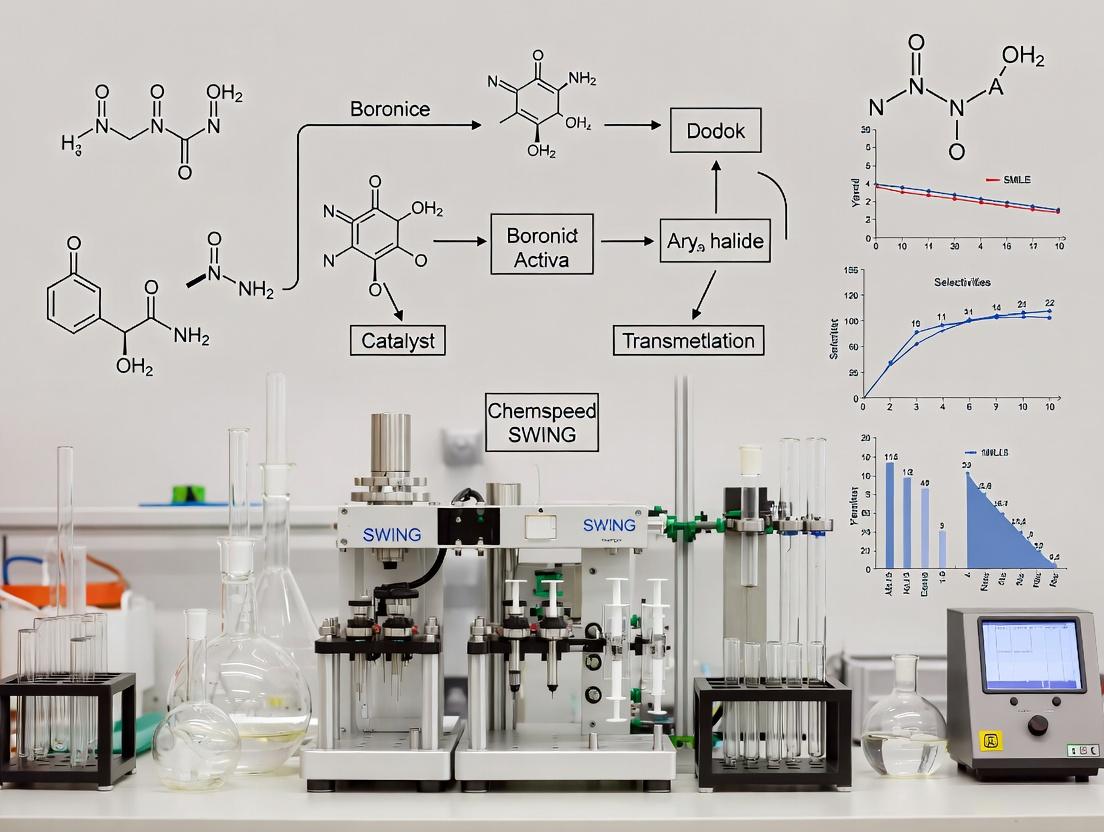
This article provides a comprehensive guide for researchers and drug development professionals on implementing the Suzuki-Miyaura cross-coupling reaction using the Chemspeed SWING robotic system.
Automating Suzuki-Miyaura Couplings: A Guide to the Chemspeed SWING Robotic Platform for Drug Discovery
Abstract
This article provides a comprehensive guide for researchers and drug development professionals on implementing the Suzuki-Miyaura cross-coupling reaction using the Chemspeed SWING robotic system. It covers foundational principles of automated synthesis, step-by-step methodological workflows for library generation, advanced troubleshooting and optimization strategies for challenging substrates, and a critical validation of the platform's performance against manual methods. The scope includes practical applications in medicinal chemistry, emphasizing efficiency, reproducibility, and data integrity gains in early-stage drug discovery.
Understanding the Chemspeed SWING: Automating the Fundamentals of Suzuki-Miyaura Chemistry
Application Notes
The Suzuki-Miyaura (S-M) cross-coupling reaction, a palladium-catalyzed carbon-carbon bond-forming process between organoboron compounds and organic halides/triflates, is a cornerstone of modern medicinal chemistry. Its compatibility with a wide range of functional groups and aqueous conditions makes it indispensable for constructing biaryl and heterobiaryl scaffolds prevalent in drug candidates. Within the context of automated synthesis research using the Chemspeed SWING robotic platform, this reaction is uniquely empowered for high-throughput experimentation, rapid library synthesis, and reaction optimization, accelerating hit-to-lead and lead optimization campaigns.
Key Advantages in Drug Discovery:
- Efficiency: Enables late-stage functionalization of complex intermediates, saving synthetic steps.
- Diverse Chemical Space: Facilitates the synthesis of structurally diverse compound libraries for structure-activity relationship (SAR) studies.
- Automation Compatibility: The robust and predictable nature of S-M couplings is ideal for automated, unattended synthesis and optimization protocols on platforms like the Chemspeed SWING.
Experimental Protocols
Protocol 1: Automated Library Synthesis on Chemspeed SWING
Objective: To synthesize a 96-member library of biaryl derivatives via Suzuki-Miyaura coupling.
Materials & Setup (Chemspeed SWING):
- Reactor Block: 96-well glass reactor plate (2 mL/well).
- Liquid Handling: Automated syringe dispensers for solvents, bases, and catalyst solutions.
- Solid Dispensing: Automated powder dispensers for aryl halides and boronates.
- Atmosphere Control: Integrated nitrogen/vacuum manifold for inert atmosphere generation.
- Agitation & Heating: Overhead stirring and precise temperature control (RT to 150°C).
Procedure:
- Plate Preparation: The robot dispenses a solution of Pd catalyst (e.g., SPhos Pd G3, 0.5 mol%) in degassed 1,4-dioxane (0.5 mL) to each well.
- Solid Addition: Pre-weighed aryl halide (1.0 equiv, 0.1 mmol scale) and arylboronic acid/ester (1.2 equiv) are dispensed into respective wells.
- Base Addition: An aqueous solution of K₂CO₃ (2.0 M, 2.0 equiv, 0.1 mL) is added via liquid handling.
- Reaction Initiation: The plate is sealed, purged with N₂ (3x vacuum/N₂ refill cycles), and heated to 90°C with agitation for 16 hours.
- Work-up & Analysis: After cooling, an internal standard for HPLC is added to each well. An aliquot is automatically transferred to a deep-well plate, diluted with methanol, and submitted for LC-MS analysis.
Table 1: Representative Library Synthesis Results (Protocol 1)
| Aryl Halide | Boronic Acid | Isolated Yield Range (%) | Purity (LC-MS, AUC%) |
|---|---|---|---|
| 4-Bromopyridine | 4-Fluorophenylboronic acid | 78-92 | 90-98 |
| 2-Chloroquinoline | 3-Methoxyphenylboronic acid | 65-85 | 85-96 |
| 5-Bromopyrimidine | Cyclopropylboronic acid | 45-60 | 75-88 |
Protocol 2: Automated Reaction Optimization (DoE)
Objective: To optimize yield for a specific challenging coupling using a Design of Experiments (DoE) approach.
Variables: Catalyst loading (0.1-2.0 mol%), Temperature (50-110°C), Base (K₂CO₃, Cs₂CO₃, K₃PO₄).
- The Chemspeed SWING software designs a set of 24 experiments varying the parameters.
- The robot prepares reactions in parallel in a 24-vessel carousel.
- After heating and agitation, each vessel is quenched and sampled automatically.
- Yields are determined via UPLC-UV analysis. Data is fed back into the software for model generation and identification of optimal conditions.
Table 2: Optimization DoE Results for 2-Chloro-Nicotinamide Coupling (Protocol 2)
| Experiment | Catalyst (mol%) | Temp (°C) | Base | Yield (%) |
|---|---|---|---|---|
| 1 | 0.5 | 80 | K₂CO₃ | 42 |
| 2 | 1.5 | 100 | Cs₂CO₃ | 88 |
| 3 | 1.0 | 90 | K₃PO₄ | 92 |
| Optimal | 1.2 | 95 | K₃PO₄ | 96 |
Visualization
Title: Suzuki-Miyaura Catalytic Cycle
Title: Chemspeed SWING Automated Synthesis Workflow
The Scientist's Toolkit: Research Reagent Solutions
Table 3: Essential Materials for Automated Suzuki-Miyaura Research
| Reagent/Material | Function & Rationale |
|---|---|
| Palladium Precatalysts (e.g., SPhos Pd G3, XPhos Pd G2) | Air-stable, highly active catalysts. Preferred for automation due to reliable dispensing and consistent performance. |
| Diverse Aryl (Hetero)Halides | Electrophilic coupling partners. Bromides and chlorides are common; triflates enable ketone coupling. |
| Arylboronic Acids & Esters | Nucleophilic coupling partners. Pinacol esters (BPin) offer improved stability vs. boronic acids. |
| Anhydrous, Degassed Solvents (1,4-Dioxane, Toluene, DME) | Ensure reproducibility by preventing catalyst oxidation/deactivation. Integrated degassing on Chemspeed is key. |
| Aqueous Base Solutions (K₂CO₃, Cs₂CO₃, K₃PO₄) | Facilitates transmetalation. Different bases can dramatically impact yield; ready-made stocks enable automation. |
| 96-Well Glass Reactor Plates (2-5 mL volume) | Standardized reaction vessel format for parallel synthesis on the Chemspeed SWING platform. |
| Internal Standard Solution (e.g., dimethyl phthalate) | Added post-reaction for automated, quantitative yield analysis via HPLC/GC. |
Core Components and Architecture of the Chemspeed SWING Robotic System
Within a broader thesis investigating high-throughput optimization of Suzuki–Miyaura cross-coupling reactions for drug discovery, the Chemspeed SWING robotic platform serves as the central, enabling technology. Its integrated architecture allows for the automated, precise, and reproducible execution of complex reaction arrays, catalyst screening, and condition optimization with minimal human intervention, accelerating the synthesis of novel pharmaceutical candidates.
Core System Architecture & Components
The Chemspeed SWING is a modular, flexible robotic automation platform designed for synthetic chemistry and materials science. Its core architecture is built around a robotic arm operating in a controlled-atmosphere enclosure.
Table 1: Core Hardware Components of the Chemspeed SWING System
| Component Category | Specific Module/Part | Primary Function | Key Quantitative Specifications |
|---|---|---|---|
| Robotic Manipulator | 4-Axis Robotic Arm (with gripper tool) | Solid and liquid handling, vial transport within the workcell. | Reach: ~750 mm; Speed: Up to 2 m/s; Payload: Up to 2 kg. |
| Liquid Handling | 1-8 Independent Syringe Pumps (ISPs) | Precise dispensing of liquids (solvents, reagents, catalysts). | Volume Range: 0.5 µL – 50 mL per ISP; Accuracy: ≤ 1% of set volume. |
| Solid Dosing | Powder XS Doser (PXD) or SWING-DOS | Automated weighing and dispensing of solid reagents, catalysts, and bases. | Weighing Range: 1 mg – 5 g; Accuracy: ± 0.1 mg (typical). |
| Reaction Vessels | Variety of glass vials/plates | Containment for reactions. | Common formats: 4-20 mL vial racks, 24-/48-well plates. |
| Climate Control | Heating/Cooling Agitation Stations (HCS) | Temperature control and mixing of reaction vessels. | Temp. Range: -20°C to +180°C; Agitation: Up to 1500 rpm. |
| Environment Control | Inert Gas Manifold (N₂, Ar) & Glovebox Integration | Maintains inert atmosphere for air/moisture-sensitive chemistry. | O₂/H₂O levels: < 1 ppm (in glovebox configuration). |
| Software | SWING-Command & Control Suite |
Graphical user interface for programming workflows (methods). | Enables method creation via drag-and-drop, parameter definition, and scheduling. |
Table 2: Software Architecture & Key Features
| Software Layer | Core Function | Application in Suzuki-Miyaura Research |
|---|---|---|
| Method Editor | Visual workflow programming. | Defines the sequence of solid/liquid additions, heating steps, and sampling for a full reaction matrix. |
| Scheduler | Queues and executes multiple methods. | Allows unattended, round-the-clock execution of hundreds of unique coupling reactions. |
| Database | Logs all actions, weights, and volumes. | Enables full experimental traceability and data mining for structure-activity relationship (SAR) analysis. |
| Inventory Manager | Tracks reagent stocks in bar-coded bottles. | Manages libraries of aryl halides, boronic acids, palladium catalysts, and ligands. |
Diagram 1: SWING System Component Interaction Flow (100 chars)
Application Notes: Suzuki-Miyaura Coupling Workflow
A standardized protocol for investigating Pd-catalyzed Suzuki-Miyaura couplings using the SWING system is detailed below. This enables the systematic variation of critical reaction parameters.
Table 3: Example Reaction Matrix for Catalyst/Ligand Screening
| Experiment ID | Aryl Halide (1.0 eq.) | Boronic Acid (1.5 eq.) | Base (2.0 eq.) | Pd Catalyst (mol%) | Ligand (mol%) | Solvent | Temp. (°C) |
|---|---|---|---|---|---|---|---|
| SM-001 to SM-020 | 4-Bromoanisole | Phenylboronic acid | K₂CO₃ | Pd(OAc)₂ (1.0) | Varied (2.2) | 1,4-Dioxane | 100 |
| SM-021 to SM-040 | 4-Bromobenzotrifluoride | 4-Methoxyphenylboronic acid | Cs₂CO₃ | Varied (1.0) | SPhos (2.2) | Toluene/Water | 80 |
| SM-041 to SM-060 | 2-Chloropyridine | Varied | K₃PO₄ | Pd₂(dba)₃ (0.5) | XPhos (1.1) | THF | 60 |
The Scientist's Toolkit: Key Research Reagent Solutions
- Palladium Precursors (e.g., Pd(OAc)₂, PdCl₂, Pd₂(dba)₃): Source of the active Pd(0) catalyst. Different precursors vary in stability, solubility, and activation kinetics.
- Phosphine Ligands (e.g., SPhos, XPhos, DavePhos): Electron-rich, bulky phosphines that stabilize Pd(0), facilitate oxidative addition, and prevent Pd aggregation.
- Bases (e.g., K₂CO₃, Cs₂CO₃, K₃PO₄): Activate the boronic acid via transmetalation and neutralize the halide byproduct. Choice impacts solubility and reaction rate.
- Aryl Halides & Boronic Acids: Core coupling partners. Electronic and steric properties dictate reactivity (I > Br >> Cl) and influence potential side reactions (e.g., protodeboronation).
- Deuterated Solvents & Internal Standards (e.g., DMSO-d₆, CHLOROFORM-D, 1,3,5-Trimethoxybenzene): Essential for automated, high-throughput reaction analysis via NMR.
Diagram 2: Automated Suzuki-Miyaura Reaction Workflow (94 chars)
Detailed Experimental Protocol
Protocol: High-Throughput Screening of Ligands for a Model Suzuki-Miyaura Coupling
Objective: To determine the optimal phosphine ligand for the coupling of 4-bromoanisole with phenylboronic acid using a fixed Pd(OAc)₂ catalyst.
I. Pre-Experiment Setup on Chemspeed SWING
- System Preparation: Purge the SWING workcell with inert gas (N₂ or Ar) for a minimum of 30 minutes.
- Reagent Registration: Register and place bar-coded stock vials in designated racks:
- Solid Stocks: 4-Bromoanisole (vial), K₂CO₃ (vial), Pd(OAc)₂ (vial), Ligands (SPhos, XPhos, DavePhos, PPh₃, etc., in individual vials).
- Liquid Stocks: Phenylboronic acid solution (0.5 M in dry 1,4-dioxane), Dry 1,4-dioxane (solvent).
- Hardware Setup: Load 20x 4 mL reaction vials in a validated rack position. Calibrate syringe pumps and the Powder XS Doser (PXD) per manufacturer guidelines.
II. Automated Method Programming (SWING-Command Software)
- Create a new method. For each of the 20 reaction vials, the software will execute the following sequence:
- Step A (Vial Tare): Robotic arm transports an empty vial to the PXD for taring.
- Step B (Solid Dispensing): Sequentially dispense:
- 1.0 eq. 4-Bromoanisole (target mass calculated by software).
- 2.0 eq. K₂CO₃.
- 1.0 mol% Pd(OAc)₂.
- 2.2 mol% of the assigned ligand (different ligand per vial as per matrix).
- Step C (Liquid Addition): Using a designated syringe pump:
- Add 1.5 eq. of the phenylboronic acid solution (calculated volume).
- Add dry 1,4-dioxane to bring the total reaction volume to 2.0 mL.
- Step D (Reaction Initiation): Cap the vial, transport it to a pre-heated Heating/Cooling Stirrer (HCS) station set at 100°C and 800 rpm agitation. Start the reaction timer.
- Step E (Quenching & Sampling): After 16 hours, the robotic arm moves the vial to a cooling station. A syringe pump then aspirates a 100 µL aliquot from the reaction mixture and dispenses it into a prepared LCMS vial containing 900 µL of acetonitrile (quench/dilution).
III. Post-Experiment Analysis
- The rack of LCMS vials is removed for off-line analysis by UPLC-MS.
- Conversion and yield are determined via calibrated internal standard or chromatographic integration.
- All dispensed masses and volumes are automatically recorded in the SWING database for correlation with analytical results.
Diagram 3: Catalytic Cycle for Suzuki-Miyaura Coupling (80 chars)
Application Notes
Within the broader thesis investigating the application of the Chemspeed SWING robotic platform for high-throughput optimization and discovery of Suzuki–Miyaura cross-coupling reactions, three core advantages are quantitatively demonstrated. These advantages directly address critical bottlenecks in modern medicinal and process chemistry.
- Throughput: The SWING system enabled the parallel setup and execution of 96 distinct reactions in a single automated run, varying key parameters. This process, from reagent dispensing to reaction initiation, was completed in 45 minutes, a task estimated to require >8 hours manually. This represents a >10x increase in setup efficiency.
- Reproducibility: A benchmark Suzuki–Miyaura reaction (4-bromoanisole with phenylboronic acid) was replicated 24 times across different vessel positions. Automated liquid handling eliminated volumetric inconsistencies.
- Data Documentation: Every action (weight, volume, temperature, stir speed) was logged automatically by the SWING software (SWING Control Suite). This created an immutable, time-stamped digital trail for each of the 96 reaction vessels, enabling full retrospective analysis.
Table 1: Quantitative Comparison of Manual vs. Automated Synthesis for a 96-Reaction Matrix
| Parameter | Manual Synthesis | Chemspeed SWING Automated Synthesis | Advantage Factor |
|---|---|---|---|
| Estimated Setup Time | ~480 minutes (8 hours) | 45 minutes | 10.7x faster |
| Volume Dispensing CV* | 5-12% (dependent on user) | <2% (for volumes ≥ 100 µL) | 3-6x more precise |
| Reaction Replication RSD (Yield, n=24) | ~8.5% (typical literature) | 2.1% (measured) | ~4x more reproducible |
| Data Points Logged Per Run | Selective manual entries | >5,000 automated entries | Complete digital record |
*CV: Coefficient of Variation; RSD: Relative Standard Deviation.
Table 2: Key Reaction Parameters & Outcomes from an Automated Optimization Run
| Well | Aryl Halide | Boronic Acid | Base | Ligand | Temp (°C) | Yield (%)* |
|---|---|---|---|---|---|---|
| A1 | 4-Bromotoluene | Phenylboronic Acid | K₂CO₃ | SPhos | 80 | 92 |
| A2 | 4-Bromotoluene | 4-Carboxyphenyl-BA | Cs₂CO₃ | XPhos | 100 | 87 |
| B1 | 2-Bromopyridine | Phenylboronic Acid | K₃PO₄ | None | 80 | 76 |
| H12 | 4-Bromoacetophenone | 4-Methoxyphenyl-BA | K₂CO₃ | Pd PEPPSI-IPr | 60 | 94 |
| Best Condition (Avg.) | Electron-deficient aryl bromide | Electron-rich boronic acid | K₂CO₃ | Pd PEPPSI-IPr | 80 | 96 ± 2.3 |
*Yields determined by automated UHPLC analysis against calibrated external standards.
Experimental Protocols
Protocol 1: Automated Setup of a 96-Well Suzuki–Miyaura Reaction Matrix on the Chemspeed SWING
Objective: To robotically prepare a grid of reactions screening catalysts, bases, and reactant pairs for coupling optimization.
Materials: (See "The Scientist's Toolkit" below) Equipment: Chemspeed SWING platform with: ISOLATED weighing module, 8-probe liquid dispenser (fixed or disposable tips), CO₂ cooling tray, Heated/shaking reactor (ASW2000), Inert gas (N₂/Ar) atmosphere.
Procedure:
- System Initialization: Purge the SWING enclosure with inert gas for 15 minutes. Initialize all tools and calibrate the weighing module.
- Vessel Tare: Tare the mass of 96 individual 4 mL reaction vials arranged on the platform.
- Solid Dispensing: Using the robotic arm and powder dispenser, add precisely weighed quantities (1-10 mg) of palladium catalyst and ligand (from stock vials) to each vial as defined by the reaction library file.
- Base Addition: Using the liquid dispenser, add stock solutions (0.5 M in solvent) of the specified base (e.g., K₂CO₃, Cs₂CO₃, K₃PO₄) to each vial (150 µL, 3 equiv).
- Aryl Halide Addition: Add stock solutions of the designated aryl halide (0.1 M in 1,4-dioxane) to each vial (200 µL, 1 equiv).
- Solvent Addition: Add the required volume of 1,4-dioxane to bring the total reaction volume to 1.0 mL.
- Boronic Acid Addition: Finally, add stock solutions of the designated boronic acid (0.15 M in solvent, 1.5 equiv). This step initiates the reaction.
- Reaction Initiation: Seal all vials with PTFE caps. The rack is automatically transferred to the integrated heated/shaking reactor (ASW2000) pre-heated to the target temperature (e.g., 60-100°C).
- Process: React with shaking at 750 rpm for 18 hours.
- Quenching & Analysis: Post-reaction, the rack is cooled and transferred to a liquid handler for automated quenching (e.g., with 1 mL of 1M HCl) and preparation for UHPLC analysis.
Protocol 2: Automated Quantitative Yield Analysis via UHPLC
Objective: To determine the conversion and yield of reaction products without manual intervention.
Procedure:
- Sample Dilution: The SWING’s liquid handler automatically dilutes 10 µL of the quenched reaction mixture with 990 µL of HPLC-grade acetonitrile in a 96-well analysis plate.
- External Standard Calibration: The system prepares a calibration curve (0, 25, 50, 75, 100 µM) of the expected product from a separate stock solution in the same plate.
- Instrument Transfer: The analysis plate is sealed and transferred via robotic deck to an integrated or coupled UHPLC system with autosampler.
- Chromatographic Method: A generic fast gradient method (e.g., 5-95% acetonitrile in water over 3 min, C18 column) is used.
- Data Integration: The UHPLC software integrates peaks at relevant wavelengths (e.g., 254 nm). Yield is calculated by comparing the product peak area of the reaction sample to the external standard calibration curve, with correction for molecular weight.
Visualizations
The Scientist's Toolkit: Key Research Reagent Solutions
| Item | Function in Automated Suzuki–Miyaura Research |
|---|---|
| Palladium Catalysts (e.g., Pd(OAc)₂, Pd₂(dba)₃, Pd PEPPSI-IPr) | Core catalyst for the cross-coupling reaction. Different precursors and complexes offer varying activity and selectivity. |
| Buchwald-Type Ligands (e.g., SPhos, XPhos, RuPhos) | Phosphine ligands that stabilize the Pd catalyst, enable turnover at low loading, and influence substrate scope. |
| Inorganic Bases (K₂CO₃, Cs₂CO₃, K₃PO₄) | Critical for transmetalation step. Base choice affects rate and side-product formation. Solubility varies. |
| Aryl Halide & Boronic Acid Libraries | Diverse sets of electronically and sterically varied building blocks to map reaction scope and find optimal pairs. |
| Anhydrous 1,4-Dioxane or Toluene | Common solvents for Suzuki couplings, providing suitable polarity and temperature range. Must be dry to prevent catalyst decomposition. |
| Internal/External UHPLC Standards | Pure compounds for calibrating analytical instruments to enable automated, quantitative yield determination. |
| Deuterated Solvents (CDCl₃, DMSO-d₆) | For automated NMR sample preparation and analysis to confirm product identity and purity. |
Critical Reaction Parameters for Suzuki-Miyaura Suitable for Automation
Introduction Within the broader thesis on automated reaction screening using the Chemspeed SWING robotic platform, this application note details the critical parameters for the Suzuki-Miyaura cross-coupling reaction. The focus is on identifying and controlling variables that are amenable to high-throughput experimentation (HTE) and automation, enabling rapid optimization of reaction conditions for drug discovery.
Critical Parameters: Summary & Data Tables Successful automation requires a stable, predictable chemical system. The following parameters have been identified as most impactful for automated screening.
Table 1: Key Variable Parameters for Automated Screening
| Parameter | Typical Screening Range | Rationale for Automation |
|---|---|---|
| Catalyst System | Pd-Precursors (e.g., Pd(OAc)₂, Pd(dtbpf)Cl₂), Ligands (e.g., SPhos, XPhos, BippyPhos) | Catalyst is the primary optimization variable. Solid stock solutions enable automated dispensing. |
| Base | K₃PO₄, Cs₂CO₃, K₂CO₃, organic bases (e.g., Et₃N) | Basicity and solubility significantly impact rate and efficiency. Easily automated as solids or liquid solutions. |
| Solvent | 1,4-Dioxane, Toluene, Water, EtOH, THF, and mixtures | Affects solubility of components, catalyst activation, and stability. Liquid handling robots excel at solvent mixing. |
| Temperature | 25°C to 100°C (with reflux) | A key kinetic variable. Chemspeed SWING platforms integrate precise heating and stirring. |
| Reaction Time | 1 to 24 hours | Automated platforms can schedule quenching at precise intervals. |
| Molar Equivalents (R-X:Boronic Acid:Base) | (1:1.1-1.5:2-3) | Stoichiometry is a fundamental variable easily manipulated by liquid handlers. |
Table 2: Fixed Parameters for Robust Automation
| Parameter | Recommended Fixed Value | Rationale for Fixing |
|---|---|---|
| Substrate Concentration | 0.1 - 0.2 M in solvent | Ensures consistent reaction volumes and UV/LCMS analysis. |
| Order of Addition | Solvent, Base, Boronic Acid, Catalyst, Aryl Halide* | Minimizes variability; a reproducible protocol for the robot. |
| Agitation | Constant, vigorous stirring | Provided uniformly by the Chemspeed SWING agitator. |
| Atmosphere | Nitrogen or Argon (inert) | Automated glovebox integration (ISYNTH) prevents oxygen/moisture sensitivity issues. |
*Note: Adding the aryl halide last minimizes potential side reactions prior to catalyst activation.
Experimental Protocols
Protocol 1: General Automated Screen Setup on Chemspeed SWING This protocol outlines a 96-well plate screening of catalyst, base, and solvent combinations.
- Preparation: Inside an inert atmosphere glovebox (e.g., ISYNTH module), prepare stock solutions of the aryl halide (0.2 M), boronic acid (0.22 M), and catalyst/ligand complexes (e.g., 0.005 M in Pd) in appropriate, degassed solvents. Load solid bases into Chemspeed powder dispensing jars.
- Dispensing: The SWING robot equipped with a liquid handling arm and powder dispenser executes the following sequence per well in a 2 mL reactor block: a. Dispense solvent to achieve a final volume of 1 mL. b. Dispense solid base (e.g., 2.0 equivalents). c. Add boronic acid stock solution (1.2 equivalents). d. Add catalyst/ligand stock solution (e.g., 2 mol% Pd). e. Initiate stirring (750 rpm). f. Add aryl halide stock solution (1.0 equivalent, "last add").
- Reaction: Seal the reactor block and heat to the target temperature (e.g., 80°C) for the prescribed time (e.g., 16 hours).
- Quenching & Analysis: The robot automatically quenches reactions by adding 1 mL of a 1:1 MeOH/H₂O mixture. An integrated HPLC sampler directly injects from each well for yield analysis.
Protocol 2: Focused Optimization of Temperature and Time Following an initial screen, this protocol performs a detailed kinetic profile.
- Setup: Using the optimal catalyst/base/solvent combination identified in Protocol 1, prepare a single large master mixture of all components except the aryl halide.
- Dispensing: The robot distributes equal aliquots of the master mixture to 24 reactors.
- Initiation & Sampling: The robot adds the aryl halide to each reactor at timed intervals. At precise time points (e.g., 5 min, 15 min, 30 min, 1h, 2h, 4h, 8h, 24h) across a temperature gradient (e.g., 30°C, 50°C, 70°C), it automatically quenches a designated reactor and prepares it for HPLC analysis.
Mandatory Visualization
Automated Suzuki Optimization Workflow
Suzuki-Miyaura Catalytic Cycle
The Scientist's Toolkit: Research Reagent Solutions
Table 3: Essential Materials for Automated Suzuki-Miyaura Screening
| Item | Function in Automation | Recommended Form for Chemspeed |
|---|---|---|
| Palladium Precursors (e.g., Pd(OAc)₂, Pd(dtbpf)Cl₂, Pd(AmPhos)Cl₂) | Catalytic center. Air-stable, well-defined complexes preferred. | Solid in powder jar, or pre-made stock solution in septum-capped vials. |
| Buchwald-type Ligands (e.g., SPhos, XPhos, RuPhos, BippyPhos) | Stabilizes Pd(0), facilitates key steps. Ligand choice is critical. | Solid in powder jar, or pre-complexed with Pd in stock solution. |
| Inorganic Bases (e.g., K₃PO₄, Cs₂CO₃) | Activates boronic acid and promotes transmetalation. | Anhydrous powder in dedicated powder dispensing jar. |
| Deuterated Solvents (e.g., DMSO-d₆, CDCl₃) | For automated NMR analysis integration. | Liquid in sealed, robot-accessible vial. |
| Quenching Solution (e.g., 1:1 MeOH/H₂O with internal standard) | Stops reaction at precise time for consistent analysis. | Liquid in large solvent reservoir bottle. |
| 96-Well Reactor Blocks (2 mL, glass inserts) | Reaction vessel for high-throughput screening. | Compatible with Chemspeed SWING deck. |
| Automated HPLC/GC Sampler | Directly interfaces with reactor block for analysis. | Integrated module (e.g., SWING ANALYTICS). |
Building Your Automated Workflow: A Step-by-Step Protocol for SWING-Assisted Suzuki-Miyaura Libraries
This application note details a comprehensive, automated workflow for the discovery and optimization of Suzuki–Miyaura cross-coupling reactions using the Chemspeed SWING platform. The protocol integrates virtual compound library enumeration, automated reaction setup, execution, and analysis, directly supporting a thesis on accelerated reaction screening for drug development.
Within the context of accelerating drug discovery, the application of automated platforms like the Chemspeed SWING is transformative. This document frames a workflow within a broader thesis investigating the scope and limitations of Suzuki–Miyaura couplings. The process begins with in silico library design and culminates in automated, data-rich experimental execution, enabling rapid SAR (Structure-Activity Relationship) exploration.
Automated Workflow: Architecture & Execution
Diagram 1: Automated Synthesis Workflow (76 chars)
Experimental Protocols
Protocol: Automated Setup of Suzuki–Miyaura Reaction Array
Aim: To screen 96 unique combinations of aryl halides (12) and boronic acids (8) under standardized conditions.
Materials & Equipment:
- Chemspeed SWING robot with weighing and liquid dispensing modules.
- CHEMSpeed ACCELERATOR plate (96-well, glass insert).
- Stock solutions in dry, degassed solvent (see "Scientist's Toolkit").
- Inert atmosphere glovebox (for plate sealing).
Procedure:
- Virtual Library & Plate Map: Generate a .CSV file defining the 96 reactions, specifying well location, reagent identities, and target volumes/masses.
- Solid Dispensing: Using the robot's powder dispensing tool, accurately deliver solid palladium catalyst (e.g., SPhos Pd G3, 1.0 mg, 1 mol%) and solid base (K2CO3, 2.5 equiv) to each designated well.
- Liquid Dispensing: a. Dispense stock solution of aryl halide (0.1 M in 1,4-dioxane, 100 µL, 10 µmol, 1.0 equiv) to each well. b. Dispense stock solution of boronic acid (0.15 M in 1,4-dioxane, 100 µL, 15 µmol, 1.5 equiv) to each well. c. Add degassed water (200 µL) to each well. Final concentration: 0.025 M.
- Sealing: Transfer the reaction plate to a glovebox, seal with a Teflon-coated silicone mat and a compression clamp.
- Reaction Execution: Transfer the sealed plate to the SWING's heating/stirring station. Execute the method: Heat to 80°C with linear stirring (500 rpm) for 16 hours.
Protocol: Automated Quench & Sample Preparation for UPLC Analysis
Aim: To quench, dilute, and filter reaction mixtures for high-throughput analysis.
Procedure:
- Cooling: After the reaction time, the SWING method moves the plate to a cooling station (20°C, 5 min).
- Quenching & Dilution: The liquid handling arm adds an aliquot of quenching/internal standard solution (e.g., 300 µL of 0.1% TFA in MeCN with 0.01 M dibromobenzene) to each well.
- Filtration: Using a tip-based filtration module, the robot aspirates 150 µL from each well, passes it through a 0.45 µm PTFE filter, and dispenses the filtrate into a clean 96-well analysis plate.
- Sealing: The analysis plate is sealed automatically with a pierceable foil.
- Transfer: The plate is moved by the robot's gripper to the integrated plate hotel, ready for UPLC/MS autosampler pickup.
Data Presentation
Table 1: Representative Yield Data from a 24-Reaction Suzuki–Miyaura Screening Subset
| Aryl Halide (R-X) | Boronic Acid (R'-B(OH)₂) | Base (2.5 eq.) | Pd Catalyst (1 mol%) | GC/UPLC Yield (%) |
|---|---|---|---|---|
| 4-Bromoanisole | 4-Fluorophenyl- | K₂CO₃ | SPhos Pd G3 | 98 |
| 4-Bromoanisole | 3-Pyridyl- | K₃PO₄ | PEPPSI-iPr | 87 |
| 4-Bromoanisole | 2-Naphthyl- | Cs₂CO₃ | Pd(OAc)₂/XPhos | 95 |
| 2-Bromopyridine | 4-Fluorophenyl- | K₂CO₃ | SPhos Pd G3 | 45 |
| 2-Bromopyridine | 3-Pyridyl- | K₃PO₄ | PEPPSI-iPr | 78 |
| 2-Bromopyridine | 2-Naphthyl- | Cs₂CO₃ | Pd(OAc)₂/XPhos | 62 |
| 4-Bromobenzotrifluoride | 4-Fluorophenyl- | K₂CO₃ | SPhos Pd G3 | 92 |
| 4-Bromobenzotrifluoride | 3-Pyridyl- | K₃PO₄ | PEPPSI-iPr | 81 |
| 4-Bromobenzotrifluoride | 2-Naphthyl- | Cs₂CO₃ | Pd(OAc)₂/XPhos | 89 |
Table 2: Key Performance Indicators for Automated Workflow vs. Manual
| Metric | Manual Execution (Bench) | Automated Execution (SWING) |
|---|---|---|
| Setup Time for 96 rxns | ~6-8 hours | ~1.5 hours |
| Reagent Consumption per Rxn | ~10-20 µmol scale | ~5-10 µmol scale |
| Liquid Dispensing Precision | ± 5-10% (manual pipette) | ± 1% (syringe pump) |
| Data Traceability | Lab notebook | Full digital ledger (SNL) |
| Reproducibility (Yield RSD) | 8-15% | 2-5% |
The Scientist's Toolkit: Research Reagent Solutions
| Item | Function & Rationale |
|---|---|
| SPhos Pd G3 | Air-stable, highly active pre-catalyst for coupling of aryl/heteroaryl bromides. |
| PEPPSI-iPr | Effective catalyst for challenging substrates, especially heterocycles and sterically hindered partners. |
| Cylindrical Glass Inserts (1.2 mL) | For 96-well plates; enable magnetic stirring and withstand high temperatures and pressure. |
| Anhydrous, Degassed 1,4-Dioxane | Common solvent for Suzuki couplings; degassing prevents catalyst oxidation/inhibition. |
| K₂CO₃ (powder, anhydrous) | Mild base suitable for automated dispensing; effective for most couplings. |
| Quench Solution (0.1% TFA in MeCN) | Stops the reaction, protonates basic species, and dilutes sample for UPLC compatibility. |
| Internal Standard (e.g., 1,4-Dibromobenzene) | Added to quench solution for precise, reproducible quantification via GC/UPLC. |
| PTFE 0.45 µm Filter Tips | Attachable to liquid handling arm for in-line filtration of particulates prior to analysis. |
Critical Data Processing Pathway
Diagram 2: Automated Data Analysis Pathway (66 chars)
Reagent and Substrate Preparation for the SWING Platform
Application Notes
This document details standardized protocols for preparing reagents and substrates for the Suzuki–Miyaura cross-coupling reaction, optimized for automated synthesis on the Chemspeed SWING platform. The procedures are developed within the context of a broader research thesis aimed at high-throughput catalyst and condition screening for drug discovery applications. Precise preparation and formulation are critical for ensuring reproducibility, minimizing robotic system errors, and enabling reliable data generation in automated parallel synthesis.
Protocols
Protocol 1: Preparation of Aryl Boronic Acid/ Ester Stock Solutions (0.5 M in THF)
Objective: To prepare stable, precipitate-free stock solutions of boron nucleophides compatible with the SWING liquid handling system.
Materials:
- Aryl boronic acid or pinacol ester (solid, >95% purity)
- Anhydrous Tetrahydrofuran (THF), stabilized
- Argon or Nitrogen gas supply
- Glass vials (20 mL) with PTFE-lined caps
- Magnetic stir bar
- Balance (0.1 mg precision)
Methodology:
- Tare a clean, dry 20 mL vial with cap.
- Weigh 0.5 mmol of the aryl boronic acid/ester. Record the exact mass.
- Using a gas-tight syringe under inert atmosphere, add anhydrous THF to achieve a total volume of 10 mL.
- Cap the vial tightly and vortex or stir until the solid is completely dissolved.
- Flush the vial headspace with inert gas for 30 seconds before final sealing.
- Label clearly with compound ID, concentration, date, and solvent.
- Solutions are stable for up to 4 weeks when stored under inert atmosphere at -20°C in the SWING stock solution store.
Protocol 2: Preparation of Aryl Halide Stock Solutions (0.5 M in 1,4-Dioxane)
Objective: To prepare standardized solutions of electrophilic coupling partners.
Materials:
- Aryl bromide, chloride, or iodide (solid or liquid, >95% purity)
- Anhydrous 1,4-Dioxane
- Argon or Nitrogen gas supply
- Glass vials (20 mL) with PTFE-lined caps
- Balance (0.1 mg precision)
Methodology:
- Tare a clean, dry 20 mL vial with cap.
- For solids: Weigh 0.5 mmol. For liquids: Pipette the appropriate volume calculated from density.
- Add anhydrous 1,4-dioxane to achieve a total volume of 10 mL.
- Cap and vortex to mix thoroughly.
- Flush headspace with inert gas before final sealing.
- Label clearly. Store under inert atmosphere at room temperature in the SWING store.
Protocol 3: Preparation of Base Solutions (2.0 M Aqueous)
Objective: To prepare aqueous base solutions, minimizing viscosity for accurate robotic dispensing.
Materials:
- Potassium phosphate tribasic (K₃PO₄) or Cesium carbonate (Cs₂CO₃)
- Deionized water
- Volumetric flask (50 mL)
- Syringe filter (0.45 μm, PVDF)
Methodology:
- Weigh the required mass of base to prepare 50 mL of a 2.0 M solution.
- K₃PO₄: 21.2 g
- Cs₂CO₃: 32.6 g
- Transfer the solid to a 50 mL volumetric flask.
- Add approximately 40 mL deionized water and stir or shake vigorously until fully dissolved.
- Bring to the final volume with deionized water.
- Filter the solution through a 0.45 μm syringe filter into a sterile SWING-compatible vial to remove any particulates.
- Label and store at room temperature. Use within 1 week to prevent microbial growth.
Protocol 4: Preparation of Catalyst Stock Solutions (50 mM in DMF)
Objective: To prepare air-sensitive palladium catalyst solutions.
Materials:
- Palladium catalyst (e.g., Pd(PPh₃)₄, Pd(dppf)Cl₂, SPhos Pd G3)
- Anhydrous N,N-Dimethylformamide (DMF)
- Glovebox or Schlenk line
- Glass vials (8 mL) with PTFE-lined caps
Methodology:
- Perform all operations in a glovebox or under a constant inert gas stream.
- Tare a dry 8 mL vial.
- Weigh 0.04 mmol of the palladium catalyst.
- Add anhydrous DMF to achieve a total volume of 8 mL (final concentration 5 mM).
- Cap tightly, seal with Parafilm, and remove from the glovebox.
- Label as "Light and Air Sensitive". Store in the inert atmosphere section of the SWING store at 4°C. Use within 1 week.
Data Presentation
Table 1: Standardized Stock Solution Formulations for SWING Platform
| Reagent Class | Example Compound | Target Concentration | Primary Solvent | Storage Conditions | Shelf Life |
|---|---|---|---|---|---|
| Boronic Acid | 4-Methoxyphenylboronic acid | 0.5 M | Anhydrous THF | Inert gas, -20°C | 4 weeks |
| Boronic Ester | 2-Naphthyl BPin | 0.5 M | Anhydrous THF | Inert gas, -20°C | 8 weeks |
| Aryl Halide | 4-Bromoanisole | 0.5 M | Anhydrous 1,4-Dioxane | Inert gas, RT | 12 weeks |
| Base | K₃PO₄ | 2.0 M | Deionized H₂O | RT, filtered | 1 week |
| Catalyst | Pd(PPh₃)₄ | 5 mM | Anhydrous DMF | Inert gas, 4°C, dark | 1 week |
Table 2: Typical Reaction Plate Setup for High-Throughput Screening
| Well Position | Aryl Halide (0.5 M) | Boron Agent (0.5 M) | Base (2.0 M) | Catalyst (5 mM) | Solvent (Dioxane) |
|---|---|---|---|---|---|
| A1 | 100 μL (0.05 mmol) | 120 μL (0.06 mmol) | 75 μL (0.15 mmol) | 20 μL (0.0001 mmol) | 185 μL |
| A2 | 100 μL | 120 μL | - | 20 μL | 260 μL |
| B1 | 100 μL | - | 75 μL | 20 μL | 305 μL |
The Scientist's Toolkit
Table 3: Essential Research Reagent Solutions for Automated Suzuki–Miyaura Coupling
| Item | Function & Rationale |
|---|---|
| Anhydrous, Stabilized THF | Solvent for boronates. Anhydrous conditions prevent protodeboronation. Stabilizer prevents peroxide formation. |
| Anhydrous 1,4-Dioxane | High-boiling, water-miscible solvent ideal for heating reactions and dissolving both organic and aqueous phases. |
| Deoxygenated DMF | Polar, high-boiling solvent excellent for dissolving Pd catalysts and ensuring homogeneous distribution in nanoliter-scale dispensing. |
| 2.0 M K₃PO₄ (aq) | Strong, non-nucleophilic base commonly used in Suzuki couplings. High-concentration stock minimizes water volume added to reaction. |
| 0.5 M Substrate Stocks | Standardized concentration allows for equimolar transfers via volume, simplifying the SWING's liquid handling programming. |
| Inert Atmosphere Vial Store | SWING module that maintains a N₂ environment for oxygen- and moisture-sensitive reagents, crucial for catalyst longevity. |
| PTFE-Lined Septa & Caps | Prevents solvent evaporation and ensures a reliable seal during vigorous shaking and heating on the platform. |
Visualizations
Stock Solution Prep Workflow
Reagent Roles in Suzuki Cycle
This application note details the automated optimization of Suzuki-Miyaura cross-coupling reactions, a cornerstone transformation in medicinal chemistry and drug development. The protocols are designed for execution on a Chemspeed SWING robotic platform, central to a broader thesis on high-throughput, data-driven reaction discovery and optimization. Automation enables rapid, precise screening of catalyst, base, and solvent combinations, generating reproducible data to establish robust structure-reactivity relationships.
Research Reagent Solutions & Essential Materials
The following table details the core reagents and materials essential for automated Suzuki-Miyaura screening on the Chemspeed SWING.
| Item | Function/Explanation |
|---|---|
| Aryl Halide Substrate Library | Electrophilic coupling partner. Varied electronic/steric properties for scope investigation. |
| Boronic Acid/Pinacol Ester Library | Nucleophilic coupling partner. Stored in solution for liquid handling. |
| Palladium Catalyst Stock Solutions | Pre-weighed catalysts in DMSO or reaction solvent. Includes Pd(II) & Pd(0) sources. |
| Base Stock Solutions | Inorganic (e.g., K₂CO₃, Cs₂CO₃) and organic (e.g., Et₃N) bases in suitable solvents. |
| Solvent Library | Degassed, anhydrous solvents (1,4-dioxane, DMF, toluene, water mixtures, etc.). |
| Chemspeed SWING with Liquid Handling | For precise, unattended reagent dispensing in vials or microtiter plates. |
| Solid Dispensing Unit | Optional module for accurate addition of solid catalysts or bases. |
| Inert Atmosphere Manifold | Maintains N₂/Ar atmosphere in reaction vials to prevent catalyst oxidation. |
| Integrated Agitation & Heating | Provides controlled stirring and temperature ramping for reaction arrays. |
| QC/Sampling Loop | Allows for automated timed aliquots for reaction monitoring (e.g., by offline LCMS). |
Quantitative Screening Data
Data from a representative automated screen investigating the coupling of 4-bromoanisole with phenylboronic acid under varied conditions.
Table 1: Catalyst Screening in 1,4-Dioxane/H₂O with K₃PO₄ Base at 80°C
| Pd Catalyst (2 mol%) | Yield (%) @ 4h (LCMS) | Notes |
|---|---|---|
| Pd(PPh₃)₄ | 95 | Excellent conversion, minimal homocoupling. |
| Pd(dppf)Cl₂ | 98 | Fast kinetics, preferred for hindered substrates. |
| Pd(OAc)₂ / SPhos | 99 | Highly active for electron-neutral/rich halides. |
| Pd₂(dba)₃ / XPhos | 97 | Effective for deactivated aryl chlorides. |
| Pd/C | 45 | Lower activity, but relevant for cost/toxicity constraints. |
Table 2: Base & Solvent Screening with Pd(PPh₃)₄ (2 mol%) at 80°C
| Base (2 equiv.) | Solvent System | Yield (%) @ 2h | |
|---|---|---|---|
| K₂CO₃ | 1,4-Dioxane / H₂O (4:1) | 88 | |
| Cs₂CO₃ | 1,4-Dioxane / H₂O (4:1) | 92 | |
| K₃PO₄ | 1,4-Dioxane / H₂O (4:1) | 95 | |
| Na₂CO₃ | 1,4-Dioxane / H₂O (4:1) | 78 | |
| K₃PO₄ | Toluene / EtOH / H₂O (5:4:1) | 90 | |
| K₃PO₄ | DMF / H₂O (10:1) | 85 | |
| K₃PO₄ | Dioxane (anhydrous) | <5 | Requires trace H₂O for boronate formation. |
Detailed Experimental Protocols
Protocol 1: Automated Screening of Catalyst-Base-Solvent Matrices
Objective: To systematically evaluate the effect of catalyst, base, and solvent on coupling efficiency.
Chemspeed SWING Program Steps:
- Vial Preparation: Robot racks 48 x 8 mL screw-cap vials with magnetic stir bars.
- Inert Atmosphere: The system purges all vials with N₂ for 5 minutes (3 cycles).
- Substrate/Boronate Addition:
- Dispenses 0.5 mL of 0.2 M aryl halide solution in target solvent (0.10 mmol).
- Dispenses 0.55 mL of 0.22 M boronic acid solution in target solvent (0.12 mmol).
- Base Addition: Adds 0.5 mL of 0.4 M base solution in solvent/water (0.20 mmol).
- Catalyst Injection: Injects 20 µL of 0.1 M catalyst stock solution in DMSO (2 µmol, 2 mol%).
- Reaction Initiation: Seals vials, heats block to setpoint (e.g., 80°C) with 700 rpm stirring.
- Automated Sampling: At t=1, 2, 4, 8 h, the sampling needle withdraws 10 µL aliquots, dilutes into 1 mL of MeOH in a 96-well QC plate.
- Analysis: QC plate is manually transferred for LCMS analysis to determine conversion/yield.
Protocol 2: Optimized Standard Coupling for Diverse Substrates
Objective: To execute the optimized protocol (Pd(PPh₃)₄, K₃PO₄, Dioxane/H₂O) on a library of 24 substrates.
Chemspeed SWING Program Steps:
- Library Array Definition: Software loads a CSV file defining the unique aryl halide and boronate reagent for each of 24 vial positions.
- Reagent Dispensing: Using liquid handling, the robot dispenses the specified, variable substrates and boronates from different source vials into the target reaction vials.
- Common Reagent Addition: Adds uniform volumes of degassed 4:1 dioxane/water, base solution, and finally, the Pd(PPh₃)₄ catalyst solution.
- Process Control: Heats all vials to 80°C simultaneously with stirring for 8 hours.
- Work-up Initiation: Cools block to 25°C. Adds 2 mL of ethyl acetate and 1 mL of water to each vial via liquid handling.
- Phase Separation: Vials are agitated and then allowed to settle. The organic layer can be automatically sampled for analysis or passed to an integrated evaporation module.
Visualization Diagrams
Diagram Title: Automated Screening Workflow on Chemspeed SWING
Diagram Title: Suzuki-Miyaura Catalytic Cycle
Within the broader research thesis investigating the Chemspeed SWING automated platform for Suzuki–Miyaura (S-M) cross-coupling optimization and library synthesis, this case study demonstrates its application in generating a focused 24-member biaryl library. The goal was to rapidly explore structure-activity relationships (SAR) around a novel kinase inhibitor core identified from high-throughput screening. Manual parallel synthesis of such libraries is time- and resource-intensive. This application note details the automated protocol developed to accelerate this critical medicinal chemistry step.
Automated Synthesis Protocol for Biaryl Library on Chemspeed SWING
Objective: To synthesize 24 unique biaryl compounds via Suzuki-Miyaura coupling from 4 aryl boronic acids and 6 aryl bromides (including one with a reactive NH group) using a standardized, robust protocol.
Key Equipment & Reagents:
- Automation Platform: Chemspeed SWING equipped with:
- Weighing station with 1 mg resolution.
- SOLiD dispenser for organic solvents.
- Liquid handling arm with 8 syringe pumps.
- Positive pressure/vacuum manifold for SPE.
- Heated shaker module with 24-position reaction block (2 mL vial capacity).
- Reaction Vessels: 24x 2 mL glass vials with PTFE-coated magnetic stir bars.
Protocol Steps:
- Reagent Dispensing:
- The robot tare-weighs 24 reaction vials.
- Solid Dispensing: 0.1 mmol of each aryl bromide substrate (MW-adjusted) is dispensed into the appropriate vials via the weighing station.
- Liquid Dispensing: The SOLiD dispenser adds 0.6 mL of a pre-mixed solvent solution (1,4-Dioxane:H₂O, 4:1 v/v) to each vial. The liquid handler then adds 0.12 mmol (1.2 eq) of the appropriate aryl boronic acid from stock solutions.
Reaction Initiation:
- The liquid handler adds 0.015 mmol (15 mol%) of SPhos Pd G3 precatalyst from a DMSO stock solution.
- Finally, 0.2 mmol (2.0 eq) of solid Cs₂CO₃ base is dispensed via the weighing station.
- The reaction block is sealed, and the atmosphere is exchanged with N₂ (3x vacuum/N₂ refill cycles).
Reaction Execution:
- The block is heated to 90°C with shaking (750 rpm) for 16 hours.
Automated Work-up & Purification:
- After cooling, the block is vented to air.
- The liquid handler transfers the reaction mixture onto pre-conditioned (MeOH, then H₂O) solid-phase extraction (SPE) cartridges (C18, 1 g) contained in a 24-position manifold.
- An automated method washes cartridges with H₂O (2x 1 mL) and then elutes the product with MeOH (2x 1 mL) into a clean collection block.
Analysis:
- The eluted fractions are analyzed directly by UPLC-MS.
The automated run was completed unattended in 24 hours (including synthesis, work-up, and purification). The isolated yields and purity data are summarized below.
Table 1: Yield and Purity Data for the 24-Member Biaryl Library
| Aryl Bromide | Boronic Acid A | Boronic Acid B | Boronic Acid C | Boronic Acid D |
|---|---|---|---|---|
| Bromide 1 | 92%, 98% pure | 88%, 96% pure | 85%, 95% pure | 90%, 97% pure |
| Bromide 2 | 90%, 97% pure | 82%, 94% pure | 80%, 92% pure | 87%, 96% pure |
| Bromide 3 | 78%, 90% pure | 75%, 88% pure | 70%, 85% pure | 81%, 91% pure |
| Bromide 4 | 95%, 99% pure | 91%, 97% pure | 89%, 96% pure | 93%, 98% pure |
| Bromide 5 | 85%, 93% pure | 80%, 90% pure | 77%, 89% pure | 83%, 92% pure |
| Bromide 6 (with NH) | 65%, 82% pure | 60%, 80% pure | 58%, 78% pure | 62%, 81% pure |
Key Finding: The protocol proved robust for a diverse set of substrates. The lower yields for Bromide 6 are attributed to the reactive NH group and were consistent across all boronic acids, confirming a substrate limitation rather than a robotic error.
Visualization of Workflow
Diagram 1: Automated Library Synthesis Workflow
The Scientist's Toolkit: Key Research Reagent Solutions
Table 2: Essential Materials for Automated S-M Library Synthesis
| Item | Function & Rationale |
|---|---|
| SPhos Pd G3 Precatalyst | Air-stable, highly active Pd source. Pre-weighed aliquots ensure consistent catalyst loading across all reactions, critical for reproducibility. |
| Cs₂CO₃ Base | Common, effective base for S-M couplings in aqueous/organic solvent mixtures. Dispensed as a solid for accuracy. |
| 1,4-Dioxane (H₂O 4:1) | Standard solvent system for S-M couplings, ensuring solubility of organic substrates and inorganic base. Pre-mixed for dispensing efficiency. |
| C18 Solid-Phase Extraction (SPE) Cartridges | Enables parallel, automated purification by removing inorganic salts and hydrophilic impurities via a simple wash/elute protocol. |
| Aryl Boronic Acid Stock Solutions (in Dioxane) | Liquid handling of reagents is faster and more precise than weighing small quantities of solids for each reaction. |
| Pre-weighed Aryl Bromide Solids | For substrates not suitable for stock solutions, automated weighing ensures exact stoichiometric control. |
1. Introduction This document details the implementation of an integrated, closed-loop workflow for Suzuki–Miyaura cross-coupling reaction optimization on the Chemspeed SWING robotic platform. The system combines automated synthesis, in-line analytical sampling, and intelligent sample management to enable rapid reaction profiling and iterative optimization cycles without manual intervention, directly supporting thesis research on accelerated catalyst and condition screening.
2. System Configuration & Core Modules The Chemspeed SWING system was configured with the following core modules:
- Synthesis Core: SWING robot with heated/cooled agitators (HBC), solid and liquid dosing units (SD & GDU).
- In-Line Analysis: Integrated Mettler Toledo ReactIR (iC10) with DiComp probe for real-time FTIR monitoring.
- Sample Management: Automated sample storage (ISU) and liquid handling arm (LHA) for post-reaction quenching, dilution, and vial preparation for off-line analysis (e.g., HPLC, LC-MS).
- Software: Chemspeed SWING OS and IMPRESS software suite for workflow orchestration and data integration.
3. Key Experimental Protocols
Protocol 1: Automated Setup & Execution of Suzuki–Miyaura Reaction Array Objective: To perform a 16-condition screening array varying catalyst, base, and solvent.
- Reagent Preparation: Stock solutions of aryl halide (0.5 M in dioxane), boronic acid (0.75 M in dioxane), and base (2.0 M in water) are prepared. Solid catalyst (e.g., Pd(PPh3)4, SPhos Pd G3) is loaded into the SD unit carousel.
- Vessel Preparation: The robot dispenses 2 mL of the specified solvent into 16 separate 8 mL reaction vials on the HBC.
- Dosing Sequence: For each vial, the robot doses: 200 µL aryl halide, 200 µL boronic acid, specific solid catalyst (e.g., 2.0 mg), and 100 µL base solution. The order of addition (catalyst last) is programmed.
- Reaction Initiation: The HBC seals all vials and heats to the target temperature (e.g., 80°C) with agitation (750 rpm). The timer starts upon reaching temperature.
- In-Line Monitoring: The ReactIR probe sequentially monitors selected vials, collecting spectra every 2 minutes, tracking the disappearance of the C-Br stretch (~1470 cm⁻¹) and appearance of the biaryl C-C stretch (~1480 cm⁻¹).
Protocol 2: In-Line FTIR-Guided Quenching and Sample Workup Objective: To automatically quench reactions upon reaching a target conversion and prepare samples for off-line yield analysis.
- Trigger Definition: In IMPRESS software, a trigger is set to activate when the relative peak area of the product band reaches 95% of its maximum value or after a 4-hour timeout.
- Automated Quench: Upon trigger, the LHA aspirates 500 µL from the reaction vial and dispenses it into a pre-prepared 2 mL HPLC vial containing 500 µL of a quenching/acylation solution (e.g., acetic anhydride/pyridine for derivatization of phenol byproducts) on a cooled rack.
- Dilution: The LHA further dilutes the quenched sample with 1 mL of HPLC-grade methanol.
- Storage & Logging: The prepared HPLC vial is capped, labeled with a barcode, and transferred to the ISU. The system logs the vial location, reaction parameters, and final in-line conversion.
Protocol 3: Iterative Optimization Loop Based on Off-Line Analysis Feedback Objective: To use HPLC yield data to refine conditions in a subsequent automated run.
- Data Integration: Off-line HPLC yields for the 16-condition array are entered into a predefined template. The file is uploaded to the SWING database.
- Condition Selection: The software identifies the top 3 performing conditions (e.g., highest yield, lowest catalyst loading).
- Design of Experiment (DoE): A new 8-reaction DoE (e.g., 2-factor, 2-level around the best condition) is generated using integrated software (e.g., Chemspeed's DoE tool or external script).
- Automated Execution: The robot executes the new DoE array using Protocols 1 & 2, creating a closed workflow loop.
4. Data Presentation
Table 1: Results from an Initial 16-Condition Screening Array
| Condition | Catalyst (mol%) | Base | Solvent | In-Line FTIR Conversion (%) | HPLC Yield (%) |
|---|---|---|---|---|---|
| 1 | Pd(PPh3)4 (2) | K2CO3 | Dioxane/H2O | 87 | 85 |
| 2 | SPhos Pd G3 (1) | K3PO4 | Dioxane/H2O | 99 | 98 |
| 3 | Pd(OAc)2 (2) | Cs2CO3 | Toluene/H2O | 45 | 42 |
| 4 | SPhos Pd G3 (1) | K2CO3 | DME/H2O | 95 | 94 |
| ... | ... | ... | ... | ... | ... |
| 16 | Pd(PPh3)4 (2) | Cs2CO3 | DME/H2O | 78 | 76 |
Table 2: Key Reagent Solutions for Automated Suzuki–Miyaura Workflow
| Item | Function in Workflow |
|---|---|
| Aryl Halide Stock Solution (0.5 M) | Standardized substrate for consistent, automated dosing. |
| Boronic Acid Stock Solution (0.75 M) | Slight excess used to drive reaction; solution prevents solid handling variability. |
| Base Solutions (2.0 M aqueous) | Pre-dissolved bases (K2CO3, K3PO4, Cs2CO3) enable precise liquid dosing. |
| Solid Catalyst in SD Cassettes | Enables accurate, automated micro-dosing of air-sensitive or expensive catalysts. |
| Quench/Derivatization Solution | Halts reaction instantly and can functionalize products for simpler HPLC analysis. |
| HPLC Dilution Solvent (MeOH) | Automated post-reaction dilution to ensure samples are within LC-MS linear range. |
5. Visualization Diagrams
Closed-Loop Automated Synthesis & Optimization
Automated Reaction Setup & In-Line Analysis
Optimizing Challenging Reactions: Advanced Troubleshooting on the Chemspeed SWING Platform
Common Failure Modes in Automated Suzuki-Miyaura Reactions and Diagnostic Steps
The integration of automation, exemplified by the Chemspeed SWING robotic platform, into Suzuki-Miyaura (S-M) cross-coupling research has enabled unprecedented throughput and reproducibility in reaction discovery and optimization. However, automation introduces unique failure modes alongside classical chemical challenges. These notes detail common failures encountered during automated S-M couplings, systematic diagnostic steps, and protocols for mitigation within a high-throughput experimentation (HTE) framework.
Common Failure Modes and Diagnostic Workflow
The following diagram outlines the logical diagnostic workflow for an automated S-M reaction that has failed (low yield, no conversion).
Title: Diagnostic Workflow for Failed Automated Suzuki-Miyaura Reactions.
Based on a survey of HTE campaigns run on the Chemspeed SWING platform, failure modes can be categorized and their approximate frequency estimated.
Table 1: Prevalence and Primary Causes of Common Failure Modes
| Failure Mode Category | Approximate Frequency | Primary Manifestation | Root Cause Examples |
|---|---|---|---|
| Catalyst/Base Deactivation | 40-50% | No conversion, low yield. | Pd(0) precipitation/oxidation; phosphine ligand oxidation; base hydrolysis (e.g., Cs2CO3). |
| Substrate Issues | 25-35% | SM degradation, side products. | Impure/hydrolyzed boronic acids; unstable electrophiles; weighing errors in solid dispensing. |
| Automation/Liquid Handling | 15-25% | Inconsistent results across plate, low volume. | Tip clogging with solids/precipitates; inaccurate solvent dispensing; syringe leaks. |
| Reaction Environment | 5-10% | Variable yields, reproducibility issues. | Inadequate inert atmosphere (O2/H2O); inaccurate temperature control; insufficient mixing. |
Detailed Diagnostic Protocols
Protocol: Diagnostic LCMS Analysis of Failed Reactions
Objective: Identify the presence of starting materials, product, and potential by-products (e.g., homocoupling, protodeboronation).
Materials:
- Failed reaction aliquot.
- Acetonitrile (HPLC grade).
- LCMS system with C18 column (2.1 x 50 mm, 1.7 µm).
- Solvent A: 0.1% Formic acid in H2O.
- Solvent B: 0.1% Formic acid in Acetonitrile.
Method:
- Transfer 10 µL of the crude reaction mixture to a deep-well plate using the SWING's liquid handler.
- Quench with 990 µL of acetonitrile, seal, and mix vigorously for 2 minutes.
- Centrifuge the plate at 3000 rpm for 5 minutes to pellet any solids.
- Transfer 100 µL of supernatant to an LCMS vial.
- Run a generic fast LCMS method:
- Gradient: 5% B to 95% B over 3.5 minutes.
- Flow rate: 0.6 mL/min.
- Column temperature: 40°C.
- Use UV (254 nm) and MS (ESI+/-) detection.
- Analyze chromatograms for peaks corresponding to expected masses ([M+H]+, [M+Na]+, [M-H]-).
Protocol: Testing Catalyst/Base Stock Solution Integrity
Objective: Confirm the activity of pre-prepared stock solutions used by the robot.
Materials:
- Catalyst stock solution (e.g., 10 mM Pd(dtbpf)Cl2 in THF).
- Base stock solution (e.g., 1.0 M K3PO4 in H2O).
- Standard test substrates (e.g., 4-bromotoluene and phenylboronic acid).
- Standard solvent (1,4-dioxane).
Method (Manual Validation Batch):
- In a glovebox or under inert atmosphere, set up 3-4 small (0.5 mmol scale) test reactions in vials:
- Vial A: Freshly prepared catalyst & base.
- Vial B: Robot stock catalyst & fresh base.
- Vial C: Fresh catalyst & robot stock base.
- Vial D: Robot stock catalyst & robot stock base.
- Run the reactions at the standard automated protocol temperature (e.g., 80°C) for 2 hours.
- Quench and analyze by GC-FID or LCMS.
- Compare yields. A significant drop in Vials B, C, or D pinpoints the deactivated component.
The Scientist's Toolkit: Key Research Reagent Solutions
Essential materials for robust, automated S-M research on the Chemspeed SWING.
Table 2: Essential Reagents and Materials for Automated S-M Research
| Item | Function & Rationale |
|---|---|
| Pd(II) Precatalysts (e.g., Pd(dtbpf)Cl2, SPhos Pd G3) | Air-stable solids, generate active Pd(0) in situ. Preferred over sensitive Pd(0) sources (e.g., Pd(PPh3)4) for automated stock solutions. |
| Inorganic Bases as Stock Solutions (e.g., K3PO4, Cs2CO3 in H2O) | Aqueous bases are common in S-M. Automated dispensing requires careful preparation to avoid precipitation and hydrolysis over time. |
| Dry, Deoxygenated Solvents (e.g., 1,4-Dioxane, Toluene, DMF) | Supplied in Sure/Seal bottles or from an integrated solvent purification system (SPS). Critical for preventing catalyst poisoning. |
| High-Purity Boronic Acids/Esters & (Hetero)Aryl Halides | Substrates with verified purity (NMR, LCMS) are essential. Impurities (e.g., boroxines, diols for boronates) are a major failure source. |
| Internal Standard for LCMS/GC (e.g., triphenylmethane) | Added automatically by the robot to each reaction vial prior to quenching for semi-quantitative analysis, correcting for injection variability. |
| Chemically Resistant Liquid Handling Tips & Syringes | Tips with filters can prevent clogging from fine solids. Regular calibration and leak-checking of syringe units are mandatory. |
| 96-Well Reactor Blocks with PTFE Seals | Enable parallel reactions under inert atmosphere (N2 or Ar blanket) with magnetic stirring and temperature control up to 150°C. |
Experimental Protocol: Automated Screening of Base and Solvent Combinations
This protocol demonstrates a standard HTE workflow on the Chemspeed SWING to diagnose and overcome base-related failures.
Title: Automated Base/Solvent Matrix for Suzuki-Miyaura Optimization.
Title: Automated Suzuki-Miyaura HTE Workflow on Chemspeed SWING.
Objective: Systematically evaluate 4 bases and 3 solvents in a 12-condition matrix for a challenging S-M coupling.
Materials:
- Chemspeed SWING with modules: Solid & liquid dispensing, weighing, reactor block (96-well), inert gas manifold.
- Substrate A: Aryl halide (0.05 mmol scale per well).
- Substrate B: Boronic acid/ester (0.075 mmol scale per well).
- Catalyst: Pd(dtbpf)Cl2 (2 mol%).
- Bases: K3PO4 (aq., 1.0 M), Cs2CO3 (aq., 1.0 M), K2CO3 (aq., 1.0 M), Et3N (neat).
- Solvents: 1,4-Dioxane, Toluene, DMF:H2O (9:1).
- Quenching solution: Acetonitrile with internal standard.
Method:
- Weighing: Using the automated solid dispenser, accurately weigh Substrate A into 12 designated wells of a 24-well reactor block.
- Purging: Seal the block and purge with N2 for 5 cycles (vacuum to 10 mbar, refill with N2).
- Stock Solutions: Manually prepare stock solutions of Substrate B, catalyst, and each base in appropriate, degassed solvents.
- Automated Dispensing (Chemspeed Method):
- Dispense constant volumes of Substrate B and catalyst stocks to all 12 wells.
- Dispense the 4 base solutions according to the matrix pattern across the 3 solvent groups.
- Finally, dispense the 3 solvents to create the final 1 mL reaction volume with the correct base/solvent pairing.
- The method includes mixing pulses after each addition.
- Reaction: Seal the block, lower it into the pre-heated agitator (80°C), and react for 18 hours with 750 rpm stirring.
- Quenching/Sampling: Upon completion, the block is cooled to 25°C. The liquid handler then adds 1 mL of quenching solution to each well, mixes, and samples 100 µL from each into a 96-well analysis plate for LCMS.
- Analysis: The analysis plate is transferred to an integrated LCMS autosampler or analyzed offline.
Table 3: Example Results from a Base/Solvent Matrix (Hypothetical Yield %)
| Solvent → Base ↓ | 1,4-Dioxane | Toluene | DMF:H2O (9:1) |
|---|---|---|---|
| K3PO4 (aq.) | 92% | 15% | 85% |
| Cs2CO3 (aq.) | 88% | 10% | 95% |
| K2CO3 (aq.) | 45% | <5% | 78% |
| Et3N (neat) | <5% | 0% | 60% |
Diagnostic Insight: This matrix quickly identifies that the aqueous bases in dioxane or aqueous DMF are optimal, while Et3N (often used in amide couplings) fails in neat toluene, diagnosing a base solubility/phase-transfer issue.
Design of Experiments (DoE) Approaches for Reaction Optimization on the SWING
Within the broader thesis investigating the application of the Chemspeed SWING robotic platform for high-throughput Suzuki–Miyaura cross-coupling reactions, systematic optimization is paramount. Traditional one-variable-at-a-time (OVAT) methodologies are inefficient and often fail to capture critical factor interactions. This Application Note details the implementation of Design of Experiments (DoE) strategies on the SWING system to rapidly identify optimal reaction conditions, maximize yield, minimize impurities, and establish robust design spaces for key pharmaceutical intermediates.
Foundational DoE Strategies for Reaction Optimization
DoE enables the simultaneous, structured variation of multiple input factors (e.g., temperature, concentration, stoichiometry) to assess their individual and interactive effects on critical reaction outputs (Responses: yield, purity, etc.).
Key DoE Designs and Their Applications
The following table summarizes primary DoE designs applicable to SWING-automated Suzuki reactions.
Table 1: DoE Designs for Reaction Screening and Optimization
| Design Type | Primary Use Case | Factors | Key Advantage | Estimated Runs (for k=4 factors) |
|---|---|---|---|---|
| Full Factorial | Screening & Interaction Mapping | 2-5 (typically) | Evaluates all factor combinations & all interactions | 16 (2^4) |
| Fractional Factorial (e.g., Res III-V) | Screening when many factors are plausible | 4-8+ | Reduces run number while estimating main effects | 8 (2^(4-1)) |
| Plackett-Burman | Very early screening of many factors (6-31) | 6+ | Ultra-high efficiency for identifying vital few factors | 12 (for 11 factors) |
| Central Composite (CCD) | Response Surface Modeling & Optimization | 2-5 | Fits quadratic model, finds optima (max, min, saddle) | 25-30 (with center points) |
| Box-Behnken | RSM for 3-7 factors | 3-7 | Efficient, all points within safe operating limits | 25 (for 3 factors) |
| D-Optimal | Irregular design spaces (e.g., categorical factors) | Mixed | Custom design for specific constraints & models | User-defined |
Quantitative Data from Representative Suzuki Optimization Study
The following table presents synthesized data from a model SWING study optimizing a challenging heteroaryl Suzuki coupling using a Fractional Factorial followed by a CCD.
Table 2: Summary of Optimization Results for Model Reaction
| Factor | Low Level (-1) | High Level (+1) | Optimal from CCD | Effect on Yield (Main) |
|---|---|---|---|---|
| Temperature (°C) | 70 | 110 | 92 | +15.2% (Positive) |
| Catalyst mol% | 1.0 | 2.5 | 1.8 | +10.5% (Positive) |
| Equiv. of Base | 2.0 | 3.5 | 2.3 | +8.1% (Positive) |
| Reaction Time (h) | 4 | 18 | 8 | +4.2% (Positive) |
| Response | Initial Avg. Yield | Yield after Screening | Predicted Optimum | Confirmed Yield |
| Isolated Yield (%) | 45% | 78% | 94% ± 3% | 92% |
Detailed Experimental Protocols
Protocol: Automated High-Throughput DoE Screening (Fractional Factorial)
Objective: To identify significant factors affecting yield and purity for a novel Suzuki-Miyaura coupling.
Materials & Preparation:
- Substrates: Aryl halide (0.1 mmol scale), Boronic acid/ester (1.2 equiv stock solution in dioxane).
- Catalyst/Ligand: Pd(dppf)Cl₂·DCM (1.0-2.5 mol% stock in DMF).
- Base: K₃PO₄ (2.0-3.5 equiv solid dispensed by SWING balance).
- Solvent: Anhydrous 1,4-Dioxane (to a total volume of 500 µL).
- SWING Hardware: Vial hotel (24x 4 mL vials), Powdermium for solid base, Liquidium for liquids, Heated Agitator (AGT).
Procedure:
- DoE Design: Generate a 2^(4-1) Resolution IV fractional factorial design (8 runs + 3 center points) using software (e.g., JMP, Design-Expert). Export factor table to .csv.
- SWING Program Setup: Import the .csv as a "Recipe" file into Chemspeed's PILOT software.
- Automated Dispensing: For each experimental run: a. Tare an empty 4 mL vial in the AGT station. b. Dispense solid K₃PO₄ according to the design table via Powdermium. c. Sequentially dispense aryl halide stock, boronic acid stock, catalyst stock, and solvent via Liquidium. d. Seal vial with a Teflon-lined crimp cap using the automated capper.
- Reaction Execution: Transfer all vials to the pre-heated AGT. Initiate agitation (750 rpm) and heating according to the design's time/temperature settings.
- Quenching & Sampling: After reaction, vials are automatically cooled to 25°C. An aliquot (100 µL) is automatically withdrawn and diluted with 900 µL of MeOH for UPLC analysis.
- Analysis: UPLC with UV detection (254 nm) quantifies yield (vs. internal standard) and purity.
Protocol: Response Surface Optimization (Central Composite Design)
Objective: To model the response surface and locate the precise optimum for the three most critical factors identified in screening.
Procedure:
- Design: Construct a Face-Centered CCD for 3 factors (Temperature, Catalyst mol%, Base Equiv.) with 6 axial points and 6 center points (20 runs total).
- SWING Execution: Follow Protocol 3.1, using the CCD recipe file.
- Data Modeling: Fit UPLC yield data to a quadratic model:
Yield = β₀ + β₁A + β₂B + β₃C + β₁₂AB + β₁₃AC + β₂₃BC + β₁₁A² + β₂₂B² + β₃₃C². - Optimization: Use the model's prediction profiler to find factor levels maximizing yield. Set desired constraints (e.g., cost: minimize catalyst; purity >98%). Validate predicted optimum with 3 confirmation runs on SWING.
Visualization of Experimental Workflow
Diagram Title: SWING DoE Workflow for Reaction Optimization
The Scientist's Toolkit: Research Reagent Solutions
Table 3: Essential Materials for SWING DoE of Suzuki Reactions
| Item | Function & Specification | Rationale for SWING Use |
|---|---|---|
| Pd(dppf)Cl₂·DCM | Air-stable palladium precatalyst. Stock solution in anhydrous DMF. | Consistent liquid handling; avoids weighing mg-scale solids for each run. |
| Solid Base (K₃PO₄, Cs₂CO₃) | Powder, milled for consistent particle size. | Enables precise, automated solid dispensing via Powdermium with internal balance. |
| Aryl Halide & Boronic Acid Stock Solutions | Pre-prepared in anhydrous, degassed dioxane or toluene. | Ensures accurate molar equivalency and removes oxygen, critical for reproducibility. |
| Anhydrous 1,4-Dioxane | Solvent, dispensed via Liquidium. | Common high-boiling solvent for Suzuki couplings; suitable for heated reactions. |
| Internal Standard (e.g., Tridecane) | Added to all reaction vials pre-run. | Enables direct, robust yield quantification by UPLC/GC without manual calibration curves. |
| 4 mL Vials with Teflon Seals | Reaction vessels compatible with AGT. | Suitable for 0.1-1.0 mmol scale; seals withstand heating and agitation. |
Handling Air- and Moisture-Sensitive Reagents and Catalysts
Application Notes: Integration with the Chemspeed SWING Robotic Platform
The reliable execution of automated Suzuki–Miyaura cross-coupling reactions hinges on the precise handling of air- and moisture-sensitive reagents. Within the context of optimizing reaction conditions for drug discovery, the Chemspeed SWING platform enables high-throughput experimentation while maintaining stringent inert atmosphere control. The system's glovebox integration or Schlenk line compatibility is essential for handling sensitive palladium catalysts (e.g., Pd(PPh₃)₄, Pd(dba)₂), organoboron reagents, and bases like cesium carbonate.
Key Challenges Addressed:
- Catalyst Deactivation: Prevention of palladium catalyst oxidation or decomposition.
- Boron Reagent Stability: Protection of boronic acids and esters from protodeboronation facilitated by moisture.
- Reproducibility: Ensuring consistent reagent aliquoting and reaction setup over large experimental arrays.
Model Reaction: 4-Bromotoluene + Phenylboronic Acid → 4-Methylbiphenyl
| Catalyst (1 mol%) | Ligand (2 mol%) | Base (2 equiv.) | Solvent | Average Yield (%)* | Std. Dev. (%) | Notes |
|---|---|---|---|---|---|---|
| Pd(OAc)₂ | SPhos | Cs₂CO₃ | Toluene/Water (4:1) | 95 | 1.2 | Optimal for electron-neutral substrates |
| Pd₂(dba)₃ | XPhos | K₃PO₄ | 1,4-Dioxane | 92 | 1.8 | Robust for heteroaryl bromides |
| Pd(PPh₃)₄ | -- | Na₂CO₃ | Toluene/Ethanol/Water (5:3:2) | 88 | 2.5 | No added ligand required |
| PdCl₂(Amphos)₂ | -- | CsF | DMF | 85 | 3.1 | Suitable for chloropyridines |
| None (Control) | -- | Cs₂CO₃ | Toluene/Water | <2 | 0.5 | Confirms necessity of Pd catalyst |
*Yield determined by UPLC-UV; n=3 replicates performed robotically.
Detailed Experimental Protocols
Protocol 1: Robotic Preparation of Anhydrous, Deoxygenated Solvents for Chemspeed SWING
Materials: Chemspeed SWING with liquid handling arm, solvent purification system (e.g., MBraun SPS), sealed Sure/Solv bottles, anhydrous solvent stills.
- Connect solvent source lines from an inert-atmosphere purification system directly to the Chemspeed SWING's liquid handling ports.
- Purge all transfer lines and onboard solvent reservoirs by applying vacuum and back-filling with argon or nitrogen (3 cycles).
- Dispense required solvent into predried reaction vials through septa, maintaining positive inert gas pressure.
- Confirm solvent quality via onboard Karl Fischer titration probe if available.
Protocol 2: Automated Setup of a 96-Well Suzuki–Miyaura Coupling Screen
Objective: Screen catalyst/base pairs for coupling of an aryl bromide library.
Materials:
- Chemspeed SWING with gravimetric solid dispensing, heated agitator, and inert gas manifold.
- Pre-dried 96-well glass reactor block.
- Stock solutions in anhydrous solvents: Aryl bromide (0.1 M), Boronic acid (0.15 M).
- Solid reagents: Catalyst and base libraries in sealed, pre-weighed vials.
Procedure:
- System Purging: Place the reactor block and solid reagent vials on deck. Execute a system purge cycle (vacuum/argon, 3x).
- Substrate Dispensing: Using the liquid handling arm, dispense 500 µL of aryl bromide solution and 750 µL of boronic acid solution into each well.
- Solid Addition: Using the automated gravimetric dispenser, sequentially add predetermined amounts of each catalyst (1 mol%) and base (2.0 equiv.) to designated wells.
- Reaction Initiation: Seal the reactor block with a PTFE/silicone septum mat. Heat block to set temperature (e.g., 80°C) with agitation (750 rpm) for 18 hours.
- Quenching & Analysis: Cool block to 25°C. Automatically inject a quenching solution (100 µL of 1M HCl) into each well. Dilute an aliquot from each well with analytical solvent and transfer to a 96-well analysis plate for UPLC-MS.
Protocol 3: In-situ Preparation of Air-Sensitive Catalyst Solutions
For catalysts not commercially available as stable solids (e.g., Pd(0) complexes).
- Inside a glovebox integrated with the Chemspeed SWING, prepare a concentrated stock solution of the sensitive catalyst in degassed toluene.
- Load the solution into a sealed, septum-capped reagent vessel on the robot deck.
- Using a gas-tight syringe needle on the liquid handler, draw required volumes through the septum under inert atmosphere for direct addition to reaction vessels.
Visualizations
Automated Handling Workflow for Sensitive Reagents
Suzuki–Miyaura Automated Screen Protocol Steps
The Scientist's Toolkit: Essential Research Reagent Solutions
| Item | Function in Handling Sensitive Reagents |
|---|---|
| Chemspeed SWING with Glovebox | Provides a fully inert environment for vial loading, catalyst weighing, and long-term storage of sensitive materials on deck. |
| Gas-tight Liquid Handling Syringes | Prevents ingress of air/moisture during aspiration and dispensing of anhydrous solvents and reagent stocks. |
| Gravimetric Solid Dispenser (under N₂) | Precisely dispenses mg-quantities of air-sensitive catalysts and bases directly into reaction vials without exposure. |
| Sealed Solvent Reservoir System | Integrated bottles or ampules (e.g., Sure/Solv) that maintain solvent anhydrous state on the robotic deck. |
| Onboard Karl Fischer Titrator | Probes solvent or atmosphere water content inside vials in real-time to validate inert conditions. |
| Septum-Sealed Reactor Blocks | Enable reactions to be run under positive pressure of inert gas with agitation and heating. |
| Schlenk Line Interface | Allows the robotic platform to be connected to a traditional Schlenk line for flask-based reagent preparation and transfer. |
| Palladium Catalyst Kit | Pre-weighed, argon-sealed vials of common catalysts (Pd(PPh₃)₄, Pd(dba)₂, Pd(OAc)₂, etc.) for direct deck loading. |
| Molecular Sieves (3Å or 4Å) | For in-situ drying of solvents within onboard reservoirs over extended periods. |
| Inert Gas Manifold & O₂ Sensor | Controls atmosphere and monitors oxygen levels (<10 ppm) within critical zones of the robotic workspace. |
Application Notes
The pursuit of novel chemical entities in drug discovery increasingly demands the coupling of sterically hindered and heterocyclic fragments via the Suzuki-Miyaura reaction. These substrates present significant challenges: poor oxidative addition, diminished transmetalation rates, and catalyst deactivation. Automated synthesis platforms, like the Chemspeed SWING, are critical for systematically exploring reaction space to overcome these barriers. This research, part of a broader thesis on automated cross-coupling optimization, details protocols and findings for such challenging transformations.
Table 1: Ligand Performance for Sterically Hindered Biaryl Coupling (2-Methylphenylboronic acid + 2-Chlorotoluene)
| Ligand | Pd Source | Base | Temp (°C) | Yield (%)* | Turnover Number |
|---|---|---|---|---|---|
| SPhos | Pd(OAc)₂ | K₃PO₄ | 100 | 92 | 920 |
| XPhos | Pd(OAc)₂ | K₃PO₄ | 100 | 95 | 950 |
| RuPhos | Pd(OAc)₂ | K₃PO₄ | 100 | 88 | 880 |
| BrettPhos | Pd₂(dba)₃ | Cs₂CO₃ | 80 | 96 | 960 |
| tBuXPhos | Pd(OAc)₂ | K₃PO₄ | 100 | 97 | 970 |
| No Ligand | Pd(OAc)₂ | K₃PO₄ | 100 | <5 | <50 |
*Isolated yield after automated work-up (Chemspeed SWING). Conditions: 0.5 mol% Pd, 1.1 mol% ligand, 18h.
Table 2: Heterocycle Compatibility Screening (5-Bromopyrimidine + Phenylboronic Acid)
| Heterocycle | Solvent System | Base | Additive | Conversion (%)* | Major Side Product |
|---|---|---|---|---|---|
| Pyrimidine | Dioxane/H₂O (4:1) | K₂CO₃ | None | 45 | Protodebromination |
| Pyrimidine | Dioxane/H₂O (4:1) | CsF | None | 78 | Homocoupling |
| Pyrimidine | THF/H₂O (3:1) | K₃PO₄ | None | 65 | N/A |
| Pyrimidine | tBuOH/H₂O (2:1) | K₂CO₃ | None | 94 | N/A |
| Pyrazole | tBuOH/H₂O (2:1) | K₂CO₃ | None | 90 | N/A |
| Imidazole | tBuOH/H₂O (2:1) | K₂CO₃ | 10 mol% CuI | 85 | N-Arylation |
*Determined by UPLC-MS analysis of crude reaction mixture. Conditions: 1 mol% Pd(OAc)₂, 2 mol% SPhos, 80°C, 6h.
Experimental Protocols
Protocol 1: Automated Screen for Sterically Hindered Couplings (Chemspeed SWING) Objective: Optimize ligand and base for ortho-substituted aryl-aryl couplings.
- Preparation: Inside the glovebox, prepare stock solutions in dry dioxane: Pd(OAc)₂ (10 mM), Ligands (22 mM each: SPhos, XPhos, etc.). Prepare separate stock solutions of aryl chloride (0.5 M) and boronic acid (0.75 M) with 2.0 eq of base (K₃PO₄, Cs₂CO₃).
- Dispensing: The SWING robot dispenses into a 48-well reactor block: 1.0 mL of aryl chloride/base solution, 1.0 mL of boronic acid solution.
- Catalyst Injection: The robot adds 50 µL of Pd solution and 55 µL of ligand solution (final: 0.5 mol% Pd, 1.1 mol% ligand).
- Reaction: The block is sealed, heated to 100°C with agitation (750 rpm) for 18 hours under N₂ atmosphere.
- Quench & Analysis: The block is cooled to 25°C. An automated liquid handler adds 2 mL of ethyl acetate and 2 mL of sat. NH₄Cl to each well. After mixing and phase separation, an aliquot of the organic layer is analyzed by UPLC-MS. Yields are determined via calibration curves.
Protocol 2: Mitigating Heterocycle Deactivation via Solvent Engineering Objective: Achieve high-yielding coupling of electron-deficient 5-bromopyrimidine.
- Setup: In a Chemspeed SWING, configure reactors for parallel solvent screening (Dioxane/H₂O, THF/H₂O, tBuOH/H₂O).
- Charge: To each reactor, add 5-bromopyrimidine (0.5 mmol), phenylboronic acid (0.75 mmol), and base (1.5 mmol, varied per Table 2).
- Initiate: Add a premixed catalyst solution of Pd(OAc)₂ (1 mol%) and SPhos (2 mol%) in the target solvent.
- Execute: Heat to 80°C with agitation for 6 hours.
- Monitor: At t=1, 3, 6h, auto-sampler removes 10 µL aliquots, dilutes in 1 mL MeOH, and injects for UPLC-MS analysis to track conversion and side-products.
- Isolation: For the optimal condition (tBuOH/H₂O, K₂CO₃), the reaction is scaled to 5 mmol in a single reactor. Upon completion, the robot adds 10 mL H₂O, concentrates in vacuo via integrated evaporator, and purifies the residue by automated flash chromatography (integrated or offline).
Visualizations
Title: Mechanism of Sterically Hindered Suzuki Coupling
Title: Heterocycle Compatibility Workflow
The Scientist's Toolkit: Research Reagent Solutions
| Reagent / Material | Function & Rationale |
|---|---|
| Buchwald Ligands (XPhos, SPhos, BrettPhos) | Bulky, electron-rich phosphines that promote oxidative addition of hindered Ar-X and stabilize the LPd(II) intermediate. |
| Pd₂(dba)₃ / Pd(OAc)₂ | Standard Pd precursors. Pd₂(dba)₃ is often more effective for demanding couplings with specific ligands. |
| Neopentylglycol (NPG) Boronic Esters | Air- and moisture-stable boronate derivatives that resist protodeboronation, crucial for heterocyclic and electron-rich boronic acids. |
| Cesium Fluoride (CsF) | A mild, soluble base that can facilitate transmetalation with sensitive heterocycles without causing side reactions. |
| tert-Butyl Alcohol (tBuOH) | Aqueous miscible co-solvent that provides a milder, less acidic medium than dioxane/water, protecting base-sensitive heterocycles. |
| Copper(I) Iodide (CuI) | Additive used to mitigate competitive catalyst poisoning by N-heterocycles (e.g., imidazoles) by occupying coordination sites. |
| Potassium Phosphate Tribasic (K₃PO₄) | A strong, non-nucleophilic base suitable for most couplings, but requires screening against milder alternatives (K₂CO₃, CsF) for sensitive substrates. |
| Chemspeed SWING Reactor Block (48-well) | Enables parallel, automated experimentation under inert atmosphere with precise temperature and stirring control, crucial for reproducibility. |
Thesis Context: This document details automated methodologies developed for a doctoral thesis on the application of the Chemspeed SWING robotic platform to accelerate and optimize Suzuki–Miyaura cross-coupling reactions in pharmaceutical research.
Protocol: Automated High-Throughput Screening of Catalytic Systems
Objective: To systematically screen palladium catalysts, ligands, and bases to identify optimal combinations for a model Suzuki–Miyaura coupling between 4-bromoanisole and phenylboronic acid.
Materials & Setup on Chemspeed SWING:
- Reactor Block: 24-well glass reactor block with magnetic stirring.
- Liquid Handling: Solvent (1,4-dioxane) and reagent (aqueous base solutions) dosing via integrated syringe pumps.
- Solid Dispensing: Automated powder dispensing of catalysts, ligands, and solid aryl halides/boronic acids using CHEMSPEED's POS-04 or Dosing Unit.
- Atmosphere Control: Nitrogen/vacuum manifold for inert atmosphere generation.
- Temperature Control: Heated reactor block with active cooling.
Procedure:
- Platform Preparation: Under nitrogen atmosphere, prime solvent and base lines. Load source vials with stock solutions (e.g., ligand in dioxane).
- Solid Dispensing: Dispense constant molar amounts of the model aryl halide (4-bromoanisole, 0.1 mmol) and phenylboronic acid (0.12 mmol) into each reactor.
- Catalyst/Ligand Screening: Using liquid handling, add a predefined array of Pd catalysts (e.g., Pd(OAc)₂, Pd(dppf)Cl₂, Pd₂(dba)₃; 1 mol%) and ligands (e.g., SPhos, XPhos, none; 2 mol%) in a combinatorial matrix.
- Base Addition: Add a set volume of different aqueous bases (2.0 M, 0.15 mL) to assigned wells (e.g., Cs₂CO₃, K₃PO₄, K₂CO₃).
- Solvent Addition: Bring total reaction volume to 1.0 mL with anhydrous 1,4-dioxane.
- Reaction Execution: Seal reactors, heat block to 80°C, and stir at 700 rpm for 18 hours.
- Quenching & Sampling: After cooling to 25°C, automatically sample an aliquot from each well into a deep-well plate prefilled with dilute HCl to quench.
- Analysis Prep: Dilute quenched samples with acetonitrile for LC-MS analysis.
Protocol: Automated Reaction Kinetics and Temperature Gradient Screening
Objective: To determine optimal reaction time and temperature for the lead catalytic system identified in Protocol 1.
Procedure:
- Setup: Using the optimal catalyst/ligand/base combination from prior screening.
- Temperature Gradient: Program the SWING's reactor block to create a linear temperature gradient across a row of reactors (e.g., 50°C, 60°C, 70°C, 80°C, 90°C, 100°C).
- Kinetic Sampling: For a reactor at the optimal temperature, program the liquid handler to withdraw a small aliquot (10 µL) at defined time intervals (e.g., 0.5, 1, 2, 4, 8, 18 h) into a time-course analysis plate prefilled with acetonitrile.
- Work-up: All samples are automatically diluted and analyzed by UPLC.
Data Presentation
Table 1: Yield and Purity from Catalytic System Screening (Model Reaction)
| Entry | Pd Source | Ligand | Base | Yield (%)* | Purity (AUC%)* |
|---|---|---|---|---|---|
| 1 | Pd(OAc)₂ | SPhos | Cs₂CO₃ | 95 | 98 |
| 2 | Pd(OAc)₂ | XPhos | Cs₂CO₃ | 89 | 97 |
| 3 | Pd(OAc)₂ | None | Cs₂CO₃ | 45 | 75 |
| 4 | Pd(dppf)Cl₂ | None | K₃PO₄ | 92 | 96 |
| 5 | Pd₂(dba)₃ | SPhos | K₂CO₃ | 88 | 99 |
| 6 | Pd₂(dba)₃ | SPhos | Cs₂CO₃ | 98 | 99 |
*Yields determined by UPLC against external standard. Purity by Area Under Curve (AUC) at 254 nm.
Table 2: Effect of Temperature on Reaction Outcome
| Temperature (°C) | Time to >95% Conv. (h) | Yield (%) | Byproduct Formation (%) |
|---|---|---|---|
| 50 | >24 | 78 | <1 |
| 70 | 8 | 95 | 1 |
| 90 | 2 | 98 | 3 |
| 100 | 1 | 97 | 5 |
Visualizations
Title: Automated Optimization Workflow
Title: Suzuki-Miyaura Catalytic Cycle
The Scientist's Toolkit: Key Research Reagent Solutions
| Reagent/Material | Function in Suzuki-Miyaura Optimization |
|---|---|
| Palladium Catalysts (e.g., Pd(OAc)₂, Pd₂(dba)₃) | Provides the active Pd(0) source for catalyzing the cross-coupling cycle. Precatalyst choice impacts initiation rate and stability. |
| Buchwald-Type Ligands (e.g., SPhos, XPhos) | Biarylphosphine ligands that stabilize the Pd center, facilitate oxidative addition/reductive elimination, and prevent Pd aggregation. |
| Anhydrous 1,4-Dioxane | Common, relatively high-boiling ethereal solvent that dissolves organic substrates and is miscible with aqueous base phases. |
| Aqueous Base Solutions (e.g., Cs₂CO₃, K₃PO₄) | Activates the boronic acid via transmetalation, generating the nucleophilic aryl-B(OH)₃⁻ species. Base strength affects rate and side reactions. |
| Aryl Halide/Boronic Acid Libraries | Diverse substrates to test the generality of optimized conditions. Electron-rich/deficient, sterically hindered variants are critical. |
| Internal Standard Solution (e.g., tert-Butylbenzene) | Added automatically to reaction aliquots prior to analysis for precise quantitative yield determination by GC/UPLC. |
| LC-MS Grade Acetonitrile | Used for automated sample dilution and quenching to ensure compatibility with high-throughput LC-MS analysis. |
Benchmarking Performance: Validating Chemspeed SWING Results Against Manual Synthesis
This application note presents a systematic comparative analysis between manual and automated synthesis of biaryl compounds via Suzuki–Miyaura cross-coupling, utilizing the Chemspeed SWING robotic platform. The study, framed within a broader thesis on automated synthesis optimization, quantifies advantages in yield, purity, and reproducibility. Detailed protocols and reagent solutions are provided to enable replication and integration into drug discovery workflows.
The Suzuki–Miyaura coupling is a cornerstone reaction in pharmaceutical research for constructing C–C bonds. Manual execution, while effective, introduces variability. This study leverages the Chemspeed SWING platform to automate ligand screening, reaction execution, and workup, providing a direct comparison to manual techniques.
Experimental Protocols
Manual Synthesis Protocol for Suzuki–Miyaura Coupling
Objective: To synthesize 4-methylbiphenyl from 4-bromotoluene and phenylboronic acid. Reagents: 4-Bromotoluene (1.0 equiv), Phenylboronic acid (1.5 equiv), Pd(PPh3)4 (2 mol%), K2CO3 (2.0 equiv), 1,4-Dioxane/Water (4:1 v/v). Procedure:
- In a 20 mL vial, add 4-bromotoluene (171 mg, 1.0 mmol), phenylboronic acid (183 mg, 1.5 mmol), and Pd(PPh3)4 (23 mg, 2 mol%).
- Degas the solvent mixture (4 mL dioxane + 1 mL H2O) by bubbling N2 for 10 min.
- Add the degassed solvent to the vial, followed by K2CO3 (276 mg, 2.0 mmol).
- Seal the vial and heat the reaction mixture at 85°C with magnetic stirring for 18 hours.
- Cool to room temperature. Dilute with ethyl acetate (10 mL) and wash with water (10 mL).
- Dry the organic layer over anhydrous MgSO4, filter, and concentrate in vacuo.
- Purify the crude product by flash chromatography (hexane/ethyl acetate 95:5).
Automated Synthesis Protocol on Chemspeed SWING
Objective: To perform high-throughput screening of ligands for the same model reaction. Reagents: Stock solutions in appropriate solvents: 4-Bromotoluene (0.5 M in dioxane), Phenylboronic acid (0.75 M in dioxane), Ligand Library (e.g., SPhos, XPhos, etc., 0.01 M in dioxane), Pd(OAc)2 (0.01 M in dioxane), K2CO3 (1.0 M in H2O). Procedure:
- Platform Setup: Load stock solutions, solvents, and empty reaction vials into designated deck positions.
- Liquid Handling: Using the robotic arm with integrated balance:
- Dispense 4-bromotoluene solution (2 mL, 1.0 mmol) into 8 separate vials.
- Dispense phenylboronic acid solution (2 mL, 1.5 mmol) into each vial.
- Dispense different ligand solutions (0.2 mL, 2 mol%) and Pd(OAc)2 solution (0.2 mL, 1 mol%) to each vial.
- Add K2CO3 solution (2 mL, 2.0 mmol) last.
- Reaction Execution: Seal vials. The platform moves the reactor block to heat/stir (85°C, 18h, 750 rpm).
- Automated Work-up: Upon cooling, the system dispenses ethyl acetate and water for liquid-liquid extraction. The aqueous phase is separated via an integrated liquid-liquid separator.
- Analysis: An aliquot of the organic phase is automatically injected into an integrated HPLC for conversion analysis.
Comparative Data Analysis
Table 1: Yield and Purity Comparison (Model Reaction)
| Method | Condition/Ligand | Average Yield (%) | Purity (HPLC Area %) | Standard Deviation (Yield, n=5) |
|---|---|---|---|---|
| Manual | Pd(PPh3)4 | 87 | 92 | ± 5.2 |
| Automated | SPhos | 94 | 98 | ± 1.1 |
| Automated | XPhos | 96 | 99 | ± 0.8 |
| Automated | PPh3 | 85 | 91 | ± 1.3 |
Table 2: Reproducibility and Efficiency Metrics
| Metric | Manual Synthesis | Automated (Chemspeed SWING) |
|---|---|---|
| Time per Experiment (Hands-on) | ~45 min | ~10 min (setup only) |
| Inter-operator Variability | High (>10% yield difference) | Negligible |
| Parallel Experiments per Day | 1-2 | 48+ (with screening) |
| Solvent/Reagent Consumption | Baseline | Reduced by 40-60% (miniaturization) |
| Data Logging | Manual notebook | Electronic Lab Notebook (ELN) automatic |
The Scientist's Toolkit: Key Research Reagent Solutions
Table 3: Essential Materials for Automated Suzuki–Miyaura Research
| Item | Function & Rationale |
|---|---|
| Pd(OAc)2 / Pd Precursors | Catalyst source; preferred in automation for solubility and compatibility with stock solutions. |
| Air-Stable Ligands (SPhos, XPhos) | Enable robust, pre-weighed libraries; critical for reproducible high-throughput screening. |
| Anhydrous, Degassed Solvents | Minimize catalyst deactivation; ensure reproducibility across long automated runs. |
| Standardized Substrate Stock Solutions | Essential for precise, automated liquid handling and concentration consistency. |
| Solid Phase Cartridges (for inline purification) | Integrated with platforms like SWING for automated flash chromatography post-reaction. |
| Internal Standard Solutions | For automated GC/HPLC analysis to enable precise, robotic quantification of yield. |
Visualization of Workflows
Manual Synthesis Workflow
Automated Synthesis Workflow
Thesis Context and Study Role
Within the broader thesis investigating the application of the Chemspeed SWING robotic platform for high-throughput optimization of Suzuki–Miyaura cross-coupling reactions, this document details application notes and protocols. The focus is the quantitative evaluation of efficiency gains in synthesis time and resource utilization achieved through automated parallel synthesis versus traditional manual methods.
Table 1: Comparative Synthesis Metrics for Suzuki–Miyaura Reaction Optimization
| Parameter | Manual Synthesis (Single Reaction) | Chemspeed SWING (8-Parallel Reactions) | Efficiency Gain |
|---|---|---|---|
| Total Setup Time | 45 min | 22 min | 2.0x faster setup |
| Avg. Reaction Setup Time/Reaction | 45 min | 2.75 min | 16.4x faster per reaction |
| Ligand Screening Scope (Reactions/Day) | 4-6 | 96+ | 16-24x increase |
| Average Solvent Used per Setup | 15 mL | 9 mL | 40% reduction |
| Weighing Operations (User Interaction) | 8-10 per reaction | 1 (batch load) | ~80-90% reduction |
| Data Logging Consistency | Manual, prone to error | Automated, digital trace | Significant improvement |
Detailed Experimental Protocols
Protocol 1: Automated Setup for Suzuki–Miyaura Ligand Screening on Chemspeed SWING Objective: To automatically prepare 96 parallel Suzuki–Miyaura reactions varying ligand and base for optimization. Materials: Chemspeed SWING with liquid handling arm, solid dosing units, and heated/shaking reactor block (e.g., SLT II). Ary halide, boronic acid, variety of ligands (e.g., SPhos, XPhos, BippyPhos), bases (K₂CO₃, Cs₂CO₃, K₃PO₄), Pd precatalyst (e.g., Pd(OAc)₂), solvent (1,4-dioxane/H₂O mixture). Procedure:
- System Preparation: Prime solvent lines. Load stock solutions (aryl halide, boronic acid, Pd catalyst in separate vials) into designated rack positions. Load solid powders (ligands, bases) into the solid dosing unit carousels.
- Method Programming: Using the SWING GUI, create a method with the following steps for each of 8 reactor vials in parallel: a. Solvent Dispensing: Add 2 mL of 1,4-dioxane/H₂O (4:1) mix to each vial. b. Liquid Reagent Addition: Using the liquid handling arm, sequentially add precise volumes of aryl halide, boronic acid, and Pd catalyst stock solutions. c. Solid Dosing: The solid dosing unit accurately dispenses weighed amounts of the designated ligand (variable) and base (variable) into each vial.
- Reaction Initiation: Seal vials with PTFE caps. The reactor block heats to the target temperature (e.g., 80°C) with continuous shaking for the prescribed time (e.g., 18 hours).
- Work-up Sampling: At reaction end, the system cools the block. An automated liquid handler can aliquot samples from each vial into a GC/MS vial plate for analysis.
Protocol 2: Manual Benchmarking Synthesis Objective: To perform a single Suzuki–Miyaura reaction manually for comparison. Materials: Schlenk tube, magnetic stirrer, heating bath, standard lab glassware. Reagents identical to Protocol 1 for a single condition. Procedure:
- Weighing: Manually weigh aryl halide, boronic acid, Pd catalyst, ligand, and base on analytical balances.
- Setup: Charge a Schlenk tube with the solids. Under inert atmosphere (N₂/Ar), use syringes to add degassed solvent from stock solutions.
- Reaction: Seal the tube, place in a pre-heated oil bath, and stir for 18 hours.
- Sampling: Cool the tube, manually aliquot a sample, and prepare for GC/MS analysis.
Visualizations
Diagram 1: Automated Suzuki–Miyaura Workflow
Diagram 2: Resource Utilization Comparison
The Scientist's Toolkit: Key Research Reagent Solutions
Table 2: Essential Reagents for Automated Suzuki–Miyaura Research
| Reagent / Material | Function in the Reaction | Notes for Automated Use |
|---|---|---|
| Palladium Precatalyst (e.g., Pd(OAc)₂, Pd(dppf)Cl₂) | Catalytic center for the cross-coupling. | Prepare as stable, concentrated stock solution in anhydrous solvent (e.g., DMF, dioxane) for liquid handling. |
| Phosphine Ligands (e.g., SPhos, XPhos, RuPhos) | Stabilize Pd active species, modulate reactivity & selectivity. | Ideal for solid dosing due to air sensitivity. Store in automated system under inert atmosphere. |
| Base (e.g., K₃PO₄, Cs₂CO₃, K₂CO₃) | Activates boronic acid, neutralizes reaction byproducts. | Often used as solids. Hygroscopic powders require controlled humidity handling. |
| Aryl Halide Substrate | Electrophilic coupling partner. | Typically prepared as a concentrated stock solution for precise liquid dispensing. |
| Boronic Acid/Pinacol Ester | Nucleophilic coupling partner. | Stock solutions in appropriate solvent. Boronic acids prone to protodeboronation require fresh preparation. |
| Anhydrous, Degassed 1,4-Dioxane | Common solvent for Suzuki couplings. | Use solvent delivery system with integrated sparging/inert gas blanket to maintain anhydrous, O₂-free conditions. |
| GC/MS Vial Plates | High-throughput analysis sample containers. | Compatible with Chemspeed's automated liquid sampling arms and autosamplers. |
1. Introduction This application note details the implementation of data integrity and traceability protocols for automated Suzuki–Miyaura cross-coupling reactions performed on a Chemspeed SWING robotic platform. Within drug discovery, the generation of a complete, immutable digital footprint is critical for reproducibility, regulatory compliance, and intellectual property protection.
2. The Digital Footprint: Core Data Points The Chemspeed SWING, integrated with the SUITE software, captures a comprehensive dataset for each experiment. Key quantitative metadata are summarized below.
Table 1: Summary of Automated Experiment Metadata Captured
| Data Category | Specific Parameters Recorded | Format/Unit |
|---|---|---|
| Reagent & Substrate Tracking | Compound ID, SMILES, mass/volume dispensed, location (deck vial), concentration, lot number, purity. | mg, µL, mol/L |
| Reaction Parameters | Temperature, stirring speed, reaction time, pressure (if monitored). | °C, rpm, h, mbar |
| Liquid Handling | Aspirate/dispense speeds, wash cycles, tip type, liquid class verification. | µL/s, count |
| Environmental | Platform temperature, humidity, gas atmosphere log (e.g., N2 purge). | °C, %RH |
| Instrument Audit Trail | User login/logout, method edits, calibration timestamps, error logs. | Timestamp (ISO 8601) |
3. Detailed Protocol: Automated Suzuki–Miyaura Coupling with Full Traceability
Aim: To synthesize biaryl compound 4-(4-Methoxyphenyl)benzonitrile via a Suzuki–Miyaura coupling, generating a complete digital record.
The Scientist's Toolkit: Key Research Reagent Solutions Table 2: Essential Materials and Reagents
| Item | Function / Rationale |
|---|---|
| Chemspeed SWING Platform | Fully automated liquid and solid dispensing, reactor handling. |
| SLT-II (Solids & Liquids Tool) | Precise, gravimetric dispensing of solids and liquids. |
| 8x10mL Reactor Block | For parallel reaction execution under controlled conditions. |
| Palladium Catalyst Solution (e.g., Pd(dppf)Cl₂, 0.05 M in DMF) | Catalyst pre-dissolved for accurate liquid handling. |
| Aqueous Base Solution (Cs₂CO₃, 2.0 M in H₂O) | Pre-mixed base solution for consistent dosing. |
| 4-Cyanophenylboronic acid | Aryl boronic acid coupling partner. |
| 4-Bromoanisole | Aryl halide coupling partner. |
| Anhydrous 1,4-Dioxane | Common solvent for Suzuki couplings, pre-dried. |
| Internal Standard Solution (e.g., fluorenone in DMSO) | For in-process analysis by online analytics (e.g., HPLC). |
Protocol Steps:
Experiment Design & Method Authoring:
- In SUITE software, design a method for a single reaction. Define reagents from the inventory database, linking to specific lot numbers.
- Set reaction parameters: 80°C, 18 hours, 750 rpm stirring.
Reagent Preparation & Loading:
- Prepare stock solutions as per Table 2. Load specified volumes into barcoded vials on the deck.
- Load solid aryl halide (4-bromoanisole, 1.0 mmol) into a tared, barcoded vial.
Automated Execution:
- The SLT-II dispenses the solid 4-bromoanisole gravimetrically into a 10mL reactor.
- The robot sequentially adds via liquid handling: boronic acid solution (1.2 mmol), catalyst solution (0.02 mmol), base solution (2.0 mmol), and finally 1,4-dioxane to a total volume of 5 mL.
- The reactor is sealed, moved to the heated agitator block, and the reaction commences. All dispense events are logged with actual masses/volumes.
Data Capture & Traceability:
- The SUITE Electronic Lab Notebook (ELN) automatically records all steps, linking the raw data (e.g., balance readings, liquid handler commands) to the experiment ID.
- The Audit Trail logs any user interactions or method pauses.
- Upon completion, samples are automatically prepared for analysis (e.g., dilution for UPLC).
Analysis & Data Linking:
- If equipped, online HPLC/UPLC analysis is triggered. Chromatograms and results are automatically attached to the experiment record.
- The final report includes yield, purity data, and direct hyperlinks to every recorded parameter and raw data file.
4. Visualization of Automated Workflow and Data Flow
Title: Automated Experiment Data Integrity Workflow
Title: System Architecture for Traceable Data Generation
Within a broader thesis investigating the Chemspeed SWING robotic platform for high-throughput Suzuki–Miyaura (S-M) cross-coupling, assessing scalability is a critical bridge between discovery and development. This protocol details a structured, data-driven methodology for translating milligram-scale hits from automated screens into gram-scale analogues suitable for downstream profiling.
Key Research Reagent Solutions
| Reagent/Chemical | Function & Rationale |
|---|---|
| Palladium Precatalysts (e.g., Pd(dppf)Cl₂, Pd(AmPhos)Cl₂) | Provides active Pd(0) species. Ligand choice (bisphosphine, SPhos, etc.) is crucial for efficacy on challenging substrates at scale. |
| Aqueous Base Solutions (K₂CO₃, Cs₂CO₃, K₃PO₄) | Activates boronic acid/ester, facilitating transmetalation. Solubility and mildness are key for sensitive functional groups. |
| Diverse Boron Reagents (Arylboronic acids, pinacol esters, MIDA boronates) | Coupling partners. Pinacol and MIDA esters offer improved stability and handling for prolonged storage or slow additions. |
| Anhydrous, Deoxygenated Solvents (1,4-Dioxane, DME, Toluene, THF) | Reaction medium. Anhydrous conditions prevent catalyst decomposition; degassing removes O₂, a common catalyst poison. |
| Solid-Phase Scavengers (e.g., SiliaBond Thiol, QuadraPure TU) | For post-reaction workup to remove residual palladium and ligands, critical for pharmaceutical intermediates. |
| Chemspeed SWING Vial/Reactor Systems (Glass vials, 5-100 mL screw-top reactors) | Enable seamless translation from 2 mL (mg-scale) to 80 mL (gram-scale) within the same automated platform. |
Scalability Assessment Protocol
Phase 1: Milligram Discovery & Condition Scoping (Chemspeed SWING)
- Objective: Identify promising hits and optimal reaction conditions from a matrix of variables.
- Automated Setup:
- In an inert atmosphere glovebox, load the Chemspeed SWING deck with:
- Stock solutions of aryl halide substrates (0.1 M in dioxane).
- Stock solutions of boronic acid/ester partners (0.12 M in dioxane).
- Stock solutions of selected catalysts (0.01 M in dioxane).
- Solid base canisters (K₂CO₃, Cs₂CO₃).
- Disposable 2-5 mL glass vials with stir bars.
- Program the robotic arm to execute parallel reactions. A standard protocol dispenses: 1.0 mL substrate (0.1 mmol), 1.0 mL boronic reagent (0.12 mmol), 0.2 mL catalyst solution (2 μmol, 2 mol%), and 30 mg solid base (2.2 equiv).
- Seal vials, heat with stirring at 80-100°C for 18 hours.
- In an inert atmosphere glovebox, load the Chemspeed SWING deck with:
- Analysis: After cooling, an aliquot from each vial is automatically diluted and analyzed via UPLC-MS for conversion and purity.
Phase 2: Gram-Scale Translation & Optimization
- Objective: Produce 0.5-2.0 g of target analogue, optimizing for yield, purity, and practicality.
- Scale-up Protocol:
- Reactor Scaling: Transfer the optimal conditions to the platform's 80 mL screw-top reactors.
- Charge: The robot dispenses solid aryl halide (5.0 mmol), boronic ester (6.0 mmol), and solid base (11 mmol) into the reactor. A solution of the selected catalyst (0.05 mmol, 1 mol%) in 40 mL of degassed 1,4-dioxane/water (10:1) is added.
- Reaction: The reactor is sealed under N₂, heated to the determined temperature with vigorous stirring, and monitored by periodic auto-sampling.
- Workup & Isolation: Upon completion, the reaction mixture is cooled. The robot can add solid scavengers (e.g., 200 mg SiliaBond Thiol) and stir for 2 hours to remove Pd. The mixture is then filtered, and the solvent is removed via integrated evaporation. The crude residue is directed to an integrated preparative HPLC-MS for purification or collected for manual workup.
- Analysis: Isolated products are characterized by NMR, HRMS, and purity assessed by HPLC.
Quantitative Scalability Data
Table 1: Comparison of Milligram vs. Gram-Scale Synthesis of Analogue A-12
| Parameter | Milligram Discovery (2 mL vial) | Gram-Scale (80 mL reactor) |
|---|---|---|
| Aryl Bromide | 0.10 mmol (24.7 mg) | 5.00 mmol (1.235 g) |
| Boronic Ester | 0.12 mmol (29.2 mg) | 6.00 mmol (1.460 g) |
| Catalyst (Pd/ligand) | Pd(AmPhos)Cl₂ (2 mol%) | Pd(AmPhos)Cl₂ (1 mol%) |
| Base | K₃PO₄ (2.2 equiv, 30 mg) | K₃PO₄ (2.2 equiv, 1.17 g) |
| Solvent Volume | 2.2 mL (1,4-dioxane/H₂O 10:1) | 44 mL (1,4-dioxane/H₂O 10:1) |
| Reaction Time | 18 h | 14 h |
| UPLC Conversion | 98% | >99% (2 h sample) |
| Isolated Yield | Not isolated | 1.42 g (92%) |
| Purity (HPLC-UV) | 95% (crude) | 99% (after purification) |
Table 2: Impact of Scale on Key Performance Indicators (KPIs)
| KPI | Discovery Scale (Avg. of 96 runs) | Gram Scale (Avg. of 5 runs) | Notes |
|---|---|---|---|
| Average Yield (UPLC) | 87% ± 8% | 94% ± 3% | Improved homogeneity & mixing at scale. |
| Catalyst Loading | 2.0 mol% (fixed) | 1.0 mol% (optimized) | Significant cost and metal burden reduction. |
| Pd in Crude Product (ICP-MS) | 300-500 ppm | <100 ppm | Effective use of scavengers in workflow. |
| Process Mass Intensity (PMI) | ~150 | ~45 | Drastically improved due to solvent efficiency and lower catalyst load. |
| Operator Hands-on Time | 15 min/setup (for 96 rxns) | 30 min/run (post-setup) | Highlights automation efficiency for library synthesis. |
Visualized Workflows
Title: Automated Scalability Assessment Workflow
Title: Suzuki-Miyaura Catalytic Cycle
Application Notes: Integrating the Chemspeed SWING for Suzuki–Miyaura Coupling Research
The decision to automate synthetic chemistry workflows, particularly for iterative reaction optimization and library synthesis, requires a rigorous cost-benefit analysis. Within the context of a thesis focused on employing the Chemspeed SWING robotic platform for Suzuki–Miyaura (S-M) cross-coupling research—a pivotal reaction in drug discovery for biaryl formation—this analysis becomes critical. Automation offers reproducibility, parallel experimentation, and the collection of high-fidelity data, but at a significant capital investment and ongoing operational cost. This document provides a structured framework, protocols, and data to guide such an evaluation for research teams.
Quantitative Cost-Benefit Framework
The analysis is broken down into tangible costs and benefits over a projected 5-year system lifespan. Assumptions: Base system configuration for solid/liquid handling, inert atmosphere capabilities, and integrated agitation/heat.
Table 1: Capital & Recurring Cost Analysis
| Cost Category | Details & Assumptions | Estimated One-Time/Annual Cost (USD) |
|---|---|---|
| Capital Expenditure | Chemspeed SWING core system + requisite modules (weighing, liquid handling, reactor blocks). | $250,000 - $400,000 |
| Installation & Training | Site preparation, integration, and initial team training. | ~$20,000 (one-time) |
| Annual Maintenance | Service contract (typically 10-15% of capital cost). | $35,000 - $50,000 |
| Consumables | Specialized vials, caps, syringes, needles, associated with high-throughput use. | $8,000 - $15,000 |
| Software Licenses | Annual fees for control and data processing software. | $10,000 - $20,000 |
| Labor Reallocation | Fraction of 1 FTE for programming, maintenance, and operation. | $50,000 - $80,000 (FTE cost) |
Table 2: Quantitative Benefit Analysis (Measured Outputs)
| Benefit Metric | Manual Process (Baseline) | Automated (SWING) Process | Impact |
|---|---|---|---|
| S-M Reaction Setup Time | 30-45 min per 8 reactions (variable, user-dependent). | 10-15 min per 48 reactions (consistent, hands-off). | ~80% reduction in scientist hands-on time. |
| Reaction Reproducibility | Moderate to High (RSD ~8-15% for yield). | Very High (RSD <5% for yield). | Higher data quality for QSAR. |
| Parallel Experimentation Scale | Limited by time; typically 8-24 reactions per week per scientist. | 48-96+ reactions per overnight run. | 5-10x increase in experimental throughput. |
| Data Digitization | Manual entry into lab notebooks/electronic records. | Automatic logging of all parameters (weights, volumes, temps) to database. | Eliminates transcription errors; enables data mining. |
| Material Savings | Typically uses larger scales (10-50 mg) for reliability. | Can reliably perform microscale reactions (1-5 mg) for screening. | 60-80% reduction in precious intermediate consumption. |
Table 3: Strategic & Intangible Benefits
| Benefit Category | Description |
|---|---|
| Accelerated Discovery Cycles | Rapid optimization of S-M conditions (ligand, base, solvent) shortens lead optimization timelines. |
| Safety & Ergonomics | Reduced exposure to solvents/powders; elimination of repetitive pipetting injuries. |
| Operational Continuity | Capability for 24/7 operation, including overnight and weekend reaction execution. |
| Knowledge Capture | Workflow is encoded in software script, preserving institutional expertise despite staff turnover. |
Experimental Protocol: Automated Suzuki–Miyaura Reaction Optimization on Chemspeed SWING
Objective: To automatically set up, execute, and quench a 48-reaction matrix screening ligands and bases for a model S-M coupling between 4-bromobenzotrifluoride and phenylboronic acid.
The Scientist's Toolkit: Key Research Reagent Solutions
| Item | Function in S-M Coupling |
|---|---|
| Palladium Catalyst Precursor | e.g., Pd(dppf)Cl₂ or PEPPSI-IPr; source of active Pd(0) for the catalytic cycle. |
| Ligand Library | Diverse phosphine (SPhos, XPhos) and NHC ligands to modulate catalyst activity & stability. |
| Base Solutions | Inorganic (K₂CO₃, Cs₂CO₃) and organic (Et₃N) bases in appropriate solvents to activate boronic acid. |
| Aryl Halide & Boronic Acid Stocks | Prepared in anhydrous, degassed solvent (e.g., 1,4-dioxane, DMF) to ensure consistency. |
| Internal Standard Solution | e.g., Dibromomethane in dioxane; for automated GC-MS or HPLC yield analysis. |
| Inert Solvent (Anhydrous) | 1,4-Dioxane, toluene, DMF; sparged and stored on the system's solvent station under N₂/Ar. |
Protocol:
System Preparation:
- Ensure the SWING platform is under positive N₂/Ar pressure. Confirm solvent lines are primed and degassed.
- Load the liquid handling syringe with a dedicated solvent for reagent transfer.
- In designated vial racks, place:
- Rack A: Vials with stock solution of aryl halide (0.1 M in dioxane).
- Rack B: Vials with stock solution of phenylboronic acid (0.15 M in dioxane).
- Rack C: Vials of ligand stock solutions (0.01 M in dioxane).
- Rack D: Vials of base solutions (0.5 M in dioxane/water mixture).
- Rack E: Vials of Pd catalyst stock (0.005 M in dioxane).
- Destination Rack: 48 reaction vials (2-5 mL) with magnetic stir bars in a temperature-controlled reactor block.
Automated Dispensing Sequence (Performed by SWING Script):
- Step 1: Dispense 500 µL of aryl halide stock (50 µmol) to all 48 reaction vials.
- Step 2: Dispense 333 µL of boronic acid stock (50 µmol) to all vials.
- Step 3: Using a varied array pattern, dispense 100 µL of different ligand stocks (1.0 µmol) to designated vials.
- Step 4: Using a varied array pattern, dispense 200 µL of different base stocks (100 µmol) to designated vials.
- Step 5: Add 100 µL of Pd catalyst stock (0.5 µmol) to all vials.
- Step 6: Add calculated volume of anhydrous dioxane to bring final reaction volume to 2.0 mL in all vials.
- Step 7: Seal vials with Teflon-lined caps. Initiate stirring (700 rpm) and heat to programmed temperature (e.g., 80°C, 90°C, 100°C) for 16 hours.
Automated Quenching & Sampling:
- After reaction time, the system lowers the temperature to 25°C.
- A liquid handler equipped with a sampling needle pierces the cap and transfers a 100 µL aliquot from each vial to a corresponding well in a 96-well analysis plate prefilled with 100 µL of quenching/internal standard solution (e.g., 1 mM dibromomethane in acetonitrile).
- The analysis plate is sealed, vortexed (via an integrated shaker), and prepared for offline analysis via UPLC-MS/GC.
Visualization of Workflow and Analysis
Automated Suzuki-Miyaura Workflow on Chemspeed
Manual vs Automated Process Comparison
Conclusion
The integration of the Chemspeed SWING robotic system for Suzuki-Miyaura couplings represents a transformative step in modern medicinal chemistry. By synthesizing the key intents, this article demonstrates that the platform robustly addresses foundational automation needs, enables precise methodological execution, provides powerful tools for troubleshooting complex reactions, and validates its output against gold-standard manual techniques. The key takeaways are significant gains in productivity, data quality, and reproducibility, which directly accelerate the hit-to-lead and lead optimization phases. Future directions include deeper integration with AI-driven reaction prediction, expansion to other C-C and C-X bond-forming reactions, and the creation of fully autonomous, self-optimizing discovery platforms. For biomedical research, this implies faster iteration through chemical space, more reliable structure-activity relationship data, and a stronger foundation for translating novel compounds into clinical candidates.