Benchmarking Thermal Performance in Parallel Reactors: A Guide for Pharmaceutical and Chemical Research
This article provides a comprehensive framework for benchmarking the thermal performance of parallel reactor systems, which are crucial for accelerating drug development and chemical synthesis.
Benchmarking Thermal Performance in Parallel Reactors: A Guide for Pharmaceutical and Chemical Research
Abstract
This article provides a comprehensive framework for benchmarking the thermal performance of parallel reactor systems, which are crucial for accelerating drug development and chemical synthesis. It covers foundational principles of heat transfer in high-throughput experimentation (HTE) platforms, explores advanced methodologies for thermal characterization and modeling, addresses common thermal challenges and optimization strategies, and establishes rigorous protocols for validation and comparative analysis. By synthesizing the latest advancements in thermal benchmarking, this guide aims to empower researchers and drug development professionals to enhance experimental reproducibility, optimize reaction outcomes, and improve the scalability of pharmaceutical processes.
Foundations of Thermal Management in High-Throughput Reactor Systems
The Critical Role of Thermal Control in Pharmaceutical HTE
In modern pharmaceutical development, High-Throughput Experimentation (HTE) has revolutionized how researchers screen reactions, optimize processes, and develop catalysts. The capability to conduct numerous experiments in parallel dramatically accelerates the drug development pipeline. However, this acceleration introduces a critical challenge: ensuring thermal performance consistency and precision across multiple simultaneous reactions. Within the broader thesis of benchmarking thermal performance in parallel reactor designs, this guide objectively compares the thermal control capabilities of leading parallel reactor systems. Precise thermal control is not merely a technical specification—it directly influences reaction kinetics, product yield, polymorphic form of Active Pharmaceutical Ingredients (APIs), and ultimately, the validity of experimental data. This analysis provides researchers with the quantitative data and methodological frameworks necessary to evaluate and benchmark thermal systems for their specific HTE applications, ensuring that speed does not come at the expense of reliability and data quality.
Thermal Control System Architectures in Parallel Reactors
Parallel reactor systems employ distinct engineering approaches to manage thermal energy across multiple reaction vessels. Understanding these architectures is fundamental to benchmarking their performance. The primary systems available to researchers include individually heated blocks, circulator-based jacketed systems, and advanced Peltier-based devices.
Individually Heated Reactor Blocks, as seen in systems like the Buchi Parallel Pressure Reactor (PPR), feature multiple reactors, each installed in its own individual heating and cooling block [1]. This design allows for true independent temperature control for each reactor position, enabling dramatically different temperatures to be run simultaneously. The PPR, for instance, offers reactor volumes from 50 to 300 ml and can operate from -20 °C to +300 °C with pressures up to 150 bar [1]. Circulator-Based Jacketed Systems represent another common architecture where a thermal fluid (oil or water) is heated or cooled by a central circulator and then pumped through jackets surrounding each reactor vessel. The efficiency of this design heavily depends on the precision of the circulator and the insulation of the fluid pathways. Peltier-Based Systems, such as the Radleys Mya 4 Reaction Station, utilize solid-state heat pumps for thermoelectric heating and cooling [2]. This technology allows for rapid temperature changes and can achieve a block temperature range from -30 °C to +180 °C without external chillers when using tap water for heat dissipation [2].
A critical benchmarking parameter for any multi-reactor system is thermal cross-talk—the extent to which a temperature change in one reactor influences the temperature in an adjacent reactor. Systems with superior insulation and independent controls minimize this effect. The Mya 4, for example, is designed to allow up to 200 °C differences between adjacent zones, making it ideal for multi-user environments and running entirely different experiments side-by-side [2]. In contrast, systems sharing a single thermal block or fluid loop may suffer from significant cross-talk, compromising experimental integrity when different temperatures are required simultaneously.
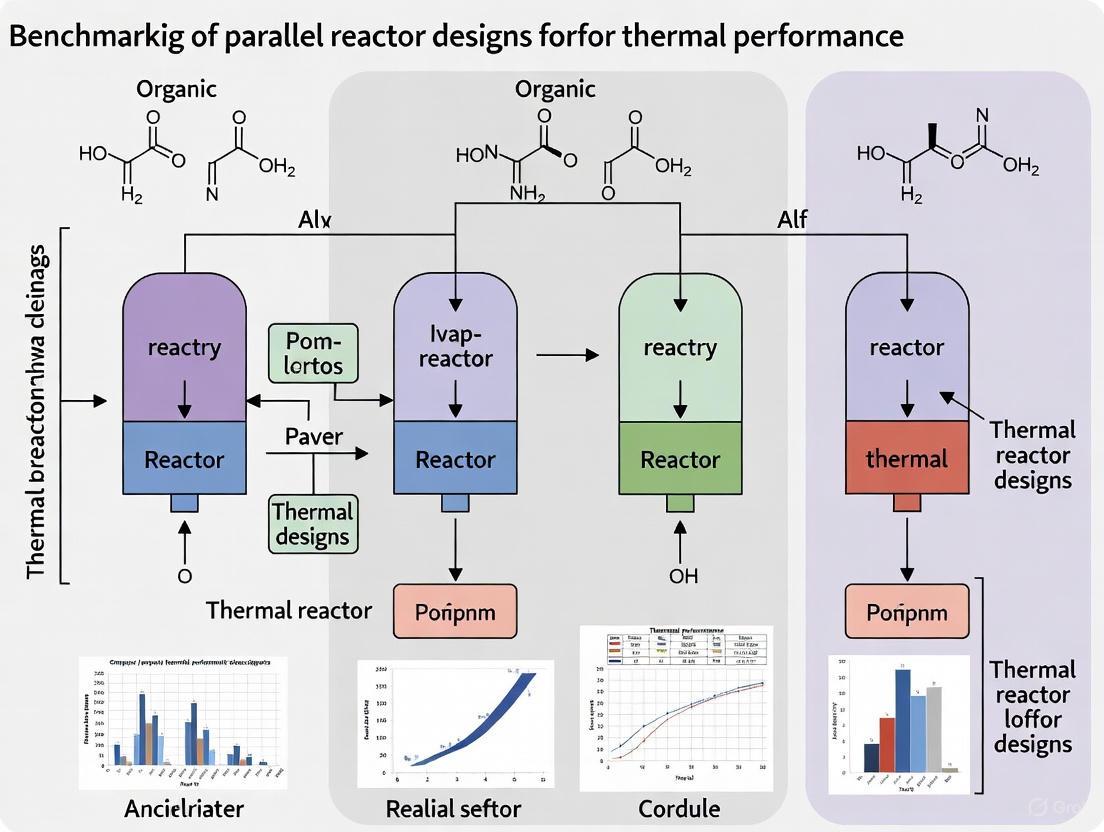
The following diagram illustrates the workflow for benchmarking these different thermal control systems, from initial parameter definition to final performance validation:
Comparative Performance Analysis of Leading Systems
To enable objective comparison, we have compiled quantitative thermal performance data from leading parallel reactor systems. This data, gathered from manufacturer specifications and independent research, provides a foundation for initial system selection. However, researchers should note that real-world performance may vary based on specific configurations, vessel sizes, and reaction media.
Table 1: Key Thermal Performance Specifications of Parallel Reactor Systems
| Reactor System | Temperature Range | Heating/Cooling Method | Max Pressure | Reactor Volume | Number of Reactors | Stirring Method |
|---|---|---|---|---|---|---|
| Buchi Parallel Pressure Reactor (PPR) [1] | -20 °C to +300 °C | Individual heating/cooling blocks | 150 bar (up to 275 bar with options) | 50-300 ml | 2-6 | Magnetic coupling (0-2500 rpm) |
| Radleys Mya 4 Reaction Station [2] | -30 °C to +180 °C (block) | Peltier technology | Not specified | 2-400 ml | 4 | Magnetic or overhead stirring (100-1000 rpm) |
| H.E.L AutoMATE [3] | Application-dependent | Modular heating/cooling | Varies by module | Up to 500 ml per reactor | Configurable | Overhead stirring |
| Asynt Multicell PLUS [4] | Up to 300 °C and beyond | Customizable | Up to 200 bar | Up to 100 ml per cell | 4, 6, 8, or 10 | Magnetic or overhead stirring |
Beyond basic specifications, the precision of temperature control is a critical differentiator. Systems with advanced software and sensor technology can maintain setpoint temperatures with minimal deviation, often within ±0.1 °C. This is particularly crucial for kinetic studies and process optimization where temperature fluctuations can significantly alter reaction pathways. The Buchi PPR system, for instance, uses Pt100 sensors and offers both manual and fully automated software control modes, allowing for detailed process tracking and recipe-driven experimentation [1]. The speed of temperature transition (ramp rates) is another key performance metric. Peltier-based systems typically offer very rapid heating and cooling between setpoints, while circulator-based systems may have slower response times due to the thermal mass of the transfer fluid.
For high-pressure chemistry common in pharmaceutical HTE—such as hydrogenations, carbonylations, and gas-liquid reactions—the integrity of thermal control under pressure is non-negotiable. Systems like the Buchi PPR and Asynt Multicell PLUS are engineered specifically for these demanding conditions, with materials like stainless steel, Hastelloy, and Inconel ensuring safety and performance at elevated temperatures and pressures [1] [4].
Experimental Protocols for Thermal Performance Benchmarking
To ensure consistent and comparable results across different platforms, researchers should adopt standardized experimental protocols for thermal performance benchmarking. The following methodologies provide a framework for quantifying the key parameters discussed in the previous section.
Protocol for Temperature Uniformity and Stability
Objective: To quantify the temperature homogeneity within a single reactor vessel and the stability of the system at maintaining a setpoint over time.
- Setup: Fill all reactor vessels with a fixed volume (e.g., 70% of capacity) of a solvent with properties similar to the typical reaction medium (e.g., water or a water-glycol mixture). Equip each vessel with a calibrated, high-precision temperature probe (e.g., Pt100) positioned in the geometric center of the liquid volume.
- Procedure: Set the system to a series of target temperatures relevant to pharmaceutical applications (e.g., 5 °C, 40 °C, 100 °C, 150 °C). For each setpoint, allow the system to stabilize for 30 minutes after the target is reached.
- Data Collection: Record the temperature from each probe at 10-second intervals over a period of 60 minutes once stabilized. Repeat the experiment under agitation (e.g., 500 rpm) and without agitation to assess the mixer's impact on thermal uniformity.
- Analysis: Calculate the mean temperature and standard deviation for each reactor over the 60-minute period. The standard deviation represents temperature stability. Compare the mean temperatures across all reactors in the system at the same timepoint to determine inter-reactor uniformity.
Protocol for Ramp Rate and Cross-Talk Quantification
Objective: To measure the system's speed in transitioning between temperatures and to assess thermal interference between adjacent reactors.
- Setup: Use the same experimental setup as in Protocol 4.1.
- Ramp Rate Procedure: Program the system to cycle from 25 °C to 80 °C and back to 25 °C. Use the system's maximum allowable ramp rate. Record the time taken for the liquid temperature (not the block temperature) to move from 10% to 90% of the target temperature change.
- Cross-Talk Procedure: Set one reactor (the "source") to a high temperature (e.g., 150 °C). Set all adjacent reactors (the "targets") to a low temperature (e.g., 5 °C). Monitor the temperature of the target reactors for at least 60 minutes after all reactors have stabilized.
- Analysis: The ramp rate is calculated as the temperature change divided by the time taken (°C/min). Cross-talk is reported as the maximum deviation (in °C) from the setpoint observed in any target reactor during the test period. A high-performance system should show minimal cross-talk, ideally less than ±1.0 °C [2].
Protocol for In-Situ Reaction Calorimetry
Objective: To evaluate the system's ability to manage exothermic and endothermic events, a critical factor in process safety and scale-up.
- Setup: Charge a reactor with a known volume of solvent. Initiate temperature control to maintain a stable setpoint.
- Procedure: Use the system's dosing module (if available) or a syringe pump to add a reagent at a controlled rate to create a known exothermic or endothermic reaction. A classic example is the neutralization of sodium hydroxide with hydrochloric acid.
- Data Collection: Monitor the system's response, particularly the energy input or removal rate required to maintain the setpoint temperature, the temperature spike ("overshoot") if the system is overpowered, and the time to return to the setpoint.
- Analysis: The system's thermal power (in Watts) can be calculated from the energy input/removal data. This protocol tests the dynamic response of the thermal system and its integration with the control software to handle real-world reaction conditions.
Essential Research Reagent Solutions for Thermal HTE
The fidelity of thermal benchmarking and subsequent HTE campaigns depends not only on the reactor hardware but also on the supporting materials and reagents. The following toolkit outlines essential solutions that enable precise and reproducible thermal experiments.
Table 2: Essential Research Reagent Solutions for Thermal HTE
| Item | Function in Thermal HTE |
|---|---|
| High-Precision Temperature Calibration Standards | To verify and calibrate internal reactor temperature probes, ensuring data accuracy against a known reference. |
| Thermally-Stable Calibration Solvents (e.g., water, glycols, silicone oils) | To provide a consistent medium for thermal performance tests without degradation or evaporation at high temperatures. |
| Model Reaction Kits (e.g., for hydrogenation, oxidation) | To serve as standardized chemical probes for comparing thermal performance across different reactor platforms under realistic conditions. |
| Inert Reaction Liners (e.g., PTFE, glass) [4] | To protect reactor internals from corrosion, prevent catalytic side reactions, and simplify cleaning between experiments. |
| Advanced Agitation Systems (e.g., magnetic couplers, overhead stirrers) [1] [2] | To ensure efficient heat and mass transfer, eliminating thermal gradients within the reaction vessel and ensuring uniform bulk temperature. |
| Automated Liquid Dosing Modules [1] [3] | To introduce reagents in a controlled manner for calorimetry studies or semi-batch reactions, enabling the study of thermal effects from feed addition. |
| Gas Consumption Monitoring Systems [1] | To quantitatively track gas uptake in hydrogenations or carbonylations, providing critical data that correlates with thermal output from the reaction. |
The integration of these reagent solutions with robust hardware creates a complete thermal benchmarking platform. For instance, using a model hydrogenation reaction with a PTFE liner and monitoring gas consumption allows researchers to directly compare the efficiency and thermal control of different systems when handling a highly relevant pharmaceutical transformation [1] [4].
The objective comparison of parallel reactor systems reveals a landscape of specialized tools, each with strengths tailored to specific pharmaceutical HTE applications. The choice between individually heated blocks, Peltier elements, or jacketed systems ultimately depends on the required temperature range, pressure, level of independence between reactors, and the specific chemical reactions being studied. The experimental protocols and reagent solutions outlined herein provide a roadmap for researchers to move beyond manufacturer specifications and conduct empirical thermal performance benchmarking.
Integrating rigorous thermal control and benchmarking is not an optional enhancement but a fundamental requirement for effective Quality by Design (QbD) and Design of Experiment (DoE) in pharmaceutical development [1]. As the industry pushes toward more complex molecules and sustainable processes, the ability to precisely manage thermal energy in parallel will remain a critical determinant of research velocity and success. By adopting a standardized approach to thermal performance evaluation, research teams can generate higher-quality, more reproducible data, de-risk process scale-up, and accelerate the delivery of new therapeutics to patients.
The pursuit of efficient and scalable chemical processes hinges on the ability to accurately benchmark the thermal performance of parallel reactor designs. In fields ranging from pharmaceutical development to renewable energy storage, researchers must navigate a complex landscape of technologies, from traditional microtiter plates to advanced flow reactors. Each system presents distinct advantages and limitations in heat transfer efficiency, temperature control, and scalability. This guide provides an objective comparison of these technologies, supported by experimental data and detailed methodologies, to inform selection criteria for research and development applications. The thermal dynamics of these systems—including heat transfer coefficients, temperature uniformity, and flow distribution—serve as critical metrics for evaluating their suitability for specific chemical processes and scaling pathways.
Comparative Analysis of Reactor Technologies
The table below summarizes key performance characteristics and experimental findings for different reactor platforms, highlighting their thermal performance and optimal use cases.
Table 1: Performance Comparison of Parallel Reactor Technologies
| Reactor Technology | Key Thermal Performance Findings | Experimental Conditions | Primary Advantages | Key Limitations |
|---|---|---|---|---|
| Microtiter Plates | Limited temperature control; all reactions confined to same conditions [5] | Typical well volumes of ~300 μL [6] | High throughput for reaction screening [6] | Poor compatibility with volatile solvents; limited temperature control [6] |
| Droplet-Based Platforms | Temperature range: 0-200°C; reproducibility: <5% standard deviation [5] | Pressure up to 20 atm; online HPLC analysis [5] | Independent control of each reactor channel [5] | Moderate throughput compared to well plates [5] |
| Parallel Flow Heat Exchangers | Flow maldistribution significantly affects thermal performance; area ratio AR<0.3 improves flow distribution [7] | Two-phase flow in multiple channels; non-uniform thermal load [7] | Higher heat transfer coefficient vs single-phase [7] | Maldistribution worsens with phase change [7] |
| Counter-Flow Configuration | Higher heat transfer efficiency; more uniform flow velocity; reduced swirling effects [8] | Liquid lead coolant with low Prandtl number; CFD-validated [8] | Maintains consistent temperature gradient [8] | More complex header design required [8] |
| Parallel-Flow Configuration | Generates intense swirling in fuel pipes; increases mechanical stress [8] | Liquid lead coolant with low Prandtl number; CFD-validated [8] | Simpler design and operation [8] | Lower heat transfer efficiency [8] |
| Fractal Fin Reactors | Reduced heat discharge time by 60-73%; boosted peak output power 2-3 times [9] | Closed thermochemical storage reactor; SrBr₂·6H₂O [9] | Multi-scale heat transfer enhancement [9] | Complex manufacturing requirements [9] |
Experimental Protocols and Methodologies
Computational Fluid Dynamics (CFD) Analysis of Flow Configurations
The comparative thermal-hydraulic analysis of parallel and counter-flow configurations employed detailed CFD simulations incorporating a variable turbulent Prandtl number model to accurately capture heat transfer behavior in liquid metal coolants with low Prandtl numbers [8]. The methodology included:
- Governing Equations: Solving time-averaged mass, momentum, and energy conservation equations with Reynolds-averaged Navier-Stokes (RANS) approach [8]
- Turbulence Modeling: Implementing a variable turbulent Prandtl number model using the empirical correlation by Kays: Prₜ = 0.85 + 0.7/Peₜ, where Peₜ denotes the turbulent Peclet number [8]
- Geometry Considerations: Simulating a quarter of the reactor domain by leveraging geometric symmetry to optimize computational resources [8]
- Validation Approach: Comparing simulation results with previously published experimental work and Direct Numerical Simulation (DNS) data [8]
Two-Phase Flow Distribution Analysis
The investigation of two-phase flow maldistribution in parallel heat exchange systems utilized a numerical model that quickly predicts flow distribution and heat transfer performance [7]. The experimental protocol included:
- Model Validation: Comparing predicted mass flow rate ratios with experimental data, achieving a maximum average relative deviation of 4.4% [7]
- Dimensionless Parameters: Introducing parameters H and Ym to predict worst-case operating conditions under non-uniform thermal loads [7]
- Geometric Parameter Analysis: Systematically evaluating the effect of channel-to-header area ratio (AR) on flow distribution, finding significant improvement when AR < 0.3 [7]
- Thermal Non-uniformity Studies: Quantifying the relationship between maximum outlet vapor quality and thermal non-uniformity parameter H, establishing H ≈ 198 as the critical threshold for worst-condition operation [7]
Fractal Fin Performance Optimization
The enhancement of thermochemical heat storage reactors employed fractal theory and numerical modeling to optimize heat transfer structures [9]. The methodology comprised:
- Fin Design: Developing novel fractal fins based on biomimetic principles, with parameters including fractal order (n), length ratio (Lₙ₊₁/Lₙ), base width (W₀), and fractal angle (β) [9]
- Numerical Modeling: Creating a computational model of a closed reactor with fractal fins to evaluate heat and mass transfer processes [9]
- Performance Metrics: Measuring heat discharge time (tₑₙd) and peak heat output power (pₚₑₐₖ) to quantify improvements [9]
- Optimization Approach: Implementing the Taguchi method to identify optimal fin configurations under fixed packing factor constraints [9]
Thermal Performance Workflow
The following diagram illustrates the systematic approach to benchmarking thermal performance in parallel reactor designs, integrating both experimental and computational methodologies.
Research Reagent Solutions for Thermal Performance Studies
Table 2: Essential Materials and Reagents for Reactor Thermal Performance Experiments
| Reagent/Material | Function in Thermal Studies | Application Examples |
|---|---|---|
| Liquid Lead/LBE | Low Prandtl number coolant for nuclear reactor simulations [8] | Dual Fluid Reactor (DFR) studies; thermal-hydraulic analysis [8] |
| Strontium Bromide Hexahydrate (SrBr₂·6H₂O) | Thermochemical storage material for energy storage applications [9] | Closed thermochemical heat storage reactors [9] |
| Nitrogen | Carrier gas for reactor systems; prevents particle deposition [10] | Solar thermal energy storage reactors; high-temperature processes [10] |
| Water/Steam | Two-phase working fluid for heat transfer studies [7] | Parallel flow heat exchange systems; thermal performance analysis [7] |
| FeCrAl Alloy | High-temperature resistance metallic alloy for reactor insulation [10] | Solar thermal reactors; insulation layer withstands up to 2000 K [10] |
| 3AlO₃-2SiO₂ (Mullet) | Insulation material with 57% porosity for thermal management [10] | Intermediate insulation layer in solar thermal reactors [10] |
The benchmarking data presented in this guide demonstrates that reactor selection involves critical trade-offs between throughput, temperature control, and scalability. Microtiter plates offer maximum throughput for initial screening but suffer from significant thermal limitations. Flow reactors provide superior heat transfer control and safety profiles, particularly for hazardous chemistry, but require more complex infrastructure. Recent advancements in fractal fin designs and two-phase flow management demonstrate promising pathways for enhancing thermal performance in next-generation reactors. Researchers must align technology selection with specific process requirements, considering thermal dynamics alongside throughput needs and scaling intentions to optimize development workflows in pharmaceutical and chemical research.
Establishing Baseline Thermal Metrics for Reactor Performance
In the fields of nuclear energy, chemical engineering, and pharmaceutical development, the thermal performance of a reactor is a critical determinant of its efficiency, safety, and operational viability. Establishing precise baseline thermal metrics enables researchers and engineers to objectively compare different reactor designs, optimize operational parameters, and predict long-term performance under varying conditions. This guide provides a structured framework for benchmarking thermal performance across parallel reactor designs, with a specific focus on methodologies applicable to advanced nuclear systems and thermochemical storage units—technologies with direct relevance to clean energy solutions and industrial process optimization.
The imperative for robust thermal benchmarking is underscored by global energy trends. In 2024, nuclear reactors alone generated a record 2,667 TWh of electricity globally, operating at an average capacity factor of 83%—a key performance metric reflecting reliability and thermal efficiency [11]. This performance level demonstrates the industry's success in maintaining optimal thermal conditions for extended operational periods. Beyond power generation, precise thermal control is equally vital in pharmaceutical reactor systems where temperature uniformity directly impacts product yield, purity, and reaction kinetics.
This article establishes standardized thermal metrics and comparative methodologies through detailed experimental data from recent studies, enabling cross-disciplinary professionals to conduct rigorous thermal performance evaluations of reactor systems in their respective fields.
Key Thermal Performance Metrics for Reactor Analysis
Table 1: Fundamental Thermal Metrics for Reactor Performance Assessment
| Metric Category | Specific Parameter | Definition | Performance Significance |
|---|---|---|---|
| Heat Transfer Efficiency | Heat Transfer Coefficient | Rate of heat transfer per unit area per degree temperature difference | Determines reactor size and efficiency; higher values enable more compact designs |
| Temperature Gradient (ΔT) | Temperature difference across heat transfer surfaces or reactor zones | Affects thermodynamic efficiency and heat exchanger sizing | |
| Turbulent Prandtl Number | Ratio of momentum diffusivity to thermal diffusivity in turbulent flow | Critical for modeling low-Prandtl number fluids like liquid metals [8] | |
| Flow Dynamics | Flow Configuration (Parallel/Counter) | Directional arrangement of hot and cold fluid streams | Counter-flow typically yields higher efficiency [8] |
| Velocity Distribution | Spatial variation of fluid velocity within reactor channels | Impacts heat transfer rates and mechanical stresses | |
| Swirling Effects | Rotational fluid motion components | Can enhance local heat transfer but increase mechanical stress [8] | |
| System Performance | Capacity Factor | Ratio of actual output to maximum potential output | Measures operational reliability and thermal stability over time [11] |
| Thermal Uniformity | Consistency of temperature distribution throughout reactor | Prevents hotspots and material degradation | |
| Response Time | Time required to reach target thermal conditions | Critical for transient operations and load-following capability |
Comparative Analysis of Reactor Configurations and Performance
Flow Configuration Impact on Thermal Performance
Table 2: Performance Comparison of Parallel vs. Counter Flow Configurations in Dual Fluid Reactor
| Performance Parameter | Parallel Flow Configuration | Counter Flow Configuration | Experimental Context |
|---|---|---|---|
| Heat Transfer Efficiency | Gradual temperature equalization along flow path | Consistent temperature gradient across entire exchanger length | Dual Fluid Reactor mini demonstrator using liquid lead coolant [8] |
| Temperature Distribution | Smoother thermal gradients | More uniform temperature distribution | CFD simulations with variable turbulent Prandtl number model [8] |
| Flow Dynamics | Intense swirling in fuel pipes | Reduced swirling effects | Analysis of velocity profiles in 7 fuel pipes and 12 coolant pipes [8] |
| Mechanical Stress | Higher stress due to swirling | Reduced mechanical stresses | Evaluation of flow patterns and structural impacts [8] |
| Application Fit | Simpler implementation | Enhanced thermal stability and reduced hotspot risk | Nuclear reactor core design [8] |
Advanced Reactor Design Performance Enhancements
Table 3: Performance Gains from Advanced Thermal Management Approaches
| Reactor Technology | Innovation | Performance Improvement | Experimental Validation |
|---|---|---|---|
| Thermochemical Heat Storage Reactor | Fractal fin design based on fractal theory | 60-73% reduction in heat discharge time; 2-3x increase in peak heat output power [9] | Numerical model of closed SrBr₂·6H₂O reactor with fractal fins [9] |
| Dual Fluid Reactor (DFR) | Variable turbulent Prandtl number model | Improved prediction accuracy for low-Prandtl number liquid metal coolant [8] | CFD simulations validated against experimental data [8] |
| Research Reactor RSG-GAS | RELAP5/MOD3.4 thermal-hydraulic modeling | <7% deviation in steady-state; <10% in transients for coolant and clad temperatures [12] | Benchmarking against instrumented fuel elements with thermocouples [12] |
Experimental Protocols for Thermal Benchmarking
Computational Fluid Dynamics (CFD) Analysis for Advanced Reactors
The application of Computational Fluid Dynamics (CFD) represents a sophisticated methodology for predicting thermal-hydraulic behavior in reactor systems. For the Dual Fluid Reactor mini demonstrator analysis, researchers implemented a comprehensive CFD approach incorporating several critical components. The methodology begins with geometry simplification using symmetric sections to optimize computational resources while maintaining accuracy. The core model included 7 fuel pipes and 12 coolant pipes of varying diameters, representing the actual reactor configuration [8].
A fundamental aspect of the protocol involves implementing specialized turbulence modeling to address the unique properties of liquid metal coolants. The model incorporates a variable turbulent Prandtl number approach using the empirical correlation by Kays: Prt = 0.85 + 0.7/Pet, where Pet represents the turbulent Peclet number [8]. This adjustment is critical for accurate simulation of low-Prandtl number fluids like liquid lead, where standard RANS models without modification produce significant errors. The governing equations solved include the time-averaged mass, momentum, and energy conservation equations, with particular attention to modeling the Reynolds stress terms and turbulent heat fluxes that dominate thermal transport in such systems [8].
The experimental workflow involves systematic comparison of different flow configurations while monitoring key output parameters including temperature gradients, velocity distribution, swirling effects, and resulting mechanical stresses. Validation occurs through comparison with experimental data where available, ensuring the computational models accurately represent physical behavior.
Experimental Thermal-Hydraulic Benchmarking with Instrumented Systems
For research reactors like the RSG-GAS, a rigorous experimental protocol was developed under the IAEA Coordinated Research Program 1496 to benchmark thermal-hydraulic performance [12]. The methodology centers on using instrumented fuel elements (IFE) equipped with thermocouples installed at multiple axial positions within the reactor core. These IFEs were strategically positioned at RI-10 and RI-11 core grid positions to capture spatial temperature variations during both steady-state and transient operations [12].
The experimental procedure involves collecting fuel cladding and coolant temperature measurements at different core locations under controlled operational states. For steady-state analysis, reactors are maintained at constant power levels with stable flow conditions, while transient tests involve planned perturbations such as flow reduction or power adjustments to observe dynamic thermal response. The RSG-GAS study specifically employed a loss-of-flow transient scenario, monitoring temperature changes as the system transitioned from forced convection to natural circulation cooling [12].
Data acquisition occurs through calibrated thermocouple systems with appropriate sampling frequencies to capture both gradual trends and rapid transitions. The collected experimental data serves dual purposes: direct performance assessment of the reactor system and validation of computational models like RELAP5. In the referenced study, the code results showed less than 7% deviation for steady-state conditions and less than 10% for most transient points, though it struggled to predict coolant output temperature after natural convection initiation (23% deviation) [12], highlighting the importance of empirical validation.
Research Reagent Solutions and Computational Tools
Table 4: Essential Research Tools for Reactor Thermal Performance Analysis
| Tool Category | Specific Tool/Platform | Application in Thermal Benchmarking | Implementation Context |
|---|---|---|---|
| Simulation Codes | RELAP5/Mod3.4 | Thermal-hydraulic analysis of transients and steady-state conditions [12] | Research reactor safety analysis [12] |
| Computational Fluid Dynamics (CFD) | Detailed 3D simulation of heat transfer and fluid flow [8] | Dual Fluid Reactor mini demonstrator analysis [8] | |
| Variable Prandtl Number Models | Specialized turbulence modeling for liquid metal coolants [8] | Low-Prandtl number fluids in advanced reactors [8] | |
| Experimental Apparatus | Instrumented Fuel Elements (IFE) | In-situ temperature measurement within reactor core [12] | RSG-GAS reactor benchmarking [12] |
| Heat Flow Meters | U-value measurement for building insulation assessment [13] | Thermal performance verification | |
| Fractal Fin Structures | Enhanced heat transfer in thermochemical reactors [9] | Thermal energy storage systems [9] | |
| Analysis Methodologies | Taguchi Optimization Method | Systematic parameter optimization for reactor design [9] | Fractal fin configuration optimization [9] |
| International Benchmarking Initiatives | Verification, validation, and uncertainty quantification [14] | OECD/NEA reactor system studies [14] |
Performance Relationships and Optimization Pathways
The relationship between reactor design parameters and thermal performance metrics follows predictable patterns that can be visualized through structured diagrams. Counter-flow configurations consistently outperform parallel-flow arrangements in heat transfer efficiency due to maintained temperature differentials across the entire heat exchanger length [8]. Similarly, advanced heat transfer enhancement structures like fractal fins demonstrate substantial improvements in thermal response times and power output.
Optimization approaches like the Taguchi method enable researchers to systematically identify optimal parameter combinations for reactor performance. In thermochemical heat storage reactor studies, this method yielded optimal fractal fin configurations with parameters of length ratio (Ln+1/Ln) = 1.25, base width = 4-5 mm, and fractal angle = 45° [9]. These structured optimization techniques provide reproducible pathways for enhancing thermal performance across different reactor classes.
Establishing rigorous baseline thermal metrics through standardized experimental protocols and computational modeling provides an essential foundation for comparing reactor performance across different designs and operational configurations. The comparative data presented in this guide demonstrates clear performance differentiators between flow configurations, heat transfer enhancement strategies, and modeling approaches. As reactor technologies evolve toward more efficient and safer designs—evidenced by the nuclear industry's achievement of record 83% capacity factors [11]—the continued refinement of these thermal benchmarking methodologies will remain crucial for researchers, engineers, and development professionals across energy and industrial sectors. The integration of advanced simulation techniques with empirical validation creates a robust framework for future innovation in reactor thermal management.
Analyzing Thermal Design of Commercial vs. Custom-Built HTE Platforms
In modern laboratories, High-Throughput Experimentation (HTE) has become an indispensable tool for accelerating research and development across pharmaceuticals, materials science, and energy technologies. The thermal design of these platforms is a critical performance differentiator, directly impacting experimental accuracy, reproducibility, and throughput. For researchers engaged in benchmarking thermal performance of parallel reactor designs, the decision between implementing commercial off-the-shelf (COTS) systems versus pursuing custom-built solutions represents a significant strategic crossroads [15] [16].
This guide provides an objective comparison of commercial and custom-built HTE platforms, focusing on their thermal design characteristics. We analyze performance metrics, detail experimental methodologies for thermal validation, and provide practical frameworks to inform selection decisions based on specific research requirements and operational constraints.
Strategic Comparison: Commercial vs. Custom HTE Platforms
The choice between commercial and custom HTE platforms involves balancing multiple factors including thermal performance requirements, integration complexity, budget, and timeline. The global thermal management market, valued at approximately $7.69 billion in 2024 and projected to reach $16.29 billion by 2034, reflects the critical importance of these technologies across industries [15].
Table 1: Strategic Comparison of HTE Platform Approaches
| Decision Factor | Commercial HTE Platforms | Custom-Built HTE Platforms |
|---|---|---|
| Time-to-Market | Weeks to months [15] | 12-18+ months [15] |
| Thermal Customization | Limited to manufacturer specifications [15] | Complete control over all parameters [15] |
| Initial Cost | Lower upfront investment [15] | Substantial non-recurring engineering costs [15] |
| Integration Complexity | Minimal engineering required [15] | Significant engineering resources needed [15] |
| Thermal Performance | Standardized specifications that may involve compromises [15] | Optimized for specific application requirements [15] |
| Best For | Standard applications, proof-of-concept, budget-constrained programs [15] | Mission-critical applications, specialized requirements, competitive differentiation [15] |
Commercial platforms offer rapid deployment with proven reliability but often limit researchers to predetermined thermal configurations. As noted in thermal imaging systems, which share similarities with HTE platforms, COTS solutions "eliminate design work, reduce development risk, and compress time-to-market with proven technology and immediate availability" [15]. However, this convenience comes with constraints—users must adapt their experimental designs to the platform's fixed thermal capabilities, which may not align with specialized research needs.
Custom-built solutions address this limitation by enabling purpose-engineered thermal management. The same principles observed in custom thermal imaging systems apply to HTE platforms: "Custom thermal systems deliver superior value for specialized performance requirements" [15]. This approach becomes particularly valuable for research involving non-standard temperature ranges, complex thermal cycling protocols, or integration with specialized analytical equipment where standard solutions fall short.
Thermal Performance Data and Experimental Validation
Quantitative assessment of thermal performance is essential for objective comparison between platforms. The following data, synthesized from thermal testing literature and high-throughput experimentation research, provides key metrics for evaluation.
Table 2: Thermal Performance Metrics for HTE Platform Assessment
| Performance Metric | Testing Methodology | Commercial Platform Benchmark | Custom Platform Advantage |
|---|---|---|---|
| Temperature Uniformity | Multi-point mapping across reactor block using calibrated thermocouples [17] | ±0.5-1.0°C across block | ±0.1-0.3°C across block [17] |
| Heating/Cooling Rate | Time-to-target from ambient to 100°C and back to 40°C [18] | 1-2°C/minute | Up to 5°C/minute with advanced Peltier systems [18] |
| Thermal Stability | Maintain setpoint for 24 hours while monitoring deviation [17] | ±0.2°C over 24 hours | ±0.05°C over 24 hours [17] |
| Cross-Well Interference | Thermal crosstalk measurement when adjacent wells have 50°C differential [19] | 3-5°C influence on adjacent wells | <1°C influence with active isolation [19] |
| Power Consumption | Kilowatt-hour measurement during standard 8-hour protocol [18] | Standard efficiency | 15-30% improvement with customized insulation and recovery [17] |
Experimental Protocols for Thermal Validation
Researchers conducting their own thermal validation should implement these standardized protocols:
Temperature Uniformity Testing: Place calibrated thermocouples or resistance temperature detectors (RTDs) in at least 8 representative reactor positions (corners, edges, center). Record temperatures simultaneously at 30-second intervals during ramp-up, steady-state, and cool-down phases. Calculate uniformity as the maximum observed deviation from setpoint [17].
Thermal Cycling Efficiency: Execute programmed temperature cycles between experimentally relevant setpoints. Measure the time required to achieve ±0.1°C of target temperature after each transition. This metric is particularly important for polymerase chain reaction (PCR) or chemical reactions requiring precise initiation [18].
Cross-Talk Assessment: Configure alternating wells with high (e.g., 95°C) and low (e.g., 37°C) temperature setpoints. Monitor temperature stability in all wells during 4-hour stabilization period. The maximum deviation in control wells indicates the system's cross-talk limitations [19].
These methodologies enable direct, reproducible comparison of thermal performance across different HTE platforms, providing empirical data to supplement manufacturer specifications.
Implementation Frameworks and Integration Considerations
Successful implementation of either commercial or custom HTE platforms requires careful consideration of integration requirements and workflow compatibility. The decision pathway can be visualized as follows:
Figure 1: Decision workflow for selecting between commercial and custom HTE platforms based on thermal requirements and operational constraints.
Integration with Data Management Systems
Modern HTE platforms generate substantial thermal data that requires sophisticated management. Software integration challenges commonly include disconnected analytical results and manual data transcription between systems [19]. Commercial platforms typically offer proprietary software with limited customization, while custom solutions can be designed to integrate with existing laboratory information management systems (LIMS) and data analytics pipelines.
For comprehensive data handling, specialized software platforms like Katalyst can streamline thermal data management across "design of experiments (DoE) software, inventory systems, automated reactors, dispensing equipment, data analytics software, statistical software, and data science applications" [19]. This integration capability is particularly valuable for research programs incorporating AI/ML approaches, where consistent, well-structured thermal data is essential for model training.
The Scientist's Toolkit: Essential Research Reagents and Materials
Table 3: Key Research Reagents and Materials for HTE Thermal Performance Evaluation
| Reagent/Material | Function in Thermal Assessment | Application Notes |
|---|---|---|
| Calibrated Thermocouples | Direct temperature measurement at multiple reactor points | Use T-type or RTDs for high precision; require NIST-traceable calibration |
| Thermal Interface Materials | Ensure efficient heat transfer between heating elements and reactor vessels | Select based on thermal conductivity, stability, and non-reactivity [18] |
| Reference Reaction Systems | Provide chemical means to validate thermal performance | Enzyme kinetics or chemical reactions with well-characterized temperature dependence |
| Data Acquisition Systems | Collect and time-synchronize temperature data from multiple sensors | Minimum 16-channel systems recommended for meaningful spatial mapping |
| Insulation Materials | Assess and optimize thermal efficiency | Custom solutions can improve energy efficiency by 15-30% [17] |
Thermal design represents a fundamental differentiator in HTE platform performance, directly impacting experimental reproducibility, throughput, and capability. The decision between commercial and custom solutions hinges on specific research requirements, with commercial platforms offering accelerated deployment for standard applications, while custom-built systems enable specialized capabilities for pioneering research.
Emerging trends point toward increasingly intelligent thermal management systems, with AI-driven design tools like ColdStream demonstrating potential to "generate, optimize, and validate your thermal designs instantly" [20]. The integration of machine learning approaches with high-throughput experimentation, as seen in superconducting materials research [21] [16], suggests a future where thermal systems not only respond to experimental parameters but actively optimize them in real-time.
For research groups operating at the forefront of their fields, where thermal performance directly correlates to competitive advantage, investment in customized HTE capabilities continues to deliver substantial returns through enhanced experimental fidelity and differentiation.
Impact of Thermal Gradients on Reaction Yield and By-product Formation
This comparison guide synthesizes current research to benchmark the thermal performance of parallel reactor designs. It objectively evaluates how thermal gradients influence core metrics such as reaction yield and by-product formation, crucial for researchers and drug development professionals optimizing synthetic and extraction processes.
Comparative Analysis of Thermal Gradient Impacts
The following table summarizes key experimental findings on how thermal gradients affect system performance across different technologies, from chemical reactors to energy systems.
| System / Study Type | Thermal Gradient Condition | Impact on Yield / Efficiency | Impact on By-product Formation / Degradation | Key Mechanism Identified |
|---|---|---|---|---|
| Microwave-Assisted Extraction (Okra pods) [22] | Selective heating creating >1°C gradient between biomass and solvent | Step-change increase in extract yield (up to ~23%) vs. conventional heating | Not explicitly measured, but cell rupture could release different compound profiles | Reduced water chemical potential inside cells, leading to high internal pressure (>100 bar) and cell disruption [22] |
| Parallel-Connected Li-ion Battery Packs [23] | Applied surface gradient of ±25°C (20-45°C range) | Accelerated capacity fade; divergent degradation leading to pack failure | Increased cathode impedance growth (a degradation by-product) negatively correlated with temperature | Thermal gradient causes positive feedback loop: impedance divergence → heterogeneous current/SOC distribution → accelerated degradation [23] |
| Dual Fluid Reactor (Counter vs. Parallel Flow) [8] | Comparative analysis of flow configurations affecting internal gradients | Counter-flow yields higher heat transfer efficiency and more uniform temperature | Reduced risk of localized thermal hotspots and associated material stress by-products | Consistent temperature gradient in counter-flow maintains better thermal stability [8] |
| Amide Synthesis (Microwave) [24] | Isothermal reaction at 100°C, varying time (indirect gradient effect) | Product yield increased with longer reaction time (2 to 15 min) | Number of lipophilic by-products increased with reaction time, reducing final product purity | Longer exposure to reaction conditions promotes secondary reactions leading to impurities [24] |
| Electrochemical Wastewater Treatment [25] | Not a gradient study, but high oxidative conditions from treatment | Efficient removal of ammonium and organics (treatment yield) | Significant formation of toxic by-products (e.g., chlorate, perchlorate, HAAs) exceeding guidelines by 10-30,000x | Reaction of chlorine species with organic matter, analogous to disinfection by-product formation [26] |
Experimental Protocols for Key Cited Studies
1. Protocol for Microwave Extraction with Selective Heating [22]
- Objective: To investigate the mechanism of yield enhancement via microwave-induced thermal gradients.
- Materials: Okra pods, deionized water, Pyrex extraction cell, sealed microwave reactor system.
- Method:
- Prepare feedstock by washing okra, removing seeds, and slicing pods uniformly.
- Load sliced okra and deionized water into the extraction cell and seal.
- For microwave runs: Heat to target temperatures (50-90°C) using controlled microwave power. Monitor temperature externally and via fiber-optic probes.
- For conventional runs: Use an oil bath to heat the extraction cell to identical temperatures.
- At set intervals, sample the extract, filter, and dry to determine solid yield.
- Measure dielectric properties (loss tangent) of both biomass and solvent to predict selective heating potential.
- Data Analysis: Correlate extraction yield with process temperature and the loss tangent ratio. Use mass transfer models to calculate internal cell pressure from measured temperature gradients.
2. Protocol for Parallel Battery Pack Cycling under Thermal Gradient [23]
- Objective: To study lifetime degradation in 1S2P packs under controlled thermal gradients.
- Materials: 5 Ah Li-ion pouch cells (NMC/LCO-Graphite), Peltier-element-based thermal control test bench, current sense resistors, potentiostat.
- Method:
- Select and group cells with minimal initial capacity and impedance variation.
- Assemble 1S2P packs with calibrated, equal interconnection resistances.
- Mount each cell in the pack onto an independent Peltier plate to control surface temperature.
- Apply defined thermal gradients (e.g., 0°C, -12.5°C, ±25°C) across the two cells in the pack.
- Cycle packs using a standard profile (e.g., 1C charge/discharge) within a thermal chamber.
- Continuously monitor individual cell currents, voltages, and temperatures.
- Periodically interrupt cycling for reference performance tests (RPT) at standard conditions to measure capacity fade and impedance growth.
- Data Analysis: Analyze divergence in current distribution over cycles. Perform post-mortem analysis via electrochemical impedance spectroscopy (EIS) and degradation mode analysis to link heterogeneous aging to cathode impedance growth.
3. Protocol for By-product Analysis in Electrochemical Treatment [25]
- Objective: To characterize toxic byproduct formation during electrolysis of wastewater.
- Materials: Authentic latrine wastewater, TiO2/IrO2 and Boron-Doped Diamond (BDD) anodes, stainless steel cathodes, ion chromatograph, TOC analyzer.
- Method:
- Filter wastewater and characterize baseline (pH, TOC, COD, chloride, ammonium).
- Set up undivided electrochemical cell with specified anode material.
- Apply constant current density (e.g., 15-43 mA cm⁻²) for variable treatment times.
- Sample at intervals, quenching residual chlorine if necessary.
- Analyze for inorganic byproducts (chlorate, perchlorate, nitrate) via ion chromatography.
- Analyze for organic byproducts (trihalomethanes, haloacetic acids) via gas chromatography or LC-MS.
- Correlate byproduct formation with treatment metrics like ammonium removal (breakpoint chlorination).
- Data Analysis: Compare byproduct concentrations against health guidelines. Evaluate the effect of operating parameters (current density, chloride level, anode material) on byproduct formation rates.
The Scientist's Toolkit: Essential Research Reagents & Materials
| Item | Function in Thermal Gradient & By-product Research |
|---|---|
| Fiber-Optic Temperature Probes | Essential for accurate internal temperature measurement in microwave fields without interference, critical for quantifying thermal gradients [22]. |
| Peltier-Element Thermal Platforms | Provide precise, independent temperature control for individual cells or reactor channels, enabling the creation of defined, stable thermal gradients in parallel systems [23]. |
| Current Sense Resistors (Low TCR) | Enable high-fidelity measurement of current distribution in parallel circuits (e.g., battery packs, reactor channels), key for detecting heterogeneity [23]. |
| Dielectric Property Analyzer | Measures loss tangent and permittivity of materials to predict microwave absorption and potential for selective heating, informing reactor design [22]. |
| Electrochemical Impedance Spectroscopy (EIS) Setup | Used to decouple and diagnose degradation modes (e.g., cathode vs. anode impedance growth) in aged cells or electrodes, linking performance loss to by-product formation [23]. |
| Anion Exchange Chromatography (IC) System | Quantifies inorganic anionic by-products like chlorate and perchlorate in reaction or treatment streams [25]. |
| Boron-Doped Diamond (BDD) Electrode | A "non-active" anode that generates high levels of hydroxyl radicals, used comparatively to study pathways of oxidative by-product formation [25]. |
Visualization of Key Mechanisms
Title: Divergent Degradation Pathway in Parallel Packs
Title: Selective Microwave Heating Mechanism for Yield Enhancement
Advanced Methodologies for Thermal Characterization and Modeling
Sensor Technologies for In-situ Thermal Monitoring in Parallel Setups
In the field of advanced reactor design, precise thermal monitoring is paramount for ensuring safety, optimizing performance, and validating computational models. The benchmarking of thermal performance in parallel reactor designs relies heavily on the ability to capture accurate, real-time temperature and flow data within complex, often inaccessible, system configurations. This guide provides an objective comparison of contemporary sensor technologies suited for in-situ thermal monitoring in parallel setups, framing the discussion within the broader context of thermal-hydraulic benchmarking research for advanced nuclear systems. We focus on technologies that provide quantitative data, detailing their operational principles, experimental validation, and applicability to researchers and scientists working on reactor design and analysis.
Comparative Analysis of Monitoring Technologies
The selection of an appropriate sensing technology depends on the specific requirements of the thermal-hydraulic experiment, including the need for spatial resolution, temporal response, and the ability to function in challenging environments. The following table summarizes the key characteristics of several relevant technologies.
Table 1: Comparison of Sensor Technologies for In-situ Thermal Monitoring
| Technology | Physical Principle | Spatial Resolution | Measurement Type | Key Advantages | Key Limitations | Experimental Validation Context |
|---|---|---|---|---|---|---|
| Ultra-Wideband (UWB) Microwave Imaging [27] [28] | Temperature-dependent changes in tissue dielectric properties | Coarse (imaging domain) | Non-invasive, quantitative temperature estimation | Non-invasive; avoids ionizing radiation; suitable for real-time 3D applications [27] [28] | Lower resolution than point probes; accuracy depends on accurate dielectric models [27] | Hyperthermia monitoring in tumor-mimicking phantoms; permittivity change detection [27] |
| Fresnel Reflection Optical Sensor [29] | Refractive index change at a cleaved optical fiber end-face | Very High (point measurement) | Point measurement of material phase transitions (e.g., glass transition) | Low-cost; simple to manufacture and interrogate; integrated into small-scale equipment [29] | Limited to point measurements; requires optical access; best for material properties rather than fluid temperature [29] | Tracking cross-linking kinetics and glass transition temperature in thermosetting resins [29] |
| Thermal Sensing (e.g., Thermocouples) [30] [31] | Seebeck effect (electromotive force from temperature gradient) | High (point measurement) | Direct, invasive point temperature measurement | Well-established; high accuracy for point measurements; relatively low cost | Invasive; requires physical penetration; provides only localized data [30] | Widely used in system thermal-hydraulic program (STH) validation for reactor safety analysis [32] |
| Computational Fluid Dynamics (CFD) [8] | Numerical solution of mass, momentum, and energy conservation equations | User-defined (full field) | Non-invasive, full-field simulation of temperature and velocity | Provides complete flow and temperature fields; enables design optimization and "what-if" studies [8] | Results are simulations requiring experimental validation; computational cost can be high [8] | Analysis of parallel vs. counter flow configurations in a Dual Fluid Reactor mini demonstrator [8] |
Detailed Experimental Protocols and Methodologies
Protocol for UWB Microwave Temperature Estimation
This methodology is designed for non-invasive quantitative temperature monitoring, validated in a biomedical hyperthermia context, which presents a relevant analog for monitoring heated zones within a complex apparatus [27] [28].
- Objective: To estimate temperature changes within a target volume by measuring the temperature-induced shifts in the dielectric properties (relative permittivity) of the material [27].
- Setup and Materials:
- UWB M-sequence Radar System: A system operating in the 3.1–10.6 GHz range is typical, utilizing Multiple-Input-Multiple-Output (MIMO) antenna arrangements [27].
- Phantom Material: A tissue-mimicking material is prepared to represent the target (e.g., tumor tissue). The material must accurately replicate the dielectric properties of the target and their temperature dependency. For example, high-water-content (HWC) phantoms are used to mimic tumors, exhibiting a permittivity decrease of approximately 0.10 to 0.20 per degree Celsius [27].
- Antenna Configuration: Antennas are arranged around the region of interest. For a neck phantom setup, three arrangements (vertical, tilted, and horizontal) have been tested to optimize signal coverage [27].
- Reference Thermometry: Invasive temperature probes (e.g., fluoroptic sensors) are used for initial calibration and validation of the UWB method [27].
- Procedure:
- Baseline Measurement: Record UWB radar signals from the phantom at a known, stable baseline temperature.
- Induced Temperature Change: Heat the target phantom region, typically aiming for a 4–8 °C increase.
- Data Acquisition: Continuously collect UWB backscattered signals throughout the heating and cooling phases.
- Signal Processing:
- Beamforming: Use algorithms like Delay and Sum (DAS) to spatially resolve the source of reflected signals.
- Image Reconstruction: Apply algorithms such as Truncated Singular Value Decomposition (TSVD) to reconstruct images of the target's reflectivity.
- Temperature Estimation: Correlate the changes in the reconstructed UWB signal (related to reflectivity) with the changes in the phantom's dielectric properties. This relationship is used to quantitatively estimate the temperature evolution within the target [27].
- Key Outputs: Quantitative temperature maps and time-temperature profiles for the region of interest. The method has been shown to successfully track real temperature changes in experimental phantoms [27].
Protocol for Thermal-Hydraulic Benchmarking with System Codes
This protocol involves using a parallelized system thermal-hydraulic solver to simulate complex flows, with results benchmarked against experimental data or analytical solutions [32].
- Objective: To validate the accuracy and improve the computational efficiency of a System Thermal-Hydraulic part of System Program (STHSP) for simulating one-dimensional two-phase flow problems [32].
- Setup and Materials:
- Parallel Solver: A solver like STHSP-MPI, developed based on the Message Passing Interface (MPI) method for distributed memory architecture [32].
- Governing Equations: The two-fluid six-equation model (mass, momentum, and energy conservation for vapor and liquid phases) is solved using the Finite Volume Method (FVM) on a staggered grid [32].
- Numerical Method: The discretized nonlinear equations are solved using the Newton-Raphson (N-R) algorithm. The parallel strategy involves domain decomposition, where the computational mesh is divided into blocks assigned to different MPI processes [32].
- Procedure:
- Problem Definition: Select a benchmark problem with a known analytical or highly trusted numerical solution (e.g., faucet flow, nozzle flow, or Bennett's heated pipe problem) [32].
- Mesh Generation: Discretize the one-dimensional domain into a finite volume mesh.
- Parallel Execution: Run the simulation on multiple CPU processors. The solver manages data communication at the boundaries between mesh blocks.
- Solution of Pressure Matrix: Employ efficient parallel methods like the odd-even reduction method to solve the full-field pressure matrix, which is critical for performance [32].
- Validation and Performance Analysis:
- Accuracy: Quantitatively compare simulation results (e.g., void fraction, temperature profiles) with benchmark solutions.
- Efficiency: Calculate the speedup ratio, defined as ( Sn = T1 / Tn ), where ( T1 ) is the computation time on one processor and ( T_n ) is the time on ( n ) processors [32].
- Key Outputs: Validated profiles of thermal-hydraulic parameters (pressure, temperature, void fraction) and performance metrics (speedup ratio) demonstrating the solver's capability for large-scale or real-time simulation [32].
Signaling Pathway and System Workflow
The following diagram illustrates the logical workflow and data integration pathway for a benchmarking study that combines sensor data with simulation for reactor thermal performance validation.
The Researcher's Toolkit: Essential Research Reagents and Materials
The following table details key materials and computational tools essential for conducting experiments in thermal monitoring and reactor benchmarking.
Table 2: Essential Research Reagents and Solutions for Featured Experiments
| Item Name | Function / Role | Specifications / Examples |
|---|---|---|
| Tissue-Mimicking Phantom | Represents the dielectric properties of biological or target materials for UWB microwave imaging calibration and testing [27]. | High-water-content (HWC) phantoms with stable dielectric properties over time; relative permittivity in the range of 55–70 at relevant frequencies [27]. |
| UWB M-sequence Radar | Core hardware for transmitting and receiving ultra-wideband electromagnetic signals to probe dielectric property changes in a target [27]. | MIMO antenna configurations; operational frequency range from 3.1–10.6 GHz; capable of fast data acquisition for real-time applications [27]. |
| Message Passing Interface (MPI) | A standardized library for parallel computing, enabling the distribution of computational tasks across multiple processors in a cluster [32]. | Used in developing parallel solvers (e.g., STHSP-MPI) for thermal-hydraulic system codes; provides scalability for large-scale simulations [32]. |
| Variable Turbulent Prandtl Number Model | A computational model critical for accurate CFD simulation of heat transfer in fluids with low Prandtl numbers, such as liquid metals [8]. | Empirical correlation (e.g., ( Prt = 0.85 + 0.7 / Pet )) is adopted to improve prediction accuracy in reactor coolants like liquid lead [8]. |
| Fresnel Reflection Sensor | A low-cost optical fiber sensor for monitoring material property changes, such as cross-linking kinetics or glass transition temperature [29]. | Cleaved optical fiber tip; tracks changes in the local refractive index of a material in contact with the fiber end-face [29]. |
Computational Fluid Dynamics (CFD) for Predicting Reactor Thermal Profiles
In the field of nuclear engineering, Computational Fluid Dynamics (CFD) has emerged as a transformative tool for predicting detailed three-dimensional thermal profiles and fluid flow behavior within nuclear reactors. Unlike traditional one-dimensional system analysis codes, which offer a more conservative approach, CFD provides the high-fidelity resolution necessary to uncover localized thermal-hydraulic phenomena critical for both safety and economic optimization of reactor designs [33]. This capability is particularly vital for advancing next-generation reactors, including Small Modular Reactors (SMRs) and High-Temperature Gas-cooled Reactors (HTGRs), where understanding precise temperature distribution and coolant mixing is paramount [34]. The international nuclear community, guided by organizations like the OECD Nuclear Energy Agency (NEA), is actively developing and validating CFD methodologies, establishing a robust framework for benchmarking these advanced simulation tools against experimental data [33] [35]. This guide objectively compares the performance of different CFD approaches against traditional methods, providing researchers with a clear understanding of their respective capabilities in benchmarking the thermal performance of parallel reactor designs.
Comparative Analysis: CFD vs. Traditional System Codes
The choice of simulation tool significantly impacts the accuracy and application of thermal-hydraulic analysis. The table below summarizes the key distinctions between modern CFD and traditional system codes.
Table 1: Comparison of CFD and Traditional System Thermal-Hydraulic (STH) Codes
| Feature | Computational Fluid Dynamics (CFD) | Traditional System Codes (e.g., RELAP5, TRAC, CATHARE) |
|---|---|---|
| Mathematical Basis | Three-dimensional, differential conservation equations (Navier-Stokes). | Lumped parameter or one-dimensional, simplified balance equations [33]. |
| Spatial Resolution | High-fidelity 3D, capturing local phenomena and complex geometries [33]. | Low-fidelity, system-level overview lacking local detail [33]. |
| Primary Application | Analysis of local safety-related parameters, detailed flow patterns, and mixing phenomena [33]. | System-level transient and accident analysis, core design safety certification [33]. |
| Representation of Physics | Models detailed turbulence, phase interaction (in two-fluid models), and complex heat transfer. | Uses homogenized equilibrium or two-fluid models with simplified interphase drag and heat transfer [33]. |
| Computational Cost | High, requiring significant computational resources and high-performance computing (HPC). | Relatively low, suitable for rapid scoping and numerous transient simulations. |
| Validation Approach | Code-to-code and code-to-experiment benchmarks (e.g., OECD/NEA benchmarks) [34]. | Extensive separate and integral effects tests for system response validation. |
Experimental Protocols for CFD Validation
The credibility of CFD predictions for reactor thermal profiles is established through rigorous validation against high-quality experimental data. International benchmark studies, often administered by bodies like the OECD/NEA, provide standardized protocols for this purpose [34]. The following section details a representative experimental methodology used for validating CFD simulations of coolant mixing in a reactor lower plenum, a critical region for core inlet temperature distribution.
Protocol: Lower Plenum Mixing Benchmark
This protocol is based on an open benchmark utilizing data from the Oregon State University (OSU) High-Temperature Test Facility (HTTF), a 1:4 scaled model of a General Atomics MHTGR design [34].
1. Objective: To validate the ability of CFD codes to accurately predict the mixing of coolant flows with different temperatures within the lower plenum of a High-Temperature Gas-cooled Reactor (HTGR).
2. Experimental Setup:
- Facility: The HTTF, an integrated effects test facility.
- Test Section: The lower plenum of the reactor vessel, where coolant from multiple core channels converges.
- Coolant: Gas (e.g., Helium or air, depending on the facility).
- Instrumentation: An array of thermocouples to measure temperature distribution and velocity probes (e.g., Pitot tubes or hot-wire anemometers) at strategic locations in the lower plenum.
3. Methodology:
- Initialization: The facility is brought to a steady-state, full-power operating condition.
- Boundary Conditions: The flow rates and temperatures at the inlets (representing flows from different core sectors) are carefully measured and controlled.
- Perturbation: A thermal perturbation is introduced by adjusting the temperature at one or more inlet channels.
- Data Acquisition: Temperature and velocity data are collected throughout the lower plenum during transient and steady-state conditions to map the mixing process.
4. CFD Simulation Setup (for Code-to-Experiment Comparison):
- Solver Type: Unsteady Reynolds-Averaged Navier-Stokes (URANS) is commonly employed [34].
- Mesh: A 3D computational mesh of the lower plenum geometry is created, with refinement near walls and in regions of expected high shear.
- Boundary Conditions: Inlet flow rates and temperatures are set to match the experimental values precisely.
- Turbulence Model: Models such as k-ε or k-ω SST are selected and their impact on results is assessed.
- Output: The simulation predicts the temperature and velocity fields throughout the plenum, which are directly compared to experimental measurements at the sensor locations.
The logical workflow for conducting and validating such a CFD benchmark study is illustrated below.
Performance Data: Key Results from CFD Benchmarks
The following tables consolidate quantitative findings from published CFD studies and benchmarks, highlighting the performance of CFD in predicting critical thermal-hydraulic parameters.
Table 2: CFD Performance in Simulating Key PWR Components
| Reactor Component | Simulated Phenomenon | CFD Approach | Key Finding / Performance Metric |
|---|---|---|---|
| Reactor Pressure Vessel (RPV) | Coolant mixing in upper plenum, temperature distribution in hot legs [33]. | 3D Steady & Unsteady RANS, Large Eddy Simulation (LES) [33]. | Accurately captures temperature heterogeneity at core outlet and its propagation into hot legs, identifying potential thermal striping [33]. |
| Steam Generator (SG) | Secondary side flow distribution and heat transfer [33]. | Porous media method, multi-scale coupling with system codes [33]. | Identifies local flow stagnation zones and maldistribution that 1D system codes cannot resolve, improving heat transfer efficiency predictions [33]. |
| Lower Plenum (HTGR) | Coolant jet mixing from core channels [34]. | URANS with different turbulence models (e.g., k-ε SST) [34]. | Good overall agreement on bulk temperature trends; disparities found in local velocity fields and specific temperature profiles, informing V&V needs [34]. |
Table 3: Capability Comparison for Two-Phase Flow Modeling
| Modeling Approach | Description | Strengths | Limitations / Challenges |
|---|---|---|---|
| Interface Tracking Method (ITM) | Fully resolves the gas-liquid interface on the grid scale [33]. | High accuracy for interface dynamics. | Computationally prohibitive for reactor-scale systems [33]. |
| Eulerian Two-Fluid Model | Solves separate balance equations for gas and liquid phases [33]. | Practical for engineering-scale applications. | Relies on closure models for interphase drag, turbulence, and boiling; model uncertainty remains high, especially for Critical Heat Flux (CHF) prediction [33]. |
Successful execution and validation of reactor thermal-hydraulic simulations require a suite of computational and experimental resources. The table below details key solutions and their functions in this field.
Table 4: Essential Research Reagent Solutions for Reactor CFD
| Tool / Solution | Category | Primary Function |
|---|---|---|
| High-Performance Computing (HPC) Cluster | Computational Hardware | Provides the parallel processing power required for large 3D transient CFD simulations with millions of cells [33]. |
| URANS/LES Solvers (e.g., in STAR-CCM+, OpenFOAM) | Software & Algorithm | The core computational engine for resolving turbulent flow and heat transfer; URANS for engineering analysis, LES for higher fidelity [33] [34]. |
| OECD/NEA Benchmark Database | Validation Data | Provides access to standardized, high-quality experimental data (e.g., from HTTF) for code validation and verification (V&V) [34] [35]. |
| Two-Phase Flow Closure Models | Mathematical Models | Constitutive equations for interphase drag, heat transfer, and bubble dynamics; essential for simulating boiling flows but a major source of uncertainty [33]. |
| Multi-Scale Coupling Interface (e.g., for CFD/STH) | Software Framework | Enables integrated simulation by exchanging data between a detailed 3D CFD domain and a full-plant 1D system code for more comprehensive analysis [33]. |
The relationships and data flow between these tools and the various physical systems in a reactor are complex. The following diagram maps this multi-scale, multi-physics paradigm.
The trajectory of CFD in nuclear reactor analysis points toward greater integration and fidelity. The principal future direction is the development of verified and validated multi-scale, multi-physics coupling platforms, where high-resolution CFD for specific components is seamlessly integrated with whole-core neutronics and system-level thermal-hydraulics codes [33]. This "digital reactor" approach, pursued by international programs like CASL (US) and NURESIM (EU), aims to provide a holistic and high-fidelity representation of reactor behavior [33]. However, significant challenges remain, including the maturity of two-phase flow models, particularly for predicting Critical Heat Flux (CHF), and the high computational cost associated with full-plant, high-resolution simulations [33]. Furthermore, for novel reactor designs like SMRs and molten salt reactors (MSRs), new physical models and validation data are urgently needed [35].
In conclusion, CFD has firmly established itself as an indispensable tool for predicting reactor thermal profiles, offering unparalleled insights into local phenomena that are beyond the reach of traditional system codes. While system codes remain vital for safety certification and full-plant transient analysis, CFD provides the detailed data necessary for optimizing reactor economics and safety through high-fidelity benchmarking. The continued validation against international benchmarks and the maturation of multi-physics capabilities will further solidify CFD's role in enabling the advanced reactor designs of the future.
Implementing Gaussian Process Models for Thermal Behavior Prediction
In the field of chemical engineering and drug development, the precise thermal management of parallel reactors is paramount for ensuring reaction efficiency, product quality, and operational safety. The benchmarking of thermal performance across different reactor designs requires sophisticated modeling techniques that can accurately predict thermal behavior under varying conditions. Among the various data-driven approaches available, Gaussian Process (GP) models have emerged as a powerful probabilistic tool for this task. They provide not only predictions but also quantifiable uncertainty estimates, which is crucial for risk assessment in research and development. This guide objectively compares the performance of Gaussian Process models against other common machine learning and traditional statistical alternatives, providing researchers and scientists with the experimental data and methodologies needed to inform their selection of thermal modeling tools for parallel reactor systems.
Core Principles of Gaussian Process Regression
Gaussian Process models are a class of non-parametric, probabilistic machine learning algorithms. They are fully defined by a mean function and a covariance function (kernel), which directly model the relationship between input data points and the predicted output. In essence, a GP defines a prior over functions, which is then updated with data to form a posterior distribution. A key advantage is that for any finite set of points, this distribution is a multivariate Gaussian, allowing for analytical tractability [36].
The model assumes that observed target values (yₙ) are related to inputs (xₙ) by (yₙ = f(xₙ) + eₙ), where (eₙ) is independent Gaussian noise. The covariance matrix K is central to the model, with each element (K[n, m] = k(xₙ, xₘ)) representing the covariance between two inputs, typically computed using a kernel function like the Quadratic Exponential (Radial Basis Function) kernel: (k(xₙ, xₘ) = \exp(-||xₙ – xₘ||²/2L²)), where L is a length-scale hyperparameter [36]. This framework allows GPs to model complex, nonlinear systems while providing natural uncertainty quantification in their predictions.
Performance Benchmarking: GPR vs. Alternative Modeling Approaches
The following tables summarize experimental data from various studies where GPR was benchmarked against other modeling techniques for predicting thermal and related phenomena.
Table 1: Comparative Model Performance in Building Thermal Modelling [37]
| Model Type | Training Period | Prediction Error (Occupied) | Prediction Error (Unoccupied) | Key Strengths | Key Limitations |
|---|---|---|---|---|---|
| Gaussian Process (GP) | 3 weeks | 27% lower than Grey-Box | Higher than Grey-Box | Reduced modeling effort; Excellent during occupied times | Large generalization error with untrained data |
| Grey-Box Model | 3 weeks | Baseline | Lower than GP | Consistent performance across periods | Requires detailed physical parameters & equations |
| GP with Adaptive Training | 3 weeks (retrained every 24h) | >10% reduction vs. standard GP | >21% reduction vs. standard GP | Adapts to changing weather conditions | Increased computational load from re-training |
Table 2: Comparative Model Performance in a Battery Thermal Management System (BTMS) [38]
| Model Type | Mean Absolute Error (MAE) Reduction | RMSE Reduction | Key Application Context |
|---|---|---|---|
| Tabular Prior-data Fitted Network (TabPFN) | 8% to 92% reduction vs. others | 7% to 90% reduction vs. others | Predicting key thermal indicators for nano-PCM BTMS |
| Backpropagation Neural Network (BPNN) | Baseline | Baseline | Black-box model with limited interpretability |
| XGBoost | Baseline | Baseline | Gradient boosting-based model |
| CatBoost | Baseline | Baseline | Gradient boosting-based model |
Table 3: Performance of GPR for Gap-Filling Evapotranspiration (ETa) Time-Series [39]
| Input Data Combination | Model Performance | Conclusion for GPR Suitability |
|---|---|---|
| Climate data, Soil Water Content (SWC), & Vegetation Indices (VIs) | Highest NSE, lowest RMSE | Most accurate with comprehensive input data |
| Limited input data | Satisfactory performance | Robust even with limited data availability |
| Climate data replaced with ERA5-L reanalysis & satellite VIs | Good performance | Effective when on-site weather data is unavailable |
Key Performance Insights
- Accuracy in Trained Regimes: GPs can outperform physics-based models like grey-box models within their trained domain. In building thermal modeling, GPs achieved 27% lower prediction errors during occupied times after a three-week training period [37].
- Adaptability: A significant weakness of standard GPs is performance degradation with out-of-training-range data (e.g., during unoccupied building times). However, adaptive training (re-training the model every 24 hours) can mitigate this, reducing prediction error by over 21% during these critical periods [37].
- Beyond Thermal-Only Systems: The flexibility of GPs is evidenced by their successful application in diverse fields. For instance, the Thermal Tracks framework uses GPs with squared-exponential kernels to analyze protein thermal stability from proteomics data, effectively modeling non-sigmoidal melting curves that challenge parametric methods [40].
Experimental Protocols for Thermal Model Benchmarking
To ensure fair and reproducible comparison between GPR and alternative models, the following experimental protocol, synthesized from the analyzed studies, is recommended.
Data Collection and Preprocessing
- Input Variable Selection: Collect time-series data for all relevant thermal drivers. For a parallel reactor, this includes internal heat generation rates, ambient temperature, coolant inlet temperature and flow rate, reactor wall temperature, and process control setpoints [37] [41].
- Output Variable: The target variable is typically the internal temperature of the reactor or specific zones within it, measured with high-precision thermocouples or RTDs.
- Data Cleaning and Normalization: Filter out sensor malfunctions and artifacts. Apply min-max scaling or median-normalization to ensure all input features are on a comparable scale [40] [39].
Model Training and Identification
- GPR Configuration: Use a squared exponential (RBF) kernel as a baseline. The hyperparameters (length-scale L and noise variance σ) are typically optimized by maximizing the log marginal likelihood (Type II maximum likelihood) [36] [40].
- Benchmarking Models: Train comparable models on the same dataset.
- Training Duration Analysis: Systematically vary the training period (e.g., from 3 days to 6 weeks) to assess the speed of model convergence and data efficiency [37].
Model Evaluation and Validation
- Performance Metrics: Calculate Root Mean Square Error (RMSE), Mean Absolute Error (MAE), coefficient of determination (R²), and the Nash-Sutcliffe efficiency (NSE) coefficient on a held-out test dataset [39].
- Generalization Error Test: Deliberately test the model on data that contains operational states or input values not present in the training set (e.g., different ambient temperature ranges or reactor shutdown phases) to evaluate robustness [37].
- Uncertainty Quantification: For GPR, assess the quality of the predictive uncertainty by checking if the empirically observed error distribution matches the model's predicted confidence intervals.
The workflow below summarizes the key stages of the experimental process.
Table 4: Key Research Reagent Solutions for Thermal Modeling Experiments
| Item Name | Function/Brief Explanation |
|---|---|
| High-Precision Thermocouple/RTD | Measures temperature at critical points (reactor core, wall, coolant inlet/outlet) to provide ground-truth data for model training and validation. |
| Data Acquisition System (DAQ) | Logs time-synchronized data from all sensors at a high sampling frequency to ensure data integrity for time-series modeling. |
| Process Control Software | Allows for programmable control of reactor setpoints (temperature, stir rate) to generate diverse operational data for model training. |
| Computational Framework (e.g., GPyTorch) | Provides optimized libraries for efficient implementation and training of Gaussian Process models, handling the intensive matrix operations [40]. |
| Grey-Box Modeling Software (e.g., TRNSYS) | Physics-based simulation environment used to generate reference data or to serve as a benchmark for data-driven model performance [37]. |
For researchers benchmarking thermal performance in parallel reactor designs, the selection of a modeling approach involves trade-offs between accuracy, interpretability, computational cost, and robustness. Gaussian Process models are a superior choice when quantifying predictive uncertainty is critical, when extensive physical modeling expertise is lacking, and when operational data is abundant within the expected range. Their performance, particularly when enhanced with adaptive training protocols, can meet or exceed that of traditional physics-based models in many practical scenarios [37].
However, for applications requiring extensive extrapolation beyond the training data or where full physical interpretability is mandatory, grey-box models retain an advantage. Similarly, other machine learning models like TabPFN may offer superior accuracy for specific, complex tabular data problems [38]. Therefore, the optimal strategy for thermal behavior prediction in parallel reactors may involve a hybrid approach, leveraging the data-driven flexibility of GPs for real-time control and adaptation, while using the foundational insights from physics-based models to ensure overall system robustness and safety.
In modern drug development, high-throughput experimentation (HTE) has become an indispensable tool for accelerating the discovery and optimization of new chemical entities. Within this framework, thermal management stands as a critical parameter that directly influences reaction rates, selectivity, and overall success in parallel screening campaigns. This case study provides a systematic benchmarking analysis of thermal performance across different parallel reactor designs, with particular emphasis on their application in nucleophilic aromatic substitution (SNAr) and photoredox catalysis—two methodologies of paramount importance in pharmaceutical synthesis. The ability to precisely control and maintain thermal conditions across multiple simultaneous reactions enables researchers to generate more reproducible and reliable data, ultimately guiding better decisions in reaction optimization and scale-up processes.
The significance of SNAr reactions extends throughout medicinal chemistry, with recent advancements enabling the functionalization of historically challenging unactivated fluoroarenes through photoredox catalysis [42]. These methodologies expand accessible chemical space but introduce complex thermal requirements, including precise temperature maintenance during light irradiation and management of exothermic events. This analysis bridges the gap between reactor engineering capabilities and synthetic chemistry applications, providing practitioners with empirical data to inform equipment selection and experimental design for thermally-sensitive reaction platforms.
Comparative Analysis of Parallel Reactor Systems
Performance Specifications of Leading Reactor Systems
Table 1: Key Performance Metrics for Commercial Parallel Reactor Systems
| Reactor System/Type | Maximum Demonstrated ΔT (Reactor - Circulator) | Temperature Ramping Capability | Reactor Volume Range | Reactor Material Compatibility | Special Features |
|---|---|---|---|---|---|
| PolyBLOCK 8 (50-150mL reactors) | +90°C [43] | Up to 6°C/min [43] | 16mL - 150mL [43] | Glass & SS316/HC276 [43] | Eight independently controlled zones; magnetic stirring |
| PolyBLOCK 8 (16mL SS316 reactor) | +80°C [43] | 4°C/min (optimal stability) [43] | 8mL - 16mL [43] | SS316 [43] | Compact footprint; compatible with ChemSCAN systems |
| Custom Packed Bed Systems | N/A (Coating-dependent) | Application-specific | Variable | Ceramic substrates with specialized coatings [44] | Enhanced emissivity coatings for improved heat transfer |
Interpretation of Performance Metrics
The comparative data reveals significant variation in thermal performance across reactor systems, directly impacting their suitability for different synthetic applications. The PolyBLOCK 8 system demonstrates robust capabilities for medium-to-high-temperature reactions, maintaining substantial temperature differentials between reactor contents and heating circulator [43]. This performance is particularly relevant for SNAr reactions requiring elevated temperatures, such as traditional transformations involving electron-poor aryl halides. The system's ability to ramp temperatures at rates up to 6°C/min enables rapid thermal profiling while maintaining stability at lower ramp rates (4°C/min), which proves beneficial for thermally-sensitive intermediates [43].
Reactor geometry and material composition significantly influence thermal performance. Smaller reactor volumes (e.g., 16mL SS316) exhibit reduced maximum temperature differentials (+80°C vs +90°C for larger reactors), highlighting the impact of surface-area-to-volume ratios on heat transfer efficiency [43]. Similarly, material selection between glass and metal reactors introduces trade-offs between chemical compatibility and thermal conductivity that must be considered during experimental design.
For specialized high-temperature applications exceeding 600°C, such as those in thermal energy storage or advanced materials synthesis, ceramic-based packed bed systems with engineered inorganic coatings offer alternative configurations [44]. While not directly applicable to most pharmaceutical synthesis, these systems demonstrate principles of thermal management—particularly regarding emissivity control—that may inform future reactor design for extreme condition applications.
Experimental Protocols for Thermal Performance Validation
Standardized Thermal Characterization Methodology
Protocol 1: Maximum Heating Capacity Assessment (Adapted from HEL Group Study)
- Equipment Setup: PolyBLOCK 8 parallel reactor system connected to Huber Unistat 430 oil-bath circulator or equivalent [43].
- Reactor Configuration: Position glass reactors (50mL, 100mL, 150mL) in mantles 1-4 and SS316 high-pressure reactors (16mL, 50mL) in positions 5-8 [43].
- Solvent Selection: Utilize silicone oil (Huber P20-275-50) as standard medium for thermal transfer tests [43].
- Agitation Parameters: Set magnetic stirring to 400 rpm using PTFE Rushton impellers for glass reactors and SS316 anchor impellers for metal reactors [43].
- Temperature Programming: Implement multi-step heating protocol:
- Heat from 40°C to 120°C with circulator at 30°C
- Set circulator to 60°C and reactor to 70°C
- Heat from 70°C to 150°C with oil temperature at 60°C
- Set circulator to 90°C and reactor to 100°C
- Heat from 100°C to 180°C with oil temperature at 90°C
- Cool to ambient conditions [43]
- Data Collection: Monitor and record reactor temperature stability at each setpoint, noting any overshoot or deviation.
- Analysis: Calculate temperature differentials between reactor contents and circulator at stabilization.
Application-Oriented Testing for SNAr and Photoredox Reactions
Protocol 2: Reaction-Specific Thermal Validation
- SNAr Reaction Setup:
- Thermal Monitoring:
- Implement controlled heating to 45-50°C to simulate photoredox conditions with Kessil lamp irradiation [42].
- Monitor for exothermic events during initial reaction phases.
- Track temperature uniformity across parallel reactor positions.
- Performance Metrics:
- Record maximum temperature variation across reactor blocks during steady-state operation.
- Document heating/cooling response times following exothermic events.
- Quantify reaction conversion relative to thermal stability using HPLC or NMR analysis [42].
Thermal Pathways in SNAr and Photoredox Reactions
Fundamental Thermal Considerations in Reaction Design
Table 2: Thermal Properties and Requirements for SNAr and Photoredox Reactions
| Reaction Component | Thermal Consideration | Impact on Reaction Outcome | Optimal Temperature Range |
|---|---|---|---|
| Unactivated Fluoroarenes | High C-F bond strength (126 kcal/mol) [42] | Requires elevated temperatures or alternative activation | 45-190°C depending on mechanism [42] |
| Photoredox Catalysts | Thermal stability of excited states [42] | Decomposition at elevated temperatures limits efficacy | Room temperature to 50°C [42] |
| Solvent Systems (HFIP) | Hydrogen-bond stabilization of intermediates [42] | Enables lower temperature pathways | Room temperature to 50°C [42] |
| Nucleophiles (Azoles, Amines) | Nucleophilicity temperature dependence [45] | Increased rates at higher temperatures but potential decomposition | Variable based on nucleophile stability |
Thermal Management Strategies for Parallel Reaction Systems
The thermal pathways diagram illustrates the complex interplay between reactor design, heating methodologies, and reaction outcomes in SNAr and photoredox systems. Reactor design decisions, including material selection and geometry, directly influence heat transfer efficiency, while the thermal sensitivity of reaction components (particularly photoredox catalysts) establishes operational boundaries [43] [42]. The demonstrated capability of advanced systems like the PolyBLOCK 8 to maintain significant temperature differentials (+80°C to +90°C) enables researchers to access higher reaction temperatures without exceeding the thermal limits of sensitive components through precise circulator temperature management [43].
In photoredox-catalyzed SNAr of unactivated fluoroarenes, the thermal management challenge becomes particularly nuanced. While these reactions benefit from thermal activation to overcome the significant C-F bond strength (126 kcal/mol), the photoredox catalysts themselves often exhibit limited thermal stability in their excited states [42]. This creates an optimization balance where sufficient thermal energy must be provided to facilitate the SNAr process without degrading the photocatalytic capability. The use of specialized solvents like HFIP, which stabilizes cationic intermediates through hydrogen bonding, provides a partial solution by lowering the effective temperature requirement [42].
Essential Research Reagent Solutions for Thermal Analysis
Table 3: Key Reagents and Equipment for Thermal Analysis Studies
| Reagent/Equipment Category | Specific Examples | Function in Thermal Analysis | Performance Considerations |
|---|---|---|---|
| Photoredox Catalysts | Xanthylium salts (E*₁/₂red > +2.5 V vs SCE); Acridinium salts [42] | Enable SNAr of unactivated fluoroarenes via single-electron oxidation | Oxidation potential must match substrate; thermal stability of excited state |
| Specialized Solvents | 1,1,1,3,3,3-Hexafluoro-2-propanol (HFIP) [42]; Silicone oil (Huber P20-275-50) [43] | Stabilize cation radical intermediates; Heat transfer medium for calibration | Hydrogen-bond donation capability; Thermal stability and viscosity |
| Reactor Systems | PolyBLOCK 8 with glass (50-150mL) and SS316 (16-50mL) reactors [43] | Provide parallel reaction environment with thermal control | Maximum ΔT capability; Temperature ramp rates; Volume-dependent performance |
| Heating/Cooling Systems | Huber Unistat 430 oil-bath circulator [43] | Deliver precise thermal control to reactor block | Temperature stability; Compatibility with reactor system |
| Nucleophiles | Pyrazole, triazoles, amines, carboxylic acids (intramolecular) [42] | Participate in SNAr with fluoroarene substrates | Nucleophilicity temperature dependence; Functional group compatibility |
| Analysis Equipment | Thermal Vacuum Chamber (TVAC) for validation [46] | Verify thermal performance under controlled conditions | Cycling capability; Temperature range; Monitoring precision |
This thermal performance benchmarking study demonstrates that modern parallel reactor systems offer sophisticated temperature control capabilities that can significantly impact outcomes in synthetically challenging reactions like SNAr and photoredox transformations. The empirical data reveals that systems like the PolyBLOCK 8 can maintain substantial temperature differentials between reactor contents and heating circulators (+80°C to +90°C), enabling access to elevated reaction temperatures while protecting thermally-sensitive components [43]. This capability proves particularly valuable for SNAr reactions requiring thermal activation of unactivated substrates while maintaining compatibility with temperature-sensitive photoredox catalysts.
The correlation between reactor geometry, material composition, and thermal performance underscores the importance of matching equipment selection to specific reaction requirements. Smaller reactor volumes (16mL) demonstrate reduced maximum temperature differentials compared to larger configurations (50-150mL), highlighting the impact of surface-area-to-volume ratios on heat transfer efficiency [43]. These findings provide researchers with practical guidance for experimental design, emphasizing the need to consider both chemical and engineering parameters when developing robust synthetic methodologies in high-throughput experimentation environments.
Integrating Process Analytical Technology (PAT) for Real-time Thermal Control
Process Analytical Technology (PAT) has emerged as a transformative regulatory framework for designing, analyzing, and controlling pharmaceutical manufacturing through timely measurements of critical quality and performance attributes [47]. The U.S. Food and Drug Administration (FDA) defines PAT as "a system for designing, analyzing, and controlling manufacturing through timely measurements (i.e., during processing) of critical quality and performance attributes of raw and in-process materials and processes, with the goal of ensuring final product quality" [47]. Within the specific context of thermal control in reactor systems, PAT enables real-time monitoring and adjustment of temperature-dependent processes, moving beyond traditional quality-by-testing (QbT) approaches that only assess product quality after manufacturing completion [47] [48].
The implementation of PAT is fundamentally aligned with the Quality by Design (QbD) paradigm, which emphasizes building quality into products through rigorous process understanding rather than relying solely on end-product testing [48]. This systematic approach begins with defining the Quality Target Product Profile (QTPP), followed by identifying Critical Quality Attributes (CQAs) and Critical Process Parameters (CPPs) that significantly impact product quality [47]. Temperature control represents one of the most ubiquitous CPPs across pharmaceutical manufacturing processes, particularly in reactor operations where thermal conditions directly influence reaction kinetics, crystal formation in crystallization processes, and overall product stability [49] [50].
The paradigm shift toward real-time thermal monitoring represents a significant advancement in bioprocess optimization, especially when benchmarking parallel reactor systems. Traditional thermal control methods often rely on predetermined setpoints with limited adaptive capability, potentially leading to process variability and suboptimal performance [50]. In contrast, PAT-enabled thermal control utilizes advanced analytical technologies integrated directly within reactor systems, providing continuous data streams that enable proactive adjustments and enhanced process understanding [49]. This approach is particularly valuable for thermal performance benchmarking across multiple reactor configurations, as it generates standardized, comparable datasets that elucidate the relationship between thermal parameters and product CQAs [47] [50].
PAT Technologies for Thermal Monitoring and Control
Spectroscopic and Sensor-Based Technologies
The implementation of effective thermal control strategies requires sophisticated monitoring technologies capable of providing real-time data on process conditions. Several PAT tools have emerged as particularly valuable for thermal monitoring applications, each offering distinct advantages for specific reactor configurations and process requirements.
Near-Infrared (NIR) Spectroscopy operates within the spectral range of approximately 780-2500 nm, utilizing the absorption of NIR light through molecular overtones and combination vibrations, primarily of C-H, O-H, and N-H bonds [49]. This technology provides valuable information regarding both the chemical and physical characteristics of processed materials, with thermal conditions influencing the resulting spectral patterns. NIR's particular strength lies in its ability to perform non-invasive measurements through fiber optic probes, making it suitable for monitoring temperature-sensitive reactions in sealed reactor environments [49]. The technology's rapid analysis capabilities enable near-instantaneous feedback for thermal control systems, allowing for real-time adjustments to maintain optimal process conditions.
Raman Spectroscopy complements NIR approaches by measuring inelastic scattering of monochromatic light, typically from a laser source [49]. This technique provides molecular vibrational information that is highly sensitive to crystalline structure changes, which are often temperature-dependent in pharmaceutical processes such as crystallization [50]. Raman systems are particularly valuable for monitoring thermal effects on polymorphic transformations during API crystallization, where temperature fluctuations can significantly impact final product quality [50]. Like NIR, Raman spectroscopy can be implemented with fiber-optic probes for in-line monitoring, enabling direct integration into reactor systems for continuous thermal performance assessment.
Process Mass Spectrometry represents another powerful PAT tool for thermal control applications, particularly in processes where gas evolution or consumption correlates with thermal conditions. Magnetic sector mass spectrometers provide fast, precise multi-component analysis of respiratory gases, inerts, and volatiles, which can be measured in seconds with high levels of precision [51]. This technology enables non-invasive monitoring of fermentation processes, providing invaluable information on the physiological state of microbial cultures, including growth kinetics and substrate consumption—all parameters intimately connected to thermal conditions [51]. The Thermo Scientific Prima PRO process mass spectrometer, for instance, can operate with up to 64 sampling ports, allowing simultaneous thermal performance benchmarking across multiple reactor systems [51].
Ultrasonic Backscattering Technology leverages high-frequency ultrasound waves to analyze material properties based on how they scatter upon encountering inhomogeneities such as particles, pores, or cracks [49]. The intensity, time delay, and frequency shifts of the reflected signals provide information about the material's internal structure, with temperature variations significantly influencing these acoustic properties. This technology offers particular utility in monitoring crystallization processes, where temperature directly affects particle formation and growth [50].
Comparative Analysis of PAT Technologies for Thermal Monitoring
Table 1: Performance Comparison of Major PAT Technologies for Thermal Control Applications
| Technology | Measurement Principle | Thermal Sensitivity | Implementation Complexity | Optimal Reactor Applications |
|---|---|---|---|---|
| NIR Spectroscopy | Molecular overtone and combination vibrations | High sensitivity to temperature-induced molecular changes | Moderate | Bioreactors, crystallization reactors, fermentation systems |
| Raman Spectroscopy | Inelastic light scattering (vibrational) | Excellent for crystalline structure changes with temperature | High | API crystallization, polymorph monitoring |
| Process Mass Spectrometry | Ion separation by mass-to-charge ratio | Indirect via gas composition changes | High | Fermentation bioreactors, gas-producing reactions |
| Ultrasonic Backscattering | High-frequency sound wave scattering | Sensitive to temperature-dependent particle characteristics | Moderate | Crystallization, slurry reactions, suspension systems |
| Soft Sensors | Computational models using process data | Derived from multiple parameter correlations | Variable (model-dependent) | All reactor types, especially when hardware sensors are impractical |
Experimental Protocols for PAT-Enabled Thermal Control
Thermal Performance Benchmarking Across Parallel Reactor Systems
Robust experimental design is essential for generating meaningful thermal performance data when benchmarking parallel reactor configurations. The following protocol outlines a standardized approach for comparing thermal control efficiency across different reactor designs using PAT tools.
Experimental Setup and Instrumentation: The foundation of reliable thermal benchmarking begins with proper sensor configuration and calibration. For a comprehensive assessment, install multiple PAT tools across parallel reactor systems, including NIR probes for chemical composition monitoring, fiber-optic temperature sensors for direct thermal measurements, and pressure transducers for coupled analysis [49] [50]. The Thermo Scientific Prima BT mass spectrometer with its 16-port Rapid Multistream Sampler (RMS) is particularly suited for this application, enabling simultaneous monitoring of multiple bioreactors with precise measurement of oxygen and carbon dioxide concentrations in both inlet and outlet streams [51]. Prior to experimentation, perform full calibration of all analytical instruments using reference standards traceable to national measurement institutes, with particular attention to cross-validating temperature measurements between different sensor types.
Thermal Perturbation Methodology: To quantitatively assess thermal control performance, implement a structured sequence of thermal challenges while monitoring the system response. Begin by establishing an isothermal baseline at the process target temperature (e.g., 37°C for mammalian cell cultures or 60-80°C for chemical synthesis). Once stable conditions are achieved, introduce a controlled thermal disturbance of ±5°C from the setpoint at a defined ramp rate (e.g., 1°C per minute) [50]. Monitor the system response through both the PAT tools and traditional temperature sensors, recording the time required to return to the setpoint (±0.5°C) and any overshoot phenomena. This methodology provides quantitative data on responsiveness and stability—two critical parameters for thermal performance benchmarking.
Data Integration and Analysis: Modern PAT implementations require sophisticated data integration strategies to handle the multivariate data streams generated by multiple analytical technologies. Implement a centralized data acquisition platform capable of synchronizing information from all PAT tools and reactor control systems. For thermal performance analysis, employ Multivariate Data Analysis (MVDA) techniques, specifically Partial Least Squares (PLS) regression, to correlate thermal parameters with critical quality attributes [48] [49]. This approach enables the identification of key thermal performance indicators (TPIs), such as temperature uniformity indices, thermal lag coefficients, and overshoot percentages, which facilitate direct comparison between different reactor designs.
Crystallization Process Monitoring with Raman Spectroscopy
Temperature control during crystallization processes directly impacts critical quality attributes including crystal size distribution, polymorph form, and purity. The following detailed protocol outlines the implementation of Raman spectroscopy for real-time thermal control during API crystallization.
System Configuration and Method Development: Install a Raman spectrometer equipped with a immersion optic probe directly into the crystallizer vessel, ensuring proper positioning to monitor the crystal slurry without obstructing mixing. Select an appropriate laser wavelength (typically 785 nm or 1064 nm) to minimize fluorescence while providing sufficient signal intensity [50]. Prior to process monitoring, develop a Raman spectral model by collecting data at various temperatures across the expected operational range, correlating specific spectral features with known polymorphic forms and particle characteristics.
In-line Monitoring and Thermal Control: During crystallization operations, continuously collect Raman spectra (e.g., 1-2 second integration time with 5-10 second intervals) while precisely controlling and monitoring temperature. Implement a feedback control system that adjusts the crystallizer temperature setpoint based on real-time Raman data, specifically targeting spectral features associated with the desired crystal form [50]. For example, upon detection of spectral markers indicating nucleation, automatically adjust the cooling profile to control crystal growth kinetics. This PAT-enabled approach allows for adaptive thermal control strategies that respond to actual process conditions rather than relying solely on predetermined temperature trajectories.
Performance Validation: Validate the Raman-based thermal control strategy by comparing resulting crystal properties against reference batches produced using conventional temperature control. Perform off-line analysis of crystal size distribution using laser diffraction or image analysis, polymorph purity via X-ray powder diffraction (XRPD), and chemical purity through HPLC [50]. Additionally, quantify process consistency by calculating the coefficient of variation for critical quality attributes across multiple batches, demonstrating the improved robustness enabled by PAT implementation.
Implementation Framework and Signaling Pathways
The integration of PAT for thermal control follows a systematic workflow that transforms sensor data into process adjustments. The diagram below illustrates this information pathway and control logic.
PAT-Enabled Thermal Control Signaling Pathway
The signaling pathway illustrates the integrated nature of PAT-enabled thermal control, highlighting the continuous feedback loop that enables real-time process adjustments. This approach represents a significant advancement over traditional thermal control methods by directly linking temperature adjustments to predicted quality attributes rather than relying solely on preset thermal profiles [47] [50].
Research Toolkit for PAT Implementation
Successful implementation of PAT for thermal control requires specific technological components and analytical resources. The table below details essential solutions and their functions within a comprehensive thermal benchmarking research program.
Table 2: Essential Research Toolkit for PAT-Enabled Thermal Control Studies
| Tool Category | Specific Solutions | Primary Function in Thermal Control | Implementation Considerations |
|---|---|---|---|
| Spectroscopic Analyzers | Thermo Scientific Prima PRO Mass Spectrometer | Precise multi-component gas analysis for metabolic monitoring in bioreactors | 32-64 port sampling for parallel reactors; magnetic sector technology for stability [51] |
| Process Sensors | MarqMetrix All-In-One Process Analyzer (Raman) | Real-time chemical composition monitoring during temperature-sensitive reactions | Fiber-optic probe integration; factory calibration for hardware stability [51] |
| Software Platforms | Thermo Scientific GasWorks Software | 21 CFR Part 11 compliant data acquisition and analysis | Configurable for simple alarms or complex data presentation [51] |
| Control Systems | Hybrid Modeling Platforms (e.g., Novasign) | Digital twin creation for predictive thermal control | Reduces experimental effort through simulation [52] |
| Data Analytics | Multivariate Data Analysis (MVDA) Tools | Correlation of thermal parameters with product CQAs | PLS regression models for predictive control [48] [49] |
The integration of Process Analytical Technology for real-time thermal control represents a paradigm shift in pharmaceutical manufacturing, particularly for benchmarking thermal performance across parallel reactor systems. By implementing advanced monitoring technologies such as NIR spectroscopy, Raman spectroscopy, process mass spectrometry, and ultrasonic backscattering, researchers can obtain unprecedented insight into temperature-dependent process dynamics [49] [50]. The experimental protocols and implementation framework presented in this review provide a structured approach for generating comparable thermal performance data across different reactor configurations.
The signaling pathway illustrates how PAT transforms thermal control from a predetermined setpoint-based approach to an adaptive, quality-focused strategy where temperature adjustments respond to real-time process conditions [47] [50]. This capability is particularly valuable for processes with complex thermal dependencies, such as API crystallization where temperature directly influences polymorphic form and particle size distribution—critical quality attributes that determine product efficacy and stability [50].
As the pharmaceutical industry continues its transition toward continuous manufacturing and more complex biotherapeutics, the role of PAT in ensuring consistent thermal performance will only increase in importance [52]. Future developments in digital twin technology, hybrid modeling approaches, and artificial intelligence will further enhance the capabilities of PAT-enabled thermal control systems, enabling more predictive and autonomous operation [52]. The research toolkit presented provides a foundation for implementing these advanced strategies, offering researchers and pharmaceutical professionals a comprehensive resource for advancing thermal control in reactor systems through Process Analytical Technology.
Troubleshooting Thermal Inconsistencies and Optimization Strategies
Identifying and Resolving Common Thermal Hotspots and Gradients
In advanced reactor systems, thermal management is a paramount concern for safety, efficiency, and longevity. Thermal hotspots—localized areas of excessive heat—and significant thermal gradients—spatial variations in temperature—can induce mechanical stress, accelerate material degradation, and compromise reactor integrity [53] [54]. Within the specific context of benchmarking thermal performance for parallel reactor designs, the configuration of coolant flow presents a fundamental variable. This guide provides a comparative analysis of parallel and counter-flow configurations, grounded in experimental and computational data, to identify and resolve these thermal anomalies.
The international effort to benchmark modeling and simulation capabilities, exemplified by OECD-NEA activities, underscores the critical need for rigorous verification and validation of thermal-hydraulic behavior in advanced reactor concepts, including lead- and sodium-cooled fast reactors [14]. This article aligns with that initiative, presenting structured comparisons and methodologies to aid researchers and engineers in optimizing thermal performance.
Fundamentals of Thermal Anomalies
Defining Hotspots and Gradients
- Thermal Hotspots: Localized zones where temperatures rise significantly above the operational average. In nuclear reactors, these can result from uneven heat generation, restricted coolant flow, or inefficient heat transfer. Left unchecked, they pose severe risks, including fuel failure or structural damage [8].
- Thermal Gradients: The rate of temperature change with respect to distance within a component or system. While some gradient is inevitable, excessive or nonlinear gradients can generate intolerable thermal stresses, leading to material fatigue and cracking [54].
Root Causes and Impacts
The formation of hotspots and gradients is influenced by multiple interrelated factors. In high-density systems, such as data center server racks or nuclear reactor cores, concentrated power output can generate more heat than the local cooling capacity can remove, especially when airflow is restricted by poor cabinet or fuel rod arrangement [53]. The underlying flow configuration itself is a primary determinant; as explored in the following sections, parallel flow can lead to different temperature distributions compared to counter flow. System design flaws, including inadequate sealing, bypass air (or coolant), and over-provisioned cooling units, can create uneven flow distribution, simultaneously causing both overcooled zones (cold spots) and overheated zones (hotspots) [53]. Finally, the inherent properties of the coolant and structural materials, such as the low Prandtl number of liquid metals, present unique challenges for accurate thermal modeling and heat transfer efficiency [8].
The consequences of poor thermal management are severe. From a safety perspective, hotspots can trigger unforeseen thermal transients and accelerate the degradation of critical components [54]. Structurally, high thermal gradients induce expansion mismatches, creating stresses that can cause warping, fatigue, and ultimately, mechanical failure [55]. From an efficiency standpoint, thermal imbalances force cooling systems to work harder to compensate for hotspots, often by overcooling other areas, which leads to significant energy waste. In data centers, for instance, cooling can account for 40% of total energy consumption, a figure exacerbated by thermal imbalances [53].
Comparative Analysis: Parallel vs. Counter-Flow Configurations
A critical factor in managing thermal profiles is the choice of flow configuration within heat exchangers and reactor cores. The following table summarizes a computational fluid dynamics (CFD) comparison of these configurations in a Dual Fluid Reactor (DFR) mini demonstrator, which uses a liquid metal coolant [8].
Table 1: Thermal-Hydraulic Performance Comparison in a Dual Fluid Reactor Mini Demonstrator
| Aspect | Parallel-Flow Configuration | Counter-Flow Configuration |
|---|---|---|
| Flow Path | Hot and cold fluids move in the same direction. | Hot and cold fluids enter from opposite ends. |
| Temperature Gradient | Gradual temperature equalization along the flow path; decreasing driving force for heat transfer. | Consistent, substantial temperature gradient maintained across the entire exchanger length. |
| Heat Transfer Efficiency | Generally lower. | Higher and more uniform. |
| Flow Dynamics | Generates intense swirling in some fuel pipes, enhancing local heat transfer but increasing mechanical stress. | More uniform flow velocity; significantly reduces swirling effects, lowering mechanical stress. |
| Thermal Stress & Structural Safety | Higher risk of local hot spots and temperature imbalances; increased mechanical stress from swirling. | Promotes more stable temperature distribution; reduces risk of localized overheating and thermal fatigue. |
| Primary Trade-off | Simpler design but lower performance and higher stress. | Superior thermal performance and safety, but potentially more complex integration. |
This comparative data reveals that the counter-flow configuration offers distinct advantages for thermal gradient management and system stability in nuclear applications [8]. The principle of maintaining a consistent temperature gradient is a key reason for its higher efficiency, a finding supported by its application in other high-temperature systems like cryogenic processes [8].
Quantitative data from the DFR study further elucidates the velocity and stress profiles. In the parallel-flow configuration, the maximum fuel velocity was recorded at 1.69 m/s, whereas counter-flow operation resulted in a lower maximum velocity of 1.37 m/s [8]. This reduction in velocity is coupled with a significant mitigation of swirling effects. The parallel configuration exhibited a maximum swirl velocity of 0.45 m/s, a value that was substantially reduced in the counter-flow case [8]. These calmer flow dynamics directly contribute to lower mechanical stresses on reactor components, enhancing operational longevity and safety.
Methodologies for Identification and Analysis
Accurately identifying thermal hotspots and quantifying gradients is a prerequisite for effective mitigation. The following experimental and computational protocols are essential tools for researchers.
In-Situ High-Speed Infrared Thermography
This technique is vital for capturing dynamic temperature fields with high spatial and temporal resolution, as used in metal additive manufacturing processes like laser powder bed fusion (L-PBF) [56].
Table 2: Key Reagents and Solutions for Thermal Imaging Analysis
| Item | Function |
|---|---|
| High-Speed IR Camera | Captures radiation intensity maps (as images) of the dynamic thermal process at high frame rates (e.g., ~15,000 fps). |
| Calibration Sample | A material with a known liquidus temperature, used to convert radiation intensity to accurate temperature values. |
| Post-Processing Software | Analyzes IR image sequences to compute thermal gradients (dT/dx), cooling rates (dT/dt), and solidification velocities. |
Experimental Protocol:
- Data Acquisition: Use a high-speed infrared camera to record the thermal process (e.g., laser melting). The camera detector captures radiation intensity maps, not direct temperature [56].
- Temperature Calibration: Convert radiation intensity to temperature by assigning a known reference temperature (e.g., the liquidus temperature identified from an ex-situ sample analysis) to a specific boundary in the IR image. This establishes a scaling relationship between the IR signal and temperature [56].
- Parameter Resolution: Using the calibrated temperature map, calculate key thermal parameters. Spatial temperature gradients (
dT/dx) and cooling rates (dT/dt) are derived directly from the temperature field. Solidification velocity is resolved by tracking the movement of the liquidus isotherm over successive frames [56]. - Microstructure Correlation: Correlate the calculated thermal parameters with the resulting material microstructure (e.g., identifying the transition from epitaxial to equiaxed grains) to validate the thermal data [56].
Computational Fluid Dynamics (CFD) with Advanced Turbulence Modeling
For reactor systems, CFD simulations are indispensable for analyzing thermal-hydraulic behavior where direct measurement is difficult or impossible.
Computational Protocol:
- Model Geometry: Create a 3D model of the system (e.g., reactor core). Leverage geometric symmetry (e.g., simulating a quarter of the domain) to optimize computational resources [8].
- Mesh Generation: Discretize the domain into a computational grid, ensuring sufficient resolution in critical regions like pipe walls and mixing zones.
- Physics Setup:
- Solver: Use a pressure-based, transient solver.
- Turbulence Model: Select an appropriate model like k-omega SST. For fluids with low Prandtl numbers (e.g., liquid lead, lead-bismuth eutectic), it is critical to incorporate a variable turbulent Prandtl number (
Prt) model to accurately predict heat transfer [8]. - Boundary Conditions: Define inlet mass flow rates and temperatures for hot and cold streams, and outlet pressure conditions [8].
- Simulation & Analysis: Run the simulation to convergence. Post-process the results to analyze temperature contours, velocity vectors, swirling strength, and wall stresses to identify hotspots and assess efficiency [8].
Diagram 1: CFD Analysis Workflow for Thermal Profiling.
Mitigation Strategies and System Optimization
Once thermal anomalies are identified, a multi-faceted approach is required for mitigation.
Flow Configuration and System Design Optimization
The foundational strategy is to select the optimal flow configuration. As the comparative analysis shows, adopting a counter-flow configuration can significantly enhance heat transfer efficiency and promote a more uniform temperature distribution, thereby reducing the risk of hotspots in reactor cores and heat exchangers [8]. Furthermore, improved airflow management is a universal principle. In data centers, this involves organizing server racks into hot aisle/cold aisle containment systems to prevent the mixing of hot exhaust and cold intake air, a strategy that can improve Power Usage Effectiveness (PUE) from averages of 1.5-2.0 to under 1.3 [53]. Similarly, using blanking panels to fill unused rack spaces and sealing cable cutouts prevents bypass airflow, directing coolant precisely to where it is needed [53].
Advanced Cooling Technologies and Active Control
For high-performance systems, passive design may be insufficient. Integrating independent cooling systems or advanced technologies like immersion cooling can target specific high-heat components [53]. These approaches can be dynamically managed using AI-driven control systems. Artificial intelligence can optimize cooling adjustments in real-time based on sensor data, moving from reactive to predictive thermal management. AI is also being used to predict performance, as demonstrated in the modeling of parallel-counterflow vortex tubes, enabling more efficient system design [57] [53] [54].
Proactive Monitoring and Sealing
A cost-effective first step is investing in a robust temperature monitoring system. Automated sensors providing real-time data and alerts are far superior to manual methods for the early detection of hotspots and cold spots, enabling predictive maintenance and reducing energy waste by up to 20% [53]. Addressing system integrity is also crucial; sealing air leaks in raised floors and walls ensures that coolant is not wasted, directly combating the inefficiency of overcooling and the formation of cold spots [53].
The Scientist's Toolkit: Essential Research Reagents and Solutions
Beyond the specific items listed for thermal imaging, the broader field of thermal performance benchmarking relies on a suite of standard tools and models.
Table 3: Key Reagents and Solutions for Thermal Benchmarking Research
| Item | Function |
|---|---|
| Validated CFD Software | Performs detailed thermal-hydraulic simulations (e.g., of parallel/counter flow) to predict temperature and velocity fields. |
| Variable Turbulent Prandtl Model | An essential sub-model for accurate simulation of heat transfer in liquid metal coolants with low Prandtl numbers. |
| Machine Learning Algorithms | (e.g., Bayesian Ridge, Category Boosting) used to analyze experimental data and predict system thermal performance with high accuracy. |
| International Benchmark Data | OECD-NEA and other benchmark data sets for verifying and validating multiphysics simulation results against international standards. |
| Thermal Decomposition Framework | A mathematical method for decomposing nonlinear temperature fields in structures (e.g., composite girders) to analyze stress contributions. |
The precise identification and resolution of thermal hotspots and gradients are critical for advancing the safety and efficiency of parallel reactor designs. The experimental data and comparative analysis presented in this guide demonstrate that flow configuration is a decisive design parameter, with counter-flow arrangements offering superior thermal performance and reduced mechanical stress compared to parallel-flow systems. The integration of advanced methodologies—from high-speed IR thermography and low-Prandtl CFD to machine learning—provides researchers with a powerful toolkit for benchmarking and optimization. As the field progresses, the adoption of international benchmarking standards and AI-driven control will be pivotal in realizing the full potential of next-generation reactor systems.
The pursuit of optimal thermal performance is a critical challenge in advanced engineering systems, ranging from nuclear reactor design to electronics cooling. Efficient thermal parameter tuning directly impacts system safety, efficiency, and economic viability. Traditional approaches, including experimental Design of Experiments (DoE) and heuristic methods, have provided foundational methodologies. However, the emergence of Bayesian optimization represents a paradigm shift, enabling more efficient navigation of complex parameter spaces with fewer evaluations. This guide objectively compares the performance of these competing optimization approaches within the context of benchmarking thermal performance in parallel reactor designs, providing researchers with experimental data and implementation protocols to inform methodological selection.
Comparative Analysis of Optimization Algorithms
The table below summarizes the core characteristics, performance metrics, and optimal use cases for the primary optimization algorithms employed in thermal parameter tuning.
Table 1: Performance Comparison of Thermal Parameter Optimization Algorithms
| Algorithm Category | Key Characteristics | Reported Performance Metrics | Computational Efficiency | Ideal Application Context |
|---|---|---|---|---|
| Bayesian Optimization | Models the objective function as a probability distribution, using an acquisition function to guide the search [58] [59]. | R² up to 1.000 (training), 0.991 (testing) for thermal parameters; ~66.6% reduction in computation time with parallel points [58] [59]. | High; excels with expensive-to-evaluate functions (e.g., CFD simulations). | Limited evaluation budgets, high-dimensional thermal inverse problems [58] [59]. |
| Heuristic Global Methods | Population-based stochastic search (e.g., Genetic Algorithms) inspired by natural processes [60]. | Temperature differences < 3°C in aerospace model correlation; 2000-4000 iterations typically required [60]. | Moderate to Low; often requires 1000s of iterations and significant parameter tuning [60]. | Highly nonlinear, non-convex problems where gradient-based methods fail [60]. |
| Design of Experiments | Structured, factorial approach to explore a parameter space and build a response surface. | Foundation for empirical model building; performance is highly design-dependent. | Varies; can become inefficient with a high number of parameters ("curse of dimensionality"). | Initial screening of influential factors and building low-fidelity empirical models. |
Experimental Protocols for Algorithm Benchmarking
Protocol for Bayesian Optimization in Thermal Systems
Bayesian Optimization has been successfully applied to model the thermal performance of hybrid nanofluids and for the inverse estimation of thermophysical properties [58] [59]. The following protocol is adapted from these studies:
- Objective: To maximize heat transfer coefficient (or minimize entropy generation) by optimizing nanoparticle concentration and flow conditions, or to inversely estimate a material's thermal conductivity.
- Experimental Setup: For nanofluid studies, prepare samples with varying volume concentrations (e.g., 0–1% Al₂O₃-CuO hybrid nanoparticles) dispersed in a base fluid using a two-step method with surfactant stabilization [58]. Use a closed-loop flow system with a heated test section, thermocouples, and a flow meter. For thermophysical property estimation, use a Transient Plane Source (TPS) method setup [59].
- Algorithm Configuration:
- Surrogate Model: Typically a Gaussian Process (GP).
- Acquisition Function: Expected Improvement (EI) is a standard choice.
- Parallel Implementation: A Multi-Objective Hybrid Strategy (MHS) can be employed to add multiple parallel points per iteration, dramatically reducing total computation time [59].
- Procedure:
- Collect initial data points through a space-filling DoE or a limited Latin Hypercube Sampling.
- For
niterations: a. Update the GP posterior with all available data. b. Find the next point(s) that maximize the acquisition function. c. Run the experiment or simulation at the new point(s) to obtain the objective function value. - Return the best-observed configuration.
Protocol for Heuristic Optimization (Genetic Algorithm)
Heuristic methods like Genetic Algorithms (GAs) are well-established for correlating complex thermal models, such as in aerospace applications [60].
- Objective: To minimize the difference (e.g., root mean square error) between a detailed thermal mathematical model and a reduced-order model or experimental test data.
- Setup: A high-fidelity thermal model (e.g., a Finite Element Model of a reactor component or aerospace instrument) and its reduced-order counterpart [60].
- Algorithm Configuration:
- Fitness Function: The inverse of the temperature difference between models across critical nodes and test cases.
- Operators: Use tournament selection, simulated binary crossover, and polynomial mutation.
- Parameters: A population size of 50-100, a crossover probability of 0.8-0.9, and a mutation probability of (1/chromosome_length).
- Procedure:
- Initialization: Generate an initial population of random candidate solutions (parameter sets for the reduced model).
- Evaluation: Run the thermal model for each candidate and compute its fitness.
- Selection: Select parents based on their fitness.
- Crossover & Mutation: Create new offspring through crossover and mutation operators.
- Replacement: Form a new generation and repeat from Step 2 until convergence (e.g., 2000-4000 iterations) [60].
Workflow Visualization of a Bayesian Optimization Framework
The following diagram illustrates the iterative workflow of a Bayesian optimization process, highlighting its data-driven and self-directed nature.
Bayesian Optimization Workflow
The Scientist's Toolkit: Essential Research Reagents and Materials
The table below lists key materials and computational tools referenced in the studies, which are essential for conducting research in this field.
Table 2: Key Research Reagents and Solutions for Thermal Optimization Studies
| Item Name | Function/Description | Example Application |
|---|---|---|
| Al₂O₃-CuO Hybrid Nanofluid | A heat transfer fluid enhanced with a mixture of Alumina and Copper Oxide nanoparticles to improve thermal conductivity [58]. | Used as a working fluid to study enhanced heat transfer performance in turbulent tube flow [58]. |
| Transient Plane Source (TPS) Probe | A sensor that acts as both a heat source and a temperature sensor to measure thermal conductivity and diffusivity of materials [59]. | Employed in the inverse problem of estimating thermophysical properties of insulation samples like glass wool [59]. |
| Sodium Dodecylbenzene Sulfonate (SDBS) | A surfactant used to improve the stability and dispersion of nanoparticles in the base fluid, preventing agglomeration [58]. | Critical for the preparation of stable nanofluids for experimental thermal performance testing [58]. |
| Body-Fitted Grid (BFG) Generator | A computational technique that transforms complex physical domains into structured computational grids, speeding up numerical solutions [59]. | Used to enhance the computational speed of the direct heat transfer problem in complex geometries like TPS probes [59]. |
| Parallel Bayesian Optimization Algorithm | An advanced optimization algorithm that can evaluate multiple parameter sets simultaneously, drastically reducing computation time [59]. | Applied to efficiently solve inverse heat conduction problems and optimize thermal designs [58] [59]. |
Enhancing Heat Transfer in Microreactors and Batch Systems
This guide compares the thermal performance of parallel and counter-flow reactor configurations, focusing on heat pipe-cooled microreactors and batch-scale spouted bed systems. It synthesizes experimental and computational data to benchmark design alternatives, providing supporting methodologies and quantitative outcomes for researchers and development professionals.
Comparative Thermal-Hydraulic Performance
The table below compares key performance metrics for parallel and counter-flow configurations, as well as heat pipe-based systems.
| System / Configuration | Key Performance Metrics | Experimental Conditions | Primary Findings |
|---|---|---|---|
| Counter-Flow Configuration (Dual Fluid Reactor Mini-Demonstrator) [8] | • Higher heat transfer efficiency• More uniform flow velocity• Reduced swirling effects & mechanical stress | Coolant: Liquid lead (low Prandtl number)Analysis: Comparative CFD study with variable turbulent Prandtl number model [8] | Maintains a consistent temperature gradient for superior heat transfer efficiency compared to parallel flow [8]. |
| Parallel-Flow Configuration (Dual Fluid Reactor Mini-Demonstrator) [8] | • Gradual heat exchange• Smoother thermal gradients• Intense swirling in fuel pipes | Coolant: Liquid lead (low Prandtl number)Analysis: Comparative CFD study with variable turbulent Prandtl number model [8] | Generates significant swirling that enhances local heat transfer but increases mechanical stress on components [8]. |
| Passive Residual Heat Removal System (PRHRS) (Heat Pipe Cooled Reactor) [61] | • Maximum heat removal power: ~0.14 MW• Heat removal vs. coolant flow: Logarithmic correlation• Heat removal vs. wall temp: Linear correlation | Coolant: WaterHeat Sink: SeawaterHeat Source: Heat pipe bundle (Emergency Cooling Section) [61] | Demonstrates passive safety; heat removal power is log-correlated with coolant mass flow and linear with heat pipe wall temperature [61]. |
| Spouted Bed Roaster (Batch Coffee Roasting System) [62] | • System modeled via energy balance• Key parameters: Batch size, airflow, inlet air temperature | • Pilot-scale (0.5 kg) spouted bed roaster• Zero-dimensional, batch-scale model calibrated with experimental data [62] | Serves as a model for batch process thermal evolution, controlled by airflow and inlet temperature [62]. |
Experimental Protocols and Methodologies
Protocol 1: Comparative CFD Analysis of Flow Configurations
This protocol details the methodology for comparing parallel and counter-flow configurations in a Dual Fluid Reactor (DFR) mini-demonstrator [8].
- 1. Objective: To analyze and compare the thermal-hydraulic behavior, including heat transfer characteristics, velocity distribution, and swirling effects, for parallel and counter-flow configurations [8].
- 2. Computational Model:
- Geometry: A quarter of the DFR mini-demonstrator core (containing 7 fuel and 12 coolant pipes) is modeled leveraging geometric symmetry [8].
- Governing Equations: The time-averaged mass, momentum, and energy conservation equations are solved [8].
- Turbulence & Heat Transfer Model: A variable turbulent Prandtl number model is used to accurately capture heat transfer in the liquid lead coolant, which has a uniquely low Prandtl number. The specific correlation used is
Prt = 0.85 + 0.7 / Pet[8].
- 3. Analysis Outputs:
- Temperature and velocity fields within the core.
- Assessment of swirling effects and associated mechanical stresses.
- Evaluation of heat exchanger efficiency and identification of potential thermal hotspots [8].
Protocol 2: Heat Transfer Characterization of a Passive Residual Heat Removal System
This protocol describes the experimental setup for evaluating the heat transfer characteristics of a Passive Residual Heat Removal System (PRHRS) for a heat pipe-cooled reactor [61].
- 1. Objective: To investigate the heat removal power and axial wall temperature distribution of a high-temperature heat pipe when an emergency cooling chamber (ECC) is activated [61].
- 2. Experimental System:
- Heat Pipe: A high-temperature sodium heat pipe with a specific geometry (e.g., 160 mm ECC axial length) is used [61].
- Cooling System: An ECC is fitted around the heat pipe's adiabatic section. Coolant (water) circulates naturally, removing heat with seawater as the ultimate heat sink [61].
- Instrumentation: The system is equipped with thermocouples and flow meters to monitor heat pipe wall temperature, coolant temperature, and coolant mass flow rate [61].
- 3. Variable Parameters:
- Coolant mass flow rate
- Coolant inlet temperature
- Heat pipe operating temperature [61]
- 4. Data Collection:
- Measure the heat removal power under steady-state conditions.
- Record the axial temperature profile along the heat pipe wall.
- Correlate heat removal power with the independent variables (flow rate, temperatures) [61].
Workflow for Thermal-Hydraulic Analysis
The diagram below outlines the logical workflow for conducting a thermal-hydraulic analysis of reactor designs, integrating the methodologies previously discussed.
The Scientist's Toolkit: Essential Research Reagents and Materials
The table below lists key materials and instruments used in the featured experiments.
| Item Name | Function / Application |
|---|---|
| Liquid Lead / Lead-Bismuth Eutectic (LBE) | Serves as a high-temperature liquid metal coolant in advanced reactor designs like the Dual Fluid Reactor (DFR) due to its excellent heat transfer properties [8]. |
| Alkali Metal Heat Pipes (Sodium/Potassium) | Passive heat transfer devices used in microreactors. They utilize phase change of a working fluid (e.g., sodium) for highly efficient heat removal from the core [61] [63]. |
| High-Speed Camera | Used for visual recording and analysis of dynamic phenomena, such as bubble formation, evaporation processes, and two-phase flow patterns [62] [64]. |
| Variable Turbulent Prandtl Number Model | A specialized computational fluid dynamics (CFD) model essential for accurate simulation of heat transfer in fluids with low Prandtl numbers, such as liquid metals [8]. |
| Acoustic Emission (AE) Sensors | Used for non-intrusive diagnostics of boiling heat transfer phenomena. When mounted externally, they detect elastic waves from bubble dynamics to monitor heat flux and regime transitions [65]. |
| Emergency Cooling Chamber (ECC) | A component in passive safety systems designed to remove residual heat from a reactor core via natural circulation of a coolant, enhancing safety without active components [61]. |
| n-Pentane Droplets | A dispersed phase fluid used in studies of direct-contact heat transfer and evaporation within an immiscible continuous liquid phase (e.g., water) [64]. |
Addressing Solvent Boiling Point Challenges and Pressure Management
This guide objectively compares the thermal performance of parallel reactor blocks, flow chemistry systems, and traditional batch reactors in managing solvent boiling points and system pressure, providing key data for research and development professionals.
Experimental Protocols for Thermal Performance Benchmarking
To ensure consistent and reproducible comparisons of reactor performance, the following experimental methodologies were employed across different systems.
1.1 Cooling Performance Characterization of Parallel Reactor Blocks A standardized protocol was used to characterize the cooling capabilities of the PolyBLOCK 8 parallel reactor system [66]. The reactor was operated in both "Heat/Cool Reactor" mode (changing temperature at a defined rate) and "Constant Reactor Temperature" mode (cooling to a specified temperature as quickly as possible). Tests utilized three solvents with varying properties: deionized water, methanol, and silicone oil (Huber P20-275-50) in different reactor volumes (16mL to 150mL) and materials (glass and SS316). Magnetic stirring was maintained at 400 rpm, with tests conducted both with and without an active cooling circulator (Huber Unistat 430) [66].
1.2 Flow Chemistry System Evaluation Flow chemistry systems were evaluated for their ability to handle volatile solvents and extreme conditions through pressurization [6]. The methodology leveraged the fundamental advantage of flow systems: their ability to be easily pressurized, enabling solvents to be used at temperatures far exceeding their atmospheric boiling points. Performance was measured through reaction efficiency, safety in handling hazardous reagents, and scalability from screening to production scales.
1.3 Thermal-Hydraulic Configuration Analysis Computational Fluid Dynamics (CFD) simulations compared parallel and counter-flow configurations in reactor systems [8]. The study modeled temperature distributions, velocity profiles, and swirling effects using a variable turbulent Prandtl number model to accurately capture heat transfer behavior in liquid metal coolants, with parameters and dimensions selected to match typical values in Dual Fluid Reactor studies to ensure accurate modeling [8].
Comparative Performance Data Analysis
The experimental data reveals significant differences in how each reactor technology manages temperature and pressure challenges.
Table 1: Cooling Performance of PolyBLOCK 8 with Different Solvents
| Solvent | Boiling Point (°C) | Reactor Material | Max Cooling Rate with Circulator (°C/min) | Cooling Stability |
|---|---|---|---|---|
| Methanol | 67.4 [67] | Glass & SS316 | -2.0 | Best with slower cooling profiles |
| Silicone Oil | N/A | Glass & SS316 | -4.0 to -9.0 | Consistent up to -6°C/min |
| Water | 100 | Glass & SS316 | Not reported | Less stable at lower temperatures |
Table 2: Reactor Technology Comparison for Solvent Boiling Point Management
| Reactor Type | Pressure Management | Max Operating Temperature Relative to Solvent BP | Heat Transfer Efficiency | Scalability |
|---|---|---|---|---|
| Parallel Reactor Block (PolyBLOCK 8) | Limited pressurization | Constrained by atmospheric boiling point | Dependent on active cooling [66] | Limited to parallel small-scale |
| Flow Chemistry Systems | Excellent pressurization | Can significantly exceed atmospheric BP [6] | Superior due to high surface-to-volume ratio | Excellent by numbering up |
| Traditional Batch | Moderate pressurization | Limited without specialized equipment | Limited by mixing efficiency | Requires re-optimization |
2.1 Performance Interpretation The PolyBLOCK 8 achieves consistent cooling across multiple reactors when rates do not exceed -6°C/min, with active cooling dramatically improving performance [66]. Reactor material and solvent volume significantly impact thermal profiles, with glass and similarly sized high-pressure reactors demonstrating comparable cooling times despite different construction materials [66].
Flow chemistry systems demonstrate superior capability for managing volatile solvents through pressurization, enabling the use of solvents at temperatures far exceeding their atmospheric boiling points [6]. This expanded process window allows access to accelerated reaction rates and improved selectivity while maintaining safety, particularly with hazardous compounds [6].
Thermal-hydraulic analysis reveals that counter-flow configurations provide more uniform temperature distribution and reduced swirling effects compared to parallel flow arrangements [8]. This translates to lower mechanical stress on reactor components and reduced risk of thermal hotspots, enhancing both safety and operational longevity [8].
Thermal Management Workflow
Essential Research Reagent Solutions
Table 3: Key Research Materials and Their Functions
| Material/Equipment | Function in Thermal Management | Application Context |
|---|---|---|
| Huber Unistat 430 Circulator | Provides active cooling to reactor blocks | Parallel reactor systems [66] |
| SS316 Reactors | Withstands high pressure and temperature | High-pressure reactions [66] |
| Glass Reactors | Allows reaction observation | Atmospheric pressure synthesis [66] |
| PTFE Rushton Impellers | Provides efficient mixing in glass reactors | Parallel reactor systems [66] |
| Anchor Impellers (SS316) | Optimizes mixing in high-pressure reactors | Viscous reactions at high pressure [66] |
| Silicone Oil (Huber P20-275-50) | High-temperature heat transfer medium | Thermal characterization studies [66] |
The thermal performance benchmarking demonstrates that reactor selection must align with specific solvent and process requirements. Flow chemistry systems excel when substantial pressure management is needed to overcome solvent boiling point limitations, while parallel reactor blocks offer efficient screening capabilities with the support of active cooling systems. The experimental data and protocols provided enable researchers to make evidence-based decisions in reactor selection and optimization for their specific synthetic challenges.
Reducing Experimental Burden through Intelligent Thermal Proxy Models
The development and licensing of advanced nuclear reactors, which often represent significant departures from traditional light-water reactor designs, rely heavily on rigorous verification, validation, and uncertainty quantification (VVUQ) procedures [68]. These processes require extensive experimental data to validate computational models, creating a significant bottleneck in time and resources. The nuclear reactor physics community has identified this challenge, with international benchmarking initiatives at the heart of recent major workshops, such as the event held by the Nuclear Energy Agency (NEA) in June 2025, which gathered 302 participants from 27 countries [14]. Similarly, in chemical processing, evaluating different reactor concepts like those for the Oxidative Coupling of Methane (OCM) reaction requires testing at miniplant scale over wide parameter ranges, a process both resource-intensive and time-consuming [69].
Intelligent thermal proxy models are emerging as a transformative solution to this experimental burden. These computational models—ranging from physics-based data-driven hybrids to AI-powered smart proxies—act as efficient digital surrogates for complex physical systems. They can predict system behavior under various conditions with significantly reduced computational cost and time compared to high-fidelity simulations or physical experiments, while maintaining acceptable accuracy for design and decision-making purposes [70] [71] [72]. This guide provides a comparative analysis of different proxy modeling approaches, their experimental validation, and their application in benchmarking thermal performance across reactor design paradigms.
Understanding Proxy Model Paradigms: A Comparative Framework
Proxy models, also called surrogate models, replace computationally expensive simulations or physical experiments with faster, approximate predictions. They are particularly valuable for parameter optimization, uncertainty quantification, and design space exploration where thousands of model evaluations are required.
Table 1: Comparison of Primary Proxy Model Architectures
| Model Type | Underlying Methodology | Primary Strengths | Ideal Application Scenarios |
|---|---|---|---|
| Physics-Based Data-Driven Hybrid | Integrates physical governing equations with data-driven parameter inference [70]. | Balances physical fidelity with computational efficiency; requires less training data. | Geothermal energy storage, reservoir management, systems with sparse data [70]. |
| AI-Based Smart Proxy | Uses AI (e.g., Neural Networks) to learn patterns from simulation or experimental data [71] [73]. | High accuracy for complex, non-linear relationships; can handle large parameter spaces. | Pipeline management, multiphase flow prediction, real-time forecasting [71]. |
| Digital Twin (GNN-Based) | Employs Graph Neural Networks (GNNs) to model systems as interconnected networks [72]. | Captures complex component relationships; enables real-time prediction and anomaly detection. | Advanced nuclear reactor monitoring, autonomous operation, and safety analysis [72]. |
The fundamental workflow for developing and deploying any proxy model follows a structured path, from data acquisition to final deployment for analysis, as illustrated below.
Experimental Benchmarking: Quantifying Thermal Performance Gains
Case Study 1: Dual Fluid Reactor (DFR) Mini Demonstrator
A detailed Computational Fluid Dynamics (CFD) study compared parallel and counter-flow configurations in a Dual Fluid Reactor mini demonstrator, providing a robust dataset for proxy model validation [8]. The research utilized a variable turbulent Prandtl number model to accurately capture heat transfer in the liquid lead coolant, a fluid with a uniquely low Prandtl number.
Table 2: Experimental Thermal-Hydraulic Performance of DFR Configurations [8]
| Performance Metric | Parallel-Flow Configuration | Counter-Flow Configuration | Implication for Reactor Design |
|---|---|---|---|
| Heat Transfer Efficiency | Moderate | Higher | Counter-flow provides more efficient heat removal. |
| Temperature Distribution | Gradual equalization along flow path | Consistent gradient across entire length | Counter-flow enables more uniform thermal profiles. |
| Flow Dynamics | Intense swirling in fuel pipes | More uniform flow velocity; reduced swirling | Counter-flow reduces mechanical stress on components. |
| Risk of Thermal Hotspots | Higher due to localized heating | Reduced via stable temperature gradient | Counter-flow enhances safety and operational stability. |
Experimental Protocol: The study employed detailed CFD simulations with a validated variable turbulent Prandtl number model [8]. The computational domain leveraged geometric symmetry, simulating only a quarter of the reactor core. The time-averaged mass, momentum, and energy conservation equations were solved, incorporating the Kays correlation for turbulent Prandtl number to address the specific challenges of low Prandtl number flows. This high-fidelity setup provides the "ground truth" data against which faster proxy models can be trained and calibrated.
Case Study 2: Oxidative Coupling of Methane (OCM) Reactors
A miniplant-scale study compared three reactor concepts for the exothermic OCM reaction: Packed Bed Reactor (PBR), Packed Bed Membrane Reactor (PBMR), and Chemical Looping Reactor (CLR) [69]. The study evaluated performance over a wide range of temperatures and gas hourly space velocities (GHSV), focusing on conversion efficiency and selectivity.
Table 3: Performance of OCM Reactor Concepts at Miniplant Scale [69]
| Reactor Concept | CH4 Conversion | C2 Selectivity | Key Thermal & Operational Characteristics |
|---|---|---|---|
| Packed Bed Reactor (PBR) | Baseline | Baseline (Reference) | Simple design; risk of hotspot formation from exothermic reactions. |
| Packed Bed Membrane Reactor (PBMR) | Similar to PBR | 23% improvement over PBR | More uniform O2 distribution improves heat management and suppresses side reactions. |
| Chemical Looping Reactor (CLR) | Lower (but improved with O2 carriers) | Up to 90% | Prevents gas-phase oxidation; eliminates direct CH4/O2 contact, enhancing safety. |
Experimental Protocol: The OCM reactor testing involved a parametric study of temperature and GHSV at miniplant scale, operating with higher gas flow rates and catalyst volumes than typical lab-scale setups [69]. The PBMR used a porous ceramic α-Alumina membrane for controlled oxygen distribution, requiring careful management of the trans-membrane pressure gradient. The CLR was operated in a poly-cyclic mode, circulating an oxygen carrier (e.g., Mn-Na₂WO₄/SiO₂, sometimes with added BSCF) between fuel and air reactors. This scale of experimentation is ideal for generating data to build proxy models for further process optimization and scale-up.
The Researcher's Toolkit: Essential Reagents & Computational Solutions
The development and application of intelligent proxy models require a combination of physical reagents, computational tools, and data sources.
Table 4: Essential Research Reagents and Solutions for Proxy Model Development
| Category / Item | Specific Examples | Function & Application |
|---|---|---|
| Catalyst & Oxygen Carriers | Mn-Na₂WO₄/SiO₂; Ba₀.₅Sr₀.₅Co₀.₈Fe₀.₂O₃−δ (BSCF) | Facilitates OCM reaction; provides lattice oxygen in Chemical Looping Reactors [69]. |
| Coolant & Fluid Materials | Liquid lead; Lead-Bismuth Eutectic (LBE) | Serves as high-temperature coolant in advanced reactor designs (e.g., DFR, LFR) [8]. |
| Membrane Materials | Porous ceramic α-Alumina membrane | Controls oxygen distribution in membrane reactors to improve selectivity and safety [69]. |
| Simulation & Data Generation | OLGA; ANSYS CFD; DARTS framework | Generates high-fidelity training data or acts as a physics-based core for hybrid models [70] [71]. |
| AI/ML Frameworks | Graph Neural Networks (GNNs); Artificial Neural Networks (ANNs); Opacus | Core architectures for building data-driven relationships and smart proxy models [71] [72] [74]. |
| Optimization Tools | Adjoint-based gradient optimization; Bayesian optimization | Enables efficient model inference and parameter tuning with minimal computational cost [70] [74]. |
Implementation Workflow: From Data to Deployed Proxy
The process of creating a reliable proxy model is iterative. The following diagram outlines the critical steps and decision points, highlighting the role of physical experiments and high-fidelity simulations as the foundation for data generation.
Intelligent thermal proxy models represent a paradigm shift in how researchers approach the thermal benchmarking of advanced reactor designs. By strategically integrating these models—whether physics-based data-driven hybrids for geothermal applications, AI-smart proxies for pipeline flow assurance, or GNN-based digital twins for nuclear reactor monitoring—the scientific community can significantly reduce the experimental burden. The comparative data presented in this guide demonstrates that these models are not merely computational shortcuts but are powerful tools that provide deeper insights into thermal performance and system dynamics.
The future of reactor design benchmarking lies in a synergistic approach. High-fidelity simulations and targeted, well-instrumented physical experiments will remain crucial for generating validation-quality data. However, intelligent proxy models will increasingly serve as the workhorses for rapid scenario exploration, uncertainty quantification, and real-time performance prediction, ultimately accelerating the development and safe deployment of next-generation energy systems.
Validation Protocols and Comparative Analysis of Reactor Thermal Performance
Developing Standardized Protocols for Thermal Validation
Thermal validation confirms that temperature-controlled equipment can perform reliably under both expected and worst-case scenarios, serving as a cornerstone of GxP compliance in pharmaceutical and healthcare logistics [75]. In pharmaceutical manufacturing, precision forms the foundation of safety, efficacy, and regulatory compliance, where each temperature measurement directly impacts product quality and ultimately patient health [76]. Without regular calibration and validation, measurement drift can compromise data integrity, trigger compliance violations, and endanger product reliability [76].
This guide establishes standardized protocols for thermal validation, framing them within broader research benchmarking the thermal performance of parallel reactor designs. The comparative analysis of parallel and counter-flow configurations in advanced reactor systems provides valuable insights into temperature distribution, flow dynamics, and heat transfer efficiency that can inform validation strategies across industries [8].
Thermal Validation Fundamentals: Principles and Regulatory Framework
Core Principles of Thermal Validation
Thermal validation verifies that equipment maintains temperatures within specified limits under real-life and worst-case conditions [75]. The process is fundamentally rooted in thermodynamic principles and heat transfer characteristics observed in both pharmaceutical and nuclear applications [8] [77]. Proteins exist in equilibrium between native (folded) and denatured (unfolded) states, with gradually increasing environmental energy through heating shifting this equilibrium toward the unfolded state [77]. This generates a thermal denaturation profile characterized by a melting temperature (Tm) that is susceptible to changes in environment through factors like pH, buffer composition, or ligand binding [77].
Regulatory Requirements and Compliance
Thermal validation is mandated under global regulatory frameworks including Good Manufacturing Practices (cGMP) with agencies such as the FDA (United States), EMA (Europe), and WHO requiring pharmaceutical companies to demonstrate traceable, well-documented calibration procedures [76]. Compliance demands include [76]:
- Traceability of instruments to national or international standards
- Comprehensive documentation of calibration activities
- Valid calibration certificates for audits
- Adherence to standards such as ISO/IEC 17025
Auditors typically request validation protocols and reports, sensor placement layouts with justification, equipment calibration certificates with ISO 17025 traceability, and records of any deviations and corrective actions [75]. Failure to meet these requirements can result in regulatory citations, recalls, fines, or suspension of manufacturing licenses [76].
Thermal Validation Process: Methodologies and Protocols
The Four-Stage Qualification Framework
Thermal validation follows four classic equipment qualification stages used in GxP environments [75]:
- Design Qualification (DQ): Confirms that the design meets user and regulatory requirements
- Installation Qualification (IQ): Verifies the equipment is installed as specified and works correctly in its environment
- Operational Qualification (OQ): Demonstrates the system functions within defined parameters under controlled conditions
- Performance Qualification (PQ): Confirms consistent, compliant operation during real-world use
Each stage must be clearly documented and aligned with the Validation Master Plan (VMP) to ensure comprehensive coverage of all critical parameters [75].
Experimental Workflow for Thermal Validation
The thermal validation process follows a systematic workflow from planning through execution and documentation:
Tools and Equipment for Thermal Validation
Successful temperature validation depends on using the right tools that are reliable, traceable, and aligned with GxP expectations [75]. The researcher's toolkit includes several essential categories:
Table: Essential Thermal Validation Research Toolkit
| Tool Category | Specific Examples | Function & Application |
|---|---|---|
| Temperature Calibrators | Dry Block Calibrators (LTR/HTR Series), Liquid Bath Calibrators (CTR Series) [76] | Portable devices for routine sensor checks; provide highly stable fluid environments for verifying multiple probes simultaneously |
| Reference Standards | IRTDs (Intelligent Resistance Thermometers) [76] | High-accuracy resistance thermometers with extremely low uncertainty values serving as calibration benchmarks |
| Monitoring Equipment | Data loggers and sensors [75] | Accurate devices with suitable range, resolution, and memory for risk-based temperature mapping |
| Calibration References | ISO/IEC 17025 Accredited Standards [76] | Nationally or internationally recognized references ensuring measurement traceability |
| Software Solutions | GxP-compliant validation software [75] | Systems supporting audit trails, user control, and secure data integrity meeting ALCOA+ principles |
Comparative Analysis of Thermal Flow Configurations
Parallel vs. Counter-Flow Configurations: Experimental Framework
Computational Fluid Dynamics (CFD) simulations provide detailed comparative data on thermal-hydraulic behavior in different flow configurations. A recent study compared parallel and counter-flow arrangements in a Dual Fluid Reactor (DFR) mini demonstrator, analyzing heat transfer characteristics, velocity distribution, and swirling effects for both configurations [8]. The CFD modeling incorporated a variable turbulent Prandtl number to address the uniquely low Prandtl number of the liquid lead coolant, an approach validated in previous research [8].
The experimental methodology involved:
- Computational Model: The DFR mini demonstrator core model included 7 fuel pipes and 12 coolant pipes, with 6 larger diameter and 6 smaller diameter pipes [8]
- Simulation Approach: Only a quarter of the domain was simulated by leveraging geometric symmetry to optimize computational resources [8]
- Governing Equations: Solving time-averaged mass, momentum, and energy conservation equations with appropriate turbulence modeling [8]
- Temperature Monitoring: Tracking temperature gradients and velocity profiles within the reactor demonstrator core [8]
Quantitative Performance Comparison
The experimental results demonstrated significant differences in thermal performance between parallel and counter-flow configurations:
Table: Quantitative Comparison of Flow Configurations in Thermal Systems
| Performance Parameter | Parallel Flow Configuration | Counter-Flow Configuration | Experimental Context |
|---|---|---|---|
| Heat Transfer Efficiency | Lower efficiency with gradual temperature equalization along flow path [8] | Higher efficiency with consistent temperature gradient across exchanger length [8] | DFR Mini Demonstrator CFD simulations [8] |
| Temperature Distribution | Smoother thermal gradients with potential for localized hot spots [8] | More uniform temperature distribution reducing risk of localized overheating [8] | Nuclear reactor core thermal analysis [8] |
| Flow Dynamics | Intense swirling in fuel pipes enhancing local heat transfer but increasing mechanical stress [8] | Reduced swirling effects yielding more uniform flow velocity and lower mechanical stresses [8] | Velocity profile analysis in DFR core [8] |
| Structural Impact | Higher mechanical stress on components due to swirling flows [8] | Reduced mechanical stress promoting structural integrity [8] | Mechanical stress evaluation in reactor components [8] |
| Temperature Gradient Range | Approximately 400-480°C (Lower ΔT across core) [8] | Approximately 400-500°C (Higher ΔT across core) [8] | Core temperature measurements in DFR simulations [8] |
Implications for Thermal Validation Protocols
The comparative analysis reveals that counter-flow configurations generally provide superior thermal performance for high-precision applications, while parallel flow may be adequate for less critical systems. These findings directly inform thermal validation protocols by highlighting that:
- System Design Impact: The choice between parallel and counter-flow configurations significantly affects temperature distribution uniformity, with counter-flow arrangements demonstrating more stable thermal gradients [8]
- Sensor Placement Strategies: Systems with parallel flow may require more intensive monitoring in potential hotspot regions, while counter-flow systems enable more predictable sensor placement [8]
- Acceptance Criteria Development: Validation protocols should establish different acceptance criteria for temperature uniformity based on the flow configuration implemented [8]
- Worst-Case Scenario Identification: Parallel flow systems may exhibit more severe worst-case scenarios due to potential swirling effects and localized heating [8]
Advanced Thermal Analysis Techniques
Thermal Unfolding Methods in Pharmaceutical Research
Thermal unfolding methods represent powerful approaches to screen compounds for potential target engagement in drug discovery [77]. These methods detect compounds that stabilize target proteins either in isolated protein assays or in physiological settings, employing detection approaches including fluorescence, aggregation, antibody binding, mass spectrometry, and luminescence methods [77]. The fundamental principle common to all these approaches is the ability to discriminate between folded and unfolded states of a protein brought about by heating [77].
Key thermal unfolding techniques include:
- Differential Scanning Calorimetry (DSC): Directly measures the enthalpy of protein transitions by monitoring excess heat capacity as a function of temperature [77]
- Differential Scanning Fluorimetry (DSF): A high-throughput method measuring thermal stability of isolated proteins using environmentally sensitive dyes that partition into unfolded protein [77]
- Cellular Thermal Shift Assay (CETSA): Enables thermal unfolding studies in cell lysates and intact cells, detecting compound-target engagement in more physiologically relevant environments [77]
Thermal Stress Testing Methodologies
Stress testing (forced degradation) provides foundational information about intrinsic stability characteristics of pharmaceutical products and supports development of stability-indicating analytical methods [78]. A cross-industry benchmarking study analyzing 62 solid dosage form drug products revealed that while solution phase stress testing produced unique degradation products, none were relevant to formal stability data [78]. This finding suggests that well-designed stress testing studies for solid dosage forms need not include solution phase stress testing of the drug product to be comprehensive [78].
Standardized Protocol Implementation
Calibration Methods and Accreditation
Proper instrument calibration forms the foundation of reliable thermal validation, with three primary methods employed:
- Standard Calibration: A baseline method for less critical instruments ensuring functionality using traceable standards [76]
- Calibration with Data: Produces detailed performance reports, though not always accredited to ISO requirements [76]
- ISO/IEC 17025 Accredited Calibration: The most rigorous method including uncertainty analysis, traceable references, and full compliance with international guidelines [76]
Calibration intervals depend on instrument usage, criticality, and environmental factors, with industry guidelines typically recommending calibration at installation, before and after critical measurements, following repairs or suspected faults, and on a recurring schedule based on risk assessment [76].
Thermal Validation Roles and Responsibilities
Effective thermal validation requires cross-functional coordination with clearly defined responsibilities [75]:
- Quality Assurance (QA): Provides oversight of the entire validation process, approving protocols, reviewing final reports, and ensuring alignment with GMP/GDP standards [75]
- Engineering and Facilities: Handles installation, setup, and maintenance of validation equipment, implementing modifications and assisting with technical troubleshooting [75]
- Validation Team/Vendor: Plans and executes validation activities including protocol development, temperature mapping, data analysis, and documentation [75]
- Operations and Logistics: Maintains validated conditions during handling and transport, implementing procedures post-validation [75]
Thermal validation represents both a regulatory requirement and scientific imperative for industries where temperature control impacts product quality and safety [76] [75]. The comparative analysis of parallel and counter-flow configurations demonstrates that system design decisions significantly influence thermal performance characteristics, with counter-flow arrangements generally providing superior temperature distribution uniformity and reduced mechanical stresses [8].
Standardized thermal validation protocols must incorporate risk-based approaches to calibration frequency, comprehensive documentation practices, and appropriate methodological choices based on the specific application and regulatory environment [76] [75]. By employing structured calibration programs, accredited methods, and reliable equipment, organizations can safeguard compliance, ensure product integrity, and build confidence in their thermal measurement systems [76].
The integration of insights from nuclear reactor thermal-hydraulic analysis [8] with pharmaceutical validation requirements [76] [75] and drug discovery thermal unfolding methods [77] creates a robust foundation for developing universal thermal validation standards that ensure product quality and patient safety across multiple regulated industries.
The choice between batch and continuous flow reactors is a critical decision in chemical process development, with significant implications for thermal performance, scalability, and ultimate product quality. This benchmarking study provides a systematic comparison of these two reactor platforms, focusing specifically on their thermal characteristics and performance metrics. Within the broader context of reactor design research, understanding these thermal performance differences is essential for researchers, scientists, and drug development professionals seeking to optimize their synthetic methodologies. The fundamental distinction lies in their operation: batch processes handle a set volume of material at a time in a single vessel, while flow processes involve the continuous movement of reactants through a reactor system [79]. This operational difference creates divergent thermal behaviors that propagate throughout the research, development, and scaling processes, influencing everything from reaction selectivity to safety protocols.
Theoretical Foundations of Thermal Performance
Fundamental Thermal Transfer Mechanisms
The thermal performance of chemical reactors is governed by fundamental differences in heat transfer mechanisms between batch and flow configurations. In batch reactors, heat transfer occurs through the vessel walls and relies heavily on mechanical agitation to achieve thermal homogeneity throughout the relatively large volume. This creates significant challenges for exothermic reactions, as the low surface-area-to-volume ratio can lead to heat accumulation and the development of temperature gradients or "hot spots" [80]. The thermal mass of the system and mixing efficiency become limiting factors for heat dissipation.
In contrast, continuous flow reactors achieve heat transfer through entirely different mechanisms, primarily leveraging their high surface-area-to-volume ratio and the principles of laminar or turbulent flow through narrow channels. The smaller dimensions of flow reactors (typically with channel diameters in the millimeter range) drastically reduce the distance over which heat must be transferred, enabling nearly instantaneous temperature equilibration [80]. This fundamental architectural difference allows flow reactors to maintain precise temperature control even for highly exothermic reactions that would be challenging or dangerous to perform in batch systems.
Comparative Thermal-Hydraulic Configurations
The thermal performance of flow reactors is further enhanced by the ability to implement specific flow configurations that optimize heat exchange efficiency. Counter-flow configurations, where hot and cold fluids move in opposite directions, maintain a consistent temperature gradient across the entire exchanger length, typically achieving higher heat transfer efficiency compared to parallel-flow systems where fluids move in the same direction [8]. Computational fluid dynamics (CFD) studies of dual fluid reactors have demonstrated that counter-flow arrangements yield more uniform temperature distributions and reduce the risk of localized overheating, thereby enhancing both thermal performance and operational safety [8].
Experimental Benchmarking Data
Biodiesel Production Case Study
A comprehensive experimental study compared the performance of batch, tubular coiled (TCR), and coiled flow inverter (CFI) reactors for biodiesel production from Karanja and used cooking oils. The research employed a 1.5 wt.% KOH catalyst with varying methanol/oil molar ratios in both batch and continuous reactors, providing direct comparative data under standardized conditions [81].
Table 1: Performance Comparison in Biodiesel Production
| Reactor Type | Maximum Yield (%) | Optimal Conditions | Key Performance Notes |
|---|---|---|---|
| Batch Reactor | 90.63% | 900 RPM agitation | Limited by mixing efficiency and heat transfer |
| Tubular Coiled Reactor (TCR) | 82.52% | 1.65 mm diameter, 4 m length | Constrained by simpler flow path |
| Coiled Flow Inverter (CFI) - U-shaped | 92.6% | 8 ml/min flow rate | Superior due to enhanced mixing from directional changes |
The CFI's design, which incorporates both coiling and bending at right angles, generates Dean vortices and secondary flows that significantly enhance heat and mass transfer rates compared to conventional tubular or batch systems. This advanced flow manipulation prevented plug flow formation and established uniform mixing and heating patterns, resulting in both higher biodiesel production yields and improved fuel properties that met or exceeded ASTM standards [81].
Hydrogenation Reaction Case Study
Research on the selective hydrogenation of functionalized nitroarenes provides additional insights into thermal performance differences, particularly for pharmaceutical and fine chemical applications. This work compared batch and continuous flow reactors for the hydrogenation of challenging substrates like halogenated nitroarenes, where temperature control critically impacts selectivity [82].
Table 2: Hydrogenation of Halogenated Nitroarenes
| Reactor Type | Catalyst | Conditions | Conversion/Selectivity | Thermal Advantages |
|---|---|---|---|---|
| Batch (Liquid Phase) | Pd/C | 5-12 bar H₂, 150°C | 100% conversion in 1-30 hours | Familiar operation, flexible for early development |
| Continuous Flow (Gas Phase) | Au/TiO₂ | Atmospheric pressure, 150-220°C | Complete conversion with high selectivity | Superior heat management, no pressure requirements |
The continuous flow system demonstrated particular advantages in thermal management, operating effectively at atmospheric pressure compared to the pressurized conditions required in batch systems. This significantly reduced energy requirements and safety hazards associated with high-pressure hydrogen, while maintaining excellent selectivity for the target haloanilines [82]. The continuous removal of products from the catalyst bed in flow systems also minimized side reactions that typically occur under prolonged exposure to heat in batch reactors.
Thermal Performance Analysis
Quantitative Thermal Metrics
The thermal performance of reactor systems can be quantified through several key metrics that directly impact reaction outcomes, safety, and scalability. Analysis of these parameters reveals fundamental differences between batch and flow platforms that inform their appropriate application spaces.
Table 3: Thermal Performance Metrics Comparison
| Performance Metric | Batch Reactors | Continuous Flow Reactors |
|---|---|---|
| Heat Transfer Efficiency | Limited by vessel geometry and mixing | Excellent due to high surface-area-to-volume ratio |
| Temperature Control Precision | ±2-5°C typical variance | ±0.1-1°C achievable |
| Exothermic Reaction Management | Challenging; risk of thermal runaway | Excellent; small volumes dissipate heat rapidly |
| Temperature Uniformity | Potential for gradients and hot spots | Highly uniform throughout reaction zone |
| Swirling Effects | Can be significant, affecting mixing | Minimal in properly designed systems |
| Thermal Stress on Equipment | Cyclical thermal loading | Consistent operational temperature |
Thermal Gradients and Hot Spot Formation
Computational fluid dynamics (CFD) studies provide detailed insights into temperature distribution patterns within different reactor configurations. Research on hydrothermal carbonization of biomass in batch reactors demonstrated significant thermal gradients, particularly during heating phases, with temperature variations exceeding 15°C between the heated walls and the reactor core [83]. These gradients necessitated prolonged mixing to achieve homogeneity and created potential for localized overheating.
In contrast, studies of counter-flow configurations in advanced reactor designs showed markedly different behavior. The counter-flow arrangement maintained a consistent temperature differential along the entire heat exchange path, reducing the maximum temperature differential by 30-50% compared to parallel-flow configurations [8]. This more stable thermal profile minimized thermal stresses on reactor materials and virtually eliminated hot spot formation, contributing to both improved safety and enhanced product consistency.
Research Reagent Solutions and Experimental Protocols
Essential Research Materials
The experimental protocols for benchmarking thermal performance require specific reagent solutions and research materials tailored to each reactor platform.
Table 4: Key Research Reagent Solutions
| Reagent/Material | Specification | Function in Thermal Performance Studies |
|---|---|---|
| KOH Catalyst | 1.5 wt.% in methanol | Transesterification catalyst for biodiesel yield studies [81] |
| Karanja Oil | Non-edible vegetable oil | Model feedstock for biodiesel production studies [81] |
| Used Cooking Oil | Collected food waste oil | Alternative biodiesel feedstock with different viscosity [81] |
| Halogenated Nitroarenes | e.g., p-chloronitrobenzene | Model substrates for hydrogenation selectivity studies [82] |
| Pd/C Catalyst | 5 wt.% palladium on carbon | Hydrogenation catalyst for batch comparisons [82] |
| Au/TiO₂ Catalyst | 0.1-0.25 wt.% gold on titanium dioxide | Selective hydrogenation catalyst for flow systems [82] |
| Thermocouple Arrays | K-type, multiple measurement points | Temperature gradient mapping throughout reactors [83] |
Experimental Protocol for Thermal Performance Assessment
A standardized methodology for evaluating thermal performance across reactor platforms enables direct comparison of thermal characteristics and their impact on reaction outcomes.
Reactor Setup and Instrumentation:
- Batch System: Equip a jacketed glass reactor (100 mL to 1 L) with a helical ribbon impeller for optimal mixing in laminar flow regimes [84]. Install calibrated thermocouples at strategic positions (near wall, impeller zone, and liquid surface) to map thermal gradients.
- Flow System: Configure a tubular reactor system with peristaltic or HPLC pumps, incorporating a coiled flow inverter (CFI) design with U-shaped bends to enhance mixing [81]. Install inline temperature sensors at the inlet, outlet, and between each coil section.
Thermal Mapping Procedure:
- Heat Transfer Analysis: For both systems, initiate a standardized exothermic reaction (such as the neutralization of sodium hydroxide with acid) at a controlled feed rate while monitoring temperature profiles across all measurement points.
- Response to Thermal Perturbations: Introduce deliberate temperature variations at the reactor inlet (flow) or heating jacket (batch) and record the system's response time and temperature stabilization profile.
- Residence Time Distribution: Use tracer studies with colored dyes or conductivity measurements to correlate thermal performance with mixing efficiency, particularly examining the relationship between mixing time and temperature homogeneity [84].
Performance Quantification:
- Calculate key metrics including heat transfer coefficients, temperature uniformity indices, and thermal response times from the collected data.
- Perform comparative reactions of interest (e.g., biodiesel production or selective hydrogenation) under optimized thermal conditions for each system.
- Analyze yields, selectivities, and byproduct formation to correlate thermal performance with reaction outcomes.
Implications for Research and Development
Reaction Selection and Optimization
The thermal performance characteristics of batch and flow reactors directly influence their suitability for specific reaction classes. Batch reactors remain advantageous for reactions requiring extended heating times, complex multi-step sequences in a single vessel, or those involving significant solid formation that might clog flow systems [79] [85]. Their flexibility in accommodating diverse reaction types with minimal reconfiguration makes them ideal for early-stage discovery and optimization where reaction parameters are frequently changed.
Flow reactors demonstrate superior performance for reactions with precise temperature requirements, highly exothermic transformations, and processes involving hazardous or unstable intermediates [80]. The enhanced thermal control enables access to wider process windows, including operation at temperatures above the normal boiling point of solvents through system pressurization [6]. This capability is particularly valuable for accelerating reaction rates and improving throughput in pharmaceutical development pipelines.
Scale-up Considerations
Thermal management becomes increasingly critical during process scale-up, where the advantages of flow reactor platforms become particularly pronounced. Batch scale-up typically involves geometric similarity principles, where maintaining consistent thermal profiles becomes challenging as vessel volume increases disproportionately to surface area [85]. This often necessitates extended processing times, different agitation strategies, or even altered reaction pathways to accommodate thermal limitations at larger scales.
In contrast, flow reactor scale-up generally follows a numbering-up approach, where additional identical reactor modules are operated in parallel, or an intensification approach, where flow rates are increased while maintaining the same reactor dimensions [80]. This strategy preserves the thermal characteristics established during initial optimization, eliminating the need for re-optimization at production scale and significantly reducing development timelines. The consistent temperature control and uniform residence time distribution in flow systems directly translate to more reproducible results across scales, a critical advantage for regulated industries like pharmaceutical manufacturing.
This benchmarking study demonstrates that the thermal performance of reactor platforms significantly influences their applicability across different research and development scenarios. Batch reactors offer flexibility and familiarity for exploratory synthesis and reactions involving solids, but face limitations in heat transfer efficiency and temperature control, particularly during scale-up. Continuous flow reactors provide superior thermal management, with enhanced safety profiles and more straightforward scaling pathways, though they require greater initial investment and specialized expertise.
The choice between these platforms should be guided by specific thermal requirements of the chemical transformation, with batch systems remaining valuable for discovery-phase research and flow systems offering compelling advantages for optimized processes destined for production. As reactor technologies continue to evolve, particularly with integration of advanced monitoring and control systems, the thermal performance gaps between these platforms may widen further, solidifying the role of flow chemistry for processes where precise thermal management determines success. Future developments in hybrid approaches that leverage the strengths of both systems will likely provide researchers with increasingly sophisticated tools for thermal control across the chemical development lifecycle.
Comparative Analysis of Cooling Strategies Across Reactor Designs
Effective thermal management is a critical determinant of performance, safety, and scalability in chemical reactor operation. This guide provides an objective comparison of cooling strategies across prominent reactor designs, benchmarking their thermal performance within the context of parallel reactor systems. The ability to remove heat efficiently governs reaction conversion, stability under dynamic operation, and adaptability to varying production loads, which is particularly vital for applications like Power-to-Ammonia (P2A) and continuous pharmaceutical manufacturing [86] [87]. This analysis synthesizes experimental data and modeling studies to compare adiabatic, indirect, and direct cooling methods, providing researchers and development professionals with a structured framework for reactor selection and optimization based on quantitative performance metrics.
Core Principles of Reactor Cooling
Reactor cooling strategies are fundamentally designed to manage the enthalpy of reaction, which can be significantly exothermic or endothermic [87]. The primary goals of these strategies are to maintain a target temperature for optimal reaction kinetics, prevent thermal runaway, ensure operational safety, and achieve high reactant conversion.
The three general types of cooling configurations are:
- Adiabatic Operation: No heat is exchanged with the surroundings; the temperature change is determined solely by the reaction enthalpy and feed conditions.
- Indirect Cooling: Heat is removed through a wall via a heat exchange medium, such as a jacket or external heat exchanger.
- Direct Cooling: A quench stream of cool feed or inert material is introduced directly into the reaction mixture.
The choice among these strategies involves trade-offs between complexity, control performance, and ultimate conversion, which are quantified in the subsequent sections.
Comparative Analysis of Reactor Cooling Performance
Steady-State Conversion and Operational Range
Rigorous steady-state modeling and optimization of three general reactor types for Power-to-Ammonia processes reveal significant performance differences at nominal load and across a variable operating window from 30% to 130% of capacity [86].
Table 1: Steady-State Performance of Reactor Types
| Reactor Type | Acronym | Nominal Load Conversion (%) | Performance at Reduced Loads |
|---|---|---|---|
| Adiabatic Quench Cooled Reactor | AQCR | 26.9 | Less pronounced increase in conversion |
| Adiabatic Indirect Cooled Reactor | AICR | 30.0 | Significantly higher conversion, adaptable to varying loads |
| Internal Direct Cooled Reactor | IDCR | 29.4 | Significantly higher conversion, adaptable to varying loads |
The AICR and IDCR achieve notably higher conversion at nominal load compared to the AQCR [86]. Furthermore, the AICR and IDCR demonstrate superior flexibility, achieving significantly higher reactant conversions at lower loads (e.g., 30% of nominal capacity), a crucial feature for processes that must respond to fluctuating energy inputs, as in Power-to-Ammonia applications [86].
Dynamic Stability and Response to Disturbances
Stability analysis is essential for safe and consistent operation. Open-loop simulations demonstrate that the optimal operating points for all three reactor types are situated precariously close to the reactor extinction threshold, making them susceptible to even minor disturbances [86].
- AQCR Dynamics: Exhibits unstable oscillatory dynamics in response to disturbances in feed temperature [86].
- AICR/IDCR Dynamics: Showcase stable and fast decaying oscillations under the same disturbance conditions, indicating more robust control characteristics [86].
Implementing a 15 K safety margin on feed temperature above the optimal value only slightly reduces ammonia conversion across the operational window but ensures stable operation even with a 15% decrease in catalyst activity [86].
Thermal Performance in Laboratory-Scale Parallel Reactors
Characterization of the PolyBLOCK 8, a parallel reactor system, demonstrates the critical interplay between heating, cooling, and reactor design. This system uses an external oil-bath circulator for active, indirect temperature control of multiple reactors simultaneously [88].
Table 2: Temperature Control Performance in a Parallel Reactor System
| Reactor Vessel | Solvent Volume | Maximum ΔT (Reactor - Circulator) | Optimal Ramping Rate |
|---|---|---|---|
| 150 mL Glass | 100 mL Silicone Oil | +90 °C | 4 °C/min (for stability) |
| 50 mL Metal (SS316) | 40 mL Silicone Oil | +90 °C | 4 °C/min (for stability) |
| 16 mL Metal (SS316) | 8 mL Silicone Oil | +80 °C | 4 °C/min (for stability) |
The system can maintain different temperatures across its reactors, offering an overall 80 °C range of reactor temperatures when using standard vessels [88]. A key finding is that lower ramping rates (±4 °C/min) provide greater stability and consistency of temperature control with no significant overshoot compared to faster ramping [88]. The solvent volume and reactor material are critical factors in experimental design for achieving desired thermal performance [88].
Experimental Protocols for Thermal Characterization
Protocol for Benchmarking Steady-State and Dynamic Performance
This methodology is derived from the analysis of Power-to-Ammonia reactors and provides a framework for comparing reactor types [86].
- Steady-State Optimization: Utilize rigorous, validated process models for each reactor type (AQCR, AICR, IDCR). The objective function is typically to maximize reactant conversion.
- Nominal Load Benchmarking: Calculate key performance indicators (KPIs)—primarily reactant conversion—at the optimized steady state for the design capacity.
- Operational Range Testing: Re-optimize and record reactor performance across a defined operating window (e.g., 30% to 130% of nominal load) to assess flexibility.
- Dynamic Stability Analysis:
- Perform open-loop simulations by introducing a step disturbance in a key input variable, such as feed temperature.
- Analyze the response (e.g., oscillations, time to settle) of the outlet temperature and reactant conversion.
- Identify the proximity of the optimal operating point to the reactor extinction threshold.
- Robustness Validation: Evaluate performance at a "safety margin" operating point (e.g., 15 K higher feed temperature) to test stability against potential disturbances like catalyst deactivation.
Protocol for Characterizing Heating/Cooling in Mixing Reactors
This protocol, based on studies of single-use ADC conjugation reactors and parallel reactor systems, assesses a reactor's ability to control temperature during operation [88] [89].
- Heating Time Determination:
- Fill the reactor with a defined volume of solvent (e.g., USP water, silicone oil) at a controlled initial temperature (e.g., 24-25 °C).
- Set the heating jacket or circulator to a target temperature.
- Start the mixer at a specified RPM and begin heating.
- Record the time taken for the reactor contents to reach the target temperature.
- Cooling Time Determination:
- Start with the reactor contents at an elevated temperature (e.g., 36-38 °C).
- Activate the cooling system to a setpoint below the starting temperature.
- Record the time taken for the reactor contents to cool to the target temperature.
- Blending Time Determination:
- Fill the reactor to the desired working volume with a solvent.
- While mixing at a set RPM, add a small, known volume of acid or base.
- Use a pH probe to measure the time required to reach a stable pH, defined as a value consistent to three decimal places for ≥3 seconds. This measures mixing efficiency, which is intrinsically linked to heat transfer uniformity [89].
Figure 1: Experimental Workflow for Reactor Thermal Characterization. Two parallel protocols for benchmarking large-scale process reactors and laboratory-scale mixing vessels.
The Scientist's Toolkit: Research Reagent Solutions
Table 3: Essential Materials for Reactor Thermal Performance studies
| Item | Function | Example in Context |
|---|---|---|
| Oil-Bath Circulator | Provides precise active heating and cooling to reactor jackets. | Huber Unistat 430 used with the PolyBLOCK 8 for temperature control [88]. |
| Silicone Oil Heat Transfer Fluid | A stable fluid with a broad liquid phase temperature range for heat transfer. | Huber P20-275-50 solvent used in heating performance tests [88]. |
| Single-Use Reactor Assembly | Offers a contained system for safe handling, eliminates cleaning, and reduces cross-contamination. | Mobius ADC Reactor for conjugation of potent compounds [89]. |
| Stainless Steel (SS316) / HC276 Reactors | High-pressure rated vessels for reactions requiring elevated temperatures and pressures. | Used in the PolyBLOCK 8 for high-pressure applications [88]. |
| Process Analytical Technology (PAT) | Enables real-time, in-line monitoring of reaction parameters (e.g., temperature, pH). | Critical for tracking blend times and reaction progress; requires forethought in port design [87]. |
This comparative analysis demonstrates that the choice of cooling strategy has profound implications for reactor performance, stability, and operational flexibility. The data indicates that while Adiabatic Indirect Cooled Reactors (AICR) and Internal Direct Cooled Reactors (IDCR) offer superior conversion and dynamic stability, all optimized reactors operate near sensitive extinction boundaries, necessitating careful safety margins [86]. In laboratory parallel reactors, indirect cooling via oil circulators provides robust control, with performance being highly dependent on reactor geometry, material, and solvent volume [88]. The provided experimental protocols and toolkit offer a foundation for researchers to systematically benchmark thermal performance, a critical step in the design and selection of reactors for advanced manufacturing processes in pharmaceuticals and sustainable energy.
Correlating Thermal Performance with Key Reaction Metrics (Yield, Selectivity, Purity)
In the field of chemical synthesis and drug development, the thermal performance of a reactor is a critical determinant of process efficiency, product quality, and economic viability. For researchers and scientists, understanding the correlation between thermal management and key reaction metrics—yield, selectivity, and purity—is fundamental to selecting and optimizing reactor systems. This guide provides an objective comparison of parallel reactor designs, focusing on their thermal characteristics and resulting performance data. Framed within broader research on benchmarking thermal performance, this analysis synthesizes experimental data and protocols to inform reactor selection and development strategies for pharmaceutical and specialty chemical applications.
Comparative Analysis of Reactor Thermal Performance
The design and operational mode of a reactor directly influence its thermal profile, which in turn governs key performance metrics. The following table summarizes the performance characteristics of different reactor concepts based on experimental studies.
Table 1: Performance Comparison of Different Reactor Concepts
| Reactor Concept | Typical Application | Key Thermal & Performance Characteristics | Reported C2 Selectivity | Reported CH4 Conversion | Key Challenges |
|---|---|---|---|---|---|
| Packed Bed Reactor (PBR) | Oxidative Coupling of Methane (OCM) | Risk of hotspot formation due to exothermic reactions; steep axial temperature profiles at scale [69]. | Up to 23% [69] | Varies with GHSV & temperature [69] | Inverse relationship between conversion and selectivity; competing side-reactions [69]. |
| Packed Bed Membrane Reactor (PBMR) | OCM; Partial Oxidations | More uniform O2 distribution improves heat management and suppresses local hot-spots [69]. | Improved over PBR [69] | Comparable to PBR [69] | Requires careful control of trans-membrane pressure to avoid back-permeation [69]. |
| Chemical Looping Reactor (CLR) | OCM; Cyclic Redox Processes | Prevents direct methane-oxygen contact, minimizing gas-phase reactions and thermal runaway [69]. | Up to 90% [69] | Lower, but improvable with O2 carriers [69] | Low conversion; requires robust oxygen carrier materials [69]. |
| Automated Flow Reactor | Organic Synthesis (e.g., Knoevenagel) | Precise temperature control in capillary reactors; real-time optimization of conditions [90]. | - | - | Requires integration of analytics and control algorithms [90]. |
| AI-Optimized Batch Reactor | Specialty Chemicals; Pharmaceuticals | AI predicts and manages exotherms, enabling operation closer to safety limits and reducing cycle time [91]. | - | - | Dependent on high-quality, synchronized data from multiple sensor sources [91]. |
Experimental Protocols for Performance Benchmarking
To ensure the reproducibility of thermal performance studies, the following sections detail the experimental methodologies employed in the cited research.
Protocol for OCM Reactor Performance Evaluation
This protocol is adapted from the mini-plant scale study comparing PBR, PBMR, and CLR concepts [69].
- Objective: To evaluate and compare the performance of different reactor concepts for the Oxidative Coupling of Methane (OCM) reaction in terms of methane conversion, C2+ selectivity, and yield, with a focus on thermal performance.
- Materials:
- Reactors: Packed Bed Reactor (PBR), Packed Bed Membrane Reactor (PBMR) with a porous ceramic α-Alumina membrane, and Chemical Looping Reactor (CLR).
- Catalyst: Mn-Na2WO4/SiO2 catalyst.
- Oxygen Carrier (for CLR): Materials such as Ba0.5Sr0.5Co0.8Fe0.2O3−δ (BSCF) to enhance O2 storage capacity.
- Feed Gases: Methane (CH4), Oxygen (O2) or air, and inert gases.
- Procedure:
- Reactor Setup: Pack each reactor with the catalyst. For the PBMR, ensure the membrane is correctly installed for axial oxygen distribution. For the CLR, configure for poly-cyclic operation with redox cycles.
- Parameter Variation: Conduct experiments over a range of temperatures (typically 650–950 °C) and Gas Hourly Space Velocity (GHSV). For the PBMR, carefully adjust the trans-membrane pressure gradient (ΔPmem) to ensure homogeneous oxygen flow and prevent back-permeation.
- CLR Operation: Operate the CLR in cycles, alternating between methane (fuel) and air (oxidation) streams. Introduce oxygen carrier materials to improve conversion.
- Product Analysis: Analyze the effluent stream using gas chromatography (GC) to quantify methane conversion and product distribution (C2 hydrocarbons, CO, CO2).
- Data Analysis: Calculate key performance metrics:
- CH4 Conversion (%) = (CH4in - CH4out) / CH4in × 100.
- C2 Selectivity (%) = (2 × C moles in C2 products) / (CH4in - CH4out) × 100.
- C2 Yield (%) = (CH4 Conversion × C2 Selectivity) / 100.
Protocol for Self-Optimizing Flow Reactor
This protocol outlines the automated optimization of a reaction in flow, utilizing real-time analytics [90].
- Objective: To autonomously optimize reaction conditions (e.g., temperature, flow rates) for maximum yield in a continuous flow system.
- Materials:
- Reactor System: Modular flow reactor system (e.g., Ehrfeld MMRS) with micromixers, capillary reactors, and temperature control.
- Analytical Instrument: Benchtop NMR spectrometer (e.g., Magritek Spinsolve Ultra) with a flow cell.
- Automation & Control: Automation system (e.g., HiTec Zang LabManager and LabVision) and optimization algorithm (e.g., Bayesian optimization).
- Reagents: Reaction substrates and solvents.
- Procedure:
- System Configuration: Set up the flow reactor with feeds for reactants and a dilution solvent. Connect the reactor outlet to the NMR flow cell. Integrate the NMR and reactor control with the automation software.
- Algorithm Setup: Define the optimization parameters (e.g., flow rates of two feeds, temperature) and the objective function (e.g., yield calculated from NMR spectra).
- Optimization Loop:
- The automation system sets the reaction conditions.
- The reaction mixture is analyzed in real-time by NMR after reaching steady-state.
- The yield is calculated and fed to the optimization algorithm.
- The algorithm suggests the next set of conditions to improve the yield, balancing exploration and exploitation.
- Termination: The process continues for a set number of iterations or until convergence on an optimum yield.
Visualization of Workflows
The integration of advanced control and optimization algorithms is key to modern reactor operation. The following diagrams illustrate two core workflows.
Self-Optimizing Flow Reactor Workflow
AI-Driven Batch Optimization
The Scientist's Toolkit: Research Reagent Solutions
Successful experimentation and process development rely on a suite of specialized materials and reagents. The following table details key components used in the featured studies.
Table 2: Essential Research Reagents and Materials
| Reagent/Material | Function in Research Context | Example Application |
|---|---|---|
| Mn-Na2WO4/SiO2 Catalyst | A highly active and selective metal oxide catalyst for the Oxidative Coupling of Methane (OCM) [69]. | Testing performance of PBR, PBMR, and CLR reactors for C2 hydrocarbon production [69]. |
| Porous Ceramic α-Alumina Membrane | Serves as a distributed oxygen distributor in a membrane reactor, enabling controlled reactant introduction [69]. | Implementing the PBMR concept for OCM to improve selectivity and heat management [69]. |
| Ba0.5Sr0.5Co0.8Fe0.2O3−δ (BSCF) | An oxygen carrier material with high oxygen storage capacity for chemical looping processes [69]. | Enhancing the oxygen donation capacity and conversion in a Chemical Looping Reactor (CLR) [69]. |
| Rb-loaded Zeolites (e.g., Rb-beta) | High-capacity CO2 adsorbents for temperature-swing adsorption processes [92]. | Capturing CO2 from low-concentration sources (e.g., air) in tandem capture-and-conversion systems [92]. |
| Ni/CeO2 Catalyst | A catalyst for the hydrogenation of CO2 to methane (methanation) [92]. | Converting captured CO2 into methane in a continuous, low-temperature tandem system [92]. |
| Cu/ZnO/Al2O3 Catalyst | A catalyst for the Reverse Water-Gas Shift (RWGS) reaction and methanol synthesis [92]. | Converting captured CO2 into carbon monoxide (syngas) in a tandem system [92]. |
This guide objectively compares the thermal performance of different reactor scales and configurations, providing critical data and methodologies for researchers scaling processes from high-throughput experimentation (HTE) to pilot plants.
Scaling chemical processes from microscale high-throughput experimentation (HTE) to pilot-scale production presents a significant challenge in maintaining thermal-hydraulic consistency. In drug development and chemical synthesis, ensuring that reaction performance, product yield, and selectivity remain consistent across scales is crucial for successful technology transfer. The core of this challenge lies in managing fundamental changes in transport phenomena, heat transfer efficiency, and flow dynamics that occur with increasing reactor size. While HTE enables rapid screening of thousands of reactions in parallel using microtiter plates with typical well volumes of ~300 μL, the optimized conditions often require significant re-optimization when transferred to larger continuous flow or batch systems [6]. This comparison guide examines the thermal performance characteristics across reactor scales and configurations, providing experimental data and protocols to bridge the scalability gap in reactor design and operation.
Theoretical Framework: Characteristic Time Scale Analysis
The scalability of chemical processes can be systematically analyzed through Characteristic Time Scale Analysis (TSA), an engineering tool that represents all processes, rates, fluxes, and contact times by their corresponding Characteristic Times (τ) measured in seconds [93]. This approach provides objective quantification of dynamic phenomena in chemical processes, enabling meaningful comparison across different reactor scales and configurations.
Figure 1: Characteristic Time Relationships in Reactor Scaling. This diagram illustrates how different characteristic times interact and scale from microscale HTE to pilot plant operations, ultimately determining key process outcomes including heat transfer efficiency, mixing quality, and reaction control.
In microscale reactors, the significantly reduced diffusion path lengths (τdif) create fundamentally different process environments compared to macroscale systems. The diffusion time scales with the square of characteristic length (τdif ∝ L²), meaning that halving the reactor diameter reduces diffusion times by a factor of four [93]. This relationship explains the superior heat and mass transfer performance observed in microreactors but also highlights why direct scale-up without adjustment of other parameters often fails.
Comparative Thermal-Hydraulic Performance Across Scales
Quantitative Performance Comparison
The thermal-hydraulic behavior of reactor systems varies significantly across scales and configurations. The following table summarizes key performance metrics based on experimental and simulation studies.
Table 1: Thermal-Hydraulic Performance Comparison Across Reactor Scales and Configurations
| Reactor Scale/Type | Heat Transfer Coefficient Enhancement | Temperature Uniformity | Pressure Drop Characteristics | Flow Stability | Key Limitations |
|---|---|---|---|---|---|
| Microscale HTE Reactor (HTe-Chem) | Excellent (5-15x vs batch) [6] | High (±0.5°C) | High (significant at small diameters) | Excellent (laminar flow dominated) | Limited throughput, potential clogging |
| Parallel Flow Config (DFR MD) | Baseline | Moderate (thermal gradients develop) | Low to moderate | Good with uniform distribution | Thermal hotspots, swirling effects [8] |
| Counter Flow Config (DFR MD) | 15-25% improvement over parallel [8] | High (uniform temperature distribution) | Moderate | Excellent (stable velocity profiles) | More complex mechanical design |
| Nanofluid-Enhanced (4% Al₂O₃) | 9% improvement over base fluid [94] | Dependent on flow distribution | 10-15% increase vs base fluid [94] | Similar to base fluid | Potential nanoparticle aggregation |
| Pilot Scale with Motion Effects | Reduced by 10-40% under ocean conditions [95] | Poor (periodic fluctuations) | Periodic fluctuation with motion cycle | Poor (resonance risks) | Additional inertial forces affect flow |
Flow Configuration Impact on Thermal Performance
The arrangement of flow paths within reactors significantly influences thermal performance, particularly in heat exchanger components. Comparative Computational Fluid Dynamics (CFD) studies of parallel and counter-flow configurations in Dual Fluid Reactor (DFR) mini demonstrators reveal distinct performance characteristics.
Table 2: Counter-Flow vs. Parallel-Flow Configuration Performance [8]
| Performance Parameter | Counter-Flow Configuration | Parallel-Flow Configuration | Advantage Factor |
|---|---|---|---|
| Heat Transfer Efficiency | High (maintained temperature gradient) | Moderate (decreasing gradient along length) | 15-25% improvement |
| Flow Distribution | Uniform velocity profile | Less uniform, higher velocity gradients | Reduced mechanical stress |
| Swirling Effects | Minimal (extended flow path reduces swirl) | Significant in fuel pipes | Enhanced stability |
| Temperature Gradient | Consistent across exchanger | Steep initial gradient diminishing rapidly | Better thermal management |
| Structural Impact | Reduced thermal stress | Higher mechanical stress from swirling | Longer component life |
Counter-flow configurations yield higher heat transfer efficiency and more uniform flow velocity while reducing swirling and mechanical stresses [8]. The fundamental advantage stems from maintaining a more consistent temperature differential across the entire heat exchanger length compared to parallel-flow arrangements where temperatures equalize along the flow path.
Experimental Protocols for Thermal Consistency Assessment
Integrated Multi-Scale Assessment Methodology
A comprehensive approach to assessing thermal consistency across scales combines object-oriented modeling with experimental validation. The following workflow provides a methodology for systematic scalability assessment:
Figure 2: Integrated Multi-Scale Thermal Assessment Workflow. This methodology combines experimental screening with modeling approaches to systematically evaluate and predict thermal performance across scales, from microscale HTE to pilot plant operations.
Detailed Experimental Protocols
Microscale HTE Thermal Screening Protocol
Apparatus: HTe-Chem 24-well electrochemical reactor or equivalent microtiter plate system with temperature control [6] Reaction Volume: 200-600 μL per well Temperature Monitoring: Integrated thermocouples or IR thermal imaging Flow Conditions: Laminar flow regime (Re < 2000) Protocol:
- Pre-equilibrate reactor to baseline temperature (typically 20°C, 40°C, 60°C)
- Introduce reaction mixtures with tracer compounds for flow visualization
- Apply thermal step changes (5-10°C increments) while monitoring response
- Measure temperature gradients across reactor geometry at 30-second intervals
- Calculate thermal time constants from response curves
- Repeat for minimum of three replicates per condition
Data Analysis: Calculate thermal distribution factor (TDF) = (Tmax - Tmin)/T_average across reactor volume
Pilot Plant Thermal Consistency Validation
Apparatus: Pilot-scale continuous flow reactor with minimum 5L capacity Instrumentation: Distributed temperature sensors (minimum 8 points), flow meters, pressure transducers Protocol:
- Establish steady-state operation at target production rate
- Implement ±10% flow rate disturbances to assess thermal response
- Monitor temperature distribution across reactor cross-sections
- Measure response to thermal transients (startup, shutdown, feed interruption)
- Collect data over minimum 8-hour continuous operation
- Perform Design of Experiments (DoE) with key variables: flow rate, temperature, concentration
Validation Metrics:
- Thermal homogeneity index: Percentage of volume within ±2°C of setpoint
- Response time to achieve thermal stability after disturbance
- Energy efficiency: Thermal energy transferred per unit volume
The Researcher's Toolkit: Essential Solutions for Thermal Performance Research
Table 3: Key Research Reagent Solutions and Materials for Thermal-Hydraulic Studies
| Reagent/Material | Function | Application Examples | Performance Considerations |
|---|---|---|---|
| Al₂O₃ Nanofluids (1-4%) | Heat transfer enhancement | PWR subchannel cooling [94] | 9% HTC improvement at 4% concentration; increased viscosity |
| Variable Conductance Heat Pipes | Thermal management under variable loads | TEG temperature control [96] | Act as thermal switches; maintain optimal TEG temperature |
| ZnO Varistors with Spiral Structure | Current equalization in parallel columns | Surge arrester design [97] | 28-65% reduction in current deviation factor |
| Molten Salt FLiBe | High-temperature heat transfer | ARC reactor coolant [98] | Operating range 825-866 K; tritium breeding capability |
| Liquid Lead Coolant | Low Prandtl number fluid | Dual Fluid Reactor applications [8] | Requires variable turbulent Prandtl number modeling |
| Modelica Modeling Environment | Object-oriented system modeling | Thermal-hydraulic safety assessment [98] | Enables component-level modeling with system integration |
The comparative assessment of thermal performance across reactor scales reveals that successful scale-up requires more than proportional size increase. The transition from microscale HTE to pilot plant operations necessitates fundamental reconsideration of dominant heat transfer mechanisms, flow configurations, and control strategies. Counter-flow configurations demonstrate clear advantages in thermal efficiency and stability [8], while advanced coolants like nanofluids offer modest but measurable performance enhancements [94]. Most critically, the integration of object-oriented thermal-hydraulic models with automated parameter screening early in development provides a powerful methodology for predicting and addressing scale-up challenges [98]. By adopting the characteristic time analysis framework and implementing the experimental protocols outlined in this guide, researchers can systematically bridge the thermal consistency gap between microscale screening and pilot-scale production, reducing development timelines and improving process reliability in pharmaceutical and chemical manufacturing.
Conclusion
Effective thermal performance benchmarking is a critical enabler for reliable and scalable high-throughput experimentation in pharmaceutical research. By integrating foundational thermal principles with advanced modeling, proactive troubleshooting, and rigorous validation, researchers can significantly enhance reaction control and outcomes. The adoption of standardized thermal benchmarking protocols, coupled with AI-driven optimization, will be pivotal for future advancements. These methodologies promise to accelerate drug development timelines, improve batch-to-batch consistency, and facilitate the seamless transition from laboratory discovery to commercial manufacturing, ultimately contributing to more efficient and sustainable pharmaceutical processes.
References
- 1. Parallel Pressure Reactor (PPR) [https://www.buchiglas.com/en/pressure-reactors-stirred-autoclaves/ppr-parallel-pressure-reactor.html]
- 2. Mya 4 Reaction Station [https://www.radleys.com/range/mya-4-reaction-station/?srsltid=AfmBOoqen_S_ZLtFOET2t7cdk_CLanW4x3coAj3-A53OyLBf_oFr2yQv]
- 3. AutoMATE | Linear, Automated Parallel Synthesis Platform [https://helgroup.com/products/parallel-reactors/automate/?srsltid=AfmBOopEdgiOA7hYj_0D1S3XNb8ulsgIxXkdzrMJX8m80RFtauFQVUi7]
- 4. Key features of a parallel high-pressure reactor [https://www.asynt.com/blog/key-features-of-a-parallel-high-pressure-reactor/]
- 5. Parallel multi-droplet platform for reaction kinetics and ... [https://pmc.ncbi.nlm.nih.gov/articles/PMC10445457/]
- 6. Flow chemistry as a tool for high throughput experimentation [https://pubs.rsc.org/en/content/articlehtml/2025/dd/d5dd00129c]
- 7. Flow distribution and heat transfer performance of two ... [https://www.sciencedirect.com/science/article/abs/pii/S0360544223003511]
- 8. Comparative thermal-hydraulic analysis of parallel and ... [https://www.sciencedirect.com/science/article/abs/pii/S0306454925006620]
- 9. Performance optimization of thermochemical heat storage ... [https://www.sciencedirect.com/science/article/abs/pii/S1385894725070160]
- 10. Reactor Design and Thermal Performance Analysis for ... [https://www.mdpi.com/1996-1073/13/12/3186]
- 11. World Nuclear Performance Report 2025 [https://world-nuclear.org/news-and-media/press-statements/world-nuclear-performance-report-2025-nuclear-delivers-record-breaking-year-in-electricity-generation]
- 12. Benchmarking RSG-GAS reactor thermal hydraulic data ... [https://www.sciencedirect.com/science/article/abs/pii/S0306454914001030]
- 13. An experimental study on U-value variability in building ... [https://www.sciencedirect.com/science/article/pii/S259012302401973X]
- 14. Benchmarking modelling and simulation capabilities for ... [https://www.oecd-nea.org/jcms/pl_108148/benchmarking-modelling-and-simulation-capabilities-for-advanced-reactor-concepts]
- 15. Thermal Imaging Camera Systems: The OEM's Guide to Building vs. Buying [https://www.lightpath.com/blog/thermal-imaging-camera-systems-the-oems-guide-to-building-vs.-buying]
- 16. High throughput computational and experimental methods for ... [https://pubs.rsc.org/en/content/articlehtml/2025/ta/d5ta00331h]
- 17. Can Custom-Built Furnaces Outperform Standard Heat Treatment Solutions? - Precons Furnaces [https://preconsfurnaces.com/can-custom-built-furnaces-outperform-standard-heat-treatment-solutions/]
- 18. Exploring the Future of Thermal Testing: Innovations and ... [https://www.iancollmceachern.com/single-post/exploring-the-future-of-thermal-testing-innovations-and-applications-in-2025]
- 19. High Throughput Experimentation (HTE) [https://www.acdlabs.com/solutions/high-throughput-experimentation-hte/]
- 20. The #1 Generative Design Software for Thermal Management | ColdStream by Diabatix [https://www.diabatix.com]
- 21. HTSC-2025: A Benchmark Dataset of Ambient-Pressure ... [https://arxiv.org/html/2506.03837v1]
- 22. Enhancing natural product extraction and mass transfer ... [https://www.sciencedirect.com/science/article/abs/pii/S0009250916301944]
- 23. Degradation in parallel -connected lithium-ion battery packs under... [https://www.nature.com/articles/s44172-023-00153-5?error=cookies_not_supported&code=df1bc3b5-46c6-4b92-a2ea-dc0664e2f887]
- 24. How does reaction time impact synthetic product purity and ... [https://www.biotage.com/blog/how-does-reaction-time-impact-synthetic-product-purity-and-yield]
- 25. Toxic Byproduct Formation during Electrochemical ... [https://pmc.ncbi.nlm.nih.gov/articles/PMC5480235/]
- 26. Disinfection by-product formation potential in response to ... [https://www.sciencedirect.com/science/article/pii/S0043135424006924]
- 27. Experimental Validation of Realistic Measurement Setup ... [https://www.mdpi.com/1424-8220/24/18/5902]
- 28. Experimental Validation of Realistic Measurement Setup ... [https://pubmed.ncbi.nlm.nih.gov/39338647/]
- 29. Theoretical framework and experimental validation for ... [https://www.sciencedirect.com/science/article/pii/S0142941825000200]
- 30. Advancements in In-Situ Monitoring Technologies for ... [https://pmc.ncbi.nlm.nih.gov/articles/PMC12472029/]
- 31. Advancements in In-Situ Monitoring Technologies for ... [https://www.mdpi.com/1996-1944/18/18/4304]
- 32. A parallel strategy applied to the simplified thermal ... [https://www.sciencedirect.com/science/article/abs/pii/S0306454923004310]
- 33. Recent progress of CFD applications in PWR thermal hydraulics study and future directions - ScienceDirect [https://www.sciencedirect.com/science/article/abs/pii/S030645492030534X]
- 34. CFD analysis of the Lower Plenum mixing test of the high ... [https://www.sciencedirect.com/science/article/pii/S1738573325005765]
- 35. Nuclear Energy Agency (NEA) - Expert Group on Reactor Core Thermal-Hydraulics and Mechanics (EGTHM) [https://www.oecd-nea.org/jcms/pl_15166/expert-group-on-reactor-core-thermal-hydraulics-and-mechanics-egthm]
- 36. Gaussian Process Models [https://towardsdatascience.com/gaussian-process-models-7ebce1feb83d/]
- 37. Thermal building modelling using Gaussian processes [https://www.sciencedirect.com/science/article/abs/pii/S0378778816300494]
- 38. In-Context Learning for Nano-PCM Thermal Behavior ... [https://www.sciencedirect.com/science/article/pii/S036054422504335X]
- 39. Assessing the performance of the Gaussian Process ... [https://www.sciencedirect.com/science/article/pii/S0378377423004614]
- 40. Thermal Tracks: A Gaussian process-based framework for ... [https://pmc.ncbi.nlm.nih.gov/articles/PMC12364058/]
- 41. Data-Driven Prediction of Li-Ion Battery Thermal Behavior [https://www.mdpi.com/2227-9717/13/9/2769]
- 42. Nucleophilic Aromatic Substitution of Unactivated ... [https://pmc.ncbi.nlm.nih.gov/articles/PMC7720250/]
- 43. Characterizing maximum heating performance for the multi ... [https://helgroup.com/application-notes/characterization-maximum-heating-performance-for-the-polyblock-8/?srsltid=AfmBOorXz9Izhwc-k9x3Fwpz_dPJyTkeGwgy2HqacaJ_UORcNUpbyNWG]
- 44. A high-temperature thermal stability and optical property ... [https://www.sciencedirect.com/science/article/pii/S0927024822001003]
- 45. The Role of Temperature in Chemical Reactions [https://www.msesupplies.com/blogs/news/the-role-of-temperature-in-chemical-reactions?srsltid=AfmBOoo7AeOH33NKLpjK6WvP_EpqCbfV5yRQrfLLP_ishwD6kkHGuwxs]
- 46. Thermal analysis and experimental validation of the ... [https://www.sciencedirect.com/science/article/pii/S1110982325000146]
- 47. Current PAT Landscape in the Downstream Processing of ... [https://pmc.ncbi.nlm.nih.gov/articles/PMC12120361/]
- 48. Process Analytical Technology Tools for Monitoring ... [https://pmc.ncbi.nlm.nih.gov/articles/PMC8234957/]
- 49. Trends and new process analytical technologies in ... [https://www.sciencedirect.com/science/article/abs/pii/S037851732500794X]
- 50. Process analytical technology in Downstream ... [https://www.sciencedirect.com/science/article/abs/pii/S037851732400646X]
- 51. Process Analytical Technology | PAT Testing [https://www.thermofisher.com/us/en/home/industrial/pharma-biopharma/manufacturing-control-pharma-biopharma/process-analytical-technology.html]
- 52. Digital Transformation and AI in Bioprocess - 2025 Archive [https://www.bioprocessingsummit.com/25/digital-transformation]
- 53. Hotspots and Coldspots: The Energy Wasting Culprits [https://www.akcp.com/index.php/2025/07/25/identifying-hotspots-through-temperature-monitoring/]
- 54. Thermal gradient management in solid oxide fuel cells [https://www.sciencedirect.com/science/article/pii/S0378775325018531]
- 55. Analytical investigation on resolution calculation method ... [https://www.frontiersin.org/journals/materials/articles/10.3389/fmats.2025.1573601/full]
- 56. Resolving thermal gradients and solidification velocities ... [https://www.sciencedirect.com/science/article/pii/S2214860425001149]
- 57. Performance analysis of a parallel-counterflow vortex tube ... [https://link.springer.com/article/10.1007/s10973-025-14245-1]
- 58. Bayesian-optimized machine learning and experimental ... [https://www.nature.com/articles/s41598-025-23785-3]
- 59. Parallel Bayesian Optimization of Thermophysical ... [https://pmc.ncbi.nlm.nih.gov/articles/PMC11675404/]
- 60. Heuristic Global Optimization for Thermal Model Reduction ... [https://www.mdpi.com/2076-3417/15/13/7002]
- 61. Preliminary design and experimental study of heat transfer ... [https://www.sciencedirect.com/science/article/abs/pii/S1359431125006568]
- 62. Batch-Scale Simulation of Heat and Mass Transfer ... [https://www.mdpi.com/2306-5710/11/6/162]
- 63. The current status of heat pipe R&D [https://www.ans.org/news/article-7390/the-current-status-of-heat-pipe-rd/]
- 64. Investigating direct-contact heat transfer of a spherical-cap ... [https://www.sciencedirect.com/science/article/abs/pii/S0894177725001165]
- 65. Predicting boiling heat flux, heat transfer coefficient, and ... [https://www.nature.com/articles/s41598-025-08183-z]
- 66. Characterizing cooling performance for the PolyBLOCK 8 [https://helgroup.com/application-notes/characterizing-cooling-performance-for-the-polyblock-8/?srsltid=AfmBOooTEMASQlgPqPygQgPdlr71_RlxykuPjdZYVepBLaWzo6JAaq0C]
- 67. Resist-Wiki: Solvents and workplace safety [https://www.allresist.com/solvents-and-workplace-safety/]
- 68. Benchmark Experiments, Development and Needs in ... [https://www.frontiersin.org/research-topics/41779/benchmark-experiments-development-and-needs-in-support-of-advanced-reactor-design/magazine]
- 69. Performance Evaluation of Different Reactor Concepts for ... [https://www.mdpi.com/2674-0389/4/4/25]
- 70. Physics-based data-driven proxy model for geothermal ... [https://www.sciencedirect.com/science/article/abs/pii/S2352152X25023321]
- 71. AI-Based Smart Proxy Models for Accurate Oil Rate Prediction ... [https://www.biolscigroup.us/articles/AMS-8-148.php]
- 72. Virtual models paving the way for advanced nuclear reactors [https://www.anl.gov/article/virtual-models-paving-the-way-for-advanced-nuclear-reactors]
- 73. Data-Driven Proxy Model for Forecasting of Cumulative Oil ... [https://pmc.ncbi.nlm.nih.gov/articles/PMC8153974/]
- 74. Program for Monday, September 8th [https://easychair.org/smart-program/OSDX2025/2025-09-08.html]
- 75. Complete guide to thermal validation [https://eupry.com/thermal-validation/]
- 76. Temperature Calibration in Pharma: Why It Matters and How ... [https://www.kayeinstruments.com/en/news/blog-post/temperature-calibration-in-pharma-why-it-matters-and-how-to-do-it-right]
- 77. Thermal unfolding methods in drug discovery - PMC [https://pmc.ncbi.nlm.nih.gov/articles/PMC10903397/]
- 78. Assessing the Relevance of Solution Phase Stress Testing ... [https://www.sciencedirect.com/science/article/abs/pii/S0022354921003026]
- 79. Benefits of Flow Chemistry vs Benefits of Batch Chemistry [https://www.asynt.com/blog/benefits-of-flow-chemistry-vs-benefits-of-batch-chemistry/]
- 80. Continuous Flow Chemistry: How AI is Making Batch ... [https://www.chemcopilot.com/blog/continuous-flow-chemistry-how-ai-is-making-batch-processing-obsolete]
- 81. Evaluating the performance of batch, tubular coiled and ... [https://www.sciencedirect.com/science/article/abs/pii/S0255270125002247]
- 82. Comparative Study of Batch and Continuous Flow ... [https://www.mdpi.com/1422-0067/24/18/14136]
- 83. Analysis of Fluid Flow and Heat Transfer inside a Batch ... [https://www.mdpi.com/1996-1073/15/3/818]
- 84. Experimental Study of Reactive Mixing in a Laminar Flow ... [https://www.sciencedirect.com/science/article/pii/S0263876298716211]
- 85. Batch vs. Continuous Flow Chemistry: Which Process is ... [https://www.labmanager.com/batch-vs-continuous-flow-chemistry-which-process-is-more-suitable-for-your-lab-33666]
- 86. Comparison, operation and cooling design of three general ... [https://www.sciencedirect.com/science/article/pii/S1385894724051490]
- 87. Reactor design and selection for effective continuous ... [https://pmc.ncbi.nlm.nih.gov/articles/PMC8130218/]
- 88. Characterizing maximum heating performance for the multi ... [https://helgroup.com/application-notes/characterization-maximum-heating-performance-for-the-polyblock-8/?srsltid=AfmBOoribpHOFKIAlQSNY1TYKsecrOIT0mriI5B-v8209KeKK71H53Ud]
- 89. Performance Characteristics of the Mobius® ADC Reactor ... [https://www.sigmaaldrich.com/US/en/technical-documents/technical-article/pharmaceutical-and-biopharmaceutical-manufacturing/performance-characteristics-mobius-adc-reactor-for-conjugation?srsltid=AfmBOooyiLAWVR7JlPNjFa7MKuevuo5hVWB8Zo2LB3p3E8iZVst4yttm]
- 90. Automated optimization of a flow reactor by using Bayesian ... [https://magritek.com/2025/06/13/automated-optimization-of-a-flow-reactor-by-using-bayesian-algorithms-and-inline-nmr-monitoring/]
- 91. How AI Is Transforming Batch Chemical Reactor ... [https://imubit.com/article/ai-chemical-reactor/]
- 92. Continuous direct air capture and conversion tandem ... [https://pubs.rsc.org/en/content/articlehtml/2025/im/d5im00028a]
- 93. Time scale analysis & characteristic times in microscale ... [https://www.sciencedirect.com/science/article/abs/pii/S0009250921000671]
- 94. Enhancing Thermal–Hydraulic Performance in Nuclear ... [https://www.mdpi.com/1996-1073/17/21/5486]
- 95. Research Progress of Reactor Thermal-Hydraulic ... [https://www.frontiersin.org/journals/energy-research/articles/10.3389/fenrg.2020.593362/full]
- 96. Experimental validation and numerical assessment of a ... [https://www.sciencedirect.com/science/article/pii/S0360544223013737]
- 97. Modeling and Experimental Validation on Current ... [https://www.mdpi.com/2076-3417/14/13/5744]
- 98. Development of an object-oriented, thermal-hydraulics ... [https://www.sciencedirect.com/science/article/abs/pii/S0920379622000953]