High-Throughput Experimentation (HTE): Accelerating Catalyst Discovery for Pharmaceutical Development
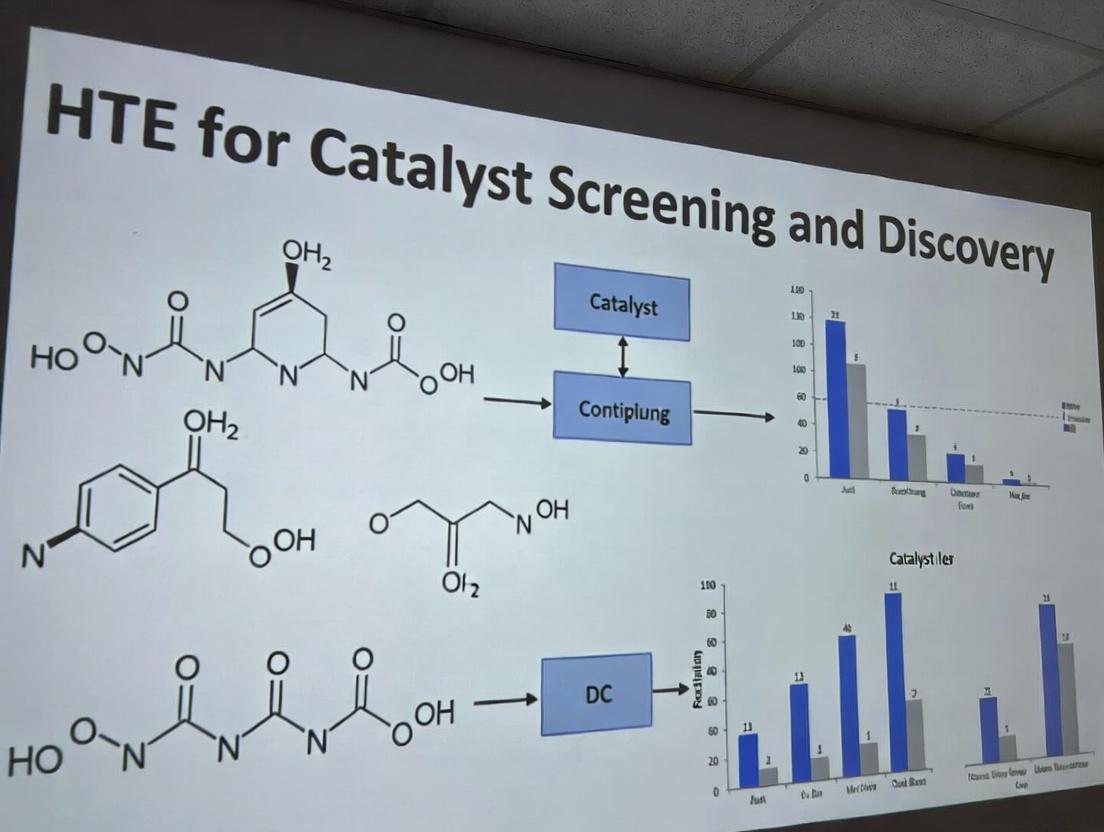
This article provides a comprehensive guide to High-Throughput Experimentation (HTE) for catalyst screening and discovery, tailored for researchers, scientists, and drug development professionals.
High-Throughput Experimentation (HTE): Accelerating Catalyst Discovery for Pharmaceutical Development
Abstract
This article provides a comprehensive guide to High-Throughput Experimentation (HTE) for catalyst screening and discovery, tailored for researchers, scientists, and drug development professionals. It covers the foundational principles of HTE and its transformative role in accelerating catalyst R&D. The article details modern methodological workflows, including automated parallel reactor systems and data analysis techniques. It addresses common challenges in experimental design and data fidelity, offering practical troubleshooting strategies. Finally, it explores validation protocols and comparative analyses against traditional methods, highlighting HTE's impact on reducing development timelines and enabling the discovery of novel catalytic transformations for complex molecule synthesis.
What is HTE in Catalysis? Core Principles and Evolution in Pharma R&D
Defining High-Throughput Experimentation (HTE) for Catalyst Screening
High-Throughput Experimentation (HTE) for catalyst screening is a multidisciplinary approach that leverages automation, miniaturization, and parallel processing to rapidly synthesize and test vast libraries of catalytic materials or conditions. It transforms catalyst discovery and optimization from a sequential, intuition-guided process into a parallelized, data-rich discipline. This methodology is foundational to modern discovery research in pharmaceuticals (e.g., catalytic route scouting for API synthesis) and materials science, enabling the exploration of expansive variable spaces—including catalyst composition, support, ligand, additive, solvent, temperature, and pressure—orders of magnitude faster than traditional methods.
Key Principles and Quantitative Workflow Metrics
HTE workflows integrate several core technological components. The quantitative metrics of a typical heterogeneous or homogeneous catalyst screening platform are summarized below.
Table 1: Standard Metrics for HTE Catalyst Screening Platforms
| Platform Component | Typical Throughput (Experiments/Day) | Reaction Scale | Key Enabling Technology | Data Point Yield per Campaign (Est.) |
|---|---|---|---|---|
| Liquid Handling / Array Synthesis | 100 - 10,000+ | 1 µL - 1 mL | Automated pipettors, microfluidic reactors | 10^2 - 10^4 |
| Parallel Pressure Reactors | 24 - 96 | 1 - 10 mL | Modular blocks with individual controls | 10^1 - 10^2 |
| High-Throughput Analysis | 100 - 10,000+ samples/day | N/A | GC/LC autosamplers, HPLC-MS, FTIR plate readers | 10^3 - 10^4 |
| Data Management & Informatics | N/A | N/A | LIMS, cheminformatics, statistical analysis software | Structured database for all above |
Detailed Application Notes & Protocols
Application Note 1: HTE for Heterogeneous Catalyst Discovery (Hydrogenation)
Objective: Rapidly identify active and selective solid catalysts for a model ketone hydrogenation reaction from a 96-member library of mixed metal oxides.
Research Reagent Solutions & Essential Materials:
- Catalyst Library: A 96-well plate containing mg-scale quantities of pre-synthesized mixed metal oxide (MMO) catalysts (e.g., variations of Pt-Pd-Sn on Al2O3). Function: Provides the diverse material space for testing.
- Substrate Solution: 0.1 M solution of ketone (e.g., acetophenone) in a standardized solvent (e.g., 2-propanol). Function: Standardized reaction starting point.
- Internal Standard Solution: Pre-mixed solution of a non-reactive compound (e.g., dodecane) in the reaction solvent. Function: Enables precise quantitative analysis by GC.
- High-Pressure Reaction Block: A 96-well, parallel, glass-lined reactor block compatible with automation. Function: Enables safe, parallel reactions under pressurized H2.
- GC-MS with High-Throughput Autosampler: Function: Provides rapid, quantitative conversion and selectivity data for all reactions.
Protocol:
- Catalyst Dispensing: Using an automated powder dispenser, transfer 1.0 mg (±0.1 mg) of each catalyst from the library plate to the corresponding well of the high-pressure reaction block.
- Reaction Assembly: Via liquid handling robot, add 100 µL of the substrate solution and 10 µL of the internal standard solution to each well.
- Reaction Execution: Seal the reactor block, purge with H2 three times, pressurize to 10 bar H2, and agitate at 600 RPM for 2 hours at 80°C.
- Quenching & Sampling: After cooling, depressurize the block. Use the robot to withdraw a 50 µL aliquot from each well into a deep-well analysis plate containing 200 µL of dilution solvent.
- Analysis: The analysis plate is sealed and transferred via robotic arm to a GC-MS autosampler. A fast GC method (e.g., <5 min per sample) quantifies substrate consumption and product formation relative to the internal standard.
- Data Processing: Conversion and selectivity data are automatically parsed from the GC software, linked to the catalyst identity via plate map, and uploaded to a central database for visualization and analysis.
Application Note 2: HTE for Homogeneous Cross-Coupling Reaction Optimization
Objective: Systematically optimize the ligand, base, and concentration for a Pd-catalyzed Suzuki-Miyaura coupling to maximize yield.
Research Reagent Solutions & Essential Materials:
- Ligand Kit: A curated set of 24 phosphine and N-heterocyclic carbene (NHC) ligand solutions in THF. Function: Screens steric and electronic effects on Pd catalyst performance.
- Base Library: A set of 8 inorganic and organic base solutions (e.g., K2CO3, Cs2CO3, K3PO4, Et3N). Function: Tests critical base effect on transmetalation.
- Pd Precursor Solution: A standardized solution of a Pd source (e.g., Pd(OAc)2) in DMF. Function: Provides the catalytic metal source.
- Stock Solutions: Separate solutions of aryl halide and boronic acid in DMF. Function: Standardized substrate inputs.
- 384-Well Microtiter Plate: Function: The reaction vessel for ultra-miniaturized, parallel reactions.
- UHPLC-MS with Flow Injection Analysis: Function: Provides ultra-high-throughput analytical data.
Protocol:
- DoE Setup: A Design of Experiments (DoE) software defines a 96-reaction subset from the full factorial of variables (Ligand (24) x Base (8) x Concentration Gradient).
- Automated Reaction Setup: A liquid handler creates reactions in a 384-well plate. For each well, it dispenses specified volumes of Pd solution, ligand solution, base solution, and both substrate stocks. Total reaction volume is 50 µL.
- Execution: The plate is sealed with a gas-permeable membrane, placed on a heated/shaking incubator, and reacted at 60°C for 18 hours.
- High-Throughput Analysis: The plate is cooled, and a portion of each reaction is automatically diluted into a secondary analysis plate containing a quenching solvent. This plate is analyzed via flow-injection MS (no chromatography) for rapid yield estimation or UHPLC-MS for detailed conversion/selectivity.
- Modeling: Yield/response data is fed into statistical analysis software to build a predictive model of the reaction landscape, identifying optimal conditions and interaction effects.
Visualizations
The Scientist's Toolkit: Key Research Reagent Solutions
Table 2: Essential HTE Catalyst Screening Materials
| Item | Function in HTE | Example/Format |
|---|---|---|
| Modular Ligand Kits | Pre-weighed, solubilized libraries to rapidly test ligand effects on metal catalysis. | 96-well plates with 1-5 mg of 100+ diverse phosphines, NHCs, diamines. |
| Catalyst Precursor Libraries | Arrays of metal salts or complexes for initial activity screening. | Microplates with late transition metal acetates, halides, or organometallics. |
| Automated Synthesis Robots | Enables unattended, precise setup of reaction arrays from stock solutions. | Liquid handlers (e.g., from Hamilton, Beckman) with temperature control. |
| Parallel Pressure Reactors | Allows simultaneous execution of multiple gas-involving reactions (H2, CO2). | Commercially available systems (e.g., from Unchained Labs, AMT) with 16-96 reactors. |
| High-Throughput Analysis Autosamplers | Dramatically increases sample analysis rate for chromatographic systems. | Robotic autosamplers for GC and LC that handle 384+ well plates. |
| Reaction Database Software | Manages, analyzes, and visualizes large datasets; crucial for pattern recognition. | Commercial (e.g., Genedata, Benchling) or custom (e.g., Python/R-based) platforms. |
Within the broader thesis on High-Throughput Experimentation (HTE) for catalyst screening and discovery, this document details the critical transition from traditional, slow sequential testing to parallelized methodologies. This paradigm shift accelerates the empirical discovery and optimization of homogeneous and heterogeneous catalysts, directly impacting pharmaceutical synthesis, agrochemical development, and materials science.
Key Principles & Advantages of Parallel Testing
Quantitative Comparison of Methodologies
Table 1: Sequential vs. Parallel Catalyst Testing Metrics
| Metric | Sequential Testing (Batch) | Parallel Testing (HTE) |
|---|---|---|
| Experiments per Week | 2 - 10 | 100 - 1,000+ |
| Reagent Consumption per Experiment | Standard scale (mmol) | Microscale (μmol) |
| Time to Initial Hit Identification | Weeks to months | Days |
| Data Point Generation for DoE | Low (limited factor exploration) | High (full factorial exploration) |
| Capital Equipment Cost | Low to Moderate | High |
| Operational Cost per Data Point | High | Low |
| Environmental Footprint (E-factor) | Higher | Lower (miniaturization) |
Application Notes & Core Protocols
Protocol A: Parallel Screening of Homogeneous Catalysts for Cross-Coupling
Objective: To rapidly identify active catalysts and optimal ligands for a model Suzuki-Miyaura cross-coupling.
Research Reagent Solutions & Essential Materials:
- HTE Reactor Block: A 24-, 48-, or 96-well glass or metal reactor block capable of heating, stirring, and inert atmosphere control (e.g., from Unchained Labs, AMTAG, or HiTec Zang).
- Liquid Handling Robot: For precise, reproducible dispensing of reagents and catalysts (e.g., Hamilton, Tecan).
- Catalyst/Ligand Stock Library: Pre-prepared solutions in DMSO or toluene in 96-deep well plates.
- Substrate Plates: Pre-dispensed aryl halide and boronic acid substrates in microtiter plates.
- Base Solution: Pre-made aqueous or solid aliquots of phosphate or carbonate base.
- Analysis Plate: A matching 96-well plate for quenching and dilution prior to analysis.
- GC/MS or UPLC-MS System: With high-throughput autosampler for rapid analysis.
Procedure:
- Preparation: Under an inert atmosphere (N2 glovebox), load the reactor block with stir bars.
- Dispensing: Using a liquid handler, transfer 0.01 mmol of aryl halide (in 100 μL solvent) to each well.
- Catalyst/Ligand Addition: Dispense variable combinations of catalyst precursors (e.g., Pd sources, 1 mol%) and ligands (2 mol%) from stock libraries (10 μL volumes).
- Reaction Initiation: Add boronic acid (0.012 mmol) and base (0.015 mmol) in 100 μL of solvent/water mixture to all wells simultaneously.
- Parallel Reaction: Seal the block, transfer to a heating/stirring station, and run all reactions in parallel at 80°C for 18 hours.
- Quenching & Analysis: Cool block, automatically add internal standard and dilution solvent to each well. Sample analysis via high-throughput GC/MS or UPLC-MS.
- Data Processing: Use informatics software to calculate conversion and yield for each well, generating a catalyst-ligand activity matrix.
Protocol B: High-Throughput Experimentation (HTE) for Heterogeneous Catalyst Discovery
Objective: To screen a library of solid catalyst formulations for a gas-phase oxidation reaction.
Research Reagent Solutions & Essential Materials:
- Parallel Pressure Reactor: A system with multiple independent or parallel fixed-bed or batch microreactors (e.g., from HEL, Parr, or custom setups).
- Automated Synthesis Platform: For incipient wetness impregnation or precipitation of catalyst libraries (e.g., from Symyx, Freeslate).
- Mass Flow Controllers: For precise, parallel control of reactant gas feeds (O2, alkane).
- Multiplexed Gas Chromatograph: With multi-stream selector valve for sequential, automated analysis of each reactor effluent.
- Catalytic Material Library: Array of doped metal oxides or zeolites on 48-well quartz plates.
Procedure:
- Library Synthesis: Prepare a library of candidate catalysts (e.g., varying V/Mo ratios on TiO2) via automated liquid dispensing of precursor solutions onto pre-weighed support plates, followed by calcination in a muffle furnace.
- Reactor Loading: Precisely weigh and load each catalyst candidate into its individual microreactor tube.
- Conditioning: Subject all reactors to a standard pre-treatment protocol (e.g., heat in O2 flow) in parallel.
- Reaction Screening: Set individual mass flow controllers to deliver a standardized reactant mix (e.g., C3H8 / O2 / He) to each reactor at identical GHSV. Heat all reactors to a common set temperature.
- Effluent Analysis: Use a multiplexed GC system to periodically sample and analyze the output from each reactor stream, quantifying propane conversion and product selectivities.
- Data Correlation: Plot performance metrics (activity, selectivity) against catalyst compositional variables to identify lead formulations.
Visualizing the Workflow
Diagram Title: Parallel Catalyst Screening Workflow
The Scientist's Toolkit: Essential Research Reagent Solutions
Table 2: Key Materials for Parallel Catalyst Testing
| Item / Solution | Function & Rationale |
|---|---|
| Modular HTE Reactor Systems (e.g., Carousel, Block) | Provides controlled, parallel reaction environments for homogeneous catalysis (temp, stir, pressure). |
| Automated Liquid Handlers | Enables precise, reproducible dispensing of microliter volumes of catalysts, ligands, and substrates from stock solutions. |
| Pre-formatted Catalyst/Ligand Stock Libraries | DMSO or toluene solutions in 96-well plates; the core "search space" for discovery. |
| High-Throughput Pressure Reactors | For screening heterogeneous catalysts or homogeneous reactions requiring gas pressure (H2, CO). |
| Multiplexed Analytical Instruments (GC, HPLC, MS) | Rapid, sequential analysis of multiple reaction outputs with minimal downtime. |
| Laboratory Information Management System (LIMS) | Tracks sample identity, location, and links analytical results to reaction conditions. |
| Data Visualization & DoE Software | Identifies trends, models responses, and guides the next iteration of experiments. |
Application Note: Accelerating Medicinal Chemistry with HTE for Catalysis
The iterative design-make-test-analyze (DMTA) cycle in medicinal chemistry is a primary rate-limiting step. High-Throughput Experimentation (HTE) expedites the "make" phase by enabling the parallel synthesis of hundreds to thousands of target molecules. This is critical for rapid structure-activity relationship (SAR) establishment and hit-to-lead optimization.
Key Quantitative Impact:
Table 1: Comparison of Traditional vs. HTE-Enabled Synthesis Screening
| Parameter | Traditional Batch Screening | HTE Parallel Screening |
|---|---|---|
| Reactions Screened per Week | 10-50 | 500-5,000 |
| Catalyst/Ligand Combinations Tested | 1-3 per campaign | 384-1,536 in one plate |
| Reagent/Solvent Scope per Reaction | Limited | Extensive, multivariate |
| Typical SAR Cycle Time | 4-8 weeks | 1-2 weeks |
| Material Consumption per Condition | 10-100 mg | 0.1-1 mg |
Protocol 1: HTE Protocol for C-N Cross-Coupling Reaction Space Exploration
Objective: Rapidly identify optimal catalyst, base, and solvent combinations for the coupling of a novel heteroaryl bromide with a proprietary amine.
Materials & Workflow:
- Preparation: In an inert-atmosphere glovebox, prepare stock solutions of the aryl bromide (0.1 M in THF), amine (0.12 M in THF), and base (0.5 M in respective solvent).
- Plate Setup: Dispense 0.05 mmol of aryl bromide (500 µL of 0.1 M) into each well of a 96-well reactor block.
- Variable Addition:
- Catalyst/Ligand: Using a liquid handler, add 5 µL of pre-mixed catalyst/ligand solutions from a 384-well master library plate (0.05 M in THF, 5 mol% final).
- Base: Add 1.2 equivalents of base (120 µL of 0.5 M solution). Bases include Cs2CO3, K3PO4, and DIPEA.
- Solvent: Add solvent to bring total volume to 1 mL. Solvents include toluene, dioxane, DMF, and t-BuOH.
- Reaction Initiation: Add 1.05 equivalents of amine (525 µL of 0.12 M solution). Seal the block.
- Execution: Heat the block to 80°C with agitation for 18 hours.
- Analysis: Cool block. Use an automated liquid handler to dilute 10 µL aliquots from each well with 1 mL of acetonitrile for direct analysis by UPLC-MS. Conversion is determined by UV peak area at 254 nm.
Diagram 1: HTE Workflow for Reaction Screening
The Scientist's Toolkit: Key Reagent Solutions for Catalytic HTE Table 2: Essential Research Reagents for HTE Catalysis Screening
| Item | Function & Rationale |
|---|---|
| Pre-weighed Catalyst/Ligand Plates | 96- or 384-well plates containing mg quantities of diverse Pd, Cu, Ni catalysts and phosphine/NHC ligands. Enables rapid reconstitution for screening. |
| Modular Ligand Libraries | Focused sets of bidentate (e.g., XPhos, SPhos) and monodentate ligands covering diverse electronic and steric profiles. |
| Solvent/Base Screening Kits | Pre-formulated plates with common solvents (ethers, aromatics, DMSO) and bases (carbonates, phosphates, amines) for systematic condition exploration. |
| Automated Liquid Handlers | Instruments for precise, nanoliter-to-milliliter dispensing of reagents, eliminating manual error and enabling plate replication. |
| Mass-Detected UPLC Systems | Ultra-Performance Liquid Chromatography with mass spectrometry enables rapid (<5 min) separation and conversion/yield analysis without internal standards. |
Application Note: HTE in Biocatalysis for Chiral Intermediate Synthesis
HTE is crucial for discovering and optimizing enzymatic transformations, providing sustainable routes to complex chiral scaffolds.
Protocol 2: HTE Protocol for Ketoreductase (KRED) Enzyme Screening
Objective: Identify a biocatalyst to reduce a prochiral ketone to the desired (S)-alcohol with >99% ee.
Materials & Workflow:
- Plate Setup: A 96-well deep-well plate is used. Each well receives 100 µL of potassium phosphate buffer (100 mM, pH 7.0).
- Enzyme Addition: Using a multichannel pipette, add 10 µL of cell lysate (or purified enzyme) from a different KRED variant (commercial library or in-house expressed) to each well. Include negative controls.
- Substrate/Co-factor Addition: Add 10 µL of a DMSO stock solution containing the ketone substrate (final concentration 10 mM) and NADPH (final concentration 1 mM).
- Reaction: Seal the plate and incubate at 30°C with shaking (500 rpm) for 24 hours.
- Quench & Extraction: Add 200 µL of ethyl acetate containing an internal standard (e.g., n-dodecane) to each well. Vortex for 2 minutes.
- Analysis: Centrifuge plate. Analyze organic layer via chiral GC-MS or UPLC to determine conversion and enantiomeric excess (ee).
Diagram 2: HTE Biocatalyst Screening & Optimization Pathway
Thesis Context Integration
Within the broader thesis on HTE for catalyst discovery, these protocols exemplify the paradigm shift from sequential, hypothesis-heavy experimentation to parallel, data-rich empirical screening. In drug development, this translates directly to timeline compression. The ability to simultaneously map thousands of data points across chemical, catalytic, and enzymatic space de-risks synthetic route selection and accelerates the delivery of key intermediates and final target compounds. HTE moves medicinal chemistry from a bottleneck to a driver of project velocity, making it indispensable for meeting aggressive development timelines.
Essential Components of an HTE Catalyst Screening Platform
Within the broader thesis on High-Throughput Experimentation (HTE) for catalyst screening and discovery, the platform's architecture is paramount. This document details the essential components, application notes, and standardized protocols for constructing and operating an integrated HTE catalyst screening system, enabling accelerated discovery and optimization in pharmaceutical synthesis.
Core Hardware Components & Specifications
An effective HTE platform integrates automated hardware for reproducibility and scalability.
Table 1: Essential HTE Platform Hardware Components
| Component | Key Specifications | Primary Function in Catalyst Screening |
|---|---|---|
| Liquid Handling Robot | 8+ tips, <5% CV precision, 96/384-well compatibility | Automated dispensing of catalysts, ligands, substrates, and reagents into microtiter plates. |
| Automated Weigh Station | 0.01 mg sensitivity, integrated with scheduler | Precise, hands-free solid dispensing (catalysts, bases, salts) for library synthesis. |
| Modular Reaction Block | -40°C to 150°C range, orbital shaking, inert atmosphere control | Parallel execution of reactions under controlled temperature and agitation. |
| In-line Analysis Sampler | Robotic arm for vial/plate sampling, zero-cross-contamination | Automated quenching and sample preparation for analytical injection. |
| High-Throughput LC/MS | <2 min/cycle runtime, UV/ELSD/CAD/MS detection | Rapid qualitative and quantitative analysis of reaction outcomes (conversion, yield, purity). |
Software & Data Management Framework
Data informatics is the critical bridge between hardware execution and knowledge generation.
Application Note 2.1: Digital Experiment Design
- Protocol: Utilize chemical registration software (e.g., ChemDraw/ChemOffice Suite) to generate digital libraries. Export SMILES strings to an Electronic Laboratory Notebook (ELN) with integrated experiment planner (e.g., Genedata, Benchling). The ELN assigns unique identifiers (IDs) to each experiment, which are linked to barcoded physical vessels (vials, plates).
- Workflow: Compound Library Design (SMILES) → ELN Experiment Definition → ID/Barcode Generation → Instruction File for Robot.
Application Note 2.2: Data Processing & Analysis
- Protocol: Configure analytical instruments (LC/MS) to deposit raw data into a centralized database. Implement automated data parsing scripts (Python, Knime) to extract key metrics (peak area, mass). Link results back to ELN experiment ID. Use visualization software (Spotfire, TIBCO) to generate heat maps and trend plots for catalyst performance.
- Workflow: LC/MS Raw Data → Automated Parsing → Results Database → ELN Integration → Visualization & SAR Analysis.
Standardized Experimental Protocol for Cross-Coupling Catalyst Screening
This protocol exemplifies a typical HTE screening campaign for a Pd-catalyzed Suzuki-Miyaura reaction.
Protocol 3.1: HTE Screen Setup & Execution Aim: To evaluate a library of 96 Pd-precatalysts and ligand combinations for the coupling of aryl bromide A with boronic acid B. Materials: See "Scientist's Toolkit" below. Method:
- Plate Map Design: In the ELN, design a 96-well plate map. Columns 1-10: test catalysts/ligands. Column 11: positive control (known active catalyst). Column 12: negative control (no catalyst).
- Stock Solution Preparation: Prepare 10 mM stock solutions of all catalysts and ligands in anhydrous DMF or THF under inert atmosphere. Prepare 0.1 M solutions of substrate A and B in dioxane.
- Automated Dispensing:
- Using the liquid handler, dispense 10 µL of each catalyst stock solution to designated wells (final catalyst loading: 1 mol%).
- Dispense 10 µL of each ligand stock (1.2 mol% final loading).
- Dispense 50 µL of substrate A stock solution (5 µmol).
- Dispense 60 µL of substrate B stock solution (6 µmol).
- Dispense 69 µL of base stock solution (Cs₂CO₃, 0.5 M in H₂O, 15 µmol).
- Add solvent (dioxane) to bring each well to a final volume of 500 µL.
- Reaction Execution: Seal the microtiter plate with a Teflon mat. Transfer plate to the modular reaction block pre-equilibrated to 80°C. React with orbital shaking (500 rpm) for 18 hours under N₂.
- Automated Quenching & Analysis: The in-line sampler injects 100 µL from each well into a 96-well analysis plate containing 100 µL of quenching solution (e.g., 10% TFA in MeCN). The plate is sealed, vortexed, and an aliquot is automatically injected into the HT-LC/MS system for analysis.
Protocol 3.2: Data Analysis Workflow
- Quantification: Integrated LC/MS peak areas for product C are normalized against an internal standard added during quenching.
- Conversion Calculation: % Conversion = [Area(Product C) / (Area(Product C) + Area(Starting Material A))] x 100%.
- Result Aggregation: Data is compiled into the ELN and visualized.
Table 2: Representative Screening Data Output (Top Hits)
| Well ID | Pd Catalyst | Ligand | % Conv. (LC/MS) | Purity (UV Area %) |
|---|---|---|---|---|
| B5 | Pd(OAc)₂ | SPhos | 99 | 95 |
| D2 | Pd-G3 Precatalyst | tBuXPhos | 98 | 97 |
| F8 | PdCl₂(AmPhos)₂ | -- | 95 | 92 |
| Ctrl+ (H11) | Pd(dppf)Cl₂ | -- | 85 | 90 |
| Ctrl- (H12) | -- | -- | <2 | -- |
Visualization of the HTE Catalyst Screening Workflow
HTE Catalyst Screening Platform Workflow
The Scientist's Toolkit: Key Reagent Solutions for HTE Screening
Table 3: Essential Research Reagents & Materials
| Item | Function & Application Note |
|---|---|
| Barcoded Microtiter Plates | 96 or 384-well plates with unique 2D barcodes for unambiguous sample tracking by automation software. |
| Pre-weighed Catalyst & Ligand Kits | Commercially available libraries (e.g., from Sigma-Aldrich, Strem, Ambeed) in vials or pre-dispensed in plate format, accelerating screen setup. |
| Anhydrous, Deoxygenated Solvents | Solvents (DMF, THF, dioxane) dispensed from sealed, inert-atmosphere reservoirs (e.g., J-Kem, Aldrich Sure/Seal) to maintain catalyst integrity. |
| Internal Standard Solutions | Pre-prepared solutions of a chemically inert compound (e.g., dibromomethane, mesitylene) for quantitative LC/MS analysis normalization. |
| Automated Quenching Solutions | Acidic, basic, or scavenging solutions in analysis plates to uniformly stop reactions prior to injection, ensuring data fidelity. |
| Calibration & Wash Solvents for HT-LC/MS | Dedicated, filtered, and degassed solvent lines for mobile phases and systematic column washing protocols to maintain analytical robustness. |
Combinatorial chemistry emerged in the late 1980s and 1990s as a paradigm shift, moving from the serial synthesis of individual compounds to the parallel creation of vast molecular libraries. Initially driven by the pharmaceutical industry's need for vast numbers of novel compounds for high-throughput screening (HTS) against new biological targets, it relied on techniques like solid-phase synthesis, split-and-pool methods, and parallel array synthesis. The primary goal was quantity. However, these libraries often suffered from poor drug-like properties, yielding high hit rates but low lead development success.
The field has since evolved dramatically, integrating with advanced analytical technologies, computational design, and automation. Today's integrated workflows for catalyst screening and discovery research emphasize quality, data-rich experimentation, and intelligence-driven design. This evolution is central to modern High-Throughput Experimentation (HTE) platforms, which combine rapid synthesis, in-line analysis, and machine learning to accelerate the discovery of novel catalysts and synthetic routes.
Table 1: Evolution of Key Methodological and Data Output Parameters
| Era (Decade) | Primary Focus | Typical Library Size | Synthesis Throughput (Compounds/week) | Key Analytical Method | Data Output per Experiment |
|---|---|---|---|---|---|
| 1990s (Combinatorial) | Library Quantity | 10⁴ – 10⁶ | 1,000 - 10,000 | LC-MS (offline) | Purity/Yield (Single point) |
| 2000s (Early HTE) | Reaction Scope/Feasibility | 10² – 10⁴ | 100 - 1,000 | HPLC-UV/ELSD | Yield, some selectivity |
| 2010s (Automation) | Reaction Optimization | 10² – 10³ | 500 - 5,000 | UPLC-MS, GC-MS | Multi-parametric (Yield, ee, etc.) |
| 2020s+ (Integrated AI/HTE) | Predictive Discovery | 10² – 10⁴ | 1,000 - 10,000+ | HPLC-MS/SFC-MS, NMR, IR (in-line) | High-dimensional datasets for ML models |
Application Notes & Protocols for Modern Integrated HTE in Catalysis
Application Note AN-2024-001: HTE Platform for Cross-Coupling Catalyst Screening
Objective: To rapidly screen a library of 384 Pd/XPhos-based catalyst complexes for the Suzuki-Miyaura coupling of a sterically hindered aryl bromide with a boronic acid, identifying hits for further optimization.
The Scientist's Toolkit: Research Reagent Solutions
| Item | Function & Rationale |
|---|---|
| Pre-dispensed Catalyst Plates | 384-well plate with lyophilized catalysts (1 µmol/well) in air-sensitive wells. Enables rapid, reproducible screening. |
| Liquid Handling Robot (e.g., Echo 655) | For non-contact, nanoliter-scale transfer of reagents and catalysts. Critical for miniaturization and speed. |
| Automated Synthesis Reactor (e.g., Unchained Labs Freeslate) | Provides controlled heating, stirring, and inert atmosphere for parallel reactions. |
| In-line UPLC-MS/HPLC-UV | Provides quantitative yield analysis and purity assessment directly from reaction crude mixtures. |
| Data Analysis Suite (e.g., Cheminformatics + Python/Spotfire) | For visualization, statistical analysis, and preparation of datasets for machine learning. |
Protocol P-2024-001: High-Throughput Screening of Palladium Catalysts
I. Reagent and Plate Preparation
- Stock Solutions: Prepare under inert atmosphere:
- Substrate A (Ar-Br): 0.1 M in anhydrous 1,4-dioxane.
- Substrate B (Ar-B(OH)₂): 0.15 M in anhydrous 1,4-dioxane.
- Base (Cs₂CO₃): 0.2 M in degassed H₂O.
- Catalyst Plate: Use a commercially sourced or pre-prepared 384-well catalyst plate stored under argon.
- Receiver Plate: Prime a new 384-well polypropylene reaction plate with inert gas (N₂ or Ar) for 5 minutes.
II. Automated Reaction Setup
- Using a liquid handler, dispense 10 µL of Substrate A stock (1.0 µmol) into each well of the receiver plate.
- Dispense 10 µL of Substrate B stock (1.5 µmol) into each well.
- Transfer the entire solid catalyst aliquot (1 µmol) from the catalyst plate to the corresponding well of the receiver plate using a solid-handling robot or by dissolving and transferring.
- Finally, dispense 10 µL of Base stock (2.0 µmol) into each well. Total reaction volume is 30 µL.
- Seal the plate with a pressure-resistant, pierceable foil seal.
III. Parallel Reaction Execution
- Place the sealed plate in a high-throughput parallel synthesizer.
- Set the reaction parameters: 80°C, 600 rpm orbital shaking, run for 18 hours under a positive pressure of inert gas.
IV. Reaction Quenching & Analysis
- After cooling, automatically pierce the seal and add 70 µL of acetonitrile containing an internal standard (e.g., 0.01 M dibromomethane) to each well to quench and dilute.
- Agitate the plate for 5 minutes to ensure homogeneity.
- Using an automated sampler, inject an aliquot (e.g., 1 µL) from each well into an in-line UPLC-MS system.
- UPLC Method: C18 column (2.1 x 50 mm, 1.7 µm), gradient 5-95% MeCN in H₂O (0.1% Formic acid) over 2.5 min.
- Quantify product yield via UV chromatogram (254 nm) relative to the internal standard, using a pre-established calibration curve.
V. Data Processing and Hit Identification
- Export peak areas for product and internal standard to a data analysis platform.
- Calculate yield for all 384 reactions.
- Apply criteria for a "hit" (e.g., Yield > 70%). Correlate catalyst structure with performance.
- Format data (catalyst descriptors, yield, MS data) for upload to a central database to inform machine learning models.
Visualization: Modern Integrated HTE Workflow
Diagram Title: Integrated AI-Driven HTE Cycle for Catalysis
The Role of Data and Machine Learning in Modern Workflows
The critical output of modern integrated workflows is not just a "hit" catalyst, but a rich, standardized dataset. HTE generates structured data on success/failure, yield, enantioselectivity, etc., under varied conditions. This data fuels machine learning models (e.g., random forest, neural networks) that predict promising catalyst/reagent combinations for new transformations, creating a virtuous cycle of prediction, experimentation, and validation.
Table 2: Comparative Analysis of Catalytic C-N Coupling HTE Campaigns
| Campaign Feature | Traditional Optimization (c. 2005) | Modern AI/HTE Integrated (c. 2024) |
|---|---|---|
| Design of Experiment | One-factor-at-a-time (OFAT) or sparse grid. | Bayesian Optimization or model-informed design. |
| Variables Tested | 3-5 (Catalyst, Base, Solvent, Temp, Time). | 10+ (incl. Precatalyst, Ligand, Additive, etc.). |
| Reactions Run | 50 - 200. | 500 - 5,000. |
| Primary Output | Optimal conditions for one substrate. | Predictive model for substrate scope. |
| Cycle Time to Prediction | Months. | Weeks. |
| Key Enabler | Parallel synthesizer. | Integration of automation, analytics, and informatics. |
The historical evolution from combinatorial chemistry to integrated workflows represents a shift from mass production of molecules to the intelligent generation of actionable chemical data. For catalyst discovery, this means HTE platforms are no longer just about screening speed but are central to building predictive, knowledge-driven research engines. This paradigm, framed within the broader thesis of HTE, is fundamentally accelerating the discovery and optimization of novel catalytic processes for drug development and beyond.
HTE Catalyst Screening Workflows: From Library Design to Data Acquisition
Strategic Design of Catalyst and Condition Libraries for Pharma-Relevant Reactions
Application Note 1: HTE for Buchwald-Hartwig Amination in API Synthesis
Context: Within a High-Throughput Experimentation (HTE) framework for catalyst discovery, the strategic assembly of libraries is critical for efficiently navigating chemical space. The Buchwald-Hartwig amination, a pivotal C-N bond-forming reaction in pharmaceutical synthesis, exhibits high sensitivity to catalyst structure, ligand, base, and solvent. A well-designed library maximizes the probability of identifying optimal conditions for challenging, electron-rich or -poor substrates common in drug candidates.
Key Quantitative Findings from Recent Studies (2023-2024):
Table 1: Performance Summary of a Strategic Catalyst/Ligand Library for a Challenging Electron-Neutral Aryl Chloride Amination
| Library Component | Variations Tested | Key Finding (Yield Range) | Optimal Identified Condition |
|---|---|---|---|
| Pd Precatalyst | 4 | Biarylphosphine-based (SPhos, XPhos) outperformed others. | Pd-PEPPSI-IPentCl (10 mol%) |
| Ligand (if separate) | 8 | Bulky, electron-rich biarylphosphines gave >80% yield. | t-BuBrettPhos |
| Base | 5 | Organic bases (Cs2CO3, K3PO4) superior to inorganic. | Cs2CO3 |
| Solvent | 6 | Aromatic (toluene) and ether (1,4-dioxane) solvents optimal. | 1,4-dioxane |
| Temperature | 3 | 80-100°C necessary for full conversion. | 100°C |
| Total Experiments | 288 (4x8 matrix) | Hit Rate (Yield >70%): 12% | Max Yield: 94% |
Protocol 1: HTE Screening for Buchwald-Hartwig Amination
Objective: To rapidly identify optimal catalyst/conditions for the coupling of a pharma-relevant aryl halide with a secondary amine.
Materials & Equipment:
- HTE Platform: 96-well glass reactor block with magnetic stirring.
- Liquid Handler: For precise reagent dispensing.
- Stock Solutions: Prepared in anhydrous solvents under N₂.
- Substrate Solution A: Aryl halide (0.1 M in toluene).
- Substrate Solution B: Amine (0.12 M in toluene).
- Catalyst/Ligand Library: Pre-weighed in 96-well plate.
- Base Library: Powder solids (Cs2CO₃, K₃PO₄, etc.) pre-dispensed.
- GC-MS/HPLC: For reaction analysis.
Procedure:
- Library Design & Plate Preparation: Design a 96-well matrix varying Pd source (4 types), ligand (8 types), and base (3 types). Use a liquid handler to dispense catalyst/ligand solids.
- Reagent Dispensing: To each well, add 100 µL of Solution A (10 µmol aryl halide) and 100 µL of Solution B (12 µmol amine).
- Solvent Addition: Add 80 µL of anhydrous toluene to bring the total volume to ~300 µL.
- Base Addition: Dispense ~1.5 mg of solid base (approx. 3.0 equiv) to each well using a solid dispenser.
- Sealing & Reaction: Seal the plate with a PTFE-silicone mat. Place the block on a pre-heated stirrer/hotplate at 100°C. Stir at 800 rpm for 18 hours.
- Quenching & Analysis: Cool block to RT. Automatically add 400 µL of a quenching/dilution solvent (e.g., MeOH with internal standard) to each well. Mix thoroughly.
- Analysis: Sample supernatant and analyze by UHPLC with UV detection (254 nm) to determine conversion and yield using calibrated curves.
- Data Processing: Use informatics software to visualize yield heatmaps and identify optimal conditions.
Visualization 1: HTE Workflow for Catalyst Screening
Title: High-Throughput Experimentation Screening Workflow
The Scientist's Toolkit: Key Reagent Solutions for Buchwald-Hartwig HTE
- Pd-PEPPSI Precatalysts: Air-stable, well-defined Pd-NHC complexes; eliminate separate ligand addition step, simplifying library setup.
- BrettPhos & RuPhos Ligand Families: Specialized biarylphosphine ligands; provide broad scope for coupling of primary/secondary amines and aryl halides.
- Cs2CO3 (Cesium Carbonate): Soluble, strong base; facilitates deprotonation in non-polar solvents, improving reaction kinetics.
- Anhydrous 1,4-Dioxane/Toluene: Common, high-boiling, non-coordinating solvents; ideal for high-temperature couplings.
- Internal Standard (e.g., Tridecane): Added to quench solution; enables precise GC-MS quantification without exact volume measurements.
Application Note 2: Systematic Exploration of Asymmetric Hydrogenation Conditions
Context: Asymmetric hydrogenation is a cornerstone for introducing chiral centers in Active Pharmaceutical Ingredients (APIs). The HTE approach requires libraries that simultaneously screen chiral ligand families, metal precursors, additives, and hydrogen pressure to find the unique combination that delivers high enantioselectivity and yield for structurally complex pharma substrates.
Key Quantitative Findings from Recent Studies (2023-2024):
Table 2: Library Screening Results for Enantioselective Hydrogenation of a Tetrasubstituted Olefin
| Parameter Screened | Library Variations | Performance Metric | Optimal Condition |
|---|---|---|---|
| Chiral Ligand | 12 (BINAP, DuPhos, Josiphos, TaniaPhos analogs) | Enantiomeric Excess (ee) Range: 10% to 99% | (R)-TaniaPhos |
| Metal Source | 3 | [Rh(COD)2]OTf gave highest ee. | [Rh(COD)2]OTf |
| Additive | 6 (Acids, Iodides) | HI (0.5 equiv) dramatically improved rate & ee. | HI (0.5 equiv) |
| Solvent | 4 | Dichloromethane (DCM) optimal for this substrate. | DCM |
| Pressure (H₂) | 3 (50, 100, 150 psi) | 100 psi gave best conversion without side reactions. | 100 psi |
| Total Experiments | 216 | Hit Rate (ee >95%): 8% | Result: 99% ee, >99% conv. |
Protocol 2: HTE for Parallel Asymmetric Hydrogenation Screening
Objective: To evaluate a library of chiral ligands and conditions for the enantioselective hydrogenation of a prochiral olefin.
Materials & Equipment:
- Parallel Pressure Reactor: 24- or 48-well autoclave system (e.g., from Parr, Büchi) with individual glass vessels.
- Automated Gas Manifold: For simultaneous H₂ pressurization.
- Stock Solutions: Substrate, metal precursor, additives in degassed solvent.
- Ligand Library: Solutions of chiral ligands in degassed solvent.
Procedure:
- Vessel Preparation: In a glovebox (or under inert atmosphere), charge each reactor vessel with a magnetic stir bar.
- Library Assembly: To each vessel, add via pipette: Substrate (0.1 mmol in 0.5 mL DCM), Metal Precursor (1 mol%), Chiral Ligand (1.1 mol%), and Additive (as per library design).
- Sealing & Pressurization: Seal the reactor block. Remove from glovebox. Connect to the H₂ manifold. Purge vessels 3x with H₂, then pressurize to the designated pressure (e.g., 100 psi).
- Reaction: Stir the block at a controlled temperature (e.g., 25°C) for the specified time (e.g., 16 h).
- Depressurization & Sampling: Carefully vent the H₂ pressure. Open vessels and take an aliquot from each.
- Analysis: Dilute aliquots and analyze by Chiral UHPLC or SFC to determine conversion and enantiomeric excess (ee).
- Data Analysis: Plot results in a 3D scatter plot (X=ligand, Y=additive, Z=ee) to visualize structure-performance trends.
Visualization 2: Strategic Library Design Logic
Title: Strategic Catalyst Library Design Process
Application Notes: High-Throughput Experimentation (HTE) for Catalytic Reaction Screening
The integration of parallel pressurized reactor systems with automated liquid handlers has become a cornerstone of modern catalyst discovery and optimization. This approach enables the rapid, systematic, and reproducible exploration of chemical space, which is central to accelerating research in pharmaceuticals, agrochemicals, and fine chemicals synthesis.
Core Advantages:
- Throughput: A single robotic platform can set up hundreds of catalyst/reaction condition variations per day, compared to a handful manually.
- Precision & Reproducibility: Robotic pipetting eliminates human error in reagent dispensing, especially for sub-microliter volumes of precious catalysts or ligands.
- Data Density: Enables multifactorial experimental designs (e.g., DoE) by simultaneously varying catalyst, ligand, base, solvent, concentration, and temperature.
- Safety: Automates the handling of air-sensitive reagents, toxic compounds, and reactions under pressure within sealed, engineered reactor blocks.
Key Application Areas:
- Cross-Coupling Catalysis: High-throughput screening of Pd, Ni, and Cu-based catalyst systems for C-C, C-N, C-O bond formations.
- Asymmetric Hydrogenation: Parallel screening of chiral ligands with precious metal catalysts (Ru, Rh, Ir) under H₂ pressure.
- Photoredox & Electrochemistry: Screening photocatalysts and mediators in parallel reactor systems equipped with LED arrays or electrodes.
- Enzyme & Biocatalyst Discovery: Automated preparation of cell lysates, substrate solutions, and assay conditions for enzymatic activity screening.
Experimental Protocols
Protocol 2.1: Automated Setup for a Suzuki-Miyaura Cross-Coupling Catalyst Screen
Objective: To screen 96 distinct Pd/ligand combinations for the coupling of aryl halides with aryl boronic acids.
Materials & Equipment:
- Robotic Liquid Handler (e.g., Hamilton STAR, Echo 650)
- 96-well parallel pressurized reactor block (e.g., Unchained Labs Little Barn, Asynt Multireactor)
- Source plates: 10 mM stock solutions of Pd precursors (e.g., Pd(OAc)₂, Pd₂(dba)₃) in DMF.
- Source plates: 20 mM stock solutions of Ligands (e.g., SPhos, XPhos, BippyPhos, CataCXium) in DMF.
- Substrate Master Mix: 0.1 M aryl halide, 0.12 M aryl boronic acid, 0.3 M Cs₂CO₃ base in 4:1 dioxane/water.
- Internal Standard Solution: 0.05 M dodecane in dioxane.
- GC-MS or UPLC-MS for analysis.
Procedure:
- Plate Design: Map a 8x12 matrix for 96 reactions. Assign rows to different Pd sources and columns to different ligands.
- Catalyst/Ligand Dispensing: Using a non-contact acoustic dispenser (or positive displacement tips), transfer 1 µL of each Pd stock and 1.5 µL of each ligand stock directly to the corresponding well of the reactor plate.
- Reagent Addition: Using the liquid handler, add 10 µL of Internal Standard Solution, followed by 87.5 µL of the Substrate Master Mix to each well. Total reaction volume is 100 µL.
- Sealing & Pressurization: Automatically seal the reactor plate, purge with N₂, and pressurize to 2 bar (if required).
- Reaction Execution: Heat the reactor block to 80°C with agitation for 2 hours.
- Quenching & Analysis: Cool the block to 25°C, depressurize, and automatically inject 10 µL from each well into a 96-well deep-well plate containing 190 µL of quenching solvent (e.g., acetonitrile with 0.1% formic acid). Seal, vortex, and centrifuge. Analyze supernatant via UPLC-MS.
Protocol 2.2: Automated Screening of Asymmetric Hydrogenation Catalysts
Objective: To evaluate the enantioselectivity and activity of 24 chiral ligand-Rh complexes for the hydrogenation of a prochiral enamide.
Materials & Equipment:
- Robotic Liquid Handler equipped with syringe pumps for gas-liquid handling.
- 24-position parallel high-pressure hydrogenation reactor (e.g., HEL Group Carousel, Parr Series 5000).
- [Rh(nbd)₂]BF₄ or [Rh(cod)₂]BF₄ stock solution (1 mg/mL in degassed DCM).
- Chiral ligand library stock solutions (2 mg/mL in degassed toluene).
- Substrate solution: 0.2 M prochiral enamide in degassed methanol.
- Chiral HPLC column for ee determination.
Procedure:
- Catalyst Preparation: In a glovebox or under N₂, the liquid handler dispenses 1 mL of Rh precursor solution and 1.1 mL of each chiral ligand solution into individual vials on the reactor carousel. The carousel stirs at 25°C for 15 min to pre-form the active complex.
- Reaction Initiation: 4 mL of substrate solution is added to each vial. The reactor is sealed, purged 3x with H₂, and pressurized to 10 bar H₂.
- Reaction Execution: The carousel is heated to 40°C with vigorous stirring for 16 hours.
- Work-up: The reactor is vented and purged with N₂. An automated sampler transfers 0.5 mL from each vial to a 96-well plate containing silica. The plate is eluted with ethyl acetate using an automated solid-phase extraction station.
- Analysis: Eluents are diluted and analyzed by chiral HPLC to determine conversion and enantiomeric excess (ee).
Data Presentation
Table 1: Performance Summary of Automated vs. Manual Catalyst Screening for a Model Suzuki Reaction
| Parameter | Manual Setup (Single Reactor) | Automated HTE (96-well Reactor Block) | Improvement Factor |
|---|---|---|---|
| Reactions per Day | 8 | 96 | 12x |
| Reagent Consumption per Rxn | 10 µmol scale | 1 µmol scale | 10x reduction |
| Liquid Handling Error (CV) | ~8% (manual pipetting) | <2% (robotic pipetting) | 4x more precise |
| Data Points per Design (DoE) | Limited to 8-10 factors | Full factorial (4-6 factors) possible | Significantly higher data density |
| Total Setup Time for 96 rxns | ~480 minutes | ~45 minutes | ~10.7x faster |
Table 2: Key Research Reagent Solutions for HTE Catalysis Screening
| Item | Function & Description |
|---|---|
| Pre-catalyst Stock Solutions | Air-stable metal complexes (Pd, Ni, Cu, Ru, Rh, Ir) in anhydrous, degassed DMF or THF. Enable precise, automated dispensing of catalytic amounts. |
| Ligand Library Plates | 96- or 384-well plates containing bidentate phosphines, NHC precursors, chiral ligands, etc., at standardized concentrations for combinatorial mixing with metals. |
| Substrate Master Mixes | Pre-mixed solutions containing electrophile, nucleophile, base, and internal standard in the chosen solvent. Ensures uniformity across all reaction wells except for the catalyst variable. |
| Quenching/Calibration Plates | Pre-filled deep-well plates with analytical solvents and calibration standards for automated post-reaction quenching, dilution, and injection preparation. |
| Deuterated Solvent Spikes | For NMR analysis, pre-dosed deuterated solvents (e.g., DMSO-d₆) in analysis plates for automated addition to reaction aliquots. |
Visualization: Workflow and Pathway Diagrams
Title: HTE Catalyst Screening Automated Workflow
Title: Multifactorial Catalyst Optimization Logic
Rapid Analysis and High-Throughput Analytics (HTA) for Reaction Monitoring
Within the broader thesis on High-Throughput Experimentation (HTE) for catalyst screening and discovery research, the implementation of rapid, parallel analytical techniques is paramount. This document details Application Notes and Protocols for integrating High-Throughput Analytics (HTA) to monitor chemical reactions in real-time, accelerating the iterative cycle of catalyst optimization and reaction discovery in pharmaceutical development.
Application Notes
Note 1: UHPLC-MS for Parallel Reaction Monitoring
Ultra-High-Performance Liquid Chromatography coupled with Mass Spectrometry (UHPLC-MS) configured with multiplexed autosamplers enables the analysis of 96- or 384-well plate formats in under 10 minutes per plate. This allows for quantitative yield assessment and byproduct identification across entire HTE campaigns.
Note 2: Inline FTIR and Raman Spectroscopy
Fourier-Transform Infrared (FTIR) and Raman spectroscopy probes integrated into microfluidic or parallel reactor arrays provide real-time kinetic data. This facilitates the rapid determination of reaction endpoints and the detection of transient intermediates, informing mechanistic understanding.
Note 3: High-Throughput NMR Analysis
Flow NMR systems with automated sample handling can acquire (^1)H NMR spectra every 1-2 minutes. This non-destructive method provides definitive structural confirmation and quantitative conversion data, crucial for complex reaction mixtures in discovery research.
Protocols
Protocol 1: High-Throughput UHPLC-MS Analysis of Catalytic Cross-Coupling Reactions
Objective: To quantitatively determine yield and conversion for a 96-well plate of Suzuki-Miyaura reactions. Materials: See "Research Reagent Solutions" table. Procedure:
- Reaction Setup: Perform reactions in a 1 mL deep-well plate using a liquid handling robot. Use 0.001 mmol of catalyst per well, 0.1 mmol aryl halide, 0.12 mmol boronic acid, and 0.2 mmol base in 500 µL of degassed solvent.
- Quenching: After 18 hours at 60°C, use the robot to add 300 µL of quenching solution (containing internal standard) to each well.
- Dilution: Transfer 100 µL from each quenched well to a new 96-well analysis plate containing 900 µL of UHPLC-MS compatible solvent. Seal and vortex.
- Analysis: Load plate onto a multiplexing UHPLC-MS system with the following method:
- Column: C18 (2.1 x 50 mm, 1.7 µm)
- Flow Rate: 0.6 mL/min
- Gradient: 5% to 95% acetonitrile in water (with 0.1% formic acid) over 1.5 min.
- Runtime: 2.5 min per sample.
- Data Processing: Use automated integration software to calculate yield based on internal standard and product/internal standard response factor.
Protocol 2: Real-Time Kinetic Monitoring via Inline Raman Spectroscopy
Objective: To monitor the progress of a hydrogenation reaction in a 24-parallel reactor block. Procedure:
- Calibration: Develop a calibration model correlating Raman peak intensity (e.g., C=C stretch at ~1650 cm(^{-1})) with substrate concentration using known standard solutions.
- Experiment Setup: Equip each reactor vial with a fiber-optic Raman probe interfaced through the reactor headplate. Ensure laser focus is consistent.
- Data Acquisition: Initiate reactions under H(_2) atmosphere. Collect a Raman spectrum (e.g., 500-1800 cm(^{-1}) range) from each reactor every 30 seconds.
- Real-Time Analysis: Software applies the calibration model to convert spectral data into concentration-time profiles for each reactor.
- Endpoint Determination: Automatically flag reactions where the target substrate peak area falls below a 5% threshold for more than 5 consecutive time points.
Table 1: Comparison of High-Throughput Analytical Techniques
| Technique | Throughput (Samples/Day) | Approximate Time per Sample | Primary Data Output | Key Limitation |
|---|---|---|---|---|
| UHPLC-MS | 500-1000 | 1.5 - 2.5 min | Quantitative yield, purity | Destructive; requires method dev. |
| Flow NMR | 300-500 | 1.5 - 3 min | Structural confirmation, conversion | Lower sensitivity than LC-MS |
| Inline Raman | Unlimited (real-time) | Continuous (e.g., every 10s) | Kinetic profiles, endpoint | Requires distinct vibrational mode |
| SFC-MS | 800-1200 | 1.0 - 1.5 min | Quantitative yield, enantioselectivity | Polarity limitations |
Table 2: Example Performance Data from a 96-Well Catalyst Screen (Protocol 1)
| Catalyst Library | Average Yield (%) | Standard Deviation | Hits (Yield >90%) | False Positive Rate (by NMR) |
|---|---|---|---|---|
| Pd-PPh3 Analogues | 75.4 | 12.3 | 8 | <2% |
| Ni N-Heterocyclic Carbenes | 41.2 | 18.7 | 2 | ~5% |
| Phosphine-Free Pd | 68.9 | 9.8 | 5 | <1% |
Diagrams
HTE to Thesis Data Flow
Catalytic Pathways & Byproduct Formation
The Scientist's Toolkit: Research Reagent Solutions
Table 3: Essential Materials for HTA Reaction Monitoring
| Item | Function & Rationale |
|---|---|
| 96/384-Well Deep-Well Plates (Glass-lined) | Chemically inert reaction vessels compatible with common organic solvents and HTE robotic systems. |
| Multiplexing UHPLC-MS Autosampler | Enables sequential injection from multiple plates, drastically reducing instrument idle time and increasing daily throughput. |
| Fiber-Optic Raman/FTIR Probes | Allow for real-time, inline monitoring of reactions without sample extraction, enabling kinetic studies in parallel. |
| Deuterated Solvent with Internal Standard (e.g., 0.1% CH2Cl2 in CDCl3) | Critical for quantitative Flow NMR; provides a constant reference peak for automated integration and yield calculation. |
| Automated Liquid Handling Workstation | Ensures precision and reproducibility in reaction setup, quenching, and dilution steps across hundreds of samples. |
| Chemical Quenching Agents | Rapidly stop reactions at precise times (e.g., phosphine-based scavengers for Pd, solid-phase acid for base). |
| Integrated Software Suite (e.g., Electronic Lab Notebook, Analytics Platform) | Manages the data pipeline from raw instrument output to structured results for thesis correlation and publication. |
1. Introduction High-Throughput Experimentation (HTE) has become a cornerstone of modern catalyst discovery and reaction optimization research, a central theme of this thesis. This application note details two critical case studies: the development of an asymmetric alkene hydrogenation catalyst and the optimization of a challenging C(sp2)-N cross-coupling. HTE methodologies enable the rapid parallel screening of thousands of reaction variables, accelerating the path from hypothesis to validated result in both asymmetric synthesis and complex bond-forming reactions.
2. Application Note: Asymmetric Hydrogenation Catalyst Discovery
2.1 Background & Thesis Context Asymmetric hydrogenation is a pivotal transformation in pharmaceutical synthesis. Within the thesis framework of HTE for catalyst discovery, this case demonstrates the systematic exploration of chiral ligand and metal precursor chemical space to identify a selective catalyst for a prochiral enamide intermediate.
2.2 Research Reagent Solutions: Key Toolkit
| Reagent / Material | Function in Experiment |
|---|---|
| Chiral Phosphine/Oxazoline (PHOX) Ligand Library (96 members) | Provides diverse stereo-electronic environments to induce enantioselectivity. |
| [Ir(COD)Cl]₂ Precursor | Forms the active iridium catalyst upon ligand coordination. |
| Enamide Substrate (Prochiral) | Target molecule for asymmetric reduction to chiral amine. |
| Hydrogen Gas (H₂) | Reductant. Supplied via parallel pressure reactor blocks. |
| Anhydrous, Deoxygenated THF | Solvent to ensure catalyst stability and activity. |
| 96-Well Glass-Reaction Block | Platform for parallel reaction execution. |
| UPLC-MS with Chiral Stationary Phase | For high-throughput analysis of conversion and enantiomeric excess (ee). |
2.3 HTE Protocol: Parallel Ligand & Metal Screening
- Plate Preparation: In an inert-atmosphere glovebox, dispense stock solutions of the chiral ligand library (0.002 mmol in 50 µL THF) into wells of a 96-well reaction block.
- Catalyst Formation: Add a stock solution of [Ir(COD)Cl]₂ (0.001 mmol in 50 µL THF) to each well. Seal and agitate for 10 minutes to pre-form catalyst complexes.
- Substrate Addition: Add a stock solution of the prochiral enamide substrate (0.1 mmol in 50 µL THF) to each well.
- Reaction Initiation: Transfer the sealed block to a high-pressure parallel reactor system. Purge with H₂ three times and pressurize to 50 bar H₂.
- Reaction Execution: Agitate the block at 60°C for 12 hours.
- Quench & Analysis: Depressurize, dilute each well with 1 mL of methanol, and filter. Analyze conversion and enantiomeric excess via UPLC-MS with a chiral column.
2.4 Results & Data Quantitative screening results for a subset of top-performing ligands (L1-L8) against two metal precursors.
Table 1: HTE Results for Asymmetric Hydrogenation
| Ligand Code | Metal Precursor | Conversion (%) | Enantiomeric Excess (% ee) |
|---|---|---|---|
| L1 (t-Bu-PHOX) | [Ir(COD)Cl]₂ | >99 | 94 (R) |
| L2 (i-Pr-PHOX) | [Ir(COD)Cl]₂ | 98 | 88 (R) |
| L3 (Ph-PHOX) | [Ir(COD)Cl]₂ | 95 | 62 (R) |
| L4 (t-Bu-PHOX) | [Ir(COD)OMe]₂ | 85 | 91 (R) |
| L5 (Cy-PHOX) | [Ir(COD)Cl]₂ | 99 | 75 (S) |
| L6 (Adamantyl-PHOX) | [Ir(COD)Cl]₂ | 92 | 96 (R) |
| L7 | [Ir(COD)Cl]₂ | 45 | 10 (R) |
| L8 | [Ir(COD)Cl]₂ | >99 | 2 (rac) |
3. Application Note: C(sp2)-N Cross-Coupling Reaction Optimization
3.1 Background & Thesis Context C-N cross-couplings are ubiquitous in medicinal chemistry. This case, contextualized within the thesis's focus on HTE for reaction optimization, addresses a low-yielding, heterocycle-sensitive Buchwald-Hartwig amination by simultaneously varying critical catalytic parameters.
3.2 HTE Experimental Protocol
- Design of Experiment (DoE): Utilize statistical software to design a 96-experiment array varying four factors: Pd Precursor (4 types), Ligand (6 types), Base (4 types), and Solvent (4 types).
- Reagent Dispensing: Using an automated liquid handler, dispense stock solutions of the Pd precursors (0.5 mol% Pd), ligands (1.1 mol%), and bases (1.5 equiv) into a 96-well plate pre-loaded with aryl bromide substrate (0.05 mmol).
- Solvent & Addition: Add the designated anhydrous solvent (400 µL) followed by the amine coupling partner (1.2 equiv).
- Reaction Execution: Seal the plate, transfer to a heated shaker, and agitate at 100°C for 18 hours.
- High-Throughput Analysis: Cool, dilute each well with 1 mL acetonitrile, and analyze by UPLC-MS to determine conversion to product.
3.3 Results & Data The HTE matrix identified clear optimal conditions. Key data from the high-performing condition cluster is summarized.
Table 2: HTE Optimization of C-N Coupling: Leading Conditions
| Condition ID | Pd Source | Ligand | Base | Solvent | Conversion (%) |
|---|---|---|---|---|---|
| B7 | Pd(OAc)₂ | t-BuXPhos | K₃PO₄ | 1,4-Dioxane | 12 |
| D12 | Pd₂(dba)₃ | BrettPhos | Cs₂CO₃ | Toluene | 45 |
| F5 | Pd(AmPhos)Cl₂ | BrettPhos | K₃PO₄ | t-AmylOH | 98 |
| H9 | Pd(AmPhos)Cl₂ | RuPhos | K₃PO₄ | t-AmylOH | 85 |
| G3 | Pd(AmPhos)Cl₂ | JohnPhos | Cs₂CO₃ | DMF | 65 |
4. Visualized Workflows & Relationships
HTE Workflow for Asymmetric Catalyst Discovery
DoE-Driven HTE for Cross-Coupling Optimization
Application Notes
The integration of High-Throughput Experimentation (HTE) with flow chemistry represents a paradigm shift in catalytic reaction screening and discovery. Within a broader thesis on HTE for catalyst screening, this convergence addresses key limitations of batch-mode HTE, such as difficulties in handling unstable intermediates, exotherms, gases, and precise residence time control. Continuous flow platforms enable the rapid serial or parallel evaluation of catalyst libraries under tightly controlled, scalable, and inherently safer conditions. This approach generates high-fidelity, directly translatable data for process development, moving beyond mere "hit" identification to acquiring continuous reaction performance landscapes.
Key Advantages:
- Enhanced Data Quality: Precise control over temperature, pressure, and mixing eliminates batch-to-batch variability, yielding highly reproducible kinetic and selectivity data.
- Rapid Parameter Mapping: Continuous operation allows for the swift variation of residence time, temperature, and catalyst loading, generating comprehensive datasets for optimization.
- Handling of Challenging Chemistry: Facilitates the safe use of hazardous reagents, gases, and photoredox or electrochemical protocols.
- Direct Scalability: Reaction conditions are defined by intrinsic parameters (e.g., residence time) rather than extrinsic vessel size, enabling smoother translation from screening to production.
Quantitative Data Summary: The following table summarizes representative data from a continuous HTE campaign evaluating a library of palladium-based cross-coupling catalysts.
Table 1: Continuous Flow HTE Screening of Pd Catalysts for Suzuki-Miyaura Coupling
| Catalyst ID | Ligand | Residence Time (min) | Temperature (°C) | Conversion (%) | Selectivity (%) | TOF (h⁻¹) |
|---|---|---|---|---|---|---|
| Pd-101 | SPhos | 5 | 80 | 99.5 | 98.7 | 1194 |
| Pd-102 | XPhos | 5 | 80 | 95.2 | 99.1 | 1142 |
| Pd-103 | RuPhos | 5 | 80 | 87.4 | 97.5 | 1049 |
| Pd-101 | SPhos | 10 | 80 | >99.9 | 98.5 | 600 |
| Pd-101 | SPhos | 5 | 60 | 85.1 | 99.0 | 1021 |
| Pd-104 | tBuXPhos | 5 | 80 | 78.3 | 99.5 | 940 |
Experimental Protocols
Protocol 1: Automated Continuous-Flow Catalyst Screening Platform Setup
Objective: To establish a system for the serial evaluation of homogeneous catalyst candidates in a model C-N coupling reaction.
Materials: (See Scientist's Toolkit below) Equipment: Syringe pumps (2), HPLC pump (1), automated injection valve with sample loop, microfluidic chip reactor or PFA coil reactor (10 µL to 1 mL volume), back-pressure regulator (BPR), temperature-controlled aluminum block or oven, in-line UV-Vis spectrometer or LC/MS for analysis, data acquisition software.
Procedure:
- System Preparation: Flush all fluidic lines and the reactor with a dry, aprotic solvent (e.g., THF, MeCN). Set the BPR to maintain 50 psi. Preheat the reactor block to the target temperature (e.g., 80°C).
- Reagent Preparation: Prepare separate solutions in dry solvent:
- Solution A: Substrate 1 (0.1 M) and internal standard.
- Solution B: Base (0.15 M).
- Solution C: Catalyst library stock solutions (each at 0.005 M in ligand and metal precursor).
- System Priming: Load Solution A and B into syringe pumps. Program the automated injection valve to sequentially load and inject aliquots from each catalyst stock solution (Solution C) into the main flow stream.
- Continuous Operation: Initiate flow of Solutions A and B at specified rates to achieve the desired residence time. Start the automated injection sequence. The catalyst bolus merges with the reagent stream, reacts in the heated reactor, and the product mixture is analyzed in-line.
- Data Collection: The analytical instrument records a time-resolved signal for each catalyst injection. Peak area relative to the internal standard is used to calculate conversion.
- Rinsing: Between catalyst injections, a wash solvent is injected to prevent cross-contamination.
Protocol 2: Residence Time and Temperature Mapping for a Selected Catalyst
Objective: To generate kinetic and thermodynamic profiles for the lead catalyst identified in Protocol 1.
Procedure:
- Fix Catalyst: Use a single feed stream containing the optimized catalyst concentration.
- Residence Time Variation: Program the syringe pumps for a series of stepped flow rate changes, inversely proportional to desired residence times (e.g., 2, 5, 10, 20 minutes). Maintain constant temperature.
- Temperature Variation: At the optimal residence time, program the reactor block to cycle through a temperature gradient (e.g., 40, 60, 80, 100°C). Allow thermal equilibration at each step.
- Continuous Monitoring: Record conversion and selectivity data continuously throughout the step changes.
- Data Analysis: Plot conversion vs. residence time for kinetic analysis. Plot selectivity vs. temperature for thermodynamic insight. Use the data to fit a kinetic model.
Diagrams
Diagram 1: Continuous HTE Catalyst Screening Workflow
Diagram 2: Flow HTE's Role in Catalyst Discovery Thesis
The Scientist's Toolkit: Key Research Reagent Solutions & Materials
Table 2: Essential Components for Continuous Flow HTE
| Item | Function & Rationale |
|---|---|
| Perfluorinated Alkoxy (PFA) Tubing | Chemically inert reactor coil material; resistant to a wide range of solvents and reagents, enabling broad reaction scope. |
| Syringe Pumps (High-Precision) | Deliver reagent solutions at precisely controlled, pulseless flow rates (µL/min to mL/min) to ensure accurate residence times. |
| Back-Pressure Regulator (BPR) | Maintains system pressure above the boiling point of solvents at reaction temperature, preventing gas formation and ensuring single-phase flow. |
| Automated Multi-Position Valve | Enables the sequential, automated injection of different catalyst or reagent solutions from a library into the continuous flow stream. |
| Solid-Supported Reagents/Catalysts | Packed-bed columns allow for heterogeneous screening and easy catalyst separation, integrating catalyst discovery and immobilization. |
| In-line Infrared or UV-Vis Flow Cell | Provides real-time, continuous monitoring of reaction progress by tracking the appearance/disappearance of specific functional groups. |
| Gas-Liquid Flow Contactor (e.g., T-mixer) | Facilitates the efficient dissolution and reaction of gases (H₂, O₂, CO₂) in liquid streams, critical for hydrogenation, oxidation, etc. |
| Integrated Liquid Chromatography-Mass Spectrometry (LC-MS) | Offers automated, high-frequency sampling and analysis for definitive identification and quantification of reaction products and by-products. |
Overcoming HTE Challenges: Ensuring Data Quality and Experimental Robustness
Application Notes: A Thesis Context for Catalyst Discovery
Within the broader thesis of utilizing High-Throughput Experimentation (HTE) for catalyst screening and discovery, a critical success factor is the anticipation and mitigation of experimental pitfalls. These systematic errors can invalidate large datasets, leading to false positives, missed opportunities, and significant resource waste. This document details common pitfalls spanning physical processes (evaporation) to chemical phenomena (catalyst deactivation), providing protocols to identify, quantify, and circumvent these issues in HTE workflows.
Pitfall: Solvent Evaporation & Cross-Contamination
Context: In multi-well plate formats, especially under heating or prolonged reaction times, differential evaporation rates can alter reagent concentrations, leading to irreproducible results and false activity trends. Quantitative Impact: Data from recent studies (2023-2024) on 96-well plates under common screening conditions:
Table 1: Evaporation-Induced Concentration Error Under Standard Conditions
| Well Position | Initial Volume (µL) | Vol. Loss after 18h, 60°C (µL) | Conc. Increase (%) | Common Solvent |
|---|---|---|---|---|
| Edge | 200 | 28 ± 5 | 16.3% | DMSO |
| Center | 200 | 12 ± 3 | 6.4% | DMSO |
| Edge | 200 | 45 ± 8 | 29.1% | MeCN |
| Center | 200 | 20 ± 4 | 11.1% | MeCN |
Protocol 1.1: Quantifying Evaporation in Your System
- Objective: Establish a plate-specific evaporation profile.
- Materials: Empty 96-well plate, precision balance, sealing film (gas-permeable and adhesive), humidity-controlled incubator.
- Procedure:
- Fill each well with 200 µL of the solvent to be used in screening.
- Weigh the entire plate immediately after filling (W0).
- Seal the plate with the intended film/sealing method.
- Place in the reactor/heater block under standard planned reaction conditions (T, t).
- Re-weigh the plate at the end of the incubation period (Wt).
- Calculate mass loss per well:
Δm = (W0 - Wt) / Number of wells. - Repeat for different plate positions (edge vs. center) by using partial fills.
- Mitigation Strategy: Use internal standards in analysis, employ over-sized wells for reactions, utilize humidity chambers, or adopt advanced sealing technologies.
Pitfall: Catalyst Deactivation Pathways
Context: Apparent catalytic activity in a short primary screen may mask rapid deactivation, leading to the selection of non-viable candidates for scale-up. Key deactivation modes include sintering, poisoning, leaching, and coking.
Table 2: Common Catalyst Deactivation Modes in HTE
| Deactivation Mode | Typical Catalysts Affected | Key Detectable Sign in HTE | Preventative Screening Strategy |
|---|---|---|---|
| Leaching | Pd, Cu, Ru complexes | Loss of activity in hot filtration test | Parallel analysis of reaction mixture vs. filtered solution. |
| Oxidative Degradation | Phosphine ligands, Low-valent metal complexes | Color change, precipitate formation. | Conduct screens under inert atmosphere; include redox stabilizers. |
| Sintering/Aggregation | Nanoparticles, Supported metals | Activity drop at higher T or over time. | Time-course sampling; TEM/EDX analysis of post-run material. |
| Poisoning | All, esp. by S, Pb, Hg | Irreversible activity loss. | Pre-treat substrates/ reagents to remove trace impurities. |
Protocol 2.1: Hot Filtration Test for Leaching
- Objective: Determine if observed catalysis is homogeneous (leached) or truly heterogeneous.
- Materials: HTE plate with reactions, heated centrifuge/filter block, 0.2 µm PTFE membrane filter plates, collection plate.
- Procedure:
- Run catalytic reactions in a standard HTE plate for 50% of the planned time.
- Rapidly transfer an aliquot of the reaction mixture to a pre-heated filter plate.
- Immediately filter under positive pressure or centrifugation into a clean collection plate maintained at reaction temperature.
- Immediately re-initiate the reaction in the filtrate by adding fresh substrate (if depleted).
- Monitor conversion in both the original reaction mixture and the filtrate over time.
- Interpretation: Continued reaction in the filtrate indicates significant leaching of active species.
Protocol 2.2: Time-Course Sampling for Deactivation Kinetics
- Objective: Differentiate between a slow catalyst and a fast-but-deactivating catalyst.
- Materials: Automated liquid handler, HTE plate, analytical plate (e.g., GC/MS, HPLC plate).
- Procedure:
- Set up catalyst screening reactions in standard format.
- Program an automated sampler to withdraw a fixed, small aliquot (e.g., 5 µL) from each well at multiple time points (e.g., t = 15 min, 30 min, 1 h, 2 h, 4 h, 8 h).
- Quench each aliquot immediately in a dedicated well of an analysis plate containing a quenching solvent (e.g., MeCN with internal standard).
- Analyze the entire time-course dataset.
- Interpretation: Plot conversion vs. time for each catalyst. A plateau or decline after an initial rise is indicative of catalyst deactivation.
The Scientist's Toolkit: Key Research Reagent Solutions
Table 3: Essential Materials for Robust HTE Catalyst Screening
| Item | Function & Rationale |
|---|---|
| Internal Standard Plates | Pre-dosed 96/384-well plates with a non-interfering, quantifiable internal standard (e.g., deuterated analogs, fluorinated aromatics). Normalizes for evaporation, injection volume, and analytical variance. |
| Oxygen/Moisture Scavenger Resins | Packet or cartridge form, placed in plate storage environments. Removes trace O₂ and H₂O that can deactivate sensitive catalysts during storage or setup. |
| High-Performance Sealing Films | Chemically inert, low-permeability, adhesive seals (e.g., PTFE/silicone laminates). Minimize evaporation and cross-contamination between wells during vigorous agitation or heating. |
| Solid-Supported Scavengers | Functionalized silica or polymer resins (e.g., quadrapure types) in micro-columns. Rapid post-reaction quenching and removal of excess reagents/catalysts to stabilize samples before analysis. |
| Calibrated Colorimetric Catalyst Indicators | Dyes sensitive to specific catalytic activity (e.g., pH indicators for acid/base, redox dyes). Allow for rapid, visual pre-screening of large libraries to identify active zones before full quantitative analysis. |
Visualizations
Diagram 1: HTE Pitfall Impact Pathway (92 chars)
Diagram 2: HTE Hit Validation Workflow (81 chars)
Optimizing Reaction Miniaturization and Ensuring Scalability Correlations
Within the paradigm of High-Throughput Experimentation (HTE) for catalyst screening and discovery research, the successful translation of microscale hits to viable production-scale processes is paramount. This application note details protocols for optimizing reaction miniaturization and establishing robust scalability correlations, a critical path in accelerating pharmaceutical and fine chemical development.
Key Principles & Data Correlation
Effective miniaturization hinges on maintaining critical reaction parameters constant while reducing volume. Scalability is validated through correlation of key performance indicators (KPIs) across scales.
Table 1: Key Performance Indicators for Scalability Correlation
| KPI | Microscale (≤1 mL) | Bench Scale (50-100 mL) | Pilot Scale (>1 L) | Correlation Metric (R² Target) |
|---|---|---|---|---|
| Conversion (%) | Measured via UPLC/MS | Measured via HPLC | Measured via HPLC | >0.95 |
| Selectivity (%) | Measured via UPLC/MS | Measured via HPLC | Measured via HPLC | >0.90 |
| Reaction Rate (min⁻¹) | Kinetic sampling | Kinetic sampling | In-line PAT | >0.85 |
| Heat Flow (W/L) | Calculated/Modeled | Calorimetry | Calorimetry | >0.80 |
| Mixing Time (s) | Characterized (e.g., dye) | Characterized | Characterized | Log-Log Plot |
Table 2: Common Pitfalls in Miniaturization and Mitigation Strategies
| Pitfall | Impact on Scalability | Mitigation Protocol |
|---|---|---|
| Evaporation Solvent Loss | Altered concentration, kinetics | Use sealed microplates, humidity-controlled env. |
| Wall Effects | Inconsistent catalyst/substrate interaction | Use low-binding surface materials, ensure agitation. |
| Inhomogeneous Mixing | Poor mass/heat transfer, variable results | Optimize shaking frequency/throw, use micro-stir bars. |
| Atmospheric Sensitivity | Oxygen/moisture degradation | Employ glovebox for setup, sealed reactors. |
Detailed Experimental Protocols
Protocol 3.1: Miniaturized Cross-Coupling Screening in 96-Well Plate Format
Objective: To screen Pd-based catalyst libraries for a model Suzuki-Miyaura reaction at 0.2 mmol scale.
Preparation: Inside an inert atmosphere glovebox (<10 ppm O₂/H₂O), prepare stock solutions in dry DMF:
- Aryl halide (0.2 M)
- Boronic acid (0.24 M)
- Base (e.g., Cs₂CO₃, 0.4 M)
- Catalyst/Ligand library (in separate wells, 10 mM in ligand/catalyst).
Dispensing: Using a liquid handler, dispense into a 1 mL deep-well plate:
- 100 µL Aryl halide stock (20 µmol).
- 125 µL Boronic acid stock (30 µmol).
- 125 µL Base stock (50 µmol).
- 50 µL Catalyst/Ligand stock (0.5 µmol).
- Add DMF to a total final volume of 500 µL.
Reaction Execution: Seal plate with a PTFE/silicone mat. Transfer plate to a pre-heated orbital shaker/heater block. React at 80°C, 800 rpm orbital shake for 18 hours.
Quenching & Analysis: Cool plate. Add 500 µL of quenching solution (1:1 MeOH:water with 0.1% acetic acid). Mix thoroughly. Filter through a 0.45 µm PVDF filter plate. Analyze conversion and selectivity via UPLC-MS with a 3-minute fast gradient method.
Protocol 3.2: Scale-Up Correlation Experiment
Objective: To validate the performance of a hit catalyst from Protocol 3.1 at 50 mL scale.
- Equipment: 100 mL jacketed reaction vessel with overhead stirring, temperature probe, and condenser.
- Charge: Under nitrogen purge, charge the vessel with:
- Aryl halide (20 mmol, 1.0 eq).
- Boronic acid (24 mmol, 1.2 eq).
- Cs₂CO₃ (50 mmol, 2.5 eq).
- Catalyst (0.025 mmol, 0.125 mol%).
- Dry DMF (total volume 50 mL).
- Process: Stir at 500 rpm, heat to 80°C. Monitor reaction progression by periodic HPLC sampling (e.g., every 30 min for 6 h).
- Data Correlation: Plot conversion vs. time for both microscale and bench-scale experiments. Calculate apparent rate constants (kapp) and compare. Target a kapp correlation within ±15%.
Visualization of Workflows and Relationships
HTE Catalyst Screening to Scale-Up Workflow
Scalability Correlation Data Logic
The Scientist's Toolkit: Key Research Reagent Solutions
Table 3: Essential Materials for HTE and Scale-Up Correlation Studies
| Item | Function & Rationale |
|---|---|
| Automated Liquid Handler | Precense, reproducible dispensing of reagents/catalysts in microplate formats, eliminating manual error. |
| Sealed Microplate Reactors | 96- or 384-well plates with chemically resistant seals to prevent evaporation and allow inert atmosphere. |
| Multiposition Stirring/Heating Block | Provides uniform temperature and agitation across all microwells for consistent reaction conditions. |
| High-Throughput UPLC/MS System | Enables rapid, quantitative analysis of reaction outcomes from minute sample volumes. |
| Benchtop Automated Reactor System | (e.g., 6-24 parallel reactors) for medium-scale (5-50 mL) validation under controlled, scalable conditions (stirring, temp, dosing). |
| Process Analytical Technology (PAT) | In-line probes (IR, Raman) for real-time monitoring of reaction progression during scale-up. |
| Low-Binding Vials & Microtubes | Minimizes loss of precious catalyst or substrate on container walls, critical for accurate stoichiometry at μL scale. |
| Modular Calorimetry System | Measures heat flow directly in small-scale reactions, providing critical safety and kinetics data for scale-up. |
Within the framework of a broader thesis on High-Throughput Experimentation (HTE) for catalyst screening and discovery research, ensuring data integrity is paramount. HTE generates vast, multivariate datasets where the statistical noise of false positives (Type I errors), false negatives (Type II errors), and the influence of outliers can severely distort structure-activity relationships and lead to erroneous conclusions. This Application Note details protocols and analytical strategies to identify, manage, and mitigate these challenges, ensuring robust and reliable discovery pipelines.
Table 1: Common Sources and Impacts of Data Integrity Issues in Catalytic HTE
| Issue Type | Typical Source in HTE Catalysis | Potential Impact on Discovery | Estimated Frequency Range |
|---|---|---|---|
| False Positive | Catalyst impurity, substrate impurity, assay interference, cross-contamination. | Pursuit of inactive leads; wasted resources on validation. | 0.5 - 5% (assay-dependent) |
| False Negative | Sub-optimal reaction conditions (solvent, temp), catalyst inhibition, analytical sensitivity limits. | Overlooking promising catalyst candidates; incomplete SAR. | 2 - 10% (screen-dependent) |
| Outlier | Microwell plate edge effects, pipetting errors, particle clogging (heterogeneous catalysis), instrument glitch. | Skewed statistical analysis; incorrect activity benchmarks. | 0.1 - 2% per data point |
Table 2: Statistical Methods for Identification and Management
| Method | Primary Use Case | Key Parameter/Threshold | Implementation Notes |
|---|---|---|---|
| Z-Score | Outlier detection in normally distributed data. | |Z| > 3.29 (p<0.001) | Simple, but sensitive to non-normal data and multiple outliers. |
| Modified Z-Score (MAD) | Robust outlier detection for non-normal data. | |MAD| > 3.5 | Uses Median Absolute Deviation; more resilient. |
| Benjamini-Hochberg | Controlling False Discovery Rate (FDR) in multi-comparison. | FDR (q-value) < 0.05 | Critical for comparing 100s of catalysts; manages false positives. |
| Power Analysis | Mitigating false negatives by design. | Power (1-β) > 0.8 | Determines necessary replicate size a priori. |
| Interquartile Range (IQR) | Non-parametric outlier flagging. | Data < Q1 - 1.5IQR or > Q3 + 1.5IQR | Useful for initial, exploratory data cleaning. |
Detailed Experimental Protocols
Protocol 1: Routine Data Integrity Check for 96/384-Well Plate HTE
Objective: To systematically identify technical outliers and plate-based artifacts prior to analytical processing. Materials: Raw analytical data (e.g., GC/MS area, UV-Vis absorbance), plate map file. Procedure:
- Data Alignment: Map raw analytical results to the physical plate layout (well, row, column).
- Negative Control Normalization: For each plate, calculate the median signal of the negative control wells (no catalyst). Subtract this median from all well signals on the plate.
- Positive Control Validation: Calculate the Z' factor for the plate using positive (high conversion) and negative controls: Z' = 1 - [3*(σp + σn) / |μp - μn|]. A Z' > 0.5 indicates an excellent assay suitable for screening.
- Spatial Outlier Detection: Generate a heat map of activity by plate position. Visually inspect for edge effects or systematic patterns. Apply a 2D Loess smoothing function to model and subtract spatial trends.
- Initial Outlier Flagging: Calculate the Modified Z-Score using the MAD for all sample wells on a per-plate basis. Flag wells with |MAD| > 3.5 for review.
- Documentation: Record all flagged wells, suspected cause (if known), and decision (include, exclude, retest).
Protocol 2: Orthogonal Validation to Mitigate False Positives/Negatives
Objective: To confirm the activity of primary hits and rescue potential false negatives. Materials: Stock solutions of primary hit catalysts and "near-miss" candidates, fresh substrate, alternative analytical method. Procedure for False Positive Mitigation (Hit Confirmation):
- Re-synthesis/Re-dispensing: Prepare fresh catalyst samples for primary hits from stock inventory or re-synthesize.
- Dose-Response: Test the hit catalyst at a minimum of three concentrations in triplicate under the original HTE conditions.
- Orthogonal Analysis: Quantify reaction conversion using a fundamentally different analytical technique (e.g., if primary screen was GC-FID, use qNMR or LC-MS).
- Statistical Threshold: Confirm a significant (p < 0.01, Student's t-test) and monotonic dose-response relationship. Hits failing this are classified as false positives.
Procedure for False Negative Rescue:
- "Near-Miss" Selection: Identify candidates whose initial activity was just below the hit threshold (e.g., bottom 10% of "inactive" group).
- Condition Robustness Check: Re-test selected candidates in triplicate, varying one key parameter (e.g., temperature ± 15°C, or solvent switch).
- Re-analysis: Compare new results to original data. Candidates showing statistically significant improvement are rescued for secondary screening.
Protocol 3: Iterative Outlier Management in SAR Modeling
Objective: To build robust Quantitative Structure-Activity Relationship (QSAR) models by accounting for outliers. Materials: Curated activity dataset, molecular descriptors for catalysts. Procedure:
- Initial Model: Fit a preliminary model (e.g., Partial Least Squares regression) to the full, cleaned dataset.
- Residual Analysis: Calculate and plot standardized residuals vs. predicted activity.
- Influence Metrics: Calculate Cook's Distance for each data point. Flag points with Cook's D > 4/(n - k - 1), where n=sample size, k=predictors.
- Diagnostic Review: Investigate the experimental records for all high-influence points. Determine if they are valid informative outliers (revealing novel catalyst behavior) or corruptive outliers (experimental error).
- Iterative Modeling: Refit the model excluding corruptive outliers. Compare the R², Q² (cross-validated R²), and root mean square error of the new and old models. The model should improve in robustness.
- Report: Explicitly document all excluded data points and the justification for their exclusion.
Visualizations
Title: Data Integrity Management Workflow for HTE
Title: Plate Layout to Analysis Pipeline
The Scientist's Toolkit: Research Reagent Solutions
Table 3: Essential Materials for High-Integrity HTE Catalysis Research
| Item / Reagent Solution | Function & Rationale |
|---|---|
| Internal Standard (Deuterated or Structurally Analogous) | Added uniformly to all reaction wells prior to analysis. Corrects for variations in sample volume, injection volume, and instrument response drift, reducing false negatives/positives. |
| High-Purity, QC'd Substrate Stock Solution | A single, centrally characterized stock eliminates variation in substrate concentration/quality across plates, a major source of false results. |
| Inert Atmosphere-Compatible Microwell Plates | Prevents catalyst deactivation (esp. for air-sensitive organometallics) and substrate oxidation, mitigating false negatives. |
| Automated Liquid Handling System with Tip Log | Ensures precise, reproducible dispensing of catalysts and substrates. The tip log allows tracing of potential cross-contamination events. |
| Multi-Mode Microplate Reader (Absorbance, Fluorescence) | Enables rapid, in-situ kinetic analysis and orthogonal endpoint assay (e.g., coupled enzyme assay) for hit confirmation. |
| QC Reference Catalyst Set | A panel of catalysts with known high, medium, low, and zero activity run on every plate. Serves as a continuous control for plate-to-plate and run-to-run validation. |
| Statistical Software (e.g., R, Python with Pandas/Scikit-learn) | Essential for implementing robust statistical filters, FDR control, and automated outlier detection pipelines beyond basic spreadsheet functions. |
| Laboratory Information Management System (LIMS) | Tracks sample provenance, preparation parameters, and analytical metadata, enabling root-cause analysis for any outlier or anomalous result. |
Strategies for Effective Design of Experiments (DoE) in High-Throughput Space
Within catalyst screening and discovery research, High-Throughput Experimentation (HTE) generates vast, multidimensional datasets. Effective Design of Experiments (DoE) is critical to extract maximum information with minimal experimental runs, transforming HTE from a brute-force tool into an intelligent discovery engine. This application note outlines modern DoE strategies tailored for the high-throughput space.
Core DoE Strategies for HTE
The selection of a DoE strategy depends on the research phase, from initial screening to precise optimization.
| Strategy | Primary Use Case in Catalyst Screening | Key Advantages | Typical Run Count for 5 Factors |
|---|---|---|---|
| Full Factorial | Studying all interaction effects in small factor sets. | Uncovers all main and interaction effects. | 32 (2^5) |
| Fractional Factorial (e.g., Resolution IV) | Initial screening to identify critical factors from many candidates. | Drastically reduces runs while estimating main effects. | 16 (2^(5-1)) |
| Plackett-Burman | Ultra-high-throughput screening of main effects only. | Extremely efficient for main effect screening. | 12 |
| Definitive Screening Design (DSD) | Screening with potential to model curvature and two-factor interactions. | Robust to active quadratic effects, efficient. | 13 |
| Response Surface Methodology (RSM) - Central Composite Design (CCD) | Optimizing catalyst composition and reaction conditions after screening. | Accurately models nonlinear (quadratic) relationships. | 43 (Full) |
| Optimal Design (D-Optimal) | Optimizing constrained spaces (e.g., solvent mixtures) or augmenting existing datasets. | Flexible, maximizes information for specific model. | User-defined |
Detailed Protocol: Sequential DSD-CCD Workflow for Catalyst Optimization
Objective: To efficiently screen and then optimize a homogeneous catalyst system for yield.
Phase 1: Definitive Screening Design for Factor Identification
- Define Factors & Ranges: Select 6 continuous factors (e.g., Catalyst Loading (mol%), Ligand Equiv., Temperature (°C), Time (h), Solvent Ratio, Base Equiv.) with broad, scientifically plausible ranges.
- Generate DSD Matrix: Use statistical software (JMP, Design-Expert,
pyDOE2in Python) to create a 13-run DSD for 6 factors. - HTE Execution: Prepare reaction plates via automated liquid handling. Execute all 13 experimental conditions in parallel using a parallel reactor block.
- Analysis: Fit a linear model with potential two-factor interactions. Identify 2-3 critical factors significantly affecting yield (e.g., Catalyst Loading, Temperature, Ligand Equiv.).
Phase 2: Central Composite Design for Optimization
- Refine Factor Ranges: Narrow the ranges for the 3 critical factors identified in Phase 1.
- Generate CCD Matrix: Design a face-centered CCD with 3 factors (20 runs: 8 cube points, 6 axial points, 6 center points).
- HTE Execution & Replication: Execute the 20-run design in duplicate (40 total reactions) to account for variability.
- Modeling & Optimization: Fit a full quadratic model. Use contour plots and numerical optimization to find the factor combination predicting maximum yield.
Visualization of DoE Strategy Selection Logic
Diagram Title: Decision Flow for HTE DoE Strategy Selection
The Scientist's Toolkit: Key Research Reagent Solutions
| Item / Solution | Function in HTE DoE for Catalysis |
|---|---|
| Automated Liquid Handling Workstation | Enables precise, reproducible dispensing of catalysts, ligands, substrates, and solvents for 96/384-well plate setup. |
| Parallel Pressure Reactor Array | Allows concurrent execution of reactions under controlled, inert atmosphere (e.g., for cross-coupling or hydrogenation screening). |
| High-Throughput Analytics (UPLC/HPLC-MS) | Rapid, automated analysis of reaction outcome (yield, conversion, enantioselectivity) for dozens of samples per hour. |
| Statistical Software with DoE Suites (JMP, Design-Expert) | Used to generate design matrices, randomize run order, and perform advanced analysis of variance (ANOVA) and modeling. |
| Modular Ligand & Additive Libraries | Pre-formatted, spatially encoded sets of ligands, bases, or additives in microplates for rapid combinatorial testing. |
D-Optimal Design Algorithms (pyDOE2, skopt) |
Open-source Python libraries for generating custom optimal designs, especially for constrained experimental spaces. |
Critical Considerations for HTE-DoE Integration
- Randomization: Always randomize experimental run order to mitigate confounding from systematic drift (e.g., reactor block gradients, reagent degradation).
- Replication: Incorporate replicate center points to estimate pure error and assess model lack-of-fit.
- Factor Constraints: Use D-Optimal designs for heavily constrained spaces (e.g., where the sum of solvent components must equal 100%).
- Sequentiality: Embrace an iterative, "learn-as-you-go" approach. Use results from one design to inform the next, maximizing resource efficiency.
Maintaining and Calibrating Automated Systems for Reproducible Results
Application Note & Protocol
Thesis Context: This document provides essential protocols for the maintenance and calibration of automated systems, specifically within the context of High-Throughput Experimentation (HTE) for catalyst screening and discovery research. Robust, reproducible workflows are foundational to generating reliable structure-activity relationships and accelerating the discovery pipeline.
1. Key Performance Indicators (KPIs) for System Health Regular monitoring of quantitative KPIs is essential for preemptive maintenance.
Table 1: Critical Automated Liquid Handler (ALH) Performance Metrics
| Metric | Target Specification | Calibration Frequency | Failure Impact on HTE |
|---|---|---|---|
| Volume Dispensing Accuracy (1 µL) | ≥ 95% of target ± 5% | Weekly / Pre-campaign | Incorrect reagent stoichiometry, invalid reaction data. |
| Volume Dispensing Precision (CV, 1 µL) | ≤ 5% | Weekly / Pre-campaign | Poor inter-well reproducibility, high data scatter. |
| Tip-to-Tip Positioning Accuracy | ± 0.2 mm | Monthly | Missed wells, cross-contamination, instrument crashes. |
| Liquid Detection Reliability | > 99% success rate | Per run | Aspiration of air, volume inaccuracy, failed reactions. |
| Plate Hotel Position Repeatability | ± 0.5 mm | Quarterly | Misaligned plate reads, integration failures with detectors. |
2. Detailed Calibration Protocols
Protocol 2.1: Gravimetric Calibration for Nanoliter Dispensing Objective: Verify accuracy and precision of low-volume non-contact dispensers. Materials: Analytical microbalance (0.001 mg resolution), low-evaporation weighing vessel, purified water, validated environment (controlled temperature/humidity). Procedure:
- Tare the weighing vessel on the microbalance.
- Program the ALH to dispense n droplets (e.g., 50) of water into the vessel. Use a dispense pattern that avoids coalescence.
- Record the mass. Calculate the average mass per droplet.
- Using the density of water at ambient temperature, calculate the average dispensed volume.
- Compare to target volume. Calculate accuracy (% deviation) and precision (Coefficient of Variation across multiple test runs).
- If out of spec, execute the manufacturer's internal calibration routine and repeat.
Protocol 2.2: Photometric Dye Calibration for Microliter Volumes Objective: Validate performance of positive-displacement or air-displacement pipettes across the full volume range. Materials: Clear aqueous dye solution (e.g., tartrazine), microplate reader, UV-transparent 96-/384-well plate. Procedure:
- Prepare a standard curve of the dye across the expected absorbance range (e.g., 0-2 AU) using a manually verified pipette.
- Program the ALH to dispense the target volume of dye into a series of wells (n≥16 per volume).
- Dispense a matching diluent volume into each well using the same method.
- Mix, then measure absorbance with the plate reader.
- Determine the mean dispensed volume for each target from the standard curve.
- Calculate accuracy and precision. Update instrument liquid class parameters if deviation is systematic.
3. System Integration and Workflow Validation
Diagram 1: Automated Catalyst Screening Workflow
Title: HTE Catalyst Screening Automated Workflow
Diagram 2: Maintenance Impact on Data Reproducibility
Title: Maintenance to Discovery Reliability Chain
4. The Scientist's Toolkit: Essential Reagents & Materials
Table 2: Key Research Reagent Solutions for Calibration & Validation
| Item | Function & Rationale |
|---|---|
| Certified Density Calibration Fluid | Precisely known density for gravimetric calibration; minimizes evaporation error. |
| Absorbance-based Dye Kit (e.g., tartrazine) | Enables photometric volume verification across microplate platforms. |
| Conductive or Capacitive Liquid Level Sensors | Verifies proper tip immersion and detects missed wells or empty source vials. |
| Certified Artifact Plates (Dimensional) | Validates robotic gripper and plate hotel positioning accuracy. |
| Stable, Inert Test Substrate Solution | For end-to-end workflow validation runs without catalyst to establish baseline. |
| Non-Volatile, High-Purity Solvents (e.g., DMSO) | Used for testing dispensing precision; properties mimic real reagents. |
| QC Sample Library | Known reaction outcomes to validate the entire integrated system post-maintenance. |
Benchmarking HTE Success: Validation, Scalability, and ROI Analysis
Application Notes: The HTE Framework for Catalysis Discovery
The transition from a high-throughput screening (HTS) "hit" to a validated "lead" catalyst is a critical, multidisciplinary challenge in modern catalysis research. This process is fundamentally accelerated by applying High-Throughput Experimentation (HTE) principles beyond initial discovery into the rigorous validation and optimization phases. Within a broader thesis on HTE, this protocol outlines a systematic, data-driven pathway to confirm catalytic performance, elucidate mechanism, and establish scalable synthesis, de-risking the journey toward practical application.
Core Principles:
- Triangulation of Data: Lead validation requires convergence of data from activity, selectivity, and stability assays under varied conditions.
- Mechanistic Interrogation: Understanding structure-activity relationships (SAR) and reaction kinetics is non-negotiable for intelligent optimization.
- Scalability-Aware Design: Early assessment of synthetic scalability and catalyst robustness under more realistic conditions prevents downstream failure.
Experimental Protocols
Protocol 2.1: Primary Hit Validation & Dose-Response (IC50/TOF Determination)
Objective: To confirm the catalytic activity of HTS hits and quantify their potency (Turnover Frequency, TOF) and efficiency (IC50 for inhibitory catalysts, or required loading for promoting catalysts).
Materials:
- Hit catalyst libraries (e.g., in 96-well or 384-well plate format).
- Substrate stock solution(s) in appropriate solvent.
- Required co-factors, reagents, or initiators.
- Quenching solution (if required for analysis).
- Internal standard for analytical quantification.
- HTE parallel reactor system (e.g., multi-well glass vials or plate-based reactor blocks with agitation/temperature control).
- High-throughput analytical platform (e.g., UPLC-MS, GC-MS with autosampler).
Procedure:
- Plate Setup: Using an automated liquid handler, serially dilute hit catalysts across a defined concentration range (e.g., 100 µM to 1 nM, 8-point dilution) in a fresh reaction plate. Include vehicle-only (no catalyst) and known reference catalyst controls in triplicate.
- Reaction Initiation: Dispense a uniform volume of substrate/co-factor mixture into all wells. Use the liquid handler to initiate reactions simultaneously by adding a critical reagent or by transferring the plate to a pre-heated reactor block.
- Incubation: Allow reactions to proceed under controlled conditions (temperature, agitation) for a predetermined, sub-saturation time period (t) to measure initial rates.
- Quenching & Analysis: Quench reactions simultaneously (e.g., by adding acid or inhibitor) and dilute with solvent containing an internal standard. Analyze conversion and selectivity via HT-UPLC-MS/GC.
- Data Processing: Plot reaction rate or % conversion vs. catalyst concentration. Fit data to a standard binding model (e.g., four-parameter logistic curve) to determine IC50 or the catalyst loading required for half-maximal activity. Calculate TOF from the initial rate at a known, low catalyst loading.
Table 1: Exemplary Hit Validation Data for a Library of Organocatalysts in an Asymmetric Aldol Reaction
| Catalyst ID | HTS Initial Conversion (%) | Validated Conversion (%) (10 mol% loading) | Enantiomeric Excess (ee%) | Estimated TOF (h⁻¹) | IC50 (µM)* | Pass/Fail (Criteria: >70% conv., >80% ee) |
|---|---|---|---|---|---|---|
| Cat-H-01 | 95.2 | 92.5 | 94.2 | 12.5 | 45.2 | PASS |
| Cat-H-02 | 88.7 | 85.1 | 76.5 | 8.1 | 112.4 | FAIL |
| Cat-H-03 | 91.5 | 22.3 (Precipitation) | N/A | N/A | N/A | FAIL |
| Cat-H-04 | 82.3 | 81.8 | 88.7 | 10.9 | 67.8 | PASS |
*For an inhibitory reaction. For a promoting catalyst, "Required Loading for 50% Conv." would be reported.
Protocol 2.2: Kinetic Profiling & Mechanistic Interrogation
Objective: To determine the order of reaction in catalyst and substrate, identify catalyst deactivation pathways, and propose a mechanistic model.
Materials:
- Validated lead catalyst.
- Substrate(s), potential inhibitors, or isotopically labeled probes (e.g., ¹³C, D).
- In-situ monitoring tools (e.g., ReactIR, Raman, or plate reader for UV-Vis active species).
- Automated sampling system coupled to analysis.
Procedure – Initial Rate Method:
- Variable Catalyst Loading: Fix substrate concentration at saturating levels ([S] >> estimated Km). Run reactions with varying catalyst loadings ([Cat]) and measure initial rates (v₀). A plot of log(v₀) vs log[Cat] gives the order in catalyst.
- Variable Substrate Loading: Fix catalyst loading. Run reactions with varying [S] below saturation. Fit v₀ vs [S] data to the Michaelis-Menten model to obtain kcat and Km.
- Identification of Deactivation: Run extended time-course reactions under standard and stressed conditions (e.g., higher temperature, presence of oxygen). Monitor conversion vs. time. Model deactivation kinetics (e.g., first-order decay of active species).
- Isotopic Labeling Studies: Use labeled substrates to probe key bond-forming/breaking steps (e.g., kinetic isotope effects) or to trace the fate of catalyst fragments.
Table 2: Kinetic Parameters for Lead Catalyst Cat-H-01 in Model Aldol Reaction
| Parameter | Value | Condition | Implication |
|---|---|---|---|
| kcat | 15.2 ± 0.8 h⁻¹ | [S] = 0.5 M, T = 25°C | Intrinsic turnover rate. |
| Km | 0.12 ± 0.02 M | [Cat] = 10 mol% | Moderate substrate binding affinity. |
| Order in [Cat] | 1.1 | [S] = 0.5 M | Suggests a monomolecular active species. |
| Deactivation Rate Constant (kd) | 0.05 h⁻¹ | T = 25°C, under N₂ | Half-life of active catalyst ~14 h under conditions. |
| Activation Energy (Ea) | 65.4 kJ/mol | Temp range 15-40°C | Typical for organic transformations. |
Protocol 2.3: Scalable Synthesis & Process-Aware Optimization
Objective: To translate the synthesis of the lead catalyst from milligram (mg) HTE scale to gram (g) scale with process safety and cost considerations.
Materials:
- Advanced intermediate for lead catalyst synthesis.
- List of potential cost-effective or greener alternative reagents.
- Standard glassware for batch synthesis (round-bottom flasks, etc.).
- In-process control (IPC) analytics (TLC, HPLC).
- Purification equipment (flash chromatography, recrystallization apparatus).
Procedure:
- Route Scouting & Hazard Assessment: Review the discovery-scale synthesis. Identify steps with hazardous reagents, extreme conditions (-78°C, high pressure), or costly purification (preparative HPLC). Perform a mini-DoE on key steps to define a robust operating window (e.g., effect of temperature, stoichiometry, solvent on yield).
- Gram-Scale Demonstration: Execute the optimized route on a 1-5 g scale. Carefully monitor exotherms and gas evolution.
- Purification & Isolation: Develop a scalable purification protocol (e.g., switching from silica chromatography to crystallization or aqueous work-up).
- Quality Control: Fully characterize the bulk material (NMR, HRMS, HPLC purity) and compare to the HTE sample. Test catalytic performance of the scaled batch against the original sample.
Table 3: Comparison of Discovery vs. Scaled Synthesis for Cat-H-01
| Synthesis Parameter | Discovery Route (100 mg) | Optimized Scale-Up Route (5 g) | Rationale for Change |
|---|---|---|---|
| Key Coupling Step | Reagent A (Cost: $500/g) | Reagent B (Cost: $50/g) | 90% cost reduction, similar yield. |
| Solvent | Anhydrous DCM (5 L/kg) | EtOAc/Water mixture (3 L/kg) | Cheaper, less hazardous, enables aqueous work-up. |
| Temperature | -40°C | 0°C | Energy-intensive step eliminated; kinetic study showed acceptable selectivity at 0°C. |
| Purification | Prep-HPLC | Acid-Base extractive work-up followed by crystallization | Eliminates costly, non-scalable chromatography. |
| Overall Yield | 12% (4 steps) | 41% (4 steps) | Higher yields due to optimized stoichiometry and reduced decomposition. |
| Purity | >95% (HPLC) | >99% (HPLC) | Improved purity via crystallization. |
Visualizations
Title: HTE Hit-to-Lead Catalyst Validation Workflow
Title: Simplified Catalytic Cycle with Rate Constants
The Scientist's Toolkit: Key Research Reagent Solutions
| Item/Category | Example Product/Source | Function in Hit-to-Lead Catalysis |
|---|---|---|
| HTE Reaction Blocks | Chemspeed Technologies SWING, Asynt ReactoMate | Provides precise temperature and stirring control for parallel reactions (24-96 positions) during validation and optimization studies. |
| Automated Liquid Handlers | Hamilton STAR, Gilson PIPETMAX | Enables accurate, reproducible serial dilutions, reagent additions, and plate reformatting for dose-response and kinetic assays. |
| High-Throughput Analysis | Agilent 1290 Infinity II UPLC with 1290 Multisampler, Waters ACQUITY QDa | Allows rapid, unattended analysis of hundreds of reaction samples for conversion, yield, and enantiomeric excess. |
| In-Situ Reaction Monitoring | Mettler Toledo ReactIR 702L with micro-scale immersion probes | Provides real-time kinetic data by tracking the disappearance of reactants and appearance of products via IR spectroscopy. |
| Parallel Purification Systems | Biotage Isolera Prime, Reveleris X2 | Automates flash chromatography purification of reaction products from optimization and scale-up experiments. |
| Catalyst Libraries | Sigma-Aldrich Organocatalyst Kit, Strem Organometallic Catalysts | Provides curated collections of well-characterized catalysts for initial screening and as benchmarks for lead validation. |
| Deuterated & Labeled Solvents/Substrates | Cambridge Isotope Laboratories, Sigma-Aldrich | Essential for mechanistic studies, including kinetic isotope effect (KIE) measurements and NMR reaction monitoring. |
| Process Chemistry Reagents | Fisher Chemical PPG solvents, Aldrich ACS grade reagents | Cost-effective, bulk reagents suitable for developing and executing gram-scale catalyst synthesis. |
Within the broader thesis on the transformative role of High-Throughput Experimentation (HTE) in catalyst discovery research, this application note provides a quantitative and procedural comparison between HTE and traditional sequential screening. The shift from linear, one-variable-at-a-time (OVAT) methods to parallelized, multidimensional HTE platforms represents a fundamental change in research strategy, directly addressing the need for accelerated discovery in pharmaceuticals and fine chemicals.
Table 1: Core Performance Metrics Comparison
| Metric | Traditional OVAT Screening | HTE Screening | Quantitative Advantage (HTE) |
|---|---|---|---|
| Experiments per Week | 5 - 20 | 500 - 10,000+ | 50x to 2000x increase |
| Material Consumption per Reaction | 10 - 100 mg | 0.1 - 5 mg | 10x to 100x reduction |
| Data Points per Project Phase | 50 - 200 | 5,000 - 100,000+ | 100x to 500x increase |
| Time to Initial Lead Identification | 3 - 6 months | 1 - 4 weeks | 75-90% reduction |
| Parameter Space Coverage | Limited (1-3 variables) | Extensive (4+ variables simultaneously) | Enables Design of Experiments (DoE) |
| Capital Equipment Cost | Low to Moderate | High | Higher initial investment |
| Operational Cost per Data Point | High | Very Low | 80-95% reduction |
Table 2: Qualitative & Strategic Advantages
| Aspect | Traditional OVAT | HTE |
|---|---|---|
| Discovery Paradigm | Hypothesis-led, linear optimization | Data-rich, hypothesis-generating |
| Risk | High risk of missing optima | Maps broad landscapes, de-risks |
| Serendipity | Low, confined to narrow path | High, explores unexpected activity |
| Iterative Learning | Slow, sequential feedback | Rapid, parallel feedback loops |
| Personnel Focus | Manual execution & observation | Design, analysis, & informatics |
Detailed Experimental Protocols
Protocol 1: Traditional OVAT Catalyst Screening for a Cross-Coupling Reaction
Objective: Optimize palladium catalyst ligand for a model Suzuki-Miyaura coupling.
Materials: See "Scientist's Toolkit" below.
Procedure:
- Reaction Setup: In a series of 10 individual 10 mL round-bottom flasks, charge aryl halide (1.0 mmol, 1.0 equiv), boronic acid (1.2 mmol, 1.2 equiv), and base (2.0 mmol, 2.0 equiv).
- Catalyst/Ligand Variation: To each flask, add Pd source (e.g., Pd(OAc)₂, 2 mol%) and a single, different phosphine ligand (4 mol%) from a pre-selected set (e.g., PPh₃, PCy₃, SPhos, XPhos, etc.).
- Solvent Addition: Add degassed solvent (5 mL, e.g., toluene/water mixture) to each flask.
- Reaction Execution: Seal flasks, purge with N₂, and heat with individual stirring at 80°C for 16 hours.
- Work-up & Analysis: Cool reactions to RT. Quench each individually with water. Extract with ethyl acetate. Dry combined organic layers (Na₂SO₄), filter, and concentrate.
- Yield Determination: Analyze each sample via quantitative NMR (qNMR) or calibrated HPLC against an internal standard. Record yield for each ligand.
- Iteration: Select best ligand. Repeat process varying one other parameter (e.g., solvent, temperature) while keeping the best ligand constant.
Protocol 2: HTE Catalyst Screening for the Same Transformation
Objective: Rapidly screen a matrix of Pd catalysts, ligands, and bases simultaneously.
Materials: See "Scientist's Toolkit" below. HTE automated liquid handler, 96-well microtiter plate.
Procedure:
- Plate Design: Create a source plate map for reagents. Design a destination 96-well plate experiment using DoE principles, varying: Pd source (4 types, A-D), Ligand (8 types, 1-8), Base (3 types, i-iii). Include replicates and controls.
- Automated Dispensing: a. Using a liquid handler, dispense stock solutions of aryl halide (in DMF, 10 µL of 0.1 M solution, 1.0 µmol) to each designated well. b. Dispense stock solutions of boronic acid (12 µL of 0.1 M, 1.2 µmol). c. Dispense varied base solutions (20 µL of 0.1 M, 2.0 µmol). d. Dispense Pd and ligand stock solutions according to the experimental matrix.
- Sealing and Reaction: Seal plate with a gas-permeable membrane. Place on a pre-heated orbital shaker/block at 80°C for 4 hours.
- High-Throughput Quenching & Dilution: After cooling, use the liquid handler to add a quenching/dilution solution (e.g., 200 µL of acetonitrile with analytical internal standard) to each well.
- High-Throughput Analysis: Centrifuge plate. Transfer supernatant via autosampler directly to a UPLC-MS system equipped with a fast analytical method (<2 min/run). Use UV and MS detection for conversion and purity analysis.
- Data Processing: Automated data analysis software integrates peaks, calculates conversion/yield, and populates a data matrix for visualization (heat maps, contour plots).
Visualization of Workflows
Diagram Title: Linear OVAT Screening Workflow
Diagram Title: Parallel HTE Screening Workflow
The Scientist's Toolkit: Essential Research Reagent Solutions
Table 3: Key Materials for Catalyst Screening
| Item | Function in OVAT | Function in HTE | Example Vendor/Product |
|---|---|---|---|
| Modular Ligand Kits | Individual bottles; manual weighing. | Pre-made stock solutions in plates; compatible with liquid handlers. | Sigma-Aldrich (Phosphine Ligand Kit), Strem (Ligand Libraries). |
| Precision Catalyst Stocks | Solid Pd complexes weighed per run. | Air-stable solutions in DMF or toluene at specified molarity. | Umicore, Johnson Matthey. |
| HTE-Ready Substrate Libraries | Neat compounds for manual dispensing. | Dissolved in DMSO or solvent at uniform concentration in deep-well plates. | Enamine, Combi-Blocks. |
| Inert Gas Manifold | Protects single flasks from oxygen/moisture. | Enables entire plate to be purged and sealed in an inert atmosphere glovebox. | MBraun, LC Technology Solutions. |
| qNMR Internal Standard | Used for accurate yield determination in isolated products. | Less critical; yields often determined via UPLC with UV calibration curves. | Eurisotop, Cambridge Isotope Labs. |
| UPLC-MS with Autosampler | Offline analysis of purified samples. | Direct injection from microtiter plates; rapid analysis (<2 min/run) essential for throughput. | Waters, Agilent, Shimadzu. |
| Data Analysis Software | Manual data entry into spreadsheets. | Specialized platforms (e.g., Genedata, Spotfire) for automated data aggregation, visualization, and modeling. | Genedata Screener, TIBCO Spotfire. |
Measuring the Return on Investment (ROI) of an HTE Platform in Drug Discovery
High-Throughput Experimentation (HTE) has revolutionized catalyst discovery and optimization, a foundational methodology for modern drug discovery research. This application note contextualizes the ROI of an HTE platform within the broader thesis that systematic, data-rich experimentation in catalyst screening directly accelerates and de-risks the synthesis of complex drug candidates, thereby improving the overall economic and scientific yield of pharmaceutical R&D.
Quantitative ROI Framework and Data
The ROI of an HTE platform is multi-faceted, encompassing direct cost/time savings and indirect value from accelerated learning and improved compound quality.
Table 1: Comparative Analysis of Traditional vs. HTE-Driven Synthesis Campaigns
| Metric | Traditional Approach | HTE-Enabled Approach | Data Source / Assumption |
|---|---|---|---|
| Reaction Screening Scope | 5-20 conditions | 96-1,536 conditions | Industry standard protocols |
| Time for Initial Screening | 2-4 weeks | 24-72 hours | Includes setup & analysis |
| Material Consumption per Condition | 10-50 mg | 0.1-1 mg (in 96-well plate) | Microscale parallel synthesis |
| Probability of Finding Viable Lead Condition | 40-60% | >85% | Retrospective study analysis |
| Time to SAR for 50 Analogues | 6-12 months | 2-4 months | Includes synthesis & purification |
| Capital Equipment Cost | Low ($50k-$100k) | High ($250k-$500k+) | Liquid handlers, LC-MS, etc. |
| Operational Cost per 1000 Reactions | ~$15,000 | ~$5,000 | Consumables, reagents, labor |
Table 2: Modeled ROI Impact for a Notional Drug Discovery Project
| Cost/Value Category | Traditional (5 years) | HTE-Enabled (4 years) | Value Differential |
|---|---|---|---|
| Total Project Cost | $12.5M | $11.0M | $1.5M saved |
| Cost of Delay (Opportunity Loss) | $8.0M | $3.2M | $4.8M value captured |
| PV of Peak Sales (1Y earlier launch) | $500M | $550M | $50M incremental NPV |
| ROI on HTE Platform Investment | -- | -- | >300% |
Assumptions: Project cost includes FTEs and overhead; Cost of Delay estimated at $100k/day; Net Present Value (NPV) calculation uses standard industry discount rate.
Detailed Application Notes & Protocols
Protocol 3.1: HTE for Key C-C Bond Formation in Lead Optimization
Objective: Rapidly identify optimal catalytic conditions for a late-stage Suzuki-Miyaura coupling to generate a 50-member SAR library.
Workflow Diagram:
Diagram Title: HTE Workflow for Suzuki-Miyaura Library Synthesis
Procedure:
- Plate Preparation: Using a liquid handler, dispense stock solutions of Pd catalyst precursors (4 types, 0.5 mol% Pd) and ligands (e.g., SPhos, XPhos, tBuXPhos, RuPhos) into a 96-well reaction block. Pre-load aryl halide substrate (0.05 mmol in 50 µL).
- Variation Introduction: Add a matrix of bases (e.g., K2CO3, Cs2CO3, K3PO4, Et3N, DBU, NaOtBu) and solvents (1:1 Dioxane/H2O, THF) using a multichannel pipettor or liquid handler.
- Reaction Initiation: Add solutions of the 50 boronic acid variants via a stock solution plate. Seal the block and heat with agitation (60°C or 80°C) for 18 hours.
- High-Throughput Analysis: Quench with 100 µL of acetonitrile containing an internal standard. Analyze directly by UPLC-MS with a 2-minute gradient. Yield is determined via UV (254 nm) integration relative to standard.
- Data Processing: Use informatics software to create a heat map of yield vs. conditions. Select top 3 condition sets for scale-up to 10 mg per successful variant.
Protocol 3.2: HTE in Route Scouting for Preclinical Candidate
Objective: Evaluate 5 synthetic routes to a target molecule by screening key catalytic steps at micro-scale.
Logical Decision Pathway Diagram:
Diagram Title: Decision Pathway for Route Scouting via HTE
Procedure:
- Route Deconstruction: Identify the critical, potentially limiting catalytic transformation in each proposed route (e.g., an asymmetric hydrogenation, a cross-coupling).
- Design of Experiment (DoE): For each key step, construct a 2D or 3D parameter space including catalyst (e.g., 8 Ru/Ir chiral complexes), solvent (4 types), pressure (2 levels), temperature (2 levels). Use software to generate a non-redundant condition set.
- Parallel Execution: Perform all screens for all routes simultaneously using a modular, automated workstation. Employ solid dispensers for catalysts and reagents.
- Holistic Analysis: Rank routes based on HTE output (conversion, selectivity), combined with downstream considerations (step count, known scalability, IP landscape). The route with the most robust, high-yielding catalytic step identified by HTE is selected.
The Scientist's Toolkit: Key Research Reagent Solutions
Table 3: Essential HTE Platform Components for Catalytic Screening
| Item | Function & Rationale |
|---|---|
| Automated Liquid Handler (e.g., Positive Displacement) | Precisely dispenses µL volumes of air-sensitive catalysts, ligands, and reagents into 96- or 384-well plates. Enables reproducibility and miniaturization. |
| Modular Reaction Block (e.g., 96-well with individual seals) | Allows parallel reactions at varied temperatures (ambient to 150°C) and atmospheres (N2, Ar). Critical for exploring diverse chemical space. |
| High-Throughput UPLC-MS System | Provides rapid (<2 min/sample), quantitative analysis of reaction outcomes (conversion, yield, byproducts) with minimal manual intervention. |
| Chemspeed, Unchained Labs, etc.) | Integrated robotic platform for end-to-end automation: weighing, dispensing, reaction, quenching, and sample preparation for analysis. |
| Commercial Catalyst/Ligand Kits (e.g., Pd, Ni, Ru, chiral phosphines) | Pre-formulated, standardized stock solutions in multi-well plates. Dramatically reduces setup time and ensures consistency across screens. |
| Informatics & Data Analysis Suite (e.g., Genedata, etc.) | Software to design experiments, manage sample tracking, process analytical data, and visualize results (heat maps, Pareto charts). Turns data into decisions. |
| Solid Dispenser | Accurately weighs and dispenses solid reagents (bases, salts, building blocks) directly into reaction vessels, eliminating manual weighing bottlenecks. |
The Role of Machine Learning in Analyzing HTE Data and Predicting Catalyst Performance
Within the paradigm of modern catalyst discovery, High-Throughput Experimentation (HTE) generates multivariate datasets at unprecedented scale. This application note, framed within a broader thesis on HTE for catalyst screening, details how machine learning (ML) transforms this data deluge into predictive insights, accelerating the development of novel catalysts for pharmaceuticals and fine chemicals.
Core ML Approaches in Catalyst HTE
Supervised Learning for Performance Prediction
Models trained on historical HTE data predict key performance indicators (KPIs) like yield, enantioselectivity, or turnover number for new, untested catalyst candidates.
Table 1: Common ML Models for Catalyst Prediction
| Model Type | Typical Use Case | Key Advantage | Limitation |
|---|---|---|---|
| Random Forest (RF) | Initial screening, classification (active/inactive) | Handles non-linear data, provides feature importance | Extrapolation poor beyond training domain |
| Gradient Boosting (XGBoost, LightGBM) | Accurate yield regression, ranking candidates | High predictive accuracy, handles mixed data types | Prone to overfitting without careful tuning |
| Graph Neural Networks (GNNs) | Relating catalyst molecular structure to performance | Naturally encodes molecular topology | High computational cost, requires large dataset |
| Kernel Ridge Regression (KRR) | Small datasets with complex descriptors | Strong performance with limited data | Scalability issues for very large datasets |
Descriptor Engineering & Feature Space
The choice of numerical representation (descriptors) for catalysts and reaction conditions is critical.
Table 2: Common Feature Descriptors for Catalytic Systems
| Descriptor Class | Examples | Description | Source |
|---|---|---|---|
| Catalyst Molecular | Morgan fingerprints, DRAGON descriptors, COSMIC descriptors | Encodes steric/electronic properties of ligand/metal complex | RDKit, Dragon Software |
| Reaction Condition | Solvent polarity, temperature, concentration, additive identity | Encodes experimental parameters | HTE rig metadata |
| Operational | Stirring speed, pressure, reaction time | Encodes process variables | HTE rig metadata |
Application Notes: Implementing ML for HTE Analysis
Note AN-101: Building a Predictive Model from HTE Campaign Data
- Objective: To create a model predicting yield for a Pd-catalyzed cross-coupling reaction from a 1,536-experiment HTE campaign.
- Data: Features include ligand structure (SMILES), aryl halide substrate (fingerprint), base identity, temperature, and solvent.
- Workflow: Data cleaning → feature generation (using RDKit) → train/test split (80/20) → model training (XGBoost) → hyperparameter optimization (Bayesian search) → validation on hold-out set.
- Outcome: Model achieved R² = 0.78 on test set, successfully identifying promising ligand scaffolds outside the training set.
Note AN-102: Active Learning for Iterative Catalyst Screening
- Objective: Minimize total experiments needed to discover a high-performance catalyst by using ML to guide each sequential batch of HTE.
- Workflow:
- Train initial model on a small, diverse seed dataset (e.g., 10% of plate).
- Use model uncertainty sampling (e.g., predicted variance) to select the next batch of experiments most likely to improve the model.
- Run the selected experiments, add data to training set, and retrain.
- Repeat until a performance target is met.
- Outcome: Reduces required experiments by 40-60% compared to random screening.
Detailed Experimental Protocols
Protocol P-201: HTE-ML Pipeline for Asymmetric Catalysis Screening
Aim: To systematically screen a library of chiral ligands for an asymmetric hydrogenation and model the outcomes.
I. Materials & Setup
- HTE Platform: Automated liquid handler equipped with microreactors (96- or 384-well plate).
- Analysis: UPLC-MS with automated sampling.
- Software: Python environment (scikit-learn, XGBoost, RDKit), electronic lab notebook (ELN).
II. Procedure
- Library Design: Define ligand, substrate, solvent, and additive spaces. Use D-optimal design to maximize feature space coverage with minimal experiments.
- Automated Reaction Execution:
- Program liquid handler to dispense substrate stock solution (50 nL to 1 µL scale) to each reactor.
- Dispense ligand and metal precursor solutions.
- Dispense solvent and any additives.
- Seal plate and transfer to parallel pressure reactor station for reaction.
- Quenching & Analysis:
- After reaction time, automatically quench each well with analysis solvent.
- Inject from each well to UPLC-MS for conversion and enantiomeric excess (ee) analysis via chiral column.
- Automate data extraction from chromatograms to structured CSV file.
- Data Preprocessing for ML:
- Clean data: remove failed reactions (e.g., internal standard not detected).
- Generate molecular features for all ligands and substrates using RDKit (e.g., Morgan fingerprints, molecular weight, number of rotatable bonds).
- Merge experimental parameters (temperature, concentration) with molecular features into a single feature vector for each experiment.
- Normalize all numerical features.
- Model Training & Validation:
- Split data into training (70%), validation (15%), and test (15%) sets.
- Train a Random Forest regressor for yield and a classifier for high-ee (>90% ee) prediction.
- Optimize using validation set. Evaluate final performance on held-out test set.
- Prediction & Design:
- Use trained model to predict performance of a virtual library of unsynthesized ligands.
- Select top 10-20 predicted performers for synthesis and validation in a subsequent HTE cycle.
III. Data Analysis
- Perform SHAP (SHapley Additive exPlanations) analysis to identify which molecular features or conditions most influence high performance.
- Validate model by physically testing a selection of its top predictions.
Protocol P-202: Transfer Learning for Catalyst Optimization
Aim: Leverage data from a related reaction to bootstrap a model for a new, data-scarce catalytic transformation.
- Source Task Data: Load pre-existing HTE dataset from a similar reaction type (e.g., Suzuki-Miyaura coupling).
- Base Model: Train a neural network on the source task.
- Target Task Data: Use a small dataset (50-100 experiments) from the new reaction (e.g., Buchwald-Hartwig amination).
- Transfer Learning: Remove the final layer of the source model. Retrain (fine-tune) the network on the target task data, keeping early layers frozen initially to retain generalized feature knowledge.
- Prediction: Use the fine-tuned model to guide the next round of experimentation for the target reaction.
Mandatory Visualizations
Diagram Title: ML-Driven Catalyst Discovery Workflow
Diagram Title: ML Model Architecture for Catalyst Prediction
The Scientist's Toolkit
Table 3: Essential Research Reagent Solutions & Materials
| Item | Function/Description | Example Vendor/Software |
|---|---|---|
| HTE Microreactor Plates | Glass or polymer plates with 96-384 wells for parallel reaction execution. | Chemglass, Porvair Sciences |
| Automated Liquid Handler | Precise dispensing of reagent stocks in µL-nL volumes. | Hamilton, Labcyte Echo (acoustic dispenser) |
| High-Throughput Analysis System | UPLC-MS or GC-MS for rapid, automated analysis of reaction outcomes. | Agilent, Waters |
| Electronic Lab Notebook (ELN) | Centralized, structured recording of all experimental parameters and results. | Benchling, LabArchive |
| Chemical Descriptor Software | Generates numerical features from molecular structures (SMILES). | RDKit (Open Source), Dragon |
| Machine Learning Framework | Platform for building, training, and deploying predictive models. | Python (scikit-learn, PyTorch), TensorFlow |
| Active Learning Platform | Software to integrate ML predictions with experiment selection. | Custom Python scripts, Citrination |
| SHAP Analysis Library | Explains ML model output, identifying critical features for success. | SHAP (shap.readthedocs.io) |
The thesis posits that High-Throughput Experimentation (HTE) is the foundational paradigm enabling the shift from manual, iterative catalyst screening to fully autonomous discovery. This document details the application and protocols for the next evolutionary stage: the integration of HTE robotic platforms with artificial intelligence (AI) planning and analysis in a closed-loop cycle. This system autonomously proposes, executes, and learns from experiments, dramatically accelerating the discovery and optimization of novel catalysts.
Core Architecture and Workflow
The autonomous discovery cycle is a recursive, self-optimizing process. The diagram below illustrates the integrated workflow and data flow.
Diagram Title: Closed-Loop Autonomous Discovery Workflow
Application Notes & Quantitative Benchmarks
Table 1: Performance Benchmarks of Autonomous vs. Manual Catalyst Screening
| Metric | Manual HTE (Benchmark) | Autonomous Closed-Loop Lab (Reported) | Improvement Factor |
|---|---|---|---|
| Experiment Throughput | 50-100 catalysts/week | 500-2,000 catalysts/week | 10-20x |
| Decision Latency | Days to weeks | Minutes to hours | ~100x |
| Material Consumed per Experiment | 10-100 mg | 1-10 mg | 10x reduction |
| Optimization Cycle Time (e.g., for Yield) | 6-12 months | 2-6 weeks | 4-10x faster |
| Key Discovery Rate* | 1 major lead per campaign | Multiple leads & novel motifs per campaign | Qualitative leap |
Note: Data synthesized from recent literature on platforms by Carnegie Mellon, UC Berkeley, and Liverpool. Key Discovery Rate is context-dependent but indicates more efficient exploration of chemical space.
Detailed Experimental Protocols
Protocol 4.1: Closed-Loop Optimization of a Cross-Coupling Catalyst
Objective: To autonomously discover an optimal palladium/ligand complex and reaction conditions for a Suzuki-Miyaura coupling.
I. System Initialization (Seed Phase):
- Load robotic platforms: (a) Liquid handler for stock solution preparation, (b) Solid dispenser for ligands/amines, (c) Parallel pressure reactors (e.g., 96-well), (d) UHPLC-UV/MS for analysis.
- Define chemical search space in machine-readable format (SMILES, InChI):
- Pd Precursors: 5 variants (e.g., Pd(OAc)₂, Pd(dba)₂, etc.).
- Ligands: A virtual library of 100 bidentate phosphines and N-heterocyclic carbenes.
- Bases: 4 variants (K₃PO₄, Cs₂CO₃, t-BuONa, NaOH).
- Solvent Ratio: THF/H₂O from 1:1 to 10:1.
- Temperature: 60-100°C.
- Input initial seed data from literature (min. 10-20 data points) into the AI model.
II. Autonomous Cycle Execution:
- AI Proposal: The Bayesian Optimization algorithm proposes a batch of 24 experiments maximizing the Expected Improvement (EI) in yield and selectivity, balancing exploration vs. exploitation.
- Validation & Queueing: A human operator reviews safety and feasibility, then approves the batch to the execution queue.
- Robotic Execution: a. Dispensing: Robotic arms prepare stock solutions of aryl halide and boronic acid in appropriate solvent mixtures in 24 parallel reactor vials. b. Catalyst/Base Addition: Solid dispenser adds precise masses of proposed Pd precursor, ligand (from stock), and base to each vial. c. Reaction: The reactor block seals, inertizes (N₂ purge), and heats to the specified temperature for 2 hours with agitation. d. Quenching & Sampling: The system cools, automatically injects an aliquot from each vial into a UHPLC vial prefilled with quenching solution. e. Analysis: UHPLC-UV/MS runs a high-throughput method (3 min/injection). Peak areas for product, starting materials, and by-products are automatically integrated.
- Data Processing: Analytical results are parsed into structured data (Yield, Selectivity, Conversion) and linked to experiment parameters.
- Model Update: The AI model (e.g., a Gaussian Process Regressor) is retrained on the expanded dataset. The system evaluates if a performance target (e.g., >95% yield) has been met or if the optimization budget (cycle count) is exhausted.
- Loop Closure: The updated model triggers the next AI Proposal (Step 1).
Protocol 4.2: Autonomous Kinetic Profiling for Catalyst Deactivation
Objective: To identify catalyst degradation pathways by integrating inline spectroscopy.
- AI-Driven Trigger: Upon detection of an anomalous result (e.g., high yield drop at a specific condition) in Protocol 4.1, the AI planner initiates a dedicated kinetic profiling experiment.
- Robotic Setup: The system prepares the reaction mixture in a specialized reactor cell equipped with an ATR-IR probe and UV-Vis flow cell.
- Inline Monitoring: The reaction proceeds with continuous spectroscopic monitoring every 30 seconds for 1 hour.
- Real-Time Analysis: Spectral features are tracked (e.g., carbonyl formation for Pd leaching/aggregation). The AI analyzes time-series data to fit kinetic models (zero-order, first-order decay).
- Feedback: The identified deactivation profile (e.g., "base-induced degradation at T>90°C") is added as a constraint to the AI Planner's search space in the main optimization loop, preventing future exploration of unstable regions.
The Scientist's Toolkit: Key Research Reagent Solutions
Table 2: Essential Components for an Autonomous Catalysis Lab
| Item | Function & Critical Feature |
|---|---|
| Modular Robotic Arm (e.g., Cartesian) | Core actuator for moving labware, tools, and samples between stations. Requires high precision and open API for custom integration. |
| Solid/Liquid Handling Robot | Precisely dispenses sub-milligram solid reagents (ligands, catalysts) and microliter volumes of liquids. Enables unattended library preparation. |
| Parallel Pressure Reactor Bank | Allows simultaneous execution of dozens of reactions under inert, heated, and pressurized conditions. Essential for air-sensitive catalysis. |
| High-Throughput UHPLC System | Provides rapid (1-3 min) quantitative analysis of reaction outcomes. Autosampler directly interfaces with robotic platforms. |
| Inline/At-Line Spectrometer (FTIR, UV-Vis) | Provides real-time reaction monitoring data for kinetic analysis and mechanistic insight, feeding the AI with rich temporal data. |
| Laboratory Information Management System (LIMS) | The digital backbone. Tracks sample provenance, links experimental parameters to analytical results, and structures data for AI consumption. |
| AI/ML Software Suite | Contains algorithms for experiment planning (Bayesian Opt., Active Learning), predictive modeling, and anomaly detection. Must interface with LIMS and robotic control software. |
| Standardized Chemically-Resistant Vials/Plates | Ensures reliability and prevents leaching/contamination during automated handling and reactions. |
Conclusion
High-Throughput Experimentation has fundamentally reshaped the landscape of catalyst discovery, transitioning from a niche tool to a core capability in pharmaceutical R&D. By mastering the foundational principles, implementing robust methodological workflows, proactively troubleshooting experimental challenges, and rigorously validating outcomes, research teams can leverage HTE to dramatically accelerate the development of efficient and selective catalytic processes. The synthesis of automated experimentation with advanced data analytics and machine learning points toward a future of autonomous discovery, where HTE platforms will not only screen predefined libraries but also intelligently design experiments, leading to the rapid identification of novel catalysts for synthesizing increasingly complex therapeutic molecules. This evolution promises to further compress drug development timelines and open new frontiers in synthetic methodology.