High-Throughput Temperature Screening in Parallel Reactors: A Foundational Guide for Accelerated Reaction Optimization
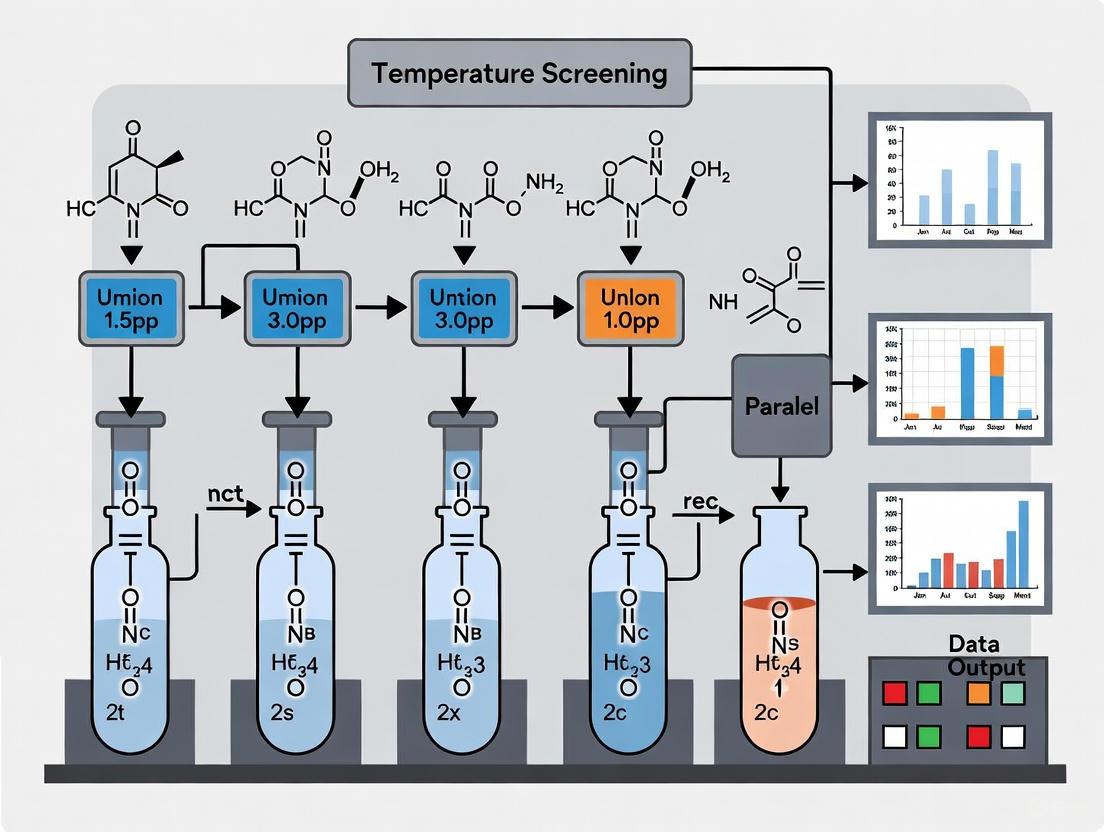
This article provides a comprehensive overview of high-throughput temperature screening within parallel reactor systems, a critical methodology for researchers and drug development professionals.
High-Throughput Temperature Screening in Parallel Reactors: A Foundational Guide for Accelerated Reaction Optimization
Abstract
This article provides a comprehensive overview of high-throughput temperature screening within parallel reactor systems, a critical methodology for researchers and drug development professionals. It covers the foundational principles of High-Throughput Experimentation (HTE) and the pivotal role of temperature control in reaction outcomes. The scope extends to practical methodologies, including the integration of automation and machine learning for experimental design, a detailed analysis of common temperature control challenges and their solutions, and finally, frameworks for the validation and comparative analysis of screening data to ensure robust and scalable process development.
The Principles and Critical Role of Temperature in High-Throughput Experimentation
High-Throughput Screening (HTS) and its evolution into Quantitative High-Throughput Screening (qHTS) represent a paradigm shift in chemical and biological research, enabling the rapid evaluation of thousands of compounds or reaction conditions in parallel. Traditional HTS methodologies, adapted from biological screening approaches, initially focused on testing compounds at a single concentration to identify hits based on activity thresholds [1] [2]. However, this approach suffered from significant limitations, including frequent false positives and false negatives, necessitating extensive follow-up testing [1]. The field has since progressed to qHTS, which generates complete concentration-response curves for every compound tested, providing rich datasets that enable immediate identification of reliable biological activities and structure-activity relationships directly from primary screens [1].
The technological advancement of HTS has been complemented by the development of High-Throughput Experimentation (HTE) in organic chemistry, which utilizes miniaturized and parallelized reactions to accelerate diverse compound library generation, optimize reaction conditions, and enable data collection for machine learning applications [2]. Modern HTE platforms, leveraging automation and sophisticated data analysis tools, have transformed reaction optimization from a resource-intensive process relying on chemical intuition and one-factor-at-a-time approaches to an efficient, data-driven exploration of chemical space [3]. This convergence of methodologies has created a powerful framework for comprehensive chemical genomics and accelerated drug discovery.
Key Principles and Technological Foundations
From Traditional HTS to Quantitative HTS
Traditional HTS operates by testing each compound in a library at a single concentration, classifying compounds as "active" or "inactive" based on whether their response exceeds a predefined threshold [1]. While this approach enabled the screening of large compound collections, it proved inadequate for comprehensively profiling biological activities due to its inability to detect partial agonism/antagonism and its susceptibility to false classifications from minor variations in sample preparation or assay conditions [1].
Quantitative HTS addresses these limitations through a titration-based approach where each compound is tested at multiple concentrations (typically seven or more), generating concentration-response curves that provide detailed pharmacological profiles [1] [4]. This methodology enables precise classification of compounds based on curve characteristics, including potency (AC50), efficacy, and response quality [1]. The implementation of qHTS with 60,000+ compounds demonstrated remarkable precision, with control compounds showing consistent response curves and statistical quality measures (Z' factor) averaging 0.87 throughout the screen [1].
Core Principles of Parallel Reactors
Parallel reactors enable high-throughput screening by allowing multiple reactions to proceed simultaneously under controlled conditions. The fundamental principles include:
- Miniaturization: Reactions are conducted at micro- to nanomole scales in multi-well plates (96, 384, or 1536 wells) or parallel reaction stations, significantly reducing reagent consumption and costs [2] [5].
- Parallelization: Multiple experiments proceed simultaneously rather than sequentially, dramatically increasing throughput [2].
- Environmental Control: Precise regulation of temperature, irradiation, and atmospheric conditions across all reaction vessels ensures reproducibility [5] [6].
- Automation: Robotic systems handle liquid dispensing, plate handling, and other repetitive tasks, improving precision and efficiency [2] [3].
Advanced parallel photoreactors have been developed specifically for photochemical applications, incorporating features such as high-intensity LED arrays with even photon distribution, safety interlocks, and active cooling systems to manage heat generated by irradiation [5] [6]. These systems enable systematic investigation of the complex interplay between parameters such as light intensity, catalyst loading, and reaction stoichiometry on nanomole scales [5].
Experimental Design and Workflow
Quantitative HTS Protocol for Enzyme Modulation Screening
The following protocol outlines a qHTS approach for identifying enzyme modulators, adapted from a pyruvate kinase screening campaign [1]:
Materials and Reagents:
- Compound library prepared as titration series (7 concentrations, 5-fold dilutions)
- Assay components: enzyme, substrates, coupling enzymes, detection reagents
- 1,536-well plates
- Liquid handling systems (pin tool or dispenser)
- Detection instrument (luminescence plate reader)
Procedure:
- Plate Preparation: Prepare compound titration plates with concentrations ranging from nM to μM concentrations. For a typical 7-point titration with 5-fold dilution, concentrations may range from 3.7 nM to 57 μM after transfer to assay plates [1].
Assay Assembly:
- Dispense 4 μL assay buffer to each well of 1,536-well plates
- Transfer compounds via pin tool (~23 nL)
- Initiate reaction by adding enzyme/substrate mixture
- Incubate under appropriate conditions (time, temperature)
Signal Detection: Measure endpoint or kinetic signals using appropriate detection method (e.g., luminescence for ATP-coupled assays)
Data Analysis:
- Normalize data to controls (positive/negative)
- Fit concentration-response curves using four-parameter Hill equation
- Classify curves based on quality (r²), efficacy, and asymptotes
- Calculate AC50 values for active compounds
Controls and Quality Assessment:
- Include control activators and inhibitors on every plate (e.g., ribose-5-phosphate as activator, luteolin as inhibitor for pyruvate kinase)
- Monitor assay performance using statistical parameters (Z' factor >0.5 acceptable, >0.7 excellent)
- Evaluate reproducibility through replicate measurements
Color-Mixing Strategy for Variant Detection
For genetic variant detection, a color-mixing strategy using toehold probes enables highly multiplexed analysis in a single reaction [7]:
Materials and Reagents:
- Asymmetric PCR primers
- Multiplex double-stranded toehold probes (fluorophore and quencher modified)
- DNA template
- iTaq Universal Probes Supermix or equivalent
- Thermal cycler with fluorescence detection capability
Procedure:
- Reaction Assembly:
- Prepare 30 μL reactions containing asymmetric primers, toehold probes, DNA template, and master mix [7]
- Utilize four fluorescence channels (ROX, CY5, FAM, HEX) with distinct emission spectra
Thermal Cycling:
- Initial denaturation: 95°C for 3 minutes
- 50 cycles of: 95°C for 30 seconds (denaturation), 64°C for 30 seconds (annealing), 72°C for 30 seconds to 2 minutes (extension, dependent on amplicon length)
- Measure background fluorescence during first 8 cycles
Probe Hybridization:
- Heat to 95°C for 5 minutes to dissociate double strands
- Cool to 40°C for probe binding
- Measure fluorescence at 40°C for 20 cycles
Data Analysis:
- Calculate final signals as raw signals minus background for each channel
- Assign color codes based on fluorescence patterns (on/off states)
- Identify variants based on specific color code combinations
Toehold Probe Design Considerations:
- Design protector and complementary strands with appropriate toehold, branch migration, and nonhomologous regions
- Calculate standard free energy of binding to ensure discrimination between variant and wild-type sequences
- Incorporate C3 spacer at 3' end of complementary strand to prevent polymerase extension
Diagram 1: Generalized qHTS workflow showing key stages from compound preparation to hit identification.
Equipment and Material Specifications
Quantitative HTS and Parallel Reactor Systems
Table 1: Comparison of High-Throughput Screening and Reaction Systems
| System Type | Throughput Capacity | Key Features | Applications | References |
|---|---|---|---|---|
| Quantitative HTS Platform | 60,000+ compounds in 30 hours | 1,536-well format, 7+ concentration titration, automated data analysis | Enzyme modulation screening, toxicological assessment, chemical genomics | [1] [4] |
| High-Intensity Parallel Photoreactor | 1,536 reactions in parallel | High photon flux, uniform illumination, efficient heat removal, temperature control | Photochemical reaction screening, reaction optimization | [5] |
| Illumin8 Parallel Photoreactor | 8 reactions simultaneously | Interchangeable LED modules (365-660 nm), magnetic stirring, heating to 80°C, safety interlocks | Benchtop photochemistry screening, method development | [6] |
| Machine Learning-Driven HTE | 96-well batch optimization | Bayesian optimization, multi-objective acquisition functions, automated experimentation | Reaction optimization, process chemistry, API synthesis | [3] |
Essential Research Reagent Solutions
Table 2: Key Reagents and Materials for High-Throughput Screening
| Reagent/Material | Function | Application Notes | References |
|---|---|---|---|
| Toehold Probes | Sequence-specific variant detection | Fluorophore-quencher modified, designed with toehold and branch migration regions for discrimination | [7] |
| Titrated Compound Libraries | Concentration-response testing | Typically 7 concentrations with 5-fold dilutions, covering 4 orders of magnitude | [1] |
| iTaq Universal Probes Supermix | qPCR reaction component | Provides enzymes, dNTPs, buffers for probe-based detection methods | [7] |
| Luminescence Detection Reagents | ATP-coupled assay detection | Enables detection of kinase activity through coupled luciferase reaction | [1] |
| Asymmetric PCR Primers | Preferential strand amplification | Enriches one strand for subsequent probe hybridization | [7] |
Data Analysis and Quality Control
Concentration-Response Curve Classification
In qHTS, concentration-response curves are systematically classified based on quality and characteristics [1]:
Class 1 Curves (Complete Response)
- Class 1a: Well fit (r² ≥ 0.9), full response (efficacy >80%), upper and lower asymptotes
- Class 1b: Same as 1a but with shallow curve (efficacy 30-80%)
Class 2 Curves (Incomplete Response)
- Class 2a: Good fit (r² ≥ 0.9), sufficient response (>80% efficacy) to calculate inflection point
- Class 2b: Weaker response (efficacy <80%, r² < 0.9)
Class 3 Curves (Marginally Active)
- Activity only at highest concentration tested with efficacy >30%
Class 4 Curves (Inactive)
- Insufficient response (efficacy <30%) or no activity
This classification system enables rapid prioritization of compounds for follow-up studies and facilitates structure-activity relationship analysis directly from primary screening data [1].
Quality Control Procedures
Robust quality control is essential for reliable qHTS data interpretation. The CASANOVA (Cluster Analysis by Subgroups using ANOVA) method provides automated quality control by identifying and filtering out compounds with multiple cluster response patterns [4]. This approach addresses the challenge of potency estimate variability that can arise from experimental factors such as chemical supplier, institutional site preparing chemical libraries, concentration-spacing, and compound purity [4].
Statistical measures for assay quality assessment include:
- Z' Factor: Measures separation between positive and negative controls (values >0.5 indicate acceptable assays, >0.7 indicate excellent assays) [1]
- Signal-to-Background Ratio: Should be sufficient for reliable detection (e.g., 9.6 as reported in pyruvate kinase screen) [1]
- Minimum Significance Ratio (MSR): Evaluates reproducibility of control compounds (e.g., 1.2-1.7 for control activators/inhibitors) [1]
Diagram 2: Data analysis workflow for qHTS, showing progression from raw data to hit selection with quality control checkpoints.
Advanced Applications and Integration with Machine Learning
The integration of machine learning with HTE has created powerful frameworks for reaction optimization and discovery. The Minerva system exemplifies this approach, combining Bayesian optimization with automated HTE to efficiently navigate complex reaction spaces [3]. This system addresses key challenges in chemical optimization, including:
- High-Dimensional Search Spaces: Handling up to 530 dimensions representing various reaction parameters
- Multi-Objective Optimization: Simultaneously optimizing yield, selectivity, cost, and other parameters
- Batch Constraints: Accommodating laboratory practicalities and experimental design limitations
- Chemical Noise: Maintaining robust performance despite experimental variability
In pharmaceutical process development, ML-driven HTE has demonstrated significant advantages over traditional approaches. For a challenging nickel-catalyzed Suzuki reaction exploring 88,000 possible conditions, the ML approach identified conditions with 76% yield and 92% selectivity, whereas chemist-designed HTE plates failed to find successful conditions [3]. Similarly, for active pharmaceutical ingredient synthesis, ML-guided optimization identified conditions achieving >95% yield and selectivity in significantly reduced timelines compared to traditional development campaigns [3].
The implementation of scalable multi-objective acquisition functions (q-NParEgo, TS-HVI, q-NEHVI) enables efficient optimization with batch sizes compatible with standard HTE workflows (24, 48, or 96 wells) [3]. Performance evaluation using the hypervolume metric, which quantifies the volume of objective space enclosed by selected reaction conditions, demonstrates the effectiveness of these approaches in rapidly identifying optimal regions of chemical space [3].
Troubleshooting and Technical Considerations
Common Challenges and Solutions
Spatial Bias in Microtiter Plates
- Problem: Edge effects causing uneven temperature distribution or evaporation
- Solution: Randomize sample placement, use control wells distributed across plates, implement plate mapping corrections [2]
Compound Library Quality
- Problem: Inconsistent results from sample preparation variations or compound degradation
- Solution: Implement quality control checks, purchase compounds from reliable suppliers, use fresh solutions [1] [4]
Photochemical Reaction Consistency
- Problem: Uneven light irradiation in parallel photoreactors
- Solution: Use reactors with uniform photon distribution, incorporate light-sensitive controls, calibrate light sources regularly [5] [6]
Data Quality and Reproducibility
- Problem: Inconsistent response patterns across experimental repeats
- Solution: Implement rigorous quality control procedures like CASANOVA, standardize protocols, account for experimental factors in statistical models [4]
Future Directions and Emerging Trends
The field of high-throughput screening continues to evolve with several promising directions:
- Ultra-HTE: Scaling to 1536 reactions simultaneously for even greater throughput [2]
- AI Integration: Enhanced machine learning algorithms for experimental design and data analysis [2] [3]
- Standardized Data Formats: Adoption of formats like Simple User-Friendly Reaction Format (SURF) for improved data sharing and reproducibility [3]
- Perceptual Contrast Algorithms: Development of advanced analytical methods like APCA (Accessible Perceptual Contrast Algorithm) for improved data visualization and interpretation [8]
- Democratization of HTE: Development of more accessible platforms and protocols for broader adoption in academic and small laboratory settings [2]
These advancements promise to further accelerate discovery timelines, enhance reproducibility, and expand the application of high-throughput methodologies across chemical and biological research domains.
In high-throughput experimentation (HTE) for chemical synthesis and process development, temperature is a fundamental parameter that exerts direct and profound influence over the reaction kinetics, selectivity, and ultimate yield. Unlike traditional one-factor-at-a-time optimization, modern HTE approaches, often enhanced by machine learning, enable the systematic exploration of temperature alongside other critical variables in highly parallelized systems [3] [9]. This allows researchers to rapidly map complex reaction landscapes and identify optimal conditions that satisfy multiple objectives simultaneously.
The integration of flow chemistry with HTE is particularly powerful for temperature screening, as it allows for precise dynamic control of temperature and access to conditions far beyond the boiling point of solvents at atmospheric pressure [9]. Understanding and controlling temperature is therefore not merely a practical necessity but a strategic tool for accelerating the discovery and development of robust chemical processes, especially in demanding fields like pharmaceutical development [3]. These application notes detail the core principles, quantitative data, and practical protocols for implementing high-throughput temperature screening.
Core Principles: Temperature's Role in Reaction Outcomes
Reaction Kinetics and the Arrhenius Law
The rate of a chemical reaction is intrinsically linked to temperature, a relationship classically described by the Arrhenius equation: [ k = A \exp\left(-Ea / RT\right) ] where (k) is the rate constant, (A) is the pre-exponential factor, (Ea) is the activation energy, (R) is the gas constant, and (T) is the absolute temperature in Kelvin. A modest increase in temperature can lead to a dramatic increase in the reaction rate, effectively reducing reaction times from hours to minutes.
Table 1: Experimentally Determined Arrhenius Parameters for Selected Reactions
| Reaction System | Temperature Range (K) | Arrhenius Expression | Application Context | Citation |
|---|---|---|---|---|
| Prenol + OH radical | 273 - 353 | ( k = (1.43 \pm 0.28) \times 10^{-11} \times \exp\left(\frac{691 \pm 59}{T}\right) ) | Atmospheric chemistry, biofuel oxidation | [10] |
| Prenol + OH radical (Extended) | 273 - 1290 | ( k = 1.46 \times 10^{-10} \times \left(\frac{T}{300}\right)^{-2.18} + 1.14 \times 10^{-10} \times \exp\left(-\frac{2961}{T}\right) ) | Combustion & atmospheric conditions | [10] |
| Mn²⁺ + Hydrated Electron (eₐq⁻) | 274 - 333 | Rate constant at 25°C: ( 2.4 \times 10^7 \, \text{M}^{-1}\text{s}^{-1} ); Follows Arrhenius behavior | Radiation chemistry, reactor coolant systems | [11] |
Selectivity and Yield
Temperature can differentially affect the activation energies of competing parallel or consecutive reactions, making it a powerful handle for controlling regioselectivity and stereoselectivity. An increase in temperature may favor the thermodynamically controlled product, while lower temperatures often favor the kinetically controlled product. In complex reactions, such as catalytic cross-couplings, temperature optimization is essential for suppressing side reactions and maximizing the yield of the desired product [3]. In one case study, a machine-learning-driven HTE campaign for a nickel-catalyzed Suzuki reaction successfully identified conditions that achieved a 76% area percent yield and 92% selectivity, a result that eluded traditional experimentalist-driven approaches [3].
High-Throughput Workflow for Temperature Screening
The following diagram illustrates a generalized, automated workflow for a high-throughput reaction optimization campaign that integrates temperature as a key variable, leveraging machine intelligence for experimental design.
Experimental Protocols
Protocol: High-Throughput Temperature Screening in Parallel Batch Reactors
This protocol is adapted from methodologies used in machine-learning-guided HTE campaigns for reaction optimization [3].
Objective: To systematically investigate the effect of temperature on the yield and selectivity of a model Ni-catalyzed Suzuki coupling reaction in a 96-well plate format.
Research Reagent Solutions:
- Catalyst Stock Solution: NiCl₂·glyme (0.1 M in anhydrous DMF)
- Ligand Stock Solution: 1,1'-Ferrocenediyl-bis(tert-butylphosphine) (0.2 M in anhydrous DMF)
- Base Stock Solution: Cs₂CO₃ (1.0 M in H₂O)
- Substrate Solutions: Aryl halide (1.0 M in DMF) and Boronic acid (1.0 M in DMF)
- Solvent: Anhydrous DMF
Procedure:
- Experimental Design: Use a Sobol sampling algorithm or a predefined temperature gradient to assign a specific temperature (e.g., 30°C, 50°C, 70°C, 90°C, 110°C) to each well or group of wells on a 96-well plate [3].
- Liquid Handling: Using an automated liquid handler, dispense into each well:
- 100 µL of DMF.
- 20 µL of Catalyst Stock Solution.
- 25 µL of Ligand Stock Solution.
- 50 µL of Aryl halide Solution.
- 50 µL of Boronic acid Solution.
- 50 µL of Base Stock Solution.
- Final volume: 295 µL.
- Sealing and Mixing: Seal the plate with a pressure-sensitive adhesive film and mix thoroughly on an orbital shaker for 1 minute.
- Parallel Reaction Execution: Place the plate in a thermostated agitating incubator or an HTE system with integrated thermal control. Run the reactions for the predetermined time (e.g., 6 hours).
- Quenching and Analysis: After the reaction time:
- Automatically quench reactions by adding 300 µL of a 1:1 MeOH/H₂O mixture.
- Centrifuge the plate to sediment any particulates.
- Analyze the supernatant directly via UPLC-MS or HPLC to determine conversion and selectivity using a calibrated internal standard.
Protocol: Investigating Temperature-Dependent Kinetics via Pulse Radiolysis
This protocol is based on studies of temperature-dependent reactions in aqueous systems, such as those between Mn²⁺ and water radiolysis products [11].
Objective: To determine the rate constant and Arrhenius parameters for the reaction between a metal ion (e.g., Mn²⁺) and the hydroxyl radical (•OH) over a temperature range of 1°C to 60°C.
Research Reagent Solutions:
- Analyte Solution: Mn(ClO₄)₂ hydrate (0.1 - 10 mM) in ultrapure water (18 MΩ·cm).
- Scavenger Gas: High-purity N₂O gas for saturating solutions to convert hydrated electrons into additional •OH radicals.
- Dosimetry Solution: 10 mM KSCN in N₂O-saturated water.
Procedure:
- Solution Preparation: Prepare a stock solution of the manganese salt in ultrapure water. Adjust the pH to the desired value (e.g., pH 5) using a non-interfering acid or base.
- Gas Saturation: Saturate the analyte solution with N₂O gas for at least 20 minutes prior to irradiation to remove dissolved oxygen and ensure complete conversion of ( e_{aq}^- ) to •OH.
- Temperature Equilibration: Load the solution into a flow-through quartz optical cell (1.0 cm pathlength) connected to the pulse radiolysis system. Use a thermoelectric cuvette holder to equilibrate the solution to the target temperature (e.g., 1°C, 25°C, 40°C, 60°C).
- Pulse Irradiation and Detection: Irradiate the solution with a short, high-energy electron pulse (e.g., 10 ns, 24.8 Gy). Monitor the formation and decay of transient species in real-time using a spectroscopic detection system, recording full transient absorption spectra or kinetics at a specific wavelength (e.g., 290 nm for H atom reaction) [11].
- Data Fitting: Fit the kinetic traces to exponential functions to obtain pseudo-first-order rate constants ((k')). Plot (k') against the Mn²⁺ concentration to determine the second-order rate constant ((k)) at each temperature.
- Arrhenius Analysis: Plot ( \ln(k) ) versus ( 1/T ) for the measured rate constants. The slope of the linear fit is ( -E_a/R ), and the intercept is ( \ln(A) ).
The Scientist's Toolkit
Table 2: Essential Reagents and Equipment for High-Throughput Temperature Screening
| Category | Item | Function & Application Notes |
|---|---|---|
| Reactor Systems | Automated Parallel Batch Reactors (e.g., 96-well) | Enables highly parallel reaction execution with independent thermal and mixing control for screening [3]. |
| Flow Chemistry Reactor Module | Provides precise temperature control and access to superheated conditions by pressurizing the system [9]. | |
| Pulse Radiolysis System | Allows direct measurement of reaction kinetics with short-lived species at varied temperatures [11]. | |
| Temperature Control | Thermostated Agitating Incubator | Provides stable, uniform heating for microtiter plates. |
| Peltier-Based Cuvette Holder | Enables rapid and precise temperature control for cuvette-based kinetics studies [11]. | |
| Analytical & Enabling Tech | Automated Liquid Handling Robot | Ensures precision and reproducibility in reagent dispensing for HTE [3]. |
| UPLC-MS / HPLC | Provides high-throughput, automated analysis for yield and selectivity determination. | |
| Machine Learning Platform (e.g., Minerva) | Guides experimental design by selecting promising reaction conditions (incl. temperature) for subsequent batches [3]. |
Data Analysis and Visualization
The relationship between temperature, kinetics, and final reaction outcomes can be visualized as a multi-parameter optimization landscape. The following diagram outlines the logical connections and decision points in this process.
Parallel reactor systems are specialized laboratory apparatuses designed to conduct multiple chemical or biological reactions simultaneously under controlled conditions. Unlike traditional single-reactor setups, these stations feature multiple independent reaction chambers, allowing researchers to rapidly screen reaction parameters such as temperature, pressure, stirring speed, and reaction time across different channels [12]. This capability significantly accelerates process development timelines across pharmaceuticals, specialty chemicals, and materials science by enabling high-throughput experimentation (HTE) [9]. The fundamental principle behind parallel reactor systems is the miniaturization and parallelization of reaction vessels, creating high-throughput laboratories that can generate extensive experimental data while consuming minimal resources [13] [14].
These systems have evolved from simple well-plate approaches to sophisticated integrated platforms featuring advanced control systems, real-time monitoring, and automation capabilities [12]. The growing demand for efficient and scalable reaction testing has made these systems essential in research laboratories focused on innovation and product development, particularly where optimizing yield, selectivity, and process safety are critical [15]. This document outlines common configurations, experimental protocols, and applications of parallel reactor systems within the context of high-throughput temperature screening for chemical and bioprocess development.
Common System Configurations and Their Characteristics
Parallel reactor systems are categorized based on their operational principles, scale, and design characteristics. The configuration selection depends on specific research needs, including the reaction type, parameters of interest, and required throughput.
Table 1: Classification and Characteristics of Parallel Reactor Systems
| Reactor Type | Scale/Volume | Key Features | Control Capabilities | Typical Applications |
|---|---|---|---|---|
| Shaken Bioreactors (Shake flask, Microtiter plates) [13] | ~300 μL to ~100 mL [9] [13] | Simple operation, high parallelization (96-384 wells) | Limited control over continuous variables; temperature often uniform per plate [9] [14] | Initial screening, cell culture studies, bioprocess development [13] |
| Stirred-Tank Reactors (Stirred-tank, Stirred column) [13] | ~mL to ~100 mL [13] | Individual stirring for each vessel, improved heat/mass transfer | Individual pH and dissolved oxygen (pO2) control, fed-batch operation [13] | Microbial fed-batch processes, reaction optimization where mixing is critical [13] |
| Sparged Bioreactors (Small-scale bubble column) [13] | ~mL to ~100 mL [13] | Gas introduction via sparging, no moving parts | Control of gas flow rate and composition | Gas-liquid reactions, aerobic fermentations [13] |
| Droplet-Based Microfluidic Reactors [14] | Nanoliter to Microliter scale [14] | Fluoropolymer tubing, stationary or oscillatory droplets, high surface-to-volume ratio | Totally independent conditions per channel, pressure (up to 20 atm), temperature (0-200°C) [14] | High-fidelity reaction screening, kinetic studies, thermal and photochemical transformations [14] |
| Flow Chemistry Reactors [9] | Continuous flow in narrow tubing | Enhanced heat/mass transfer, safe use of hazardous reagents, pressurization | Precise control of residence time, temperature, and pressure; wide process windows [9] | Photochemistry, electrochemistry, process intensification, scale-up studies [9] |
Table 2: Quantitative Performance Metrics of Advanced Parallel Reactor Systems
| Performance Parameter | Droplet-Based Microfluidic Platform [14] | Advanced Stirred Bioreactor Systems [13] | Automated Flow Chemistry HTE [3] |
|---|---|---|---|
| Throughput (Number of Parallel Reactors) | 10 independent channels | 48 stirred-tank reactors | 96-well plate format |
| Temperature Range | 0 °C to 200 °C (solvent-dependent) | Not specified | Not specified |
| Pressure Range | Up to 20 atm | Not specified | Accessible via pressurization |
| Reproducibility | <5% standard deviation | Not specified | Outperforms traditional methods |
| Reaction Scale | Nanoliter to Microliter scale | Milliliter scale | ~300 μL per well |
| Key Technological Integrations | On-line HPLC, Bayesian optimization, scheduling algorithm | Individual pH- and pO2-controls, automation, liquid handling | Machine learning (Minerva), robotic fluid handling, multi-objective optimization |
Configuration Workflow Diagram
The following diagram illustrates the general workflow for selecting and implementing a parallel reactor system for high-throughput temperature screening:
Experimental Protocols for High-Throughput Temperature Screening
Protocol: Automated Multi-Objective Reaction Optimization Using Machine Learning
This protocol details the use of a machine learning-driven workflow for reaction optimization with parallel reactors, capable of handling large experimental batches and high-dimensional search spaces [3].
1. Pre-Experimental Planning
- Define Reaction Objectives: Clearly specify primary and secondary optimization targets (e.g., yield, selectivity, cost, safety) [3].
- Delineate Reaction Condition Space: Compile a discrete combinatorial set of plausible reaction conditions including catalysts, ligands, solvents, and additives. Apply chemical knowledge filters to exclude impractical combinations (e.g., temperatures exceeding solvent boiling points, unsafe reagent combinations) [3].
- Select Platform and Scale: Choose an appropriate parallel reactor system (e.g., 96-well HTE platform or droplet-based microreactors) based on throughput needs and parameter control requirements [3] [14].
2. Initial Experimental Setup
- Algorithmic Initial Sampling: Employ quasi-random Sobol sampling to select the initial batch of experiments. This approach maximizes coverage of the reaction space, increasing the likelihood of discovering regions containing optimal conditions [3].
- Plate Preparation: Utilize automated liquid handlers to prepare reaction mixtures according to the initial experimental design in 96-well plates or microfluidic reactor channels [3] [14].
- Reactor Parameter Programming: Program individual reactor vessels with assigned temperatures, pressures, and other continuous variables as per the experimental design.
3. Iterative Optimization Cycle
- Execute Reactions: Run parallel reactions under specified conditions with precise temperature control.
- Analyze Outcomes: Employ inline, online, or offline analytical techniques (e.g., HPLC, UPLC, GC) to quantify reaction outcomes [14].
- Train Machine Learning Model: Using acquired experimental data, train a Gaussian Process (GP) regressor to predict reaction outcomes and their uncertainties for all possible conditions in the predefined space [3].
- Select Next Experiment Batch: Apply a multi-objective acquisition function (e.g., q-NParEgo, TS-HVI, q-NEHVI) to identify the most promising next batch of experiments, balancing exploration of uncertain regions with exploitation of known promising conditions [3].
- Repeat: Conduct additional optimization cycles until convergence, performance stagnation, or exhaustion of the experimental budget.
4. Data Analysis and Validation
- Identify Optimal Conditions: Select reaction conditions that best meet all objectives from the Pareto front of non-dominated solutions.
- Laboratory Validation: Confirm performance of identified optimal conditions in traditional laboratory glassware to verify transferability.
- Scale-Up Studies: Translate optimized conditions to larger scales using flow chemistry or traditional batch reactors [9].
Protocol: High-Throughput Temperature Screening for Photochemical Reactions
This protocol specifically addresses temperature screening for photochemical applications using parallel flow reactor systems [9].
1. System Configuration
- Reactor Selection: Configure a parallel droplet-based microfluidic platform or a continuous flow system with integrated photoirradiation capabilities [14] [9].
- Light Source Integration: Install and calibrate LED arrays or other controlled light sources with appropriate wavelengths for the photocatalytic system.
- Temperature Control Module: Implement precise temperature control for individual reactor channels using Peltier elements or circulating baths, ensuring each channel can maintain independent set points.
2. Experimental Execution
- Reagent Preparation: Prepare stock solutions of substrates, photocatalysts, and other reagents in appropriate solvents.
- Droplet/Flow Path Setup: For microfluidic systems, generate discrete reaction droplets separated by an immiscible carrier fluid. For continuous flow, establish stable flow rates through photoreactor channels [14].
- Parallel Reaction Execution: Simultaneously expose reactions across multiple channels to controlled light irradiation while maintaining individual temperature set points.
- Residence Time Control: Precisely control reaction times through flow rate adjustment (continuous flow) or droplet stationing times (microfluidic systems).
3. Analysis and Optimization
- Inline Analysis: Utilize integrated analytical systems (e.g., on-line HPLC with automated injection valves) for real-time reaction monitoring [14].
- Data Correlation: Correlate reaction outcomes (conversion, selectivity) with temperature profiles across all parallel channels.
- Temperature Optima Identification: Identify temperature conditions that maximize desired outcomes while minimizing decomposition or side reactions.
The Scientist's Toolkit: Essential Research Reagent Solutions
Successful implementation of parallel reactor screening requires carefully selected reagents and materials compatible with miniaturized, automated formats.
Table 3: Essential Research Reagents and Materials for Parallel Reaction Screening
| Reagent/Material Category | Specific Examples | Function in Parallel Screening | Compatibility Notes |
|---|---|---|---|
| Catalysts | Nickel catalysts [3], Palladium catalysts [3], Flavin photocatalysts [9] | Facilitate chemical transformations; non-precious metal alternatives (e.g., Ni) offer cost and sustainability advantages [3] | Compatibility with microfluidics; homogeneous catalysts preferred to avoid clogging [9] |
| Ligands | Diverse phosphine ligands, N-heterocyclic carbenes | Modulate catalyst activity and selectivity; key categorical variable in optimization [3] | Solubility in selected solvent systems crucial for performance |
| Solvents | Dimethylformamide (DMF), Acetonitrile, Tetrahydrofuran (THF), Toluene | Medium for reaction; significantly influences outcome; categorical screening variable [3] | Must be compatible with reactor materials (e.g., fluoropolymer tubing [14]); volatility considerations for open-well systems |
| Additives | Bases (e.g., carbonates, phosphates), Acids, Salts | Modify reaction environment; affect kinetics and selectivity [3] | Screening various bases identified optimal conditions in photoredox fluorodecarboxylation [9] |
| Analytical Standards | Internal standards for HPLC/GC, Calibration solutions | Enable accurate quantification of reaction outcomes [14] | Must be stable and compatible with automated sampling systems |
| Solid Handling Aids | Glass microvials [14], Solid-dispensing robots [3] | Enable accurate dispensing of small quantities of solids for library synthesis | Essential for preparing diverse reaction conditions in 96/384-well formats |
Workflow Integration Diagram
The following diagram illustrates the integrated workflow combining parallel reactor systems with machine intelligence for automated optimization:
Fundamentals of Heat Transfer and Temperature Uniformity in Miniaturized Reactors
The adoption of miniaturized reactors, including micro- and milli-reactors, has become transformative for high-throughput temperature screening in pharmaceutical and fine chemical research. These systems enable researchers to perform rapid, parallelized experimentation under tightly controlled conditions, dramatically accelerating reaction optimization and catalyst development [16]. The core principle enabling this advancement is the superior heat transfer characteristics inherent at reduced scales, which provide enhanced temperature uniformity and control compared to traditional batch reactors. This application note details the fundamental heat transfer principles, experimental protocols, and practical implementation strategies essential for leveraging miniaturized reactor technology effectively within high-throughput parallel reactor research environments.
Within the context of a broader thesis on high-throughput screening, mastering these fundamentals is critical for generating reproducible, scalable, and kinetically meaningful data. The ability to maintain precise and uniform temperature across multiple parallel reactors directly impacts critical process parameters such as reaction rate, selectivity, product yield, and ultimately, the reliability of the data used for scale-up decisions [17] [14]. This document provides a structured framework for understanding and applying these principles in practice.
Technical Background
Heat Transfer Fundamentals in Miniaturized Systems
The exceptional heat transfer performance in miniaturized reactors stems from their high surface-area-to-volume ratio. As reactor dimensions decrease, this ratio increases significantly, bringing a greater proportion of the reaction volume into close proximity with the heat transfer surface. This geometry fundamentally enhances heat dissipation and acquisition, minimizing internal temperature gradients and enabling rapid thermal equilibration [16]. This characteristic is particularly vital for exothermic reactions, where it prevents the formation of hot spots that can lead to side reactions, safety hazards, and inaccurate kinetic data.
Effective heat transfer management is a prerequisite for achieving the key technical indicators in reactor design: power-flow ratio, limit quality (resistance to flow instability), and critical heat flux (CHF) [17]. In single-phase flow, which is dominant in many continuous-flow applications, heat transfer is improved by promoting turbulence and continuous disturbance of the thermal boundary layer. In two-phase boiling flow, the objectives shift to suppressing vapor aggregation to delay DNB-type boiling crisis and promoting rewetting of the heating surface to enhance CHF [17].
Strategies for Temperature Uniformity in Parallel Systems
In parallel reactor configurations, ensuring temperature uniformity across individual reactor units is as important as maintaining it within a single unit. Inconsistencies can invalidate comparative screening results. Two primary engineering approaches address this:
- Passive Heat Transfer Enhancement: This involves design modifications to the reactor structure itself. Technologies include micro-channel designs and longitudinal vortex generators, which increase the specific surface area, enhance turbulent mixing, and disturb the near-wall thermal boundary layer [17]. These technologies are mature and widely applicable.
- Active Heat Transfer Enhancement: This involves external intervention, such as the application of magnetic or electric fields to influence coolant properties and flow fields. While effective for both single- and two-phase heat transfer, these technologies are predominantly in the research phase and lack broad engineering application [17].
For parallel systems, a common challenge is maintaining precise gas feed distribution when catalyst bed pressure drops vary between reactors. Individual Reactor Pressure Control (RPC) technology solves this by actively controlling the pressure at each reactor's outlet to ensure equal inlet pressures, thereby guaranteeing identical feed distribution and preserving reaction condition integrity across the entire bank [18].
The following tables consolidate key performance metrics and design parameters for miniaturized reactor systems, providing a reference for experimental planning and system selection.
Table 1: Performance Characteristics of Miniaturized Reactor Systems
| Parameter | Droplet-Based Platform [14] | Parallel Reactor System (e.g., PolyBLOCK) [19] | High-Pressure Screening System (e.g., PolyCAT) [20] |
|---|---|---|---|
| Reactor Channels | 10 independent parallel channels | 4 or 8 independent zones | 8 independent reactors |
| Typical Volume | Microliter to nanoliter scale (droplets) | Up to 500 mL (PB4) or 120 mL (PB8) | 16 mL (standard), up to 50 mL |
| Temperature Range | 0 °C to 200 °C (solvent dependent) | -40 °C to +200 °C | Ambient to 250 °C (with options down to -40 °C) |
| Pressure Range | Up to 20 atm | Not specified | Up to 200 bar |
| Key Feature | Online HPLC analysis; Bayesian optimization | Small footprint; flexible vessel options | Individual pressure control up to 200 bar |
Table 2: Heat Transfer Enhancement Technologies & Performance [17]
| Technology | Classification | Mechanism of Action | Primary Application | Maturity |
|---|---|---|---|---|
| Micro-channel / Structure Innovation | Passive | Increases surface-area-to-volume ratio; disturbs thermal boundary layer. | Single-phase & two-phase conditions; reactor core & heat exchangers. | High |
| Surface Micro-/Nano-structuring | Passive | Affects bubble dynamics and two-phase interface evolution. | Boiling / two-phase heat transfer. | Medium |
| Longitudinal Vortex Generators | Passive | Enhances turbulent mixing of the flow field. | Single-phase & two-phase conditions. | High |
| Magnetic/Electric Fields | Active | Alters coolant physical properties and flow field via external fields. | Single-phase & two-phase conditions (laboratory scale). | Low (R&D) |
Experimental Protocols
Protocol: Validating Temperature Uniformity Across a Parallel Reactor Block
This protocol is designed to verify and ensure temperature consistency across all zones of a parallel reactor system before commencing critical high-throughput screening campaigns.
The Scientist's Toolkit: Essential Materials for Temperature Uniformity Validation
| Item | Function | Example/Notes |
|---|---|---|
| Parallel Reactor System | Provides the multi-zone testing platform. | e.g., PolyBLOCK 4 or 8 [19]. |
| Calibrated Thermocouples | Accurate temperature measurement in each reactor vessel. | Ensure calibration is current. |
| Reference Fluid | A thermally stable fluid with known properties. | e.g., Silicone oil or a standard solvent. |
| Data Logging Software | Records temperature from all zones simultaneously. | e.g., labCONSOL or equivalent [20]. |
Methodology:
- System Setup: Install identical reaction vessels in all zones of the parallel reactor system (e.g., PolyBLOCK). Fill each vessel with the same volume of a reference fluid with known heat capacity.
- Sensor Calibration and Placement: Place pre-calibrated thermocouples in each vessel, ensuring consistent depth and position relative to the vessel geometry and heating mantle.
- Temperature Ramp: Program the reactor controller to execute a temperature ramp from ambient to a standard target temperature (e.g., 100 °C) at a defined rate (e.g., 2 °C/min) for all zones simultaneously.
- Data Collection: Use the data logging software to record the temperature in each zone at high frequency (e.g., every 10 seconds) throughout the ramp and during a subsequent 1-hour hold at the target temperature.
- Data Analysis: Calculate the mean temperature and standard deviation across all zones at the steady-state hold. A well-performing system should exhibit an inter-zone temperature standard deviation of < 1.0 °C. Plot the temperature trajectories for all zones to identify any laggards or outliers.
Protocol: High-Throughput Reaction Kinetics Study in a Droplet Platform
This protocol leverages an automated droplet-based platform to efficiently collect kinetic data for a model photochemical or thermal reaction.
The Scientist's Toolkit: Essential Materials for Droplet-Based Kinetics
| Item | Function | Example/Notes |
|---|---|---|
| Droplet Reactor Platform | Executes reactions in discrete, controlled droplets. | Platform with parallel channels and online analytics [14]. |
| Liquid Handler | Prepares and injects reagent solutions with high precision. | Integrated with the droplet platform. |
| On-line HPLC with UV/Vis | Provides real-time reaction conversion data. | Equipped with a nanoliter-scale injection valve [14]. |
| Bayesian Optimization Software | Intelligently selects subsequent experimental conditions. | Integrated into the platform's control software [14]. |
Methodology:
- Reagent Preparation: Prepare stock solutions of reactants in appropriate solvents. Utilize the liquid handler to formulate reaction mixtures according to an initial experimental design, which may vary concentration, catalyst loading, or other factors.
- Droplet Generation and Scheduling: The platform forms discrete reaction droplets and, using selector valves, directs each droplet to an assigned reactor channel. Each channel is pre-set to a specific temperature (for thermal reactions) or equipped with a photoirradiation source (for photochemical reactions). A scheduling algorithm orchestrates the movement of droplets to ensure integrity and efficiency [14].
- In-situ Reaction Monitoring: At designated time intervals, the system automatically samples the reaction droplet from a channel via a nanoliter-scale injection valve and transfers it to the on-line HPLC for analysis. This minimizes the delay between reaction quenching and analysis.
- Iterative Experimental Design: The Bayesian optimization algorithm analyzes the collected conversion/yield data and proposes a new set of reaction conditions (e.g., temperature, time) to maximize the information gain towards the objective (e.g., determining rate constants). This closed-loop process continues automatically until the kinetic model is sufficiently refined [14].
Implementation Workflows
The following diagrams illustrate the logical and experimental workflows central to operating and leveraging miniaturized parallel reactor systems.
Diagram 1: High-Throughput Screening Workflow. This flowchart outlines the end-to-end process for conducting a reliable screening campaign, highlighting the critical step of temperature validation before kinetic studies.
Diagram 2: System Architecture for an Automated Parallel Screening Platform. This diagram shows the integration of key components, including the microfluidic distributor for precise flow splitting and the individual reactor pressure control (RPC) for maintaining distribution integrity, all under the supervision of an optimization algorithm.
The successful implementation of high-throughput temperature screening in miniaturized reactors hinges on a deep understanding of heat transfer fundamentals and a meticulous approach to experimental execution. The high surface-area-to-volume ratio of these systems provides an inherent advantage for achieving superior temperature control and uniformity, which is a critical prerequisite for generating high-quality, reproducible data. By adhering to the validated protocols for temperature validation and kinetic studies, and by leveraging the advanced capabilities of modern parallel reactor systems—such as individual reactor pressure control and integrated Bayesian optimization—researchers can significantly accelerate the drug development and catalyst screening processes. The data and workflows provided herein serve as a foundational guide for the effective application of these powerful technologies in a research environment.
Implementing Temperature Control: Systems, Automation, and Workflow Integration
Temperature control is a critical parameter in high-throughput screening and parallel reactor research, directly influencing reaction kinetics, yield, and selectivity in chemical and pharmaceutical development. This application note provides a detailed comparative analysis of three predominant temperature control methodologies—Peltier, liquid circulation, and air cooling—within the context of parallel reactor systems. Each method offers distinct operational principles, performance characteristics, and suitability for specific experimental requirements. The analysis synthesizes current technical data and establishes standardized protocols to guide researchers and drug development professionals in selecting and implementing optimal thermal management strategies for their high-throughput workflows. By framing this comparison around quantitative performance metrics and practical implementation guidelines, this document aims to support robust experimental design and enhance reproducibility in accelerated research environments.
Fundamental Principles and System Architectures
Peltier (Thermoelectric) Systems
Peltier systems, or Thermoelectric Coolers (TECs), are solid-state heat pumps that utilize the Peltier effect to transfer heat from one side of the device to the other when an electrical current is applied [21] [22]. Inside a Peltier element, the Peltier effect (Qp) creates a temperature difference between two sides when DC current flows. This core effect is superimposed with heat backflow (QRth) from the hot to the cold side and Joule heating losses (QRv) from the device's electrical resistance [21]. The direction of heat pumping reverses with the direction of the electrical current, enabling both cooling and heating without mechanical reconfiguration [22]. A typical Peltier module comprises numerous n-type and p-type semiconductor pillars (commonly Bismuth Telluride) arranged electrically in series and thermally in parallel, sandwiched between ceramic substrates [22] [23]. This solid-state architecture provides a compact, reversible, and precisely controllable heat pump mechanism ideal for integrating into multi-reactor instrumentation, such as the Crystal16 parallel crystallizer, which uses Peltier elements for temperature control across 16 reactors [24].
Liquid Circulation Systems
Liquid circulation systems manage temperature by transferring heat via a pumped fluid, typically a water-glycol mixture, through a network of channels or jackets in contact with reaction vessels [25]. These systems operate on forced convection principles, where coolant absorbs heat from the reactor and rejects it to an external chiller or heat exchanger. The thermal performance is governed by coolant properties (e.g., specific heat capacity, thermal conductivity, flow rate), channel geometry, and heat exchanger efficiency [25]. Advanced systems, like the serpentine-channel cold plates studied for battery thermal management, demonstrate the critical impact of parameters such as channel depth, width, and flow rate on achieving temperature uniformity and managing significant heat loads [25]. This method excels in applications requiring high heat flux removal and precise temperature stability across multiple reaction sites.
Air Cooling Systems
Air cooling represents the most straightforward thermal management approach, relying on forced convection of ambient or conditioned air across heating elements or reactor surfaces to dissipate heat [26]. A typical implementation involves fans that blow air across target surfaces, with fan speed often modulated by temperature feedback to maintain a setpoint [26]. Its operation is fundamentally simple, but its effectiveness is highly dependent on the temperature differential between the target surface and the ambient air, as well as the airflow rate and pathway [26]. While mechanically simple and cost-effective, its cooling capacity and stability can be limited by fluctuating ambient conditions and relatively low heat transfer coefficients compared to liquid-based or solid-state systems.
Comparative Performance Analysis
The selection of an appropriate temperature control method requires a thorough understanding of performance boundaries, efficiency, and operational constraints. The following table synthesizes key quantitative and qualitative characteristics of the three methods, drawing from current technical data and application notes.
Table 1: Comparative Performance Analysis of Temperature Control Methods
| Parameter | Peltier (TEC) | Liquid Circulation | Air Cooling |
|---|---|---|---|
| Typical Temperature Range | -20°C to 150°C [24] | -25°C to >150°C (chiller-dependent) [24] | Near-ambient to >150°C (limited cooling) [26] |
| Max. Temperature Difference (ΔT) | ~70°C for single-stage [22] | Limited only by chiller capacity | Highly dependent on ambient temperature [26] |
| Cooling/Heating Rate | High (0 - 20 °C/min) [24] | Moderate to High (depends on flow rate and pump) | Low to Moderate [26] |
| Temperature Stability | High (±0.1°C or better) [23] | High (±0.5°C or better) [24] | Moderate (susceptible to ambient fluctuations) [26] |
| Coefficient of Performance (COP) | Low (typically <1) [21] [22] | Moderate to High | High (for cooling near ambient) [26] |
| Heat Load Capacity | Medium (up to hundreds of Watts) [23] | High (kW range possible) | Low [26] |
| Spatial Uniformity | Good (per reactor block) | Excellent (with optimized channel design) [25] | Poor to Fair |
| Key Advantage(s) | Bidirectional control, compact, no moving parts in module [22] [23] | High heat flux handling, excellent for large/exothermic loads [25] | Simplicity, low cost, maintenance-free [26] |
| Primary Limitation(s) | Low efficiency at high ΔT, self-heating (Joule effect) [21] [22] | System complexity, potential for leaks, higher cost | Low capacity, noisy, external temperature sensitivity [26] |
The performance data reveals a clear trade-off between control precision, heat load capacity, and system complexity. Peltier devices offer superior bidirectional control and precision in a compact form factor, making them ideal for medium-throughput platforms where rapid cycling and sub-ambient cooling are required, but they struggle with efficiency under high thermal loads [21] [23]. Liquid circulation systems provide the highest capacity and stability for managing large heat fluxes, as evidenced by their use in high-capacity battery modules and reactors requiring tight thermal uniformity, albeit with increased infrastructure and cost [25]. Air cooling remains a viable, cost-effective solution for applications with minimal heat loads and where operational temperatures are close to ambient, though its susceptibility to environmental changes makes it less suitable for critical, sensitive reactions [26].
Table 2: Suitability for High-Throughput Reactor Applications
| Application Scenario | Recommended Method | Rationale |
|---|---|---|
| Rapid Temperature Cycling (e.g., PCR, crystallization kinetics) | Peltier (TEC) | Inherent bidirectional control enables very fast heating and cooling rates [24] [23]. |
| High Exothermic/Endothermic Reactions | Liquid Circulation | High heat flux capacity prevents reactor runaway and maintains setpoint [25]. |
| Solubility Studies & Metastable Zone Width | Peltier (TEC) | High stability and precision allow for accurate clear/cloud point detection [24]. |
| Budget-Constrained, Near-Ambient Screening | Air Cooling | Lowest initial cost and system complexity for suitable applications [26]. |
| Operations Requiring Sub-Ambient Cooling | Peltier or Liquid Circulation | Both can achieve sub-ambient temperatures; choice depends on required ΔT and heat load [24]. |
| Large-Footprint or Distributed Reactors | Liquid Circulation | Centralized chiller can service multiple remote reactor blocks efficiently. |
Experimental Protocols for High-Throughput Screening
Protocol: Temperature Calibration and Uniformity Mapping
This protocol is essential for validating the performance of any temperature control system prior to critical experiments, ensuring data integrity and reproducibility.
1. Purpose and Scope: To verify the accuracy and spatial uniformity of temperature setpoints across all reactor positions in a parallel system. This method applies to Peltier, liquid circulation, and air-cooled systems.
2. Research Reagent Solutions & Essential Materials:
- Temperature Calibration Standard: Traceable precision thermometer (e.g., PT100 RTD) with a known uncertainty (e.g., ±0.05°C).
- Mapping Sensors: Multiple calibrated thermocouples (Type T or K) or a multi-channel data acquisition system.
- Thermal Simulant Fluid: A heat transfer fluid with similar viscosity and thermal capacity to typical reaction solvents (e.g., silicone oil, ethylene glycol/water mix).
- Reactor Vessels: Standard, clean, and dry reactor vials or vessels used in the platform.
3. Step-by-Step Workflow: 1. Setup: Place the thermal simulant fluid in all reactor vessels to the standard working volume. Insert the mapping sensors into the fluid of selected vessels, ensuring consistent depth and placement across the reactor block. 2. Data Acquisition: Set the control system to a series of target temperatures (e.g., 10°C, 40°C, 70°C). At each setpoint, allow the system to stabilize for a duration ≥ 5 times the system's reported time constant. 3. Measurement: Record temperatures from all mapping sensors and the calibration standard simultaneously over a stable period (e.g., 10 minutes). Calculate the average temperature and standard deviation for each reactor position. 4. Analysis: Generate a uniformity map. The system passes if the maximum deviation from the setpoint and the inter-reactor temperature spread are within the required tolerance for the intended application (e.g., ±0.5°C).
Protocol: Determining System-Specific Ramp Rates
Determining the maximum non-destructive ramp rate is critical for optimizing cycle times without triggering thermal runaway.
1. Purpose: To empirically determine the maximum heating and cooling ramp rate for a specific reaction load without causing control instability or thermal runaway.
2. Research Reagent Solutions & Essential Materials: * Reaction Simulant: A solution with thermal properties (heat capacity, density) mimicking the actual reaction mixture. * Data Logging Software: The system's native software or an external DAQ to record temperature and control output.
3. Step-by-Step Workflow: 1. Initialization: Load all reactors with the reaction simulant. Set the controller to a moderate starting ramp rate (e.g., 5°C/min). 2. Ramp Execution: Initiate a temperature cycle (e.g., from 25°C to 80°C and back to 25°C). Monitor the controller output (e.g., current for TEC, valve position for liquid). 3. Observation: If the controller output saturates at 100% for a prolonged period and the actual temperature ramp deviates significantly from the setpoint, the rate is too aggressive. Thermal runaway in TECs is indicated when increasing current leads to increased temperature on the cold side due to dominant Joule heating [23]. 4. Iteration: Repeat with adjusted ramp rates. The maximum safe rate is the fastest one where the controller does not saturate and the actual temperature profile closely follows the setpoint.
Protocol: High-Throughput Solubility and Crystallization Screening
This protocol leverages the strengths of Peltier-based parallel reactors for efficient material science research.
1. Purpose: To automatically generate solubility curves and metastable zone width (MSZW) data for multiple solvent-solute systems in parallel.
2. Research Reagent Solutions & Essential Materials: * Analyte: High-purity compound of interest. * Solvent Library: A selection of anhydrous solvents and solvent mixtures. * Parallel Reactor System: A system with integrated turbidity sensing and temperature control (e.g., Crystal16) [24].
3. Step-by-Step Workflow: 1. Preparation: Dispense standardized volumes of different solvents and a known mass of the analyte into each reactor vessel. 2. Dissolution: Heat the blocks with stirring to a temperature ensuring complete dissolution of the solute in all reactors. 3. Turbidity Tuning: Tune the integrated transmissivity probes against the clear solutions [24]. 4. Temperature Profile Execution: Program a controlled cooling ramp (e.g., 0.1-0.5°C/min). The software will automatically record the "cloud point" (temperature of first detection of particles) and the "clear point" upon subsequent heating. 5. Data Analysis: The software typically generates solubility curves and calculates the MSZW from the clear and cloud point data, allowing for rapid comparison across solvents [24].
System Integration and Control Logic
Effective temperature control requires more than just a heating/cooling element; it demands a well-integrated system with logical feedback. The following diagram illustrates the core control architecture common to all three methods, highlighting the closed-loop logic that ensures stability.
The control logic begins with a user-defined temperature setpoint. A sensor measures the actual reactor temperature, and this value is compared to the setpoint within a Proportional-Integral-Derivative (PID) controller. The controller computes a corrective signal sent to the method-specific actuator. For Peltier systems, this actuator adjusts the magnitude and direction of DC current [23]; for liquid systems, it modulates pump speed or a control valve [25]; and for air systems, it adjusts fan speed and/or auxiliary heater power [26]. The process heat is either added or removed, and the resulting temperature is measured again, closing the loop. Critically, all methods require a heat sink (ambient air, a chiller, or a liquid-cooled radiator) to dissipate the waste heat generated during operation.
The Scientist's Toolkit: Essential Materials and Reagents
Successful implementation of temperature control protocols relies on a foundation of key materials and instruments. The following table details these essential components.
Table 3: Essential Research Reagent Solutions and Materials for Temperature Control Experiments
| Item Name | Function/Description | Application Notes |
|---|---|---|
| Calibrated Precision Thermometer | Provides a traceable reference for validating sensor accuracy. | Use for initial calibration of integrated sensors; essential for GxP compliance. |
| Thermal Interface Material (TIM) | Improves thermal contact between surfaces (e.g., reactor vial and block). | Includes thermal greases, pads, or phase change materials; reduces thermal resistance [23]. |
| Standardized Solvent Library | A curated set of high-purity solvents for solubility and crystallization screening. | Ensures reproducibility in high-throughput material science studies [24]. |
| Heat Transfer Fluid | Circulating medium for liquid-based systems. | 50/50 water-ethylene glycol is common; check chemical compatibility and operating range [25]. |
| Data Acquisition (DAQ) System | Logs temperature data from multiple sensors for uniformity mapping. | Critical for characterizing system performance beyond the built-in controller readings. |
| Reaction Simulant Solution | A solution with known thermal properties (Cp, ρ) to mimic real reaction loads. | Used for system testing and ramp rate optimization without consuming valuable compounds. |
The comparative analysis presented in this application note underscores that there is no universally superior temperature control method; rather, the optimal choice is dictated by the specific demands of the high-throughput application. Peltier (thermoelectric) systems offer an unparalleled combination of bidirectional control, rapid cycling, and compact integration, making them ideal for precision tasks like solubility screening and polymorph research in parallel reactor platforms [24]. Liquid circulation systems excel in managing high heat fluxes and maintaining exceptional temperature uniformity, proving indispensable for scaling up exothermic reactions or managing large thermal masses [25]. Air cooling remains a pragmatic and cost-effective solution for applications operating near ambient conditions with low thermal loads [26].
The provided experimental protocols for calibration, ramp rate determination, and solubility screening furnish a framework for robust implementation, ensuring data quality and reproducibility. Ultimately, the convergence of these reliable thermal management technologies with automated platforms and intelligent control systems is foundational to advancing high-throughput research, accelerating the pace of discovery and development in the chemical and pharmaceutical sciences.
High-throughput experimentation (HTE) has revolutionized research and development in chemistry and pharmaceuticals, enabling the rapid parallel assessment of thousands of reaction conditions. Within this framework, temperature screening represents a critical parameter optimization domain, as temperature profoundly influences reaction kinetics, selectivity, yield, and scalability. Traditional one-factor-at-a-time (OFAT) temperature studies are prohibitively time-consuming and resource-intensive for exploring complex, multi-dimensional experimental spaces. This Application Note provides a detailed protocol for designing and executing a systematic temperature screening campaign within parallel reactor systems, contextualized within a broader thesis on advancing HTE methodologies. The integration of precision temperature control with automated platforms and machine intelligence, as exemplified by the Minerva framework [3], enables researchers to efficiently navigate high-dimensional optimization challenges and accelerate development timelines for chemical processes and active pharmaceutical ingredients (APIs).
Key Concepts and Scientific Rationale
The Role of Temperature in Reaction Optimization
Temperature is a fundamental physical parameter that directly affects molecular interactions and reaction pathways. In synthetic chemistry, temperature influences:
- Reaction Rate: According to the Arrhenius equation, rate constants exhibit exponential dependence on temperature.
- Reaction Selectivity: Differential activation energies for parallel pathways can make selectivity highly temperature-dependent.
- Catalyst Stability and Performance: Many catalytic systems, particularly non-precious metal catalysts like nickel, exhibit optimal activity within specific temperature windows [3].
- Phase Behavior: Temperature affects solubility, gas absorption, and mass transfer rates, particularly in multiphase systems.
High-Throughput Screening (HTS) Fundamentals
High-throughput screening involves the parallelized execution of numerous experiments using automated platforms and miniaturized reaction scales. Effective HTS campaigns require:
- Experimental Design: Strategic selection of factor combinations to maximize information gain within experimental constraints.
- Automation and Robotics: Enabling precise liquid handling, temperature control, and reaction setup.
- Analytical Integration: High-throughput analytical techniques for rapid product characterization.
- Data Analysis: Computational methods for extracting meaningful patterns and optimal conditions from large datasets.
The Z-factor is a key statistical parameter for assessing the quality and suitability of HTS assays, reflecting both the assay signal dynamic range and data variation associated with signal measurements [27].
Temperature Control Challenges in HTE
Maintaining precise and uniform temperature across multiple parallel reactions presents significant technical challenges:
- Thermal Gradients: Temperature variations across reactor blocks can lead to inconsistent results [28].
- Heat Transfer Limitations: Inefficient heat transfer through reactor materials and variable reaction volumes.
- Exothermic Reactions: Self-heating effects that create local temperature hotspots.
- Ambient Influences: Proximity to external ambient temperatures or nearby heat sources can significantly affect thermal performance [28].
Advanced thermal management systems address these challenges through closed-loop thermal control, thermal profiling, and design optimization to minimize impacts from heat sources [28].
Experimental Design and Workflow
Strategic Planning
A successful temperature screening campaign requires meticulous preliminary planning:
Define Clear Objectives: Establish primary optimization goals (e.g., yield maximization, impurity minimization, selectivity enhancement) and any constraints (e.g., temperature limits for thermally labile compounds).
Select Temperature Range and Intervals: Based on chemical feasibility and hardware capabilities. For many synthetic applications, a range from -20°C to +80°C can be explored using advanced temperature-controlled photoreactors [29]. The specific range should consider solvent boiling points, reagent stability, and catalyst activation requirements.
Determine Parallelization Scale: Standard HTE platforms typically operate at 24-, 48-, 96-, or 384-well formats, with 96-well plates being common in pharmaceutical process development [3].
Establish Experimental Budget: Define the total number of experiments feasible within time and resource constraints.
Temperature Screening Workflow
The following diagram illustrates the comprehensive workflow for a high-throughput temperature screening campaign:
Figure 1: High-Throughput Temperature Screening Workflow. The iterative optimization loop enables continuous model improvement based on experimental results.
Temperature Range Selection Guidelines
Table 1: Recommended Temperature Ranges for Different Reaction Types
| Reaction Category | Typical Range (°C) | Considerations |
|---|---|---|
| Biocatalytic Transformations | 20-45 | Limited by enzyme stability and activity |
| Photoredox Catalysis [29] | -20 to +80 | Temperature control critical for reproducibility |
| Transition Metal Catalysis [3] | 25-100 | Catalyst activation and stability dependent |
| Organometallic Reactions | -78 to 25 | Cryogenic conditions for unstable intermediates |
| Aqueous Mediated Processes | 50-150 | Enhanced kinetics while avoiding boiling |
| Solid-State Synthesis | 100-300 | Materials synthesis and crystallization |
Materials and Equipment
The Scientist's Toolkit: Essential Research Reagent Solutions
Table 2: Key Materials and Equipment for High-Throughput Temperature Screening
| Item | Function/Purpose | Specifications |
|---|---|---|
| Temperature-Controlled Parallel Reactor [29] | Parallel execution of reactions at defined temperatures | Precise control from -20°C to +80°C, 96-well format |
| Automated Liquid Handling System | Precise reagent dispensing across multiple reaction vessels | Nanoliter to milliliter volume range, temperature-controlled deck |
| Chemical Libraries | Diverse reactant sets for comprehensive screening | May include catalysts, ligands, substrates, additives |
| Thermal Stability Reference Standards | Monitoring and validation of temperature accuracy | Certified reference materials with known melting points |
| Sealed Reaction Vessels | Prevent solvent evaporation and atmospheric moisture ingress | Chemically resistant, temperature-stable materials |
| Inline Analytical Capability | Real-time reaction monitoring | HPLC, GC, FTIR, or MS detection compatible with flow systems |
| High-Throughput Flow Cytometry [30] [31] | Biological screening applications | Multi-parameter detection with compensation controls |
| Data Analysis Software | Processing and modeling of screening results | Machine learning algorithms for multi-objective optimization [3] |
Equipment Calibration and Validation
Proper calibration of temperature control systems is essential for generating reliable data:
- Regular Verification: Use calibrated thermocouples or resistance temperature detectors (RTDs) to verify setpoint accuracy across all reactor positions.
- Spatial Uniformity Mapping: Document temperature distribution across the entire reactor block to identify potential hotspots or cold spots [28].
- Dynamic Response Characterization: Assess heating and cooling rates to inform experimental timelines.
- Automated Calibration: Implement automated calibration procedures to baseline each thermal cell, applying offset values to ensure precise temperature control across all thermal locations [28].
Step-by-Step Experimental Protocol
Pre-Screening Preparation
Reactor System Setup
- Verify calibration of temperature control systems and thermal uniformity across all positions.
- Confirm clean, dry reaction vessels are properly seated in reactor blocks.
- Program temperature control method with defined setpoints, ramping rates, and stabilization periods.
Reaction Mixture Preparation
- Prepare master stocks of reagents, catalysts, and solvents at appropriate concentrations.
- Utilize automated liquid handlers to dispense reagents into reaction vessels according to experimental design.
- Implement appropriate mixing protocols to ensure homogeneity while considering potential solvent evaporation.
Temperature Gradient Establishment
- Program temperature controller with desired screening temperatures.
- Allow sufficient time for thermal equilibration before reaction initiation (typically 10-30 minutes depending on system).
- Verify stabilization using inline temperature probes in reference wells.
Screening Execution
Reaction Initiation
- For time-sensitive reactions, use automated reagent addition at temperature.
- Record precise reaction start times for each vessel to account for sequential processing.
Process Monitoring
- Monitor temperature stability throughout reaction duration.
- For extended reactions, implement periodic mixing to maintain homogeneity.
- Document any deviations from set conditions for subsequent data analysis.
Reaction Quenching
- Program automated quenching at predetermined timepoints.
- Alternatively, rapidly cool all reactions simultaneously to arrest reactivity.
- Ensure quenching method is compatible with subsequent analysis.
Analysis and Data Processing
Sample Processing
- Transfer reaction aliquots to analysis plates using automated liquid handlers.
- Dilute samples as needed to fit analytical method dynamic range.
- Include appropriate calibration standards and quality controls.
High-Throughput Analysis
Data Extraction and Management
- Automate data extraction from analytical instruments to structured databases.
- Apply necessary correction factors for background interference or matrix effects.
- Document all metadata including lot numbers, preparation dates, and any deviations.
Data Analysis and Interpretation
Response Surface Modeling
The complex relationship between temperature and reaction outcomes is best understood through response surface methodology:
- Multi-Objective Optimization: Simultaneously optimize yield, selectivity, and other critical parameters using machine learning approaches like Minerva [3].
- Bayesian Optimization: Employ Gaussian Process regressors to predict reaction outcomes and their uncertainties across the temperature landscape [3].
- Acquisition Functions: Utilize functions such as q-NParEgo, Thompson sampling with hypervolume improvement (TS-HVI), or q-Noisy Expected Hypervolume Improvement (q-NEHVI) to balance exploration and exploitation [3].
Thermal Stability Assessment
For biological systems or thermally labile compounds, determine thermal stability parameters:
- Melting Temperature (Tₘ): The midpoint temperature at which half of the proteins denature, providing a common and interpretable indicator of thermodynamic equilibrium [32].
- Unfolding Enthalpy (ΔH): The energy difference between the folded and unfolded states [32].
- Aggregation Onset Temperature: Identify temperatures where chaotic aggregation begins due to exposed hydrophobic patches [32].
Z-Factor Calculation for Assay Quality Assessment
Calculate the Z-factor to evaluate the quality and suitability of the temperature screening assay:
Where σ₊ and σ₋ are the standard deviations of positive and negative controls, and μ₊ and μ₋ are their means [27]. A Z-factor > 0.5 indicates an excellent assay suitable for high-throughput screening.
Case Studies and Applications
Pharmaceutical Process Development
In pharmaceutical process development, high-throughput temperature screening has demonstrated significant value:
- Ni-Catalyzed Suzuki Reaction: Minerva ML framework identified conditions achieving >95% yield and selectivity, outperforming traditional experimentalist-driven methods in a 96-well HTE optimization campaign [3].
- Pd-Catalyzed Buchwald-Hartwig Reaction: Multiple optimal conditions identified through ML-guided temperature screening, accelerating process development timelines from 6 months to 4 weeks [3].
- Protein Thermal Stability: Comprehensive analysis of 186 single mutants of a single-chain variable fragment using high-throughput thermal stability analysis system ("Brevity"), enabling data-driven stabilization in protein design [32].
Photoredox Catalysis Development
Advanced temperature-controlled photoreactors have addressed reproducibility and scalability challenges in photoredox chemistry:
- Temperature-Controlled Modular Photoreactors: Enable precise internal temperature control from -20°C to +80°C, ensuring remarkable reproducibility across all positions [29].
- Seamless Scale-Up: The same cooling concept and light source enable transfer of reaction conditions from microscale 96-position photoreactors to flow photoreactors [29].
- Screening Campaigns: Successful screening of photoredox C-C and C-N couplings on scales as small as 2 μmol [29].
Troubleshooting and Optimization
Common Challenges and Solutions
Table 3: Troubleshooting Guide for Temperature Screening Issues
| Problem | Potential Causes | Solutions |
|---|---|---|
| Poor temperature uniformity across reactor | Heater block irregularities, uneven vessel contact, air currents | Verify vessel seating, implement automated calibration, use thermal paste for improved contact |
| Excessive solvent evaporation | Inadequate sealing, high temperature, low boiling solvents | Use pressure-rated vessels, implement sealed systems, consider solvent additives to raise boiling point |
| Inconsistent reaction outcomes | Thermal gradients, inadequate mixing, timing variations | Validate thermal profile, optimize mixing parameters, standardize processing times |
| Analytical data variability | Sample degradation, incomplete quenching, analytical drift | Implement immediate analysis, validate quenching efficiency, use internal standards |
| Poor Z-factor values [27] | High signal variation, small dynamic range | Optimize assay conditions, increase signal strength, improve reagent quality |
Optimization Strategies
- Iterative Screening: Employ machine learning-guided experimental design to focus on promising temperature regions in subsequent iterations [3].
- Multi-Parameter Optimization: Simultaneously optimize temperature with other factors such as catalyst loading, solvent composition, and concentration [3].
- Adaptive Experimental Design: Use real-time data analysis to dynamically adjust screening parameters during the campaign.
- Cross-Validation: Confirm optimal conditions in secondary validation experiments with extended reaction times or different scales.
High-throughput temperature screening represents a powerful methodology for accelerating reaction optimization and understanding thermal effects on chemical and biological systems. By implementing the systematic approach outlined in this protocol-research scientists can efficiently explore temperature as a critical reaction parameter while integrating with other optimization variables. The combination of precision temperature control, automated workflow execution, and advanced data analysis enables comprehensive mapping of temperature effects on reaction outcomes. Furthermore, the integration of machine learning approaches like the Minerva framework [3] with high-throughput temperature screening creates a powerful feedback loop for rapid identification of optimal process conditions. As HTE technologies continue to advance, temperature screening campaigns will play an increasingly vital role in accelerating research and development across pharmaceutical, chemical, and biotechnology sectors.
Integration with Automated Liquid Handling and Robotic Platforms
The integration of automated liquid handling (ALH) and robotic platforms with parallel reactor systems is a foundational technology for modern high-throughput experimentation (HTE) in chemical synthesis and drug development. This approach enables the rapid optimization of reaction conditions by systematically exploring multivariable parameter spaces—such as temperature, catalyst loading, and solvent composition—with unparalleled speed and reproducibility [33] [3]. The implementation of these automated workflows is a key driver in the high-throughput screening market, which is projected to grow at a CAGR of 10.6% [34] [35], reflecting its critical role in accelerating research and development.
This application note provides a detailed protocol for establishing a high-throughput temperature screening workflow within parallel photoreactors, a system vital for optimizing photochemical reactions. The methodology emphasizes the synergy between robotic liquid handling for precise reagent dispensing and advanced temperature control modules for maintaining precise thermal environments. By combining these technologies, researchers can achieve a >40% reduction in screening time and a 75% reduction in assay variability compared to manual pipetting [36], substantially accelerating the development of new chemical processes and active pharmaceutical ingredients (APIs) [3].
Quantitative Data and Specifications
The tables below summarize key quantitative data relevant to the integration of automated liquid handling and robotic platforms.
Table 1: Performance Metrics of Integrated Robotic Platforms
| Metric | Value | Impact / Context |
|---|---|---|
| Screening Time Reduction | >40% [36] | Compared to manual methods. |
| Assay Variability Reduction | Up to 75% [36] | Improved reproducibility and data quality. |
| Instrument Utilization Increase | >60% [36] | For platforms with AI-enhanced analytics. |
| Optimization Campaign Batch Size | 96-well plates [3] | Standard for high-throughput batch optimization. |
| Search Space Complexity | Up to 88,000 conditions [3] | Demonstrated in a Ni-catalyzed Suzuki reaction optimization. |
Table 2: Comparison of Temperature Control Methods for Parallel Reactors
| Method | Temperature Precision | Best For | Scalability | Relative Cost |
|---|---|---|---|---|
| Peltier-Based Systems | High, rapid changes [37] | Small-scale, precise lab research [37] | Low to Medium [37] | Medium [37] |
| Liquid Circulation Systems | Uniform distribution, high capacity [37] | Large-scale, exothermic reactions [37] | High [37] | High [37] |
| Air Cooling Systems | Low, less precise [37] | Low-heat-load, cost-sensitive applications [37] | Low [37] | Low [37] |
Experimental Protocol: High-Throughput Temperature Screening in Parallel Photoreactors
This protocol details a multi-objective optimization campaign for a catalytic reaction, integrating automated reagent preparation, temperature-controlled parallel reactors, and machine learning-driven experimental design. The workflow is adapted from successful implementations in pharmaceutical process development [3].
Stage 1: Pre-Experimental Setup and Reagent Preparation
Objective: To define the experimental search space and prepare the reagent library using an automated liquid handler.
Step 1.1: Define the Reaction Parameter Space
- Identify all continuous variables (e.g., temperature, concentration, catalyst loading) and categorical variables (e.g., solvent, ligand, catalyst type) [3].
- Establish a discrete combinatorial set of plausible reaction conditions, incorporating chemical knowledge to filter out impractical or unsafe combinations (e.g., temperatures exceeding solvent boiling points) [3].
- Example: For a nickel-catalyzed Suzuki reaction, the space may include 4 solvents, 6 ligands, 3 temperatures, and 4 concentrations, creating a search space of ~88,000 potential conditions [3].
Step 1.2: Algorithmic Initial Design
- Use a quasi-random Sobol sampling algorithm to select the initial batch of experiments (e.g., one 96-well plate) [3]. This ensures the initial conditions are diversely spread across the entire parameter space, maximizing the likelihood of finding promising regions.
Step 1.3: Automated Reagent Dispensing
- Employ a robotic liquid handler (e.g., Hamilton Robotics, Tecan, or Beckman Coulter systems) for plate preparation [36].
- Program the robot to dispense precise volumes of stock solutions (catalysts, ligands, bases) into designated wells on a 96-well reaction plate according to the initial experimental design.
- Seal the plate and store it appropriately if not used immediately.
Stage 2: Automated Execution in Parallel Photoreactors
Objective: To initiate and run reactions under precisely controlled temperature and lighting conditions.
Step 2.1: Substrate Addition and Reaction Initiation
- Transfer the prepared reagent plate to the parallel photoreactor system.
- Using the integrated ALH system, dispense the substrate(s) into all wells simultaneously or in rapid sequence to initiate the reactions. This minimizes timing differences between wells.
Step 2.2: Temperature Control and Photoirradiation
- Set the photoreactor's temperature control system based on the designated protocol.
- Activate the light source (e.g., LEDs) at the specified wavelength and intensity. Ensure uniform irradiation across all reactor vessels.
- Monitor and log temperature in real-time for each reactor vessel throughout the reaction duration.
Stage 3: Reaction Work-up and Analysis
Objective: To quench the reactions and prepare samples for analytical characterization.
Step 3.1: Automated Reaction Quenching
- After the set reaction time, the ALH system automatically dispenses a quenching agent (e.g., a dilute acid or a scavenging resin) into each well to stop the reaction.
Step 3.2: Sample Preparation for Analysis
- The robotic platform performs dilution and transfer of the quenched reaction mixtures to a new analysis plate.
- For assays like UPLC or MS, the system may also add an internal standard to each well to ensure analytical accuracy.
Stage 4: Machine Learning-Guided Optimization
Objective: To analyze results and design subsequent experimental batches for iterative optimization.
Step 4.1: Data Acquisition and Processing
- Analyze the samples using high-throughput analytics (e.g., UPLC) to determine key outcome metrics such as yield, conversion, and selectivity [3].
- Compile the results into a structured dataset linking each reaction condition to its outcomes.
Step 4.2: Bayesian Optimization Loop
- Train a multi-output Gaussian Process (GP) regressor on the collected experimental data to build a model that predicts reaction outcomes and their uncertainties for all possible conditions in the search space [3].
- Use a scalable multi-objective acquisition function, such as q-NParEgo or Thompson sampling with hypervolume improvement (TS-HVI), to select the next batch of experiments (e.g., the next 96-well plate) [3]. This function balances exploring uncertain regions of the parameter space with exploiting conditions that already show high performance.
- Repeat Stages 1-4 using the algorithmically selected conditions for the next iteration.
- Continue this loop until performance converges, the experimental budget is exhausted, or satisfactory performance (e.g., >95% yield and selectivity) is achieved [3].
Workflow Visualization
The following diagram illustrates the integrated, closed-loop workflow for high-throughput screening.
High-Throughput Screening Workflow
The data analysis and experimental design logic within the Machine Learning phase is detailed below.
Machine Learning Optimization Loop
The Scientist's Toolkit: Research Reagent Solutions
Table 3: Essential Materials and Reagents for High-Throughput Screening
| Item | Function / Description | Application Note |
|---|---|---|
| Robotic Liquid Handler | Automated workstations for precise, high-volume reagent dispensing [36]. | Enables miniaturization and parallelization; critical for 96/384-well plate formatting [3] [36]. |
| Parallel Photoreactor System | Reactors that allow simultaneous execution of multiple photochemical reactions [37]. | Integrated temperature control (Peltier/Liquid) is essential for reproducible kinetic studies [37]. |
| Chemical Reaction Plates | 96-well or 384-well microplates designed for chemical resistance and heat transfer. | The physical substrate for high-throughput experimentation. |
| CLAMP Beads / nELISA Kits | Barcoded microparticles for high-plex, high-throughput protein quantification [38]. | Used for phenotypic screening and secretome analysis in cell-based assays, integrating with Cell Painting [38]. |
| Machine Learning Software (e.g., Minerva) | Framework for Bayesian optimization of multi-objective reactions [3]. | Guides experimental design, dramatically reducing the number of experiments needed to find optima [3]. |
Leveraging Machine Learning and Bayesian Optimization for Efficient Experimental Design
The integration of Machine Learning (ML) and Bayesian Optimization (BO) is revolutionizing experimental design across scientific and industrial research. These methodologies enable a paradigm shift from traditional, resource-intensive "Edisonian" approaches to intelligent, data-driven strategies that dramatically accelerate the optimization of complex processes. This is particularly transformative for high-throughput screening in parallel reactors, where researchers must navigate vast, multidimensional experimental spaces to find optimal conditions efficiently. By leveraging algorithms that balance exploration of unknown parameter regions with exploitation of known promising areas, ML-guided BO can identify high-performing experimental conditions with a significantly reduced number of trials, saving time, materials, and computational resources [3] [14]. This document provides detailed application notes and protocols for implementing these advanced methodologies, with a specific focus on applications relevant to temperature screening in parallel bioreactors and chemical synthesis.
Key Concepts and Definitions
- Bayesian Optimization (BO): A sequential design strategy for global optimization of black-box functions that are expensive to evaluate. It builds a probabilistic surrogate model of the objective function and uses an acquisition function to decide where to sample next.
- Acquisition Function: A function that guides the search in BO by quantifying the desirability of sampling a new point, typically balancing exploration (high uncertainty) and exploitation (high predicted value).
- Gaussian Process (GP): A non-parametric Bayesian model used as a surrogate function in BO, which provides a mean and variance (uncertainty) prediction for any point in the search space.
- High-Throughput Experimentation (HTE): An automated approach that uses miniaturized and parallelized experiments to rapidly screen a vast number of experimental conditions.
- Multi-Objective Optimization: The process of simultaneously optimizing two or more conflicting objectives (e.g., maximizing yield while minimizing cost).
- Multifidelity Optimization: An optimization approach that strategically uses experiments of differing costs and accuracies (e.g., computational docking, single-point assays, and dose-response curves) to efficiently locate optima.
Machine Learning and Bayesian Optimization in Practice: A Quantitative Review
Recent advancements demonstrate the efficacy of ML and BO across diverse experimental domains. The following table summarizes quantitative findings from key studies.
Table 1: Performance Summary of ML/BO in Experimental Optimization
| Application Domain | ML/BO Approach | Key Performance Outcomes | Reference |
|---|---|---|---|
| Nanofluid Thermal Performance | XGBoost Model | Achieved R² of 0.991 (testing) for predicting thermal parameters; led to a 71% reduction in total entropy generation. | [39] |
| Chemical Reaction Optimization | Bayesian Optimization (Minerva Framework) | Efficiently navigated a search space of 88,000 conditions; identified conditions with 76% yield and 92% selectivity where traditional methods failed. | [3] |
| Drug Discovery (HDAC Inhibitors) | Multifidelity Bayesian Optimization (MF-BO) | Automatically generated, synthesized, and tested new drug molecules; identified sub-micromolar inhibitors without problematic moieties. | [40] |
| Biologics Formulation Development | Multi-Objective Bayesian Optimization | Identified highly optimized formulation conditions for a monoclonal antibody in just 33 experiments. | [41] |
| Automated Droplet Reactor Platform | Integrated Bayesian Optimization | Demonstrated rapid reaction optimization and kinetic investigation over both categorical and continuous variables. | [14] |
| Additive Manufacturing (Inconel 625) | Gaussian Process Regression (GPR) | Effectively built Process-Structure-Property models from small datasets (7 samples), enabling predictive optimization. | [42] |
Detailed Experimental Protocols
Protocol 1: Bayesian Optimization for a Nickel-Catalysed Suzuki Reaction in a 96-Well HTE Platform
This protocol is adapted from a highly parallel reaction optimization campaign [3].
4.1.1 Research Objectives and Preparation
- Primary Objective: To identify reaction conditions that maximize yield and selectivity for a nickel-catalysed Suzuki coupling.
- Defined Search Space: Enumerate 88,000 plausible reaction condition combinations, including categorical variables (e.g., ligands, solvents, bases) and continuous variables (e.g., temperature, concentration).
- Constraint Definition: Pre-filter the search space to exclude impractical conditions (e.g., temperatures exceeding solvent boiling points, unsafe reagent combinations).
4.1.2 Required Materials and Equipment
- Table 2: Research Reagent Solutions for Suzuki Reaction Optimization
Reagent Type Specific Examples Function in Reaction Catalyst Nickel-based catalysts (e.g., Ni(acac)₂) Facilitates the cross-coupling reaction. Ligands A diverse library of phosphine and nitrogen-based ligands Modifies catalyst activity and selectivity. Solvents A library of organic solvents (e.g., DMF, THF, 1,4-Dioxane) Dissolves reagents and influences reaction pathway. Base Inorganic and organic bases (e.g., K₂CO₃, Cs₂CO₃, Et₃N) Neutralizes acid generated during the catalytic cycle. - Equipment: Automated liquid handler, 96-well plate reactor, analytical HPLC/MS system.
4.1.3 Workflow and Experimental Procedure The following diagram outlines the core iterative workflow of the Bayesian optimization campaign.
- Initialization: Use Sobol sampling to select an initial batch of 96 diverse reaction conditions from the defined search space. This ensures broad coverage and provides foundational data for the model [3].
- High-Throughput Experimentation: a. Use an automated liquid handler to prepare the 96 reactions in parallel according to the selected conditions. b. Allow reactions to proceed under specified temperatures and durations. c. Quench reactions and analyze using HPLC/MS to determine yield and selectivity (Area Percent).
- Machine Learning Cycle: a. Model Training: Train a Gaussian Process (GP) surrogate model on all accumulated experimental data. The model learns to predict reaction outcomes and their uncertainty for any condition in the search space [3]. b. Candidate Selection: Use a multi-objective acquisition function (e.g., q-NParEgo or TS-HVI) to select the next batch of 96 experiments. This function proposes conditions that optimally balance the exploration of uncertain regions and the exploitation of conditions predicted to have high yield and selectivity [3].
- Iteration: Repeat steps 2 and 3 for a predetermined number of iterations (typically 4-6) or until convergence is achieved (i.e., no significant improvement in objectives is observed).
- Validation: Manually validate the top-performing conditions identified by the algorithm in a larger-scale reactor to confirm performance.
Protocol 2: Multifidelity Bayesian Optimization for Drug Discovery
This protocol outlines the use of assays with different fidelities and costs to optimize for new histone deacetylase inhibitors (HDACIs) [40].
4.2.1 Research Objectives and Preparation
- Primary Objective: Discover new, potent HDAC inhibitors free of problematic hydroxamate moieties.
- Defined Fidelities:
- Low-Fidelity: Docking scores (computational, cheap, high throughput).
- Medium-Fidelity: Single-point percent inhibition (experimental, moderate cost and throughput).
- High-Fidelity: Dose-response IC₅₀ values (experimental, expensive, low throughput).
4.2.2 Required Materials and Equipment
- Computational: Molecular generation algorithm (e.g., genetic algorithm), docking software (e.g., DiffDock).
- Experimental: Automated synthesis platform (e.g., liquid handler, HPLC-MS, fraction collector), plate reader, equipment for manual NMR validation.
4.2.3 Workflow and Experimental Procedure
- Molecule Generation: Use a genetic algorithm to generate a diverse library of candidate molecules synthetically accessible by the platform.
- Initialization: Perform low-fidelity docking on a large set of molecules. Execute a small number of medium- and high-fidelity assays on a diverse subset (e.g., 5%) to initialize the model [40].
- Multifidelity BO Cycle: a. Model Training: Train a surrogate model (e.g., GP with Morgan fingerprints) on all available data across all fidelities. The model learns the correlations between molecular structure, assay type, and bioactivity. b. Candidate & Fidelity Selection: For a given iteration budget (e.g., cost = 10, where docking=0.01, single-point=0.2, IC₅₀=1.0), the MF-BO algorithm selects the batch of molecule-fidelity pairs that maximizes the expected improvement at the high-fidelity level. This often means many cheap docking experiments and a few targeted, expensive IC₅₀ assays [40]. c. Experiment Execution: Automatically synthesize and test the selected molecules at their designated fidelity levels.
- Iteration: Repeat step 3. The model becomes increasingly adept at prioritizing molecules likely to be successful in high-fidelity assays, directing resources efficiently.
- Validation: Manually synthesize and confirm the identity and activity of the most promising inhibitors via NMR and dose-response assays.
The Scientist's Toolkit: Essential Research Reagents and Materials
The following table catalogs key reagents, materials, and algorithms commonly employed in ML-driven experimental platforms.
Table 3: Essential Research Reagent Solutions and Computational Tools
| Category | Item | Function / Explanation |
|---|---|---|
| Computational & ML | Gaussian Process (GP) Regression | A robust surrogate model for BO that provides uncertainty estimates, ideal for small datasets [42]. |
| XGBoost | A powerful, tree-based ensemble algorithm for high-accuracy prediction of continuous variables (regression) [39]. | |
| Acquisition Functions (EI, UCB, q-EHVI) | Algorithms that determine the next experiments by balancing exploration and exploitation. | |
| Chemical Synthesis | Diverse Ligand & Solvent Libraries | Provides broad coverage of chemical space for optimizing catalytic reactions [3]. |
| Solid Dispensing Robot | Enables accurate, automated handling of solid reagents in HTE workflows [3]. | |
| Automation & Reactors | Parallel Droplet Reactor Platform | Enables high-fidelity, parallel screening of thermal/photochemical reactions with independent control [14]. |
| Open-Source Bioreactor (BIO-SPEC) | A cost-effective, modular system for batch, chemostat, or sequencing batch cultivations [43]. | |
| Characterization & Sensing | Piezoelectric Wafer Active Sensors (PWAS) | Low-cost, unobtrusive sensors for ultrasonic guided wave-based temperature monitoring [44]. |
| Small Punch Test (SPT) | A high-throughput mechanical testing method for estimating tensile properties from small samples [42]. |
This application note details the successful deployment of a machine learning-driven, high-throughput experimentation (HTE) platform for the optimization of a challenging nickel-catalyzed Suzuki coupling reaction in pharmaceutical process development. The "Minerva" platform enabled rapid identification of high-performance reaction conditions within a 96-well plate format, navigating a complex search space of 88,000 potential conditions [3]. This approach outperformed traditional chemist-designed methods, identifying conditions achieving >95% area percent (AP) yield and selectivity, and accelerated process development timelines from 6 months to just 4 weeks [3]. The methodology and findings are presented within the broader research context of high-throughput temperature screening in parallel reactors.
Suzuki–Miyaura Cross-Coupling (SMC) is a pivotal transition-metal-catalyzed reaction for carbon–carbon bond formation, widely used in synthesizing pharmaceuticals and fine chemicals [45]. Traditional development for challenging couplings, such as those employing non-precious nickel catalysts, is often resource-intensive. The integration of high-throughput experimentation and machine learning (ML) creates a paradigm shift, enabling efficient exploration of vast experimental spaces [3]. This case study examines the application of an automated ML-driven platform to optimize a Ni-catalyzed Suzuki reaction, demonstrating its utility within a high-throughput parallel reactor framework that includes precise temperature screening.
Experimental Workflow & Platform Integration
The optimization campaign followed a closed-loop workflow integrating automated hardware with machine intelligence. The core of this approach was the Minerva platform [3], which orchestrated experimental design, execution in a parallel reactor format, and data analysis.
Machine Learning-Driven Workflow
The following diagram illustrates the iterative, closed-loop optimization process.
High-Throughput Parallel Reactor Platform
The experimental platform shared key characteristics with advanced parallel droplet reactor systems designed for high-fidelity screening [14]. These systems are engineered for excellent reproducibility (<5% standard deviation) and independent control of reaction variables across multiple parallel channels, which is critical for meaningful high-throughput temperature screening [14].
- Reactor Core: A bank of independent, parallel microfluidic reactors constructed from fluoropolymer tubes, each capable of operating under varied conditions [14].
- Environmental Control: Each reactor channel can be individually controlled across a broad temperature range (0 to 200 °C, solvent-dependent) [14], enabling direct screening of temperature as a key variable.
- Liquid Handling & Analytics: Automated liquid handlers prepare reaction mixtures. On-line High-Performance Liquid Chromatography (HPLC) provides rapid analysis with minimal delay between reaction completion and evaluation [3] [14].
- Scheduling Software: Customized control software synchronizes all hardware operations, ensuring droplet integrity and overall efficiency within the parallel system [14].
The Scientist's Toolkit: Research Reagent Solutions
The table below catalogues the essential materials and reagents used in the featured Ni-catalyzed Suzuki coupling optimization campaign [3].
| Item Name | Type/Class | Function in the Experiment |
|---|---|---|
| Nickel Catalyst | Catalyst | Serves as the earth-abundant, non-precious metal catalyst for the cross-coupling reaction, replacing traditional palladium catalysts [3]. |
| Alkyl Boron Reagent | Coupling Partner | Organoboron reagent (e.g., alkylborane, boronic ester) that transmetallates to the nickel center, forming the new carbon-carbon bond [3] [45]. |
| Aryl/Alkyl Halide | Coupling Partner | Substrate that undergoes oxidative addition with the nickel catalyst to initiate the catalytic cycle [3] [45]. |
| Ligand Library | Catalyst Modifier | A diverse set of organic ligands screened to modulate the catalyst's activity, stability, and selectivity. |
| Solvent Library | Reaction Medium | A collection of solvents (e.g., alcohols, aqueous solvents) screened to solvate reactants and influence reaction outcome and mechanism [3] [45]. |
| Base | Additive | Activates the boron reagent and facilitates transmetalation, a key step in the Suzuki coupling mechanism [3] [45]. |
Results & Performance Data
The ML-driven platform demonstrated superior performance in both efficiency and final outcome compared to traditional approaches.
Optimization Performance Comparison
Table 1: Comparative performance of the ML-driven approach versus traditional HTE for the Ni-catalyzed Suzuki reaction.
| Method | Search Space Size | Key Outcome (Yield & Selectivity) | Development Timeline |
|---|---|---|---|
| ML-Driven Workflow (Minerva) | 88,000 conditions [3] | 76% AP Yield, 92% Selectivity [3] | 4 weeks [3] |
| Chemist-Designed HTE Plates | Limited subset of full space [3] | Failed to find successful conditions [3] | 6 months (for previous campaign) [3] |
High-Performing Condition Profiles
The optimization campaign successfully identified multiple high-performing conditions for different catalytic systems.
Table 2: Summary of optimized conditions for different catalytic systems in API synthesis, as identified by the ML-platform. [3]
| Reaction Type | Catalyst System | Optimized Performance (Area Percent) | Key Application Outcome |
|---|---|---|---|
| Ni-catalyzed Suzuki Coupling | Nickel / Specific Ligand | >95% Yield, >95% Selectivity [3] | Identified improved process conditions for an Active Pharmaceutical Ingredient (API) [3]. |
| Pd-catalyzed Buchwald-Hartwig | Palladium / Specific Ligand | >95% Yield, >95% Selectivity [3] | Accelerated process development for a second API synthesis [3]. |
Detailed Experimental Protocols
Protocol 1: Initial Setup and Reaction Space Definition
This protocol outlines the foundational steps for initiating an ML-driven optimization campaign.
- Reaction Parameter Identification: Define all variable parameters for the Suzuki coupling. This typically includes:
- Categorical Variables: Catalyst, ligand, solvent, and base.
- Continuous Variables: Temperature, catalyst loading, concentration, and reaction time.
- Condition Space Generation: Create a discrete combinatorial set of all plausible reaction conditions by combining the parameters from Step 1. Implement automated filtering to exclude impractical or unsafe combinations (e.g., temperatures exceeding solvent boiling points) [3].
- Stock Solution Preparation: Prepare stock solutions of all reagents, including the nickel catalyst, organoboron reagent, aryl/alkyl halide, ligands, and bases, in an inert atmosphere glovebox if air-sensitive.
- Initial Batch Selection: Use a quasi-random Sobol sampling algorithm to select the first batch of 96 experiments. This ensures maximum diversity and coverage of the defined reaction space for the initial data collection round [3].
Protocol 2: Automated High-Throughput Reaction Execution
This protocol describes the procedure for running reactions within the parallel HTE platform.
- Reaction Plate Preparation: In a 96-well plate, use an automated liquid handler to dispense specified volumes of stock solutions according to the experimental design generated by the ML platform. Seal the plate to prevent solvent evaporation.
- Parallel Reaction Execution: Load the plate onto the HTE platform. The system conducts all reactions in parallel with individual temperature control, allowing for precise high-throughput temperature screening [3] [14]. The reactions proceed with agitation for a specified time.
- Automated Quenching & Dilution: Upon completion, the platform automatically quenches the reactions and dilutes samples to a consistent concentration suitable for analysis.
Protocol 3: Analysis, ML Modeling, and Next-Batch Proposal
This protocol covers the data analysis and decision-making cycle.
- Automated Quantitative Analysis: Transfer diluted reaction samples via an autosampler to an on-line HPLC system equipped with a UV/Vis or mass spectrometry (MS) detector. Use chromatographic data to calculate Area Percent (AP) yield and selectivity for each reaction [3].
- Machine Learning Model Training: Input the results from all conducted experiments into the Minerva platform. Train a Gaussian Process (GP) regressor model to predict reaction outcomes (yield, selectivity) and their associated uncertainties for all remaining conditions in the search space [3].
- Next-Batch Selection: The ML algorithm uses a multi-objective acquisition function (e.g., q-NParEgo, TS-HVI) to evaluate all unexplored conditions. The function balances exploration (testing uncertain conditions) and exploitation (testing conditions predicted to be high-performing) to select the next batch of 96 experiments [3].
- Iteration: Repeat Protocols 2 and 3 until reaction performance converges to a satisfactory level or the experimental budget is exhausted. The platform's scheduling software orchestrates this closed-loop operation for maximal efficiency [14].
Platform Diagram: Parallel Droplet Reactor System
The following diagram details the architecture of a parallel droplet reactor system, representative of the advanced HTE platforms that enable this type of research [14].
This case study demonstrates that the integration of machine learning with automated high-throughput experimentation in parallel reactors represents a transformative advancement for pharmaceutical process development. The described platform successfully optimized a challenging Ni-catalyzed Suzuki coupling, rapidly identifying high-yielding and selective conditions that eluded traditional approaches. This methodology, which includes robust high-throughput temperature screening, significantly accelerates development timelines and enhances the identification of optimal, scalable process conditions for Active Pharmaceutical Ingredients (APIs).
Solving Common Challenges in High-Throughput Temperature Screening
In high-throughput experimentation (HTE) for chemical synthesis and drug development, the uniformity of temperature control is a critical determinant of success. Temperature gradients and inhomogeneities within parallel reactor systems can lead to inconsistent reaction outcomes, irreproducible data, and failed optimization campaigns. Within the context of high-throughput temperature screening in parallel reactors, these thermal inconsistencies present a significant barrier to reliability and scalability. This Application Note details the sources, impacts, and mitigation strategies for temperature-related inhomogeneities, providing actionable protocols to ensure data integrity and accelerate research timelines.
The Impact of Temperature Inhomogeneity in HTE Systems
Temperature inhomogeneity refers to the spatial variation in temperature within a reaction vessel or across multiple vessels in a parallel system. In HTE, where numerous reactions are conducted simultaneously in microtiter plates or multi-well reactors, even minor thermal gradients can profoundly impact experimental outcomes.
Quantified Impact on Chemical and Material Systems
Table 1: Documented Impacts of Temperature Gradients in Various Systems
| System/Context | Observed Impact of Temperature Gradients | Magnitude of Effect | Citation |
|---|---|---|---|
| Lithium-ion Batteries | Accelerated inhomogeneous degradation | 300% acceleration with just 3°C gradient | [46] |
| Type K Thermocouples | Temperature measurement error due to acquired thermoelectric inhomogeneity | Error up to 10.75°C (conventional TC) vs. 0.2°C (novel TCTF design) | [47] |
| Nickel-catalysed Suzuki Reaction | Varied reaction yield and selectivity in optimization campaign | Successful optimization where traditional HTE failed (76% AP yield, 92% selectivity) | [3] |
| Quantitative Sensory Testing (QST) | Altered pain perception thresholds in clinical assessments | Reproducible thresholds over 6-9 months; significant differences in patients vs. controls | [48] |
The battery degradation study illustrates a crucial positive feedback mechanism: initial small temperature differences cause uneven current distribution and localized degradation, which in turn increases resistance inhomogeneity, further exacerbating the temperature and current imbalances [46]. This principle translates directly to parallel chemical reactors, where varying thermal profiles can lead to divergent reaction pathways and product distributions.
Key Research Reagent Solutions and Materials
Table 2: Essential Materials and Tools for Thermal Homogeneity Research
| Item/Category | Specific Examples | Function/Application in Thermal Management | Citation |
|---|---|---|---|
| Advanced Temperature Sensors | Thermocouple with Controlled Temperature Field (TCTF) | Measures object temperature while an auxiliary multi-zone furnace maintains a stable, preset temperature field along its legs, preventing error manifestation. | [47] |
| Automated HTE Platforms | iChemFoundry Platform; 96-well HTE reaction blocks | Enables highly parallel reaction execution with integrated thermal control, essential for ML-driven optimization. | [3] [49] |
| Flow Chemistry Reactors | Miniaturized tubing/chip reactors (e.g., Vapourtec UV150 photoreactor) | Provides superior heat transfer versus batch systems, enabling precise temperature control and access to wider process windows. | [9] |
| Process Analytical Technology (PAT) | Inline/real-time PAT | Allows for continuous monitoring of reaction parameters and outcomes, facilitating real-time detection of thermal inconsistencies. | [9] |
| Machine Learning Frameworks | Minerva; Gaussian Process (GP) regressors | Uses algorithmic optimization to navigate complex parameter spaces (including temperature) and identify optimal conditions despite experimental noise. | [3] |
Experimental Protocols for Assessing Thermal Performance
Protocol 4.1: Characterizing Inter-Well Temperature Homogeneity in a 96-Well Reactor Block
Objective: To quantify the spatial temperature profile across an HTE reactor block under standard operating conditions.
Materials:
- Thermostatable 96-well aluminum reaction block
- High-precision thermocouple or RTD (Resolution: ≤ 0.1°C)
- Data acquisition unit
- Thermal interface material (e.g., thermal paste)
- Insulating lid or capping mat
Method:
- Sensor Calibration: Calibrate the temperature sensor against a certified reference thermometer across the intended operating temperature range (e.g., 25°C to 150°C).
- Instrumentation: Select a representative subset of wells (e.g., 16 wells: 4 corners and 12 internal wells). Fill these wells with a thermally conductive medium (e.g., silicone oil) to ensure good heat transfer.
- Sensor Placement: Immerse the sensor probe in each instrumented well, ensuring consistent depth and contact. Use thermal paste to improve the thermal connection between the sensor and the well wall if measuring block temperature directly.
- Equilibration: Set the block to a target temperature (T_target). Allow the system to equilibrate for a duration sufficient to reach a steady state (e.g., 30-60 minutes, to be determined empirically).
- Data Acquisition: Record the temperature from all instrumented wells simultaneously over a period of 30 minutes after equilibration.
- Replication: Repeat steps 4-5 for at least three different target temperatures relevant to your chemistry (e.g., 50°C, 100°C, 150°C).
Data Analysis:
- For each target temperature, calculate the mean (Tmean), standard deviation (σ), and range (Tmax - T_min) of the recorded temperatures.
- The spatial inhomogeneity can be reported as ±3σ, representing the expected variation across the block.
- Generate a 2D contour plot of the block temperature to visualize spatial gradients.
Protocol 4.2: Evaluating the Impact of Temperature Gradients on a Model Reaction
Objective: To empirically determine the sensitivity of a chemical reaction to temperature variations inherent in the HTE system.
Materials:
- Characterized 96-well reactor block (from Protocol 4.1)
- Reagents for a well-understood, temperature-sensitive model reaction (e.g., a hydrolysis or catalytic coupling)
- Standard analytical equipment (e.g., UHPLC, GC)
Method:
- Reaction Selection: Choose a unimolecular or bimolecular reaction with a known and significant activation energy (E_a).
- Experimental Setup: Prepare a master mix of the reaction reagents to ensure uniform initial composition.
- Parallel Execution: Dispense the master mix into all 96 wells of the reactor block. Run the reaction at a nominal temperature where a 1-2°C variation is expected to cause a measurable (e.g., >5%) change in conversion or yield.
- Quenching & Analysis: After the designated reaction time, quench all reactions in parallel and analyze the composition of each well.
- Correlation: Correlate the reaction outcome (e.g., yield, conversion) from each well with the temperature characterized for that specific well location in Protocol 4.1.
Data Analysis:
- Plot reaction outcome versus well temperature.
- Perform a linear regression to determine the sensitivity of the reaction to temperature (e.g., % yield change per °C).
- This measured sensitivity defines the required level of temperature control for future HTE campaigns using this reaction.
Diagram 1: Workflow for Assessing and Mitigating Thermal Inhomogeneity in HTE.
Mitigation Strategies and Advanced Solutions
Sensor Technology and Calibration
The conventional approach of periodic calibration is insufficient to correct for errors arising from acquired thermoelectric inhomogeneity, where the sensor's material properties degrade unevenly along its length [47]. A advanced solution is the Thermocouple with Controlled Temperature Field (TCTF). This design uses an auxiliary multi-zone tubular furnace to create and maintain a stable, preset temperature field along the legs of the main thermocouple. By stabilizing this environment, the manifestation of error due to inhomogeneity is prevented, reducing maximum error from over 10°C to below 0.2°C [47].
Integration of Machine Intelligence
Machine learning (ML) frameworks like Minerva can overcome the challenges posed by imperfect thermal control. By treating temperature as one variable within a high-dimensional search space, ML algorithms can efficiently navigate towards optimal conditions despite experimental noise [3]. Gaussian Process (GP) regressors model both the predicted outcome and its uncertainty, allowing the optimization algorithm to balance exploring new conditions and exploiting known promising regions. This approach successfully identified high-yielding conditions for nickel-catalyzed Suzuki and Buchwald-Hartwig reactions where traditional, intuition-based HTE plate designs had failed [3].
System Design: Flow Chemistry as an HTE Tool
Flow chemistry is a powerful alternative to batch-wise HTE for reactions highly sensitive to temperature. Its miniaturized tubing or chip reactors offer superior heat transfer due to their high surface-area-to-volume ratio [9]. This minimizes internal temperature gradients within a reaction mixture. Furthermore, flow systems can be easily pressurized, allowing solvents to be used at temperatures far above their atmospheric boiling points, thus widening the accessible "process window" for screening [9]. The precise control over residence time and temperature in flow decreases the risk of by-products arising from local hot spots or inconsistent heating.
Diagram 2: Logical relationship between sources of thermal inhomogeneity, their impacts on HTE, and the corresponding advanced mitigation strategies.
Effective identification and mitigation of temperature gradients are not merely procedural details but are foundational to generating reliable and scalable data in high-throughput parallel reactor research. The protocols and strategies outlined herein—ranging from fundamental system characterization and advanced sensor technology to the integration of machine intelligence and novel reactor designs—provide a comprehensive toolkit for researchers. By systematically addressing thermal inhomogeneity, scientists can enhance the fidelity of their HTE campaigns, accelerate process development timelines, and ensure a more seamless translation of optimized conditions from the microplate to the production scale.
Ensuring Reproducibility and Data Fidelity in Parallel Operations
Within the context of high-throughput temperature screening in parallel reactors research, ensuring reproducibility and data fidelity is a cornerstone for generating reliable and actionable results. The move towards automated, miniaturized, and parallelized experimentation in chemical and pharmaceutical development brings immense efficiency gains but also introduces significant challenges in maintaining data integrity and experimental consistency [14]. This application note details the critical factors and protocols for achieving robust operation in parallel reactor systems, with a specific focus on thermal control and data management, which are vital for researchers and drug development professionals aiming to accelerate their R&D cycles without compromising data quality.
Key Challenges & Technical Solutions
The path to reliable parallel operations is fraught with technical hurdles. The table below summarizes the primary challenges and the corresponding solutions that form the basis of the protocols detailed in this document.
Table 1: Key Challenges and Technical Solutions for Reproducibility in Parallel Operations
| Challenge Area | Specific Challenge | Proposed Solution |
|---|---|---|
| Thermal Performance | Temperature uniformity across multiple reactors [50] | Multi-zone validation and strategic sensor placement [50] [51] |
| Unexpected temperature fluctuations [50] | Contingency planning with fail-safes and alarms [50] | |
| Data Integrity | Assay artifacts and interference [52] | Data analysis pipelines with noise filtering and artifact flagging [52] |
| Manual record-keeping errors [51] | Automated, validated monitoring systems with audit trails [51] | |
| System Operation | Reproducibility of reaction outcomes [14] | Integrated control software and standardized calibration [14] |
| Resource-intensive validation processes [50] | Leveraging modern technology like wireless sensors [50] |
Experimental Protocols
Protocol for Thermal Validation of a Parallel Reactor Station
This protocol ensures temperature uniformity and accuracy across all reaction channels, a foundational requirement for reproducible high-throughput screening [14] [51].
1. Planning and Sensor Placement:
- Define Scope: Determine the temperature range for validation (e.g., 0 °C to 200 °C) based on the platform's specifications and intended research applications [14].
- Identify Zones: Divide the reactor block into critical validation zones. Prioritize areas with potential fluctuations, such as locations near heat sources, coolant inlets/outlets, and the periphery [50].
- Install Sensors: Place multiple calibrated temperature sensors (e.g., thermocouples) at predetermined grid points. A minimum of one sensor per reactor channel is recommended, with additional sensors in identified critical zones. Ensure all sensors have valid calibration certificates traceable to national standards [51].
2. Data Recording and Stress Testing:
- Steady-State Profiling: For each target temperature, record data from all sensors over a sufficient period (e.g., 24-72 hours) to capture system stability. Perform this under both "empty" and "loaded" conditions (with reactors filled with standard solvents) to simulate real operations [51].
- Thermal Cycling: Subject the system to thermal cycling by repeatedly heating and cooling between the operational limits. This assesses the system's response time and identifies potential thermal fatigue issues [53].
- Worst-Case Simulation: Intentionally create stress conditions, such as simulating frequent door openings or blockages to airflow, to evaluate the system's resilience and the effectiveness of alarms [50].
3. Analysis and Reporting:
- Calculate Uniformity: For each temperature setpoint, calculate the maximum, minimum, and mean temperature across all sensors. The variation should be within the predefined acceptable limits (e.g., <±0.5 °C).
- Identify Deviations: Highlight any sensors or zones that consistently show deviations. Generate a temperature distribution map of the reactor block [51].
- Generate Report: Compile a detailed validation report including the mapping protocol, raw data, analysis results, and a statement of conformity. This report serves as part of the system's Performance Qualification (PQ) documentation [51].
Protocol for Ensuring Data Fidelity in a Screening Campaign
This protocol focuses on maintaining data integrity from experimental setup through to data analysis, critical for accurate compound activity interpretation [52].
1. Pre-Run System Checks:
- Calibration Verification: Verify the calibration status of all fluid handling robots, temperature sensors, and in-line analytical instruments (e.g., HPLC, mass spectrometer) [14] [54].
- Control Experiments: Run standardized control reactions (positive and negative controls) across the reactor bank to establish baseline performance and inter-channel reproducibility. The platform should demonstrate excellent reproducibility, for example, a standard deviation of less than 5% in reaction outcomes [14].
2. Automated and Secure Data Acquisition:
- Utilize Integrated Control Software: Operate the platform using customized control software that synchronizes all hardware operations (liquid handling, droplet scheduling, temperature control, analysis) to minimize human error [14].
- Implement ALCOA+ Principles: Ensure all generated data is Attributable, Legible, Contemporaneous, Original, and Accurate, in addition to being Complete, Consistent, and Secure. Use monitoring systems with built-in audit trails and user access controls to prevent unauthorized data modification [51].
3. Post-Run Data Analysis and Curation:
- Apply Noise Filtering: Process raw screening data through a pipeline that filters nonreproducible signals. For qHTS data, this includes identifying and flagging irregular concentration-response curves [52].
- Flag Assay Interference: Employ an assay interference flagging system to account for confounding factors like compound autofluorescence or cytotoxicity, which can affect a significant portion of a compound library [52].
- Use Robust Activity Metrics: For qHTS data, adopt metrics like the weighted Area Under the Curve (wAUC) to quantify activity, as it has been shown to offer superior reproducibility compared to traditional parameters like AC50 [52].
Diagram 1: Data Fidelity Workflow for High-Throughput Screening.
The Scientist's Toolkit: Essential Research Reagent Solutions
The following table outlines key materials and reagents essential for conducting reliable experiments in parallel reactor systems.
Table 2: Key Research Reagent Solutions for Parallel Reactor Screening
| Item | Function / Explanation |
|---|---|
| Calibrated Temperature Sensors | High-precision sensors (e.g., thermocouples) traceable to national standards are fundamental for accurate thermal validation and ongoing monitoring [50] [51]. |
| Standardized Control Compounds | Well-characterized compounds used in control reactions to establish baseline performance, inter-channel reproducibility, and validate the assay response in each campaign [14]. |
| Chemically Compatible Reactor Vessels | Reactors constructed from inert materials like fluoropolymer tubes to ensure broad chemical compatibility and prevent catalytic interference or solvent degradation [14]. |
| Benchmark Catalysts & Reagents | High-purity catalysts (e.g., Ni, Pd) and reagents for process optimization campaigns, allowing for direct comparison against literature or previous results [3]. |
| Automated Data Analysis Pipeline | Software solutions that incorporate noise filtering, artifact flagging (e.g., for cytotoxicity), and robust activity metrics (e.g., wAUC) for reliable data interpretation [52]. |
Data Analysis and Presentation
Quantitative Performance Metrics
Establishing and monitoring key performance indicators (KPIs) is essential for maintaining reproducibility. The following table outlines critical metrics derived from platform validation and screening campaigns.
Table 3: Key Quantitative Metrics for Reproducibility and Fidelity
| Metric Category | Target Performance Indicator | Example / Value |
|---|---|---|
| Thermal Performance | Temperature Uniformity | Variation within ±0.5 °C across all reactor channels [14] [53] |
| Thermal Response Time | Time to stabilize at a new setpoint (e.g., <5 minutes) [53] | |
| Experimental Reproducibility | Outcome Reproducibility | Standard deviation of <5% in reaction outcomes for control reactions [14] |
| Parameter Estimation Precision | Confidence intervals for parameters like AC50 spanning less than an order of magnitude [55] | |
| Data Quality | Signal Reproducibility | Pearson’s r = 0.91 for wAUC metric in qHTS [52] |
| Assay Interference Rate | Cytotoxicity affects ~8% of compounds; autofluorescence <0.5% [52] |
Advanced Optimization and Machine Learning Integration
For complex optimization campaigns, integrating machine learning (ML) with parallel platforms is a powerful strategy. Bayesian optimization algorithms, such as those used in the Minerva framework, can efficiently navigate high-dimensional search spaces (e.g., solvent, catalyst, ligand, temperature) to identify optimal reaction conditions with minimal experimental cycles [3]. These algorithms balance exploration of unknown conditions with exploitation of known high-performing regions, outperforming traditional grid-based screening approaches. This is particularly valuable for challenging reactions, such as those using non-precious metal catalysts like nickel, where the reaction landscape can be unpredictable [3].
Diagram 2: Machine Learning-Driven Optimization Loop.
Strategies for Optimizing Heating/Cooling Rates and Energy Efficiency
In high-throughput experimentation (HTE) for drug development, achieving precise and efficient thermal control in parallel reactors is a cornerstone for accelerating reaction discovery and optimization. The ability to rapidly and independently modulate temperature across multiple reactor channels directly impacts both the speed of research and the quality of the resulting data [14]. This document details application notes and protocols for optimizing heating/cooling rates and energy efficiency, framed within the context of a modern, automated HTE workflow utilizing machine intelligence for experimental design [3].
Key Technical Specifications for Parallel Reactor Systems
Advanced parallel reactor platforms are engineered to meet specific performance criteria that enable rigorous and reproducible temperature screening. The following table summarizes the essential design goals for a high-fidelity system:
Table 1: Key Performance Specifications for High-Throughput Parallel Reactor Systems
| Parameter | Specification | Impact on Heating/Cooling & Efficiency |
|---|---|---|
| Temperature Range | 0 to 200 °C (solvent-dependent) [14] | Dictates the breadth of chemically viable reactions and the required performance of heating and cooling subsystems. |
| Operating Pressure | Up to 20 atm [14] | Enables higher-temperature reactions by suppressing solvent boiling, expanding the usable temperature range. |
| Reproducibility | <5% standard deviation in reaction outcomes [14] | Demands highly stable and uniform temperature control across all parallel reactor channels. |
| Reactor Throughput | 10 independent parallel channels [14] | Parallelism increases data acquisition efficiency but requires a robust thermal design to service multiple independent temperature setpoints simultaneously. |
| Reaction Scale | Microfluidic droplet-based (nanoliter to microliter) [14] | Miniaturization reduces overall energy consumption per data point and enables faster heating/cooling rates due to high surface-to-volume ratios. |
Experimental Protocols
Protocol: Multi-Objective Bayesian Optimization for Temperature-Inclusive Reaction Screening
This protocol leverages a Machine Learning (ML) framework to efficiently navigate complex reaction spaces, including temperature, catalyst, solvent, and ligand variables, to optimize objectives such as yield and selectivity while implicitly considering energy efficiency [3].
1. Reaction Condition Space Definition:
- Define a discrete set of plausible reaction conditions. This must include:
- Categorical Variables: Solvent, ligand, additive.
- Continuous Variables: Temperature (°C), catalyst loading (mol%), reaction time.
- Apply chemical knowledge filters to exclude impractical or unsafe combinations (e.g., temperatures exceeding solvent boiling points) [3].
2. Initial Experimental Design:
- Use a quasi-random Sobol sampling algorithm to select an initial batch of experiments (e.g., 1x 96-well plate) [3].
- The goal is to maximize diversity and coverage of the reaction space in the first iteration.
3. Automated High-Throughput Execution:
- Execute the batch of reactions using an automated HTE platform capable of independent thermal control in parallel reactors [14].
- Analyze outcomes (e.g., yield, selectivity) via on-line analytics such as HPLC.
4. Machine Learning-Guided Iteration:
- Train a Gaussian Process (GP) regressor on all collected experimental data to build a model that predicts reaction outcomes and their associated uncertainty for all possible conditions in the defined space [3].
- Use a scalable multi-objective acquisition function (e.g., q-NParEgo, TS-HVI) to select the next batch of experiments. This function balances the exploration of uncertain regions of the search space with the exploitation of known high-performing conditions [3].
- The algorithm will propose a new set of conditions, which may include new temperature setpoints to test.
5. Iteration and Convergence:
- Repeat steps 3 and 4 for multiple iterations.
- Termination criteria include convergence on optimal conditions, stagnation in improvement, or exhaustion of the experimental budget.
Protocol: Calibration and Validation of Parallel Reactor Thermal Performance
Ensuring temperature accuracy and uniformity is critical for data quality.
1. Thermocouple Calibration:
- Calibrate all thermocouples against a NIST-traceable reference thermometer.
- Ensure identical positioning of each thermocouple on the reactor plate for all channels [14].
2. Temperature Uniformity Mapping:
- With the system at a stable setpoint (e.g., 100°C), measure the temperature in each reactor channel.
- Calculate the standard deviation across channels. The system should meet the specified reproducibility target (<5% std dev in reaction outcomes, which implies even tighter temperature control) [14].
3. Heating/Cooling Rate Characterization:
- Program a temperature ramp from a low (e.g., 30°C) to a high (e.g., 150°C) setpoint and record the time taken for each reactor to reach within 1°C of the target.
- Repeat for a cooling ramp.
- This data is essential for scheduling and optimizing workflow efficiency.
The Scientist's Toolkit: Essential Research Reagent Solutions
The following reagents and materials are fundamental for conducting high-throughput temperature screening in parallel reactor systems.
Table 2: Key Research Reagent Solutions for High-Throughput Reaction Screening
| Item | Function/Application |
|---|---|
| Nickel Catalysts | Earth-abundant, cost-effective alternative to precious metal catalysts like palladium for cross-coupling reactions (e.g., Suzuki, Buchwald-Hartwig) [3]. |
| Palladium Catalysts | Traditional precious metal catalysts for key C-C and C-N bond-forming reactions; subject to replacement efforts for cost and sustainability [3]. |
| Ligand Libraries | Diverse sets of phosphine and nitrogen-based ligands that modulate catalyst activity and selectivity; a key categorical variable in ML-driven optimisation [3]. |
| Solvent Sets | A curated collection of solvents covering a range of polarities, boiling points, and green chemistry credentials (e.g., guided by pharmaceutical industry guidelines) [3]. |
| Activated Carbon Additives | Used to mitigate catalyst poisoning by absorbing impurities, potentially improving reaction robustness and reproducibility [3]. |
Workflow Visualization
Overcoming Solvent Compatibility and Material Constraints at Micro-Scales
In high-throughput temperature screening within parallel microreactors, achieving experimental fidelity is critically dependent on overcoming two intertwined challenges: the compatibility of reactor materials with diverse organic solvents and the precise control of temperature at microscales. The selection of materials for fabricating microfluidic devices and multi-well plates directly dictates the chemical space that can be explored, as many advanced polymer systems suffer from swelling, degradation, or analyte absorption when exposed to common organic solvents [56]. Simultaneously, traditional, macroscale heating methods often fail to provide the rapid, uniform, and multiplexed temperature control required for efficient screening in microscale formats [57]. This application note details integrated solutions—encompassing advanced materials, a novel wireless heating platform, and supporting analytical protocols—designed to overcome these constraints, thereby enabling robust and reliable high-throughput experimentation (HTE) for applications in drug development and chemical synthesis.
Key Challenges in Microscale Reactor Systems
Material Constraints and Solvent Incompatibility
The integrity of microscale reactions is heavily influenced by the physicochemical properties of the reactor materials. Polydimethylsiloxane (PDMS), a widely used elastomer in microfluidics due to its optical transparency, gas permeability, and biocompatibility, presents significant limitations. Its inherent hydrophobicity increases the adsorption and absorption of hydrophobic molecules, leading to channel fouling and potential loss of valuable compounds [56]. Furthermore, PDMS is incompatible with many organic solvents; for instance, it swells in octane and other solvents, altering microchannel dimensions and compromising experimental reproducibility [56].
Alternative materials offer varying advantages and drawbacks. Glass provides excellent optical transparency, well-defined surface chemistry, and high resistance to solvents and pressure, but its fabrication into high-aspect-ratio structures is challenging and costly [56]. Thermoset polymers like SU-8 exhibit superior chemical resistance and stability at high temperatures but are often brittle and expensive [56]. These material constraints necessitate a careful selection process based on the specific chemical transformations and solvents involved in the screening campaign.
Limitations of Conventional Heating Methods
Traditional heating methods, such as conductive heating via hotplates, are poorly suited for modern, plastic-based multi-well plates. They often result in:
- Uneven temperature distribution across the plate, leading to inconsistent reaction outcomes [57].
- Slow thermal response times, hindering rapid temperature cycling and optimization.
- Material degradation of plastic well plates when exposed to high temperatures for prolonged periods [57]. These limitations make it impractical to perform multi-temperature screening within a single experimental run, drastically increasing the time and material resources required for reaction optimization.
Integrated Solutions for High-Throughput Workflows
A Novel Wireless Induction Heating Platform
A groundbreaking solution to the temperature control challenge is a wireless induction heating platform designed for multiplexed temperature screening in multi-well plates [57]. This system uses metal balls placed within the reaction wells to convert electromagnetic energy into localized, uniform heat remotely.
- Principle of Operation: The platform generates an electromagnetic field. The metal balls (e.g., steel) within each well act as susceptors, efficiently converting the surrounding electromagnetic energy into heat through induction. This delivers heat directly and rapidly to the reaction site.
- Key Advantages:
- Localized Heating: Overcomes issues of uneven temperature distribution and prevents degradation of the plastic well plate [57].
- Rapid and Stable Control: Enables quick reaching of target temperatures and maintains stable thermal conditions throughout the reaction.
- Multiplexed Screening: Allows different wells to contain different numbers of metal balls, facilitating the screening of multiple temperatures simultaneously within a single plate. This eliminates the need for multiple temperature-specific plates, enhancing throughput [57].
- Multifunctional Reactor Balls: The metal balls serve a tri-functional role:
- Heating Agents: Efficiently convert electromagnetic energy to heat.
- Precise Reagent Delivery Vehicles: Can be pre-coated with reagents (e.g., as "ChemBeads").
- Effective Agitators: Movement within the well upon agitation ensures efficient mixing [57].
Advanced Materials for Enhanced Solvent Compatibility
Selecting the appropriate reactor material is crucial for solvent compatibility. The following table summarizes key material options and their properties:
Table 1: Material Options for Microscale Reactors and Their Properties
| Material | Key Advantages | Solvent Compatibility & Key Limitations | Best Use Cases |
|---|---|---|---|
| Polydimethylsiloxane (PDMS) [56] | Optical transparency, gas permeability, biocompatibility, flexibility | Poor compatibility with organic solvents (e.g., swells in octane); absorbs hydrophobic molecules | Aqueous biological assays, cell culture, gas-phase reactions |
| Glass [56] | Excellent solvent resistance, high-pressure stability, superior optical clarity, well-defined surface chemistry | Broad compatibility with organic and aqueous solvents | High-pressure reactions, syntheses involving aggressive organic solvents |
| Thermosets (e.g., SU-8) [56] | High chemical resistance, thermal stability, ability to form high-aspect-ratio structures | Broad solvent compatibility; can be brittle and high-cost | Fabrication of durable, high-resolution microstructures for harsh conditions |
| Polymethyl Methacrylate (PMMA) [56] | Low cost, ease of fabrication, good optical clarity | Moderate chemical resistance; can be attacked by ketones, esters, and chlorinated solvents | Disposable devices for screening with milder solvents |
For applications requiring both flexibility and solvent resistance, hybrid and composite materials are an area of active development. These can combine the favorable properties of different material classes, such as incorporating glass-like surface layers into polymer matrices [56].
Experimental Protocols
Protocol: Multi-Temperature Suzuki-Miyaura Coupling Optimization using Wireless Induction Heating
This protocol outlines the steps for optimizing a Ni-catalyzed Suzuki reaction in a 96-well plate format using the wireless induction heating platform, based on methodologies from state-of-the-art HTE campaigns [3] [57].
I. Research Reagent Solutions Table 2: Essential Reagents and Materials for Suzuki Reaction Optimization
| Item | Function/Description | Notes for High-Throughput Use |
|---|---|---|
| 96-Well HTE Plate [3] | Reaction vessel | Use plates made from chemically resistant polymers (e.g., polypropylene) compatible with your solvent system. |
| Induction Heating Platform [57] | Provides wireless, localized heating | Ensure compatibility with well plate dimensions. |
| Tri-functional Metal Balls [57] | Heating agent, reagent carrier, and agitator | Steel balls are typical. The number of balls per well can be varied to create different temperature zones. |
| Aryl Halide Substrate | Key reactant | Pre-dispensed in solvent across wells. |
| Boronated Coupling Partner | Key reactant | Pre-dispensed in solvent across wells. |
| Nickel Catalyst (e.g., Ni(II) salt) [3] | Non-precious metal catalyst for cross-coupling | Earth-abundant alternative to palladium catalysts. |
| Ligand Library [3] | Modulates catalyst activity and selectivity | A key categorical variable for optimization. Pre-coated on metal balls or dispensed as solutions. |
| Base Solution | Essential for transmetalation step in Suzuki mechanism | |
| Solvent Library [3] | Reaction medium | A key categorical variable. Include a diverse set of solvents compatible with the plate material. |
II. Procedure
- Experimental Design: Define your reaction search space, including categorical variables (ligands, solvents, bases) and continuous variables (catalyst loading, equivalence of reactants). Use algorithmic sampling (e.g., Sobol) or machine learning-guided design to select the initial 96 condition set [3].
- Reagent Dispensing:
- Using an automated liquid handler, dispense stock solutions of the aryl halide, boronated partner, base, and catalyst into the designated wells of the 96-well plate according to the experimental design.
- Variation in solvent and ligand can be introduced at this stage as per the design.
- Adding Tri-functional Metal Balls: Place metal balls into each well. The number of balls can be standardized or varied across rows/columns to create intentional temperature gradients for simultaneous screening [57].
- Sealing and Agitation: Seal the plate with a chemically resistant septum to prevent evaporation and cross-contamination. Place the plate on the induction heater's agitator to ensure mixing during the reaction.
- Induction Heating: Activate the induction heating platform. The power setting and duration will be proportional to the target temperature and reaction time. The system allows for rapid heating to the desired set-point.
- Reaction Quenching: After the set reaction time, deactivate the heater and remove the plate. The reactions can be quenched by the addition of a standard solvent or solution via automated liquid handling.
- Analysis and Iteration:
- Analyze the reaction outcomes (e.g., yield, selectivity) using UPLC-MS or HPLC [3].
- Input the results into a machine learning-driven optimization framework (e.g., Minerva) [3]. The algorithm will then propose a subsequent set of conditions for the next iteration, focusing the search on the most promising regions of the chemical space.
Protocol: Validating Temperature Uniformity and Material Compatibility
I. Materials
- Wireless induction heating platform [57]
- Infrared thermal camera or contact micro-thermocouple
- Candidate well plates (e.g., polypropylene, glass-filled composites)
- Solvent library (e.g., DMSO, MeCN, THF, Toluene, Heptane)
- Titanium dioxide (TiO₂) anatase powder [58]
II. Procedure for Temperature Calibration and Mapping
- Raman Thermometry Setup: Fill wells with a solvent and add a small amount of TiO₂ anatase powder, which serves as a Raman-active thermometer [58].
- Calibration: Place the plate on the induction heater. Use a calibrated temperature stage to control the plate temperature (Tref). At several known Tref points (e.g., 283 K, 303 K, 323 K), acquire both Stokes and anti-Stokes Raman spectra for the Eg mode of anatase (~143 cm⁻¹) [58].
- Calculate Ratio: For each temperature, calculate the area ratio of the anti-Stokes to Stokes signals (IAS/IS). Plot this ratio against T_ref to establish a calibration curve [58].
- Uniformity Test: Under a fixed induction power, use the Raman microscope to scan multiple wells and different locations within a single well. Use the calibration curve to convert the measured IAS/IS ratios into temperature values, thereby creating a 2D map of temperature distribution [58].
III. Procedure for Material Compatibility Testing
- Swelling Test: Incubate samples of the candidate reactor plate material in a panel of organic solvents for 24 hours. Measure dimensional changes (swelling) and mass uptake.
- Chemical Resistance Test: After solvent exposure, analyze the solvent via GC-MS or LC-MS to check for leachates or degradation products from the material.
- Functional Test: Perform a control reaction (e.g., a known catalytic transformation) in different plate materials using a challenging solvent like toluene. Compare reaction yield and selectivity to identify any material-induced interference.
Workflow Visualization
The following diagram illustrates the integrated high-throughput screening workflow that combines the novel heating platform with machine learning-guided experimental design.
Integrated High-Throughput Screening Workflow
The synergy of robust material selection, innovative non-contact heating technologies, and intelligent data analysis is pivotal for advancing high-throughput temperature screening. The wireless induction heating platform directly addresses the critical bottleneck of precise, parallel thermal control in microscale reactors, while a careful choice of construction materials ensures chemical integrity across a diverse solvent landscape. When these capabilities are integrated into a closed-loop, machine learning-driven workflow, they enable the rapid identification of optimal reaction conditions, as demonstrated in complex transformations like Ni-catalyzed Suzuki couplings [3]. This integrated approach significantly accelerates process development timelines—from months to weeks in some industrial applications—thereby enhancing the efficiency of drug discovery and materials development [3].
High-Throughput Experimentation (HTE) has revolutionized the discovery and optimization of chemical reactions, enabling the parallel execution of numerous experiments. The integration of quantitative High-Throughput Screening (qHTS) with dynamic temperature profiling represents a significant advancement, particularly for challenging chemical transformations and pharmaceutical process development. Traditional HTE approaches often explore reaction parameters such as catalysts, solvents, and ligands but have limitations in investigating continuous variables like temperature. The combination of flow chemistry with HTE enables precise dynamic control of temperature and other process parameters, granting access to wider process windows and facilitating the safe execution of hazardous chemistry. This approach provides a powerful tool for accelerating reaction optimization while maintaining stringent economic, environmental, and safety standards required in industrial applications [9].
For temperature-sensitive processes, particularly those involving catalytic systems with deactivation profiles, dynamic temperature control becomes crucial. In such systems, optimal temperature profiles represent a compromise between maximizing the production rate of desired products, minimizing reagent residence time, and preserving catalyst activity. The shape of the optimal temperature profile directly depends on the mutual relationships between activation energies of desired reactions, side reactions, and catalyst deactivation processes. Advanced optimization techniques demonstrate that optimal profiles often require non-isothermal trajectories to balance these competing factors effectively [59].
Quantitative HTS (qHTS) Fundamentals
Principles and Methodologies
Quantitative HTS extends traditional screening by generating concentration-response curves for large compound libraries, providing rich datasets for robust statistical analysis and machine learning. Unlike traditional binary HTE, qHTS evaluates all compounds at multiple concentrations, enabling more reliable activity assessments and reducing false positives/negatives. This approach is particularly valuable in chemical reaction optimization, where multiple objectives such as yield, selectivity, and cost must be balanced simultaneously [3].
Recent advancements in machine learning frameworks like Minerva demonstrate robust performance for highly parallel multi-objective reaction optimization, efficiently handling large parallel batches, high-dimensional search spaces, reaction noise, and batch constraints present in real-world laboratories. These systems employ Bayesian optimization with Gaussian Process regressors to predict reaction outcomes and their uncertainties, using acquisition functions that balance exploration of unknown regions of the search space with exploitation of previous experimental results [3].
Technological Platforms for qHTS
Table 1: Comparison of qHTS Platforms
| Platform Type | Throughput | Reagent Consumption | Temperature Control | Key Applications |
|---|---|---|---|---|
| Microtiter Plates (96-1536 well) | Medium-High | Moderate-High (µL-mL) | Limited (static) | Initial reaction screening, biochemical assays |
| Droplet Microarray (DMA) | High | Low (nL-µL) | Limited (static) | Click chemistry, surface immobilization |
| Droplet-Array Sandwiching Technology (DAST) | Very High | Very Low (pL-nL) | Limited (static) | Cross-contamination-resistant assays, click chemistry |
| Automated Flow Reactors | Medium | Moderate (mL) | Precise dynamic control | Reaction optimization, kinetic studies, photochemistry |
| ML-Driven HTE Platforms | High | Moderate | Integrated control | Multi-objective optimization, pharmaceutical process development |
Microtiter plates remain the standard HTS platform but consume considerable reagent volumes and typically depend on robotic systems for efficient operation. More advanced platforms like Droplet-Array Sandwiching Technology (DAST) employ droplet microarrays on wettability-patterned substrates to achieve reagent consumption reduced by up to 3×10⁴-fold compared with 96-well methods while maintaining resistance to cross-contamination. DAST enables high-density arraying (~75×384-well plates per substrate) and simultaneous manipulation of multiple droplets without dedicated dispensers or large robots [60].
For temperature profiling applications, flow chemistry platforms provide significant advantages. These systems enable efficient photochemical processes via minimized light path length and precise irradiation control, with commercial and bespoke photochemical reactors successfully implementing HTE approaches for optimizing challenging transformations [9].
Dynamic Temperature Profiling in Parallel Reactors
Theoretical Foundations
Dynamic temperature profiling involves the deliberate variation of temperature along a reaction pathway to optimize reaction outcomes. For complex reaction systems, particularly parallel-consecutive networks with catalyst deactivation, temperature profiles significantly impact selectivity and overall productivity. Research demonstrates that in tubular reactors with deactivating catalysts, optimal temperature profiles represent a compromise between the overall production rate of desired products, conservation of reagent residence time, and preservation of catalyst activity [59].
The activation energies of the main reaction, side reactions, and catalyst deactivation processes determine the optimal temperature profile shape. When the activation energy of the desired reaction (E₁) exceeds that of the undesired reaction (E₂), decreasing temperature profiles often prove optimal. Conversely, when E₂ > E₁, increasing temperature profiles may be preferred. The relationship with catalyst deactivation activation energy (Ed) further modulates these profiles, with higher Ed values pushing optimal temperatures downward to preserve catalyst activity [59].
Implementation in Reactor Systems
Table 2: Temperature Profiling Techniques in Different Reactor Systems
| Reactor Type | Temperature Control Method | Maximum Temperature | Pressure Resistance | Heat Transfer Efficiency |
|---|---|---|---|---|
| PTFE/PFA Coil Reactors | Convective heating | 150°C | 20 bar | Moderate |
| Stainless Steel Coil Reactors | Convective heating | 300°C | 200 bar | High |
| Hastelloy C-276 Reactors | Convective heating | 300°C | 200 bar | High |
| Chip Microreactors | Conductive heating | Varies | Varies | Very High |
| Photochemical Flow Reactors | Combined convective and irradiation control | Varies | Varies | High |
Continuous-flow reactors enable precise temperature control through their high surface-to-volume ratios, providing superior heat transfer compared to batch systems. This improves selectivity, reduces costs, and maximizes reaction yields and product quality. In practice, however, the actual temperature profile within a reactor depends on multiple factors including flow rate, heating system design, and reactor material thermal properties [61].
Finite element method software like COMSOL Multiphysics enables detailed modeling of temperature profiles within reactors, coupling heat transfer, mass transfer, momentum transfer, and chemical reaction kinetics. Such modeling reveals that although PTFE is not an optimal thermal conductor, it remains suitable for many applications, with all reactor materials exhibiting significant stabilization lengths where the desired temperature is not reached. This understanding enables more accurate residence time control to ensure reactions occur at target temperatures [61].
Integrated Applications and Case Studies
Pharmaceutical Process Development
Machine learning-driven HTE has demonstrated significant success in pharmaceutical process development. In one application, the Minerva framework was deployed for optimizing two active pharmaceutical ingredient (API) syntheses: a Ni-catalysed Suzuki coupling and a Pd-catalysed Buchwald-Hartwig reaction. The approach identified multiple conditions achieving >95 area percent yield and selectivity, directly translating to improved process conditions at scale. In one notable case, the ML framework led to identification of improved process conditions in just 4 weeks compared to a previous 6-month development campaign [3].
For a nickel-catalysed Suzuki reaction explored through a 96-well HTE optimization campaign navigating 88,000 possible reaction conditions, the ML-driven approach identified conditions yielding 76% area percent and 92% selectivity where traditional chemist-designed HTE plates failed to find successful conditions. This demonstrates the particular advantage of ML-guided approaches for challenging transformations with complex reaction landscapes and unexpected chemical reactivity [3].
Catalyst Optimization with Deactivation
Studies on parallel-consecutive reaction systems with catalyst deactivation reveal sophisticated temperature profiling strategies. For reactions A+B→R (desired) and R+B→S (undesired) with deactivating catalysts, optimization must balance multiple factors: maximizing R production, minimizing R consumption in the second reaction, conserving reactor volume, and preserving catalyst activity. The recycle ratio of catalyst and the slip between reagents and catalyst particles significantly influence optimal temperature profiles, with higher recycle ratios pushing profiles toward lower temperatures to save catalyst [59].
Economic factors also substantially impact optimal temperature strategies. When the economic value of outlet catalyst activity increases, temperature profiles shift downward to preserve catalyst, potentially reaching isothermal operation at minimum allowable temperatures. Similarly, decreased reactor unit price increases optimal catalyst residence time while decreasing optimal temperatures [59].
Diagram 1: Decision workflow for determining optimal temperature profiles in catalytic reactions with deactivation, based on activation energies and economic factors [59].
Experimental Protocols
Protocol 1: ML-Driven HTE Optimization for Suzuki Coupling
Objective: Optimize reaction conditions for a nickel-catalysed Suzuki coupling using machine learning-guided high-throughput experimentation.
Materials:
- 96-well HTE reaction plate
- Automated liquid handling system
- Nickel catalyst library
- Ligand library
- Solvent library
- Temperature control system
Procedure:
- Reaction Condition Space Definition: Define a discrete combinatorial set of plausible reaction conditions including reagents, solvents, and temperatures, filtering impractical combinations.
- Initial Sampling: Employ algorithmic quasi-random Sobol sampling to select initial experiments, maximizing coverage of the reaction condition space.
- Reaction Execution: Execute reactions in parallel using automated HTE systems.
- Analysis and Modeling: Analyze yields and selectivities, then train a Gaussian Process regressor to predict outcomes and uncertainties for all conditions.
- Batch Selection: Use multi-objective acquisition functions to select the next batch of experiments balancing exploration and exploitation.
- Iteration: Repeat steps 3-5 for multiple iterations until convergence or experimental budget exhaustion.
Notes: This protocol successfully identified reaction conditions with 76% area percent yield and 92% selectivity for a challenging nickel-catalysed Suzuki reaction where traditional approaches failed [3].
Protocol 2: Temperature Profiling in Continuous-Flow Reactors
Objective: Determine optimal temperature profiles for parallel-consecutive reactions with deactivating catalyst in a tubular flow reactor.
Materials:
- Cocurrent tubular reactor with temperature profile control
- Moving deactivating catalyst with recycle system
- Temperature monitoring sensors along reactor length
- Reagent delivery pumps
Procedure:
- Reactor Setup: Configure cocurrent tubular reactor with temperature control zones and catalyst recycle system.
- Baseline Operation: Establish baseline performance with isothermal operation.
- Temperature Profiling: Implement varying temperature profiles along reactor length.
- Performance Monitoring: Measure concentrations of desired product R and byproduct S at outlet.
- Catalyst Activity Tracking: Monitor catalyst activity at inlet and outlet.
- Optimization: Apply maximum principle algorithms to identify temperature profiles maximizing profit flux.
- Validation: Validate optimal profiles under continuous operation.
Notes: Optimal temperature profiles emerging from this protocol represent compromises between production rate, reactor volume conservation, and catalyst saving, strongly influenced by activation energy relationships [59].
Protocol 3: Flow Chemistry HTE with Temperature Gradients
Objective: Implement high-throughput temperature screening using flow chemistry platforms.
Materials:
- Flow chemistry system with temperature control modules
- Microreactor chips or coil reactors
- Inline analytical capabilities (e.g., IR, UV-Vis)
- Back pressure regulators
Procedure:
- System Configuration: Set up flow system with temperature-controlled zones capable of maintaining different temperatures.
- Residence Time Control: Adjust flow rates to achieve desired residence times at each temperature.
- Parallel Screening: Implement parallel reaction channels with different temperature profiles.
- Inline Monitoring: Utilize process analytical technology for real-time reaction monitoring.
- Data Collection: Collect temperature-specific yield and selectivity data.
- Profile Optimization: Identify optimal temperature sequences for specific reaction classes.
Notes: Flow chemistry enables precise temperature control and wider process windows, particularly valuable for photochemical reactions and hazardous chemistry [9].
The Scientist's Toolkit
Table 3: Essential Research Reagent Solutions for qHTS and Temperature Profiling
| Reagent/Material | Function | Application Examples | Key Characteristics |
|---|---|---|---|
| Nickel Catalysts | Non-precious metal catalysis | Suzuki couplings, cross-couplings | Earth-abundant, cost-effective alternative to Pd |
| Palladium Catalysts | Precious metal catalysis | Buchwald-Hartwig aminations | High activity for C-N, C-C bond formation |
| DBCO Reagents | Click chemistry handle | Strain-promoted azide-alkyne cycloaddition | Catalyst-free conjugation, biocompatible |
| TRISO Fuel Particles | Nuclear reactor fuel | Advanced reactor designs | High-temperature stability, fission product retention |
| Photoredox Catalysts | Light-mediated reactions | Photochemical transformations | Radical generation under mild conditions |
| PEG-Based Linkers | Surface functionalization | Bioconjugation, immobilization | Water solubility, biocompatibility |
| Molten Salts | Reactor coolant/media | Molten salt reactors | High-temperature stability, efficient heat transfer |
| Ligand Libraries | Tunable coordination | Transition metal catalysis | Modifies selectivity and activity of metal centers |
Computational and Modeling Approaches
Machine learning frameworks have demonstrated remarkable capabilities in navigating complex reaction optimization landscapes. The Minerva system employs several scalable multi-objective acquisition functions to handle the computational challenges of large batch sizes:
- q-NParEgo: A scalarization-based approach that is highly computationally efficient for large batch sizes
- Thompson Sampling with Hypervolume Improvement (TS-HVI): Provides competitive performance with reduced computational complexity
- q-Noisy Expected Hypervolume Improvement (q-NEHVI): Delivers strong performance but with higher computational demands [3]
For temperature profile optimization in systems with catalyst deactivation, Pontryagin's maximum principle provides a mathematical framework for identifying optimal temperature trajectories. This approach formulates the optimization as a compromise between multiple competing factors: production rate of desired products, reagent residence time conservation, and catalyst activity preservation. The resulting optimal profiles are strongly influenced by the relationship between activation energies of the main reaction, side reactions, and catalyst deactivation [59].
Diagram 2: Machine learning-driven workflow for high-throughput experimentation, showing the iterative process of experimental design and optimization [3].
The integration of quantitative HTS with dynamic temperature profiling represents a paradigm shift in reaction optimization methodology. The combination of advanced automation, machine learning intelligence, and sophisticated reactor engineering enables unprecedented efficiency in navigating complex chemical spaces. Future developments will likely focus on increasing integration across platforms, with flow chemistry systems providing precise temperature and parameter control while machine learning algorithms direct experimental campaigns toward optimal conditions with minimal human intervention.
For the pharmaceutical industry and chemical process development, these approaches offer significant acceleration of development timelines and improved process robustness. The ability to simultaneously optimize multiple objectives while considering economic, environmental, and safety constraints positions these methodologies as essential tools for modern chemical research and development. As these technologies continue to mature, their application will expand beyond specialized research groups to become standard approaches for reaction discovery and optimization across academic and industrial settings.
Data Quality, Analysis, and Scaling Up from Screening to Production
High-throughput screening (HTS) assays are pivotal in modern biomedical research and drug discovery, enabling the rapid evaluation of vast libraries of compounds or biological entities [62]. The reliability of data generated from these assays is paramount, especially when dealing with the typical small sample sizes of positive and negative controls in HTS [62]. Establishing robust quality control (QC) metrics ensures that technical variability—arising from factors such as plate-to-plate differences, reagent inconsistencies, or environmental fluctuations—does not compromise data integrity [62]. This is particularly critical in specialized applications like high-throughput temperature screening in parallel reactors, where maintaining consistent thermal conditions is essential for experimental validity [63]. Without stringent QC measures, researchers risk erroneous conclusions and wasted resources [62].
A effective QC metric must evaluate an assay's ability to clearly distinguish between positive and negative controls while minimizing variability [64]. This document details the application and protocol for two powerful statistical metrics: the Z-factor and the Strictly Standardized Mean Difference (SSMD). While the Z-factor offers simplicity and widespread adoption, SSMD provides a statistically rigorous alternative that is less influenced by sample size and better accommodates various data distributions [64]. We frame this discussion within the context of temperature-sensitive parallel reactor systems, where thermal uniformity (e.g., ±1°C) is a key performance parameter [63].
Theoretical Foundations of QC Metrics
Definition and Comparison of Key Metrics
A good assay requires a methodology that results in a clear difference in the positive and negative controls while minimizing variability [64]. Several metrics have been developed to quantify this, broadly falling into two categories: signal-based metrics and those that analyze variability.
Signal-based metrics, such as the Signal-to-Background Ratio (S/B) and Signal-to-Noise Ratio (S/N), provide a simple comparison of means but lack comprehensive information about data variability [64]. In contrast, variability-analyzing metrics like the Z-factor and SSMD incorporate the standard deviations of both control groups, offering a more robust assessment of assay quality [64].
The table below summarizes the key equations and characteristics of major QC metrics.
Table 1: Key Quality Control Metrics for HTS Assays
| Metric | Formula | Key Characteristics | Advantages | Disadvantages | ||
|---|---|---|---|---|---|---|
| Signal-to-Background (S/B) | ( S/B = \frac{\mu{positive}}{\mu{negative}} ) | Simple ratio of means [64]. | Easy to calculate and interpret [64]. | Ignores data variability; can be misleading [64]. | ||
| Z-factor (Z') | ( Z' = 1 - \frac{3(\sigma{positive} + \sigma{negative})}{ | \mu{positive} - \mu{negative} | } ) | Dimensionless parameter ranging from -∞ to 1 [64]. Accounts for variability of both controls [64]. | Intuitive scale (-1 to 1); widely accepted and used; simple for binary decisions [64]. | Assumes normal distribution; sensitive to outliers; does not scale well with larger signal strengths [64]. |
| Strictly Standardized Mean Difference (SSMD) | ( SSMD = \frac{\mu{positive} - \mu{negative}}{\sqrt{\sigma{positive}^2 + \sigma{negative}^2}} ) | Standardized effect size [62]. | Robust to sample size effects; useful for controls of varying strengths; solid statistical foundation [62] [64]. | Less intuitive; not as widely accepted; less useful for identifying spatial errors on plates [64]. |
The Relationship Between SSMD and AUROC
The Area Under the Receiver Operating Characteristic Curve (AUROC) is another threshold-independent metric that evaluates an assay's discriminative power between positive and negative controls across all possible classification thresholds [62]. Theoretically, for normally distributed data, AUROC is directly related to SSMD through the standard normal cumulative distribution function (( \Phi )): AUROC = ( \Phi(\frac{SSMD}{\sqrt{2}}) ) [62]. This relationship provides a probabilistic interpretation: the AUROC represents the probability that a randomly selected positive control will have a higher measured value than a randomly selected negative control [62]. This integration of SSMD and AUROC enables a more comprehensive evaluation by capturing both effect size and classification accuracy [62].
Experimental Protocols for QC Assessment
This section provides detailed methodologies for implementing QC metrics in the context of high-throughput screening, with specific considerations for temperature-controlled systems.
Protocol 1: Comprehensive HTS Assay Validation
The following workflow, adapted from the Target Discovery Institute at the University of Oxford, ensures rigorous assay validation before full-scale production screening [65].
Diagram 1: HTS Assay Validation Workflow
- Initial Consultation: Discuss assay conception, reagent choices, and phenotype optimization at the earliest stage. For temperature-sensitive assays, this includes planning for thermal uniformity validation [65].
- Stability and Process Study: Evaluate all reagents for stability during production, in storage, and at room temperature (e.g., in case of equipment failure). For cell-based assays in temperature-controlled reactors, conduct time-course experiments to determine cell health under the planned thermal conditions [65].
- Liquid Handling Validation: Program all assay steps on the liquid handling workstation and validate using colored dyes to track liquid transfer. All protocol variations must be approved by the assay scientist [65].
- Plate Uniformity Assessment: Address systematic errors [65].
- Drift: Measure left-to-right signal shifts across the plate. A drift of <20% is generally acceptable [65].
- Edge Effects: Measure signal variations along the perimeter wells. To minimize this, leave the outer rows and columns empty in 384-well plates. For 96-well plates, larger volumes can help reduce edge effects [65].
- Control Validation and Z' Calculation: Perform a "dry run" using all assay components to calculate the Z'-factor [65].
- Replicate Experiment: Conduct a minimum of two replicate studies over different days to confirm biological reproducibility and robustness [65].
- Pilot Screen: Run a small number of plates containing pharmacologically active compounds and controls to finalize the screening conditions [65].
- Production Run: Commence full-scale HTS after all validation criteria are met [65].
Protocol 2: QC Metric Calculation and Interpretation
This routine protocol should be embedded within the production run to monitor ongoing assay quality.
Table 2: SSMD Values and Corresponding Assay Quality [64]
| SSMD Value | Assay Quality Interpretation |
|---|---|
| SSMD > 3 | Excellent Assay |
| 2 < SSMD ≤ 3 | Good Assay |
| 1 < SSMD ≤ 2 | Moderate Assay |
| SSMD ≤ 1 | Poor Assay |
- Plate Layout: On each screening plate, include a suitable number of positive controls (PC) and negative controls (NC). The negative control is often a concentration of DMSO equal to that in the compound wells [65].
- Data Collection: Collect raw signal data from all control wells.
- Metric Calculation:
- Calculate the mean (( \mu )) and standard deviation (( \sigma )) for both the positive and negative control groups.
- Compute the Z-factor using the formula:
Z' = 1 - [3*(σ_positive + σ_negative) / |μ_positive - μ_negative|][64]. - Compute the SSMD using the formula:
SSMD = (μ_positive - μ_negative) / sqrt(σ²_positive + σ²_negative)[62] [64].
- Interpretation and Decision:
- For Z-factor, refer to the standard scale where a value between 0.5 and 1.0 is excellent, and above 0.3 is acceptable for cell-based screens [65].
- For SSMD, use Table 2 for interpretation. SSMD is particularly valuable for detecting small effects and is less influenced by sample size than the Z-factor [64].
- Corrective Action: If QC metrics fall below acceptable thresholds, investigate potential causes. In temperature-sensitive systems, verify reactor block uniformity, as excessive heat gradients (e.g., +/- 13°C in standard blocks vs. +/- 1°C in temperature-controlled reactors) can significantly impact data variability [63].
The Scientist's Toolkit: Essential Materials for HTS QC
Table 3: Key Research Reagent Solutions for HTS QC
| Item | Function/Application |
|---|---|
| Temperature Controlled Reactor (TCR) | A fluid-filled reactor block (24 or 48 positions) that maintains consistent temperature (e.g., ±1°C) around samples, crucial for reducing heat gradients in photoredox or other temperature-sensitive HTS chemistry [63]. |
| Positive & Negative Controls | Compounds or samples with known activity (positive) and inactivity (negative). These are essential for calculating Z-factor, SSMD, and other QC metrics by defining the assay's dynamic range [64] [65]. |
| Liquid Handling Workstation | Automated systems (e.g., PerkinElmer Janus) for precise reagent and compound transfer across 96- or 384-well plates, ensuring protocol reproducibility and minimizing human error [65]. |
| High-Throughput Plate Reader | Instrumentation for rapidly measuring optical signals (fluorescence, luminescence, absorbance) from microtiter plates, generating the primary data for analysis [65]. |
| Cell Viability Assay Reagents | Reagents like Resazurin for uniform well readouts in cell-based screens to measure phenotypic changes such as viability [65]. |
| Magnetic Beads (Affinity-based) | Used in high-throughput cell separation methods to isolate specific cell populations (e.g., T cells, B cells) with high purity for downstream molecular applications in cell-based screens [66]. |
Application in High-Throughput Temperature Screening
In parallel reactor research, particularly where temperature is a critical variable, traditional reactor blocks can exhibit significant thermal gradients. For instance, standard 96-well blocks may have heat gradients of up to ±13°C under high-powered LEDs, causing severe heat island effects [63]. This level of variability can drastically reduce the Z-factor and SSMD of an assay, leading to unreliable hit identification.
The implementation of a Temperature Controlled Reactor (TCR) that maintains a uniformity of ±1°C is a direct engineering solution to minimize this key source of variability [63]. By reducing thermal noise, the measured signal (the difference between positive and negative controls) becomes more robust, thereby increasing the calculated values of both Z-factor and SSMD. This enhances the overall quality and reproducibility of the screen [63]. Integrating thermal performance as a key performance indicator (KPI) during the "Plate Uniformity Assessment" phase (Protocol 1, Step 4) is essential for robust assay development in this field. This approach aligns with the growing need to integrate technical, economic, and safety parameters into the design of sustainable and reproducible reactive sections for scale-up processes [67].
The establishment of robust QC metrics is a non-negotiable prerequisite for successful high-throughput screening. While the Z-factor remains a popular and intuitive tool for a quick binary assessment of assay quality, the SSMD offers a more statistically rigorous approach, especially for controls of varying strengths or non-normal distributions. Their joint application, potentially complemented by the threshold-independent AUROC, provides a comprehensive framework for evaluating assay performance [62] [64].
For researchers in high-throughput temperature screening, controlling for thermal variability is a critical factor that directly impacts these metrics. By adhering to the detailed validation protocols and utilizing tools like temperature-controlled reactors, scientists can ensure their assays are robust, reproducible, and capable of generating reliable data to drive meaningful advancements in drug discovery and chemical genomics.
High-Throughput Experimentation (HTE) has emerged as a transformative approach in chemical and pharmaceutical research, enabling the rapid screening of vast reaction condition spaces. This Application Note provides a detailed comparative analysis of HTE outcomes against traditional One-Factor-At-a-Time (OFAT) methodologies, with specific focus on temperature screening applications in parallel reactor systems. We present quantitative benchmarking data, detailed experimental protocols, and implementation frameworks to guide researchers in selecting appropriate optimization strategies for their specific applications.
The critical importance of temperature control in pharmaceutical development provides a compelling framework for this comparison. Temperature variations directly affect drug stability, potency, and safety, as many pharmaceutical compounds are temperature-sensitive and can undergo chemical changes when exposed to temperatures outside specified ranges [68]. Similarly, in chemical synthesis, temperature control significantly impacts reaction outcomes, selectivity, and scalability [9].
Theoretical Background and Significance
Fundamental Methodological Differences
Traditional OFAT approaches vary a single parameter while holding all others constant, requiring extensive experimental campaigns to explore multi-dimensional parameter spaces. This method fundamentally assumes parameter independence and fails to capture interaction effects between variables such as temperature, catalyst loading, and solvent composition [3].
In contrast, HTE employs parallel experimentation to systematically explore broad parameter spaces, enabling the identification of optimal conditions while capturing complex parameter interactions. Modern HTE platforms utilize miniaturized reaction scales and automated robotic tools to execute numerous reactions in parallel, dramatically reducing optimization timelines [3]. When combined with flow chemistry platforms, HTE enables investigation of continuous variables like temperature and pressure in a dynamically alterable manner not possible in batch-based OFAT approaches [9].
The Critical Role of Temperature Screening
Temperature screening represents a particularly powerful application for HTE methodologies. Temperature sensitivity affects numerous research domains:
- Small-Molecule Drug Discovery: Temperature-related intensity change (TRIC) enables immobilization-free screening of chemical libraries [69]
- Biopharmaceutical Development: Thermal shift assays determine protein stability and identify stabilizing conditions [70]
- Process Chemistry: Reaction optimization must account for temperature effects on yield, selectivity, and safety [3]
- Materials Science: Temperature-controlled microscopy characterizes phase transitions and polymorphic behavior [71]
Comparative Performance Benchmarking
Quantitative Benchmarking Data
Table 1: Direct Performance Comparison Between HTE and OFAT Methodologies
| Performance Metric | HTE Approach | Traditional OFAT | Improvement Factor |
|---|---|---|---|
| Experimental cycles required for optimization [3] | 4-5 iterations (96 reactions/cycle) | 15-20+ sequential experiments | 3-4x faster convergence |
| Parameter space exploration capability [3] | 88,000+ conditions screened | Typically <100 conditions | ~880x broader exploration |
| Material consumption per data point [9] | ~300 μL (96-well plates) | 10-100 mL | 30-300x reduction |
| Temperature parameter investigation [9] | Continuous dynamic adjustment | Discrete point testing | Superior resolution |
| Success rate for challenging transformations [3] | 76% yield, 92% selectivity | Failed to find successful conditions | Demonstrated superiority |
| Scale-up re-optimization requirements [9] | Minimal (flow chemistry advantage) | Often extensive | Significant time savings |
Case Study: Ni-Catalyzed Suzuki Reaction Optimization
A direct experimental comparison demonstrated HTE's superiority for challenging chemical transformations. For a nickel-catalyzed Suzuki reaction exploring a search space of 88,000 possible conditions:
- HTE with Machine Learning: Identified conditions yielding 76% AP yield and 92% selectivity within 4-5 iterations [3]
- Chemist-Designed HTE Plates: Failed to find successful reaction conditions [3]
- Traditional OFAT Approaches: Unable to navigate the complex reaction landscape with unexpected chemical reactivity [3]
This case study highlights HTE's particular advantage when combined with machine learning for navigating complex, high-dimensional parameter spaces where human intuition may overlook optimal regions.
Pharmaceutical Process Development Applications
In pharmaceutical process development, HTE methodologies have dramatically accelerated timelines:
- Active Pharmaceutical Ingredient (API) Synthesis: HTE identified multiple conditions achieving >95% yield and selectivity for both Ni-catalyzed Suzuki coupling and Pd-catalyzed Buchwald-Hartwig reactions [3]
- Timeline Acceleration: ML-driven HTE frameworks achieved improved process conditions at scale in 4 weeks compared to previous 6-month development campaigns [3]
- Temperature Excursion Management: HTE enables comprehensive stability profiling across temperature ranges, supporting quality by design (QbD) initiatives [72]
Experimental Protocols
Protocol 1: HTE Thermal Shift Screening for Protein Stability
This protocol adapts the High-Throughput Thermal Scanning (HTTS) method for determining relative protein stability [70].
Materials and Equipment
- Purified protein variants (target concentration 100 μM)
- SYPRO Orange dye (5× concentration)
- Real-time PCR machine compatible with 96-well plates
- Multichannel pipettes and 96-well optical reaction plates
- Lysis buffer (for cell-based expressions)
- NiNTA magnetic beads (for his-tagged proteins)
- TEV protease (for tag removal)
Procedure
Protein Purification:
- Express protein variants in 2 mL cultures in deep 96-well plates
- Induce with IPTG when cultures reach target density
- Lyse cells using glass beads or detergent
- Capture his-tagged proteins on magnetic NiNTA beads
- Wash beads thoroughly to remove contaminants
- Release protein by TEV protease cleavage
- Remove His6-TEV site tag (critical to prevent dye interference)
Sample Preparation:
- Dilute purified proteins to uniform concentration in assay buffer
- Prepare dye solution according to manufacturer recommendations
- Mix 10 μL protein solution with 10 μL dye solution in PCR plate
- Include controls: buffer only, dye only, and reference protein
Thermal Melting Protocol:
- Set real-time PCR machine to detect SYPRO Orange fluorescence
- Program temperature gradient from 25°C to 95°C with 1°C increments
- Set dwell time at each temperature to 30-60 seconds
- Monitor fluorescence throughout the temperature ramp
Data Analysis:
- Export fluorescence versus temperature data
- Normalize fluorescence signals between 0-100%
- Calculate apparent Tₘ using Boltzmann sigmoidal fit or first derivative method
- Compare Tₘ values across variants to determine relative stability
Troubleshooting Notes
- High initial fluorescence may indicate molten globule formation or improper folding
- Remove his-tags completely to avoid spurious fluorescence at ~45°C
- Ensure uniform protein concentrations across samples for valid comparisons
- Regenerate NiNTA magnetic beads for cost-effective screening
Protocol 2: HTE-ML Optimization for Chemical Reactions
This protocol implements the Minerva framework for machine-learning-guided reaction optimization [3].
Materials and Equipment
- Automated HTE platform with liquid handling capabilities
- 96-well reaction plates appropriate for temperature range
- Solid dispensing unit for catalyst and reagent addition
- Temperature-controlled agitation system
- UHPLC-MS or GC-MS for reaction analysis
- Machine learning software (custom or commercial packages)
Procedure
Experimental Design Phase:
- Define reaction parameter space (catalysts, ligands, solvents, temperatures, concentrations)
- Establish constraints to filter impractical conditions (e.g., temperature exceeding solvent boiling points)
- Implement quasi-random Sobol sampling for initial batch selection
- Program liquid handling methods for reagent addition
Initial Screening Batch:
- Prepare stock solutions of reactants at appropriate concentrations
- Dispense solvents, catalysts, and ligands according to initial design
- Add substrates to initiate reactions
- Seal plates and initiate temperature program with agitation
- Quench reactions after specified time
Analysis and Model Building:
- Analyze reaction outcomes via UHPLC-MS/GC-MS
- Calculate yields and selectivity metrics
- Train Gaussian Process regressor on initial data
- Use acquisition function (q-NParEgo, TS-HVI, or q-NEHVI) to select next experiment batch
Iterative Optimization:
- Execute additional batches based on ML recommendations
- Retrain model after each iteration with new data
- Continue until convergence or experimental budget exhaustion
- Validate top-performing conditions in scale-up experiments
Data Analysis Considerations
- Use hypervolume metric to quantify multi-objective optimization performance
- Apply appropriate data normalization to account for inter-plate variability
- Implement statistical filters to identify significant outliers
- Incorporate process constraints early in optimization campaign
Implementation Workflows
HTE Temperature Screening Workflow
Diagram 1: Comprehensive HTE workflow integrating temperature screening and machine learning for accelerated optimization.
Comparative Method Selection Framework
Diagram 2: Method selection framework guiding researchers toward appropriate optimization strategies based on project constraints.
Research Reagent Solutions
Table 2: Essential Research Tools for High-Throughput Temperature Screening
| Category | Specific Solution | Key Features | Application Examples |
|---|---|---|---|
| Thermal Analysis Instruments | RS-DSC (Rapid Screening DSC) [73] | Dilution-free analysis, disposable microfluidics chips, 5μL sample volume | Biotherapeutic formulation, protein stability screening |
| Temperature Monitoring | Wireless sensor networks [68] | Real-time monitoring, cloud-based data platforms, automated alert systems | Pharmaceutical manufacturing, supply chain monitoring |
| Dye-Based Screening | SYPRO Orange [70] | Binds hydrophobic patches, fluorescence increase upon denaturation | Protein stability screening, thermal shift assays |
| High-Throughput Reactors | 3D-printed microreactors [74] | Enhanced heat transfer, numbering-up capability, customizable geometries | Fischer-Tropsch synthesis, process intensification |
| Photochemical Screening | Vapourtec UV150 [9] | Controlled irradiation, precise residence time, scalable configuration | Photoredox catalysis, fluorodecarboxylation |
| Plate-Based Screening | 96/384-well microtiter plates [9] | ~300μL well volumes, compatibility with automation, parallel processing | Enzyme screening, catalyst testing, solubility studies |
Discussion and Implementation Guidelines
Strategic Considerations for Method Selection
The comparative data presented demonstrates that HTE methodologies consistently outperform OFAT approaches across multiple performance metrics, particularly for complex, multi-parameter optimization challenges. However, strategic implementation requires careful consideration of several factors:
Parameter Space Complexity: HTE demonstrates greatest advantage when screening ≥5 critical parameters where interaction effects significantly impact outcomes [3]. For simpler systems with 2-3 parameters, OFAT may provide sufficient optimization with lower initial setup requirements.
Material Constraints: HTE enables comprehensive screening with 30-300× reduced material consumption compared to OFAT [9], making it particularly valuable for precious compounds, novel intermediates, or biological macromolecules.
Temperature-Specific Applications: For temperature-critical applications including protein therapeutic development, catalyst optimization, and polymorph screening, HTE provides superior resolution for identifying optimal thermal conditions and stability thresholds [70] [71].
Implementation Timing: The significant setup and resource requirements for HTE are most justified later in development workflows once preliminary conditions are established. OFAT remains valuable for initial parameter range-finding.
Future Directions in HTE Temperature Screening
Emerging methodologies continue to enhance HTE capabilities for temperature-influenced systems:
- Machine Learning Integration: Advanced algorithms like Minerva demonstrate remarkable efficiency in navigating complex temperature-reaction landscapes [3]
- Advanced Process Analytical Technology (PAT): Real-time monitoring enables dynamic parameter adjustment during HTE campaigns [9]
- Multi-Objective Optimization: Contemporary HTE platforms simultaneously optimize yield, selectivity, cost, and safety parameters [3]
- Hybrid Approaches: Strategic combination of initial OFAT range-finding followed by focused HTE optimization balances efficiency with comprehensive exploration
This benchmarking analysis demonstrates that HTE methodologies provide substantial advantages over traditional OFAT approaches for temperature screening applications in parallel reactor systems. The quantitative data shows 3-4× faster optimization timelines, 30-300× reduced material consumption, and superior identification of optimal conditions, particularly for complex systems with significant parameter interactions.
Implementation success requires appropriate method selection based on project-specific constraints, careful experimental design, and integration of modern analytical and computational tools. The protocols and frameworks provided herein offer practical guidance for researchers deploying these methodologies in pharmaceutical, chemical, and materials development applications.
As temperature screening continues to play a critical role in development workflows across multiple research domains, HTE approaches—particularly when enhanced with machine learning—offer powerful capabilities for accelerating innovation while maintaining rigorous scientific standards.
Statistical Methods for Hit Selection and Robust Data Interpretation
In modern high-throughput experimentation (HTE) campaigns, particularly within parallel reactor systems for temperature screening, the volume and complexity of data generated present significant analytical challenges. The shift from traditional one-factor-at-a-time (OFAT) approaches to highly parallelized experimentation has created a pressing need for advanced statistical methods that can efficiently distinguish meaningful signals from experimental noise [3]. This document outlines rigorous statistical protocols and data interpretation frameworks specifically tailored for HTE campaigns in temperature screening, enabling researchers to accurately identify successful "hits" and make robust, data-driven decisions in process chemistry and drug development.
Core Statistical Frameworks for HTE Data Analysis
Multi-Objective Optimization in Reaction Screening
High-throughput temperature screening often involves optimizing multiple, sometimes competing, reaction objectives simultaneously. Machine learning frameworks like Minerva have demonstrated robust performance in handling large parallel batches, high-dimensional search spaces, and reaction noise present in real-world laboratories [3]. These approaches employ several advanced statistical techniques for hit selection:
- Bayesian Optimization: Uses Gaussian Process (GP) regressors to predict reaction outcomes and their uncertainties across the experimental space, balancing exploration of unknown regions with exploitation of promising areas [3]
- Multi-Objective Acquisition Functions: Scalable functions including q-NParEgo, Thompson sampling with hypervolume improvement (TS-HVI), and q-Noisy Expected Hypervolume Improvement (q-NEHVI) enable efficient optimization of multiple objectives like yield and selectivity [3]
- Hypervolume Metric: Quantifies the quality of identified reaction conditions by calculating the volume of objective space (e.g., yield, selectivity) enclosed by the algorithm-selected conditions, considering both convergence toward optimal objectives and diversity of solutions [3]
Handling High-Dimensional Data in Temperature Screening
The high-dimensional nature of HTE temperature data, characterized by numerous categorical variables (e.g., ligands, solvents, additives) and continuous variables (e.g., temperature, concentration), requires specialized statistical approaches. The reaction condition space is typically represented as a discrete combinatorial set of potential conditions, with practical constraints automatically filtering impractical combinations [3]. Initial experimental design often employs algorithmic quasi-random Sobol sampling to maximize reaction space coverage, increasing the likelihood of discovering regions containing optimal conditions [3].
Table 1: Statistical Methods for Multi-Objective Optimization in HTE
| Method | Key Features | Best Applications | Scalability |
|---|---|---|---|
| q-NParEgo | Scalable multi-objective acquisition function | Large batch sizes (24-96) | High - suitable for 96-well HTE |
| TS-HVI | Thompson sampling with hypervolume improvement | Parallel batch optimization | Moderate to high |
| q-NEHVI | Noisy expected hypervolume improvement | Handling experimental noise | Limited for large batches |
| Hypervolume Metric | Measures convergence and diversity | Performance evaluation | Computational intensity increases with objectives |
Experimental Protocols for HTE Hit Selection
HTE Workflow Implementation for Temperature Screening
The following protocol outlines a standardized approach for conducting HTE campaigns with integrated statistical analysis for hit selection:
Initial Experimental Design
- Define the reaction condition space as a discrete combinatorial set of potential conditions comprising plausible reaction parameters guided by domain knowledge [3]
- Implement algorithmic quasi-random Sobol sampling to select initial experiments, maximizing coverage of the reaction space [3]
- Establish temperature control parameters based on reaction requirements, considering Peltier-based systems for rapid, precise adjustments or liquid circulation for high-heat-load applications [37]
Automated Execution and Data Collection
- Execute reactions using parallel photoreactors or 96-well HTE systems with appropriate temperature control methods [37] [9]
- For photochemical transformations in temperature screening, utilize flow reactors to minimize light path length and precisely control irradiation time and temperature [9]
- Implement automated analytical techniques, including inline/real-time process analytical technologies (PAT) for efficient HTE workflows [9]
Data Analysis and Hit Selection
- Train Gaussian Process regressors on initial experimental data to predict reaction outcomes and uncertainties [3]
- Apply acquisition functions to evaluate all reaction conditions and select the most promising next batch of experiments [3]
- Use hypervolume metrics to quantify optimization performance, comparing the quality of identified reaction conditions to established experimental optima [3]
- Repeat the process for multiple iterations, terminating upon convergence, stagnation in improvement, or exhaustion of experimental budget [3]
Specialized Protocol: Radiochemistry HTE Workflow
Radiochemistry presents unique challenges for HTE due to short radioisotope half-lives. The following adapted protocol demonstrates robust hit selection under constrained conditions:
- Utilize commercial 96-well reaction blocks and plate-based solid-phase extraction (SPE) for parallel reaction setup [75]
- Prepare reagents as homogeneous stock solutions or suspensions, dispensing using multi-channel pipettes in standardized order for optimal reproducibility [75]
- Implement preheated reaction blocks with transfer plates to minimize thermal equilibration time, critical for short-half-life isotopes [75]
- Employ multiple analysis techniques (PET scanners, gamma counters, autoradiography) to rapidly quantify 96 reactions in parallel [75]
- Validate HTE-identified optimal conditions through manual radiochemistry experiments at larger scales [75]
Data Visualization and Interpretation Framework
Quantitative Data Representation
Effective visualization of HTE data is essential for accurate hit selection and interpretation:
- Bar Charts: Ideal for comparing data across categories, such as reaction yields under different temperature conditions [76] [77]
- Line Charts: Suitable for tracking trends over time, such as reaction progression at different temperature setpoints [76]
- Scatter Plots: Allow exploration of relationships between two variables, such as temperature versus yield correlations [76]
- Heatmaps: Offer visual representation of data density, displaying intensity through color gradients, ideal for visualizing temperature response surfaces [76]
Data Table Design Principles for HTE
Structured data tables are critical for presenting specific data points where precise values, not just general trends, are important:
- Include only data relevant to the audience's focus, removing distracting irrelevant information [78]
- Use intentional table titles, column titles, and color/boldness to emphasize key takeaways [78]
- Implement two-way tables to examine associations between two variables, using color to highlight associations [78]
- Apply simple conditional formatting to automatically highlight cells that are outliers or meet certain benchmarks [78]
- Incorporate spark lines within tables as quick graphical summaries of row data trends [78]
Table 2: Research Reagent Solutions for HTE Temperature Screening
| Reagent/Category | Function in HTE | Application Notes |
|---|---|---|
| Peltier-Based Systems | Precise temperature control | Ideal for small-scale reactions requiring rapid temperature changes [37] |
| Liquid Circulation Systems | Temperature regulation via heat transfer fluid | Suitable for large-scale or exothermic reactions; uniform temperature distribution [37] |
| Air Cooling Systems | Cost-effective temperature control | Simple implementation for low-heat-load applications [37] |
| Copper Salts (Cu(OTf)₂) | Catalyst in CMRF reactions | Prepared as homogenous stock solutions for dispensing in HTE [75] |
| Heteroaryl Boronate Esters | Substrates for reaction screening | Representative range of functional groups for evaluating separation procedures [75] |
Visualization of HTE Workflows
The following diagrams illustrate key workflows and logical relationships in HTE temperature screening with integrated statistical analysis for hit selection.
HTE Optimization Workflow
Multi-Objective Optimization Process
Implementation Considerations
Addressing Experimental Noise and Variability
HTE temperature screening data inherently contains chemical noise and experimental variability that must be accounted for in statistical analysis:
- Implement robust ML frameworks capable of handling reaction noise and batch constraints present in real-world laboratories [3]
- Utilize benchmark virtual datasets to evaluate optimization performance against established experimental optima [3]
- Conduct reproducibility assessments with duplicate reactions to quantify variability both within runs and between different positions on HTE plates [75]
Scalability and Computational Efficiency
The computational demands of HTE data analysis require careful consideration of scalability:
- Select acquisition functions with appropriate time and memory complexity for the batch sizes employed (24, 48, or 96 wells) [3]
- For large-scale operations, prioritize liquid circulation temperature control systems capable of handling higher heat loads [37]
- Consider energy efficiency of temperature control methods, with Peltier systems being efficient for small-scale applications but less suitable for larger scales [37]
Statistical methods for hit selection in high-throughput temperature screening represent a critical advancement in accelerating chemical research and development. By implementing robust machine learning frameworks, multi-objective optimization approaches, and structured data interpretation protocols, researchers can efficiently navigate complex reaction landscapes and identify optimal conditions with greater speed and confidence than traditional approaches. The integration of these statistical methods with automated HTE platforms continues to redefine the pace of chemical synthesis and innovation in pharmaceutical development.
Correlating Microscale Screening Results with Macroscale Process Performance
In modern research and development, particularly in fields like pharmaceuticals and materials science, high-throughput experimentation (HTE) has become indispensable for rapidly optimizing processes. A significant challenge within this paradigm is effectively bridging the micro-macro gap—using data from picomole-scale, parallelized screening to predict performance at gram or kilogram scales relevant for production. This application note details protocols for conducting microscale screening in parallel reactors and provides a framework for correlating these results with key macroscale process performance indicators, enabling more efficient and predictive process development.
Background: The Micro-Macro Correlation Challenge
The core principle of this approach is establishing a quantitative link between conditions or outcomes at the microscale and the resulting macroscopic properties or performance. Successful correlation allows researchers to use rapid, low-cost, small-volume experiments to forecast the behavior of a process at a commercially viable scale.
Recent studies underscore the value of this approach across diverse fields:
- In composite materials science, strong correlations have been established between micro-mechanical analyses (like fiber-matrix interfacial shear strength) and macro-scale mechanical properties (like interlaminar shear strength). One study on polyphenylene sulfide/basalt fiber composites demonstrated a 360% improvement in interfacial shear strength and a corresponding 60% enhancement in mechanical performance at the macroscale through optimized sizing, effectively bridging the micro-macro gap [79].
- In geology, numerical simulations based on mesoscale characteristics (like gravel indentation modulus) are used to predict the macroscale Young's modulus of tight glutenite reservoirs, providing a cost-effective alternative to complex and expensive core experiments [80].
- In radiochemistry, HTE workflows are being developed to overcome the limitations of one-factor-at-a-time optimization. These workflows use parallel reaction setup and analysis to identify optimal radiofluorination conditions at a microscale, with findings that successfully translate to standard, manually conducted radiochemistry at approximately a 10-fold larger scale [75].
Application Note: High-Throughput Temperature Screening Protocol
This protocol describes a method for screening reaction temperature in parallel reactors at the microscale, with subsequent validation at the macroscale to establish a performance correlation.
Key Research Reagent Solutions
The following table details essential materials and their functions for implementing this HTE workflow.
Table 1: Essential Research Reagents and Materials for HTE Screening
| Item | Function/Explanation |
|---|---|
| 96-Well Reaction Block | A platform for conducting up to 96 parallel reactions simultaneously; enables efficient use of reagents and time [75]. |
| Disposable Glass Microvials | Individual reaction vessels within the block; ensure consistency and prevent cross-contamination [75]. |
| Multichannel Pipettes | Critical for rapid, consistent dispensing of reagents and stock solutions into multiple wells, minimizing setup time and radiation exposure in radiochemistry [75]. |
| Preheated Aluminum Reaction Block | A preheated thermal transfer block minimizes thermal equilibration time, which is crucial for short-duration reactions or those involving short-lived isotopes [75]. |
| Automated Purification Platform | An integrated system for the high-throughput purification of libraries on microscale; links synthesis to analysis and reformatting [81]. |
| Copper(II) Triflate (Cu(OTf)₂) | A common metal precursor in metal-mediated reactions, such as the copper-mediated radiofluorination test reaction used in HTE workflow development [75]. |
| Boronate Ester Substrates | Common coupling partners in metal-catalyzed reactions; used in informer libraries to explore chemical space and optimize reaction conditions [75]. |
Experimental Workflow
The diagram below illustrates the integrated workflow for high-throughput screening and scale-up correlation.
Detailed Methodology
Protocol 1: Microscale Parallel Temperature Screening
Objective: To identify the optimal reaction temperature for a given chemical transformation using a high-throughput, parallel reactor system.
Materials:
- Equipment: 96-well reaction block, disposable glass microvials (1 mL), multichannel pipettes, preheated aluminum reaction block with Teflon film and capping mat, analytical balance [75].
- Reagents: Substrate stock solution, catalyst stock solution, ligand stock solution (if applicable), solvent.
Procedure:
- Reaction Block Setup: Arrange glass microvials in the 96-well reaction block.
- Stock Solution Preparation: Prepare homogenous stock solutions of all reagents at specified concentrations. Allocate reagents to a staging plate for efficient transfer.
- Reagent Dispensing: Using a multichannel pipette, dispense reagents into the reaction vials in the following order to ensure reproducibility:
- Catalyst solution and any additives.
- Substrate solution.
- Solvent to achieve the final desired volume [75].
- Temperature Equilibration: Seal the vials with a capping mat. Using a transfer plate, simultaneously transfer all reaction vials to a preheated aluminum reaction block. Secure the block with wingnuts and a rigid top plate.
- Parallel Reaction Execution: Heat the reaction block for the designated time (e.g., 30 minutes). The preheated block minimizes thermal equilibration time, which is critical for consistent results [75].
- Termination and Analysis: After the reaction time, use the transfer plate to move the vials to a cooling block. Proceed with parallel analysis (e.g., rTLC, UHPLC-MS) to determine conversion or yield for each condition [75].
Protocol 2: Macroscale Validation and Correlation
Objective: To validate the optimal conditions identified in Protocol 1 at a larger scale and establish a quantitative correlation between microscale screening results and macroscale performance.
Materials:
- Equipment: Round-bottom flask, heating mantle with magnetic stirrer, reflux condenser, temperature probe, syringe pumps (if needed), analytical HPLC/UPLC system.
- Reagents: Identical to those used in Protocol 1, but in larger quantities.
Procedure:
- Scale-up Reaction: In a suitable reaction vessel, charge the substrate, catalyst, and solvent at a 10-fold larger scale than the microscale screening. Equip the vessel with a condenser and temperature probe.
- Process Execution: Heat the reaction mixture to the optimal temperature identified from microscale screening under continuous stirring. Monitor the reaction by periodic sampling for HPLC analysis.
- Data Collection: Record key performance indicators, including:
- Final conversion and yield.
- Reaction kinetics.
- Process impurities profile.
- Physical properties of the product (if relevant).
- Correlation Analysis: Plot the macroscale performance metric (e.g., yield) against the corresponding microscale screening result for the same set of conditions. Perform linear regression or other statistical analysis to establish the correlation coefficient (R²).
Data Presentation and Analysis
Table 2: Summary of Microscale vs. Macroscale Performance Data for a Model Reaction
| Temperature (°C) | Microscale Yield (%) (2.5 μmol scale) | Macroscale Yield (%) (25 μmol scale) | Correlation Coefficient (R²) for Kinetic Profile |
|---|---|---|---|
| 60 | 45 | 42 | 0.98 |
| 80 | 78 | 75 | 0.99 |
| 100 | 92 | 90 | 0.97 |
| 120 | 95 | 85* | 0.82 |
Note the deviation at 120°C, potentially indicating a scale-dependent phenomenon such as increased decomposition or differing heat/mass transfer effects.
The successful correlation between scales enables the use of microscale data as a predictive tool for macroscale performance. The workflow's effectiveness is demonstrated by its application in optimizing copper-mediated radiofluorination, where trends identified in HTE screens accurately translated to standard, manually conducted radiochemistry at a larger scale [75].
The integration of high-throughput temperature screening in parallel reactors with robust macroscale validation provides a powerful framework for accelerating process development. The protocols outlined herein enable researchers to efficiently explore a wide parameter space with minimal resource expenditure and establish predictive correlations that bridge the micro-macro gap. This approach, demonstrated successfully in radiochemistry and materials science, enhances the speed, cost-effectiveness, and reliability of scaling chemical processes from discovery to production [79] [75].
The field of high-throughput screening (HTS) is undergoing a profound transformation driven by the synergistic convergence of artificial intelligence (AI), advanced automation, and ultra-high-throughput screening (uHTS) technologies. This paradigm shift is transitioning HTS from a largely brute-force, data-generating operation to an intelligent, predictive, and adaptive discovery engine [82] [83]. Within the specific context of high-throughput temperature screening in parallel reactors, this convergence enables the precise control and optimization of reaction conditions on a miniaturized scale, dramatically accelerating research and development timelines [3] [9]. The integration of machine learning (ML) with automated, miniaturized experimentation allows researchers to efficiently navigate vast multi-dimensional parameter spaces—including temperature, solvent, catalyst, and concentration—to identify optimal conditions for chemical synthesis and drug discovery with unprecedented speed and accuracy [3]. This application note details the protocols, reagents, and data analysis frameworks that underpin this modern approach, providing researchers with the practical tools to implement these advanced methodologies.
Quantitative Landscape of Modern HTS
The adoption of integrated AI and HTS technologies is reflected in the growing market and its technological segmentation. The following tables summarize key quantitative data that defines the current and projected state of the HTS field.
Table 1: Global High-Throughput Screening Market Projection (2025-2032)
| Metric | Value | Source/Notes |
|---|---|---|
| Market Size in 2025 | USD 26.12 Billion | [84] |
| Projected Market Size in 2032 | USD 53.21 Billion | [84] |
| Compound Annual Growth Rate (CAGR) | 10.7% | 2025-2032 [84] |
Table 2: HTS Market Segmentation and Regional Growth (2025)
| Segment | Projected Share in 2025 | Segment | Projected Share in 2025 |
|---|---|---|---|
| Product: Instruments | 49.3% | Application: Drug Discovery | 45.6% |
| Technology: Cell-Based Assays | 33.4% | Region: North America | 39.3% |
| Region: Asia Pacific | 24.5% (Fastest-growing) |
Integrated AI-Automation-uHTS Workflow Protocol
The power of contemporary HTS lies in the closed-loop workflow that seamlessly connects assay design, automated execution, and AI-driven data analysis and decision-making.
Protocol: AI-Guided Experimental Workflow for Reaction Optimization
This protocol outlines a generalized procedure for optimizing chemical reactions, such as a nickel-catalyzed Suzuki coupling, using an integrated AI and automation platform like the Minerva framework [3].
1. Objective: To efficiently identify the combination of reaction parameters (e.g., temperature, ligand, solvent, catalyst loading) that maximizes yield and selectivity for a target transformation within a defined experimental budget.
2. Experimental Design and Initialization:
- Define Search Space: Enumerate all plausible reaction conditions as a discrete combinatorial set. This includes categorical variables (e.g., solvent, ligand) and continuous variables (e.g., temperature, concentration). Practical constraints, such as solvent boiling points, are programmed in to filter out unsafe or impractical combinations [3].
- Algorithmic Initial Sampling: Use a quasi-random Sobol sampling algorithm to select the initial batch of experiments (e.g., one 96-well plate). This approach maximizes the diversity and coverage of the initial exploration of the chemical space [3].
3. Automated High-Throughput Execution:
- Platform: Employ an automated robotic platform equipped with solid dispensers and a nanoliter-scale liquid handler for precise reagent dispensing in 96-, 384-, or 1536-well plate formats [84] [85].
- Parallel Reactor Operation: Conduct reactions in parallel within the microplate reactor block, ensuring precise temperature control for each well as per the experimental design. Flow chemistry systems can be used as an alternative to access wider temperature ranges and improve heat transfer [9].
- Analysis: Integrate with high-speed analysis systems, such as liquid chromatography-mass spectrometry (LC-MS), for rapid yield and selectivity determination [9].
4. AI-Driven Analysis and Iteration:
- Model Training: Train a machine learning model (e.g., a Gaussian Process regressor) on the collected experimental data to predict reaction outcomes (yield, selectivity) and their associated uncertainties for all possible conditions in the search space [3].
- Next-Batch Selection: Use a multi-objective acquisition function (e.g., q-NParEgo, Thompson sampling with hypervolume improvement) to select the next batch of experiments. This function balances the exploration of uncertain regions of the parameter space with the exploitation of conditions predicted to be high-performing [3].
- Iterate: Repeat steps 3 and 4 for multiple cycles until performance converges, the experimental budget is exhausted, or a satisfactory solution is identified.
The following diagram illustrates this iterative, closed-loop workflow.
The Scientist's Toolkit: Essential Research Reagent Solutions
Successful implementation of the above protocol relies on a suite of essential reagents and instruments.
Table 3: Key Research Reagent Solutions for AI-Driven uHTS
| Item Category | Specific Examples | Function in Workflow |
|---|---|---|
| Liquid Handling Systems | Beckman Coulter Cydem VT System; Acoustic dispensers | Automates precise, nanoliter-scale dispensing of reagents and compounds in microplates, enabling miniaturization and reproducibility [84] [86]. |
| Detection & Reader Systems | High-Throughput Screening Cytometer (e.g., iQue 5); High-content imaging systems | Rapidly quantifies biological or chemical assay readouts, such as fluorescence, luminescence, or cell phenotype, generating the primary data for AI analysis [84] [85]. |
| Microplates & Reactors | 96-, 384-, 1536-well plates; Microfluidic chips | Provides the miniaturized, parallelized reaction vessels for conducting thousands of experiments simultaneously, drastically reducing reagent consumption [85] [9]. |
| Cell-Based Assay Kits | 3D Spheroid/Organoid kits; Reporter Assays (e.g., INDIGO Melanocortin Assays) | Offers physiologically relevant screening models that more accurately predict clinical outcomes, especially in drug discovery [84] [86]. |
| AI/ML Software Platforms | Minerva; Schrödinger Suite; Insilico Medicine Platform | Applies machine learning algorithms to design experiments, predict molecular interactions, and analyze complex HTS data, guiding the optimization process [82] [3]. |
Case Study Protocol: Optimization of a Nickel-Catalyzed Suzuki Reaction
This section provides a detailed, applied protocol based on a published case study [3].
Background and Objective
Nickel catalysis is an attractive, earth-abundant alternative to precious palladium catalysts for Suzuki couplings, but its optimization can be challenging. The objective is to rapidly identify reaction conditions (ligand, base, solvent, temperature) that maximize the area percent (AP) yield and selectivity for a specific Ni-catalyzed Suzuki reaction from a search space of 88,000 potential conditions [3].
Detailed Experimental Procedure
Materials:
- Reactants: Aryl halide, Boronic acid.
- Catalyst: Nickel source (e.g., Ni(acac)₂).
- Ligand Library: A diverse set of 10-20 commercially available ligands.
- Solvent Library: A set of 5-10 common organic solvents (e.g., DMF, THF, 1,4-Dioxane).
- Base Library: A set of 5-10 inorganic and organic bases (e.g., K₂CO₃, Cs₂CO₃, TEA).
- Platform: Automated HTE platform (e.g., SPT Labtech's firefly) with a 96-well plate form factor [84].
Method:
- Plate Setup: Following the initial batch selection by the Minerva AI, the automated liquid handler prepares a 96-well plate by dispensing precise aliquots of the solid reagents (catalyst, ligands, base) into each well.
- Stock Solution Addition: The robotic arm adds measured volumes of stock solutions of the reactants in the designated solvents to each well, initiating the reaction.
- Temperature Control: The sealed plate is transferred to a parallel reactor block that maintains a uniform, pre-programmed temperature across all wells for the duration of the reaction.
- Quenching and Dilution: After the reaction time elapses, the platform automatically quenches the reactions and dilutes the samples for analysis.
- Analysis: An integrated LC-MS system equipped with an autosampler analyzes each well's content to determine conversion, yield, and selectivity.
Data Analysis and AI Decision Logic
The data from the LC-MS analysis is fed into the AI model. The model's decision-making process for selecting subsequent experiments can be visualized as follows.
Outcome: In the referenced study, this AI-driven approach identified reaction conditions with a 76% AP yield and 92% selectivity for this challenging transformation, whereas traditional, chemist-designed HTE plates failed to find successful conditions [3]. The entire optimization campaign was completed in a fraction of the time required by conventional methods.
The convergence of AI, automation, and uHTS represents the future of empirical research in chemistry and biology. The protocols and tools detailed herein provide a roadmap for researchers to leverage these technologies, transforming high-throughput temperature screening in parallel reactors from a screening tool into an intelligent discovery system. This paradigm not only accelerates the identification of optimal conditions but also enhances the quality and translatability of results, ultimately driving innovation in drug discovery and materials science.
Conclusion
High-throughput temperature screening in parallel reactors represents a paradigm shift in chemical and pharmaceutical development, dramatically accelerating the optimization of reaction conditions. By integrating robust temperature control methods with automated platforms and intelligent machine learning algorithms, researchers can efficiently navigate vast experimental spaces to identify optimal, scalable processes with high fidelity. The key takeaways underscore that precise thermal management is not merely an operational detail but a fundamental variable governing reaction success. Future advancements will hinge on the deeper fusion of artificial intelligence with experimental automation, pushing the boundaries towards fully autonomous laboratories that can rapidly translate screening data into commercially viable and sustainable manufacturing processes for new therapeutics and materials.
References
- 1. Quantitative high-throughput screening: A titration-based ... [https://pmc.ncbi.nlm.nih.gov/articles/PMC1518803/]
- 2. Advancing Organic Chemistry Using High‐Throughput ... [https://pmc.ncbi.nlm.nih.gov/articles/PMC12462754/]
- 3. Highly parallel optimisation of chemical reactions through ... [https://www.nature.com/articles/s41467-025-61803-0]
- 4. Quality Control of Quantitative High Throughput Screening ... [https://pmc.ncbi.nlm.nih.gov/articles/PMC6520559/]
- 5. Development of a high intensity parallel photoreactor for ... [https://pubs.rsc.org/en/content/articlelanding/2022/re/d1re00317h]
- 6. Illumin8 Parallel Photoreactor | UV Photochemistry [https://www.asynt.com/product/illumin8-parallel-photoreactor/]
- 7. High-Throughput Variant Detection Using a Color-Mixing ... [https://pmc.ncbi.nlm.nih.gov/articles/PMC9379672/]
- 8. Color, contrast and reading on the web: what nobody told ... [https://medium.com/design-bootcamp/color-contrast-and-reading-on-the-web-what-nobody-told-you-3b070b15c33d]
- 9. Flow chemistry as a tool for high throughput experimentation [https://pubs.rsc.org/en/content/articlehtml/2025/dd/d5dd00129c]
- 10. Temperature dependent kinetics and insights on the gas ... [https://www.sciencedirect.com/science/article/pii/S1352231025002353]
- 11. Temperature dependence of reactions between aqueous ... [https://pubs.rsc.org/en/content/articlehtml/2025/cp/d5cp02625c]
- 12. What is Parallel Reaction Station? Uses, How It Works & ... [https://www.linkedin.com/pulse/what-parallel-reaction-station-uses-how-works-top-9wztf/]
- 13. Parallel reactor systems for bioprocess development [https://pubmed.ncbi.nlm.nih.gov/15791935/]
- 14. Parallel multi-droplet platform for reaction kinetics and ... [https://pmc.ncbi.nlm.nih.gov/articles/PMC10445457/]
- 15. A Systems Approach to Multiphase Reactor Selection [https://www.sciencedirect.com/science/article/abs/pii/S006523770860215X]
- 16. Scale-up of micro- and milli-reactors: An overview ... [https://www.sciencedirect.com/science/article/pii/S2590140021000101]
- 17. Review of interdisciplinary heat transfer enhancement ... [https://www.sciencedirect.com/science/article/abs/pii/S030645492100178X]
- 18. Precision and accuracy in fluid and pressure control for ... [https://rds.avantium.com/knowledge-base/precision-and-accuracy-in-fluid-and-pressure-control/]
- 19. PolyBLOCK | Compact Automated Parallel Synthesis ... [https://helgroup.com/products/parallel-reactors/polyblock/?srsltid=AfmBOorD5FKok5cMBqntlZFHwbx7nACrOHmkYQVgvFxKxzcI2-41EEWa]
- 20. Bench-top, 8-reactor, automated parallel catalyst screening ... [https://www.azom.com/equipment-details.aspx?EquipID=7706]
- 21. Peltier Elements [https://www.meerstetter.ch/customer-center/compendium/70-peltier-elements?srsltid=AfmBOopIycO1pvsU9GtHr8KWSNT87xFb9Wy3Vjfu7NuARopKIbrxS8jR]
- 22. Thermoelectric heat pump [https://en.wikipedia.org/wiki/Thermoelectric_heat_pump]
- 23. Understanding Thermoelectric Coolers: Cooling Tech ... [https://www.simplexitypd.com/blog/understanding-thermoelectric-coolers/]
- 24. Crystallization platform | Crystal16 [https://www.crystallizationsystems.com/products/crystal16/]
- 25. Orthogonal experimental-based thermal management ... [https://www.nature.com/articles/s41598-025-19098-0]
- 26. An Analysis of the Characteristics of Air-Cooling ... [https://www.3s-tech.net/en/contents/53/1782.html]
- 27. A Simple Statistical Parameter for Use in Evaluation and ... [https://www.sciencedirect.com/science/article/pii/S2472555222086403]
- 28. Thermal Management in High-Throughput Screening [https://mls.ascentialtech.com/mls/resources/thermal-management-guide/]
- 29. Parallel and flow photoredox chemistry enabled by ... [https://chemrxiv.org/engage/chemrxiv/article-details/679a5a226dde43c908ddce1c]
- 30. Controls, Compensation and Calibration Information [https://www.thermofisher.com/st/en/home/life-science/cell-analysis/flow-cytometry/flow-cytometry-learning-center/controls-compensation-calibration-information.html]
- 31. Compensation in Flow Cytometry [https://fluorofinder.com/compensation-flow-cytometry/]
- 32. High‐throughput system for the thermostability analysis of ... [https://pmc.ncbi.nlm.nih.gov/articles/PMC11129621/]
- 33. How automation & parallel systems improve chemical ... [https://helgroup.com/blog/how-can-automation-and-parallel-systems-improve-chemical-synthesis-processes/?srsltid=AfmBOooSfEIiBpO4syD6M2Ir6yazSf65XFaGF2uKc3k8NDlJXaXe4pkl]
- 34. High Throughput Screening (HTS) Market Size 2025-2029 [https://www.technavio.com/report/high-throughput-screening-market-industry-analysis]
- 35. High Throughput Screening (HTS) Market 2025-2029 [https://www.researchandmarkets.com/reports/5139292/high-throughput-screening-hts-market-2025-2029?srsltid=AfmBOooXDeVuk4eYLX9muh-tGAi5ppWDAHVOorturmYHAMO6XsYK5Tbi]
- 36. Robotic liquid hling Equipment Market Outlook 2025-2032 [https://www.intelmarketresearch.com/robotic-liquid-handling-equipment-2025-2032-29-2609]
- 37. Selection of Temperature Control Methods for Parallel ... [https://www.3s-tech.net/en/contents/53/1780.html]
- 38. nELISA: a high-throughput, high-plex platform enables ... [https://www.nature.com/articles/s41592-025-02861-6]
- 39. Bayesian-optimized machine learning and experimental ... [https://www.nature.com/articles/s41598-025-23785-3]
- 40. Bayesian Optimization over Multiple Experimental Fidelities ... [https://pmc.ncbi.nlm.nih.gov/articles/PMC11869128/]
- 41. Bayesian Optimization for Efficient Multiobjective ... [https://pubmed.ncbi.nlm.nih.gov/41002022/]
- 42. High-throughput experiments and machine learning ... [https://www.sciencedirect.com/science/article/abs/pii/S1359645425001673]
- 43. BIO-SPEC: An open-source bench-top parallel bioreactor ... [https://www.sciencedirect.com/science/article/pii/S2468067225000483]
- 44. An Experimental Study of Machine-Learning-Driven ... [https://www.mdpi.com/2813-477X/3/1/1]
- 45. –Miyaura cross- Suzuki for alkyl boron reagent: recent... couplings [https://fjps.springeropen.com/articles/10.1186/s43094-023-00520-1]
- 46. Effect of thermal gradients on inhomogeneous degradation ... [https://www.nature.com/articles/s44172-023-00124-w]
- 47. Simulating Error Due to Acquired Thermoelectric ... [https://www.mdpi.com/1424-8220/24/16/5256]
- 48. Quantitative sensory testing of temperature thresholds [https://www.medicaljournals.se/jrm/content/html/10.2340/16501977-2024]
- 49. Automated Intelligent Platforms for High‐Throughput ... [https://www.sciencedirect.com/science/article/pii/S2949747724000150]
- 50. Top 10 Challenges in Thermal Validation and How to ... [https://www.incepbio.com/top-ten-challenges-in-thermal-validation/]
- 51. Ensuring Accuracy in Critical Storage Environments [https://www.laboratorytemperaturecontrol.co.uk/temperature-mapping-validation-ensuring-accuracy-in-critical-storage-environments]
- 52. A Data Analysis Pipeline Accounting for Artifacts in Tox21 ... [https://www.sciencedirect.com/science/article/pii/S2472555222072525]
- 53. Factors for Characterization, Validation, and Thermal ... [https://www.linkedin.com/pulse/factors-characterization-validation-thermal-stress-4rvof]
- 54. Acoustic Ejection Mass Spectrometry: A Fully Automatable ... [https://www.sciencedirect.com/science/article/pii/S2472555222067478]
- 55. Quantitative high-throughput screening data analysis [https://pmc.ncbi.nlm.nih.gov/articles/PMC4375054/]
- 56. Interplay between materials and microfluidics - PMC [https://pmc.ncbi.nlm.nih.gov/articles/PMC11237287/]
- 57. Wireless Induction Heating for Multi-Temperature ... [https://chemrxiv.org/engage/chemrxiv/article-details/690ca268a482cba1227235f9]
- 58. Contactless Temperature Sensing at the Microscale Based on ... [https://pmc.ncbi.nlm.nih.gov/articles/PMC8066910/]
- 59. Optimal temperature profiles for parallel-consecutive ... [https://www.sciencedirect.com/science/article/abs/pii/S0920586100006568]
- 60. Application of Droplet-Array Sandwiching Technology to ... [https://pmc.ncbi.nlm.nih.gov/articles/PMC12654708/]
- 61. Modeling Temperature and Species Concentration Profiles ... [https://pmc.ncbi.nlm.nih.gov/articles/PMC9202279/]
- 62. Integrating AUROC and SSMD for quality control in ... - PMC [https://pmc.ncbi.nlm.nih.gov/articles/PMC12629507/]
- 63. Paradox Temperature Controlled Reactor [https://www.analytical-sales.com/product-category/photoredox-parallel-synthesis/aluminum-reaction-blocks/temperature-controlled-reactor/?srsltid=AfmBOop2nJEIVcMmwxOnFXI-ibYZd_ZmRog5AJd4NKs_LzCbMuQHfppv]
- 64. What Metrics Are Used to Assess Assay Quality? [https://htds.wordpress.ncsu.edu/topics/what-metrics-are-used-to-assess-assay-quality/]
- 65. Small Compound Screening Overview [https://www.tdi.ox.ac.uk/research/research/cellular-high-throughput-screening-hts/cellular-hts/small-compound-screening-overview]
- 66. Validation of a New High-Throughput Cell Separation ... [https://pubmed.ncbi.nlm.nih.gov/40724996/]
- 67. Design of sustainable reactor based on key performance ... [https://www.sciencedirect.com/science/article/pii/S0009250923011478]
- 68. Temperature monitoring pharmaceutical manufacturing ... [https://www.senseanywhere.com/what-is-temperature-monitoring-in-pharmaceutical-manufacturing/]
- 69. Temperature-related intensity change (TRIC)-based high ... [https://www.sciencedirect.com/science/article/pii/S2472555225000498]
- 70. a general, rapid dye-binding thermal shift screen for protein ... [https://pmc.ncbi.nlm.nih.gov/articles/PMC2701314/]
- 71. The Importance of Temperature Control in Pharmaceutical ... [https://www.iptonline.com/articles/importance-of-temperature-control-in-pharmaceutical-analysis]
- 72. Temperature excursion management: A novel approach of ... [https://pmc.ncbi.nlm.nih.gov/articles/PMC5355558/]
- 73. The Ultimate High Throughput DSC for Rapid Screening [https://www.tainstruments.com/rs-dsc-the-ultimate-high-throughput-dsc-for-rapid-screening-blog/]
- 74. Scale-up of high-pressure F-T synthesis in 3D printed ... [https://www.sciencedirect.com/science/article/abs/pii/S0920586121004417]
- 75. Development of High-Throughput Experimentation ... [https://pmc.ncbi.nlm.nih.gov/articles/PMC11099536/]
- 76. Visualizing Quantitative Data: Best Practices [https://ajelix.com/data/visualizing-quantitative-data-best-practices/]
- 77. 5.6 Data Visualization [https://web.stevenson.edu/mbranson/m4tp/version1/greenhouse-gas-math-topic-data-visualization.html]
- 78. Data Visualization Toolkit: Data Tables Design Principles [https://dasycenter.org/datavis-toolkit/data-tables/]
- 79. Correlations between micro mechanical analyses and ... [https://www.sciencedirect.com/science/article/pii/S0142941825002089]
- 80. Simulation Study on the Prediction of Macroscale Young's ... [https://www.mdpi.com/2227-9717/12/1/185]
- 81. Integrated and automated high-throughput purification of ... [https://www.sciencedirect.com/science/article/pii/S247263032205172X]
- 82. AI-driven High Throughput Screening for Targeted Drug ... [https://oxfordglobal.com/discovery-development/resources/ai-driven-high-throughput-screening-for-targeted-drug-discovery]
- 83. What role does AI play in high-throughput screening for ... [https://synapse.patsnap.com/article/what-role-does-ai-play-in-high-throughput-screening-for-drug-discovery]
- 84. High Throughput Screening Market Forecast, 2025-2032 [https://www.coherentmarketinsights.com/industry-reports/high-throughput-screening-market]
- 85. High-Throughput Screening - Drug Discovery [https://www.technologynetworks.com/drug-discovery/articles/high-throughput-screening-principles-applications-and-advancements-405121]
- 86. High-Throughput Screening Meets AI and 3D Models [https://www.technologynetworks.com/drug-discovery/articles/how-high-throughput-screening-is-transforming-modern-drug-discovery-405922]