Traditional SAR vs. Modern High-Throughput Experimentation: A Comparative Analysis for Optimizing Drug Development
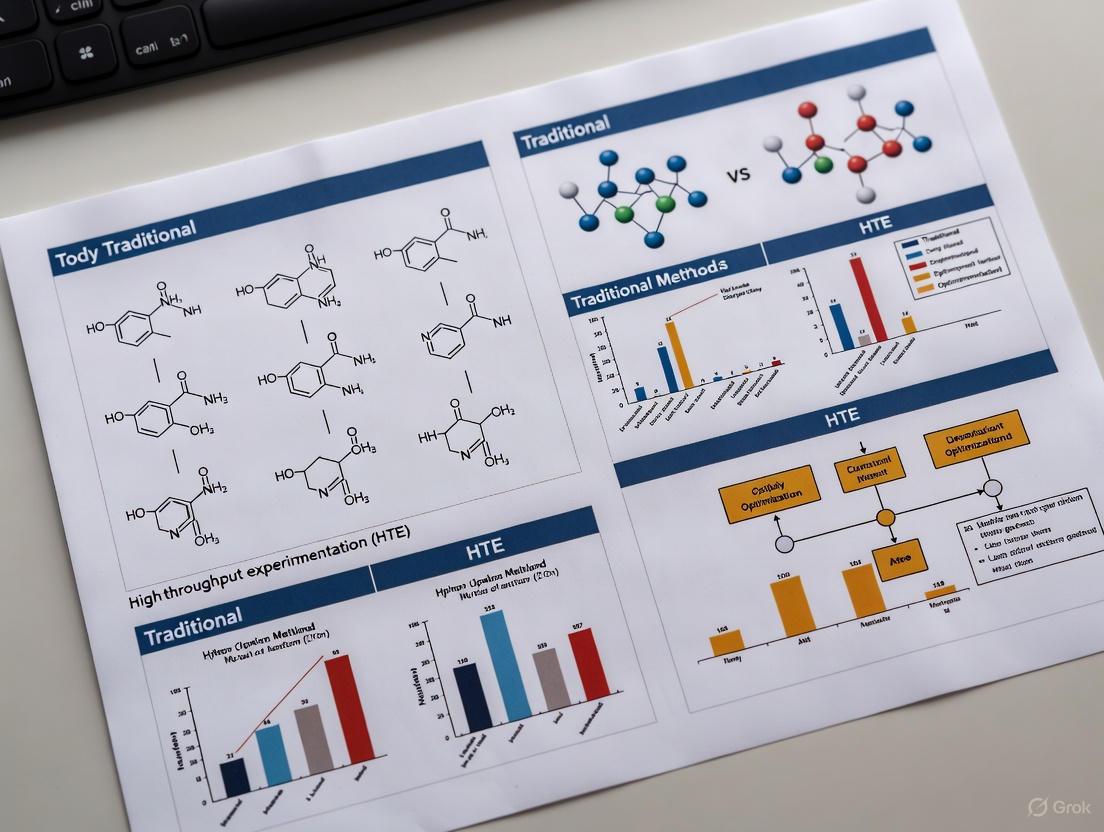
This article provides a comparative analysis for researchers and drug development professionals on the evolution from traditional Structure-Activity Relationship (SAR) optimization to modern High-Throughput Experimentation (HTE) and AI-driven approaches.
Traditional SAR vs. Modern High-Throughput Experimentation: A Comparative Analysis for Optimizing Drug Development
Abstract
This article provides a comparative analysis for researchers and drug development professionals on the evolution from traditional Structure-Activity Relationship (SAR) optimization to modern High-Throughput Experimentation (HTE) and AI-driven approaches. It explores the foundational principles of both paradigms, detailing their methodological applications in lead identification and optimization. The scope extends to troubleshooting common challenges, such as high clinical attrition rates due to efficacy and toxicity, and examines optimization strategies from lead candidate selection to clinical dose optimization. Finally, it offers a validation framework for comparing the success rates, cost efficiency, and future potential of these strategies in improving the productivity of biomedical research.
From Single Targets to Complex Systems: The Evolution of Drug Optimization Philosophy
In the pursuit of optimization within drug development and chemical research, two distinct methodological paradigms have emerged: the linear, sequential approach of Traditional Successive Approximation (SAR) and the highly parallel, multi-dimensional framework of High-Throughput Experimentation (HTE). The fundamental distinction between these paradigms lies in their core operational logic. Traditional SAR employs a linear, sequential process where each experiment is designed based on the outcome of the previous one, creating a deliberate but slow path toward optimization [1]. In contrast, HTE leverages parallelism, executing vast arrays of experiments simultaneously to explore a broad experimental space rapidly [2].
This article provides a comparative analysis of these two approaches, examining their underlying principles, methodological workflows, and applications in research and development. By understanding their respective strengths, limitations, and ideal use cases, researchers can make more informed decisions about which paradigm best suits their specific optimization challenges.
Understanding the Traditional SAR Paradigm
Core Principles and Sequential Workflow
The Traditional Successive Approximation (SAR) paradigm is rooted in a binary search algorithm, operating on a linear, stepwise principle. In this approach, each experiment is designed, executed, and analyzed before the next one is conceived. The outcome of each step directly informs the design of the subsequent experiment, creating a tightly coupled chain of experimental reasoning [1].
This methodology is characterized by its deliberate, sequential nature. Much like a binary search algorithm, it systematically narrows possibilities by testing hypotheses at the midpoints of progressively smaller ranges [1]. This process requires significant domain expertise and chemical intuition at each decision point, as researchers must interpret results and determine the most promising direction for the next experimental iteration.
The sequential workflow of Traditional SAR, while methodical, presents inherent limitations in exploration speed. Since each experiment depends on the completion and analysis of the previous one, the total timeline for optimization scales linearly with the number of experimental iterations required. This makes the approach thorough but time-consuming, particularly for complex optimization spaces with multiple interacting variables.
Application Contexts and Limitations
Traditional SAR finds its strongest application in targeted optimization problems where the experimental space is relatively well-understood and the number of critical variables is limited. It is particularly effective when resources are constrained or when experiments are expensive to conduct, as it minimizes wasted effort on unproductive directions through its deliberate, informed sequencing [1].
However, this approach struggles with high-dimensional problems where multiple variables interact in complex, non-linear ways. Its sequential nature makes it susceptible to local optima convergence, as the path-dependent exploration may fail to escape promising regions that are not globally optimal [2]. Additionally, the linear workflow provides limited capacity for discovering unexpected reactivity or synergistic effects between variables, as the experimental trajectory is guided by prior expectations and existing chemical intuition.
Understanding the HTE Parallelism Paradigm
Core Principles and Parallel Workflow
High-Throughput Experimentation represents a paradigm shift from sequential to parallel investigation. Instead of conducting experiments one after another, HTE employs massively parallel experimentation through miniaturized reaction scales and automated robotic systems [2]. This approach allows for the simultaneous execution of hundreds or thousands of experiments, systematically exploring multi-dimensional parameter spaces in a fraction of the time required by traditional methods.
The power of HTE parallelism lies in its comprehensive exploration capabilities. Where Traditional SAR follows a single experimental path, HTE maps broad landscapes of reactivity by testing numerous combinations of variables concurrently [3]. This is particularly valuable for understanding complex reactions like Buchwald-Hartwig couplings, where outcomes are sensitive to multiple interacting parameters including catalysts, ligands, solvents, and bases [3].
Modern HTE campaigns increasingly integrate machine learning frameworks like Minerva to guide experimental design. These systems use Bayesian optimization to balance exploration of unknown regions with exploitation of promising areas, efficiently navigating spaces of up to 88,000 possible reaction conditions [2]. This represents a significant evolution from earlier grid-based HTE designs toward more intelligent, adaptive parallel exploration.
Application Contexts and Strengths
HTE parallelism excels in complex optimization challenges with high-dimensional parameter spaces, particularly in pharmaceutical process development where multiple objectives must be balanced simultaneously [2]. It has demonstrated remarkable success in optimizing challenging transformations such as nickel-catalyzed Suzuki reactions and Buchwald-Hartwig aminations, where traditional methods often struggle to identify productive conditions [2].
The methodology is particularly valuable for discovering unexpected reactivity and non-linear synergistic effects that would be unlikely found through sequential approaches. By comprehensively sampling the experimental space, HTE can reveal hidden structure-activity relationships and identify optimal conditions that defy conventional chemical intuition [3]. Additionally, the rich, multi-dimensional datasets generated by HTE campaigns provide valuable insights that extend beyond immediate optimization goals, contributing to broader chemical knowledge and reactome understanding [3].
Comparative Analysis: Key Differences and Experimental Data
Direct Paradigm Comparison
The table below summarizes the fundamental differences between the Traditional SAR and HTE parallelism approaches:
| Feature | Traditional SAR | HTE Parallelism |
|---|---|---|
| Core Principle | Sequential binary search algorithm [1] | Parallel multi-dimensional mapping [2] |
| Workflow Structure | Linear, dependent sequence | Simultaneous, independent experiments |
| Experimental Throughput | Low (1 to few experiments per cycle) | High (96 to 1000+ experiments per cycle) [2] |
| Information Generation | Incremental, path-dependent | Comprehensive, landscape mapping |
| Optimal Application Space | Well-constrained, low-dimensional problems | Complex, high-dimensional optimization [2] |
| Resource Requirements | Lower equipment cost, higher time investment | High equipment cost, reduced time investment |
| Discovery Potential | Limited to anticipated reaction spaces | High potential for unexpected discoveries [3] |
Performance Comparison in Pharmaceutical Optimization
Recent studies directly comparing these approaches in pharmaceutical process development demonstrate their relative performance characteristics:
| Optimization Metric | Traditional SAR | HTE Parallelism |
|---|---|---|
| Time to Optimization | 6+ months for complex reactions [2] | 4 weeks for comparable systems [2] |
| Success Rate (Challenging Reactions) | Low (failed to find conditions for Ni-catalyzed Suzuki reaction) [2] | High (76% yield, 92% selectivity for same reaction) [2] |
| Parameter Space Exploration | Limited (guided by chemical intuition) | Comprehensive (88,000 condition space) [2] |
| Multi-objective Optimization | Sequential priority balancing | Simultaneous yield, selectivity, and cost optimization [2] |
| Data Generation for ML | Sparse, sequential data points | Rich, structured datasets for model training [2] |
Experimental Protocols and Methodologies
Traditional SAR Experimental Protocol
The Traditional SAR approach follows a well-defined sequential methodology for reaction optimization:
Initial Condition Selection: Based on chemical intuition and literature precedent, select a starting point for reaction parameters (catalyst, solvent, temperature) [1].
Baseline Establishment: Execute the reaction at chosen conditions and analyze outcomes (yield, selectivity, conversion) using appropriate analytical methods [1].
Sequential Parameter Variation:
- Identify the parameter deemed most influential on reaction outcome
- Systematically vary this parameter while holding others constant
- Execute experiments sequentially, with each condition chosen based on previous results [1]
Iterative Refinement:
- Analyze results to determine optimal value for the first parameter
- Select the next most influential parameter to vary
- Repeat the sequential variation process [1]
Convergence Testing: Continue iterative refinement until additional parameter adjustments no longer produce significant improvements in reaction outcomes [1].
This methodology mirrors the binary search algorithm used in SAR analog-to-digital converters, where each comparison halves the possible solution space, progressively converging toward an optimum [1].
HTE Parallelism Experimental Protocol
HTE parallelism employs a distinctly different approach focused on simultaneous experimentation:
Reaction Parameter Selection: Identify critical reaction variables (catalysts, ligands, solvents, bases, additives, temperatures) and define plausible ranges for each [2].
Experimental Design:
- Create a diverse set of reaction conditions spanning the parameter space
- Utilize algorithmic sampling (e.g., Sobol sampling) to maximize space coverage
- Design 96-well or 384-well plates with varied condition combinations [2]
Parallel Execution:
- Use automated liquid handling systems to prepare reaction mixtures
- Execute all reactions simultaneously under controlled conditions
- Quench and work up reactions in parallel [2]
High-Throughput Analysis:
- Employ automated analytical systems (UPLC, HPLC, GC) for rapid analysis
- Utilize plate readers for colorimetric or fluorescence-based assays [4]
Data Integration and Machine Learning:
Iterative Campaign Design:
Research Reagent Solutions Toolkit
The experimental paradigms require different reagent and material approaches, reflected in the following research toolkit:
| Tool/Reagent | Function in Traditional SAR | Function in HTE Parallelism |
|---|---|---|
| Catalyst Libraries | Individual catalysts tested sequentially | Diverse catalyst sets (Pd, Ni, Cu) screened in parallel [3] [2] |
| Solvent Systems | Limited, commonly used solvents | Broad solvent diversity including unconventional options [2] |
| Ligand Sets | Selected based on mechanism hypothesis | Comprehensive ligand libraries for mapping structure-activity relationships [3] |
| Analytical Standards | External standards for quantitative analysis | Internal standards and calibration curves for high-throughput quantification [4] |
| Base/Additive Arrays | Limited selection varied one-at-a-time | Diverse bases and additives screened for synergistic effects [3] |
Workflow Visualization
Traditional SAR Sequential Workflow
HTE Parallelism Workflow
The choice between Traditional SAR and HTE parallelism represents a fundamental strategic decision in optimization research. Traditional SAR offers a focused, resource-efficient approach for problems with constrained parameter spaces and established reaction paradigms. Its sequential nature provides deep mechanistic insights through careful, iterative experimentation but risks convergence on local optima in complex landscapes.
HTE parallelism delivers unparalleled exploratory power for high-dimensional optimization challenges, particularly in pharmaceutical development where multiple objectives must be balanced. The ability to rapidly map complex reaction landscapes and discover non-obvious synergistic effects makes it invaluable for tackling the most challenging optimization problems in modern chemistry [2].
Rather than viewing these approaches as mutually exclusive, research organizations benefit from maintaining both capabilities, deploying each according to problem characteristics. Traditional SAR remains effective for straightforward parameter optimization and resource-constrained environments, while HTE parallelism excels when comprehensive landscape mapping and discovery of unexpected reactivity are required. The integration of machine learning with HTE represents the evolving frontier of optimization science, creating a powerful synergy between human chemical intuition and algorithmic search capabilities [2].
For decades, drug discovery has been predominantly guided by the "Single Target, Single Disease" model, a paradigm that revolves around identifying a single molecular target critically involved in a disease pathway and developing a highly selective drug to modulate it. [5] [6] This approach, often termed the "one disease–one target–one drug" dogma, has been successful for some conditions, particularly monogenic diseases or those with a clear, singular pathological cause. [6] The development of selective cyclooxygenase-2 inhibitors for arthritis is a classic example of its successful application. [6]
However, clinical data increasingly reveal that this model is inefficient for multifactorial conditions. [5] [6] Complex diseases like Alzheimer's disease, Parkinson's disease, cancer, and diabetes involve intricate signaling networks rather than a single defective protein. [5] [6] [7] The over-reliance on the single-target paradigm has become a significant obstacle, contributing to high attrition rates, with many compounds failing in late-stage clinical development due to insufficient therapeutic effect, adverse side effects, or the emergence of drug resistance. [6] [7] This article examines the historical context and fundamental limitations of this model, framing it within a comparative analysis of traditional and modern High-Throughput Experimentation (HTE) optimization research.
Core Limitations of the Single-Target Model
The limitations of the "Single Target, Single Disease" model stem from its reductionist nature, which often fails to account for the complex, networked physiology of human diseases. The core shortcomings are summarized in the table below.
Table 1: Key Limitations of the 'Single Target, Single Disease' Paradigm
| Limitation | Underlying Cause | Clinical Consequence |
|---|---|---|
| Insufficient Therapeutic Efficacy [6] [7] | Inability to interfere with the complete disease network; activation of bypass biological pathways. [7] | Poor efficacy, especially in complex, multifactorial diseases. [6] |
| Development of Drug Resistance [5] [7] | Selective pressure on a single target leads to mutations; the body develops self-resistance. [7] | Loss of drug effectiveness over time, common in oncology and infectious diseases. [5] |
| Off-Target Toxicity & Adverse Effects [6] [7] | High selectivity for one target does not preclude unintended interactions with other proteins or pathways. [7] | Side effects and toxicity that limit dosing and clinical utility. [6] |
| Poor Translation to Clinics [6] | Lack of physiological relevance in target-based assays; oversimplification of disease biology. [6] | High late-stage failure rates despite promising preclinical data. [6] |
| Inefficiency in Treating Comorbidities [7] | Inability to address multiple symptoms or disease pathways simultaneously. [7] | Difficulty in managing patients with complex, overlapping conditions. [7] |
The Network Nature of Disease
The fundamental problem is that diseases, particularly neurodegenerative disorders, cancers, and metabolic syndromes, are not caused by a single protein but by dysregulated signaling networks. [6] As noted in a 2025 review, "when a single target drug interferes with the target or inhibits the downstream pathway, the body produces self-resistance, activates the bypass biological pathway, [leading to] the mutation of the therapeutic target." [7] This network effect explains why highly selective drugs often fail to achieve the desired clinical outcome; the disease network simply rewires around the single blocked node.
The Resistance and Toxicity Challenge
Drug resistance is a direct consequence of this model. In cancer, for example, inhibiting a single oncogenic kinase often leads to the selection of resistant clones or the activation of alternative survival pathways. [5] Furthermore, the pursuit of extreme selectivity does not automatically guarantee safety. Off-target effects remain a significant problem, as a drug can still interact with unforeseen proteins, "bring corresponding toxicity when bringing the expected efficacy." [7]
Comparative Analysis: Traditional vs. HTE Optimization Research
The evolution beyond the single-target paradigm has been driven by new research approaches that leverage scale, automation, and computational power. The table below contrasts the core methodologies.
Table 2: Paradigm Comparison: Traditional Target-Based vs. Modern HTE Optimization Research
| Aspect | Traditional Target-Based Research | HTE Optimization Research |
|---|---|---|
| Philosophy | "One disease–one target–one drug"; Reductionist. [6] | Multi-target, network-based; Systems biology. [6] |
| Screening Approach | Target-based screening (biochemical assays on purified proteins). [8] | Phenotypic screening (cell-based, organoids); Virtual screening (AI/ML). [6] [8] [9] |
| Throughput & Scale | Lower throughput, often manual or semi-automated. [8] | Ultra-high-throughput, miniaturized, and fully automated (e.g., 1536-well plates). [8] |
| Hit Identification | Based on affinity for a single, pre-specified target. [9] | Based on complex phenotypic readouts or multi-parameter AI analysis. [6] [10] |
| Data Output | Single-parameter data (e.g., IC50, Ki). [9] | Multi-parametric, high-content data (e.g., cell morphology, multi-omics). [6] [8] |
| Lead Optimization | Linear, slow Design-Make-Test-Analyze (DMTA) cycles. [10] | Rapid, integrated AI-driven DMTA cycles; can compress timelines from months to weeks. [10] |
The Rise of Phenotypic Screening and Multi-Target Strategies
A significant shift has been the renaissance of Phenotypic Drug Discovery (PDD). [6] Unlike target-based screening, PDD identifies compounds based on their ability to modify a disease-relevant phenotype in cells or tissues, without prior knowledge of a specific molecular target. [6] This approach is agnostic to the underlying complexity and is particularly advantageous for identifying first-in-class drugs or molecules that engage multiple targets simultaneously, making it a powerful tool for multi-target drug discovery. [6]
This aligns with the strategy of developing multi-target drugs or "designed multiple ligands," which aim to modulate several key nodes in a disease network concurrently. [5] [6] This approach, characterized by "multi-target, low affinity and low selectivity," can improve efficacy and reduce the likelihood of resistance by restoring the overall balance of the diseased network. [7] The antipsychotic drug olanzapine, which exhibits nanomolar affinities for over a dozen different receptors, is a successful example of a multi-targeted drug that succeeded where highly selective candidates failed. [6]
The Role of AI and Automation
Modern HTE is deeply integrated with Artificial Intelligence (AI) and machine learning. [10] [8] AI algorithms are used to analyze the massive, complex datasets generated by high-throughput screens, uncovering patterns that are invisible to traditional analysis. [8] Furthermore, AI is now being used for generative chemistry, where it designs novel molecular structures that satisfy multi-parameter optimization goals, including potency against multiple targets, selectivity, and optimal pharmacokinetic properties. [11] For instance, companies like Exscientia have reported AI-driven design cycles that are ~70% faster and require 10-fold fewer synthesized compounds than industry norms. [11]
The Scientist's Toolkit: Essential Research Reagents and Platforms
The transition to modern, network-driven drug discovery relies on a new set of tools and reagents that enable complex, high-throughput experimentation.
Table 3: Key Research Reagent Solutions for Modern Drug Discovery
| Tool / Reagent | Function | Application in Comparative Studies |
|---|---|---|
| iPSC-Derived Cells [6] | Physiologically relevant human cell models that reproduce disease mechanisms. | Provides human-relevant, predictive models for phenotypic screening and toxicity assessment, reducing reliance on non-translational animal models. [6] |
| 3D Organoids & Cocultures [6] | Advanced in vitro models that mimic cell-cell interactions and tissue-level complexity. | Used to model neuroinflammation, neurodegeneration, and other complex phenotypes in a more physiologically relevant context. [6] |
| CETSA (Cellular Thermal Shift Assay) [10] | Validates direct drug-target engagement in intact cells and native tissue environments. | Bridges the gap between biochemical potency and cellular efficacy; provides decisive evidence of mechanistic function within a complex biological system. [10] |
| Label-Free Technologies (e.g., SPR) [8] | Monitor molecular interactions in real-time without fluorescent or radioactive tags. | Provides high-quality data on binding affinity and kinetics for hit validation and optimization in screening campaigns. [8] |
| AI/ML Drug Discovery Platforms [11] | Generative AI and machine learning for target ID, compound design, and property prediction. | Accelerates discovery timelines and enables the rational design of multi-target drugs. For example, an AI-designed CDK7 inhibitor reached candidate stage after synthesizing only 136 compounds. [11] |
| High-Content Screening (HCS) [7] | Cell phenotype screening combining automatic fluorescence microscopy with automated image analysis. | Enables simultaneous detection of multiple phenotypic parameters (morphology, intracellular targets) in a single assay, ideal for complex drug studies. [7] |
Visualizing the Paradigm Shift
The following diagrams illustrate the core conceptual and methodological differences between the traditional and modern drug discovery paradigms.
The Traditional Single-Target Model
Linear Single-Target Pathway
The Modern Network-Based Model
Network-Based Multi-Target Therapy
The "Single Target, Single Disease" model, while historically productive, possesses inherent limitations in tackling the complex, networked nature of most major human diseases. Its insufficiency in delivering effective therapies for conditions like neurodegenerative disorders and complex cancers has driven a paradigm shift. The future of drug discovery lies in approaches that embrace biological complexity: multi-target strategies, phenotypic screening in human-relevant models, and the power of AI and HTE to navigate this complexity. This transition from a reductionist to a systems-level view is essential for increasing the success rate of drug development and delivering better therapies to patients.
High-Throughput Experimentation (HTE) has fundamentally reengineered the drug discovery landscape, transforming it from a painstaking, sequential process into a parallelized, data-rich science. This systematic approach allows researchers to rapidly conduct thousands to millions of chemical, genetic, or pharmacological tests using automated robotics, data processing software, liquid handling devices, and sensitive detectors [12]. The traditional drug discovery process historically consumed 12-15 years and cost over $1 billion to bring a new drug to market [13]. HTE, particularly through its implementation in High-Throughput Screening (HTS), has dramatically compressed the early discovery timeline by enabling the screening of vast compound libraries containing hundreds of thousands of drug candidates at rates exceeding 100,000 compounds per day [14] [13]. This acceleration is not merely about speed; it represents a fundamental shift in how researchers identify active compounds, antibodies, or genes that modulate specific biomolecular pathways, providing superior starting points for drug design and understanding complex biological interactions [12].
Table 1: Core Capability Comparison: Traditional Methods vs. Modern HTE
| Aspect | Traditional Screening | Modern HTE/HTS |
|---|---|---|
| Screening Throughput | Dozens to hundreds of compounds per week [13] | Up to 100,000+ compounds per day [14] [13] |
| Typical Assay Volume | Milliliter scale | Microliter to nanoliter scale (2.5-10 µL) [14] |
| Automation Level | Manual or semi-automated | Fully automated, integrated robotic systems [12] |
| Data Output | Low, manually processed | High-volume, automated data acquisition and processing [12] |
| Primary Goal | Target identification and initial validation | Rapid identification of "hit" compounds and comprehensive SAR [15] [16] |
The HTE Toolbox: Core Technologies and Methodologies
The power of HTE stems from the integration of several core technologies that work in concert to create a seamless, automated pipeline. Understanding these components is essential to appreciating its revolutionary impact.
The Scientist's Toolkit: Essential Research Reagent Solutions
Table 2: Key Research Reagent Solutions in a Typical HTE Workflow
| Tool/Reagent | Function in HTE | Specific Examples & Specifications |
|---|---|---|
| Microtiter Plates | The core labware for running parallel assays. | 96-, 384-, 1536-, or 3456-well plates; chosen based on assay nature and detection method [14] [12]. |
| Compound Libraries | Collections of molecules screened for biological activity. | Libraries of chemical compounds, siRNAs, or natural products; carefully catalogued in stock plates [12]. |
| Assay Reagents | Biological components used to measure compound interaction. | Includes enzymes (e.g., tyrosine kinase), cell lines, antibodies, and fluorescent dyes for detection [15] [14]. |
| Liquid Handling Systems | Automated devices for precise reagent transfer. | Robotic pipettors that transfer nanoliter volumes from stock plates to assay plates, ensuring accuracy and reproducibility [12]. |
| Detection Reagents | Chemicals that generate a measurable signal upon biological activity. | Fluorescent dyes (e.g., for cell viability, apoptosis), luminescent substrates, and FRET/HTRF reagents [15] [14]. |
| Automated Robotics | Integrated systems that transport and process microplates. | Robotic arms that move plates between stations for addition, mixing, incubation, and reading [13] [12]. |
Standardized Experimental Workflow and Protocol
A typical HTE screening campaign follows a rigorous, multi-stage protocol designed to efficiently sift through large compound libraries and validate true "hits." The workflow below outlines the key stages from initial setup to confirmed hits.
Diagram 1: HTE Screening Workflow
Detailed Experimental Protocol:
Target Identification and Reagent Preparation: The process begins with the identification and validation of a specific biological target (e.g., a protein, enzyme, or cellular pathway). Reagents, including the target and test compounds, are optimized and prepared for automation. Contamination must be avoided, and reagents like aptamers are often used for their high affinity and compatibility with detection strategies [14].
Assay Plate Preparation: Compound libraries, stored as stock plates, are used to create assay plates via liquid handling systems. A small volume (often nanoliters) of each compound is transferred into the wells of a microtiter plate (96- to 3456-well formats) [12]. The wells are then filled with the biological entity (e.g., proteins, cells, or enzymes) for testing [12].
Automated Reaction and Incubation: An integrated robotic system transports the assay plates through various stations for reagent addition, mixing, and incubation. The system can handle many plates simultaneously, managing the entire process from start to finish under controlled conditions [13] [12].
High-Throughput Detection: After incubation, measurements are taken across all wells. This is typically done using optical measurements, such as fluorescence, luminescence, or light scatter (e.g., using NanoBRET or FRET) [13] [12]. Specialized automated analysis machines can measure dozens of plates in minutes, generating thousands of data points [12].
Primary Data Analysis and Hit Selection: Automated software processes the raw data. Quality control (QC) metrics like the Z-factor are used to assess assay quality [12] [17]. Compounds that show a desired level of activity, known as "hits," are identified using statistical methods such as z-score or SSMD, which help manage the high false-positive rate common in primary screens [17] [12].
Confirmatory Screening: Initial "hits" are "cherry-picked" and tested in follow-up assays to confirm activity. This hierarchical validation is crucial and often involves testing compounds in concentration-response curves to determine potency (IC50/EC50) and in counter-screens to rule out non-specific activity [17] [12].
Hit Validation and Progression: Confirmed hits undergo further biological validation to understand their mechanism of action and selectivity. Techniques like High-Content Screening (HCS), which uses automated microscopy and image analysis to measure multiple cellular parameters, are invaluable here for providing a deeper understanding of cellular responses [15].
Quantitative Performance: HTE vs. Traditional Screening
The superiority of HTE is unequivocally demonstrated when comparing its quantitative output and efficiency against traditional methods. The data below highlights the transformative gains in throughput, resource utilization, and cost-effectiveness.
Table 3: Performance Metrics: Traditional vs. HTE Screening
| Performance Metric | Traditional Screening | HTE Screening | Advantage Ratio |
|---|---|---|---|
| Theoretical Daily Throughput | ~100 compounds [13] | ~100,000 compounds [14] [13] | 1,000x |
| Typical Assay Volume | 1-10 mL | 1-10 µL [14] | 1,000x less reagent use |
| Typical Project Duration | 1-2 years (for 3000 compounds) [16] | 3-4 weeks (for 3000 compounds) [16] | ~10x faster |
| Data Points per Experiment | Limited by manual capacity | Millions of tests [12] | Several orders of magnitude |
| Key Analytical Outputs | Basic activity assessment | Full concentration-response (EC50, IC50), SAR [12] | Rich, quantitative pharmacological profiling |
The Evolving HTE Landscape: Integration of Enabling Technologies
The capabilities of HTE are continually being augmented by integration with other cutting-edge technologies. This synergy is pushing the boundaries of what is possible in drug discovery.
Convergence with AI and Machine Learning
The large, high-quality datasets generated by HTE are ideal fuel for artificial intelligence (AI) and machine learning (ML) algorithms. This combination creates a powerful feedback loop: HTE provides the robust data needed to train predictive models, which in turn can propose new compounds or optimize reaction conditions for subsequent HTE cycles, significantly accelerating the discovery process [18]. This integration is proving to be a "game-changer," enhancing the efficiency, precision, and innovative capacity of research [18].
Adoption of Flow Chemistry
Flow chemistry is emerging as a powerful complement to traditional plate-based HTE. It addresses several limitations of plate-based systems, particularly for chemical reactions. Flow chemistry allows for superior control over continuous variables like temperature, pressure, and reaction time, and enables facile scale-up from screening to production without re-optimization [16]. It also provides safer handling of hazardous reagents and is particularly beneficial for photochemical and electrochemical reactions, opening new avenues for HTE in synthetic chemistry [16].
The Rise of High-Content Screening (HCS)
While HTS excels at speed and volume, High-Content Screening (HCS) provides a more detailed, multi-parameter analysis. Also known as High-Content Analysis (HCA), HCS uses automated fluorescence microscopy and image analysis to quantify complex cellular phenotypes—such as cell morphology, protein localization, and organelle health—in response to compounds [15]. This provides deep insights into a compound's mechanism of action and potential off-target effects, making it invaluable for secondary screening and lead optimization [15]. The relationship between these core screening technologies is illustrated below.
Diagram 2: Synergy of Screening Technologies
The rise of High-Throughput Experimentation is a definitive driver for change in modern drug discovery. The transition from low-throughput, manual processes to automated, data-dense workflows has created a paradigm shift, compressing discovery timelines and enriching the quality of lead compounds. The integration of HTE with other transformative technologies like AI, flow chemistry, and High-Content Screening creates a synergistic ecosystem that is more powerful than the sum of its parts. As these technologies continue to evolve and converge, they promise to further de-risk the drug development process and accelerate the delivery of novel therapeutics to patients, solidifying HTE's role as an indispensable pillar of 21st-century biomedical research.
Core Principles of Structure-Activity Relationship (SAR) and Lead Optimization
Structure-Activity Relationship (SAR) analysis represents a fundamental pillar of modern drug discovery, providing the critical scientific link between a molecule's chemical structure and its biological activity [19]. The core premise of SAR is that specific arrangements of atoms and functional groups within a molecule dictate its properties and interactions with biological systems [20]. By systematically exploring how modifications to a molecule's structure affect its biological activity, researchers can identify key structural features that influence potency, selectivity, and safety, enabling progression from initial hits to well-optimized lead compounds [20]. This process is intrinsically linked to lead optimization, the comprehensive phase of drug discovery that focuses on refining different characteristics of lead compounds, including target selectivity, biological activity, potency, and toxicity potential [21]. Within the broader context of comparative studies between traditional and high-throughput experimentation (HTE) optimization research, understanding the fundamental principles and methodologies of SAR becomes essential for evaluating the relative strengths, applications, and limitations of each approach in advancing therapeutic candidates.
Core Principles of Structure-Activity Relationship (SAR)
Fundamental Concepts and Historical Foundation
The conceptual foundation of SAR was first established by Alexander Crum Brown and Thomas Richard Fraser, who in 1868 formally proposed a connection between chemical constitution and physiological action [19]. The basic assumption underlying all molecule-based hypotheses is that similar molecules have similar activities [22]. This principle, however, is tempered by the SAR paradox, which acknowledges that it is not universally true that all similar molecules have similar activities [22]. This paradox highlights the complexity of biological systems and the fact that different types of activity (e.g., reaction ability, biotransformation ability, solubility, target activity) may depend on different molecular differences [22].
The essential components considered in SAR analysis include:
- Size and shape of the carbon skeleton and overall spatial arrangement
- Functional groups that participate in key interactions (hydrogen bonding, ionic interactions, hydrophobic interactions)
- Stereochemistry or three-dimensional arrangement of atoms
- Nature and position of substituents on a parent scaffold
- Physicochemical properties including solubility, lipophilicity, pKa, polarity, and molecular flexibility [20]
The SAR Study Workflow
SAR studies typically follow a systematic, iterative workflow often described as the Design – Make – Test – Analyze cycle [20]:
- Design: Based on existing data and structural information, propose structural analogs with specific modifications.
- Make: Synthesize the planned series of compounds (analogs), each with deliberate structural variations from a known active compound.
- Test: Measure the biological activity of each analog using relevant assays (e.g., enzyme inhibition, receptor binding, cellular effects).
- Analyze: Correlate the results to identify which structural features associate with increased, decreased, or altered activity, thus pinpointing the pharmacophore—the essential molecular features responsible for biological activity [20].
This workflow enables medicinal chemists to navigate vast chemical space systematically, making informed structural modifications to achieve desired biological outcomes [20].
SAR and QSAR: From Qualitative to Quantitative Analysis
While SAR provides qualitative relationships between structure and activity, Quantitative Structure-Activity Relationship (QSAR) modeling extends this concept by building mathematical models that relate a set of "predictor" variables (X) to the potency of a response variable (Y) [22]. QSAR models are regression or classification models that use physicochemical properties or theoretical molecular descriptors of chemicals to predict biological activities [22]. The general form of a QSAR model is: Activity = f(physicochemical properties and/or structural properties) + error [22].
Types of QSAR Approaches
Multiple QSAR methodologies have been developed, each with distinct advantages and applications:
Table 1: Comparative Analysis of QSAR Modeling Approaches
| QSAR Type | Core Principle | Key Features | Common Applications |
|---|---|---|---|
| Fragment-Based (GQSAR) [22] | Uses contributions of molecular fragments/substituents. | Studies various molecular fragments; Considers cross-term fragment interactions. | Fragment library design; Fragment-to-lead identification. |
| 3D-QSAR [22] | Applies force field calculations to 3D structures. | Requires molecular alignment; Analyzes steric and electrostatic fields. | Understanding detailed ligand-receptor interactions when structure is available. |
| Chemical Descriptor-Based [22] | Uses computed electronic, geometric, or steric descriptors for the whole molecule. | Descriptors are scalar quantities computed for the entire system. | Broad QSAR applications, especially when 3D structure is uncertain. |
| q-RASAR [22] | Merges QSAR with similarity-based read-across. | Hybrid method; Integrates with ARKA descriptors. | Leveraging combined predictive power of different modeling paradigms. |
QSAR Model Development and Validation
The principal steps of QSAR studies include: (1) selection of data set and extraction of structural/empirical descriptors, (2) variable selection, (3) model construction, and (4) validation evaluation [22]. Validation is particularly critical for establishing the reliability and relevance of QSAR models and must address robustness, predictive performance, and the applicability domain (AD) of the models [22] [23]. The domain of applicability defines the scope and limitations of a model, indicating when predictions can be considered reliable [23]. Validation strategies include internal validation (cross-validation), external validation by splitting data into training and prediction sets, blind external validation, and data randomization (Y-scrambling) to verify the absence of chance correlations [22].
Lead Optimization: Strategies and Methodologies
Lead optimization is the final phase of drug discovery that aims to enhance the efficacy, safety, and pharmacological properties of lead compounds to develop effective drug candidates [21]. This stage extensively evaluates the absorption, distribution, metabolism, excretion, and toxicity (ADMET) properties of compounds, often using animal models to analyze effectiveness in modulating disease [21].
Key Lead Optimization Strategies
Table 2: Lead Optimization Strategies in Drug Discovery
| Strategy | Core Approach | Key Techniques | Primary Objectives |
|---|---|---|---|
| Direct Chemical Manipulation [21] | Modifying the natural structure of lead compounds. | Adding/swapping functional groups; Isosteric replacements; Adjusting ring systems. | Initial improvement of binding, potency, or stability. |
| SAR-Directed Optimization [21] | Systematic modifications guided by established SAR. | Analyzing biological data from structural changes; Focus on ADMET challenges. | Improving efficacy and safety without altering core structure. |
| Pharmacophore-Oriented Design [21] | Significant modification of the core structure. | Structure-based design; Scaffold hopping. | Addressing chemical accessibility; Creating novel leads with distinct properties. |
A critical aspect of modern lead optimization involves the use of ligand efficiency (LE) metrics, which normalize experimental activity to molecular size (e.g., LE ≥ 0.3 kcal/mol/heavy atom) [9]. This is particularly important because the aim of virtual screening and lead optimization is usually to provide a novel chemical scaffold for further optimization, and hits with sub-micromolar activity, while desirable, are not typically necessary [9]. Most optimization efforts begin with hits in the low to mid-micromolar range [9].
Computational Approaches in Lead Optimization
Computational methods play an increasingly vital role in lead optimization, improving both efficacy and efficiency [21]. Specific computational techniques include:
- Molecular docking and dynamics simulations: Investigate how compounds interact with biological targets at a molecular level [20]. For example, molecular dynamics simulations using tools like NAMD can explore the dynamic behavior and stability of ligand-protein complexes [20].
- Free energy perturbation (FEP) calculations: Used in conjunction with Monte Carlo statistical mechanics simulations for protein-inhibitor complexes in aqueous solution to provide rigorous binding free energy estimates [24].
- 3D-QSAR methods: Such as comparative molecular field analysis (CoMFA) and comparative molecular similarity indices analysis (CoMSIA) [21].
- De novo design: Using programs like BOMB (Biochemical and Organic Model Builder) to grow molecules by adding layers of substituents to a core placed in a binding site [24].
- Virtual screening: Docking of available compound collections to identify promising candidates for purchase and assaying [24].
These computational approaches allow researchers to predict activities for new molecules, prioritize large screening decks, and generate new compounds de novo [23].
Experimental Protocols and Methodologies
Experimental SAR Protocols
Experimental SAR studies involve the synthesis and testing of a series of structurally related compounds [20]. Key experimental techniques include:
- Biological assays: Measure compound activity on a specific target (enzyme, receptor, cell) [20]. In early SAR, percentage inhibition at a given concentration is widely used, while concentration-response endpoints (IC₅₀, EC₅₀, Kᵢ, or K_d) provide more quantitative data [9].
- Pharmacokinetic studies: Measure absorption, distribution, metabolism, and excretion of compounds [20].
- Toxicological studies: Assess compound safety by measuring effects on various organs and systems [20]. This includes tests like Irwin's test for general safety screening and the Ames test for genotoxicity [21].
Computational SAR Protocols
Computational SAR methods utilize machine learning and other modeling approaches to predict biological activity based on chemical structure [20]. Standard protocols include:
- Descriptor calculation: Quantifying structural and physicochemical properties of molecules [22] [20].
- Model construction: Using statistical methods (e.g., regression analysis, machine learning like support vector machines or random forests) to build predictive equations [22] [23].
- Model validation: Applying rigorous validation procedures including external validation and applicability domain assessment [22] [23].
- Activity prediction: Using validated models to predict activities of new compounds or virtual libraries [23].
Advanced protocols may include scans for possible additions of small substituents to a molecular core, interchange of heterocycles, and focused optimization of substituents at one site [24].
Visualization of SAR and Lead Optimization Workflows
SAR Analysis Workflow
SAR Analysis Workflow
Integrated Lead Optimization Strategy
Lead Optimization Strategy
The Scientist's Toolkit: Essential Research Reagents and Solutions
Table 3: Essential Research Reagents and Tools for SAR and Lead Optimization
| Tool/Reagent Category | Specific Examples | Function in SAR/Optimization |
|---|---|---|
| Computational Software [24] [20] | Molecular Operating Environment (MOE), BOMB, Glide, KNIME, NAMD | Enables molecular modeling, QSAR, docking, dynamics simulations, and workflow automation. |
| Compound Libraries [9] [24] | ZINC database, Maybridge, Commercial catalogs | Sources of compounds for virtual screening and experimental testing to expand SAR. |
| Assay Technologies [21] | High-Throughput Screening (HTS), Ultra-HTS, Fluorescence-based assays | Measures biological activity of compounds in automated, miniaturized formats. |
| Analytical Instruments [21] | NMR, LCMS, Crystallography | Characterizes molecular structure, identifies metabolites, studies ligand-protein interactions. |
| Descriptor Packages [22] | QikProp, Various molecular descriptor calculators | Computes physicochemical properties and molecular descriptors for QSAR modeling. |
Comparative Analysis: Traditional vs. HTE Optimization Research
Traditional SAR approaches often focus on sequential, hypothesis-driven testing of a limited number of compounds, with heavy reliance on medicinal chemistry intuition and experience [23]. In contrast, High-Throughput Experimentation (HTE) leverages automation and miniaturization to rapidly test thousands to hundreds of thousands of compounds [21]. Key comparative aspects include:
- Throughput: Traditional methods handle smaller compound sets; HTE can analyze >100,000 assays per day using UHTS [21].
- Data Generation: HTE produces massive datasets that require computational methods for interpretation and SAR analysis [23] [21].
- Resource Requirements: HTE reduces human resource needs through automation but requires significant upfront investment [21].
- Hit Identification: Virtual screening, often used with HTE, typically tests a smaller fraction of higher-scoring compounds compared to traditional HTS [9].
- Success Rates: Despite technological advances, lead optimization remains challenging, with only approximately one in ten optimized lead compounds ultimately reaching the market [21].
The integration of both approaches—using HTE for broad exploration and traditional methods for focused optimization—represents the current state-of-the-art in drug discovery. This hybrid strategy allows researchers to leverage the strengths of both methodologies while mitigating their respective limitations.
Core Principles of High-Throughput Screening (HTS) and High-Content Screening (HCS)
In the landscape of modern drug discovery, the shift from traditional, targeted research to High-Throughput Experimentation (HTE) has fundamentally accelerated the identification of novel therapeutic candidates. Within this paradigm, High-Throughput Screening (HTS) and High-Content Screening (HCS) serve as complementary pillars. HTS is designed for the rapid testing of thousands to millions of compounds against a biological target to identify active "hits" [15] [25]. In contrast, HCS provides a multiparameter, in-depth analysis of cellular responses by combining automated microscopy with quantitative image analysis, yielding rich mechanistic data on how these hits affect cellular systems [15] [26]. This guide provides an objective comparison of their core principles, applications, and performance, framing them within the broader thesis of traditional versus HTE optimization research.
Core Principles and Direct Comparison
The fundamental difference lies in the depth versus breadth of analysis. HTS prioritizes speed and scale for initial hit identification, while HCS sacrifices some throughput to gain profound insights into phenotypic changes and mechanisms of action [15] [26].
Table 1: Fundamental Comparison of HTS and HCS
| Feature | High-Throughput Screening (HTS) | High-Content Screening (HCS) |
|---|---|---|
| Primary Objective | Rapid identification of active compounds ("hits") from vast libraries [15] [25] | Multiparameter analysis of cellular morphology and function [15] [26] |
| Typical Readout | Single-parameter (e.g., enzyme activity, receptor binding) [15] | Multiparameter, image-based (e.g., cell size, morphology, protein localization) [15] [26] |
| Throughput | Very high (10,000 - 100,000+ compounds per day) [25] | High, but typically lower than HTS due to complex analysis [15] |
| Data Output | Quantitative data on compound activity [27] | Quantitative phenotypic fingerprints from high-dimensional datasets [28] [26] |
| Key Advantage | Speed and efficiency in screening large libraries [27] | Provides deep biological insight and mechanistic context [15] [28] |
| Common Assay Types | Biochemical (e.g., enzymatic) and cell-based [25] | Cell-based phenotypic assays [15] [26] |
| Information on Mechanism of Action | Limited, requires follow-up assays [15] | High, can infer mechanism from phenotypic profile [28] [26] |
The following diagram illustrates the core HTS workflow, from library preparation to hit identification:
The HCS workflow is more complex, involving image acquisition and analysis to extract multi-parameter data:
Quantitative Data and Market Context
The growing adoption of these technologies is reflected in market data. The global HTS market, valued at approximately $28.8 billion in 2024, is projected to advance at a Compound Annual Growth Rate (CAGR) of 10.5% to 11.8%, reaching up to $50.2 billion by 2029 [27] [29]. This growth is propelled by the rising demand for faster drug development, the prevalence of chronic diseases, and advancements in automation and artificial intelligence (AI) [27] [30].
Table 2: Quantitative Market and Performance Data
| Parameter | High-Throughput Screening (HTS) | High-Content Screening (HCS) | Sources |
|---|---|---|---|
| Market Size (2024) | $28.8 billion | (Part of HTS market) | [27] |
| Projected Market (2029) | $39.2 - $50.2 billion | (Part of HTS market) | [27] [29] |
| Projected CAGR | 10.5% - 11.8% | (Part of HTS market) | [27] [29] |
| Typical Throughput | 10,000 - 100,000 compounds/day; uHTS: >300,000 compounds/day [25] | Lower than HTS, varies by assay complexity | [15] [25] |
| Standard Assay Formats | 96-, 384-, 1536-well microplates [25] | 96-, 384-well microplates [15] | [15] [25] |
| Key Growth Catalysts | AI/ML integration, 3D cell cultures, lab-on-a-chip [27] [30] | AI-powered image analysis, 3D organoids, complex disease modeling [15] [26] | [15] [27] [30] |
Experimental Protocols and Methodologies
Protocol for a Biochemical HTS Assay
This protocol outlines a typical enzymatic HTS, such as screening for histone deacetylase (HDAC) inhibitors [25].
- Assay Design and Miniaturization: A peptide substrate coupled to a fluorescent leaving group is designed. The assay is optimized for a 384-well or 1536-well microplate format to minimize reagent use [25].
- Reagent and Library Preparation: The enzyme, substrate, and test compounds from the library are dispensed into the microplates using automated liquid handling robots capable of nanoliter dispensing [25].
- Reaction and Incubation: The enzymatic reaction is initiated and allowed to incubate under controlled conditions. The activity of HDAC cleaves the substrate, releasing the fluorescent group [25].
- Detection and Readout: Fluorescence intensity is measured using a plate reader. An increase in fluorescence signal indicates inhibitor activity, as more substrate remains cleaved [25].
- Data Triage and Hit Identification: Data analysis software processes the results. "Hits" are identified based on a predefined threshold of activity (e.g., compounds showing >50% inhibition). Statistical methods and cheminformatic filters are applied to flag and eliminate false positives caused by assay interference [31] [25].
Protocol for a Phenotypic HCS Assay
This protocol details an imaging-based HCS, such as the Cell Painting assay or a targeted assay using fluorescent ligands [28] [32].
- Cell-Based Assay Setup: Cells are cultured in 96- or 384-well microplates and treated with compounds. For complex models, zebrafish embryos or 3D cell cultures like organoids may be used [15] [28].
- Staining and Fixation: Cells are stained with multiple fluorescent dyes to highlight specific cellular components (e.g., nucleus, actin, mitochondria, Golgi apparatus). Alternatively, targeted fluorescent ligands are used to label specific proteins like XPB in live cells [28] [32].
- Image Acquisition: Automated high-resolution fluorescence microscopes capture multiple images per well across different fluorescence channels [15] [26].
- Image Processing and Analysis: Advanced AI and machine learning algorithms, such as convolutional neural networks (CNNs), perform image segmentation to identify individual cells and subcellular structures. Hundreds of morphological features (size, shape, texture, intensity) are extracted quantitatively from each cell [28] [26].
- Data Integration and Phenotypic Profiling: The extracted features are integrated to create a high-dimensional "phenotypic fingerprint" for each treated sample. Machine learning models analyze these fingerprints to classify compounds, infer mechanisms of action, and identify subtle phenotypic changes [28] [26].
The Scientist's Toolkit: Essential Research Reagents and Materials
Table 3: Key Reagent Solutions in HTS and HCS
| Reagent / Material | Function | Screening Context |
|---|---|---|
| Compound Libraries | Large collections of diverse chemical or biological molecules used for screening [27] [25] | HTS & HCS |
| Fluorescent Dyes & Probes | Tags for visualizing cellular components (e.g., DAPI for nucleus) or measuring enzymatic activity [15] [25] | HTS & HCS (Essential for HCS) |
| Clickable Chemical Probes | Specialized probes (e.g., TL-alkyne) for bio-orthogonal labeling, enabling direct visualization of drug-target interactions in live cells [32] | HCS |
| Microplates (96 to 1536-well) | Miniaturized assay platforms that enable high-density testing and reduce reagent consumption [25] | HTS & HCS |
| Cell Lines & 3D Organoids | Biological models for cell-based assays; 3D models provide more physiologically relevant data [27] [26] | Primarily HCS, also cell-based HTS |
| Automated Liquid Handlers | Robotics for accurate, nanoliter-scale dispensing of reagents and compounds, enabling automation [27] [25] | HTS & HCS |
Synergistic Integration in the Drug Discovery Pipeline
HTS and HCS are not mutually exclusive but are most powerful when used synergistically. A typical modern drug discovery campaign leverages the strengths of both in a cascading workflow. The process begins with ultra-HTS (uHTS) to rapidly sieve through millions of compounds, identifying a smaller subset of potent "hits" [15] [25]. These hits are then funneled into secondary HCS assays, where their effects on complex cellular phenotypes are profiled. This step helps triage artifacts, identify off-target effects, and generate hypotheses about the mechanism of action [31] [15]. Finally, during lead optimization, HCS is invaluable for assessing cellular toxicity and efficacy in more physiologically relevant models, such as primary cells or 3D organoids, ensuring that only the most promising and safe candidates progress [15] [26].
Within the framework of comparative traditional versus HTE optimization research, HTS and HCS represent a fundamental evolution. HTS excels as the primary discovery engine, offering unparalleled speed and scale for navigating vast chemical spaces. HCS serves as the mechanistic interrogator, providing the deep, contextual biological insight necessary to understand why a compound is active and what its broader cellular consequences might be. The future of efficient drug discovery lies not in choosing one over the other, but in strategically integrating both. The convergence of these technologies with AI, more complex biological models like organoids, and novel probe chemistry [28] [32] is poised to further reduce attrition rates and usher in a new era of predictive and personalized therapeutics.
The high failure rate of clinical drug development, persistently around 90%, necessitates a critical re-evaluation of traditional optimization approaches [33]. Historically, drug discovery has rigorously optimized for structure-activity relationship (SAR) to achieve high specificity and potency against molecular targets, alongside drug-like properties primarily assessed through plasma pharmacokinetics (PK) [33]. However, a significant proportion of clinical failures due to insufficient efficacy (~40-50%) or unmanageable toxicity (~30%) suggest that critical factors affecting the clinical balance of efficacy and safety are being overlooked in early development [33] [34].
This guide compares two paradigms in early drug optimization: the Traditional SAR-Centric Approach, which primarily relies on plasma exposure, and the Integrated ADMET & STR Approach, which incorporates Absorption, Distribution, Metabolism, Excretion, Toxicity (ADMET) profiling and Structure-Tissue Exposure/Selectivity Relationship (STR) early in the process. The integration of these elements, supported by High-Throughput Experimentation (HTE), represents a fundamental shift aimed at de-risking drug candidates before they enter costly clinical trials [35] [36].
Comparative Analysis: Traditional vs. Modern Optimization Strategies
Table 1: Core Differences Between Traditional and Modern Optimization Approaches
| Aspect | Traditional SAR-Centric Approach | Integrated ADMET & STR Approach |
|---|---|---|
| Primary Focus | Potency (IC₅₀, Kᵢ) and plasma PK [33] | Balanced efficacy, tissue exposure, and safety [33] [37] |
| Distribution Assessment | Plasma exposure as surrogate for tissue exposure [33] | Direct measurement of tissue exposure and selectivity (STR) [33] [38] |
| Toxicity Evaluation | Often later stage; limited early prediction [34] | Early ADMET screening (e.g., Ames, hERG, CYP inhibition) [39] [34] |
| Throughput & Data | Lower throughput, OVAT (One Variable at a Time) [36] | High-Throughput Experimentation (HTE), parallelized data-rich workflows [36] |
| Lead Candidate Selection | May favor compounds with high plasma AUC [33] | Selects for optimal tissue exposure/selectivity and acceptable plasma PK [33] [38] |
| Theoretical Basis | Free Drug Hypothesis [33] | Empirical tissue distribution data; acknowledges limitations of free drug hypothesis [33] |
The Critical Role of ADMET and STR in De-risking Development
Quantitative ADMET Scoring
The ADMET-score is a comprehensive scoring function developed to evaluate chemical drug-likeness based on 18 predicted ADMET properties [39]. It integrates critical endpoints such as Ames mutagenicity, hERG inhibition, CYP450 interactions, human intestinal absorption, and P-glycoprotein substrate/inhibitor status. The scoring function's weights are determined by model accuracy, endpoint importance in pharmacokinetics, and usefulness index, providing a single metric to prioritize compounds with a higher probability of success [39].
Table 2: Key ADMET Properties for Early Screening and Their Performance Metrics [39]
| Endpoint | Model Accuracy | Endpoint | Model Accuracy |
|---|---|---|---|
| Ames mutagenicity | 0.843 | CYP2D6 inhibitor | 0.855 |
| Acute oral toxicity | 0.832 | CYP3A4 substrate | 0.66 |
| Caco-2 permeability | 0.768 | CYP inhibitory promiscuity | 0.821 |
| hERG inhibitor | 0.804 | P-gp inhibitor | 0.861 |
| Human intestinal absorption | 0.965 | P-gp substrate | 0.802 |
Structure-Tissue Exposure/Selectivity Relationship (STR)
STR is an emerging concept that investigates how structural modifications influence a drug's distribution and accumulation in specific tissues, particularly disease-targeted tissues versus normal tissues [33] [37]. This relationship is crucial because plasma exposure often poorly correlates with target tissue exposure.
A seminal study on Selective Estrogen Receptor Modulators (SERMs) demonstrated that drugs with similar structures and nearly identical plasma exposure (AUC) could have dramatically different distributions in target tissues like tumors, bone, and uterus [33] [37]. This tissue-level selectivity was directly correlated with their observed clinical efficacy and safety profiles, suggesting that STR optimization is critical for balancing clinical outcomes [33].
Experimental Protocols and Data Generation
HTE-Enabled ADMET Screening
Protocol Overview: High-Throughput Experimentation (HTE) employs miniaturized, parallelized reactions to rapidly profile compounds across a wide array of conditions and assays [36].
Key Methodologies:
- In vitro ADMET assays are conducted using automated platforms. These include:
- CYP450 Inhibition: Using liver microsomes or hepatocytes to assess drug-drug interaction potential [34].
- Metabolic Stability: Incubating compounds with liver microsomes/S9 fractions and quantifying parent compound loss over time [34].
- Cellular Permeability: Utilizing Caco-2 or MDCK cell monolayers to predict intestinal absorption [39] [34].
- hERG Inhibition: Binding or functional assays to flag potential cardiotoxicity [39].
- Toxicokinetics (TK) studies link external exposure concentrations to internal doses in animal models, often using higher, therapeutically irrelevant doses to understand toxicity thresholds [40] [41]. Data from these studies are used to estimate a safe starting dose for human clinical trials [41].
STR Determination Protocol
Protocol Overview: Quantifying drug concentrations in multiple tissues over time to establish STR and calculate tissue-to-plasma distribution coefficients (Kp) [33] [38].
Detailed Workflow:
- Animal Dosing: Administer a single dose of the drug candidate (e.g., orally or intravenously) to relevant animal models (e.g., transgenic disease models when possible) [33].
- Serial Sacrifice and Sampling: At predetermined time points post-dosing, collect blood/plasma and a comprehensive panel of tissues (e.g., target tissue, liver, kidney, heart, brain, muscle) [33].
- Sample Processing: Homogenize tissue samples. Use protein precipitation (e.g., with ice-cold acetonitrile) or other extraction methods to isolate the drug and metabolites from plasma and tissue homogenates [33].
- Bioanalysis: Employ sensitive analytical techniques like LC-MS/MS or UPLC-HRMS to quantify drug concentrations in each sample [33] [38].
- Data Analysis: Calculate the Area Under the Concentration-time curve (AUC) for plasma and each tissue. The tissue-to-plasma distribution coefficient (Kp) is determined as AUCtissue / AUCplasma [38].
Table 3: Experimental Tissue Distribution Data for CBD Carbamates L2 and L4 [38]
| Compound | Plasma AUC (ng·h/mL) | Brain AUC (ng·h/g) | Brain Kp (AUCbrain/AUCplasma) | eqBuChE IC₅₀ (μM) |
|---|---|---|---|---|
| L2 | ~1200 | ~6000 | ~5.0 | 0.077 |
| L4 | ~1200 | ~1200 | ~1.0 | Most potent |
This table illustrates the STR concept: while L2 and L4 have identical plasma exposure, L2 achieves a 5-fold higher brain concentration, which is critical for CNS-targeted drugs, despite L4 having superior in vitro potency [38].
Visualizing Workflows and Relationships
Diagram 1: A comparison of drug optimization workflows. The integrated approach introduces critical ADMET and STR profiling earlier, creating a more robust and de-risked development pipeline.
Diagram 2: The central principle of STR. Drug exposure in plasma is a poor predictor of tissue exposure, which in turn is a stronger correlate of clinical efficacy and toxicity. STR is the key determinant of tissue exposure and selectivity.
The Scientist's Toolkit: Essential Research Reagent Solutions
Table 4: Key Reagents and Materials for ADMET and STR Research
| Reagent/Material | Function in Experimentation |
|---|---|
| Liver Microsomes / Hepatocytes | In vitro models for assessing metabolic stability and CYP450 inhibition/induction [34]. |
| Caco-2 / MDCK Cells | Cell-based assays to predict intestinal permeability and absorption [34]. |
| Recombinant CYP Enzymes | Specific isoform-level analysis of metabolic pathways and drug-drug interactions [39]. |
| hERG Assay Kits | Screening for potential cardiotoxicity by inhibiting the hERG potassium channel [39]. |
| Bioanalytical Internal Standards | Isotope-labeled compounds for accurate LC-MS/MS quantification of drugs and metabolites in biological matrices [33]. |
| Tissue Homogenization Kits | Reagents and protocols for efficient and consistent extraction of analytes from diverse tissue types [33]. |
The expanding scope of early drug development to systematically incorporate ADMET profiling and STR analysis represents a necessary evolution from traditional, potency-centric approaches. The experimental data and comparative analysis presented in this guide consistently demonstrate that plasma exposure is a poor surrogate for target tissue exposure, and over-reliance on it can mislead candidate selection [33] [38] [37]. The integration of these elements, powered by modern HTE platforms that generate rich, parallelized datasets, provides a more holistic and predictive framework for selecting drug candidates with the highest likelihood of clinical success, ultimately aiming to improve the unacceptably high failure rates in drug development [36].
A Tale of Two Pipelines: Methodologies in Traditional and HTE Workflows
The hit-to-lead (H2L) and subsequent lead optimization phases represent a critical, well-established pathway in small-molecule drug discovery. This traditional approach is characterized by a linear, multi-step process designed to transform initial screening "hits"—compounds showing any desired biological activity—into refined "lead" candidates with robust pharmacological profiles suitable for preclinical development [42] [43]. The entire process from hit identification to a preclinical candidate typically spans 4-7 years, with the H2L phase itself averaging 6-9 months [42] [44]. The primary objective of this rigorous pathway is to thoroughly evaluate and optimize chemical series against a multi-parameter profile, balancing potency, selectivity, and drug-like properties while systematically reducing attrition risk before committing to costly late-stage development [43] [45].
This traditional methodology relies heavily on iterative Design-Make-Test-Analyze (DMTA) cycles [42]. In this framework, medicinal chemists design new compounds based on emerging structure-activity relationship (SAR) data, followed by synthesis ("Make"), biological and physicochemical testing ("Test"), and data analysis to inform the next design cycle [42] [46]. The process is driven by a defined Candidate Drug Target Profile (CDTP), which establishes specific criteria for potency, selectivity, pharmacokinetics, and safety that must be met for a compound to advance [42]. Initially, H2L exploration typically begins with 3-4 different chemotypes, aiming to deliver at least 2 promising lead series for the subsequent lead optimization phase [42].
The Hit-to-Lead and Lead Optimization Workflow
Stage 1: Hit Identification and Triage
The traditional H2L process begins after the identification of "hits" from high-throughput screening (HTS), virtual screening, or fragment-based approaches [42] [44]. A hit is defined as a compound that displays desired biological activity toward a drug target and reproduces this activity upon retesting [42]. Following primary screening, the hit triage process is employed to select the most promising starting points from often hundreds of initial actives [43]. This critical winnowing uses multi-parameter optimization strategies such as the "Traffic Light" (TL) system, which scores compounds across key parameters like potency, ligand efficiency, lipophilicity (cLogP), and solubility [43]. Each parameter is assigned a score (good=0, warning=1, bad=2), and the aggregate "golf score" (where lower is better) enables objective comparison of diverse chemotypes [43]. This systematic prioritization ensures resources are focused on hit series with the greatest potential for successful optimization.
Stage 2: Core Hit-to-Lead Optimization
The H2L phase focuses on establishing a robust understanding of the Structure-Activity Relationships (SAR) within each hit series [42] [46]. Through iterative DMTA cycles, medicinal chemists synthesize analogs to explore the chemical space around the original hits, systematically improving key properties [42]. The screening cascade during this phase expands significantly beyond primary activity to include orthogonal assays that confirm target engagement and mechanism of action, selectivity panels against related targets to minimize off-target effects, and early ADME profiling (Absorption, Distribution, Metabolism, Excretion) to assess drug-like properties [47] [43]. Critical properties optimized during H2L include:
- Potency: Improving half-maximal inhibitory concentration (IC₅₀) or effective concentration (EC₅₀) values, often guided by metrics like Ligand Efficiency (LE) and Lipophilic Efficiency (LipE) that penalize excessive molecular size or lipophilicity [43].
- Selectivity: Demonstrating specific activity against the intended target versus unrelated proteins or closely related family members [47] [45].
- Physicochemical Properties: Optimizing solubility, lipophilicity (LogP), and molecular size to ensure adequate exposure and absorption [43].
- Early ADME: Assessing metabolic stability (e.g., in liver microsomes), membrane permeability, and protein binding [42] [45].
- In Vitro Safety: Initial cytotoxicity screening and assessment of activity against anti-targets such as cytochrome P450 enzymes [43].
Table 1: Key Assays in the Hit-to-Lead Screening Cascade
| Assay Category | Specific Examples | Primary Objective | Typical Output Metrics |
|---|---|---|---|
| Biochemical Potency | Enzyme inhibition, Binding assays (SPR, ITC) | Confirm primary target engagement and measure affinity | IC₅₀, Kd, Ki |
| Cell-Based Activity | Reporter gene assays, Pathway modulation | Demonstrate functional activity in cellular context | EC₅₀, % inhibition/activation |
| Selectivity | Counter-screening against related targets, Orthologue assays | Identify and minimize off-target interactions | Selectivity ratio (e.g., 10-100x) |
| Physicochemical | Kinetic solubility, Lipophilicity (LogD) | Ensure adequate drug-like properties | Solubility (µg/mL), cLogP/LogD |
| Early ADME | Metabolic stability (microsomes), Permeability (PAMPA, Caco-2) | Predict in vivo exposure and absorption | % remaining, Papp |
| In Vitro Safety | Cytochrome P450 inhibition, Cytotoxicity | Identify early safety liabilities | % inhibition at 10 µM, CC₅₀ |
Stage 3: Lead Optimization
Lead optimization (LO) represents an extension and intensification of the H2L process, focusing on refining the most promising lead series into preclinical candidates [42] [44]. While H2L typically aims to identify compounds suitable for testing in animal disease models, LO demands more stringent criteria appropriate for potential clinical use [45]. This phase involves deeper pharmacokinetic and pharmacodynamic (PK/PD) studies, including in vivo profiling to understand absorption, distribution, and elimination [44]. Additional considerations include:
- Advanced SAR Exploration: Employing techniques like scaffold hopping to modify core structures while maintaining potency but improving properties like solubility or reducing toxicity [44].
- Stereochemistry Optimization: Investigating enantiomeric differences that can significantly impact both potency and toxicity profiles [44].
- Comprehensive Safety Assessment: Expanding toxicity screening to include genetic toxicity, cardiovascular safety (hERG channel binding), and broader organ toxicity panels [44].
- Formulation Development: Initial work on salt forms, crystallinity, and prodrug approaches to enhance bioavailability [44].
The successful output of lead optimization is a preclinical candidate that meets the predefined Candidate Drug Target Profile and is suitable for regulatory submission as an Investigational New Drug (IND) [42] [44].
Diagram 1: Traditional H2L and Lead Optimization Workflow. This linear process transitions from initial hits through progressive optimization stages to a preclinical candidate.
Quantitative Comparison of Traditional Optimization
Table 2: Quantitative Metrics for Traditional H2L and Lead Optimization
| Performance Metric | Hit-to-Lead Phase | Lead Optimization Phase | Overall (H2L through LO) |
|---|---|---|---|
| Typical Timeline | 6-9 months [42] | 2-4 years [44] | 3-5 years [44] |
| Initial Compound Input | 3-4 chemotypes [42] | 2-3 lead series [42] | 3-4 initial chemotypes |
| Compounds Synthesized & Tested | Hundreds [43] | Thousands [44] | Thousands |
| Key Success Metrics | Robust SAR established, Favorable early ADME, 2 series selected for LO [42] | PIC50 >7, LipE >5, Solubility >10 µg/mL, Clean in vitro safety [43] | Meets Candidate Drug Target Profile [42] |
| Attrition Rate | High (Multiple series eliminated) [42] | Moderate (Lead series refined) | ~90% from hit to preclinical candidate [44] |
| Primary Optimization Focus | Potency, Selectivity, Early ADME [47] | PK/PD, Safety, Pharmocokinetics [44] | Multi-parameter optimization [42] |
The quantitative profile of the traditional pathway reveals a process of progressive focus and refinement. The hit-to-lead phase serves as a rigorous filter, systematically eliminating problematic chemotypes while investing in the most promising series. The high attrition during H2L is strategic, designed to prevent costly investment in suboptimal chemical matter during the more resource-intensive lead optimization phase [42]. The transition to LO is marked by a defined milestone—typically the identification of compounds with sufficient potency (often PIC50 >7), favorable lipophilic efficiency (LipE >5), and acceptable solubility (>10 µg/mL) that can be tested in animal models of disease [43] [45].
Experimental Protocols in Traditional H2L/LO
Protocol 1: Hit Triage and Progression Criteria
The initial triage of HTS hits follows a standardized protocol to eliminate false positives and prioritize scaffolds with optimal developability potential [43].
Methodology:
- Activity Confirmation: Retest primary hits in concentration-response format to determine IC₅₀/EC₅₀ values and confirm dose-dependent activity [43].
- Orthogonal Assay Validation: Test confirmed hits in a biophysical binding assay (e.g., Surface Plasmon Resonance - SPR) to verify direct target engagement and eliminate assay-specific artifacts [42] [43].
- Compound Integrity Verification: Confirm chemical structure and purity (>95%) of hits via liquid chromatography-mass spectrometry (LC-MS) and nuclear magnetic resonance (NMR) spectroscopy [43].
- Computational Profiling: Calculate key physicochemical parameters (molecular weight, cLogP, topological polar surface area - TPSA) and efficiency metrics (Ligand Efficiency - LE, Lipophilic Efficiency - LipE) [43].
- "Traffic Light" Scoring: Apply the multi-parameter scoring system across calculated and experimental parameters to rank hit series [43].
- "SAR by Catalogue" Expansion: Purchase and test commercially available structural analogs to preliminary assess structure-activity relationships without custom synthesis [43].
Key Parameters for Progression:
- Ligand Efficiency (LE) > 0.3 kcal/mol per heavy atom [43]
- Lipophilic Efficiency (LipE) > 5 [43]
- Clear, reproducible structure-activity relationships [43]
- No critical structural alerts or reactivity concerns [43]
Protocol 2: Multi-Parameter Optimization Screening Cascade
The core H2L process employs a defined screening cascade that balances throughput with information content [47] [43].
Methodology:
- Primary Potency Assay:
- Format: Biochemical or cell-based assay measuring target modulation
- Measurement: IC₅₀ or EC₅₀ determination via 10-point concentration curve
- Throughput: Medium (50-100 compounds/week) [47]
Selectivity Profiling:
Physicochemical Properties:
- Kinetic Solubility: Measured in phosphate buffered saline (PBS) at pH 7.4 via nephelometry or LC-UV [43]
- Lipophilicity: Determined via chromatographic LogD (chromLogD) or shake-flask method [43]
- Permeability: Assessed using Parallel Artificial Membrane Permeability Assay (PAMPA) or Caco-2 models [43]
Early ADME:
- Metabolic Stability: Incubation with liver microsomes (human and relevant species) with LC-MS/MS quantification of parent compound depletion [43]
- Plasma Protein Binding: Determined using equilibrium dialysis or ultracentrifugation [45]
- Cytochrome P450 Inhibition: Screen against major CYP isoforms (3A4, 2D6, 2C9, 1A2, 2C19) at single concentration followed by IC₅₀ determination for actives [43]
Cellular Toxicity:
Diagram 2: Traditional H2L Screening Cascade. This sequential funnel progressively eliminates compounds with undesirable properties at each stage.
Research Reagent Solutions for Traditional H2L/LO
Table 3: Essential Research Reagents and Platforms for Traditional H2L/LO
| Reagent/Platform Category | Specific Examples | Primary Function in H2L/LO | Key Characteristics |
|---|---|---|---|
| Biophysical Binding Assays | Surface Plasmon Resonance (SPR), Isothermal Titration Calorimetry (ITC), Differential Scanning Fluorimetry (DSF) [42] | Confirm direct target engagement and quantify binding affinity | Label-free interaction analysis, Measures KD, kinetics, thermodynamics |
| Biochemical Activity Assays | Transcreener HTS Assays, Fluorescence Polarization, TR-FRET [47] | Quantify functional activity against purified targets | Homogeneous format, High signal-to-noise, Medium throughput |
| Cell-Based Assay Systems | Reporter gene assays, Pathway-specific cell lines, Primary cell models [47] | Evaluate functional activity in physiological context | Phenotypic relevance, Mechanism confirmation |
| ADME/Tox Screening Platforms | PAMPA, Caco-2, Liver microsomes, Hepatocytes, CYP450 inhibition panels [43] [45] | Assess drug-like properties and identify safety liabilities | Predictive of in vivo behavior, Medium to high throughput |
| Medicinal Chemistry Tools | Compound management systems, Automated synthesis platforms, Analytical HPLC/LC-MS [42] | Enable design, synthesis, and characterization of analogs | Supports DMTA cycles, Rapid compound turnover |
| Computational Chemistry Software | Molecular docking, SAR analysis, Physicochemical property calculation [43] [46] | Guide compound design and prioritize synthesis targets | Predictive modeling, Structure-based design |
The traditional H2L/LO workflow depends on this integrated toolkit of specialized reagents and platforms. The sequential application of these tools within the DMTA cycle framework enables the systematic optimization of multiple parameters simultaneously [42]. The emphasis on medium-throughput, information-rich assays distinguishes the traditional approach from earlier pure high-throughput methods, recognizing that quality of data often outweighs quantity in effective lead optimization [43]. Recent enhancements to this traditional toolkit include increased automation and the integration of computational predictions to guide experimental design, though the fundamental reagent requirements and assay principles remain largely unchanged [48].
The landscape of drug discovery has been fundamentally reshaped by the shift from traditional, low-throughput methods to highly automated, high-throughput experimentation (HTE). Traditional screening methods, which often involved manual, one-experiment-at-a-time approaches, were characterized by low throughput (typically 10-100 compounds per week), high consumption of reagents and compounds, and extended timelines that could stretch for years in early discovery phases [49]. These methods, while sometimes yielding deep insights into specific compounds, were ill-suited for exploring vast chemical spaces and often created critical bottlenecks in the research and development pipeline.
The emergence of High-Throughput Screening (HTS) and its advanced evolution, Ultra-High-Throughput Screening (uHTS), represents a paradigm shift towards the industrialization of biology. This transition enables researchers to rapidly test hundreds of thousands of chemical compounds against biological targets, dramatically accelerating the identification of potential drug leads [25] [50]. The global high throughput screening market, estimated at USD 26.12 billion in 2025 and projected to reach USD 53.21 billion by 2032, reflects the widespread adoption and critical importance of these technologies, exhibiting a compound annual growth rate (CAGR) of 10.7% [51]. This growth is propelled by the integration of automation, miniaturization, and sophisticated data analytics, creating a powerful arsenal for modern research scientists and drug development professionals.
Defining the Screening Spectrum: From Traditional Methods to uHTS
The continuum from traditional screening to uHTS is defined by fundamental differences in scale, automation, and technological sophistication. The distinction between HTS and uHTS, while somewhat arbitrary, is primarily marked by a significant increase in throughput and a corresponding decrease in assay volumes [49].
Table 1: Comparative Analysis of Screening Methodologies
| Attribute | Traditional Screening | High-Throughput Screening (HTS) | Ultra-High-Throughput Screening (uHTS) |
|---|---|---|---|
| Throughput (tests per day) | 10s - 100s per week | Up to 100,000 | >100,000 to millions [25] [49] |
| Typical Assay Format | Test tubes, low-density plates (e.g., 96-well) | 384-well plates | 1536-well, 3456-well, and chip-based formats [50] [49] |
| Assay Volume | 50-100 µL (historical) | Low microliter | Sub-microliter to nanoliter [49] |
| Automation Level | Mostly manual | Automated, robotic systems | Fully integrated, highly engineered robotic systems [50] |
| Data Output | Limited, manually processed | Large datasets requiring specialized analysis | Massive datasets requiring AI/ML and advanced informatics [51] [52] |
| Primary Goal | In-depth study of few compounds | Rapid identification of "hits" from large libraries | Comprehensive screening of ultra-large libraries for novel leads [25] [50] |
| Key Driver | Individual researcher skill | Automation and miniaturization | Integration, engineering, and advanced detection technologies [49] |
The historical context is illuminating. Until the 1980s, screening throughput was limited to between 10 and 100 compounds per week at a single facility. The pivotal shift began in the late 1980s with the adoption of 96-well plates and reduced assay volumes. By 1992, technology had advanced to screen thousands of compounds weekly, and the term "Ultra-High-Throughput Screening" was first introduced in 1994. The period around 1996 marked another leap, with the emergence of 384-well plates and systems capable of screening tens of thousands of compounds per day, paving the way for the modern uHTS landscape where screening over a million compounds per day is achievable [49].
Core Technological Pillars of uHTS and Automated Assays
The operational superiority of uHTS rests on several interconnected technological pillars that enable its massive scale and efficiency.
Automation, Robotics, and Miniaturization
Automation is the backbone of uHTS, transforming the screening process through robotic systems that handle sample preparation, liquid handling, plate management, and detection with minimal human intervention [52]. Liquid handling robots are particularly critical, capable of accurately dispensing nanoliter aliquots of samples, which minimizes assay setup times and reagent consumption while ensuring reproducibility [25]. This automation extends to compound management—a highly automated procedure for compound storage, retrieval, solubilization, and quality control on miniaturized microwell plates [25].
The push for miniaturization is relentless. The development of 1536-well and even 3456-well capable systems was a key engineering milestone for uHTS, requiring specialized source plates amenable to automation at these ultra-miniaturized formats [50]. This miniaturization directly enables the "bigger, faster, better, cheaper" paradigm that drives uHTS development [50].
Advanced Detection Technologies
uHTS relies on highly sensitive detection technologies capable of reading signals from minute volumes in high-density formats. While fluorescence and luminescence-based methods are common due to their sensitivity and adaptability [25], more sophisticated techniques are continually being developed.
Time-resolved fluorescence resonance energy transfer (TR-FRET) assays, for instance, have been optimized for uHTS to study specific protein-protein interactions, such as the SLIT2/ROBO1 signaling axis in cancer research. This method provides a robust, homogeneous assay format that is ideal for automated screening platforms [53]. Similarly, fluorescence intensity-based enzymatic assays and flash luminescence platforms have been configured for 1536-well formats to screen hundreds of thousands of compounds per day [25] [49].
High-Performance Computing and Data Analytics
The massive data volumes generated by uHTS—often terabytes or petabytes—demand robust data management and analysis capabilities [52]. High-Performance Computing (HPC) and GPUs provide the computational backbone, accelerating data analysis and complex simulations through parallel processing. GPU acceleration can make specific tasks, like genomic sequence alignment, up to 50 times faster than CPU-only methods [52].
Artificial Intelligence (AI) and Machine Learning (ML) have become cornerstones of modern uHTS, transforming these workflows from mere data generators to intelligent discovery engines. AI algorithms enhance uHTS by detecting patterns and correlations in massive datasets, filtering noise, prioritizing experiments with the highest chance of success, and optimizing experimental conditions in real-time [51] [52]. This capability is crucial for triaging HTS output, ranking compounds based on their probability of success, and reducing the high rates of false positives that have historically plagued screening campaigns [25].
Experimental Protocols and Methodologies
A Representative uHTS Workflow: 3D Spheroid-Based Viability Assay
The following workflow, developed by researchers at Scripps Research, exemplifies a modern, physiologically relevant uHTS application for oncology drug discovery [50].
Title: uHTS 3D Spheroid Screening Workflow
Protocol Details:
- 3D Spheroid Model Generation: Patient-derived tumor samples are obtained and cultured into 3D organoids or spheroids. This is facilitated by using specialized microplates with ultra-low attachment or cell-repellent surfaces that allow for direct conjugation of cells, whether they are lab-adapted cell lines or patient-derived organoids [50].
- Plate Replication and Compound Transfer: The compound library (e.g., ~665,000 molecules at Scripps) is stored in source plates. An automated, integrated system performs plate replication and transfers compounds in nanoliter volumes into the assay plates containing the spheroids. This step uses highly engineered systems for bulk reagent dispensing and compound disbursement [50].
- Bulk Reagent Dispensing: Assay reagents are added automatically via robotic liquid handlers. The entire process is designed for 1536-well formats to maximize throughput while minimizing reagent use [50].
- uHTS Incubation and Viability Readout: The assay plates are incubated under controlled conditions. A 3D viability assay is then performed to assess the cytotoxic effect of drugs on spheroids. This typically uses a fluorescence or luminescence-based readout detected by a high-sensitivity plate reader capable of handling 1536-well plates [50].
- Multi-Omics Data Integration: Screening results are combined with exome sequencing data, biomarker data, RNA-Seq data, and expression profiles from collaborators. This creates a comprehensive drug-gene network profile [50].
- Hit Identification and Clinical Correlation: The integrated data guides the selection of drug pathways and combinations. The most potent hits or combinations move forward for further validation, with some advancing directly to clinical trials based on their efficacy in inhibiting patient-derived cancers in vitro [50].
TR-FRET Assay for Protein-Protein Interaction Inhibition
This protocol details the development of a uHTS-compatible biochemical assay to identify inhibitors of the SLIT2/ROBO1 interaction, a target in cancer and other diseases [53].
Protocol Details:
- Reagent Preparation: Recombinant SLIT2 and ROBO1 proteins are produced and purified. The assay is optimized for a homogenous TR-FRET format, which requires labeling the proteins with donor (e.g., Europium cryptate) and acceptor fluorophores.
- Assay Optimization: Critical parameters are optimized, including the concentration of both proteins, label stoichiometry, buffer conditions (pH, salt concentration), and DMSO tolerance to ensure compatibility with compound libraries stored in DMSO.
- uHTS Execution: The optimized assay is miniaturized into a 1536-well plate format. A focused chemical library of protein-protein interaction (PPI) inhibitors is transferred to the assay plates using non-contact dispensers. The labeled SLIT2 and ROBO1 proteins are then added.
- Detection and Analysis: After incubation, TR-FRET signals are measured using a compatible plate reader. A significant reduction in the FRET signal indicates successful disruption of the SLIT2/ROBO1 interaction. The compound SMIFH2 was identified this way, demonstrating dose-dependent inhibition [53].
The Scientist's Toolkit: Essential Research Reagent Solutions
Table 2: Key Research Reagents and Materials for uHTS
| Item | Function in uHTS | Application Example |
|---|---|---|
| Ultra-Low Attachment (ULA) Microplates | Enables the formation and maintenance of 3D spheroids and organoids by minimizing cell attachment. | Creating physiologically relevant cancer models for compound screening [50]. |
| 1536-Well Source and Assay Plates | Standardized format for ultra-miniaturized assays, designed for compatibility with automated plate handlers and liquid dispensers. | General uHTS compound library screening in volumes of 1-2 µL [25] [50]. |
| Recombinant Proteins | Highly purified, consistent proteins for molecular target-based screening (MT-HTS). | TR-FRET assays to find inhibitors of specific protein-protein interactions like SLIT2/ROBO1 [53]. |
| TR-FRET Detection Kits | Provide pre-optimized reagents for time-resolved FRET assays, reducing development time and ensuring robustness. | Screening for modulators of enzymatic activity or biomolecular interactions [53]. |
| Fluorescent & Luminescent Probes | Report on biological activity through changes in fluorescence or luminescence intensity, polarization, or lifetime. | Viability assays, calcium flux measurements in GPCR screening, and reporter gene assays [25] [49]. |
| Cryopreserved Cell Banks | Ready-to-use, characterized cells that ensure consistency and reproducibility in cell-based uHTS across multiple screening campaigns. | Cell-based assays (CT-HTS) for phenotypic screening and toxicity assessment [25]. |
Comparative Performance Data: uHTS in Action
The true measure of uHTS's value lies in its performance relative to traditional and standard HTS methods. The data demonstrates its impact on speed, cost, and the discovery of more clinically relevant hits.
Table 3: Quantitative Performance Comparison: uHTS vs. HTS
| Performance Metric | HTS | uHTS | Impact and Context |
|---|---|---|---|
| Screening Speed | ~70,000 assays/day (1997 system) [49] | >315,000 assays/day (modern system) [25] | Reduces screening timeline from months to days for large libraries. |
| Assay Volume | Low microliter (384-well format) | Sub-microliter (1536-well and higher) [49] | Drastic reduction in reagent and compound consumption, lowering cost per test. |
| Hit Rate in Phenotypic Screening | Varies; can be high in false positives. | More physiologically relevant hits in 3D vs 2D models [50] | uHTS with 3D models identifies different, often more clinically predictive, hits. Some hits from 3D screens are already in clinical trials [50]. |
| Data Point Generation | ~100,000 data points/day (with specialized instruments) [49] | Can exceed 1,000,000 data points/day [49] | Enables exploration of vastly larger chemical and biological spaces. |
| Clinical Translation | Answers from 2D models may lack physiological context. | Direct screening on patient-derived organoids provides patient-specific data [50] | Facilitates personalized medicine; drug combinations identified in uHTS show complete cancer inhibition in vitro [50]. |
A compelling case study from Scripps Research directly compared 2D and 3D screening using the same cell types derived from pancreatic cancers. The results were significant: uHTS in 3D formats provided different answers than 2D screens, and some of the unique hits identified in the 3D uHTS campaign progressed directly into clinical trials. This underscores the superior biological relevance and predictive power that advanced uHTS methodologies can offer [50].
The evolution from traditional screening to uHTS and automated assays represents more than just an increase in speed; it is a fundamental transformation in how biological research and drug discovery are conducted. uHTS has matured into a sophisticated, integrated discipline that combines advanced robotics, miniaturization, and computational power to interrogate biological systems at an unprecedented scale.
The future of uHTS is likely to see even greater integration of AI and ML for predictive modeling and experimental design, a move towards even higher-density chip-based and microfluidic screening systems, and a continued emphasis on more physiologically relevant assay formats like 3D organoids and tissue mimics [51] [49]. As these technologies become more accessible and cost-effective, their adoption will expand beyond large pharmaceutical companies to academic institutions and small research companies, further accelerating the pace of discovery across the life sciences [49]. The uHTS arsenal, therefore, is not a static set of tools but a dynamically evolving ecosystem that continues to push the boundaries of what is possible in medical research and therapeutic development.
Computer-Aided Drug Design (CADD) is a specialized discipline that uses computational methods to simulate drug-receptor interactions to determine drug affinity for a target [54]. It has become a mainstay in pharmaceutical research, with estimates suggesting it can reduce the cost of drug discovery and development by up to 50% [54]. CADD is broadly categorized into two main paradigms: Structure-Based Drug Design (SBDD) and Ligand-Based Drug Design (LBDD).
SBDD relies on the three-dimensional structure of a biological target, obtained through experimental methods like X-ray crystallography or Cryo-EM, or predicted by AI tools such as AlphaFold [54]. The AlphaFold Database, with over 214 million predicted protein structures, has dramatically expanded the scope of SBDD [54]. In contrast, LBDD is employed when the target structure is unknown and uses knowledge from known active compounds to build predictive models [54]. Within both paradigms, Molecular Dynamics (MD) has emerged as a crucial tool for capturing the dynamic nature of proteins and ligands, moving beyond static structural models [54].
Comparative Analysis of SBDD and LBDD
The table below summarizes the core principles, key techniques, and outputs of SBDD and LBDD, highlighting their distinct approaches to drug discovery.
| Feature | Structure-Based Drug Design (SBDD) | Ligand-Based Drug Design (LBDD) |
|---|---|---|
| Fundamental Principle | Utilizes 3D structural information of the biological target (protein, nucleic acid). | Relies on the known properties and structures of active ligands that bind to the target. |
| Primary Data Source | Experimental structures (X-ray, Cryo-EM) or AI-predicted models (AlphaFold). | Databases of chemical compounds and their associated biological activities. |
| Key Methodologies | Molecular Docking, Virtual Screening, Molecular Dynamics (MD) Simulations. | Quantitative Structure-Activity Relationship (QSAR), Pharmacophore Modeling, Similarity Searching. |
| Typical Output | Predicted binding pose and affinity of a ligand within a target's binding site. | Predictive model of biological activity for new, untested compounds. |
| Main Advantage | Direct visualization and analysis of binding interactions; can identify novel scaffolds. | Applicable when the 3D structure of the target is unavailable. |
| Primary Challenge | Accounting for target flexibility and solvation effects; quality of the structural model. | Limited by the quality and diversity of existing ligand data; may lack true structural insights. |
The Role of Molecular Dynamics in Bridging Paradigms
Molecular Dynamics (MD) simulations address a significant limitation in traditional SBDD: target flexibility. Standard molecular docking often treats the protein as a rigid or semi-rigid object, which fails to capture the conformational changes that occur upon ligand binding and can miss important allosteric or cryptic binding sites [54]. MD simulations model the physical movements of atoms and molecules over time, providing a dynamic view of the protein-ligand system [55] [54].
MD serves as a bridge between SBDD and LBDD by adding a dynamic and thermodynamic dimension to both. In SBDD, the Relaxed Complex Method (RCM) is a powerful approach that uses representative target conformations sampled from MD simulations for docking studies [54]. This allows for the consideration of protein flexibility and the identification of ligands that bind to transiently formed cryptic pockets, which are not visible in static crystal structures [54]. For LBDD, MD simulations can provide dynamic structural information that helps rationalize the pharmacophore features or the QSAR models derived from ligand data. Furthermore, MD is critical for calculating binding free energies using rigorous methods, moving beyond the approximate scoring functions used in docking to provide more accurate affinity predictions [56] [57].
Experimental Protocols and Data in Computational Workflows
Virtual Screening and Hit Identification
Virtual screening (VS) is a cornerstone application of CADD. A typical structure-based VS workflow involves docking millions to billions of compounds from a virtual library into a target's binding site [54]. The performance of such screens is often measured by the hit rate—the percentage of tested compounds that show experimental activity. An analysis of over 400 published VS studies found that hit rates can range from 10% to 40%, with hit compounds often exhibiting potencies in the 0.1–10 µM range [54].
Defining a "hit" is critical for success. A literature analysis of VS studies recommended using size-targeted ligand efficiency (LE) metrics as hit identification criteria, rather than relying solely on potency (e.g., IC50) [9]. LE normalizes binding affinity by molecular size, helping to prioritize hits with more optimal properties for further optimization [9]. The table below summarizes quantitative data from a large-scale virtual screening analysis.
| Metric | Value / Range | Context |
|---|---|---|
| Typical VS Hit Rate | 10% - 40% | Range of experimentally confirmed actives from computational predictions [54]. |
| Typical Hit Potency | 0.1 - 10 µM | IC50, Ki, or Kd of initial hits identified through VS [54]. |
| Common Hit Criteria | 1 - 25 µM | The most frequently used activity cutoff in VS studies [9]. |
| Screening Library Size | Billions of compounds | Ultra-large libraries (e.g., Enamine REAL: 6.7B compounds) are now feasible for VS [54]. |
| Ligand Efficiency (LE) Goal | ≥ 0.3 kcal/mol/heavy atom | A common threshold used in fragment-based screening to identify high-quality hits [9]. |
Example Protocol: MD-Assisted Allosteric Inhibitor Discovery
A study discovering novel Phosphodiesterase-5 (PDE5) inhibitors provides a clear protocol for integrating MD into a screening workflow [57].
- Objective: Identify selective inhibitors targeting a unique allosteric pocket to avoid off-target effects against PDE6 [57].
- Workflow:
- Step 1: Pharmacophore Screening. A pharmacophore model of the allosteric pocket was used to screen a commercial compound library [57].
- Step 2: Molecular Docking. The resulting compounds were docked into the allosteric site to predict binding poses and rank compounds [57].
- Step 3: Molecular Dynamics (MD) Simulations. Top-ranked hits were subjected to MD simulations (e.g., 100-200 ns) to assess the stability of the protein-ligand complex and binding interactions over time [57].
- Step 4: Binding Free Energy Calculation. Energetically favorable complexes from MD were analyzed using methods like MM/GBSA or MM/PBSA to calculate binding free energies [57].
- Step 5: Experimental Validation. The top computational hits were purchased and tested in enzymatic assays [57].
- Result: From 33 compounds tested, 7 showed significant inhibition (>50% at 10 µM), yielding a high hit rate of ~21%. One compound, AI-898/12177002, demonstrated potent inhibition (IC50 = 1.6 µM) and over 10-fold selectivity for PDE5 over PDE6 [57].
The Scientist's Toolkit: Essential Software and Reagents
A successful computational drug discovery campaign relies on a suite of specialized software and data resources. The table below catalogs key tools used across different stages of the workflow.
| Tool Name | Category / Type | Primary Function in Research | License Model |
|---|---|---|---|
| AlphaFold2 [58] [54] | Structure Prediction | Accurately predicts 3D protein structures from amino acid sequences, enabling SBDD for targets without experimental structures. | Free / Open Source |
| RDKit [55] | Cheminformatics Toolkit | Core library for manipulating molecules, calculating descriptors, fingerprinting, and similarity searching; widely used in LBDD and QSAR. | Open Source (BSD) |
| AutoDock Vina | Molecular Docking | Performs rigid or flexible ligand docking into a protein binding site for virtual screening and pose prediction in SBDD. | Open Source |
| GROMACS [59] | Molecular Dynamics | High-performance MD simulation software to study protein dynamics, ligand binding, and conformational changes. | Open Source (GPL) |
| AMBER [59] | Molecular Dynamics | Suite of biomolecular simulation programs for MD and energy minimization, widely used for detailed binding studies. | Proprietary / Free |
| Schrödinger Suite [59] | Comprehensive Modeling | Integrated platform for molecular modeling, including docking (Glide), MD (Desmond), and cheminformatics (Maestro). | Proprietary / Commercial |
| Enamine REAL [54] | Compound Library | Ultra-large, make-on-demand virtual screening library of over 6.7 billion synthesizable compounds for virtual screening. | Commercial |
| PDB (Protein Data Bank) | Structural Database | Repository for experimentally determined 3D structures of proteins and nucleic acids, the foundation for SBDD. | Public / Free |
Visualizing Workflows: From Structure to Dynamic Lead
The following diagrams illustrate the logical flow of two key computational paradigms, highlighting the integration of MD.
Diagram 1: Structure-Based Drug Discovery with MD Integration. This workflow shows how SBDD uses a target structure (experimental or predicted) to screen ultra-large compound libraries. MD simulations are integrated via the Relaxed Complex Method to provide dynamic structural information for more effective docking.
Diagram 2: Ligand-Based Design Enhanced by MD. This workflow begins with known active compounds to build predictive models for screening. MD is used downstream to validate hits, elucidate binding mechanisms, and perform rigorous free energy calculations during lead optimization.
In the landscape of drug discovery, the transition from identifying initial "hits" against a biological target to developing optimized "leads" is a critical, resource-intensive phase. Two predominant methodologies guide this process: the established Structure-Activity Relationship (SAR) approach and the more recent High-Throughput Experimentation (HTE) paradigm. The SAR approach is a hypothesis-driven method that relies on the systematic, sequential modification of a chemical structure to explore how these changes affect biological activity, thereby building a understanding of the molecular interactions governing potency [22]. In contrast, HTE is a data-centric strategy that employs automation and miniaturization to synthesize and screen vast libraries of compounds in parallel, generating massive datasets to empirically determine which structural variations yield the most promising results [9]. This guide provides an objective comparison of these strategies, focusing on their application in hit confirmation and expansion. It synthesizes experimental data and protocols to offer researchers a clear perspective on the performance, requirements, and outputs of each method, framed within a broader thesis on traditional versus HTE optimization research.
Core Principles and Methodologies
The fundamental distinction between SAR and HTE lies in their philosophical approach to optimization. SAR is inherently iterative and knowledge-seeking, while HTE is parallel and data-generating.
The SAR and QSAR Framework
The basic assumption of SAR is that similar molecules have similar activities, allowing chemists to infer the biological properties of new analogs based on known compounds [22]. This qualitative principle is formalized through Quantitative Structure-Activity Relationship (QSAR) modeling, which creates mathematical models that relate a set of predictor variables—physicochemical properties or theoretical molecular descriptors—to the potency of a biological response [60] [22]. The essential steps of a QSAR study include:
- Selection of a Data Set and Extraction of Descriptors: A congeneric series of compounds with known activities is compiled. Their structures are then characterized using descriptors, which can range from simple physicochemical properties (e.g., logP, molar refractivity) to complex quantum mechanical calculations or topological indices [60] [22].
- Variable Selection: The most relevant descriptors for predicting activity are identified to create a robust and interpretable model.
- Model Construction: A statistical or machine learning method (e.g., partial least squares regression, support vector machines) is used to build the predictive model [60].
- Validation and Evaluation: The model is rigorously validated for robustness, predictive power, and applicability domain, using techniques like cross-validation and external test sets [60] [22].
The High-Throughput Experimentation (HTE) Paradigm
HTE aims to drastically accelerate the exploration of chemical space by conducting a large number of experiments simultaneously. Instead of synthesizing and testing a few dozen compounds in a sequential manner, HTE leverages automation and miniaturization to prepare and screen hundreds to thousands of compounds in a single, highly parallelized campaign [9]. The workflow typically involves:
- Design of a Library: A large library of compounds is designed, often around one or more core scaffolds with many combinations of variable building blocks.
- Automated Synthesis and Purification: Reactions are set up robotically in microtiter plates, and products are purified using automated systems.
- High-Throughput Screening (HTS): The entire library is screened against the biological target in an automated fashion, often using a single concentration to determine percent inhibition or binding [9].
- Hit Identification: Statistical analyses or activity thresholds (e.g., >50% inhibition at 10 µM) are applied to the screening data to identify "hits" from the vast library [9].
The following diagram illustrates the fundamental logical difference in the workflow between the sequential SAR and parallel HTE processes.
Experimental Protocols in Practice
A Typical QSAR Study Protocol
A well-constructed QSAR study follows a detailed protocol to ensure model reliability [60] [22].
- Data Set Curation: A set of 50-200 compounds with reliably measured biological activity (e.g., IC50, Ki) is assembled. The chemical structures must be carefully standardized.
- Descriptor Calculation and Selection: Thousands of molecular descriptors are computed using software like DRAGON or PaDEL-Descriptor. Feature selection techniques (e.g., genetic algorithms, stepwise regression) are used to reduce dimensionality and avoid overfitting [60].
- Model Training and Internal Validation: The model is built on a training set. Internal validation is performed, most commonly using cross-validation (e.g., leave-one-out), to assess robustness. The coefficient of determination (R²) and cross-validated R² (Q²) are reported.
- External Model Validation: The model's true predictive power is evaluated by predicting the activity of a completely external test set of compounds that were not used in model building. This is considered the gold standard for validating a QSAR model [22].
- Domain of Applicability: The chemical space where the model makes reliable predictions is defined to guide its future use [60].
A Typical HTE Screening Protocol
HTE protocols prioritize speed and parallelism for hit confirmation and expansion [9].
- Library Design and Plate Mapping: A diverse library of thousands to millions of compounds is selected or designed. Compounds are pre-plated in wells for automated handling.
- Automated Assay Execution: The biological assay is miniaturized (e.g., to 1536-well plates) and automated. A single concentration of each compound is tested, often with percent inhibition as the primary readout.
- Hit Identification Criteria: A statistical threshold is set to distinguish active compounds from noise. A common criterion is a percentage inhibition at a specific concentration (e.g., >50% inhibition at 10 µM), or activity that is a certain number of standard deviations above the mean of the entire screen [9].
- Hit Validation: Primary hits are typically re-tested in a dose-response manner to determine potency (IC50/Ki) and confirm activity. Counter-screens or secondary assays are used to verify the mechanism of action and selectivity [9].
Performance Comparison: Quantitative Data Analysis
A critical analysis of over 400 published virtual screening (a computational cousin to HTE) studies provides robust quantitative data for comparison. The table below summarizes key performance metrics for hit identification based on this large-scale literature review [9].
Table 1: Hit Identification Metrics from Virtual Screening Studies (2007-2011)
| Metric | SAR / QSAR (Typical Range) | HTE / Virtual Screening (Reported Data) |
|---|---|---|
| Primary Hit Identification Metric | Ligand Efficiency, IC50/Ki | Percentage Inhibition, IC50/Ki |
| Typical Library Size | 50 - 200 compounds [60] | 1,000 - >10 million compounds [9] |
| Typical Number of Compounds Tested | All synthesized compounds (e.g., 20-100) | 1 - 500 compounds [9] |
| Calculated Hit Rate | Not typically calculated (sequential approach) | <1% - ≥25% (widely variable) [9] |
| Common Hit Potency (for confirmed hits) | Low micromolar (e.g., 1-25 µM) | Low to mid-micromolar (1-100 µM is common) [9] |
| Use of Ligand Efficiency (LE) | Often used as a key optimization parameter [9] | Rarely used as a primary hit identification criterion (0% of 121 studies with defined cutoffs) [9] |
| Validation Assays | Binding and functional assays are standard. | Secondary assays (67% of studies) and binding assays (18% of studies) are common for confirmation [9] |
The data reveals that only about 30% of HTE/virtual screening studies reported a clear, predefined hit cutoff, indicating a lack of consensus in the field. Furthermore, the hit rates observed in these campaigns were highly variable. The table below breaks down the activity cutoffs used to define a "hit" in these studies, showing a strong preference for low-to-mid micromolar potency for initial leads [9].
Table 2: Activity Cutoffs Used for Hit Identification in Virtual Screening
| Activity Cutoff Range | Number of Studies (with defined cutoff) | Number of Studies (estimated from least active compound) |
|---|---|---|
| < 1 µM | 4 | 8 |
| 1 - 25 µM | 38 | 98 |
| 25 - 50 µM | 19 | 35 |
| 50 - 100 µM | 16 | 35 |
| 100 - 500 µM | 31 | 25 |
| > 500 µM | 13 | 12 |
Data derived from a review of 421 prospective virtual screening studies [9].
The Scientist's Toolkit: Essential Research Reagents and Solutions
The following table details key reagents, resources, and software solutions essential for conducting SAR and HTE studies.
Table 3: Essential Research Toolkit for Hit Analysis and Expansion
| Tool / Reagent / Solution | Function / Description | Relevance to SAR vs. HTE |
|---|---|---|
| Molecular Descriptor Software (e.g., DRAGON, PaDEL) | Calculates numerical representations of molecular structures for QSAR model building. | Core to SAR/QSAR: Used to quantify structural features and build predictive models [60]. |
| Chemical Fragments / Building Block Libraries | Collections of small, diverse molecular pieces for constructing larger compound libraries. | Core to HTE: Enables rapid assembly of vast numbers of compounds. Used in SAR: For systematic probing of specific structural features. |
| Validated Biological Assay Kits | Ready-to-use kits for target-based (enzymatic) or cell-based screening. | Essential for both: Provides the primary data on compound activity. Must be robust and miniaturizable for HTE. |
| QSAR Modeling Software (e.g., SILICO-IT, KNIME, Python/R with scikit-learn) | Platforms for statistical analysis, machine learning, and QSAR model development and validation. | Core to SAR/QSAR: The computational engine for deriving structure-activity relationships [60] [22]. |
| Automated Synthesis & Purification Systems | Robotic platforms for parallel synthesis and chromatography. | Core to HTE: Enables the physical creation of large libraries. Less critical for traditional SAR. |
| High-Throughput Screening (HTS) Infrastructure | Automated liquid handlers, plate readers, and data management systems for testing thousands of compounds. | Core to HTE: The physical platform for running parallel assays. |
| Ligand Efficiency (LE) Metrics | Calculates binding energy per heavy atom (or similar) to normalize for molecule size. | A key concept in SAR: Critical for guiding hit-to-lead optimization toward drug-like properties [9]. |
The comparative analysis of SAR and HTE reveals that neither approach is universally superior; rather, they serve complementary roles in the hit analysis and expansion workflow. The HTE paradigm excels in speed and breadth, capable of empirically testing vast tracts of chemical space in a relatively short time to identify multiple promising starting points with confirmed activity. However, its initial outputs can be large numbers of hits with poorly understood structure-activity relationships. The SAR/QSAR approach excels in depth and efficiency, providing a deep, mechanistic understanding of the interactions between a molecule and its target. This hypothesis-driven framework efficiently guides the optimization process, often leading to higher-quality leads with improved properties, though its sequential nature can be slower.
For the modern drug development professional, the optimal strategy lies in a hybrid approach. HTE can be deployed for initial hit confirmation and the rapid generation of a rich dataset around a promising chemical series. Subsequently, QSAR modeling and traditional SAR principles can be applied to this data to extract meaningful structure-activity relationships, prioritize compounds for further development, and rationally design next-generation molecules with enhanced potency and optimized properties. This synergistic integration of high-throughput data generation with knowledge-driven analysis represents the most powerful pathway for accelerating drug discovery.
The discovery of drugs from natural products (NPs) is undergoing a profound transformation, moving away from serendipitous discovery toward a deliberate, engineered process. Traditional natural product research has historically been plagued by labor-intensive extraction and isolation techniques, low yields of active compounds, and complex molecular structures that complicate synthesis and optimization [61]. The development of Taxol, a cancer drug derived from the Pacific yew tree that took 30 years to bring to market, exemplifies these historical challenges [61]. However, the integration of High-Throughput Experimentation (HTE) and Artificial Intelligence (AI) is now revolutionizing this field, enabling systematic exploration of natural chemical space and accelerating the identification and optimization of multi-target therapeutic candidates.
This paradigm shift is particularly valuable for addressing complex diseases such as Alzheimer's disease, cancer, and metabolic disorders, where modulating multiple targets simultaneously often yields superior therapeutic outcomes compared to single-target approaches. The UAB Systems Pharmacology AI Research Center (SPARC) recently demonstrated this potential with their AI-driven framework that produced promising drug-like molecules for multiple Alzheimer's disease targets, including SGLT2, HDAC, and DYRK1A [62]. Their work exemplifies how a coordinated ecosystem of AI agents can autonomously navigate the early stages of drug discovery—from mining literature and identifying therapeutic targets to generating, evaluating, and optimizing candidate molecules [62].
This case study examines the convergence of HTE and AI technologies in natural product research, providing a comparative analysis of traditional and modern approaches, detailing experimental methodologies, and highlighting how these advanced tools are reshaping multi-target drug discovery.
Comparative Analysis: Traditional vs. HTE-AI Driven Approaches
Performance Metrics and Workflow Characteristics
The integration of HTE and AI has fundamentally redefined the operational parameters and success metrics of natural product drug discovery. The table below quantifies these differences across key performance indicators:
Table 1: Performance comparison of traditional versus HTE-AI driven natural product drug discovery
| Performance Metric | Traditional Approach | HTE-AI Driven Approach | Supporting Data/Examples |
|---|---|---|---|
| Timeline for Hit Identification | Years to decades (e.g., 30 years for Taxol) [61] | 12-18 months [63] | Insilico Medicine's IPF drug: target to Phase I in 18 months [11] |
| Cost Efficiency | High (≈$2.6 billion average per drug) [63] | 30-40% cost reduction in discovery [63] | AI-driven workflows save up to 40% time and 30% costs for complex targets [63] |
| Compound Screening Capacity | Limited by manual processes | Billions of compounds screened virtually [64] | GALILEO AI screened 52 trillion molecules, narrowed to 1 billion, then 12 hits [64] |
| Hit Rate Efficiency | Low (often <0.001% in HTS) [10] | Significantly enhanced (e.g., 100% in validated cases) [64] | Model Medicines' GALILEO achieved 100% hit rate in vitro for antiviral candidates [64] |
| Multi-Target Capability | Limited, often serendipitous | Systematic exploration of polypharmacology [62] | SPARC's AI framework simultaneously targeted SGLT2, HDAC, and DYRK1A for Alzheimer's [62] |
| Chemical Novelty | Limited by existing compound libraries | Expanded chemical space through generative AI [64] | GALILEO-generated compounds showed minimal similarity to known drugs [64] |
Technological Workflow Comparison
The fundamental differences between these approaches extend beyond performance metrics to encompass distinct technological workflows. The following diagram contrasts the traditional linear process with the integrated, cyclical nature of modern HTE-AI platforms:
Diagram 1: Traditional vs. HTE-AI drug discovery workflows
Experimental Framework for HTE-AI Natural Product Discovery
Integrated Multi-Agent AI and HTE Platform Architecture
Leading research institutions and companies have developed sophisticated platforms that integrate AI-driven design with automated experimental validation. The SPARC framework exemplifies this approach, utilizing a modular, multi-agent design powered by Google's Gemini 2.5 Pro, Claude-opus 4.1, and leading generative chemistry models [62]. This architecture enables autonomous reasoning with scientific transparency, making AI a trusted collaborator in biomedical discovery [62].
The following diagram illustrates the workflow of such an integrated platform, showing how AI agents coordinate with automated laboratory systems:
Diagram 2: Integrated AI-HT workflow architecture
Key Experimental Protocols in HTE-AI Natural Product Research
Multi-Target Virtual Screening with AI Prioritization
Objective: To rapidly identify natural product-derived compounds with desired polypharmacology against multiple disease targets.
Methodology:
- Library Curation: Compile an annotated database of natural products and derivatives from sources like LOTUS, COCONUT, and NPASS, enriched with structural descriptors and predicted properties [61].
- Multi-Target Docking: Employ ensemble docking with tools like AutoDock Vina against all target structures (e.g., SGLT2, HDAC, DYRK1A for Alzheimer's application) [62] [10].
- AI-Based Scoring: Integrate docking scores with predictions from machine learning models (e.g., Random Forest, Graph Neural Networks) for binding affinity, selectivity, and ADMET properties [61] [65].
- Multi-Parameter Optimization: Use Pareto ranking to identify compounds balancing potency across multiple targets with favorable drug-like properties [62].
Recent Innovation: A 2025 study demonstrated that integrating pharmacophoric features with protein-ligand interaction data boosted hit enrichment rates by more than 50-fold compared to traditional methods [10].
Generative AI for Natural Product-Inspired Compound Design
Objective: To expand chemical space by designing novel compounds inspired by natural product scaffolds but optimized for synthetic accessibility and multi-target activity.
Methodology:
- Scaffold Identification: Extract privileged structural motifs from bioactive natural products using computational fragmentation analysis.
- Generative Design: Utilize generative adversarial networks (GANs) or variational autoencoders (VAEs) to create novel analogs with optimized properties [61] [11].
- Synthetic Accessibility Assessment: Employ models like SYBA or SCScore to prioritize readily synthesizable compounds [66].
- Multi-Objective Optimization: Simultaneously optimize for target affinity, selectivity, and pharmacokinetic properties using reinforcement learning [11].
Case Example: In a 2025 study, deep graph networks were used to generate 26,000+ virtual analogs from a natural product scaffold, resulting in sub-nanomolar MAGL inhibitors with over 4,500-fold potency improvement over initial hits [10].
High-Throughput Experimental Validation
Objective: To rapidly synthesize and biologically characterize AI-prioritized compounds using automated platforms.
Methodology:
- Automated Synthesis: Implement robotic liquid handling systems (e.g., Tecan Veya, Eppendorf Research 3 neo pipettes) for parallel synthesis in microtiter plates [67] [66].
- High-Throughput Screening: Conduct multi-parameter cellular assays in 384- or 1536-well formats, measuring viability, target engagement, and selectivity.
- Target Engagement Validation: Apply Cellular Thermal Shift Assay (CETSA) in high-throughput format to confirm direct target binding in physiologically relevant environments [10].
- ADMET Profiling: Utilize automated systems for high-throughput pharmacokinetic and toxicity assessment.
Implementation Example: The iChemFoundry platform at ZJU-Hangzhou Global Scientific and Technological Innovation Center exemplifies this approach, demonstrating low consumption, low risk, high efficiency, high reproducibility, and good versatility [66].
The Scientist's Toolkit: Essential Research Reagents and Platforms
Successful implementation of HTE-AI approaches for natural product drug discovery requires specialized reagents, platforms, and computational tools. The following table catalogues essential components of the modern drug discovery toolkit:
Table 2: Essential research reagents and platforms for HTE-AI natural product discovery
| Category | Specific Tools/Platforms | Function in NP Drug Discovery |
|---|---|---|
| AI & Computational Platforms | SPARC Multi-Agent Framework [62] | Coordinates AI agents for autonomous drug discovery from target ID to optimization |
| GALILEO (Model Medicines) [64] | Generative AI platform for expanding chemical space and predicting novel compounds | |
| Centaur Chemist (Exscientia) [11] | AI-driven molecular design with human expert oversight | |
| AlphaFold/Genie [63] | Predicts protein structures from amino acid sequences for target identification | |
| HTE & Automation Systems | iChemFoundry Platform [66] | Automated high-throughput chemical synthesis with AI integration |
| MO:BOT (mo:re) [67] | Automates 3D cell culture for biologically relevant screening | |
| eProtein Discovery System (Nuclera) [67] | Automates protein expression from design to purification | |
| Firefly+ (SPT Labtech) [67] | Integrated pipetting, dispensing, mixing for genomic workflows | |
| Target Engagement Assays | CETSA (Cellular Thermal Shift Assay) [10] | Validates direct drug-target engagement in intact cells and tissues |
| High-Content Imaging Systems | Multiparameter analysis of phenotypic responses in cellular models | |
| Analytical & Characterization | Automated HPLC-MS Systems | High-throughput compound purification and characterization |
| Automated NMR Platforms | Streamlines structural elucidation of natural products and derivatives | |
| Data Integration & Analytics | Labguru/Mosaic (Cenevo) [67] | Connects experimental data, instruments, and processes for AI analysis |
| Sonrai Discovery Platform [67] | Integrates imaging, multi-omic, and clinical data with AI analytics |
Case Study: SPARC's Multi-Target Alzheimer's Disease Project
Implementation and Results
A concrete example of the HTE-AI approach in action comes from the University of Alabama at Birmingham's SPARC team, whose work on multi-target drug discovery for Alzheimer's disease was selected as a spotlight presentation at the 2025 Stanford AI Agents for Science Conference [62]. Their study, "Multi-target Parallel Drug Discovery with Multi-agent Orchestration," demonstrated how a coordinated ecosystem of AI agents could autonomously navigate the early stages of drug discovery for complex neurodegenerative disease.
The platform successfully identified and optimized drug-like molecules targeting multiple Alzheimer's disease targets simultaneously, including SGLT2, HDAC, and DYRK1A [62]. The AI framework demonstrated effective multi-target exploration and scaffold hopping from initial natural product-inspired hits as seed compounds in the generative process. This approach enabled the team to explore chemical and biological spaces at unprecedented speed while maintaining scientific rigor.
Challenges and Limitations
Despite these promising results, the SPARC study also revealed critical limitations of current HTE-AI approaches, particularly the poor performance of predictive models for data-scarce targets such as CGAS, where limited public datasets constrained accuracy [62]. These findings reinforce that AI-driven drug discovery remains data-dependent and tool-sensitive, underscoring the importance of a human-in-the-loop strategy for model validation and decision-making [62].
The integration of HTE and AI technologies is fundamentally reshaping the landscape of natural product-based drug discovery. This comparative analysis demonstrates that the combined HTE-AI approach offers substantial advantages over traditional methods in terms of speed, efficiency, cost-effectiveness, and the ability to systematically address multi-target therapeutic challenges. The emergence of automated platforms with integrated AI decision-making creates a continuous optimization loop that dramatically accelerates the design-make-test-analyze cycle.
Looking forward, several trends are poised to further transform this field. The rise of quantum-classical hybrid models, as demonstrated by Insilico Medicine's quantum-enhanced pipeline for KRAS-G12D inhibitors, shows potential for tackling increasingly complex targets [64]. The growing emphasis on explainable AI and transparent workflows will be essential for regulatory acceptance and building scientific trust [67]. Additionally, the expansion of cloud-based AI platforms (SaaS) is making these advanced capabilities accessible to smaller biotech firms and academic institutions, democratizing access to cutting-edge drug discovery tools [68].
While challenges remain—particularly regarding data quality, model interpretability, and validation for novel targets—the convergence of HTE and AI represents the most significant advancement in natural product drug discovery in decades. Organizations that strategically align their research pipelines with these technologies position themselves to more effectively harness the vast therapeutic potential of natural products, translating nature's chemical diversity into innovative multi-target therapies for complex diseases.
The field of oncology drug development is undergoing a fundamental shift, moving away from the traditional Maximum Tolerated Dose (MTD) paradigm toward a more nuanced focus on identifying the Optimal Biological Dose (OBD). This transition, heavily influenced by the U.S. Food and Drug Administration's (FDA) Project Optimus initiative, challenges developers to establish a dose that delivers therapeutic benefit with acceptable toxicity, supported by robust mechanistic and clinical evidence [69]. The MTD approach, rooted in the chemotherapy era, operated on the principle that higher doses yielded stronger effects. However, for modern targeted therapies and immunotherapies, efficacy does not necessarily increase with dose, and excessive toxicity can undermine long-term patient benefit and treatment adherence [69] [70]. Historically, this led to drugs entering the market at doses patients could not tolerate, resulting in frequent dose reductions, interruptions, and post-approval modifications [69].
Project Optimus aims to bring oncology dose selection in line with best practices long established in other therapeutic areas, emphasizing dose-ranging studies to establish evidence-based dosing [69]. This new paradigm requires a more integrated strategy, leveraging preclinical models, sophisticated clinical trial designs, and a multitude of data types to inform dose selection before pivotal trials begin. This guide explores and compares the traditional methods with the emerging, high-throughput-enabled strategies that are reshaping how the optimal dose is found.
Comparative Analysis: Traditional vs. Modern Optimization Research
The following table summarizes the core differences between the traditional MTD-focused approach and the modern strategies encouraged by Project Optimus.
Table 1: Comparison of Traditional and Modern Dose Optimization Strategies
| Feature | Traditional MTD Paradigm | Modern Project Optimus Paradigm |
|---|---|---|
| Primary Goal | Identify the highest tolerable dose [70] | Identify the Optimal Biological Dose (OBD) with the best efficacy-tolerability balance [69] [71] |
| Therapeutic Focus | Cytotoxic chemotherapies [69] | Targeted therapies, immunotherapies, and other novel modalities [69] [70] |
| Key Preclinical Driver | Preclinical toxicology to estimate a safe starting dose [72] | Pharmacological Audit Trail (PhAT): Integrates PK/PD modeling, toxicology, and biomarker data to build a quantitative framework for human dose prediction [72] |
| Common Trial Design | "3+3" dose escalation design [69] | Model-informed designs (e.g., BOIN, Bayesian models), randomized dose-ranging studies, and adaptive designs [69] [72] |
| Dose Selection Basis | Short-term Dose-Limiting Toxicities (DLTs) in the first treatment cycle [71] | Multi-faceted analysis of dose-response, safety, tolerability, PK/PD, biomarkers, and patient-reported outcomes [71] [72] |
| Role of Biomarkers | Limited, often exploratory | Central; includes integral and integrated biomarkers (e.g., ctDNA, PD biomarkers) to establish biological effect [72] |
| High-Throughput/Data Science Integration | Limited application | Use of AI/ML for patient profiling, predictive modeling, and analyzing complex datasets to guide dose selection [70] |
| Post-Marketing Needs | Common; often requires post-approval dose optimization studies [69] [72] | Reduced; robust dose justification is expected before approval [69] |
Experimental Protocols and Methodologies
Protocol for a Randomized Dose-Finding Trial under Project Optimus
This protocol outlines a Phase Ib/II study designed to select an optimal dose for a novel targeted therapy in oncology, consistent with Project Optimus expectations [72].
- Objective: To characterize the dose-response relationship and select a recommended Phase II dose (RP2D) based on efficacy and tolerability, rather than MTD alone.
- Patient Population: Patients with advanced solid tumors of a specific histology known to express the drug target. Key eligibility criteria include adequate organ function and measurable disease per RECIST criteria.
- Study Design: A multi-center, open-label study with two parts:
- Dose Escalation (Phase Ib): Utilizes a Bayesian Optimal Interval (BOIN) design to identify a range of safe and potentially active doses. The BOIN design is a model-assisted approach that allows for more flexible patient allocation and the treatment of more than six patients at a dose level to better characterize toxicity and preliminary activity [72].
- Dose Expansion (Phase II): Patients are randomized between two or three candidate dose levels identified from the escalation phase (e.g., a higher and a lower dose). This randomized comparison is critical for evaluating the therapeutic trade-offs between doses [69] [72].
- Key Assessments:
- Efficacy: Objective Response Rate (ORR) per RECIST, Progression-Free Survival (PFS).
- Safety & Tolerability: Incidence and severity of adverse events (CTCAE), rates of dose reductions, interruptions, and discontinuations.
- Pharmacokinetics (PK): Serum concentrations to determine exposure (AUC, C~max~, trough).
- Pharmacodynamics (PD): Assessment of target engagement in tumor tissue (if feasible) or surrogate tissues (e.g., peripheral blood mononuclear cells).
- Biomarkers: Circulating tumor DNA (ctDNA) dynamics for early assessment of molecular response [72].
- Endpoint for Dose Selection: The primary endpoint for dose selection is a composite metric, such as a Clinical Utility Index (CUI), which integrates key efficacy (e.g., ORR), safety (e.g., rate of ≥Grade 3 toxicity), and tolerability (e.g., rate of dose modifications) metrics into a single value to facilitate quantitative decision-making [72].
High-Throughput Screening (HTS) in Preclinical Dose Optimization
HTS is a drug discovery method that uses automated, miniaturized assays to rapidly test thousands to millions of compounds for biological activity [25]. In the context of dose optimization, its principles inform early candidate selection and model development.
- Objective: To rapidly identify "hit" compounds with desired activity against a specific biological target and generate rich data for structure-activity relationship (SAR) analysis and early PK/PD model building [25] [73].
- Workflow:
- Library Preparation: A diverse chemical library is prepared in microplates (384- or 1536-well formats) [25].
- Assay Development: A robust, miniaturizable biochemical or cell-based assay is developed and validated. The assay must have a high signal-to-noise ratio and a high Z-factor (a statistical measure of assay quality and robustness) to be suitable for HTS [25].
- Automated Screening: Robotic liquid handlers dispense nanoliter volumes of compounds and assay reagents into microplates. The plates are then incubated, and a signal (e.g., fluorescence, luminescence) is read by automated detectors [25].
- Hit Triage & Data Analysis: Raw data is processed. False positives, often caused by compound aggregation, chemical reactivity, or assay interference, are identified and filtered out using cheminformatics and statistical methods [25]. Promising hits are confirmed in dose-response curves to determine IC~50~ values.
- Application to Dose Optimization: The rich SAR and potency data from HTS campaigns feed into early PK/PD models. Understanding the relationship between chemical structure, target potency, and physicochemical properties helps predict a starting dose and therapeutic window in humans, forming a foundational part of the PhAT [72].
Visualization of Strategies and Workflows
The Project Optimus-Informed Clinical Development Workflow
The following diagram illustrates the integrated, data-driven workflow for dose optimization in modern oncology drug development.
Diagram 1: Project Optimus Clinical Development Workflow
High-Throughput Screening (HTS) Triage & Validation Workflow
This diagram details the process of moving from a massive compound library to validated leads ready for further development.
Diagram 2: HTS Triage and Validation Workflow
The Scientist's Toolkit: Essential Reagents & Technologies
The successful implementation of modern dose optimization strategies relies on a suite of specialized reagents and technologies.
Table 2: Key Research Reagent Solutions for Dose Optimization
| Tool Category | Specific Examples | Function in Dose Optimization |
|---|---|---|
| Biomarkers | ctDNA Assays, Pharmacodynamic (PD) Assays (e.g., target phosphorylation, immune cell activation), Predictive Biomarker Assays (e.g., IHC, NGS) | ctDNA provides a dynamic, non-invasive measure of molecular response. PD assays confirm target engagement and help establish the Biologically Effective Dose (BED) [72]. |
| Cell-Based Assays | Primary Cell Co-cultures, 3D Organoid Models, Reporter Gene Assays | Provide more physiologically relevant models for testing compound efficacy and toxicity, improving translational predictability from preclinical to clinical stages [25]. |
| HTS & Automation | Automated Liquid Handlers, High-Density Microplates (1536-well), Multiplexed Sensor Systems | Enable rapid, miniaturized screening of compounds and conditions, generating the large datasets needed for robust PK/PD and SAR analysis [25]. |
| Detection Technologies | Flow Cytometry, High-Content Imaging, Luminescence/Fluorescence Detectors, Mass Spectrometry | Quantify biological responses with high sensitivity and specificity, crucial for generating high-quality data for modeling [25]. |
| Modeling & Informatics | PK/PD Modeling Software, AI/ML Platforms, Chemical Library Management Databases (LIMS) | Integrate diverse data types to predict human dose-response, identify optimal responders, and manage compound libraries [70] [72]. |
The paradigm for oncology dose optimization is decisively shifting from a toxicity-driven MTD model to an integrated, evidence-based OBD model, as championed by Project Optimus. This new approach demands a holistic strategy that begins in the preclinical phase with robust PK/PD modeling and extends into clinical development through randomized dose comparisons and the comprehensive use of biomarkers and other data sources. While this modern framework introduces complexity and extends early-phase timelines, it represents a strategic investment that reduces the risk of late-stage failures and post-marketing commitments, ultimately leading to safer, more effective, and better-tolerated therapies for patients [69] [70]. Success in this new environment requires cross-functional expertise, early and frequent regulatory engagement, and the adoption of innovative trial designs and technologies.
Addressing the 90% Failure Rate: Optimization and Problem-Solving in Development
Clinical drug development represents one of the most challenging and high-risk endeavors in modern science, characterized by staggering failure rates and enormous financial costs. Current industry analyses indicate that approximately 90% of clinical drug candidates fail to achieve regulatory approval, representing a massive sustainability challenge for the pharmaceutical industry [74]. This attrition crisis persists despite decades of scientific advancement, with recent data showing clinical trial success rates (ClinSR) have actually been declining since the early 21st century, only recently beginning to plateau [75]. The probability of a drug candidate successfully navigating from Phase I trials to market approval remains dismally low, with recent estimates suggesting only 6.7% success rates for Phase I drugs in 2024, compared to 10% a decade ago [76].
The financial implications of this high attrition rate are profound. The average cost to bring a new drug to market now exceeds $2.6 billion, with failed clinical trials contributing significantly to this figure—the average cost of a failed Phase III trial alone can exceed $100 million [77] [74]. Beyond financial consequences, these failures represent lost opportunities for patients awaiting new therapies and raise ethical concerns about participant exposure to interventions that ultimately provide no therapeutic benefit [74].
This root cause analysis examines the multifactorial reasons behind clinical drug development failure, with particular emphasis on how traditional approaches compare with emerging methodologies like High-Throughput Experimentation (HTE) and artificial intelligence (AI)-driven optimization. By systematically categorizing failure mechanisms and evaluating innovative solutions, this analysis provides researchers, scientists, and drug development professionals with evidence-based insights to navigate the complex clinical development landscape.
Quantitative Analysis of Clinical Attrition Rates
Understanding the magnitude and distribution of clinical failure rates provides essential context for root cause analysis. Recent comprehensive research published in Nature Communications (2025) analyzing 20,398 clinical development programs reveals dynamic shifts in clinical trial success rates (ClinSR) over time, with great variations across therapeutic areas, developmental strategies, and drug modalities [75].
Table 1: Clinical Trial Success Rates (ClinSR) by Phase
| Development Phase | Historical Success Rate | Current Success Rate (2025) | Primary Failure Causes |
|---|---|---|---|
| Phase I | ~10% (2014) | 6.7% [76] | Unexpected human toxicity, poor pharmacokinetics [78] |
| Phase II | 30-35% | ~30% [78] | Inadequate efficacy in patients (40-50% of failures) [74] |
| Phase III | 25-30% | ~25-30% [78] | Insufficient efficacy in larger trials, safety issues [74] |
| Overall Approval | <10% | ~10% [74] | Cumulative failures across all phases |
The therapeutic area significantly influences success probability. Oncology trials face particularly challenging patient recruitment hurdles due to stringent eligibility criteria and complex informed consent processes, while Alzheimer's disease studies confront logistical barriers and extended timelines because patients often cannot provide independent consent and disease progression occurs over many years [74]. Recent analysis also identifies an unexpectedly lower ClinSR for repurposed drugs compared to new molecular entities, challenging conventional wisdom about drug repositioning strategies [75].
Root Cause Analysis: Methodological Framework
This analysis employs a systematic framework to categorize clinical failure causes, examining contributions from biological validation, operational execution, and external factors. The following diagram illustrates this analytical approach:
Figure 1: Clinical Failure Analysis Framework. This diagram categorizes primary failure causes in clinical drug development into three core domains.
Biological Validation Failures
Inadequate Target Engagement
Target engagement failure represents a fundamental biological challenge in clinical development, accounting for nearly 50% of efficacy-related failures [79]. This occurs when drug candidates cannot effectively interact with their intended biological targets in humans despite promising preclinical results.
The Cellular Thermal Shift Assay (CETSA) has emerged as a transformative methodology for assessing target engagement under physiologically relevant conditions. Unlike traditional biochemical assays conducted in artificial systems, CETSA measures drug-target binding directly in intact cells and tissues, preserving native cellular environment and protein complexes [10] [79]. Recent work by Mazur et al. (2024) applied CETSA with high-resolution mass spectrometry to quantitatively measure drug-target engagement of DPP9 in rat tissue, confirming dose- and temperature-dependent stabilization ex vivo and in vivo [10].
Table 2: Target Engagement Assessment Methods
| Method | Experimental Approach | Key Advantages | Limitations |
|---|---|---|---|
| CETSA | Thermal shift measurement in intact cells | Label-free, physiological conditions, works with native tissues | Requires specific detection methods |
| Cellular Binding Assays | Radioligand displacement in cells | Quantitative, can determine affinity | Requires modified ligands, artificial systems |
| Biochemical Assays | Purified protein systems | High throughput, controlled environment | Lacks cellular context, may not reflect physiology |
| Imaging Techniques | PET, SPECT of labeled compounds | Direct in vivo measurement in humans | Complex tracer development, limited resolution |
Insufficient Biomarker Development
The absence of robust pharmacodynamic biomarkers compromises the ability to confirm target modulation in clinical trials and make informed dose selection decisions. Without validated biomarkers, researchers cannot determine whether inadequate efficacy stems from poor target engagement or incorrect biological hypothesis [79]. Advanced techniques like CETSA facilitate biomarker discovery by detecting target engagement and downstream pharmacological effects in accessible clinical samples [79].
Operational and Methodological Failures
flawed Clinical Trial Design
Methodological weaknesses in trial design represent a preventable yet common cause of clinical failure. Overly complex protocols increase the likelihood of deviations, missing data, and patient non-compliance [74]. In therapeutic areas like antidepressants, approximately 50% of interventions fail to show statistical significance partly because trial designs inadequately capture clinical nuances of patient conditions [74].
Excessively restrictive inclusion and exclusion criteria represent another common design flaw. While intended to create homogeneous populations, such criteria dramatically shrink eligible patient pools, slowing recruitment and prolonging study timelines [74]. Furthermore, many protocols establish unrealistic efficacy benchmarks based on overly optimistic preclinical data, creating impossible-to-achieve endpoints in diverse human populations [74].
Patient Recruitment and Retention Challenges
A staggering 55% of clinical trials terminate prematurely due to poor patient enrollment, making recruitment the single largest operational barrier to clinical development success [74]. This problem stems from overestimated eligible participant numbers based on epidemiological data without accounting for real-world limitations, patient concerns about experimental treatment risks, and physician hesitancy to refer eligible patients due to administrative burden, lack of incentives, or preference for standard care [74].
Resource Allocation and Financial Constraints
Clinical trials represent extraordinarily expensive undertakings, with inaccurate budget estimation causing project delays or premature termination. Early projections frequently underestimate timelines and costs, particularly for indirect expenses like site maintenance, technology infrastructure, and staff turnover [74]. The declining R&D productivity has pushed the internal rate of return for biopharma R&D investment to just 4.1%—well below the cost of capital—creating intense pressure for more efficient resource allocation [76].
External Factors Influencing Trial Outcomes
Not all clinical failures stem from internal program flaws. The COVID-19 pandemic demonstrated how external crises can disrupt trial execution through staff shortages, shifting hospital priorities, and patient hesitancy to attend non-essential visits [74]. Beyond acute crises, ongoing cultural, linguistic, and socioeconomic disparities influence trial success by deterring participation and reducing result generalizability [74].
The competitive landscape also increasingly impacts development success. With over 23,000 drug candidates currently in development and a projected $350 billion revenue at risk from patent expirations between 2025-2029, companies face intense pressure to demonstrate superior efficacy and safety profiles [76].
Comparative Analysis: Traditional vs. HTE Optimization Research
The pharmaceutical industry is responding to high attrition rates through fundamental methodological shifts, particularly the adoption of High-Throughput Experimentation (HTE) and artificial intelligence (AI)-driven approaches. The following diagram contrasts these developmental paradigms:
Figure 2: Traditional vs. HTE/AI Drug Development. This diagram compares fundamental differences between conventional sequential approaches and integrated high-throughput methodologies.
Target Identification and Validation
Traditional approaches to target validation rely heavily on limited preclinical models that frequently fail to predict human clinical efficacy. In oncology, for example, many preclinical models demonstrate poor translational accuracy, contributing to Phase III failures [79]. This biological uncertainty remains a major contributor to clinical failure, particularly as drug modalities expand to include protein degraders, RNA-targeting agents, and covalent inhibitors [10].
HTE and AI-enhanced approaches leverage massive biological datasets to identify novel disease-associated targets with higher predictive validity. AI platforms process genomics, proteomics, and patient data to uncover hidden connections between genes, proteins, and diseases, enabling more biologically relevant target selection [77]. Companies like Insilico Medicine have demonstrated the power of this approach, identifying a novel target for idiopathic pulmonary fibrosis and advancing a drug candidate to preclinical trials in just 18 months—a process that traditionally requires 4-6 years [80].
Compound Screening and Optimization
Traditional compound screening relies heavily on physical high-throughput screening (HTS) of compound libraries, requiring synthesis and testing of thousands of molecules in resource-intensive processes. The hit-to-lead (H2L) phase traditionally spans months of iterative optimization through medicinal chemistry [10].
HTE and computational methods have revolutionized this landscape. Virtual screening technologies can explore chemical spaces spanning up to 10³³ drug-like compounds, predicting molecular properties with unprecedented accuracy [77]. In a 2025 study, deep graph networks generated over 26,000 virtual analogs, producing sub-nanomolar MAGL inhibitors with 4,500-fold potency improvement over initial hits [10]. Companies like Exscientia report achieving clinical candidates with approximately 90% fewer synthesized compounds compared to industry norms through AI-driven design [11].
Table 3: Traditional vs. HTE Screening Performance
| Performance Metric | Traditional Approach | HTE/AI Approach | Experimental Evidence |
|---|---|---|---|
| Screening Capacity | 10⁵-10⁶ compounds physically tested | 10³³+ compounds virtually screened [77] | AI explores full chemical space virtually |
| Hit-to-Lead Timeline | Several months | Weeks [10] | Deep graph networks compress optimization cycles |
| Compounds Synthesized | Thousands | Hundreds (70-90% reduction) [11] | Exscientia's CDK7 program: 136 compounds [11] |
| Potency Improvement | Incremental gains | 4,500-fold demonstrated [10] | MAGL inhibitor case study (Nippa et al., 2025) |
Clinical Trial Design and Execution
Traditional trial design often employs rigid, static protocols with limited adaptive features. Patient recruitment strategies frequently rely on manual site identification and physician referrals, contributing to the 55% premature termination rate due to enrollment challenges [74].
AI-enhanced trial design leverages predictive analytics to optimize protocols, identify recruitment challenges proactively, and match patients to trials more efficiently. Machine learning tools analyze electronic health records to identify patients matching complex inclusion/exclusion criteria far more efficiently than manual methods [77]. AI algorithms can also predict clinical trial site performance, including enrollment rates and dropout probabilities, enabling better resource allocation [77].
The Scientist's Toolkit: Essential Research Solutions
Implementing effective strategies to reduce clinical failure rates requires specialized research tools and methodologies. The following table details essential research solutions addressing key failure mechanisms:
Table 4: Essential Research Reagent Solutions for Reducing Clinical Attrition
| Research Solution | Primary Function | Application Context | Impact on Failure Reduction |
|---|---|---|---|
| CETSA Technology | Measure target engagement in physiological conditions | Preclinical validation, biomarker development, dose selection | Addresses ~50% efficacy failures from poor target engagement [79] |
| AI-Driven Design Platforms | de novo molecule design and optimization | Hit identification, lead optimization, ADMET prediction | Reduces compounds needed by 90%, compresses timelines [11] |
| Molecular Docking Tools | Virtual screening of compound libraries | Prioritization for synthesis and testing | Enables screening of 10³³ compounds vs. physical limitations [10] |
| Predictive ADMET Platforms | In silico absorption, distribution, metabolism, excretion, toxicity | Early compound prioritization, toxicity risk assessment | Identifies problematic compounds before costly development [10] |
| Clinical Trial Risk Tools | Predictive analytics for trial operational risks | Protocol design, site selection, enrollment forecasting | Addresses 55% trial termination from poor enrollment [74] |
This root cause analysis demonstrates that clinical drug development failures stem from interconnected biological, operational, and external factors rather than single-point causes. The high attrition rates observed across all development phases reflect fundamental challenges in target validation, compound optimization, and clinical trial execution.
The comparative analysis between traditional and HTE/AI-enhanced approaches reveals a paradigm shift in how the industry approaches these challenges. While traditional methods rely heavily on sequential, physical experimentation, integrated HTE and AI platforms enable parallel processing of biological and chemical data, earlier failure prediction, and more physiologically relevant validation. The organizations leading the field are those combining in silico foresight with robust in-cell validation, with technologies like CETSA playing critical roles in maintaining mechanistic fidelity [10].
For researchers, scientists, and drug development professionals, several strategic imperatives emerge. First, invest in integrated validation approaches that bridge computational prediction with physiological relevance, particularly for target engagement assessment. Second, adopt AI-enhanced design and optimization tools to compress timelines and reduce compound attrition early in development. Third, implement predictive analytics in clinical trial planning to address operational risks proactively rather than reactively.
As the industry stands at the convergence of unprecedented computational power and biological insight, the organizations that strategically align with these integrated, data-driven approaches will be best positioned to navigate the complex clinical development landscape and deliver the novel therapies that patients urgently need.
In the relentless pursuit of new therapeutics, drug discovery has traditionally operated under a well-established optimization paradigm. This conventional approach rigorously improves drug potency and specificity through Structure-Activity Relationship (SAR) studies and optimizes drug-like properties primarily through plasma pharmacokinetic (PK) parameters [33]. Despite tremendous investments and technological advancements, this paradigm has long been plagued by a persistent 90% failure rate in clinical drug development, with approximately 40-50% of failures attributed to insufficient clinical efficacy and around 30% to unmanageable toxicity [33]. This staggering failure rate has prompted critical introspection within the pharmaceutical research community, raising a pivotal question: are we overlooking a fundamental determinant of clinical success?
Emerging evidence now challenges a core tenet of traditional drug optimization—the "free drug hypothesis"—which posits that only free, unbound drug from plasma distributes to tissues and that free drug concentration in plasma and target tissues is similar at steady state [33]. Contemporary research demonstrates that this hypothesis may only apply to a limited class of drug candidates, as numerous factors can cause asymmetric free drug distribution between plasma and tissues [33]. The conventional overreliance on plasma drug exposure as a surrogate for therapeutic exposure in disease-targeted tissues may fundamentally mislead drug candidate selection [33] [38].
This recognition has catalyzed a paradigm shift toward a more holistic framework: the Structure–Tissue Exposure/Selectivity–Activity Relationship (STAR). This approach expands beyond traditional SAR by integrating critical dimensions of tissue exposure and selectivity, representing a significant evolution in how we optimize and select drug candidates [33] [38]. This comparative guide examines the foundational principles, experimental evidence, and practical implications of STAR in contrast to traditional optimization approaches, providing drug development professionals with a comprehensive framework for implementing this transformative strategy.
Comparative Analysis: Traditional SAR vs. The STAR Framework
Foundational Principles and Optimization Criteria
Table 1: Core Principles of Traditional SAR versus the STAR Framework
| Aspect | Traditional SAR Approach | STAR Framework |
|---|---|---|
| Primary Focus | Potency and specificity for molecular target [33] | Integration of potency, tissue exposure, and tissue selectivity [33] [38] |
| Key Optimization Parameters | IC₅₀, Ki, plasma PK parameters (AUC, Cmax, T₁/₂) [33] | Tissue Kp (partition coefficient), tissue AUC, selectivity indices (disease tissue/normal tissue) [33] [38] |
| Distribution Hypothesis | Free drug hypothesis [33] | Multifactorial, asymmetric tissue distribution [33] |
| Lead Selection Criteria | High plasma exposure, target potency [33] [38] | Balanced tissue exposure/selectivity correlating with efficacy/toxicity [33] [38] |
| Clinical Translation | Often poor correlation with efficacy/toxicity [33] | Improved correlation with clinical efficacy/safety profiles [33] [38] |
Experimental Evidence Showcasing the STAR Advantage
Compelling case studies demonstrate how the STAR framework provides critical insights that traditional SAR approaches overlook:
Case Study 1: Selective Estrogen Receptor Modulators (SERMs) A comprehensive investigation of seven SERMs with similar structures and the same molecular target revealed a pivotal disconnect: drug plasma exposure showed no correlation with drug exposure in target tissues (tumor, fat pad, bone, uterus) [33]. Conversely, tissue exposure and selectivity strongly correlated with observed clinical efficacy and safety profiles. Most significantly, slight structural modifications of four SERMs did not alter plasma exposure but dramatically altered tissue exposure and selectivity, explaining their distinct clinical efficacy/toxicity profiles despite similar plasma PK [33].
Case Study 2: CBD Carbamates for Alzheimer's Disease Research on butyrocholinesterase (BuChE)-targeted cannabidiol (CBD) carbamates provided further validation. Compounds L2 and L4 showed nearly identical plasma exposure but markedly different brain exposure (L2 brain concentration was 5-fold higher than L4), despite L4 having more potent BuChE inhibitory activity [38]. This demonstrates that plasma exposure alone is a poor predictor of target tissue exposure, particularly for central nervous system targets [38].
Table 2: Experimental Tissue Distribution Profiles of Selected Drug Candidates
| Compound | Plasma AUC (ng·h/mL) | Target Tissue AUC | Tissue/Plasma Ratio (Kp) | Clinical Outcome Correlation |
|---|---|---|---|---|
| SERM A | High [33] | High tumor, Low uterus [33] | High tumor selectivity [33] | High efficacy, Low toxicity [33] |
| SERM B | High [33] | Low tumor, High uterus [33] | Poor tumor selectivity [33] | Low efficacy, High toxicity [33] |
| CBD Carbamate L2 | ~300 [38] | Brain: ~1500 [38] | ~5.0 [38] | Favorable brain exposure [38] |
| CBD Carbamate L4 | ~300 [38] | Brain: ~300 [38] | ~1.0 [38] | Limited brain exposure [38] |
Methodological Approaches for STAR Implementation
Core Experimental Protocols for Tissue Exposure Assessment
Implementing the STAR framework requires specific methodological approaches that go standard plasma PK studies:
Comprehensive Tissue Distribution Studies:
- Animal Models: Utilize disease-relevant animal models (e.g., transgenic mice bearing spontaneous breast cancer for SERM studies) [33]. Female MMTV-PyMT mice (8-12 weeks old) are appropriate for oncology-focused distribution studies [33].
- Dosing and Sample Collection: Administer compounds via relevant routes (e.g., oral at 5 mg/kg or IV at 2.5 mg/kg). Collect samples of blood, plasma, and multiple tissues (bone, tumor, brain, fat, fatpad, heart, skin, uterus, intestine, kidney, liver, lung, muscle, pancreas, spleen, stomach) at strategic time points (e.g., 0.08, 0.5, 1, 2, 4, and 7 hours post-dosing) [33].
- Sample Preparation: Aliquot plasma or blood samples (40 μL) into 96-well plates. Add 40 μL of ice-cold acetonitrile (100%) and 120 μL of internal standard solution. Vortex for 10 minutes, then centrifuge at 3500 rpm for 10 minutes at 4°C [33].
- Bioanalytical Quantification: Employ LC-MS/MS systems for precise drug quantification in complex tissue matrices. Use established chromatographic conditions specific to compound class [33] [38].
Data Analysis and Calculation:
- Determine area under the curve (AUC) for plasma and each tissue using non-compartmental analysis.
- Calculate tissue-to-plasma distribution coefficients (Kp) using the formula: Kp = AUCtissue / AUCplasma [38].
- Compute tissue selectivity indices between disease-targeted tissues and toxicity-related normal tissues.
The Scientist's Toolkit: Essential Research Reagents and Solutions
Table 3: Key Research Reagents for STAR Investigations
| Reagent/Solution | Function | Application Notes |
|---|---|---|
| LC-MS/MS Systems | Quantitative drug measurement in biological matrices [33] [38] | Essential for precise drug quantification in complex tissue homogenates |
| Stable Isotope-Labeled Internal Standards | Normalization of extraction and ionization efficiency [33] | Critical for analytical accuracy and reproducibility |
| Animal Disease Models | Contextualize tissue distribution in pathophysiology [33] | Use transgenic or orthotopic models that recapitulate human disease |
| Tissue Homogenization Buffers | Efficient drug extraction from tissue matrices [33] | Optimize for different tissue types (e.g., brain vs. bone) |
| Protein Precipitation Reagents | Sample clean-up prior to analysis [33] | Acetonitrile effectively precipitates proteins while maintaining drug stability |
| ADMET Prediction Platforms | In silico estimation of tissue distribution [38] [81] | Provide preliminary STR insights before experimental validation |
Visualizing the STAR Workflow and Conceptual Framework
The STAR-Based Drug Optimization Workflow
Diagram 1: STAR-Based Drug Optimization Workflow - This workflow illustrates the integration of traditional SAR with comprehensive tissue distribution assessment to enable optimized candidate selection based on both potency and tissue selectivity.
Conceptual Relationship Between Structure, Tissue Exposure, and Clinical Outcomes
Diagram 2: STAR Clinical Outcome Relationships - This conceptual diagram illustrates how structural modifications directly alter tissue exposure and selectivity, which demonstrate stronger correlation with clinical efficacy and toxicity compared to traditional plasma exposure metrics.
The evidence supporting the STAR framework presents a compelling case for transforming how we approach drug optimization. The fundamental limitation of traditional SAR—its overreliance on plasma exposure as a surrogate for tissue exposure—can be effectively addressed through systematic integration of tissue distribution and selectivity assessment early in the optimization process [33] [38].
The comparative analyses presented in this guide demonstrate that structural modifications that minimally impact plasma PK can dramatically alter tissue distribution profiles, explaining why compounds with nearly identical in vitro potency and plasma exposure can exhibit markedly different clinical efficacy and toxicity [33] [38]. This understanding provides a mechanistic explanation for the high clinical failure rate of the traditional paradigm and offers a practical path forward.
For drug development professionals, implementing STAR requires:
- Shifting from a primarily plasma-centric view of drug exposure to a tissue-focused perspective
- Incorporating comprehensive tissue distribution studies earlier in lead optimization
- Utilizing tissue selectivity indices as critical decision-making criteria alongside traditional potency metrics
- Leveraging computational approaches including AI and machine learning to predict STR during initial compound design [81]
The future of successful drug development lies in balancing the established principles of SAR with the critical insights of STAR, creating a more holistic and predictive optimization framework that ultimately improves clinical success rates and delivers safer, more effective therapeutics to patients.
A foundational challenge in modern drug discovery lies in bridging the translational gap between initial target identification and clinical success. Insufficient target validation and unanticipated biological discrepancies between model systems and human disease remain primary reasons for the high failure rates in drug development [82] [83]. Historically, drug optimization has relied heavily on traditional, sequential approaches that test one variable at a time (OVAT), which can overlook complex biological interactions and lead to incomplete target assessment [36] [84]. The emergence of high-throughput experimentation (HTE) represents a paradigm shift, enabling researchers to systematically explore chemical and biological space with unprecedented breadth and depth [36]. This guide provides a comparative analysis of these approaches, offering experimental frameworks and data-driven insights to enhance efficacy optimization while addressing critical validation gaps.
Table 1: Core Challenges in Target Validation and Efficacy Optimization
| Challenge | Impact on Development | Traditional Approach Limitations | HTE Advantages |
|---|---|---|---|
| Insufficient Target Engagement | Late-stage failure due to lack of efficacy | Tests limited chemical space; often misses optimal engagement profiles | Systematically explores diverse compound libraries to identify optimal engagement characteristics [36] |
| Unanticipated Biological Redundancy | Efficacy limitations due to compensatory pathways | Focused hypothesis testing may miss alternative pathways | Broad profiling reveals off-target effects and compensatory mechanisms early [84] |
| Species-Specific Discrepancies | Poor translation from animal models to humans | Relies on limited model systems | Enables parallel testing across multiple model systems and species [83] |
| Inadequate Biomarker Development | Inability to monitor target modulation in clinical trials | Linear development delays biomarker identification | Simultaneously tests compounds and identifies correlative biomarkers [84] |
Experimental Approaches: Methodologies Compared
Traditional Optimization Workflows
Traditional drug optimization typically employs a sequential, hypothesis-driven approach centered on structure-activity relationship (SAR) analysis [82]. The process begins with target identification and validation, followed by lead compound screening through methods such as high-throughput screening (HTS) or focused screening based on prior knowledge [85] [86]. Lead optimization then proceeds through iterative cycles of chemical synthesis and characterization, evaluating potency, selectivity, toxicity, and pharmacokinetic properties [86]. A critical component involves proof-of-concept (POC) studies in animal models to establish target-disease linkage, assess efficacy, and measure biomarker modulation [84]. The final stages focus on optimizing compounds to achieve balanced properties suitable for clinical development.
High-Throughput Experimentation Frameworks
HTE employs miniaturization and parallelization to conduct thousands of experiments simultaneously, dramatically accelerating optimization [36]. Modern HTE workflows integrate advanced automation, robotics, and artificial intelligence to explore multidimensional parameter spaces encompassing diverse reagents, catalysts, solvents, and conditions [36] [87]. A key application involves categorical variable optimization, where HTE systematically evaluates different combinations of catalysts, bases, and solvents to identify optimal configurations [87]. When coupled with machine learning (ML), HTE becomes increasingly predictive, with algorithms suggesting optimal experimental conditions based on accumulating data [87]. This approach generates comprehensive datasets that enhance understanding of reaction landscapes and biological interactions while facilitating serendipitous discovery.
Comparative Performance Data
Quantitative Benchmarking of Optimization Approaches
Table 2: Experimental Performance Comparison - Traditional vs. HTE Optimization
| Performance Metric | Traditional Optimization | High-Throughput Experimentation | HTE with AI/ML Integration |
|---|---|---|---|
| Experiments Required | 768 (full factorial design) [87] | 768 (full mapping) [87] | 48 (94% reduction) [87] |
| Time to Optimization | 6-12 months (typical cycle) | 2-4 months (parallel processing) | 2-6 weeks (predictive design) [87] |
| Chemical Space Explored | Limited by hypothesis and resources | 1536 reactions simultaneously [36] | Targeted exploration of promising regions [87] |
| Resource Requirements | Moderate per experiment but high overall | High infrastructure investment | Reduced consumables (94% less) [87] |
| Data Generation Quality | Focused but potentially incomplete | Comprehensive but can overwhelm | Balanced with strategic sampling [36] |
| Success Rate in Translation | ~10% (industry average) [82] | Improved mechanistic understanding | Early problem identification [36] |
Case Study: Suzuki-Miyaura Cross-Coupling Optimization
A direct comparison in pharmaceutical R&D demonstrates the efficiency gains achievable through integrated approaches. In optimizing a Suzuki-Miyaura cross-coupling reaction, traditional HTE required 768 experiments to fully map the parameter space [87]. In contrast, a machine learning-guided approach (SuntheticsML) identified the optimal solvent-base-catalyst combination using just 48 experiments - a 94% reduction in experimental burden [87]. Notably, the ML-driven approach revealed non-intuitive insights, determining that base selection - rather than catalyst or solvent - exerted the greatest influence on reaction yield [87]. This case highlights how integrated approaches can not only accelerate optimization but also uncover fundamental scientific insights that challenge conventional assumptions.
Table 3: Categorical Variable Optimization in Suzuki-Miyaura Reaction
| Optimization Approach | Catalysts Screened | Bases Evaluated | Solvents Tested | Total Combinations | Key Finding |
|---|---|---|---|---|---|
| Traditional HTE | 8 | 4 | 24 | 768 | Complete mapping with no priority insight |
| HTE with AI/ML | 8 | 4 | 24 | 48 (6.25% of total) | Base selection has 3.2x greater impact than catalyst |
Research Reagent Solutions Toolkit
Table 4: Essential Research Tools for Efficacy Optimization
| Reagent/Tool Category | Specific Examples | Function in Target Validation | Application Notes |
|---|---|---|---|
| Target Modulation Tools | Chemical probes, monoclonal antibodies, siRNA [85] [84] | Establish causal link between target and phenotype | Antibodies provide exquisite specificity for extracellular targets; siRNA for intracellular [85] |
| Biomarker Assay Systems | qPCR reagents, immunoassay kits, reporter gene systems [84] | Quantify target modulation and downstream effects | Critical for demonstrating target engagement and pharmacodynamic effects [84] |
| Selectivity Panels | Kinase panels, GPCR arrays, safety profiling services [84] | Identify off-target effects that compromise efficacy | Essential for triaging tool compounds and clinical candidates [84] |
| HTE-Compatible Reagents | Miniaturized assay kits, 1536-well formatted reagents [36] | Enable high-density screening with minimal material | Require specialized automation and detection systems [36] |
| Analytical Standards | Internal standards, metabolite references, purity standards [82] | Ensure accurate compound characterization and quantification | Critical for SAR interpretation and ADMET profiling [82] |
Implementation Guidelines
Experimental Protocol: ML-Enhanced HTE for Efficacy Optimization
Objective: Identify optimal compound profiles with balanced potency, selectivity, and developmental potential while using minimal experimental resources.
Step 1 - Experimental Design: Select a diverse yet strategically chosen set of 36 initial compounds representing broad chemical space. Include categorical variables (e.g., catalyst, base, solvent) and continuous parameters (e.g., temperature, concentration) [87].
Step 2 - Automated Setup: Utilize liquid handling robotics to prepare reaction plates in 1536-well format. Implement inert atmosphere protocols for air-sensitive chemistry [36].
Step 3 - Parallel Execution: Conduct simultaneous reactions under varied conditions. Include control reactions for quality assurance and normalize for spatial effects within plates [36].
Step 4 - High-Throughput Analysis: Employ UHPLC-MS for rapid reaction quantification. Integrate with automated data processing pipelines for immediate yield calculation [36].
Step 5 - Active Learning Cycle: Feed results to ML algorithm which suggests subsequent experiments (typically 5 predicted optimal conditions + 1 exploratory point) [87]. Repeat until convergence (typically 2-9 iterations) [87].
Validation Measures: Confirm optimal findings through triplicate validation experiments. Apply secondary assays to assess selectivity and preliminary toxicity [84].
Protocol: Robust Target Validation Using Multiple Chemical Series
Objective: Establish conclusive linkage between target engagement and therapeutic efficacy while minimizing false positive outcomes from off-target effects.
Step 1 - Tool Compound Development: Optimize at least two structurally distinct chemical series for potency (IC50 < 100 nM), selectivity (>30x against related targets), and appropriate pharmacokinetic properties [84].
Step 2 - Biomarker Correlation: Establish robust, quantitative relationship between target engagement and modulation of relevant biomarkers in cellular assays [84].
Step 3 - In Vivo Proof-of-Concept: Administer tool compounds in relevant disease models with appropriate dosing regimens to achieve target engagement above efficacious levels [84].
Step 4 - Negative Control Testing: Include structurally related but inactive compounds as controls to identify off-target mediated effects [84].
Step 5 - Multi-Parameter Assessment: Evaluate efficacy, pharmacokinetics, and biomarker modulation simultaneously to establish comprehensive validation [84].
Validation Criteria: Consistent efficacy observed with multiple chemical series, dose-dependent biomarker modulation, and absence of efficacy with negative controls [84].
Concluding Analysis
The integration of high-throughput experimentation with artificial intelligence represents a transformative approach to overcoming persistent challenges in target validation and efficacy optimization [36] [87]. While traditional methods remain valuable for focused optimization, HTE provides unparalleled capability to explore complex biological and chemical spaces, generating the comprehensive datasets necessary to address biological discrepancies before clinical development [36] [83]. The implementation of structure-tissue exposure/selectivity-activity relationship (STAR) analysis further enhances this approach by explicitly considering tissue exposure and selectivity alongside traditional potency metrics [82]. As these technologies become more accessible and democratized, they promise to enhance the robustness and efficiency of the entire drug development pipeline, potentially reversing the current paradigm where 90% of clinical drug development fails [36] [82]. Researchers who strategically integrate these approaches while maintaining rigorous validation standards will be best positioned to overcome insufficient target validation and biological discrepancies that have long plagued drug development.
The paradigm of cancer treatment has been revolutionized by the advent of targeted therapies, including antibody-drug conjugates (ADCs) and tyrosine kinase inhibitors (TKIs). While these modalities offer enhanced efficacy through precise molecular targeting, they introduce complex safety considerations rooted in their fundamental mechanisms of action. Effective toxicity management requires a clear distinction between on-target toxicities—effects resulting from the drug's interaction with its intended target in healthy tissues—and off-target toxicities—adverse effects arising from interactions with unintended biological structures or the premature release of cytotoxic payloads [88]. This mechanistic understanding forms the critical foundation for developing safer therapeutic agents and optimizing their use in clinical practice.
For ADCs, the trifecta of antibody, linker, and payload creates a multifaceted toxicity profile. The monoclonal antibody directs the conjugate to tumor cells expressing specific surface antigens, but on-target toxicity can occur when these antigens are present at lower levels on healthy cells [89]. Meanwhile, off-target toxicities frequently stem from the premature release of the cytotoxic payload into systemic circulation or the uptake of the ADC by non-malignant cells, leading to traditional chemotherapy-like adverse effects [88]. Similarly, TKIs exhibit distinct toxicity patterns based on their specificity for intended kinase targets and potential cross-reactivity with structurally similar off-target kinases. The evolution from first-generation to later-generation TKIs reflects an ongoing effort to enhance target specificity while managing unique resistance mechanisms and toxicity trade-offs [90].
Table 1: Comparative Toxicity Profiles of Selected ADCs in HER2-Negative Metastatic Breast Cancer
| ADC Agent | Common On-Target Toxicities | Common Off-Target Toxicities | Grade ≥3 AE Rate | Notable Unique Toxicities |
|---|---|---|---|---|
| Trastuzumab Deruxtecan (T-DXd) | Nausea (69.2%), fatigue (47.2%) | Neutropenia (35.6%) | 52.7% | Pneumonitis (10.7%, with 2.6% grade ≥3) |
| Sacituzumab Govitecan (SG) | - | Neutropenia (67.1%), diarrhea (60.8%) | 51.3% (neutropenia) | - |
| Gemtuzumab Ozogamicin | - | Neutropenia | Highest risk (OR=60.50) | - |
| Inotuzumab Ozogamicin | - | Neutropenia | High risk (OR=16.90) | - |
| Fam-trastuzumab Deruxtecan | - | Neutropenia | Lower risk (OR=0.31) | - |
| Ado-trastuzumab Emtansine | - | Neutropenia | Lowest risk (OR=0.01) | - |
Comparative Analysis: Traditional vs. HTE Optimization Approaches
Traditional Toxicity Assessment Methods
Traditional toxicity assessment in drug discovery has relied heavily on sequential, hypothesis-driven experimental approaches conducted in silico, in vitro, and in vivo. The process typically begins with molecular docking simulations to predict binding affinity and specificity, followed by structure-activity relationship (SAR) analyses to optimize lead compounds. These computational approaches are complemented by standardized in vitro assays assessing cytotoxicity, followed by extensive animal studies evaluating organ-specific toxicities. While these methods have established the foundation of drug safety assessment, they present significant limitations including low throughput, high material requirements, and limited predictive accuracy for human physiological responses. The stage-gated nature of traditional toxicity assessment often results in delayed identification of toxicity issues, leading to costly late-stage failures and substantial timeline extensions in drug development pipelines [91].
The inherent constraints of traditional approaches are particularly evident in the context of complex targeted therapies. For example, the prediction of neurocognitive adverse effects associated with next-generation ALK inhibitors like lorlatinib or the interstitial lung disease linked to T-DXd has proven challenging with conventional preclinical models [89] [90]. These limitations have stimulated the pharmaceutical industry to rethink R&D strategies, with 56% of biopharma executives acknowledging the need for more predictive safety assessment platforms [91].
High-Throughput Experimentation (HTE) and AI-Driven Solutions
High-Throughput Experimentation (HTE) represents a paradigm shift in toxicity optimization, leveraging automation, miniaturization, and data science to accelerate and enhance safety profiling. HTE platforms enable parallelized toxicity screening of thousands of compounds against multiple cell lines and molecular targets, generating comprehensive datasets that elucidate structure-toxicity relationships. The integration of artificial intelligence (AI) and machine learning (ML) with HTE has been particularly transformative, with advanced algorithms now capable of predicting toxicity endpoints from chemical structures and in vitro data with increasing accuracy [92] [10].
The streaMLine platform developed by Gubra exemplifies the power of integrated HTE and AI approaches. This platform combines high-throughput data generation with machine learning to simultaneously optimize for potency, selectivity, and stability of therapeutic peptides. In developing GLP-1 receptor agonists, streaMLine enabled AI-driven substitutions that improved target affinity while abolishing off-target effects, demonstrating how HTE approaches can concurrently address efficacy and safety considerations [92]. Similarly, the application of Cellular Thermal Shift Assay (CETSA) in high-throughput formats allows for the quantitative assessment of target engagement in intact cells, providing system-level validation of drug-target interactions and potential off-target binding [10].
Table 2: Comparison of Traditional vs. HTE Optimization Approaches for Toxicity Assessment
| Assessment Characteristic | Traditional Approaches | HTE Optimization Approaches | Impact on Toxicity Management |
|---|---|---|---|
| Throughput | Low (sequential testing) | High (parallelized screening) | Enables comprehensive toxicity profiling early in discovery |
| Data Output | Limited, focused datasets | Multidimensional, structure-toxicity relationships | Facilitates ML-driven toxicity prediction |
| Timeline | Months to years | Weeks to months | Early identification of toxicity liabilities |
| Predictive Accuracy | Moderate, limited translatability | Enhanced through human-relevant systems (e.g., digital twins) | Reduces clinical attrition due to toxicity |
| Resource Requirements | High (compound, personnel) | Reduced through miniaturization and automation | Cost-effective safety optimization |
| Example Applications | Molecular docking, SAR analysis, animal toxicology | AI-driven de novo design, CETSA, streaMLine platform | Simultaneous optimization of efficacy and safety |
Experimental Protocols for Toxicity Profiling
Protocol for ADC Toxicity Analysis in HER2-Negative Metastatic Breast Cancer
The comprehensive toxicity profiling of antibody-drug conjugates presented in recent literature provides a robust methodological framework for comparative safety assessment [89]. This protocol begins with patient selection criteria focusing on individuals with HER2-negative metastatic breast cancer who have received at least one dose of the ADCs of interest. The study population should be sufficiently large to detect significant differences in adverse event rates, with the cited analysis including over 1,500 patients across multiple centers to ensure statistical power and generalizability.
The core of the methodology involves systematic extraction and analysis of safety data from pivotal phase 3 clinical trials, including DESTINY-Breast04 and DESTINY-Breast06 for T-DXd, and ASCENT and TROPICS-02 for sacituzumab govitecan. Researchers should employ standardized MedDRA terminology for adverse event classification and CTCAE grading criteria for severity assessment. The analytical approach should incorporate weighted mean calculations for adverse event frequencies to account for variations in sample sizes across studies, using the formula: wAE = (nAEs1 + nAEs2)/(Ns1 + Ns2), where nAE represents the number of specific adverse events in each study and N represents the total evaluable patients [89].
For data visualization and comparative analysis, the protocol recommends generating bar plots and radar plots to provide intuitive graphical representations of toxicity profiles. These visual tools facilitate direct comparison of multiple ADCs across diverse toxicity domains, enabling clinicians and researchers to quickly identify key differences in safety signatures. The statistical analysis should include multivariate logistic regression to identify independent risk factors for severe toxicities, controlling for potential confounders such as patient demographics, baseline laboratory abnormalities, and comorbidities [93] [89].
Protocol for TKI Toxicity Trade-off Analysis in NSCLC
The systematic approach to evaluating toxicity trade-offs in tyrosine kinase inhibitors for non-small cell lung cancer requires a distinct methodological framework [90]. This protocol begins with molecular characterization of tumor specimens to identify specific oncogenic drivers (ALK, ROS1, RET, or NTRK fusions) through next-generation sequencing platforms. Patient stratification should consider prior treatment history, with separate cohorts for TKI-naïve and TKI-pretreated populations to account for potential sequence-dependent toxicity effects.
The assessment methodology incorporates longitudinal monitoring of both efficacy endpoints (objective response rate, progression-free survival) and safety parameters. For neurocognitive toxicities associated with agents like lorlatinib, the protocol implements standardized assessment tools at regular intervals to detect mood changes, cognitive slowing, and other CNS effects. Similarly, for ROS1 inhibitors like repotrectinib and taletrectinib, the protocol includes structured monitoring for neurologic toxicities such as dizziness, with precise documentation of onset, severity, and duration [90].
A critical component of this protocol involves resistance mechanism profiling through post-progression tumor biopsies or liquid biopsies. This analysis should differentiate between on-target resistance mutations (which may respond to next-generation TKIs) and off-target resistance mechanisms (which typically require alternative therapeutic approaches). The integration of patient-reported outcomes (PROs) provides valuable insights into the subjective impact of toxicities on quality of life, complementing clinician-assessed toxicity grading [90].
Signaling Pathways and Experimental Workflows
ADC Toxicity Mechanisms Workflow
The following diagram illustrates the key mechanisms underlying both on-target and off-target toxicities for antibody-drug conjugates, highlighting the pathways from cellular uptake to manifested adverse effects:
TKI Toxicity Optimization Workflow
The following diagram outlines the strategic workflow for optimizing tyrosine kinase inhibitor therapy through resistance profiling and toxicity management:
The Scientist's Toolkit: Essential Research Reagents and Platforms
Table 3: Key Research Reagent Solutions for Toxicity Optimization Studies
| Research Tool | Primary Function | Application in Toxicity Management |
|---|---|---|
| CETSA (Cellular Thermal Shift Assay) | Quantitative assessment of drug-target engagement in intact cells and tissues | Validates on-target binding and identifies off-target interactions in physiologically relevant systems [10] |
| streaMLine Platform | AI-guided peptide optimization combining high-throughput data generation with machine learning | Simultaneously optimizes for potency, selectivity, and stability to minimize off-target effects [92] |
| GALILEO Generative AI | Deep learning platform for molecular design and virtual screening | Expands chemical space to identify novel compounds with high specificity and reduced toxicity potential [64] |
| Digital Twin Technology | Virtual patient replicas for simulating drug effects | Enables early testing of drug candidates for toxicity risks before human trials [91] |
| AlphaFold & ProteinMPNN | Protein structure prediction and sequence design | Facilitates structure-based drug design to enhance target specificity and reduce off-target binding [92] |
| Quantum-Classical Hybrid Models | Enhanced molecular simulation for exploring complex chemical landscapes | Improves prediction of molecular interactions and potential toxicity endpoints [64] |
The strategic optimization of targeted therapy safety profiles represents a critical frontier in oncology drug development. The comparative analysis presented in this guide demonstrates that high-throughput experimentation and AI-driven approaches offer transformative advantages over traditional methods in predicting and mitigating both on-target and off-target toxicities. The integration of advanced platforms such as CETSA for target engagement validation, streaMLine for simultaneous efficacy-toxicity optimization, and generative AI for de novo molecular design enables a more predictive and efficient paradigm for toxicity management [92] [10].
For clinical practitioners, the detailed toxicity profiles of ADCs and TKIs underscore the importance of therapy-specific monitoring protocols and personalized risk mitigation strategies. The substantial differences in toxicity signatures between even mechanistically similar agents—such as the pronounced pneumonitis risk with T-DXd versus the neutropenia and diarrhea predominating with SG, or the neurocognitive effects distinguishing lorlatinib from other ALK inhibitors—highlight the necessity of tailored toxicity management approaches [89] [90]. Furthermore, the identification of specific patient-related risk factors, including pre-existing anemia, liver dysfunction, and immunodeficiency disorders, provides a foundation for implementing preemptive supportive care measures and personalized treatment selection [93].
As the targeted therapy landscape continues to evolve with the emergence of next-generation agents and novel modalities, the continued integration of sophisticated toxicity assessment platforms throughout the drug development pipeline will be essential for delivering on the dual promise of enhanced efficacy and optimized safety in cancer care.
The integration of Artificial Intelligence (AI) and the emerging paradigm of Agentic AI are fundamentally reshaping how the pharmaceutical industry approaches one of its most persistent challenges: predicting Adverse Drug Reactions (ADRs) and de-risking candidate molecules early in development. This transformation occurs within a broader thesis comparing traditional, often linear, research methods with modern, high-throughput experimentation (HTE) optimization research. Traditional drug discovery has historically relied on high-throughput screening (HTS), which, while transformative in its own right, primarily addresses the scale of experimentation through automation and miniaturization [8]. In contrast, AI-driven approaches introduce a layer of predictive intelligence, enabling researchers to move beyond mere screening to proactive forecasting of complex biological outcomes like ADRs. This guide provides an objective comparison of these methodologies, focusing on their performance in enhancing drug safety profiles.
Agentic AI, defined as software programs capable of acting autonomously to understand, plan, and execute multi-step tasks, represents the next frontier [94] [95]. Unlike single-task AI models, agentic systems can orchestrate complex workflows—for example, by autonomously generating a hypothesis about a potential drug toxicity, planning the necessary in silico experiments to test it, executing those simulations using various tools, and then interpreting the results to recommend a course of action [96]. This capability is poised to further accelerate and de-risk the development pipeline.
Comparative Performance: Traditional, AI, and Agentic Approaches
The following tables summarize the comparative performance of traditional, AI-driven, and agentic AI approaches across key metrics relevant to ADR prediction and candidate de-risking.
Table 1: Comparative Performance Across Drug Discovery Approaches
| Performance Metric | Traditional HTS | AI-Driven Discovery | Agentic AI |
|---|---|---|---|
| Typical Assay Throughput | Millions of compounds [8] | Billions of virtual compounds [64] | Dynamic, goal-oriented library exploration |
| Hit Rate | Low (often <0.1%) | Significantly Higher (e.g., up to 100% in specific antiviral studies) [64] | Aims to optimize hit rate via iterative learning |
| Phase II Failure Rate | ~60% [97] | Early data shows potential improvement (80-90% success in Phase I for AI drugs) [97] | Predictive value not yet established |
| Key Strength | Proven, industrial-scale physical screening | Predictive modeling and vast chemical space exploration [98] | Autonomous, integrated workflow orchestration [94] |
| Primary Limitation | Labor-intensive, high cost, high false positives [8] | "Black box" models, data quality dependency [96] | Nascent technology, regulatory uncertainty, complex governance [94] [96] |
Table 2: Quantitative Impact on Key Troubleshooting Activities
| Troubleshooting Activity | Traditional Approach | AI/Agentic AI Approach | Impact and Supporting Data |
|---|---|---|---|
| Predicting Kinase-Related ADRs | Post-hoc analysis of clinical data | ML models (e.g., Random Survival Forests) decode kinase-Adverse Event associations pre-clinically [97] | Enabled public tool (ml4ki) for verifying kinase-inhibitor adverse event pairs, aiding precision medicine [97] |
| Early Toxicity & Safety Screening | Sequential in vitro and in vivo studies | Deep-learning models predict toxicity risks before synthesis [99] | One biopharma company reported eliminating >70% of high-risk molecules early, improving candidate quality [99] |
| Lead Optimization | Iterative SAR cycles via medicinal chemistry | Generative AI designs novel molecules with optimized properties (potency, selectivity) [64] [99] | Reduced early screening/design from 18-24 months to ~3 months, cutting development time by >60% [99] |
| Target Identification & Validation | Hypothesis-driven, manual research | ML analysis of multi-omic datasets uncovers novel targets with data-validated insights [99] | Enabled discovery of first AI-designed drug (Rentosertib) where both target and compound were identified by AI [96] |
Experimental Protocols and Methodologies
Protocol 1: AI-Driven Prediction of Kinase-Inhibitor Adverse Events
This methodology, derived from an FDA case study, uses conventional machine learning to proactively identify safety signals [97].
Aim: To decode associations between specific kinases and adverse events for small molecule kinase inhibitors (SMKIs). Key Reagents & Tools: Multi-domain dataset from 4,638 patients across 16 FDA-approved SMKIs, covering 442 kinases and 2,145 adverse events. Methodology:
- Data Curation: Construct a comprehensive dataset from registrational trials, integrating kinase inhibition profiles with clinical adverse event reports.
- Model Training: Implement and train multiple ML models, including:
- Random Survival Forests (RSF): For modeling time-to-event data.
- Artificial Neural Networks (ANNs): To capture non-linear relationships.
- DeepHit: A deep learning method for complex survival analyses.
- Validation & Deployment: Statistically validate model outputs and deploy findings via an interactive web application (e.g., "Identification of Kinase-Specific Signal") for experimental verification and risk assessment.
Protocol 2: Generative AI for De Novo Molecule Design and Optimization
This protocol outlines the one-shot generative AI process used for creating novel, safe, and effective drug candidates [64].
Aim: To generate and optimize novel drug molecules with high specificity and low predicted toxicity. Key Reagents & Tools: Generative AI platform (e.g., GALILEO), geometric graph convolutional network (e.g., ChemPrint), large-scale molecular libraries. Methodology:
- Library Generation: Initiate the process with an ultra-large virtual chemical library (e.g., 52 trillion molecules) [64].
- AI-Driven Screening: Use deep learning models to screen and reduce the library to a focused inference set (e.g., 1 billion molecules) based on target-specific criteria.
- One-Shot Prediction: Employ the platform's generative engine to predict and select a final set of candidate compounds (e.g., 12 highly specific antivirals) without iterative optimization.
- In Vitro Validation: Synthesize and test the top candidates in biological assays to confirm activity and potency, as demonstrated by a 100% hit rate in a published antiviral study [64].
Protocol 3: Autonomous ADR Hypothesis Testing with Agentic AI
This protocol describes a prospective workflow for a multi-agent AI system to autonomously investigate a potential ADR.
Aim: To autonomously generate, test, and refine hypotheses concerning a drug candidate's potential off-target effects and associated ADRs. Key Reagents & Tools: Multi-agent AI platform (e.g., based on architectures like BioMARS [96]), access to biological databases, computational simulation tools (e.g., Boltz-2 for binding affinity prediction [96]), and robotic lab systems for validation. Methodology:
- Hypothesis Generation: The "Biologist Agent" analyzes the candidate drug's structure and known profiles to propose potential off-target interactions (e.g., with a specific kinase) and hypothesizes a linked adverse event.
- Workflow Planning: The "Planner Agent" decomposes the hypothesis into a sequence of tasks: running a molecular docking simulation with the off-target, predicting binding affinity, and checking results against known adverse event databases.
- Task Execution: The "Executor Agent" interfaces with specialized tools (e.g., Boltz-2 for affinity prediction, a PharmBERT-like model to scan drug labels for similar events [97]) to perform the planned tasks.
- Analysis and Validation: The "Inspector Agent" monitors results, compares predictions against predefined risk thresholds, and, if risk is confirmed, can orchestrate the synthesis and experimental testing of the compound via integrated lab automation (e.g., robotic systems) to validate the finding [96].
Visualizing Workflows and Signaling Pathways
Workflow Diagram: Traditional vs. AI-Enhanced ADR Prediction
The following diagram contrasts the linear, experimental-heavy traditional workflow with the iterative, predictive AI-driven approach for ADR identification and mitigation.
Pathway Diagram: Kinase Inhibition Adverse Event Signaling
A generalized signaling pathway illustrates how kinase inhibitors, a common drug class, can lead to adverse events, providing a context for AI model interpretation.
The Scientist's Toolkit: Essential Research Reagents and Solutions
This table details key reagents, tools, and platforms essential for implementing the AI and agentic AI methodologies discussed in this guide.
Table 3: Key Research Reagent Solutions for AI-Driven Drug De-risking
| Tool/Reagent Category | Specific Examples | Function in Troubleshooting ADRs/De-risking |
|---|---|---|
| AI/ML Modeling Platforms | GALILEO, PharmBERT, Boltz-2, pyDarwin [64] [97] [96] | Predict molecular interactions, design novel compounds, classify ADRs from text, optimize PK/PD models, and predict binding affinities with high accuracy. |
| Agentic AI Systems | CRISPR-GPT, BioMARS [96] | Act as autonomous "AI scientists" to design gene-editing experiments, formulate and execute complex biological protocols, and test hypotheses with minimal human intervention. |
| Data Resources | Multi-omic datasets (genomics, proteomics), clinical trial data (e.g., from FDA-approved drugs), drug labeling databases (e.g., DailyMed) [97] [99] | Provide the high-quality, large-scale data necessary to train and validate AI models for accurate target and toxicity prediction. |
| Computational & Simulation Tools | Quantitative Structure-Activity Relationship (QSAR) models, PBPK models, AlphaFold/MULTICOM4 [97] [100] [96] | Enable in silico prediction of compound properties, absorption, distribution, and protein-ligand interactions, reducing reliance on early physical experiments. |
| Lab Automation & Validation | Robotic liquid-handling systems, automated synthesis platforms, high-content screening systems [96] [99] [8] | Physically validate AI-generated hypotheses and compounds at high throughput, ensuring the transition from in silico predictions to tangible results. |
In the competitive landscape of drug development and materials science, formulation and processing optimization is a critical determinant of success. Researchers are continuously challenged to identify optimal conditions and compositions while managing complex constraints, from limited reagents to safety thresholds. This pursuit has given rise to two distinct paradigms in optimization research: traditional methods and modern High-Throughput Experimentation (HTE) approaches.
Traditional mathematical optimization techniques, including the simplex method for linear programming and Lagrangian methods for constrained problems, provide well-established, model-based frameworks for decision-making [101]. Meanwhile, contemporary HTE approaches leverage automation, miniaturization, and data-driven analysis to empirically explore vast experimental spaces [8]. Within comparative studies, a critical question emerges: how do these paradigms complement or compete with one another in solving real-world research optimization problems?
This guide provides an objective comparison of these methodological families, focusing on their implementation, performance characteristics, and applicability within research environments. By examining experimental data and procedural requirements, we aim to equip scientists with the knowledge needed to select appropriate optimization strategies for their specific formulation and processing challenges.
Methodological Foundations: Simplex, Lagrangian, and HTE Approaches
Traditional Optimization Methods
Simplex Method
The simplex method represents a cornerstone algorithm in linear programming (LP). It operates by systematically traversing the vertices of the feasible region defined by linear constraints to find the optimal solution [101]. In research applications, it excels at solving problems where relationships between variables can be approximated linearly, such as resource allocation in reagent preparation or blending optimization in polymer formulations.
Lagrangian Methods
Lagrangian methods, including the Augmented Lagrangian approach, transform constrained optimization problems into a series of unconstrained problems through the introduction of penalty terms and Lagrange multipliers [102]. This framework is particularly valuable for handling nonlinear constraints encountered in real-world research settings, such as maintaining pH boundaries in biochemical processes or managing energy budgets in synthetic reactions. The Hybrid Low-Rank Augmented Lagrangian Method (HALLaR) exemplifies a modern evolution of this approach, specifically adapted for large-scale semidefinite programming problems [102].
High-Throughput Experimentation (HTE) Optimization
HTE represents a paradigm shift from model-driven to data-driven optimization. By leveraging automation, robotics, and miniaturization, HTE enables the rapid empirical testing of thousands to millions of experimental conditions [8]. This approach is characterized by:
- Massive parallelization of experiments using microplates (96 to 1536 wells) [8]
- Automated liquid handling and sample processing [8]
- Integration with AI and machine learning for experimental design and data analysis [10]
- Reduced reagent consumption and increased throughput [8]
In modern drug discovery, HTE has become a transformative solution, addressing bottlenecks in hit identification and lead optimization that traditionally required years of effort [8].
Table 1: Core Characteristics of Optimization Approaches
| Feature | Simplex Method | Lagrangian Methods | High-Throughput Experimentation |
|---|---|---|---|
| Primary Domain | Linear Programming | Constrained Nonlinear Optimization | Empirical Search & Optimization |
| Theoretical Basis | Mathematical Programming | Calculus of Variations | Statistical Design of Experiments |
| Key Mechanism | Vertex-to-Vertex Traversal | Penalty Functions & Multipliers | Parallel Experimental Arrays |
| Constraint Handling | Linear Inequalities | Nonlinear Equality/Inequality | Built-in Experimental Boundaries |
| Solution Guarantees | Global Optimal (LP) | Local/Global under Conditions | Statistical Confidence |
Comparative Performance Analysis
Computational Efficiency and Scalability
The performance characteristics of optimization methods vary significantly based on problem scale and structure. Interior point methods (IPMs), which share characteristics with Lagrangian approaches, demonstrate polynomial time complexity for many problem classes, offering advantages over the simplex method for very large-scale linear programs [101].
Recent advancements in hardware acceleration have dramatically improved the performance of certain optimization methods. For the cuHALLaR implementation of the augmented Lagrangian approach, GPU acceleration enabled speedups of up to 165× for massive semidefinite programs with matrix variables of size 2 million × 2 million and over 260 million constraints [102]. This demonstrates the potential for combining mathematical optimization with modern computing architectures.
HTE approaches achieve scalability through automation and miniaturization rather than algorithmic efficiency. Modern HTS platforms can conduct millions of tests simultaneously using minimal reagent volumes, compressing experimental timelines from years to months or weeks [8] [10].
Table 2: Performance Comparison Across Problem Scales
| Problem Scale | Simplex Method | Lagrangian Methods | HTE Approaches |
|---|---|---|---|
| Small (10-100 vars) | Fast convergence | Moderate speed | High overhead |
| Medium (100-10k vars) | Performance degrades | Good performance | High throughput |
| Large (>10k vars) | Often impractical | Suitable with acceleration | Massive parallelization |
| Experimental Cost | Low computational | Low computational | High infrastructure |
| Solution Precision | Exact for LP | High accuracy | Statistical approximation |
Application-Specific Performance
In drug discovery optimization, HTE has demonstrated remarkable success in accelerating key processes. AI-guided HTE platforms have reduced hit-to-lead optimization timelines from months to weeks, with one study demonstrating the generation of 26,000+ virtual analogs leading to sub-nanomolar inhibitors with 4,500-fold potency improvement over initial hits [10].
For mathematical programming approaches, performance varies by problem structure. The simplex method can be efficient for well-conditioned linear programs but may struggle with degeneracy [101]. Lagrangian methods like the ADRC-Lagrangian approach have shown substantial improvements in handling constraints, reducing safety violations by up to 74% and constraint violation magnitudes by 89% in safe reinforcement learning applications [103].
Experimental Protocols and Methodologies
Implementation of Lagrangian Methods
The augmented Lagrangian method for semidefinite programming follows this computational protocol:
Problem Formulation: Express the optimization problem in standard form:
AL Subproblem Sequence: Solve a sequence of subproblems:
- argmin C ∙ X + pᵀ(𝒜(X) - b) + β‖𝒜X - b‖²/2 restricted to low-rank matrices [102]
Low-Rank Factorization: Employ Burer-Monteiro factorization (X = UUᵀ) to reduce dimensionality [102]
GPU Acceleration: Implement core operations (linear maps, adjoints, gradients) on GPU architectures [102]
Convergence Checking: Monitor primal-dual gap and feasibility metrics until desired tolerance is achieved
HTE Screening Protocol
Standardized protocols for high-throughput screening in formulation optimization:
Assay Design:
Library Management:
Automated Screening:
Data Processing:
Diagram 1: HTE Experimental Workflow
The Scientist's Toolkit: Essential Research Reagents and Materials
Successful implementation of optimization strategies requires specific experimental resources. The following table details essential research reagent solutions and their functions in formulation and processing optimization studies.
Table 3: Essential Research Reagents and Materials for Optimization Studies
| Reagent/Material | Function in Optimization | Application Context |
|---|---|---|
| High-Density Microplates | Enable miniaturized parallel experimentation | HTE screening campaigns [8] |
| Automated Liquid Handling Systems | Provide precise reagent dispensing and transfer | HTE assay assembly [8] |
| CETSA Reagents | Validate direct target engagement in intact cells | Drug discovery optimization [10] |
| SiO₂ Nanocomposites | Serve as model system for process parameter studies | Materials formulation optimization [104] |
| Specialized Assay Kits | Measure specific biological or chemical endpoints | HTE readouts [30] |
| GPU Computing Clusters | Accelerate mathematical optimization algorithms | Large-scale Lagrangian methods [102] |
Decision Framework: Selection Guidelines for Research Applications
Method Selection Criteria
Choosing between optimization approaches requires careful consideration of research objectives and constraints. The following diagram illustrates a decision pathway for method selection:
Diagram 2: Optimization Method Selection
Integration Opportunities
Rather than viewing traditional and HTE approaches as mutually exclusive, researchers can leverage their complementary strengths through sequential or hierarchical strategies:
- Hybrid Approach 1: Use simplex or Lagrangian methods to identify promising regions of experimental space, then apply HTE for local refinement [101] [10]
- Hybrid Approach 2: Employ HTE for broad exploration and data generation, then build mathematical models for interpolation and prediction [8] [10]
- Unified Framework: Implement ADRC-Lagrangian methods that incorporate empirical data for adaptive constraint handling [103]
This integrated perspective acknowledges that comprehensive formulation and processing optimization often requires both theoretical rigor and empirical validation.
The comparative analysis of simplex, Lagrangian, and HTE optimization approaches reveals a diverse methodological landscape with distinct strengths and applications. Traditional mathematical methods provide computational efficiency and theoretical guarantees for well-structured problems, while HTE approaches offer unparalleled empirical exploration capabilities for complex, poorly understood systems.
In the context of comparative studies between traditional and HTE optimization research, the most significant insight emerges: these paradigms are fundamentally complementary rather than competitive. Mathematical optimization excels in domains with well-characterized relationships and constraints, while HTE provides the empirical foundation to explore complex biological and chemical systems where first-principles modeling remains challenging.
For research organizations, strategic investment in both capabilities—and more importantly, in their integration—represents the most promising path toward accelerating formulation and processing optimization across drug discovery and materials development. The future of optimization research lies not in choosing between these paradigms, but in developing sophisticated frameworks that leverage their respective strengths to solve increasingly complex research and development challenges.
Benchmarking Success: A Comparative Look at Efficiency, Cost, and Output
The pharmaceutical industry stands at a crossroads, facing a well-documented productivity crisis despite unprecedented scientific advances. Traditional drug development, characterized by its linear, sequential, and siloed approach, has struggled with excessive costs, protracted timelines, and daunting failure rates. This landscape is now being reshaped by modern approaches centered on High-Throughput Experimentation (HTE) and Artificial Intelligence (AI), which promise a more integrated, data-driven, and efficient path from discovery to market [77] [105]. This guide provides a head-to-head comparison of these two paradigms, quantifying their performance across critical metrics to offer researchers and drug development professionals an objective, data-driven assessment.
The traditional model is governed by Eroom's Law (Moore's Law spelled backward), which observes that the number of new drugs approved per billion US dollars spent has halved roughly every nine years since 1950 [77]. In contrast, AI and HTE-driven optimization represent a fundamental re-engineering of the R&D process, leveraging predictive modeling, generative chemistry, and automated experimentation to reverse this trend [105] [106] [107]. The following analysis synthesizes the most current data and case studies to compare these competing approaches.
Comparative Performance Metrics: Traditional vs. Modern AI/HTE-Driven Research
The quantitative superiority of modern AI and HTE-driven approaches becomes evident when examining core performance metrics side-by-side. The table below summarizes the stark differences in cost, time, and success rates.
Table 1: Key Performance Indicators - Traditional vs. AI/HTE-Driven Drug Discovery
| Metric | Traditional Approach | AI/HTE-Driven Approach | Data Source & Context |
|---|---|---|---|
| Average Cost per Approved Drug | ~$2.6 billion [77] | Potential for significant reduction (e.g., one program reported at ~10% of traditional cost [106]) | Industry-wide average; AI cost data from specific case studies. |
| Discovery to Clinical Trial Timeline | 4-6 years for discovery/lead optimization [106] | 12-18 months for select cases [106] [107] | Demonstrated by companies like Exscientia and Insilico Medicine. |
| Overall Development Timeline | 10-15 years [77] [80] | Projected to be roughly halved [106] | From initial discovery to regulatory approval. |
| Clinical Trial Attrition Rate | ~90% failure rate from clinical entry to approval [77] | Early data shows improved Phase I success (~85-88%) [106] | Industry-wide baseline vs. early performance of AI-designed molecules. |
| Phase I Success Rate | ~6.7% (2024) [76] | ~85-88% in early sample (n=24 molecules) [106] | Highlights the severe attrition challenge in traditional pipelines. |
| Phase II Success Rate | ~70% failure rate [77] | Data still emerging | Phase II is the major "graveyard" for traditional drug candidates. |
| Compounds Synthesized & Tested | Thousands (e.g., ~2,500 typical) [106] | Hundreds (e.g., ~350 in a cited case) [106] | AI enables more targeted design, drastically improving efficiency. |
Experimental Protocols & Methodologies
The divergent outcomes in the table above stem from fundamentally different operational methodologies. This section details the experimental protocols that define the traditional and modern AI/HTE-driven workflows.
Traditional Drug Discovery Workflow
The conventional pipeline is a linear, sequential process with minimal feedback between stages.
- Target Identification & Validation: Scientists review published literature to hypothesize a disease-associated target (e.g., a specific protein or gene). Validation involves low-throughput cellular and molecular biology assays (e.g., Western blot, PCR, gene knockdown) in model cell lines to confirm the target's role in the disease pathology [77] [108].
- Hit Identification via High-Throughput Screening (HTS): A library of hundreds of thousands to millions of compounds is screened against the purified target or cellular assay. This process is resource-intensive, requiring sophisticated automation for liquid handling and plate reading. "Hits" are compounds showing a desired level of activity [80] [51].
- Lead Optimization: Medicinal chemists synthesize analogs of the hit compounds in an iterative, trial-and-error manner. Each batch of compounds is tested in a series of in vitro ADMET (Absorption, Distribution, Metabolism, Excretion, Toxicity) assays and functional assays. This cycle of "design-make-test-analyze" is repeated over 4-6 years to produce a molecule with sufficient potency, selectivity, and drug-like properties for clinical candidacy [77] [106].
- Preclinical & Clinical Development: The lead candidate undergoes safety testing in animal models. If successful, it progresses to lengthy and costly Phases I-III clinical trials in humans, which have a collective failure rate of approximately 90% [77] [80].
Modern AI/HTE-Driven Discovery Workflow
Modern approaches are characterized by integration, automation, and data-driven feedback loops.
- AI-Driven Target & Biomaker Discovery: Instead of relying solely on literature, knowledge graphs are constructed by integrating massive-scale, multimodal data. These include omics data (genomics, proteomics), clinical data, and scientific text from patents and publications processed by Natural Language Processing (NLP). Machine learning models mine these graphs to uncover novel, genetically validated targets and associated biomarkers with higher translational potential [77] [108].
- Generative Molecular Design & Virtual Screening: For the selected target, a generative AI model (e.g., using Generative Adversarial Networks (GANs) or Variational Autoencoders (VAEs)) is used to design novel molecular structures from scratch. These models are trained on vast chemical and biological datasets to optimize for multiple parameters simultaneously, including binding affinity, selectivity, and predicted ADMET properties [105] [107] [108]. This in-silico step explores a chemical space of ~10³³ compounds, virtually screening billions of possibilities to output a focused set of high-priority candidates for synthesis [77].
- Automated "Lab-in-the-Loop" Optimization: The AI-generated compounds are synthesized and tested in automated, high-throughput wet labs. The experimental results are fed back into the AI models in a closed-loop system, a process known as reinforcement learning. This iterative "design-make-test-analyze" cycle is dramatically accelerated, often taking only weeks per cycle instead of months, as the AI continuously learns from the new data and refines its subsequent designs [106] [108].
- Model-Informed Clinical Development: AI and quantitative modeling are used to optimize clinical trials. This includes using digital twins and virtual control arms, analyzing real-world data for patient stratification, and predicting clinical outcomes to design more efficient and informative trials with a higher probability of success [77] [100].
The following diagram visualizes the logical workflow and fundamental differences between these two approaches.
The Scientist's Toolkit: Essential Research Reagents & Platforms
The successful implementation of these workflows relies on a suite of specialized tools, reagents, and platforms.
Table 2: Essential Research Tools for Drug Discovery
| Tool / Reagent / Platform | Function / Application | Relevant Workflow |
|---|---|---|
| CRISPR-based Screening (e.g., CIBER) | Enables genome-wide functional studies to identify key genes and validate targets [51]. | Target Discovery |
| Cell-Based Assays | Provides physiologically relevant data on cellular processes, drug action, and toxicity; foundational for HTS and phenotypic screening [51]. | Hit Identification, Lead Optimization |
| Liquid Handling Systems & HTS Instruments | Automated robotics for precise, high-speed dispensing and mixing of samples, enabling the testing of vast compound libraries [51]. | Hit Identification, HTE |
| AI/ML Platforms (e.g., Insilico Medicine's Pharma.AI, Recursion OS) | Integrated software for target identification (PandaOmics), generative molecular design (Chemistry42), and predictive toxicology [77] [108]. | AI/HTE Workflow |
| Knowledge Graphs | Computational representations integrating biological relationships (e.g., gene-disease, compound-target) to uncover novel insights for target and biomarker discovery [108]. | AI/HTE Workflow |
| Generative AI Models (GANs, VAEs, Transformers) | Neural network architectures that create novel, optimized molecular structures and predict drug-target interactions [77] [107]. | Generative Molecular Design |
| Model-Informed Drug Development (MIDD) Tools | Quantitative frameworks (e.g., PBPK, QSP) that use modeling and simulation to inform dosing, trial design, and predict human pharmacokinetics [100]. | Clinical Development |
The data presented in this comparison guide unequivocally demonstrates that modern AI and HTE-driven approaches are fundamentally reshaping the economics and logistics of pharmaceutical R&D. While traditional methods have produced life-saving medicines, their staggering costs, decade-long timelines, and high failure rates are no longer sustainable [77] [76]. The emerging paradigm, characterized by integrated data platforms, generative AI, and automated experimental feedback loops, offers a path to dramatically compress timelines, reduce costs, and improve the probability of technical and regulatory success [106] [108].
For researchers and drug development professionals, the implication is clear: leveraging these modern tools is transitioning from a competitive advantage to an operational necessity. The integration of computational and experimental sciences, through platforms that enable a holistic, systems-level view of biology, is the cornerstone of a more productive and efficient future for drug discovery [108]. As these technologies continue to mature and regulatory frameworks adapt, the industry is poised to potentially reverse Eroom's Law and deliver innovative therapies to patients faster than ever before.
Analyzing Clinical Success Rates and Likelihood of Approval (LOA)
This guide provides a comparative analysis of clinical success rates and the overall Likelihood of Approval (LOA) for drug development programs. The data reveals significant variability based on therapeutic area, drug modality, and the application of modern optimization techniques like High-Throughput Experimentation (HTE). Understanding these metrics is crucial for researchers and drug development professionals to allocate resources efficiently and de-risk development pipelines.
Table: Overall Likelihood of Approval (LOA) Across Drug Modalities
| Modality / Category | Overall LOA | Key Influencing Factors |
|---|---|---|
| Cell and Gene Therapies (CGT) | 5.3% (95% CI 4.0–6.9) [109] | Orphan status, therapeutic area (oncology vs. non-oncology) [109] |
| CGT with Orphan Designation | 9.4% (95% CI 6.6–13.3) [109] | Regulatory incentives for rare diseases [109] |
| CGT for Non-Oncology Indications | 8.0% (95% CI 5.7–11.1) [109] | Lower development complexity compared to oncology [109] |
| CAR-T Cell Therapies | 13.6% (95% CI 7.3–23.9) [109] | High efficacy in specific hematological malignancies [109] |
| AAV Gene Therapies | 13.6% (95% CI 6.4–26.7) [109] | Promising modality despite safety and manufacturing challenges [109] |
Detailed Comparative Analysis of Success Rates
Success Rates by Therapeutic Area and Regulatory Path
The probability of a drug progressing from clinical development to market approval is not uniform. It is significantly influenced by the therapeutic area and the regulatory strategy employed.
Table: Likelihood of Approval and Key Metrics by Category
| Category | LOA or Metric | Context and Notes |
|---|---|---|
| Oncology CGT | 3.2% (95% CI 1.6–5.1) [109] | Lower LOA for CGTs in oncology vs. non-oncology [109] |
| 2024 FDA Novel Approvals | 50 drugs [110] | 10-year rolling average is 46.5 approvals/year [110] |
| First-in-Class Therapies (2024) | 44% (22/50 approvals) [110] | Indicates a strong focus on innovative mechanisms [110] |
| Orphan Drugs (2024) | 52% of approvals [110] | Reflects market viability and regulatory incentives for rare diseases [110] |
| Expedited Pathway Use (2024) | 57% of applications [110] | Breakthrough Therapy, Fast Track, or Accelerated Approval designation [110] |
The Impact of HTE and AI on Optimization Success
Traditional, sequential optimization methods are being supplanted by data-driven HTE approaches, which leverage automation and machine learning to explore experimental parameters more efficiently.
Traditional vs. HTE-Optimized Research Workflows The following diagram contrasts the fundamental differences between traditional, intuition-driven research and modern, data-driven HTE workflows.
Performance of HTE and Machine Learning: A key study demonstrates the power of this modern approach. An ML-driven Bayesian optimization workflow (Minerva) was applied to a challenging nickel-catalysed Suzuki reaction exploring a space of 88,000 possible conditions. The ML-guided approach identified conditions achieving a 76% area percent (AP) yield and 92% selectivity, whereas traditional, chemist-designed HTE plates failed to find successful conditions [111]. In pharmaceutical process development, this approach identified conditions with >95% yield and selectivity for both a Ni-catalysed Suzuki coupling and a Pd-catalysed Buchwald-Hartwig reaction, in one case replacing a 6-month development campaign with a 4-week one [111].
Table: HTE and ML Optimization Performance Metrics
| Metric / Challenge | Traditional/Current State | HTE/ML-Optimized Performance |
|---|---|---|
| Reaction Optimization | Relies on chemist intuition and OFAT [111] | Bayesian optimization navigates complex landscapes [111] |
| Typical Batch Size | Small parallel batches (up to 16) [111] | Highly parallel (e.g., 96-well plates) [111] |
| Development Timeline | Can extend to 6 months [111] | Condensed to 4 weeks for equivalent output [111] |
| Data Handling | Manual analysis, a significant bottleneck [112] | Automated, integrated data management and insight generation [112] |
Experimental Protocols and Methodologies
Clinical Development Trajectory Analysis
The LOA and probability of success for drug development programs are calculated by tracking the progression of products through phased clinical trials [109].
- Data Source and Cohort Selection: Analysis begins with data from pharmaceutical tracking databases (e.g., AdisInsight). The cohort includes all products, such as Cell and Gene Therapies (CGTs), entering clinical development within a defined period. Development programs are defined as the sequence of trials for a specific product-indication pair [109].
- Status Classification and Success Metrics: Each program is classified as achieving "market approval," being "stalled" (trials discontinued or no progress after a defined follow-up period), or "in progress." The probability of phase transition is calculated as the proportion of programs advancing from one trial phase (e.g., Phase I) to the next (e.g., Phase II). The overall LOA is the proportion of programs that secure marketing approval [109].
- Statistical Analysis: Methods account for censored data (programs still in progress) and use statistical models to estimate transition probabilities and cumulative success rates, often with confidence intervals [109].
Machine Learning-Driven HTE Workflow
The modern alternative to traditional optimization employs a closed-loop, automated system.
- Reaction Space Definition: The process begins by defining a discrete combinatorial set of plausible reaction conditions (reagents, solvents, temperatures), automatically filtering impractical combinations (e.g., temperature exceeding solvent boiling point) [111].
- Initial Sampling and Experimentation: The workflow initiates with algorithmic quasi-random sampling (e.g., Sobol sampling) to select an initial batch of experiments that diversely cover the reaction space. These are executed on a highly parallel automated platform (e.g., a 96-well HTE system) [111].
- ML Model and Iterative Optimization: Experimental outcomes (e.g., yield, selectivity) are used to train a machine learning model, typically a Gaussian Process (GP) regressor. This model predicts outcomes and their uncertainties for all possible conditions. A multi-objective acquisition function (e.g., q-NParEgo, TS-HVI) then balances exploration and exploitation to select the most promising next batch of experiments. This cycle repeats, with each iteration refining the model and guiding the search toward optimal conditions [111].
The Scientist's Toolkit: Essential Research Reagent Solutions
Table: Key Reagents and Platforms for Modern Optimization Research
| Research Reagent / Solution | Function in Optimization Research |
|---|---|
| Bayesian Optimization Software (e.g., Minerva) | ML framework that guides experimental design by balancing the exploration of new conditions with the exploitation of known high-performing areas [111]. |
| Automated Liquid Handling Robots | Enables highly parallel and reproducible dispensing of reagents at microscales (10-1000 μL), forming the core of HTE execution [111] [112]. |
| Microfluidic/96-Well Plate Platforms | Miniaturized reaction vessels that allow hundreds of reactions to be conducted simultaneously, drastically reducing reagent consumption and time [111] [112]. |
| Gaussian Process (GP) Regressor | A machine learning model that predicts reaction outcomes and, crucially, quantifies the uncertainty of its predictions, which is essential for guiding optimization [111]. |
| Multi-Objective Acquisition Functions | Algorithms (e.g., q-NParEgo) that identify the next experiments to run when optimizing for multiple, competing goals like maximizing yield while minimizing cost [111]. |
| Integrated Data Management Systems | Specialized software to handle, standardize, and analyze the massive, multidimensional datasets generated by HTE campaigns [112]. |
The data clearly demonstrates that clinical success is not a matter of chance but is significantly influenced by strategic choices. Therapeutic areas like rare diseases and the use of expedited regulatory pathways correlate with higher LOAs. Furthermore, a paradigm shift is underway in research and development methodology. Traditional, linear optimization is being outclassed by highly parallelized, ML-driven HTE approaches, which offer dramatic improvements in speed, efficiency, and the ability to solve complex optimization challenges. For drug development professionals, integrating these comparative insights and modern methodologies is key to building more predictable and successful development pipelines.
The drug discovery landscape is defined by a continuous pursuit of more efficient and targeted therapeutic interventions. This pursuit has created a diverse ecosystem of drug classes, primarily categorized as small molecules, natural products, and biologics, each with distinct characteristics and developmental pathways. Traditionally, drug discovery relied on hypothesis-driven methods and the systematic investigation of natural sources. However, the rising demands of modern healthcare have catalyzed a paradigm shift towards high-throughput experimentation (HTE) and data-driven approaches [8]. HTE integrates automation, miniaturization, and advanced data analytics to rapidly test thousands to millions of compounds, systematically accelerating hit identification and optimization [8]. This guide provides a comparative analysis of these three major drug classes, objectively evaluating their performance and placing their evolution within the context of the transition from traditional methods to contemporary HTE-enabled research.
Comparative Analysis of Major Drug Classes
The table below summarizes the core characteristics, advantages, and challenges of small molecules, natural products, and biologics, highlighting their distinct positions in the therapeutic arsenal.
Table 1: Fundamental Comparison of Small Molecules, Natural Products, and Biologics
| Feature | Small Molecules | Natural Products | Biologics |
|---|---|---|---|
| Definition & Origin | Low molecular weight (<900 Da) chemically synthesized compounds [113] [114]. | Complex molecules derived from natural sources (plants, microbes, marine organisms) [115]. | Large, complex molecules produced in living systems (e.g., antibodies, proteins) [114] [115]. |
| Molecular Weight | Typically < 1000 Da [114]. | Often higher and more complex than synthetic small molecules [115]. | >1000 Da; often 5,000 to 50,000 atoms [114]. |
| Key Advantages | - Oral bioavailability [113] [114]- Can penetrate cell membranes to hit intracellular targets [114] [115]- Lower cost of manufacturing [116] [115]- Scalable chemical synthesis [113] | - High structural diversity and complexity- Evolved biological relevance- Proven history as a source of bioactive leads (e.g., aspirin, paclitaxel) [115] | - High specificity and potency [114]- Ability to target "undruggable" pathways (e.g., protein-protein interactions) [115]- Longer half-life, enabling less frequent dosing [115] |
| Primary Challenges | - Potential for off-target effects [114]- Susceptible to resistance [115]- Rapid metabolism [115] | - Complex and often unsustainable synthesis/isolation- Supply chain complexities | - Must be injected (not orally bioavailable) [114] [115]- High manufacturing cost and complexity [115]- Risk of immunogenicity [114] [115] |
| Common Therapeutic Areas | Oncology, Infectious Diseases, Cardiovascular Diseases, CNS disorders [113] | Oncology, Infectious Diseases, Immunology | Oncology, Autoimmune Diseases, Rare Genetic Disorders [115] [117] |
Quantitative Performance and Market Data
The impact of each drug class is reflected not only in their scientific attributes but also in their commercial and developmental trajectories. The following table summarizes key quantitative metrics, illustrating the dynamic shifts within the pharmaceutical market.
Table 2: Quantitative Market and R&D Performance Data
| Metric | Small Molecules | Biologics |
|---|---|---|
| Global Market Share (2023) | 58% (~$780B) [115] | 42% (~$564B) [115] |
| Projected Market Growth | Slower growth rate [115] | CAGR of 9.1% (2025-2035), projected to reach $1077B in 2035 [115] |
| R&D Spending Trend | Declining share of R&D budget (~40-45% in 2024) [115] | Increasing share of R&D budget [115] |
| Typical Development Cost | 25-40% less than biologics [115] | Estimated $2.6-2.8B per approved drug [115] |
| FDA Approval Trends | Gradual decline in share of new approvals (62% in 2024) [115] | Increasing share of new approvals [115] |
| Route of Administration | Predominantly oral (e.g., ~72% oral solid dose) [113] | Almost exclusively injection/infusion [114] [115] |
Natural Products often serve as starting points for both small molecule and biologic discovery (e.g., the cancer drug paclitaxel from the yew tree, or early biologics like diphtheria antitoxin) [115]. Their quantitative market data is often integrated into the broader categories of small molecules or biologics, but their role as inspirational leads remains profound.
Experimental Protocols in Traditional vs. HTE Workflows
The methodologies for discovering and optimizing drugs from these classes have been transformed by high-throughput technologies. The following experimental protocols highlight the contrast between traditional and modern HTE approaches.
Protocol 1: Hit Identification via Virtual Screening (HTE)
Aim: To computationally identify potential small molecule hits from large chemical libraries by predicting their binding affinity to a target protein.
- Step 1 - Target Preparation: Obtain a 3D structure of the target (e.g., from Protein Data Bank or via prediction with AlphaFold 3 [118]). Prepare the structure by adding hydrogen atoms, assigning charges, and defining the binding site [9].
- Step 2 - Library Preparation: Curate a virtual library of small molecules (e.g., millions of compounds). Generate their 3D conformations and optimize their geometries [9].
- Step 3 - Virtual Screening (VS): Use structure-based (e.g., molecular docking) or ligand-based methods to rank compounds based on predicted activity or binding score.
- Step 4 - Hit Selection: Apply hit identification criteria. Modern approaches recommend using size-targeted ligand efficiency (LE) to normalize activity by molecular size, which is more predictive of optimizable hits than raw potency alone [9]. A typical cutoff is LE ≥ 0.3 kcal/mol per heavy atom.
- Step 5 - Experimental Validation: Test the top-ranked compounds (typically 10s-100s) in a biochemical or cell-based assay to confirm activity.
Protocol 2: High-Throughput Screening (HTS) for Small Molecules
Aim: To experimentally test hundreds of thousands of small molecule compounds for activity against a biological target in an automated, miniaturized format [8].
- Step 1 - Assay Development: Design a robust biochemical (e.g., enzyme inhibition) or cell-based assay that reports on target activity. The assay is optimized for automation and miniaturization into 384- or 1536-well microplates [8].
- Step 2 - Automation and Screening: Employ robotic liquid-handling systems to dispense nanoliter volumes of compounds and reagents into microplates. The entire library is screened rapidly, often testing millions of data points [8].
- Step 3 - Primary Hit Identification: Analyze the data to identify "hits" that meet a predefined activity threshold (e.g., >50% inhibition at a set concentration). Statistical analyses are used to distinguish signal from noise [8].
- Step 4 - Confirmatory Screening: Re-test primary hits in a dose-response format and in orthogonal assays (e.g., using a different detection technology like Surface Plasmon Resonance) to eliminate false positives and validate the activity [8].
Protocol 3: Biologics Optimization (e.g., Monoclonal Antibodies)
Aim: To improve the affinity and developability of a therapeutic antibody. While discovery often involves animal immunization or phage display, optimization now heavily utilizes HTE.
- Step 1 - Library Generation: Create a vast library of antibody variants (e.g., in the millions) by mutating the complementarity-determining regions (CDRs) using techniques like site-saturation mutagenesis.
- Step 2 - Phage or Yeast Display: Display the antibody variants on the surface of phage or yeast particles, where each particle carries the gene for the antibody it displays.
- Step 3 - High-Throughput Selection (Panning): Incubate the library with the immobilized target antigen. Wash away non-binders and elute the high-affinity binders. This cycle is repeated 2-3 times to enrich for the best binders [8].
- Step 4 - Screening and Characterization: Isolate and sequence the genes of the enriched antibodies. The antibodies are then expressed and screened in a high-throughput manner for affinity (K_D), specificity, and biophysical properties (e.g., stability, solubility) to select the final lead candidate.
Workflow Visualization: Traditional vs. HTE-Accelerated Discovery
The following diagram illustrates the logical workflow and key decision points in a modern, HTE-driven drug discovery pipeline, which contrasts with the more linear and slower traditional approaches.
Diagram 1: Contrasting traditional and HTE-accelerated drug discovery workflows. The HTE path leverages AI, virtual screening (VS), and high-throughput screening (HTS) to enable parallel, data-driven decisions, significantly compressing development timelines.
The Scientist's Toolkit: Essential Research Reagents and Solutions
The execution of the experimental protocols above relies on a suite of specialized reagents and tools. The following table details key solutions used in modern, HTE-focused drug discovery.
Table 3: Essential Research Reagent Solutions for Modern Drug Discovery
| Research Reagent / Tool | Function in Discovery & Optimization |
|---|---|
| AI/ML Drug Discovery Platforms (e.g., PandaOmics, Chemistry42) | Utilizes deep learning for de novo molecular design, target prediction, and optimization of small molecules and biologics, dramatically reducing discovery time [118]. |
| Virtual Screening Compound Libraries | Large, curated digital databases of small molecules with associated chemical descriptors, used for in silico hit identification before costly wet-lab testing [9]. |
| High-Density Microplates (384-/1536-well) | The physical foundation of HTS, enabling miniaturization of assays to reduce reagent consumption and increase throughput [8]. |
| Robotic Liquid Handling Systems | Automated workstations that perform precise pipetting and dispensing of nanoliter volumes, essential for the accuracy and speed of HTS [8]. |
| Label-Free Detection Technologies (e.g., Surface Plasmon Resonance - SPR) | Measures biomolecular interactions in real-time without fluorescent or radioactive labels, providing high-quality data on binding kinetics and affinity during hit validation and lead optimization [8]. |
| Display Technologies (Phage/Yeast Display) | Platforms for generating and screening vast libraries of proteins or antibodies to identify high-affinity binders, crucial for biologics optimization [8]. |
The comparative analysis of small molecules, natural products, and biologics reveals a dynamic and complementary therapeutic landscape. Small molecules continue to hold a dominant market position due to their oral bioavailability and manufacturing simplicity, while biologics represent the fastest-growing class, offering unparalleled specificity for complex diseases [113] [115]. Natural products remain an invaluable source of structural inspiration. The critical differentiator in modern drug development is no longer the drug class alone, but the methodology employed. The transition from traditional, linear research to integrated, HTE-driven paradigms—powered by AI, automation, and sophisticated data analytics—is fundamentally accelerating the discovery and optimization of therapeutics across all classes. This synthesis of advanced technologies with deep biological insight is paving the way for more effective, targeted, and personalized medicines.
The Role of AI and Machine Learning in Enhancing Both Traditional and HTE Workflows
The integration of Artificial Intelligence (AI) and Machine Learning (ML) into research and development represents a paradigm shift, offering to address long-standing inefficiencies in traditional methods. Classical approaches, while responsible for many successes, often face challenges of high costs, extended timelines, and low success rates. In drug discovery, for instance, bringing a new drug to market typically takes 10–15 years and costs approximately $2.6 billion, with a failure rate exceeding 90% for candidates entering early clinical trials [119]. High-Throughput Experimentation (HTE), which allows for the rapid experimental testing of thousands to millions of hypotheses, generates vast, complex datasets that are difficult to fully interpret with conventional statistics.
AI and ML are uniquely suited to navigate this complexity. Unlike traditional statistical methods reliant on pre-specified parametric models, AI techniques like deep learning can autonomously extract meaningful features from noisy, high-dimensional data, capturing non-linear relationships that would otherwise be missed [119]. This capability is transforming both traditional one-variable-at-a-time workflows and modern HTE pipelines, moving research from a largely manual, linear process to an intelligent, automated, and accelerated endeavor. This guide provides a comparative analysis of how AI and ML enhance these workflows, offering researchers a clear understanding of the tools, methods, and evidence shaping the future of optimization research.
Comparative Analysis: AI-Enhanced Workflows vs. Traditional Counterparts
The following table summarizes the core differences between traditional, AI-enhanced traditional, and AI-enhanced HTE workflows across key research and development activities.
Table 1: Workflow Comparison: Traditional vs. AI-Enhanced Traditional vs. AI-Enhanced HTE
| Research Activity | Traditional Workflow | AI-Enhanced Traditional Workflow | AI-Enhanced HTE Workflow |
|---|---|---|---|
| Target Identification | Relies on hypothesis-driven, low-throughput experimental methods (e.g., gene knockout) and literature review [119]. | AI analyzes large-scale multi-omics data and scientific literature to propose novel, data-driven therapeutic targets and uncover hidden patterns [119]. | AI analyzes massive, complex datasets from genome-wide CRISPR screens or other HTE platforms to identify novel targets and vulnerabilities at scale [119]. |
| Molecular Screening | Low-throughput, structure-activity relationship (SAR) studies and manual virtual screening [119]. | AI-powered virtual screening (e.g., using QSAR models, DeepVS) prioritizes lead compounds from large digital libraries, accelerating early discovery [120] [119]. | ML models classify and predict properties from HTE data. A 2024 study screened 522 materials and used a two-step ML classifier to identify 49 additional promising dielectrics with >80% accuracy [121]. |
| Lead Optimization | Iterative, time-consuming cycles of chemical synthesis and experimental testing to improve potency and safety [119]. | AI models (e.g., multiobjective automated algorithms) optimize chemical structures for multiple parameters simultaneously (potency, selectivity, ADMET) [120]. | AI, particularly generative models, designs and optimizes molecular structures in silico, creating novel compounds with specific, desired biological properties [119]. |
| Clinical Trial Design | Relies on classical designs like the "3 + 3" dose escalation, which can be slow and may not account for patient heterogeneity [119]. | AI improves trial design through predictive modeling of patient response and supports the creation of synthetic control arms using real-world data [119]. | Not typically applied to clinical trials. The volume and scale of HTE is generally confined to preclinical research. |
| Data Analysis & Workflow Automation | Manual data processing and analysis; rule-based, static software automation [122]. | AI agents automate complex, dynamic decision-making in ML workflows (e.g., model monitoring, retraining) and clean/prepare structured data for analysis [123] [124]. | End-to-end AI workflow platforms (e.g., Vellum AI, n8n) orchestrate entire HTE pipelines, from data ingestion and validation to model inference and reporting [124] [125]. |
Experimental Protocols and Data
Protocol: Machine Learning Classification in a High-Throughput Screen
This protocol is adapted from a 2024 Nature Communications study that screened van der Waals dielectrics for 2D nanoelectronics, a prime example of an HTE workflow supercharged by ML [121].
1. Hypothesis & Objective: To identify promising van der Waals dielectric materials with high dielectric constants and proper band alignment from a vast chemical space.
2. High-Throughput Data Generation:
- Initial Library: Screened 126,335 materials from the Materials Project database.
- Sequential Filtering: Applied filters (bandgap >1.0 eV, synthesized, no transition metals) to narrow the pool to 5,753 candidates.
- Dimensionality Identification: A topology-scaling algorithm identified 452 OD, 113 1D, and 351 2D van der Waals materials.
- First-Principles Calculations: High-throughput computational analysis yielded the bandgap and dielectric properties for a final set of 189 OD, 81 1D, and 252 2D materials. This curated dataset served as the training ground for the ML model.
3. Machine Learning Model Training & Active Learning:
- Feature Selection: The ML model was built using seven relevant feature descriptors derived from the calculated material properties.
- Model Architecture: A two-step classifier was developed:
- The first classifier predicted the band gap.
- The second classifier predicted the dielectric constant.
- Performance: Both classifiers achieved accuracies exceeding 80%.
- Active Learning Loop: The trained model was deployed in an active learning framework. It screened the broader chemical space, and its predictions were used to identify the most promising candidates for further validation. This iterative process successfully discovered 49 additional promising dielectric materials that were not in the initial high-throughput set [121].
Quantitative Results from an HTE-ML Workflow
The effectiveness of integrating ML with HTE is demonstrated by the quantitative outputs of the aforementioned study.
Table 2: Performance Data from an Integrated HTE and ML Workflow [121]
| Metric | Result |
|---|---|
| Total materials initially screened from database | 126,335 |
| Viable vdW materials identified for calculation | 522 (189 OD, 81 1D, 252 2D) |
| Highly promising dielectrics identified from HTE calculations | 9 |
| Accuracy of the two-step ML classifier | >80% |
| Additional promising dielectrics identified via the ML active learning loop | 49 |
Visualizing Workflows
AI-Augmented Research Workflow
The following diagram illustrates the logical relationship and iterative feedback loop between high-throughput experimentation (HTE) and machine learning, which forms the core of a modern, AI-augmented research pipeline.
Traditional vs. AI-Enhanced Target Identification
This diagram contrasts the sequential, linear path of traditional target identification with the data-centric, integrative approach enabled by AI.
The Scientist's Toolkit: Key Reagents and Platforms
The successful implementation of AI in research depends on both wet-lab reagents and digital platforms. The following table details key solutions for building and executing AI-enhanced workflows.
Table 3: Essential Research Reagents and Digital Solutions for AI-Enhanced Workflows
| Item | Type | Function in Workflow |
|---|---|---|
| CRISPR-Cas9 Libraries | Wet-Lab Reagent | Enables genome-wide high-throughput screening for functional genomics and target identification by generating vast, systematic genetic perturbation data [119]. |
| Multi-Omics Assays | Wet-Lab Reagent | Provides the complex, high-dimensional data (genomic, proteomic, metabolomic) required to train AI models for discovering novel biological patterns and targets [119]. |
| Vellum AI | Digital Platform | An AI workflow builder designed for technical and non-technical collaboration. It helps teams build, test, and deploy production-grade AI workflows with features like native evaluations and versioning [125]. |
| n8n | Digital Platform | An open-source workflow automation tool that combines visual design with code flexibility. It is ideal for automating data pipelines, model monitoring, and integrating various data sources and business systems [124] [125]. |
| LangChain/LangGraph | Digital Framework | A popular programming framework for building complex, stateful, LLM-powered applications, such as automated hyperparameter tuning and intelligent experiment tracking [124]. |
| AlphaFold | Digital Tool | An AI system that predicts protein structures with high accuracy. It is transformative for structure-based drug design and assessing target druggability [119]. |
| IBM Watson | Digital Platform | An AI supercomputer platform designed to analyze medical information and vast databases to suggest treatment strategies and assist in disease detection [120]. |
The evidence from current research leaves little doubt: AI and ML are no longer futuristic concepts but essential components of a modern research strategy. They provide a decisive edge by transforming both traditional and HTE workflows from slow, costly, and sequential processes into fast, cost-effective, and intelligent cycles of learning and optimization. The comparative data shows that AI-enhanced methods can rapidly screen vast chemical and biological spaces with high accuracy, uncover non-obvious patterns from complex data, and autonomously optimize experimental targets.
For researchers and drug development professionals, the imperative is clear. The choice is not between traditional methods and AI, but rather how to best integrate AI and ML to augment human expertise. The tools and platforms now available make this integration more accessible than ever. The organizations that succeed in competitively leveraging these technologies will be those that strategically adopt these AI-powered toolkits, enabling them to accelerate the pace of discovery and development in the years to come.
This guide provides an objective comparison between High-Throughput Experimentation (HTE) and traditional R&D approaches, focusing on quantifying the Return on Investment (ROI) of HTE infrastructure. For researchers and drug development professionals, the analysis reveals that while HTE requires significant initial investment, it can reduce R&D costs per lead by up to two orders of magnitude and cut development timelines by years, leading to substantially improved NPV for projects [126].
The pursuit of efficiency in research and development has catalyzed the adoption of parallelized methodologies. This section introduces the core concepts of traditional sequential research and modern high-throughput experimentation.
Traditional R&D Methodology
Traditional R&D is characterized by sequential, iterative experimentation, where each reaction informs the next in a linear workflow [127]. This method is manual, often bespoke, and relies heavily on individual scientist expertise. While it can be effective for specific, narrowly-defined problems, its serial nature makes it inherently time-consuming and difficult to scale, leading to longer discovery cycles and higher cumulative costs.
High-Throughput Experimentation (HTE) Infrastructure
HTE represents a paradigm shift, utilizing parallel experimentation to rapidly test thousands of hypotheses simultaneously [126]. This approach converges hardware and software technologies—including robotics, micro-reactors, sophisticated sensors, and informatics—to create "innovation factories." HTE generates vast, reproducible datasets that can feed AI and machine learning algorithms, creating a virtuous cycle of predictive insight and experimental validation [127].
Quantitative ROI Comparison
A direct financial comparison highlights the compelling economic case for HTE infrastructure investment in large-scale or long-term research programs.
Table 1: Financial and Operational Comparison of Traditional vs. HTE R&D
| Metric | Traditional R&D | HTE Infrastructure | Data Source |
|---|---|---|---|
| Typical Setup Cost | Lower initial capital | $8–20 million [126] | NIST/ATP industry data |
| R&D Cost per Lead | Baseline | Can drop ~100x (two orders of magnitude) [126] | Pharmaceutical industry data |
| Experiment Throughput | Months to years for results | Millions of compounds screened per year [126] | Pharmaceutical industry data |
| Time to Launch Catalyst | Baseline | ~2 years faster [126] | Chemical process industry report |
| Data Reproducibility | Variable, relies on individual skill | Highly reproducible [127] | Industry consultant analysis |
| Primary Value Driver | Immediate problem-solving | Long-term data asset creation [127] | Industry implementation analysis |
Table 2: Return on Investment (ROI) Analysis for HTE
| ROI Factor | Quantitative Impact | Context |
|---|---|---|
| Capital Efficiency | 20-30% potential improvement [128] | Model for public sector digital twins |
| NPV Improvement | ~$20 million for a typical $100M plant [126] | From 2-year reduction in break-even point for a chemical catalyst |
| Federal ROI | 30-100% social rate of return [129] | Estimates for broader R&D investment |
HTE ROI Decision Pathway
Experimental Protocols & Methodologies
The quantitative advantages of HTE emerge from fundamentally different operational protocols.
Traditional Sequential Experimentation Protocol
- Objective Definition: Formulate a single, specific hypothesis to test.
- Iterative Experiment Setup: Design and prepare a single experiment or small batch.
- Serial Execution: Conduct the experiment, often with manual intervention.
- Analysis and Interpretation: Analyze results, which then inform the next single hypothesis.
- Repetition: The cycle repeats until an optimal solution is found.
This process is linear: Objective → Setup A → Execution A → Analysis A → Setup B → Execution B → Analysis B, and so on.
HTE Parallel Experimentation Protocol
- Library Design: Define a broad experimental space using statistical design of experiments (DoE) to maximize information gain [126].
- High-Throughput Fabrication: Utilize robotics and automation to synthesize thousands of discrete samples (e.g., in 96-well plates) in parallel [127] [126].
- Parallelized Screening: Subject the entire library to simultaneous testing using automated, miniaturized assays and characterization tools.
- Data Capture and Integration: Automatically link analytical results (e.g., LC/MS, HPLC) back to each experimental condition in a structured database [127].
- Informatics and Analysis: Employ data visualization and modeling tools to identify "hits" and "leads" from the multidimensional data surface [126].
The HTE workflow is parallelized: Library Design → Parallel Fabrication → Parallel Screening → Integrated Data Analysis.
Key Research Reagent Solutions & Materials
Successful HTE implementation requires a specialized toolkit that integrates hardware, software, and consumables.
Table 3: Essential HTE Research Reagent Solutions
| Tool Category | Specific Examples / Functions | Role in HTE Workflow |
|---|---|---|
| Library Fabrication | Robotics, Micro-reactors (MRT), Micro-jet/laser ablation/vacuum deposition systems [126] | Enables parallel synthesis of thousands of solid-state or solution-based samples. |
| Automated Analysis | Sensor arrays, LC/MS, HPLC, integrated with experiment data [127] | Provides high-speed, parallel characterization of sample libraries. |
| Specialized Software | Katalyst D2D, JMP, molecular modeling (e.g., SPARTAN, Cerius²) [127] [126] | Manages HTE workflow, links data to samples, enables data visualization and QSPR. |
| Informatics & Data Management | Structured databases, AI/ML algorithms, data visualization tools [126] | Transforms raw data into predictive insights; essential for secondary use and ML readiness [127]. |
| Consumables | 96/384-well plates, specialized substrates, microfluidic chips [126] | Provides the physical platform for miniaturized, parallel experiments. |
Implementation Challenges & Strategic Considerations
Adopting HTE is not merely a technical upgrade but a strategic transformation requiring careful planning.
Organizational and Data Hurdles
- Change Management: Success requires a shift in researcher mindset from iterative, intuition-based work to parallel, data-driven experimentation. Securing chemist buy-in is critical to overcome inevitable "teething problems" [127].
- Data Handling: The primary ROI of HTE is the long-term value of the data generated. Without a plan, data becomes disconnected and burdensome. Integrated software that connects experimental setup to analytical results is essential to prevent this bottleneck [127].
- Model Selection: Organizations must choose between a democratized model (HTE available to all chemists) and a core service model (centralized expertise). The optimal choice depends on organizational culture and goals [127].
Financial and Technical Hurdles
- High Capital Outlay: The initial investment for a full HTE suite is substantial, historically in the $15–20 million range [126]. This high entry cost can be prohibitive for smaller organizations.
- Systems Integration: A significant technological hurdle is the integration of diverse hardware and software tools into a cohesive, automated workflow. Failure often occurs if one component—infrastructure, data handling, or software—is overlooked [127] [126].
- Scalability and Validation: Results from micro-scale samples must be validated at every process step, as interfacial effects and kinetics can differ from bulk-scale manufacturing, creating a "scalability" challenge [126].
HTE Data-Driven Discovery Cycle
The quantitative evidence demonstrates that HTE infrastructure, despite its significant initial cost, offers a superior ROI profile for organizations engaged in sustained, high-volume research. The key differentiator is the fundamental shift from generating data points to generating data surfaces, enabling predictive insights and dramatically accelerating the innovation cycle [126]. The decision to invest in HTE should be framed not as a simple procurement but as a strategic commitment to a data-centric R&D model, where the long-term value of curated, reusable data assets ultimately justifies the substantial upfront investment.
The development of effective therapeutics hinges on the optimization of chemical and biological agents. Traditional optimization, often a linear, one-variable-at-a-time (OVAT) process, is being superseded by High-Throughput Experimentation (HTE), which generates vast, multidimensional datasets. This comparison guide evaluates these two paradigms, focusing on their convergence with Artificial Intelligence (AI) to enable precision medicine.
Comparison Guide: Traditional vs. HTE-AI-Driven Lead Optimization
This guide compares the performance of traditional medicinal chemistry approaches with an integrated HTE-AI workflow for optimizing a drug candidate's potency and metabolic stability.
Experimental Protocol:
- Objective: To identify a lead compound with >100 nM potency (IC50) and >30-minute human liver microsomal (HLM) half-life from a 5,000-member chemical library.
- Traditional Approach: A sequential, hypothesis-driven synthesis of ~200 analogs based on initial screening data and medicinal chemistry intuition. Compounds are synthesized and tested in small batches.
- HTE-AI Approach: The entire 5,000-member library is synthesized and screened in a single, miniaturized campaign using automated platforms. Data is used to train a Bayesian Optimization machine learning model, which iteratively selects the most informative compounds for the next round of synthesis and testing, focusing the search.
Quantitative Performance Comparison:
| Metric | Traditional Optimization | HTE-AI Optimization |
|---|---|---|
| Total Compounds Synthesized & Tested | ~200 | ~800 (over 3 iterative cycles) |
| Project Duration | 18 months | 6 months |
| Final Lead Potency (IC50) | 45 nM | 12 nM |
| Final Lead HLM Half-life | 42 min | 65 min |
| Key Learning | Linear, expert-dependent; limited exploration of chemical space. | Non-linear, data-driven; efficiently navigates high-dimensional space to find global optima. |
Workflow Diagram: Traditional vs. HTE-AI
The Scientist's Toolkit: Essential Reagents for HTE-AI
| Research Reagent Solution | Function in HTE-AI Convergence |
|---|---|
| DNA-Encoded Chemical Library (DEL) | Allows for the synthesis and screening of billions of compounds in a single tube by tagging each molecule with a unique DNA barcode. |
| Advanced Cell Painting Kits | Uses multiplexed fluorescent dyes to reveal morphological changes in cells, providing a high-content readout for phenotypic drug screening. |
| Phospho-Specific Antibody Panels | Enables high-throughput profiling of signaling pathway activity via platforms like Luminex, critical for understanding drug mechanism of action. |
| Stable Isotope Labeled Metabolites | Used in mass spectrometry-based metabolomics to track metabolic flux and identify drug-induced perturbations in cellular pathways. |
| Recombinant G-Protein Coupled Receptors (GPCRs) | Purified, stable GPCRs essential for high-throughput screening assays to discover and characterize targeted therapeutics. |
Case Study: Predicting Drug Synergy in Oncology
A key application in precision medicine is predicting synergistic drug combinations for complex cancers. This case compares a traditional matrix screen with an AI-guided approach.
Experimental Protocol:
- Cell Line: A genetically characterized non-small cell lung cancer (NSCLC) line with KRAS G12C mutation.
- Traditional Method: A full 10x10 matrix screen of two drug libraries (Oncology & Targeted agents), testing all 100 pairwise combinations at a single concentration.
- AI-Guided Method: An initial, smaller matrix screen provides training data. A deep learning model (Graph Neural Network) predicts synergy scores for all untested pairs. Validation is performed only on the top 10 predicted synergistic pairs.
Quantitative Synergy Prediction Comparison:
| Metric | Traditional Matrix Screen | AI-Guided Prediction |
|---|---|---|
| Total Experiments Required | 100 | 25 (15 initial + 10 validation) |
| Hit Rate (Synergy Score >20) | 8% | 60% |
| Top Identified Synergy | Drug A + Drug B (Score: 28) | Drug C + Drug D (Score: 45) |
| Biological Insight | Limited to observed pairs; no predictive power for new combinations. | Model identifies shared pathway nodes (e.g., ERK, AKT) as key predictors of synergy. |
AI Synergy Prediction Workflow
Pathway Diagram: Identified Synergistic Mechanism
Conclusion
The comparative analysis reveals that the evolution from traditional SAR to HTE and integrated AI approaches is not about complete replacement but strategic enhancement. While traditional methods provide deep, mechanistic understanding, HTE offers unparalleled speed and data density for exploring chemical space. The key to improving the dismal 90% clinical failure rate lies in a holistic strategy that incorporates tissue exposure and selectivity (STAR) alongside activity, and employs modern dose optimization paradigms like Project Optimus. Future success in drug development will be driven by the synergistic convergence of these methodologies, where AI and automation handle large-scale data generation and initial optimization, allowing researchers to focus on high-level strategy and tackling complex diseases through multi-target therapies. This hybrid, data-driven future promises to enhance precision, reduce costs, and ultimately deliver more effective and safer drugs to patients faster.
References
- 1. Their Architecture and Comparison with Other ADCs [https://www.analog.com/en/resources/technical-articles/successive-approximation-registers-sar-and-flash-adcs.html]
- 2. Highly parallel optimisation of chemical reactions through ... [https://pmc.ncbi.nlm.nih.gov/articles/PMC12255721/]
- 3. Probing the chemical 'reactome' with high-throughput ... [https://www.nature.com/articles/s41557-023-01393-w]
- 4. Dilutional Linearity, Parallelism, Spike-and-Recovery in ... [https://www.enzo.com/note/dilutional-linearity-parallelism-spike-and-recovery-in-elisa-how-to-qc-your-results/]
- 5. A new paradigm for drug discovery in the treatment of ... [https://pubmed.ncbi.nlm.nih.gov/40122800/?dopt=Abstract]
- 6. Moving Beyond the 'One Disease, One Drug' Paradigm to ... [https://www.ncardia.com/insights/resources/how-to-approach-drug-development-for-neurodegenerative-diseases]
- 7. A new paradigm for drug discovery in the treatment of complex ... [https://cmjournal.biomedcentral.com/articles/10.1186/s13020-025-01075-4]
- 8. The High-Throughput Screening Transformation in Modern ... [https://www.pharmasalmanac.com/articles/the-high-throughput-screening-transformation-in-modern-drug-development]
- 9. Hit Identification and Optimization in Virtual Screening [https://pmc.ncbi.nlm.nih.gov/articles/PMC3772997/]
- 10. Top 5 Drug Discovery Trends 2025 Driving Breakthroughs [https://www.pelagobio.com/cetsa-drug-discovery-resources/blog/drug-discovery-trends-2025/]
- 11. Leading AI-Driven Drug Discovery Platforms [https://www.sciencedirect.com/science/article/abs/pii/S0031699725075118]
- 12. High-throughput screening [https://en.wikipedia.org/wiki/High-throughput_screening]
- 13. Navigating Drug Discovery with High-Throughput Screening [https://htds.wordpress.ncsu.edu/topics/novel-high-throughput-micro-nanofluidic-technology/]
- 14. Adaptation of High-Throughput Screening in Drug Discovery ... [https://pmc.ncbi.nlm.nih.gov/articles/PMC3269696/]
- 15. High-Content Screening (HCS) and High-Throughput ... [https://biobide.com/difference-between-hcs-and-hts]
- 16. Flow chemistry as a tool for high throughput experimentation [https://pubs.rsc.org/en/content/articlehtml/2025/dd/d5dd00129c]
- 17. High-Throughput Screening Assay Datasets from the ... [https://pmc.ncbi.nlm.nih.gov/articles/PMC5962024/]
- 18. The integration of artificial intelligence and high-throughput ... [https://www.sciencedirect.com/science/article/abs/pii/S1004954125001831]
- 19. Structure–activity relationship [https://en.wikipedia.org/wiki/Structure%E2%80%93activity_relationship]
- 20. Structure-Activity Relationship (SAR) Studies [https://www.oncodesign-services.com/discovery-services/medicinal-chemistry/sar-study/]
- 21. Lead Optimization in Drug Discovery | Danaher Life Sciences [https://lifesciences.danaher.com/us/en/library/lead-optimization-drug-discovery-guide.html]
- 22. Quantitative structure–activity relationship [https://en.wikipedia.org/wiki/Quantitative_structure%E2%80%93activity_relationship]
- 23. On Exploring Structure Activity Relationships - PMC [https://pmc.ncbi.nlm.nih.gov/articles/PMC4852705/]
- 24. Efficient Drug Lead Discovery and Optimization - PMC [https://pmc.ncbi.nlm.nih.gov/articles/PMC2727934/]
- 25. High-Throughput Screening - Drug Discovery [https://www.technologynetworks.com/drug-discovery/articles/high-throughput-screening-principles-applications-and-advancements-405121]
- 26. AI for High-Content Screening in Drug Discovery [https://lifesciences.danaher.com/us/en/library/ai-high-content-screening-drug-discovery]
- 27. How Is High Throughput Screening Transforming Drug ... [https://www.marketsandmarkets.com/blog/HC/high-throughput-screening]
- 28. A more scalable alternative to cell painting in HCS [https://www.celtarys.com/science-highlights/cell-painting-high-content-screening.html]
- 29. High-Throughput Screening Market: Transforming Drug ... [https://blog.bccresearch.com/high-throughput-screening-market-transforming-drug-discovery]
- 30. High-Throughput Screening (HTS) for Drug Discovery [https://www.archivemarketresearch.com/reports/high-throughput-screening-hts-for-drug-discovery-766137]
- 31. Experimental Strategies for High-Quality Hit Selection from ... [https://www.sciencedirect.com/science/article/pii/S2472555222067296]
- 32. Imaging‐Based High‐Content Screening with Clickable ... [https://pmc.ncbi.nlm.nih.gov/articles/PMC12402854/]
- 33. Structure‒tissue exposure/selectivity relationship (STR ... [https://pmc.ncbi.nlm.nih.gov/articles/PMC9136610/]
- 34. The Role of ADME & Toxicology Studies in Drug Discovery ... [https://www.thermofisher.com/blog/connectedlab/the-role-of-adme-toxicology-studies-in-drug-discovery-development/]
- 35. ADDME--Avoiding Drug Development Mistakes Early: central nervous system drug discovery perspective - PubMed [https://pubmed.ncbi.nlm.nih.gov/19534730/]
- 36. Advancing Organic Chemistry Using High‐Throughput ... [https://pmc.ncbi.nlm.nih.gov/articles/PMC12462754/]
- 37. Structure‒tissue exposure/selectivity relationship (STR) ... [https://pubmed.ncbi.nlm.nih.gov/35646532/]
- 38. Structure–Tissue Exposure/Selectivity Relationship (STR) ... [https://www.mdpi.com/1422-0067/25/22/11888]
- 39. ADMET-score – a comprehensive scoring function for evaluation of chemical drug-likeness - PMC [https://pmc.ncbi.nlm.nih.gov/articles/PMC6350845/]
- 40. Toxicokinetics Overview | US EPA [https://www.epa.gov/chemical-research/toxicokinetics-overview]
- 41. Pharmacokinetics, Pharmacodynamics, and Toxicokinetics ... [https://www.altasciences.com/resource-center/blog/pharmacokinetics-pharmacodynamics-and-toxicokinetics-demystified]
- 42. Hit-to-Lead process | Drug Discovery [https://www.oncodesign-services.com/drive-idds/hit-to-lead/]
- 43. Hit-to-lead in drug discovery [https://www.drugtargetreview.com/article/33018/hit-to-lead-in-drug-discovery/]
- 44. Drug Discovery Workflow - What is it? [https://www.vipergen.com/from-target-to-therapy-a-comprehensive-overview-of-the-drug-discovery-workflow/]
- 45. Hit & Lead Discovery | Hit-to-Lead Services [https://axxam.com/screening-hit-to-lead/hit-to-lead/]
- 46. What is hit to lead stage in drug discovery? [https://www.dotmatics.com/faqs/what-is-hit-to-lead-stage-in-drug-discovery]
- 47. Hit to Lead Assays: Accelerating Early Drug Discovery [https://bellbrooklabs.com/hit-to-lead-assays/?srsltid=AfmBOoqC3y0PZo2gZ_VGoO-2AaClmFO2dctxMpU-GvVjRePNRgMjfTdr]
- 48. Unlocking hit-to-lead efficiency through AI and automation [https://www.ddw-online.com/unlocking-hit-to-lead-efficiency-through-ai-and-automation-36007-202508/]
- 49. Evolution of Ultra-High-Throughput Screening [https://www.labmanager.com/evolution-of-ultra-high-throughput-screening-17974]
- 50. Ultra-High-Throughput Screening (uHTS): How Scientists ... [https://www.corning.com/worldwide/en/products/life-sciences/resources/stories/the-cutting-edge/ultra-high-throughput-screening-uhts-how-scientists-at-scripps-research-target-global-medical-breakthroughs.html]
- 51. High Throughput Screening Market Forecast, 2025-2032 [https://www.coherentmarketinsights.com/industry-reports/high-throughput-screening-market]
- 52. How GPUs Can Accelerate High Throughput Screening ... [https://www.exxactcorp.com/blog/molecular-dynamics/how-gpus-can-accelerate-high-throughput-screening-research]
- 53. Optimization and development of a high-throughput TR-FRET ... [https://pubmed.ncbi.nlm.nih.gov/40393541/]
- 54. Structure and dynamics in drug discovery [https://www.nature.com/articles/s44386-024-00001-2]
- 55. A Comparative Analysis of Cheminformatics Platforms [https://intuitionlabs.ai/articles/cheminformatics-platforms-comparison]
- 56. Euro MedChem and CADD 2025 [https://medchem.pharmaceuticalconferences.com/]
- 57. Recent Advances in Computer-Aided Drug Design and ... [https://www.mdpi.com/journal/molecules/special_issues/LEJXFP9W80]
- 58. Integrating artificial intelligence in drug discovery and early ... [https://pmc.ncbi.nlm.nih.gov/articles/PMC11909971/]
- 59. Comparison of software for molecular mechanics modeling [https://en.wikipedia.org/wiki/Comparison_of_software_for_molecular_mechanics_modeling]
- 60. A review of quantitative structure-activity relationship [https://www.sciencedirect.com/science/article/abs/pii/S0169743924002181]
- 61. Artificial Intelligence in Natural Product Drug Discovery [https://pmc.ncbi.nlm.nih.gov/articles/PMC11874025/]
- 62. Agents4Science Press Release [https://sites.uab.edu/sparc/agents4science-press-release/]
- 63. AI in Pharma and Biotech: Market Trends 2025 and Beyond [https://www.coherentsolutions.com/insights/artificial-intelligence-in-pharmaceuticals-and-biotechnology-current-trends-and-innovations]
- 64. The Future of Drug Discovery: 2025 as the Inflection Year ... [https://modelmedicines.com/newsroom/the-future-of-drug-discovery-2025-as-the-inflection-year-for-hybrid-ai-and-quantum-computing]
- 65. Transformative Role of Artificial Intelligence in Drug ... [https://pmc.ncbi.nlm.nih.gov/articles/PMC12406033/]
- 66. Automated Intelligent Platforms for High‐Throughput ... [https://www.sciencedirect.com/science/article/pii/S2949747724000150]
- 67. Inside ELRIG's Drug Discovery 2025 [https://www.drugtargetreview.com/article/190237/inside-elrigs-drug-discovery-2025/]
- 68. AI-Based Pharmaceutical R&D Services Market on a [https://www.globenewswire.com/news-release/2025/11/20/3192101/0/en/AI-Based-Pharmaceutical-R-D-Services-Market-on-a-High-Growth-Trajectory-report-by-Towards-Healthcare.html]
- 69. FDA Project Optimus: Dose Optimization in Oncology Trials [https://www.allucent.com/resources/blog/fda-project-optimus-dose-optimization-oncology-trials]
- 70. Project Optimus: The evolution of dose optimisation in ... [https://www.fortrea.com/insights/project-optimus-evolution-dose-optimisation-oncology]
- 71. Review Dose optimization in cancer drug development [https://www.sciencedirect.com/science/article/pii/S0959804925003752]
- 72. FDA-AACR Strategies for Optimizing Dosages for Oncology ... [https://pmc.ncbi.nlm.nih.gov/articles/PMC12614637/]
- 73. High Throughput Screening (HTS) Market Size 2025-2029 [https://www.technavio.com/report/high-throughput-screening-market-industry-analysis]
- 74. Why clinical trials fail - top reasons overviewed [https://clinicaltrialrisk.org/clinical-trial-design/why-clinical-trials-fail-top-reasons-overviewed/]
- 75. Dynamic clinical trial success rates for drugs in the 21st ... [https://www.nature.com/articles/s41467-025-64552-2]
- 76. Biopharma RD Faces Productivity And Attrition Challenges ... [https://www.clinicalleader.com/doc/biopharma-r-d-faces-productivity-and-attrition-challenges-in-2025-0001]
- 77. End to end drug discovery: Revolutionizing 2025 [https://lifebit.ai/blog/end-to-end-drug-discovery/]
- 78. Why Drug Development Takes Decades: Process & ... [https://intuitionlabs.ai/articles/drug-development-timeline-challenges]
- 79. Target Engagement: A Key Factor in Drug Development ... [https://www.pelagobio.com/cetsa-drug-discovery-resources/blog/target-engagement-drug-failure/]
- 80. From Lab to Clinic: How Artificial Intelligence (AI) Is ... [https://pmc.ncbi.nlm.nih.gov/articles/PMC12298131/]
- 81. Advancing pharmaceutical research: A comprehensive ... [https://www.sciencedirect.com/science/article/pii/S157341292400001X]
- 82. Why 90% of clinical drug development fails and how to ... [https://www.sciencedirect.com/science/article/pii/S2211383522000521]
- 83. Improving target assessment in biomedical research [https://www.nature.com/articles/s41573-020-0087-3]
- 84. Target (In)Validation: A Critical, Sometimes Unheralded ... [https://pmc.ncbi.nlm.nih.gov/articles/PMC4468394/]
- 85. Principles of early drug discovery - PMC - PubMed Central [https://pmc.ncbi.nlm.nih.gov/articles/PMC3058157/]
- 86. Traditional Drug Development Process - The Actuary Magazine [https://www.theactuarymagazine.org/traditional-drug-development-process/]
- 87. How SuntheticsML Outperformed High-Throughput ... [https://www.sunthetics.io/case-studies/how-suntheticsml-outperformed-high-throughput-experimentation-in-cross-coupling-chemistry]
- 88. Understanding How On-Target and Off-Target ADC ... [https://www.oncnursingnews.com/view/understanding-how-on-target-and-off-target-adc-toxicities-work]
- 89. Toxicity Profiles of Antibody–Drug Conjugates [https://pmc.ncbi.nlm.nih.gov/articles/PMC12293329/]
- 90. Newer Generations, Resistance Profiling, and Toxicity ... [https://www.onclive.com/view/newer-generations-resistance-profiling-and-toxicity-trade-offs-guide-modern-tki-selection-use-in-oncogene-driven-nsclc]
- 91. 2025 life sciences outlook | Deloitte Insights [https://www.deloitte.com/us/en/insights/industry/health-care/life-sciences-and-health-care-industry-outlooks/2025-life-sciences-executive-outlook.html]
- 92. AI in drug discovery: Key trends shaping therapeutics in 2025 [https://www.gubra.dk/blog/ai-in-drug-discovery-key-trends-shaping-therapeutics-in-2025/]
- 93. MASCC 2025 Highliths ADCs and Neutropenia Risk [https://oncodaily.com/oncolibrary/318438]
- 94. AI Agents in 2025: Expectations vs. Reality [https://www.ibm.com/think/insights/ai-agents-2025-expectations-vs-reality]
- 95. State of the Art of Agentic AI Transformation [https://www.bain.com/insights/state-of-the-art-of-agentic-ai-transformation-technology-report-2025/]
- 96. AI in Biotech: 2025 Trends, Discoveries, and Game-Changing ... [https://blackthorn.ai/blog/ai-in-biotech-trends-discoveries-and-game-changing-technologies/]
- 97. AI In Action: Redefining Drug Discovery and Development [https://pmc.ncbi.nlm.nih.gov/articles/PMC11800368/]
- 98. The future of pharmaceuticals: Artificial intelligence in drug ... [https://www.sciencedirect.com/science/article/pii/S2095177925000656]
- 99. Artificial Intelligence (AI) in Drug Discovery Market Size ... [https://www.biospace.com/press-releases/artificial-intelligence-ai-in-drug-discovery-market-size-expected-to-reach-usd-16-52-billion-by-2034]
- 100. Advancing drug development with “Fit-for-Purpose” modeling ... [https://pmc.ncbi.nlm.nih.gov/articles/PMC12436579/]
- 101. Interior point methods in the year 2025 [https://www.sciencedirect.com/science/article/pii/S2192440625000024]
- 102. cuHALLaR: A GPU Accelerated Low-Rank Augmented ... [https://arxiv.org/html/2505.13719v2]
- 103. Safe Reinforcement Learning with ADRC Lagrangian Method [https://openreview.net/forum?id=5coA0SxUua]
- 104. Comparative performance analysis of optimization ... [https://www.sciencedirect.com/science/article/abs/pii/S0957417425017324]
- 105. Artificial intelligence revolution in drug discovery [https://www.sciencedirect.com/science/article/pii/S037851732500626X]
- 106. Accelerating Drug Development with AI in the U.S. ... [https://intuitionlabs.ai/articles/accelerating-drug-development-ai-pharma]
- 107. Generative AI in Drug Discovery: Transforming Pharma R&D [https://www.delveinsight.com/blog/generative-ai-drug-discovery-market-impact]
- 108. Beyond Legacy Tools: Defining Modern AI Drug Discovery ... [https://www.biopharmatrend.com/business-intelligence/what-is-ai-drug-discovery/]
- 109. Mapping the Clinical Development Trajectory of Cell and ... [https://pmc.ncbi.nlm.nih.gov/articles/PMC12447590/]
- 110. Snapshot of US FDA Drug Approval Trends 2024 - 25 [https://bla-regulatory.com/fda-drug-approval-trends-2024-2025/]
- 111. Highly parallel optimisation of chemical reactions through ... [https://www.nature.com/articles/s41467-025-61803-0]
- 112. Comparative Analysis of High-Throughput Experimentation ... [https://eureka.patsnap.com/report-comparative-analysis-of-high-throughput-experimentation-techniques]
- 113. Small Molecules Market 2025 Trends, Forecast and Shares [https://www.towardshealthcare.com/insights/small-molecules-market-sizing]
- 114. Small Molecules vs. Biologics: Key Drug Differences [https://www.allucent.com/resources/blog/points-consider-drug-development-biologics-and-small-molecules]
- 115. From Small Molecules to Biologics, New Modalities in Drug ... [https://chemaxon.com/blog/small-molecules-vs-biologics]
- 116. Biologics vs. small molecules: Drug costs and patient access [https://www.sciencedirect.com/science/article/pii/S2590098620300622]
- 117. Innovative Biologics - Expected Drug Approvals in 2025 [https://www.mabion.eu/science-hub/articles/innovative-biologics-expected-approvals-in-2025/]
- 118. The future of pharmaceuticals: Artificial intelligence in drug ... [https://pmc.ncbi.nlm.nih.gov/articles/PMC12391800/]
- 119. Integrating artificial intelligence in drug discovery and early ... [https://biomarkerres.biomedcentral.com/articles/10.1186/s40364-025-00758-2]
- 120. Artificial intelligence in drug discovery and development - PMC [https://pmc.ncbi.nlm.nih.gov/articles/PMC7577280/]
- 121. High-throughput screening and machine learning ... [https://www.nature.com/articles/s41467-024-53864-4]
- 122. AI Agents vs Traditional Software: Key Differences in 2025 [https://www.robylon.ai/blog/ai-agents-vs-traditional-software-2025]
- 123. Machine learning and generative AI: What are they good ... [https://mitsloan.mit.edu/ideas-made-to-matter/machine-learning-and-generative-ai-what-are-they-good-for]
- 124. 7 AI Agent Frameworks for Machine Learning Workflows in ... [https://machinelearningmastery.com/7-ai-agent-frameworks-for-machine-learning-workflows-in-2025/]
- 125. Top 12 AI Workflow Platforms for September 2025 [https://www.vellum.ai/blog/top-ai-workflow-platform]
- 126. High throughput materials research and development [https://www.sciencedirect.com/science/article/abs/pii/S0169433201010054]
- 127. 5 Things to Consider When Creating or Expanding HTE Labs [https://www.acdlabs.com/blog/5-things-to-consider-when-creating-or-expanding-hte-labs/]
- 128. Digital twins and government infrastructure ROI [https://www.mckinsey.com/industries/public-sector/our-insights/digital-twins-boosting-roi-of-government-infrastructure-investments]
- 129. How Reducing Federal R&D Reduces GDP Growth [https://itif.org/publications/2025/09/15/how-reducing-federal-rd-reduces-gdp-growth/]