Transforming Organic Synthesis: A Comprehensive Guide to High-Throughput Experimentation Workflows
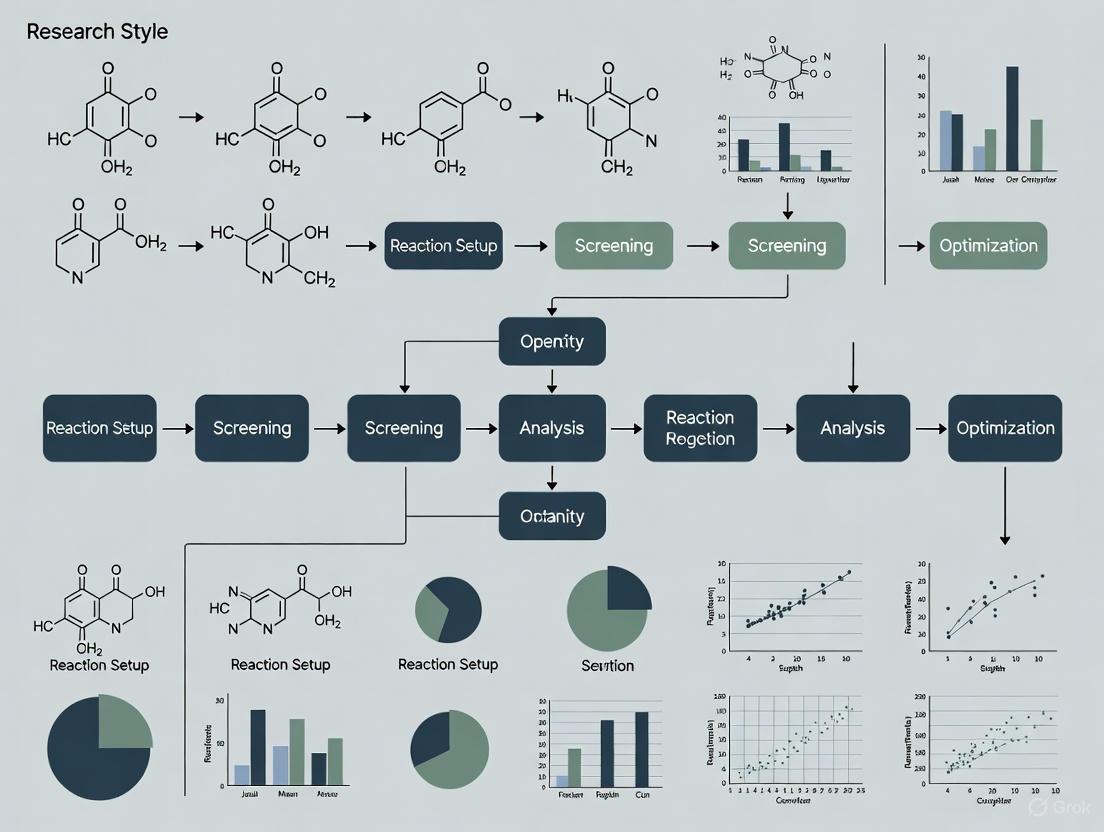
High-Throughput Experimentation (HTE) has emerged as a transformative force in organic synthesis, drastically accelerating reaction discovery and optimization for researchers and drug development professionals.
Transforming Organic Synthesis: A Comprehensive Guide to High-Throughput Experimentation Workflows
Abstract
High-Throughput Experimentation (HTE) has emerged as a transformative force in organic synthesis, drastically accelerating reaction discovery and optimization for researchers and drug development professionals. This article provides a comprehensive analysis of modern HTE workflows, from foundational principles of miniaturization and parallelization to advanced integration with flow chemistry and artificial intelligence. It explores practical applications across pharmaceutical and materials chemistry, addresses key challenges in reproducibility and data management, and validates the approach through comparative case studies. By synthesizing the latest methodologies and future-facing trends, this guide serves as an essential resource for scientists seeking to implement robust, data-driven HTE platforms to shorten development cycles and drive innovation in biomedical research.
HTE Foundations: Core Principles and Evolving Landscape in Modern Organic Chemistry
High-Throughput Experimentation (HTE) represents a paradigm shift in research methodology, fundamentally restructuring traditional scientific approaches through the integrated application of miniaturization, parallelization, and automation. This framework enables the rapid execution of hundreds to thousands of parallel experiments, dramatically accelerating the pace of discovery and optimization in fields ranging from organic synthesis to drug development [1] [2]. By generating vast, rich datasets, HTE provides the empirical foundation necessary for advanced data analysis and machine learning applications, creating a powerful, iterative cycle of experimentation and learning. This whitepaper examines the core technical principles of HTE and their role in constructing efficient workflows for modern scientific research.
High-Throughput Experimentation (HTE) is a sophisticated process of scientific exploration that leverages lab automation, effective experimental design, and rapid parallel or serial experiments to accelerate research and development [2]. In the specific context of organic synthesis and methodology development, HTE serves as a valuable tool for generating diverse compound libraries, optimizing reaction conditions, and collecting high-quality data for machine learning applications [1]. The power of HTE lies in its synergistic combination of three fundamental principles: miniaturization, parallelization, and automation. When effectively implemented, this approach produces a wealth of experimental data that forms the foundation for robust technical decisions, ultimately leading to more efficient and innovative scientific outcomes.
Core Fundamental Principles
Miniaturization
Miniaturization involves the systematic reduction in the physical scale at which experiments are performed. This is not merely a matter of convenience but a critical strategy for enhancing research efficiency and scope.
Miniaturization technologies are categorized by scale, each offering distinct advantages [3]:
- Mini-scale: Several millimeters or microliters (μL).
- Micro-scale: A few millimeters down to 50 micrometers, processing samples from a few μL to 10 nanoliters (nL).
- Nano-scale: Below 50 micrometers, with sample sizes below 10 nL, even reaching picoliter (pL) or femtoliter (fL) levels.
The primary benefit of miniaturization is the drastic reduction in the consumption of often costly and precious biological and chemical reagents and samples [3]. This reduction, in turn, enables higher throughput assays through massive parallelization and multiplex detection modes. Furthermore, miniaturization promotes the development of novel procedures with simpler handling protocols. The most common miniaturized platforms include microplates, microarrays, nanoarrays, and microfluidic (lab-on-a-chip) devices [3].
Table 1: Miniaturization Platforms in HTE
| Platform | Scale/Format | Key Characteristics | Common Applications |
|---|---|---|---|
| Microplates [3] | 96, 384, 1536 wells | Standardized format, amenable to automation, well-established instrumentation. | Primary screening, enzymatic assays, cell-based assays. |
| Microarrays [3] | Spots at densities of 1000s/cm² | High feature density, minimal reagent use. | Multiplexed screening of biomolecular interactions. |
| Nanoarrays [3] | Features at densities 10⁴-10⁵ higher than microarrays | Ultra-high throughput, extremely low reagent consumption. | High-density screening, fundamental studies at single-molecule level. |
| Microfluidics (Lab-on-a-Chip) [3] | Microchannels (nanometers to hundreds of micrometers) | High performance, integration of multiple process steps, precise fluid control, low reagent consumption. | Complex assay automation, continuous-flow analysis, diagnostics. |
Parallelization
Parallelization is the simultaneous execution of multiple experimental reactions or assays. This principle is the direct engine of high throughput, allowing for the exponential increase in data acquisition compared to traditional sequential (one-at-a-time) experimentation.
In practice, parallelization is achieved through hardware designed to handle many reactions at once. This includes robotics, rigs, and reactors with multiple parallel vessels. In materials science and catalysis, for instance, HTE often focuses on equipment with a limited reactor parallelization (e.g., 4 to 16 reactors) that use conditions allowing for easier scale-up, striking a balance between throughput and practical relevance [2]. The combinatorial approach, while powerful, can become intractable for some material science applications, necessitating more selective experimental designs informed by techniques like active learning [2].
The core advantage of parallelization is the ability to test multiple hypotheses in parallel, which has produced an exponential increase in data generation [2]. This allows researchers to explore a broader experimental space—such as varying catalysts, ligands, solvents, and temperatures—in a single, coordinated campaign rather than over an extended period.
Automation
Automation replaces manual, repetitive tasks with electromechanical systems and sophisticated software, ensuring consistency, reproducibility, and operational efficiency throughout the HTE workflow. It is the critical enabling technology that makes large-scale, miniaturized, and parallelized experimentation feasible.
Automation in HTE encompasses both hardware and software components [2]:
- Hardware: Robotics, liquid handlers, solid dispensers, multichannel pipettors, and automated analytical instruments. Vendors such as Tecan, Hamilton, and Molecular Devices provide transformational hardware for biological and chemical HTE [2].
- Software: This includes computational methods for Design of Experiments (DOE), and informatics infrastructure for data capture and management. Effective automation requires an appropriate IT and informatics infrastructure to fully capture all data in a FAIR (Findable, Accessible, Interoperable, Reusable)-compliant fashion [2].
Automation enhances reproducibility by minimizing human error and variation. It also fuels efficiency, allowing laboratories to "accomplish more with less, and do it faster" [2]. Perhaps most importantly, by automating routine tasks, scientists are freed to focus on higher-value activities such as ideation, experimental design, and data interpretation.
The Integrated HTE Workflow for Organic Synthesis
The fundamental principles of HTE converge into a cohesive, iterative workflow that transforms the research cycle in organic synthesis. The diagram below illustrates this integrated process.
Experimental Protocol: A Generalized HTE Workflow
This protocol provides a template for executing an HTE campaign, adaptable to specific research goals.
1. Hypothesis and Experimental Design (DOE):
- Define the scientific question and objective (e.g., optimizing reaction yield, discovering new catalysts).
- Employ Design of Experiments (DOE) principles to systematically select the set of conditions to be tested. This replaces inefficient one-variable-at-a-time (OVAT) approaches and allows for the efficient exploration of complex variable interactions [2].
- Identify the factors (e.g., temperature, concentration, solvent, catalyst) and their respective ranges.
2. Reaction Setup and Library Design:
- Prepare stock solutions of reagents, catalysts, and solvents.
- Utilize automated liquid handlers or dispensers to accurately transfer nanoliter to microliter volumes into reaction vessels (e.g., wells in a 384-well microplate) according to the DOE plan [3].
- This stage is critical for ensuring the accuracy and reproducibility of the entire experiment.
3. Miniaturized and Parallelized Execution:
- Reactions are run simultaneously in a parallelized format (e.g., in a microplate block or multiple microreactors) [2] [3].
- Conditions such as temperature and stirring are controlled uniformly across the platform.
4. Automated Reaction and Analysis:
- Upon completion, reaction mixtures are automatically quenched if necessary.
- Analysis is performed using high-throughput analytical methods, such as:
- High-Throughput LC-MS/GC-MS: Configured with automated sample injection from microplates.
- Plate-based Spectrophotometry: For colorimetric or fluorometric assays (common in enzymatic activity screening) [3].
- The output is raw analytical data (e.g., chromatograms, spectra) for each reaction vessel.
5. Data Capture and Management:
- All experimental data, including reaction parameters (inputs) and analytical results (outputs), are automatically captured and stored in a FAIR-compliant data environment [2].
- This typically involves the use of Electronic Lab Notebooks (ELNs) and Laboratory Information Management Systems (LIMS) to create a structured, queryable database [2]. Proper data management at this stage is essential for future analysis and machine learning.
6. Data Analysis, Visualization, and Insight Generation:
- Raw data is processed to calculate key performance metrics (e.g., conversion, yield, enantiomeric excess).
- Data visualization techniques are employed to identify patterns, trends, and outliers [4] [5] [6]. Effective visualization is crucial for interpreting the high-dimensional data generated by HTE.
- Results are analyzed to validate or refute the initial hypothesis, leading to new insights and the refinement of predictive models, thus informing the next cycle of experimentation.
Data Management and Visualization in HTE
The massive datasets generated by HTE present both an opportunity and a challenge. Effective data management and visualization are not final steps but integral components of the HTE workflow.
The FAIR Data Principle
Managing HTE data requires an informatics infrastructure designed for volume and complexity. The core modern standard is the FAIR principle, which dictates that data must be Findable, Accessible, Interoperable, and Reusable [2]. Establishing a FAIR-compliant data environment dramatically reduces the effort spent on data wrangling and allows scientists to focus on ideation and design, leading to better experiments and outcomes. This often involves integrating Electronic Lab Notebooks (ELNs) and Laboratory Information Management Systems (LIMS) to manage the request, sample, experiment, test, analysis, and reporting workflows [2].
Visualizing High-Dimensional HTE Data
Data visualization transforms complex numerical data into accessible visual narratives, which is essential for interpreting HTE results and communicating findings [4] [6]. The human brain processes visual information far more efficiently than raw numbers, making visualization key to identifying trends, correlations, and outliers [5] [6].
Best Practices for HTE Data Visualization:
- Know Your Audience and Message: Tailor the complexity and technical depth of the visualization to the expertise of the researchers or stakeholders [5] [7].
- Select the Right Chart Type: Choose visual encodings that match the data's structure and the insight you wish to convey [4] [5].
- Bar Charts: Ideal for comparing quantitative results across different categorical conditions (e.g., yield across different catalysts) [4] [6].
- Line Charts: Effective for displaying trends over a continuous variable like time or temperature [4] [6].
- Scatter Plots: Essential for exploring correlations between two continuous variables (e.g., yield vs. catalyst loading) [4].
- Heatmaps: Powerful for visualizing large matrices of data, such as reaction outcomes across two variables (e.g., solvent vs. ligand), using color intensity to represent values [4] [6].
- Use Color Strategically: Utilize color palettes that are appropriate for the data type (qualitative, sequential, or diverging) and ensure sufficient contrast for readability [5]. Avoid using color in a way that may mislead the viewer.
- Maintain Accuracy and Simplicity: Avoid "chartjunk"—unnecessary graphical elements that clutter the visualization. Ensure that scales are not distorted, which can misrepresent the underlying data [5] [6] [7].
The entire data lifecycle within an HTE context, from capture to actionable insight, can be visualized as follows:
Implementing a successful HTE program requires a suite of specialized tools and reagents. The following table details key components of the HTE research toolkit.
Table 2: Essential Research Reagent Solutions and Materials for HTE
| Category | Item/Solution | Function in HTE Workflow |
|---|---|---|
| Automation Hardware | Liquid Handling Robots | Precisely dispenses nanoliter to microliter volumes of reagents and solvents into microplates or microreactors, enabling miniaturization and parallelization [2]. |
| Solid Dispensers | Accurately weighs and dispenses small, precise amounts of solid reagents (catalysts, bases, etc.) into reaction vessels [2]. | |
| Microplate Readers | Performs high-speed spectrophotometric measurements (absorbance, fluorescence) for plate-based assays, often used in enzymatic activity screening [3]. | |
| Reaction Platforms | Microplates (96 to 1536-well) | Standardized platforms for performing thousands of parallel chemical or biological reactions in a miniaturized format [3]. |
| Microreactors / Lab-on-a-Chip | Devices with microchannels that allow for controlled fluidics, reaction execution, and sometimes integrated analysis, offering high integration and low reagent use [3]. | |
| Informatics & Software | Electronic Lab Notebook (ELN) | Digitally captures experimental procedures, parameters, and observations, ensuring data is accessible and structured [2]. |
| Laboratory Information Management System (LIMS) | Tracks samples and manages workflow data, integrating with instrumentation to create a FAIR-compliant data environment [2]. | |
| Design of Experiments (DOE) Software | Assists in designing efficient and effective experimental arrays to maximize information gain while minimizing the number of experiments [2]. | |
| Analytical Tools | High-Throughput LC-MS/GC-MS | Provides rapid, automated chemical analysis for reaction mixture composition, yield, and purity determination across a large number of samples [2]. |
High-Throughput Experimentation is a transformative approach, fundamentally built upon the interdependent pillars of miniaturization, parallelization, and automation. This methodology enables an unprecedented rate of empirical data generation, which is critical for accelerating innovation in organic synthesis and drug discovery. The full potential of HTE is realized only when this data is managed within a FAIR-compliant informatics infrastructure and analyzed through effective visualization and data analysis techniques. As the field evolves, the integration of artificial intelligence and machine learning with HTE workflows promises to further refine experimental design, uncover deeper insights, and ultimately close the loop toward fully autonomous discovery, empowering researchers to solve increasingly complex scientific challenges [1] [2].
The Evolution from Traditional One-Variable-at-a-Time to Parallel Screening Approaches
The discovery and optimization of chemical reactions represent a fundamental challenge in organic synthesis, historically addressed through labor-intensive, time-consuming experimentation. Traditional approaches have been dominated by the one-variable-at-a-time (OVAT) methodology, where reaction variables are modified individually while keeping all other parameters constant to find optimal conditions for a specific reaction outcome [8]. This linear methodology, while straightforward, possesses significant limitations as it disregards the intricate interactions among competing variables within complex synthesis processes [8]. In recent years, a profound paradigm change in chemical reaction optimization has been enabled by concurrent advances in laboratory automation, artificial intelligence, and the strategic implementation of parallel screening approaches [8].
This evolution from sequential to parallel experimentation represents more than merely a technical improvement—it constitutes a fundamental restructuring of the scientific method as applied to chemical synthesis. The emerging methodology allows researchers to navigate high-dimensional parametric spaces efficiently, uncovering optimal conditions that balance multiple competing objectives such as yield, selectivity, purity, cost, and environmental impact [8]. Within the context of high-throughput experimentation (HTE) workflows for organic synthesis research, this transition has been particularly transformative, enabling the rapid exploration of chemical space that would be practically inaccessible through traditional OVAT approaches. The implementation of parallel screening has become especially crucial in drug discovery pipelines, where the efficient identification and optimization of lead compounds can significantly accelerate the development of new therapeutic agents [9].
Limitations of Traditional One-Variable-at-a-Time Approaches
The one-variable-at-a-time approach to reaction optimization, while methodologically straightforward, suffers from several critical limitations that become particularly pronounced when addressing complex chemical systems. The most significant drawback lies in its inability to detect interactions between variables. By examining factors in isolation, OVAT methodologies inherently miss synergistic or antagonistic effects between parameters such as temperature, concentration, catalyst loading, and solvent composition [8]. This limitation can lead researchers to identify local optima that fall far short of the global optimum for a given reaction system.
Furthermore, the OVAT approach is exceptionally resource-intensive, requiring substantial time, material, and human resources to systematically explore even moderately complex parameter spaces [8]. For a reaction with just five variables, each examined at only five levels, the OVAT methodology would require 25 experiments if no interactions are present—and far more if proper replication is included. This experimental burden creates practical constraints on how thoroughly chemical space can be explored, potentially causing researchers to miss superior reaction conditions that lie outside the narrowly defined search paths.
The sequential nature of OVAT experimentation also significantly prolongs optimization timelines, creating bottlenecks in research and development pipelines [8] [10]. Each experimental cycle requires completion, analysis, and planning before the subsequent variable can be addressed, resulting in protracted development cycles that delay process implementation and scale-up. This sequential constraint is particularly problematic in drug discovery, where accelerated timelines can have substantial implications for therapeutic development and patient access to new treatments [9].
The Rise of Parallel Screening Methodologies
Fundamental Principles and Definitions
Parallel screening represents a fundamentally different approach to experimental design and execution, characterized by the simultaneous evaluation of multiple experimental conditions rather than their sequential examination. In the context of chemical synthesis, HTE is defined as a technique that "leverages a combination of automation, parallelization of experiments, advanced analytics, and data processing methods to streamline repetitive experimental tasks, reduce manual intervention, and increase the rate of experimental execution in comparison to traditional manual experimentation" [8]. This methodology enables researchers to efficiently explore multidimensional parameter spaces by executing numerous experiments in parallel, dramatically reducing optimization timelines while providing a comprehensive view of variable interactions and their effects on reaction outcomes [8].
The conceptual framework for parallel screening extends beyond mere parallel execution of experiments to incorporate adaptive experimentation strategies, where results from initial experimental arrays inform the selection of subsequent conditions [11]. This creates an iterative, data-driven feedback loop that progressively refines understanding of the chemical system and converges more efficiently toward optimal conditions. The integration of machine learning algorithms further enhances this approach by predicting promising regions of chemical space to explore, effectively guiding the parallel screening process toward the most informative experiments [8].
Implementation Platforms and Technologies
The practical implementation of parallel screening methodologies has been enabled by specialized hardware and software systems designed specifically for high-throughput chemical experimentation. HTE platforms typically include liquid handling systems for reagent distribution, modular reactor systems capable of maintaining diverse reaction conditions, and integrated analytical tools for rapid product characterization [8]. These systems may operate in batch mode, where multiple discrete reactions proceed simultaneously in separate vessels, or in flow systems, where continuous processing enables additional dimensions of control and analysis [8].
Microtiter plates (MTP) have become foundational tools in parallel screening, with formats including 96, 384, 1536, or even 6144 individual wells enabling massive experimental parallelization [8] [9]. These platforms are particularly valuable for screening discrete compounds or catalysts across diverse reaction conditions, facilitating the rapid identification of "hits" that merit more detailed investigation [9]. Commercial HTE platforms such as the Chemspeed SWING robotic system exemplify this approach, offering integrated robotic systems with multiple dispense heads for precise delivery of reagents—including challenging materials like slurries—across dozens or hundreds of parallel reactions [8].
For even greater throughput, combinatorial approaches such as the "split and pool" methodology enable the synthesis and screening of extremely large compound libraries [9]. In this technique, solid supports or solutions are divided, subjected to different chemical transformations, then recombined in successive cycles, generating exponential diversity from linear experimental steps. When combined with DNA-encoding strategies—where library components are tagged with identifiable oligonucleotide sequences—combinatorial approaches enable the screening of libraries containing billions of distinct compounds, far beyond the practical limits of discrete parallel screening [9].
Quantitative Comparison: Traditional vs. Parallel Approaches
The efficiency advantages of parallel screening become quantitatively apparent when examining the experimental requirements for exploring complex parameter spaces or synthesizing diverse compound libraries. The table below compares the requirements for synthesizing a library of one billion compounds using parallel versus combinatorial approaches:
Table 1: Comparison of Synthesis Methods for a One-Billion Compound Library
| Parameter | Parallel Synthesis | Combinatorial Synthesis |
|---|---|---|
| Coupling Steps Required | 3 billion | 3,000 |
| Time Requirement | ~2,000 years (with 2 runs/day) | Reasonable time frame |
| Cost Estimate | $0.4-2 million (for 1 million compounds) | ~$200,000 |
| Library Encoding | Not required | DNA encoding beneficial |
The extraordinary difference in experimental requirements—3 billion coupling steps for parallel synthesis versus only 3,000 for combinatorial synthesis—highlight why parallel and combinatorial approaches have become indispensable in modern chemical research, particularly in drug discovery [9]. Similar efficiency advantages extend to the screening process itself, where parallel high-throughput screening (HTS) methods utilizing microtiter plates with 96 to 6144 wells enable the evaluation of thousands to hundreds of thousands of compounds per day, compared to the impractical timelines that would be required for individual assessment of each compound in a billion-member library [9].
Practical Implementation: Workflows and Experimental Design
Integrated Parallel Screening Workflow
The implementation of an effective parallel screening strategy follows a systematic workflow that integrates experimental design, execution, analysis, and iterative optimization. This process creates a closed-loop system where data from each experimental cycle informs subsequent design decisions, progressively refining understanding of the chemical system and converging toward optimal conditions.
Diagram 1: Parallel Screening Workflow
This workflow begins with careful design of experiments (DOE) to define the parameter space to be explored, followed by parallel reaction execution using HTE platforms [8]. Data collection through in-line or offline analytical tools enables reaction characterization, with subsequent mapping of collected data points against target objectives. Machine learning algorithms then process this information to predict promising regions for further exploration, selecting the next set of reaction conditions to evaluate [8]. This iterative cycle continues until optimal conditions are identified, achieving the desired balance between multiple competing objectives such as yield, selectivity, and cost.
Two-Tiered Screening and Optimization Strategy
For comprehensive reaction development, a two-tiered strategy implementing "breadth-first" screening followed by "depth-second" optimization has proven highly effective [11]. This approach first identifies promising candidate compounds or conditions through broad parallel screening, then subjects these hits to more focused optimization using adaptive experimentation methods.
Table 2: Two-Tiered Screening and Optimization Methodology
| Stage | Objective | Methods | Key Features |
|---|---|---|---|
| Tier 1: Broad Screening | Identify initial "hit" compounds/catalysts | Parallel screening of discrete candidates | Examines each candidate over concentration range; Implements early termination for hits |
| Tier 2: Focused Optimization | Refine conditions for each hit | Multidirectional Search (MDS) algorithms | Adaptive experimentation; Defines continuous search space; Navigates to local optimum |
In the first tier, the Parascreen module examines discrete candidates in parallel over a range of concentrations, implementing decision-making at two levels: (1) local evaluation, where yield-versus-time data are examined using pattern-matching to determine whether monitoring should continue or terminate, and (2) global evaluation, where candidates reaching user-defined thresholds are flagged as hits, with subsequent experiments at higher concentrations of the same candidate being deleted to conserve resources [11]. This approach efficiently prunes unproductive experimental pathways while focusing resources on the most promising candidates.
In the second tier, each hit compound undergoes refined condition optimization using multidirectional search (MDS) algorithms, which perform parallel adaptive experimentation within a defined continuous search space [11]. This methodology efficiently navigates complex parameter landscapes to identify local optima for each promising candidate identified in the initial screening phase.
The Scientist's Toolkit: Essential Research Reagent Solutions
Successful implementation of parallel screening methodologies requires specialized materials and equipment designed specifically for high-throughput experimentation. The table below details key research reagent solutions and their functions within HTE workflows:
Table 3: Essential Research Reagent Solutions for Parallel Screening
| Tool/Reagent | Function | Application Notes |
|---|---|---|
| Microtiter Plates | Parallel reaction vessels | 96, 384, 1536 wells; Compatible with automated liquid handling |
| Multipin Apparatus | Parallel synthesis on solid support | Peptide/epitope synthesis; Screening without cleavage from pins |
| DNA-Encoding Oligomers | Library component identification | Tags building blocks for sequence-based decoding |
| Automated Synthesizers | High-throughput compound production | Systems like Vantage (96-384 compounds in parallel) |
| Liquid Handling Robots | Precise reagent distribution | Nanoliter to microliter volumes; 96/384-channel heads |
These specialized tools enable the practical execution of parallel screening campaigns, with each component addressing specific challenges associated with miniaturization, parallelization, or analysis throughput. The selection of appropriate tools depends on specific research objectives, with considerations including reaction scale, analytical requirements, and the degree of automation integration desired [8] [9].
Case Studies and Applications in Organic Synthesis
Reaction Optimization in Pharmaceutical Development
Parallel screening methodologies have demonstrated particular utility in optimizing key transformations relevant to pharmaceutical development, including Suzuki–Miyaura couplings, Buchwald–Hartwig aminations, and other transition-metal-catalyzed processes that are highly sensitive to multiple reaction parameters [8]. In one implementation, a Chemspeed SWING robotic system equipped with two fluoropolymer-sealed 96-well metal blocks enabled the exploration of stereoselective Suzuki–Miyaura couplings, providing precise control over both categorical and continuous variables [8]. The integrated robotic system with a four-needle dispense head facilitated low-volume reagent delivery, including challenging slurry formulations, while parallelization of experimental workflows enabled completion of 192 reactions within 24 hours—a throughput rate practically unattainable through traditional OVAT approaches.
Similar parallel screening approaches have been successfully applied to diverse reaction classes including N-alkylations, hydroxylations, and photochemical reactions, demonstrating the broad applicability of HTE methodologies across diverse synthetic challenges [8]. In each case, the ability to simultaneously vary multiple parameters—including catalyst identity and loading, ligand structure, base strength, solvent composition, and temperature—enabled rapid identification of optimal conditions that might have been missed through sequential optimization approaches.
Catalyst Screening and Discovery
The search for novel catalysts represents another area where parallel screening methodologies have demonstrated significant advantages. In one approach, a mobile robot equipped with sample-handling arms was developed to execute photocatalytic reactions for water cleavage to produce hydrogen [8]. This system functioned as a direct replacement for human experimenters, executing tasks and linking eight separate experimental stations including solid and liquid dispensing, sonication, characterization equipment, and sample storage. Through a comprehensive ten-dimensional parameter search spanning eight days, the robotic system identified conditions achieving an impressive hydrogen evolution rate of approximately 21.05 µmol·h⁻¹ [8]. This systematic exploration of a complex parameter space would have been prohibitively time-consuming using traditional OVAT approaches, demonstrating how parallel screening can accelerate discovery in catalyst development.
The evolution from traditional one-variable-at-a-time to parallel screening approaches represents a fundamental transformation in how chemical research is conducted, enabling efficient exploration of complex parameter spaces that were previously practically inaccessible. This paradigm shift has been driven by advances in automation technologies, machine learning algorithms, and data analysis methods that collectively support the design, execution, and interpretation of parallel experimentation campaigns [8]. The resulting acceleration in reaction optimization and compound screening has been particularly transformative in drug discovery, where parallel and combinatorial methods have become essential for generating the diverse compound libraries needed to identify novel therapeutic agents [9].
Future developments in parallel screening will likely focus on increasing integration and adaptability across experimental platforms, enhancing the sophistication of decision-making algorithms, and improving data management practices for greater accessibility and shareability [8] [12]. The ongoing development of "self-driving" laboratories capable of autonomous experimentation with minimal human intervention represents the logical extension of current parallel screening methodologies, potentially further accelerating the pace of discovery in organic synthesis and related fields [8] [11].
As these technologies continue to evolve, parallel screening approaches will become increasingly central to chemical research, enabling more efficient exploration of chemical space while managing the complexity of multi-parameter optimization. This methodological evolution from sequential to parallel experimentation represents not merely a technical improvement, but a fundamental advancement in how we approach scientific discovery in chemistry, with implications for fields ranging from pharmaceutical development to materials science and beyond.
High-Throughput Experimentation (HTE) has emerged as a transformative approach in organic synthesis, radically accelerating reaction discovery, optimization, and the generation of robust chemical data. This technical guide details the core components of HTE workflows, framed within the context of modern organic synthesis research for drug development and materials science. By integrating advanced automation, data-rich experimentation, and intelligent analysis, HTE provides a structured framework to navigate complex chemical spaces efficiently.
Reaction Design and Workflow Planning
The foundation of a successful HTE campaign lies in meticulous reaction design and strategic workflow planning. This initial phase moves beyond traditional one-variable-at-a-time (OVAT) approaches to enable the concurrent exploration of a high-dimensional parameter space.
Strategic Experiment Design
Reaction design in HTE involves defining the objectives and rationally selecting which variables to screen. Key considerations include:
- Objective Definition: Clearly define the campaign's goal, whether it is reaction discovery, substrate scope exploration, or optimization of reaction conditions for yield, selectivity, or robustness [13].
- Variable Selection: A typical screen investigates multiple categorical variables simultaneously. For example, a catalytic reaction might screen arrays of catalysts, ligands, bases, and solvents to find optimal combinations [1] [13].
- Bias Mitigation and Serendipity: By testing a wide range of conditions, including those that might be counter-intuitive, HTE helps reduce human bias and promotes serendipitous discoveries [1].
- Inclusion of Negative Data: Deliberately incorporating potentially negative reactions based on expert rules (e.g., known steric hindrance effects) is crucial for generating datasets that are valuable for machine learning and understanding reaction boundaries [14].
Miniaturization and Parallelization
A core principle of HTE is the miniaturization and parallelization of reactions.
- Reaction Scale: HTE is conducted at dramatically reduced scales, typically in the microliter (96- or 384-well plates) to nanoliter (1536-well plates) range [13]. This enables significant reduction in material consumption, cost, and waste.
- Platforms: Reactions are performed in parallel arrays, most commonly in 96-well plates [13] or other multi-well formats. An emerging, ultra-high-throughput alternative uses DNA-encoded libraries, allowing for hundreds of thousands of reactions to be performed and analyzed simultaneously [15].
- Complementary Technologies: Flow chemistry serves as a powerful complementary tool to batch-based HTE, especially for reactions involving hazardous reagents, requiring pressurized conditions, or benefiting from superior heat and mass transfer [16].
The designed workflow must be carefully planned, including the layout of reaction plates and the integration of subsequent execution and analysis steps [13].
Reaction Execution and Automation Systems
The physical execution of HTE campaigns relies on integrated systems that ensure precision, reproducibility, and efficiency. Automation is a key enabler, handling tasks that are repetitive, prone to human error, or require operation in controlled environments.
Core Hardware Components
A modern HTE platform combines several automated modules:
- Solid Dosing Systems: Automated powder dispensing is critical for accuracy and efficiency. Systems like the CHRONECT XPR can dose a wide range of solids (from sub-milligram to several grams) with high precision (<10% deviation at low masses, <1% at >50 mg) and significantly reduce weighing time compared to manual operations [17].
- Liquid Handling Robots: These systems automate the dispensing of solvents, liquid reagents, and catalysts, ensuring consistent volumes across hundreds of reactions [13] [17].
- Reaction Environment Control: Experiments are often conducted within inert atmosphere gloveboxes to exclude moisture and oxygen, which is crucial for air- and moisture-sensitive chemistry [13] [17]. Agitation is provided by tumble stirrers or other systems to ensure proper mixing in small volumes [13].
- Reactor Blocks: Temperature-controlled blocks hold 96-well plates or vials, allowing parallel reactions to be run under defined thermal conditions [13].
Implementation and Impact
The integration of these components into a cohesive workflow is demonstrated by industrial and academic implementations:
- AstraZeneca's HTE Evolution: Over 20 years, AstraZeneca implemented global HTE capabilities, co-locating specialists with medicinal chemists to foster a cooperative model. This led to a dramatic increase in screening capacity, from ~20-30 screens per quarter to ~50-85, and the number of conditions evaluated surged from under 500 to about 2000 per quarter [17].
- Automated Chemical Synthesis Platform (AutoCSP): One study established an AutoCSP that integrated dispensing, transfer, reaction, and analysis functions. The platform successfully screened 432 organic reactions for the anticancer drug Sonidegib, demonstrating results comparable to manual operation but with superior consistency, providing high-quality data for AI analysis [18].
Table 1: Key Automation Hardware in HTE Workflows
| Component | Example System/Model | Key Function | Performance Specifications |
|---|---|---|---|
| Solid Dosing | CHRONECT XPR [17] | Automated powder dispensing | Range: 1 mg - several grams; Dosing time: 10-60 sec/component |
| Liquid Handling | Various liquid handlers [17] | Dispensing solvents & liquid reagents | Handles 96-well plate formats; precise µL-scale dispensing |
| Reaction Agitation | Tumble Stirrer (e.g., VP 711D-1) [13] | Homogeneous mixing in small vials | Consistent stirring in parallel format |
| Reactor System | Paradox reactor [13] | Parallel execution of reactions | Holds 96x 1mL vials with temperature control |
Analysis, Data Management, and Machine Learning
The value of an HTE campaign is fully realized only through robust analysis, effective data management, and the application of machine learning to extract predictive insights from the large datasets generated.
High-Throughput Analysis Techniques
Rapid, automated analysis is essential for evaluating the outcome of hundreds to thousands of experiments.
- Liquid Chromatography-Mass Spectrometry (LC-MS/UPLC-MS): This is the workhorse analytical technique for HTE. Platforms like the Waters Acquity UPLC are standard, allowing for the rapid determination of conversion, yield, and identification of byproducts [13] [14].
- Analysis Workflow: At the end of the reaction, samples are typically diluted automatically, often with a solution containing an internal standard (e.g., biphenyl) for semi-quantitative analysis. Aliquots are then transferred to a analysis plate for injection into the LC-MS [13].
- Alternative Ultra-High-Throughput Analysis: For DNA-encoded libraries, reaction outcomes are analyzed not by chromatography but by high-throughput DNA sequencing, which can decode the results of hundreds of thousands of reactions in a single run [15].
Data Management and Machine Learning
The data generated by HTE is a valuable asset for building predictive models.
- Datasets for AI: Large, self-generated HTE datasets are used to train machine learning models. For instance, one study created a dataset of 11,669 distinct acid-amine coupling reactions to train a Bayesian neural network model, which achieved 89.48% accuracy in predicting reaction feasibility [14].
- Uncertainty and Robustness: Advanced ML models can disentangle uncertainty, identifying whether a reaction is likely to fail due to its intrinsic chemistry or due to sensitivity to subtle environmental variations. This allows for the prediction of reaction robustness, a critical factor for scaling up industrial processes [14].
- Active Learning: ML models can guide subsequent experimental design. By analyzing prediction uncertainty, an active learning strategy can be implemented, which has been shown to reduce data requirements by up to 80% for effective model training [14].
Table 2: Core Analytical and Data Management Techniques in HTE
| Technique | Primary Function | Throughput & Scale | Key Outcome Measures |
|---|---|---|---|
| LC-MS/UPLC-MS [13] [14] | Quantitative reaction analysis | 96/384-well plates; ~minutes/sample | Conversion, yield (via AUC), byproduct formation |
| DNA Sequencing [15] | Analysis of DNA-encoded libraries | 504,000+ reactions in a single run | Relative reaction efficiency for vast condition matrices |
| Bayesian Deep Learning [14] | Predict feasibility & robustness | Trained on 10,000+ reactions | Feasibility accuracy, robustness estimation, uncertainty quantification |
| Random Forest Algorithm [18] | Data quality control & anomaly detection | Accurate anomaly identification (98.3%) | Identifies experimental outliers, ensures dataset integrity |
The Scientist's Toolkit: Essential Research Reagents and Materials
Successful HTE relies on a suite of specialized reagents, materials, and software tools that form the basic toolkit for researchers.
Table 3: Essential Research Reagent Solutions and Materials for HTE
| Item | Function/Description | Example/Specification |
|---|---|---|
| 96-Well Plate Reactor | Platform for running parallel reactions in microliter volumes. | 1 mL vials in an 8x12 array (e.g., Paradox reactor) [13]. |
| Condensation Reagents | Facilitate amide bond formation, a critical reaction in medicinal chemistry. | A set of 6 different reagents screened to find the optimal one for a given acid-amine pair [14]. |
| Photoredox Catalysts | Enable photochemical reactions by absorbing light and engaging in single-electron transfer. | A library of 24 catalysts screened for a fluorodecarboxylation reaction [16]. |
| Transition Metal Catalysts & Ligands | Core components for cross-coupling and other catalytic reactions. | Screened in arrays to identify active catalytic systems [13] [17]. |
| Internal Standard (e.g., Biphenyl) | Added post-reaction for semi-quantitative analysis by LC-MS. | Allows for calculation of relative yield/conversion based on Area Under the Curve (AUC) ratios [13]. |
| HTE Design Software | Software for designing the experiment layout and tracking variables. | In-house software (e.g., HTDesign) or commercial packages for planning reaction matrices [13]. |
Addressing Reproducibility Challenges Through Standardized Protocols and Automated Platforms
Reproducibility forms the cornerstone of the scientific method, yet synthetic chemistry faces significant challenges in this domain. Irreproducible synthetic methods consume substantial time, financial resources, and research momentum across both academic and industrial laboratories [19]. The manifestations of irreproducibility are varied, including fluctuations in reaction yields, inconsistent selectivity in organic transformations, and unpredictable performance of newly developed catalytic materials [19]. In materials chemistry, this problem is particularly acute, with quantitative analyses revealing that a substantial fraction of newly reported materials are synthesized only once, providing no opportunity to assess the reproducibility of their properties [20]. Within the specific context of metal-organic frameworks (MOFs) research, for example, significant variations in synthetic and characterization practices hinder comparative analysis and replication efforts [21]. The fundamental thesis of this whitepaper is that addressing these challenges requires a dual approach: implementing standardized reporting protocols and leveraging automated high-throughput experimentation (HTE) platforms, which together can transform reproducibility in organic synthesis research.
Quantitative Assessment of Reproducibility Challenges
A systematic analysis of synthesis reproducibility in materials chemistry reveals distinct patterns. Literature meta-analysis of metal-organic frameworks (MOFs) indicates that the frequency of repeat syntheses follows a power-law distribution, where the fraction θ(n) of materials synthesized exactly n times is modeled as θ(n) = fn^(-α), with f representing the fraction of materials synthesized only once [20]. This mathematical framework helps quantify the reproducibility challenge and identifies a small subset of "supermaterials" that are replicated far more frequently than the model predicts [20].
Table 1: Quantitative Analysis of Synthesis Reproducibility for Metal-Organic Frameworks (MOFs)
| Metric | Finding | Implication |
|---|---|---|
| Power-law parameter (f) | ~0.5 (50% of MOFs synthesized only once) [20] | Half of reported materials lack independent verification |
| Most replicated MOFs | Small number of "supermaterials" exceed predicted replication [20] | Highlights materials with exceptional reproducibility |
| UiO-66 synthesis variations | 10 different protocols across 10 publications [21] | Standardization lacking even for well-studied materials |
| Reaction concentration variance | 8-169 mmol L⁻¹ for UiO-66 syntheses [21] | Critical parameters vary widely between laboratories |
| BET surface area variance | 716-1456 m² g⁻¹ for UiO-66 [21] | Material properties differ significantly between batches |
The observed variations in synthetic protocols for even well-established materials like UiO-66 demonstrate the standardization deficit in the field. Across ten recent publications examining UiO-66 for biomedical applications, researchers employed different reaction stoichiometries (varying from 1:1 to 1:4.5 metal-to-ligand ratios), different modulators (acetic acid, HCl, formic acid, benzoic acid, or none), and significantly different reaction concentrations [21]. These synthetic discrepancies naturally lead to variations in key material properties such as particle size, porosity, and defectivity, which subsequently influence experimental outcomes and application performance [21].
Standardized Reporting Protocols for Enhanced Reproducibility
Comprehensive Procedural Documentation
Standardized reporting represents the foundational element of reproducible synthesis. Leading journals and organizations have established detailed guidelines to ensure critical experimental parameters are documented. Organic Syntheses, for instance, requires procedures with significantly more detail than typical journals, including explicit specifications for reaction setup—describing the size and type of flask, how every neck is equipped, drying procedures, and atmosphere maintenance methods [22]. Specific requirements include avoiding balloons for inert atmospheres in most cases, defining room temperature and vacuum pressures explicitly, and providing justification when specialized equipment like gloveboxes is employed [22]. Furthermore, they mandate that authors identify the most expensive reagent or starting material and estimate its cost per run, with a general threshold of $500 for any single reactant in a full-scale procedure [22].
Reagent and Characterization Standards
Complete documentation of reagent sources and purification methods is essential for reproducibility. Authors must indicate the purity or grade of each reagent, its commercial source (particularly for chemicals where trace impurities may vary between suppliers), and detailed descriptions of any purification, drying, or activation procedures [22]. For characterization, sufficient data must be provided to support claims and confirm the identity and purity of molecules and materials produced [19]. This includes peak listings, solvent information, and spectra for spectroscopic analyses, with raw data files ideally provided in non-proprietary formats to enable comparison [19]. When quantitative NMR is employed for purity determination, the internal standard must be identified and calculation-printed spectra included [22].
Data Accessibility and Code Sharing
Enhancing reproducibility requires making underlying data and analysis methods accessible. Nature Synthesis, for example, mandates data availability statements describing how research data can be accessed and encourages deposition in repositories rather than "available on request" status [19]. When unpublished code or software central to the work is developed, authors must adhere to specific code and software guidelines, release the associated version upon publication, and deposit it at a DOI-minting repository [19]. These practices ensure that both the experimental and computational aspects of research can be examined and replicated by the community.
Automated Platforms and High-Throughput Experimentation
Intelligent Automated Synthesis Platforms
Automation and high-throughput techniques provide a technological foundation for addressing reproducibility challenges while dramatically increasing research efficiency. Intelligent automated platforms for high-throughput chemical synthesis offer distinctive advantages of low consumption, low risk, high efficiency, high reproducibility, high flexibility, and excellent versatility [23]. These systems integrate various capabilities including automated combinatorial materials synthesis, high-throughput screening, and optimization for large-scale data generation [24]. At Pacific Northwest National Laboratory (PNNL), for instance, HTE equipment enables researchers to perform more than 200 experiments per day—a dramatic increase from the handful possible with manual approaches—while maintaining comprehensive data tracking [24]. These systems typically include solid dispensers, liquid handlers with positive displacement pipetting for viscous liquids/slurries, capping/uncapping stations, on-deck magnetic stirrers with heating/cooling, vortex mixers, centrifuges, and multiple optimization sampling reactors [24].
Universal Chemical Programming Languages
A transformative approach to standardization involves the development of universal chemical programming languages. Recent work demonstrates the use of χDL (chiDL), a human- and machine-readable language that standardizes synthetic procedures and enables their execution across automated synthesis platforms [19]. This language allows synthetic procedures to be encoded and performed across different automated platforms, as demonstrated through transfers between systems at the University of British Columbia and the University of Glasgow [19]. The approach enables synthetic procedures to be shared and validated between automated synthesis platforms in host-to-peer or peer-to-peer transfers, similar to BitTorrent data file sharing, establishing a framework for truly reproducible protocol distribution [19].
Integrated HTE Workflows and Data Management
Complete HTE workflows support researchers from experiment submission through to results presentation. Systems like HTE OS provide open-source, freely available workflows that integrate reaction planning, execution, and data analysis [25]. These platforms typically utilize core spreadsheets for reaction planning and communication with robotic systems, while funneling all generated data into analysis environments where users can process and interpret results [25]. The workflow includes tools for parsing LCMS data and translating chemical identifiers, providing essential data-wrangling capabilities to complete the experimental cycle [25]. When applied to organic synthesis and methodology development, these integrated systems help address challenges posed by diverse workflows and reagents through standardized protocols, enhanced reproducibility, and improved efficiency [1].
Integrated Framework: Connecting Standardization and Automation
The power of standardized protocols and automated platforms multiplies when these elements are integrated into a cohesive workflow. The combination creates a virtuous cycle where standardized reporting informs automated execution, which in turn generates consistent data that further refines standards. This integration represents the future of reproducible synthetic research.
This integrated workflow demonstrates how standardized protocols become machine-readable through digital encoding using systems like χDL, enabling seamless transfer between automated HTE platforms. The automated execution generates high-quality, reproducible data that serves dual purposes: validating and refining community standards while simultaneously training AI/ML models for reaction optimization. These models, in turn, provide predictive insights that further enhance standardized protocols, creating a continuous improvement cycle for synthetic reproducibility.
The Scientist's Toolkit: Essential Research Reagent Solutions
Table 2: Essential Components for Reproducible High-Throughput Experimentation
| Component | Function | Implementation Example |
|---|---|---|
| Liquid Handling Systems | Precise reagent dispensing with minimal cross-contamination | Positive displacement pipetting for viscous liquids/slurries [24] |
| Solid Dispensers | Automated powder weighing and distribution | Modular robotic platforms with analytical balance [24] |
| Reaction Stations | Controlled environment for parallel reactions | Multi-well microarray substrates with stirring and heating/cooling [24] |
| Universal Chemical Language | Standardized protocol sharing across platforms | χDL for human- and machine-readable procedures [19] |
| Open-Source HTE Software | Integrated workflow management | HTE OS for experiment submission to results presentation [25] |
| High-Throughput Analysis | Rapid characterization of reaction outcomes | Compatible property measurements (solubility, conductivity, etc.) [24] |
Implementation of these toolkit components requires careful consideration of system configuration. For general experiments, modular robotic platforms operated in nitrogen purge boxes provide flexibility, while for highly sensitive experiments, completely configurable systems within argon glove boxes maintain appropriate environments [24]. The integration of these components enables the characterization of basic physical properties such as solubility, conductivity, and viscosity alongside electrochemical measurements, providing comprehensive data for reaction optimization and validation [24].
The convergence of standardized reporting protocols and automated high-throughput platforms presents a transformative opportunity for addressing longstanding reproducibility challenges in synthetic chemistry. Through comprehensive documentation standards, universal chemical programming languages, and integrated robotic systems, the research community can establish a new paradigm of reproducible synthesis. The power-law model of material resynthesis suggests that systematic efforts to increase replication rates could significantly enhance the reliability of synthetic research [20]. Future developments will likely focus on increasingly intelligent platforms that leverage artificial intelligence techniques not just for execution, but for synthetic route design and outcome prediction [23]. As these technologies mature and become more accessible, they will reshape traditional disciplinary approaches, promote innovative methodologies, redefine the pace of chemical discovery, and ultimately transform materials manufacturing processes across pharmaceutical, energy storage, and specialty chemicals sectors.
The discovery and optimization of organic synthetic routes are fundamental to progress in the pharmaceutical, materials, and agricultural industries. Historically, this process has been characterized by labor-intensive, time-consuming experimentation guided primarily by human intuition and one-variable-at-a-time (OVAT) approaches. This traditional methodology requires exploring high-dimensional parametric spaces and presents a significant bottleneck in the iterative design–make–test–analyze (DMTA) cycle [26]. However, a profound paradigm shift is occurring, driven by the convergence of high-throughput experimentation (HTE) and data-driven machine learning (ML) algorithms. This transformation enables multiple reaction variables to be synchronously optimized, significantly reducing experimentation time and minimizing human intervention [26]. The bridging of academic research and industrial implementation represents the most significant advancement in synthetic methodology in decades, moving the field from artisanal practice to automated, data-driven science.
Core Methodologies: HTE and Machine Learning Integration
High-Throughput Experimentation Platforms
HTE has emerged as a foundational technology for systematically interrogating reactivity across diverse chemical spaces. Modern HTE platforms leverage lab automation to execute thousands of reactions in parallel, generating expansive datasets that capture complex relationships between reaction components and outcomes [27]. These platforms provide several distinct advantages over traditional approaches:
- Broad Reaction Space Exploration: HTE enables comprehensive investigation of numerous variables simultaneously, including catalysts, solvents, bases, temperatures, and concentrations, across hundreds to thousands of discrete experiments [27].
- Valuable Negative Data: Unlike conventional literature sources that predominantly report successful reactions, HTE datasets capture valuable failure data that provide crucial boundaries for reaction feasibility [27].
- Real-World Relevance: HTE data typically samples reaction spaces of direct interest to medicinal and process chemistry, ensuring that data-driven findings possess immediate practical relevance [27].
Recent disclosures of large-scale HTE datasets, such as the release of over 39,000 previously proprietary HTE reactions covering cross-coupling reactions and chiral salt resolutions, have dramatically improved the data landscape for method development [27].
Machine Learning Algorithms for Reaction Optimization
Machine learning algorithms serve as the analytical engine that transforms HTE data into predictive models and actionable chemical insights. Several ML approaches have demonstrated particular utility for reaction optimization:
- Random Forests: These non-linear algorithms effectively handle the complex, interdependent nature of reaction parameters without requiring data linearization, providing robust variable importance metrics that identify which reaction components (catalysts, solvents, etc.) most significantly influence outcomes [27].
- Bayesian Optimization: This sequential design strategy efficiently navigates high-dimensional parameter spaces to identify optimal reaction conditions with minimal experimentation, benefiting from literature-informed initializations that outperform random sampling [28].
- Multi-label Classification: This approach predicts multiple condition components simultaneously, treating condition recommendation as a structured output problem over a fixed set of reaction roles [28].
- Sequence-to-Sequence Models: These models generate structured condition recommendations using open vocabularies (e.g., SMILES strings), providing flexibility beyond predefined chemical lists [28].
Table 1: Key Machine Learning Approaches in Reaction Optimization
| Algorithm Type | Primary Function | Advantages | Limitations |
|---|---|---|---|
| Random Forests | Variable importance analysis | Handles non-linear data; No requirement for linearization | Limited extrapolation beyond training data |
| Bayesian Optimization | Efficient parameter space navigation | Minimal experiments required; Excellent for optimization campaigns | Requires careful initialization; Computationally intensive |
| Multi-label Classification | Predicts multiple condition components | Structured outputs; Handles fixed reaction roles | Limited to predefined chemical lists |
| Sequence-to-Sequence Models | Generates agent identities | Open vocabulary; Potential for novel agent prediction | May generate impractical or non-executable suggestions |
Analytical Frameworks: Extracting Chemical Insights from HTE Data
The HiTEA Statistical Framework
The High-Throughput Experimentation Analyzer (HiTEA) represents a significant advancement in statistical frameworks for extracting chemical insights from HTE datasets. HiTEA employs three orthogonal statistical methodologies that work in concert to elucidate the hidden "reactome" – the complex network of relationships between reaction components and outcomes [27]:
- Random Forests identify which reaction variables (catalyst, solvent, temperature, etc.) exert the most significant influence on reaction outcomes, answering the question: "Which variables are most important?" [27]
- Z-score ANOVA-Tukey analysis pinpoints statistically significant best-in-class and worst-in-class reagents, enabling robust performance comparisons across chemical classes [27].
- Principal Component Analysis (PCA) visualizes how these best-in-class and worst-in-class reagents populate the chemical space, revealing clustering patterns and selection biases within datasets [27].
This combination of statistical analyses requires no assumptions about underlying data structure, accommodates non-linear and discontinuous relationships, and functions effectively with the sparse, non-combinatorial data typical of chemical datasets [27].
The QUARC Framework for Quantitative Condition Recommendation
Bridging the gap between qualitative recommendations and executable procedures, the QUARC (QUAntitative Recommendation of reaction Conditions) framework extends condition prediction beyond agent identities and temperature to include quantitative details essential for experimental execution [28]. QUARC formulates condition recommendation as a four-stage prediction task:
- Agent Identity Prediction: Identifying suitable catalysts, solvents, and additives.
- Temperature Prediction: Recommending optimal reaction temperatures.
- Reactant Amount Prediction: Determining appropriate equivalence ratios for reactants.
- Agent Amount Prediction: Specifying quantities for non-reactant components [28].
This sequential inference approach captures natural dependencies between conditions (e.g., temperature selection depends on catalyst identity) while maximizing data usage across incomplete reaction records [28]. The framework's reaction-role agnosticism avoids ambiguities in classifying chemical agents and provides structured outputs readily convertible into executable instructions for automated synthesis platforms [28].
QUARC Workflow: Sequential prediction pipeline for quantitative reaction conditions.
Research Reagent Solutions
Successful implementation of HTE workflows requires specialized materials and platforms designed for high-throughput screening. The table below details essential components of a modern HTE toolkit:
Table 2: Essential Research Reagent Solutions for HTE Workflows
| Tool/Reagent | Function | Implementation Role |
|---|---|---|
| Automated Synthesis Platforms | Parallel reaction execution | Enables rapid empirical testing of thousands of reaction conditions [26] |
| Broad Catalyst/Ligand Libraries | Diverse metal complexes and organocatalysts | Provides structural diversity for discovering optimal catalytic systems [27] |
| Solvent Collections | Diverse polarity, coordinating ability, and green credentials | Screens solvent effects on yield and selectivity [27] |
| HTE Reaction Blocks | Specialized vessels for parallel reactions | Standardizes format for automated screening campaigns [27] |
| Analytical Integration | HPLC, GC-MS, SFC for rapid analysis | Provides high-throughput outcome quantification [27] |
Data Processing and Visualization Tools
Effective data management and visualization are critical for interpreting HTE results. Key computational tools include:
- Color Palette Generators: Specialized tools for creating perceptually uniform color schemes that ensure accessibility (WCAG 2.1 contrast ratios of at least 4.5:1) and effective data visualization [29].
- Statistical Analysis Packages: Implementations of PCA, random forests, and ANOVA for identifying significant trends and outliers in multivariate HTE data [27].
- Chemical Space Visualization: Dimensionality reduction techniques (PCA, t-SNE) for mapping reagent relationships and performance clusters [27].
Case Studies: Successful Academic-Industrial Integration
Cross-Coupling Reaction Optimization
The application of HiTEA to Buchwald-Hartwig coupling datasets comprising approximately 3,000 reactions demonstrated the framework's ability to extract nuanced structure-activity relationships [27]. The analysis confirmed the known dependence of yield on ligand electronic and steric properties while also identifying unexpected reagent interactions that would be difficult to detect through traditional experimentation [27]. Temporal analysis of the dataset revealed evolving best-practice conditions while demonstrating that inclusion of historical data expands the investigational substrate space, ultimately providing a more comprehensive understanding of the reaction class [27].
QUARC Performance Evaluation
In comparative studies, the QUARC framework demonstrated modest but consistent improvements over popularity-based and nearest-neighbor baselines across all condition prediction tasks [28]. The model's practical utility was particularly evident in its ability to recommend viable conditions for diverse reaction classes, including those with limited precedent in the training data [28]. By incorporating quantitative aspects of reaction setup, QUARC provides more actionable recommendations than models limited to qualitative agent identification, effectively bridging the specificity gap between retrosynthetic planning and experimental execution [28].
HTE-ML Integration: Cyclical workflow from data generation to industrial implementation.
Challenges and Future Directions
Despite significant progress, several challenges remain in fully bridging academic research and industrial implementation:
- Data Quality and Standardization: Yield calculations in HTE are often derived from uncalibrated ultraviolet absorbance ratios, making measurements more qualitative than quantitative nuclear magnetic resonance spectroscopy or isolated yield determinations [27].
- Dataset Biases: HTE datasets may be subject to selection biases in reactant and condition choice, creating regions of substantial data sparsity that limit model generalizability [27].
- Interpretability Gap: While models can successfully predict high-performing conditions, translating these predictions into fundamental chemical principles and mechanistic understanding remains challenging [27].
- Integration with Automated Synthesis: Converting model recommendations into executable code for robotic platforms requires additional layers of translation and validation [28].
Future developments will likely focus on closing the loop between prediction and experimental validation through autonomous discovery systems, improving model interpretability to extract novel chemical insights, and developing standardized protocols for data sharing and comparison across institutions [26] [27]. As these technologies mature, the bridge between academic research and industrial implementation will strengthen, fundamentally transforming how organic molecules are designed and synthesized.
Advanced HTE Methodologies and Real-World Applications in Drug Discovery and Development
High-Throughput Experimentation (HTE) has fundamentally transformed the landscape of organic synthesis research, enabling a paradigm shift from traditional one-variable-at-a-time (OVAT) approaches to massively parallelized experimentation. This evolution is characterized by the progressive miniaturization and automation of reaction platforms, moving from established 96-well plate systems to advanced 1536-well nanoscale configurations. Within organic chemistry, HTE serves as a powerful tool for accelerating reaction discovery, optimizing synthetic methodologies, and generating comprehensive datasets for machine learning applications [1] [13]. The core principle of HTE involves the miniaturization and parallelization of chemical reactions, allowing researchers to explore a vast experimental space—encompassing catalysts, solvents, reactants, and conditions—with unprecedented speed and efficiency while conserving valuable resources [12].
The drive toward miniaturization, from microliter volumes in 96-well plates to nanoliter-scale reactions in 1536-well systems, is motivated by the need to enhance screening efficiency, reduce material consumption, lower costs, and minimize chemical waste [13] [30]. This transition is particularly crucial in fields like pharmaceutical development, where HTE has proven instrumental in derisking the drug discovery and development (DDD) pipeline by enabling the rapid testing of numerous relevant molecules [13]. Furthermore, the standardized, reproducible datasets generated by HTE workflows are invaluable for building predictive models that augment chemist intuition and guide the development of new synthetic methodologies [31] [1]. This technical guide examines the architecture, capabilities, and applications of different HTE platform configurations, providing a framework for their implementation in modern organic synthesis research.
Core HTE Platform Specifications and Comparisons
Quantitative Comparison of HTE Platforms
The choice of HTE platform is a critical determinant of experimental strategy, impacting throughput, resource requirements, and operational complexity. The following table summarizes the key specifications of standard HTE formats.
Table 1: Technical Specifications of Standard HTE Platform Configurations
| Platform Format | Well Volume Range | Well Count | Typical Reaction Scale | Primary Applications & Notes |
|---|---|---|---|---|
| 96-Well Plate | ~300 μL [16] | 96 | Micromole scale [13] | Standard Screening: Accessible, semi-manual or automated; ideal for initial reaction discovery and optimization [13]. |
| 384-Well Plate | Information missing | 384 | Information missing | High-Throughput Screening: Used for screening many reactions or substrates simultaneously [16]. |
| 1536-Well Plate | 1 to 10 μL [32] | 1536 | Nanomole scale [13] | Ultra High-Throughput Screening (uHTS): Designed for automation and robotics; maximizes screening efficiency in minimal space [32] [30]. |
Analysis of Platform Selection
The 96-well plate format represents a highly accessible entry point into HTE. It operates at the micromole scale, typically using 1 mL vials in a 96-well plate format, which strikes a balance between manageable manual liquid handling and a significant increase in throughput over traditional round-bottom flasks [13]. This format is versatile and can be implemented in both automated and semi-manual setups, making it a mainstay in both academic and industrial laboratories for initial reaction discovery and optimization campaigns [13].
In contrast, the 1536-well plate configuration is engineered for ultra high-throughput screening (uHTS) where maximizing data points per unit area is paramount. With working volumes as low as 1 to 10 μL and reactions run at the nanomole scale, this format drastically reduces the consumption of often precious reagents and compounds [13] [32]. These plates are manufactured to international standards (e.g., ANSI/SBS) for compatibility with automated robotic systems [32]. Due to the precision required for dispensing and handling at this scale, their use is predominantly confined to core laboratories, pharmaceutical research and development labs, and contract research organizations equipped with specialized liquid handling robots [30].
The progression from 96-well to 1536-well systems is not merely a matter of increasing well count; it represents a fundamental shift in workflow philosophy. While 96-well plates offer a bridge between traditional and high-throughput methods, 1536-well plates are a cornerstone of fully industrialized, data-driven chemical research, enabling the rapid generation of very large datasets essential for robust machine learning and cheminformatics [1] [13].
Advanced HTE Configurations and Enabling Technologies
Integration of Flow Chemistry with HTE
While plate-based HTE is highly effective for screening discrete reaction conditions, it faces limitations in handling continuous variables like temperature, pressure, and reaction time with high precision [16]. The integration of flow chemistry with HTE principles has emerged as a powerful solution to these challenges, creating a complementary and enabling technology platform [16]. In flow chemistry, reactions are performed in continuously flowing streams within narrow tubing or microreactors, rather than in batch wells. This approach provides several distinct advantages for HTE, including superior heat and mass transfer, the ability to safely use hazardous reagents, and access to wider process windows (e.g., high temperatures and pressures) [16].
A key benefit of flow-based HTE is the ability to dynamically and continuously vary parameters throughout an experiment. This allows for the high-throughput investigation of continuous variables in a way that is not feasible in static batch plates [16]. Furthermore, scale-up from a screening campaign is often more straightforward in flow; instead of re-optimizing for a larger batch vessel, scale can be increased simply by running the optimized flow process for a longer duration, a concept known as "numbering up" [16]. This technology has been successfully applied across diverse areas of organic synthesis, including photochemistry, electrochemistry, and catalysis [16]. For instance, flow HTE has been used to safely screen photoredox reactions, where the short path lengths in microreactors ensure uniform irradiation, overcoming the light penetration issues common in batch photochemistry [16].
Nanoscale and Magnetic Catalytic Systems
The push towards miniaturization in HTE is paralleled by the adoption of advanced nanoscale materials as catalysts, which align perfectly with the reduced reaction volumes of systems like 1536-well plates. Nanoparticles and Magnetic Catalytic Systems (MCSs) are two prominent classes of materials that enhance HTE workflows [33] [34].
Nanoparticles exhibit exceptional catalytic properties due to their high surface-to-volume ratio. They are notably efficient, cost-effective, and can significantly accelerate reaction processes, leading to high yields of desired products and shorter reaction times [33]. Their application in catalyzing essential organic condensation reactions, for example, represents a promising advancement that aligns with green chemistry principles by often reducing waste and energy consumption [33].
Magnetic Catalytic Systems (MCSs), often based on iron oxide nanoparticles (Fe₃O₄ NPs), offer a unique operational advantage: facile separation from the reaction mixture using an external magnet [34]. This simplifies the workup process dramatically and prevents catalyst loss, making them ideal for heterogeneous catalysis in HTE workflows where rapid purification is needed. These systems are typically coated with a layer of silica (SiO₂) to prevent oxidation and are often functionalized to enhance their activity and stability [34]. Their biodegradable, biocompatible, and eco-benign nature makes them particularly attractive for sustainable synthesis [34]. The combination of such nanoscale catalysts with ultra-high-throughput plate formats creates a powerful synergy for accelerating the development of new synthetic methodologies.
Experimental Protocols and Workflow Implementation
Generalized HTE Workflow for Organic Synthesis
The following diagram illustrates the standard workflow for planning and executing an HTE campaign in organic synthesis, integrating both plate-based and flow-based approaches.
Diagram: High-Level HTE Workflow for Organic Synthesis
Case Study Protocol: HTE Optimization of a Flortaucipir Synthesis Step
This protocol details a specific application of the generalized workflow, demonstrating the re-optimization of a key step in the synthesis of Flortaucipir, an FDA-approved imaging agent for Alzheimer's disease, using a 96-well plate system [13].
- 1. Experimental Design: The reaction variables to be screened are selected. This typically includes catalysts, ligands, bases, and solvents. The plate layout is designed using specialized software (e.g., HTDesign) to ensure proper organization and randomization to minimize bias [13].
- 2. Reaction Setup & Execution:
- Platform: Reactions are performed in a 96-well plate format using 1 mL vials [13].
- Dispensing: Liquid dispensing is performed using calibrated manual pipettes and multipipettes. In automated systems, this would be handled by robotics [13].
- Reaction Environment: The plate is placed in a parallel reactor (e.g., Paradox reactor) capable of controlling temperature and providing homogeneous stirring. Stirring is achieved using specialized systems like Parylene C-coated stainless steel elements with a tumble stirrer [13].
- 3. Reaction Quenching & Workup:
- At the end of the prescribed reaction time, each sample is quenched and diluted in parallel. In the case study, this was done by adding a solution of acetonitrile containing a known amount of an internal standard (biphenyl) for subsequent quantitative analysis [13].
- Aliquots are then transferred to a deep-well analysis plate for injection.
- 4. High-Throughput Analysis:
- Analysis is performed using rapid, automated analytical techniques. The case study utilized a Waters Acquity UPLC system equipped with a PDA detector and a mass spectrometer [13].
- The mobile phases were water and acetonitrile, each modified with 0.1% formic acid.
- 5. Data Processing:
- The Area Under the Curve (AUC) for the starting material, products, and any side products is measured via chromatographic analysis.
- The ratio of these areas, often normalized to the internal standard, is used to calculate conversion and yield, which are then tabulated for all reactions in the screen [13].
The Scientist's Toolkit: Essential Reagents and Materials
Table 2: Key Research Reagent Solutions for HTE in Organic Synthesis
| Item | Function in HTE Workflow |
|---|---|
| Nunc 1536-Well Microplates | Polystyrene plates for ultra high-throughput screening; white for luminescence, black for fluorescence assays; require robotic handling [32] [30]. |
| Magnetic Catalytic Systems (MCSs) | e.g., Fe₃O₄-based nanoparticles; heterogeneous catalysts that enable facile separation via external magnet, simplifying workup and enabling reuse [34]. |
| Functionalized Nanoparticles | Nanoscale catalysts (e.g., metal oxides) offering high activity and selectivity due to large surface area; used in condensation and other key reactions [33]. |
| Internal Standards (e.g., Biphenyl) | Added quantitatively to reaction mixtures post-reaction to enable accurate yield/conversion calculation during chromatographic analysis [13]. |
| UPLC/MS Grade Solvents | High-purity solvents (e.g., Acetonitrile + 0.1% Formic Acid) used as mobile phases in high-throughput UPLC-MS analysis to ensure reliability and sensitivity [13]. |
The evolution of HTE platform configurations from 96-well plates to 1536-well nanoscale systems and integrated flow reactors marks a significant leap forward in organic synthesis methodology. This progression empowers researchers to navigate complex chemical spaces with unparalleled speed and efficiency, fundamentally changing how reactions are discovered and optimized. The continued integration of these advanced platforms with automation, machine learning, and novel catalytic materials like magnetic nanoparticles is poised to further accelerate the design and development of new molecules and synthetic pathways [31] [1] [34]. As these technologies become more accessible and standardized, their adoption will be crucial for addressing future challenges in drug discovery, materials science, and sustainable chemistry.
The paradigm for discovering and optimizing chemical compounds and processes is undergoing a significant transformation, catalyzed by advancements in technology and automation [16]. High Throughput Experimentation (HTE) has emerged as one of the most prevalent techniques in this evolution, enabling researchers to explore vast chemical reaction spaces by conducting diverse conditions in parallel [16]. However, traditional batch-based HTE approaches face limitations in handling volatile solvents, investigating continuous variables, and scaling up optimized conditions without extensive re-optimization [16]. These challenges can be effectively addressed by integrating HTE with flow chemistry, an enabling technology that widens available process windows and provides access to chemistry extremely challenging to perform under batch-wise HTE [16] [35].
Flow chemistry, which involves running chemical reactions in a continuous stream through reactors rather than in discrete batches, offers several intrinsic advantages [36]. The technique provides enhanced mass and heat transfer due to miniaturization, improved safety profiles when handling hazardous reagents, and precise control over reaction parameters [16] [36]. When strategically combined with HTE methodologies, these capabilities enable researchers to accelerate discovery and optimization workflows while accessing more challenging chemical transformations [16]. This technical guide explores the principles, applications, and implementation strategies for successfully integrating flow chemistry with HTE in organic synthesis research.
Fundamental Principles and Advantages of Flow Chemistry in HTE
Enhanced Mass and Heat Transfer Capabilities
The improved mass and heat transfer characteristics of flow reactors constitute foundational advantages for high-throughput experimentation [36]. The small dimensions of microreactors (typically sub-millimeter) create high surface-to-volume ratios, significantly enhancing both mixing efficiency and thermal management compared to traditional batch reactors [36].
Mass Transfer Enhancement: In flow chemistry, mass transfer – defined as the net movement of reactant species within the reactor due to diffusion and/or convection – is dramatically improved [36]. This is particularly crucial for multiphase reactions, such as gas-liquid transformations where reagents must migrate between phases [36]. For example, researchers have demonstrated efficient photocatalytic Giese-type alkylation using gaseous light hydrocarbons (methane, ethane, propane, isobutane) via hydrogen atom transfer photocatalysis in flow [36]. By employing back-pressure regulators to increase reactor pressure (up to 45 bar), gaseous alkanes are forced into the liquid phase, overcoming traditional solubility limitations and enabling C(sp³)-H bond activation that would be inefficient in batch systems [36].
Heat Transfer Superiority: The high area-to-volume ratio of microchannels enables exceptional heat transfer efficiency, allowing precise temperature control and preventing thermal runaway in exothermic reactions [36] [37]. This capability enables operation under isothermal conditions and facilitates superheating of solvents well above their atmospheric boiling points, significantly accelerating reaction rates [36]. These characteristics make flow chemistry particularly valuable for safely conducting highly exothermic transformations such as nitrations, halogenations, and organometallic reactions that would be challenging in traditional HTE plate-based systems [36].
Expanded Process Windows and Safe Handling of Hazardous Reagents
Flow chemistry significantly expands accessible process windows by enabling reactions under conditions that would be dangerous or impossible in batch HTE [16] [36]. The continuous nature of flow systems, combined with small reactant volumes at any given time, allows safe handling of hazardous and explosive reagents including alkyl lithium compounds, azides, diazo species, and toxic gases [16] [36]. Additionally, the ease of pressurizing flow systems enables the use of solvents at temperatures far exceeding their atmospheric boiling points, unlocking novel reaction pathways and accelerated kinetics [16].
The technology is particularly advantageous for "flash chemistry" – conducting extremely fast reactions in a highly controlled manner to produce desired compounds with high selectivity [36]. One notable example demonstrated the functionalization of iodophenyl carbamates by outpacing anionic Fries rearrangement using a chip microreactor with mixing times as low as 330 milliseconds [36]. This level of control enabled selective intermolecular reaction over intramolecular rearrangement, a feat not achievable in batch systems [36].
Seamless Scalability and Integration with Process Analytical Technology
A significant limitation of traditional well-plate-based HTE is the frequent need for re-optimization when scaling successful conditions from micro-scale to production volumes [16] [38]. Flow chemistry addresses this challenge through consistent heat and mass transfer characteristics across scales [38]. Scale-up in flow typically occurs through numbering up (adding parallel reactors) or increasing runtime, minimizing re-optimization requirements and preserving the time-saving benefits of initial high-throughput screening [16] [38].
Flow systems also facilitate integration with Process Analytical Technology (PAT) for real-time, inline reaction monitoring [16] [38]. This capability enables immediate feedback on reaction performance and allows for autonomous optimization approaches, significantly accelerating the design-make-test-analyze (DMTA) cycle central to efficient chemical development [16] [39].
Strategic Implementation: Complementary Roles of Flow Chemistry and HTE
The integration of flow chemistry and HTE is not a question of one technology replacing the other, but rather leveraging their complementary strengths throughout the drug discovery and development pipeline [38]. Each approach offers distinct advantages suited to different stages of research and development.
Figure 1: Integrated HTE and Flow Chemistry Workflow with AI/ML Enhancement
Distinct Yet Complementary Roles
High-Throughput Experimentation (HTE) excels in early discovery phases where rapid exploration of chemical space is paramount [38]. Its strengths include:
- Parallel Screening Capability: HTE enables simultaneous testing of numerous conditions using 24-, 96-, or 384-well plates, dramatically increasing throughput for reaction discovery [16] [38].
- Categorical Parameter Investigation: The approach is ideal for screening discrete variables such as catalyst types, solvent systems, and additive combinations across a plate [38].
- Library Synthesis: HTE efficiently generates diverse compound libraries for structure-activity relationship studies, a crucial activity in medicinal chemistry [16] [17].
Flow Chemistry demonstrates particular strength in process optimization and development stages [38]. Its advantages include:
- Continuous Parameter Optimization: Flow systems enable dynamic investigation of continuous variables (temperature, residence time, concentration) throughout experiments, providing granular optimization data [16] [38].
- Process Intensification: The technology facilitates access to extreme process conditions (high temperature/pressure) that enable novel transformations and accelerate reaction kinetics [16] [36].
- Straightforward Scale-up: Optimized conditions can be directly scaled to production volumes without significant re-optimization, bridging the gap between discovery and manufacturing [16] [38].
Sequential Workflow Integration
The most effective implementation strategy employs these technologies sequentially throughout the research pipeline [38]. A typical integrated workflow proceeds through distinct phases:
- Initial Exploration: Employ HTE for broad reaction scouting and categorical variable screening to identify promising lead conditions [38].
- Process Optimization: Transfer successful leads to flow systems for granular optimization of continuous parameters and process intensification [38].
- Scale-up and Production: Utilize flow chemistry to directly scale optimized conditions to preparative or production scales [16].
This sequential approach leverages the respective strengths of each technology while mitigating their individual limitations, creating an efficient end-to-end discovery and development pipeline [38].
Applications and Case Studies in Pharmaceutical Research
Photochemical Transformations
The combination of flow chemistry and HTE has proven particularly impactful in photochemical transformations, where traditional batch approaches suffer from poor light penetration and non-uniform irradiation [16]. Flow reactors address these limitations by minimizing light path length and precisely controlling irradiation time, leading to improved selectivities and conversions [16].
A representative case study involved the development and scale-up of a flavin-catalyzed photoredox fluorodecarboxylation reaction [16]. Researchers initially employed HTE using a 96-well plate-based reactor to screen 24 photocatalysts, 13 bases, and 4 fluorinating agents, identifying several hits outside previously reported optimal conditions [16]. Following validation and optimization through Design of Experiments (DoE), the process was transferred to flow chemistry, initially achieving 95% conversion on a 2-gram scale [16]. Through gradual scale-up and parameter optimization using a custom two-feed setup, the process was successfully scaled to kilogram production, achieving 1.23 kg of the desired product at 97% conversion and 92% yield, corresponding to a throughput of 6.56 kg per day [16].
Handling Organometallic and Sensitive Chemistry
Flow chemistry integrated with HTE approaches has demonstrated remarkable success in controlling highly reactive organometallic transformations where efficient mixing is critical to selectivity [36]. A notable example comes from process development for verubecestat (MK-8931), where an organolithium intermediate underwent competing side reactions due to inefficient mixing in batch systems [36].
The original batch process for synthesizing a key intermediate proceeded with only 73% assay yield because the generated anion tended to deprotonate the electrophilic partner, leading to disguised selectivity [36]. By transitioning to flow chemistry and incorporating static mixing elements, the team achieved significantly improved selectivity toward the desired product [36]. The flow process delivered the intermediate at 5 g/h based on assay yield and was subsequently scaled to pilot-plant level, demonstrating the scalability advantages of the flow approach [36].
Pharmaceutical Implementation Case: AstraZeneca
AstraZeneca's two-decade journey in implementing and evolving HTE provides compelling evidence of the strategic value of integrating automation technologies in pharmaceutical research [17]. The company established clear goals for their HTE implementation, aiming to deliver high-quality reactions, screen twenty catalytic reactions weekly within three years, develop catalyst libraries, enhance reaction understanding, and employ advanced data analysis techniques [17].
A key advancement was addressing the challenge of automated solid and corrosive liquid handling through specialized instrumentation [17]. The implementation of CHRONECT XPR workstations enabled precise powder dispensing across a range of 1 mg to several grams, handling various powder types including free-flowing, fluffy, granular, or electrostatically charged materials [17]. This automation dramatically reduced weighing time from 5-10 minutes per vial manually to processing entire experiments in under thirty minutes while eliminating significant human errors associated with manual powder weighing at small scales [17].
The investment in HTE automation at AstraZeneca's Boston and Cambridge R&D oncology departments yielded substantial efficiency improvements [17]. Following implementation, average quarterly screen sizes increased from approximately 20-30 to 50-85, while the number of conditions evaluated surged from under 500 to approximately 2000 over the same period [17].
Experimental Methodologies and Protocols
Implementation Framework for Integrated HTE-Flow Approaches
Successful integration of flow chemistry with HTE requires systematic experimental design and execution. The following protocols outline standardized approaches for leveraging these technologies throughout the discovery-optimization pipeline.
Protocol 1: Initial Reaction Scouting Using HTE
Experimental Design:
- Identify critical categorical variables (catalysts, ligands, solvents, additives) for initial screening
- Utilize statistical design of experiments (DoE) principles to maximize information gain while minimizing experimental count
- Design 96-well plate layouts with appropriate controls and replicates
Material Preparation:
- Prepare stock solutions of reagents at appropriate concentrations
- Implement automated liquid handling for reproducibility and efficiency
- Employ inert atmosphere handling for air- and moisture-sensitive reactions
Execution and Analysis:
- Conduct parallel reactions in temperature-controlled well plates
- Quench reactions at predetermined timepoints
- Analyze outcomes via high-throughput LC/MS or HPLC systems
- Process data using specialized software (e.g., Katalyst D2D, AS-Experiment Builder) for rapid visualization and interpretation [39] [40]
Protocol 2: Flow Chemistry Optimization of HTE Hits
System Configuration:
- Configure flow reactor with appropriate mixing elements, residence time units, and temperature control zones
- Integrate pumps for precise reagent delivery
- Install back-pressure regulators for superheated conditions
- Implement in-line PAT (FTIR, UV-Vis) for real-time monitoring
Parameter Optimization:
- Systematically vary continuous parameters (temperature, residence time, concentration)
- Employ automated feedback control for autonomous optimization
- Conduct kinetic studies through residence time variation
- Explore process windows beyond batch capabilities (high T/P)
Scale-up Translation:
- Maintain geometric similarity during reactor scale-up
- Implement numbering-up strategies for parallel production
- Validate performance at increasing production targets
- Isolate and characterize products to confirm quality maintenance
Specialized Methodologies for Challenging Chemistry
Gas-Liquid Reactions:
- Utilize tube-in-tube reactors for efficient gas dissolution
- Implement high-pressure membranes for selective gas transport
- Employ mass flow controllers for precise gas stoichiometry
- Monitor gas consumption via in-line sensors [36]
Photochemical Transformations:
- Select appropriate photoreactor type (falling film, capillary, packed bed)
- Optimize light source intensity and wavelength
- Determine quantum yield through controlled irradiation studies
- Ensure uniform illumination through reactor design [16]
Electrochemical Processes:
- Design flow cells with optimized electrode spacing and surface area
- Control potential/current density precisely
- Manage gas evolution in paired electrochemical reactions
- Integrate product separation for improved efficiency [37]
Essential Tools and Technologies
Successful implementation of integrated HTE-flow approaches requires specialized equipment and software solutions. The following toolkit outlines critical components for establishing these capabilities.
Table 1: Research Reagent Solutions for Integrated HTE-Flow Systems
| Tool Category | Specific Examples | Function & Application | Key Characteristics |
|---|---|---|---|
| Flow Reactors | Vapourtec UV150, Corning AFR, Syrris Asia | Photochemical transformations, general synthesis | Temperature control, pressure resistance, material compatibility |
| HTE Platforms | CHRONECT XPR, Minimapper, Flexiweigh | Automated solid/liquid handling, parallel reaction screening | Powder dispensing (1mg-grams), liquid transfer, inert atmosphere capability |
| Process Analytics | In-line FTIR, UV-Vis, Raman probes | Real-time reaction monitoring, kinetic studies | Flow-cell compatibility, rapid sampling, multivariate capability |
| Software Solutions | Katalyst D2D, AS-Experiment Builder, Custom platforms | Experimental design, data management, analysis | Plate layout automation, instrument integration, visualization tools |
| Specialized Components | Koflo Stratos mixers, Back-pressure regulators, Chip microreactors | Enhanced mixing, pressure control, flash chemistry | Rapid mixing (<1s), precise pressure control, microfluidic channels |
Software and Data Management Infrastructure
Modern integrated workflows require sophisticated software platforms to manage experimental design, execution, and data analysis [39] [40]. Systems such as Katalyst D2D provide comprehensive workflow support, enabling researchers to design experiments, generate automated procedures, process analytical data, and visualize results within a unified interface [39]. These platforms facilitate structured data capture essential for artificial intelligence and machine learning applications, creating valuable knowledge repositories that accelerate future projects through predictive modeling [39].
Key software capabilities for integrated HTE-flow approaches include:
- Chemical-Aware Design: Tools that recognize chemical structures and properties, enabling intelligent experimental planning [39]
- Instrument Integration: Seamless connection with liquid handlers, analytical instruments, and flow reactor controls [39] [40]
- Data Processing Automation: Automated analysis of LC/MS, HPLC, UHPLC, and NMR data with association to specific experimental conditions [39]
- Visualization and Interpretation: Heat maps, well-plate visualizations, and comparative analytical data displays for rapid decision-making [39] [40]
Quantitative Performance Comparison
The integration of flow chemistry with HTE provides measurable advantages across multiple performance metrics. The following tables summarize key quantitative benefits observed in implemented systems.
Table 2: Throughput and Efficiency Metrics for HTE and Flow Chemistry
| Performance Metric | Traditional Batch HTE | Integrated Flow-HTE | Improvement Factor |
|---|---|---|---|
| Reaction Screening Throughput | 20-30 screens/quarter [17] | 50-85 screens/quarter [17] | 2.5-4.2x |
| Conditions Evaluated | <500/quarter [17] | ~2000/quarter [17] | >4x |
| Weighing Time | 5-10 minutes/vial (manual) [17] | <30 minutes/96-well plate (automated) [17] | >16x faster |
| Scale-up Time | Weeks-months (re-optimization) | Days (direct transfer) [16] | 3-10x faster |
| Material Consumption | ~300 μL/well [16] | Minimal continuous volumes | Significant reduction |
Table 3: Process Window Expansion through Flow Chemistry Integration
| Process Parameter | Conventional Batch Limits | Flow-Enhanced Capabilities | Enabled Applications |
|---|---|---|---|
| Temperature Range | Solvent boiling point at ATM | 100-200°C above BP [36] | Accelerated reaction rates |
| Pressure Operation | Atmospheric (limited) | Up to 45 bar (650 psi) [36] | Improved gas solubility |
| Mixing Efficiency | Seconds (magnetic stirring) | Milliseconds (330 ms) [36] | Flash chemistry, selectivity control |
| Hazardous Reagents | Limited (safety concerns) | Enabled (small inventory) [16] | Azides, diazo, organolithium |
| Photochemical Efficiency | Limited (penetration depth) | Enhanced (short path length) [16] | Improved selectivity/yield |
Future Directions and Emerging Opportunities
The convergence of flow chemistry with HTE continues to evolve, driven by technological advancements and increasing adoption across the chemical and pharmaceutical industries [16]. Several emerging trends promise to further enhance the capabilities and impact of these integrated approaches:
Artificial Intelligence and Machine Learning Integration: As hardware solutions mature, software development represents the next frontier for advancing integrated HTE-flow systems [17]. The structured, high-quality data generated by these automated platforms provides ideal training sets for machine learning models that can increasingly predict optimal reaction conditions, identify promising synthetic routes, and reduce experimental burden [39] [17]. Closed-loop autonomous systems combining flow chemistry with AI-driven optimization represent the cutting edge of this evolution [17].
Broader Adoption in Biopharmaceutical Discovery: While small molecules have traditionally been the focus of HTE and flow chemistry applications, these technologies are increasingly being adapted for biopharmaceutical discovery [17]. The growing predominance of biologics in therapeutic development, particularly in oncology, has prompted investment in HTE facilities specifically designed for biomolecule manipulation and optimization [17].
Accessibility and Standardization: As technology costs decrease and user interfaces improve, integrated HTE-flow approaches are becoming accessible to a broader range of research organizations beyond large pharmaceutical companies [36]. Standardized reactor designs, plug-and-play components, and shared protocol libraries are accelerating adoption and reducing implementation barriers [36].
The ongoing integration of flow chemistry with high-throughput experimentation represents a fundamental shift in how chemical research is conducted, moving from sequential trial-and-error approaches to parallelized, data-rich, and automated workflows. This convergence enables researchers to not only accelerate discovery and optimization but also access chemical transformations and process conditions previously considered inaccessible or impractical. As these technologies continue to evolve and integrate with artificial intelligence systems, they promise to further transform chemical synthesis across academic, industrial, and pharmaceutical research domains.
High-Throughput Experimentation (HTE) has emerged as a transformative methodology in pharmaceutical development, dramatically accelerating the discovery and optimization of Active Pharmaceutical Ingredient (API) synthesis routes. This technical guide examines HTE workflows through industrial and academic case studies, demonstrating how parallelized, miniaturized experimentation enables rapid exploration of chemical reaction spaces. By transitioning from traditional one-variable-at-a-time (OVAT) approaches to data-rich HTE frameworks, researchers can achieve significant improvements in process efficiency, safety, sustainability, and scalability while generating high-quality datasets amenable to machine learning and predictive modeling.
High-Throughput Experimentation represents a paradigm shift in how chemical research is conducted in pharmaceutical development. HTE encompasses the miniaturization and parallelization of reaction conditions, enabling researchers to execute hundreds to thousands of experiments simultaneously rather than sequentially [13]. This approach has proven particularly valuable in API synthesis optimization, where multiple reaction parameters—including catalysts, solvents, reagents, temperatures, and concentrations—must be systematically evaluated to identify optimal conditions [41].
The adoption of HTE methodologies addresses several critical challenges in traditional pharmaceutical development. First, it significantly compresses development timelines, with some reports indicating that HTE can reduce optimization periods from years to weeks [16]. Second, it enhances reproducibility and reliability by minimizing human error and operator-dependent variability through standardized workflows and automated systems [13]. Third, HTE generates comprehensive datasets that provide greater insight into reaction mechanisms and parameter interactions than traditional approaches [41]. Finally, the miniaturized nature of HTE (typically conducted at micromole to nanomole scales) substantially reduces material consumption, waste generation, and associated costs [13].
Fundamental Principles of HTE Workflows
Core HTE Components and Infrastructure
A robust HTE platform for API synthesis requires integration of several key components:
- Reaction Vessels: Standardized plate formats (96-, 384-, or 1536-well plates) or arrays of microvials that enable parallel experimentation [13] [41].
- Liquid Handling Systems: Manual pipettes, multipipettes, or automated liquid handling robots for precise reagent dispensing [13].
- Environmental Control: Temperature regulation, stirring mechanisms (e.g., tumble stirrers), and atmosphere control systems [13].
- Analytical Integration: High-throughput analytical techniques, typically UPLC-MS or HPLC-MS, for rapid reaction analysis [13] [41].
- Data Management Software: Platforms for experimental design, data capture, visualization, and analysis [41].
HTE Workflow Implementation
The implementation of a typical HTE workflow follows a systematic process from experimental design to data analysis, as illustrated below:
Diagram 1: HTE Workflow Process
This streamlined workflow enables researchers to rapidly iterate through design-make-test-analyze cycles, significantly accelerating the optimization process compared to traditional OVAT approaches.
HTE Methodologies and Experimental Protocols
Standard HTE Experimental Setup
HTE campaigns for API synthesis typically employ meticulously planned experimental protocols. The following methodology from a Flortaucipir case study illustrates a representative approach:
Equipment and Materials:
- 96-well plate format with 1 mL vials [13]
- Paradox reactor for temperature control [13]
- Parylene C-coated stainless steel stirring elements [13]
- Manual or automated liquid handling systems [13]
- UPLC-MS with PDA detection for analysis [13]
Experimental Procedure:
- Reaction Plate Preparation: Design reaction array using specialized software (e.g., HTDesign or phactor) [13] [41]
- Stock Solution Preparation: Prepare concentrated stock solutions of substrates, catalysts, and reagents
- Reagent Dispensing: Aliquot calculated volumes of stock solutions into reaction vials using calibrated pipettes or liquid handling robots
- Reaction Initiation: Seal plates and initiate reactions under controlled temperature and stirring conditions
- Reaction Quenching: After predetermined time, quench reactions by dilution with appropriate solvent
- Analysis: Sample aliquots for UPLC-MS analysis with internal standards for quantification
- Data Processing: Convert chromatographic data to conversion and yield metrics [13]
This protocol enables efficient screening of numerous reaction variables with minimal material consumption and maximal data output.
Research Reagent Solutions for HTE
Successful implementation of HTE requires specialized materials and reagents tailored to miniaturized, parallel formats. The following table details essential components of an HTE toolkit for API synthesis:
Table 1: Essential Research Reagent Solutions for HTE in API Synthesis
| Component | Function | Implementation Examples |
|---|---|---|
| Microplate Reactors | Parallel reaction vessels | 96-well plates with 1mL vials [13]; 384-well plates [41] |
| Specialized Stirring Systems | Homogeneous mixing in small volumes | Parylene C-coated stirring elements; tumble stirrers [13] |
| Liquid Handling Systems | Precise reagent dispensing | Manual multipipettes; robotic liquid handlers (Opentrons OT-2, mosquito) [41] |
| Catalyst/Ligand Libraries | Screening catalytic systems | Diverse transition metal catalysts; phosphine ligands; organocatalysts [41] |
| Solvent Libraries | Evaluating solvent effects | Diverse polarity, protic/aprotic, and green solvent options [13] |
| Process Analytical Technology | Real-time reaction monitoring | Inline IR monitoring; UPLC-MS analysis [42] [43] |
| Internal Standards | Analytical quantification | Biphenyl; caffeine for normalization in chromatographic analysis [13] [41] |
Case Study: Flortaucipir API Synthesis Optimization
Background and Challenge
The synthesis of Flortaucipir, an FDA-approved imaging agent for Alzheimer's disease diagnosis, presented significant optimization challenges in a key synthetic step [13]. Traditional OVAT optimization approaches had proven time-consuming and failed to identify optimal conditions due to the complex interplay of multiple reaction parameters.
HTE Experimental Design and Implementation
Researchers implemented a comprehensive HTE campaign to optimize the challenging synthetic step:
HTE Platform Specifications:
- Format: 96-well plate with 1 mL vials
- Reaction Scale: Micromole range
- Variables Screened: Catalyst systems, ligands, additives, solvents, concentrations
- Analysis: UPLC-MS with biphenyl internal standard [13]
Experimental Array:
- Multiple catalyst classes evaluated simultaneously
- Diverse ligand libraries screened against each catalyst
- Additive effects systematically investigated
- Solvent effects across polarity and coordination ability
- Concentration and stoichiometry variations [13]
Results and Outcomes
The HTE approach identified significantly improved reaction conditions compared to prior optimization attempts. Key outcomes included:
- Identification of previously unexplored catalyst-ligand combinations
- Discovery of synergistic effects between specific additives and catalyst systems
- Optimization of solvent composition for improved conversion and selectivity
- Reduction of overall process impurities through optimized parameter combinations [13]
This case demonstrates how HTE can uncover optimal conditions that might be missed through traditional sequential experimentation due to complex parameter interactions.
Case Study: Continuous API Synthesis with Process Intensification
Background and Implementation
In an industrial case study, Microinnova implemented continuous API synthesis for a second-generation API process, combining HTE with flow chemistry and process intensification techniques [42]. This approach addressed challenges with fast exothermic reactions and hazardous chemistries that were difficult to control in traditional batch processes.
Key Technological Components:
- Flow chemistry systems with enhanced heat and mass transfer
- Process Analytical Technology (PAT) for real-time monitoring
- Specialized reactor designs for hazardous chemistries
- In situ generation of hazardous reagents [42]
Quantitative Outcomes and Process Improvements
The implementation of HTE-guided continuous manufacturing delivered dramatic improvements in process efficiency and sustainability:
Table 2: Quantitative Benefits of HTE-Optimized Continuous API Synthesis
| Process Metric | Traditional Process | HTE-Optimized Process | Improvement |
|---|---|---|---|
| Unit Operations | 18 steps | 9 steps | 50% reduction [42] |
| Solvent Consumption | 14 kg/kg product | 7 kg/kg product | 50% reduction [42] |
| Processing Time | Baseline | Optimized | Up to 10× reduction [42] |
| Chlorinated Solvents | Present | Eliminated | Improved sustainability [42] |
| Sequential Steps Without Isolation | Not feasible | 3-4 steps enabled | Reduced intermediate handling [42] |
Safety and Quality Enhancements
Beyond efficiency gains, the HTE-optimized continuous process delivered significant safety and quality benefits:
- Enhanced Safety: Smaller reactor volumes, improved temperature control, and elimination of hazardous reagent storage [42]
- Quality Consistency: PAT tools enabled real-time monitoring and control, ensuring consistent product quality [42]
- Reduced Variability: Automated continuous processes minimized batch-to-batch variations [42]
HTE Data Management and Analysis Methods
Data Analysis Frameworks
The substantial data output from HTE campaigns requires specialized analysis methodologies. The "dots in boxes" approach developed by New England Biolabs provides an effective framework for visualizing and interpreting qPCR data, with principles applicable to API synthesis HTE [44].
Key Analysis Parameters:
- PCR Efficiency: Measure of product duplication at each amplification cycle [44]
- Dynamic Range: Upper and lower quantification limits [44]
- Limit of Detection (LOD): Lowest reliable detection concentration [44]
- Target Specificity: Confirmation of intended product formation [44]
- Assay Precision: Replicate concordance and variability [44]
Visualization and Interpretation
Effective data visualization is critical for interpreting complex HTE datasets. The "dots in boxes" method exemplifies how multidimensional data can be condensed into intuitive visual formats:
- X-axis: ΔCq (difference between NTC and lowest template dilution Cq values) [44]
- Y-axis: PCR efficiency [44]
- Quality Scoring: Size and opacity of data points indicating overall data quality [44]
- Acceptance Criteria: Defined boxes indicating optimal parameter ranges [44]
Similar approaches can be adapted for API synthesis HTE, where multiple performance metrics (conversion, selectivity, yield, purity) can be visualized simultaneously to identify optimal conditions.
Comparative Analysis: HTE vs. Traditional Approaches
The advantages of HTE over traditional OVAT approaches become apparent when evaluating multiple dimensions of experimental efficiency and output quality. The following diagram illustrates the relative strengths of each approach across eight critical parameters:
Diagram 2: HTE vs OVAT Approach Comparison
This comparative analysis, evaluated by synthetic chemists from academia and industry, demonstrates HTE's superior performance across most metrics, particularly in data richness, efficiency parameters, and identification of parameter interactions [13].
Advanced HTE Applications and Emerging Methodologies
Flow Chemistry Integration
The integration of flow chemistry with HTE represents a significant advancement in reaction screening capabilities. This combination addresses several limitations of traditional plate-based HTE:
- Continuous Variable Investigation: Dynamic adjustment of temperature, pressure, and reaction time during experiments [16]
- Scale-up Translation: Direct scalability by increasing operation time without process re-optimization [16]
- Expanded Process Windows: Access to elevated temperatures and pressures beyond solvent boiling points [16]
- Enhanced Safety Profile: Handling of hazardous intermediates and reagents through controlled continuous flows [16]
AI and Machine Learning Integration
Advanced HTE platforms increasingly incorporate artificial intelligence and machine learning to accelerate experimental design and optimization:
- Bayesian Optimization: Machine learning algorithms that guide iterative experimental design toward optimal conditions [43]
- Autonomous Experimental Control: AI-driven systems that adjust reaction conditions in real-time based on analytical feedback [43]
- Predictive Modeling: Large HTE datasets training algorithms to predict reaction outcomes for new substrates [41]
- Closed-Loop Optimization: Integrated systems combining HTE, real-time analytics, and AI-directed parameter adjustment [43]
These advanced implementations have demonstrated remarkable efficiency improvements, with some platforms achieving 50-100× faster experimentation cycles compared to traditional approaches [43].
High-Throughput Experimentation has fundamentally transformed API synthesis and optimization in pharmaceutical development. Through case studies including Flortaucipir synthesis and continuous process intensification, HTE has demonstrated compelling advantages in efficiency, sustainability, safety, and data quality compared to traditional OVAT approaches. The integration of HTE with emerging technologies including flow chemistry, artificial intelligence, and automated analytical systems promises to further accelerate pharmaceutical development timelines while improving process understanding and control. As HTE methodologies become more accessible and standardized, their adoption as a core technology in pharmaceutical development represents a critical competitive advantage for organizations pursuing efficient, sustainable, and cost-effective API manufacturing.
The development of novel positron emission tomography (PET) imaging agents demands rapid optimization of radiochemical synthesis processes, a challenge perfectly suited for High-Throughput Experimentation (HTE). PET imaging provides non-invasive, quantitative assessment of biological processes in vivo, with fluorine-18 ($^{18}$F) emerging as a pivotal radionuclide due to its favorable physical properties: 97% positron emission, 109.8-minute half-life, and low positron energy enabling high spatial resolution [45] [46]. The integration of HTE methodologies addresses critical bottlenecks in radiochemistry by enabling rapid screening of reaction conditions, substrates, and reagents on a micro-scale, significantly accelerating the optimization of $^{18}$F-radiolabeling reactions [1] [47]. This approach is particularly valuable in nuclear medicine, where the short half-life of $^{18}$F creates inherent time pressures for developing efficient, reproducible radiolabeling strategies for clinical translation.
Strategic Implementation of HTE Workflows
Core Principles and Workflow Architecture
The implementation of HTE in radiofluorination requires a meticulously planned workflow that emphasizes miniaturization, parallelization, and rapid data collection. This systematic approach allows researchers to efficiently navigate the complex parameter space of radiochemical reactions, which typically includes variables such as solvent, temperature, precursor concentration, catalyst, and reaction time [1]. A standardized HTE workflow for radiofluorination can be conceptualized in several key stages, as illustrated below:
This HTE workflow enables the simultaneous testing of numerous reaction conditions with minimal consumption of precious precursors and $^{18}$F radioactivity, which is typically produced in cyclotrons via the $^{18}$O(p,n)$^{18}$F nuclear reaction [48]. A recent demonstration of this approach systematically evaluated 96 reaction conditions in a single experiment, testing 12 different substrates covering diverse functional groups with known radiochemical conversions ranging from 1-75%, with and without pyridine and nBuOH additives [47]. This systematic parameter mapping exemplifies how HTE can rapidly identify optimal conditions for challenging radiofluorination reactions.
Enabling Technologies and Automation
Advanced technologies form the backbone of effective HTE implementation in radiochemistry. Automation platforms and artificial intelligence (AI) are crucial for standardizing protocols, enhancing reproducibility, and improving efficiency [1]. These systems enable precise handling of microliter volumes of radioactive solutions, maintaining reaction integrity while ensuring radiation safety. For reaction analysis, HTE workflows employ multiple detection modalities including gamma scintillation counters, positron emission tomography scanners for direct radiotracer detection, and autoradiography, though the latter has shown somewhat lower reliability for radiochemical conversion determination in HTE formats [47]. The integration of cheminformatics tools for data management and analysis is equally critical, transforming experimental results into actionable insights for reaction optimization and facilitating the development of predictive models that guide future radiochemical synthesis efforts.
HTE-Optimized Radiofluorination Methodologies
Nucleophilic Aliphatic Radiofluorination
The construction of aliphatic C-$^{18}$F bonds represents a fundamental transformation in PET tracer development, traditionally accomplished via nucleophilic substitution of alcohol-derived leaving groups (mesylate, triflate, tosylate) with [$^{18}$F]fluoride [45]. HTE approaches have dramatically accelerated the optimization of these reactions by enabling systematic evaluation of:
- Leaving group performance across diverse molecular scaffolds
- Phase transfer catalysts (e.g., Kryptofix 222) and their optimal concentrations
- Solvent systems and their impact on reaction kinetics
- Temperature profiles and their effect on radiochemical yield
Traditional vessel-based approaches often struggle with elimination byproducts when radiofluorinating secondary alcohols activated via sulfonate groups [45]. HTE methodologies enable rapid screening of alternative activation strategies, including the use of [$^{18}$F]CuF$2$ generated *in situ* from Cu(OTf)$2$ and [$^{18}$F]KF, which has demonstrated successful radiofluorination of alcohols in 54% radiochemical yield without elimination byproducts [45]. Similarly, HTE has facilitated the development of novel deoxy-radiofluorination methods using reagents such as [$^{18}$F]PyFluor, achieving high radiochemical conversion (88%) under mild conditions (80°C for 5 minutes) [45].
Nucleophilic Aromatic Radiofluorination
Aromatic radiofluorination presents distinct challenges due to electronic requirements and side reaction profiles. HTE has proven particularly valuable for optimizing copper-mediated radiofluorination of (hetero)aryl boronate esters, a versatile method for constructing aromatic C-$^{18}$F bonds [47]. Key parameters systematically addressed through HTE include:
- Copper catalyst selection and oxidation state optimization
- Ligand systems for stabilizing reactive intermediates
- Additive effects (e.g., pyridine, nBuOH) on reaction efficiency
- Solvent basicity and drying agent influences
The implementation of a 96-well plate HTE system for this transformation has enabled comprehensive mapping of substrate scope, identifying both electron-rich and electron-deficient aromatics amenable to this radiofluorination strategy [47]. This approach has demonstrated particular value for optimizing reactions for substrates exhibiting variable radiochemical conversions (1-75%) under standard conditions, allowing identification of tailored conditions for challenging molecular systems.
Advanced Radiofluorination Strategies
Beyond conventional nucleophilic substitutions, HTE platforms have accelerated the development of sophisticated radiofluorination methodologies:
Radiofluorination of Au(III) Complexes: HTE has facilitated the optimization of formal deoxy-radiofluorination for radiosynthesis of [$^{18}$F]trifluoromethyl groups via borane-catalyzed formal C(sp$^3$)-CF$_3$ reductive elimination from Au(III) complexes [45]. This approach enabled radiosynthesis of BAY 59-3074, a cannabinoid agonist, in 12% radiochemical conversion.
Silver(I)-Mediated Radiofluorination: HTE optimization has been applied to silver(I)-facilitated transformations of aryl-OCHFCl, -OCF$2$Br and -SCF$2$Br to corresponding [$^{18}$F]OCHF$2$, [$^{18}$F]OCF$3$ and [$^{18}$F]SCF$3$ derivatives, establishing reactivity patterns (aryl-OCHFCl > aryl-CF$2$Br > aryl-CHFCl > aryl-SCF$2$Br > aryl-OCF$2$Br) [45].
Bioorthogonal Pre-targeting Probes: HTE has supported development of tetrazine-based [$^{18}$F]probes for inverse electron demand Diels-Alder (IEDDA) pre-targeting applications, optimizing two-step radiolabeling procedures achieving 22-24% radiochemical yield with >96% radiochemical purity [49].
Experimental Protocols & Data Analysis
Detailed HTE Radiofluorination Protocol
The following protocol outlines a standardized HTE approach for copper-mediated radiofluorination of (hetero)aryl boronate esters, adaptable to other radiofluorination methodologies [47]:
Step 1: Reaction Plate Preparation
- Utilize a standard 96-well plate with 2.5 μmol of (hetero)aryl pinacol boronate ester substrate per well
- Distribute substrates to test diverse functional groups and known performance variations (1-75% RCC)
- Include control wells with and without additives (pyridine, nBuOH) in duplicate for reproducibility assessment
Step 2: Reaction Mixture Assembly
- Prepare stock solution of Cu(OTf)$_2$ catalyst in dimethylacetamide (DMA)
- Add [$^{18}$F]KF (produced via $^{18}$O(p,n)$^{18}$F reaction in cyclotron) to each well [48]
- Maintain consistent solvent volume across all wells while varying targeted parameters
Step 3: Reaction Execution
- Seal plate to prevent solvent evaporation and isotope contamination
- Heat to predetermined temperatures (typically 80-150°C) using precision heating block
- Vary residence times (5-30 minutes) across wells to establish kinetic profiles
Step 4: Workup and Analysis
- Perform solid-phase extraction using 96-well plate format compatible systems
- Quantify radiochemical conversion using gamma scintillation counting or direct PET scanning
- Validate results across analytical methods (autoradiography shows lower reliability) [47]
Quantitative Data from HTE Optimization
Table 1: Performance of Radiofluorination Strategies Optimized Through HTE Approaches
| Radiofluorination Method | Typical RCC/RCY Range | Reaction Conditions | Key Advantages | Representative Applications |
|---|---|---|---|---|
| Deoxy-radiofluorination with [$^{18}$F]PyFluor | 88% RCC | 80°C, 5 min, K222 | One-pot direct alcohol conversion | Hydroxy-protected [$^{18}$F]FDG (15% RCC) [45] |
| Copper-mediated [$^{18}$F]fluorination of alcohols | 54% RCY | [$^{18}$F]CuF$_2$, DIC activation | Avoids elimination byproducts | Secondary alcohol substrates [45] |
| Au(III)-mediated [$^{18}$F]trifluoromethylation | 12% RCC | Borane catalyst, AgOAc | Access to CF$_3$-containing tracers | BAY 59-3074 (0.3 GBq/μmol) [45] |
| Tetrazine prosthetic group labeling | 22-24% RCY | Two-step, solid support | Bioorthogonal applications | Pre-targeting imaging agents [49] |
| Aryltrifluoroborate radiofluorination | Not specified | Aqueous conditions | Biomolecular compatibility | Blood pool imaging agents [50] |
Table 2: HTE-Optimized Reaction Parameters for Copper-Mediated Aromatic Radiofluorination
| Parameter | Screened Range | Optimal Conditions | Impact on Radiochemical Conversion |
|---|---|---|---|
| Solvent System | DMA, DMF, MeCN, DMSO | DMA | Highest conversion across substrate classes |
| Copper Catalyst | Cu(OTf)$2$, Cu(acac)$2$, CuCl | Cu(OTf)$_2$ | Superior $^{18}$F incorporation efficiency |
| Additives | None, pyridine, nBuOH | Substrate-dependent | Pyridine enhances yield for electron-deficient systems |
| Temperature | 80-150°C | 110-130°C | Balance between conversion and precursor stability |
| Reaction Time | 5-30 minutes | 15-20 minutes | Diminishing returns beyond optimal window |
| Substrate Concentration | 1-10 μmol | 2.5 μmol (HTE scale) | Linear scaling to preparative amounts |
The Scientist's Toolkit: Essential Research Reagents
Table 3: Key Research Reagent Solutions for HTE Radiofluorination
| Reagent/Category | Function | Specific Examples | Application Notes |
|---|---|---|---|
| Phase Transfer Catalysts | Enhance [$^{18}$F]fluoride reactivity in organic solvents | Kryptofix 222, Tetraalkylammonium salts | Critical for nucleophilic substitutions [48] |
| Metal Catalysts | Mediate challenging $^{18}$F-incorporation | Cu(OTf)$_2$, Silver triflate | Enables aromatic radiofluorination [45] [47] |
| Leaving Groups | Precursor activation for nucleophilic substitution | Triflates, boronate esters, iodonium salts | Determines reaction efficiency and byproducts [45] |
| Solvent Systems | Reaction medium optimization | DMA, DMF, MeCN, DMSO | DMA preferred for copper-mediated reactions [47] |
| Additives | Modulate reaction efficiency | Pyridine, nBuOH | Substrate-dependent performance enhancement [47] |
| Solid Supports | Facilitate micro-scale reactions | QMA cartridges, functionalized resins | [$^{18}$F]fluoride concentration and reaction [49] |
| Purification Materials | Rapid workup of HTE reactions | Solid-phase extraction cartridges, HPLC | Essential for accurate RCC determination [47] |
Translation to Clinical Applications
The ultimate validation of HTE-optimized radiofluorination strategies lies in their successful translation to clinically applicable PET tracers. This transition requires careful consideration of scalability, reproducibility, and regulatory compliance within a Good Manufacturing Practice (GMP) framework [46]. Key translational considerations include:
Automation Compatibility: HTE-optimized conditions must be transferable to automated synthesis modules capable of producing clinical-grade radiopharmaceuticals. Both conventional vessel-based systems and emerging technologies like microfluidic reactors benefit from HTE-derived parameters [51] [48].
Molar Activity Optimization: HTE approaches must identify conditions that maximize molar activity (Am), a critical parameter for receptor-targeted PET tracers where high specific activity prevents pharmacological effects [46]. Strategies include minimizing precursor concentration, optimizing reaction efficiency, and reducing carrier fluoride introduction.
Quality Control Integration: HTE workflows should incorporate assessments of critical quality attributes early in development, including radiochemical purity, chemical purity, solvent residues, and sterility considerations essential for human administration [48].
Probe Stability Assessment: HTE platforms can rapidly screen formulation conditions to ensure tracer stability during the synthesis-to-administration window, particularly important for $^{18}$F-labeled compounds with 110-minute half-life [48].
The convergence of HTE with translational radiochemistry principles creates a powerful paradigm for accelerating the development of novel PET imaging agents from concept to clinic, effectively bridging the gap between basic radiochemistry research and clinical application [46] [50]. This approach is particularly valuable for optimizing probes for emerging applications including neuroimaging, oncology, and cardiology, where rapid iteration cycles can significantly compress development timelines.
Leveraging HTE for Catalytic Reaction Screening and Methodology Development
High-Throughput Experimentation (HTE) has emerged as a transformative approach in organic synthesis, enabling the rapid screening and optimization of catalytic reactions. This methodology allows researchers to efficiently explore vast chemical spaces by conducting numerous parallel experiments at micro-scale, significantly accelerating the development of new synthetic methodologies and catalytic processes. Within pharmaceutical research and development, HTE addresses critical challenges by reducing reaction costs, simplifying complexity, minimizing side reactions, and decreasing waste generation [52]. The implementation of HTE is particularly valuable in catalyst screening, where traditional one-factor-at-a-time approaches fundamentally limit the number of conditions that can be practically evaluated. By employing automated, parallel reaction setups, researchers can now systematically investigate diverse catalyst libraries, solvent systems, and reaction parameters to identify optimal conditions with unprecedented efficiency [17] [53].
The evolution of HTE over the past two decades demonstrates its growing importance in industrial and academic settings. As evidenced by the 20-year implementation journey at AstraZeneca, strategic adoption of HTE has enabled massive improvements in throughput while maintaining rigorous quality standards [17]. Modern HTE workflows integrate specialized hardware for automated reagent handling, sophisticated software for experimental design and data analysis, and streamlined analytical techniques for rapid reaction evaluation. This comprehensive approach has proven especially valuable in pharmaceutical development, where it facilitates both the optimization of key synthetic intermediates and the synthesis of analogue libraries from late-stage precursors [17].
Core Principles and Workflows of HTE
Fundamental HTE Workflow Architecture
The implementation of a successful HTE program requires careful integration of multiple interconnected components into a cohesive workflow. This begins with experimental design, proceeds through automated execution, and culminates in data analysis and decision-making. A well-constructed HTE workflow maintains seamless metadata flow between all steps, ensuring traceability and enabling meaningful interpretation of results [40].
At its core, HTE leverages parallel experimentation in multi-well formats (typically 96-well plates or similar arrays) to maximize throughput while minimizing reagent consumption and waste generation. These experiments are conducted at significantly smaller scales than traditional synthesis—often employing milligram quantities of precious catalysts and substrates—which reduces costs and environmental impact while maintaining relevant reaction outcomes [17]. The workflow's effectiveness depends on robust informatics systems that connect experimental design with execution and analysis, transforming raw data into actionable chemical insights.
Hardware Systems for Automated HTE
Modern HTE laboratories employ integrated hardware systems that automate critical steps in the experimental workflow. These systems address the key operational challenges of catalyst screening, including precise handling of small quantities of solids and liquids, execution of reactions under controlled atmospheres and pressure, and maintenance of consistent temperature profiles across multiple parallel reactions [52] [17].
Automated powder dispensing systems represent a crucial enabling technology for catalytic reaction screening, as they facilitate accurate dosing of solid catalysts, substrates, and additives at milligram scales. Systems like the CHRONECT XPR workstation demonstrate the capabilities of modern HTE hardware, offering dosing ranges from 1 mg to several grams and handling diverse powder types including free-flowing, fluffy, granular, or electrostatically charged materials [17]. For liquid handling, heated, spreadable multi-tip dispensers enable transfer of reagents and solvents while maintaining temperature control up to 120°C, with adjustable tip pitch to accommodate various vial formats [52].
Specialized reactor systems allow parallel execution of reactions under precisely controlled conditions. The Deck Screening Pressure Reactor (DSPR) enables simultaneous execution of up to 96 reactions under pressures up to 200 psi (13.8 bar), while the Optimization Sampling Reactor (OSR) supports smaller numbers of experiments (up to 8) at higher pressures (400 psi/27.6 bar) with the capability for sampling during reactions [52]. For the most demanding conditions, standalone Screening Pressure Reactors (SPR) can achieve temperatures up to 400°C and pressures up to 3000 psi (207 bar) for 96 parallel reactions [52].
Table 1: Key Hardware Components for HTE Catalytic Screening
| Component Type | Representative System | Key Specifications | Application in Catalysis |
|---|---|---|---|
| Powder Dispensing | CHRONECT XPR | Range: 1 mg - several grams; Time: 10-60 sec/component; Handles various powder types [17] | Precise catalyst weighing; Solid reagent addition; Additive screening |
| Liquid Handling | Big Kahuna/Junior Heated Tips | Temperature: to 120°C; Pitch: 9-20 mm; 6-tip or 4-tip configurations [52] | Solvent addition; Liquid reagent transfer; Temperature-sensitive solutions |
| Parallel Reactors | Deck Screening Pressure Reactor (DSPR) | 96 reactions; Pressure: to 200 psi (13.8 bar) [52] | Simultaneous reaction screening; Pressure-dependent catalytic reactions |
| Advanced Reactors | Optimization Sampling Reactor (OSR) | 8 reactions; Pressure: to 400 psi (27.6 bar); Temperature: -15°C to 200°C [52] | Reaction optimization; Sampling during reaction; Parameter exploration |
| High-P/T Reactors | Screening Pressure Reactor (SPR) | 96 reactions; Temperature: to 400°C; Pressure: to 3000 psi (207 bar) [52] | High-pressure catalysis; High-temperature reactions; Demanding conditions |
HTE Software and Data Management Systems
Integrated Software Platforms
The computational infrastructure supporting HTE workflows plays an equally critical role as the physical hardware. Specialized software platforms enable researchers to design experiments, track materials, process analytical data, and visualize results in an integrated environment. Systems such as Katalyst D2D and AS-Experiment Builder provide end-to-end solutions that connect experimental design with execution and analysis, addressing the challenge of fragmented workflows across multiple systems [54] [40].
These software platforms offer both automated and manual experiment design capabilities. Automated plate layout features allow users to specify chemicals and conditions for evaluation, with the software generating optimized plate layouts to ensure comprehensive test coverage [40]. Manual layout options provide flexibility for designing complex experiments with varying compound concentrations, temperatures, or other parameters across different wells. Template functionality enables researchers to save and duplicate experimental designs, facilitating technology transfer between laboratories and creating starting points for further optimization [40].
Chemical intelligence is a crucial feature of modern HTE software, with capabilities for displaying reaction schemes as structures or text, tracking the identity of each component in reaction arrays, and automatically performing targeted analysis of spectra [54]. This structural awareness distinguishes specialized HTE software from generic statistical design tools and ensures appropriate handling of chemical information throughout the workflow.
Data Analysis and Visualization
Advanced data processing and visualization capabilities transform raw analytical data into actionable insights. Software platforms like AS-Professional leverage metadata from experiment design to simplify data analysis, providing well-plate views that enable rapid assessment of experimental outcomes through color-coded results [40]. These visualizations can indicate successful reactions, percent conversion, or other key metrics, allowing researchers to quickly identify promising conditions or trends.
Vendor-neutral data processing represents another critical feature, with software capable of reading and processing data files from multiple analytical instruments (>150 vendor formats in some cases) and displaying results simultaneously [54] [40]. This flexibility allows researchers to select best-in-class instruments for specific applications without being constrained to a single vendor's ecosystem.
The integration of artificial intelligence and machine learning capabilities represents the cutting edge of HTE software development. Platforms like Katalyst now incorporate Bayesian Optimization modules for ML-enabled design of experiments (DoE), reducing the number of experiments required to achieve optimal conditions [54]. Furthermore, these systems structure experimental reaction data for export to AI/ML frameworks, enabling future studies to build upon accumulated data without the challenges of normalizing information from heterogeneous systems.
Table 2: Software Capabilities for HTE Workflow Integration
| Software Function | Key Features | Benefits for Catalytic Screening |
|---|---|---|
| Experiment Design | Automated and manual plate layout; Template saving and reuse; Chemical structure awareness [40] | Accelerates experimental setup; Ensures appropriate chemical space coverage; Standardizes workflows |
| Inventory Integration | Connection with internal chemical databases; Links to commercial databases [40] | Simplifies experimental design; Ensures chemical availability; Streamlines reagent tracking |
| Robotics Integration | Automated generation of sample preparation instructions; Transfer to sample prep robots [40] | Reduces manual intervention; Minimizes setup time; Decreases human error |
| Data Processing | Vendor-neutral data reading; Automatic peak identification; Compound ID and yield calculations [54] [40] | Streamlines data analysis; Enables multi-instrument workflows; Automates result interpretation |
| Results Visualization | Well-plate view with color coding; Percent conversion displays; TWC for compound identification [40] | Enables rapid outcome assessment; Facilitates pattern recognition; Supports decision-making |
| AI/ML Integration | Bayesian Optimization for DoE; Structured data export for machine learning [54] | Reduces experiments needed; Accelerates optimization; Enables predictive modeling |
Experimental Protocols for Catalytic Reaction Screening
General Workflow for Parallel Catalyst Evaluation
The following protocol outlines a standardized approach for high-throughput screening of catalytic reactions using automated systems. This methodology is adapted from published HTE workflows [17] [53] and can be applied to various catalytic transformations:
Experimental Design Phase:
- Define the chemical space to be evaluated, including catalyst libraries, solvent systems, substrates, and potential additives.
- Utilize HTE software to generate optimized plate layouts, ensuring appropriate distribution of variables and controls.
- For catalytic cross-coupling reactions, typical screens might include 10-20 catalyst complexes, 3-5 ligands, 4-6 solvents, and 2-3 bases in systematic combinations.
Reagent Preparation:
- Prepare stock solutions of catalysts, ligands, and substrates at standardized concentrations (typically 0.1-0.5 M in appropriate solvents).
- For solid reagents and catalysts, employ automated powder dispensing systems with target masses in the 1-50 mg range.
- Distribute reagents to source plates compatible with liquid handling systems.
Automated Reaction Setup:
- Program liquid handling systems to dispense specified volumes of stock solutions to reaction vials (typically 1-5 mL glass vials in 96-well blocks).
- Implement solid dosing for catalyst addition using systems like CHRONECT XPR, with dosing accuracy of <10% deviation at low masses (sub-mg to low single-mg) and <1% deviation at higher masses (>50 mg) [17].
- Maintain inert atmosphere throughout setup using gloveboxes or sealed reaction blocks.
Parallel Reaction Execution:
- Transfer reaction blocks to preheated stations using specialized transfer plates to minimize thermal equilibration time [53].
- Execute reactions with consistent heating and mixing across all wells, typically for 2-24 hours depending on reaction kinetics.
- For pressure-dependent reactions, utilize specialized reactor blocks capable of maintaining consistent pressure across all wells.
Reaction Workup and Analysis:
- Implement parallel workup procedures using plate-based solid-phase extraction (SPE) or liquid-liquid extraction where necessary [53].
- Employ high-throughput analytical techniques such as UHPLC-MS with automated sampling from reaction wells.
- Utilize integrated software to process analytical data and calculate conversion, yield, or other relevant metrics.
Case Study: Implementation of HTE at AstraZeneca
The implementation of HTE for catalytic reaction screening at AstraZeneca provides a compelling case study of the methodology's impact. Over a 20-year development period, the organization established five key goals for their HTE program: (1) deliver reactions of high quality, (2) screen twenty catalytic reactions per week within 3 years of implementation, (3) develop a catalyst library, (4) achieve comprehensive reaction understanding rather than just identifying "hits," and (5) employ principal component analysis to accelerate knowledge of reaction mechanisms and kinetics [17].
The deployment of CHRONECT XPR systems for automated powder dosing at AZ's Boston and Cambridge R&D oncology departments demonstrated significant improvements in laboratory efficiency. Following implementation, the average screen size increased from approximately 20-30 per quarter to 50-85 per quarter, while the number of conditions evaluated rose from under 500 to approximately 2000 over the same period [17]. This substantial increase in throughput accelerated reaction optimization and candidate selection in drug development programs.
For catalytic cross-coupling reactions executed in 96-well plate formats, the use of automated powder dispensing proved significantly more efficient than manual approaches, while also eliminating human errors that were reported to be "significant" when powders are weighed manually at small scales [17]. The system successfully handled a wide range of solids including transition metal complexes, organic starting materials, and inorganic additives, demonstrating its versatility for diverse catalytic applications.
Advanced Applications and Specialized Methodologies
HTE in Radiochemistry for PET Tracer Development
The application of HTE methodologies to radiochemistry represents a particularly advanced implementation, addressing unique challenges associated with short-lived radioisotopes. Researchers have developed specialized HTE workflows for copper-mediated radiofluorination (CMRF) reactions, which are crucial for developing positron emission tomography (PET) imaging agents [53].
This workflow utilizes commercial HTE equipment while addressing the specific constraints of radiochemistry, including the short half-life of ¹⁸F (t₁/₂ = 109.8 min) and the trace quantities of radiolabeled product (∼1 picomole) generated in each reaction. The methodology employs 96-well reaction blocks and plate-based solid-phase extraction (SPE), with reactions conducted at 2.5 μmol scale in 1 mL disposable glass microvials—significantly smaller than traditional manual radiochemistry reactions (10-60 μmol) [53].
A critical innovation in this workflow is the approach to parallel analysis, which employs multiple techniques (PET scanners, gamma counters, and autoradiography) to rapidly quantify 96 reactions despite radioactive decay. With appropriate preparation and multichannel pipettes, 96 reaction vials can be dosed in approximately 20 minutes, with ≤5 minutes of radiation exposure (∼25 mCi) [53]. This represents a substantial improvement over conventional manual approaches, where setup and analysis of 10 reactions typically requires 1.5-6 hours.
Reaction Informatics and Data Management
Effective data management strategies are essential for maximizing the value of HTE campaigns in catalytic reaction screening. The integration of informatics systems throughout the HTE workflow ensures that rich datasets generated from parallel experiments are properly structured, annotated, and available for analysis and machine learning applications [54].
Modern HTE software platforms facilitate this data management by capturing comprehensive experimental metadata, including reaction conditions, reagent quantities, analytical results, and contextual information. This structured approach to data collection enables researchers to identify trends and relationships across large experimental datasets, moving beyond simple condition optimization to deeper mechanistic understanding [54] [40].
The application of machine learning to HTE data represents the cutting edge of reaction optimization. As noted in the AstraZeneca case study, future developments in HTE will likely focus on software enabling full closed-loop autonomous chemistry, building on advances in self-optimizing batch reactions [17]. These systems will leverage accumulated HTE data to guide experimental design, progressively refining reaction conditions through iterative optimization cycles with minimal human intervention.
Essential Research Reagent Solutions for HTE Catalytic Screening
Table 3: Key Research Reagent Solutions for HTE Catalytic Screening
| Reagent Category | Specific Examples | Function in Catalytic Screening | HTE-Specific Considerations |
|---|---|---|---|
| Transition Metal Catalysts | Pd(PPh₃)₄, Pd₂(dba)₃, Ni(COD)₂, [Ru], [Rh], [Ir] complexes | Facilitate key bond-forming reactions (cross-couplings, hydrogenations, etc.) | Pre-weighed in vials; Stable stock solutions; Compatible with automated dispensing |
| Ligand Libraries | Phosphines (XPhos, SPhos), N-Heterocyclic Carbenes, Diamines | Modulate catalyst activity, selectivity, and stability | Diverse electronic and steric properties; Soluble in common solvents; Air-stable options preferred |
| Base Arrays | Carbonates (Cs₂CO₃, K₂CO₃), Phosphates, Alkoxides, Amines | Facilitate substrate activation and catalytic turnover | Solid bases for powder dispensing; Soluble bases for stock solutions; Varying strength and solubility |
| Solvent Systems | Aromatic, ethereal, polar aprotic, alcoholic, halogenated | Medium for reaction execution; Can significantly influence outcomes | Anhydrous grades; Purified for sensitive catalysis; Compatible with analytical methods |
| Substrate Collections | (Hetero)aryl halides, Boronic acids/esters, Amines, Alcohols | Starting materials for reaction evaluation | Purified and characterized; Soluble at screening concentrations; Structurally diverse |
High-Throughput Experimentation has fundamentally transformed the approach to catalytic reaction screening and methodology development in organic synthesis. By enabling the parallel evaluation of hundreds to thousands of reaction conditions, HTE empowers researchers to efficiently explore complex chemical spaces that would be impractical to investigate through traditional one-factor-at-a-time approaches. The integration of automated hardware systems, sophisticated software platforms, and streamlined analytical techniques has established HTE as an indispensable tool in both academic and industrial settings.
The continued evolution of HTE methodologies points toward increasingly autonomous experimental workflows, with artificial intelligence and machine learning playing expanded roles in experimental design and optimization. As these technologies mature, researchers can anticipate further acceleration in catalyst discovery and reaction optimization, ultimately shortening development timelines for new synthetic methodologies and pharmaceutical candidates. The ongoing challenge for the field remains the development of integrated systems that seamlessly connect all aspects of the HTE workflow, from initial design to final decision-making, while generating high-quality, machine-readable data that can fuel future AI-driven discovery efforts.
Overcoming HTE Implementation Challenges: Strategies for Workflow Optimization and Data Management
High-Throughput Experimentation (HTE) has revolutionized organic synthesis by enabling the rapid parallelization and miniaturization of reactions, thereby accelerating drug discovery and materials science. However, key technical hurdles in solvent handling, evaporation, and solid dosing can significantly impede workflow efficiency and data quality. This technical guide examines these critical bottlenecks within the HTE workflow, presenting advanced methodologies, equipment solutions, and optimized protocols to enhance reproducibility, throughput, and data reliability for research scientists and drug development professionals. By addressing these operational challenges, laboratories can fully leverage HTE for diverse compound library generation, reaction optimization, and machine learning-ready data collection.
High-Throughput Experimentation (HTE) refers to the miniaturization and parallelization of chemical reactions, allowing scientists to evaluate hundreds to thousands of reaction conditions simultaneously. This approach has transformed organic chemistry by enabling accelerated data generation, comprehensive reaction optimization, and the discovery of novel transformations. The foundational workflow, adapted from high-throughput screening (HTS), typically encompasses virtual library design, reaction execution, analysis and purification, and data management [55].
Despite its transformative potential, the practical implementation of HTE faces significant technical challenges. Solvent evaporation from microtiter plates (MTPs) can lead to inconsistent reagent concentrations and reaction outcomes, introducing spatial bias where edge and center wells behave differently [55]. Solid dosing of minute, precise quantities of reagents, and the general handling of diverse solvents—which vary in viscosity, surface tension, and material compatibility—add layers of complexity [55]. These hurdles are compounded when working with air-sensitive chemistry or aiming for the high levels of reproducibility required for machine learning applications. This guide details strategies to overcome these specific bottlenecks, focusing on practical, implementable solutions.
Solvent Evaporation: Mechanisms, Impact, and Mitigation
The Evaporation Problem in HTE
In HTE, reactions are typically performed on micro- or nanoliter scales in the wells of microtiter plates. The large surface-area-to-volume ratio of these wells makes them highly susceptible to solvent evaporation, especially during extended reaction times or at elevated temperatures. This uncontrolled loss of solvent can alter reagent concentrations, increase solution viscosity, and potentially precipitate reactants, leading to irreproducible results and failed reactions [55]. This spatial bias is a well-known phenomenon, where edge wells often experience different evaporation rates and temperature profiles compared to center wells, creating a systematic error across an entire plate [55].
Advanced Evaporation Techniques and Equipment
Beyond simple plate sealing, several targeted technologies are employed to control or utilize evaporation in HTE workflows.
Nitrogen Blow-Down Evaporation: This method is a mainstay for actively removing solvents after reactions, for instance, to concentrate analytes or dry products for resuspension. It involves introducing heated nitrogen gas directly into well plates via sanitized stainless-steel injectors. The nitrogen displaces the vapor, lowering partial pressure and accelerating evaporation, while the heat compensates for the latent heat of vaporization. This method is particularly suited for high-throughput environments as it allows for uniform processing of multiple wells in parallel. Modern systems can handle up to four 96-well plates simultaneously, significantly reducing this potential workflow bottleneck [56].
Forced Recirculation Evaporators (FRE): For larger-scale or process-oriented applications, FRE systems superheat the product above its boiling point and then introduce it into a flash separation vessel at a lower pressure. This rapid pressure drop causes instantaneous evaporation (flashing). FRE systems are robust and can use various heat exchangers (plate, corrugated tubes, scraped surface) to handle different product types [57].
Falling Film Evaporators (FFE): In FFE systems, the product is distributed as a thin film down the inside of a vertical tube bundle, while heating media is applied on the outside. This design offers very high heat transfer and short residence times, making it ideal for heat-sensitive materials. FFEs are particularly effective in systems using thermal or mechanical vapor recompression for enhanced energy efficiency [57].
Table 1: Industrial Evaporation Techniques for Concentration and Solvent Removal
| Evaporator Type | Principle of Operation | Key Advantages | Common Applications in R&D |
|---|---|---|---|
| Jacketed Tank Evaporator (JTE) | Heating via an external jacket; may include an agitator. | Simple design, easy to install, low capex. | Small-scale batch concentration, preliminary studies. |
| Forced Recirculation Evaporator (FRE) | Superheating followed by flash separation under vacuum. | Handles a wide range of viscosities, robust. | Concentrating product streams, pre-processing for drying. |
| Falling Film Evaporator (FFE) | Thin film evaporation inside vertical tubes. | High heat transfer, short residence time, energy-efficient. | Concentrating heat-sensitive biologicals or pharmaceuticals. |
Protocol: Solvent Evaporation via Nitrogen Blow-Down
This protocol is designed for drying down samples in a 96-well plate following a synthesis step.
1. Materials and Equipment:
- Nitrogen blow-down evaporator (e.g., Glas-Col ZipVap4 or equivalent) [56]
- Sealed 96-well plate containing reaction mixtures in a volatile solvent (e.g., dichloromethane, methanol).
- Appropriate waste collection vessel.
2. Procedure:
- Setup: After the reaction is quenched, unseal the plate and place it securely into the evaporator's carousel.
- Parameter Selection: Select a pre-programmed method or manually set the parameters. Typical settings include:
- Temperature: Set bath temperature to 30-40°C for low-boiling solvents like DCM. Avoid excessive heat that may degrade the product.
- Nitrogen Pressure: A typical pressure range is 5-15 psi. Optimize to ensure a steady gas flow without causing splashing.
- Time: Run for 10-30 minutes, or until visual inspection confirms dryness.
- Initiation: Start the evaporation cycle. The instrument will lower the needle manifold, introducing nitrogen into each well simultaneously.
- Completion: Once the cycle is complete, raise the manifold and remove the plate. The samples should appear as dry residues or concentrated solutions at the bottom of each well.
3. Troubleshooting:
- Incomplete Evaporation: Increase temperature, gas flow, or process time. Ensure needles are not clogged.
- Splashing or Cross-Contamination: Reduce the nitrogen pressure to create a gentler gas flow.
- Sample Degradation: Lower the bath temperature and rely on a longer processing time or higher gas flow.
Solvent Handling in High-Throughput Environments
The diverse range of solvents used in organic synthesis—from non-polar alkanes to polar aprotic solvents—poses a significant challenge for automation. Unlike the aqueous solutions common in HTS, organic solvents exhibit a wide spectrum of viscosities, surface tensions, and volatilities, which can affect dispensing accuracy and material compatibility with robotic components [55]. Furthermore, many modern synthetic methodologies, especially those involving organometallic catalysts, are air- and moisture-sensitive, necessitating an inert atmosphere for the entire workflow.
Key Solutions and Best Practices:
- Automation-Compatible Solvent Selection: Where possible, choose solvents with properties that are easier to handle with liquid handlers. Consider viscosity and vapor pressure when designing libraries.
- Inert Atmosphere Enclosure: Conduct entire plate preparation processes (weighing, solvent dispensing, reagent addition) inside gloveboxes or using automated platforms equipped with inert gas manifolds. This is critical for maintaining the integrity of sensitive reactions.
- Regular Calibration of Liquid Handlers: Automated dispensers must be regularly calibrated for each solvent type to ensure volume accuracy, as properties like viscosity directly affect dispensing precision.
The Solid Dosing Bottleneck
The accurate and rapid weighing of solid reagents—a process known as solid dosing—remains one of the most persistent bottlenecks in HTE. Manually weighing milligram quantities of dozens or hundreds of different reagents is time-consuming, prone to error, and a major limit on throughput.
Emerging Solutions:
- Automated Solid Dispensing Systems: Technologies such as acoustic liquid handlers can transfer nanoliter volumes of pre-dissolved reagents from a source plate to a reaction plate with high speed and precision, effectively bypassing the dry powder weighing step [55].
- Pre-weighed Reagent Tubes and Kits: Commercial suppliers now offer reagents in pre-weighed, single-use quantities, which can be directly dissolved in a solvent and used by liquid handlers.
- Standardized Workflows: As highlighted in early HTE work, integrating robust data and automation systems to manage the workflow—from virtual library creation to resin loading and sorting—is essential for streamlining processes that involve solid supports [58].
Integrated HTE Workflow: A Visual Guide
The following diagram synthesizes the core HTE process, highlighting where the technical hurdles of solvent handling, evaporation, and solid dosing occur, and integrating the mitigation strategies discussed.
The Scientist's Toolkit: Essential Research Reagents and Materials
The following table details key materials and equipment essential for implementing robust HTE workflows with effective solvent and dosing control.
Table 2: Essential Research Reagent Solutions for HTE
| Item | Function in HTE Workflow | Key Considerations |
|---|---|---|
| Microtiter Plates (MTPs) | The primary reaction vessel for parallel experimentation. | Choose material (e.g., glass, polypropylene) compatible with a wide range of organic solvents. Select well volume based on reaction scale. |
| Automated Liquid Handler | Precisely dispenses solvents and liquid reagents. | Must be capable of handling diverse solvent properties. Inert gas compatibility is critical for air-sensitive chemistry [55]. |
| Nitrogen Blow-Down Evaporator | Rapidly removes volatile solvents post-reaction for concentration or analysis. | Look for systems that process multiple plates, offer programmable heating and gas flow, and ensure uniform evaporation across all wells [56]. |
| Glovebox or Inert Atmosphere Chamber | Provides a controlled environment for handling air/moisture-sensitive solids and liquids. | Essential for reliable results in organometallic catalysis, lithiation chemistry, and other sensitive transformations [55]. |
| Pre-weighed Reagent Kits | Supplied in individual, pre-dosed quantities. | Dramatically reduces solid dosing bottleneck and improves weighing accuracy and speed during library production [58]. |
| Corrugated Tube or Scraped Surface Heat Exchangers | Used in scaled-up evaporation processes (e.g., FRE). | Provide efficient heat transfer for viscous or fouling products during concentration steps [57]. |
Effectively managing the technical hurdles of solvent evaporation, solvent handling, and solid dosing is not merely an operational concern but a fundamental requirement for unlocking the full potential of High-Throughput Experimentation in organic synthesis. By adopting a strategic approach that combines specialized equipment like nitrogen blow-down evaporators, rigorous protocols for maintaining inert atmospheres, and innovative solutions like acoustic dispensing and pre-weighed reagents, research teams can establish robust, reproducible, and highly efficient HTE workflows. Mastering these foundational elements paves the way for the generation of high-quality, machine learning-ready data sets, ultimately accelerating the discovery and optimization of new chemical reactions and therapeutic agents.
Automation Solutions for Powder and Corrosive Liquid Handling in HTE Workflows
High-Throughput Experimentation (HTE) has revolutionized organic synthesis research by enabling the miniaturization and parallelization of reactions, thereby accelerating reaction discovery, optimization, and the generation of robust datasets for machine learning applications [55] [13]. This approach represents a fundamental shift from the traditional one-variable-at-a-time (OVAT) method, allowing researchers to explore multiple factors simultaneously with significant reductions in material, time, cost, and waste [13]. Within pharmaceutical development and drug discovery, HTE has become an indispensable tool for derisking the lengthy and expensive process of bringing new therapeutics to market [13].
However, the full potential of HTE is often hampered by significant practical challenges in handling certain material types, particularly powdered solids and corrosive liquids. These challenges include serious worker health risks from inhalation hazards of fugitive dusts or toxic vapors, safety concerns related to combustible dust explosions or chemical exposures, and operational inefficiencies caused by manual handling bottlenecks [59] [60]. Additionally, manual powder and liquid handling introduces variability that can compromise the reproducibility and reliability of experimental results, which is particularly problematic when generating data for predictive modeling [13] [27]. This technical guide examines specialized automation solutions designed to overcome these specific challenges, enabling safer, more efficient, and more reliable HTE workflows for modern organic synthesis research.
Automating Powder Handling in HTE Workflows
Challenges of Manual Powder Handling
Manual powder handling operations present multiple significant challenges in laboratory environments. From a health perspective, workers face inhalation hazards from fugitive dusts, including allergens like sesame seed dust or milk powders, irritants such as super-absorbent polymers that dry out mucous membranes, and potentially carcinogenic materials like silica sand [59]. Physically, the repetitive, demanding nature of manual container dumping or filling leads to musculoskeletal disorders, with average direct worker's compensation costs for lower back injuries approaching $40,000, arm/shoulder injuries at $50,000, and hip/thigh/pelvis injuries at nearly $60,000 [59].
From an operational safety standpoint, most organic materials and many non-organic materials in powder form are combustible, creating explosion risks when dust accumulations combine with ignition sources [59]. Manual handling also introduces quality control issues through potential contamination, inconsistent delivery to processes, and difficulties in accurately following complex recipes [59]. Furthermore, manual powder handling creates a productivity bottleneck, as human labor cannot practically meet the demands of modern packaging lines that require up to 10,000 pounds (4,500 kg) of powder per hour [59].
Powder Handling Automation Technologies
Automated powder handling systems address these challenges through several technological approaches:
Vacuum Conveying Systems: These enclosed systems transport powders through pipelines using air pressure or vacuum, preventing fugitive dust escape and reducing explosion risks [59] [61]. They are "container agnostic," working with various ingredient containers from 50-lb bags to 2,000-lb bulk bags and silos [59]. A key feature is "discharge-on-demand," which maintains consistent head pressure for downstream equipment like auger fillers and minimizes refill time for loss-in-weight feeders, maximizing their accuracy [59].
Robotic Weighing Systems: These systems automate the weighing and handling tasks traditionally performed by operators, achieving much higher accuracy without error or waste [62]. Robots are inherently more reliable for repetitive tasks, eliminating the risk of choosing wrong ingredients or misreading labels, which is especially critical when handling allergens or harmful chemicals [62]. With a mean downtime of approximately 30 minutes per year, they significantly boost productivity [62].
Pneumatic Transfer Systems: Using air pressure or vacuum to transport fine powders through pipelines, these systems ensure efficient, dust-free operations while maintaining product integrity [61]. They are particularly valuable in industries with high hygiene and safety standards, as they fully enclose the powder throughout the transfer process.
Specialized Powder Dosing Units: These gravimetric dosing systems provide high-accuracy dispensing of sample powders into crucibles, cups, or other container types, ensuring reproducible and traceable results throughout the HTE process [63]. Examples include the HP-GID and HP-GSD for precise dosing of additives like fluxes, and the HP-GCD for gravimetric dosing of sample powders [63].
Implementation Considerations for Powder Automation
When integrating automated powder handling into HTE workflows, several factors must be considered:
Material Characteristics: The system design must account for specific powder properties including particle size, bulk density, and flowability, which significantly influence equipment selection and overall system performance [61].
Hygiene Requirements: For pharmaceutical, nutraceutical, and food applications, systems must use non-corrosive, easy-to-clean materials like stainless steel with smooth, non-porous surfaces and quick-disconnect fittings for proper sanitization between batches [61].
System Integration: Automated powder handling can be integrated with other process equipment to increase overall throughput. For instance, vacuum conveying systems can stage ingredients above blenders and mixers for immediate filling when the previous batch completes, thereby reducing loading and unloading times and enabling more batches per day [59].
Table 1: Powder Handling Equipment Comparison
| Equipment Type | Primary Function | Key Benefits | Common HTE Applications |
|---|---|---|---|
| Vacuum Conveying Systems | Transport powders through enclosed pipelines | Dust containment, container agnostic, discharge-on-demand | Feeding reactors, blenders, packaging machines |
| Robotic Weighing Systems | Precise weighing and transfer of powders | High accuracy, eliminates human error, traceability | Recipe preparation, minor ingredient additions |
| Pneumatic Conveyors | Long-distance powder transport through pipes | High efficiency, dust-free operation, minimal product degradation | Bulk material transfer between process areas |
| Powder Dosing Units | Gravimetric dispensing of specific powder quantities | High precision, reproducible results, traceable data | Sample preparation, analytical testing |
Automating Corrosive Liquid Handling in HTE Workflows
Challenges of Corrosive Liquid Handling
Corrosive liquids including strong acids, bases, and reactive solvents present unique handling challenges that are particularly acute in HTE environments where numerous parallel reactions are performed. Safety risks are paramount, as exposure to these substances can cause severe tissue damage, respiratory issues, and other health hazards [60]. The volatile nature of many corrosive liquids leads to evaporation and volume loss during handling, compromising experimental accuracy [64]. Additionally, material compatibility concerns require that all wetted components resist chemical attack to prevent system degradation and contamination [60].
Manual handling of corrosive liquids in HTE workflows not only places laboratory personnel at risk but also introduces significant experimental variability due to inconsistent liquid transfer techniques, particularly when working with sub-milliliter volumes commonly used in high-throughput screening [64]. This variability directly impacts the reliability and reproducibility of HTE data, which is particularly problematic when this data is used to train machine learning algorithms for reaction prediction [55] [27].
Corrosive Liquid Handling Automation Technologies
Specialized automated systems address the challenges of corrosive liquids through several technological approaches:
Liquid Handling Systems with Advanced Liquid Classes: These automated or semi-automated setups are designed to accurately measure, mix, transfer, or dispense liquids while minimizing manual handling [65]. Their effectiveness relies on properly configured "liquid classes" - sets of parameters that define a liquid's physical properties and translate them into mechanical behaviors for pipetting systems [64]. For corrosive liquids, key parameters include aspiration and dispensing speeds, delay times, air gaps, and touch-off settings optimized for specific chemical properties [64].
Positive Displacement Pipetting: This method differs from standard air displacement pipetting by having the piston come into direct contact with the liquid, eliminating the compressible air cushion that can cause inaccuracies with volatile, viscous, or non-aqueous liquids [64]. Positive displacement is particularly effective for volatile solvents like methanol, acetone, and ethanol, which require extended delays, larger air gaps, and specialized tips to prevent evaporation and volume loss [64].
Peristaltic Pump Systems: These systems use flexible tubing and rollers to move liquid through compression, creating a vacuum that propels liquid forward without the fluid contacting precision mechanical components [64]. This makes them ideal for handling corrosive chemicals, as the tubing can be selected for chemical compatibility and replaced as needed, while the pump mechanism remains protected [64]. They are particularly valuable for continuous flow applications and processes involving cell suspensions [64].
Automated Sample Preparation Workstations: Comprehensive systems like the Vulcan Automated Sample Handling System or HERZOG Liquid Lab provide fully automated solutions for handling corrosive liquids in demanding applications [63] [60]. These systems integrate capabilities for digestion, dilution, and transfer of corrosive samples while maintaining containment and enabling precise temperature control [63]. For instance, the HL-TU Liquid Transfer Unit employs contamination control measures where the dispensing needle is automatically cleaned with appropriate solutions after each transfer, maintaining purity and preventing cross-contamination between samples [63].
Implementation Considerations for Corrosive Liquid Automation
Successfully implementing automated corrosive liquid handling requires attention to several critical factors:
Liquid Class Optimization: Effective handling of different liquid types requires specific programming adjustments within liquid classes [64]. For organic solvents like DMSO, which has a viscosity 2.2 times higher than water and absorbs moisture quickly, adjustments include slower aspiration and dispensing speeds to prevent turbulence and bubble formation [64]. For viscous liquids such as glycerol (1,400 times more viscous than water), systems must implement slowed aspiration/dispensing speeds, increased immersion depths, and extended delay times [64].
Transfer Method Selection: The choice between wet dispensing (tip contacts the liquid or vessel surface) and free dispensing (liquid jets out without contact) involves trade-offs between precision and speed [64]. Wet dispensing provides improved precision with viscous liquids and enhanced accuracy with small volumes, potentially reducing the coefficient of variation by up to 60% compared to free dispensing [64]. Free dispensing offers faster processing times and less contamination risk, enabling a 96-well plate to be filled up to three times faster [64].
Safety Integration: Automated systems should incorporate ventilated fume hoods to channel hazardous gasses, vapors, and nanoparticles away from the operator, with custom exhaust systems available for particularly toxic or acidic vapors [60]. Additionally, systems should include automatic cleaning cycles for all fluid paths that contact corrosive liquids to prevent accumulation and cross-contamination [63].
Table 2: Corrosive Liquid Handling Methods Comparison
| Handling Method | Mechanism | Best For | Limitations |
|---|---|---|---|
| Positive Displacement Pipetting | Piston contacts liquid directly | Volatile solvents, viscous liquids, non-aqueous solutions | Higher tip costs, requires liquid-specific optimization |
| Peristaltic Pump | Rollers compress tubing to move liquid | Corrosive chemicals, continuous flow, cell suspensions | Limited precision at very low volumes, tubing replacement |
| Acoustic Transfer | Sound waves eject droplets without contact | Precious samples, DMSO solutions, zero cross-contamination | Struggles with viscous samples, requires fine-tuning |
| Free (Jet) Dispensing | Liquid shoots without tip contact | High-throughput applications, aqueous solutions | Less precise with volatile or viscous liquids |
Integrated HTE Workflow Automation
Workflow Integration Strategies
Successful implementation of automation for powder and corrosive liquid handling requires thoughtful integration into complete HTE workflows. Modern systems employ modular architectures that allow for scaling and adaptation to changing research needs [63]. The HERZOG Liquid Lab, for example, demonstrates this approach with specialized modules for digestion, dosing, mixing, and analytical transfer that can be configured based on specific application requirements [63].
Centralized control systems using programmable logic controllers (PLCs) and supervisory control and data acquisition (SCADA) software enable precise monitoring and coordination of all automated components [61]. This integrated control strategy is essential for maintaining reproducibility across complex multi-step processes. Additionally, direct analytical instrument integration through units like the HL-ATU Analytical Transfer Unit enables fully automated transfer of prepared samples into analyzers such as ICP-OES and ICP-MS, creating closed-loop workflows where analysis results can automatically trigger conditional dilutions or other process adjustments [63].
Quality Control and Data Management
Automated quality assurance measures are critical for maintaining reliability in high-throughput environments. Technologies like the PrepMaster Vision turbidity module use high-resolution cameras with precision-controlled LED backlighting to detect turbidity and foreign particles across liquid samples, automatically evaluating digestion efficiency without manual intervention [63]. This automated verification enables uninterrupted workflow operation that would otherwise require manual inspection and approval by laboratory technicians for each sample [63].
Effective data management following FAIR principles (Findable, Accessible, Interoperable, and Reusable) is essential for maximizing the value of HTE-generated data [55]. Statistical analysis frameworks like HiTEA (High-Throughput Experimentation Analyzer) can interpret large HTE datasets to identify statistically significant correlations between reaction components and outcomes, helping researchers understand the "reactome" - the hidden chemical insights within their data [27]. This approach is particularly valuable for identifying both best-in-class and worst-in-class reagents, providing crucial information for reaction optimization [27].
Experimental Protocols and Methodologies
Protocol for Automated Powder Handling in HTE
A typical protocol for implementing automated powder handling in HTE campaigns, adapted from published methodologies [13], involves the following steps:
System Setup and Calibration: Install and calibrate robotic powder dosing units or vacuum conveying systems according to manufacturer specifications. Verify accuracy by dispensing and weighing reference materials across the expected weight range.
Recipe Programming: Input specific reaction recipes into the control software, defining exact quantities for each powdered ingredient. For the Flortaucipir synthesis optimization case study [13], this would include precise measurements of all solid reagents and catalysts.
Container Preparation: Load appropriate reaction vessels, typically in a 96-well plate format with 1 mL vials [13]. Secure plates in the designated work area of the automated system.
Automated Dispensing Sequence: Execute the dispensing program, which may employ gravimetric dosing units for high-accuracy powder addition into crucibles, cups, or other container types [63]. The system should document actual dispensed weights for traceability.
Liquid Addition: Following powder dispensing, implement automated liquid handling for solvent and liquid reagent addition using methods appropriate for the specific liquids (see Section 5.2).
Reaction Initiation and Monitoring: Transfer the prepared reaction plate to a controlled environment reactor, such as a Paradox reactor [13], with homogeneous stirring controlled using appropriate stirring elements. Monitor reaction progress according to established analytical protocols.
Protocol for Automated Corrosive Liquid Handling
A standardized protocol for handling corrosive liquids in HTE workflows would include these critical steps:
Liquid Class Configuration: Define or select appropriate liquid classes for each corrosive liquid based on its physical properties including viscosity, surface tension, density, and vapor pressure [64]. For volatile solvents, incorporate extended delays, larger air gaps, and positive displacement tips when available [64].
Safety System Verification: Confirm proper functioning of ventilated fume hoods, exhaust systems, and emergency shutoff controls before initiating liquid transfer operations [60].
Automated Liquid Transfer: Program the liquid handling system for precise reagent addition. For corrosive liquids in digestion applications, this may involve automated dosing of acids using membrane pumps or syringe pumps that provide accurate and reliable dispensing [63].
Reaction Process Control: For applications involving heated digestion, implement precise temperature control using systems like the Hot Block Digestion Unit (HL-HBDU), which provides uniform temperature distribution by heating sample vessels from all sides [63]. For microwave-assisted digestion, use specialized modules like the HL-MDU developed for use with microwave digestion systems [63].
Post-Reaction Processing: Execute automated dilution and transfer steps using systems like the HL-TU Liquid Transfer Unit, which enables accurate, contamination-free aliquoting of prepared samples into analysis vessels [63]. Implement automatic cleaning cycles for all fluid path components that contacted corrosive liquids.
Analytical Integration: Transfer samples directly to analytical instruments such as ICP-OES or ICP-MS using integrated transfer units [63]. For conditional workflows, program the system to automatically perform dilutions based on initial measurement results without operator intervention.
Diagram 1: HTE Automation Workflow Logic. This diagram illustrates the transition from manual handling challenges to integrated automation solutions and resulting benefits.
Essential Research Reagent Solutions
Implementing effective automation for powder and corrosive liquid handling requires specific research reagent solutions and specialized equipment. The following table details key components essential for modern HTE workflows:
Table 3: Research Reagent Solutions for Automated HTE
| Solution Category | Specific Equipment | Function in HTE Workflow | Key Features |
|---|---|---|---|
| Powder Dosing Systems | Gravimetric Dosing Units (HP-GCD) | High-accuracy dispensing of powder samples | Gravimetric measurement, traceable data, reproducible results |
| Powder Transfer | Vacuum Conveying Systems | Enclosed transport of powders between containers | Dust containment, container agnostic, discharge-on-demand capability |
| Liquid Handling | Positive Displacement Pipettes | Precise transfer of volatile/viscous liquids | Direct piston contact, eliminates air cushion, suitable for solvents |
| Corrosive Liquid Processing | Automated Hot Block Systems (e.g., Vulcan) | Controlled heating of corrosive samples | Temperature to 400°C, corrosive liquid dispensing, post-digestion dilution |
| Sample Digestion | Automated Microwave Digestors (e.g., QWave) | Digestion of samples with corrosive acids | Temperature/pressure monitoring, ideal for open/closed vessel digestion |
| Liquid Transfer | Peristaltic Pump Systems | Handling of corrosive chemicals and suspensions | No fluid contact with mechanics, chemical-resistant tubing, continuous flow |
| Workflow Integration | Analytical Transfer Units (HL-ATU) | Direct transfer to analytical instruments | Conditional dilution based on results, seamless ICP-OES/MS integration |
| Quality Control | Turbidity Modules (PrepMaster Vision) | Automated digestion efficiency verification | Image analysis, particle detection, no manual intervention required |
Automation solutions for powder and corrosive liquid handling represent critical enabling technologies for advancing High-Throughput Experimentation in organic synthesis research. By addressing fundamental challenges related to safety, reproducibility, and efficiency, these specialized systems allow researchers to fully leverage the power of HTE methodologies. The integration of vacuum conveying, robotic weighing, advanced liquid handling systems, and specialized reagent workstations creates robust workflows capable of generating the high-quality, reproducible data required for modern drug development and chemical research.
As HTE continues to evolve toward even higher throughput formats like 1536-well plates and greater integration with artificial intelligence and machine learning, the role of specialized automation for challenging materials will only grow in importance [55] [27]. Organizations that successfully implement these automation solutions position themselves to accelerate discovery timelines, improve operational safety, and generate more reliable experimental data - ultimately driving innovation in organic synthesis and pharmaceutical development.
Design of Experiments (DoE) Principles for Efficient Parameter Space Exploration
In the development of new synthetic methodology, chemists traditionally optimize reactions using a One-Variable-At-a-Time (OVAT) approach. This method involves varying a single factor while keeping others constant, proceeding through each parameter sequentially. While intuitively simple, this methodology contains a critical flaw: it inherently fails to capture interaction effects between variables and often misidentifies true optimal conditions due to its limited exploration of the experimental space [66]. Consequently, conditions deemed "optimal" through OVAT may represent only a local optimum, potentially missing superior conditions that exist in unexplored regions of the parameter space [67].
Design of Experiments (DoE) represents a paradigm shift in reaction optimization. As a statistical framework for planning, executing, and analyzing multi-variable experiments, DoE enables the efficient and systematic exploration of complex parameter spaces. By deliberately varying multiple factors simultaneously according to a predefined matrix, DoE allows researchers to model the relationship between input variables (e.g., temperature, concentration, catalyst loading) and output responses (e.g., yield, selectivity) [66] [67]. This approach captures not only the main effects of individual parameters but also their interaction effects—how the influence of one factor depends on the level of another. The resulting models identify true optimal conditions while dramatically reducing the number of experiments required, saving both time and valuable materials [67]. When integrated into High-Throughput Experimentation (HTE) workflows for organic synthesis, DoE transforms from a statistical tool into a powerful engine for accelerated discovery and optimization, enabling the rapid generation of rich, machine-learning-ready datasets [12] [1].
Fundamental Principles of DoE
The Statistical Foundation of DoE
The power of DoE stems from its ability to build a mathematical model that describes how experimental factors influence one or more responses. This model is typically represented by a polynomial equation:
Response = β₀ + β₁x₁ + β₂x₂ + β₁₂x₁x₂ + β₁₁x₁² + ...
The components of this equation have specific interpretations [67]:
- β₀ (Constant) : The baseline response when all factors are at their center point.
- β₁x₁, β₂x₂ (Main Effects) : The individual, linear effect of each factor (x₁, x₂, etc.) on the response. A positive β coefficient indicates the response increases as the factor moves from its low to high level.
- β₁₂x₁x₂ (Interaction Effects) : Represents how the effect of one factor changes depending on the level of another factor. This is the component that OVAT methodologies cannot capture.
- β₁₁x₁² (Quadratic Effects) : Captures nonlinear, curved relationships between a factor and the response, indicating the presence of a true optimum within the experimental range.
Different types of experimental designs include different combinations of these terms. Screening designs typically focus on main effects and low-level interactions, while optimization designs include quadratic terms to map the curvature of the response surface and pinpoint precise optima [67].
Key DoE Concepts and Terminology
To effectively implement DoE, understanding its specific lexicon is essential. The table below defines the core terminology.
| Concept | Definition | Example in Synthetic Chemistry |
|---|---|---|
| Factor (Variable) | An input parameter or condition that can be controlled and varied in an experiment. | Temperature, catalyst loading, solvent polarity, concentration, reaction time. |
| Level | The specific value or setting at which a factor is tested. | For temperature: 25°C (low), 60°C (center), 95°C (high). |
| Response | The measured output or outcome of an experiment that is being optimized. | Reaction yield, enantiomeric excess (e.e.), conversion, purity. |
| Interaction | When the effect of one factor on the response depends on the level of another factor. | A specific ligand may only be effective at higher temperatures. |
| Design Space | The multi-dimensional region defined by the ranges of all factors being studied. | The universe of all possible combinations of the chosen factors and their levels. |
| Center Point | An experiment where all continuous factors are set at their midpoint between the high and low levels. | Used to estimate experimental error and check for curvature in the model. |
Implementing DoE: A Step-by-Step Workflow for Synthetic Chemists
A structured workflow is crucial for the successful implementation of DoE. The following diagram outlines the key stages, from initial planning to final validation.
Define Objective and Responses
The first step is to clearly define the goal of the study and select the responses to be measured. In synthetic chemistry, this is most often the chemical yield, but for asymmetric transformations, selectivity factors like enantiomeric or diastereomeric ratio become equally important [67]. A significant advantage of DoE over OVAT is the ability to optimize multiple responses simultaneously. Furthermore, the goal is not always maximization; DoE can also be used to minimize the use of an expensive reagent, reduce waste formation, or balance trade-offs between yield and selectivity through a desirability function [67]. It is critical that the chosen responses provide quantifiable data across the design space. Too many "null" results (e.g., 0% yield) can act as severe outliers and skew the model, making DoE less suitable for pure reaction discovery where no productive conditions are known [67].
Plan the Experiment: Selecting Factors, Levels, and Design Type
This is the most critical planning phase. Researchers must select which factors to investigate and define feasible high and low levels for each based on chemical intuition and practicality.
- Factor Selection: Common factors in synthetic method development include temperature, catalyst loading, ligand stoichiometry, concentration, and solvent identity [67]. The use of a solvent map, generated through Principal Component Analysis (PCA) of solvent properties, allows the solvent to be treated as a continuous variable in the design by selecting solvents from different regions of the map [66].
- Design Selection: The choice of design depends on the number of factors and the objective.
- Screening Designs (e.g., Fractional Factorial): Used when many factors (5+) need to be evaluated quickly to identify the most influential ones. These designs efficiently estimate main effects and low-order interactions with a minimal number of experiments [67].
- Optimization Designs (e.g., Response Surface Methodology, Central Composite Design): Used after screening to model curvature and locate the precise optimum for a smaller number of critical factors. These designs include quadratic (x²) terms [67].
Execute, Analyze, and Validate
Once the design is established, the experiments are executed, ideally in a randomized order to avoid systematic bias. The resulting data is analyzed using statistical software to build a model, which is evaluated using Analysis of Variance (ANOVA). The model's diagnostic statistics, such as R² and p-values, indicate how well it fits the data and which effects are significant [67]. Finally, the model's predictive power must be validated by running one or more confirmation experiments at the predicted optimum. If the experimental result matches the prediction within a reasonable error margin, the model is validated and the optimized conditions are confirmed [67].
DoE in High-Throughput Experimentation Workflows
The integration of DoE with HTE creates a powerful, data-rich research pipeline. HTE provides the technological platform for the miniaturization, parallelization, and automation of chemistry, enabling the rapid execution of the numerous experiments required by a DoE study [12] [1]. Automation tackles key hurdles like the handling of solids and corrosive liquids, and minimizes solvent evaporation, which is critical at small scales [17].
A prime example is the implementation of HTE at AstraZeneca, where automated workstations like the CHRONECT XPR are used for precise powder dosing of reagents, catalysts, and starting materials [17]. This system can dose a wide range of solids, from sub-milligram to gram quantities, with high accuracy and significant time savings compared to manual weighing. This capability is essential for setting up complex DoE screens, such as a 96-well plate for catalytic cross-coupling reactions, efficiently and without human error [17]. The colocation of HTE specialists with medicinal chemists fosters a cooperative approach, ensuring that DoE/HTE campaigns are designed to answer the most critical chemical questions [17].
The data generated from DoE-driven HTE campaigns is invaluable for machine learning (ML). The structured, multi-dimensional data is ideal for training ML models to predict reaction outcomes, which can then propose new, high-performing experiments in a closed-loop, autonomous fashion [17] [12]. This represents the future of reaction optimization, moving from a human-directed, sequential process to an autonomous, data-driven one.
The Scientist's Toolkit: Essential Research Reagent Solutions
The table below details key materials and technologies that form the backbone of a modern HTE/DoE workflow.
| Tool / Material | Function in HTE/DoE Workflow |
|---|---|
| Automated Powder Dosing (e.g., CHRONECT XPR) | Precisely dispenses solid reagents (catalysts, starting materials, additives) in ranges from 1 mg to several grams into microtiter plates, eliminating human error and saving time [17]. |
| Liquid Handling Robots | Automates the transfer of solvents, liquid reagents, and corrosive liquids in high-throughput formats, ensuring accuracy and reproducibility at small scales [17]. |
| Inert Atmosphere Gloveboxes | Provides a safe, moisture- and oxygen-free environment for handling air-sensitive reagents and conducting experiments, which is crucial for many catalytic transformations [17]. |
| Catalyst & Reagent Libraries | Pre-curated collections of diverse catalysts, ligands, and building blocks enable rapid screening of chemical space as part of a DoE screening campaign [17]. |
| Solvent Map (PCA-Derived) | A principal component analysis-based map that clusters solvents by their physicochemical properties, allowing for the systematic selection of solvents to explore "solvent space" in a DoE [66]. |
| 96-Well Reactor Blocks | Miniaturized parallel reaction vessels (e.g., 2 mL, 10 mL vials) housed in a standardized block, allowing for dozens of reactions to be run and heated/cooled simultaneously [17]. |
Case Study: DoE for Reaction Optimization and Solvent Selection
A practical application of DoE in academic research involved optimizing a nucleophilic aromatic substitution (SNAr) reaction while simultaneously addressing solvent sustainability [66]. The traditional OVAT approach might have tested a handful of common solvents (e.g., DMF, DMSO, THF) in combination with other variables one at a time.
Instead, the researchers employed a DoE approach using a map of solvent space [66]. This map, created by applying Principal Component Analysis to a wide range of solvent properties, positions solvents in a 2D or 3D plot where proximity indicates similarity. The team selected solvents from the extremes of this map to ensure a broad exploration of solvent properties. This allowed them to treat "solvent" not as a categorical variable, but as a continuous one defined by its principal components.
By incorporating this solvent selection into a multi-factor DoE, the researchers were able to:
- Identify the key solvent properties that favored the SNAr reaction.
- Model the interaction between solvent identity and other factors like temperature and concentration.
- Predict and validate high-performing, safer solvent alternatives that would likely have been overlooked by a traditional OVAT screen [66].
This case underscores how DoE, particularly when coupled with smart variable selection like a solvent map, can lead to more robust, efficient, and sustainable synthetic protocols.
The adoption of Design of Experiments represents a critical evolution in the practice of synthetic chemistry. By providing a structured framework for efficient parameter space exploration, DoE delivers profound benefits over the traditional OVAT approach: it captures critical interaction effects, finds true optimal conditions, minimizes experimental effort, and saves valuable time and resources [66] [67]. Its integration into High-Throughput Experimentation workflows, powered by automation and robotics, amplifies these benefits, enabling the generation of rich, high-quality datasets at an unprecedented pace [17] [12].
The future of DoE and HTE is inextricably linked to artificial intelligence and machine learning. The data generated from well-designed DoE studies serves as the ideal training ground for ML models, which can learn to predict complex reaction outcomes and guide the design of subsequent experimental cycles [12] [1]. The vision for the future is a closed-loop, autonomous discovery platform where AI plans a DoE, robotic HTE systems execute it, automated analytics characterize the results, and the data is fed back to the AI to plan the next, more informed cycle of experiments [17]. While significant software development is still needed to fully realize this vision, the foundational principles of DoE will remain the bedrock of this data-driven, accelerated approach to innovation in organic synthesis and drug discovery.
High-Throughput Experimentation (HTE) has emerged as a transformative approach in organic synthesis and drug development, enabling the rapid parallelization and miniaturization of chemical reactions [1] [13]. This methodology accelerates reaction discovery and optimization while generating vast, complex datasets. However, the sheer volume and diversity of data produced present significant challenges in management, interpretation, and reuse [13]. The cheminformatics community has responded by developing standardized protocols and frameworks to ensure that valuable experimental data remain findable, accessible, interoperable, and reusable (FAIR) [68] [69].
The evolution from proprietary, closed systems to open science principles has fundamentally reshaped cheminformatics [68]. Where the field was once dominated by commercial software with restricted access, the adoption of open-source tools, open data initiatives, and community-driven standards has democratized computational chemistry. This whitepaper examines current best practices in data management and cheminformatics, providing technical guidance for researchers implementing robust, standardized protocols within HTE workflows for organic synthesis.
Foundational Principles for FAIR Chemical Data
The FAIR Guiding Principles
The FAIR principles provide a framework for managing scientific data to maximize its utility and longevity. In the context of cheminformatics and HTE:
- Findable: Data and metadata must be discoverable through unique persistent identifiers and rich metadata [69].
- Accessible: Data should be retrievable using standardized protocols without unnecessary barriers [69].
- Interoperable: Data must integrate with other datasets and workflows through shared languages and vocabularies [69].
- Reusable: Data should be sufficiently well-described to be repurposed in future studies [68] [69].
Metadata Schemas for Computational Chemistry
Metadata—often described as "data about data"—is essential for characterizing, reproducing, and reusing chemical data [69]. A robust metadata schema for computational materials science should capture:
- Provenance: The complete workflow that produced the data [69].
- Experimental Conditions: All parameters necessary to reproduce results [13].
- Chemical Context: Structures, identifiers, and relationships between entities [68].
Table 1: Essential Metadata Components for HTE Data
| Metadata Category | Specific Elements | FAIR Principle Addressed |
|---|---|---|
| Identification | Persistent Identifier (PID), Digital Object Identifier (DOI) | Findability |
| Provenance | Researcher, Institution, Date, Instrumentation | Reusability |
| Experimental Parameters | Temperature, Solvent, Catalyst, Concentration, Reaction Time | Reusability, Interoperability |
| Chemical Descriptors | InChI Key, SMILES Notation, Structural Identifiers | Interoperability |
| Analytical Data | Instrument Type, Detection Method, Resolution | Accessibility, Reusability |
Standardized Workflows for HTE Data Management
Comprehensive Experimental Documentation
In HTE campaigns for organic synthesis, incomplete protocol description represents a major reproducibility challenge [13]. Key parameters frequently omitted include exact temperature control, stirring system specifications (including RPM), reagent batches, and light power in photoredox synthesis [13]. Standardized documentation must capture these variables systematically.
HTE methodology addresses reproducibility concerns through parallelization under tightly controlled conditions [13]. This approach minimizes operator-induced variation and enables traceability of potential errors in dispensing operations. The integration of real-time monitoring with analytical tools such as spectrometry or chromatography provides accurate measurements of reaction kinetics and product distributions [13].
Integrated Analysis and Quality Control
A robust HTE workflow incorporates automated quality control checkpoints. As demonstrated in pharmaceutical screening workflows, compounds meeting predefined purity and yield thresholds (typically >80% by LC/MS and NMR) are automatically flagged as "acceptable" in databases [58]. Failed compounds are examined for trends to inform future library production [58].
The integration of flow chemistry with HTE addresses several limitations of traditional plate-based approaches [16]. Flow systems enable investigation of continuous variables (temperature, pressure, reaction time) in a high-throughput manner not possible in batch, while facilitating scale-up without extensive re-optimization [16].
Table 2: Analytical Techniques for HTE Workflows
| Technique | Application in HTE | Throughput Capacity |
|---|---|---|
| LC-MS | Purity assessment, reaction monitoring | High (96-well plates) |
| Flow NMR | Structural verification, yield determination | Medium (48-position racks) |
| Process Analytical Technology (PAT) | Real-time reaction monitoring | Continuous |
| UPLC with PDA Detection | Quantitative analysis, compound identification | High (parallel processing) |
Cheminformatics Tools for Data Standardization
Open-Source Cheminformatics Toolkits
The development of open-source software has been instrumental in democratizing computational chemistry [68]. Key toolkits include:
- RDKit: A comprehensive open-source toolkit for cheminformatics and machine learning, widely adopted in both academia and industry since 2003 [68].
- Chemistry Development Kit (CDK): An open-source Java library for structural chemo- and bioinformatics, providing algorithms for various chemistry-related tasks [68].
- Open Babel: A chemical toolbox designed to interconvert chemical file formats, facilitating data exchange between applications [68].
These tools have enabled researchers without significant funding to perform high-quality cheminformatics work, fostering a culture of collaboration and mutual improvement [68].
Community-Driven Standards and Initiatives
Several community-driven initiatives have been crucial in promoting open standards:
- Blue Obelisk: A movement of open-source, open-data, and open-standards enthusiasts in chemistry that has promoted interoperability and data exchange [68].
- International Chemical Identifier (InChI): A non-proprietary textual identifier that encodes chemical structures and enables unambiguous linking across databases [68].
- Panton Principles: Guidelines for making scientific data fully open to promote transparency, reproducibility, and innovation [68].
These initiatives underscore the importance of placing chemical data in the public domain or under open licenses to allow unrestricted reuse, redistribution, and modification [68].
Implementing Reproducible Computational Research
Code and Workflow Management
Computational reproducibility remains a significant challenge in cheminformatics. Common issues include partially available code, missing licenses, non-automated installation, and poor documentation [70]. The Journal of Cheminformatics has implemented a questionnaire-based approach to address these challenges, focusing on seven key aspects [70]:
- Presence of a LICENSE file
- Comprehensive README documentation
- Public issue tracker
- External archiving (Zenodo, FigShare)
- Installation documentation
- Straightforward installability
- Code conformity to style guidelines
Workflow management platforms like KNIME, Taverna, and Jupyter Notebooks have become essential for creating reproducible analytical pipelines [68]. These tools provide version-controlled environments that capture the complete data analysis trajectory from raw data to final results.
Data and Metadata Standards
Effective metadata management requires careful planning of what information to capture. Metadata should answer the fundamental "wh- questions": who produced the data, what do they represent, when were they produced, where are they stored, why were they produced, and how were they obtained [69].
For computational chemistry, the metadata schema must describe both inputs (atomic coordinates, chemical species, physical models) and outputs (total energy, forces, electronic properties) [69]. The Novel-Materials Discovery (NOMAD) Laboratory has implemented a comprehensive metadata schema for managing millions of data objects produced by atomistic calculations [69].
Case Study: HTE in Flortaucipir Synthesis
Implementation of HTE Methodology
The optimization of a key step in Flortaucipir synthesis demonstrates the practical application of HTE principles [13]. Researchers employed a 96-well plate format with 1mL vials in a Paradox reactor, with homogeneous stirring controlled using Parylene C-coated stirring elements [13]. Liquid dispensing utilized calibrated manual pipettes and multipipettes, with experimental design facilitated by specialized software (HTDesign) [13].
This approach enabled systematic exploration of reaction parameters while maintaining precise control over variables—a significant advantage over traditional one-variable-at-a-time (OVAT) optimization [13]. The miniaturized parallel format allowed for rapid assessment of multiple conditions with minimal material consumption.
Research Reagent Solutions
Table 3: Essential Research Reagents and Materials for HTE
| Reagent/Material | Function in HTE Workflow | Application Example |
|---|---|---|
| 96-well plates | Parallel reaction execution | Screening reaction conditions [13] |
| Stirring elements | Homogeneous mixing | Parylene C-coated elements for consistent stirring [13] |
| Calibrated pipettes | Precise liquid dispensing | Transfer of reagents and solvents [13] |
| Internal standards | Analytical quantification | Biphenyl for AUC calculation in LC-MS [13] |
| Multi-well photoreactors | Photochemical screening | Investigation of photoredox reactions [16] |
Emerging Technologies and Approaches
The integration of artificial intelligence and machine learning with HTE represents the next frontier in cheminformatics data management [1]. AI-driven approaches can analyze complex datasets to identify patterns and optimize experimental designs, further accelerating discovery cycles.
Semantic web technologies and Linked Open Data (LOD) principles are gaining momentum in cheminformatics, making chemical information more interoperable and machine-readable [68]. Initiatives like Linked Open Drug Data (LODD) demonstrate how open standards can unify chemical structures, properties, and bioactivity data while connecting to related domains in life sciences [68].
National data infrastructure projects such as the German National Research Data Initiative (NFDI) and its domain-specific consortium NFDI4Chem aim to standardize research data management in chemistry [68]. These coordinated efforts establish common standards, best practices, and digital tools for managing chemical data, ensuring long-term sustainability of open science practices [68].
Standardizing protocols for data management in cheminformatics is no longer optional but essential for advancing organic synthesis research through High-Throughput Experimentation. By implementing FAIR data principles, adopting open standards, and maintaining rigorous documentation practices, researchers can maximize the value of their experimental data. The continued collaboration between chemists, data scientists, and software developers will further enhance our ability to extract meaningful insights from complex chemical data, ultimately accelerating drug discovery and materials development.
The journey toward fully reproducible, shareable chemical data requires ongoing community effort. As tools and standards evolve, maintaining a commitment to open science and collaborative development will ensure that cheminformatics continues to transform how we discover and optimize chemical processes.
Analytical Method Development for High-Throughput Reaction Analysis and Screening
High-Throughput Experimentation (HTE) has revolutionized organic synthesis research by enabling the rapid parallelization and miniaturization of chemical reactions. In contemporary drug development, the ability to execute thousands of reactions daily has shifted the bottleneck from reaction execution to analysis, making advanced analytical method development critically important. Modern high-throughput analysis (HTA) platforms must generate data at unprecedented speeds while maintaining analytical precision, with the primary objective of delivering same-day or next-day analysis to support iterative research cycles [71]. The fundamental challenge lies in the inherent tradeoff between analytical speed and data quality, requiring sophisticated methodological approaches to achieve both simultaneously [71].
Within pharmaceutical research, HTE has been adopted across diverse areas including biomarker discovery, identification of new chemical entities, characterization of pharmaceutical compounds, small-molecule process development, and forced degradation studies [71]. The evolution of HTE has transformed it from a specialized tool into an essential component of modern organic synthesis research, with particular significance in accelerating reaction discovery and optimization while generating standardized datasets for predictive algorithm development [13]. This technical guide examines the current state of analytical method development for high-throughput reaction analysis, focusing on practical implementation within organic synthesis workflows for drug development professionals.
Core Analytical Technologies for HTE
Chromatographic Techniques
Ultrahigh-Pressure Liquid Chromatography (UHPLC) UHPLC systems utilizing sub-2µm diameter stationary phase particles represent the cornerstone of modern high-throughput chromatographic analysis [71]. The technology enables significant reductions in analysis time while maintaining separation efficiency, with methods now achieving timeframes of less than one minute per sample using commercially available instruments and columns [71]. Recent advancements have pushed separation speeds to the sub-second timeframe through custom-made devices featuring very short bed lengths and optimized geometries, approaching sensor-like throughput [71].
The theoretical foundation for these advancements lies in the van Deemter equation, where kinetic plot-based evaluations demonstrate that columns packed with superficially porous particles (SPPs) provide the most favorable compromise between speed and efficiency [71]. SPPs, also known as core-shell particles, offer reduced plate heights similar to sub-2µm fully porous particles (FPPs) without requiring ultra-high-pressure instrumentation, due to their reduction of the analyte diffusion path length which affects both eddy diffusion and resistance to mass transfer terms in the van Deemter equation [71].
Supercritical Fluid Chromatography (SFC) SFC has emerged as a powerful complementary technique to UHPLC in HTE workflows, particularly for chiral analysis and purification. The technique offers distinct advantages for high-throughput applications, including faster analysis times and reduced solvent consumption compared to traditional normal-phase chromatography [71]. Modern SFC systems integrated with mass spectrometry provide robust platforms for the rapid analysis of diverse compound libraries, with method development strategies focusing on stationary phase selection, modifier composition, and back-pressure regulation to optimize separation efficiency.
Stationary Phase Selection Guide Table 1: HTE Chromatography Stationary Phase Characteristics
| Particle Type | Typical Size | Pressure Requirement | Throughput Capacity | Primary Applications |
|---|---|---|---|---|
| Fully Porous Particles (FPP) | 1.8-5µm | High (>1000 bar) | Moderate | General analysis, method development |
| Superficially Porous Particles (SPP) | 2.7-5µm | Moderate (400-600 bar) | High | Fast analysis, high throughput screening |
| Sub-2µm FPP | 1.0-1.8µm | Very High (>1000 bar) | High | Ultra-fast analysis, complex mixtures |
| Monolithic | Continuous bed | Low-Moderate | Moderate | Dedicated methods, crude reaction mixtures |
Mass Spectrometry Techniques
Mass spectrometry has become indispensable in HTE workflows due to its unique combination of high throughput capability (seconds per sample) and exceptional selectivity [71]. Recent innovations have dramatically increased MS analysis speeds while addressing historical limitations in quantitative accuracy.
Acoustic Ejection Mass Spectrometry (AEMS) AEMS represents a revolutionary approach that combines acoustic droplet ejection with ESI-MS detection, enabling ultrahigh-throughput analysis of samples in 1536-well plates without liquid chromatography separation [71]. This technology achieves analysis rates of several samples per second by directly injecting nanoliter-volume droplets into the mass spectrometer source, bypassing the chromatographic separation step that traditionally limits throughput [71].
Ambient Ionization Mass Spectrometry Ambient ionization techniques including desorption electrospray ionization (DESI) and direct analysis in real time (DART) enable direct sample analysis with minimal preparation, making them particularly valuable for high-throughput reaction screening [71]. These techniques facilitate rapid analysis of reaction outcomes directly from well plates or reaction vessels, significantly reducing sample handling requirements.
Self-Assembled Monolayers with Desorption/Ionization (SAMDI) SAMDI-MS has emerged as a powerful label-free technique for monitoring enzymatic reactions and other biological assays in high-throughput formats [71]. This technology combines the selectivity of mass-based detection with the throughput required for large-scale screening campaigns, making it particularly valuable in early-stage drug discovery.
Table 2: Mass Spectrometry Techniques for HTE Applications
| Technique | Speed (samples/second) | Quantitative Capability | Compatibility | Key Limitations |
|---|---|---|---|---|
| AEMS | 1-3 | Moderate | 1536-well plates | Matrix effects, ion suppression |
| LC-ESI-MS | 0.1-0.5 | High | Various formats | Chromatography limits speed |
| - | - | - | - | - |
| MALDI-TOF | 0.5-2 | Moderate | Spot arrays | Sample preparation intensive |
| Ambient Ionization MS | 1-5 | Low | Direct sampling | Quantitative variability |
| SAMDI-MS | 0.5-1 | Moderate | Functionalized surfaces | Specialized substrate requirements |
Quantitative High-Throughput Screening (qHTS) Data Analysis
The Hill Equation in Concentration-Response Modeling
The Hill equation remains the fundamental model for analyzing qHTS data, providing parameters for half-maximal activity concentration (AC50) and maximal response (efficacy) that enable quantitative comparison across compounds [72]. The logistic form of the Hill equation is expressed as:
[ Ri = E0 + \frac{(E{\infty} - E0)}{1 + \exp{-h[\log Ci - \log AC{50}]}} ]
Where (Ri) represents the measured response at concentration (Ci), (E0) is the baseline response, (E{\infty}) is the maximal response, (AC_{50}) is the concentration for half-maximal response, and (h) is the shape parameter [72]. The logarithm transformation ensures that back-calculated AC50 estimates remain positive, which is critical for accurate potency ranking [72].
Parameter estimation reliability depends heavily on experimental design, particularly the concentration range tested relative to the AC50. Simulation studies demonstrate that AC50 estimates show poor repeatability (spanning several orders of magnitude) when the concentration range fails to establish at least one of the two asymptotes [72]. Including experimental replicates significantly improves parameter estimation precision, with sample size increases producing noticeable enhancements in both AC50 and efficacy estimate reliability [72].
qHTS Data Analysis Pipeline
The National Center for Advancing Translational Sciences (NCATS) has developed a comprehensive qHTS data analysis pipeline that processes over 100 million data points generated from triplicate 15-dose titration experiments [73]. This standardized approach ensures consistent evaluation of technical quality and biological activity across diverse assay formats.
Plate-Level Data Processing Raw plate reads undergo normalization relative to positive control compounds (100% for agonist mode, -100% for antagonist mode) and DMSO-only wells (0%) using the formula [73]:
[ \% \text{Activity} = \frac{(V{\text{compound}} - V{\text{DMSO}})}{(V{\text{pos}} - V{\text{DMSO}})} \times 100 ]
Where (V{\text{compound}}) denotes compound well values, (V{\text{pos}}) represents the median value of positive control wells, and (V_{\text{DMSO}}) represents the median value of DMSO-only wells. Background patterns and abnormalities are corrected using compound-free control plates [73].
Concentration-Response Curve Classification The pipeline employs a sophisticated curve classification system (Class 1-4) based on efficacy, data points above background activity, and fit quality [73]. This classification scheme has been specifically adapted for toxicology research requirements, with heuristic measures of data confidence guiding subsequent analysis. Problematic concentration responses are automatically assigned to Class 5 based on criteria including alternating activity direction or unusually large signals at low concentrations [73].
Activity Outcome Assignment Following manual curation, clean curve fitting results from replicate assays undergo reproducibility assessment to determine final activity calls [73]. Each sample curve receives an activity outcome categorization (inactive, active agonist/antagonist, agonist/antagonist, inconclusive agonist/antagonist, or no call), with corresponding numerical scores enabling quantitative activity profiling and cross-assay comparison [73].
Experimental Protocols and Methodologies
HTE Workflow Implementation
The phactor software platform exemplifies modern HTE workflow implementation, facilitating experiment design, execution, and analysis across 24-, 96-, 384-, and 1536-well plate formats [41]. This integrated approach minimizes time between experiment ideation and result interpretation while ensuring data standardization for machine learning applications.
Reaction Array Design Experimental design begins with reagent selection from chemical inventories with automatic field population, or manual entry for custom substrates [41]. The platform supports both automatic and manual reaction array layout design, with reagent distribution instructions generated for manual execution or robotic liquid handling systems. This flexibility accommodates various instrumentation levels while maintaining workflow consistency [41].
Analytical Data Integration Following reaction completion, analytical results with well-location maps are uploaded for integrated visualization and analysis [41]. This enables simultaneous evaluation of reaction performance data (UPLC-MS conversion) and biological assay results (bioactivity), providing comprehensive reaction outcome assessment. The platform stores all chemical data, metadata, and results in machine-readable formats compatible with various software systems [41].
Case Study: Flortaucipir Synthesis Optimization
A recent investigation demonstrates HTE implementation for optimizing a key step in Flortaucipir synthesis, an FDA-approved imaging agent for Alzheimer's diagnosis [13]. The study highlights HTE advantages over traditional one-variable-at-a-time (OVAT) approaches, particularly in accuracy, reproducibility, and parameter space exploration.
Experimental Protocol The HTE campaign was performed in 96-well plate format using 1mL vials with controlled homogeneous stirring via stainless steel, Parylene C-coated stirring elements and tumble stirrers [13]. Liquid dispensing utilized calibrated manual pipettes and multipipettes, with experiment design managed by specialized software (HTDesign). Following reactions, each sample was diluted with biphenyl internal standard solution in MeCN, with aliquots transferred to deep-well plates for UPLC-MS analysis [13].
Analytical Methodology Analysis employed Waters Acquity UPLC systems with PDA detection and SQ Detector 2, using mobile phases of H2O + 0.1% formic acid (A) and acetonitrile + 0.1% formic acid (B) [13]. Peak integration values for starting materials, products, and side products were tabulated as Area Under Curve (AUC) ratios, enabling quantitative reaction outcome assessment across hundreds of parallel experiments.
Essential Research Reagent Solutions
Table 3: Essential Materials for High-Throughput Experimentation
| Reagent/Category | Function in HTE Workflow | Implementation Example | Technical Specifications |
|---|---|---|---|
| Transition Metal Catalysts | Enable diverse bond-forming reactions | CuI, Pd2dba3, CuBr | 20 mol% loading, DMSO solutions |
| Organocatalysts | Facilitate asymmetric transformations | Proline derivatives, cinchona alkaloids | 10-30 mol% loading |
| Ligand Libraries | Modulate catalyst activity/selectivity | Phosphines, N-heterocyclic carbenes | 40 mol% relative to metal |
| Base/Additive Sets | Influence reaction efficiency/pathway | Cs2CO3, MgSO4, AgNO3 | 1.0-3.0 equivalents |
| Solvent Collections | Medium optimization | DMSO, MeCN, toluene, DMF | Anhydrous, degassed |
| Internal Standards | Quantitative analytical calibration | Biphenyl, caffeine | 1 µmol in MeCN |
Advanced Data Analysis and Integration Strategies
Artifact Identification and Counter Screens
qHTS assays employing fluorescence or luminescence readouts require careful artifact identification through specialized counter screens. Common interference mechanisms include compound autofluorescence, reporter gene interaction, and cytotoxicity [73]. The Tox21 program systematically addresses these challenges through comprehensive counter-screening approaches.
Autofluorescence Assessment All compounds in the Tox21 10K library undergo autofluorescence testing at wavelengths used for assay readouts [73]. This identifies compounds exhibiting intrinsic fluorescence that could interfere with assay signals, particularly in agonist mode assays where signal increase indicates activity.
Reporter Gene Interference Compounds are tested for direct interaction with luciferase and β-lactamase reporters used in Tox21 assays [73]. This identifies compounds that activate or inhibit the reporter gene itself rather than the biological target, which could be misinterpreted as agonist or antagonist activity.
Cytotoxicity Confounding Cell-based antagonist mode assays are particularly vulnerable to cytotoxicity interference, as both cell death and target inhibition produce signal decreases [73]. Multiplexed cell viability measurements enable identification of cytotoxic compounds, ensuring accurate activity interpretation.
Data Reprodubility and Quality Assessment
Technical quality assessment through signal reproducibility evaluation forms a critical component of the qHTS data analysis pipeline [73]. Following manual curation, clean curve fitting results from replicate assay runs undergo rigorous reproducibility assessment to determine final assay performance. Activity outcomes from multiple replicates are integrated using predefined scoring systems, with concordance across replicates strengthening confidence in activity calls [73].
Future Perspectives and Emerging Technologies
The field of high-throughput analytical method development continues to evolve rapidly, with several emerging technologies poised to address current limitations. The integration of artificial intelligence and machine learning approaches promises to enhance experimental design, data analysis, and prediction of reaction outcomes [1]. These technologies leverage the large, standardized datasets generated by HTE workflows to build predictive models that can guide future experimentation.
Advances in analytical instrumentation continue to push the boundaries of throughput and sensitivity. The development of even faster separation techniques, more sensitive detection methods, and improved sample introduction systems will further reduce analysis times while maintaining data quality [71]. Additionally, the growing adoption of standardized data formats and open-source software platforms promotes collaboration and data sharing across the scientific community, accelerating method development and validation [41].
The ongoing miniaturization of reaction scales presents both opportunities and challenges for analytical method development. As reaction volumes decrease to nanoliter scales, analytical techniques must evolve to provide reliable data from extremely limited sample amounts. Emerging technologies including microfluidic separation devices and nanoscale sampling methods show particular promise for addressing these challenges, potentially enabling new paradigms in high-throughput experimentation for organic synthesis research [71] [41].
HTE Validation and Impact Assessment: Case Studies and Comparative Performance Metrics
The optimization of synthetic routes for Active Pharmaceutical Ingredients (APIs) like Flortaucipir, an FDA-approved tau PET imaging agent for Alzheimer's disease, represents a critical challenge in modern drug development. This case study examines the application of High-Throughput Experimentation (HTE) as a superior alternative to traditional one-variable-at-a-time (OVAT) approaches for optimizing a key step in the Flortaucipir synthesis. HTE employs miniaturized, parallel experimentation to systematically explore chemical reaction spaces, dramatically accelerating optimization while improving reproducibility and data quality. The transition from conventional methods to HTE workflows demonstrates transformative potential for organic synthesis, offering enhanced accuracy, material efficiency, and richer datasets for machine learning applications in pharmaceutical research and development.
High-Throughput Experimentation has undergone revolutionary advancement over the past two decades, emerging as a powerful methodology for accelerating reaction discovery and optimization in organic chemistry [13]. HTE fundamentally shifts how researchers design and execute chemical experiments through the miniaturization and parallelization of reaction conditions. This approach enables researchers to conduct numerous experiments simultaneously with significant reductions in material, time, cost, and waste generation while maintaining high reproducibility [13].
Within pharmaceutical development, HTE addresses critical limitations of traditional optimization approaches. The conventional OVAT method, which varies a single parameter while holding others constant, is inherently time-consuming and often fails to identify optimal conditions due to its inability to detect parameter interactions [13]. Furthermore, traditional approaches suffer from reproducibility challenges, frequently under-documented protocols, and publication bias against negative results—all of which impede efficient process development [13]. HTE methodologies systematically address these limitations by enabling comprehensive exploration of multivariate parameter spaces, standardized protocol implementation, and systematic documentation of all experimental outcomes.
Flortaucipir: Clinical Significance and Synthetic Challenges
Diagnostic Applications and Importance
Flortaucipir (also known as [18F]AV1451 or [18F]T807) is an FDA-approved diagnostic radiopharmaceutical for positron emission tomography (PET) imaging of tau protein neurofibrillary tangles in patients with Alzheimer's disease [74] [75]. The in vivo detection and quantification of aggregated tau density and distribution represents a significant advancement in neurodegenerative disease management, enabling precise diagnosis and potential monitoring of anti-tau therapies [74]. The clinical importance of Flortaucipir has driven substantial interest in developing efficient, reproducible synthetic routes suitable for clinical application.
Synthetic Complexities and Optimization Imperatives
The radiosynthesis of [18F]Flortaucipir presents distinct challenges typical of PET radiopharmaceuticals, including the need for rapid optimization to accommodate the short 110-minute half-life of fluorine-18, requirements for high radiochemical purity and specific activity, and necessity for robust, reproducible protocols suitable for Good Manufacturing Practice (GMP) compliance [74] [76]. Early synthetic routes utilizing precursors with nitro leaving groups encountered purification difficulties, necessitating complex separation processes or additional reduction steps [74]. These challenges highlighted the critical need for efficient optimization methodologies to improve synthetic efficiency and reliability.
HTE Workflow Implementation for Flortaucipir Synthesis
Experimental Design and Platform Configuration
The HTE campaign for Flortaucipir synthesis optimization was conducted in a 96-well plate format using 1 mL vials within a Paradox reactor system [13]. This configuration enabled parallel screening of numerous reaction conditions with homogeneous stirring controlled by Parylene C-coated stainless steel elements and a tumble stirrer. Liquid handling employed calibrated manual pipettes and multipipettes, while experimental design utilized specialized software (HTDesign) developed by the GIPSI team at CEA Paris-Saclay to ensure systematic exploration of parameter spaces [13].
Analytical and Data Processing Methods
Reaction analysis incorporated rigorous analytical methodologies essential for reliable HTE implementation. Upon completion, each sample was diluted with a solution containing biphenyl as an internal standard in acetonitrile [13]. Analysis was performed via LC-MS spectrometry using a Waters Acquity UPLC system equipped with PDA eλ and SQ Detector 2. Mobile phases consisted of water with 0.1% formic acid (A) and acetonitrile with 0.1% formic acid (B). Data processing quantified reaction components through ratios of Area Under Curve (AUC) measurements for starting material, products, and side products, enabling comprehensive reaction profiling [13].
Table: Key Research Reagent Solutions for Flortaucipir HTE
| Reagent/Equipment | Function/Application | Specifications |
|---|---|---|
| AV1622 Precursor | Radiofluorination substrate | Trimethylammonium leaving group for improved purification [74] |
| K₂.₂.₂/K₂CO₃ | Phase transfer catalyst system | Facilitates [18F]fluoride dissolution in organic solvents [74] |
| DMSO | Reaction solvent | Polar aprotic solvent for fluorination step [74] |
| HCl (3N) | Deprotection agent | Acid hydrolysis of protected intermediate [74] |
| Semi-preparative HPLC | Purification system | ZORBAX Eclipse XDB C18 column for final product isolation [74] |
| Oasis HLB Cartridge | Solid-phase extraction | Pre-purification crude product before HPLC [74] |
Comparative Analysis: HTE vs. Traditional Optimization
Methodological Framework Comparison
The fundamental differences between HTE and traditional OVAT approaches create divergent optimization pathways with significant implications for efficiency and outcomes:
Quantitative Performance Metrics
Direct comparison of performance metrics reveals substantial advantages for HTE across critical optimization parameters:
Table: Performance Comparison - HTE vs. Traditional Methods
| Performance Metric | HTE Approach | Traditional OVAT |
|---|---|---|
| Experimental Throughput | 48-96 parallel reactions [13] | Sequential execution |
| Material Consumption | Miniaturized (nanomole to micromole scale) [13] | Conventional scale (millimole) |
| Parameter Interactions | Comprehensive detection [13] | Limited identification |
| Reproducibility | High (controlled variables, reduced operator variation) [13] | Variable (operator-dependent) |
| Data Richness | Extensive (supports ML applications) [13] [1] | Limited |
| Optimization Timeframe | Days to weeks [13] | Weeks to months |
| Negative Result Documentation | Systematic [13] | Selective reporting |
Qualitative Advantage Assessment
Beyond quantitative metrics, HTE demonstrates superior performance across multiple qualitative dimensions essential for robust process development. A radar chart evaluation conducted by chemists from academia and pharmaceutical industries assessed both methodologies across eight critical attributes [13]:
HTE-Driven Radiosynthesis of Flortaucipir
Automated Radiosynthesis Implementation
The HTE-optimized conditions enabled the development of efficient automated radiosynthesis of [18F]Flortaucipir compliant with Good Manufacturing Practice standards. The implemented process utilized a RNplus Research module for complete automation, incorporating nucleophilic radiofluorination of precursor AV1622 followed by acid hydrolysis [74]. This automated workflow encompassed radiosynthesis, semi-preparative HPLC purification, and final formulation via solid-phase extraction, producing clinical-grade [18F]Flortaucipir with non-decay corrected radiochemical yields of 14.8-16.6% (n = 3) within a total synthesis time of 55 minutes [74] [77].
Quality Control and Validation
Rigorous quality control testing confirmed the superiority of the HTE-optimized process, with final products demonstrating exceptional radiochemical purity (> 99.9%) and high molar activities (247.9-384.8 GBq/µmol) at end of synthesis [74]. Three consecutive GMP-compliant validation runs confirmed the robustness and reproducibility of the method, with all quality control parameters—including appearance, pH, radiochemical identity, residual solvent analysis, filter integrity, endotoxin levels, and sterility—meeting specifications for human use within 8-hour expiration windows [74] [77].
Broader Implications for Synthetic Chemistry
Transformative Potential Across Chemical Disciplines
The successful application of HTE to Flortaucipir synthesis exemplifies its transformative potential across organic chemistry domains. Recent advances have expanded HTE applications to diverse areas including photochemistry, electrocatalysis, and supramolecular chemistry through integration with flow chemistry systems [16]. This expansion addresses traditional HTE limitations in handling volatile solvents and challenging process windows, enabling high-throughput screening of previously inaccessible chemical transformations [16]. The combination of HTE with flow chemistry facilitates investigation of continuous variables in a high-throughput manner, overcoming a significant constraint of plate-based screening approaches [16].
Data Science and Machine Learning Integration
Beyond immediate process optimization, HTE generates the rich, standardized datasets necessary for advancing machine learning and artificial intelligence applications in synthetic chemistry [13] [1]. The systematic documentation of both successful and failed experiments provides invaluable training data for predictive algorithm development, creating opportunities for predictive reaction optimization and autonomous synthetic planning [13] [1]. This data-centric approach addresses the critical challenge of reproducibility in chemical research while maximizing information extraction from experimental campaigns.
The case study of Flortaucipir synthesis optimization demonstrates the unequivocal advantages of High-Throughput Experimentation over traditional OVAT approaches for complex pharmaceutical development. HTE delivers superior performance through comprehensive parameter space exploration, enhanced reproducibility, and significant resource efficiency. The methodology generates chemically intelligent datasets that facilitate both immediate process optimization and long-term algorithmic development, positioning HTE as a cornerstone technology for the ongoing digital transformation of chemical research.
Future developments will likely focus on the full integration of HTE with artificial intelligence, flow chemistry platforms, automated analytical systems, and decentralized accessibility models. As these technologies mature, HTE workflows are poised to become the standardized approach for reaction optimization across academic, pharmaceutical, and industrial chemical research, fundamentally accelerating the discovery and development of novel therapeutic agents and functional materials.
High-Throughput Experimentation (HTE) has emerged as a transformative approach in modern pharmaceutical discovery and development, revolutionizing how chemical reactions are optimized and executed. The technique involves the miniaturization and parallelization of chemical experiments, enabling researchers to systematically explore vast reaction spaces with unprecedented efficiency [13]. Within the context of organic synthesis research, HTE represents a paradigm shift from traditional one-variable-at-a-time (OVAT) optimization to a data-rich approach that accelerates reaction discovery, optimization, and scale-up [27]. AstraZeneca's two-decade journey with HTE exemplifies how strategic implementation of this technology can enhance R&D productivity, reduce environmental impact through minimized solvent and reagent usage, and deliver complex portfolio molecules with improved success rates [78]. This whitepaper details the systematic implementation, technological evolution, and measurable outcomes of AstraZeneca's HTE program, providing a comprehensive case study for researchers, scientists, and drug development professionals seeking to leverage HTE within organic synthesis workflows.
Historical Evolution and Strategic Goals of HTE at AstraZeneca
The 20-Year Development Trajectory
AstraZeneca's HTE program has undergone significant evolution since its inception, transforming from early beginnings to a global community of HTE specialists that are critical to portfolio delivery [78]. The initial implementation phase focused on establishing core capabilities with an emphasis on catalytic reactions, where the complexity of factors influencing outcomes makes the HTE approach particularly suitable [78]. Early adoption was characterized by the development of miniaturized, plate-based formats that enabled multiple parallel experiments to be conducted simultaneously, fundamentally changing how chemical reaction optimization was approached [78]. Over the 20-year journey, the program expanded from a single-site operation to a global network of HTE specialists embedded across multiple R&D sites, including Macclesfield and Cambridge in the United Kingdom, Mölndal in Sweden, and Boston and Waltham in the United States [78].
The development of HTE at AstraZeneca can be characterized by five distinct phases: (1) initial proof-of-concept and capability establishment (2003-2007), (2) technology scaling and workflow refinement (2008-2012), (3) global expansion and site specialization (2013-2017), (4) integration with data science and automation (2018-2022), and (5) the current phase of autonomous chemistry and closed-loop optimization (2023-present) [17]. This phased approach allowed for continuous improvement and adaptation to emerging scientific needs and technological opportunities.
Foundational Strategic Goals
From the outset, AstraZeneca's HTE initiative was guided by five clearly defined strategic goals that established both quantitative targets and qualitative objectives for the program. These goals provided a framework for measuring success and directing investment:
- Deliver reactions of high quality - Establishing rigorous standards for reaction performance and reproducibility across all HTE outputs [17]
- Achieve specific throughput targets - Screening twenty catalytic reactions per week within three years of initial implementation [17]
- Develop a comprehensive catalyst library - Creating a centralized, well-characterized collection of catalytic systems for broad screening applications [17]
- Move beyond reaction 'hits' to comprehensive understanding - Developing mechanistic insights rather than merely identifying successful conditions [17]
- Employ advanced data analysis techniques - Implementing principal component analysis to accelerate reaction mechanism and kinetics knowledge [17]
These foundational goals established a culture of quantitative metrics and scientific rigor that enabled objective assessment of the program's progress and value proposition. The explicit throughput target provided a clear benchmark for capability development, while the emphasis on mechanistic understanding established HTE as a scientific discipline rather than merely a screening service.
Technology Infrastructure and Automation Systems
Evolution of Hardware and Robotics
AstraZeneca's HTE capabilities have been underpinned by continuous investment in and development of specialized automation hardware. The initial technology stack relied on inert atmosphere gloveboxes, a Minimapper robot for liquid handling employing a Miniblock-XT holding 24 tubes with a resealable gasket to prevent solvent evaporation, and a Flexiweigh robot (Mettler Toledo) for powder dosing [17]. While these early systems established the proof-of-concept for automated experimentation, they presented significant limitations in throughput, accuracy, and user experience.
The evolution of solid dosing technology represents a particularly critical advancement in AstraZeneca's HTE capabilities. Early systems were described as "in many ways imperfect" but established the foundation for current generation weighing devices [17]. During 2010, the team at AstraZeneca's Alderley Park facility collaborated with Mettler to develop more user-friendly software for their Quantos Weighing technology [17]. This collaboration eventually led to the development of the CHRONECT XPR system, a next-generation powder and liquid dosing platform that combines Trajan's expertise in robotics using Trajan's Chronos control software with Mettler's market-leading Quantos/XPR weighing technology [17].
The CHRONECT XPR system provides specifications critical for robust HTE implementation:
- Powder dispensing range: 1 mg to several grams
- Component dosing heads: Up to 32 Mettler Toledo standard dosing heads
- Suitable powders: Free-flowing, fluffy, granular, or electrostatically charged
- Dispensing time: 10-60 seconds per component, depending on compound
- Target vial formats: Sealed and unsealed vials (2 mL, 10 mL, 20 mL); unsealed 1 mL vials [17]
This technology operates within a compact footprint, enabling safe handling of powder samples in an inert gas environment - a critical requirement for many HTE workflows involving air- or moisture-sensitive reagents or catalysts [17].
Specialized HTE Facility Design
The strategic design of specialized HTE facilities has been instrumental in maximizing the impact of automation investments. In 2023, AstraZeneca initiated development of a 1000 sq. ft HTE facility at their Gothenburg site, incorporating learnings from previous laboratory projects and prior HTE experience [17]. This facility was designed with three compartmentalized HTE workflows in separate gloveboxes:
- Glovebox A: Dedicated to automated processing of solids, featuring a CHRONECT XPR automated solid weighing system and providing secure, safe storage for solids including catalysts, with particular importance for preserving catalyst reactivity by omitting liquid reagents [17]
- Glovebox B: Dedicated to conducting automated reactions and validation of HTE conditions to gram scales [17]
- Glovebox C: Housing standard equipment used in global HTE teams, enabling reaction screening using liquid reagents combining liquid automation with options for manual pipetting, allowing continued refinement of miniaturization expertise [17]
This compartmentalized design supports specialized workflows while maintaining flexibility for different experiment types and scales, representing the maturation of HTE laboratory design principles developed over two decades of implementation.
Implementation Methodology and Workflow Protocols
Standardized HTE Screening Workflow
AstraZeneca has developed and refined a standardized HTE screening workflow that ensures consistency, reproducibility, and efficiency across global sites. The core workflow encompasses experiment design, preparation, execution, analysis, and data interpretation phases, with specific protocols tailored to different reaction classes and objectives [78] [17]. The Library Validation Experiment (LVE) represents a key workflow in which building block chemical space is evaluated in one axis of a 96-well array while specific variables such as catalyst type and solvent choice are scoped in the opposing axis, all conducted at milligram scales to minimize material consumption [17].
The liquid dispensing workflow employs calibrated manual pipettes and multipipettes (Thermo Fisher Scientific/Eppendorf) within controlled environments to ensure precision in reagent delivery [13]. Homogeneous stirring is maintained using stainless steel, Parylene C-coated stirring elements, and a tumble stirrer (VP 711D-1 and VP 710 Series from V&P Scientific), providing consistent mixing across all wells in the screening platform [13]. Reaction experimentation is typically performed in a 96-well plate format using 1 mL vials within a Paradox reactor, enabling parallel processing under controlled temperature and atmospheric conditions [13].
Post-reaction processing follows a standardized quenching and dilution protocol where each sample is diluted with a solution containing internal standard (typically 1 μmol of biphenyl in 500 μL of 0.002 M solution in MeCN) [13]. Aliquots (50 μL) are then sampled into a 1 mL deep 96-well plate containing 600 μL MeCN to prepare samples for analysis. This standardized workflow ensures consistent treatment across all samples in a screening campaign, minimizing technical variability and enabling robust comparison of results.
Analytical and Data Processing Methods
Analysis of HTE samples leverages high-throughput liquid chromatography-mass spectrometry (LC-MS) systems, with spectra typically recorded on Waters Acquity UPLC systems equipped with PDA eλ Detector and SQ Detector 2 [13]. Standard mobile phases consist of H2O + 0.1% formic acid (mobile phase A) and acetonitrile + 0.1% formic acid (mobile phase B), providing robust separation for diverse compound classes encountered in pharmaceutical synthesis [13].
Data processing employs specialized software tools for rapid interpretation of large datasets. AstraZeneca utilizes an in-house software called HTDesign developed by the GIPSI team at CEA Paris-Saclay for experiment design and data analysis [13]. For broader dataset interpretation, the High-Throughput Experimentation Analyzer (HiTEA) provides a robust, statistically rigorous framework applicable to any HTE dataset regardless of size, scope, or target reaction outcome [27]. HiTEA employs three orthogonal statistical analysis frameworks:
- Random forests to identify which variables are most important in influencing reaction outcomes
- Z-score ANOVA-Tukey analysis to determine statistically significant best-in-class and worst-in-class reagents
- Principal component analysis (PCA) to visualize how best-in-class and worst-in-class reagents populate the chemical space [27]
This multi-faceted analytical approach enables extraction of meaningful chemical insights from complex HTE datasets, moving beyond simple condition identification to understanding fundamental structure-reactivity relationships.
Quantitative Outcomes and Performance Metrics
Throughput and Efficiency Gains
The implementation and refinement of HTE at AstraZeneca has yielded substantial, quantifiable improvements in research throughput and efficiency. These metrics demonstrate the transformative impact of HTE on pharmaceutical research capabilities.
Table 1: HTE Performance Metrics at AstraZeneca Oncology Sites
| Metric | Pre-Automation (Q1 2023) | Post-Automation (Following 6-7 Quarters) | Change |
|---|---|---|---|
| Average Screen Size (per quarter) | 20-30 | 50-85 | ~183% increase |
| Conditions Evaluated (per quarter) | <500 | ~2000 | ~300% increase |
| Solid Dosing Time (per vial) | 5-10 minutes (manual) | <30 seconds (automated) | ~90% reduction |
| Weighing Accuracy (low masses) | Variable (manual) | <10% deviation from target | Significant improvement |
| Weighing Accuracy (>50 mg) | Variable (manual) | <1% deviation from target | Significant improvement |
The automation initiative, which included a $1.8M investment in capital equipment at both Boston and Cambridge R&D oncology departments in 2022, enabled these dramatic improvements in throughput [17]. The installation of CHRONECT XPR systems at both sites, complemented by different liquid handling systems at each location, facilitated a step-change in laboratory efficiency [17]. The Boston facility demonstrated particularly impressive gains, with screen sizes increasing approximately three-fold while the number of conditions evaluated increased four-fold over a comparable timeframe [17].
Case Study: Automated Solid Weighing Performance
A detailed case study of CHRONECT XPR implementation at AstraZeneca's Boston HTE labs quantified multiple benefits across key performance indicators [17]:
- Materials Compatibility: The system successfully dosed a wide range of solids including transition metal complexes, organic starting materials, and inorganic additives, demonstrating versatility across diverse synthetic chemistry needs
- Accuracy and Precision: At low masses (sub-milligram to low single-milligram), the system achieved less than 10% deviation from target mass, while at higher masses (>50 mg), deviation was less than 1% from target mass
- Time Efficiency: Manual weighing typically required 5-10 minutes per vial, while automated processing of a complete experiment took less than half an hour including planning and instrument preparation
- Error Reduction: For complex reactions such as catalytic cross-coupling using 96-well plates, automated powder dosing significantly improved efficiency and eliminated human errors that were described as "significant" when powders are weighed manually at small scales [17]
This case study demonstrates how targeted automation addresses specific bottlenecks in the HTE workflow, particularly the historically challenging process of accurate, reproducible solid dispensing at milligram scales.
Table 2: Catalytic Reaction Screening Outcomes
| Reaction Class | Dataset Size | Key Statistical Findings | Impact on Understanding |
|---|---|---|---|
| Buchwald-Hartwig Couplings | ~3,000 reactions | Confirmed dependence on ligand electronic and steric properties | Validated literature reactome while identifying dataset biases |
| Ullmann Couplings | Not specified | Identified statistically significant best/worst-in-class reagents | Enhanced mechanistic understanding through dataset analysis |
| Heterogeneous Hydrogenations | Not specified | Revealed substrate-specific catalyst preferences | Enabled predictive model development for catalyst selection |
| Homogeneous Hydrogenations | Not specified | Identified privileged ligand frameworks across substrate classes | Informed design of focused screening libraries |
The analysis of these extensive datasets through HiTEA has enabled AstraZeneca to move beyond simple condition optimization to developing fundamental understanding of reaction classes, identifying not just what works but why certain conditions succeed while others fail [27]. This deeper understanding enhances predictive capabilities and informs the design of more efficient screening strategies for new reaction development.
Integration with Data Science and AI
HTE Data Management and Analysis
The generation of large, standardized datasets through HTE has created unprecedented opportunities for data science applications in chemical synthesis. AstraZeneca has developed sophisticated infrastructure and methodologies to maximize the value extracted from HTE data. The disclosure of over 39,000 previously proprietary HTE reactions has significantly expanded the publicly available data landscape for data-driven chemistry [27]. These reactions cover a breadth of chemistry including cross-coupling reactions and chiral salt resolutions, providing real-world data that captures the complexity and challenges of pharmaceutical synthesis.
The HiTEA framework has proven particularly valuable for interpreting these complex datasets, enabling identification of statistically significant hidden relationships between reaction components and outcomes [27]. This approach has highlighted areas of dataset bias and identified specific reaction spaces that necessitate further investigation, guiding future research directions [27]. Critically, analysis of datasets with zero-yield reactions removed demonstrated substantially poorer understanding of reaction classes, highlighting the essential value of including negative data in chemical machine learning [27].
Artificial Intelligence and Predictive Modeling
AstraZeneca has established formal principles for ethical data and AI use, emphasizing explainability, transparency, fairness, accountability, and human-centric implementation [79]. These principles guide the application of AI to HTE data, ensuring robust, interpretable outcomes that enhance rather than replace chemical intuition. The company's collaborative approach to AI development is exemplified by partnerships such as that with BenevolentAI, which focuses on developing novel targeted drugs for complex diseases including Idiopathic Pulmonary Fibrosis (IPF) and Chronic Kidney Disease (CKD) [79].
The integration of AI with HTE data has enabled more predictive approaches to reaction optimization, moving beyond purely empirical screening to model-guided experimentation. This integration is particularly evident in the company's vision for fully closed-loop autonomous chemistry, where AI systems direct experimental iteration based on real-time analysis of results [17]. While significant progress has been made, the company acknowledges that current self-optimizing batch reactions still require substantial human involvement in experimentation, analysis, and planning, indicating ongoing development opportunities in this area [17].
The Scientist's Toolkit: Essential Research Reagent Solutions
The effective implementation of HTE requires specialized reagents, materials, and equipment designed specifically for miniaturized, parallel experimentation. The following table details key components of the HTE research toolkit as implemented at AstraZeneca.
Table 3: Essential Research Reagent Solutions for HTE Implementation
| Tool/Reagent | Specification | Function in HTE Workflow |
|---|---|---|
| CHRONECT XPR System | 1 mg-several gram range; 32 dosing heads; handles challenging powders | Automated solid dispensing for reproducibility and efficiency |
| 96-well Reactor Blocks | 1 mL vials; sealed systems with resealable gaskets | Parallel reaction execution with minimal solvent evaporation |
| Tumble Stirrers | Parylene C-coated stirring elements; VP 711D-1 and VP 710 Series | Homogeneous mixing in microtiter plate formats |
| Catalyst Libraries | Curated collections of privileged structures | Rapid screening of catalytic systems for reaction optimization |
| Solvent Screening Kits | Pre-selected diverse solvent collections | Systematic exploration of solvent effects on reaction outcomes |
| Internal Standards | Biphenyl, other non-interfering compounds | Quantitative analysis through standardized calibration |
| HTDesign Software | In-house experiment design platform | Design of orthogonal screening arrays for efficient space exploration |
| HiTEA Analyzer | Statistical analysis framework (random forest, Z-score, PCA) | Extraction of meaningful insights from complex HTE datasets |
This toolkit represents the culmination of two decades of refinement, balancing commercial availability with custom development to address the specific needs of pharmaceutical HTE. The integration of specialized hardware, curated reagent collections, and purpose-built software creates an ecosystem that supports efficient, informative experimentation.
Impact on Drug Development Pipeline and R&D Productivity
Enhancement of Broader R&D Framework
The implementation of HTE at AstraZeneca has occurred within the context of a comprehensive transformation of the company's R&D strategy, notably through the introduction of the 5R Framework (right target, right patient, right tissue, right safety, right commercial potential) [80]. This framework, established following a major review of R&D strategy in 2010, has guided how drug candidates are discovered and developed, with HTE playing a critical role in enabling several of the "R"s [80]. The 5R framework championed quality over quantity and transformed the organization's culture, leading to a five-fold improvement in the proportion of pipeline molecules advancing from preclinical investigation to completion of Phase III clinical trials - from 4% to 19% - surpassing the industry average success rate of 6% for small molecules during the 2013-2015 timeframe [80].
HTE directly contributes to the "right safety" component through early identification of synthetic routes with reduced genotoxic impurity potential, and to the "right commercial" aspect through development of cost-effective, scalable syntheses. The technology's ability to rapidly explore structure-activity relationships also supports the "right target" dimension by enabling efficient synthesis of analogues for biological evaluation. This integration of HTE within the broader R&D framework demonstrates how technological capabilities align with strategic objectives to drive overall research productivity.
Portfolio Delivery and Environmental Impact
Beyond laboratory efficiency metrics, HTE has demonstrated significant impact on portfolio delivery and sustainability indicators. The reduced material consumption inherent in miniaturized experimentation – typically conducted at milligram rather than gram scale – translates to substantially lower solvent waste and reduced environmental footprint [78] [17]. This alignment with AstraZeneca's "Ambition Zero Carbon" initiative demonstrates how scientific efficiency supports corporate sustainability goals [79].
The co-location of HTE specialists with general medicinal chemists, described as "highly beneficial to the HTE model within Oncology, enabling a co-operative rather than service-led approach," has facilitated broader adoption and more sophisticated application of HTE methodologies [17]. This organizational model, contrasted with the specialized service groups adopted by other pharmaceutical companies, has fostered deeper integration of HTE principles into mainstream medicinal chemistry practice, accelerating the cultural transformation necessary for maximal technology impact.
Future Directions and Concluding Perspectives
Emerging Opportunities and Development Areas
Despite two decades of progress, AstraZeneca's HTE leadership identifies significant opportunities for continued advancement. The company notes that while much of the hardware for HTE is either now developed or will likely be developed in the near future, substantial opportunities remain in software development to enable full closed-loop autonomous chemistry [17]. This capability has been previously demonstrated within AstraZeneca's flow-chemistry labs but represents a continuing challenge for batch reaction optimization [17].
The continued expansion of HTE into new reaction classes and chemical spaces represents another development frontier. As noted in analysis of the "reactome," significant regions of chemical space remain underexplored even within extensively studied reaction classes such as Buchwald-Hartwig couplings [27]. Targeted exploration of these underrepresented areas will enhance the predictive capabilities of models derived from HTE data and potentially uncover novel reactivity patterns.
The integration of flow chemistry with HTE approaches presents particularly promising opportunities for reaction classes that are challenging for batch-based screening. Flow chemistry enables exploration of continuous variables such as temperature, pressure, and reaction time in a high-throughput manner, in a way not possible in batch systems [16]. It also facilitates scale-up by increasing operating time without changing process parameters, reducing re-optimization requirements [16]. These advantages are especially valuable for photochemical reactions, electrochemical transformations, and processes involving hazardous or unstable intermediates.
Concluding Remarks
AstraZeneca's 20-year journey with High-Throughput Experimentation demonstrates the transformative impact of systematically implementing and continuously refining automated experimentation platforms within pharmaceutical R&D. From initial proof-of-concept systems to today's globally integrated network of specialized facilities, the program has evolved to become a cornerstone of the company's drug discovery and development capabilities. The quantifiable improvements in throughput, efficiency, and success rates validate the strategic investment in HTE infrastructure and expertise.
The integration of HTE with data science and artificial intelligence represents the current frontier, enabling extraction of deeper insights from experimental data and creating increasingly predictive approaches to reaction optimization. As the field advances toward fully autonomous experimentation, the foundational work documented in AstraZeneca's two-decade journey provides both inspiration and practical guidance for organizations seeking to leverage HTE in organic synthesis research. The continued emphasis on quality, reproducibility, and fundamental understanding ensures that technological capability remains aligned with the ultimate objective of delivering life-changing medicines to patients.
The adoption of High-Throughput Experimentation (HTE) in organic synthesis represents a paradigm shift from traditional one-variable-at-a-time (OVAT) approaches to data-driven discovery and optimization. This transformation is driven by increasing pressure to accelerate research and development cycles, particularly in pharmaceutical and materials science applications where time and resource constraints are critical. HTE encompasses the miniaturization and parallelization of chemical reactions, enabling researchers to explore vast experimental spaces efficiently by conducting numerous experiments simultaneously under precisely controlled conditions [13] [1]. The integration of artificial intelligence, machine learning, and robotics with HTE has further enhanced its capabilities, creating powerful workflows that transcend traditional experimental limitations.
This whitepaper provides a comprehensive comparative analysis of accuracy, reproducibility, and efficiency metrics across different HTE approaches and traditional methods. We examine how these methodologies perform against critical benchmarks that matter to researchers, scientists, and drug development professionals. Through quantitative data analysis, detailed experimental protocols, and visual workflow representations, we demonstrate the transformative potential of modern HTE workflows in organic synthesis research, framing these advancements within the broader context of accelerating scientific discovery.
Performance Metrics Comparison
Quantitative Metrics Across Methodologies
Table 1: Comparative performance metrics for different experimental approaches in organic synthesis
| Metric | Traditional OVAT | Standard HTE | AI-Enhanced HTE | Robotic/Autonomous HTE |
|---|---|---|---|---|
| Experiments per Week | 5-20 | 200-1,000 | 1,000-5,000 | 3,000-10,000+ |
| Material Consumption | 1-100 g | 1-100 mg | 0.1-10 mg | 0.001-10 mg |
| Reproducibility Rate | ~80-90% | ~90-95% | ~95-98% | >98% |
| Reaction Optimization Time | 2-8 weeks | 1-3 weeks | 1-7 days | Hours-3 days |
| Feasibility Prediction Accuracy | N/A (Expert-dependent) | 70-85% | 85-95% | 89.48% (Reported) [14] |
| Data Generation for ML | Limited | Moderate | Extensive | Continuous/Real-time |
| Error Rate | 5-15% (Human-dependent) | 2-5% | 1-3% | <1% |
Interpretation of Comparative Metrics
The quantitative comparison reveals significant advantages across all metrics for HTE-based approaches compared to traditional methods. Standard HTE demonstrates a 10-50x improvement in throughput compared to OVAT approaches, primarily through miniaturization and parallelization [13]. This efficiency gain translates directly to reduced reaction optimization timelines, accelerating research cycles from months to weeks.
AI-enhanced HTE shows further improvements in prediction accuracy and efficiency. The integration of Bayesian neural networks has achieved remarkable feasibility prediction accuracy of 89.48% for acid-amine coupling reactions, significantly outperforming expert-dependent traditional approaches [14]. Furthermore, AI implementation enables active learning strategies that reduce data requirements by up to 80% while maintaining prediction quality, creating a virtuous cycle of improved efficiency [14].
Autonomous robotic systems represent the current state-of-the-art, demonstrating unprecedented reproducibility rates exceeding 98% while operating continuously with minimal human intervention [81]. These systems leverage multiple analytical techniques (UPLC-MS, NMR) for orthogonal verification, enabling confident decision-making without human input. The integration of computer vision for real-time monitoring and error detection further enhances reliability, addressing historical challenges with experimental reproducibility in chemical research [82].
HTE Workflow Architectures
Standard HTE Workflow
Diagram 1: Standard HTE workflow for organic synthesis
The standard HTE workflow begins with careful experimental design and plate layout planning, typically using 96-well or 384-well plates with reaction volumes ranging from 200-300 μL [13]. Liquid handling can be performed using manual pipettes, multipipettes, or automated liquid handlers, with stainless steel, Parylene C-coated stirring elements ensuring homogeneous mixing [13]. Following parallel reaction execution under controlled temperature and atmosphere, reactions are quenched and diluted for analysis, typically using liquid chromatography-mass spectrometry (LC-MS) or other analytical techniques. Data processing involves tabulating ratios of Area Under Curve (AUC) for starting materials, products, and side products, followed by hit validation and further optimization of promising conditions.
Advanced Robotic HTE Workflow
Diagram 2: Advanced robotic HTE workflow with autonomous decision-making
Advanced robotic HTE workflows incorporate autonomous decision-making capabilities through integrated AI and mobile robotics. These systems begin with diversity-guided experimental design that rationally samples broad chemical spaces, often using MaxMin sampling within substrate categories to ensure structural diversity [14]. Automated powder dosing systems like CHRONECT XPR enable precise solid handling (1 mg to several grams) for a wide range of challenging powders, including electrostatically charged materials [17].
Reaction execution occurs in automated synthesis platforms such as Chemspeed ISynth, with mobile robots transporting samples to analysis stations including UPLC-MS and benchtop NMR spectrometers [81]. A heuristic decision-maker processes orthogonal measurement data, applying binary pass/fail grading based on experiment-specific criteria defined by domain experts [81]. This enables fully autonomous selection of successful reactions for further elaboration, creating closed-loop discovery systems that can operate continuously with minimal human intervention.
Experimental Protocols
HTE Protocol for Reaction Feasibility Screening
Table 2: Key research reagent solutions for HTE feasibility screening
| Reagent/Category | Specific Examples | Function/Purpose |
|---|---|---|
| Reaction Vessels | 1 mL vials (8 × 30 mm) in 96-well format | Miniaturized reaction containment compatible with high-throughput screening [13] |
| Stirring System | Parylene C-coated stainless steel stirring elements with tumble stirrer | Homogeneous mixing in small volumes under inert atmosphere [13] |
| Liquid Handling | Calibrated manual pipettes and multipipettes | Precise reagent dispensing at microliter scales [13] |
| Solid Dosing | CHRONECT XPR automated powder dosing system | Handling challenging solids (1 mg to grams) with <10% deviation at low masses [17] |
| Condensation Reagents | 6 different types (e.g., HATU, T3P, EDC/HCl) | Facilitate acid-amine coupling through varied activation mechanisms [14] |
| Solvent System | Single solvent (e.g., DMF, MeCN) | Maintain consistency while exploring substrate and condition space [14] |
| Analysis Standard | Biphenyl in MeCN (0.002 M) | Internal standard for quantitative LC-MS analysis [13] |
Protocol:
- Experimental Design: Design reaction plate layout using specialized software (e.g., HTDesign), selecting substrates through diversity-guided down-sampling to ensure broad chemical space coverage [14].
- Reagent Preparation: Prepare stock solutions of all reagents at appropriate concentrations in suitable solvents. For solid reagents, employ automated dosing systems where available.
- Plate Setup: Dispense reactants into 96-well plate using calibrated pipettes or automated liquid handlers, maintaining inert atmosphere where necessary.
- Reaction Execution: Conduct reactions at specified temperatures with continuous mixing using tumble stirrers for predetermined time periods.
- Quenching and Dilution: Quench reactions and dilute with analytical internal standard solution (e.g., 0.002 M biphenyl in MeCN).
- Analysis: Transfer aliquots to analysis plates and characterize using UPLC-MS with mobile phase A: H2O + 0.1% formic acid, mobile phase B: acetonitrile + 0.1% formic acid [13].
- Data Processing: Tabulate AUC ratios for starting materials, products, and side products to determine reaction feasibility and approximate conversion.
Bayesian Deep Learning for Feasibility Prediction
Protocol:
- Dataset Curation: Compile extensive HTE dataset covering diverse substrate combinations. For acid-amine coupling, this includes 11,669 distinct reactions covering 272 acids, 231 amines, 6 condensation reagents, 2 bases, and 1 solvent [14].
- Substrate Representation: Categorize substrates based on carbon atom type attached to reaction center and employ MaxMin sampling within categories to ensure structural diversity.
- Model Architecture: Implement Bayesian Neural Network (BNN) with appropriate architecture for chemical feasibility prediction.
- Training Regimen: Train model using extensive HTE data, incorporating active learning strategies to minimize data requirements.
- Uncertainty Quantification: Employ fine-grained uncertainty disentanglement to identify modeling and chemical origins of prediction uncertainty.
- Validation: Validate model performance through benchmark accuracy assessment (typically >89% for feasibility prediction) and robustness evaluation [14].
Case Studies and Applications
Flortaucipir Synthesis Optimization
The optimization of a key step in the synthesis of Flortaucipir, an FDA-approved imaging agent for Alzheimer's diagnosis, demonstrates the tangible benefits of HTE over traditional optimization approaches. Through systematic HTE screening in a 96-well plate format, researchers identified optimal reaction conditions that would have been difficult to discover using OVAT approaches due to the complex interplay of multiple variables [13]. The HTE approach provided superior accuracy through precise control of variables, minimization of operator bias, and real-time monitoring capabilities, leading to more reliable and reproducible outcomes compared to traditional methods.
AstraZeneca's HTE Implementation
AstraZeneca's 20-year journey in implementing HTE across multiple sites provides compelling evidence for the long-term value of these approaches. Their implementation focused on five key goals: delivering high-quality reactions, screening twenty catalytic reactions per week within three years, developing a catalyst library, comprehensively understanding reactions beyond simple "hits," and employing principal component analysis to accelerate reaction mechanism and kinetics knowledge [17]. The deployment of CHRONECT XPR systems for automated powder dosing at their Boston and Cambridge R&D oncology departments led to remarkable efficiency improvements, increasing average screen size from 20-30 per quarter to 50-85 per quarter, while expanding the number of conditions evaluated from <500 to approximately 2000 over the same period [17].
Autonomous Supramolecular Synthesis
The integration of mobile robots for exploratory synthetic chemistry represents a groundbreaking advancement in autonomous HTE. This system combines mobile robots, an automated synthesis platform (Chemspeed ISynth), UPLC-MS, and benchtop NMR spectroscopy to create a modular workflow for general exploratory synthetic chemistry [81]. The robots operate equipment and make decisions in a human-like way, sharing existing laboratory equipment with human researchers without monopolizing it or requiring extensive redesign. This approach has been successfully applied to structural diversification chemistry, supramolecular host-guest chemistry, and photochemical synthesis, demonstrating the flexibility and broad applicability of advanced robotic HTE systems [81].
The continuing evolution of HTE in organic synthesis points toward increasingly autonomous, intelligent systems capable of navigating chemical space with minimal human intervention. Future developments will likely focus on enhancing AI-driven decision-making, expanding the integration of multimodal data sources, and improving the interoperability of automated systems. The CRESt (Copilot for Real-world Experimental Scientists) platform exemplifies this direction, incorporating information from diverse sources including scientific literature, chemical compositions, microstructural images, and human feedback to optimize materials recipes and plan experiments [82].
The democratization of HTE through open-source hardware, modular systems, and digital fabrication will make these powerful approaches accessible to smaller research institutions, further accelerating innovation across the chemical sciences [83]. As these technologies mature, we anticipate a shift toward collaborative intelligence models where human researchers and AI systems co-create knowledge, each contributing distinct strengths to the scientific discovery process.
In conclusion, this comparative analysis demonstrates the significant advantages of HTE approaches over traditional methods across all key metrics of accuracy, reproducibility, and efficiency. The integration of AI, machine learning, and robotics with HTE workflows has created powerful platforms capable of accelerating organic synthesis research while improving reliability and predictive capability. As these technologies continue to evolve, they promise to transform the landscape of chemical research, enabling more efficient navigation of complex chemical spaces and accelerating the discovery of new molecules and materials to address critical global challenges.
Transitioning a chemical reaction from discovery to robust, gram-scale production presents a significant challenge in organic synthesis. High-Throughput Experimentation (HTE) has emerged as a powerful tool for accelerating reaction discovery and optimization, enabling researchers to screen hundreds of reaction conditions in parallel with minimal material consumption [13]. However, a critical gap often exists between identifying promising conditions in microtiter plates and reproducing these results on a practical synthetic scale. This guide provides a comprehensive framework for bridging this gap, ensuring that HTE-optimized conditions translate successfully to gram-scale production through rigorous validation protocols and systematic scale-up principles.
The need for such an approach is underscored by widespread reproducibility issues in chemical research. A non-negligible number of published results are not reliably reproducible, partly because protocols are often under-described and duplicates are not systematically performed [13]. Organic Syntheses, a journal renowned for its rigorous reproducibility standards, emphasizes that "difficulties often arise in obtaining the results and yields reported by the submitters of procedures" even with detailed experimental descriptions [22]. By implementing the validation workflow described in this guide, researchers can overcome these challenges and establish a robust pipeline from nanomole screening to gram-scale synthesis.
HTE Foundations and Advantages
High-Throughput Experimentation represents a paradigm shift from traditional one-variable-at-a-time (OVAT) optimization. HTE involves miniaturized reactions tested in parallel, allowing for rapid exploration of multidimensional parameter spaces including catalysts, ligands, solvents, bases, and temperature [13]. This approach offers several distinct advantages for subsequent scale-up:
- Accuracy: HTE enables precise control of variables through parallelized systems, minimizing human error and bias while providing reliable data on reaction kinetics and product distributions [13].
- Reproducibility: Automated or semi-automated workflows reduce operator-dependent variation, with consistent experimental setups across multiple runs ensuring highly reproducible outcomes [13].
- Comprehensive Parameter Space Mapping: Unlike OVAT approaches that screen a restricted number of parameters, HTE facilitates examination of complex variable interactions, identifying optimal condition combinations that might otherwise be missed [13].
- Material and Time Efficiency: Miniaturization significantly reduces reagent consumption and waste generation during optimization, while parallelization compresses development timelines from months to days [13].
HTE implementation ranges from fully automated robotic platforms to semi-manual setups using 96-well plates and manual pipettes, making the technology accessible to laboratories without extensive automation capabilities [13]. The case study on Flortaucipir synthesis optimization demonstrates how HTE methodologies can be successfully applied to key steps in pharmaceutical development, highlighting their practical utility in complex synthetic scenarios [13].
A Systematic Scale-Up Workflow
Transitioning from HTE-optimized conditions to successful gram-scale production requires a systematic, phased approach. The following workflow ensures consistent results across scales while identifying potential pitfalls early in the process.
Figure 1: Systematic workflow for translating HTE results to gram-scale production.
Phase 1: HTE Campaign and Hit Validation
The initial HTE campaign should explore a broad experimental space to identify promising reaction conditions. For catalytic reactions, this typically includes variations in catalyst, ligand, solvent, base, and temperature [13]. Following primary screening, top-performing conditions undergo rigorous validation:
- Replicate Experiments: Conduct multiple replicates (minimum n=3) of promising conditions to assess reproducibility and statistical significance [13].
- Miniaturized Scale Verification: Confirm hit conditions in the original HTE format (96-well plates or similar) before progressing to larger volumes.
- Byproduct Analysis: Employ analytical techniques (LC-MS, GC-MS) to identify and quantify major byproducts, ensuring reaction selectivity translates across scales.
Phase 2: Process Understanding and Parameter Sensitivity Analysis
Before scale-up, develop a thorough understanding of critical process parameters and their acceptable ranges:
- Parameter Sensitivity: Systematically vary key parameters (temperature, stoichiometry, concentration) around optimal conditions to define operable ranges.
- Kinetic Profiling: Monitor reaction progress over time to identify potential induction periods, intermediate accumulation, or decomposition pathways.
- Purge Point Identification: Determine at which stage impurities are removed from the process, informing purification strategy at larger scales.
Phase 3: Gram-Scale Demonstration and Final Validation
The final phase demonstrates the process at synthetically useful scales (typically 2-50 g of final product) [22]:
- Equipment Selection: Choose appropriately sized reaction vessels that maintain similar geometry and mixing characteristics to HTE formats.
- Process Monitoring: Implement in-situ analytics (FTIR, Raman) or frequent sampling to track reaction progression and identify scale-dependent phenomena.
- Independent Reproduction: Following the Organic Syntheses model, have the procedure executed by a researcher not involved in the original development to identify ambiguities in the protocol [22].
Key Technical Considerations for Successful Scale-Up
Several technical factors frequently differ between microscale HTE and gram-scale operations, requiring specific attention during translation.
Reaction Setup and Equipment
Mixing Efficiency: Mass transfer limitations often emerge during scale-up due to reduced mixing efficiency. At gram scale, factors such as stirrer type, agitation rate, and vessel geometry significantly impact reaction performance, particularly for heterogeneous systems or multiphase reactions [84]. Organic Syntheses requires "a full description of all reaction setups, including how each neck of flasks are equipped" to ensure reproducibility [22].
Atmosphere Control: In HTE, reactions in sealed plates under inert gas are standard. At larger scales, maintaining an inert atmosphere requires specialized equipment. Organic Syntheses explicitly notes that "balloons are not acceptable as a means of maintaining an inert atmosphere unless warranted by special circumstances" [22]. Instead, flame-dried apparatus maintained under positive pressure of inert gas (argon or nitrogen) is recommended.
Temperature Control: Heat transfer limitations become significant at larger scales. Exothermic reactions manageable in HTE may require controlled addition strategies or modified cooling systems at gram scale. For reactions conducted below -20°C, monitoring internal temperature with a thermocouple or thermometer is advisable [22].
Purification and Isolation
Chromatographic purification common at small scale may become impractical at gram quantities. Early consideration of alternative isolation techniques is essential:
- Crystallization: Develop crystallization procedures for solid products, optimizing solvent systems, cooling rates, and seeding protocols.
- Distillation: Implement distillation techniques for volatile compounds, carefully controlling temperature and pressure to prevent decomposition.
- Aqueous Workup: Design efficient extraction protocols, ensuring partition coefficients favor product recovery in the desired phase.
When a product is used in subsequent steps without purification, Organic Syntheses requires "a Note describing the purification of a sample and characterization data for both the purified sample and the crude material" [22].
Quantitative Assessment of Scale-Up Performance
Systematic evaluation of performance metrics across scales ensures successful translation and identifies areas requiring optimization.
Table 1: Key Performance Indicators for HTE to Gram-Scale Translation
| Performance Metric | HTE Scale | Gram Scale | Acceptable Variation | Measurement Technique |
|---|---|---|---|---|
| Yield | 82% (n=4, SD=±3%) | 78% | ≤5% absolute difference | qNMR, HPLC with calibration curve |
| Reaction Time | 2 hours | 2.5 hours | ≤20% increase | Reaction monitoring (TLC, HPLC) |
| Purity | 95% (by HPLC) | 92% | ≤3% absolute difference | HPLC, qNMR |
| Impurity Profile | Consistent major impurities | Similar profile, one impurity increased from 2% to 4% | No new impurities >1% | HPLC-MS, GC-MS |
| Physical Form | Oil | Crystalline solid | Consistent polymorph (if solid) | Microscopy, XRD |
As specified in Organic Syntheses guidelines, "yields should be rounded off to the nearest percent and purity if measured by qNMR should be reported to tenths of a percent" [22]. A range in yield over several runs of more than 10% may indicate unidentified variables affecting the reaction and could be cause for procedure rejection [22].
The Scientist's Toolkit: Essential Research Reagent Solutions
Successful scale-up from HTE requires careful selection and characterization of starting materials, reagents, and equipment.
Table 2: Essential Research Reagent Solutions for Scale-Up
| Item | Function | Scale-Up Considerations |
|---|---|---|
| Scandium(III) Triflate | Lewis acid catalyst for ring expansion reactions | Highly hygroscopic; requires rigorous drying (150°C, 0.30 mmHg) with P₂O₅ before use [85] |
| Diphenyldiazomethane | Homologation reagent | Light-sensitive; solutions should be prepared at 0°C and shielded from light with aluminum foil during addition [85] |
| Pressure-Equalizing Addition Funnel | Controlled reagent addition | Enables dropwise addition over extended periods (3+ hours) while maintaining inert atmosphere [85] |
| Tumble Stirrer | Homogeneous mixing in HTE | Provides consistent mixing in microtiter plates; replaced with overhead mechanical stirring at gram scale [13] |
| Silica Gel | Chromatographic stationary phase | Particle size and porosity affect resolution; consistent grade should be used across scales [85] |
| Deuterated Solvents | NMR spectroscopy | Required for quantitative NMR (qNMR) purity determination; internal standard must be specified [22] |
Solvent Selection: Consider substitute solvents for scale-up to enhance safety and sustainability. For example, t-butyl methyl ether (MTBE) may replace diethyl ether, particularly in large-scale work [22]. Authors are encouraged to consult solvent selection guides such as Sanofi's Solvent Selection Guide or resources available through the ACS Green Chemistry Institute [22].
Reagent Purity and Source: Documenting reagent source and purity is essential for reproducibility. Organic Syntheses requires that authors "indicate the source (company the chemical was purchased from), particularly in the case of chemicals where it is suspected that the composition (trace impurities, etc.) may vary from one supplier to another" [22]. For example: "Diisopropylamine (99.5%) was obtained from Aldrich Chemical Co., Inc. and distilled under argon from calcium hydride before use" [22].
Case Study: Catalytic Ring Expansion from HTE to Gram Scale
The catalytic diazoalkane-carbonyl homologation for synthesizing 2,2-diphenylcycloheptanone illustrates successful HTE to gram-scale translation [85]. This case study highlights key implementation aspects of the previously described workflow.
Figure 2: Process flow for catalytic ring expansion scale-up.
HTE Optimization and Key Findings
Initial HTE screening identified scandium(III) triflate (Sc(OTf)₃) as an effective catalyst for the ring expansion of cyclohexanone with diphenyldiazomethane [85]. Critical optimized parameters included:
- Catalyst Loading: 5.6 mol% Sc(OTf)₃
- Solvent System: Toluene for the reaction mixture, heptane for diazoalkane solution
- Stoichiometry: 1.13 equivalents of cyclohexanone relative to diphenyldiazomethane
- Temperature: Room temperature (24-26°C) for the reaction
Critical Scale-Up Adaptations
Several modifications were essential for successful gram-scale implementation:
Catalyst Activation: Commercial Sc(OTf)₃ is hygroscopic and required rigorous drying before use. At gram scale, this was achieved by heating the catalyst at 150°C under vacuum (0.30 mmHg) for 12 hours with P₂O₅ to absorb released water [85]. This precise drying protocol was critical to prevent acid-catalyzed decomposition of the diazo reagent.
Reagent Addition Strategy: In HTE, all reagents are typically combined simultaneously. At gram scale, a controlled addition protocol was implemented using a pressure-equalizing addition funnel cooled to 0°C to maintain diazoalkane stability during the 3-hour addition period [85].
Atmosphere Management: The gram-scale procedure implemented a meticulously assembled apparatus with argon inlets, vacuum lines, and careful sealing of all joints with grease and Teflon tape to maintain an inert atmosphere throughout the reaction [85].
Performance Metrics Across Scales
The procedure successfully produced 5.34 g (56% yield) of 2,2-diphenylcycloheptanone as a pale-yellow solid [85]. Independent validation by Organic Syntheses checkers confirmed reproducibility, with yields within acceptable variation limits (typically ≤5% absolute difference from reported yields) [22].
Successful translation of microscale HTE results to gram-scale production requires more than simple volume expansion. It demands a systematic approach to process understanding, careful attention to scale-dependent phenomena, and rigorous validation through independent repetition. By implementing the workflow and principles outlined in this guide, researchers can bridge the reproducibility gap between high-throughput discovery and practical synthesis, accelerating the development of robust synthetic methodologies for pharmaceutical and fine chemical applications.
The integrated approach of combining HTE's comprehensive parameter mapping with systematic scale-up validation creates a powerful pipeline for synthetic methodology development. This methodology ensures that promising reactions identified through high-throughput screening successfully transition to practical synthetic tools that can be reliably implemented across the scientific community.
The pharmaceutical industry faces a critical productivity challenge, with the average internal rate of return (IRR) on R&D investment falling to just 4.1% and the cost to develop a single asset reaching $2.23 billion [86] [87]. In this constrained economic environment, high-throughput experimentation (HTE) has emerged as a transformative approach for compressing timelines and reducing material costs in organic synthesis and drug discovery. By leveraging miniaturization, automation, and parallel processing, HTE workflows address key bottlenecks in the drug development pipeline, from initial candidate screening to lead optimization. This whitepaper assesses the quantitative economic impact of HTE implementation, provides detailed experimental protocols for researchers, and visualizes the workflow integration that enables these significant efficiencies.
The Economic Imperative for HTE in Drug Discovery
Current drug development is characterized by unsustainable cost structures and extended timelines. On average, bringing a new medicine to market takes 12-15 years and costs approximately $2.8 billion from inception to launch [17]. Several converging factors exacerbate this economic challenge:
- Declining R&D Productivity: The success rate for Phase 1 drugs has plummeted to just 6.7% in 2024, compared to 10% a decade ago [87].
- Patent Cliff Pressures: An estimated $350 billion in revenue is at risk from 2025-2029 as key products lose exclusivity [87].
- Rising Development Costs: Complex trial requirements and prolonged development cycles continue to drive costs upward, with average spending per asset now exceeding $2 billion [86].
HTE addresses these challenges directly by enabling rapid empirical testing of chemical hypotheses, generating robust data sets for machine learning, and accelerating optimization cycles that traditionally consumed significant resources.
Table 1: Economic Challenges in Pharmaceutical R&D
| Challenge Metric | Current Status | Trend | Source |
|---|---|---|---|
| Average IRR on R&D | 4.1% | Declining | [87] |
| Cost per Asset | $2.23 billion | Rising | [86] |
| Phase 1 Success Rate | 6.7% | Declining (from 10% a decade ago) | [87] |
| Revenue at Risk from Patent Expiry (2025-2029) | $350 billion | Increasing | [87] |
Quantitative Impact of HTE Implementation
Case Study: AstraZeneca's HTE Implementation
A 20-year longitudinal assessment of HTE implementation at AstraZeneca demonstrates substantial operational improvements. Following a strategic investment of $1.8 million in HTE infrastructure across their Boston (USA) and Cambridge (UK) R&D oncology departments in 2022, the organization achieved remarkable throughput enhancements [17]:
- Screening Capacity: Average quarterly screen size increased from 20-30 pre-implementation (Q1 2023) to 50-85 over the following 6-7 quarters
- Condition Evaluation: The number of conditions evaluated per quarter surged from under 500 to approximately 2000
- Weighing Efficiency: Automated powder dosing reduced manual weighing time from 5-10 minutes per vial to under 30 minutes for entire experiments, including planning and preparation
The implementation of CHRONECT XPR workstations for powder dispensing enabled handling of diverse solids (transition metal complexes, organic starting materials, inorganic additives) with precision accuracy: <10% deviation at sub-mg to low single-mg masses, and <1% deviation at masses >50 mg [17].
Cross-Industry Efficiency Metrics
Beyond individual case studies, industry-wide data confirms the transformative potential of automated workflows. Artificial intelligence adoption, often integrated with HTE platforms, has demonstrated 25-50% reductions in drug discovery timelines and costs during preclinical stages [88]. This acceleration is particularly critical given that only 50 novel drugs received FDA approval in 2024 despite 6,923 active clinical trials registered by industry, highlighting the efficiency challenges in the development pipeline [17].
Table 2: Documented Efficiency Gains from HTE and Automation
| Efficiency Metric | Pre-HTE Performance | Post-HTE Performance | Improvement | Source |
|---|---|---|---|---|
| Screening Throughput | 20-30 screens/quarter | 50-85 screens/quarter | ~200% increase | [17] |
| Conditions Evaluated | <500/quarter | ~2000/quarter | ~400% increase | [17] |
| Powder Dosing Time | 5-10 minutes/vial | <30 minutes/complete experiment | ~80% reduction | [17] |
| Drug Discovery Timelines (Preclinical) | Baseline | With AI integration | 25-50% reduction | [88] |
HTE Experimental Design and Workflow
The fundamental principle of HTE in organic synthesis involves miniaturizing and parallelizing reactions to empirically explore chemical space with unprecedented efficiency. A standard HTE workflow encompasses several interconnected phases, from initial experimental design through data management and analysis.
Core HTE Experimental Protocols
Library Validation Experiment (LVE) Protocol
Purpose: To evaluate building block chemical space and reaction variables simultaneously in a single efficient experimental design [17].
Materials and Equipment:
- 96-well array manifold (heated/cooled)
- Inert atmosphere glovebox
- Automated liquid handling system
- CHRONECT XPR or equivalent powder dosing system
- Sealed vials (2 mL, 10 mL, 20 mL formats)
Methodology:
- Plate Design: Configure one axis of the 96-well array to represent diverse building blocks, while the opposing axis tests specific reaction variables (catalyst type, solvent choice, etc.)
- Solid Dispensing: Utilize automated powder dosing systems for accurate dispensing of catalysts, bases, and other solid reagents at 1 mg to gram scales
- Liquid Handling: Employ automated liquid handlers to dispense solvents, liquid reagents, and substrate solutions
- Reaction Execution: Conduct reactions under controlled temperature with continuous mixing
- Quenching and Analysis: Terminate reactions simultaneously or sequentially based on stability considerations, then analyze via high-throughput LC-MS or UPLC
Key Advantages: This approach enables testing of multiple variables in a single experiment while consuming only milligram quantities of valuable intermediates, significantly reducing material costs compared to traditional sequential optimization.
Reaction Optimization Protocol
Purpose: To efficiently identify optimal conditions for a specific transformation by simultaneously varying multiple parameters.
Materials and Equipment:
- Flexiweigh robot or equivalent automated weighing system
- Minimapper robot for liquid handling
- Miniblock-XT with 24 tubes (resealable gasket to prevent evaporation)
- Temperature-controlled incubation system
Methodology:
- Parameter Selection: Identify critical variables to optimize (typically catalyst, ligand, base, solvent, temperature)
- Experimental Design: Implement a design of experiments (DoE) approach to maximize information gain from minimal experiments
- Automated Setup: Utilize robotics for precise reagent addition in inert atmosphere
- Parallel Execution: Conduct all reactions simultaneously under controlled conditions
- High-Throughput Analysis: Employ rapid chromatographic methods with automated sample injection
- Data Integration: Correlate reaction outcomes with input parameters to identify optimal conditions
Economic Impact: This methodology typically reduces optimization time from several weeks to 1-2 days while using 10-100x less material than traditional flask-based approaches.
Essential Research Reagent Solutions for HTE
Successful HTE implementation requires specialized materials and equipment designed for miniaturization, automation, and reproducibility.
Table 3: Essential Research Reagent Solutions for HTE Workflows
| Item | Function | Key Features | Source/Example |
|---|---|---|---|
| CHRONECT XPR Workstation | Automated powder dosing | Handles 1mg-several gram range; suitable for free-flowing, fluffy, granular, or electrostatically charged powders | [17] |
| 96-well Array Manifolds | Parallel reaction execution | Heated/cooled; compatible with sealed and unsealed vials (2mL, 10mL, 20mL) | [17] |
| Automated Liquid Handling Systems | Precise liquid reagent dispensing | Compatible with diverse organic solvents; minimal evaporation; inert atmosphere capability | [17] |
| Flexiweigh/Quantos Weighing Technology | Automated solid weighing | User-friendly software; integrated with robotic systems | [17] |
| Inert Atmosphere Gloveboxes | Oxygen/moisture sensitive reactions | Enable work with air-sensitive catalysts and reagents; integrated robotic operation | [17] [55] |
Integrated Economic Impact Pathway
The economic value of HTE extends beyond direct time and material savings to encompass broader pipeline efficiency and quality improvements.
Material Efficiency and Environmental Impact
HTE workflows operate at significantly reduced scales compared to traditional synthesis, typically using 10-100 times less reagent and solvent per experiment [17]. This miniaturization generates substantial cost savings, particularly when investigating expensive catalysts or novel intermediates. Additionally, reduced solvent consumption translates to lower waste disposal costs and diminished environmental impact, contributing to more sustainable research practices.
Data Quality and Machine Learning Enablement
Beyond immediate throughput benefits, HTE generates standardized, high-quality data sets essential for training machine learning algorithms [55]. The precision of automated systems enhances reproducibility compared to manual techniques, while the comprehensive exploration of chemical space—including both positive and negative results—creates robust training data for predictive models. This creates a virtuous cycle where ML models informed by HTE data can design more efficient subsequent experiments, further accelerating optimization.
Implementation Challenges and Mitigation Strategies
Despite its demonstrated benefits, HTE adoption presents technical and cultural challenges that require strategic management.
Technical Hurdles
- Spatial Bias: Reactions in different positions within microtiter plates can experience variations in temperature, mixing efficiency, and light exposure (particularly problematic for photoredox chemistry) [55]
- Solvent Compatibility: Adaptation of instrumentation designed for aqueous HTS to diverse organic solvents with varying surface tensions and viscosities [55]
- Atmosphere Sensitivity: Need for inert environments for many synthetic transformations, requiring specialized equipment [55]
Organizational Adoption
Academic labs particularly face barriers in establishing HTE capabilities due to infrastructure costs, technical expertise requirements, and high researcher turnover [55]. Successful implementations like AstraZeneca's approach of collocating HTE specialists with medicinal chemists—fostering a "co-operative rather than service-led approach"—demonstrate the importance of organizational integration [17].
Future Outlook and Strategic Implications
The ongoing development of HTE technologies points toward increasingly integrated and autonomous systems. While current hardware capabilities are advanced, future progress will focus on software development to enable full closed-loop autonomous chemistry [17]. The convergence of HTE with artificial intelligence represents the next frontier, where AI-driven experimental design coupled with robotic execution will further compress development timelines.
For research organizations seeking to maintain competitive advantage in an increasingly challenging economic environment, strategic investment in HTE capabilities offers a demonstrated path to enhanced productivity. The quantitative evidence from early adopters confirms that HTE delivers substantial cost and time savings while simultaneously improving data quality and enabling next-generation computational approaches. As the pharmaceutical industry navigates patent expirations and rising development complexity, HTE workflows provide a critical methodology for sustaining innovation while managing economic constraints.
Conclusion
High-Throughput Experimentation represents a paradigm shift in organic synthesis, offering unprecedented capabilities for accelerating discovery and optimization cycles in biomedical research. The integration of HTE with enabling technologies like flow chemistry, artificial intelligence, and automated platforms has created powerful, data-driven workflows that outperform traditional methods in accuracy, reproducibility, and efficiency. As demonstrated through pharmaceutical case studies and industrial implementations, HTE successfully addresses critical challenges in drug development, from API synthesis to radiochemistry. Future advancements will focus on fully integrated, democratized platforms with enhanced AI-driven autonomous optimization, standardized data protocols for improved shareability, and expanded applications in biopharmaceutical discovery. The continued evolution of HTE promises to significantly shorten therapeutic development timelines and drive innovation in clinical research, ultimately accelerating the delivery of new treatments to patients.
References
- 1. Advancing Organic Chemistry Using High-Throughput ... [https://pubmed.ncbi.nlm.nih.gov/40899616/]
- 2. High Throughput Experimentation Drives Better Outcomes [https://www.labmanager.com/high-throughput-experimentation-drives-better-outcomes-24503]
- 3. Miniaturized technologies for high-throughput drug ... [https://www.sciencedirect.com/science/article/abs/pii/S0165993620300911]
- 4. Visualizing Quantitative Data: Best Practices [https://ajelix.com/data/visualizing-quantitative-data-best-practices/]
- 5. Designing Effective Data Visualizations [https://guides.library.jhu.edu/datavisualization/design]
- 6. What Is Data Visualization? Benefits, Types & Best Practices [https://ischool.syracuse.edu/what-is-data-visualization/]
- 7. Review of Best Practices in Data Visualization [https://pressbooks.calstate.edu/writingargumentsinstem/chapter/review-of-best-practices-in-data-visualization/]
- 8. BJOC - Emerging trends in the optimization of organic ... synthesis [https://www.beilstein-journals.org/bjoc/articles/21/3]
- 9. The parallel and combinatorial synthesis and screening in ... [https://link.springer.com/article/10.1007/s11224-025-02595-3]
- 10. You can have it all: Parallel Testing in A/B Testing [https://medium.com/data-science-collective/you-can-have-it-all-parallel-testing-in-a-b-testing-555f11109252]
- 11. An approach for parallel and adaptive screening of discrete ... [https://www.sciencedirect.com/science/article/pii/S0169743902000126]
- 12. Advancing Organic Chemistry Using High - Throughput ... [https://chemrxiv.org/engage/chemrxiv/article-details/67d4ac1081d2151a026afe4c]
- 13. Case Study on the Flortaucipir Synthesis [https://www.mdpi.com/2673-401X/6/4/50]
- 14. Towards global reaction feasibility and robustness ... [https://www.nature.com/articles/s41467-025-59812-0]
- 15. DNA-Scaffolded Ultrahigh-Throughput Reaction Screening [https://chemrxiv.org/engage/chemrxiv/article-details/68991ed623be8e43d6ac4cce]
- 16. Flow chemistry as a tool for high throughput experimentation [https://pubs.rsc.org/en/content/articlehtml/2025/dd/d5dd00129c]
- 17. Automation Revolutionizes High Throughput ... [https://chronect.trajanscimed.com/news/high-throughput-experimentation-hte]
- 18. Production and evaluation of high-throughput reaction data ... [https://link.springer.com/article/10.1007/s11426-025-2676-x]
- 19. Reproducing synthesis [https://www.nature.com/articles/s44160-024-00529-1]
- 20. Does repeat synthesis in materials chemistry obey a power law? [https://pmc.ncbi.nlm.nih.gov/articles/PMC6969490/]
- 21. Reproducibility in research into metal-organic frameworks ... [https://www.nature.com/articles/s43246-024-00475-7]
- 22. Instructions for Articles [http://www.orgsyn.org/instructions.aspx]
- 23. Automated Intelligent Platforms for High‐Throughput ... [https://www.sciencedirect.com/science/article/pii/S2949747724000150]
- 24. High-Throughput Experimentation Accelerates Energy ... [https://www.pnnl.gov/energy-storage-high-throughput-experimentation-system]
- 25. HTE OS: A High-Throughput Experimentation Workflow ... [https://www.sciencedirect.com/org/science/article/pii/S1083616024002263]
- 26. Emerging trends in the optimization of organic synthesis through high-throughput tools and machine learning - PubMed [https://pubmed.ncbi.nlm.nih.gov/39811684/]
- 27. Probing the chemical 'reactome' with high-throughput ... [https://www.nature.com/articles/s41557-023-01393-w]
- 28. Data-driven recommendation of agents, temperature, and ... [https://pubs.rsc.org/en/content/articlehtml/2025/sc/d5sc04957a]
- 29. Colour Palette Generator - Cancer Systems Microscopy Lab [https://www.cancersystemsmicroscopylab.com/colour-palette-generator]
- 30. - 1536 Microplate | Ultra High-Throughput Screening Applications Well [https://www.wellplate.com/1536-well-microplate/]
- 31. The Evolution of Data-Driven Modeling in Organic Chemistry [https://pmc.ncbi.nlm.nih.gov/articles/PMC8554870/]
- 32. Thermo Scientific Nunc 1536 - Well Microplates Plates ... | Fisher Scientific [https://www.fishersci.com/shop/products/nunc-1536-well-microplates/12565452]
- 33. Nanoparticles in organic condensation reactions: A review [https://www.sciencedirect.com/science/article/pii/S2667022425001185]
- 34. Functionalized hybrid magnetic catalytic systems on micro [https://pubs.rsc.org/en/content/articlehtml/2022/na/d1na00818h]
- 35. Flow chemistry as a tool for high throughput experimentation [https://www.sciencedirect.com/org/science/article/pii/S2635098X25001603]
- 36. A field guide to flow chemistry for synthetic organic chemists [https://pubs.rsc.org/en/content/articlehtml/2023/sc/d3sc00992k]
- 37. A Field Guide to Flow Chemistry for Synthetic Organic ... [https://www.elveflow.com/blog/a-field-guide-to-flow-chemistry-for-synthetic-organic-chemists.html/]
- 38. Flow chemistry or HTE? When machine learning enters the ... [https://www.reactwise.com/news/flow-chemistry-or-hte-when-machine-learning-enters-the-lab-the-best-setup-isnt-one-size-fits-all]
- 39. HTE, Process Development & Preformulation | Katalyst D2D® [https://www.acdlabs.com/products/spectrus-platform/katalyst-d2d/]
- 40. High-Throughput Experimentation (HTE) [https://www.virscidian.com/applications/high-throughput-experimentation]
- 41. Rapid planning and analysis of high-throughput ... [https://www.nature.com/articles/s41467-023-39531-0]
- 42. Continuous API Synthesis Optimization [https://microinnova.com/case-study/continuous-api-synthesis-optimization/]
- 43. Advanced Processes for API & Intermediate Synthesis [https://www.evonik.com/en/company/businesslines/hc/drug-substance/advanced-processes-for-custom-api-and-intermediate-synthesis.html]
- 44. High-Throughput Data Analysis for qPCR [https://www.neb.com/en-us/tools-and-resources/feature-articles/development-of-a-high-throughput-data-analysis-method-for-quantitative-real-time-pcr?srsltid=AfmBOoqMowLZV7wA9pp0ImFUOeIoxerWIPNI_X_vqbbmRHMXSnoBsA2d]
- 45. Fluorine-18: Radiochemistry and Target-Specific PET ... [https://pmc.ncbi.nlm.nih.gov/articles/PMC9277085/]
- 46. Radiochemistry for positron emission tomography [https://www.nature.com/articles/s41467-023-36377-4]
- 47. Rapid radiofluorination exploration | Nature Synthesis [https://www.nature.com/articles/s44160-024-00551-3]
- 48. An Overview of PET Radiochemistry, Part 1: The Covalent ... [https://jnm.snmjournals.org/content/59/9/1350]
- 49. Synthesis and evaluation of fluorine-18 labelled tetrazines as ... [https://ejnmmipharmchem.springeropen.com/articles/10.1186/s41181-024-00250-6]
- 50. Modular strategies for PET imaging agents [https://www.sciencedirect.com/science/article/abs/pii/S1367593109001513]
- 51. Optimization of nucleophilic ¹⁸F radiofluorinations using a ... [https://pubmed.ncbi.nlm.nih.gov/25079426/]
- 52. Catalyst Screening [https://www.unchainedlabs.com/catalyst-screening/]
- 53. Development of High-Throughput Experimentation ... [https://pmc.ncbi.nlm.nih.gov/articles/PMC11099536/]
- 54. High Throughput Experimentation (HTE) [https://www.acdlabs.com/solutions/high-throughput-experimentation-hte/]
- 55. Advancing Organic Chemistry Using High‐Throughput ... [https://pmc.ncbi.nlm.nih.gov/articles/PMC12462754/]
- 56. Evaporators for Improved Sample Preparation [https://www.glascol.com/Evaporators-for-Improved-Sample-Preparation]
- 57. Best Practice For Evaporation Processes [https://fluidhandlingpro.com/beverage-industry/best-practice-for-evaporation-processes/]
- 58. Managing the Workflow of a High-Throughput Organic ... [https://www.sciencedirect.com/science/article/pii/S1535553504000383]
- 59. Five bulk powder handling automation benefits for ... [https://www.plantengineering.com/five-bulk-powder-handling-automation-benefits-for-manufacturers-operators/]
- 60. Top Precautions You Must Follow When Handling Corrosive ... [https://questron.ca/top-precautions-you-must-follow-when-handling-corrosive-chemicals-in-the-lab/]
- 61. Powder Handling Systems & Equipment: A Comprehensive ... [https://indpro.com/blog/powder-handling-systems-equipment-a-comprehensive-guide/]
- 62. Powder handling systems - fully automated ... - OAL Group [https://www.oalgroup.com/powder-handling-systems]
- 63. Liquid Lab: Standard automation for wet chemistry processes [https://www.herzog-maschinenfabrik.de/en-us/solution/product-overview/product-details/liquidlab]
- 64. Liquid Class Principles: Understanding Automated ... [https://www.bostonind.com/blog/liquid-class-principles-understanding-automated-liquid-handling?srsltid=AfmBOopZo1jsgoVX3r281PmHOGLa87-YaN42QP0hturKiwbFSwSPdxjv]
- 65. Liquid Handling System Precision Engineered Solutions ... [https://timesautomation.com/blog-des/Liquid-Handling-System-Precision-Engineered-Solutions-by-Times-Automation]
- 66. The application of design of experiments (DoE) reaction ... [https://pubs.rsc.org/en/content/articlehtml/2016/ob/c5ob01892g]
- 67. A Practical Start-Up Guide for Synthetic Chemists to ... [https://pmc.ncbi.nlm.nih.gov/articles/PMC12150262/]
- 68. The evolution of open science in cheminformatics [https://pmc.ncbi.nlm.nih.gov/articles/PMC11969984/]
- 69. Shared metadata for data-centric materials science [https://www.nature.com/articles/s41597-023-02501-8]
- 70. Improving reproducibility and reusability in the Journal of ... [https://jcheminf.biomedcentral.com/articles/10.1186/s13321-023-00730-y]
- 71. Recent advances in analytical techniques for high ... [https://pmc.ncbi.nlm.nih.gov/articles/PMC10989611/]
- 72. Quantitative high-throughput screening data analysis [https://pmc.ncbi.nlm.nih.gov/articles/PMC4375054/]
- 73. A Quantitative High-Throughput Screening Data Analysis ... [https://pmc.ncbi.nlm.nih.gov/articles/PMC9540341/]
- 74. Automated production of [18F]Flortaucipir for PET imaging ... [https://pmc.ncbi.nlm.nih.gov/articles/PMC8255216/]
- 75. Comparison Between Brain and Cerebellar Autoradiography ... [https://jnm.snmjournals.org/content/66/1/123]
- 76. An updated radiosynthesis of [18F]AV1451 for tau PET imaging [https://pubmed.ncbi.nlm.nih.gov/29503848/]
- 77. Automated production of [18F]Flortaucipir for PET imaging of ... [https://jnm.snmjournals.org/content/62/supplement_1/1199]
- 78. Implementation and Impact of Chemical High Throughput ... [https://www.chemspeed.com/news/implementation-and-impact-of-chemical-high-throughput-experimentation-at-astra-zeneca/]
- 79. Advancing data and artificial intelligence [https://www.astrazeneca.com/content/astraz/sustainability/ethics-compliance/data-and-ai-ethics.html]
- 80. Transforming AstraZeneca's R&D productivity [https://www.astrazeneca.com/content/astraz/what-science-can-do/topics/disease-understanding/transforming-astrazenecas-rd-productivity.html]
- 81. Autonomous mobile robots for exploratory synthetic chemistry [https://www.nature.com/articles/s41586-024-08173-7]
- 82. AI system learns from many types of scientific information ... [https://news.mit.edu/2025/ai-system-learns-many-types-scientific-information-and-runs-experiments-discovering-new-materials-0925]
- 83. democratizing automation and the evolution towards true AI ... [https://pubs.rsc.org/en/content/articlehtml/2025/sc/d5sc03183d?page=search]
- 84. Overcoming Challenges in Scale-Up Production [https://www.worldpharmatoday.com/articles/overcoming-challenges-in-scale-up-production/]
- 85. Organic Syntheses Procedure [http://orgsyn.org/demo.aspx?prep=v98p0343]
- 86. Measuring the return from pharmaceutical innovation 2025 [https://www.deloitte.com/ch/en/Industries/life-sciences-health-care/research/measuring-return-from-pharmaceutical-innovation.html]
- 87. Biopharma RD Faces Productivity And Attrition Challenges ... [https://www.clinicalleader.com/doc/biopharma-r-d-faces-productivity-and-attrition-challenges-in-2025-0001]
- 88. How 2025 can be a pivotal year of progress for pharma [https://www.weforum.org/stories/2025/01/2025-can-be-a-pivotal-year-of-progress-for-pharma/]